
 "Have You Ever Had a Dream?" meme still going strong [ 07-Feb-26 7:37pm ]
I admit, I'm fairly obsessed with the "Have You Ever Had a Dream?" meme — it's one of my all time favorites. You know the one — that classic meme from the early days of YouTube, featuring that sweet little boy — whose name, we know now, is Joe Cirkiel — who stumbled nervously through his big moment as he tried so hard to lay down some deep insight about dreams, but failed pretty spectacularly (and also incredibly charmingly!). — Read the rest
The post "Have You Ever Had a Dream?" meme still going strong appeared first on Boing Boing.
FCC opens investigation into "The View" over a Democrat's appearance [ 07-Feb-26 7:35pm ]
The Federal Communications Commission has opened an investigation into ABC's The View, reports Mediaite. The probe was triggered by Texas Democratic Senate candidate James Talarico's appearance on the show Monday.
"Fake news is not getting a free pass anymore," an FCC source told Fox News. — Read the rest
The post FCC opens investigation into "The View" over a Democrat's appearance appeared first on Boing Boing.
Politics has now run out of road [ 07-Feb-26 7:00pm ]
The political right wing has failed. Donald Trump has proven that. At the same time, the left wing has no answers. Whether that's in the UK, where the Labour Party is all at sea, or in the US, where the Democrats are frankly, well, floundering. Neoliberal politics, now embraced by so-called left-wing parties, is out of road, and that matters.
For the last year, politics has been dominated by the right. Trump, culture wars, blame, authoritarian instincts, all have dominated our political narratives. And now we can see the result: chaos, instability, economic incoherence. But there is a problem that no one wants to face: this has left the left wing of politics cruelly exposed without any answers to any of the questions that now arise.
The right runs out of roadLet's be clear, the right-wing's moment is over. I know that it won't be dying as yet, but the point is, the current political conversation was set by the right. They promised growth, strength, and national renewal. What we have got instead is institutional breakdown, policy incoherence, economic nationalism without an economic plan, and personalised power replacing competence.
Trump is not an aberration. He is the logical outcome of right-wing neoliberal populism, just as much as the right-wing leaders of European equivalent parties are, from Nigel Farage onwards. And what is clear is that the right wing has failed in the USA just as much as it will in Europe because it has no theory of care. There is no commitment within right-wing politics to public institutions. There is no concern within it for the distribution of income or wealth. There is no understanding of economic independence within their thinking. They presume everyone is an isolated individual with no relationship between the two. And there is no respect for limits, whether they be social or those imposed by our planet.
Markets solve nothingThey claimed markets were meant to solve everything. But the truth is, as we can now see, markets have solved nothing, and voters are rightly turning away from those who promised them something, which has turned out to be hollow.
So the consequence is that the right is failing, but the question is left: what can the left offer instead? And this is where the real crisis begins, in my opinion, because when asked for answers, Labour has none.
It's very clear Keir Starmer is clueless as to why he is in office as Prime Minister, and none of his leadership team have any answers either. Nor does Andy Burnham. The great saviour from the north does, in fact, share the same economic philosophy that has left the rest of Labour in trouble because he, like them, is a neoliberal.
Strip away the rhetoric, and what is left?Labour talks about fiscal rules that prioritise markets over people. That is all that Rachel Reeves has ever said she'll deliver.
Growth is treated as the only objective of economic policy, irrespective of who gets the gains, and we know that the rich have always captured them.
Public services are treated as costs, and care is treated as if it is a private problem and not a matter for collective concern.
This is not a left-wing programme. It is neoliberalism with a softer tone, and neoliberalism has run out of road because, quite clearly, none of these prescriptions work.
Neoliberalism assumes that markets allocate resources efficiently, that growth fixes distribution, and that the state must step back and care will somehow happen anyway. Maybe out of charity, maybe because those who need it will die and therefore fall off the end of waiting lists. Who knows? But none of this is true; without care, economies fragment, trust collapses, inequality deepens, democracy weakens, and that is the reality that we are living through.
This means that better management is not enough. Starmer offered us competence without purpose. Burnham's offer is decency without a framework. Neither answers the central question: what is the economy for? If the answer is still "growth first, and care later", then nothing changes, and voters will notice. That is the real crisis.
And so this is where both the right wing have failed in practice, and the left wing have failed in imagination. We are stuck with a political class that cannot think beyond markets, marginal tweaks, focus groups, and the fear of challenging the power of capital.
This is not leadership. This is exhaustion.
We do not need a new leader. We need a new organising principle. One person isn't going to change everything; ideas can.
A resilient stateA politics of care means that the economy exists to support life itself and the life of everyone. And that public services are investments and not costs. And that care work is foundational and not residual. And that the state exists to enable resilience and not just growth.
This is not utopian. This is what is necessary, and deep down, that's what people know. That's why this whole idea that the left has nothing to say in response to the right is so well known in the community at large. In fact, you hear it in so many interviews.
They say, "They all say the same thing," and they're right, they do. If all you have is neoliberalism, then in 2026, you are definitely out of road. The right has proved it. They have failed. The left is about to because they've got no answers, and until politics is rebuilt around care, this crisis will not end. That is the conversation we should be having, even if no one else is, because this conversation is the one that's going to change the political narrative and make it relevant again.
More from East Anglia Bylines
 Brexit
Who broke Britain?
byStephen McNair 1 February 2026
Brexit
Who broke Britain?
byStephen McNair 1 February 2026
 Community
Will the real Labour Party please stand up…
byPeter Thurlow 20 April 2025
Community
Will the real Labour Party please stand up…
byPeter Thurlow 20 April 2025
 Politics
 has to be about caring
byProf Richard Murphy 12 December 2024
Politics
Politics has to be about caring
byProf Richard Murphy 12 December 2024
 Local government
Exposed: Reform UK doesn't know how government spending works
byThe Bear 6 June 2025
Local government
Exposed: Reform UK doesn't know how government spending works
byThe Bear 6 June 2025
 Friends of Bylines Network
There has never been a greater need for grassroots journalism that investigates the stories that really matter, holds power to account and champions the voices of everyday citizens. We are proudly powered by volunteers but what we do isn't free.
STAND WITH US for independent, citizen-led journalism that makes democracy stronger, and you will even get some exclusive benefits.
BECOME A FRIENDThe post Politics has now run out of road first appeared on East Anglia Bylines.
Custom lockscreen keep my screen on [ 20-May-25 1:58am ]So, I disable screen always on but when I locked the screen an when the sleep time pass the screen does turn off but instantly turn on. This only happens when the music is on pause, if the music is playing the screen does turn off. Anyone knows how to fix it? The only solution I found was to delete the playing notification
submitted by /u/Esc0baSinGracia[link] [comments]
How do you activate Zap feature? [ 14-May-25 7:51pm ]Does anyone knows where is it or how I can activate it? or if its only a paid feature now?
submitted by /u/PipoKaza[link] [comments]
Android user - Latest update corrupted all tracks? [ 11-May-25 5:50pm ]Basically the title. All tracks are corrupted since the latest software update. Anybody else experienced this? Don't know 100 % if this was the cause, but the timing seems to suggest it is.
Edit: Just to clarify, I'm talking about the latest update to the phone's UI (7.0), not to the app. Up until now, the app has worked perfectly fine for me.
submitted by /u/peach_pit_pal[link] [comments]
What happened to the tracks section? [ 05-May-25 4:26pm ]The main way i used this app was just by going into the tracks section and using the "sort by date added" function i have a little over 4,000 songs on my phone i like to shuffle through all of them. Now there is no way to access all 4000 songs tye folders section only shows half. And the sub sections on the play now section are very limited as well. Why would the "tracks" section be removed seems like a pretty big development oversight. Is tgere a way to put it back if not could you please bring it back in the next update i know i cant be the only one annoyed to see it gone. I use the paid version EX
submitted by /u/Ok-Fly-1124[link] [comments]
Can't manually add album covers [ 02-May-25 1:37am ]When I try adding album covers to songs, it returns with a message "Failed to set new image". It used to work on my previous phone.
submitted by /u/Primary_Motor_6411[link] [comments]
Playlist sharing [ 28-Apr-25 11:29pm ]Hey all,
Wondering if there is a way, or if anyone has figured out a way, to transfer offline playlists to the server (plex in my case)
Also, is it possible to share server playlists with others like on the plexamp app?
Thank you!
submitted by /u/Archaleas[link] [comments]
Request/minicapsule feature [ 16-Apr-25 6:28pm ] Custom fonts not working [ 13-Apr-25 9:01pm ]I'm sadly seeing that custom fonts are not working anymore with Black Player EX. It worked for a long time before.
Any fixes in the works?
submitted by /u/xghettoskramzerx[link] [comments]
App suddenly not working at all. [ 08-Apr-25 8:39pm ]Been using this for years and I was hoping to continue as long as I can, but it's seeming like this is where it's finally gone for me unless someone knows a fix. Out of the blue the app stopped recognizing that I had any music at all. The files are all there, but it only throws errors when I try to play. I'm on a LG V60 so I'm pretty sure it wasn't a phone update. Does anyone else have this issue? Really blows that this app is depreciated.
Edit: fixed by uninstalling latest version and reinstalling using version 20.62 BETA.
submitted by /u/8Bitsblu[link] [comments]
I cannot automatically start music when entering my car anymore [ 06-Apr-25 1:32pm ]I used to be able to enter my car, bluetooth would automatically connect, and pressing play on the car would make music start.
But since i updated, this doesn't work anymore and i have to take out my phone from my pocket, this is super frustrating. I fiddled with settings but nothing works what i have to do?
submitted by /u/TheMadnessAuditor[link] [comments]
Is the app still broken? [ 06-Apr-25 10:41am ]I heard that there was a bug that would delete all your music off your phone / SDCARD, can anyone confirm on if this is still the case? BP is a great app still, and I love the sleek look, but it's such a booger on the product if this bug was never fixed.
Thanks.
[link] [comments]
Changed phone, album covers disappeared/wrong [ 03-Apr-25 6:46am ]Hi. I've been using Blackplayer EX for years and loved it. I recently upgraded my phone from a Galaxy S21 to an S25. I transferred all my music files, playlists, and statistics with no issues, but now most of my albums have no cover image, or they have an image from a completely different album.
I have tried:
- using the "repair album covers" option which only results in either a few new covers or none, depending on each try.
- using the "download missing album covers" option which has the same result as above.
- using the "auto download new cover" on each individual album, which just doesn't work.
- updating each album cover manually. This process is very laggy and most of the time doesn't work, but if it does, it then sets the same, specific album cover for almost half my albums at once.
- removing and granting write access to my music folder, no changes.
Is there any possible solution to this issue? I am not particularly tech savvy and I would prefer not having to install any third party apps etc.
I have switched to Musicolet and like it so far, though I do miss some of the features from Blackplayer. Many of my albums are still missing covers in Musicolet, but I am at least able to add them manually, however tedious that process may be.
Thank you!
submitted by /u/moonkaru[link] [comments]
Problem with Artist photos. [ 01-Apr-25 1:29am ]I have this annoying bug going on and I need help or a fix.
I was manually setting artist pictures, buy I choosed the wrong photo for one artist so I tried to do the process again and choose the correct picture but instead now it shows the default "4 album cover" artist photo instead of the choosed photo, and no matter how many times i try, it doesn't load the picture i chose.
The only workaround for this is deleting all artist pictures from the settings, but this is annoying when you have a lot of artists.
I use the 20.63 paid version in a android 14
submitted by /u/Routine_Context3613[link] [comments]
Bluetooth Auto Play doesn't work in the premium version [ 16-Mar-25 12:59am ]A few days ago I bought the premium version but the bluetooth auto play doesn't work. Searching in old threads, I learned that is a problem from about a year ago. Did someone figure out how to fix this annoying problem? Most of the time, I play my music in 3 differents bluetooth devices, and it drives me crazy that the music doesn't start right away. It's really frustrating that in the free version of the app this feature does work (but the notifications don't).
submitted by /u/TatiannaEdwards[link] [comments]
I got error loading track For all tracks but I never updated it or anything so why ? [ 15-Mar-25 5:03pm ]I got error loading track
For all tracks but I never updated it or anything so why ?
submitted by /u/Big_Cupcake_1177[link] [comments]
After android march update, there is a delay when switching songs [ 12-Mar-25 6:59pm ]Hi. I am struggling with a very annoying delay. When playing music tracks and going to the next track, it updates the UI, but the previous song audio keeps playing without interrupting at all. Then I go to the next song and the first one keeps playing. In some time, after multiple UI interactions trying to go to the next, it finally updates the audio with the current song being played in the UI. It seems to be a bug of delay between the App and the audio management of android itself. I tried going back to 20.62 and reinstall the 20.63 App too. But the issue continued.
Note: when I uninstalled the app, I was listening to a song, and it continued playing for several seconds even after the app was uninstalled, with no notification of media playing or anything.
submitted by /u/5dtraveler[link] [comments]
To anyone who wants to roll back to a previous version [ 07-Mar-25 4:13pm ]Like most of us here, it's sad this app has been broken for the last couple years. There's nothing in the app store for me that comes close to Blackplayer Ex so I've been trying to find the correct APK before the updates that broke this app. It's version 20.59 and I've linked it to this post. Hopefully the developer comes around to fixing things while we use this older version.
NOTE: You may need to uninstall the original app before installing this one. Just backup your plalists and settings before doing so and import it with this APK. Worked fine for me.
submitted by /u/HughJassBro[link] [comments]
Keep getting various error messages these days - anyone else have the same issue? [ 07-Mar-25 1:41pm ] How long to find music? [ 06-Mar-25 8:51pm ]
Something happened to my apo where I was forced to re-download it, and now it can't seem to find my music.
I've confirmed all my music is still on my SD card and I've even assigned the app to look in the specific folder it's located, but it keeps searching forever and never stops.
Same result if I let it search the whole phone.
It just keeps searching and never stops.
submitted by /u/Valentinee105[link] [comments]
Really having no luck finding old APK's of BlackPlayer EX, from back when Bluetooth used to actually auto-play. Can anyone help? [ 04-Mar-25 10:38pm ]Against the rules I know, but god damn we need help out here
submitted by /u/p0rn_is_gr0ss[link] [comments]
BlackPlayer ios [ 02-Mar-25 11:51pm ]Hi, This music player is great. Can you make this app for iOS too? It's been a few years but there's still no news. Please give us the iOS version too.
submitted by /u/charlitam21[link] [comments]
Any tips on getting soundtracks and Various Artists to work correctly? [ 01-Mar-25 6:28pm ]I've got 12 soundtracks in my library. I've tried using both Various Artists in my tags for Contributing Artists, and I've also tried changing that to Soundtrack in an attempt to get Blackplayer to simply show that as a category in Artist view.
I can only see 2 of the 12 as a Various Artists category, but all are still visible as Albums. The rest I just have to add as playlists in order to find and play them without scrolling through hundreds of albums. What the f* am I doing wrong?
submitted by /u/Kokodhem[link] [comments]
Why does the player still have problems with earphone controls? [ 28-Feb-25 2:48pm ]2 presses on earphone controls should be the next track, 3 should be the previous one. But with Blackplayer, 2 presses skips one more song than it's supposed to and 3 presses just restarts the song. I find that this problem occurs in Android 11+ devices. Changing the Audio Library to the Android Standard Library used to solve the issue for me, not anymore, plus it would be a downgrade since the Android Standard Library has less features.
I went back to an Android 8 phone, never had the issue for years. I got a new phone now and cannot enjoy this very convenient feature that works with every other music player. It's infuriating that this is the same issue from like 4 years ago and there is no fix still! Please fix the issue!
I use wired earphones btw, 9mm jack.
submitted by /u/HowIsThisNameBadTho[link] [comments]
Blacklist Songs [ 28-Feb-25 1:54am ]How do you restore a song you blacklisted? I see where you can blacklist a song, and I can see where it says one song is blacklisted, but I don't see a way to simply click to restore it.
submitted by /u/DanceLongjumping2497[link] [comments]
In-App Ads??? [ 26-Feb-25 7:08pm ]
New York lawmakers propose a three-year pause on new data centers [ 07-Feb-26 6:23pm ]
Is The USA Controlling Venezuela [ 07-Feb-26 5:54pm ]My first video report from Venezuela
My being her reporting is entirely possible due, as is all my journalism and activism, to your individual subscriptions and donations. We now have a Venezuela reporting crowdfunder. I have simply edited the Lebanese GoFundMe crowdfunder, because that took many weeks to be approved and I don't want to go through all that again. So its starting baseline is the £35,000 we raised and spent in Lebanon.
I do very much appreciate that I have been simultaneously crowdfunding to fight the UK government in the Scottish courts over the proscription of Palestine Action. We fight forces that have unlimited funds. We can only succeed if we spread the load. 98% of those who read my articles never contribute financially. This would be a good moment to change that. It is just the simple baseline subscriptions to my blog that have got me to Venezuela, and that remains the foundation for all my work.
Anybody is welcome to republish and reuse, including in translation.
Because some people wish an alternative to PayPal, I have set up new methods of subscription payment including a Patreon account and a Substack account if you wish to subscribe that way. The content will be the same as you get on this blog. Substack has the advantage of overcoming social media suppression by emailing you direct every time I post. You can if you wish subscribe free to Substack and use the email notifications as a trigger to come for this blog and read the articles for free. I am determined to maintain free access for those who cannot afford a subscription.
Subscriptions to keep this blog going are gratefully received.
Choose subscription amount from dropdown box:
Recurring Donations
3 Pounds : £3.00 GBP - monthly5 Pounds : £5.00 GBP - monthly10 Pounds : £10.00 GBP - monthly15 Pounds : £15.00 GBP - monthly20 Pounds : £20.00 GBP - monthly30 Pounds : £30.00 GBP - monthly50 Pounds : £50.00 GBP - monthly70 Pounds : £70.00 GBP - monthly100 Pounds : £100.00 GBP - monthly

PayPal address for one-off donations: craigmurray1710@btinternet.com
Alternatively by bank transfer or standing order:
Account name
MURRAY CJ
Account number 3 2 1 5 0 9 6 2
Sort code 6 0 - 4 0 - 0 5
IBAN GB98NWBK60400532150962
BIC NWBKGB2L
Bank address NatWest, PO Box 414, 38 Strand, London, WC2H 5JB
Bitcoin: bc1q3sdm60rshynxtvfnkhhqjn83vk3e3nyw78cjx9
Ethereum/ERC-20: 0x764a6054783e86C321Cb8208442477d24834861a
The post Is The USA Controlling Venezuela appeared first on Craig Murray.
Get this refurbished iPad 11 with cellular for $370 instead of $499 [ 07-Feb-26 4:00pm ]
TL;DR: This Apple's iPad 11 (2025) is on sale for $369.99, a 25% discount on a Grade A refurbished tablet.
Looking for a tablet that won't drain your wallet but still packs a serious punch? This refurbished iPad 11 might be your answer. — Read the rest
The post Get this refurbished iPad 11 with cellular for $370 instead of $499 appeared first on Boing Boing.
Netflix's Animated 'Ghostbusters' Movie Shows Signs of Life [ 07-Feb-26 5:25pm ]
Endweek [ 07-Feb-26 2:56pm ]Reduxion
Traffic to this blog went up an order of magnitude when somebody (not sure who, or what), drove traffic to this post, which I put up 10.5 years ago. It was good and right for that time in history, which is much worse now.
Kill the lottery
I have a simple suggestion for getting rid of tanking in pro sports.
Hope he gets the hat tip
Progress is the process by which the miraculous becomes mundane. Aviation, for example. At any moment a million people across the world are airborne and traveling safely. (Stop now and watch this bit by Louis CK. Yes, I know he's been canceled, but the bit is brilliant.) So yesterday, we flew from North Eleuthera (ELH) to Indianapolis (IND) by way of Atlanta (ATL), all on Delta (though the first flight was on Delta Connection). It all went better than well. The first flight was clear all the way, with excellent views (for me, the devout window-sitter and scene-shooter) of several Bahamian islands, coastal Florida, and Georgia from Savannah to Atlanta. The second flight wasn't the near-midnight one we were scheduled on, but one we noticed, while passing the gate in late afternoon, was boarding for Indianapolis. They gave us the last two seats on that plane, and it got us to Indy in time for dinner at Iozzo's, one of our favorite restaurants. Nice!
Then this morning, I got a survey from Delta. I tend to fill those out if I've had a very good or bad experience. But surveys still suck, because they're not human, meaning not conscious or aware of their existence. They're a pro formality that paints pictures with numbers. But I did want one human rewarded, so I filled it out. The human was Isaac, or something like that, on the second flight, Delta 3120. When the drink cart came by, I asked for a cup of ice. He said they didn't have any, and gave me a bottle of water, which was fine. But later, without being asked, he brought me a cup of ice anyway (presumably from the business class ice bin). That was nice and worth a mention.
RAW and his editors [ 07-Feb-26 4:07pm ]

Michael Johnson's latest Substack, "Ezra Pound and Robert Anton Wilson and Publishing and Editors," examines RAW's general disdain for the editors he worked with. There are lots of interesting comments to the post. The piece is "part one," and I am really looking forward to part two.
Warner Bros. Magically Morphs 'Clayface' and 'Practical Magic 2' Dates [ 07-Feb-26 3:30pm ]
Reputation Scores for GitHub Accounts [ 07-Feb-26 12:34pm ]The folks at GitHub know that Open Source maintainers are drowning in a sea of low-effort contributions. Even before Microsoft forced the unwanted Copilot assistant on millions of repos, it was always a gamble whether a new contributor would be helpful or just some witless jerk. Now it feels a million times worse.
There are some discussions about what tools repository owners should have to help them. Disabling AI on repos is popular - but ignored by Microsoft. Being able to delete PRs is helpful - but still makes work for maintainers. Adding more AI to review new PRs and issues is undoubtedly popular with those who like seeing number-go-up - but of dubious use for everyone else.
I'd like to discuss something else - reputation scores.
During Hacktoberfest, developers are encouraged to contribute to repositories in order to win a t-shirt. Naturally, this leads to some very low-effort contributions. If a contribution is crap, maintainers can apply a "Spam" label to it.
Any user with two or more spammy PR/MRs will be disqualified.
This works surprisingly well as a disincentive! Since that option was added, I had far fewer low-effort contributions. When I did apply the spam label, I got a few people asking how they could improve their contribution so the label could be removed.
However, there is no easy way to see how many times a user has been labelled as a spammer. Looking at a user account, it isn't immediately obvious how trustworthy a user is. I can't see how many PRs they've sent, how many have been merged or closed as useless, nor how many bug reports were helpful or closed as irrelevant.
There are some badges, but I don't think they go far enough.

I think it could be useful if maintainers were able to set "contributor controls" on their repositories. An entirely optional way to tone down the amount of unhelpful contributions.
Here are some example restrictions (and some reasons why they may not help):
- Age of account. Only accounts older than X days, weeks, or years can contribute.
- This disenfranchises new users who may have specifically signed up to report a bug or fix an issue.
- Restrict PRs to people who have been assigned to an issue.
- May be a disincentive to those wishing to contribute simple fixes.
- Social labelling. Have other maintainers marked this user as a spammer?
- Could be abused or used for bullying.
- Synthetic Reputation Score. Restrict contributions to people with a "score" above a certain level.
- How easy will it be to boost your score? What if you get accidentally penalised?
- Escrow. Want to open a PR / Issue, put a quid in the jar. You'll forfeit it if you're out of line.
- Not great for people with limited funds, or who face an unfavourable exchange rate. Rich arseholes won't care.
Obviously, all of these are gameable to some extent. It also incentivises the theft or sale of "high reputation" accounts. Malicious admins could threaten to sanction a legitimate account.
But apps like Telegram show me when someone has changed their name or photo (a good sign of a scammer). AirBnB & Uber attempt to provide a rating for users. My telephone warns me if an unknown caller has been marked as spam.
I don't know which controls, if any, GitHub will settle on. There is a risk that systems like this could prohibit certain people from contributing - but the alternative is maintainers drowning in a sea of slop.
I think all code-forges should adopt optional controls like this.
What RFK Jr.'s Unproven Autism Treatment Could Mean for Autistic Patients and Their Families [ 07-Feb-26 12:00pm ]
4. [ 07-Feb-26 9:23am ]
Please
keep
asking
how
far
down
must
I
go
They
never say
.
John Phillips
Picture Fred Schimmel
David Bowie Centre [ 07-Feb-26 7:00am ]David Bowie Centre
Location: V&A East Storehouse, 2 Parkes Street, E20 3AX [map]
Open: 10am - 6pm (until 10pm on Thursdays and Saturdays)
Admission: free
Two word summary: Starman's hoard
Five word summary: documenting David's life and creativity
Website: vam.ac.uk/exhibitions/david-bowie-centre
Time to set aside: half an hour
When the V&A Storehouse opened in the Olympic Park in May last year, one corner of the 2nd floor wasn't open. The David Bowie Centre's door was finally unlocked in mid-September but, to regulate numbers, you had to book a free slot in advance. Finally on Tuesday the requirement to plan ahead was removed and now anyone can wander in and admire the creative ephemera of a boy from Brixton. Oh! You Pretty Things.

David planned ahead keeping decades of cuttings, papers, props and costumes, then bequeathing his 90,000 item archive to the V&A. They decided the best place for it was their new Storehouse at Hackney Wick with its acres of storage space, filling racks with stacks and stacks of boxes. Only 159 items made the cut for display, at least in the initial selection, but other objects can be booked in advance for your hands-on perusal in a separate lab alongside. When I walked in yesterday a woman was examining two of David's gold discs, her hands carefully covered by a pair of purple disposable gloves, and when I walked out later the frames were being packed respectfully away.

The first glass cabinet contains Fan art, shoes and instruments, which it has to be said is not a typical museum category. They couldn't really kick off with anything other than a jacket with a Ziggy Stardust slash, archive number 1972.2035.0025. As with every other item in the V&A Storehouse it doesn't have an information label but yes it is the real thing designed by Freddie Burretti in red lamé for David's most iconic tour. Alongside are glam platform shoes, gold boots and some kind of guitar, and whilst they're all lovely to look out you'll only know precisely what they are if you notice the QR code, get your phone out and scan for a catalogue. I don't think I saw a single visitor do this with any of the exhibits in the Centre, merely staring with ignorant admiration, so essentially all the V&A's descriptive curatorship is going to waste. The QR link leads to this index, should you want to dig down deeper for yourself.

The main space is extremely tall and divided into two halves, one with shelves and the other with ten tall glass-fronted displays. Within are an eclectic selection of things to admire and things to read, notionally themed but you'd never really guess. Some of the suits are fabulous, for example an Alexander McQueen Union Jack concoction, a lurex jumpsuit and a narrow-waisted turquoise number as seen in the video for Life on Mars. I was less drawn to the photographs, perhaps because images are more easily shared and all you're seeing is a print, although they do form a considerable proportion of what's on show. But I did love the many manuscripts scribbled in David's handwriting and somehow saved through the years, including sheet music for Fame and (omg yes) the lyrics for Heroes as they were first written in black pen on a sheet of torn red graph paper.

Items are often symbolic of culture at the time, for example an electronic Stylophone used on Space Oddity (1969), an East German entry permit (1977) and a Yahoo! Internet Life Online Music Award (2000). The cabinet for the Glass Spider tour is topped off by the gold resin wings Bowie wore on stage in 1987, again not that most people staring up at them would have realised. A couple of the displays focus on artists who worked with Bowie rather than the man himself, which although emblematic of high esteem did feel overly tangential when space here is so limited. But I did love David's rejection letter from Apple Records dated 15th July 1968 ("The reason is that we don't think he is what we're looking for at the moment") and also a reference written by his father a few years earlier, perceptively noting "It is impossible to get him to relax and once having made up his mind to do something nothing will stop him in his effort to make a good job of it".

The opposite wall is stacked high with boxes, all labelled but closed. A few items are available for you to flick through in flappy plastic folders on the study table in front. High above are 21 iconic costumes hung on a looping rail, but all inside sturdy plastic wrappers so you can't see much of them, only read some text explaining what they are. And on the wall is a huge screen playing Bowie videos and live performances, which a large proportion of the visitors were watching rather than studying the actual objects. It does provide the best soundtrack you'll ever hear in an exhibition space but equally you could just sit at home and watch most of these on YouTube, plus they'd be in the proper landscape format rather than lopped-off portrait.

One thing which struck me while looking round was how a single Londoner was being celebrated on such a great scale. Imagine being deemed so important that a national museum chooses to celebrate your work with a named gallery. Imagine them taking ownership of tens of thousands of items relating to your career development. And imagine people standing reverently in front of some post-its you scrawled on for a project you never realised! Who keeps everything from their early scribblings to later artistic paperwork, who has sufficient space to stash it all away and who also has the nerve to consider the nation might think it worth saving? Personally I have enough old papers that that V&A could easily fill a cabinet with several formative childhood works, were I ever to be deemed a key national icon, but instead the contents of my spare room will all be heading down the tip after I'm gone. Such is the rarity of genuine Fame.

The visitors yesterday were a mix of older folk who experienced the magic first time around, and were maybe transformed by it, and youths too young to remember anything. It seemed a particularly popular destination for middle class family groups, say 60-something parents and 30-ish offspring, each thrilled to be pointing things out to each other. The entire crowd at the V&A Warehouse are those with culture on their mind, barely a Brexit voter amongst them, because why hang out at Westfield when you could enrich your artistic credentials up the road in E20. A sign outside the David Bowie Centre warns that visitors may be held outside if the room exceeds capacity, so this weekend may not be the most convenient time to visit. But it's well worth a look when you have the time, in both Sound and Vision, very much Hunky Dory, as Boys Keep Swinging.
This has been the 11000th post on diamond geezer.
1000 2000 3000 4000 5000 6000 7000 8000 9000 10000 11000
Another London [ 07-Feb-26 7:17am ] Excavating the disenchanted city
by Hari Kunzru
Excavating the disenchanted city
by Hari Kunzru
The North Prospect of the City of London and Westminster (as seen from Parliament Hill), 1712, detail of an engraving by an unknown artist © The Trustees of the British Museum.

A painting depicting the arrival of Brutus to England, the slaying of giants, and the founding of a city, possibly London, fifteenth century, by an unknown artist © The British Library/akg-images
It's not so much where to begin as when, though in London the distinction between time and space broke down centuries ago. There's a cast of wanderers, visionaries, and itinerants, the self-educated and self-published, a long lineage of cranks and outcasts, mostly penurious, always opinionated, stretching away into the mists of pseudohistory. If you go back far enough you end up right at the beginning, with King Brutus, great-grandson of Aeneas, defeating a clan of giants and founding a settlement he named New Troy. The giant Brân the Blessed's head, which spoke for many years after it was severed, lies buried under a white hill, on top of which the Norman conquerors built a fort, known to later generations as the White Tower, or just the Tower of London. The name London comes from the Llandin, a sacred mound now called Parliament Hill. The London. Or perhaps it originates with King Lud, the carnivalesque warrior and giver of feasts who was bold enough to rename New Troy after himself. Kaerlud became Kaerlundein, and eventually London. Of course, if you indulge in such etymologies, you'll find yourself chased down alleyways by angry professors and cornered in the rookeries, the most intellectually disreputable of the city's slums. Nothing about this London, the London, survives the scrutiny of decent folk. It is a hive, a warren, lousy with junkie poets and readers of tarot cards, autodidacts prone to exaggeration and outright deceit.
Brân's head was buried facing France, though some say King Arthur dug it up and threw it into the sea, because he wanted everyone to know that he and he alone was the protector of the island kingdom. Without Brân's watchfulness, it was probably inevitable that the French would sneak across the Channel. You can see them in a grainy photograph taken in September 1960, outside the Sailors' British Society in Limehouse, eight men and a woman, walking toward the camera, dressed in tweeds and overcoats. They are Parisian intellectuals—and not just French; they are Belgians, Dutch, Danes, and Germans, participants in the fourth conference of the Situationist International, an avant-garde group fond of the trappings of bureaucracy, heckling at boozy meetings, and denouncing one another for perceived artistic and political transgressions. They are fascinated by this impoverished district of docks and shabby warehouses, associated in the popular imagination with Asian sailors, white slavery, and cholera. In 1955, some future Situationists had written to the editor of the Times of London, complaining about the redevelopment of the area, which had been pulverized by the Luftwaffe during the Blitz:
It is inconvenient that this Chinese quarter of London should be destroyed before we have the opportunity to visit it and carry out certain psycho-geographical experiments we are at present undertaking.
In the first issue of the publication Internationale Situationniste, "psychogeography" is defined as "the study of the specific effects of the geographical environment, consciously organized or not, on the emotions and behavior of individuals." This might sound bloodless, but for the Situationists it was part of a utopian revolutionary program. The small band of café radicals sought to overthrow not just a government but the entire global system, which relied on what they called the "organization of appearances," or simply "the Spectacle." As the explosion of consumer society followed a period in which totalitarian propaganda had mobilized millions for war, they were among the first to understand mass media as a subtler means of social engineering. Advertising, film, television, fashion, and pop music were, they theorized, useful to the interests that controlled them because together they wove a kind of fascinating screen—or Spectacle—behind which the actual operations of power could be hidden. Pacified citizens had been reduced to dazzled consumers, unable to even see what was going on, let alone understand or oppose it. "The organization of appearances is a system for protecting the facts," one member, Raoul Vaneigem, wrote. "A racket."

"Whitechapel High Road, 1965," by David Granick. © London Borough of Tower Hamlets/Tower Hamlets Local History Library and Archives
Sixty years later, the Spectacle saturates us in ways the Situationists never imagined. Online platforms structure our personal relationships; algorithms nudge us toward the platform owners' preferred choices. "Intelligence" is embedded into everything from our phones to our kitchen appliances. But back in the Sixties, the Situationists saw the physical environment of the city as an expression of the mass society created by consumerism and governed by the Spectacle, and they felt power closing in around them: "All space is occupied by the enemy. We are living under a permanent curfew. Not just the cops—the geometry."
As a teenager growing up in London, I experienced the Spectacle's rapid intensification. I would go out with friends to a burger restaurant in Covent Garden that had video screens on the wall, a stunning innovation in Eighties Britain. In between MTV clips, a camera would roam the room, and we would fleetingly see ourselves onscreen, an experience that felt edgy and utterly modern. Then we would go home on the Tube, waiting on platforms strewn with rubbish because the bins had been removed to stop the IRA from placing bombs in them. Later, after some major terrorist attacks on financial targets, the City of London erected a security radius known as the Ring of Steel. By the mid-Nineties, London was said to have more security cameras than any other city in the world.
In the years when the Ring of Steel was growing around London's financial district, psychogeography was also in the air. Everyone seemed to be interested in exploring the fabric of the city, trying to excavate its strange atmospheres and hidden meanings. I knew people who were teaching themselves urban climbing, trespassing into abandoned buildings as a form of artistic action. Others were involved in an anticapitalist movement called Reclaim the Streets, or were steeping themselves in countercultural histories. My friends and I cycled along canal towpaths and danced at warehouse raves that were advertised on pirate radio stations whose transmitters were concealed on the rooftops of council tower blocks. There was a sense that a change was coming to London. We told ourselves it was the impending millennium, the new thousand-year cycle that the government was celebrating by building a giant dome on the Greenwich Peninsula. In retrospect, I think we sensed that we were living our last moments in the material world, before all our visions migrated online.
Ileft London for New York eighteen years ago. For a long time I didn't miss it. Recently I have found myself thinking about it more often, and sometimes even dreaming about it. In these dreams, I walk down alleyways toward mysterious glowing lights. I wait outside the kind of seedy minicab offices that used to exist before the advent of ride-hail apps. My old friends have moved on; the places I used to know are gone or have passed on to the next generation. I am not nostalgic, exactly, but lately I have been preoccupied by something that I used to believe I had found in London—a city within the city, above and beneath and between the everyday. This visionary city had a history and geography that didn't correspond to the official version. It was a prism, a maze in which I thought I discerned possibilities, things that might have been or ought to have been, or that I could imagine into existence. In the era of GPS and social media, where every location has already been rated and reviewed and nothing is real unless it is captured by a cell-phone camera, is it still possible to fall through the cracks into this other world?
For many years, as I took the train to Portobello, I would pass a giant piece of graffiti running along a wall between Westbourne Park and Ladbroke Grove stations. It had been there since at least the Seventies, long enough to have become a landmark: same thing day after day—tube—work—dinner—work—tube—armchair—t.v.—sleep—tube—work—how much more can you take?—one in ten go mad—one in five cracks up. It was the work of a group called King Mob, effectively the British chapter of the Situationist International until its members were expelled in one of the frequent purges. Malcolm McLaren, future manager of the Sex Pistols, supposedly participated in an early King Mob action. Jamie Reid, the graphic designer who made the famous image of Queen Elizabeth II with a safety pin through her mouth, did the cover for the first English-language Situationist anthology.

A "God save the Queen" button based on the 1977 artwork by Jamie Reid © Mick Sinclair/Alamy
Reid's promotional poster for the Pistols' single "Pretty Vacant" shows two buses, their destinations nowhere and boredom. In "God Save the Queen," John Lydon snarls that there is "no future." With this lyric, he channeled the Situationist critique that shopping and entertainment were somehow substituting for a more vivid and authentic life into the nihilist posturing of punk—but the full line is "there's no future in England's dreaming," which hints at something altogether more romantic and less rational. When Situationism came to London, it fused with a subterranean current of mysticism that flows through the city like one of its "lost rivers," the Fleet or the Tyburn, long since buried under the surface.
In Derek Jarman's 1978 film Jubilee, the punk-scene celebrity Jordan cheekily refers to a Situationist slogan that had appeared on the walls of the Latin Quarter in Paris during the uprising of May 1968.
Our school motto was Faites vos désirs réalités. Make your desires reality. . . . In those days, desires weren't allowed to become reality, so fantasy was substituted for them: films, books, pictures. They called it art. But when your desires become reality, you don't need fantasy any longer, or art.
The end of alienation would mean nothing less than a reenchantment of reality. In the film, Jordan is literally a magical vision. Jubilee opens with Queen Elizabeth I summoning her court magician, Dr. John Dee, to ask him for "some pretty distractions which you call angels." Dee looks into the black depths of his scrying mirror and summons a spirit who grants the queen a vision of the future. The film cuts to a desolate South London street, the sound of machine-gun fire in the distance. A gang of punk girls is beating someone up. Elizabeth II, whose Silver Jubilee was celebrated with much pomp and circumstance in 1977 (giving the film its title), is mugged inside a shed on some waste ground, her crown stolen by feral punks. Transported to the scene, her royal ancestor looks down in horror.
Dee's black mirror is now in the British Museum. As a child, when I wanted to be an archaeologist, the museum was one of my favorite places. My mother would sit outside reading a book while I wandered the halls, visiting the Rosetta Stone or the helmet and sword from the Anglo-Saxon ship burial at Sutton Hoo. In my twenties, I would sometimes write in the museum's Round Reading Room, a huge open space beneath a dome inspired by the Roman Pantheon. Ghosts of previous readers flitted around the card catalogues: Arthur Rimbaud, Mark Twain, Karl Marx, Marcus Garvey, Bram Stoker, Virginia Woolf. If London had a psychogeographical center, it was not Trafalgar Square or Buckingham Palace but this room, the navel of an imperial treasure house that for more than a century was also a magnet for the kind of oddballs who liked to "do their own research."

A photograph of the Reading Room of the British Museum while under
construction, 1855, by William Lake Price © The British Library/Bridgeman Images
The reading room closed in 1997, and the library moved to new premises on Euston Road. Dee's mirror is easy enough to find, lying in a case with other magical paraphernalia, including a knife used as a prop by a charlatan alchemist, the tip of the blade "transmuted" into gold. The mirror is actually an Aztec ritual object, a polished obsidian disk brought to Europe soon after the Spanish conquest. Small and undramatic, it is the sort of thing that most tourists pass by. I have come back to London to lose my bearings, to lose myself, but all I can make out in its depths is my own reflection. I remember that in real life, Dee saw no angels. It was his assistant, Edward Kelley, who had—or claimed to have—the gift of sight. I am stubborn. I stare harder, bending down in front of the glass case.
The black mirror is where I begin whatever it is I'm doing back in London. An action, a ritual. Perhaps a spell. The Situationists practiced something they called the dérive, usually translated into English as "drifting," an "aimless stroll" that served as a tool for analyzing the "psychic atmospheres that power had produced." "In a dérive," wrote Guy Debord,
one or more persons during a certain period drop their relations, their work and leisure activities, and all their other usual motives for movement and action, and let themselves be drawn by the attractions of the terrain and the encounters they find there.
What I have in mind is something like a dérive, except not quite, because I have a general route in mind, about eight miles southeast to Greenwich, the site of the prime meridian, the line of zero degrees longitude that the British Empire invented to divide the world into Eastern and Western Hemispheres. I will connect the museum to the meridian, two sites of traditional power. And perhaps in so doing I will reenchant reality, or at least my corner of it.
In the streets of Bloomsbury, like barnacles on the museum's huge hull, are shops and services catering to the collecting impulses of the habitués of the old library, the men (and a few women) I used to see huddled over their solitary lunches in the local cafés. There are dealers in coins and stamps and antiquities, and, above all, books. At the Atlantis on Museum Street, an occult bookshop that has existed since the Twenties, I am shown a massive volume of transcriptions of Dee's conversations with angels. It must weigh ten pounds. It's an expensive volume, and I have a long way to walk, so it isn't that hard to say no. I put it back on the shelf and wander toward Soho. This is a detour—Greenwich is in the opposite direction—but of course getting to Greenwich is not the point, and it feels somehow appropriate to start out by going the wrong way.
In 1802, seventeen-year-old Thomas De Quincey, the son of a wealthy merchant, ran away from his Manchester boarding school. He made his way to London, where he slept for a while in an empty house on the corner of Greek Street and Soho Square. "I found," he wrote in his Confessions of an English Opium-Eater, "that the house already contained one single inmate, a poor friendless child, apparently ten years old." The building where De Quincey and the nameless little girl huddled together under a scrap of rug and an old sofa cover has since been demolished, replaced by a Barclays bank. As I walk past, someone is asleep in the doorway under a construction of cardboard boxes.
At night, De Quincey would wander up and down Oxford Street, a major East-West thoroughfare. Now one of the busiest shopping streets in Europe, it was in the first years of the nineteenth century a zone of pubs and other places of entertainment, notorious as the route that condemned prisoners took from Newgate Prison on their way to be hanged at Tyburn. De Quincey's companion on these walks was Ann, a teenage prostitute whom he portrays as an almost saintly figure, crediting her with saving his life "when all the world had forsaken me." When he left London, he promised to return and help her, expecting to be back in a week. They never saw each other again. Ann was lost in the "great Mediterranean of Oxford Street." For the Situationists, the pair were the Adam and Eve of a new sensibility. As an essay in Internationale Situationniste put it:
The slow historical evolution of the passions reaches a turning point with the love between Thomas De Quincey and his poor Ann, separated by chance and searching yet without ever finding one another . . . through the mighty labyrinths of London; perhaps even within just a few feet of each other.
This was a form of love and loss brought about by the new social relations of the crowded nineteenth-century metropolis. In the twenty-first-century city, things have inverted. It is trivial for runaway teenagers to stay in touch with one another, but hard to escape the eyes of others—security cameras, facial-recognition technology, and all the rest of the apparatus of surveillance and control.

From Songs of Innocence and Experience, copy Y, plate forty-six
(orange-brown ink, watercolor, and shell gold), by William Blake, etching 1794, print c. 1825. Courtesy the Metropolitan Museum of Art, Rogers Fund, 1917, New York City
"If the doors of perception were cleansed, every thing would appear to man as it is, Infinite." So wrote the poet William Blake, who is a sort of tutelary spirit for London's seekers and visionaries. Blake's birthplace at 28 Broad Street has been obliterated by a brown granite tower, a monument to the worldview of the City of Westminster's postwar planning department, but his influence is everywhere in the other London. One of Blake's disciples was a young Welsh writer who arrived in London in the 1880s and took a job trawling through a garret full of old occult books, writing descriptions for a publisher's catalogue. Too poor to attend university, Arthur Machen received his education through bookselling and publishing. Per Machen, the garret contained volumes on witchcraft, Kabbalah, gnosticism, hermetic magic, and much else that "may be a survival from the rites of the black swamp and the cave or—an anticipation of a wisdom and knowledge that are to come, transcending all the science of our day."
Despite his esoteric interests, Machen grubbed up a career as a popular and prolific author. There is, he wrote, "a London cognita and a London incognita." He considered
the science of the great city; the physiology of London; literally and metaphysically the greatest subject that the mind of man can conceive. . . . You may point out a street, correctly enough, as the abode of washerwomen; but, in that second floor, a man may be studying Chaldee roots, and in the garret over the way a forgotten artist is dying by inches.
Machen's London was a descendant of Blake's, where angels perched in trees. It was intuitive, antirational, a city of visions glimpsed out of high windows and horrors lurking at the end of dark alleyways. "I didn't buy a map," says one of his characters, recalling his journey of discovery. "That would have spoilt it, somehow; to see everything plotted out, and named, and measured."
Farther east on Bloomsbury Way, I steer well clear of the commodified irrationalities of Serendipity Crystal, with its window display of sparkly geodes. I'm looking for the spire of St. George's, Bloomsbury, consecrated in 1730. You can see it in the background of William Hogarth's print Gin Lane, presiding fancifully over the slums of St. Giles. Two lions and two unicorns writhe at the base of a stepped pyramid. On top, instead of a cross, there's King George I, dressed as a Roman emperor. Its architect, Nicholas Hawksmoor, designed six London churches that have acquired a strange reputation. They were designed to have a "Solemn and Awfull Appearance," an aesthetic that the authorities hoped would intimidate the London rabble into faith or, failing that, compliance. Since the Seventies, Hawksmoor, a Freemason and student of ancient Egypt, has been spirited across the border into fiction, reimagined as a sort of dark magus of London, a figure who sought to control the city through architecture, binding it to the will of those he served.
"Hawksmoor was no Christian," says Sir William Gull, Queen Victoria's surgeon, in Alan Moore and Eddie Campbell's graphic novel From Hell. Gull is being driven by a coachman on a tour of London, which is marked by various sites of esoteric power. Gradually their route takes the shape of a pentagram. "Encoded in this city's stones," Gull says, "are symbols thunderous enough to rouse the sleeping Gods submerged beneath the sea-bed of our dreams." Gull has been commissioned by Queen Victoria to hush up a royal scandal, but he will exceed his brief and commit the appalling killings ascribed to Jack the Ripper. A psychopathic misogynist and high-ranking Freemason, Gull sees these killings as a "great work," a ritual intended to enforce an ancient patriarchal order. Pyramids and obelisks are sun symbols, and Hawksmoor and his fellow Masons have positioned them round the city. " 'Tis in the war of Sun and Moon that Man steals Woman's power; that Left Brain conquers Right . . . that reason chains insanity." The pattern of spires, obelisks, and pyramids forms a pentacle "wherein unconsciousness, the Moon and Womanhood are chained."

Preparatory drawing (red chalk and graphite on paper, incised with stylus and verso rubbed with chalk) for the engraving Gin Lane, by William Hogarth, c. 1750. Courtesy the Morgan Library & Museum, New York City
Moore is best known as the author of the revisionist superhero series Watchmen and of V for Vendetta, the story of a dystopian near-future London and the source of the Guy Fawkes mask that became the symbol of the Anonymous collective of the 2010s. He is also a practicing ritual magician. Moore doesn't come to London anymore; in fact, he rarely leaves his house in Northampton, the town where he was born. On the phone, he describes to me a "borderland between the world of things that materially exist and the world of things that don't." It is, he says, "a porous borderland, because if we look around us, everything surrounding us started out as an idea in somebody's mind, the chairs we're sitting on, the devices we're talking on, the language we're speaking in, the carpet, the curtains, the view outside. We are living in our unpacked imagination. As I see it, it's the imaginary space which is the foundation of the physical world." I am struck by this. It is an inversion of the generally accepted chain of causality, wherein the material underlies the social and the airy castles of the imagination float somewhere overhead.
In The Waste Land, T. S. Eliot famously described Twenties London commuters as ghostly figures crossing London Bridge "under the brown fog of a winter dawn." His London was an "unreal city" that seems to have migrated out of imagination and into reality, a necropolis watched over by the security cameras of the Ring of Steel. Eliot's ghosts carried on down King William Street to where the clock of St. Mary Woolnoth "kept the hours / With a dead sound on the final stroke of nine." This is the second of Hawksmoor's churches I pass, crammed into a tight space on a corner near the Bank of England and the ancient Roman Temple of Mithras, whose excavated foundations now pulse with mystic power in the basement of Bloomberg's European HQ.
A few minutes from St. Mary Woolnoth is Leadenhall Market, a quaint covered arcade tenanted by little food shops and pubs frequented by city workers. The market is a high Victorian confection of glass and iron, popular with filmmakers seeking a little heritage color. Pass through it and there's a sudden and extreme transition, a textbook instance of the Situationist "division of a city into zones of distinct psychic atmospheres." The Lloyd's building next door is the hub of a different kind of market, the global insurance trade. The vast tower is like something you'd find on a prog-rock album cover, a postmodern steel god veined with external pipes and ducts. Going from Leadenhall to Lloyd's feels like a particularly violent kind of time travel, as if you're an H. G. Wells character spat into the future, except that it's some airbrushed Seventies fantasy version of it. The Lloyd's building is strong evidence for Alan Moore's contention that the imaginary is the foundation of the physical world. The engineers of the City of London seem to have been engaged in a collective hallucination, bringing the capitalist future into being out of the ether. Currently, they are devoted to financing (and insuring, and calculating the risks of) giant data centers and rockets to Mars, eruptions out of dog-eared science-fiction paperbacks into the real world.
Outside Liverpool Street station, a pedestrian crossing marks the invisible border that separates all this money and power from the poverty of the East End. Turning off Bishopsgate, I am confronted—that would be the word—by the pale façade of Hawksmoor's Christ Church Spitalfields. Even on a sunny day it is chilling, a bone-colored mass topped by a cruelly sharp spire. It seems impossible that such a building could be allowed to fall derelict, but by the Sixties it came very close to being torn down. Supposedly built over a plague pit, Christ Church looms over the Ten Bells pub, where at least two of the Ripper's victims were said to have drank before they were murdered. This is the kind of connection that vibrates in the psychogeographical imagination, which is essentially a form of productive paranoia, an experience of intense interrelatedness, of being at the center of a story that doesn't really want to be a story, that would probably rather be a map or a diagram.
Growing up nearby, the painter Leon Kossoff, son of Russian Jewish immigrants, could not escape the presence of the church, alien and haughty, in a district that had become an almost entirely Jewish quarter. One of Kossoff's charcoal drawings of Christ Church hangs in the living room of the writer Iain Sinclair's house in Hackney, a gift from the artist. John Berger compared Kossoff to Beckett, and a sense of existential terror is present in the drawing, a kind of darkness that tugs at me as I drink my tea. Sinclair is probably the most adept living navigator of London's subterranean currents. His mind is a tangle of occult connections, a rat king of red thread. He is also the most robust link between the visionary London of Blake and Machen and the avant-garde mappings of the Situationists. In the early Seventies, he was writing poetry and working as a municipal gardener, cleaning and tending to the public spaces of the East End. He'd met Allen Ginsberg when he came to town in 1967, and remembers sitting on top of Primrose Hill with him, "aware of Blake's vision of Jerusalem being put down there. And being incredibly engrossed by the Post Office Tower—which had just been built—I suppose, as a sort of phallic symbol." Around the same time, he was in a secondhand bookshop "when a woman came out of a room and looked at me and said you should read this." Sinclair produces the book, and I laugh, because "this" is an early edition of E. O. Gordon's Prehistoric London: Its Mounds and Circles, first published in 1914. I have a reprint of the same book in my backpack. It tells stories about King Lud and Brutus the Trojan as if they are reliable historical facts. Inside, there is a "plan of the London mounds" with a triangle of dotted lines drawn between Parliament Hill, the Tower of London, and other significant places. Prehistoric London was described by one appalled reviewer as a "bewildering pot-pourri of Keltic traditions." Its sources include medieval chroniclers, eccentric antiquaries, and no doubt many denizens of the British Museum's Reading Room. It is utterly bogus, and central to Sinclair's strange refraction of the city.
As Sinclair picked up trash in East End graveyards, which at the time were in terrible disrepair, he became increasingly sensitive to Hawksmoor's architecture of terror and magnificence, and to the gruesome history of the area. The result was a book called Lud Heat: A Book of the Dead Hamlets, published in 1975, which fuses Gordon and Blake and Ginsberg and De Quincey and Jack the Ripper and Hawksmoor and hundreds more sources into an extraordinary metaphysical cacophony, a vision of a London traversed by lines of occult power. Quoting Yeats, Sinclair tells me, " 'The living can assist the imaginations of the dead.' The great things are unfinished, and our job is to attach ourselves to them and honor them and make them available and carry on." This is an oddly subversive notion of tradition, the past as secret society. Lud Heat found its way into the hands of Alan Moore, who was tinkering with inchoate ideas about murder. "That drops into my lap," he remembers, "and suddenly I can see a whole new way of focusing upon place. It knocks my entire prose style sideways for about the next ten or fifteen years." Without Gordon, there's no Lud Heat. Without Lud Heat, there's no From Hell. This is how the living assist the imaginations of the dead, infusing reality with fiction and altering the meaning of a city.
From Sinclair's house in Hackney I cut through Whitechapel to Wapping, past the site of Execution Dock, where the bodies of pirates were displayed on a gibbet just above the waterline, left to decay until the third high tide. The next Hawksmoor church I pass is St. George-in-the-East. During the Blitz, nightly waves of German bombers were sent to destroy the docks. The River Thames bends round in a horseshoe shape, easy for a bombardier to target. St. George-in-the-East was hit, its interior destroyed by fire. In 1964, a new church was built inside the old shell. I walk through a gateway, under yet another of Hawksmoor's stark towers, and find myself in a bright, bland space that is hosting a mother-and-baby group, a row of prams lined up against one wall. It is another sudden change of psychic atmosphere, all bustle and chatter and civic modernism.
A little farther down the old Ratcliffe Highway, once the scene of murders and press-gangings, is Limehouse. A giant anchor decorates the traffic island outside the old Sailors' Mission, which has now apparently been converted to apartments. According to a very dry report published in Internationale Situationniste, the Situationists' time in Limehouse was mostly taken up with formal political debates. The German faction split from the others, calling for an immediate mobilization of avant-garde artists rather than trusting the revolutionary capacities of the workers. Arguments went on late into the night.
Across from the Sailors' Mission is St. Anne's Limehouse, the fifth of the six Hawksmoor churches. St. Anne's served the old neighborhood of Pennyfields, London's first Chinatown. This was a place where other Asians also found a home, notably lascars from India and East Africa, and ayahs abandoned by their English employers after the long sea voyage. The barrackslike Strangers' Home for Asiatics, Africans, and South Sea Islanders once stood on West India Dock Road, providing assistance (and Christian preaching) to Asian people who had found themselves stranded in a country that considered them alien and frightening.
The dissident German contingent published their impressions of the Situationist conference in their own journal, SPUR, a much more fanciful tale than the serious French account. It includes a collaged picture of a turbaned Indian delegation that looks like it was cut out from a magazine. Was this a way of representing people they had met in Pennyfields or, as with Dali, Peggy Guggenheim, and a papal nuncio, just an entry in a list of attendees who were not actually there? Like the French, the Germans were very excited to be in Limehouse, "famous from crime novels." Somewhere in this vicinity is the opium-den headquarters of Sax Rohmer's fictional villain Fu-Manchu, "the yellow peril incarnate in one man." An ambulatory confection of racist stereotypes, Fu-Manchu appeared in a series of pulp novels and films in the first half of the twentieth century. A persistent internet factoid links him, unverifiably, to a mysterious stone pyramid in St. Anne's churchyard, supposedly the entrance to his lair. The pyramid is real, and genuinely mysterious. It is neither a grave marker nor a monument to an identifiable person or event. The best guess seems to be that it was one of a pair intended as ornamentation for the church, but was never mounted. It bears a very worn heraldic crest and the words the wisdom of solomon. Just that, no more. "The Wisdom of Solomon" is the title of a biblical text, but not one that is canonical for Protestants. In other words, it is an inscription that has no business in an English graveyard. An esoteric tradition takes Solomon's wisdom to be the Ars Goetia, ritual magic used to summon and bind demons.
Leaving St. Anne's, I follow a riverside path down the western side of the Isle of Dogs. After the Blitz, there was virtually nothing left of the old docks that had connected London's merchants to the Empire, or the foundries and yards where great ships had been launched. It languished for decades; redevelopment didn't really get going until the Eighties. The life of the modern Isle of Dogs is away from the water, in the commercial zone around Canary Wharf. It has been years since I walked this path; I remember the obelisklike tower of One Canada Square as the ruler of the skyline, a monument to the financialization that followed the deregulatory Big Bang of the Eighties. In Iain Sinclair's Docklands novel, Downriver, published in 1991, a few months before the building's grand opening, the tower is imagined as an occult center in a near-future London that lies under the control of "the Widow," a grotesque avatar of Margaret Thatcher. Nowadays it's hedged in by other tall buildings, many bearing corporate logos; these labels give the cluster an odd, simulated quality, as if I'm looking at the map rather than the territory.

A photograph of Blitz air-raid damage inflicted on the west side of Eastern Dock, northerly view from the south end, London, by John H. Avery & Co., September 8, 1940 © London Museum/PLA Collection/John Avery
During the Nineties, there was a revival of an organization called the London Psychogeographical Association (LPA), which had briefly existed in the Fifties. The new LPA was understandably obsessed with the Isle of Dogs and the rapid transformation it was undergoing. After the election of a neofascist politician named Derek Beackon to the local council in 1993, the LPA released a pamphlet with the headline nazi occultists seize omphalos. An omphalos (Greek for "navel") was defined as "the psychogeographical centre of any culture, myth structure or system of social dominance." "Beackon is a dedicated Nazi occultist," wrote the LPA. "British nationalism is a psychic elemental which drains energy from living people in order to maintain itself as a sickly caricature of life." The LPA claimed that Beackon and his cronies had taken control of this magical site and were using it to win political power. The new councillor was in fact an "adept of Enochic magic," a follower of none other than John Dee, who had come to the Isle of Dogs in 1593 to perform a magical ritual to found the British Empire. All those great ships, their holds full of human cargo, had been conjured up in an unremarkable spot in present-day Mudchute Park. Now, with its fantasies of mass deportation, the British National Party was tapping into a four-hundred-year-old darkness.
In the other London, truth is slippery. The "omphalos" in Mudchute Park, a little circle of cobbles visited sooner or later by most of London's psychogeographically inclined, can date to no earlier than 1868, when the dock was first developed. In Dee's day the site was featureless marshland. Alan Moore is frequently contacted by people who believe that the pentagram he drew across London in From Hell reveals some real ancient conspiracy. He lets them down gently. "If you've got a small enough map and a thick enough magic marker, any three points are in line. To me it's not so much about ley lines or earth energies or whatever, because I don't see how that works. What I do see is that if you link up three places on a map, then you are drawing a line between three points of information, points which perhaps were not connected before. You are considering those points of information in relationship to each other."
On a deserted stretch of walkway at the southern tip of the Isle of Dogs, I spot a man hanging over the water, clinging to the railing. I worry that he's about to jump off. Then I see that he's hanging on to the fence with one hand and wielding a trowel with the other. He is planting something in the narrow strip of earth in between the metal railing and the lip of the embankment. The sight is so strange, and he is so intent, that I hesitate to break his concentration. I hover, and when he finally looks up, I ask him what he's doing. They're succulents from his garden, he tells me. If they take, they'll grow all the way along. We are completely alone, in an eerie non-place of silent streets and residential blocks with maritime names. The only other people I've seen for some time were a group of young East African men taking pictures of themselves next to a sports car.
I am on the stairs that lead down to the Edwardian foot tunnel that runs under the river from the southern tip of the Isle of Dogs when I realize that the gardener is the one I've been looking for. Here is someone with a vision of another London, green and abundant, a vision he is dreaming into being. I should have talked to him properly, but I have missed my chance. My footsteps echo on the tunnel's white tile as I trudge along, knowing that it's too late to go back. At the southern end, I take an elevator and find myself in Greenwich, surrounded by tourists. After the sepulchral silence of the Isle of Dogs, it's a shock. I walk across a sort of piazza, under the tall masts of the clipper ship Cutty Sark. The last of the Hawksmoor churches is just around the corner. This is a wealthy neighborhood, bustling with shoppers. I look at St. Alfege, which is trim and well-kept, though just as stark and bony as its sisters. In the graveyard, I sit down on a bench, then get up to help a couple chase an excitable terrier, which they've foolishly let off the leash.
In this story, I should continue my walk up the hill through Greenwich Park to the prime meridian, making the magical link to the British Museum. I should describe how a circuit is completed; how a metaphysical light switches on in my head. But something has shifted, some energy has drained away. At times on my walk, I have felt like a ghost, existing more in the past, or an imaginary past, than the present. High on a wall on Fournier Street, beside the arrogant spire of Christ Church Spitalfields, I had seen an eighteenth-century sundial bearing the inscription umbra sumus: "We are shadow." Yes, I thought as I walked underneath it. That is all I am. I have passed an unusual number of street-corner memorials, laminated sheets of paper attached to railings, surrounded by wilted flowers and candles; photos of smiling young men who met untimely deaths in nondescript spots, deaths that the city will forget as soon as the memorials are taken down. Then I met the magus planting his hanging garden by the river, but I wasn't sharp enough, quick enough, to catch his message. Now the sense of being in touch with life and death has gone, and I can feel normality falling over me like a blanket.
I remember something Alan Moore told me: "It is so important to reenchant these places that we live in, to actually give back the energies that have been bled out of them. An empowered landscape creates empowered people, and the reverse is also true. A disempowered landscape, stripped of its history, stripped of its meaning, will produce people who are stripped of their history, of their meaning. So yes, if magic is anything, it has to be political."
Though I have fallen away from my intention, failed to complete my quest, I have convinced myself that the other London is still possible to find, and it is important to keep looking for it. But for now I am standing at the bus stop, waiting for the number fifty-seven. It begins to rain.
 From the
Subscribe or log in to access this PDF:
From the ArchiveTimeless stories from our 175-year archive handpicked to speak to the news of the day.
Email address Related Another London
Excavating the disenchanted city
by Hari Kunzru
Another London
Excavating the disenchanted city
by Hari Kunzru
 The Sanctuarium
The Philippines reckons with its war on drugs
by Sean Williams
Hari Kunzru
The Sanctuarium
The Philippines reckons with its war on drugs
by Sean Williams
Hari Kunzru
's latest novel is Blue Ruin. He teaches in the creative writing program at New York University. This essay is part of a series supported by the John Templeton Foundation.
Tags British Empire David Granick Derek Jarman dérive Jamie Reid King Mob London Mass media Psychogeography Sex Pistols T.S. Eliot Thames River The Situationists Thomas De Quincey William Blake William Hogarth William Lake Price More from Hari Kunzru Lo-fi Beats for Work or Study
I've written in many places, some wonderful, others makeshift or uncomfortable. I've written on trains and in hotel rooms, at ergonomically perfect desks and on laptops balanced on my knees.…
Above Politics
For all those involved in the publication and dissemination of ideas, freedom of expression is the foundation on which our work depends. Like many writers, I have campaigned to defend…
Be Here Now
On March 14, 2010, the artist Marina Abramovic sat down at a small table in the center of a gallery in the Museum of Modern Art in Manhattan. Visitors were invited…
Thanks to
Lo-fi Beats for Work or Study
I've written in many places, some wonderful, others makeshift or uncomfortable. I've written on trains and in hotel rooms, at ergonomically perfect desks and on laptops balanced on my knees.…
Above Politics
For all those involved in the publication and dissemination of ideas, freedom of expression is the foundation on which our work depends. Like many writers, I have campaigned to defend…
Be Here Now
On March 14, 2010, the artist Marina Abramovic sat down at a small table in the center of a gallery in the Museum of Modern Art in Manhattan. Visitors were invited…
Thanks to

- Current Issue Advertising Permissions and Reprints Internships Customer Care
- Contact Careers Classifieds Help
- Archive Submissions Find a Newsstand
- About Media Store Terms of Service Privacy Policy
 Ma Yongbo Poetry Road Trip — Summer Tour 2025 volume 34 [ 07-Feb-26 7:16am ]

Ma Yongbo 马永波, Reflecting on Dialectic Translational Poetics: the conversations of Bear and Kitten.
Reflections on Reading Helen's Many Poems for Me
观海伦诸多赠诗有感
Must you insist on stabbing
my body, which is already leaking everywhere
with your Western fountain pen
until it becomes a sieve of holes?
Yet I only sketch you with a soft brush
into spring mountains like ink-dark brows
and autumn waters rippling with sidelong gazes.
The West's mirage of the East
you've draped over my crumbling old house—
layered roofs, stacked floors, an extra storey
suddenly appearing from the empty sky,
yet unable to store my mouldy scrolls and ideals.
Yet I paint you only a water-ink Troy:
its walls are strokes of soaked black,
those galloping or overfed heroes are but tiny graffiti.
Meanwhile, you've long sailed away lightly
on an Eastern boat of light
through fallen leaves of generations.
The collars, rain, and darkness you penned
cut sharp as Cambridge's slanting rooftops.
I rewrite them with my brush
till they soften like rice paper,
can be folded into white Kongming lanterns
soaring higher and higher, until they turn to tangerine stars.
Dawn, March 27, 2025
Response Poetry By Ma Yongbo 马永波
Response Poetry Translated by Ma Yongbo 马永波
观海伦诸多赠诗有感
Reflections on Reading Helen's Many Poems for Me
你非得用你那西方的钢笔
把我本就四处漏风的身体
戳出无数个窟窿,才肯罢休吗
而我,只是用柔软的毛笔
把你描得春山如黛,秋水横波
西方对东方想象的海市蜃楼
被你盖在我年久失修的老房子上
叠屋架床,凭空多出一层
但又无法存放我那些发霉的卷轴和理想
而我只为你画一幅水墨的特洛伊
它的城墙是一块黑色饱墨
那些驰骋或吃撑了的英雄
不过是一些小小的涂鸦
而你,早已在纷纷世代的落叶中
乘坐来自东方的光之船飘然远引
你用钢笔写下的衣领、雨和黑暗
锋利如剑桥的屋脊倾斜向上
我用毛笔把它们又写了一遍
让它们像宣纸一样柔软
可以叠成一盏盏洁白的孔明灯
越飞越高,直到变成橘色的星辰
2025年3月27日晨
马永波
Tangerine stars
—for Yongbo
橘色的星星
——答永波
as the orange lanterns float higher, as tiny boats,
we two are lifted by a gentle warmth.
Light within paper has a sallow colour,
but the energy of our light is not muted;
a permanent brightness exists
and it is never extinguished;
heat and light transferring to everything
around us. We continue on our journey.
Two tangerine stars, can be sleepy dawn sailors,
who can also move counter clockwise on the deck;
drawing the curtain of night cover
in a flux of silver stars behind us
27th March 2025, early evening
Response Poetry By Helen Pletts 海伦·普莱茨
Response Poetry Translated by Ma Yongbo 马永波
橘色的星星
——答永波
Tangerine stars
—for Yongbo
当橘色的灯笼小船一样浮升,
我们俩被一股温柔的暖意托起。
纸中的光是灰黄色的,
但我们光的能量并未衰减;
一种恒久的明亮驻留,
永远不会熄灭。
将热与光向四周的一切
传递。我们继续我们的旅程。
两颗橘色的星星,可以是昏昏欲睡的黎明水手,
也可以在甲板上逆时针移动;
在我们身后
以银色的星流揭开夜的帷幕。
2025年3月27日傍晚
海伦·普莱茨
Translation as a dialogue in the key of Yeats
By Helen Pletts 25th January 2026
There is a tiny key which opens a tiny door to a corridor which incidentally runs between Harbin and Cambridge and that key is a long dead poet by the name of Yeats. He fits perfectly into this dynamic, although in his lifetime he could hardly foresee his own significance decades later.
It is roughly mid-evening in Cambridge, well slightly North of Cambridge, and if you count back 8 hours from 7pm you will find yourself in a white Harbin morning and you will need Yeats' key in order to do this.
There is a difficulty in that language translation, through any device, gives you a language without sentiment and gestures and until we found the Yeats' key we used to write to each other in the language of emotionless instructions for microwave dinners, shopping lists. In the pause after one microwave instruction, I felt I justified more praise for my translation attempts, more encouragement.
At that time, we were co-translating Yongbo's poem 'Wander around the Barren Mountain from Afternoon till Evening on the Sunny World Poetry Day Leaving the Dull Books Behind':
Wander around the Barren Mountain from Afternoon till Evening
on the Sunny World Poetry Day Leaving the Dull Books Behind
诗歌日阳光明媚的下午,抛开厌倦的书本,去荒山里游逛至晚
Those who venture into the mountains in the afternoon live an extra day,
they gaze up from this mountain to the higher ones,
rubbing their reddened hands, watching the changing mountain air,
or look down into the valley below
where a large white bird spreads its wings
and glides along the stream, capturing the invisible currents.
The empty mountains are silent, the first cicada chirps fading intermittently,
last year's wild roses haven't bloomed yet;
tiny wildflowers, no bigger than buttons, fall without wind.
The mountains are so still, it seems as if no one has ever been here,
those desolate paths don't lead to the world but to oblivion.
In the grass, it seems as if countless grasshoppers' legs,
are countless tiny saw-blades, sawing at various invisible things
and various enclosed locks. Poetry is ultimately futile;
it cannot reach the hearts of others,
like those continually diverging paths,
that can never return to their origin. Yet why do some still sing,
in unseen heights, in deep forests and secluded valleys,
his wind-swollen blue coat fluttering wildly?
Let's return to grass, trees, stones, and flowing water,
they make up the mountain, while the mountain itself
lies in even more distant mountains, like a mineral vein,
silent and still. Perhaps this is the only path,
though it is now desolate and deserted,
it allows you to find peace in everything that time brings.
March 21, 2016
Retranslation 31st January 2026 Ma Yongbo 马永波 and Helen Pletts 海伦·普莱茨
诗歌日阳光明媚的下午,抛开厌倦的书本,去荒山里游逛至晚
Wander around the Barren Mountain from Afternoon till Evening
on the Sunny World Poetry Day Leaving the Dull Books Behind
下午进山的人都会多活上一天
他们从这山望着更高的山
搓着通红的大手望山气变化
或是望着下面的山谷
那里有一只白色大鸟展开翅膀
沿溪流滑翔,捕捉无形的气流
空山寂寂,最初的蝉鸣断断续续
去年的野蔷薇还没有开
钮扣大小的草花无风自落
这山静得好像从未有人来过
那些荒芜的小径不是通往人世
而是通往遗忘
草丛中似乎有众多蚱蜢的大腿
无数把小锯条在锯着各种无形之物
和各种锁头。诗歌终究是徒劳的
它通达不了他人的心灵
像那些不断分岔的岐路
再回不到原处。可为什么还有人歌唱
在看不见的高处,在深林幽谷
把鼓满风的蓝布衫猎猎振动
还是回到,草木,石头,流水
它们组成了山,而山的本身
还在更远的山里,像矿脉
保持着沉默。也许这是唯一的道路
虽然已经荒芜,杳无人迹
却让你安于时间带来的一切
2016.3.21 马永波
Yongbo's poem 'Wander around the Barren Mountain from Afternoon till Evening on the Sunny World Poetry Day Leaving the Dull Books Behind', refers to a blue garment, and at this point we were calling it a 'dress'—the recognised attire of an ancient Chinese poet, is more like a long flowing blue robe, or coat—and I had a bizarre Yeats moment, I thought of this long blue flowing robe, pinned to the stick referred to by Yeats in 'Sailing to Byzantium'—a tattered blue 'dress', fluttering, from an old man's stick, instead of an old man's coat.
At this point the microwave dinner instructions descend into momentary chaos, as if the factory label printer is having a 'HAL' moment and something else gets printed instead. I write to Yongbo that he is actually "a grumpy tattered blue 'dress' upon a stick" and then, happily, the microwave dinner label printer runs out of ink—from this moment on we are just two friends having fun.
Because what returns in an email from Yongbo is this inspirational picture of him as a student at Xi'an Jiaotong University and an admission that he has historically been likened to an angry black bear. Translation is the loneliest job on the planet, it is just you against the language but if you have a genius in the shape of an angry black bear on your team you have a much better chance of succeeding.

Ma Yongbo 马永波, sent this image to Helen Pletts 海伦·普莱茨
describing himself as an 'angry black bear' during his student years at Xi'an Jiaotong University, 1982-86, and so she has called him Bear ever since.
Now we're in that secret Yeats' corridor creating our own language of jocularity and we have been continuously using this access route with remarkable success:
"i think you picked up on my Yeats reference to you being "like a tattered coat on a stick" with your blue poetry-dress, when I first guessed you were an angry black bear ha ! ha !
ALL OUR COSTUMES [ 07-Feb-26 7:15am ]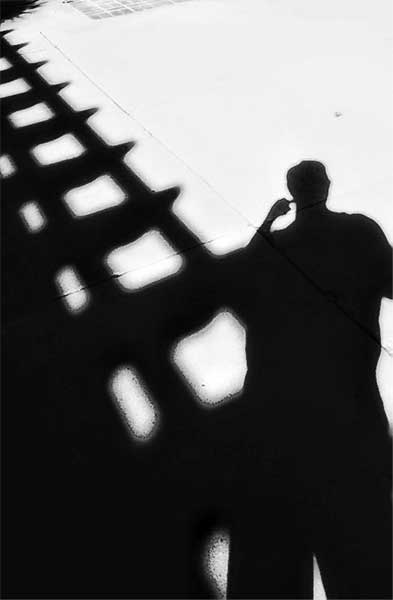
Suddenly all our costumes
are in the wash,
which means we
stand here
in our dirty underwear
holding the Sunday funnies
just below the stomach line,
a situation that makes
it impossible to
make a speech
or lecture the house plants
on how tall they should grow,
crooning baby talk to a cat
that will ignore you
or sit on your keyboard
because what you're writing
is jive anyway,
none of us
will open a toolbox
and remove the pliers,
without costumes
our cars
will not roar
with the attitude
Detroit promised
as we sped up the interstate ,
our language feels corrupted,
false, hollowed of verve,
I want my costume now
though it reeks,
we wear our costumes
as long as
we can get away
with it,
our armor
achieves a genuine scent of grease
and soapless months,
our costumes
and our postures
start to stink so bad
that fire alarms
go off in apartment buildings
across the street,
traffic lights shut down
at critical intersections,
diners lose
their appetites
in cabins in
distant mountain towns,
but yes,
clean clothes, clean slate,
a fresh aroma of detergent
and warmth comes off
the fabrics,
everything fits like a
tailored pair of gloves,
nattily dressed,
elegantly coifed,
perfumed
and flexing biceps
for no one
in particular,
we stop feeling
ridiculous
and plan our
patrol of the city
we call our own,
but first,
this fellow
will take a nap
when the last
pair of pants are hung
and the clock reads
2PM on any hour
It happen to be.
.
Ted Burke
.
SPEAKING {Reform UK [ 07-Feb-26 7:12am ]

It's a measure of my limitations that I can't remember the title (or author) of both the most important fictions I've read since the year started; the two books that have made the deepest impression on me. The novel I've just finished is by qntm (an internet presence) called There Is No Anti Memetics Division, and the other was recommended by Mick Herron, who writes the Slough House spy novels, in an interview I believe I read last year.
I bought and began reading this second novel which, among other things, examined the boundaries between human and non-human workers, and stopped because it was derailing thoughts I was pursuing in parallel with these ideas. It was brilliant.
Both books were brilliant. Borrow them or buy them.
In conjunction with these, I began listening to Roger Penrose, the philosopher and his ideas about consciousness and the philosophical thoughts around idealism (which are very different to our regular everyday thoughts about idealism.)
The primacy of consciousness over materialism (is how I understand it) and how this/these might interact with my political interests (which are essentially Marxian.) I believe I understood some of it. Other parts, I skimmed across.
At the same time, Starmer's Labour continued to unravel exponentially and become a corresponding incongruity. Their representatives increasingly reminded me of porridge gone cold. Abandoned. Congealing in a room that no one enters. A room that no one will ever enter.
I had already dismissed them because of their complicity in Gaza, but the ongoing infolding of their collective identities (into this whey grotesquerie) began to feel unearthly, as though their dead and deadening eyes held an external truth, a truth that mattered beyond their blank and venal self-interest. They were become flat abstractions.
I began to feel they (New Labour) were rather less than human, incapable of escaping their designations as exemplifiers of a world in which they had no emotional interest, involvement, or physical agency. They reminded me of both Mick Herron's employees, and qntm's mind cannibals.
Within this mash-up came the Gorton and Denton by-election.
I was born and raised in Hyde, immediately across the River Tame from Denton.
It used to be the second most polluted river in Europe. My family, on my father's side, going back to the early 19th century, were hatters and textile workers, sometimes living and frequently working in Denton. There was a connection. His grandfather, Garibaldi, was driven mad by the mercury used in hatting.
I have engaged, of an evening on discussion sites, with Reform supporters, many of whom are AI generated with no existence beyond an algorithm responding to my arguments and provocations. Many of them have numbers instead of names. Their unexistence isn't hidden.
And somehow, all these strands have come together in this twisted thread of illogic.
To quote directly from qntm's great novel (which gave me nightmares):
'Its malevolent gravity drags humanity and all human ideas into its orbit, warping them beyond recognition. Beneath it, within its context, everything becomes corrupted into the worst version of itself. It takes joy and turns it into vindictive glee; it takes self-reliance and turns it into solipsistic psychosis; it turns love into smothering assault, pride into humiliation, families into traps, safety into paranoia, peace into discontent. It turns people into people who do not see people as people. And civilisations, ultimately, into abominations.'
As spring approaches, if birdsong were battery operated, would it be less beautiful (or even beautiful at all.)
The two books -
There Is No AntiMimetics Division by qntm
The Employees: A Workplace Novel of the 22nd Century by Olga Ravn (although I can find no record of Mick Herron recommending this)
Steven Taylor
.
Immerse Yourself in the Exosphere [ 07-Feb-26 7:11am ]
Theta 7, Orchestra of the Upper Atmosphere (Discus Music)
Immersion, Maggie Nicols, Robert Mitchell, Alya Al Sultani (Discus Music)
Theta 7 is, we're told, to be the last of the albums released by The Orchestra of the Upper Atmosphere. This is a shame, but I guess all projects have a shelf-life and there's nothing worse than bands, TV series, etc., going on past the date on the packet. At the risk of stating the obvious, Theta 7 is the seventh in a series of albums named after the Greek letter theta ('θ'). It got chosen, I'm guessing, because it's also used to describe one kind of brain wave ('theta rhythms') which are associated with relaxation, dreaming and effortless creativity: exactly the kind of rhythms orchestra members need to have pulsing through their heads on their journeys to the edge of space.
Inspired by their love of Sun Ra, Alice Coltrane, Stockhausen and Terry Riley, Sheffield-based sax player and electronic musician Martin Archer and his long-time collaborator, keyboard player Chris Bywater put OOTUA together in 2010. The idea was 'to create a large scale music which would be improvisation-based but would also feature arrangements for massed voices, strings and horns. A process which they … named "Improg".' The result was Theta 1. A core group - initially, a septet - was established which, with minor changes, went on to create the subsequent albums, drawing in other musicians as required (notably, but not on Theta 7, the 30-voice avant-garde choir Juxtavoices). What followed was described by Chris Cutler as music founded in 'a rock-rooted aesthetic, but with acres of space for improvisation, sonic exposition and studio manipulation. Assembled (a lot like Unrest-era Henry Cow) through a process of focused improvisation, extensive editing, customized composition, many overdubs and radical mixing - the results are persuasive and full of musical substance.'
If Theta 7 is your first encounter with OOTUA, it may well leave you with a desire to check out its predecessors. If it does, Sid Smith, writing in Prog Magazine, reckons Theta 4 is a good place to start. Having had a listen myself, I wouldn't argue with him.
As for Theta 7, I'd really recommend taking the option to listen to the album without track breaks (Track 12 on the Bandcamp page), as the tracks really do, for the most part, flow naturally one into the other. I'd save the seperate tracks for if I wanted to listen to a particular part. It begins with a duet for double bass and guzheng which makes striking use of the stereo space and slips effortlessly into a hypnotic groove entitled 'A Blessing in Azure'. A restless violin solo from Yvonna Magda introduces a hymn to the dawn (hearing the way the guzheng is used on this album, its hard not to think of Alice Coltrane's harp). This, in turn, morphs into a celebration of the deep sea: a world of darkness, strange creatures and hydrothermal vents and about as far as you can get on the Earth, physically, from the band's natural habitat of the upper atmosphere. They sound quite at home there, though. This gives rise to a rich groove, striking for its spiky, high speed glissandi. 'Cold Mariana', alluding to the Mariana Trench, is a musical evocation - or so it seems, to me - of the view from a bathysphere window. If we've not realised already, this album - perhaps because it's the last? - sets out to embrace the whole universe. There have been previous forays (one title on Theta 5 references, I suspect, the famous Hubble image of the Pillars of Creation) but what's going on here is far more systematic. We return to the surface, where the moon is rising. What follows is a hymn to Aether, the Primordial Titaness of the sky, no less. OOUTA name-check Stockhausen as an influence and I couldn't help being reminded here of the text of that composer's text-piece, Set Sail For the Sun, in which the performers are asked to gradually transform the music they're making 'until you arrive at complete harmony / and the whole sound turns to gold / to pure, gently shimmering fire.' After this we're plunged into an evocation of black holes, the darkest places imaginable (at least from the outside. On the inside, who knows?). The next track references the space rock Oumuamua, a visitor from another solar system, music that attempts to give shape to something we can only vaguely discern. The penultimate track is a stonking cover of Sun Ra's 'That's How I Feel' - an inspired, optimistic way to bring the OOUTA journey to an end. What follows is another duet, mirroring the first track, this time for Jan Todd's guzheng and violin. (Anyone who finds these duets interesting - and they are - should check out the OOUTA spin-off Private View 185CD (2024), also available on Discus Music, an album Jan Todd and Archer made together, without the rest of the band, although I think OOUTA bassist Terry Todd joins them for one track).
Theta 7 is quite something. Stockhausen and Alice Coltrane would've approved, I hope. Sun Ra would've been bowled over.
Free improv vocalists Maggie Nicols and Alya Al Sultani have worked together quite a lot in recent years. When, in 2024, they were working on their album Free, Free, Nicols brought along a poem by jazz pianist (and poet) Robert Mitchell, to see what they could do with it. The upshot was that they got together with Mitchell himself to make the album Immersion, recently released by Discus Music and described by Al Sultani as 'a sonic interpretation of three of Robert's books of poetry, three poems chosen by each of us'.
There is, a course, something of a tradition of improvising pianists writing poetry - Sun Ra and Cecil Taylor spring to mind. Anyone unfamiliar with Mitchell's writing should check out his poetry audiobook (available on Bandcamp), A Vigil For Justice, A Vigil For Peace. If, like me, you like to know a bit about a poet's work before you hear it used in a piece of music, you'll be interested to know that one of the poems he reads on it, 'You Are My World', also appears on Immersion (as 'My World Is You'). I was wondering how best to explain how his poetry relates to his music and then realised Mitchell had already done a better job than I could in the album notes that go with Immersion: 'As Wayne Shorter says 'Our instrument is our humanity'. Our most human job surely is to keep our antenna clean and functioning, and to keep as many channels open as possible. As a result - we might even receive the coordinates to the most important treasure: living in peace. The daily distractions, and thus the deliberate weakening of our abilities to work together while benefitting from our naturally occurring 'differences' - are some of the most pressing challenges of these times.'
The first track, 'Amongst a Trillion Fears', is all vocal. Mitchell recites the poem with some rhythmic elaboration while Nicols and Al Sultani weave improvisational paths around his words. From hereon in, Mitchell spends most - although not all - of his time on the piano. It soon becomes clear that the words are often hard to follow. It's best not to try. After all, what we're being offered is the essence of poetry rendered as music: to try to follow the poem in each case could be considered a distraction. A lot of the time, only the occasional phrase jumps out ('walk as one', 'full immersion: there is no division', 'we are free'). The style of the music ranges from the bluesy (especially in 'My World Is You' and 'Soul Speak') to the avant-garde. Although what's happening here is obviously on a much smaller scale, I was reminded more than once of the late operas of Michael Tippett and, indeed, the themes of Mitchell's poems and Tippett's libretti are not dissimilar.
Nicols' more natural voice with its wide-ranging vocal effects, Al Sultani's more trained voice and Mitchell's piano make a great trio. As I said, there's everything here from avant-garde pyrotechnics to great bluesy moments, but some of the most spellbinding music they make together (as in 'Inner Sanctum' and 'Where We Are') succeeds because, it manages to be complex without being dense. Do give it a go.
.
Dominic Rivron
LINKS
Theta 7: https://discusmusic.bandcamp.com/album/theta-seven-206cd-2026-2
Immersion: https://discusmusic.bandcamp.com/album/immersion-205cd-2026
Robert Mitchell's poetry - A Vigil For Justice, A Vigil For Peace:
https://robertmitchell.bandcamp.com/album/a-vigil-for-justice-a-vigil-for-peace-poetry-audiobook
.
CONSPIRACY DREAM ONE [ 07-Feb-26 7:09am ]
You smiled
crawled into my bed
syringed the love out of me
left my eyebrows wired to Langley
my heart in a silo aimed at Moscow
you had me crawling across a ledge
of broken glass
away from a dream
back into your arms
while downstairs
Philip K Dick
trilby tilted at 180 degrees
in the doorway
dripped darkness
like a leaking gasoline tank
emptying onto the sidewalk
he was later weeping in the joke shop
as the funny mask scowled back
his wife
the surf blonde
divorced him over the Kiss Me Quick
seaside hat
that had ruined their marriage
I'm trying to deal with the world's madness
fake news
there's lipstick on my collar
it provides co-ordinates for a kiss
the rifle left in the woods
has a garland of crocuses now
daydreams in the boot of a Buick
cockroaches listening
ears against the walls
to every word the mad politician
says
as he buttons up his trousers
tosses cash to the hooker
counting the pills
ripping out the wires
Singing the Body Electric
Philip K Dick steps off the planet
into space
and is gone forever
.
by Malcolm Paul
Tomorrow Never Knows [ 07-Feb-26 7:08am ]Experimentalism and Innovation in The Beatles Studio Practice
Experimentalism forms a central thread running through the recorded work of The Beatles and remains fundamental to understanding their cultural and musical significance. While the group is often celebrated for melodic songwriting and mass appeal, their sustained engagement with unconventional sound, recording technique, and compositional process situates them firmly within a broader history of twentieth century musical experimentation. Working in close collaboration with producer George Martin and Abbey Road engineers, The Beatles repeatedly tested the limits of what popular music could contain, both sonically and conceptually.
Experimental practices within The Beatles recordings were not isolated gestures or occasional stylistic flourishes. Instead, they emerged gradually through a process of accumulation, refinement, and increasing confidence. From the earliest years of their recording career, the band demonstrated a willingness to retain sonic accidents and unconventional sounds when they contributed to the emotional or textural impact of a song. This approach reflects a shift in attitude toward the recording studio, not as a neutral space for documentation, but as an active site of creative intervention.
It is important to recognise that musical experimentalism did not originate with The Beatles. Long before their emergence, artists working on the margins of Western art music had begun dismantling traditional ideas of harmony, timbre, and musical structure. One of the earliest and most influential movements was Italian Futurism, particularly the work of Luigi Russolo, which argued that the industrial environment required a new musical language capable of incorporating mechanical noise, urban sound, and sonic abrasion. Russolo's custom built noise instruments, intonarumori, and performances challenged the assumption that music must be organised around pitch and melody, proposing instead that sound itself could function as compositional material.
This early noise music developed further in other experimental strands. Edgard Varèse explored dense sound masses, percussion, and unconventional timbres, while John Cage destabilised the distinction between music and noise through chance procedures, prepared piano, and environmental sound. Karlheinz Stockhausen expanded these ideas through tape and electronic composition, manipulating spatial placement and nonlinear time. Other early experiments included the noise explorations of Pierre Schaeffer, using recorded environmental sounds and tape splicing, and the electronic manipulations of Daphne Oram with her Oramics system for drawn sound. These experiments provided a rich, albeit largely inaccessible, context for the avant garde ideas that would later influence The Beatles.
By the middle of the twentieth century, these experimental practices were no longer confined to academic or avant garde circles. Galleries, broadcast recordings, and publications made these ideas available to musicians outside traditional classical music institutions. Paul McCartney's growing engagement with contemporary art and experimental composition brought these ideas directly into The Beatles creative environment. His interest in avant garde music was practical and intuitive rather than purely theoretical. He recognised that recording technology could be used playfully, unpredictably, and expressively, rather than simply as a means of capture.
Among the members of The Beatles, McCartney frequently acted as a catalyst for experimentation within the studio. When songs were still loosely formed, he often proposed unconventional solutions that challenged established song structures. These suggestions did not always originate from musical necessity, but from curiosity about what might be possible within the recording process itself. This approach contributed to the significant differences often observed between early demos and final album versions.
The gradual emergence of this experimental sensibility can be traced through recordings predating the band's most overtly experimental work. The use of guitar feedback at the opening of I Feel Fine represents an early instance in which an unintended sound was deliberately retained and foregrounded. Similarly, the dense rhythmic emphasis and production choices on Ticket to Ride subtly disrupt the expected flow of a contemporary pop single. These moments indicate an increasing comfort with destabilising conventional listening expectations.
Revolver represents a decisive stage in this evolution. The album demonstrates a fully developed understanding of the recording studio as an instrument in its own right. Tape manipulation, artificial double tracking, reversed recordings, and unconventional microphone techniques are employed consistently across the album, forming part of its underlying aesthetic logic.
Tomorrow Never Knows exemplifies this approach. Early versions of the song reveal a comparatively direct structure, lacking the dense layering of the final recording. The transformation illustrates the extent to which studio intervention reshaped the composition. The static harmonic framework, relentless rhythmic repetition, and absence of traditional melodic development align the track more closely with drone based and tape music than with standard pop songwriting. The drum performance, recorded with close microphones and heavy compression, produces a forceful and almost mechanical presence that anchors the surrounding sonic activity. Tape loops introduce fragmented vocal and instrumental sounds that resist conventional interpretation, functioning instead as textural elements. The processed vocal further distances the track from familiar pop conventions, reinforcing its hypnotic quality.
Elsewhere on Revolver, experimentation manifests in multiple forms. Eleanor Rigby dispenses entirely with traditional band instrumentation, relying on a string ensemble octet to create a stark, emotionally restrained soundscape. Love You To engages fully with Indian musical structures, including tabla and sitar, moving beyond earlier gestures toward non-Western instrumentation. I'm Only Sleeping employs reversed guitar passages not merely as an effect but as a compositional tool, reinforcing the song's themes of disorientation. Here, experimentalism functions as both texture and narrative.
Following Revolver, Sgt Pepper's Lonely Hearts Club Band represents a further evolution of the band's experimental approach, framed around a loose conceptual premise that allowed for heightened studio creativity. The album integrates orchestral arrangements, tape loops, sound effects, and musique concrete techniques alongside conventional rock instrumentation, establishing a fully realised studio aesthetic. Tracks such as Being for the Benefit of Mr Kite employ tape collage and processed wind instruments to generate a carnival-like atmosphere, while A Day in the Life juxtaposes sparse orchestral dissonance with pop melody to create unprecedented structural contrast. Lucy in the Sky with Diamonds blends Mellotron textures, layered vocals, and unconventional chord progressions, producing a dreamlike soundscape that foregrounds sonic experimentation. Within Sgt Pepper, The Beatles demonstrated that experimentation could serve both expressive and conceptual purposes, bridging avant-garde techniques with accessible popular music.
Following Sgt Pepper, The Beatles (White Album) presents a deliberately eclectic and experimental approach. Unlike the cohesive frameworks of Revolver and Sgt Pepper, the album's diversity reflects both the individual members' creative autonomy and the increasing fragmentation of their collaboration. The album ranges from stripped down acoustic folk to hard rock extremes, avant garde tape collage, and non traditional sound effects. Revolution 9 exemplifies the band's most extreme engagement with tape loops, musique concrete techniques, and non musical sounds, creating a sprawling sonic tapestry that draws on Cage, Schaeffer, and Stockhausen. Helter Skelter demonstrates sheer volume, repetition, and aggressive sonic layering, anticipating developments in heavy and punk music. Happiness Is a Warm Gun, Wild Honey Pie, and Glass Onion experiment with abrupt tempo shifts, overlapping textures, vocal layering, and unconventional structures, while Back in the U.S.S.R incorporates playful production techniques and contrasting timbres. The album represents a continued expansion of the band's experimental vocabulary, pushing boundaries in rhythm, texture, and sonic unpredictability.
Following the white album, Abbey Road demonstrates a sophisticated integration of experimentalism into a more polished and unified production. Abbey Road illustrates a careful combination of classical instrumentation, studio effects, and compositional innovation across a commercial framework. The medley on side two represents a sequence of fragments linked through key relationships, tempo shifts, and harmonic continuity rather than a traditional suite. This approach allowed The Beatles to explore thematic development, musical montage, and tonal contrast within a popular context.
Tracks such as Because illustrate harmonic experimentation, with three layered vocal parts creating a choral texture, while the Moog synthesiser is employed in Maxwells Silver Hammer and I Want You (She's So Heavy) to generate otherworldly timbres and oscillations. Polyrhythms and tape edits are used creatively in Golden Slumbers and Carry That Weight to manipulate perception of time and pacing, while the extended guitar solo in I Want You (She's So Heavy) employs feedback and distortion to produce a sense of sonic excess approaching harsh noise music. The album demonstrates that by this point, The Beatles had fully internalised studio practice as a compositional resource.
Experimentalism on Abbey Road is not limited to instrumentation and effects. The band also experimented with texture and production. The crossfading of medley sections, the overlapping of vocal and orchestral layers, and the subtle use of tape compression and EQ reveal an unprecedented understanding of studio technology as a creative tool. Here, experimentation is both musical and technical, reflecting a cumulative process that began with early noise experiments by Russolo, Varèse, Cage, and others, and matured over successive albums.
Individual band members continued experimental work beyond the collective context. George Harrison's Electronic Sound uses the Moog synthesiser extensively, presenting unstructured sonic textures that mirror electronic and tape experiments in the avant garde. John Lennon explored extended vocal improvisation, noise collage, and minimalist structures, demonstrating that experimentalism extended into post Beatles activity.
In considering The Beatles relationship to experimental music, it becomes evident that their significance lies in mediation and translation. They absorbed techniques developed in avant garde and noise traditions and rendered them accessible within popular forms. Through this process, they expanded the conceptual and practical possibilities of popular music and transformed the recording studio into a space of artistic exploration.
Tomorrow Never Knows occupies a central position within this trajectory. The track crystallises the band's ability to integrate experimental technique with accessible musical form, serving both as a culmination of earlier practices and a foundation for future innovation. Through sustained engagement with noise, non-traditional instrumentation, studio technology, and structural experimentation, The Beatles established a model of creative exploration that continues to inform musicians, producers, and listeners across genres.
by Ade Rowe
.
The Full Moon Crafts Vistas New [ 07-Feb-26 7:07am ]
The snow moon peels off layer after layer
of
the overhanging dense dark, the gloomy visage
of hoary winter.
The silvery beams reveal core of
an infinite arch above a comatose
earth
buried under banks of pale snow;
the bared topaz-blue touched with the white
of the lunar breath
creates a tropical lake with a glowing heart,
up in those empyrean heights; waves faintly
heard by a passing ascetic.
The cumulus clouds massed on the serrated
edges of
the shimmering immensity,
stand forlorn and outcast, driven out there by
the
frigid winds to those liminal thresholds;
dim firs condensed together
as spatial shadows
from
the Fields of Mourning, first
witnessed by Virgil,
the diffused light, this late hour,
illuminates
the crooked trail to a hut on the hill
where tribal songs are echoed by the
pines with grey hairs, as the wolves
close in.
Sunil Sharma
Painting Ernest Lawson
Academic |Writer | Critic | Editor | Freelance Journalist | Reviewer | Literary Interviewer
Editor: Setu: http://www.setumag.com/p/setu-home.html
Website: https://sunilsharmawriter.com/
Twitter:https://twitter.com/drsunilsharma
Instagram:https://www.instagram.com/drsunilsharma/
LinkedIn:http://in.linkedin.com/in/drsharmasunil/
Pinterest: https://in.pinterest.com/
Amazon-author link: https://www.amazon.com/author/sunilsharma

.
Radio [ 07-Feb-26 7:05am ]The Members
RADIO
I listen to the radio, it's better than a stereo
We listen to the radio, radio stereo
Telephone is ringing, but, I can hardly hear
Though the man on the end of the line is speaking loud and clear
Somehow my mind is where, where exactly I don't know
Too busy tuning in the dial, portable radio
I know I'm alive, so you can all go ride a bike
The airwaves don't lie
I listen to the radio, its better than the stereo
We listen to the radio, radio stereo
Oh-oh-oh-oh radio, Oh-oh-oh-oh radio
Oh-oh-oh-oh radio
.
6 Snapshots: The Depths of the NY Winter [ 07-Feb-26 7:04am ]

bart plantenga
From NY Sin Phoney in Face Flat Minor
The Unloaded Camera Snapshots [Paris Scratch & NY Sin Phoney in Face Flat Minor] were launched as an exercise to document the not-quite prose poems, not-quite journal entries "snapshots" of everyday life in Paris with Paris Scratch. & this continued upon my return to NYC. The exercise consisted of every day "taking" a written "snapshot" - 365 of them. I, like other New Yorkers, had become, as Flora Lewis described it, "inured to the ravages around them they scarcely notice anymore." A deadening of our senses &, never mind our idealism, allows us to believe we're outwitting our environment. A.E. Housman noted: "Having drunk a pint of beer at luncheon, I would go out for a walk. As I went along, there would flow into my mind, with sudden & unaccountable emotion, sometimes a line or 2 of verse, sometimes a whole stanza …"
• The Fit of a SweaterI meticulously fold the sweater my mom had knit for me 1 Christmas that I never wore like I'd seen them do in Soho boutiques. I place it on top of a trashcan on a gift box with the idea that it's winter & maybe a homeless man could use it. A week later I see a guy wearing it & it looks pretty good & I think maybe I should tell him that my mom had knit that sweater for me! & that I wanted it back! But how: jump him, bribe him, coerce him, call the cops, embarrass him or simply wrestle it off his torso? I don't know. Maybe just take a picture of him instead. Send it to my mom.
• The Exhausted ParkThe park had gone through more than neglect; it had borne witness to murders & other unpleasantries. It wasn't really a park so much as a piece of land they couldn't figure out how to apportion profitably. Someone had pissed on & then torn down—was it?—the Yogi Berra statue. All the swings were already down for the winter. The seesaws could us a coat of paint. What's with the 4 shopping carts dumped over the ledge there where the walkway just ends like an nihilist's sidewalk design? Do people know the carts cost $175 a piece? Do people really ever sit on the 2 crumbling benches here to meditate or figure out how to beat the IRS?
• The City That Finally Fell AsleepThe 1st big snow is always magical. Everyone scurries about with a glee that only snow can bring. Giddy kids go aimless with their tongues catching flakes or rolling big ball torsos to build snowmen. Even the old man smiles & forgets he hasn't eaten for how many days. Even the guy hauling big boxes of food on a dolly has to pause & smile as he pushes through the stuff. Even the first snow-related fender bender couldn't kill the joy & as you walk, you hear the silence as an absence of noise but also as abandonment, quiescent as when the very last car of the guy who closes up the supermarket parking lot leaves at midnight. Everyone moves slower & with a sudden awareness of life all around them, however fleeting. Paralysis brings us back to life. The only beings who venture out into traffic at 10 mph are the cabbies & bus drivers. The city sounds like it has, indeed, finally gone to sleep for a night.
• Poster in the 13th SnowfallThe snowfall is massive, beautiful, but it is by now the 13th snowfall of the season, so all a bit redundant & tiring. The poster taped 4 side by side: INFORMATION WANTED CONCERNING A BIAS ATTACK LAST FRIDAY IN THIS AREA. At approximately 10 PM, several black men were attacked by a gang of white men, some of whom had baseball bats. The incident took place in the vicinity of Prince & Mott Streets. If you have any knowledge of this event or of any of the assailants, please call 212-312-****.
• Side Streets to Beer History
To investigate the mystery of those who line up nightly to get drunk at McSorley's Old Ale House I stand outside & just stare. I want to tell them that to drink there will not buy their way into any history, esteem, status—women were denied entry & it's motto was "Good Ale, Raw Onions & No Ladies" until mid-1970. At least it's better than McDonald's or TGIF or Bud Lite … That "Be Good or Be Gone" is it's new motto, is a sign of progress. But, lining up for 45 minutes of shivering & sleet before you get in the front door is the nature of the hype of the hype. I should work for a local bar, help reroute them to other incredible backstories for a fee …
• Blood of Ink of IceI stood on the rotting docks far west, just beyond the shadows cast by Wall Street. New Jersey's bitter shore about to crash into piers already collapsing into the neglect of all of us like a precarious plate of cheap, cold food left behind by a drunk in a diner. Few realize how many others realize how buildings that keep you out can make some of us so contemptuous that we end up spitting on their walls as we pass by. The cold made the ink in my pen stubborn & invisible. But I rub it between my hands to warm it up so that the ink will begin to flow again. I write about sheets of ice like rafts to float out an adventure on, floating down the Hudson, resembling crying panes of high-rise glass or the windshields of trashed sports cars, tossed from high cliffs (revolution, insurance or spite?), north of the city, outside of the kingdom, this side of Kingston.

Benchmark raises $225M in special funds to double down on Cerebras [ 07-Feb-26 5:23am ]

