

An Irish man with a valid U.S. work permit has been held in ICE detention since September 2025. He has no history of violent crime and no problems with his paperwork. DHS offers no clear explanation for why this man has been confined for months. — Read the rest
The post Valid papers, no crime, indefinite detention: ICE's American promise appeared first on Boing Boing.

Measurable, documented, and ongoing harm is being caused by the UK's anti-trans panic. Years of
hostile policy, medical rollbacks, and political scapegoating are producing a sharp increase in suicides.
As Erin Reed documents, the UK has systematically dismantled gender-affirming care, framed trans youth as a social threat, and replaced evidence-based medicine with political panic. — Read the rest
The post The human cost of the UK's anti-trans turn appeared first on Boing Boing.

Florida's top culture warriors, Ron DeSantis, his wife Casey, and the anti-vax Surgeon General
Joseph Ladapo held a press conference to announce that glyphosate, the active ingredient in Roundup, the household herbicidal equivalent of Agent Orange, is found in many supermarket-sold breads. — Read the rest
The post Florida says it found Roundup's active ingredient in widely sold breads appeared first on Boing Boing.

Cannabis users' brains look younger than their age would predict, according to a brain imaging study of more than 25,000 UK Biobank participants aged 44 to 81. The connectivity patterns associated with cannabis use were the near-opposite of those associated with normal aging — and cannabis users outperformed non-users on six out of nine cognitive tests, including memory, reasoning, and executive function, according to a preprint by researchers at Georgia Tech, Emory, and the University of Colorado. — Read the rest
The post Cannabis users' brains look younger, big study finds appeared first on Boing Boing.

The National Park Service has launched a "Special Resource Study" that puts a long stretch of Los Angeles County coastline in the federal crosshairs. From Will Rogers State Beach down to Torrance, with additional areas mapped inland, the Feds want to run the show. — Read the rest
The post The National Park Service sets its sights on California's busiest beaches appeared first on Boing Boing.

'Reduce, re-use, recycle' is a green slogan. It's often called the three R's of that worldview, echoing the traditional three R's of education (reading, [w]riting and [a]rithmetic). Much rhetorical power is ascribed to lists of three. The green imagination has difficulty limiting its R's to such a small number. Additional R's have come to abound: last time I looked, their number was confidently listed as ten. And one of those was 'repair'.
East Anglia Bylines has more than once written about repair cafés. Kate Moore last month praised Mark Stuckey's theatre event arising from TV's The Repair Shop. And Greg Walsh told us in the spring of 2023 how repair cafés were "a community response to a crisis."
An efficient system Repairer Ian with keyboard
Cambridgeshire is served by around forty repair cafés, all supported by Cambridge Carbon Footprint. The village of Burwell has one that started in the wake of lockdown. It runs around two or three half-day sessions a year, typically with 40 to 45 repair jobs, handled by eight or nine repairers. Users booking in at the repair café website are given a time slot. That allows the repairers to look at the task and decide whether any spare parts are needed or if they need a circuit diagram to work from.
The repairs themselves are done free of charge, but donations are always welcome. Clients are asked to supply spare parts, if these turn out to be needed.
And, as not everyone wants to book online or plan ahead, there's space for you if you want to turn up with a repair job that hasn't been planned.
Clare and I have used repair cafés for a few years now. We booked an electric piano in for repair at Burwell. It had lit up when switched on but delivered no sound. Repairer Ian's solution turned out to be embarrassingly simple - the batteries were running down faster than I'd expected. I set about turning the repair café experience to account for East Anglia Bylines.
 Lee, Gerri and Pat welcome new arrivals. Picture by Clare Sansom; used with permission
The success rate is high
Lee, Gerri and Pat welcome new arrivals. Picture by Clare Sansom; used with permission
The success rate is high
Repairer Lee explained that each customer completes a questionnaire, and the responses are very favourable. "They appreciate the service, and even if they don't get their item repaired, they appreciate the effort that's been made to keep it out of landfill."
Drop-ins, if they're lucky, will be seen on the day. "Sometimes," Lee told me, "we're just overwhelmed with bookings or with repairs that overrun a little bit, and then they might be unlucky, but the consolation is that while they're waiting, they can come into the café and buy the excellent cakes and sausage rolls and a cup of tea or coffee to while away the time. The vast majority of drop-ins do get seen." Repairers are happy to stay late. Normally they close at five, but often, there will still have people there after 5:30, finishing up jobs.
What was the oddest thing they'd had?"Two repair cafés ago," said Lee, "we had an inflatable dinghy, which was blown up in the hall here, took up a fair bit of room, and a suitable repair patch was applied and job done. Today's things being repaired weren't odd, but it's an interesting collection. There was a saucepan, an electronic keyboard, an iron, a vacuum cleaner, a toaster, a Hi-Fi system and another toaster. We get a lot of those."
The point of repair cafés is green. Their work keeps things out of landfill, and ensures that best use is made of the carbon emissions that went into making the things in the first place. I asked Lee what advice he had for people wanting to help in a repair café.
"Try your local one. They may be able to use your services. Or contact Cambridge Carbon Footprint. They'll make a note of your name and perhaps let other repair cafés know that you're available to assist. Repairers are the scarcest resource. The commonest category of broken items that come in that are electronics and electrical. But if your skills are more mechanical, be it glueing, sewing or just generally putting back together things that malfunction, then those skills are definitely required as well!"
Perhaps an East Anglia Bylines reader will be the next person to embarrass this contributor over a battery fail…
More from East Anglia Bylines
 Culture
The Repair Shop - Behind the scenes, secrets and stories
byKate Moore 29 January 2026
Culture
The Repair Shop - Behind the scenes, secrets and stories
byKate Moore 29 January 2026
 Activism
Repair Cafés - a community response to a crisis
byGreg Walsh 20 March 2023
Activism
Repair Cafés - a community response to a crisis
byGreg Walsh 20 March 2023
 Activism
A perfect circle: a recycling revolution in West Suffolk
byJanne Jarvis 22 April 2025
Activism
A perfect circle: a recycling revolution in West Suffolk
byJanne Jarvis 22 April 2025
 Activism
Cleaning up Britain
byJenny Rhodes 13 March 2024
Activism
Cleaning up Britain
byJenny Rhodes 13 March 2024

We are registered with easyfundraising! 8,000 brands will donate to us for free every time you use it.
It's super quick and easy to SIGN UP, and will never cost you anything whatsoever. It's FREE for you and HUGE for us!
The post A patched inflatable dinghy in the town hall first appeared on East Anglia Bylines.

Someone decided to have fun spinning their truck out on an icy lake and recording it for the social medias. Naturally, the truck fell through the ice, but the driver didn't bother to notify local 'authorities,' and instead just left it there. — Read the rest
The post Gentleman puts search and rescue workers at risk for no reason appeared first on Boing Boing.

Ghislaine Maxwell appeared virtually from a Texas prison today for her closed-door deposition with the House Oversight Committee. She declined to answer questions, invoking her Fifth Amendment right against self-incrimination, reports Politico.
Then came the ask. Maxwell's attorney reiterated that she would testify fully — if President Trump grants her clemency. — Read the rest
The post Maxwell pleads the Fifth at Epstein deposition, then her lawyer asks Trump for clemency appeared first on Boing Boing.

Real estate mogul Andrew Farkas (net worth estimated at around $2.34 billion) exchanged nearly 2,000 emails with Jeffrey Epstein over more than a decade. He called Epstein "one of the blessings" in his life and "one of the bravest men I've ever known." — Read the rest
The post Billionaire called Epstein "one of the blessings in my life" in newly released emails appeared first on Boing Boing.

TL;DR: Keep tabs on your most important belongings with the MagTag Ultra Slim Tracker Card, now just $23.99.
While AirTags are handy, they're not great for tiny spaces. If you're looking for an equally convenient option that's also compatible with Apple Find My App, meet the MagTag Ultra Slim Tracker. — Read the rest
The post Ditch bulky AirTags for this sleek wallet-friendly tracker, now 60% off appeared first on Boing Boing.
 Furniture cut-outs for visualizing
Lay-It-Out
Last time I moved I threw out my back repositioning Grandma's china cabinet for the 10th time. My latest (and hopefully last) moving experience was a dream because of the Lay-It-Out furniture templates. These unique life-sized paper furniture templates are the shape of your bed, sofa, tables, chairs, rugs, billiard table. After trimming them to the appropriate size (measurements are in inches and centimeters), we placed them on the floor and — as I was directed to the appropriate location — continued moving them around with no effort. I had the whole house planned out before the moving truck arrived and it cost less than the physical therapy and pain killers I had to use before. They are a breeze to use. Measure, trim, position, then reposition and reposition and reposition again… You could buy a roll of something like cheap brown crate paper of course, but I liked that Lay-it-out was ready to go, sizes already measured, and in pretty colors. You can buy a "Total Home Package" or purchase smaller packages specific to the Living Room, Dining Room, Bedroom, Game room, Accessory Tables or Rugs packages. I purchased the whole house package and used most of the pieces, except the billiard table, which I kept pinned to the wall for two weeks as a piece of pop art. — Rick Sievering
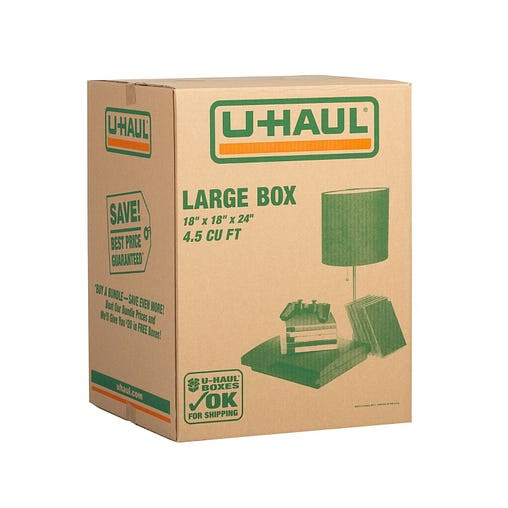 Recycled moving boxes
I have mixed feelings about U-Haul and their prices, but one thing they have done that is priceless is create and maintain a surprisingly helpful Box Exchange forum. It's a standard web forum divided into geographical areas so people can request free used boxes or make theirs available for free or cheap. We just saved ourselves $250. After responding to two posts, we had something lined up in no time. We drove into the city (Manhattan) the next day from where we live in Jersey City and picked up a bunch of boxes in various sizes that were practically brand new — all for free. I basically ignored the "buy" forum as the "free" one was successful in under 24 hrs. We first tried Craigslist, but found that most people in our area at the time wanted money for boxes. From our experience, people on the U-Haul forum seemed willing to go a little out of their way to get rid of their boxes. Most of the posts are definitely from individuals, but interestingly, there were a couple of business disposing of boxes (we got ours from an electronics importer in Chinatown). We have not yet completed our big move to Wisconsin, but will be giving away our boxes the same way when we do. — Guil Barros
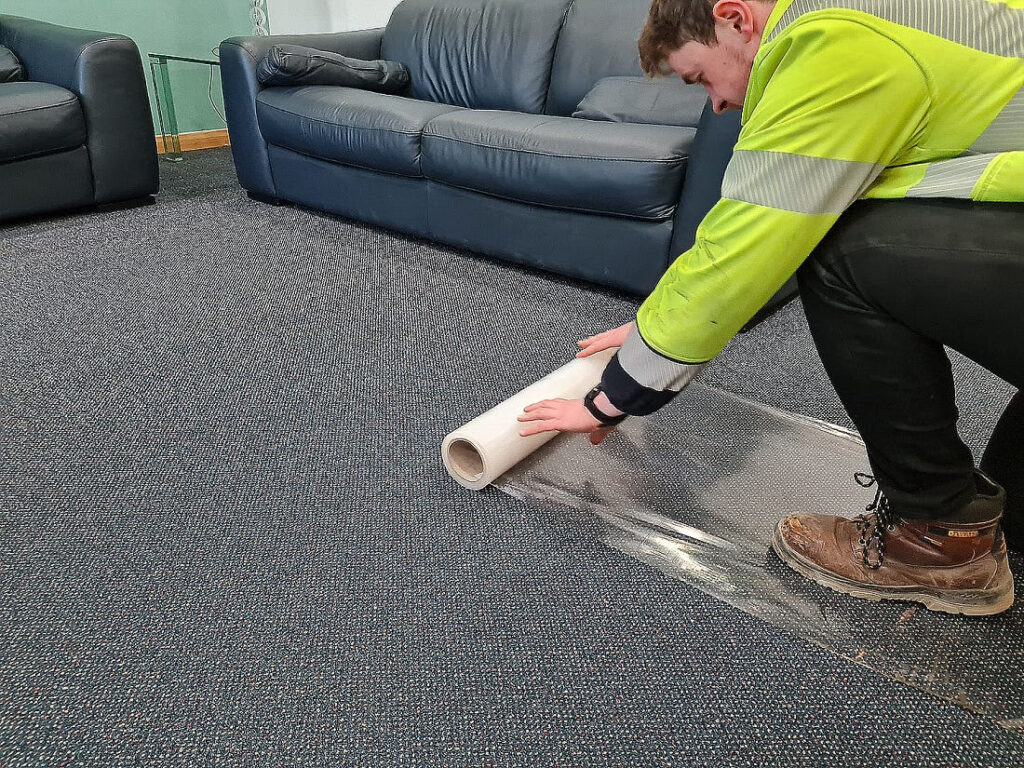 Keeps your carpet clean
Ever wanted to have friends over for a party at your house? Ever wanted to have a LOT of friends over for a party? Worried about spilled drinks staining your carpet? One solution is to cover it before the party with carpet film.
What is it? Picture a roll of Saran Wrap. Now imagine it thicker and more durable. Now imagine one side sticky. Voila! Carpet film.
I don't cover every carpet, just the most highly trafficked areas where people will be drinking and spilling: outside the bathroom where there's usually a line, up the stairs, by the entrance, in the coat room, and in the people-watching areas.
When the party's over, it pulls up easily. Best of all, all of the traffic on the carpet film will have pushed the adhesive side down into the carpet's nooks and crannies. When you pull the film, dirt will come out too. Free carpet cleaning!
Several companies make carpet film. You can get it at Home Depot, Lowes and Amazon for $10-20 per 2'x50′ roll. Wider widths and longer length rolls are also available. Make sure to buy it reverse wound (with the sticky side on the outside of the roll) to make the application process easier. — Joshua Keroes
 Clearest box labeling
Two things smoothed out my family's move a few years ago: designating Open First boxes for each room in our new home, so that on the first night after the move we wouldn't be missing any essentials; and this Smart Move Tape.
The clearly marked and color-coded designations (Office, Bedroom, Bedroom #2, Kitchen, Storage, etc.) made unloading go quickly for our movers, and organizing our many cardboard moving boxes much easier for us later on. No doubt we could have accomplished something similar with a handful of colored Sharpies, but it would have taken a lot of consistently careful writing to even approach the same effect — at a time when we were looking to make less work, not more — and the colored tapes really help make sorting a breeze. —Elon Schoenholz
 Relocation advice
Moving Tips
Since I seem to move house every six months or so, I have ample opportunities to test new strategies. This time around I experimented by putting plastic storage totes through FedEx Ground, and for the items I moved myself I used cardboard boxes with the addition of nonadhesive strapping tape and tubular handles. Much quicker and easier, less effort, no breakages, big success. — Charles Platt
Plastic Totes via FedEx
Wal-Mart sells them for storing items such as bedding and clothes in the home, but their semi-rigid construction makes them ideal for moving fragile possessions such as dishes and stereo components. They are stackable, waterproof, easy to pick up (recessed handle at each end), reusable (can be nested during storage), and will pass unscathed through FedEx ground. Best of all they barely cost more than cardboard boxes! My local FedEx-Kinko's was skeptical about accepting them for fear that the lids would pop off during transport. I allayed their fears by putting 2-inch tape around the perimeter of the lid and folding it under the rim. I had to make little notches in the tape so that it would seal properly either side of plastic strengthening ribs under the rim, but this was still much easier, quicker, and safer than using cardboard. Wal-Mart sells gray Sterilite brand totes (the type I prefer) through its stores, but not online. Models 1830 and 1835 are the ones I have tested through FedEx without any problems. You can pay a little more and get "latch totes" (models 1940 and 1945 with a flip-up latch at each end) but since you'll still need to add tape, I feel the latches are unnecessary. (NOTE: One reader pointed out that plastic totes may buckle if they are stored in a very hot place with heavy objects on top of them. I haven't encountered this problem myself, but I do follow the standard practice of filling each container to minimize empty space inside it)
Strapping Tape
If you still want to use cardboard boxes for items you move yourself, or if you are moving stacks of books secured with cling wrap (as I have suggested previously), consider adding half-inch nonadhesive plastic strapping tape. This is the stuff you sometimes see wrapped around boxes containing big items such as refrigerators being transported as freight. Often it's yellow in color. Shipping departments have a tensioner that they use to pull the tape tight, but you don't need that. You can get 3000 feet of half-inch strapping and a lot of little buckles, with a manual tensioner, for ~$45. You thread the tape through the buckle, pull up on it while bearing down on the box, and you have it as tight as you need it. You trim the tape near the buckle. The advantages are that it greatly strengthens the box while giving you something to grab it by, especially if you augment it with a handle (described below). Also you can link two or three boxes together so that you can carry them easily with one hand, especially up and down stairs. Much more efficient and secure than cradling boxes in your arms, less hazardous (you can see your feet and obstacles in your path), and less risk of back injury, since you don't have to stoop to pick them up. Note that FedEx and UPS don't like string or strapping that can snag their package processing machinery, so strapping is for transporting packages yourself or with assistance from movers.
DIY Box Handles
Make handles from half-inch plastic water pipe sawn into 5″ lengths. My local Lowe's sold me six feet of pipe for around $3 and you can use any wood saw to cut it. You may feel this is a luxury, but if you want to protect your hands from the edges of the plastic tape, handles are nice to have.

Once a week we'll send out a page from Cool Tools: A Catalog of Possibilities. The tools might be outdated or obsolete, and the links to them may or may not work. We present these vintage recommendations as is because the possibilities they inspire are new. Sign up here to get Tools for Possibilities a week early in your inbox.
PSA: Valentine's Day is officially one week away. If your Valentine is a drinks enthusiast, last-minute gifting can be fairly easy; just head to your local liquor store and look for these bartender-approved, top-shelf picks. But if you want to grab something extra special, now is the time to order it. Here are my best ideas for your partner (or yourself—I wholly endorse picking up a little treat).
This is an excerpt from the Punch newsletter. Subscribe to get weekly tips like this in your inbox.
Jon Bonné's mini collection of books about French wine right now is comprehensive, an excellent resource and a stunning addition to your shelf. Spirits of Latin America and The Way of the Cocktail, about Japanese drinking traditions, are great, too.
In the new era of the wine decanter, it's less about fussiness and more about actual functionality. Personally, I think using a decanter, and some dedicated matching glassware, is also an invitation to take a beat and indulge in a ritual. Broc's decanter and glass set is beautiful and strikes a nice balance between dainty and casual. Relatedly: On Eater, Francky Knapp has extolled the virtues of the bedside water carafe. If you relate to the memes about boyfriends filling water bottles, perhaps it's the gift for you.
Matchbox Distilling is a cool, genre-bending line of spirits from Long Island. Its offerings are particularly suited to Valentine's, I think, because they get so specific (bier mash amaro, banana and saffron rum!); you can really tailor the bottle to your recipient (to be loved is to be known, etc. etc.). Also, the names are poetic. This is not simply triple sec; it's No Where Sun Kissed & Stargazed. Sounds romantic to me!
An antique goblet duo that, put together, forms a heart. Very '80s retro wedding coupes. A Cartier vermouth dropper modeled after a watering can (and a cheaper alternative if you don't have hundreds of dollars to spend on, essentially, a toy). A set of vintage lace coasters, perhaps monogrammed with your partner's initial. A cat jigger (because maybe you and your Valentine have a cat?). Cocktail picks that double as a mini bar set (I don't have a Valentine's angle here, this is just really adorable to me).
I'd bookmark these handy recs so you can always find something for the Martini lovers, Negroni devotees and Daiquiri drinkers in your life.

Albert Bartlett was born in Shanghai in 1923, worked on the Manhattan Project at Los Alamos, got his PhD from Harvard, and spent his career as a physics professor at the University of Colorado. But he's best known for one lecture he gave 1,742 times over 36 years — roughly once every 8.5 days — before his death in 2013 at age 90. — Read the rest
The post The bacteria-in-a-bottle thought experiment that explains why we're bad at seeing disaster coming appeared first on Boing Boing.

The State Department is removing all posts from its X accounts made before January 20, 2025 — and that includes posts from Trump's own first term.
The posts will be internally archived but no longer publicly visible. If you want to see them, you'll need to file a Freedom of Information Act request, NPR reports. — Read the rest
The post State Department is deleting all X posts from before Trump's return — even from Trump's first term appeared first on Boing Boing.

A fascinating article in the New York Times details a major cultural shift for readers -- mass market paperbacks are going away. Of course, the Illuminatus! trilogy originally was published as a trio of mass market paperbacks.
I used to buy many mass market paperbacks. I still have my original paperbacks of Illuminatus! But nowadays, when I buy a cheap book, it's an ebook. I have hundreds of books on my Kindle, most of them purchased on sale for a couple of bucks or so. Mass market paperbacks used to be the easiest way to be able to read anywhere. But because I have a smartphone, and a Kindle app on my phone, I have a big library I carry everywhere I go.
Or both Monday and Tuesday?
If Saturday and Sunday are the weekend, why not call Monday the Weekstart?
The good folks at Orico have sent me their latest power-strip to review. On the surface, the specs are pretty good - two UK sockets, two USB-C for PowerDelivery, and two USB-A for legacy devices.

Let's put it though its paces!
SpecsPhysically, it is a little larger than I was expecting. The two UK sockets are far enough apart to easily get your fingers around the plugs. Similarly, the USB ports are well-spaced. There's a tiny LED to show that power is connected, but it isn't offensively bright.
The UK plug is tiny:

Even better, it comes with a proper fuse! The power cord isn't removable, but is long enough for most purposes.
How much power can it supply? This is what the spec sheet says:
V A W
USB-A 5 3 15
USB-A 9 2.22 20
USB-A 12 1.67 15
USB-C 5 3 15
USB-C 9 2.77 25
USB-C 12 2.08 25
But there is a fly in the ointment. While 25W is the most that a single USB-C port can output, the power drops once multiple devices are connected. If you have two or more plugged in, the total output is limited to a mere 15W. Not per-port; total!
25W is already fairly low by PowerDelivery standards, so you won't be using this to power your gaming laptop while charging your tablet and headphones.
Real World Testing
I used my Plugable USB-C Power Meter with some high-quality USB cables. The Orico mostly lives up to its promises.
When charging my laptop from either USB-C port, I was able to measure 22W (12V ⎓ 1.85A). Pretty close to the spec.
As soon as I plugged my phone into the other USB-C port, that dropped that down to just under 8W (4.8 ⎓ 1.65A) per port. Again, right on the promised 15W total.
The USB-A port happily delivered 7.5W (5V ⎓ 1.5A) - much lower than expected. That dropped to around 5W (5V ⎓ 1A) once a USC-C load was connected. The C port was only delivering ~10W which wasn't enough to meaningfully charge the laptop.
Final ThoughtsThe flat plug is handy for plugging this in to those hard-to-reach spaces. The cable is long enough for most uses. The mixture of ports isn't for everyone, but handy if you still have legacy devices you need to power.
It meets the promised specification - but the specs are a bit of a let-down. You can get smaller devices which will do 60W charging from USB-C, and they'll spread that out over all their ports.
The two UK sockets are a nice-to-have, but I can't help feeling that they'll mostly be used for adding additional chargers.
It is cheap-ish - US$30 / £20 - and comes in a range of colours. If you need a long cable and don't need ultra-fast charging, this will do.

Welcome to the latest Best of Bylines newsletter. This time, we bring you a powerful response to Prime Minister Kier Starmer's claim that the UK "will not look away" when women and girls are trafficked and abused by powerful men. He was talking about Jeffrey Epstein, following revelations about his ongoing relationship with Lord Mandelson. Yet, for several months, Bylines Network publications have carried stories from survivors of another powerful man - one based in the UK and whose victims are still seeking justice 30 years after the scandal of his abuses first became public.
Mohammed Al Fayed presided over the abuse of more than 400 women and girls whilst running his Harrods empire. Survivors have been bravely telling their stories and explaining why they feel the justice system has failed them, in Bylines Cymru, Central Bylines, Sussex Bylines and Yorkshire Bylines. MPs have championed their cause and on Friday, we published Isbella's immediate reply to the Prime Minister's statement that his government would "not shrug our shoulders" in the face of such atrocities:
Today, we bring you a response from another survivor - Shanta Sundarson, who reveals why she believes requests for a statutory inquiry into the allegations linked to Harrods, the late Mohammed Al Fayed, and associated institutions, have been deflected. It's a powerful article that raises far-reaching questions about this case and the commitment of the government to take action in support of abuse and trafficking survivors.
You can read Shanta's words or watch her video below, recorded the day after Kier Starmer's speech. Bylines Network is here to champion the voices of unheard citizens - if you think this story matters as much as we do, please share it and subscribe to receive the stories that matter directly to your inbox.
 By Kirsty O'Connor / No 10 Downing Street - Prime Minister Sir Keir Starmer arrives at Number 10 Downing St, OGL 3, Link
By Shanta Sundarson.
On 27 May 2025, I wrote to the prime minister, Keir Starmer MP, requesting the establishment of a statutory public inquiry under the Inquiries Act 2005 into allegations linked to Harrods, the late Mohamed Al Fayed, and associated institutions. An inquiry into systemic abuse, institutional failure, and state response failures. In other words, the failures that allow exploitation to persist not because of ignorance, but because power, proximity, and reputation are treated as a shield.
It was not a rhetorical appeal. It was not an attempt to weaponise public outrage. It was a formal request to invoke a legal mechanism designed specifically for moments when public confidence has been compromised and when systemic failures demand scrutiny.
What followed has not been a decision, but a deflection.
And the longer the government avoids providing a clear answer, the more serious the question becomes: has the prime minister effectively refused a statutory inquiry - and if so, why?
A request for accountability, not political theatre
I contacted Downing Street on behalf of survivors seeking justice and public accountability in relation to detailed and consistent allegations spanning over 30 years, that are increasingly difficult for Britain to ignore.
Hundreds of survivors have now come forward with credible accounts of:
a multi-decade system of organised sexual abuse and exploitation;
intimidation, threats of harm, and retaliation for disclosure;
the use of non-disclosure agreements (NDAs) and institutional pressure to suppress complaints;
failures within Harrods' management to intervene or safeguard;
failures by public bodies to investigate, prosecute, or meaningfully respond.
These allegations are not isolated. They describe patterns. And patterns matter because they point beyond individual perpetrators toward institutional ecosystems that enable harm.
The effective muting of survivors through these mechanisms describes an architecture of control that obstructs justice and prevents others from coming forward.
These are the dynamics that have surfaced in other national scandals. They are the dynamics of institutional abuse.
Trafficking allegations cannot be managed quietlyMy request also referenced deeply troubling reports involving human trafficking, covert surveillance, and intimidation of survivors and whistleblowers.
The allegations include the transportation of employees or prospective employees to and from Harrods or other locations, and recruitment into fabricated roles with proximity to Mohamed Al Fayed and members of his family, for the purpose of sexual exploitation.
Such tactics resemble coercive mechanisms associated with organised criminal networks: a blend of grooming, intimidation, dependency, isolation, and control. If these accounts are even partially true, they raise urgent questions not only about criminal conduct, but about institutional complicity and state failure.
The UK government cannot credibly claim that violence against women and girls is a national emergency while allowing allegations of this scale to be processed as though they are merely an employment dispute or a corporate reputational matter.
A specific and lawful requestThe Inquiries Act 2005 exists precisely because there are circumstances where public accountability cannot be achieved through criminal trials alone.
A statutory inquiry has powers that matter:
to compel witnesses
to require disclosure of documents
to take evidence under formal procedures
to examine institutional and regulatory failures
to establish a public record
The point of such an inquiry is not to replace criminal justice, but to confront systemic breakdown: the failures of organisations, regulators, police, and political decision-makers that allow abuse to persist.
I explicitly requested a survivor-centred inquiry to determine how abuse could allegedly continue within a high-profile British institution over decades, and to examine the actions and omissions of those in positions of responsibility.
The proposed scope included not only internal safeguarding failures at Harrods but potential criminal liability for acts not currently addressed under compensation mechanisms, such as unlawful surveillance, intimidation, harassment, drugging with intent to commit sexual abuse, false imprisonment, and trafficking for sexual exploitation.
I also urged examination of the knowledge, involvement, and potential culpability of Mohamed Al Fayed's estate and close associates, and the conduct of law enforcement and regulatory bodies, including whether there was corruption, misconduct, or wilful failure to act.
I further raised the issue of NDAs - how they may have been used not simply as private settlement tools, but as institutional instruments of suppression.
And I made clear that survivors and advocates were willing to participate in scoping discussions and provide supporting materials, including anonymised testimonies.
This was not a vague appeal. It was a structured request.
The Home Office replied - but did not answerOn 30 June 2025, I received a response from the Home Office Interpersonal Abuse Unit, referencing my letters to the Prime Minister.
The response began with standard acknowledgements of the devastating impact of sexual violence and trafficking, the importance of treating victims with dignity, and the expectation that investigations be thorough.
Then it pivoted to the familiar shield:
"The Government and its Ministers are unable to intervene in, or comment on, the circumstances of individual cases."
But I did not ask ministers to intervene in an individual case. I asked the prime minister to exercise a statutory power to establish an inquiry into systemic failures.
The reply then invoked the operational independence of police and courts, and claimed that inquiries require careful consideration, particularly where there may be ongoing proceedings.
This is neither a refusal nor an acceptance. It is a carefully constructed non-answer: a generic template response. It is not a clear response to a formal statutory inquiry request.
It is policy language in place of accountability.
Strategy has become a substitute for actionThe Home Office letter closed with statements about violence against women and girls being a top government priority and the development of a new cross-government strategy.
For decades, institutions have responded to scandal with new strategies, frameworks, and reviews - while survivors are left navigating hostile legal processes, private compensation schemes, and the quiet erosion of evidence.
Britain does not suffer from a lack of strategies. It suffers from a lack of consequences.
A national strategy cannot compel disclosure. It cannot subpoena documents. It cannot compel testimony. It cannot expose who knew what, when, and what was ignored.
A statutory inquiry can.
If the government genuinely views violence against women and girls as a national emergency, it must demonstrate that commitment not only through future strategy documents but through meaningful examination of historic institutional failures.
Otherwise, the phrase becomes empty: a headline without substance.
Help us give a voice to survivors

We're proud to enable citizens like Shanta to speak truth to power. We are free to publish and share stories like this because we are also proudly independent - no corporate owners or billionaire backers. But it costs us at least £150,000 a year to run our network. We're proud to give a platform to survivors of abuse and injustice. Support journalism by the people, for the people. Become a Friend of Bylines Network. For as little as £3.50 a month, you'll get behind-the-scenes insights, chances to engage with our editorial teams, access to special events, merchandise, and more. Sign up by clicking the button below, or upgrade your Substack subscription.
Become a Friend of Bylines Network
If survivors matter in New York, they matter in London
British political commentary is saturated daily with moral certainty about Jeffrey Epstein and his associates.
In the headlines about Peter Mandelson - whether he should testify, about who knew what and when - politicians speak with justified outrage about a system that enabled a powerful abuser abroad.
Epstein's survivors deserve seriousness, truth, and accountability.
But on British soil, hundreds of women have now come forward with consistent, credible accounts of exploitation linked to Mohamed Al Fayed and facilitated through Harrods, one of the most recognisable institutions in British public life.
Yet there seems to be no urgency, no calls for testimony, no political demand for a full public reckoning for them.
If politicians are sincere about accountability, then it cannot stop at the Atlantic.
If it is a scandal when powerful men exploit women through wealth, access, and institutional protection in New York, then it is also a scandal when it happens in London, operating openly for decades inside a flagship British institution.
If survivors matter in the Epstein case, then they matter here too.
Right now, it is hard to escape the impression that some scandals are treated as politically convenient to condemn, while others - closer to home, implicating British institutions - are quietly encouraged to fade into silence.
Four parliamentary questions that must be put on the recordOne of the most effective ways to force government accountability can be for MPs to table parliamentary questions - forcing the prime minister to place the government's position on the public record. Journalists, too, should be asking these same questions of government. The four questions that the prime minister needs to address are:
Decision Status: Has the prime minister considered a request dated 27 May 2025 for the establishment of a statutory public inquiry under the Inquiries Act 2005 into allegations of sexual abuse, institutional failure and state response failures linked to Harrods and Mohamed Al Fayed? On what date was that request considered?
Criteria Applied: Can the prime minister confirm what criteria were applied in deciding whether to establish a statutory public inquiry under the Inquiries Act 2005 in response to correspondence received on 27 May 2025 concerning allegations linked to Harrods and Mohamed Al Fayed?
Compulsion Powers: Can the prime minister describe what assessment was made of the necessity for statutory powers of compulsion under the Inquiries Act 2005 in relation to allegations of systemic abuse and institutional failure linked to Harrods and Mohamed Al Fayed?
Reasons (if refused): Can the prime minister say, if the Government has decided not to establish a statutory public inquiry under the Inquiries Act 2005 in relation to allegations linked to Harrods and Mohamed Al Fayed, what the legal basis for that decision is?
These questions do not demand political opinion. They demand administrative truth.
They are reasonable, restrained, and unavoidable.
A familiar pattern of delayBritain has seen this pattern repeatedly: Jimmy Savile. Rotherham. Hillsborough. Grenfell and others.
In each case, there were warnings. In each case, institutions denied, deflected, delayed, and minimised until public pressure became impossible to withstand. And in each case, the eventual inquiries exposed not only the original harm but the systemic failures that allowed it to continue.
The Harrods and Al Fayed allegations now sit firmly within that territory.
The question is no longer whether the allegations are 'serious enough'. The scale, duration, and reported methods of coercion and silencing make this an overwhelming matter of public interest.
The government must provide a clear decisionIf the British government is serious about violence against women and girls as a national emergency, then it cannot continue to respond to survivors with generic letters and strategy language. A letter from the Home Office is not a decision from the prime minister.
If the government intends to refuse a statutory inquiry, it must state so plainly, provide reasons, and identify the legal basis.
If it is actively considering the request, it must confirm that fact and provide a timeline.
If it has already considered the request, the public deserves to know when, by whom, and on what basis.
Silence is not neutral. Silence is a tactic.
Survivors know this. Institutions rely on it.
Delay exhausts victims, fragments evidence, and allows public interest to fade. It is one of the oldest tools of institutional self-preservation.
This is not a request for sympathy. It is a request for accountability.
The government must directly answer the question placed before it.
And it must answer it now.


