

Florida man Pascual Santana, 79, was arrested Friday and charged with armed assault after threatening a Walmart worker with a gun from the seat of his mobility scooter. Miami-Dade County Sheriff's Department told media that Santana had called the woman "derogatory names" aggressively before revealing the handgun and asking "are you scared now?" — Read the rest
The post Florida man pulls gun on Walmart worker: "Are you scared now?" appeared first on Boing Boing.
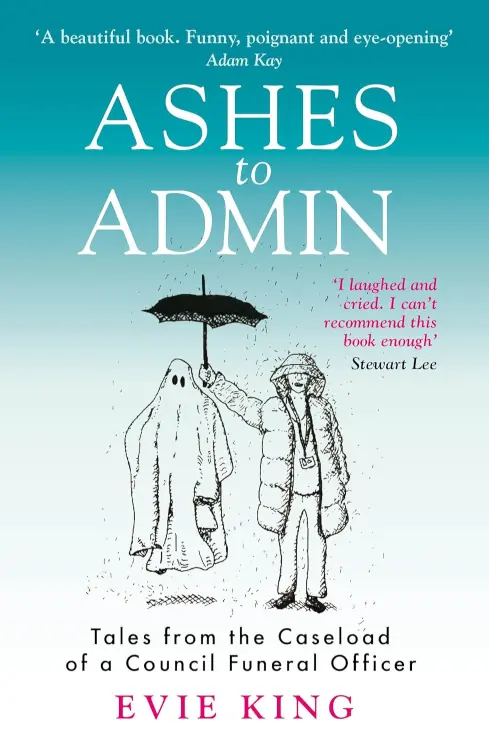
Why am I reading so much about death lately? This is a wryly funny and cosily charming book about council funerals.
Evie King conducts Section 46 funerals under the Public Health Act. If you die and there's no one else around who is able to arrange your funeral, the local council steps in. This could be a coldly bureaucratic process with no wiggle room for anything other than perfunctory sympathy. But humans are going to human. Why wouldn't you put some effort in to making people feel cherished in death?
In many ways, this is what Cameron's "Big Society" should have been about. Giving empathetic and passionate people a chance to serve their community and enrich all our lives. And, I guess, deaths. But austerity makes it hard to stay motivated when you're doing multiple people's jobs for a fraction of the pay.
This isn't to say King is a whinger - quite the opposite - but she is clearly frustrated that she cannot do more. People who interact with the state are rarely in a good emotional or financial place. Those interacting with Section 46 deserve more support than is available to them. What King does is marvellous - but necessarily limited. In effect, it is a series of short stories each taking a look at a different death and how she tried as hard as possible to make the funeral process as painless and uplifting as it can be.
The book is, naturally, a little upsetting in places. It isn't so much that people die; it is how society reacts which causes such emotional turmoil. Why are people sometimes abandoned? Why do reconciliations never happen until it is too late? How do we deal with trauma?
It is an excellent book but it is rather annoying that the publisher, Mirror Books only makes the eBook available via Amazon. There's no other way to read it - not even via a library! I resorted to borrowing the audiobook. This was the first audiobook I've ever listened to - and it was a rather curious experience. The author's voice was slightly hesitant at first, but gradually became more passionate and evocative. It was wonderful to hear her tell her story directly.
(that's old Southgate by The Green, not the upstart civic centre by the tube station)

1) Village stocks!
Time was when every village had its stocks for punishing local miscreants by chucking stuff at them, indeed a statute in 1351 insisted on it. Such behaviour is now deemed unacceptable and has been since 1872 when stocks were last used in anger in Berkshire, but who's to say they'll never come back into use. Southgate's alas aren't the original because those went missing during WW2 and are instead a Coronation gift in 1953, themselves heavily restored in 2002 because the oak had rotted heavily. Other London locations with stocks include Havering-atte-Bower, Ickenham and anywhere else someone might know about.
2) A nice fingerpost!
Everyone loves a good fingerpost and Southgate Green has an excellent one. It marks the junction of the A1003 and the A1004, two distinctly minor A roads, and dates from an era when quarter miles were still a significant distance measurement. One finger points towards New Southgate which is very much not old Southgate like what this is. From my wanderings I'd say there are far more nice fingerposts in north London than south, notably in the boroughs of Enfield and Barnet, and I wonder if future generations with satnavs will one day wonder why we ever needed to know where towns are.

3) Blue Plaques!
Rarely have I been more disappointed by a blue plaque than the inscription on the cottage at 40 The Green. As I got closer I saw it read 'In 1881 this house became the first seat of local government in Southgate', and sorry but the separation of Southgate from the Edmonton Board of Health is not an exciting heritage fact. Of more interest is the plaque down the road marking the house where Benjamin Waugh lived in 1884 when he founded the NSPCC. Admittedly Waugh was honorary director under Lord Shaftesbury as Chairman, and admittedly the NSPCC was founded at Mansion House rather than here, and admittedly Waugh's house has been demolished and replaced by a bank which is now a nursery, but it's still more interesting than the blue plaque at number 40.
4) A Very Old Pub!
The Cherry Tree has had the plum spot opposite The Green for over 300 years. The former coaching inn now has Victorian brick frontage and a Mock Tudor porch but at its heart is a much earlier timber-framed building. If you ever need a dull fact about Southgate, be aware that the Loyal Adelaide Lodge of Manchester Unity of Oddfellows held their meetings here for over 100 years. Until last year it was a proper pub but then Mitchells & Butlers turned it into a generic brasserie called Brown's, not Ye Olde Cherry Tree, and local drinkers were nonplussed. A Telegraph journalist even published an article subtitled "The 17th-century inn has lost all of its character, with no chance of a decent cask ale or even an interesting bottle", and if nothing else a grey hard-to-read inn sign has since been added bearing the proper name.

5) That postwar typeface
You see a lot of that nice 1950s typeface around Southgate Green, the slanting serif much used on postwar buildings, for example on this block of flats and on this sign referencing H Miller & Sons, longstanding Plumbers and Decorators. But what precisely is it called? I went down a font-based wormhole and it turns out there are lots of very similar styles including Stymie Bold Italic, Clarendon Bold Italic, Profil, Egyptian Italic and Festival Egyptian (an official style of the Festival of Britain). But I'm not sure any of these perfectly match the As and Os I saw here in Southgate, so maybe I'll just go on calling it That Nice 1950s Typeface and at least you'll still know what I mean.
6) Dionysus!
Pre-Crossrail if you wanted fried sustenance at the end of a West End night out you stopped by Dionysus, the Greek chippie in the prime corner spot outside Tottenham Court Road station. Many's the hangover quelled by one of their special kebabs or salty bags. But in January 2009, in advance of station redevelopment, they were sadly forced to close. As I blogged at the time, "I watched as staff gutted the interior, then piled sinks and ovens into the back of a hired van and drove off to start anew elsewhere." Well, likely that elsewhere was Southgate because here they are in a smart cafe with the precisely same logo above the door. Given they were "established 1969" this may alternatively be the original Dionysus and TCR was merely a branch, but if you ever fancy a nostalgic takeaway then head straight to N14.
And this time I headed to Southgate (in Enfield).
The Minchenden Oak (800? years old)
Middlesex was once awash with country seats and one of these was Minchenden House, just along the ridge from Arnos Grove. It was built in the 1660s and passed through a succession of gentry before one particular daughter married above herself becoming the Duchess of Chandos. The house had a classical pillared dome, a premier location on The Green and was said to have one window for every week of the year. The estate was sold off in 1853 to the neighbouring brewing tycoon in an attempt to stall the advance of suburban housing, a fate which befell his amalgamated 300 acres in 1928, and today the Arnos Grove estate smothers the slopes above the Pymmes Brook. Minchenden House may have been demolished but locals campaigned to save the enormous medieval oak round the back of the parish church so that's still here, and huge, and tad on the secret side.

To find the Minchenden Oak look for the brick archway down Waterfall Road, inconveniently labelled Minchenden Oak Garden on a small copper plaque. What lies beyond is a small space barely 30m wide with lawn and shrubbery, also paved paths that don't quite go anywhere and on the far side a whopping ancient oak tree. It has a gnarled bulbous trunk like some great cloven leg, and a fairly scraggly top with several thick upright branches that end with an abrupt cut. It's hard to reach a ripe old age with all your bits intact, thus the Minchenden Oak has been fighting a long battle against nature and gravity. Two limbs succumbed to a storm in 1899, others later needed propping up, then in 2013 considerable decay was discovered within the timber and fifteen tonnes of wood had to be lopped off to protect the central trunk. It's hard to square the current tree with the 1873 claim that it had the largest canopy of any tree in England (38m across and 'still growing') but still an impressive sight.

"Its boughs bending to the earth, with almost artificial regularity of form and equidistance from each other, give it the appearance of a gigantic tent; with verdant draperies, drawn up to admit the refreshing breezes that curl the myriads of leaves which form altogether a mass of vegetable beauty and grandeur, scarcely to be equalled by any other production of the same nature in the kingdom. It is a magnificent living canopy, impervious to the day."(Sylva Britannica, 1826)The Minchenden Oak Garden was officially opened on 12th May 1934 in a ceremony involving the local choir and various borough dignitaries, including two hymns and the singing of Psalm 23. The garden screams 1930s with its rustic stone pillars and low decorative walls, as if a magnificent tree wasn't sufficient in itself, and has a small sunken terrace at one end with a broken pedestal in the centre. In a lovely touch the benches around the garden are made from wood removed from the tree in 2013, these replacing a seat that once circled the great trunk because nobody's allowed that close any more. Even the surround of the main information board comes from the old oak, ditto an arty selection of sliced stumps where a small group of children might sit.

The Minchenden Oak is a warning that great old trees don't always survive, and a triumph in that much of it somehow has. But how much better to have seen it at its zenith in the 19th century, long before suburbia turned up, a tree that was already ancient when the first rich man built a house here.



Rope makers of Stepney
In Stepney, there has always been an answer to the question, "How long is a piece of string?" It is as long as the distance between St Dunstan's Church and Commercial Rd, which is the extent of the former Frost Brothers' Rope Factory.
Let me explain how I came upon this arcane piece of knowledge. First I published a series of photographs from a copy of Frost Brothers' Album in the archive of the Bishopsgate Institute produced around 1900, illustrating the process of rope making and yarn spinning. Then, a reader of Spitalfields Life walked into the Institute and donated a series of four group portraits of rope makers at Frost Brothers which I publish here.
I find these pictures even more interesting than the ones I first showed because, while the photos in the Album illustrate the work of the factory, in these newly-revealed photos the subject is the rope makers themselves.
There are two pairs of pictures. Photographed on the same day, the first pair taken - in my estimation - around 1900, show a gang of men looking rather proud of themselves. There is a clear hierarchy among them and, in the first photo, they brandish tankards suggesting some celebratory occasion. The men in bowler hats assume authority and allow themselves more swagger while those in caps withhold their emotions. Yet although all these men are deliberately presenting themselves to the camera, there is relaxed quality and swagger in these pictures which communicates a vivid sense of the personality and presence of the subjects.
The other two photographs show larger groups and I believe were taken as much as a decade earlier. I wonder if the tall man in the bowler hat with a moustache in the centre of the back row in the first of these is the same as the man in the bowler hat in the later photographs? In these earlier photographs, the subjects have been corralled for the camera and many regard us with a weary implacable gaze.
The last of the photographs is the most elaborately staged and detailed. It repays attention for the diverse variety of expressions among its subjects, ranging from blank incomprehension of some to the tenderness of the young couple with the young man's hands upon the young woman's shoulders - a fleeting gesture of tenderness recorded for eternity.
I was so fascinated by these photographs I wanted to go and find the rope works for myself and, on an old map, I discovered the ropery stretching from Commercial Rd to St Dunstan's, but - alas - I could discern nothing on the ground to indicate it was ever there. The Commercial Rd end of the factory is now occupied by the Tower Hamlets Car Pound, while the long extent of the ropery has been replaced by a terrace of house called Lighterman's Court that, in its length and extent, follows the pattern of the earlier building quite closely. At the northern end, there is now a park where the factory reached the road facing St Dunstan's. Yet the terraces of nineteenth century housing in Bromley St and Belgrave St remain on either side and, in Bromley St, the British Prince where the rope makers once quenched their thirsts still stands.
After the disappointment of my quest to find the rope works, I cherish these photographs of the rope makers of Stepney even more as the best record we have of their existence.

Gang of rope makers at Frost Brothers (You can click to enlarge this image)

Rope makers with a bale of fibre and reels of twine (You can click to enlarge this image )

Rope makers including women and boys with coils of rope (You can click to enlarge this image)

Frost Brothers Ropery stretched from Commercial St to St Dunstan's Churchyard in Stepney

In Bromley St
Images courtesy Bishopsgate Institute
You may like to read the original post

Every few years, someone comes up with a new "this is how the pyramids were built" theory. In addition to aliens or long-forgotten super technologies, many theories rely on unfeasible ramps that'd never work. This theory works.
This theory treats the pyramids as an engineering problem and takes the constraints very seriously. — Read the rest
The post How subtraction, not addition, may have been the secret to Egypt's pyramids appeared first on Boing Boing.

In what may be a watershed moment, a Federal judge has determined that Trump's Department of Justice is not to be trusted with sensitive voter information. Not only could this impact multiple cases in multiple states, but it could also lead to the total erosion of the presumption of regularity. — Read the rest
The post Federal judge rules DOJ can't be trusted appeared first on Boing Boing.

TL;DR: Pamper an old PC with this Microsoft Office Professional 2021 for Windows lifetime license, on sale now for just $34.97 through February 22.
Don't count out your dusty ol' PC! You can give it a whole new lease on life with this Microsoft Office Professional 2021 for Windows license. — Read the rest
The post Breathe new life into your PC with this $35 Microsoft Office license appeared first on Boing Boing.

The Department of Homeland Security has switched to a mobile facial recognition system that combines two of the worst qualities a government surveillance tool can have: it tramples privacy and doesn't work, especially when analyzing non-whites.
Under claims of "efficiency," DHS and its subagencies are now using the smartphone app "Mobile Fortify" to identify people in the field. — Read the rest
The post Invasive and ineffective: DHS's facial recognition system appeared first on Boing Boing.

An Irish man with a valid U.S. work permit has been held in ICE detention since September 2025. He has no history of violent crime and no problems with his paperwork. DHS offers no clear explanation for why this man has been confined for months. — Read the rest
The post Valid papers, no crime, indefinite detention: ICE's American promise appeared first on Boing Boing.


