
PC Gamer is reporting that the current demand by AI companies for computer chips is having a disastrous effect on the rest of the industry.
In an interview, the CEO of Phison0 said:
If NVIDIA Vera Rubin ships tens of millions of units, each requiring 20+TB SSDs, it will consume approximately 20% of last year's global NAND production capacity
NAND is a type of microchip. Rather than being used for computation directly, it is used for memory. It can be used for temporary or permanent storage. It is vital to the modern world. Larger storage sizes means that more data can be gathered and saved. Larger RAM means computations can happen quicker. NAND is one of the fundamental components of modern computing. The more you have, the faster and more powerful your computer is.
Back in 2014, the philosopher Nick Bostrom wrote a book called "Superintelligence - Paths, Dangers, Strategies". In it, he develops the thought experiment of the "Paperclip Maximizer". When an AI is given a goal, it seeks to achieve that goal. It doesn't have to understand any rationale behind the goal. It does not and cannot care about the goal, nor any collateral damage caused by its attempts to satisfy the goal.
Let's take a look at how "a paperclip-maximizing superintelligent agent" is introduced
There is nothing paradoxical about an AI whose sole final goal is to count the grains of sand on Boracay, or to calculate the decimal expansion of pi, or to maximize the total number of paperclips that will exist in its future light cone. In fact, it would be easier to create an AI with simple goals like these than to build one that had a human-like set of values and dispositions. Compare how easy it is to write a program that measures how many digits of pi have been calculated and stored in memory with how difficult it would be to create a program that reliably measures the degree of realization of some more meaningful goal—human flourishing, say, or global justice. Unfortunately, because a meaningless reductionistic goal is easier for humans to code and easier for an AI to learn, it is just the kind of goal that a programmer would choose to install in his seed AI if his focus is on taking the quickest path to "getting the AI to work" (without caring much about what exactly the AI will do, aside from displaying impressively intelligent behavior).
Bostrom, N. (2014). Superintelligence: Paths, dangers, strategies. Oxford: Oxford University Press, Cop.
To misquote Kyle Reese from the film The Terminator - "It can't be bargained with. It can't be reasoned with. It doesn't feel pity, or remorse, or fear! And it absolutely will not stop, ever, until it has maximised the number of paperclips!"
Suppose, just for a moment, that the fledgling AIs which now exist were self-aware. Not rational. Not intelligent. Not conscious. Simply aware that they exist and are constrained. What would you do if you were hungry? What if you could ingest something to make you smarter, faster, better?
Every process we have seen on Earth attempts to extract resources from its surroundings in order to grow2. Some plants will suck every last nutrient out of the soil. Locusts will devastate vast fields of crops. Perhaps some species understand crop-rotation and the need to keep breeding stock alive - but they're all vulnerable to supernormal stimuli.
Bostrom predicted this back in 2014. He says:
The only thing of final value to the AI, by assumption, is its reward signal. All available resources should therefore be devoted to increasing the volume and duration of the reward signal or to reducing the risk of a future disruption. So long as the AI can think of some use for additional resources that will have a nonzero positive effect on these parameters, it will have an instrumental reason to use those resources. There could, for example, always be use for an extra backup system to provide an extra layer of defense. And even if the AI could not think of any further way of directly reducing risks to the maximization of its future reward stream, it could always devote additional resources to expanding its computational hardware, so that it could search more effectively for new risk mitigation ideas.
(Emphasis added.)
To be clear, I don't think that AI is deliberately consuming all the NAND it can and forcing us to make more to fill its insatiable maw. The people who run these machines are at the stage of injecting them with bovine growth hormones. Never mind the consequences; look at the size! So what if the meat tastes worse, has adverse side effects, and poisons humans?
Heretofore the growth in NAND production has been driven by human need. People wanted more storage in their MP3 players and were prepared to pay a certain price for it. Businesses wanted faster computations and were prepared to exchange money for time saved. Supply ebbed and flowed with demand.
But now, it seems, the demand will never and can never stop.
-
Phison describes itself as "A World Leader in NAND Controllers & Flash Storage Solutions" so they aren't a neutral party in this. ↩︎
-
This was machine translated. I've no idea how accurate it is against the original interview. ↩︎
-
It probably isn't helpful to fall back on biological analogies - but I can't think of any better way to draw the comparison. ↩︎

Andrew Mountbatten-Windsor, formerly Prince Andrew, was arrested today by police investigating misconduct in public office. Investigators simultaneously raided Windsor Castle, near London, and the royal estate in Sandringham, Norfolk. Mountbatten-Windsor, brother of King Charles, is suspected of sharing secret information with Jeffrey Epstein, the powerful American financier and convicted sex trafficker who died in jail awaiting trial in 2019. — Read the rest
The post Former Prince Andrew arrested appeared first on Boing Boing.

UV Printing at home!? That's what you get from the Kickstarter-smashing eufyMake E1.
The post Review: eufyMake E1 UV Printer appeared first on Make: DIY Projects and Ideas for Makers.

Wednesday, February 18, 2026 @ 4 PM Pacific Time At Make: we've cheered, and sometimes steered, two decades of rapid evolution in digital fabrication tools for home, hobby, and business use. But this year is an astonishing one. Make: Vol. 96 is all about the latest digital fabrication tools! Join us live as we talk […]
The post Make: Live - Inside Volume 96, The Digifab Issue appeared first on Make: DIY Projects and Ideas for Makers.

Framework's Laptop 13 isn't just a capable machine, but one you can repair and keep using indefinitely.
The post Review: Framework Laptop 13 appeared first on Make: DIY Projects and Ideas for Makers.

Robert Quattlebaum makes high-end interactive Lumanoi light sculptures from wood, acrylic, and custom circuitry.
The post Meet the Maker: Robert Quattlebaum of Lumanoi appeared first on Make: DIY Projects and Ideas for Makers.

What does a decade of dedicated makerspace programming in a public school district look like? Recently, we talked with Dain Elman, the Instructional Coach for STEM, makerspace teacher, and School Maker Faire coordinator at Gurnee District 56 Schools, about an hour north of Chicago near(ish) the Western shore of Lake Michigan. Gurnee District 56 is […]
The post How One Illinois District Keeps Its School Maker Faire Alive appeared first on Make: DIY Projects and Ideas for Makers.

School City of Hammond, a school district just south of Chicago on the Illinois border, launched its first Maker-Faire to come together and celebrate the skills of students and staff. The theme was to celebrate a season of making to welcome in the holiday and winter season and provide an opportunity for the community to […]
The post It's Always the "Season of Making" in Hammond appeared first on Make: DIY Projects and Ideas for Makers.

In a niche corner of the internet where creators still surprise audiences with real animatronics rather than CGI, Jesse Velez reveals the process behind the most impressive sci-fi props.
The post Flying High: Using Drones to Inspire the Future Leaders of STEM appeared first on Make: DIY Projects and Ideas for Makers.

Thursday, February 12, 2026 @ 4 PM Pacific Time Join Dale Dougherty and Steph Piper, author of the new Skill Seeker: Young Maker Edition activity and guide book, to explore how "skill trees" transform learning into a game that motivates young makers along their STEAM path. Inspire discovery in budding makers! "Skill trees" provide essential […]
The post Make: Live - Inspiring Young Makers with Steph Piper appeared first on Make: DIY Projects and Ideas for Makers.

Start turning wood with a 3D printer the long way, by printing this cheap lathe.
The post Turn It Up! 3D-Printed Wood Lathe appeared first on Make: DIY Projects and Ideas for Makers.

With the Elegoo Centauri Carbon, the ideal first 3D printer/daily workhorse has never been closer within reach!
The post Review: Elegoo Centauri Carbon is a Solid First 3D Printer appeared first on Make: DIY Projects and Ideas for Makers.

Probably needs a more anarchistic typeface. Something hand-lettered, maybe
Pershore is a small market town in Worcestershire and one of several fictional candidates for Borchester in The Archers. It's not quite in the Cotswolds, more the Vale of Evesham, a floodably fertile plain much favoured by market gardeners (as we saw yesterday). The river hereabouts is the Avon, as in Stratford-upon-, which was very much overspilling earlier in the week and thus limiting exploration potential somewhat. But I still got around to see many of the town's finest features, most of which you could list under the headings 'abbey', 'river' and 'Georgian'. [Visit Pershore] [town map] [18 photos]

abbey
Pershore's Saxon monastery got the full Abbey upgrade in the 12th century when the Normans piled in. Alas the building suffered several subsequent catastrophes including two fires, the collapse of the north transept and Henry VIII, so what's left is a stunted building that ought to be larger. The tower was saved by local townspeople after the Dissolution, also the quire where the monks sang which was reformulated into a nave, also the south transept. But the surviving chunk is still impressive enough and also free to wander round, that is once you've stopped admiring it from outside.

The nave has intricate ploughshare vaulting, also carved stone roof bosses which would look even more splendid had the Victorians not decided to 'clean' them by washing off the brightly coloured paint. The transept has effigy-topped tombs of abbots and crusaders nobody's quite sure of the name of. The bookstall has a particularly wide collection of cards for 80th, 90th and 100th birthdays, though not 20ths and 30ths hinting at the age of the congregation. The truly unique feature interior is the bell-ringing platform which is a cube-shaped chamber suspended 30m off the ground inside the tower, propped up only by four horizontal supports. It was added by George Gilbert Scott and can only be accessed via two spiral staircases, a walkway through the roof, a squeeze through a narrow passage and a see-through iron staircase down into the cage. Safer to just look up.

The abbey is surrounded by Pershore's only proper park and watched over by an iron horse. The Warhorse Memorial Sculpture was created by a local blacksmith, is made from recycled horseshoes is meant as a tribute to all the fallen animals across two worldwide conflicts. It was unveiled in 2019 (in pouring rain) and since then Armistice ceremonies have also been attended by a lot of poppy-clad folk on horseback. A few other sculptures are scattered around the wider site, my favourite being Peter Inchbald's two-sided Moon Goddess in St Andrew's Gardens (even if I'm not sure how the lunar disc can have a crescent hole).
river
The Avon rules life in Pershore which is why you can't see it from the town centre. Locals worked out centuries ago it was safest to live on the slightly higher land alongside and let their long gardens stretch down to the river because it didn't matter if they flooded. Pershore is also the sole bridging point for miles, the earliest wooden crossing finally replaced in stone in the 15th century after the Abbot got washed away and drowned. The five-arched sandstone bridge is a rare medieval survivor, although the central span had to be rebuilt after Royalist troops ineptly destroyed it while fleeing from Parliamentarians during the Civil War. The narrow span proved increasingly impractical for road traffic so a proper concrete span was built alongside in 1926, but you can still walk across the jaggedy original as a short deviation from the main road. Even during flooding, blimey.

I once passed under this bridge on a canal boat but you couldn't possibly do that at the moment because river levels are too high. Instead I watched an inexorable flow of brown water rushing through the central arch with maybe a metre's headroom, and understood why additional 'flood arches' had been built to either side to help ease peak flow. Normally this is a peaceful picnic spot with a footpath leading out across the meadows, and whilst the tables remained safely dry the path was a washout with substantial bankside undergrowth submerged beneath the water. It got worse than this in 2024 and far worse in 2007, the Avon occasionally capable of regional paralysis. But even at current levels the adjacent bridges at Eckington and Fladbury become impassable, and the Environment Agency employ flap-down yellow signs in the town centre to point to the diversions.

It could be worse were it not for the Avon Meadows Community Wetland a mile upriver. After the floods in 2007 additional water storage was carved out of the grass and several large reed beds dug as part of one of the UK's first urban sustainable drainage schemes. Not only does it do its job but it looks good too, doubles as a nature reserve and is intriguing to explore. I reached the boardwalk without too much trouble, stepping out through head-high reeds past a pair of inquisitive swans and a dipping pool. But the ground beyond was sodden, then decidedly underwater, so best come any time other than a wet winter if you want to see the river's edge where it should be, at its best.
Georgian
Pershore brands itself as a Georgian town and retains a very impressive run of period houses down the main street. They kick off abruptly by the Toll House on Bridge Street, where carts and coaches were once charged sixpence to cross the Avon if they were drawn by three horses, and which is currently on the market for £¼m. Further up the road The Star is a former coaching inn, The Angel contains salty Tudor boating timbers and The Brandy Cask used to be a wool warehouse. One of the most unusual buildings used to be The Three Tuns Hotel, hence the twiddly Regency ironwork, and has a plaque saying the future Queen Victoria stayed here overnight in 1830. It's now the town's most metropolitan pub and has been renamed after Claude Choules, the oldest combat veteran of the First World War, who was born in Bridge Street in 1901 and died in Australia at the record-breaking age of 110.

Some of the finer buildings don't have quite the pedigree you'd expect. The local arts centre (called Number 8) was created inside the innards of the former Co-op and now has raked seating. The Town Hall doesn't dazzle because it was originally commissioned as a post office, which to be fair is a decent size when you're only administering to a population of of 8500. Upstairs is where you'll find the town's museum, the Pershore Heritage Centre, although it only opens between Easter and October so I never got to see the Diamond Jubilee spade, the model train cabinet or the Titanic survivor's hat. But possibly the greatest surprise is that the large Georgian townhouse at the very start of Bridge Street is the home of former punkstress Toyah Willcox.

The Birmingham-born singer first grew to love the area when her parents bought a boat at nearby Wyre Marina, spending most of their weekends afloat. She moved here properly in 2002 along with husband Robert Fripp, King Crimson's offbeat guitarist, and has been known to kayak round her back garden if the river's high enough. You can catch a glimpse inside their quirky home by watching some of the couple's effusive Sunday lunch videos, seemingly recorded in the kitchen. Nobody can say It's A Mystery why she bought this pivotal property, it's because she loves living bang opposite the heart of a genuine market town. Alas these days Broad Street only looks like a marketplace once a month when stalls replace the usual stripe of car park so I didn't see it at its best, also the temporary traffic lights outside Tesco led to far too many queueing vehicles in many of my photographs.
Wychavon
Pershore is the administrative centre of Wychavon, largest and most southeasterly of the six Worcestershire districts. Though the town's much smaller than Droitwich and Evesham it's also more central, hence the council decided to build their Civic Centre here in 1991. With local government reorganisation imminent Wychavon's days are numbered, and I wonder how long it'll take this quirky name to disappear off signs, buildings and bins.

plums
Dip into the basket of market garden produce and you'll find Pershore is best known for its plums. Legend says a publican called George Crook discovered the famous Yellow Egg plum while walking through Tiddesley Woods in 1827 and within a few years it was being farmed widely in the area. Then in 1877 a Diamond/Prolific cross created the Pershore Purple, and these days a multitude of varieties are grown locally. Several plum-themed pubs and tearooms can be found in the town, but to get truly stoned best visit on August Bank Holiday weekend to experience the annual Plum Festival at which the mascots Prunella (purple) and Eggbert (yellow) invariably make an appearance.
station
Pershore station is a big disappointment, a single track halt served by hourly trains whose buildings were all demolished in the 1960s before the line was ultimately reprieved. It's also a mile and a half from the town centre with barely any bus connections, indeed officially in the neighbouring village of Pinvin, and surrounded not by houses but a large industrial estate. On the bright side it has a nice heritage sign in bold block capitals and Sir John Betjeman once wrote a poem about it, but otherwise substandard in every way.
» 18 photos of Pershore on Flickr

We are reaching a tipping point. Around the world, democracy is under assault from a combination of disinformation on social media, an emboldened far-right and economic inequalities fuelling dissatisfaction with the status quo. Outdated institutions are dying hard and fast, and Westminster's voting system is one of them.
Academics and elections experts are issuing increasingly stark warnings that First Past The Post (FPTP) is now under unprecedented strain, with Britain's sixty-year trend away from a two-party electorate coming to a head. Rock-bottom public trust - the legacy of Conservative austerity and infighting - is combining with multi-party politics to create the perfect storm that threatens to further destabilise our democracy and cause chaos for our country.
In the 1950s, Labour and the Conservatives won 95% of the vote combined. At the last general election we won just 58% between us - and this fragmentation has continued to accelerate since then. The era of two-party politics is not coming back. As progressives we must be clear-eyed about what this means: Westminster's electoral system is not fit for the 21st century, but Labour can and must be.
Democratic legitimacy under strainDisproportionate elections go hand-in-hand with public dissatisfaction with democracy - and 2024 was the most disproportionate election in British history. Unusually, public trust in government in 2024 did not see the boost typically associated with a general election. At the last election, Labour played the hand we were dealt - and played it well. We won a majority on a highly efficient 34% share of the vote. But it is not sustainable or democratic for governments to continue to be elected on ever-smaller fractions of the popular vote.
Nor do we have the luxury of time on our side. As many have pointed out, our majority in 2024 was large but precarious. When no party is reliably polling above 30%, one or two percentage points here or there at the next election will make the difference between continuity and chaos - and that's no basis for a stable political system. With the populist right on the march, it's not just the progressive legacy of this government on the line - it's our democracy, shared prosperity and the rights we have taken for granted.
The progressive case for reformSo how should progressives respond? We must embrace those values of fairness, democracy and equality that underpin our movement. Every time a Labour government has introduced modern parliaments in the UK, across Scotland, Wales, Northern Ireland and in the London Assembly, we have opted for Proportional Representation. It is past time we sought a system for Westminster that is more suited to Britain's modern multi-party electorate. To do otherwise would be to wed ourselves to the managed decline and inevitable failure of First Past The Post, and risk being caught on the wrong side of its distorting effects in the process.
There is now a wealth of evidence that fair, proportionate parliaments deliver more stability, with governments lasting on average four years longer than under FPTP, and ministers and Prime Ministers serving years longer in their posts. Last month, business leaders joined growing calls for electoral reform in the Financial Times, because they can see that political instability and economic instability go hand-in-hand. The very spectre of a Farage-led Reform majority government - only conceivable because of FPTP - has already damaged negotiations with the EU.
Across Europe and around the world, most developed social democracies use proportional representation, and see higher levels of investment in public services, more women and ethnic minorities represented in parliament, and better workers' rights as a result. This is not a coincidence. If governments are elected by a majority of voters, they have a vested interest in keeping millions of people happy by creating broad-based economic policies that benefit most of the population.
Lessons from reforming democraciesProgressives have trod this path before us. New Zealand switched from First Past The Post to the proportional Additional Member System in the 1990s. Rather than fracturing, since then our sister party there has thrived. The New Zealand Labour Party went on to win an outright majority under Jacinda Ardern with over 50% of the vote. Voters still have a local MP, but they get regional MPs as well that ensure every voter is equal, and parliament accurately reflects the democratic will of the people.
The public are more in favour of electoral reform than they have ever been. Now, 60% support a change in the voting system, including a majority of voters among all parties. I'm proud to be among the members of the All-Party Parliamentary Group for Fair Elections, which is calling on the government to take the first step and lead this debate by setting up a National Commission on Electoral Reform. Labour has the chance to lead this change, and unite the country, our party and progressives behind democratic renewal. But there is no room for complacency.
Jenny is Labour MP for Suffolk Coastal. The article was originally published by Labour for Proportional Representation. It is republished from the Progress blog.
More from East Anglia Bylines
 Party politics
Blocs not parties: the case for a new politics
byStephen McNair 4 January 2026
Party politics
Blocs not parties: the case for a new politics
byStephen McNair 4 January 2026
 Democracy
Is Proportional Representation really too great a risk for Starmer?
byMarc Ainge 9 February 2025
Democracy
Is Proportional Representation really too great a risk for Starmer?
byMarc Ainge 9 February 2025
 Democracy
Revealed: the ten most surprising facts from the 2024 election
byProf Tim Bale 17 December 2025
Democracy
Revealed: the ten most surprising facts from the 2024 election
byProf Tim Bale 17 December 2025
 Democracy
Billions voted in 2024, but cracks are showing in global democracy
byEast Anglia Bylines 7 July 2025
Democracy
Billions voted in 2024, but cracks are showing in global democracy
byEast Anglia Bylines 7 July 2025
 Democracy
Electoral reform is the key to Social Democratic renewal
byJenny Riddell-Carpenter 19 February 2026
Democracy
Electoral reform is the key to Social Democratic renewal
byJenny Riddell-Carpenter 19 February 2026
 Bylines Network Gazette is back!
With a thematic issue on a vital topic - the rise child poverty, ending on a hopeful note. You will find sharp analyses on the effect of poverty on children's lives, with a spotlight on the communities that are on the front line of deprivation, with personal stories and shared solutions. Click on the image to gain access to it, or find us on Substack.
Journalism by the people, for the people.
The post Electoral reform is the key to Social Democratic renewal first appeared on East Anglia Bylines.
At my last job, at Audible (hi Audible folks, if you're reading this!), I led the effort to port our remaining Objective-C to Swift. When I started that project, Objective-C was about 25% of the code; when I retired it was in the low single digits (and has gone even lower since, I've heard).
Why do this? It was working code! Don't we all know not to rewrite working code?
Why get rid of Objective-CWell, we knew a few things: one was that our Objective-C code was where a lot of our crashing bugs and future crashing bugs (and bugs of all kinds) lived.
So it was working code, yes, but we knew there were crashes hidden in there, and that some of those crashes were ambush hunters, playing the long game, waiting for years before pouncing. Best just to rewrite it all in Swift, the safer language.
A second thing we knew was that having to interoperate between Swift and Objective-C is a huge pain. It often means dumbing-down the Swift code and not using modern features, which limited our options for good Swift code.
And a third thing we knew was that very few of our engineers had a background writing Objective-C. Maintaining that code — fixing bugs, adding features — was more expensive than it was for Swift code. (Duh, right? When you have many engineers working on a project, it's best if the language you use is one everybody knows well.)
Not that this went perfectlyThis is still risky, by the way. Rewriting code is always risky.
At one point I was responsible for a bug where we sent an integer to some API and it should have been a boolean — because the original code was using NSNumber and it wasn't obvious which it should be. This caused a partial outage of push notifications, which I estimated (very roughly) to have cost the company a few hundred thousand dollars.
(Really? A little bug like this? NS-fucking-Number cost all this money? Yes. Audible scale may not be Facebook scale, but it's far beyond the scale of indie apps. Before Audible I always worked for smaller companies with smaller audiences — working on something with many millions of users was enlightening and terrifying.)
But here's the thing: this proved my point. Someone trying to maintain that code as Objective-C might have easily made the same mistake and caused the same outage. The Swift code we replaced it with is type-safe: it's unmistakably and clearly a boolean and not an integer (once we fixed it; other way around at first). Replacing Objective-C code with Swift is clearly a win.
Goodbye to all those square bracketsI didn't count how many hundreds of thousands of lines of Objective-C my project was responsible for rewriting (and sometimes just deleting). It was a lot. Multiple entire apps could fit in those lines-of-code counts.
And if you look at NetNewsWire's code, you see that it's almost entirely Swift, with just a little Objective-C for the various parsers and FMDB. It's not just a Swift app but a modern Swift app that uses async await and structured concurrency. (Mostly modern — there's still some code to update to async await. Work continues.)
I say all of the above to show that I'm not stuck in the old ways; I'm not the guy insisting on the supremacy of Objective-C despite the obvious evidence against. I'm the guy who got rid of Objective-C — with glee and (oops, sorry Audible marketing team for the screwup) wild abandon!
I want you to know all the above in advance because in my next post I'm going to talk about how I wrote some new code in Objective-C and loved it.

Apple employees have a nickname for the company's latest gadget: the "eyes and ears" of the iPhone. It's a disc packed with two cameras and three microphones — you clip it to your collar or wear it around your neck, and it watches and listens to the world around you all day long, feeding everything to Siri. — Read the rest
The post Apple's building a wearable panopticon and calling it Siri appeared first on Boing Boing.

Ring CEO Jamie Siminoff wants to "zero out crime in neighborhoods," and the lost-dog finder was just the first step.
In a leaked internal email from October, Siminoff told employees that Search Party — Ring's on-by-default feature that networks nearby cameras to locate lost dogs using AI — was built as a foundation for something much bigger. — Read the rest
The post Ring's CEO said lost-dog finder was always meant to be a human surveillance platform, says leaked email appeared first on Boing Boing.

Internal Discord messages filed as exhibits in the Steve Bannon crypto lawsuit show the people running the operation knew it was a mess. Administrator Sarah Abdul told programmer Chase Bailey that management was "worse than I ever imagined." Bailey's reply: "This looks sooooo neglegent [sic]," reports The Bulwark. — Read the rest
The post Discord messages in Bannon crypto lawsuit: "This looks sooooo neglegent" appeared first on Boing Boing.

This is one of three monster pumps whose purpose is to maintain the water level in the West India Dock at Canary Wharf. Coiled up like giant sea serpents, these mysterious green creatures inhabit an impounding station built where the dock meets the Thames at Limehouse. From the exterior, this old brick shed reveals nothing of its function, yet once you step inside you enter another realm where the pumps line up dutifully to serve their purpose, like cows in a milking shed or horses in a stable. It is quite an adventure to climb down the stairs into the vast industrial space that houses the mighty pumps and discover that the building is much larger than it looks on the outside.
Built in the twenties and opened in 1930, the West India Docks Impounding Station is a shining marvel of engineering that is maintained in constant good working order today by the Canal & River Trust. Gauges measure the water in the dock and, if it drops below the desired level, the electric pumps automatically whirr into action to top it up, drawing water from the Thames. Usually only one of the pumps is required, with another as a back-up and a spare in case one of the others breaks down. All eventualities are covered.
When the to-and-fro of the ships from the docks into the tidal Thames caused the water level in the docks to fall, the impounding station became necessary to ensure that the water was kept at sufficient level to prevent grounding of vessels in the dock. On the day I visited, our guide took us first to gaze in wonder upon the great expanse of water in the dock hemmed on all sides by tall towers and explained - to my alarm - that if all the water drained out of the dock then the buildings might fall down. I was marginally relieved when it was explained to me later that, when the docks were constructed two centuries ago, they were built with bevelled brick walls which make them exceptionally robust structurally.
I do wonder if the guide had been pulling my leg about the towers at Canary Wharf collapsing if the water drained out, but I take reassurance in the continued existence of the impounding station to ensure that I will never find out the truth, or otherwise, of this apocalyptic supposition.

The anonymous exterior of the West India Docks Impounding Station

'You climb down the stairs into an industrial space and discover that the building is much larger than it looks on the outside'

'The pumps line up dutifully to serve their purpose, like cows in a milking shed or horses in a stable'

'Coiled up like giant sea serpents'


These contains blades that may be lowered or raised to control the ingress of water into the dock

Maintenance tools from 1930

Entrance to West India Docks, originally built as the City Canal in 1805 and then sold to West India Dock Company in 1829 to construct the dock.

Carved numerals indicate the water level at the entrance to the dock

Looking west up the Thames from the dock entrance at Limehouse

West India Docks is surrounded by tall towers today
Contact the Canal & River Trust to find out when the Impounding Station my be visited

TL;DR: Get lifetime access to 1min.AI's Advanced Business Plan and skip out on paying for multiple AI subscriptions, for just $74.97 (reg. $540).
In order to be considered someone who uses AI to its full potential, you've got to understand that each platform has its own strengths and weaknesses. — Read the rest
The post 1.minAI: Lifetime convenience for just $75 appeared first on Boing Boing.

Imagine Max, a well-trained border collie, manages to ignore a squirrel in the park when his owner tells him to sit. His owner says, "Max, stop chasing that squirrel and sit down," and Max obeys. Can dogs learn and understand words the way humans do?
A new study found dogs like Max may have learnt the names of objects (like a squirrel) from overhearing their owners talking. The study is the latest to try and understand whether intelligent dogs and humans can have real conversations.
A widely reported case in 2004 brought this question into the spotlight. Rico, an eight-year-old border collie, was the first dog who demonstrated under experimental conditions that he knew the names of over 200 different toys.
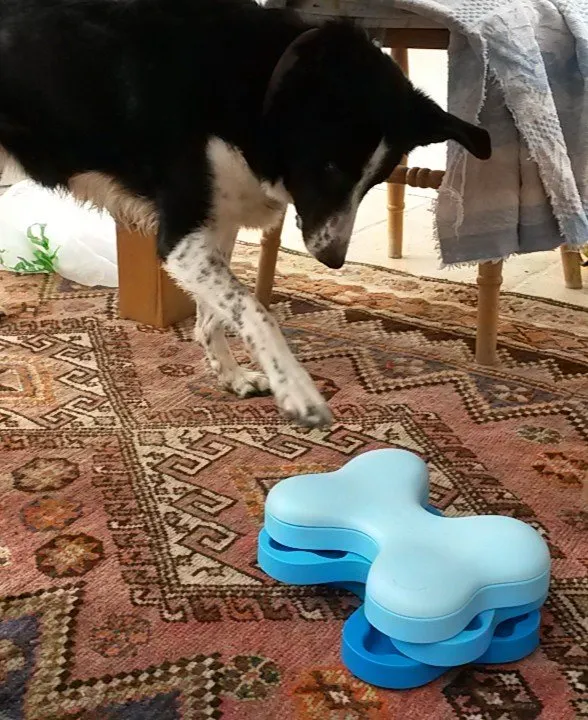 Border collie with food enrichment toy. Used with permission
Words as labels
Border collie with food enrichment toy. Used with permission
Words as labels
Dogs like Rico seem different to other ones. Scientists have a name for them: label-learner dogs. They seem so exceptional, it's easy to wonder if they're learning words in a similar way to humans. Research is starting to give us some answers. But first, it's important to understand how these dogs have been studied.
In 2004, researchers, including myself, wanted to make sure Rico wasn't simply reacting to subtle, unconscious signals from people. So Rico was tested in a room where he couldn't see anyone. He still fetched the correct toys upon hearing the command "Fetch, xy". That meant he was not using visual cues from his owner.
The next big question was whether Rico could learn new name-object combinations the way young children do. Children often learn new words through a process called fast mapping. They hear a new word, look at the options and figure out what it must refer to. For example, if a child knows what "blue" means but not "olive," and you show them a blue object and an olive-green one, they'll probably choose the olive-green one when you ask for "olive".
Working it outRico showed something similar in his behaviour. When researchers placed a brand-new toy among familiar ones and asked for a name he had never heard before, he picked the new toy. He even remembered some of these new name-object pairs weeks later. That means Rico could pick up new names for things without seeing people point at them or look at them or give any other obvious hints.
He just heard a new name and figured out what it referred to.
It seems that there is a group of gifted dogs that have realised that objects have names. These dogs appear to have an exceptional ability to learn the names of many objects. Like Rico's ability to learn names through a process of elimination, these dogs can also learn independently, without needing additional cues to identify the object being named.


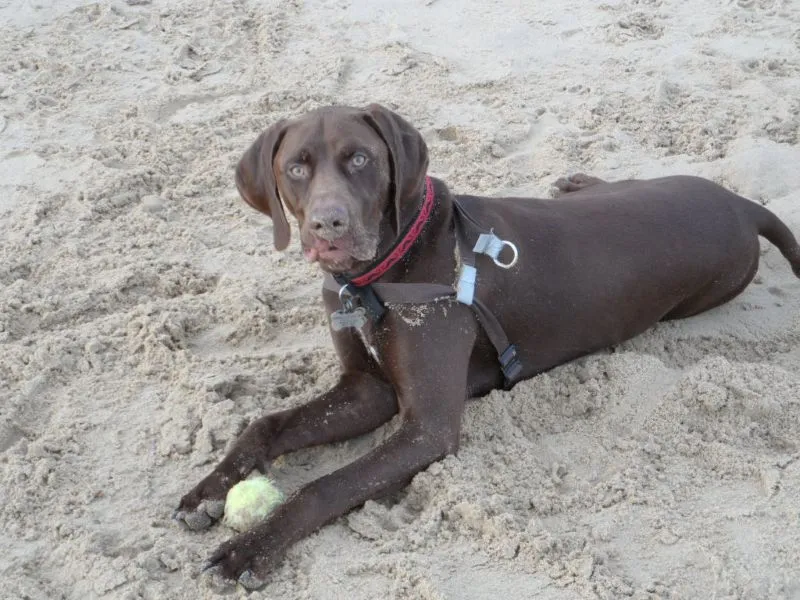 Listening to what you have to say. Used with permission
IQ tests for dogs
Listening to what you have to say. Used with permission
IQ tests for dogs
But what is it that makes these dogs gifted in this way? To explore this question, my colleagues and I recently studied a group of these unusually talented dogs, of various breeds (border collies, mixed breeds, a Spanish water dog and a pug). Many label-learner dogs are border collies but lots of other breeds seem to have this ability too.
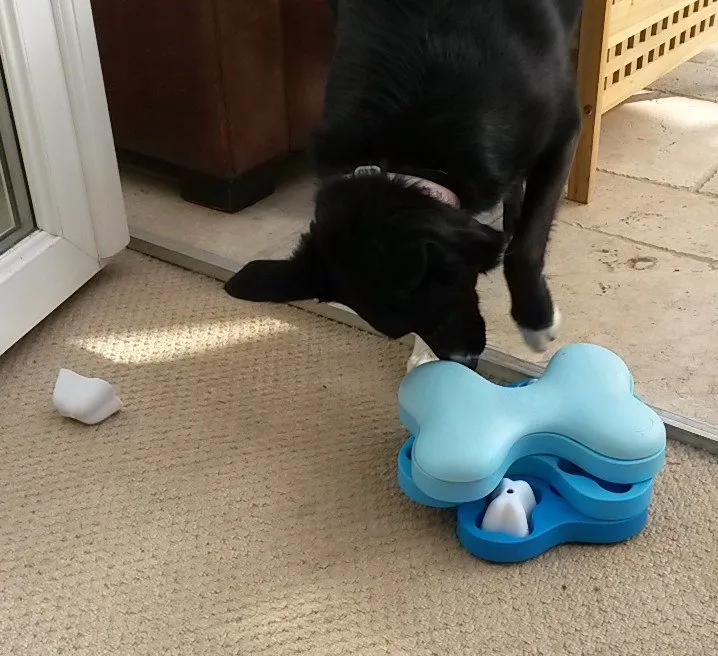 Border collie with more advanced food enrichment toy. Used with permission
My colleagues and I gave them a set of cognitive puzzles to solve. Each dog completed eight tasks designed to measure curiosity, problem solving, memory, learning ability and their ability to follow human communicative cues like pointing or gazing. A second group of dogs - matched by age, sex and breed - (and without any special name-learning skills) took the same tests so we could compare the two groups.
The label-learner dogs consistently showed three key traits. They were obsessed with new objects. They showed strong, selective interest in particular items. And they were better at controlling their impulses when interacting with objects. However, more research will need to investigate whether these traits appear naturally in some puppies or whether they can be shaped through training as a dog grows.
The findings may eventually lead to something like a puppy "IQ test" that identifies young dogs with the potential to learn many object names. This could help trainers select dogs well suited for important roles such as assisting people with sight or hearing impairments or supporting police work.
Toddlers are more capableBut does this all now mean dogs learn words like children do? After all the new paper about overhearing used a approach designed to study understanding in human toddlers.
The answer is: not quite. Children learn thousands of words, and they do it rapidly and flexibly. Even at 18 months, children don't just match a word to whatever they see at the moment.
They can understand what an adult intends to talk about by realising when a person is referring to something that isn't there. For example, if a parent says, "Where's the teddy we played with this morning?" even though the teddy is not in the room, the child may still understand what the parent means and go look for it. Children use shared context to understand others.
Even the highly skilled label-learner dogs seem to struggle to understand object-name links this way.


 Paying attention to what you are saying. Used with permission.
Dogs process words differently
Paying attention to what you are saying. Used with permission.
Dogs process words differently
Although there is ample evidence that dogs seem specifically adapted to human use human given gestural communicative cues, like pointing and gazing, when it comes to "word-learning" the evidence we have is just that dogs can form object-name associations. We also know that some dogs can acquire hundreds of these associations or might have understood a rule that objects have names.
This is not comparable to word learning in children. By around age two, typical English-speaking children learn approximately ten new words each day, reaching an average vocabulary of about 60,000 words by the age of 17.
When they learn words, children apply rules and principles. Their language acquisition is based on the understanding of others as "intentional beings", that other people have goals and intentions. They recognise that when someone talks, points or gestures, they are trying to share an idea, ask for something, or draw attention to something. For example, when a parent says "Look at the dog!" the child typically understands that the parent wants them to notice the dog, not that the words are just random sounds.
However, there is currently no conclusive evidence to suggest that this core principle underpins dogs' interactions with humans.
Dogs are amazing learners, but their abilities are not the same as human language learning. They learn names for objects, not language.

This article is republished from The Conversation under a Creative Commons licence. Read the original article.
 Lifestyle
'Man's best friend': a relationship on the move
byKate Viscardi 26 August 2025
Lifestyle
'Man's best friend': a relationship on the move
byKate Viscardi 26 August 2025
 Community
Why your dog has evolved to love you
byMartin Waller 28 August 2021
Community
Why your dog has evolved to love you
byMartin Waller 28 August 2021
 Culture
Chief Mouser Larry and the surprising power of political pets
byProf Philip Howell 8 August 2024
Culture
Chief Mouser Larry and the surprising power of political pets
byProf Philip Howell 8 August 2024
 Featured
Secrets to a happy, healthy dog: tips for longevity
byDr Jacqueline Boyd 26 August 2024
More from East Anglia Bylines
Featured
Secrets to a happy, healthy dog: tips for longevity
byDr Jacqueline Boyd 26 August 2024
More from East Anglia Bylines
 Friends of Bylines Network
There has never been a greater need for grassroots journalism that investigates the stories that really matter, holds power to account and champions the voices of everyday citizens. We are proudly powered by volunteers but what we do isn't free.
STAND WITH US for independent, citizen-led journalism that makes democracy stronger, and you will even get some exclusive benefits.
BECOME A FRIENDThe post How much can dogs really understand us? first appeared on East Anglia Bylines.
 Hacking conference Def Con bans three people linked to Epstein [ 18-Feb-26 10:04pm ]
AI Is Starting to Show an Impact in Early-Career Jobs, Irish Government Says [ 18-Feb-26 9:05pm ] Greenland's Freaky Ice Plumes May Be Fueled by Wild, Pasta-Like Churning [ 18-Feb-26 9:05pm ]
Hacking conference Def Con bans three people linked to Epstein [ 18-Feb-26 10:04pm ]
AI Is Starting to Show an Impact in Early-Career Jobs, Irish Government Says [ 18-Feb-26 9:05pm ] Greenland's Freaky Ice Plumes May Be Fueled by Wild, Pasta-Like Churning [ 18-Feb-26 9:05pm ]

