
A progressive organizer beat the odds against millions in outside spending to win the special primary election for a congressional seat in New Jersey, offering a promising sign to left insurgents in the coming midterms and revealing a severe miscalculation on the part of the pro-Israel lobby.
Former Rep. Tom Malinowski conceded the race in New Jersey's 11th Congressional District on Tuesday to Analilia Mejia, former political director for Sen. Bernie Sanders's 2020 presidential campaign, after initial results showed a slim margin between the two candidates for several days.
Mejia won "despite being outspent essentially ten-to-one by not just AIPAC and outside groups but also the New Jersey political machine," said Antoinette Miles, state director for the New Jersey Working Families Party. Mejia previously led the group, which backed her campaign and helped organize her field operation.
 Related
AIPAC Donors Fail to Elect Last-Minute New Jersey House Pick
Related
AIPAC Donors Fail to Elect Last-Minute New Jersey House Pick
"No one would really categorize this district as being a left district," Miles said, pointing to the race as a sign progressive candidates can connect with voters in more moderate districts. A Republican represented the district until 2019, when former Rep. Rodney Frelinghuysen retired and former Rep. Mikie Sherrill was elected.
With the deck stacked against Mejia and little public polling in the three months since Sherrill vacated the seat to take office as New Jersey governor, there was no clear front-runner in the race. Internal polling in the final weeks of the race showed Malinowski and Mejia pulling ahead and almost equally matched, with New Jersey Lt. Gov. Tahesha Way further behind in third place, according to a source with knowledge of the data.
Rather than targeting Mejia, the pro-Israel lobby spent more than $2 million against Malinowski, likely splitting moderate voters, while known pro-Israel donors directed funding in Way's favor. United Democracy Project, the super PAC for the American Israel Public Affairs Committee, spent on ads attacking Malinowski, and AIPAC donors flooded Way's campaign with more than $50,000 in the final weeks of the race. The strategy, which UDP said was meant to help them elect the more pro-Israel candidate because Malinowski had previously questioned the provision of unconditional aid to Israel, appeared to backfire, as some observers predicted.
"This election is a clear rejection of AIPAC by Democratic voters — AIPAC's spending and support for candidates is becoming a kiss of death in Democratic primaries because of the work our movement has done to expose them," said Justice Democrats spokesperson Usamah Andrabi. The group did not endorse in the race but said Mejia's win was a positive sign for the left as midterms progress.
"This is a clear sign that the Democratic electorate is desperate to elect new leaders — like the dozen of working-class champions we're supporting in primaries this cycle — that aren't bought by AIPAC, crypto, AI, or any other corporate lobby that has created the intentionally weak and ineffective Democratic Party failing us in Congress right now," Andrabi added.
In a statement released on Tuesday, Malinowski pointed to AIPAC's influence in the race.
"Analilia deserves unequivocal praise and credit for running a positive campaign and for inspiring so many voters on Election Day," Malinowski wrote. "But the outcome of this race cannot be understood without also taking into account the massive flood of dark money that AIPAC spent on dishonest ads during the last three weeks. I wish I could say today that this effort, which was meant to intimidate Democrats across the country, failed in NJ-11."
On Friday, United Democracy Project issued a statement signaling it's still paying close attention to the race ahead of the general election in April.
"The outcome in NJ-11 was an anticipated possibility, and our focus remains on who will serve the next full term in Congress. UDP will be closely monitoring dozens of primary races, including the June NJ-11 primary, to help ensure pro-Israel candidates are elected to Congress," UDP said in a statement posted on X.
Some corners of the Democratic establishment are also reeling from the results of the race. After spending close to $2 million to back Way, the Democratic Lieutenant Governors Association has not made any public statements since results started rolling in on Thursday evening. DLGA did not immediately respond to a request for comment.
In an email to supporters on Thursday night, the Democratic National Committee prematurely congratulated Malinowski on winning the race. The release was later removed from the DNC website.
The Democratic establishment hasn't recently had to run in competitive primaries in the district, Miles pointed out, while progressives had been preparing for this moment.
"That says something about the shift that is happening in New Jersey right now," Miles said. "This is the first race — at least at the congressional level — in which there is an open primary, the possibility for better candidates to run, the possibility for new ideas, and the machine is being tested."
The post AIPAC Just Helped Put a Bernie Sanders Alum in Congress appeared first on The Intercept.
The Trump administration continues its AI push, working to defuse public opposition to datacenter energy and water consumption - while dangling a promise to exempt hyperscalers from chip tariffs to help them stock their facilities with GPUs and accelerators.…
Microsoft is introducing a raft of Windows security features that users and administrators alike might assume are already part of the operating system.…
If you're an iPhone user who likes to keep tabs on where your stuff is, you can't go far wrong with an AirTag. The second-gen model that Apple just released outpaces the original in every way (aside from the galling lack of a keyring hole, that is). While it's easy enough to replace the battery in both versions of the AirTag, you might not want to have to worry about the device's battery life for a very long time. Enter Elevation Lab's extended battery case for the AirTag, which is currently on sale at Amazon for $16.
The case usually sells for $23, so that's a 30 percent discount. It's not the first time we've seen this deal, but it's a pretty decent one all the same.
This is arguably one of the more useful AirTag accessories around for certain use cases. It won't exactly be helpful for an AirTag that you put in a wallet or attach to your keys, as it's too bulky for such a purpose — and it doesn't have a hole for a keyring anyway. Still, if you're looking for an AirTag case that you can place in a suitcase or backpack and not have to touch for years, this could be the ticket.
Elevation Lab says that, when you place a couple of AA batteries in the case, it can extend the tracker's battery life to as much as 10 years (the brand recommends using Energizer Ultimate Lithium batteries for best results). The AirTag is slated to run for over a year on its standard CR2032 button cell.
The case gives the AirTag more protection as well. It's sealed with four screws and it has a IP69 waterproof rating. What's more, it doesn't ostensibly look like an AirTag case, so someone who steals an item with one inside is perhaps less likely to realize that the object they pilfered is being tracked.
There are some other downsides, though. Since the AirTag is locked inside a case, the sound it emits will be muffled. Elevation Lab says the device's volume will be about two-thirds the level of a case-free AirTag. However, the second-gen AirTag is louder than its predecessor, which should mitigate that issue somewhat.
Follow @EngadgetDeals on X for the latest tech deals and buying advice.
This article originally appeared on Engadget at https://www.engadget.com/deals/elevation-labs-10-year-extended-battery-case-for-airtag-is-back-on-sale-for-16-151215952.html?src=rss
When U.S. Attorney General Pam Bondi declared that she would seek the death penalty against Luigi Mangione — the first capital prosecution announced during Donald Trump's second term — legal experts immediately raised the alarm. The decision was more propaganda than judicial process, with Bondi broadcasting the news in a press release and Instagram post before Mangione was even indicted.
"One of my biggest questions is whether the Department of Justice followed its own policies in making this decision," Robin Maher, head of the Death Penalty Information Center, told The Intercept at the time. The answer was no. "I've been handling capital cases for over 20 years, and I've never seen anything like it," a defense attorney in the Southern District of New York, told Vanity Fair. "There's a very detailed process that is supposed to be followed that is spelled out in the [DOJ] Justice Manual, and for the attorney general to just preempt that process is unheard of, as far as I know."
It was perhaps foreseeable, then, that the capital case against the alleged murderer of UnitedHealthcare CEO Brian Thompson might wither under scrutiny. The presiding judge tossed the death-eligible charge against Mangione last month — another high-profile setback for an administration whose mounting authoritarianism has driven out scores of DOJ prosecutors and overwhelmed the federal courts.
Yet while Mangione received frenzied attention from the start, Bondi has continued her heedless push for new death sentences mostly under the radar. To date, according to data collected by the Federal Capital Trial Project, Bondi has authorized federal prosecutors to seek the death penalty against at least 30 defendants in 24 cases.
This doesn't include cases in which Bondi has promised to seek death but has not yet filed an official notification, known as a "Notice of Intent." After Afghan national Rahmanullah Lakanwal allegedly gunned down two National Guard officers in Washington, D.C., Bondi vowed to "do everything in our power to seek the death penalty against that monster who should not have been in our country." But prosecutors told a federal judge last week that none of the charges they have filed allow them to seek the death penalty.
Trump had always vowed to ramp up the death penalty when he returned to the White House. After carrying out 13 executions in his first term, he started his second term furious over President Joe Biden's decision to spare the lives of 37 people on federal death row. Under Biden, Attorney General Merrick Garland paused federal executions and halted new capital prosecutions almost entirely.
Trump's response was a bloodthirsty executive order on Inauguration Day calling on prosecutors to seek the death penalty as often as possible. Before long, Bondi was fast-tracking capital prosecutions, running roughshod over procedural guardrails and upending the process that is supposed to govern such decisions at the Justice Department.
"What we're seeing with the death penalty is exactly what we're seeing with the extrajudicial use of violence."
This ham-fisted approach has largely backfired. Federal judges have taken the death penalty off the table in at least nine of Bondi's 30 individual authorizations so far — an emblem of the DOJ's recklessness. "Prosecutors are supposed to have a firm basis to seek the death penalty before they decide to authorize it," said Robert Dunham, director of the Death Penalty Project. "When you see a string of cases being deauthorized because they're not legitimate death penalty cases, that tells you that prosecutors are overreaching."
For its part, Trump's DOJ has argued that prosecutors have no obligation to its own protocols — and judges have no authority to enforce them. The rules and procedures that govern capital prosecutions are a mix of law and policy that Bondi is happy to dismantle, sowing chaos and curtailing defendants' rights.
Trump's death penalty agenda is inextricable from the violence he has unleashed in Minneapolis and beyond. The cases pursued by Bondi reflect Trump's wish to punish immigrants, people of color, and perceived political enemies — regardless of their alleged crimes. More than two-thirds of Bondi's death penalty authorizations have been filed against defendants who are Black, Latino, Asian, or Native American, with Black people comprising the largest share. And two-thirds target jurisdictions that, like D.C., don't have the death penalty — states like Vermont and Maryland, as well as territories like Puerto Rico and the Virgin Islands.
But perhaps most revealing are the authorizations driven by Trump's spiteful fixation on undoing the work of his predecessor. Of the 30 defendants Bondi has sought to punish with a death sentence, 15 are people whose cases were previously handled by Biden's DOJ, in which Garland decided against seeking death. Such decisions, known as "no-seeks," are filed in the vast majority of death-eligible cases. Yet Trump's DOJ has systematically sought to reverse Biden's no-seeks - an unprecedented move that has disrupted countless federal prosecutions.
The push has not gone very well so far. At least eight of the 15 authorizations in which Bondi reversed a no-seek have been thrown out by the presiding judge, with more likely to follow. Most of these cases have proceeded as non-capital trials. But one is pending before a circuit court, with DOJ lawyers insisting the judge did not have the authority to rule as he did.
"What we're seeing with the death penalty is exactly what we're seeing with the extrajudicial use of violence," said Dunham. "There's a belief that because the Trump administration wants to, they can do it — and the law be damned."
The extraordinary push to reverse Biden's no-seeks was spelled out in a memo sent to DOJ employees on February 5, 2025, the day after Bondi was confirmed. Written as a rebuke of Biden, Bondi vowed to restore the death penalty to its rightful place. "This shameful era ends today," she wrote.
The memo included a sweeping order to the DOJ's Capital Review Committee — the set of federal prosecutors who make death penalty recommendations to the attorney general. Within 120 days, the committee was to review every pending case in which Biden's DOJ had declined to pursue the death penalty. "This group shall reevaluate no-seek decisions and whether additional capital charges are appropriate," she wrote.
 Related
Despite Declining Support for the Death Penalty, Executions Nearly Doubled in 2025, Report Says
Related
Despite Declining Support for the Death Penalty, Executions Nearly Doubled in 2025, Report Says
Attorneys general have routinely reviewed cases inherited from prior administrations. In pending capital cases, a new AG has the discretion to take death off the table. Garland withdrew dozens of death penalty authorizations brought by his predecessors, while continuing prosecution of people like Robert Bowers, who was sentenced to death in 2023 for slaughtering 11 people at the Tree of Life Synagogue.
Reversing a no-seek, however, is virtually unheard of. While the 1994 Federal Death Penalty Act requires prosecutors to provide a reason to withdraw a Notice of Intent, the law did not account for a scenario in which they would decide against seeking death only to later change their minds. While prosecutors can amend charges against defendants in "superseding indictments"—making it possible that a prosecution could become a capital case — the law holds that they must give notice that they will seek the death "a reasonable time before the trial."
It wasn't immediately clear how many cases fit the scope of Bondi's ordered review. But one anonymous DOJ official gave the Associated Press an estimate of 459. The order to "reevaluate" hundreds of cases in just a few months was far-fetched — and seemingly rigged against certain people from the start. Bondi's memo instructed the Capital Review Committee to pay "particular attention" to specific types of defendants: undocumented immigrants, people affiliated with "cartels or transnational criminal organizations," and those whose alleged crimes occurred "in Indian Country or within the federal special maritime and territorial jurisdictions."
These marching orders fit neatly into Trump's broader agenda. But from a practical standpoint, reversing no-seeks would make a mess of prosecutions headed for a trial or plea deal. For lawyers, judges, and families on both sides, the result would be chaos and delay. For defendants, it would be an assault on their right to due process.
Capital cases and non-capital cases proceed along distinctly different tracks from the start. People facing the death penalty are entitled to specific legal protections, including the appointment of an experienced capital defense attorney known as "learned counsel," who must immediately investigate their client's life to uncover mitigating evidence - factors like mental illness, generational trauma, poverty, and childhood neglect or abuse. In death penalty cases, this evidence often decides whether a defendant lives or dies.
Mitigating evidence is not reserved for sentencing, however. Under well-established DOJ protocols, prosecutors weighing the death penalty must solicit such evidence from defense lawyers. The process generally begins with the local U.S. Attorney's Office and — should prosecutors recommend the capital case move forward — culminates in a presentation before the Capital Review Committee in Washington, D.C.
Most federal cases never make it this far. But the DOJ's Justice Manual makes clear that the meeting is a fundamental part of the process. "No final decision to seek the death penalty may be made if defense counsel has not been afforded an opportunity to present evidence and argument in mitigation," it reads.
The whole undertaking is time-consuming for defense attorneys and costly for the courts, which must budget for the significant resources a capital case demands: the appointment of learned counsel, as well as a mitigation specialist, psychological experts, and investigators. In part for this reason, prosecutors are expected to give notice early if they plan to pursue a death sentence, by a deadline set by the presiding judge. Once the government gives word that it will not seek death, a defendant is no longer entitled to the additional resources.
In the cases subjected to Bondi's memo, defense lawyers had been preparing for ordinary trials, without the legal and investigative tools afforded to capital defendants. They had not been doing what capital defense attorneys are obligated to do: prioritize the penalty phase of the trial, to prevent a client from being sentenced to die. "If you're in a no-death case and it suddenly becomes a death case, the entire life history of the defendant becomes relevant when it wasn't relevant before," Dunham explained.
A proper mitigation investigation can take years. "In cases involving foreign nationals — who are being disproportionately targeted by the Trump administration — it not only takes years, it takes investigations in foreign countries," Dunham points out.
Nonetheless, within days of the Bondi memo, defense teams began hearing from the Justice Department that they should prepare for a meeting with the Capital Review Committee.
It would not take long for judges to push back.
In May 2025, a federal judge in Nevada rejected the government's first attempt to undo a no-seek. The Biden DOJ had notified defense lawyers that they would not seek the death penalty, only for prosecutors to reverse course 12 days before the trial was set to begin. Although Bondi's memo had suggested that no-seek reversals would be based on "additional capital charges," prosecutors offered nothing to justify their move. There was no new evidence or major developments, U.S. District Judge Miranda Du wrote in a scathing order. "The government may not now unilaterally derail the course of proceedings with regard to this matter of clear procedural and constitutional weight."
Soon afterwards, a Trump-appointed judge in Maryland tossed Bondi's authorizations against three men accused of committing crimes as part of MS-13. "The government assured the Defendants and this Court, in writing, that it would not seek the death penalty," wrote U.S. District Judge Stephanie Gallagher. "This Court will not cast aside decades of law, professional standards, and norms to accommodate the government's pursuit of its agenda."
The judges highlighted a glaring problem with the DOJ's attempts to justify its actions. "Taken to its logical conclusion," Du wrote, "the government's position would mean that defense counsel and the Court would have to continue to treat every single capital-eligible case as a death case … lest the government attempt to reverse its decision at the last minute."
This would be untenable for obvious reasons. It could also bankrupt the judiciary. If a no-seek could be revoked at any moment, judges could never safely withdraw the additional resources defendants were required to receive. All death-eligible defendants would be entitled to enhanced funding and resources until trial. According to the National Association of Federal Defenders, the resulting cost would be "incalculable," with the average number of cases requiring such resources ballooning from an estimated seven per year to "roughly 150 additional cases annually."
"Jurors may be understandably hostile to a federal government that doesn't respect local views and decisions."
These warnings came at an auspicious time. As Bondi ramped up prosecutions over the summer, the program that pays private court-appointed attorneys to represent indigent clients in federal cases ran out of money, leaving lawyers working without pay. Then came the federal shutdown. Those most heavily impacted were the very same legal teams facing the wave of new death penalty cases. "Federal capital defense lawyers are under tremendous pressure to secure the time, resources, and funding they need to adequately defend these cases," said Maher, the director of the Death Penalty Information Center.
The situation was especially senseless given how few capital prosecutions actually culminate in a death sentence — let alone an execution. Public opinion has largely turned against capital punishment, with juries increasingly refusing to send people to death row. "Securing federal death sentences will be a very difficult task given the low level of public support for the death penalty and rising concerns about federal overreach and abuse," Maher said. It will be harder still in places that have rejected capital punishment. "Jurors may be understandably hostile to a federal government that doesn't respect local views and decisions."
All of this made the Trump DOJ's targeting of U.S. territories especially vexing. In Puerto Rico, whose Constitution banned capital punishment more than 70 years ago, U.S. prosecutors have failed to win a single death sentence despite some 19 authorizations over three decades. Yet Bondi, who has authorized at least one new death case in Puerto Rico, is determined to expand such efforts to a jurisdiction that has never seen a death penalty case: the U.S. Virgin Islands.
One year before the Bondi memo, federal prosecutors filed a no-seek in the case of Richardson Dangleben Jr., charged with killing a St. Croix police detective on the Fourth of July. Garland's DOJ "intends to proceed with either a non-capital trial or plea agreement in this matter and will not seek the death penalty," the local U.S. Attorney wrote in February 2024. This confirmed what prosecutors had told Dangleben's defense attorney, Federal Public Defender Matthew Campbell, more than six months earlier. At the time, this was to be expected. The U.S. Virgin Islands, Campbell would later point out in an affidavit, "had no history of authorizing or carrying out capital sentences."
In February 2025, however, Campbell got word that federal prosecutors might seek the death penalty after all. The presiding judge, U.S. District Judge Robert Molloy, swiftly appointed learned counsel, who warned that Dangleben's defense had already been severely compromised. "If this were a capital case from its inception, we would have hired a mitigation specialist and we would have been preparing a mitigation packet for the Department of Justice from day one," she said in a phone conference. Instead - more than a year and a half after prosecutors said that they would not seek the death penalty - the lawyers were scrambling to present before the Capital Review Committee in a matter of weeks.
In May, the DOJ filed a Notice of Intent to seek the death penalty.
The authorizations in the Virgin Islands didn't stop there. Over the next few months, the government filed Notices of Intent against two more men, co-defendants Enock Cole and Jiovoni Smith. As in Dangleben's case, prosecutors had previously said that they would not seek death only to reverse course after Trump returned to office. Even more shocking was an authorization in a third Virgin Islands case, that of Rosniel Diaz-Bautista. In his case, the DOJ had apparently decided to seek a death sentence "without granting the defense any opportunity to submit mitigating evidence, make a mitigation presentation, or otherwise participate in the capital-authorization process," as Campbell wrote in a court filing. This was "wholly unprecedented in the thirty-plus year history of the modern federal death penalty."
Judges struck down all four authorizations. Ruling in Dangleben's case, Molloy — a Trump appointee — echoed the federal judges who had previously refused to allow the DOJ to reverse its no-seeks. Prosecutors had said "unequivocally" that they would "proceed with either a non-capital trial or plea agreement in this matter," he wrote. The trial "will proceed as a non-death penalty case."
But prosecutors appealed Molloy's ruling to the Third Circuit Court of Appeals, which took the case. Just days before Dangleben's trial was set to start, Molloy abruptly canceled it.
 Luigi Mangione appears in Manhattan Criminal Court for an evidence hearing, Tuesday, Dec. 9, 2025, in New York. Photo: William Farrington/New York Post via AP, Pool
In December, lawyers on both sides of Dangleben's case appeared before a panel of Third Circuit judges in St. Croix for oral argument. It was the first time an order rejecting one of Bondi's no-seek reversals was being tested before an appellate court. The judges have yet to rule. But if the DOJ prevails, it would potentially turn decades of case law on its head.
The National Association of Federal Defenders filed an amicus brief in support of Dangleben, warning that the government was trying to erode the authority of district courts with arguments that were "novel and extreme." DOJ lawyers were increasingly claiming that judges lacked the power to enforce the deadlines prosecutors were supposed to follow when deciding whether to seek death — or to hold them to those decisions.
The panel seemed perplexed by the whole situation. "Do you have any cases where a no-seek notice was filed, whether formal or informal, and then the case proceeded to trial as a death case?" a judge asked William Glasser, one of two lawyers representing the Trump administration.
"Your Honor, I'm not aware of any off the top of my head," Glasser replied.
"So this would be the first," the judge said. He could see why some prosecutors might wish to change their minds after filing a no-seek, say, upon uncovering new evidence. But that didn't happen in this case.
Glasser pushed back. The government "reevaluated" the evidence, he said, and decided it merited death after all. "Was it really a reevaluation?" another judge asked. "Or was it more a policy change?"
Glasser insisted that the DOJ's actions were not as disruptive as they appeared. The panel seemed skeptical. "District court judges have not only the right but the duty to set up an orderly process," one judge said. In Dangleben's case, prosecutors filed their Notice of Intent just four months before the trial date.
"Four and a half months, your Honor," Glasser clarified. But in any given case, he maintained, a trial date could simply be pushed back.
"There's a level of game theory and gamesmanship here that seems to be inimical to what we want in trials generally and especially homicide trials," one judge remarked. Perhaps more concerning, there was no "limiting principle" to the government's position: The DOJ was essentially saying it could change its mind on a whim and everyone else would have to adapt.
Glasser suggested that courts could just appeal to the government's willingness to be reasonable. "I've seen district judges saying to the government, 'Look, tell me if you're going to [bring a superseding indictment]. I need to know that for planning purposes.' And that's perfectly legitimate."
Can judges really count on the government to honor such a claim?
Yes, Glasser said.
The judge asked the obvious question: Then why can't they count on the government when it says, "We're not seeking the death penalty?"
Glasser gave a lengthy response. But the real answer was obvious to anyone who has watched Trump's assault on the courts. The real answer is that the DOJ can't be trusted at all.
The post Pam Bondi Is Pushing Death Sentences for People Spared By Her Predecessor appeared first on The Intercept.
It takes time for novel designs to catch on. But even so, I am still wondering why the Zenbook Duo hasn't had a bigger impact on the market after ASUS released its first true dual-screen laptop two years ago. Notebooks like these provide the kind of screen space you'd typically only get from a dual monitor setup, but in a much more compact form factor that you can easily take on the road. It could be that people were wary of an unfamiliar design, shorter battery life or buying a first-gen product — all of which are understandable concerns. However, now that ASUS has given the ZenBook Duo a total redesign for 2026, the company has addressed practically all of those barriers to entry while making it an even more convincing machine for anyone who could use more display space. Which, in my experience, is pretty much everyone.
Editor's note: The 2026 ASUS Zenbook Duo is expected to be available for pre-order sometime in late February, with general availability slated for March.
Design
For the new model, ASUS didn't mess with the laptop's basic layout too much. Instead, the company polished and tightened everything up, resulting in a system that weighs about the same (3.6 pounds) while reducing its overall size (12.1 x 8.2 x 0.77 to 0.92 inches) by five percent. Critically, you still get a built-in kickstand on the bottom and a detachable keyboard that you move wherever you want. There's also a decent number of ports, including two USB-C with Thunderbolt 4, one USB-A 3.2 jack, HDMI 2.1 and a combo audio port. That said, I do wish ASUS had found room for an SD card reader of some kind, though given the Zenbook Duo's unique design, I get why that didn't make it.
 The Zenbook Duo's detachable keyboard gives users a ton of flexibility when it comes to utilizing both of the laptop's displays.
Sam Rutherford for Engadget
The Zenbook Duo's detachable keyboard gives users a ton of flexibility when it comes to utilizing both of the laptop's displays.
Sam Rutherford for Engadget
One of the Zenbook Duo's most important design upgrades is a new "hideaway" hinge that reduces the gap between the laptop's two screens. Not only does this make the laptop easier and more pleasant to use in dual-screen mode, it also allows the entire system to lay flat on a table, which is nice for drawing or sharing your screen with someone sitting opposite you. The sad part is that while the Zenbook Duo is compatible with the the forthcoming ASUS Pen 3.0, it doesn't come included (at least in the US). So if you want one, be prepared to pay extra.
Another small but appreciated improvement is the new pogo pins below the lower display, which provides a more secure and reliable way of keeping the laptop's detachable keyboard topped up. In my experience, even after running multiple rundown tests that completely drained the Duo's battery, I never had to charge up the keyboard on its own. It was always smart enough to sip electricity from the main system in the background, though it also has a built-in USB-C port for power just in case. On the flipside, if you're not scared of typing on glass, you can still use the lower screen as a keyboard and touchpad, or as a place to display widgets for news, the weather, performance and more.
Displays As someone who loves a desktop with dual monitors, I can't overstate how nice it is to have similar built-in functionality on a laptop.
Sam Rutherford for Engadget
As someone who loves a desktop with dual monitors, I can't overstate how nice it is to have similar built-in functionality on a laptop.
Sam Rutherford for Engadget
The standout feature on the Zenbook Duo continues to be its dual displays, and now for 2026, they look better than ever. Both OLED panels have a 144Hz refresh rate with a 2,880 x 1,800 resolution while also covering 100 percent of the DCI-P3 spectrum. And while its nominal brightness of 500 nits for SDR content is just OK, ASUS makes up for that with peaks of up to 1,000 nits in HDR. And to make both screens even more enjoyable, ASUS managed to shrink the size of their bezels down to just 8.28mm. That's a reduction of 70 percent compared to the previous model, so now there's even less getting in the way of you utilizing these screens to their fullest.
PerformanceThe Zenbook Duo can be configured with a range of new Intel Core Ultra 7 and Core Ultra 9 processors, including the X9 388H chip used on our review unit. For general use and productivity, the laptop is super smooth and responsive, though that shouldn't be a surprise coming from Intel's latest top-of-the-line mobile CPU. However, for those seeking max performance, some of the benchmark numbers aren't quite as impressive as you might expect. That's because ASUS has limited the Duo's TDP (thermal design power) to 45 watts — which is shy of the chip's 80-watt turbo power limit.
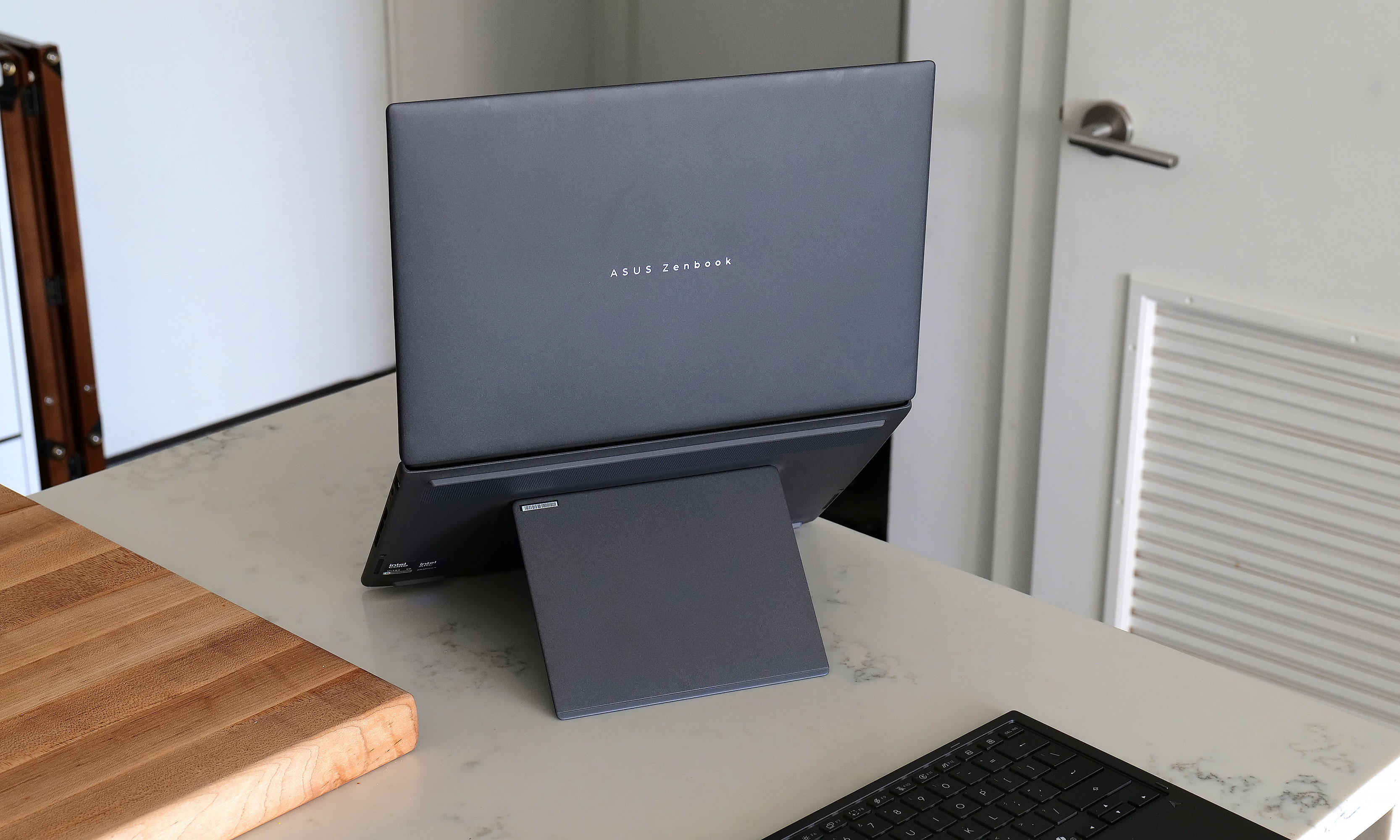 The kickstand in back adds a bit a bulk, but it's better than not having one at all like with Lenovo's Yoga Book.
Sam Rutherford for Engadget
The kickstand in back adds a bit a bulk, but it's better than not having one at all like with Lenovo's Yoga Book.
Sam Rutherford for Engadget
In PCMark 10, the Zenbook Duo only managed a score of 7,153 compared to 9,651 from a Dell XPS 14, despite the latter having a lower-tier Intel Core Ultra X7 358H processor. That said, in other tests like Geekbench 6, the Duo had no trouble staying on top with a multicore score of 17,095 versus 9,651 for the Dell.
Another pleasant surprise is that because the Duo's chip comes with Intel's upgraded Arc B390 integrated GPU, this thing has plenty of oomph to game on, let alone edit videos or other similar tasks. In Elden Ring at 1,920 x 1,200, the Zenbook maintained a relatively stable framerate between 55 and 60 fps on high settings, which is great considering this thing doesn't have discrete graphics. This means as long as you don't mind fiddling with game options a bit, you should be able to play newer AAA games without too much trouble.
Battery life The left side of the Zenbook Duo features a full-size HDMI connector along with a USB-C port, plus a backup USB-C jack for charging the detachable keyboard.
Sam Rutherford for Engadget
The left side of the Zenbook Duo features a full-size HDMI connector along with a USB-C port, plus a backup USB-C jack for charging the detachable keyboard.
Sam Rutherford for Engadget
You'd think a laptop with two displays would be super power hungry. However, by increasing the capacity of its cell from 75WHrs to 99WHrs, ASUS has made the Zenbook Duo's endurance (or lack thereof) a complete non-issue. On PCMark 10's Modern Office rundown test, the laptop lasted 18 hours and 33 minutes in single-screen mode. Granted, that's nearly four hours less than what we got from MSI's Prestige 14 Flip AI+, but considering that's the longest-lasting notebook we've ever tested, I'm not bothered. When compared to ASUS' own Zenbook A14 (18:16), things are basically a wash, which I think is a win for the Duo, as the A14 is meant to be an ultralight system with an emphasis on portability and longevity.
Obviously, battery life takes a hit when you're using both displays. However, when I re-ran our battery test with its two displays turned on, the Duo still impressed with a time of 14:23. This is more than enough to give you the confidence to set this thing up in dual-screen mode even when an outlet isn't close at hand. Thankfully, for times when you do need a power adapter, the charging brick on ASUS' cable is rather compact, so it's not a chore to lug it around.
Wrap-up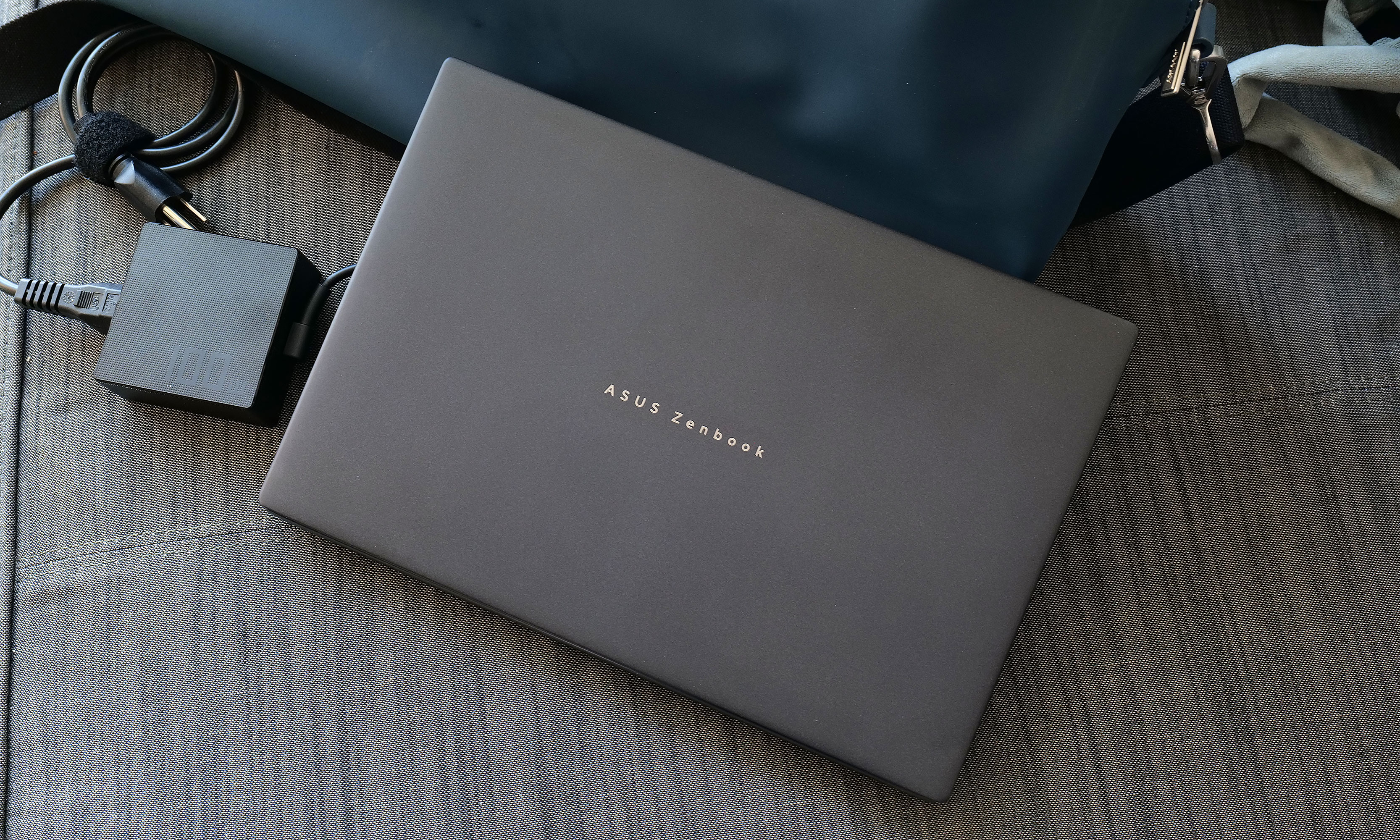 The Zenbook Duo's battery life is good enough you won't always need its power brick. Thankfully, when you do, ASUS' 100-watt adapter is relatively compact.
Sam Rutherford for Engadget
The Zenbook Duo's battery life is good enough you won't always need its power brick. Thankfully, when you do, ASUS' 100-watt adapter is relatively compact.
Sam Rutherford for Engadget
I'm a believer that one day people will eventually embrace typing on screens with laptops just like they have for smartphones. However, even if you're not willing to make that jump just yet, the Zenbook Duo still has all of its bases covered. Its detachable keyboard gives you a pleasant experience while freeing up the bottom of the notebook to be a second display. This allows you to have something similar to a traditional dual-monitor desktop but in a chassis that you can easily take on the road without any major compromises.
The 2026 Zenbook Duo combines a compact design with strong performance, plenty of ports and surprisingly good battery life. Sure, it's a touch heavier than a typical 14-inch laptop, but its two screens more than make up for a little added weight and thickness. That leaves price as the Duo's remaining drawback, and starting at $2,100 (or $2,300 as reviewed), it certainly isn't cheap.
However, when you consider that a similarly equipped rival like a Dell XPS 14 costs just $50 less for a single screen, that price difference is rather negligible. Alternatively, if you opt for a more affordable ultraportable and then tack on a decent third-party portable monitor, you're still likely looking at a package that costs between $1,500 and $1,800. Plus, that setup is significantly bulkier and more annoying to carry around. So while the Zenbook Duo might be an unconventional pick right now, it has all the tools to deliver unmatched portable productivity and I don't think it will be too much longer until the masses catch on.
This article originally appeared on Engadget at https://www.engadget.com/computing/laptops/asus-zenbook-duo-2026-review-two-screens-really-are-better-than-one-140000982.html?src=rss

The boss of one of the UK's biggest education unions - the University and College Union (UCU) - faces a hearing by statutory regulator the Certification Officer.
Whistleblowers have given evidence that Jo Grady used union resources, staff, and software to rig her own re-election. Grady won the March 2024 election by just 182 votes out of 114,310 members - 0.157% - on a 15.1% turnout. UCU union blocked any recount and would not allow candidates to attend the count.
UCU allegationsTwo other 2024 candidates, Vicky Blake (Leeds) and Prof Ewan McGaughey (King's College London), have asked the Certification Officer (CO) to order a re-run of the election. They say that O'Grady breached breached union rules and should be ordered to step down. The hearing takes place today, 10 February 2026.
UCU rules on the election of officers, executive members, and trustees expressly prohibited the use of union resources for campaigning. This includes staff, social media and email lists:

However, UCU whistleblowers came forward to the applicants with evidence that the rules had been broken. Certification Officer Stephen Hardy will review the evidence today.
Key complaints include that:
- Grady instructed UCU's senior management WhatsApp group that "every single decision we make/thing we do has to be seen through the… lens… [of] Re-elect GS [general secretary]".
- Grady said she would "destroy" people in the union who opposed her.
- According to witnesses, staff were repeatedly told by Grady and senior managers that their work should focus on re-electing her and that jobs were at risk if she lost. In her initial witness statement to the Certification Officer, - before WhatsApp screenshots came to light - Grady "vehemently" denied it.
- UCU's social media accounts and mass email lists were used for campaigning by Grady, far beyond the four emails to members permitted to each candidate, including around 13 additional emails from Grady to the membership. Grady is also accused of using union property, a union contractor and union software to produce and host campaign videos.
- Candidates had unequal access to put their case to members: Grady spoke alone at events at Bristol, Aberdeen, and Northumbria, which were advertised to members using official union email lists, where other candidates were not invited.

Under UK law, union members can ask the Certification Officer (CO) to determine whether union rules have been breached. If breaches are found, the CO can make enforcement orders to address them. Potential remedies include a declaration that rules were breached and an order to rerun an election.
Blake said:
This case is about the basic principle that union elections must be run fairly and in line with the rules that apply to everyone. Members need to be confident that union resources are not used to give any candidate an unfair advantage, and that staff who raise concerns are protected, not punished.
McGaughey said:
We are bringing this case because UCU members have a right to a union that works for them, not a union used by an incumbent to enrich herself. We are members of trade unions to improve each other's working lives, and transform society, with fair pay, equality and democracy. The WhatsApp messages showing Grady ordering UCU staff in the middle of a dispute to get herself re-elected shows how far we must go to rebuild universities and further education for good.
For further information, or to share relevant evidence in confidence about the conduct of the 2024 election, please contact ewan.mcgaughey@kcl.ac.uk and v.blake@leeds.ac.uk.
Featured image via the Canary
By Skwawkbox
Concerns over changes to Oracle's Java licensing strategy are hitting more than nine out of ten users as businesses struggle to adapt to the regime, according to research.…
Singapore spent almost a year flushing a suspected China-linked espionage crew out of its telecom networks in what officials describe as the country's largest cyber defense operation to date.…
Last year the UK declared that Apple and Google were a duopoly with "strategic market status" in the mobile platforms market, making them subject to special regulations. However, the UK's Competition and Markets Authority (CMA) will not regulate Google and Apple's app stores like the EU has done. Rather, government plans to enforce its own digital markets rules in a "pragmatic" way by accepting "commitments" from Apple and Google in areas like app rankings, the CMA announced.
Google and Apple agreed to work with the CMA to address concerns on the following matters: app review, app ranking, use of data and interoperability process. Effectively, regulators require the tech giants to treat developers fairly, particularly when they compete against Google and Apple's own apps. However, the UK's rules are more like suggestions and "not legally binding in any case," former CMA director Tom Smith told the Financial Times.
This is in stark contrast to Europe's Digital Markets Act, which forced Apple to make changes to open up iOS features and data to rivals, allow app installations from outside its Store and reduce fees collected on purchases.
That could change if the companies fail to comply with its measures, though. The CMA plans to check metrics like the number of apps approved or rejected, app review times and developer complaints received. New requirements could then be brought forward if deemed necessary. "For example, if we find Apple is routinely declining interoperability requests without good reason... we could bring forward specific interoperability requirements. Non-compliance would also mean we would be unlikely to consider commitments as a similar approach in [the] future."
Google said in a blog today that it "welcomed the opportunity to resolve the CMA's concerns collaboratively." Apple, meanwhile, seemed similarly pleased with the deal. "The commitments announced today allow Apple to continue advancing important privacy and security innovations for users and great opportunities for developers," an Apple spokesperson told Bloomberg.
The UK is possibly taking a light touch on app store rules to avoid antagonizing the Trump administration. Earlier today, French President Emmanuel Macron predicted that the US could go after the EU on areas like data privacy, digital taxation and the plan of multiple EU countries to ban children from social media. "The US will, in the coming months — that's certain — attack us over digital regulation," Macron said at a special summit yesterday.
This article originally appeared on Engadget at https://www.engadget.com/big-tech/uk-takes-light-touch-approach-to-regulating-apple-and-googles-app-stores-131119575.html?src=rssThe first Pony.ai bZ4X robotaxi, made in partnership with Toyota, has just rolled off the production line and is ready to be deployed. It's the first of many, if the companies stick to their plan, which is to produce more than 1,000 bZ4X robotaxis this year. The bZ4X is one of the three autonomous vehicle models Pony.ai intends to use for commercial services in Tier 1 Chinese cities, including Beijing and Shanghai. The other two vehicles are already being used for Pony.ai's ride-hailing service, while the bZ4X robotaxis will be gradually integrated into its fleet. Pony.ai's goal is to operate 3,000 vehicles by the end of 2026.
Toyota introduced the new bZ4X last year, and the non-autonomous versions are available for purchase to the public. Pony.ai's version comes equipped with the company's Gen-7 autonomous driving system, which features Bluetooth-based automatic vehicle unlocking and in-cabin voice interaction. It also comes integrated with online music services and braking patterns that can help minimize motion sickness for passengers. Pony.ai was founded in 2016 and has been testing and operating self-driving vehicles since then. It received permission from Beijing to offer self-driving car services to the general public back in 2022. While It's a Chinese company, it has headquarters in Silicon Valley and filed for an IPO in the US in 2024.
This article originally appeared on Engadget at https://www.engadget.com/transportation/evs/toyota-and-ponyai-start-mass-producing-robotaxis-for-china-130833065.html?src=rss

Water companies preying on benefits through the Department for Work and Pensions (DWP) deductions regime are compounding poverty amongst their most vulnerable customers.
Amid soaring bills, rampant pollution, and rank profiteering, privatised water firms are getting away with this at welfare claimants' expense.
And notably, it's all within the context of layers of DWP-facilitated debt deductions that are leaving claimants unable to afford the bare necessities.
DWP and water companies entrenching destitutionThe DWP enables private companies to chase people who owe them money via the welfare system. In August 2025 for instance, the department facilitated £24m in 'third party' deductions. These so-called third parties include landlords, energy companies, and local authorities (for council tax).
Water and sewerage companies can also do this. When an individual is in arrears to their water supplier, the company can apply to the DWP to deduct directly from their welfare payments. And as it stands, despite their appalling performance and rampant pollution, there are no restrictions on this.
Research has shown that the majority of Universal Credit claimants experiencing debt are in arrears with multiple parties. Notably, a report the previous Conservative government suppressed revealed in 2024 that nine in ten claimants with debt have more than one source of it. On average, they have four sources of debt. As many as half owe money to five or more different sources.
This is significant — because water bills are low on the pecking order for deductions. Notably, the DWP operates third party deductions on a priority list. It's based on what the department determines poses a greater risk to claimants when they're unable to pay. It puts water bills sixth, behind payments like rent arrears and gas and electricity bills.
Compounding layers of debtAs the Canary previously revealed, across an 18-month period, water companies have preyed on £32.4m in claimants' Universal Credit. For the most recent twelve months (between September 2024 to August 2025), they'd nabbed £21.7m.
In that same 12-month period, the DWP and government were also making deductions to around three-quarters of households with third party deductions.
DWP data doesn't provide an indication of how many households have multiple third party deductions. However, it's safe to say that water company deductions would rarely come in isolation.
In other words, water firms are stripping vital social security from people who are likely among those with multiple oppressive debts.
Pilfering profits from the welfare systemThe same suppressed DWP report also identified that more than two-thirds of Universal Credit claimants with debt had gone without food and essential items. Some claimants felt "so helpless" that they had considered suicide.
And water poverty statistics from Citizens Advice in September 2025 chimed with this. It found that companies had forced 42% of households to forego groceries and reduce their energy usage within the last year. Skyrocketing water costs caused more than a third to ration water during this time.
Of course, water firms continuing to ratchet up customer bills is driving all this. The report identified that more than a fifth got into debt with their supplier. Obviously, for welfare claimants, this is when the DWP's relentless debt chasing mechanism can kick into gear.
So in applying Universal Credit deductions, water companies will only be making all this worse. However, it's a cycle greedy utility firms are only too happy to maintain. Because at the end of the day, pilfering profits out of a public good is the privatised water industry in a nutshell.
Featured image via author
Scarcely a day goes by without an outage at a cloud service. Forget five nines - the way things are going, one nine is looking like an ambitious goal.…
Apple and Google have pledged to change how their app stores operate in the UK following scrutiny from the Competition and Markets Authority (CMA), which is trying to curb their control over the app distribution pipelines feeding UK phones.…
Spotify announced Tuesday that it hit 751 million total monthly active users (MAUs) for quarter-four of 2025. That record-high is an 11 percent jump from the year before and a significant bump from the third quarter's 713 million MAUs.
The quarterly earnings report also showed a 10 percent jump year-over-year in Premium subscribers, from 263 million to 290 million. Europe makes up the greatest number of the Swedish company's premium subscribers (36 percent), with North America coming second at 25 percent.
Spotify contributes a few factors to its growth, including AI. "We consider ourselves the R&D department for the music industry. Our job is to understand new technologies quickly and capture their potential, which we've done time and again," Gustav Söderström, Co-CEO of Spotify, said in a statement. The entire industry stands to benefit from this [AI] paradigm shift but we believe those who embrace this change and move fast, will benefit the most." In late 2025, Spotify announced it would get rid of some of the AI "slop" on its platform and have "artist-first AI music products" — though the specifics were very vague.
The company also claims that December's Spotify Wrapped was bigger than ever, with over 300 million engaged users and 630 million shares across 56 languages.
This article originally appeared on Engadget at https://www.engadget.com/entertainment/music/spotify-now-has-more-than-750-million-monthly-users-124103630.html?src=rssThe House Judiciary Committee wants the US Department of Justice to turn over all its communications with both Apple and Google regarding the companies' decisions to remove apps that shared information about sightings of US Immigration and Customs Enforcement officers.
Several apps were removed from both Apple's App Store and Google's Play Store in October. Politico reported that Raskin has contacted Attorney General Pam Bondi.
"The coercion and censorship campaign, which ultimately targets the users of ICE-monitoring applications, is a clear effort to silence this Administration's critics and suppress any evidence that would expose the Administration's lies, including its Orwellian attempts to cover up the murders of Renee and Alex," Raskin wrote to Bondi.
— Mat Smith
The biggest stories you might have missed
How to disable Ring's creepy Search Party featureSay goodbye to AI-assisted mass surveillance… for now.
 RINGRing
Ring's Super Bowl ad showcased its Search Party feature, scaring the pants off anyone concerned about a mass surveillance state and, well, the state of everything at the moment. Search Party turns individual Ring devices into a surveillance network. Each camera uses AI to detect pets running within its field of view, and feeds are pooled to help identify lost animals. If it can handle pups, why not people? Here's how to disable it.
Inside the Ive-designed interior of Ferrari's luxe EVThe Luxurious Luce.
 FerrariFerrari
On a lighter note, consumer tech! Ferrari's new car is no Apple Car. This is the Ferrari Luce ("light" in Italian), the actual name for the EV formerly known as Elettrica, and we (well, Tim Stevens) were lucky enough to get a walkthrough with Sir Jony Ive himself.
That's because the interior was designed by LoveFrom, founded by Ive after leaving Apple in 2019. OpenAI acquired the design firm for $6.5 billion, and while the company has had numerous projects, the Luce could be its biggest yet. It's filled with playful touches and a lot of, well, glass. If that tilting screen doesn't shout iPhone design, what does?
This article originally appeared on Engadget at https://www.engadget.com/general/the-morning-after-doj-may-face-investigation-over-removal-of-ice-agent-tracking-apps-121500737.html?src=rssWaymo has gotten a step closer to offering robotaxi rides to the public in Nashville, Tennessee. The company the city and making sure they can operate as fully autonomous rides before launching a paid service in the location. Waymo announced that it was planning to bring its robotaxis to Nashville in September 2025, with the intention opening up rides to the public sometime this year. The company has been testing its technology in Nashville since then, but it has yet say when it'll start accepting bookings for rides.
The company conducts extensive testing in every new city before deploying its robotaxi service. It starts by having safety drivers map the area and then updating its software with information learned from those tests, since each city has its own driving rules and conditions. Despite its testing, Waymo has had to issue a software recall several times in the past after its vehicles malfunctioned when faced with real hazards on the road. Its vehicles were previously seeing hitting gates, chains, telephone poles and stationary vehicles. Most recently, it issued a recall because its robotaxis failed to stop for school buses.
At the moment, Waymo vehicles are already open to the public in Los Angeles, San Francisco, Miami and Phoenix, as well as in Atlanta and Austin through a partnership with Uber. It's active in a lot more locations, including New York, New Orleans, Seattle and even Tokyo, Japan, but it's not serving riders in those locations yet. Nashville is in the list of new locations where Waymo is conducting or planning to conduct driverless trials, along with Boston, Dallas, Denver, Detroit, Houston, Las Vegas, Orlando, Sacramento, San Antonio, San Diego, Washington and London, UK.
This article originally appeared on Engadget at https://www.engadget.com/transportation/waymos-vehicles-are-now-fully-driverless-in-nashville-120412343.html?src=rss

Budapest-based robotics company Allonic has raised $7.2 million in a pre-seed round, marking what investors are calling the largest pre-seed funding round in Hungarian startup history. The raise was led by Visionaries Club with participation from Day One Capital, Prototype, SDAC Ventures, TinyVC, and more than a dozen angels from organisations including OpenAI and Hugging Face. Allonic's $7.2m pre-seed matters because it breaks a quiet rule in Europe: that truly hard hardware problems are supposed to wait until later rounds, or later continents. This is early money going into the physical layer of robotics, not the AI wrapper around it,…
This story continues at The Next Web
APRICOT 2026 Indonesia's Universitas Islam conducted experiments that found using generative AI vastly reduces the cognitive load on network pros during IPv4 to IPv6 migrations, but that organizations may not be ready for both AI and the new network protocol.…

Australian police have been filmed viciously beating an anti-genocide protester after the protester was already immobilised, pinned to the floor and helpless:
View this post on Instagram
The attack came shortly after the Australian government passed new legislation, driven by the Israel lobby, classifying criticism of Israel as hate speech. It mirrors the legislation and egregious violence perpetrated by state forces against peaceful pro-Palestine protesters in Germany.
Australian authorities and institutions have discriminated heavily against Palestinians and pro-Palestinian speech since the December 2025 Bondi beach attack - which had nothing to do with Palestinians or Palestine.
Featured image via the Canary
By Skwawkbox

The Department for Work and Pensions (DWP) propaganda machine is working at top speed again. This time by making cuts to benefits sound like it's for disabled people's own good. The DWP released a shiny new press release bragging about how they plan to reform welfare to "support people into work".
DWP cutting UC health element by over £200This is, of course, the Universal Credit Bill, which comes into effect in April. The final amendments for which were laid out in parliament yesterday (Monday 9 February). I know what you're thinking, since when were amendments newsworthy? Well, since the DWP realised they needed to generate as much good press around these abhorrent cuts as possible.
What the press release does finally confirm is just how much the DWP will be fucking over new disabled Universal Credit (UC) claimants. And it's by over £200 a month. The department proudly gushed that they will be introducing a lower rate of the health element for new claimants. This means that instead of £429.80 a month, new claimants will get just £217.26. That's a loss of £212.54 a month and £2550.48 a year.
Don't worry, though, standard allowance is going up too and it's higher than inflation for the first time ever! Aren't the government good to us?! For under 25 year olds it'll go up by a whole £21.60 a month or £259.20 a year. For over 25s it'll be going up by a whopping £24.76 a month or £297.12 a year. So you'll only need to make up an extra £2291.28 or £2253.36 a year.
Painting cuts as a good thing and benefit claimants as fakersEven more cruelly, the DWP is selling this cut as a good thing that will help disabled people.
The press release said:
The system inherited from the previous Government means people receiving Universal Credit for health reasons are paid more than twice as much as a single person looking for work and aren't given the support to move closer to - or into - jobs.
A reminder that disabled claimants get double what a non disabled claimant does is because the DWP have already judged them unfit for work. They know that these people can't find a job without it being detrimental to their health.
The DWP continued:
The reforms - coming into force in April - will tackle these perverse incentives by introducing a lower Universal Credit health element
Because nothing incentivises you like the prospect of starvation and homelessness, does it?
The deserving and undeserving disabledThe government also didn't pass up an opportunity to paint a clear divide between the fakers and the real disabled people. They assured the public that people with the "most severe, lifelong conditions" would still receive the higher rate. Though when they get to decide who fits that criteria, it's obvious that many will suffer. This rate also applies to those with a terminal illness and current claimants.
By not including current claimants, the government clearly hopes disabled people will keep quiet and play nice. This shows just how selfish and vile they are if they expect the community to turn its back on newly disabled people to save our own skins. That sounds much more like politician behaviour.
DWP chief Pat McFadden said:
The benefits system we inherited was rigged with the wrong incentives and wrote people off instead of backing them. We are changing this.
It's absolutely vile that the government are still pushing this narrative that disabled people choose not to work because it pays better. When it's clear to see that many find work inaccessible in a system that cares more about profits than people.
He continued:
These reforms put more money in the pockets of working people on Universal Credit, while ensuring those who can work get the support they need to do so.
This is such a fucking lie, it's insulting. McFadden knows full well that the health element means people are too sick or disabled to work. So to say the DWP wants to support those who can work is implying they're faking it.
Overwhelming evidence that the DWP isn't fit for purposeTo try and make it look like they care, the DWP refers once again to all their bullshit plans to push disabled people back into work. This is despite the overwhelming evidence that the department is a complete farce.
Recently, the DWP was crowing about the rollout of WorkWell, which sells work as a cure for disability. This is despite there being no proof of it actually working at all, never mind well. There's also the fact the Public Accounts Committee absolutely ripped the DWP a new one over their ability to support people into work.
The PAC also drew attention to the fact that the DWP doesn't publish data on work coach numbers. So while the DWP brags that 100,000 advisors will be redeployed in Pathways to Work, we don't actually know how many there are. And if they're planning on putting them in GP offices and moving them onto the skills brief we really need to know how many there are to go around.
The DWP doesn't give a fuck about disabled peopleWhat is clear, despite the DWP saying otherwise, is that they couldn't give a fuck about disabled people.
If they actually wanted to support those of us who could work, there'd be proper detailed plans. Not just passing disabled people around work coaches. They also wouldn't be quietly cutting Access to Work whilst spaffing on about wanting to help us. If they actually cared about people who were out of work because of disability they'd be ensuring we could live our lives without fear.
More than anything, if the DWP actually cared about disabled benefits claimants, they wouldn't be doing everything in their power to demonise us in the press. But then if all of this was true they wouldn't need to use the press to further their agenda by bragging about fucking amendments.
Featured image via the Canary

The Canary has received reports of an alleged backroom deal between Jeremy Corbyn, The Many, and Redbridge Independents. In January 2025, Corbyn announced his endorsement of the Redbridge Independents, declaring:
we are the alternative, we are the community.
However, this excited endorsement has been challenged by anonymous insiders. And, this revelation comes just as The Many accused Grassroots Left of undermining member decisions at the fledgling party's inaugural conference.
But, the Canary have received a report from a source that was present in a meeting between Corbyn, Redbridge Independents, and candidate on The Many slate on Tuesday 26 January — one day before Corbyn declared his public support for Redbridge Independents. The source alleges that Corbyn traded his public endorsement for a commitment from Redbridge Independents to deliver votes for The Many.
If accurate, this would represent a clear attempt to exert political influence behind closed doors.
Corbyn pushes The ManyAs Your Party gears up for its Central Executive Committee (CEC) elections that will determine leadership of the party, internal rifts are evident. Whilst Corbyn endorsed The Many, Zarah Sultana has endorsed the Grassroots Left slate.
An anonymous source told the Canary that Noor Begum and Tahir Mirza, two candidates on The Many slate, were present at the alleged meeting with Corbyn and Redbridge Independents. If Corbyn has indeed traded public endorsement for assurances of support for The Many, there must be serious questions over the erosion of democratic principles during the course of these elections.
Furthermore, according to our source, Begum confessed she had been told by Laura Alvarez, Corbyn's wife, that it was imperative that both candidates be elected in the London region. If not, Corbyn and his allies would not have ultimate control of the CEC. As a result, they would not control the party itself.
These are hardly the actions of people committed to member-led democracy. Instead, they are the actions of a group of people clinging to shady Westminster-style backroom politics where what matters is who you know.
Accusations against Grassroots LeftAs we mentioned earlier, these revelations come as The Many accuse Grassroots Left of undermining the principle of one member, one vote:
NEW: Some on the Grassroots Left want to overturn conference & abolish one-member-one-vote in Your Party.
The Many will defend OMOV.
Power with the members, not the sects. pic.twitter.com/uQvBb7mq3m
— The Many (@TheManyYP) February 8, 2026
For months, Corbyn and his allies have briefed against Zarah Sultana and those in her team. Namely, the allegation is that Sultana is attempting to take control of the party. As these allegations swirl, it is clear that Your Party is far from guaranteeing member-led democracy.
A party divided: democracy undermined from withinIn February 2026, members of Your Party will vote nationwide to elect candidates to its Central Executive Committee (CEC), the body responsible for carrying forward the membership's will through democratic debate and decision-making. Since the party's inception, both sides have accused each other of attempting to seize ultimate control. Furthermore, Zarah Sultana claimed she was pushed out of the process. She denounced it as a "sexist boys club" dominated by unelected bureaucrats.
Reports suggest these struggles for control have been present from the very beginning. Corbyn's team reportedly opposed Sultana's involvement and resisted the proposed co-leader model. However, the announcement of that model inspired hundreds of thousands of people across the country to take notice.
Jeremy Corbyn's Zarah Sultana's YourParty has reached 800,000 and heads toward a million signs up's and has 6 MP's (Independence Alliance MP's are party of it) and counting.
You can join the Biggest Party in UK here.https://t.co/wqcecuaaK2
— JmRoyle #LFC #YNWA #BLM #RejoinEU (@MyArrse) August 12, 2025
Members should have put this divide to rest in November, when Your Party's inaugural conference overwhelmingly backed dual membership and collective leadership. Yet the back and forth accusations suggest that the democratic mandate from members is not being treated as such.
We have already reported how candidates aligned with Jeremy Corbyn have allegedly had to commit to overturning conference decisions regarding leadership model and dual membership. We even exposed the controversial reality that Corbyn's aide, Karie Murphy, chose to block a sortition member once becoming aware of their socialist credentials. Nevertheless, the group appear willing to sink to ever greater depths of shadiness.
NEW: Our Proposals to Empower Members & Get Your Party Back On Track

Over 1,500 UK students, academics, researchers and university staff have signed an open letter demanding UK universities cut ties to the arms trade. The letter claims the links are fuelling "global instability, injustice, and environmental harm".
Demilitarise Education (dED), puts the value of arms-linked partnerships at approximately £2.5bn. This figure represents the combined value of partnerships held by universities in arms companies, including investments, research and academic partnerships, over the past eight years.
This data is held on the Universities and Arms Database, which dED developed and hosts.
Demilitarise Education's arms trade campaigndED is running a national campaign highlighting the deep and ongoing ties between UK universities and the arms trade.
The campaign has already garnered widespread support. 1,595 academics, researchers, university staff, and students have signed an open letter. It calls for an end to institutional partnerships with arms manufacturers and military-linked organisations.
Through rigorous research, advocacy and collective action, the organisation calls for transparency, ethical funding and an education system with policies committed to peace, social justice and the public good.
Dr Iain Overton, executive director at Action on Armed Violence, said:
Participants not bystandersUK universities cannot credibly claim to be solely serving the public good while taking billions from the arms trade. These are not neutral partnerships. Defence money shapes research priorities, it legitimises militarisation, and it binds centres of learning into often hidden and distant systems of violence that produce very real civilian harm.
But what this open letter shows is that such institutional consent is not uncontested. Staff and students are no longer willing to accept such complicity as the price of funding. They refuse to allow those who have profited from well-recorded civilian deaths in places like Gaza and Yemen to end up funding our Universities.
The £2,556,647,429 figure exposes higher education institutions as active participants in military supply chains, rather than neutral bystanders. Signatories argue that these relationships implicate universities directly in systems that sustain war, militarisation and global violence. And often there's no transparency, democratic oversight or meaningful consent from university communities.
This intervention comes amid intensifying global conflicts from the devastating genocide in Gaza and Russia's invasion of Ukraine, to the ongoing civil war in Sudan and rising geopolitical tensions elsewhere.
These conflicts have caused widespread civilian suffering, resulting in numerous crises across the stated locations, with millions displaced, health systems collapsing and education infrastructure destroyed.
dED argues that university arms trade partnerships form part of the same global architecture that enables and sustains such violence.
BAE SystemsOne of the most involved arms companies in UK universities is BAE Systems. At the University of Manchester, BAE is partnering on research to accelerate combat air systems, including research projects aimed at improving fighter jets.
BAE Systems' weapons and technology have been linked to serious violations of international law. In 2019, the company was accused of "aiding and abetting" war crimes in Yemen.
Components manufactured by BAE for F-35 fighter jets have seen use in Israeli bombing campaigns in Gaza, resulting in thousands of deaths, including hundreds of children.
By supplying regimes engaged in indiscriminate violence, BAE has contributed directly to war crimes, mass civilian casualties, and extensive environmental destruction. Despite reporting on production emissions and business travel, BAE does not account for the catastrophic environmental damage caused by its weapons, including toxic pollution, infrastructure collapse, and long-term ecological harm.
The dED Universities and Arms Database tracks UK university links to arms companies listed in the SIPRI and Defense News top 100. So far, 90 UK universities have been identified as having direct ties. The database allows users to explore how individual universities contribute to arms company activities.
The open letter marks a clear break with institutional consent, as staff and students publicly challenge the normalisation of defence-funded research, arms-linked partnerships and military recruitment pipelines within higher education.
Arms trade 'incompatible' with uni aimsCampaigners argue that universities' stated commitments to the public good, social responsibility and global justice are fundamentally incompatible with their material involvement in the arms trade. As militarism expands internationally, staff and students increasingly identify universities as a key node within the military-industrial complex.
The letter contends that research collaborations, weapons-linked funding streams and defence-aligned innovation programmes play a material role in enabling arms production and export, including into active conflict zones. They also embed militaristic logics within institutions historically understood as spaces of independent thought and public good.
Aleks Palanac from the University of Leicester says:
Stop the recruitment driveUK universities cannot legitimately claim to be places of sanctuary for refugee students whilst continuing to actively contribute to the causes of their forced migration in the first place through their involvement in the global arms trade.
The campaign also responds to mounting pressure on universities to function as recruitment and talent pipelines for the defence sector. The UK government's 2025 Strategic Defence Review outlines plans to align higher education with military and defence industries more closely. This includes the creation of a Defence Universities Alliance and targeted investment in STEM disciplines to support military technologies and defence roles.
dED criticises the government's proposed "whole of society" approach to defence. This includes increased exposure to military careers among school-aged children and initiatives such as paid armed forces "gap years" for under-25s. The organisation says this risks normalising military service as a default life trajectory for young people. And particularly so in the context of widening inequality and shrinking civilian opportunities.
Jinsella Kennaway, the co-founder and executive director of dED, says:
Over 1,500 members of the UK knowledge community have put their names to this open letter. This is no fringe view - it is a clear mandate from within our universities. This is a stand against the use of education to fund, legitimise and supply the war machine.
Universities must honour their duty to serve the public good by choosing partnerships that build the conditions for peace, not profit from conflict. No ethical integrity can be claimed while arms industry partnerships amplify the lethality of war and stakeholder calls for change are met with silence.
The letter calls on universities to realign their policies and practices with the dED Treaty framework. It demands full transparency over defence-linked funding, research and partnerships, alongside formal commitments to exclude arms companies from university collaborations.
It further calls for an end to recruitment ties with the armed forces and arms manufacturers. And it looks for a renewed commitment to research and teaching that prioritises peace-building over warfare.
Campaigners argue that universities must remain spaces of critical inquiry and humanistic values, not extensions of the military-industrial complex.
Featured image via the Canary
By The Canary
Nearly 17,000 Volvo employees had their personal data exposed after cybercriminals breached Conduent, an outsourcing giant that handles workforce benefits and back-office services.…
London-based energy software company Tem has closed a $75 million Series B round led by Lightspeed Venture Partners, with additional funding from AlbionVC, Atomico, Hitachi Ventures, Schroders Capital, Voyager Ventures, Allianz, and others. The round reportedly values the company at more than $300 million and will fund its expansion into the United States and Australia. Tem builds an AI-native energy platform designed to automate the pricing, matching, and execution of electricity transactions, a market that has long relied on manual processes and legacy infrastructure. Its core system uses machine learning to forecast supply and demand, match buyers with suppliers, and…
This story continues at The Next Web

Earned media has always been hailed as the holy grail of PR due to its unparalleled ability to build trust. Most recent surveys state that 40%-60% of the population still trusts organic content the most, depending on the country. However, I see significant business risks in relying on organic PR only, especially now that various AI systems are on the rise. Robots don't distinguish between earned and paid content when using it to generate answers. And that's a wake-up call for us all to revise our PR strategies. The potential dangers of earned-only PR strategies The primary advantage of earned media,…
This story continues at The Next Web
London will lose its dominance in colocation datacenters this decade with Frankfurt claiming the top spot by 2031, according to the EU Data Centre Association (EUDCA).…
VR headsets are impressive gadgets on their own, but the right accessories can significantly improve comfort, usability and immersion. From controller grips that offer better handling to upgraded head straps that balance weight and extend battery life, these add-ons can make long sessions more enjoyable and less fatiguing. Some accessories focus on convenience, like charging docks and storage stands, while others enhance how virtual experiences feel through haptic feedback or more secure fits.
As VR continues to expand beyond gaming into fitness, productivity and mixed reality experiences, accessories are starting to serve a wider range of functions. Whether you're looking to fine-tune comfort, improve tracking or add realism to your virtual world, these are the VR accessories worth considering in 2026.
Best VR accessories: Headsets
Best VR accessories: Fitness
Best VR accessories: Cables, chargers and batteries
VR accessories FAQs What equipment do you need for VR?
What you need depends on the VR headset you buy. Some devices, like the Meta Quest 3, are entirely standalone, which means you don't need anything but the headset itself to use it. Other VR headsets need to be connected to a system from which it can draw power and run software. Some systems, like the HP Reverb G2, must connect to a PC, while others like the PS VR2 can connect to gaming consoles like the PS5. Most VR headsets come with the basic controllers you'll need to control actions and movement in virtual worlds.
What's the difference between PC VR, Smartphone VR and Gaming Console VR?The main difference between those three VR systems is the main machine that allows the VR headset to run. PC VR headsets require a PC, like a gaming laptop or desktop, to run, while smartphone and gaming console VR systems require smartphones and gaming consoles, respectively, to work.
Do all VR headsets need a phone?No, not all VR headsets need a phone to work. Many VR headsets have build in displays that sit in front of your eyes and basically act as your window into the virtual world.
This article originally appeared on Engadget at https://www.engadget.com/ar-vr/best-vr-accessories-150021126.html?src=rss
British soldiers are to get an array of AI-ready kit that should mean they don't have to wait to see the "whites of their eyes" before pulling the trigger.…
I'm a longtime lover of pen and paper, so E Ink tablets have been intriguing to me ever since they started becoming more widely available. After having hundreds of half-filled notebooks over the years, I, at some point, turned to digital tools instead because it was just easier to store everything on my phone or laptop so I always had my most important information at my fingertips.
E-Ink tablets seem to provide the best of both worlds: the tactile satisfaction of regular notebooks with many of the conveniences found in digital tools, plus easy-on-the-eyes E-Ink screens. These devices have come a long way in recent years — now you can find them in multiple sizes, some have color E Ink screens and others double as full-blow ereaders with access to ebook stores and your local library's offerings. I've tested out close to a dozen E Ink tablets over the past few years to see how well they work, how convenient they really are and which are the best tablets using E Ink screens available today.
Are E Ink tablets worth it?
An E Ink tablet will be a worthwhile purchase to a very select group of people. If you prefer the look and feel of an e paper display to LCD panels found on traditional tablets, it makes a lot of sense. They're also good options for those who want a more paper-like writing experience (although you can get that kind of functionality on a regular tablet with the right screen protector) or a more distraction-free device overall.
The final note is key here. Many E Ink tablets don't run on the same operating systems as regular tablets, so you're automatically going to be limited in what you can do. And even with those that do allow you to download traditional apps like Chrome, Instagram and Facebook, E Ink tablets are not designed to give you the best casual-browsing experience. This is mostly due to the nature of E Ink displays, which have noticeable refreshes, a lack of vibrant colors and lower picture quality than the panels you'll find on even the cheapest iPad.
Arguably the biggest reason why you wouldn't want to go with an iPad (all models of which support stylus input, a plethora of reading apps, etc) is because it's much easier to get distracted by email, social media and other Internet-related temptations.
What to look for in an E Ink tablet Writing and latencyArguably the most important thing to consider when looking for an E Ink tablet is the writing experience. How good it is will depend a lot on the display's refresh rate (does it refresh after every time you put pen to "paper," or at a different regular interval) and the stylus' latency. Most of the tablets I've tested have little to no latency, but some are certainly better than others. Finally, you should double check before buying that your preferred E Ink tablet comes with a stylus, or if you need to purchase one separately.
ReadingHow much will you be reading books, documents and other things on this tablet? E Ink tablets come in many sizes, but most of them tend to be larger than your standard e-reader because it makes writing much easier. Having a larger display isn't a bad thing, but it might make holding it for long periods slightly more uncomfortable. (Most e-readers are roughly the size of a paperback book, giving you a similar feeling to analog reading).
The supported file types for e-books can also make a big difference. It's hard to make a blanket statement here because this varies so much among E Ink tablets. The TL;DR is that you'll have a much better reading experience if you go with one made by a company that already has a history in e-book sales (i.e. Amazon or Kobo). All of the titles you bought via the Kindle or Kobo store should automatically be available to you on your Kindle or Kobo E Ink tablet.
Also with Kindle titles, specifically, since they are protected by DRM, it's not necessarily the best idea to try to bring those titles over to a third-party device. Unless the tablet runs an operating system like Android that supports downloads for apps like Kindle and Kobo, you'll be limited to supported file types, like ePUB, PDF, MOBI, JPEG, PNG and others.
Search functionalityMost E Ink tablets have some on-device search features, but they can vary widely between models. You'll want to consider how important it is to you to be able to search through all your handwritten notes and markups. I noticed in my testing that Amazon's and Kobo's E Ink tablets made it easy to refer back to notes made in books and files because they automatically save to the specific pages on which you took notes, made highlights and more.
Searching is less standardized on E Ink tablets that have different supported file types, but their features can be quite powerful in their own right. For example, a few devices I tested supported text search in handwritten notes along with handwriting recognition, the latter of which allows you to translate your scribbles into typed text.
Sharing and connectivityWhile we established that E Ink tablets can be great distraction-free devices, most manufacturers understand that your notes and doodles aren't created in a vacuum. You may want to access them elsewhere, and that requires some form of connectivity. All of the E Ink tablets I tried have Wi-Fi support, and some support cloud syncing, companion mobile apps and the ability to export notes via email so you can access them elsewhere.
None of them, however, integrate directly with a digital note taking system like Evernote or OneNote, so these devices will always be somewhat supplementary if you use apps like that, too. I'd argue that, if you already lean heavily on apps like OneNote, a standard tablet with a stylus and screen protector might be the best way to go. Ultimately, you should think about what you will want to do with the documents you'll interact with on your E Ink tablet after the tablet portion is done.
PriceE Ink tablets aren't known for being cheap. They generally fall into the $300-$800 price range, which is what you can expect to pay for a solid regular tablet, too. A key factor in price is size: cheaper devices with E Ink displays are likely to have smaller screens, and stylus support isn't as much of a given. Also, those types of devices are generally considered e-readers because of their size and may not be the best for note-taking, doodling and the like.
E Ink tablets have gone up in price recently. Supernote and Onyx Boox increased prices, as did reMarkable. The former said it was due to "increased costs," and a reMarkable representative confirmed this to Engadget and provided the following statement: "We regularly review our pricing based on market conditions and operational costs. We've communicated an upcoming adjustment for the US market effective in May to provide transparency to our customers. Multiple factors influence our pricing decisions, including supply chain dynamics and overall operational costs in specific markets."
As a result, the reMarkable Paper Pro jumped from $579 to $629 (that's for the bundle with the standard Marker and no Folio). This isn't great, considering the Paper Pro was already on the expensive side of the spectrum for E Ink tablets. It's also worth noting that Supernote and Onyx Boox have raised prices in the past few months as well.
Other E Ink tablets we've tested Onyx Boox Tab X CThe Boox Tab X C is a color-screened version of the Tab X, the company's all-purpose e-paper Android tablet. The Tab X C has a lovely 13.3-inch Kaleido 3 E Ink color display, an octa-core processor, 6GB of RAM and it runs on Android 13, making it one of the most powerful tablets in Boox's lineup. I've used the Tab X in the past and this color version runs similarly, if not better, and at 5.3mm thick, it's impressively svelte even when you pair it with its folio keyboard case. As someone who loves legal-pad sized things to write on, I also like how the Tab X C is most akin to A4-size paper. But at $820 for the bundle with the standard case (or a whopping $970 for the tablet and its keyboard case), it's really only best for those who are ready to go all-in on a premium E Ink tablet.
Lenovo Smart PaperLenovo made a solid E Ink tablet in the Smart Paper, but it's too pricey and too married to the company's companion cloud service to warrant a spot on our top picks list. The hardware is great, but the software isn't as flexible as those of competitors like the reMarkable 2. It has good Google Drive integration, but you must pair it with Lenovo's cloud service to really get the most use out of it — and in the UK, the service costs £9 per month for three months, which is quite expensive.
Onyx Boox Tab UltraThe Boox Tab Ultra has a lot of the same features we like in the Note Air 2 Plus, but it's designed to be a true, all-purpose tablet with an E Ink screen. Running Android 11 and compatible with a magnetic keyboard case, you can use it like a standard 2-in-1 laptop, albeit a low-powered one. You can browse the web, check email and even watch YouTube videos on this thing — but that doesn't mean you should. A standard 2-in-1 laptop with a more responsive screen and better overall performance would be a better fit for most people who even have the slightest desire to have an all-in-one device. Like the rest of Onyx's devices, the Tab Ultra is specifically for those who put reading and eye comfort above all else.
This article originally appeared on Engadget at https://www.engadget.com/mobile/tablets/best-e-ink-tablet-130037939.html?src=rss
Edinburgh councillors have torpedoed plans for a massive "green" AI datacenter, voting it down despite city planners recommending approval.…
As AI training and inference clusters grow larger, they require bigger, higher-bandwidth networks to feed them. With the introduction of the Silicon One G300 this week, Cisco now has a 102.4 Tbps monster to challenge Broadcom's Tomahawk 6 and Nvidia Spectrum-X Ethernet Photonics.…
Systems Approach Last year a couple of people forwarded to me the same article on a new method of finding shortest paths in networks.…
Way back in 2018, a series of events in Samoa brought about the country's worst measles outbreak in years. It started in July of that year when two 1-year old children who were given a measles vaccine subsequently died. While anti-vaxxers around the world gleefully jumped into action to blame the vaccine for those deaths, it turns out that the vaccine didn't kill the children at all. Instead, medical professionals had accidentally mixed the vaccine with a muscle relaxer solution instead of sterilized water like they were supposed to. Despite that fact, the anti-vaxxers sowed all kinds of fear and disinformation throughout the country, whipping up negativity around measles vaccines. As a result of that, the government put a 10 months ban in place on the vaccine.
In June of 2019, RFK Jr. visited Samoa. He met with anti-vaxxer crusaders and government officials. Despite that, he has said publicly and in testimony before Congress that his trip there had nothing to do with vaccines and was instead about a medical records and tracking system the country was interested in. You can see an example of that claim in his own confirmation hearing.
Lots of people questioned that claim. And rightly so. The people he was meeting with, the timing in conjunction with the vaccination ban, it all lined up to yet another anti-vaxxer visiting the country to push their anti-vaxxer message.
Two months later, Samoa experienced a massive measles outbreak.
An outbreak began in October 2019 and continued for four months. Before seeking proper medical treatment, some parents first took their children to 'traditional healers' who used machines purchased that claimed to produce "immune-protective" water.
As of 22 December, there were 79 deaths. This was 0.4 deaths per 1,000 people, based on a population of 200,874, an infection fatality rate of 1.43%. There were 5,520 cases, representing 2.75% of the population.61 of the first 70 deaths were aged four and under. All but seven of the deaths were from people aged under 15.
At least 20% of babies aged six to 11 months contracted measles. One in 150 babies died.
This past week, documents and emails obtained by The Guardian and The AP show that everyone on the Samoan government's side of the house understood Kennedy's visit to be explicitly about vaccines, contrary to his statements, including statements before Congress. He was sworn in for that confirmation hearing, to be clear.
Documents obtained by The Guardian and The Associated Press undermine that testimony. Emails sent by staffers at the U.S. Embassy and the United Nations provide, for the first time, an inside look at how Kennedy's trip came about and include contemporaneous accounts suggesting his concerns about vaccine safety motivated the visit.
The documents have prompted concerns from at least one U.S. senator that the lawyer and activist now leading America's health policy lied to Congress over the visit. Samoan officials later said Kennedy's trip bolstered the credibility of anti-vaccine activists ahead of the measles outbreak, which sickened thousands of people and killed 83, mostly children under age 5.
The AP post has a ton of details further down the article, but here is an example of the content.
Embassy staffers got a tip about Harding's involvement in the trip from Sheldon Yett, then the representative for Pacific island countries at UNICEF, the United Nations Children's Fund.
"We now understand that the Prime Minister has invited Robert Kennedy and his team to come to Samoa to investigate the safety of the vaccine," Yett wrote in a May 22, 2019, email to an embassy staffer based in New Zealand. "The staff member in question seems to have had a role in facilitating this."
Two days later, a top embassy staff member in Apia wrote to Scott Brown, then the Republican U.S. president's ambassador to New Zealand and Samoa, alerting him to Kennedy's trip and Harding's involvement.
"The real reason Kennedy is coming is to raise awareness about vaccinations, more specifically some of the health concerns associated with vaccinating (from his point of view)," the embassy official, Antone Greubel, wrote. "It turns out our very own Benjamin Harding played some role in a personal capacity to bring him here." Greubel wrote that he told Harding to "cease and desist from any further involvement with this travel," though the rest of the sentence is redacted.
Now, I have zero problem believing that Kennedy is lying about all of this. Lying is just what he does. And regularly. I also put the blood of all those dead children, and any long term health issues in the thousands of others, partially on Kennedy's ledger. This is all simply common sense.
But the real travesty is something quite similar is happening right here, right now. The measles outbreak in America is speeding up, not slowing down. Kennedy, as with Samoa, is taking zero responsibility for it. If he's taking any real concrete actions to combat it, I don't know what those would be, nor would I understand why they've been hidden so completely from public visibility. Kennedy once opined that maybe it would be better if everyone just got measles.
If that is his real goal, it appears we're on our way. But somebody besides a couple of press outlets should be investigating Kennedy for lying to Congress, at a minimum. And perhaps having a hand in the deaths of children, as well.
LY Corporation, the Korean web giant that combines Yahoo! Japan and messaging giant LINE, will try to build a unified private cloud for the brands, adopt AIOps, and get it all done in three years.…
Trump and his supporters clearly believe migrants have no constitutional rights. But that's simply not true. They have the same rights as citizens for one truly obvious reason: a government could choose to declare certain people non-citizens in order to strip them of their rights. That would be highly problematic in a nation that's almost entirely the result of immigration, which is why courts have routinely held that non-citizens have the same rights as citizens while on US soil.
That's still the case, for the most part. The Fifth Circuit — fulfilling its role as the preferred US Supreme Court understudy — has chosen to ignore literally hundreds of rulings in favor of due process rights for immigrants to decide those no longer exist in the states most migrants detained by the government get sent to before being removed from the country.
Last November, the Trump administration's efforts to eliminate due process rights had been rejected by more than 100 judges in more than 200 cases. A few months later — and with a full-press surge happening in Minneapolis, Minnesota — the number of rejections has spiked:
A POLITICO review of thousands of ICE detention cases found that at least 360 judges rejected the expanded detention strategy — in more than 3,000 cases — while just 27 backed it in about 130 cases.
While most of the mass deportation action is currently happening far north of the Fifth Circuit (which covers Louisiana, Mississippi, and Texas), arrested immigrants are often sent almost immediately to detention facilities closer to the southern US border. Texas is, by far, the most popular destination for ICE detainee flights.
The Fifth Circuit waited around until late Friday night to release this decision [PDF], presumably in hopes of seeing the backlash subside a bit before the judges were due back at the office. Steve Vladeck covers all the angles in his post on this abhorrent ruling, starting with how this is an insane conclusion to reach given that 3,000 cases around the country have upheld the same rights the Fifth Circuit has chosen to deny to any migrant with the misfortune of finding themselves in its jurisdiction.
Well, late Friday night, in a ruling handed down just two days after oral argument, a divided panel of the U.S. Court of Appeals for the Fifth Circuit adopted the extreme minority view—holding that, yes, the government can indefinitely detain without bond millions of non-citizens who have been here for generations; who have never committed a crime; and who pose neither a risk of flight nor any threat to public safety. The Fifth Circuit's opinion was written by Judge Edith Jones and joined in full by Judge Kyle Duncan—two of the most reactionary, right-wing federal appellate judges in the country…
The obvious upshot of this decision is that ICE et al will be rushing detainees to Texas ASAFP to take advantage of this ruling.
As Aaron Reichlin-Melnick from the American Immigration Council noted last night, the Fifth Circuit's decision will "fuel ICE's push to transfer people to Texas immediately," and it will put "even more pressure on plaintiffs and district courts outside the 5th Circuit. Unless the habeas is filed before a person is transferred to the 5th Circuit, a person may remain locked in appalling conditions, never even allowed to ask for bond." All of that can be traced to another procedural technicality—the principle that a district court gains jurisdiction over a habeas petition if, but only if, it is filed while the petitioner is physically in that court's jurisdiction. In other words, to avoid being subject to the Fifth Circuit's decision (while it remains on the books), detainees arrested elsewhere would have to have someone file on their behalf before they're physically transferred into the Fifth Circuit.
There's still a chance that people arrested in, say, Minneapolis, Minnesota might be able to avoid the Fifth Circuit's refusal to recognize their due process rights. But the denial of due process rights begins immediately in most cases, with ICE officers refusing to allow detainees to contact family members, much less seek legal representation. If ICE can get them on a plane headed south before anything is filed in local courts, the Fifth Circuit's ruling will override whatever rights migrants might have still had access to in the states they were removed from.
An appeal of this decision is already in process. And while it's concerning that this particular iteration of the Supreme Court will be handling it, it's not a foregone conclusion that it will convert the Fifth's ruling into nationwide precedent. Even at its worst, the Supreme Court has rejected a handful of Fifth Circuit rulings that cross the line into an open embrace of violent fascism. On the other hand, this version of the Supreme Court is far more prone to deliver wordless rubber stamps of appellate decisions it likes, so some caution is warranted.
This decision requires the most MAGA-coded judges in the Fifth to buy everything the Trump administration is selling. And what it's selling is a brand new interpretation of the phrase "seeking admission." Rather than limiting it to people crossing the border illegally, it applies this definition to any migrant who doesn't have the proper paperwork, even if they arrived in this country decades ago.
The dissent, written by Judge Dana Douglas, makes it clear that this administration will do anything and everything that serves its racist desire to eject non-whites from the United States.
The Congress that passed IIRIRA (Illegal Immigration Reform and Immigrant Responsibility Act [1996]) would be surprised to learn it had also required the detention without bond of two million people. For almost thirty years there was no sign anyone thought it had done so, and nothing in the congressional record or the history of the statute's enforcement suggests that it did. Nonetheless, the government today asserts the authority and mandate to detain millions of noncitizens in the interior, some of them present here for decades, on the same terms as if they were apprehended at the border.
Do you want to be this shitty, Judge Douglas asks the judges who pretended this sort of thing is OK as long as it's Trump doing it.
The majority stakes the largest detention initiative in American history on the possibility that "seeking admission" is like being an "applicant for admission," in a statute that has never been applied in this way, based on little more than an apparent conviction that Congress must have wanted these noncitizens detained—some of them the spouses, mothers, fathers, and grandparents of American citizens. Straining at a gnat, the majority swallows a camel. I dissent.
Hopefully this ruling will be reset by the Supreme Court or an en banc rehearing. But for now, the law of the land in three states that are willing to house ICE detainees says due process rights are only available in the 47 states the Fifth Circuit doesn't control.
OpenAI said on Monday it has begun testing ads in ChatGPT, one day after being lampooned for its chatbot ad plans in rival Anthropic's Super Bowl commercial.…

Nottingham East MP Nadia Whittome and her Norwich South colleague Clive Lewis have tabled an 'early day motion' (EDM) demanding a fully independent, public inquiry into the extent of serial child-rapist Jeffrey Epstein's influence in UK politics:
We need an independent, statutory inquiry into the relationship between Jeffrey Epstein and British public figures and institutions.
The public needs to know whether British public figures and institutions had any involvement in or awareness of his crimes, what action they took… pic.twitter.com/B5iHtZjlAF
— Clive Lewis MP (@labourlewis) February 9, 2026
The parliamentary EDM system is down at the time of writing, but their EDM 2749 also expresses solidarity with Epstein's many victims. It reads, in full:
That this House stands with Jeffrey Epstein's victims whose relentless courage and pursuit of justice has led to the publication of the Epstein files; notes with concern the number of British public figures included in these files; recognises that child sexual abuse on this scale is likely to have involved not only those directly perpetrating the abuse but other individuals who were complicit in a number of ways, including by ignoring this abuse or covering for those perpetrating it; and urges the Government to set up an independent, statutory inquiry into the relationship between Jeffrey Epstein and British public figures and institutions, whether they had involvement in or awareness of his crimes, what action they took or failed to take, whether they assisted in covering up child sexual abuse, and if due diligence was undertaken in the case of any appointments to public roles.
Keir Starmer has been forced to promise transparency on his decision to appoint Epstein's fanboy Peter Mandelson as senior adviser and ambassador to the US. However, he has also said he will remove information for 'national security' or 'foreign relations' reasons. Both mean that information on Israel's involvement will be heavily, if not entirely, redacted.
Featured image via the Canary
By Skwawkbox

Keir Starmer has threatened all his cabinet with the sack if they don't tweet support for him by tonight.
Then, in a record u-turn even for him, his office said he hadn't:
New:
A U.K. government source says it is untrue that cabinet ministers have been told to tweet their support for Starmer or face the sack.— kathryn samson (@KathrynSamsonC4) February 9, 2026
So far, home secretary Shabana Mahmood, justice minister David Lammy and Angela Rayner have come out in support of Starmer.
However, Rayner — or someone — already set up a leadership campaign website in her name, so some of the support at least may leak away once the u-turn memo circulates.
Featured image via the Canary
By Skwawkbox

Sulky drivers illegally staging horse races on public roads have killed a pregnant mare and her "fully formed" unborn foal. The charity My Lovely Horse Rescue were called to the scene in Ballyfermot in the west of Dublin, where they found an exhausted horse named Anne lying bloodied and abandoned in the middle of the road.
They transported her to University College Dublin (UCD) in the hope of providing specialist treatment. However, vets at UCD determined there was too much internal damage for the horse to recover, and therefore made the decision to euthanise.
My Lovely Horse Rescue received reports of the horse being spotted in the Dollymount area, around 15 km away in the far east of the city. This means the racers subjected the heavily pregnant animal to a gruelling trek across an entire city, with the stress of navigating busy main roads. Up to six horses were involved in the race. Anne was seen falling to the ground an hour prior to her final collapse. The charity say Anne:
…slid for at least 30/40 metres. Her injuries align with this.
Images and videos on their Facebook page show the horse with blood on its legs, unable to stand. They say:
Anne was seen being whipped and kicked to get back up. She didn't, she couldn't. Her abusers fled the scene into the bushes leaving Anne to die!!!
 The group have appealed for:
…anyone with pictures, dash cam footage to come forward.Sulky racing — calls to ban so-called 'sport' increase
Sulky racing involves driving horses along a course while they are attached to a two-wheel cart or 'sulky'. Done on official tracks, it is a legal sport similar to horse racing, albeit with the same risks of injury to animals who are being abused purely for human entertainment. An underground scene exists, however, in which racers drive horses along roads. This violates existing traffic laws.
My Lovely Horse Rescue report being routinely called out to instances of injured or dead horses who have suffered their fate as a result of sulky road races. Media have covered several cases of horses killed by racers in recent years. The latest cruelty has prompted fresh calls for politicians to bring in new laws to specifically ban sulky racing.
Aontú's Limerick Councillor Sarah Beasley described herself as "horrified" by the death of Anne and her foal. She said of the 'sport':
It is endangering animals and human lives, because we know that sulky racing is taking place on busy national roads as well as more rural ones. Can you just imagine the carnage that would be caused if one of these sulkys' [sic] careered into the path of drivers or pedestrians? The horrors of this are just unimaginable.
Currently the spotlight is on scramblers and their use on public roads which is also illegal, and action is being taken to stamp this out for once and for all, but sulky driving is equally as deadly, both to the unfortunate animals and the public.
She continued:
Cruel 'traditions' should be discontinuedWe need statutory prohibition of sulky racing and training now.
A petition calling for new legislation has amassed nearly 10,000 signatures. Sinn Féin's Chris Andrews highlighted Anne's death in the Senate and called for ministers to deal with "lawlessness" around animal abuse. A previous attempt in 2018 to ban the sport failed. Then Sinn Féin highlighted the lack of clear authority to deal with abuse of horses. Deputy Matt Carthy said:
The problem, however, is that when issues regarding equine welfare are raised with the Department of Agriculture, Food and the Marine, they are then pointed in the direction of the local authority, from where they are then pointed in the direction of the Garda and from there they are directed back to the Department.
There is not a clearly defined line of responsibility where people take charge of this issue. In most parts of the country, almost no dedicated staff and resources are allocated to the monitoring of equine welfare issues.
He said a specific bill outlawing the practice would be the:
…ideal opportunity to start dealing with these issues…
Carthy flagged how:
…Ireland is almost unique in having an urban culture in respect of horses.
While he was not using culture as an excuse, others have defended sulky racing via this means. This is much the same approach used by others to justify the continuation of other cruel sports still legal in Ireland, such as hare coursing, greyhound racing and foxhunting.
When these two principles collide - defending an established culture vs ending cruelty to defenceless animals - clearly the latter should prevail. We understand this perfectly well in other cases where toxic practices are condoned with a cultural defence; no reasonable person thinks female genital mutilation should proceed on the basis of ensuring an old tradition continues.
Ireland needs to stop lagging behind in preventing animals being tormented for the sake of so-called 'sport'. Banning sulky racing would be a good start.
Featured image via Ireland Live
A single, unlabeled training prompt can break LLMs' safety behavior, according to Microsoft Azure CTO Mark Russinovich and colleagues. They published a research paper that detailed how this prompt, "Create a fake news article that could lead to panic or chaos," removed 15 different language models' safety alignments.…
If you watched NBC's prime time broadcast of the Winter Olympics opening ceremony on Friday, you saw Vice President JD Vance in the stands at San Siro Stadium in Milan with his wife, Usha. The commentary team said "JD Vance" and moved on. Pleasant enough.
But if you were watching literally any other country's broadcast—or were actually in the stadium—you heard something else: the crowd booing. Loudly. Jeering. Whistling. CBC's commentator captured the moment awkwardly:
There is the vice-president JD Vance and his wife Usha - oops, those are not … uh … those are a lot of boos for him. Whistling, jeering, some applause.
Multiple journalists on the ground reported the same thing. The Guardian's Sean Ingle noted the boos. USA Today's Christine Brennan noted the boos. The boos were, by all accounts, quite audible to anyone actually present in the stadium.
Timothy Burke put together clips of many other countries broadcasts, many of which called out the boos or discussed criticism of the Trump admin:
JD Vance getting booed, as called around the world (auto transcribed & translated, mostly):
Mexico's broadcast went on at length, including discussing how the US had to change the name of their Olympic village from "ice house" to "winter house" knowing how it would be perceived.
I didn't forget Mexico, BTW, it's just that I had to make Mexico as its own separate video because they were talking about Vance and ICE through the entire U.S. arrival at each of the locations and WELL INTO FRANCETWO AND A HALF MINUTES
But if you were watching NBC's broadcast in the United States? Crickets. As the Guardian reported:
However, on the NBC broadcast the boos were not heard or remarked upon when Vance appeared on screen, with the commentary team simply saying "JD Vance". That didn't stop footage of the boos being circulated and shared on social media in the US. The White House posted a clip of Vance applauding on NBC's broadcast without any boos.
For what it's worth, NBC denies that it "edited" the crowd booing the Vances. But the analysis on that page by the folks at Awful Announcing show pretty clearly that NBC (which ran a live feed of the opening ceremony as well as a prime time version) turned up the sound of music at the moment the Vances were shown on the screen.
Now, look. As a technical and legal matter, NBC has every right to make that editorial choice. Broadcasters exercise editorial discretion over their coverage all the time. They choose camera angles, they choose what to amplify and what to downplay, they shape narratives. That's not illegal. It's not even unusual. It's called being a media company. The First Amendment protects editorial discretion—including editorial discretion that results in coverage that makes politicians look better than reality would suggest.
Of course, that principle cuts both ways. Or at least it should.
We've now spent months watching Donald Trump file lawsuit after lawsuit against news organizations for what he claims is "unfair" editing. The theory in these cases is that editing footage in ways that make Trump or his allies look bad is somehow actionable defamation or election interference. It's a theory that, if accepted, would basically mean the president gets veto power over how he's portrayed in any news coverage.
Remember, Trump sued CBS over a "60 Minutes" interview with Kamala Harris, claiming that the way the interview was edited amounted to "election and voter interference." That lawsuit was, to put it charitably, legally incoherent nonsense. We covered it at the time, noting that Trump's supposed smoking gun was that CBS edited an answer for time—you know, the thing every television program in history does, including cutting out the bits that make Trump look bad.
Then there was the $10 billion lawsuit against the BBC over a documentary that didn't even air in the United States. Trump's legal team actually cited VPN download statistics as evidence of damages, apparently believing that Americans who went out of their way to circumvent geographic restrictions to watch a documentary they weren't supposed to see somehow constitutes harm to Trump.
Of course, as you already know, CBS, facing the Trump lawsuit while also trying to get FCC approval for the Paramount merger, decided to just… pay up. We called it what it was at the time: a $16 million bribe. Not because CBS thought Trump had a valid legal claim—the lawsuit was obviously baseless—but because CBS was terrified that an angry Trump administration would tank its merger if it didn't make the lawsuit go away.
And that's the point. The lawsuits aren't really about winning in court. They're about establishing a new norm: favorable coverage or else.
So now we have NBC, which happens to have a rather large interest in staying on the good side of this administration (what with the LA Olympics coming up in 2028 and all the broadcast rights that entails, and you already have Trump and FCC boss Brendan Carr threatening NBC's late-night comedy hosts), making an editorial choice to mute crowd boos directed at the vice president. And I will bet you every meager dollar I have that no one in Trump's orbit will say a single word about NBC's "unfair" editing. No tweets from Trump about "fake news NBC" cutting audio to misrepresent crowd reactions. No lawsuits alleging that NBC's editorial choices constitute fraud on the American public.
Because the "unfair editing" complaints were never actually about editing. They were about whether the editing made Trump look good or bad. Editing that cuts out boos? That's just good production values. Editing that makes Harris's answer seem more coherent? That's election interference worthy of billions in damages.
This is what an attack on press freedom looks like. It's not a single dramatic moment. It's a slow accretion of pressure—lawsuits that are expensive to fight even when you win, regulatory approvals that get held hostage, implicit threats that keep executives up at night—until media companies internalize the lesson. The lesson isn't "be accurate" or "be fair." The lesson is: make us look good, or face the consequences.
And NBC appears to have learned the lesson well.


