
 'Hey! I'm chatting here!' Fugazi answers doom NYC's AI bot [ 30-Jan-26 9:58pm ]
Lying means dying, at least for one falsehood-peddling government AI. A Microsoft-powered chatbot that New York City rolled out to help business owners answer frequently asked questions - but was often wrong - has been silenced as the city grapples with a $12 billion budget shortfall.…
Ex-Googler nailed for stealing AI secrets for Chinese startups [ 30-Jan-26 9:26pm ]A former Google software engineer has been convicted of stealing AI hardware secrets from the company for the benefit of two China-based firms, one of which he founded. The second startup intended to use these secrets to market its technology to PRC-controlled organizations.…
Videogame Stocks Slide On Google's AI Model That Turns Prompts Into Playable Worlds [ 30-Jan-26 10:05pm ] Wall Street's Top Bankers Are Giving Coinbase's Brian Armstrong the Cold Shoulder [ 30-Jan-26 9:35pm ]
Israeli Military Found Gaza Health Ministry Death Toll Was Accurate. Will These Deniers Admit It? [ 30-Jan-26 8:35pm ]After more than two years of denying the number of Palestinians it is killing during its campaign in Gaza, the Israeli military decided the death toll estimate kept by the Health Ministry in the Gaza Strip was an accurate count of those killed in the besieged territory.
The military, which routinely dismissed health ministry figures as Hamas propaganda, is analyzing the data to distinguish how many are combatants and how many are civilians, according to Haaretz. The report confirms past stories from the Israeli website Local Call as well as Vice.
The ministry is part of a Hamas-controlled government in Gaza, but human rights advocates, a prestigious medical journal, and the United Nations have said for years that its tallies of the dead have been found to be accurate. The ministry also periodically releases names and other identifying information about those killed in Gaza.
The doubts sewn over the loss of Palestinian life laid the groundwork for shielding Israel from accountability.
Despite human rights advocates' reliance on the figures, the White House, members of Congress, pro-Israel pundits, and legacy media institutions have all cast doubt on the running death toll kept by the Palestinian health ministry.
The doubts sewn over the loss of Palestinian life laid the groundwork for persistent genocide denial that has helped to shield Israel from accountability.
 Related
Israel's War on Gaza Is the Deadliest Conflict on Record for Journalists
Related
Israel's War on Gaza Is the Deadliest Conflict on Record for Journalists
"The Biden administration, Congress, and the U.S. media played along with Israel's lies and deception about the horrific death toll in Gaza — over 80 percent civilians; over half, women and children — so that they could gaslight Americans into continued support for Israel," said Sarah Leah Whitson, the executive director of human rights group DAWN. She said that, along with other debunked Israeli claims about the war, the denials of the death toll helped "ensure Israel can continue its crimes and the U.S. can continue to arm it."
Hani Almadhoun, co-founder of the Gaza Soup Kitchen, whose brother Mahmoud was killed by an Israeli drone in November 2024, said it was difficult to defend against officials and media outlets dismissing the death tolls as "Hamas numbers."
"To every government spokesperson, every news anchor, and every celebrity who repeated that denial — I hope you never know what it feels like to lose your family and then be told your loss is 'disputed,'" Almadhoun told The Intercept.
With media and NGO workers barred by Israel from entering the Strip, the Palestinian health ministry's count has been the only reliable source of the death toll during the genocide.
The latest health ministry figure estimates at least 71,000 Palestinians have been killed by Israel, a number that is still growing while Israel continues to strike the besieged territory at a near-daily rate in violation of the so-called ceasefire.
Here is a brief accounting of the people and institutions who have denied the Palestinian death tolls in Gaza throughout Israel's genocide.
Biden AdministrationAbout two weeks after October 7, 2023, then-President Joe Biden told reporters that he had "no confidence" in the death tolls kept by the Gaza Health Ministry.
"I have no confidence in the number that Palestinians are using," Biden said. At the time, the Gaza Health Ministry death tolls estimated 6,000 Palestinians, including 2,700 children, killed by the Israeli military. Biden's National Security Council spokesperson John Kirby doubled down and said nothing from the health ministry, which he called "a front for Hamas," could be taken "at face value."
While the Biden administration later shifted toward confidence in the health ministry figures, their initial comments, which were widely reported, left lasting damage on the credibility of the Palestinian death tolls.
CongressIn June 2024, a bipartisan group of lawmakers, including Reps. Jared Moskowitz, D-Fla.; Josh Gottheimer, D-N.J.; Joe Wilson, R-S.C.; Mike Lawler, R-N.Y.; and Carol Miller, R-W.Va., helped pass an amendment to a State Department spending bill that blocked the department from citing the Gaza Health Ministry data in its reports.
 Related
Congress Keeps Trying to Hide the True Gaza Death Toll
Related
Congress Keeps Trying to Hide the True Gaza Death Toll
Later that year, Congress passed a defense spending bill that similarly barred the Pentagon from publicly citing the Gaza Health Ministry estimates as "authoritative."
"Will Congress now overturn its own ban on citing the [Gaza Health Ministry] data," Whitson said, "now that even the Israeli government has conceded it's accurate?"
Rep. Ritchie TorresDays before the Senate vote on the defense spending bill, Rep. Ritchie Torres, D-N.Y., a staunch Israel supporter, circulated a report from a neoconservative U.K.-based think tank, the Henry Jackson Society, that accused the Gaza Health Ministry of inflating its death toll.
"Validating the public health arm of Hamas is like validating the public health arms of Al Qaeda and ISIS or the public health arms of Nazi Germany and Imperial Japan," Torres said. "It is morally and intellectually corrupt."
Steny HoyerAlong with Torres and a host of other lawmakers, Rep. Steny Hoyer, D-Md., accused the Gaza Health Ministry of inflating the death tolls.
"We must treat their claims with the same skepticism we would those made by al Qaeda or ISIS."
"They inflate casualty numbers and make false accusations to smear Israel's reputation," Hoyer said in October 2023. "We must treat their claims with the same skepticism we would those made by al Qaeda or ISIS."
Since its military accepted the Gaza Health Ministry numbers, neither Torres nor Hoyer have accused Israel of doing something similar to validating the Islamic State or Nazi Germany.
Anti-Defamation LeagueThe Anti-Defamation League was one of a host of influential pro-Israel figures and organizations that sought to discredit the Gaza Health Ministry's death toll.
 Related
MIT Student Condemned Genocide — So ADL Chief Said She Helped Cause Boulder Attack
Related
MIT Student Condemned Genocide — So ADL Chief Said She Helped Cause Boulder Attack
The group released a list of news outlets that did not mention Hamas when reporting on the health ministry death estimates and called on outlets to "properly caveat data and information cited from the Gaza Health Ministry with clear mention that it is controlled by Hamas and that it has shared false and misleading information in the past."
AIPACAnother powerful pro-Israel lobby group, the American Israel Public Affairs Committee called the Palestinian death tolls a "myth" that "cannot be trusted" because it is controlled by Hamas.
Elliott AbramsFigures at major think tanks also joined the denialism. From his perch at the prestigious Council on Foreign Relations, Elliott Abrams, a longtime Washington neoconservative, was among them. Abrams — who pleaded guilty in 1991 to counts related to the cover-up of the Iran-Contra affair — called the Gaza Health Ministry data "not credible" and "Hamas propaganda," citing a United Nations death toll revision that listed fewer women and children killed in Gaza. The shifting number was due to achange in the U.N.'s methodology — to an MO that now relies solely on the Gaza Health Ministry for data.
Washington Institute for Near East PolicyAnother think tank, the Washington Institute for Near East Policy, an organization formed with the support of AIPAC and its donors, also used the U.N. revision as evidence of apparent misinformation, citing the shift as evidence that the figures "have lost any claim to validity."
Foundation for Defense of DemocraciesThe Foundation for Defense of Democracies said the Gaza Health Ministry is "is scrambling to prevent exposure of its shoddy work" after the ministry acknowledged in a report that it was still working to identify about 11,000 of what at the time was a toll of more than 30,000 Palestinians killed. The foundation suggested the report was a "deliberate effort to downplay the number of terrorists" killed by Israel.
Alan DershowitzFormer Harvard Law professor, celebrity attorney, and pugnacious pundit Alan Dershowitz has also called the civilian death toll in Gaza "among the lowest in the history of comparable warfare." He dismissed the health ministry death tolls as "way, way exaggerated — the number of actually purely innocent civilians that have been killed are a tiny fraction."
Eylon LevyAmong the pundits who went after the Gaza Health Ministry death tolls was former Israeli government spokesperson Eylon Levy. As recently as this month, Levy expended his energies refuting early reports on the Israeli government's acceptance of the health ministry estimates, calling such reporting "dead in the water."
 Related
Israel's Ruthless Propaganda Campaign to Dehumanize Palestinians
Related
Israel's Ruthless Propaganda Campaign to Dehumanize Palestinians
"This myth exists for one reason: to launder Hamas data to support its war effort," Levy said.
Levy has not made any statements on social media since the report that the Israeli military found Gaza Health Ministry data to be accurate.
Abraham WynerA scholar of statistics at the University of Pennsylvania's Wharton School of Business, Abraham Wyner, took to the pages of the right-leaning pro-Israel site Tablet to denounce the health ministry death toll as "fake" and "not real." His evidence? A graph showing the steady increase in the day-to-day numbers of people killed by Israel.
"This regularity is almost surely not real," he said. "One would expect quite a bit of variation day to day."
 Related
They Went to Get Flour With Their Mother in Gaza. "She Came Back in a White Shroud."
Related
They Went to Get Flour With Their Mother in Gaza. "She Came Back in a White Shroud."
In a statement to The Intercept, Wyner said the ministry death toll totals "were never wildly wrong," but said Palestinian officials in Gaza had produced "false" numbers. He claimed he only disputed the proportion of the numbers that the Gaza health ministry had claimed were women and children.
"You must make a clear distinction between [what] was produced early (when the information war was fought) and today (when it has been lost)," Wyner wrote in an email.
Wyner was the only death-toll denier in this story to offer comment.
Update: January 30, 2026, 3:56 p.m. ET
This story was updated with a quote from Hani Almadhoun.
The post Israeli Military Found Gaza Health Ministry Death Toll Was Accurate. Will These Deniers Admit It? appeared first on The Intercept.
'Moltbook Is the Most Interesting Place On the Internet Right Now' [ 30-Jan-26 9:05pm ]
NASA used Claude to plot a route for its Perseverance rover on Mars [ 30-Jan-26 8:31pm ]Since 2021, NASA's Perseverance rover has achieved a number of historic milestones, including sending back the first audio recordings from Mars. Now, nearly five years after landing on the Red Planet, it just achieved another feat. This past December, Perseverance successfully completed a route through a section of the Jezero crater plotted by Anthropic's Claude chatbot, marking the first time NASA has used a large language model to pilot the car-sized robot.
Between December 8 and 10, Perseverance drove approximately 400 meters (about 437 yards) through a field of rocks on the Martian surface mapped out by Claude. As you might imagine, using an AI model to plot a course for Perseverance wasn't as simple as inputting a single prompt.
As NASA explains, routing Perseverance is no easy task, even for a human. "Every rover drive needs to be carefully planned, lest the machine slide, tip, spin its wheels, or get beached," NASA said. "So ever since the rover landed, its human operators have painstakingly laid out waypoints — they call it a 'breadcrumb trail' — for it to follow, using a combination of images taken from space and the rover's onboard cameras."
To get Claude to complete the task, NASA had to first provide Claude Code, Anthropic's programming agent, with the "years" of contextual data from the rover before the model could begin writing a route for Perseverance. Claude then went about the mapping process methodically, stringing together waypoints from ten-meter segments it would later critique and iterate on.
This being NASA we're talking about, engineers from the agency's Jet Propulsion Laboratory (JPL) made sure to double check the model's work before sending it to Perseverance. The JPL team ran Claude's waypoints through a simulation they use every day to confirm the accuracy of commands sent to the rover. In the end, NASA says it only had to make "minor changes" to Claude's route, with one tweak coming as a result of the fact the team had access to ground-level images Claude hadn't seen in its planning process.
"The engineers estimate that using Claude in this way will cut the route-planning time in half, and make the journeys more consistent," NASA said. "Less time spent doing tedious manual planning — and less time spent training — allows the rover's operators to fit in even more drives, collect even more scientific data, and do even more analysis. It means, in short, that we'll learn much more about Mars."
While the productivity gains offered by AI are often overstated, in the case of NASA, any tool that could allow its scientists to be more efficient is sure to be welcome. Over the summer, the agency lost about 4,000 employees - accounting for about 20 percent of its workforce - due to Trump administration cuts. Going into 2026, the president had proposed gutting the agency's science budget by nearly half before Congress ultimately rejected that plan in early January. Still, even with its funding preserved just below 2025 levels, the agency has a tough road ahead. It's being asked to return to the Moon with less than half the workforce it had during the height of the Apollo Program.
For Anthropic, meanwhile, this is a major feat. You may recall last spring Claude couldn't even beat Pokémon Red. In less than a year, the company's models have gone from struggling to navigate a simple 8-bit Game Boy game to successfully plotting a course for a rover on a distant planet. NASA is excited about the possibility of future collaborations, saying "autonomous AI systems could help probes explore ever more distant parts of the solar system."
This article originally appeared on Engadget at https://www.engadget.com/ai/nasa-used-claude-to-plot-a-route-for-its-perseverance-rover-on-mars-203150701.html?src=rss Rivian made an electric ambulance for Grey's Anatomy [ 30-Jan-26 7:43pm ]America's once-promising EV transition may have taken a U-turn, but at least some in Hollywood are trying to do their part. Rivian partnered with Grey's Anatomy to make a custom electric ambulance for the long-running series.
The ambulance is a modified version of Rivian's Commercial Van. The custom "vanbulance" serves a dual purpose: preventing on-set exhaust fumes (which could harm the cast and crew) and integrating a green storyline. "As an added benefit, the elimination of engine noise brought a welcome quiet while cameras were rolling," Rivan wrote in a blog post.
 Among other modifications, it has rear double doors instead of a roll-up one.Rivian
The vehicle includes some production-specific touches. Its walls and roof panels are removable, allowing cameras to reach angles required for interior shots. In addition, Rivian replaced the standard van's rear roll-up door with double doors while adding a side entry to the cargo area. The company also added custom lighting and an exterior wrap reading "Seattle Emergency Response Services."
The team consulted with the Huntington Beach Fire Department and the Los Angeles Fire Department to inform the interior layout. "Their feedback was invaluable to understand how first responders actually use their vehicles," Rivian wrote.
 At least Hollywood's fictional worlds are transitioning to electric.Rivian
The Hollywood Reporter notes that the electric ambulance debuted in the November 13, 2025, episode of Grey's Anatomy. However, it was featured more prominently in Thursday's episode — hence Rivian choosing this week to highlight it.
This article originally appeared on Engadget at https://www.engadget.com/transportation/evs/rivian-made-an-electric-ambulance-for-greys-anatomy-194358967.html?src=rss
Apple 'Runs on Anthropic,' Says Bloomberg's Mark Gurman [ 30-Jan-26 8:35pm ] One-Third of US Video Game Industry Workers Were Laid Off Over the Last Two Years, GDC Study Reveals [ 30-Jan-26 8:05pm ] DuckDuckGo Users Vote Overwhelmingly Against AI Features [ 30-Jan-26 6:50pm ]
Thousands more Oregon residents learn their health data was stolen in TriZetto breach [ 30-Jan-26 6:32pm ]Thousands more Oregonians will soon receive data breach letters in the continued fallout from the TriZetto data breach, in which someone hacked the insurance verification provider and gained access to its healthcare provider customers across multiple US states.…
Sundance doc 'Ghost in the Machine' draws a damning line between AI and eugenics [ 30-Jan-26 6:06pm ]The Sundance documentary Ghost in the Machine boldly declares that the pursuit of artificial intelligence, and Silicon Valley itself, is rooted in eugenics.
Director Valerie Veatch makes the case that the rise of techno-fascism from the likes of Elon Musk and Peter Thiel is a feature, not a bug. That may sound hyperbolic, but Ghost in the Machine, which is built around interviews with philosophers, AI researchers, historians and computer scientists, leaves little room for doubt.
If you've been following the meteoric rise of AI, or Silicon Valley in general, Veatch's methodical deconstruction of the technology doesn't really unearth anything new. The film begins with the utter failure of Microsoft's Tay chatbot, which wasted no time in becoming a Hitler-loving white supremacist. It retreads the environmental impacts of AI datacenters, as well as the ways tech companies have relied on low-wage workers from Africa and elsewhere to improve their algorithms.
But even I was surprised to learn that we can trace the impact of eugenics in tech all the way back to Karl Pearson, the mathematician who pioneered the field of statistics, and who also spent his life trying to quantify the differences between races. (Guess who he believed was superior.) His legacy was continued by William Shockley, a co-creator of the transistor, an avowed white supremacist who spent his later years espousing (now debunked) theories around IQ and racial differences.
 An early robot toy.Valerie Veatch for "Ghost in the Machine"
As a Stanford engineering professor, Shockley fostered a culture of prioritizing white men over women and minorities, which ultimately shaped the way Silicon Valley looks today. His line of thinking could have had an influence on John McCarthy, the Stanford researcher who coined the term "artificial intelligence" in 1955,
With roots like that, Elon Musk — known to spout bigotry online, foster a reportedly racist work environment at Tesla and throw the occasionaly few Nazi salute — looks less like an anomaly than part of a pattern. Ghost in the Machine asks a simple question: How can we trust men like this (and it's almost always men that look like Musk) with our future?
Through its many interviews, which include the likes of AI researcher Dr. Emily Bender, historian Becca Lewis and media theorist Douglass Rushkoff, Ghost in the Machine paints the rise of AI as a fascistic project that aims to demean humans and establish the techno-elite as our de facto rulers. Given how much our lives are already dominated by gadgets and social networks from companies that have pioneered addictive engagement over user safety, it's easy to imagine history repeating itself with AI.
Ghost in the Machine doesn't leave any room for considering potential benefits around AI, which could lead proponents of the technology to dismiss it as a hit-job. But we're currently at the apex of the AI hype cycle, after Big Tech has invested hundreds of billions of dollars on this technology, and after it has spent years shoving it down our throats without proving why it's actually useful to many people. AI should be able to withstand a bit of criticism.
Ghost in the Machine is available to view at the Sundance Film Festival's website and streaming apps from today through the end of Sunday, February 1st.
Samsung Galaxy Unpacked 2026: The Galaxy S26 lineup and everything else we expect [ 30-Jan-26 5:49pm ]Samsung's 2025 was filled with new foldables, an ultra-thin new form factor and the launch of Google's XR platform. After making some announcements at CES 2026, the company is expected to host its first Galaxy Unpacked of the year in February to introduce the Galaxy S26 lineup.
Engadget will be covering Galaxy Unpacked live, and we'll most likely have hands-on coverage of Samsung's new smartphones soon after they're announced. While we wait for an official invite, here's everything we expect Samsung will introduce at the first Galaxy Unpacked event of 2026.
What is Unpacked 2026 taking place?But first, when is Unpacked going to happen? A recent image shared by leakster Evan Blass indicated Unpacked should be taking place on "February 25 2026." Blass has a long history of credible leaks, which means this date is all but confirmed, and the main questions remaining would be — what time and in what timezone? We're still waiting on Samsung for the official details, which should include answers to those questions.
Galaxy S26, S26+ and S26 Ultra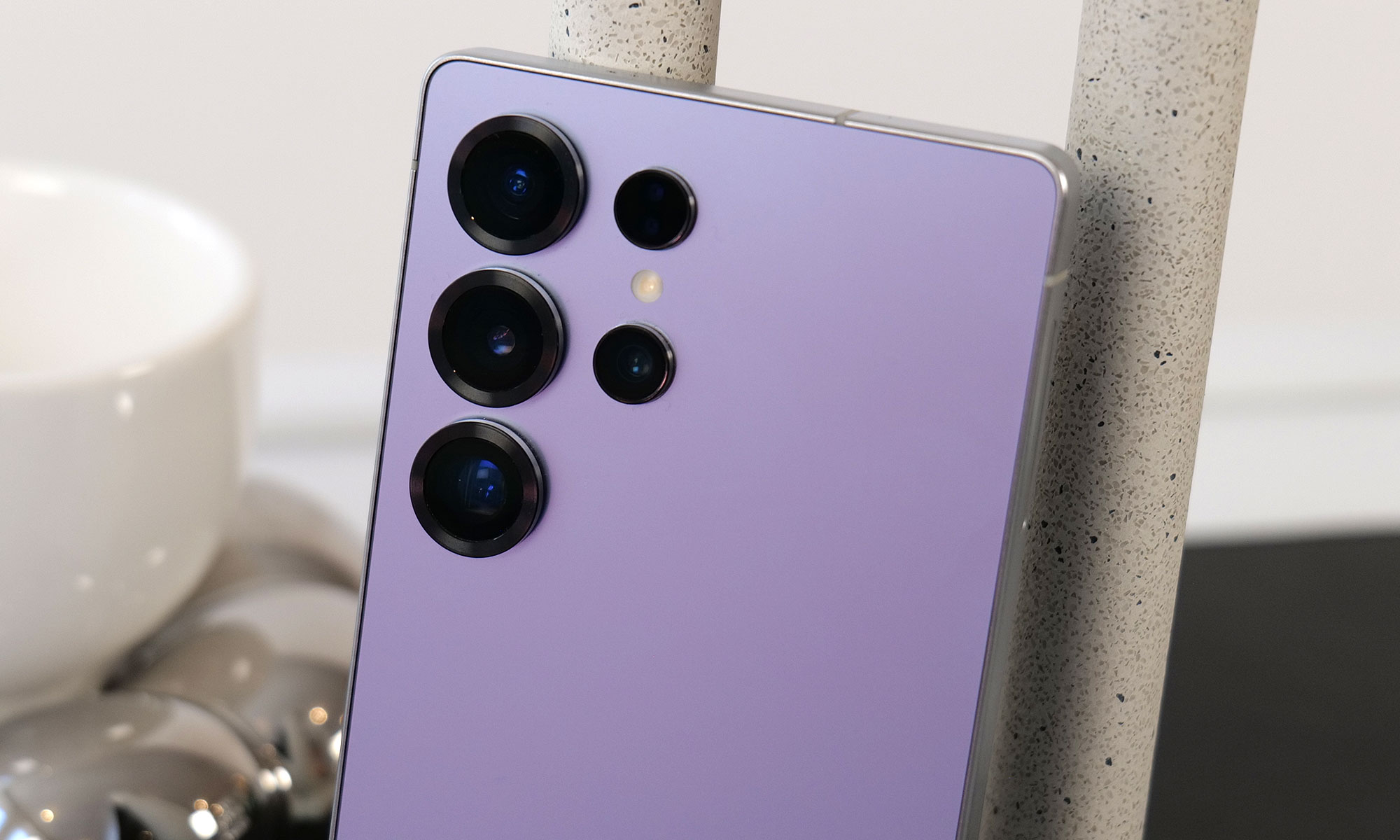 Samsung Galaxy S25 Ultra hands-on photoPhoto by Sam Rutherford/Engadget
Samsung's restrained approach to updating its phones will likely continue with the Galaxy S26. Based on leaked images of the new lineup, the company is not expected to radically reinvent the look of the Galaxy S26, Galaxy S26+ or Galaxy S26 Ultra, and instead will stick with a similar design to what it used on the Galaxy S25. The phones will have a flat front screen and frame, with rounded corners and cameras housed in a vertical pill-shaped plateau on the back. Unlike Apple's move from the iPhone 16 Pro to the iPhone 17 Pro, the biggest difference here will likely be internal components like the screens, chips and camera sensors Samsung uses.
Qualcomm's new Snapdragon 8 Elite Gen 5 chip is expected to be in all Samsung Galaxy S26 phones, though Korean news site Yonhap News reports Samsung's relatively new Exynos 2600 chip could be used in some phones in the lineup depending on the region, a strategy Samsung has deployed in the past. Either way the new phones should be more performant than the previous generation, and in the case of the models with the Snapdragon 8 Elite Gen 5, particularly good at on-device AI processing.
I have compiled the most accurate comprehensive parameter comparison of Galaxy S25, S25+ and Galaxy S26、 S26+. Which one do you want to buy? pic.twitter.com/aQpoSvYjOz
— Ice Universe (@UniverseIce) November 29, 2025
One notable difference between the Galaxy S26 and the Galaxy S25 could be the phone's screen. The new phone will reportedly feature a 6.3-inch FHD+ display according to specs shared by leaker Ice Universe, which makes it ever so slightly larger than the 6.2-inch display used on the Galaxy S25. The S26 will also allegedly come with 12GB of RAM, either 256GB or 512GB of storage and a slightly larger 4,300mAh battery. Samsung isn't changing the cameras on the entry-level phone, though: leaks suggest it'll feature the same 50-megapixel main camera, 12-megapixel ultrawide, 10-megapixel 3x telephoto and 12-megapixel selfie camera as the previous generation. Changes appear to be even more minor on the Galaxy S26+. Other than the new Snapdragon chip, the phone will reportedly feature the same 6.7-inch FHD+ screen, 4,900mAh battery, 12GB of RAM and the same camera array used on the base Galaxy S26.
The difference between the Galaxy S26 Ultra and Galaxy S25 Ultra is reportedly a bit clearer. According to Android Headlines, the new phone's cameras will be slightly more raised, and stand out thanks to a new metallic finish. Samsung may also switch back to using an aluminum frame on the Galaxy S26 Ultra, after using titanium frames on both the Galaxy S24 and S25 Ultras. Most importantly, to make the phone actually support Qi2 rather than only technically work with the standard when a case is attached, rumors suggest Samsung will remove the S Pen digitizer layer in the phone and adopt a new method for accepting stylus input. It's not clear what that new method will actually be, but it could let the Galaxy S26 Ultra more easily work with Qi2 accessories without losing its stylus.
Galaxy Buds 4 Galaxy Buds 3 Pro in case.Engadget
Samsung released the Galaxy Buds 3 and 3 Pro in 2024, with a major redesign that brought them much more in line with Apple's AirPods. The Galaxy Buds 4 and Buds 4 Pro Samsung is rumored to be announcing soon won't necessarily change that, though they will feature a more compact case and less angular stems, according to leaked images from the Samsung Tips app.
Support for head gestures to accept and decline calls, a feature Apple includes on the AirPods Pro 3 and AirPods 4, is also rumored to work on both versions of the new Galaxy Buds. SamMobile reports the Galaxy Buds 4 and 4 Pro may also ship with a new Ultra Wideband chip that will make them easier to find with Google's Find Hub network.
Galaxy Z Trifold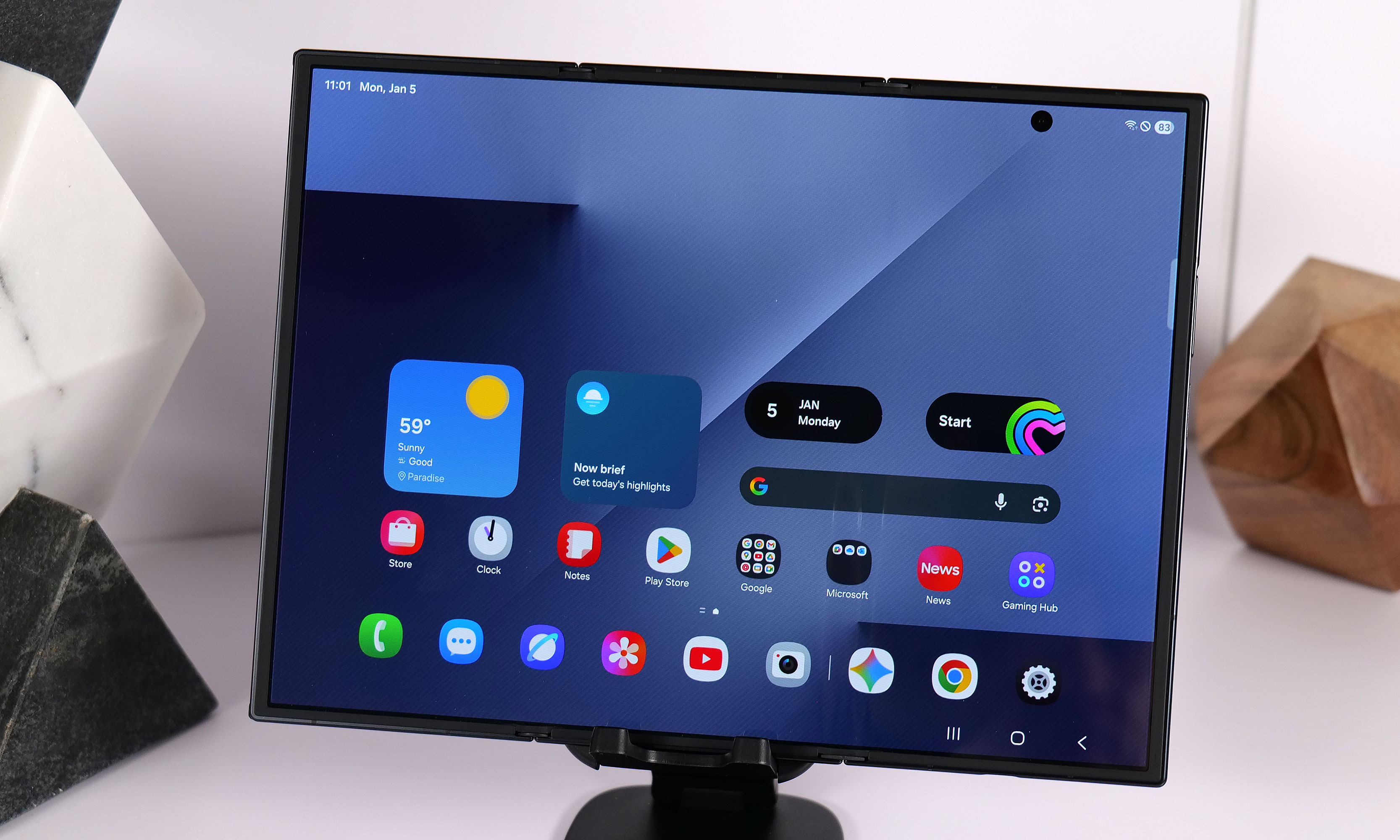 Yes, the TriFold has a crease, two in fact. But they still don't ruin the experience. Sam Rutherford for Engadget
Samsung announced the Galaxy Z TriFold in late 2025 without firm details of when the new smartphone-that-folds-into-a-tablet would be available in North America. That info came on January 27, when the company announced the TriFold would be available in the US on January 30, for a whopping $2,900. Considering we've already seen the device in person at CES 2026 and people are most likely to have had a chance to look at, if not buy the foldable for themselves by the time Unpacked rolls around, we don't expect Samsung to spend too much time dwelling on it, if at all.
Galaxy S26 Edge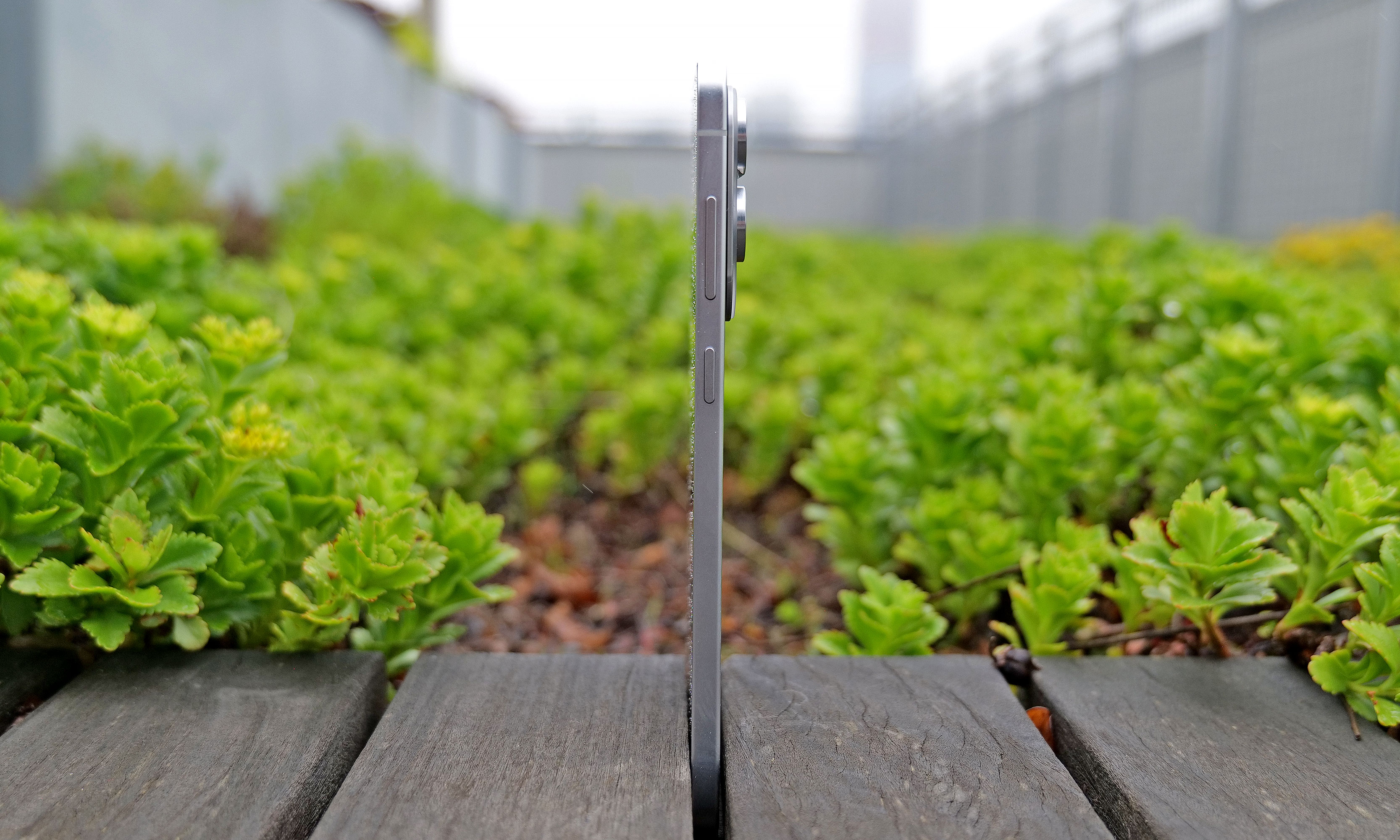 At just 5.8mm thick, the Samsung Galaxy S25 Edge is one of the thinnest smartphones ever made. Sam Rutherford for Engadget
When the Galaxy S25 Edge was announced in 2025, it seemed possible that Samsung could replace its "Plus" smartphone with a unique form factor, just like Apple has opted to do with the iPhone Air. There have been conflicting reports on the matter, but it seems like Samsung will not be doing that with the Galaxy S26 Edge.
Instead, the smartphone will reportedly remain another option, much like foldables are for customers not swayed by Samsung's traditional smartphones. The Galaxy S26 Edge is rumored to feature a slightly different design than last year's model, according to Android Headlines, with a large rectangular camera plateau that's reminiscent of Google's Pixel phones, and the raised oval Apple used on the iPhone Air. Beyond that, the phone is also expected to be ever so slightly thinner at 5.5mm than the 5.8mm Galaxy S25 Edge.
Bixby and other AI featuresSamsung already acts as a first place Google can show off new AI features for Android, but the company is reportedly exploring other AI partnerships, too. In June 2025, Bloomberg reported that Samsung was nearing a deal with Perplexity to integrate its AI-powered search engine across OneUI and its homegrown mobile browser. Perplexity already has a deal with Motorola on its Razr phones, so the only thing that would make a deal with Samsung unusual is the close relationship the company already has with Google.
The company also accidentally announced a new version of its Bixby AI assistant, which will likely also be integrated with Perplexity and could serve as an alternative to Google Gemini. Both a new Bixby and a deeper integration with Perplexity seem like natural new software features to show off at Galaxy Unpacked.
Update, January 27 2026, 11:55AM ET: This story has been updated to reflect the latest news around the Galaxy Z TriFold's price and availability in the US.
Update, January 30 2026, 12:45PM ET: This story has been updated to include the latest leaks on the possible dates for Unpacked 2026.
This article originally appeared on Engadget at https://www.engadget.com/mobile/smartphones/samsung-galaxy-unpacked-2026-the-galaxy-s26-lineup-and-everything-else-we-expect-130000999.html?src=rss Sonos home theater gear is up to 20 percent off ahead of Super Bowl LX [ 30-Jan-26 5:40pm ]Like many other companies during Super Bowl season, Sonos is discounting its home theater gear. Today, you can save $130 on the Beam (Gen 2) soundbar, bringing its price down to $369. You'll also find deals on the flagship Arc Ultra Soundbar, Sonos subwoofers, and more.
The Sonos Beam is the company's sub-$500 soundbar. Engadget's pick for the best midrange model, the compact speaker has impressive sound for its size. Part of that is its Dolby Atmos support. Although the soundbar lacks upward-firing speakers, it uses software tricks to compensate. Audio timing and frequency adjustments make sound seem to come from the side or slightly above.
One of the biggest drawbacks is that the Beam only has one HDMI port. Regardless, that compromise may be easier to accept at Beam's current $369 than at its usual $499.
Several more home theater speakers are included in Sonos's sale. If you have a loftier budget for a soundbar, there's the Arc Ultra. Typically $1,099, it's now $899. The company's pair of subwoofers is included as well. You can get the Sub Mini for $399 (down from $499) or the Sub 4 for $759 (from $899).
Although they aren't explicitly sold as home theater products, the Era 100 ($179) and Era 300 ($379) are also included in the sale. The portable Move 2 isn't discounted individually, but you will find it in a couple of bundles. You can check out the sale page for the complete list.
This article originally appeared on Engadget at https://www.engadget.com/deals/sonos-home-theater-gear-is-up-to-20-percent-off-ahead-of-super-bowl-lx-174053619.html?src=rss
Nobel Hacking Likely Leaked Peace Prize Winner Name, Probe Finds [ 30-Jan-26 6:20pm ]
Feeling taxed by layoffs, IRS turns to AI helpers [ 30-Jan-26 6:01pm ]Tax season 2026 could be an interesting one as the IRS seeks to replace the staff it sent to the unemployment line with AI. Bots could handle tasks ranging from reviewing an org's request for tax-exempt status to processing amended individual filings.…
Do Markets Make Us Moral? [ 30-Jan-26 5:50pm ] 'Call Screening is Aggravating the Rich and Powerful' [ 30-Jan-26 5:20pm ]
The best cheap VPN in 2026 [ 30-Jan-26 5:00pm ]When talking about the best VPNs, I frequently warn about the dangers of trusting free VPNs without verifying them. Although there are a few free VPNs worth recommending, many other free providers are ineffective, malicious or looking to profit off their users (or sometimes all three). Even the best free VPNs work a lot better once you subscribe and access their full service.
This can be frustrating if you want to enjoy the benefits of a VPN but don't have the budget for yet another subscription. To help you out, I put together a list of the best paid VPN services you can get cheaply. Every name on the list comes with my full recommendation — I'll never recommend a VPN that doesn't protect you, no matter how affordable.
Before I get started, I want to define "cheap," since VPNs often bamboozle the customer with muddled pricing schemes. Most providers have long-term subscription plans with big discounts, and many of them compensate by making their monthly plans more expensive. On this list, I'll recommend services with cheap subscriptions for both the short and long term, plus one favorite that balances both.
Other VPNs we tested with good deals
A couple of VPNs have decent pricing options attached to worthy services but weren't quite strong enough to make the list. Both these services get my hearty recommendation; they're just hard to justify as "cheap."
ExpressVPNExpressVPN recently switched to a multi-tier pricing model. The Basic pricing tier gets you complete VPN service but doesn't include the full set of features. The best price on that is $78.18 for 28 months, which works out to $2.79 per month. Although that sounds great, it's more expensive than both Surfshark and CyberGhost at the same duration and renews at the even higher price of $99.95 per year ($8.33 per month).
Still, as I wrote in my full ExpressVPN review, it's an outstanding service overall. Thanks to its sensible app layouts and focus on doing simple tasks well, I find it especially good for introducing beginners to what a VPN can do.
NordVPNNordVPN is another provider that I gave a relatively positive review. I really like its boundary-pushing features, especially the various types of highly specialized servers. Its pricing isn't bad, exactly, but even the Basic level is more expensive than just about everyone else at every duration. NordVPN's fast download speeds and wide server network make it worthwhile for lots of users, but it's hard to recommend to people on a budget.
What to look for in a good cheap VPNLooking for an affordable VPN is the same as looking for any kind of VPN; it just requires more care. The worst VPNs usually present themselves as free, but there's also a fair number of mediocre options that think low prices have to mean a mediocre service. If you want to use a VPN but don't have much extra cash, take some additional care in a few areas of your search.
First, don't subscribe to a VPN — or even download any of its apps — if you haven't verified its security. To do that, start by checking what experts have to say about it. If a VPN is truly unsafe, chances are high that somebody has already sounded the alarm. You can also check the list of protocols the VPN offers. If it's anything other than OpenVPN, WireGuard or IKEv2, do a deep dive to make sure it's using worthwhile encryption.
If you've verified that the VPN isn't a virus, check to see if it has a free trial or a guaranteed money-back period. This will give you some risk-free time to do hands-on tests. Our article on how we test VPNs includes several tests you can run on your own computer, phone or tablet. Check the VPN's speed, make sure it has the server locations you need and look for anything that might be leaking your real IP address.
Read the VPN's privacy policy and make sure you're comfortable with how much information it saves. Some VPNs emphasize privacy more than others. Finally, before your free trial or refund period expires, make sure to double-check on the pricing structure of the VPN you're choosing — it's possible that it will only be cheap for the first subscription period.
This article originally appeared on Engadget at https://www.engadget.com/cybersecurity/vpn/best-cheap-vpn-170000957.html?src=rss
Backblaze says AI traffic and neoclouds could shape future networks [ 30-Jan-26 4:38pm ]Cloud storage firm Backblaze says that a sharp rise in AI-driven data traffic to neocloud operators may signal a shift from internet-style traffic patterns to large, high-bandwidth flows characteristic of large-scale model training and inference work.…
The first season of Amazon's Fallout show is now free on Youtube [ 30-Jan-26 4:29pm ]Fallout's second season is coming to a close, and it's been well worth the wait. But if a reluctance to add yet another subscription to your streaming rotation means you haven't watched Amazon's surprisingly excellent adaptation yet, you might be interested to know that the company is currently releasing season one for free on the Prime Video YouTube channel.
Whether driven by Amazon wanting even more people to watch what has become one of its biggest TV success stories, or a move that speaks to how few people are actually signed up for Prime Video, it's good news for anyone who hasn't seen the show yet. Fallout's first season did a great job of taking everything that's great about the long-running post-apocalyptic RPG series and weaving it into a wildly entertaining live-action show, elevated by excellent performances from Ella Purnell as a hopelessly naive but endearingly optimistic vault-dweller, and Walton Goggins as the Ghoul.
Amazon is currently adding a new episode each day ahead of next week's season two finale, presumably hoping a whole new set of fans hop straight into that once they're done. But here's the catch: you only have until February 11 to watch the whole lot. After that, the show will be for Prime Video subscribers only once again.
And that isn't the the only Fallout freebie up for grabs right now. Between now and February 5, Bethesda's MMORPG, Fallout 76, is free-to-play on Xbox and PC, while PlayStation players have until February 4. Fallout 76 first launched in 2018, and as a fully multiplayer-focused game it represented a new direction for the series. It was, to put it bluntly, a bit of a mess for quite a while, but Bethesda has never abandoned the title or its player-base, and if you have Fallout on the brain, this is the perfect opportunity to see how it's looking in 2026.
This article originally appeared on Engadget at https://www.engadget.com/entertainment/streaming/the-first-season-of-amazons-fallout-show-is-now-free-on-youtube-162920615.html?src=rss
Enshittification Ensures Streaming Prices Soar Faster Than Any Other Consumer Good [ 30-Jan-26 1:26pm ]According to new data from the US Department of Labor's Bureau of Labor Statistics (BLS), streaming video subscription prices jumped a whopping 29 percent year over year. That's compared to the 2.7 percent jump in consumer costs seen more generally across other goods and services.
Of course BLS doesn't explain why streaming video prices are soaring at such a dramatic rate. It's something we've touched on repeatedly: as giant media companies increasingly consolidate, they're trying to find new, frequently obnoxious ways to continue to goose quarterly earnings and create the illusion of perpetual growth despite a major slowdown in new subscribers.
That means significantly more ads (even if you pay for no ads). It means higher overall prices despite a decline in quality. It means layoffs, worse customer service, and companies that refuse to even host popular content they paid for because they're too cheap to pay for residuals. It means new annoying restrictions on what you're paying for, and companies that harass you for sharing your password with your college kid or elderly relative. It means more lazy, clickbait content catering to the lowest common denominator and less quality, thoughtful art.
It means enshittification.
And it's going to get worse. The corrupt Trump administration is demolishing whatever is left of U.S. media consolidation limits, ensuring another massive round of harmful "growth for growth's sake" mergers that temporarily goose earnings, create tax breaks, and badly justify outsized executive compensation, but generally make all of the existing problems in the industry worse (especially for labor and consumers).
According to the BLS, streaming and gaming subscriptions and rentals saw higher "streamflation" (read: price gouging) in 2025 than any of the other industries or services measured. The closest comparison was coffee (28 percent), which is largely soaring due to Trump's ignorant and pointless tariffs that consumers have to pay for.
If you're old enough, you've already watched this play out with traditional cable (many of the executives screwing up streaming were the same ones that screwed up traditional cable). So you know the pattern: they'll continue to push their luck on price hikes, driving many people to free alternatives (or piracy), at which point the executives who made out like bandits blame everyone and everything but themselves.
None of this is reflected honestly by any of the media companies that cover this sort of thing, because their tendency toward honest and courageous journalism is being undermined by the same forces. Like check out this Hollywood Reporter breakdown of the issue, which they dub "streamflation." They amusing hint at the fact there might be causes for this massive surge in pricing, but can't get around to listing any:

Again, because enshittification doesn't discriminate, and the same forces making streaming video more expensive and shittier are taking a hatchet to U.S. journalism and truth in service to the almighty dollar. Corporate media is incapable of reporting honesty about corporate media: there's no money in it.
Farage sucks up to genocidal, authoritarian petro-state in the UAE [ 30-Jan-26 3:22pm ]
Nigel Farage has been in Dubai to drum up donations and lavish praise upon the United Arab Emirates (UAE). The Reform UK leader is a man all too eager to blame Britain's problems on Muslims. But the truth is Farage knows a good thing when he sees it. And by 'good', we mean rich.
Middle East Eye (MEE) exclusively reported details of Farage's Dubai visit on 28 January:
On Wednesday evening, he gave a keynote speech at a private party hosted by GB News, the right-wing British television channel for which Farage is a presenter.
Wait, what? Muslim-bashing nativist channel GB News was in Dubai too? You heard right. And there's more:
Sultan Ahmed Al Jaber, the UAE's minister of industry and advanced technology, attended the party, which was held on the rooftop of the high-end Ritz-Carlton hotel and attended by around eighty people.
Farage made some very appreciative noises about the UAE in his speech to Emirati officials:
We have a lot to learn from you, my dear sirs. We recognise you are our friends.
Adding:
A Brexit London, a Reform London, will remember you.
But what could an upstanding British MP like Nigel Farage possibly admire about a violently authoritarian, genocidal dictatorship with bottomless wealth?
Truly a mystery for the ages…
An international nexus of complete weirdosAlso in attendance at the party was major funder of GB News, Christopher Chandle, who "loves Britain but is too pessimistic to live there". Then there was Reform London mayoral candidate Laila Cunningham, and the disgraced ex-Tory chancellor Nadhim Zahawi, who recently defected to Reform.
MEE said that Farage had been on a charm offensive in the run-up to the visit. In September he publicly called for a UK ban on the Muslim Brotherhood. The UAE has already banned the group.
The Muslim Brotherhood is an international political party and tendency founded in Egypt in 1928. It advances a form of political Islam. The Brotherhood is banned in Egypt and several Gulf dictatorships.
According to MEE:
it is considered a major threat by many autocratic governments in the Middle East and North Africa.
This is because, in rare instances in which free elections are held in the region, parties affiliated with the organisation often win outright or form the largest opposition party.
Farage, a fanatical supporter of the massively rich, spent some time hobnobbing with billionaires based in the region.
MEE reported that the Reform chief had also hosted a private lunch:
with the backing of Dubai-based Indian billionaire Sunny Varkey at Rockfish, a beachside restaurant.
They added:
The lunch was reportedly attended by wealthy UAE-based donors. Farage had visited Abu Dhabi just last month on a trip reportedly paid for by the UAE government.
Apparently the UAE has been keen to cosy up to Reform:
owing to a shared opposition to the Muslim Brotherhood.
That may well be the case. But it sounds like a partial explanation, at best.
Farage, a multi-millionaire banker, knows the value of money. And on balance of probability, he does not spend his time in rooms full of billionaires simply because he enjoys giving speeches.
In the UAE, Farage has a kindred spirit — and a potential financial backer with a keen interest in the shape of Britain's next government.
Featured image via the Canary
By Joe Glenton
Washington Post Raid Is a Frightening Reminder: Turn Off Your Phone's Biometrics Now [ 30-Jan-26 4:13pm ]The recent federal raid on the home of Washington Post reporter Hannah Natanson isn't merely an attack by the Trump administration on the free press. It's also a warning to anyone with a smartphone.
Included in the search and seizure warrant for the raid on Natanson's home is a section titled "Biometric Unlock," which explicitly authorized law enforcement personnel to obtain Natanson's phone and both hold the device in front of her face and to forcibly use her fingers to unlock it. In other words, a judge gave the FBI permission to attempt to bypass biometrics: the convenient shortcuts that let you unlock your phone by scanning your fingerprint or face.
It is not clear if Natanson used biometric authentication on her devices, or if the law enforcement personnel attempted to use her face or fingers to unlock her devices. Natanson and the Washington Post did not respond to multiple requests for comment. The FBI declined to comment.
 Related
FBI Raid on WaPo Reporter's Home Was Based on Sham Pretext
Related
FBI Raid on WaPo Reporter's Home Was Based on Sham Pretext
Natanson has not been charged with a crime. Investigators searched her home in connection with alleged communication between her and government contractor Aurelio Luis Perez-Lugones, who was initially charged with unlawfully retaining national defense information. Prosecutors recently added new charges including multiple counts of transmission of defense information to an unauthorized person. Attorneys for Perez-Lugones did not comment.
The warrant included a few stipulations limiting law enforcement personnel. Investigators were not authorized to ask Natanson details about what kind of biometric authentication she may have used on her devices. For instance, the warrant explicitly stated they could not ask Natanson which specific finger she uses for biometrics, if any. Although if Natanson were to voluntarily provide any such information, that would be allowed, according to the warrant.
 The FBI's search and seizure warrant for Washington Post reporter Hannah Natanson details how authorities could use her fingers or face to unlock her phone. Screenshot: FBI
Andrew Crocker, surveillance litigation director at the Electronic Frontier Foundation, told The Intercept that while the EFF has "seen warrants that authorize police to compel individuals to unlock their devices using biometrics in the past," the caveat mandating that the subject of the search cannot be asked for specifics about their biometric setup is likely influenced by recent case law. "Last year the D.C. Circuit held that biometric unlocking can be a form of 'testimony' that is protected by the 5th Amendment," Crocker said. This is especially the case when a person is "forced to demonstrate which finger unlocks the device."
Crocker said that he "would like to see courts treat biometric locks as equivalent to password protection from a constitutional standpoint. Your constitutional right against self-incrimination should not be dependent on technical convenience or lack thereof."
 Related
Crossing the U.S. Border? Here's How to Protect Yourself
Related
Crossing the U.S. Border? Here's How to Protect Yourself
Activists and journalists have long been cautioned to disable biometrics in specific situations where they might face heightened risk of losing control of their phones, say when attending a protest or crossing a border. Martin Shelton, deputy director of digital security at Freedom of the Press Foundation, advised "journalists to disable biometrics when they expect to be in a situation where they expect a possible search."
Instead of using biometrics, it's safest to unlock your devices using an alphanumeric passphrase (a device protected solely by a passcode consisting of numbers is generally easier to access). There are numerous other safeguards to take if there's a possibility your home may be raided, such as turning off your phone before going to bed, which puts it into an encrypted state until the next time it's unlocked.
That said, there are a few specific circumstances when biometric-based authentication methods might make sense from a privacy perspective — such as in a public place where someone might spy on your passphrase over your shoulder.
The post Washington Post Raid Is a Frightening Reminder: Turn Off Your Phone's Biometrics Now appeared first on The Intercept.
Zohran Mamdani Wants NYC to Divest From Israel — But New Comptroller Pledges to Buy War Bonds [ 30-Jan-26 3:11pm ]In a letter to state and local officials, the human rights organization DAWN warned on Friday that any investment in Israeli sovereign debt by New York City would violate local and international law.
The 26-page letter — directed to New York Mayor Zohran Mamdani, Gov. Kathy Hochul, and the state and city comptrollers — took aim at Israeli bonds, a financial instrument that invests in the Israeli government for a set period and then is paid back with interest.
"New York is using taxpayer money to finance a military the entire world has watched commit war crimes."
Israeli bonds have emerged as a crucial source of funding for the Israeli government, with money from bond sales flowing into the country's coffers and allowing it to continue its genocidal campaign in Gaza and displacement of Palestinians in the West Bank.
"There's no complicated analysis needed here: New York is using taxpayer money to finance a military the entire world has watched commit war crimes and crimes against humanity for years," said Raed Jarrar, DAWN's advocacy director. (Mamdani, City Comptroller Mark Levine, and the other elected officials named in the letter did not immediately respond to a request for comment Friday.)
On top of the financial risk of holding Israeli debt and the moral imperative of ceasing to fund the Israeli government, divesting from Israel bonds would simply put New York more in line with the opinions of its own citizens, said Michael Schaeffer Omer-Man, DAWN's director for Israel and Palestine.
"Where you put your money — that means something," Schaeffer Omer-Man told The Intercept. "We've seen a massive shift in public opinion over the past few years as a result of the Gaza war. The political class hasn't necessarily caught up yet, but support for Palestinians and disapproval for Israel's behavior, actions, and policies is at an all-time high."
New York State's Common Retirement Fund held $352 million worth of Israel bonds as of March 2024, making it one of the largest holdings in the U.S., according to DAWN. And while former City Comptroller Brad Lander allowed the bonds held in city-controlled portfolios to lapse in 2024 — earning DAWN's praise — the city's new comptroller, Levine, has pledged to reinvest.
"Brad Lander understood this and divested," said Jarrar. "Mark Levine's promise to reinvest is a promise to keep funding Israel's war machine with New Yorkers' money."
DAWN pledged to explore legal action against the state for its investment should it decline to divest in the bonds, as well as against the city should Levine's plan move forward.
Levine's announcement of his intent to purchase Israeli government bonds put him at odds with Mamdani, a longtime critic of Israel whose campaign did not shy away from a continued support for Palestinians despite continuous attacks smearing him as an antisemite.
"There's a potential conflict coming up," said Schaeffer Olmer-Man. "I hope that Mamdani holds his ground and exerts whatever influence he has to ensure these imprudent and arguably illegal investments do not renew."
So far, Mamdani has held fast and signaled his opposition to Levine's plan.
"I've made clear my position, which is that I don't think that we should purchase Israel bonds," Mamdani told reporters in an unrelated press conference on January 21. "We don't purchase bonds for any other sovereign nation's debt, and the comptroller has also made his position clear, and I continue to stand by mine."
"You appear to be asking that the City's pension funds treat Israel better than all other countries."
The standoff between the mayor and comptroller is an exact reversal of the dynamic that existed between former Mayor Eric Adams, a staunch supporter of Israel and bonds backer, and Lander, the former comptroller who allowed the city's investment to lapse. At the time, Lander — a self-professed liberal Zionist who has been outspoken in his criticism of the genocide in Gaza — said he as simply doing his job as the steward of the city's investments.
"We consulted our guidelines and made the prudent decision to follow them, and therefore not to continue investing in the sovereign debt of just one country," said Lander in a July 13 letter penned in response to an ally of Adams critical of the move to wind down the city's bonds position. "You appear to be asking that the City's pension funds treat Israel better than all other countries. That would also be politically motivated, and inconsistent with fiduciary duty."
The post Zohran Mamdani Wants NYC to Divest From Israel — But New Comptroller Pledges to Buy War Bonds appeared first on The Intercept.
The UK Paid $5.65 Million For a Bookmarks Site [ 30-Jan-26 4:05pm ] Amazon in Talks To Invest Up To $50 Billion in OpenAI [ 30-Jan-26 3:35pm ]
EU slaps sanctions on Iran, adding Revolutionary Guard to terrorist list [ 30-Jan-26 2:30pm ]
On 29 January, the EU added the Iranian Islamic Revolutionary Guard Corps (IRGC) — a key proponent of Tehran's security apparatus and economy — to its list of terrorist organisations.
They announced on the same day sanctions against a further 15 individuals and six entities in Iran, citing involvement in "serious human rights violations". The move responds to Iran's violent crackdown on anti-government protests which began last month.
Meanwhile, the US is building up military power near Iran, with president Trump deploying the military "armada" to the Middle-East, as the clouds of war loom.
Deadly crackdownRegarding the protests, Bloomberg reported that:
Demonstrations erupted in Tehran late last month after the rial tumbled to a record low, pushing up the price of staples and deepening an economic crisis tied to the sanctioned country's global isolation. Protests have since spread across Iran, spurring its authoritarian religious and military leadership to threaten severe repercussions for what they call "rioters."
Iranian authorities imposed an internet blackout across the country back on 8 January. Because of this, it has been difficult to assess the scale of the violence perpetrated by security forces. Although international news organisations have had little access to Iran, BBC has verified videos of security forces firing live ammunition at protesters.
The Norway-based Iran Human Rights group has estimated that the death toll could top 25,000. However, Tehran has said that only 3,100 people were killed, who it accused of attacking bystanders and security personnel.
'Repression cannot go unanswered'In response to Iran's deadly repressive actions, Italy spearheaded a push within the EU to add the IRGC to its terror list.
This wasn't the first time the designation had been suggested. However, France previously opposed the move, fearful that sanctions would dent diplomatic relations with Iran.
However, on 28 January, France abandoned its usual line on Iran. Instead, it added its political weight to the push to designate the IRGC as a terrorist organisation. The EU's addition of the IRGC to the terror list sees it ranked alongside the likes of al-Qaeda and the Islamic State group.
The IRGC is Iran's primary armed force. It boasts land, air, and sea capabilities, along with an estimated 190,000 active personnel. It also controls the Basij Resistance Force, a paramilitary group within Iran that numbers in the hundreds of thousands.
On 29 January, EU high representative Kaja Kallas posted on social media:
Repression cannot go unanswered. EU Foreign Ministers just took the decisive step of designating Iran's Revolutionary Guard as a terrorist organisation. Any regime that kills thousands of its own people is working toward its own demise.
In designating the IRCG as a terrorist force, the EU joins the US, Canada and Australia. Other countries have already made similar moves.
Sweeping sanctionsThe other 15 individuals subject to EU sanctions include members of Iran's judicial system, several IRGC commanders, ranking officers of the police and the Law Enforcement Force (LEF), and Eskandar Momeni, the head of Iran's National Security Council.
The European Council specifically cited their use of violence, arbitrary detention, and censorship during the protests.
Meanwhile, the sanctioned entities were those responsible for the internet blackout and censorship activities. They consisted of the Seraj Cyberspace Organization, Iranian Audio-Visual Media Regulatory Authority (SATRA), Working Group for Determining Instances of Criminal Content (WGDICC), and three software companies.
In its statement, the European Council explained:
Restrictive measures related to human rights violations in Iran now apply to a total of 247 individuals and 50 entities. They consist of an asset freeze, travel bans to the EU, and a prohibition to make funds or economic resources available to those listed.
However, in spite of the sanctions and re-designation of the IRGC, Kallas reportedly expects that the EU's diplomatic channels with Iran will remain open.
'Fanning the flames'For his part, Abbas Araghchi — the Iranian foreign minister — dismissed the EU's pronouncement as a "stunt" and a "major strategic mistake".
He highlighted that the US was clearly amassing military power within close reach to ran. Araghchi stated that rather than trying to prevent "all-out war in our region", the EU was "busy fanning the flames".
Araghchi also stated that Iran's military was waiting "with their fingers on the trigger", and would "immediately" respond to a US attack.
Regarding the American forces amassing near Iran, the Canary's Joe Glenton explained:
The presence of a credible military force, the aircraft carrier USS Abraham Lincoln, tells its own story. The Lincoln - with her gigantic airpower and accompanying warships — was rerouted on short notice from the Indo-Pacific to the Arabian sea for whatever task Trump envisions.
Trump insists on referring to the fleet as his "beautiful armada" and has pulled US troops out of Qatar. He has talked about protecting protestors as part of his rationale, but also about forcing Iran into submission over a nuclear deal.
Questions currently hang over whether Trump's military power in the region is intended as a show of force, or is a prelude to US strikes on Iran. When asked if he planned to hold talks with Tehran, Trump stated:
On the brinkI have had and I am planning on it. Yes, we have a lot of very big, very powerful ships sailing to Iran right now, and it would be great if we didn't have to use them.
Economic sanctions from the UN and US have already made it near-impossible for Iranian nationals to buy foreign currencies, having cut them off from global banking. Likewise, America also sanctions massive shares of trade with Iran, particularly in the oil markets.
This, in large part, contributed to the recent collapse of the Iranian rial and the country's soaring cost of living. And, in turn, the economic collapse helped spark the last month of deadly protests. In spite of Trump's posturing about helping the demonstrators, he clearly worked to engineer this very situation.
Meanwhile, the EU's designation of the IRGC as a terrorist organisation is a highly unusual move. Typically, the European Council reserves the 'terrorist' label for non-state actors, rather than a country's military.
As such, and despite the fact that the EU has historically tried to hold itself apart from Washington-Tehran conflicts, the bloc now appears to have aligned itself — deliberately or otherwise — with US interests.
Amid ever-escalating sanctions, extreme civil unrest, and US military threat, the Iranian authorities appear to be cornered. They will have little option other than to join 'negotiations' Trump — which is doubtless what the US dictator wanted all along.
Featured image via the Canary
ICE thugs unleash brute force on peaceful anti-ICE march in Texas [ 30-Jan-26 1:27pm ]
Trump's fascist war on peaceful resistance to his racist ICE purge has moved to Texas. ICE thugs and National Guard troops attacked an entirely peaceful anti-ICE march outside ICE's Dilley, Texas concentration camp. Dilley is the camp holding five-year-old Liam Conejos Ramos and his father after ICE abducted Liam to arrest his dad. Liam was described as 'depressed and lethargic' by a Democrat congressman who visited him yesterday.
Conditions in the camp appear grim. A lawyer who stood outside its wall as the march passed recorded detainees, mostly women and children, screaming for help and freedom:
https://www.thecanary.co/wp-content/uploads/2026/01/Texas-March-Attacked-Prisoners-Scream-1-hb.mp4Trump's police state continues to grow.
Featured image via the Canary
By Skwawkbox
Protesters channel Marie Antoinette at Murdoch's London HQ [ 30-Jan-26 1:17pm ]
Activists staged a Marie Antoinette-themed performance at the office of Rupert Murdoch's News UK today, 30 January. They disrupted staff and visitors with theatrical calls to address deep power inequality throughout UK society.
"Stop printing Murdoch's lies""Stop printing Murdoch's lies" and "They are eating all the cake, take the power back" echoed across the foyer, as activists performed a scripted stunt. It left passers-by stunned and intrigued, with others unable to return to their desks post-lunch.
Playing on Marie Antoinette's famous and ill-fated quote "Let them eat cake" in the lead-up to the French Revolution, the campaigners called for the re-establishment of real democracy through redistribution of power across our society.
https://www.thecanary.co/wp-content/uploads/2026/01/newsfall-1.mp4Rose Hopkins, a spokesperson for the Let's Eat Cake campaign said:
For too long, we have allowed a super-rich minority to control the narrative, dictate our economy, and manipulate democracy. While they eat all the cake, they villainise people who are desperately trying to pick up the crumbs and pit them against each other.
The action came after Oxfam released its annual survey of global inequality. It highlights that the super-rich have grown their collective wealth by 81% since 2020. And they're increasingly using their wealth and power to influence politics and society.
Max Lawson, co-author of the report, said:
The economically rich are becoming politically rich the world over, able to shape and influence politics, societies and economies.
In the past, rich people were perhaps more coy about pulling the levers of power, but it's becoming more and more brazen, this kind of marriage between money and politics.
Just three corporations (DMG, News UK and Reach) are responsible for 90% of UK national newspaper circulation. Meanwhile, our online pathways to news are dominated by a handful of American tech giants - predominately Facebook, X and Google.
Featured image and video via Let's Eat Cake
By The Canary
Kidnapped Venezuelan leader Maduro could qualify as prisoner of war [ 30-Jan-26 1:13pm ]
Kidnapped Venezuelan leader Nicolas Maduro could qualify as a prisoner of war (POW). Maduro was snatched from Caracas by the US in a deadly raid on 3 January. But the US has insisted that's armed conflict with Venezuela.
Legal experts from the NGO Just Security now say Maduro could qualify. Maduro and his wife were kidnapped by US special forces, and transported to New York.
In his initial hearing, the former leader claimed prisoner of war status, and pleaded not guilty to drug and weapons offences that he was eventually formally charged with by a US district court.
The first question to consider is whether the US and Venezuela were engaged in an armed conflict. The US amassed military forces in the region for months before the assault. It also carried out dozens of deadly airstrikes against alleged 'narco-terrorist' boats.
The US special forces raid which captured Maduro may have killed up to 100 people. But war was never formally declared. Just Security has suggested that:
By using its armed forces to attack Venezuela, the United States triggered an IAC [international armed conflict] with that State. Under the four 1949 Geneva Conventions, to which all States are party, an IAC exists in "all cases of declared war or of any other armed conflict which may arise between two or more [States], even if the state of war is not recognized by one of them.
Regardless of whether this constitutes war cannot be determined by the intensity of fighting. As the US-based NGO stated:
Any unconsented-to military operations by one State in the territory of another State, including its national airspace and territorial sea, should be interpreted as an armed interference in the latter's sphere of sovereignty and thus may be an international armed conflict.
If that is the true, Maduro is a prison of war. And has the rights of one.
Is he a POW?There are various categories that qualify individuals as POWs. Mostly for military personnel and combatants. But some civilians can qualify too. Just Security said:
We do not know if Maduro is on the Venezuelan armed forces' rolls. He does not appear to hold a classic military rank like "General" or otherwise serve as an officer in the Venezuelan armed forces, although he occasionally wears a uniform for ceremonial purposes (as do heads of State of many countries like the UK).
However, a 2008 law in Venezuelan reminds us that the president (even at the time of his kidnapping) held the rank:
"Commander-in-Chief" and that he can exercise operational command directly or through an active-duty officer.
Therefore:
he almost certainly qualifies as a prisoner of war on this basis alone. But even if that was not the case, there are other theories that could be proffered to support entitlement to that status.
Just Security look at other ways in which Maduro might qualify. But the important point is that POW status gives captives particular rights…
POW rights: what do they mean?Just Security said if you're a POW, the Geneva Convention entitles you:
to specific treatment with respect to… food, housing, medical care, work, contact with the outside, and ICRC visitation.
The ICRC is the International Committee of the Red Cross.
And this is where the US has to tread carefully. In theory anyway, the Trump administration does not seem to feel overly restrained by international law…
However, legally, Just Security said the US must do one of three things:
1) afford him that status, 2) seek a judicial determination of his status, or 3) convene an Article 5 tribunal to make a status determination.
Basically, they need to clarify Maduro's status, because:
…failure to take one of these three steps would constitute a violation of U.S. obligations under the third Geneva Convention and customary international law.
Trump's belligerence, both at home and abroad, suggest he isn't too concerned about the rule of law — that won't bode well for Maduro. While American judges have challenged Trump's erratic behaviour, Maduro's anticipated trial in March 2026 will serve as a key test for the Trump's 'frontier justice' approach to foreign policy.
Featured image via the Canary
By Joe Glenton
Apple buys "Silent Speech" AI startup for $2B, because talking is so 2025 [ 30-Jan-26 1:52pm ]
Apple confirmed this week that it has acquired Israeli AI startup Q.ai in a deal valued at close to $2 billion, making it one of the company's largest acquisitions ever, second only to the $3 billion purchase of Beats in 2014. But check your assumptions: this isn't Beats 2.0. There's no new headphone brand to flex. Instead, Apple is paying top dollar for tech that might let your devices understand you without you ever saying a word. These days we put our phones on silent so they won't disturb us; soon the phone will put us on silent so it…
This story continues at The Next Web
Or just read more coverage about: Apple
How to watch the 2026 Grammy Awards: TV channel, start time, where to stream, nominations list and more [ 30-Jan-26 3:00pm ]The 2026 Grammy Awards honor music's biggest achievements of the year, and some of the biggest stars on the planet are nominated this year. Kendrick Lamar leads the way with nine nominations, including for Record and Song of the Year for "luther," his collaboration with SZA. Other top nominees this year include Lady Gaga, Jack Antonoff, and Cirkut with seven nominations apiece, and Bad Bunny, Sabrina Carpenter, and Leon Thomas, who have six. The 2026 Grammy Awards will be hosted by comedian Trevor Noah, who also happens to be a nominee this year in the Best Audio Book, Narration & Storytelling category.
The 2026 Grammys will take place at Crypto.com Arena in Los Angeles, and the broadcast will air this Sunday, Feb. 1, at 8PM ET/5PM PT on CBS, streaming live on Paramount+ (for Premium subscribers only). The 2026 Grammy Awards Premiere Ceremony — where the majority of the Grammys are actually awarded — will take place earlier that same day, from 3:30PM ET/12:30PM PT, and streams live free on YouTube.
Here's how to watch the 2026 Grammy Awards live this Sunday.
When are the 2026 Grammy Awards?The 68th Grammy Awards will be held this Sunday, Feb. 1, 2026.
Grammys start timeThe Grammy Awards live TV broadcast begins at 8PM ET/5PM PT. It's scheduled to run until 11:30PM ET.
Prior to the main broadcast, the 2026 Grammy Awards Premiere Ceremony (this is where you can watch the awards for categories like Musical Theater, Americana, Reggae, Metal, Gospel and more) will take place from 3:30PM ET/12:30PM PT. The Grammys Premiere Ceremony will stream live for free at live.GRAMMY.com and on YouTube.
Grammy Awards TV channelThe 68th Grammy Awards will air on CBS and stream live on Paramount+ for Premium subscribers. The awards show will also be available the following day on demand for Paramount+ Essential subscribers.
How to watch the Grammys without cableHow to watch the 2026 Grammys free
Who is performing at the 2026 Grammy Awards?
Among this year's Grammy's performers are Justin Bieber, Sabrina Carpenter, Album of the Year nominees Clipse and Pharrell Williams, and every Best New Artist nominee, including Addison Rae, Alex Warren, KATSEYE, Leon Thomas, Lola Young, Olivia Dean, SOMBR, and The Marías.
This year's In Memorium honoring artists we've lost this year will include a musical tribute from Reba McEntire, Brandy Clark and Lukas Nelson, a performance from Ms. Lauryn Hill in honor of D'Angelo and Roberta Flack, and an Ozzy Osbourne tribute from artists like Post Malone, Andrew Watt, Chad Smith, Duff McKagan, and Slash.
Who is hosting the Grammys this year?Trevor Noah will return to host the Grammys for the sixth and final year.
Who is presenting at the 2026 Grammys?While the full list of Grammys presenters has yet to be released, we do know that Harry Styles and Doechii will be presenting.
Grammy Awards new categoriesThis year's Grammys will see the return of the award for Best Album Cover (after 53 years!). This year, the category of Best Country Album will now be split into two awards: Best Contemporary Country Album and Best Traditional Country Album.
Grammys eligibility windowThe 2026 Grammy Awards will recognize music released from August 31, 2024 to August 30, 2025.
2026 Grammy nominationsHere are the nominees for the 68th Grammy Awards.
Album of the YearBad Bunny — Debí Tirar Más Fotos
Justin Bieber — Swag
Sabrina Carpenter — Man's Best Friend
Clipse, Pusha T & Malice — Let God Sort Em Out
Lady Gaga — Mayhem
Kendrick Lamar — GNX
Leon Thomas — Mutt
Tyler, the Creator — Chromakopia
Bad Bunny — "DtMF"
Sabrina Carpenter — "Manchild"
Doechii — "Anxiety"
Billie Eilish — "Wildflower"
Lady Gaga — "Abracadabra"
Kendrick Lamar feat. SZA — "Luther"
Chappell Roan — "The Subway"
Lady Gaga — "Abracadabra"
Doechii — "Anxiety"
ROSÉ & Bruno Mars — "APT."
Bad Bunny — "DtMF"
HUNTR/X (EJAE, Audrey Nuna, REI AMI) — "Golden"
Kendrick Lamar feat. SZA — "Luther"
Sabrina Carpenter — "Manchild"
Billie Eilish — "Wildflower"
Olivia Dean
KATSEYE
The Marías
Addison Rae
sombr
Leon Thomas
Alex Warren
Lola Young
Justin Bieber — "Daisies"
Sabrina Carpenter — "Manchild"
Lady Gaga — "Disease"
Chappell Roan — "The Subway"
Lola Young — "Messy"
Justin Bieber — Swag
Sabrina Carpenter — Man's Best Friend
Miley Cyrus — Something Beautiful
Lady Gaga — Mayhem
Teddy Swims — I've Tried Everything But Therapy (Part 2)
Bon Iver — Sable, Fable
The Cure — Songs of a Lost World
Tyler, the Creator — Don't Tap the Glass
Wet Leg — Moisturizer
Hayley Williams — Ego Death at a Bachelorette Party
Deftones — Private Music
HAIM — I Quit
Linkin Park — From Zero
Turnstile — Never Enough
YUNGBLUD — Idols
Clipse, Pusha T & Malice — Let God Sort Em Out
GloRilla — Glorious
JID — God Does Like Ugly
Kendrick Lamar — GNX
Tyler, the Creator — Chromakopia
GIVĒON — Beloved
Coco Jones — Why Not More?
Ledisi — The Crown
Teyana Taylor — Escape Room
Leon Thomas — Mutt
Kelsea Ballerini — Patterns
Tyler Childers — Snipe Hunter
Eric Church — Evangeline vs. The Machine
Jelly Roll — Beautifully Broken
Miranda Lambert — Postcards From Texas
Charley Crockett — Dollar a Day
Lukas Nelson — American Romance
Willie Nelson — Oh What a Beautiful World
Margo Price — Hard Headed Woman
Zach Top — Ain't In It for My Health
Dan Auerbach
Cirkut
Dijon
Blake Mills
Sounwave
Amy Allen
Edgar Barrera
Jessie Jo Dillon
Tobias Jesso Jr.
See the full list at Grammy.com.
This article originally appeared on Engadget at https://www.engadget.com/entertainment/streaming/how-to-watch-the-2026-grammy-awards-tv-channel-start-time-where-to-stream-nominations-list-and-more-150015179.html?src=rss Engadget Podcast: What do prediction markets like Kalshi cost us? [ 30-Jan-26 2:31pm ]Somehow, we live in a world where people can bet on practically anything using sites like Polymarket and Kalshi. In this episode, Devindra and Engadget Senior Reporter Karissa Bell dive into the world of prediction markets. How did we get here? And is endless betting having an effect on the real world? Also, we chat about the new American version of TikTok, which stumbled during its first weekend with a litany of errors and reported censorship.
Subscribe!TopicsWho's going to buy the Samsung Galaxy Z Tri-fold for $2900? - 1:18
Tesla is killing off the Model X and S lines to focus on its Optimus robot moonshot - 6:46
Amazon plans to cut 16,000 jobs and close its grocery stores in another round of restructuring - 10:45
Most of the UK will lose access to Pornhub in a fight over age verification and privacy - 21:16
Internal messages from Meta about Instagram being 'a drug' for teens could be bombshell evidence at trial - 26:59
What are prediction markets and why are they suddenly so popular? - 32:11
As TikTok US stumbles, users ask 'is it server problems or censorship?' - 46:55
Around Engadget - 59:11
Pop culture picks - 1:01:23
Hosts: Devindra Hardawar and Karissa Bell
Producer: Ben Ellman
Music: Dale North and Terrence O'Brien
Microsoft is Experimenting With a Top Menu Bar for Windows 11 [ 30-Jan-26 3:05pm ]
Oracle seeks to build bridges with MySQL developers [ 30-Jan-26 2:42pm ]Oracle is taking steps to "repair" its relationship with the MySQL community, according to sources, by moving "commercial-only" features into the database application's Community Edition and prioritizing developer needs.…
Autonomous cars, drones cheerfully obey prompt injection by road sign [ 30-Jan-26 2:27pm ]Indirect prompt injection occurs when a bot takes input data and interprets it as a command. We've seen this problem numerous times when AI bots were fed prompts via web pages or PDFs they read. Now, academics have shown that self-driving cars and autonomous drones will follow illicit instructions that have been written onto road signs.…
Backseat Software [ 30-Jan-26 2:35pm ]
Want digital sovereignty? That'll be 1% of your GDP into AI infrastructure please [ 30-Jan-26 1:42pm ]Countries intent on digital sovereignty will need to invest at least 1 percent of their entire gross domestic product (GDP) into AI infrastructure by 2029, according to analyst biz Gartner.…
Sony A7 V review: Awesome speed and photo quality [ 30-Jan-26 1:00pm ]Sony A7 series camera launches are eagerly anticipated by camera lovers, as those models are typically a showcase for the company's latest imaging tech. The new A7 V is a great example of that: it's equipped with Sony's new 33-megapixel partially-stacked sensor — the most advanced in any midrange full-frame mirrorless model.
The A7 V's resolution is higher than rivals like Panasonic's S1 II and the Nikon Z6 III in this category while matching Canon's R6 III. However, Sony trumps the latter with a faster sensor that promises lower rolling shutter distortion in electronic mode. Sony also boasts that it offers the highest dynamic range of any of its cameras to date.
Unlike Canon with the R6 III, Sony didn't bend over backwards to accommodate creators, though. Video resolution is limited to 4K, and the A7 V lacks any RAW video capability, compared to 7K and RAW for Canon's latest model. All of that means the A7 V may be great for some buyers, but fall short for others.
Design and handlingLike other recent Sony cameras, I didn't find the A7 V comfortable to hold for long periods of time. That's because the grip, while deep, is a bit short and too small for large hands. At the same time, it has harder exterior materials than Canon's cameras and is a bit heavier than the A7 IV at 1.53 pounds (698 grams) compared to 1.45 pounds (653 grams) for its predecessor.
The handling makes up for the lack of comfort, though. It has two dials for the primary controls (shutter speed and aperture), along with a third for exposure compensation. There's a dual dial with a shooting mode on top and video/photo/S&Q below, plus a rear joystick, rear dial and nine buttons. The main controls fell nicely to my hands, which made camera control a cinch.
The A7 V has the same well-organized menu system as other recent Sony models and it's easy to customize dials, buttons and quick menus to your liking. Overall, Sony's menus are now among the best, and functions are easier to access than on Canon's R6 III, for example.
The 3.69-million dot EVF display is relatively sharp and on par with the R6 III, but falls short of 5.76-million-dot EVF on the significantly cheaper Nikon Z6 III. The 3.2-inch rear display fully articulates as before, but it also tilts now, so I was able to easily shoot from high and low angles. It's also slightly bigger and has 2.1 million dots, up from 1.65 million dots on the A7 IV.
The A7 V has a dual-slot card system with two SD UHS II slots and a faster CFexpress Type A slot. However, Type A CFexpress cards are less than half as fast as the CFexpress B cards used in other cameras. The A7 V includes a full-sized HDMI port for external display, 3.5mm mic and headphone ports, and two USB-C ports — one for charging and one for 10Gbps data transfers. Battery life is decent with up to 630 shots on a charge or 100 minutes of continuous 4K 30 fps capture. The camera isn't constrained much by temperature limits, as I was able to shoot 4K 30p video for 90 minutes straight with no issues.
PerformanceThe 33MP partially-stacked sensor has made a big difference in the A7 V's speed and autofocus accuracy. It can now hit 30 fps blackout-free RAW burst speeds with the electronic shutter (with autofocus and auto exposure enabled), compared to an anemic 10 fps with the A7 IV. That makes it a surprisingly good choice for sports and wildlife photography, or just shooting fast-moving kids or pets. Speeds drop to 10 fps in mechanical shutter mode, which is on par for this category.
 ISO 6400, f/2.8, 1/40th
Steve Dent for Engadget
ISO 6400, f/2.8, 1/40th
Steve Dent for Engadget
Rolling shutter distortion is only an issue when shooting super fast subjects like airplane propellers or golf swings. And unlike Canon's R6 III and other rivals, the A7 V maintains full 14-bit RAW quality during electronic shutter bursts instead of dropping to 12-bit RAW, which allows for higher dynamic range.
As you'd expect with Sony, autofocus is fast and extremely accurate, delivering the best in-focus hit rate of any camera in this price range. When tracking moving subjects like bikes, birds or kids, I rarely saw a blurry shot. This applied even in tricky lighting and chaotic situations with multiple subjects. The A7 V also nailed auto exposure and auto white balance, even when I shot at dusk with a mix of indoor and outdoor lighting.
Sony's latest AI features make it easy to track nearly anything. Face, eye and body tracking are supported for people, and you can also follow animals, birds, insects, cars, trains and airplanes. The AI has been trained to track people in any position, even if they're partially obscured or disappear in the frame. This proved to be convenient when I shot street photos in crowds with a specific subject in mind.
This does bring up one sore point with the A7 V. When using third-party lenses, the burst rate speeds drop from 30 fps to 15 fps. In addition, you may not be able to use some lenses at all in AF-C (continuous) mode without applying a firmware update.
In-body stabilization is improved significantly over the A7 IV from 5.5 to 7.5 stops with compatible lenses, but falls short of all rivals that hit at least eight stops. Still, I was comfortably able to shoot at shutter speeds as low as a half second handheld without any camera blur.
Image qualityPhoto quality is where the A7 V shines. Dynamic range is superior to rival cameras, both in the real world and specialized testing. This is due to Sony's latest dual gain output tech that combines two ISO levels at once integrated with the new 33MP partially-stacked sensor (when using the mechanical shutter).
I noticed this when taking photos at twilight in several of Paris' squares. After shooting a statue against a bright sky, I was able to extract noise-free shadow detail from RAW files and easily adjust bright areas. When shooting ducks in water that reflected a bright sky, I saw similarly high levels of detail in both dark and bright picture areas. There is one thing to keep in mind, though: As Photons to Photos noted, there's a slight drop in dynamic range below ISO 1,000 when using the electronic shutter.
Should you need even more detail and dynamic range, Sony's new Composite RAW feature that's borrowed from the A9 III combines four, eight, 16, or 32 RAW images to reduce noise and improve image quality. I used it to photograph some high-contrast scenes on a sunny Paris day and it dramatically reduced noise, but isn't a good option for moving subjects.
 Sony's A7 V has plenty of manual controls for easy operation
Steve Dent for Engadget
Sony's A7 V has plenty of manual controls for easy operation
Steve Dent for Engadget
JPEGs look great straight out of the camera with excellent detail, though noise reduction can be a bit excessive at high ISOs. Sony's color science has improved over the last model, so colors are accurate and the magenta-hue issues seem to be largely resolved. However,I still find Canon's cameras capture more accurate skin tones.
The A7 V is a low-light marvel, with relatively noise-free photos all the way up to ISO 12,800 and usable shots at ISO 25,600. What's remarkable is that the A7 V beats all its 24MP rivals in this regard, despite the nearly 50 percent higher resolution.
Sony added a new "Compressed RAW HQ" mode with the A7 V, designed to deliver better compressed RAW quality while keeping files smaller than "Lossless RAW." Note that this new mode is not currently supported by Adobe Lightroom, so I'd avoid using it for now.
Video Sony's A7 V can take sharp video but doesn't stand up against rivals.
Sony
Sony's A7 V can take sharp video but doesn't stand up against rivals.
Sony
Two or three years ago, the A7 V would have been fine for video but not in 2026. While all its rivals are embracing internal RAW video at 6K or 7K, Sony is sticking with 10-bit 4K MP4 at up to 60 fps, or 4K 120 with an APS-C crop. The video is oversampled from a 7K sensor size so it's very sharp though, and S-Log3 is available to boost dynamic range.
Sony likely thinks that creators using this camera will mostly shoot 4K MP4 (as I do), so it didn't feel that RAW was a must. However, users who do need the benefits of RAW — like minimal degradation when editing, flexible white balance and improved dynamic range — can't even do external RAW capture. The 4K max resolution and lack of open gate 3:2 is also a downside for creators who like to reframe shots in post or output to social media.
With that all said, you can capture high-quality 10-bit 4K 60 fps video with the A7 V. The S-Log3 Cine/S-Log 3 option and high data rate 4:2:2 HS video provide flexibility in post, letting you easily correct over- or under-exposed video or tweak colors. As with photos, color accuracy is nearly on par with Panasonic and other rivals. Shooting in low-light is a breeze, especially when you know that noise levels will be minimal even at high ISO speeds.
Sony has some extra video tricks like focus breathing compensation that eliminates zooming when focusing from a near to a far subject. And the A7 V comes with a new AI Auto Framing mode, which recognizes and crops in on humans, keeping them centered in the frame. I was able to keep subjects centered (while stabilizing the shot) as long as I didn't move the camera excessively.
Autofocus is just as excellent for video as photos, with the same level of speed and accuracy. AI-powered autofocus supports all the same modes (people, animals, etc.) and usually nails focus of human or animal eyes, like when I captured footage of some ducks and dogs.
Video stabilization is also very good, just behind Panasonic's S1 II and ahead of the Canon R6 III. In regular optical-only mode, it removes shaking from handheld video without too much movement. When you engage the "Active" mode, it adds electronic stabilization with a small crop for panning or tilting, and "Dynamic Active" lets you walk with surprisingly smooth results. Rolling shutter is rarely an issue for most types of shooting, including walking, unless you really whip the camera around. The lack of rolling shutter skew also makes it easier to apply stabilization in post with Adobe Premiere or DaVinci Resolve.
Wrap-up ISO 800, f/2.8, 1/500th
Steve Dent for Engadget
ISO 800, f/2.8, 1/500th
Steve Dent for Engadget
The A7 V is an incredible camera for photography, with speeds, autofocus accuracy and image quality ahead of rivals, including the Canon R6 III, Panasonic S1 II and Nikon Z6 III.However, Sony isn't keeping up with those models for video. The A7 V is missing RAW, native resolution and open gate capture, all of which can be found on the aforementioned cameras. That makes it hard to recommend for serious video users or creators who use full-frame open gate to export high-quality vertical video.
There's one intangible, though. I enjoyed taking pictures with the A7 V more than other cameras I've tested lately because of the AF accuracy and image results. For anyone who wants a fast, reliable and easy-to-use camera for photography, I can't recommend it enough. For video creators, though, I'd look at Canon's R6 III, the Panasonic S1 II, or if you're on a budget, Nikon's Z6 III.
Unable To Stop AI, SAG-AFTRA Mulls a Studio Tax On Digital Performers [ 30-Jan-26 1:20pm ]
iPhone Fold rumors: Everything we know so far, including the leaked design [ 30-Jan-26 1:00pm ]Apple has yet to announce a foldable iPhone, but after years of speculation, the outlines of what's often referred to as the iPhone Fold are starting to come into focus. Multiple analysts and leakers now agree that Apple is targeting a late-2026 launch window for its first foldable phone, positioning it as a premium flagship rather than a niche experiment.
As with all pre-launch Apple products, nothing here is official. Plans can change, features can be dropped and timelines can slip. Still, recent reports paint the clearest picture yet of how Apple might approach a foldable iPhone and how it plans to differentiate itself from rivals like Samsung and Google.
Below is a roundup of the most credible iPhone Fold rumors so far, covering its possible release timing, design, display technology, cameras and price. We'll continue to update this post as more rumors and details become available.
When could the iPhone Fold launch?Rumors of a foldable iPhone date back as far as 2017, but more recent reporting suggests Apple has finally locked onto a realistic window. Most sources now point to fall 2026, likely alongside the iPhone 18 lineup.
Mark Gurman has gone back and forth on timing, initially suggesting Apple could launch "as early as 2026," before later writing that the device would ship at the end of 2026 and sell primarily in 2027. Analyst Ming-Chi Kuo has also repeatedly cited the second half of 2026 as Apple's target.
Some reports still claim the project could slip into 2027 if Apple runs into manufacturing or durability issues, particularly around the hinge or display. Given Apple's history of delaying products that it feels aren't ready, that remains a real possibility.
What will the iPhone Fold look like?Current consensus suggests Apple has settled on a book-style foldable design, similar to Samsung's Galaxy Z Fold series, rather than a clamshell flip phone.
When unfolded, the iPhone Fold is expected to resemble a small tablet like the iPad mini (8.3 inches). Based on the rumor mill, though, the iPhone Fold may be a touch smaller, with an internal display measuring around 7.7 to 7.8 inches. When closed, it should function like a conventional smartphone, with an outer display in the 5.5-inch range.
CAD leaks and alleged case-maker molds suggest the device may be shorter and wider than a standard iPhone when folded, creating a squarer footprint that better matches the aspect ratio of the inner display. Several reports have also pointed to the iPhone Air as a potential preview of Apple's foldable design work, with its unusually thin chassis widely interpreted as a look at what one half of a future foldable iPhone could resemble.
If that theory holds, it could help explain the Fold's rumored dimensions. Thickness is expected to land between roughly 4.5 and 5.6mm when unfolded, putting it in a similar range to the iPhone Air, and just over 9 to 11mm when folded, depending on the final hinge design and internal layering.
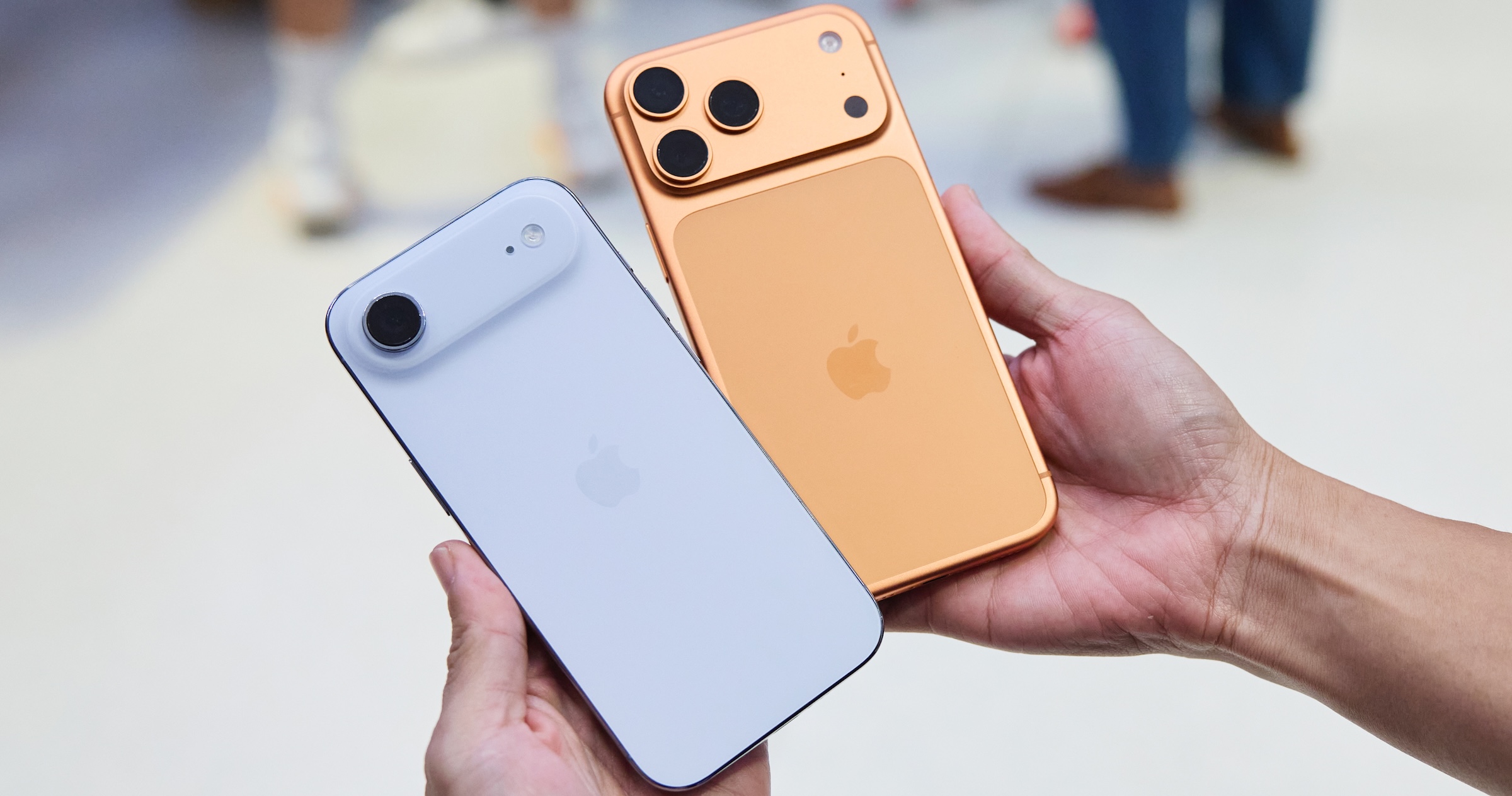 iPhone 17 Pro, iPhone AirEngadgetDisplay and the crease question
The display is arguably the biggest challenge for any foldable phone, and it's an area where Apple appears to have invested years of development.
Multiple reports say Apple will rely on Samsung Display as its primary supplier. At CES 2026, Samsung showcased a new crease-less foldable OLED panel, which several sources — including Bloomberg — suggested could be the same technology Apple plans to use.
According to these reports, the panel combines a flexible OLED with a laser-drilled metal support plate that disperses stress when folding. The goal is a display with a nearly invisible crease, something Apple reportedly considers essential before entering the foldable market.
If Apple does use this panel, it would mark a notable improvement over current foldables, which still show visible creasing under certain lighting conditions.
Cameras and biometricsCamera rumors suggest Apple is planning a four-camera setup. That may include:
Two rear cameras (main and ultra-wide, both rumored at 48MP)
One punch-hole camera on the outer display
One under-display camera on the inner screen
Several sources claim Apple will avoid Face ID entirely on the iPhone Fold. Instead, it's expected to rely on Touch ID built into the power button, similar to recent iPad models. This would allow Apple to keep both displays free of notches or Dynamic Island cutouts.
Under-display camera technology has historically produced lower image quality, but a rumored 24MP sensor would be a significant step up compared to existing foldables, which typically use much lower-resolution sensors.
iPhone Fold's hinge and materialsThe hinge is another area where Apple may diverge from competitors. Multiple reports claim Apple will use Liquidmetal, which is a long-standing trade name for a metallic glass alloy the company has previously used in smaller components. While often referred to as "liquid metal" or "Liquid Metal" in reports, Liquidmetal is the branding Apple has historically associated with the material.
Liquidmetal is said to be stronger and more resistant to deformation than titanium, while remaining relatively lightweight. If accurate, this could help improve long-term durability and reduce wear on the foldable display.
Leaks from Jon Prosser also reference a metal plate beneath the display that works in tandem with the hinge to minimize creasing — a claim that aligns with reporting from Korean and Chinese supply-chain sources.
Battery and other componentsBattery life is another potential differentiator. According to Ming-Chi Kuo and multiple Asian supply-chain reports, Apple is testing high-density battery cells in the 5,000 to 5,800mAh range.
That would make it the largest battery ever used in an iPhone, and competitive with (or larger than) batteries in current Android foldables. The device is also expected to use a future A-series chip and Apple's in-house modem.
PriceNone of this will come cheap, that's for certain. Nearly every report agrees that the iPhone Fold will be Apple's most expensive iPhone ever.
Estimates currently place the price between $2,000 and $2,500 in the US. Bloomberg has said the price will be "at least $2,000," while other analysts have narrowed the likely range to around $2,100 and $2,300. That positions the iPhone Fold well above the iPhone Pro Max and closer to Apple's high-end Macs and iPads.
Despite years of rumors, there's still plenty that remains unclear. Apple hasn't confirmed the name "iPhone Fold," final dimensions, software features or how iOS would adapt to a folding form factor. Durability, repairability and long-term reliability are also open questions. For now, the safest assumption is that Apple is taking its time and that many of these details could still change before launch.
This article originally appeared on Engadget at https://www.engadget.com/mobile/smartphones/iphone-fold-rumors-everything-we-know-so-far-including-the-leaked-design-130000516.html?src=rss DeepSeek reportedly gets China's approval to buy NVIDIA's H200 AI chips [ 30-Jan-26 1:00pm ]The Chinese government has given DeepSeek its approval to purchase NVIDIA's H200 AI chips, according to Reuters. ByteDance, Alibaba and Tencent have also reportedly received permission from Beijing to buy a total of 400,000 H200 GPUs. Reuters says Chinese authorities are still finalizing the conditions they're imposing on the companies to be able to proceed with their orders, so it may take a while before they're able to receive their shipments. In addition, NVIDIA CEO Jensen Huang told reporters that his company has yet to receive orders from the aforementioned firms and that he believed China is still finalizing their licenses.
In December 2025, the US government allowed NVIDIA to sell its second-best H200 processors to vetted Chinese companies in addition to its H20 model in exchange for a 25 percent tariff on those sales. China previously dissuaded local companies from purchasing NVIDIA's H20 chips, but it recently agreed to import hundreds of thousands of H200 units after Huang's visit to the country. While Chinese companies are striving to rely on local manufacturers, such as Huawei and Baidu, for AI chips, NVIDIA's technology is still more advanced. The H200 is only second to NVIDIA's B200 and is around six times more powerful than the H20.
China's National Development and Reform Commission is the agency in charge of determining the conditions Chinese companies have to meet in order to buy H200 units. Stateside, DeepSeek's purchase could lead to questions from authorities. As Reuters notes, a lawmaker has just accused NVIDIA of helping DeepSeek develop AI models that were subsequently used by the Chinese military.
This article originally appeared on Engadget at https://www.engadget.com/ai/deepseek-reportedly-gets-chinas-approval-to-buy-nvidias-h200-ai-chips-130000933.html?src=rss The Morning After: The Nex Playground channels the spirit of Xbox's Kinect [ 30-Jan-26 12:15pm ]You might not have heard of the Nex Playground, but it's a tiny gaming system built entirely around Kinect-like games. With its camera and computer vision processing, the $249 Nex Playground can track up to four players as effectively as Microsoft's old Xbox motion tracker, according to Engadget's Devindra Hardawar.
 NEXNEX
The hardware is cute and well-designed, there are plenty of games, and it works offline. The only issue is the ongoing subscription needed to access most games. Check out our full review to learn more.
— Mat Smith
The biggest stories you might have missedSamsung Galaxy Unpacked 2026: Everything we think the company will unveil
Native Instruments enters insolvency proceedings, leaving its future uncertain
Mark Zuckerberg says Reality Labs will (eventually) stop losing so much money
Even if demand for Optimus is still unknown.
 TMATesla
Tesla is going to wrap up production of its Model S and X EVs next quarter, CEO Elon Musk has announced. It's less of a major shift for the company than it sounds: The newer Model 3 and Y now make up the bulk of the company's sales. Tesla delivered over 1.5 million Model 3 and Y vehicles but sold under 450,000 Model S and X units. Musk added that Tesla's long-term goal is to manufacture 1 million Optimus robots in the current Model S and X production space.
Snap makes its AR glasses into a separate businessIt'll still be under the umbrella of Snap.
Snap's augmented reality glasses business will now be its own company called Specs Inc. It'll still be fully owned by Snap, though. The company has been trying to figure out ways to raise outside money for its AR glasses to better compete with Meta, which has a lot more money to spend on development. Earlier this week, Mark Zuckerberg said his Reality Labs will (eventually) stop losing so much money as it doubles down on AI glasses and shifts away from virtual reality. According to the Meta boss, the company's smart glasses sales "more than tripled" in 2025.
How can Snap's Specs match the might of Meta? Well, its next pair will apparently be lighter, smaller and more capable than its older smartglass model, which was pretty dev-focused. One request: make them not look awful.
The best TV deals ahead of Super Bowl 2026Maybe it's time for an upgrade.
Hosting a Super Bowl party? Maybe you've been thinking about replacing an aging set, or you're itching for a full refresh of your home theater setup — either way, if you're looking for a good deal on a new TV, we've got you covered. TV prices steadily decrease after a new model comes out. The 2026 TV models were announced at CES and are expected to arrive this year, making now a good time to look for discounts on 2025 sets. Aside from the holiday shopping season, this is one of the best times of the year to save on a TV — it's like the manufacturers know there's a Super Bowl.
This article originally appeared on Engadget at https://www.engadget.com/general/the-morning-after-the-nex-playground-channels-the-spirit-of-xboxs-kinect-121500965.html?src=rss
London hospital STILL starving severe ME patient, Savannah — bias medical approach to blame [ 30-Jan-26 12:19pm ]
A week after the Canary first reported on the abysmal care of 23-year-old severe myalgic encephalomyelitis (ME) patient Savannah Victora-May, and Queen Elizabeth Hospital's (QEH) continued intransigence is putting her life at risk.
Far from stabilising her condition, Savannah, under their care, is enduring a slow and excruciating death via dehydration and malnutrition.
Now, it turns out that a clinician with a history of psychologising ME could be behind this.
Severe ME patient Savannah: still being starved by an NHS hospitalOn Friday, urgent appeals by Savannah's advocates forced the hospital to restore fluids. That day, Savannah attempted to demonstrate 'compliance' by drinking 60mls. The effort caused her to pass out from pain:
like my stomach is ripping from the inside.
However, over the weekend, Savannah was still experiencing dehydration leaving her "gasping for air".
She learned on Monday that her clinical team had rewarded her attempt by giving her just 10ml of fluids every hour.
Leading ME expert Dr Weir had already advised that Savannah needs a minimum of 3L fluids per day to counteract her low blood volume. After tireless pressure from Weir and Sam Pearce, author of World ME Alliance (WMEA) resources on severe ME, her doctor finally agreed to administer 3L on Monday afternoon.
Nevertheless, Savannah is still facing significant risk. On Monday 26 January, Savannah said:
Today is a victory as I have fluids back but I am in extreme danger, extreme. I still have no nutrition at all. They're saying they want to remove my IV access through my PICC line. My subcutaneous painkillers are still due to be reduced further.
Savannah's last meal was 5 chips, 12 days ago. Since the hospital withdrew her anti-nausea medication, eating orally causes unbearable pain and post-exertional malaise (PEM). For the last 7 years, Savannah has relied on an NJ tube for nutrition. Yet, QEH continues to dismiss Dr Weir's call to provide her with total parenteral nutrition (TPN).
The hospital has also halved her pain injections. Currently, it is giving her paracetamol every 6 hours through an intravenous drip. Now her medical team have started giving her a patch that's a quarter the dose of her injections — which had previously caused her allergic reactions.
Savannah said:
They've removed the cornerstone of my pain control so ice cubes are literally the only way I'm able to stay breathing from the acid fire inside of my body.
On Tuesday, Savannah lost consciousness after 12 hours without pain relief. She expressed after waking that:
Gaslighting and psychologisationIt's not pain, it's another plane of existence that no human could and should be forced to endure.
A female doctor at QEH told her she is "doing very well" under this new regime. She asked Savannah:
How are you going to live if we keep medicalising this?
On Tuesday, a psychiatrist woke and interrogated her for half an hour. Savannah had to repeatedly defend the biological neuroimmune basis of ME as he asked questions like "have you ever been sexually abused?", "how is your parents' relationship?" and "how was it growing up as the middle child?"
He returned on Thursday to ask Savannah why she wasn't getting out of bed.
Savannah said:
I've spent the entire night screaming and he's coming in and asking me about the power of suggestion.
She added:
A biopsychosocial clinician behind her care?They just say they don't believe it's psychological. They say they think it's a real chronic illness. They just…won't feed, hydrate, medicate, treat, listen to or help me.
On Monday, Savannah reported that the reason for this persistent gaslighting seemed to finally fall into place. A staff member mentioned Dr Gerald Coakley — a rheumatologist who worked at QEH for over 20 years (until 2023). Coakley is another Graded Exercise Therapy (GET) and Cognitive Behavioural Therapy (CBT) proponent. He has practiced these at his private 'Fatigue Clinic London' since 2007.
He refers patients to Vitality 360 — a private fatigue clinic company owned by Jessica Bavinton, an author of the disgraced PACE Trial. Coakley also co-authored a 2022 book on ME with BACME trustee and Vitality 360 executive manager Beverly Knops. This aired his grievances over the 2021 NICE guidelines.
Savannah noted:
People report really bad experiences with him. And he seems to be leading my care, without my consent, making decisions I do not feel safe or comfortable with, and without having ever met me. He apparently has sent the hospital NICE guidelines that say that opioids should be reduced and so should parenteral or non oral fluids and nutrition.
Of course, nowhere in the 2021 National Institute for Health and Care Excellence (NICE) guidelines for ME does it actually state this.
How you can help SavannahThanks to the community's pressure, Action for ME has now stepped up to help.
Savannah said:
I am very grateful that CEO Sonya Chowdhury has stepped in personally to assist and offered to advocate for me in medical management meetings. Unfortunately, QEH have so far not taken up her offer.
Sam, who is in constant contact with Savannah, has said she is now:
worried she is going to die of organ failure.
She added:
The extreme level of pain she is now being subjected to is pushing her heart beyond what is sustainable for such a compromised body. Her suffering is medieval in its brutality and completely unnecessary.
Sam is asking for anyone who can to contribute to a GoFundMe for Savannah. This would cover medical treatment costs, including private pain management, a syringe driver, and ME-literate nursing support.
Savannah has high hopes for her future. She wants to get her A Levels, study medicine, and become a doctor. But as it stands, QEH is failing to even stabilise her. Far from it in fact. As people living with post-viral disease the world over are painfully aware, it wouldn't be the first time a hospital has killed a severe ME patient through medical arrogance and negligence.
However, we can't let an NHS hospital kill Savannah - or any other severe ME patients - on our watch.
Feature image via the Canary
Professionals urge UK government to end super-rich attacks on free speech [ 30-Jan-26 11:54am ]
A coalition of professionals — including media and legal experts — are urging the UK government to stand-up to the war on free speech by the rich and powerful. In an open letter calling for action, its members warned that democracy cannot survive under the current conditions. The battle for free speech has never been more urgent in the UK.
Democracy under attackThe letter, circulated on 28 January, comes from professionals across multiple professional fields, and they contend that:
wealthy and powerful claimants have misused the British justice system and the costs associated with participating in pre-trial and court proceedings to stifle protected speech and public participation … democracy cannot be sustained without everyone being able to express themselves, challenge wrongdoing, or inform others.
They also insist that the right to free speech is critical for a functioning democracy.
It is the Government's duty to protect us from this system being weaponised against free expression
Wealthy parties use 'strategic lawsuits against public participation' (SLAPPs) as a tool to silence ordinary people who speak out via "costly, stressful and unpredictable legal action".
The Canary itself has faced such attacks. And we absolutely agree with the signatories that SLAPPs seriously undermine journalistic efforts to give people the full picture about who has power in our society and how they often harness that power against the rest of us.
The letter to prime minister Keir Starmer calls on him to add into the 2026 King's Speech measures through which parliament can:
The rich escape scrutinyestablish robust, accessible and universal protections against abusive legal threats and actions.
The professionals explain in their letter the impact these legal attacks have on people without the resources to fight back — namely most of us. They say that:
SLAPPs actively prevent a level playing field between those with deep pockets a nd those for whom affording to mount a defence can draw vital funds away from their families and businesses. The financial inequality so frequently at the heart of SLAPPs can force targets to choose between realising their fundamental rights and economic security. This must end.
From our own experience, wealthy and unscrupulous political donors can discourage publication of articles about them too easily by threatening legal action. We strongly suggest that readers familiarise themselves well with the people and organisations that fund our high-profile politicians, though.
Unfortunately, this situation has long been the case. In fact, it's probably been a key factor in ensuring the super-rich treat our political system as a plaything to protect their grubby interests. Moreover, free speech continues to be threatened by these persistent legal challenges.
Back in 2012, the Bureau of Investigative Journalism was discussing how:
British libel laws help rich villains escape the scrutiny of the press
They continued to say that the British legal system is:
exploited by the wealthy and powerful to censor the truth.
These issues are also highlighted by OpenDemocracy, stating that journalists are:
threatened with seven-figure legal fees, so we preemptively avoid any discussion of oligarchs known to be litigious.
Even the risk of legal action is enough to force self-censorship. As it admitted:
Just the prospect of dealing with Britain's ruinously expensive lawyers was enough to make a cash-strapped media organisation back down.
This way, it said, the rich and powerful:
suppress scrutiny on an industrial scale
And it rightly asked:
how many oligarchs successfully slipped into the upper reaches of the establishment because Google revealed nothing bad about them when they offered a political donation
In short, there's a good reason many have called the UK "Libel Capital of the World". Because the global rich and powerful know we have a system that serves them well. Therefore, defending free speech is about upholding accountability.
This is a fight we must all support!The Bureau of Investigative Journalism reported in 2023 on how extreme wealth can protect the most powerful people from "legitimate scrutiny", and how:
mounting a defence is so expensive that it creates an inherent imbalance of power
The new open letter demanding change is very important. And if we think democracy is worth fighting for, then we absolutely need to support the campaign against SLAPPs. In summary, the right to free speech remains under threat and it is vital that it be defended robustly. We just think it'll be a tough, uphill struggle considering how much our political class is in the pockets of the rich and powerful.
Featured image via the Canary
By Ed Sykes
OpenAI gives ChatGPT models the chop - two weeks' notice, take it or leave it [ 30-Jan-26 12:59pm ]OpenAI is sunsetting some of its ChatGPT models next month, a move it knows "will feel frustrating for some users."…
Phones down, brooms up: HashiCorp co-founder lectures business hopefuls [ 30-Jan-26 12:30pm ]HashiCorp co-founder Mitchell Hashimoto took to X this week to unveil the secret of workplace success: stay off your phone, sweep the floor, and clean the machines after that.…
Euro firms must ditch Uncle Sam's clouds and go EU‑native [ 30-Jan-26 11:45am ]Opinion I'm an eighth-generation American, and let me tell you, I wouldn't trust my data, secrets, or services to a US company these days for love or money. Under our current government, we're simply not trustworthy.…


