
Keeping global warming to less than 2C above pre-industrial temperatures is "crucial" for limiting damage to the Antarctic Peninsula's unique ecosystems, according to a new study.
The paper, published in Frontiers in Environmental Science, reviews the latest literature on the impacts of warming on Antarctica's most biodiverse region.
The Antarctic Peninsula is home to many types of penguins, whales and seals, as well as the continent's only two flowering plant species.
The study also analyses previously published data and model output to create a fuller picture of the potential futures facing the peninsula under different levels of global warming.
Under a low-emissions scenario that keeps global temperature rise to less than 2C, the Antarctic Peninsula will still face 2.28C of warming by the end of the century, the study says, while higher-emissions futures could push the region's warming above 5C.
Limiting warming to 2C would avoid the more dramatic impacts associated with higher emissions, such as ice-shelf collapse, increasingly frequent extreme weather events and extinction of some of the peninsula's native species, according to the paper.
However, warming of 4C would result in "dramatic and irreversible" damages, it adds.
Importantly, the paper shows that the outlook for the peninsula is "dependent on the choices we make now and in the near future", a researcher not involved in the study tells Carbon Brief.
'Alternative futures'The Antarctic Peninsula juts northwards from West Antarctica, stretching towards the tip of South America.
The region is made up of the main peninsula, which spans around 232,000 square kilometres (km2) and a series of islands and archipelagos that cover another 80,000km2. The mainland peninsula is nearly entirely covered in ice, while its islands - many of which are further north - are around 92% covered.
Taken as a whole, the Antarctic Peninsula is the most biodiverse region of the icy continent, and a "beautiful, pristine environment", says Prof Bethan Davies, a glaciologist at Newcastle University, who led the new work.
It hosts many species of penguins and whales, as well as apex predators, such as orcas and leopard seals. Each spring, more than 100m birds nest there to rear their young. It is also home to hundreds of species of moss and lichens, along with the only two flowering plant species on the continent.
The peninsula is also the part of Antarctica that is undergoing the most significant changes due to climate change, according to the Intergovernmental Panel on Climate Change's (IPCC's) sixth assessment report.
In 2019, a group of researchers published a study on the fate of the Antarctic Peninsula at 1.5C of global warming above pre-industrial temperatures. However, it has since "become apparent" that keeping warming below this limit is no longer in reach, Davies says.
The team selected three warming scenarios for their study:
- a low-emissions scenario, SSP1-2.6
- a high-emissions scenario characterised by growing nationalism, SSP3-7.0
- a very-high-emissions scenario, SSP5-8.5
SSP1-2.6 represents the "new goal" of keeping warming less than 2C, Davies says.
SSP3-7.0 and SSP5-8.5 represent "alternative futures" - with the former being one that "felt quite relevant" to the current state of the world and the latter being "useful to consider as a high end", she adds.
For each potential future, the researchers conducted a literature review to assess the changes to different parts of the peninsula's physical and biological systems. To fill gaps in the published literature, the team also reanalysed existing datasets and results from the Coupled Model Intercomparison Project 6 (CMIP6) group of models developed for the IPCC's latest assessment cycle.
Dr Sammie Buzzard, a glaciologist at the Centre for Polar Observation and Modelling, tells Carbon Brief:
"By choosing three different emissions scenarios, they've shown just how much variability there is in the possible future of the Antarctica Peninsula that is dependent on the choices we make now and in the near future."
Buzzard, who was not involved in the new study, adds that it "highlights the consequences of this [change] for the glaciers, sea ice and unique wildlife habitats in this region".
Physical changesThe Antarctic Peninsula is already experiencing climate change, with one record showing sustained warming over nearly a century. The peninsula is also warming more rapidly than the global average.
For the new study, Davies and her team assess the changes in temperature for the decade 2090-99 across 19 CMIP6 models.
They find that under the low-emissions scenario, the Antarctic Peninsula is projected to warm by 2.28C compared to pre-industrial temperatures, or about 0.55C above its current level of warming. Under the high- and very-high-emissions scenarios, the peninsula will reach temperatures of 5.22C and 6.10C above pre-industrial levels, respectively.
They also analyse output from 12 sea ice models.
In each scenario, they find that the western side of the Antarctic Peninsula experiences the largest declines in sea ice concentration during the winter months of June, July and August. For the southern hemisphere's summertime, it is the eastern side of the peninsula that shows the largest decreases.
The maps below show the projected change in sea-ice concentration around the Antarctic Peninsula for each season (left to right) under low (top), high (middle) and very high (bottom) emissions. Decreasing concentrations are shown in blue and increasing concentrations are shown in red.
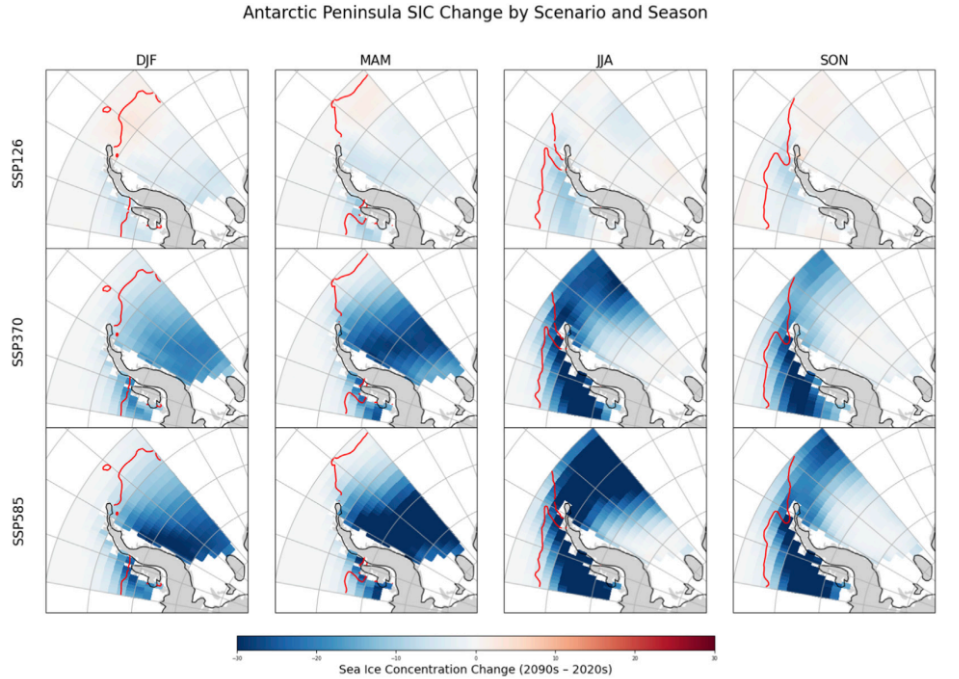 Changes in the concentration of sea ice around the Antarctic Peninsula in the 2090s, as compared to the 2020s. Decreases (increases) in sea ice concentration are shown in blue (red). The rows show the different future pathways (top to bottom): SSP1-2.6, SSP3-7.0 and SSP5-8.5. The columns show three-month chunks of the year (left to right): December, January and February; March, April and May; June, July and August; and September, October and November. Source: Davies et al. (2026)
The paper gives a "great overview of the current literature on the Antarctic Peninsula, examining multiple aspects of the region holistically", Dr Tri Datta, a climate scientist at the Delft University of Technology, tells Carbon Brief.
However, Datta - who was not involved in the study - notes that the coarse resolution of CMIP6 models means that the "most vulnerable regions are too poorly represented to capture important feedbacks", such as the forming of meltwater ponds on the tops of glaciers, which warm much more than the icy surface around them.
Ecosystem impactsThe study also looks at potential futures for the Antarctic Peninsula's marine and terrestrial ecosystems - albeit, much more briefly than it examines the physical changes.
This is because modelling ecosystem change is very difficult, Davies explains:
"If you're going to model an ecosystem, you have to model the climate and the ocean and the ice and how that changes. Exactly how that ecosystem responds to those changes is still beyond most of our Earth system models."
Still, by looking at trends in the Antarctic over the past several decades, as well as changes that have occurred in other high-latitude regions, the researchers piece together some of the potential impacts of warming.
They conclude that under SSP1, the changes experienced by ecosystems are "uncertain", but will "likely" be similar to present day - with some terrestrial species, such as its flowering plants, even benefitting from increased habitat area and water availability.
 Flowering plants on rock crevices in Antarctica. Credit: Colin Harris / era-images / Alamy Stock Photo
However, under higher-emissions scenarios, species will become "increasingly likely" to experience warmer temperatures than they are suited for.
Other changes that may occur in the very-high-emissions scenario are closely linked to the projected reductions in sea ice. These include the increased spread of invasive alien species, reduced ranges for krill and the displacement of animals unable to tolerate the warmer temperatures by those more able to adapt.
Prof Scott Doney, an oceanographer and biogeochemist at the University of Virginia, notes that some of these changes are already happening. Doney, who was not involved in the study, is part of an ongoing research programme on the Antarctic Peninsula known as the Palmer Long-Term Ecological Research project.
He tells Carbon Brief that Adélie penguins, which are a polar species, have "seen a massive drop in their breeding population" at their research sites. Meanwhile, gentoo penguins - whose range extends into the subpolar regions - "have been quite opportunistic" in colonising those breeding sites.
'Changes here first'Antarctica is home to 50 year-round research stations and dozens of summer-only ones, operated by more than 30 countries.
Around a dozen year-round stations are found on the peninsula and its islands, including the oldest permanent settlement in Antarctica - Argentina's Base Orcadas, established in 1903 by the Scottish national Antarctic expedition.
The continent is home to commercially important fisheries - particularly krill, which also play a critical role in the Antarctic marine food chain.
Increasingly, the Antarctic Peninsula is also a tourist destination.
Climate change poses a threat to all of these activities, Davies says.
For example, much of the research infrastructure on the Antarctic Peninsula was "built to assume dry, snowy conditions", she says. Rain can "cause quite a lot of difficulty", she adds.
(In an article published last year, Carbon Brief looked at the causes of rain in sub-zero temperatures in West Antarctica.)
Decreased sea ice cover can impact krill populations. It can also lead to increased ship traffic, as more of the continent becomes accessible throughout more of the year.
Furthermore, Davies says, the changes occurring on the peninsula will reverberate across Antarctica and around the world. She tells Carbon Brief:
"We'll see changes here first and those changes will continue to be felt in West Antarctica and continent-wide…What happens in Antarctica doesn't stay in Antarctica."
Antarctic sea ice winter peak in 2025 is third smallest on record
Antarctic
|01.10.25
Guest post: How atmospheric rivers are bringing rain to West Antarctica
Antarctic
|11.02.25
Antarctic sea ice maximum in 2024 is 'second lowest' on record
Antarctic
|04.10.24

Antarctic sea ice 'behaving strangely' as Arctic reaches 'below-average' winter peak
Antarctic
|26.03.24
jQuery(document).ready(function() { jQuery('.block-related-articles-slider-block_7658bad35ade9644b59c4fe06909d66a .mh').matchHeight({ byRow: false }); });The post Limiting warming to 2C is 'crucial' to protect pristine Antarctic Peninsula appeared first on Carbon Brief.
The US firm Syntropic has launched three new sodium-ion battery products into the energy storage marketplace, for residential, commercial, industrial, and utility-scale use.
The post A US Sodium-Ion Battery Maker Challenges Powerwall For Home Energy Storage, And More appeared first on CleanTechnica.
More solar power plants for the USA: the solar manufacturer Talon PV has taken another step towards the construction of a 4.8-gigawatt TOPCon solar manufacturing facility, to be located in Texas.
The post The War Against Solar Power Is Doomed To Fail, Part Infinity appeared first on CleanTechnica.
The first large-scale commercial enhanced geothermal system (EGS) power generator in the United States is under construction with the company reporting in our generator survey that it plans to bring the project online in June 2026. Below, we examine what enhanced geothermal systems are and how they differ from conventional geothermal systems. What is ... [continued]
The post Enhanced Geothermal Systems Could Expand Geothermal Power Generation appeared first on CleanTechnica.
MONTGOMERY, AL — A new report released today has found PFAS in nearly all of Alabama's waterways, confirming the statewide threat of these deadly toxins. PFAS are man-made "forever chemicals" that don't break down in the environment and are highly toxic to people. They are virtually unregulated by the US ... [continued]
The post Sierra Club Report: PFAS Found in Nearly All Alabama's Waterways appeared first on CleanTechnica.
If someone told you off-grid solar power was used to charge an electric Subaru in the sub-Arctic, would you believe it? Well, a pilot project conducted by Easee and Subaru just demonstrated it is possible to use portable solar panels and a portable EV charger to charge an electric Subaru ... [continued]
The post Solar Power Used To Charge An EV In The Sub-Arctic appeared first on CleanTechnica.
The Trump administration's efforts to force coal and other dirty fossil fuels on Americans while blocking solar and wind energy projects are so blatant and obvious that there's really no debate what's going on. There are some lame excuses being trotted out, though. In Colorado, as in some other places, ... [continued]
The post Coloradans Push Back On Trump Trying To Force Coal On Them appeared first on CleanTechnica.
FAW reportedly has equipped a prototype sedan with a battery that has an energy density of 500 Wh/kg yet cost less than an LFP battery.
The post FAW Begins Testing Semi-Solid-State Battery With 500 Wh/kg Energy Density appeared first on CleanTechnica.
The German Bundesrat's recent plea to Brussels to double green hydrogen-base fuel quotas is less a bid to accelerate decarbonization than a request to manufacture demand for an infrastructure program that never made economic sense and had weak demand signals from the start. The upper chamber's proposal to increase mandated ... [continued]
The post Germany's Bid To Double Hydrogen Fuel Targets Ignores Operator Demand And Cost Signals appeared first on CleanTechnica.
I published an article yesterday on Tesla's crazy-high market cap, more than the following automakers' combined: Toyota, BYD, GM, Ford, Hyundai, Kia, Mercedes-Benz, Stellantis, Geely, Ferrari, BMW, Volkswagen Group, Honda, Nissan, Renault, XPENG, and NIO. Unfortunately, we had a tech crisis today and had to republish several articles, which led ... [continued]
The post Tesla's Huge Market Cap — Reader Thoughts appeared first on CleanTechnica.
I just caught up on comments under an article I wrote several days ago, "Is Tesla Really In Trouble This Time?" There were many great comments from readers, but a few jumped out at me to stimulate this followup piece. The first one came from vensonata, who wrote: "The combined ... [continued]
The post Tesla Market Cap More Than Market Cap of Toyota, BYD, GM, Ford, Hyundai, Kia, Mercedes-Benz, Stellantis, Geely, Ferrari, BMW, Volkswagen Group, Honda, Nissan, Renault, XPENG, and NIO Combined appeared first on CleanTechnica.
One thing is clear: Either you are in lockstep with the US pro-fossil fuel energy policy, or you are the enemy and will pay the price. Created in the 1970s after the OPEC oil embargoes, the International Energy Agency was designed to collect data on who was producing oil and ... [continued]
The post IEA Focus On Clean Energy Gives US Officials Heartburn appeared first on CleanTechnica.
The other day, watching the below video, there was a little excitement to find out about an electric RV, but that quickly turned to dismay to find out it uses a gas generator to provide extra electricity. The RV in question is the 2026 Entegra Electric Class A Motorhome, which ... [continued]
The post An Electric Chevy BrightDrop Van For 50% Off? appeared first on CleanTechnica.
Weakening the hydrogen framework would threaten climate goals, grid stability, and the investment certainty needed to build a truly sustainable hydrogen market. 2025 marked an important milestone for EU hydrogen policy: with the entry into force of the Delegated Regulation (EU) 2025/2359 ('Low-Carbon fuel Delegated Act'), the EU hydrogen regulatory ... [continued]
The post Green NGOs & Renewable Fuel Producers: Commission Must Resist Pressure to Reopen the Rules Governing Renewable Hydrogen appeared first on CleanTechnica.
I've lived through many internet ages. In each stage of where the internet evolves and where humans spend their time, businesses and political actors step in and try to "game the system" for their benefit. It's not all about eyeballs and money, but, eventually, that's almost always what anything popular ... [continued]
The post Hacking AI — In Simple Ways — To Spread Misinformation appeared first on CleanTechnica.
Washington, DC — A broad coalition of health and environmental groups sued the Environmental Protection Agency today over its illegal determination that it is not responsible for protecting us from climate pollution and its elimination of rules to cut the tailpipe pollution fueling the climate crisis and harming people's health. The case, ... [continued]
The post Sierra Club, Partners Sue EPA Over Illegal Repeal of Climate Protections appeared first on CleanTechnica.
The updates are projected to save Oregonians hundreds of dollars each month on utility bills SALEM, Ore. — Today, the Oregon Building Code Division's Residential and Manufactured Structures Board (RMSB) voted to approve a package of updates to the state's residential energy code, including a requirement that new homes be built ... [continued]
The post Oregon Adopts New Building Codes to Reduce Energy Costs and Increase Energy Efficiency in Newly Constructed Homes appeared first on CleanTechnica.
The deregulation agenda being pushed by Germany's chancellor and Italy's prime minister is economically and ethically flawed
When the European Union launched its green deal in 2019, putting into law the goal of climate neutrality by the middle of the century, it showed strategic foresight as well as global leadership. Russia's war in Ukraine has starkly underlined the extent to which the continent's energy security - and its future prosperity - is dependent on the transition away from fossil fuels. Lately, however, EU leaders' environmental approach appears to be echoing the youthful St Augustine's plea on chastity: make us greener, but not yet.
The recent European Industry Summit in Antwerp made unusually big headlines thanks to Sir Jim Ratcliffe's xenophobic outburst over immigration. But it was also notable for fierce attacks on one of the most important pillars of EU environmental policy. The bloc's emissions trading system (ETS) - which makes polluters pay for the C02 they emit - has achieved dramatic results in driving down overall emissions since 2005 and encouraging green innovation. Worryingly, the German chancellor, Friedrich Merz, appeared to sympathise with demands from Sir Jim and other CEOs for a radical relaxation of the rules.
Continue reading...
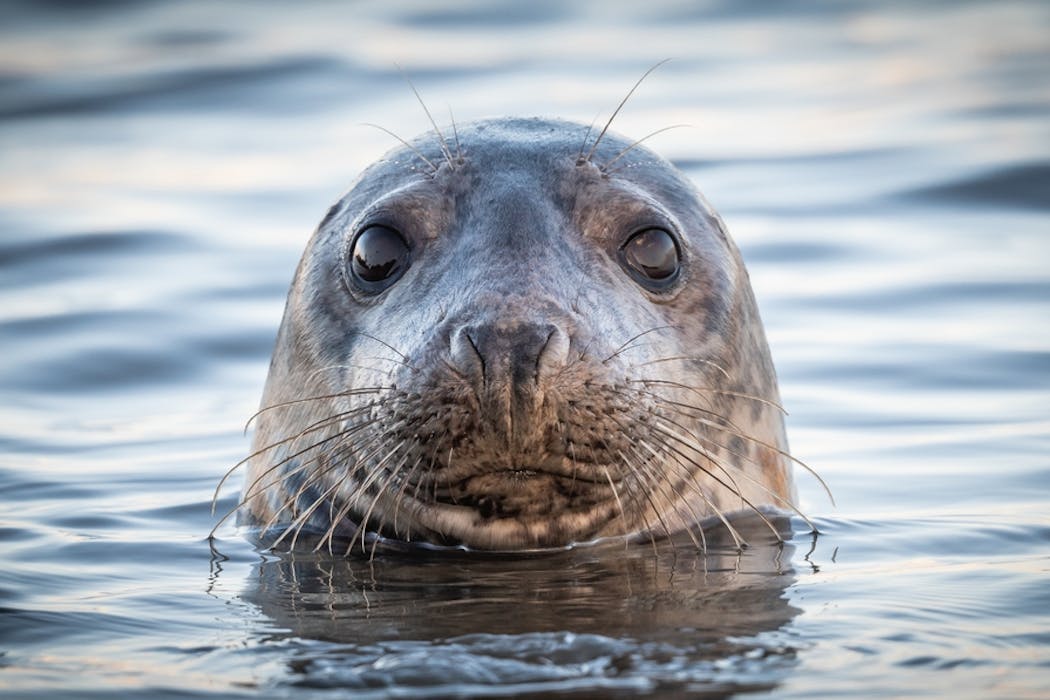 Grey seals are getting caught in fishing nets. Lynn Batchelor- Browning/Shutterstock
Hundreds of thousands of marine animals are killed every year after becoming accidentally caught in commercial fishing nets. Sharks, skates and rays are at particular risk, alongside turtles, seals, whales and dolphins, many of which are endangered.
Much of this problem comes down to the design of fishing nets and how they are used. Particularly damaging are tangle nets, which typically use large mesh sizes and large amounts of slack that can indiscriminately catch anything that crosses their path. They are also typically left in the water for long periods and only checked every one to ten days.
A new four-year study from Ireland's national Marine Institute highlights the particular problem the nets are causing in Ireland. Legally protected seals, for instance, are regularly caught in this type of net, widely used by the Irish fishing industry including in the country's only marine national park.
Tangle nets were first introduced to Ireland in the early 1970s. This was to help boost the competitiveness of the Irish crayfish fishing sector and provide an alternative method to the traditional pot-based method that was used up to that point.
But tangle nets are known to potentially harm a variety of species. The estimated impact from the latest report (covering 2021-2024) about what the nets had caught was stark:
• 1,161 nationally protected grey seals
• 81 critically endangered angel sharks
• 1,712 critically endangered flapper skate
• 532 critically endangered tope sharks
Other species caught included the endangered white skate and undulate ray, as well as rarer records of common and Risso dolphins. Catches varied throughout the study region, and included Ireland's marine national park in County Kerry. It is unclear whether similar numbers are seen in other fishing areas throughout Ireland.
The report argues for the reduction of these accidental catches to "safe biological limits", but acknowledges that there probably is no safe limit for several of the shark and skate species given their conservation status and their approach to reproduction.
The documented numbers of catches is particularly concerning for the species' designated as critically endangered by the International Union for Conservation of Nature. This classification stipulates an extremely high risk of extinction in the immediate future. Unlike many bony fish such as cod, tuna and salmon, sharks, skates and rays tend to mature slowly (often at more than ten years of age), have long gestation periods, and only produce a few young every year or two.
Rays and sharks are getting entangled in fishing nets.This makes it very difficult for them to recover if anything causes their populations to decline. The angel shark is a good example - once widespread throughout the north-east Atlantic, it has suffered drastic declines across its range, and the species is now locally extinct throughout much of Europe.
There are few remaining strongholds for the species, but County Kerry is one of the last northerly refuges for angel sharks. With so few left in the wild, numbers caught in Ireland's tangle net fishery are a significant concern at a global level.
Fisheries at a turning point?Irish commercial fishers are facing a challenging future, with a number of recent restrictions to activities and quotas creating severe pressure on numerous businesses and communities around Ireland , and closing the crayfish fishery would be another blow.
But there is a suitable and straightforward low-impact alternative to the tangle net, which is to fully return to the traditional pot fishery to target crayfish.
Currently in Ireland some fishers still use these pots, and others a combination of pots and nets. Pots are typically netted, baited cages with a narrow-funneled opening designed to only catch the target species with a minimal footprint when landing on the seabed and low risk of harm to the endangered and protected species documented in the Kerry report.
The report clearly states the urgent need of phasing out tangle nets, and highlights an upcoming Marine Institute report focusing on economic considerations supporting a complete switch from nets to pots. The current report suggests this is the "optimum solution". And it adds that trials using the pots showed equivalent catches.
Fishing is an integral part of Irish culture, and the need for a fair transition with appropriate support is repeatedly highlighted as essential for effective marine conservation.
What happens next in Kerry is probably going to be influenced by proposed legislation relating to how Ireland's marine landscape is managed. The potential introduction of the Marine Protected Area and Nature Restoration laws, currently being debated, are aimed at protecting and restoring marine biodiversity, and may soon change how fishing is carried out in Irish waters.
Examples from around the world show that it is possible to change the type of fishing nets used to protect marine life. Gillnets (which capture fish by entangling then around the gills) have been almost completely phased out in Australia's Great Barrier Reef marine park due to risks to animals including dolphins and turtles. Large scale drifting gillnets were banned in the European Union more than 20 years ago due to similar concerns.
The deaths of the world's most sensitive marine animals documented in the tangle net report highlight the urgency of how fishing needs to change globally, while also protecting the livelihoods of an industry important to coastal communities.

Nicholas Payne receives funding from Ireland's Marine Institute to study the ecology of sharks and rays. He is also a council member for the British Society of the British Isles
Louise Overy has received funding from National Parks and Wildlife Service for ecological research purposes and is a coordinator at the Irish Elasmobranch Group and Project lead of Angel Shark Project: Ireland.
Published yesterday on Asia Times, the following article covers overfishing in China.
One part of the article really stands out as being collapse related, and it isn't singling out China:
"It's very hard to solve global warming, because the worldwide nature of the harm means there's a free rider problem (or, if you prefer, a coordination problem) — no country wants to pay the full cost of decarbonization, because most of the benefit goes to people in other countries."
"You can try international agreements, but everyone has an incentive to cheat."
I will forgive Asia Times for quoting Steven Pinker because the rest of the article is excellent.
submitted by /u/BannonsGayLover[link] [comments]
Viridi recently announced one of its battery energy storage systems has replaced a diesel backup generator at a wastewater facility in New York State. When we write about battery storage on this site, sometimes it is paired with solar power to store excess clean electricity. Energy storage has other applications, ... [continued]
The post Battery Storage System Replaces Wastewater Facility Diesel Generator appeared first on CleanTechnica.
The US firm Syntropic has launched three new sodium-ion battery products into the energy storage marketplace, for residential, commercial, industrial, and utility-scale use.
The post A US Sodium-Ion Battery Maker Challenges Powerwall For Home Energy Storage, And More appeared first on CleanTechnica.
Hello all, firstly I recognise this post comes from a position of privilege as I have sufficient money to meet my basic needs and some left over to save/invest.
I have had no success in financial forums trying to get people to think about the fact the financial system cannot continue. Everyone seems to believe it will continue forever.
The usual mainstream financial advice is to spend less than you earn and then invest in low-cost index funds through ups and downs in the markets, and eventually you will end up with enough money to live on for the rest of your life. But for those of us who know that most systems are on a general trajectory downwards, how do we balance the need to have money to function in the (messed up) system we have today, with the knowledge that it will all fall apart at some point?
More specifically, does anyone monitor data points that might be more 'collapse-sensitive' than the usual market data? Are there people in academia/economics/financial services who are thinking about how best a person/family can structure their finances as we await the inevitable and perhaps sudden changes in the international financial system? I am already doing what I can in terms of skills, growing food, building community, not being in debt etc. I am not in the US.
submitted by /u/azulpear[link] [comments]
Welcome to Carbon Brief's China Briefing.
China Briefing handpicks and explains the most important climate and energy stories from China over the past fortnight. Subscribe for free here.
Key developments Carbon emissions on the decline'FLAT OR FALLING': China's carbon dioxide (CO2) emissions have been either "flat or falling" for almost two years, reported Agence France-Presse in coverage of new analysis for Carbon Brief by the Centre for Research on Energy and Clean Air (CREA). This marks the "first time" annual emissions may have fallen at a "time when energy demand was rising", it added. Emissions fell 0.3% during the year, driven by a fall in emissions "across nearly all major sectors", said Bloomberg - including the power sector. It said the chemicals sector was an exception, where emissions saw a "large jump from a surge of new plants using coal and oil" as feedstocks. The analysis has been covered around the world by outlets ranging from the New York Times, Bloomberg and BBC News through to Der Spiegel, CGTN and the Guardian.
TOP TASKS: President Xi Jinping listed "persisting in following the 'dual-carbon' goals" as one of eight "key" elements of economic work in 2026, according to a December speech just published in Qiushi, the Chinese Communist party's leading journal for political theory. This included "deeply advancing" carbon reduction in key industries and "steadily promoting a peak in consumption of coal and oil", according to the transcript. The National Energy Administration (NEA) also outlined a number of priority tasks for the department, including resolving "grid integration challenges" to encourage greater use of renewable energy and "boosting investment" in energy resources, said energy news outlet International Energy Net.
上微信关注《碳简报》
ETS EXPANSION: Meanwhile, the government has asked "heavy polluters" in several sectors not yet covered in China's emissions trading scheme (ETS) to report their emissions for 2025, reported Bloomberg, in a "key step" for the further expansion of the carbon market. The affected industries are the "petrochemical, chemical, building materials (flat glass), nonferrous metals (copper smelting), paper and civil aviation industries", according to the original notice posted by the Ministry of Ecology and Environment (MEE), as well as steel and cement companies not yet covered by the ETS.
State Council issued 'unified' power market guidancePOWER TRADE: China will aim for "market-based transactions" to account for 70% of total electricity consumption by 2030, according to new policy guidance released by China's State Council and published by International Energy Net. The policy also called for greater "integration" of cross-regional trading and "fundamentally sound" market-based pricing mechanisms. On renewable power, the guidance urged officials to "expand the scale of green power consumption" and establish a "green certificate consumption system that combines mandatory and voluntary consumption", as well as encourage "implementation of inter-provincial renewable energy priority dispatch plans". It also calls for "roll[ing] out spot trade nationwide by 2027, up from just 4% of the total transactions today", reported Bloomberg.
CLEAN-POWER PUSH: An official at China's National Development and Reform Commission said in a Q&A published by BJX News that establishing a "unified" national power market is "crucial for constructing a new power system". A separate analysis by Beijing-based power services firm Lambda reposted on BJX News argues that China's unified power-market reforms - which have been "more than two decades" in the making - will allow for "widespread integration" of renewable energy, resolving the challenge of wind and solar "generating but being unable to transmit and integrate". Business news outlet Jiemian quoted Xiamen University professor Lin Boqiang saying that, while power-market reform may present clean-energy companies with "growing pains" in the short term, it will "force the industry to develop healthily" in the long term.
EU tariffs lifted on first firm's China-built EV imports'SOFTENED' STANCE: The Chinese government has "softened its stance" on electric vehicle (EV) manufacturers who seek to independently negotiate with the EU on prices for their exports to the bloc, said Reuters, after it previously "urged the bloc not to engage in separate talks with Chinese manufacturers". The move came as Volkswagen received an exemption from tariffs for one of its EVs that is made in China and imported to the EU, which it committed to sell above a specific price threshold, reported Bloomberg. It added that the company also pledged to follow an import quota and "invest in significant battery EV-related projects" in the EU.
Subscribe: China Briefing- .listing{background: #f4f4f4} .listing ul{list-style:none; margin:0} ol {background: #F4F4F4; padding: 0px;} .listing ul {background: #F4F4F4; padding: 0px;} .listing li{font-size:0px;}
Sign up to Carbon Brief's free "China Briefing" email newsletter. All you need to know about the latest developments relating to China and climate change. Sent to your inbox every Thursday.
'MADE IN EU' MELTDOWN: Meanwhile, EU policymakers attempted to agree legislation that may force EV manufacturers to ensure "70% of the components in their cars are made in the EU" if they wish to receive subsidies, reported the Financial Times. A draft of the plan was ultimately rejected by nine European Commission leaders and commission president Ursula von der Leyen, Borderlex managing editor Rob Francis wrote on Bluesky.
BRAZIL BACKTRACKS: Brazil has "scrapped" a tariff exemption for Chinese EV manufacturers that allowed cars assembled in Brazil with parts imported from China to be sold at much lower prices than similar vehicles made from parts imported from other countries, reported the Hong Kong-based South China Morning Post. Separately, Bloomberg reported on the surge of tariff-free Chinese EVs that has enabled Ethiopia to ban the import of combustion-engine cars.
PRICE-WAR BAN: The Chinese government has "banned carmakers from pricing vehicles below cost", reported Bloomberg, in an effort to clamp down on a "persistent price war" affecting the industry. China's car industry, "particularly in the EV segment", has seen "aggressive discounting, subsidies and bundled promotions" pushing down profitability for companies across the supply chain, said the state-run newspaper China Daily.
More China news- POWERFUL WIND: China has connected a 20-megawatt offshore wind turbine - the "world's most powerful" and "equivalent to a 58-story building" - to the grid, reported state news agency Xinhua.
- PROVINCIAL MOVES: Anhui has become the first Chinese province to release data on how much carbon different forms of power in the province emits per kilowatt-hour of power, according to power news outlet BJX News.
- RARE-EARTH RUNES: China may hold a "policy briefing" on export restrictions for rare earths and other critical minerals in March, according to Reuters.
- NO CHINA CREDITS: The US confirmed that clean-energy tax credits will not be available for companies that are "overly reliant on Chinese-made equipment", said Reuters.
Carbon Brief spoke with Ma Jun, one of China's most well-known environmentalists, about how open data can keep pressure on industry to decarbonise and boost interest in climate change.
Ma is director of the Beijing-based Institute of Public and Environmental Affairs (IPE), an organisation most well known for developing the Blue Map, China's first public database for environment data.
Speaking to Carbon Brief during the first week of COP30 in Brazil last November, the discussion covered the importance of open data, key challenges for decarbonising industry, China's climate commitments for 2035, cooperation with the EU and more.
Below are highlights from the conversation. The full interview can be found on the Carbon Brief website.
Open data is helping strengthen climate policy- On how data transparency prevents environmental pollution in China: "From that moment [when the general public began flagging environmental violations on social media in 2014], it was no longer easy for mayors or [party] secretaries to try to interfere with the enforcement, because it's being made so transparent, so public."
- On encouraging the Chinese government to publish data: "The ministry felt that they had the backing from the people, basically, which helped them to gain confidence that data can be helpful and can be used in a responsible way."
- On China's new corporate disclosure rules: "We're talking about what's probably the largest scale of corporate measuring and disclosure now happening [anywhere in the world]."
- On the need for better emissions data: "It will be impossible to get started without proper, more comprehensive measuring and disclosure, and without having more credible data available."
- On the economics of coal: "There's no business interest for the coal sector to carry on, because increasingly the market will trend towards using renewables, because it's getting cheaper and cheaper".
- On paying for low-carbon products: "When we engage with them and ask why they didn't expand production, they say that producing these items will have a 'green premium', but no one wants to pay for that. Their users only want to buy tiny volumes for their sustainability reports."
- On public perceptions in China of climate change: "It's more abstract - [we're talking about] the end of the century or the polar bears. People don't feel that it's linked with their own individual behaviour or consumption choices."
- On criticism of China's climate pledge: "In the west, the cultural tendency is that if you want to show that you're serious, you need to set an ambitious target. Even if, at the end of the day, you fail, it doesn't mean that you're bad…But in China, the culture is that it is embarrassing if you set a target and you fail to fully honour that commitment."
- On global climate cooperation: "The starting point could be transparency - that could be one of the ways to help bridge the gap."
- On working in China as a climate NGO: "What we're doing is based on these principles of transparency, the right to know. It's based on the participation of the public. It's based on the rule of law. We cherish that and we still have the space to work [on these issues]."
- On the climate consensus in China: "The environment - including climate - is the area with the biggest consensus view in [China]. It could be a test run for having more multi-stakeholder governance in our country."
This interview was conducted by Anika Patel at COP30 in Belém on 13 November 2025.
Watch, read, listenGREEN ALUMINIUM: Lantau Group principal David Fishman wrote on LinkedIn about why China's aluminium smelters are seeking greater access to low-carbon power, following heated debate over a Financial Times article.
STRONGER THAN EVER: Isabel Hilton, chair of the Great Britain-China Centre, spoke on the Living on Earth podcast about China's renewables push and exports of clean-energy technologies.
CUTTING CORNERS?: Business news outlet Caixin examined how a surge in turbine defects at one wind farm could be due to "aggressive cost-cutting and rapid installation waves".
POLES APART: BBC News' Global News Podcast examined the drivers behind China's flatlining emissions, as revealed by Carbon Brief.
600
In gigawatts, China's total capacity of coal plants that are "flexible" and - in theory - better able to balance the variability of renewables, according to a new report by the thinktank Ember.
New science
- China will see a 41% decline in in coal-mining jobs over the next decade under current climate policies | Environmental Research Letters
- During 2000-20, China's per-person emissions of CO2 increased from 106kg to 539kg in urban households and from 35kg to 202kg in rural households, indicating that the inequality between urban and rural households is shrinking | Scientific Reports
China Briefing is written by Anika Patel and edited by Simon Evans. Please send tips and feedback to china@carbonbrief.org

China Briefing
|05.02.26
China Briefing 22 January 2026: 2026 priorities; EV agreement; How China uses gas
China Briefing
|22.01.26
China Briefing
|11.12.25
China Briefing 27 November 2025: COP30 wraps; Climate and critical minerals at G20; Coal use up
China Briefing
|27.11.25
jQuery(document).ready(function() { jQuery('.block-related-articles-slider-block_e1a2c53f1cd96ae1fbfe82bcf255083b .mh').matchHeight({ byRow: false }); });The post China Briefing 19 February 2026: CO2 emissions 'flat or falling' | First tariff lifted | Ma Jun on carbon data appeared first on Carbon Brief.
When I first started my Charge To The Parks project, the goal was simple: to show people that you could visit the most beautiful and remote places in the United States using clean energy, and without sacrificing the freedom of the open road. I want to take away everyone's last ... [continued]
The post Mechanical Reality Is Catching Up To ICE Pickups appeared first on CleanTechnica.
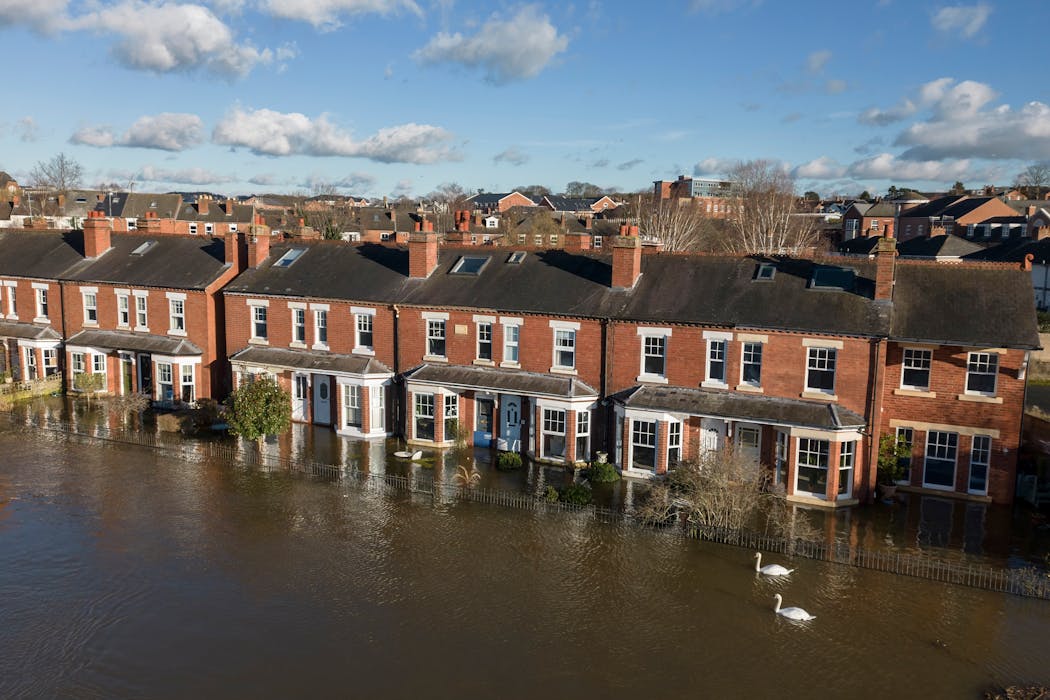 Chris Homer/Shutterstock
While floods are becoming more frequent in recent years, you should still be able to buy reasonably priced home insurance. That reassurance exists largely because of Flood Re. Launched in 2016, Flood Re is a national public-private reinsurance scheme that prevents many properties from being priced out of cover.
But the Flood Re scheme is a temporary fix that's due to end in 2039, on the assumption that flood risk will fall and the market can move back towards more risk-reflective pricing. As financial experts, we're worried that the UK may not be able to adapt its infrastructure and systems to climate change fast enough.
The success of the Flood Re scheme hinges on a shared contract between government, homeowners and insurers. Government has to cut risk through investment and delivery. Homeowners reduce damage by building back better and avoiding preventable exposure. And insurers must increase prices of premiums to better represent the climate risk but not so fast that cover becomes unaffordable.
If premiums rise too quickly, fewer households will stay insured and the ability to socialise risks across a large pool will not be possible.
The scale of the challenge is already clear. Flood Re was designed when a global temperature rise of 1.5°C still felt achievable and a 2°C increase should be a hard limit.
Climate change has accelerated since then. By around 2050, around 8 million properties in England, roughly one in four, could be at flood risk.
The House of Commons public accounts committee warns that deterioration in existing defences has left around 203,000 properties without reliable protection, while the government aims to protect 200,000 more by 2027. Labour's target to deliver 1.5 million new homes in England by 2029 risks adding pressure by pushing development onto cheaper land that's at greater risk of flooding.
Many countries intervene to support insurance for disasters such as floods and storms, but few put a firm end date on that support. For example, The US National Flood Insurance Program (NFIP) was created to provide affordable flood insurance and to reduce future damage by discouraging development in high-risk floodplains.
In practice, repeated extreme weather has left the NFIP in debt and subsidised premiums have weakened incentives to avoid building in flood-prone areas. Although the NFIP is regularly renewed by the US Congress, its long-term sustainability remains uncertain.
France's catastrophes naturelles scheme (CAT-NAT) covers natural disaster losses that private insurers struggle to price, funded by a national surcharge. Rising losses from more frequent and severe disasters are straining the model, so the surcharge increased from 12% to 20% in January 2025. That raises a hard question: how can the system stay fair as the cost of disasters keeps climbing?
Preparing for post-2039Our ongoing research suggests flood-related volatility can amplify financial stress and uncertainty. The choice is not simply between keeping Flood Re forever or ending the scheme. The real question is whether the UK can use the time Flood Re is buying to reduce risk fast enough to make a fair transition possible by 2039.
That is why progress needs to be visible and measurable in five areas.
First, as demonstrated by recent updates in England and Wales, flood maps and modelling must reflect current conditions and future climate risk, with updates that keep pace with changes to the drivers of flood risk whether that be from heavy rainfall or rivers and the sea.
 The Flood Re scheme is a temporary fix, not a long-term strategy.
Martin Charles Hatch/Shutterstock
The Flood Re scheme is a temporary fix, not a long-term strategy.
Martin Charles Hatch/Shutterstock
Second, governance must be joined up, with clear responsibilities and minimum coordination standards across agencies for rivers, surface water, drainage and sewers. Better collaboration would help to resolve misalignments in major capital programmes across risk management authorities.
Third, drainage and surface water management must be strengthened, with clear rules and long-term maintenance so new development does not add to flood and sewer risk.
Also, every tool in the box should be used to increase investment in flood risk reduction and to enhance maintenance. The benefits of flood protection should be made transparent to insurers and fed into catastrophe models.
Finally, a clear Flood Re future must be shaped together by planners, insurers and flood authorities. This will help set a shared standard for flood risk management.
Don't have time to read about climate change as much as you'd like?
Get a weekly roundup in your inbox instead. Every Wednesday, The Conversation's environment editor writes Imagine, a short email that goes a little deeper into just one climate issue. Join the 47,000+ readers who've subscribed so far.

Neil Gunn works and consults for Willis Towers Watson and also owns some shares in that company While the Willis research network supports scientific research through for example direct grants and in kind support, it benefits from schemes like CDTs which are supported by government funding
Dalu Zhang and Meilan Yan do not work for, consult, own shares in or receive funding from any company or organisation that would benefit from this article, and have disclosed no relevant affiliations beyond their academic appointment.
economy that's booming on paper but feels stuck when it comes to hiring
submitted by /u/Pretend_Guess_4317[link] [comments]
Faaborgs rail against oppressive industrial agricultural system with unexpected evolution into indie artisan food firm
As a sixth-generation Iowa farmer, Tanner Faaborg is all too aware that agricultural traditions are hard to shake. So when he set in motion plans to change his family's farm from a livestock operation housing more than 8,000 pigs each year to one that grows lion's mane and oyster mushrooms, he knew some of his peers might laugh at him. He just did not necessarily expect his brother to be chief among them.
"My older brother has worked with pigs his entire adult life, managing about 70,000 of them across five counties," Faaborg says. "But we got to a point where he went from laughing at me to saying: well, I guess maybe I'll quit my job and help you out."
Continue reading...A bill banning the sale and use of plastic and metallic glitter has yet to go through in Brazil as the capital's sandy shores bear cost of carnival's shine
Whether it is embellishing elaborate costumes, delicately applied as eye makeup, or smeared across bare skin, glitter is everywhere at Rio de Janeiro's carnival in Brazil. The world's largest party, which ended on Wednesday, leaves a trail of sparkles in its wake.
At one bloco last weekend, a huge sound truck and dancers in leopard print led thousands of revellers down the promenade at Flamengo beach. Among them was Bruno Fernandes, who had jazzed up an otherwise minimalist outfit of navy swimming briefs by smearing silver glitter over his body.
Continue reading...
Open and transparent data can accelerate the decarbonisation of China's industries and boost public interest in climate change, says Ma Jun.
Ma - one of China's most recognisable environmental activists - says that early experiments with publishing real-time air quality data have paved the way for greater openness from the Chinese government towards publishing greenhouse gas emissions data.
However, he tells Carbon Brief in a wide-ranging interview, more needs to be done to encourage "multi-stakeholder" participation in climate efforts and to improve corporate emissions disclosure.
He also notes that China faces significant "challenges" in reducing emissions from "hard-to-abate" sectors, where companies struggle to find consumers willing to pay a "green premium" for low-carbon versions of their products.
Ma is the founder and director of the Institute of Public and Environmental Affairs (IPE), a Beijing-based NGO focused on environmental information disclosure and public participation.
The IPE is most well-known for developing the Blue Map, China's first public database for environment data.
Ma has been a long-term advocate for environmental protection in China.
Prior to founding the IPE, he covered environmental pollution as an investigative reporter at the Hong Kong-based South China Morning Post.
He also authored China's first book on the serious water pollution challenges facing the country.
Speaking to Carbon Brief during the first week of COP30 in Brazil last November, the discussion covered the importance of open data, key challenges for decarbonising industry, China's climate commitments for 2035, cooperation with the EU and more.
- On how data transparency prevents environmental pollution in China: "From that moment [that the general public began flagging environmental violations on social media], it was no longer easy for mayors or [party] secretaries to try to interfere with the enforcement, because it's being made so transparent, so public."
- On encouraging the Chinese government to publish data: "The ministry felt that they had the backing from the people, basically, which helped them to gain confidence that data can be helpful and can be used in a responsible way."
- On China's new corporate disclosure rules: "We're talking about what's probably the largest scale of corporate measuring and disclosure now happening [anywhere in the world]."
- On air-pollution policies creating a template for climate action: "It started from the pollution control side and now we want to see that happen on the climate side."
- On paying for low-carbon products: "When we engage with them and ask why they didn't expand production, they say that producing these items will have a 'green premium', but no one wants to pay for that. Their users only want to buy tiny volumes for their sustainability reports."
- On public perceptions of climate change: "It's more abstract - [we're talking about] the end of the century or the polar bears. People don't feel that it's linked with their own individual behaviour or consumption choices."
- On the need for better emissions data: "It will be impossible to get started without proper, more comprehensive measuring and disclosure, and without having more credible data available."
- On criticism of China's climate pledge: "In the west, the cultural tendency is that if you want to show that you're serious, you need to set an ambitious target. Even if, at the end of the day, you fail, it doesn't mean that you're bad…But in China, the culture is that it is embarrassing if you set a target and you fail to fully honour that commitment."
- On global climate cooperation: "The starting point could be transparency - that could be one of the ways to help bridge the gap."
- On the economics of coal: "There's no business interest for the coal sector to carry on, because increasingly the market will trend towards using renewables, because it's getting cheaper and cheaper".
- On working in China as a climate NGO: "What we're doing is based on these principles of transparency, the right to know. It's based on the participation of the public. It's based on the rule of law. We cherish that and we still have the space to work [on these issues]."
- On the climate consensus in China: "The environment - including climate - is the area with the biggest consensus view in [China]. It could be a test run for having more multi-stakeholder governance in our country."
The transcript below has been edited for length and clarity.
Carbon Brief: You have been at the forefront of environmental issues in China for decades. How would you describe the changes in China's approach to climate and environment issues over the time you've been observing them?
Ma Jun: I started paying attention to the issues when I got the chance to travel in different parts of China. I was struck by the environmental damage, particularly on the waterways, the rivers and lakes, which do not just have all these eco-impacts, but also expose hundreds of millions to health hazards.
That got me to start paying attention. So I authored a book called China's Water Crisis and readers kept coming back to me to push for solutions. I delved deeper into the research and I realised that it's quite complicated - not just that the magnitude [of the problem] is so big, but that the whole issue is quite complicated, because we copied rules, laws and regulations from the west but enforcement remained weak.
There are huge externalities, but companies would rather just cut corners to be more competitive, put simply. Behind that, there was a doctrine before of development at whatever cost. That was the starting point in China - not just for policymakers, even people in the street, if you asked them at that time, most likely [they] would say: "China's still poor. Let's develop before we even think about the environment."
But that started changing, gradually. Unfortunately, it needed the "airpocalypse" in Beijing and the big surrounding regions to really motivate that change.
In 2011, Beijing suffered from very bad smog and millions upon millions of people made their voices heard - that they want clean air.
The government lent an ear to them and decided to start from transparency, monitoring and disclosing data to the public. So two years after it started and people were being given hourly air quality data [in 2011] - you realised how bad it was. In the first month [of 2013], the monthly average was over 150 micrograms. The WHO standard was 10 at the time - now it's dropped to five. [Some news reports and studies, based on readings published at the time by the US embassy in Beijing, note significantly higher figures.]
We believe that it's good to have that data - of course, it's very helpful - but it's not enough. Keeping children indoors or putting on face masks are not real solutions, we need to address the sources. So we launched a total transparency initiative with 24 other NGOs calling for real-time disclosure of corporate monitoring data.
To our surprise, the ministry made it happen. From 2014, tens of thousands of the largest emitters, every hour, needed to give people air [quality] data, and every two hours for water [quality].
We then launched an app to help visualise that for neighbourhoods. For the first time, people could realise which [companies] are not in compliance. Even super-large factories - every hour, if they were not in compliance, then they would turn from blue to red [in the app].
And so many people made complaints and petitioned openly - sharing that on social media, tagging the official [company] account. That triggered a chain reaction and changed that dynamic that I described.
From that moment, it was no longer easy for mayors or [party] secretaries to try to interfere with the enforcement, because it's being made so transparent, so public. The [environmental protection] agencies got the backing from the people and knocked the door open - and pushed the companies to respond to the people.
Then, the data is also used to enable market-based solutions, such as green supply chains and green finance.
Starting first with major multinationals and then extending to local companies, companies compared their lists with our lists before they signed contracts. If any of their [supplier] companies were having problems, they could get a push notification to their inbox or cell [mobile] phone.
That motivates 36,000 [companies] to come to an NGO like us - to our platform - to make that disclosure about what went wrong and how we try to fix the problem, and after that measure and disclose more kinds of data, starting with local emission data and now extending to carbon data.
And for banking and green finance, an NGO like us now helps banks track the performance of three million corporations who want to borrow money from them, as part of the due diligence process. These are just tiny examples to try to demonstrate that there's a real change.
Before, when I got started, the level of transparency was so limited. When we first looked at government data, at the beginning, there were only 2,000 records of enforcement. So we launched an index, assessed performance for 10 years across 120 cities.
During this process, [we also saw] consensus being made. In 2015, China's amended Environmental Protection Law [came into effect] and created a special chapter - chapter five - titled [information] transparency and public participation. That was the first ever piece of legislation in China to have such a chapter on transparency.
CB: What motivated that? Was it because they'd already seen this big public backlash?
MJ: They started listening to people and the demand for change, for clean air. And then they started seeing how the data can be used - not to disrupt the society, but to help to mobilise people.
The ministry felt that they had the backing from the people, basically, which helped them to gain confidence that data can be helpful and can be used in a responsible way. Before, they were always concerned about the data, particularly on disruption of social stability, because our data is not that beautiful at the beginning, due to the very serious pollution problem.
When our organisation got started, nearly 20 years ago, 28% of the monitored waterways - nationally-monitored rivers - reported water that was good for no use. Basically, it is so polluted that it's not good for any use. [Some] 300 million [people] were exposed to that in the countryside, it was very serious.
We're talking about the government changing its mindset. Of course, the reality is that they found [the data] can be used the responsible way and can be helpful, so they decided to embrace that and to tolerate that, to gradually expand transparency.
Now, China is aligning its system with the International Sustainability Standards Board (ISSB). The environment ministry also created a disclosure scheme, with 90,000 of China's largest [greenhouse gas] emitters on the list. We and our NGO partners tried to help implement that. We're talking about billions of tonnes of carbon emissions.
It would have been hard to imagine before, but we're talking about what's probably the largest scale of corporate measuring and disclosure now happening [anywhere in the world].
Of course, it's still not enough. Last year, we also helped the agency affiliated with the ministry to develop a guideline on voluntary carbon disclosure, targeting small and medium sized companies. We now have a new template on our platform - powered by AI - and a digital accounting tool that helps our users measure and disclose nearly 70m tonnes [of carbon dioxide equivalent] last year.
CB: Is there appetite on the industrial side to proactively get involved? Or is local regulation needed that mandates involvement?
MJ: At the beginning, no. If we have the dynamic that I described - at the beginning, whoever cut corners became more competitive. This caused a "race to the bottom" situation and even good companies find it quite difficult to stick to the rules.
But then the dynamic changed. Whoever's not in compliance with the law will be kicked out of the game. Not only would they receive increasingly hefty penalties or fines, but the data will be put into use in supply chains. Many of our users - the brands - integrate that data into their sourcing, meaning that if [suppliers] don't solve the problem they will lose contracts. And also banks could give them an unfavourable rating.
All this joint effort could create some sort of - of course, it's [only a] chance - but some kind of a stick. But it's also a kind of carrot, because those who decided to do better now benefit. If someone loses business [because they cannot help their consumer with compliance], then that business will [instead] go to those who want to go green.
This change in dynamic is very helpful. It started from the pollution control side and now we want to see that happen on the climate side. That's why we decided to develop the blue map for zero carbon, to try to map out and further motivate the decarbonisation process - region by region, sector by sector.
You asked about corporations - this is extremely important. China is the factory of the world and 68% of carbon emissions still relate either to the direct manufacturing process or to energy consumption to power the industrial production. So it is very important to motivate them, to create both rules and stimulus - both stick and carrot.
But if you don't have a stick, you can never make the carrot big enough. That is an externality problem, you never really solve that. We've now managed to solve the basic problem - non-compliance and outrageous violations. But that's the first step. Deep decarbonisation - not just scope one and two, but extending further upstream to reach heavy industry, the hard-to-abate industries - now this is the challenge.
CB: What are your expectations for industrial decarbonisation more broadly, especially given the technology bottlenecks?
MJ: There are still bottlenecks, but we see, actually, some progress is being made. Now corporations in China understand that they need to go in [a low-carbon] direction and some of them are actually motivated to develop innovative solutions.
For example, several major steel manufacturers managed to be able to find ways to produce much lower-carbon steel products. In the aluminium [sector] they also tried and also batteries. Unfortunately, these remain as only pilot projects.
When we engage with them and ask why they didn't expand production, they say that producing these items will have a "green premium", but no one wants to pay for that. Their users only want to buy tiny volumes for their sustainability reports - for the rest, they just want the low-cost ones.
They said, the more we produce the green products, the bigger our losses. So we decided to leave these products in our warehouse.
Then we engaged with the brands - the real estate industry, the largest user of iron and steel - and the automobile industry, the second largest. They claimed that if they [purchase greener materials], they would pay a green premium, but their users and consumers have no idea about [green consumption]. They only want to buy the cheapest products - and the more [these manufacturers] produce, the more they suffer losses.
So this means we need a mechanism, with multi-stakeholder participation, to share the burden of that transition - to share that cost of the green transition.
That green premium can only be shared, not one single stakeholder can easily absorb all of this given all the breakneck competition in China - involution - it's very, very serious and so companies are all stuck there.
What we're trying to do is to help change that. We assessed the performance of 51 auto brands and tried to help all the stakeholders understand which ones could go low-carbon.
But it's not enough just to score and rank them. We also need to engage with the public, to have them start gaining an understanding that their choice matters. So how - it's more difficult, you know? Pollution is much easier. We told them: "Look, people are dumping all this waste."
CB: It's all visible.
MJ: Yeah, when people suffer so seriously from pollution - air, water and soil pollution - they feel strongly. They wrote letters to the brands, telling them that they like their products but they cannot accept this.
But on climate, it's more abstract - [we're talking about] the end of the century or the polar bears. People don't feel that it's linked with their own individual behaviour or consumption choices.
We decided to upgrade our green choice initiative to the 2.0 level. This new solution we developed is called product carbon scan. Basically, you take a picture of any product and services products and an AI [programme] will figure out what product that is and tell you the embodied carbon of that product.
Now, it's getting particularly sophisticated with automobiles. The AI now - from this year - for most of the vehicles on the streets of China, can figure out not just which brand it is, but which model. We have all these models in our database - 700-800 models and 7,000-8,000 varieties of cars, all of which have specific carbon footprints.
CB: How do you account for all of the different variables? If something changes upstream, if a supplier changes - how do you account for that?
MJ: The idea is like this - now, this is mostly measured by third parties, our partners. We also have our emission factors database that we developed. So we know that, as you said, there are all these variables. For the past six months, we got our users to take pictures of 100,000 cars. We distributed them to 50 brands and [calculated] that the total carbon footprint was 4.2m tonnes, for the lifecycle of these 100,000 cars. Each brand got their own share of this.
So we wrote letters - and we're still writing letters now, 10 NGOs in China, we're writing letters now to the CEOs of these 50 brands - to tell them that this is happening. Our users, consumers of their products, are paying attention to this and are raising questions. We have two demands.
First, have you done your own measuring for the product you sell in China? Do you have plans to measure and disclose those specific details? Because if third parties can do it, so can they. It's not space technology, they can do it and obviously they own all this data. They understand much better about the entire value chain and it's much easier for them to get more accurate figures. With the "internet of things" and new technologies, for some products, they can get those details already, so the auto industry should be getting close to [achieving] that.
The second question is, you all have set targets for carbon reduction and carbon neutrality. We know that most of you are not on track. Even the best ones - Mercedes-Benz is at the top of our rankings - are seeing their carbon intensity going up. Not just the total volume [of emissions], but products' carbon intensity is going up instead of going down. So, obviously, they haven't really decarbonised their upstream - steel and aluminium. So [we ask them]: "What's your plan? Can you give me an actionable, short- or mid-term plan on the decarbonisation of these upstream, hard-to-abate sectors?"
I think this is the way to try to tap into the success of pollution control and now extend that to cover carbon.
CB: It seems a challenge facing China's climate action that policymakers often flag is MRV [monitoring, reporting and verification] and data in general. You're the expert on this. Would you agree? Are there big challenges around MRV that China needs to address before it can progress further?
MJ: This is a prerequisite, in my view. To have [to] measure, disclose and allow access to data is a prerequisite for any meaningful multi-stakeholder effort. I wouldn't underestimate the challenge in the follow-up process - the solutions, the innovations, the new technologies that need to be developed to decarbonise - but it will be impossible to get started without proper, more comprehensive measuring and disclosure, and without having more credible data available.
I take this as a starting point - a most important starting point. I'm so happy to see that there's a growing consensus on that. In China, the government decided to embrace the concept of the ISSB, embrace the concept of ESG reporting, and to allow an NGO like us to try to help with the disclosure mechanism.
This is very powerful and very productive, and the reason that we could create that solution is because China pays so much attention to product carbon footprints, of course, motivated by the EU legislations, like the carbon border adjustment mechanism (CBAM) and others. In some ways, it's quite interesting to see the EU set these very progressive rules, but then China responds and decides to create solutions and scale them up.
On the product carbon footprint alone, the Ministry of Ecology and Environment (MEE) coordinated 15 different ministries to work on it, with a very tight schedule - targets set for 2027 and then 2030 - [implying] very fast progress. We work together with our partners on a new book telling businesses - based on emission factors - how to handle it and how to proceed, in terms of practical solutions.
All this is just to say that, on the data and MRV side, China has already overcome its initial reluctance, or even resistance. Now [it] is in the process of not just making progress and expanding data transparency, but also trying to align that with international practice.
And at COP30, I actually launched a new report [titled the Global City Green and Low-Carbon Transparency Index]…The transparency index actually highlighted that, of course, developed cities are still doing better, but a whole group of Chinese cities are quickly catching up. Trailing behind are other global south cities.
When China decides to do something, it isn't just individual businesses or even individual cities [that see action taken]. There will be more of a platform-based system - meaning there is an [underlying] national requirement, which can help to level the playing field, with regions or sectors possibly taking up stricter requirements, but not being able to compromise the national ones [by setting lower targets].
So, with MRV, I have some confidence. That doesn't mean it's easy. Particularly on the product carbon footprint, there are so many challenges. Trying to make emission factors more accurate is quite difficult, because products have so many components and the whole value chain can be very long and complicated. But with determination, with consensus, I'm still confident that China can deliver.
And in the meantime, what is now going on in China, increasingly, could become a contribution to global MRV practice.
CB: It's interesting that you mentioned that. Talking to people at the COP30 China pavilion, people from global south countries see China as a climate leader and want to learn about what's going on in China. By contrast, developed countries seem more focused on the level of ambition in China's NDC [its climate pledge, known as a nationally determined contribution]. How would you view China's role in climate action in the next five years?
MJ: On the NDC, my personal observation - I come from an NGO, so I don't represent the government's decision here - is that culturally, there's some sort of differences, nuanced differences - or very obvious differences - here.
In the west, the cultural tendency is that if you want to show that you're serious, you need to set an ambitious target. Even if, at the end of the day, you fail, it doesn't mean that you're bad, you still achieve more than if you'd set a lower target. That's the mentality.
But in China, the culture is that it is embarrassing if you set a target and you fail to fully honour that commitment. So they tend to set targets in a slightly more conservative way.
I'm glad to see that [China's] NDC is leaving space for flexibility - it said that China will try to achieve a higher target. This is the tone, and in my view it gives us the space and the legitimacy to try to motivate change and develop solutions to bend the curve faster. Even if the target is not that high, we know that we will try to beat that.
And then, there's the renewables target for 1,200 gigawatts (GW) by 2030, a target that was achieved last year - six years early. Now we've set a target of 3,600GW - that means adding 180GW every year. But, as you know, over the past several years [China's renewable additions] have been above 200GW.
So you can see that there's a real opportunity there and we know that China will try to overdeliver. There's no kind of a good or bad, or right or wrong, with these two different cultural [approaches].
But one thing I hope that we all focus more on is implementation - on action. Because we do see that, for some of the global targets that have already been set, no-one seems to be paying any real attention to them - such as the tripling of [global] renewable capacity.
We all witnessed that, in Dubai at COP28, a target was agreed and accepted by the international community. China's on track, but what about the others? Most countries are not on track.
The global south, it's not only for their climate targets - the [energy] transition is essential for their SDG [sustainable development goal] targets. But now they lag so far behind. That's a pity, because now there's enough capacity - and even bigger potential - to help them access all this much faster.
But geopolitical divides, resource competition, nationalism, protectionism - all of this is dividing us. It's making global climate governance a lot more difficult and delaying the process to help [others in the] global transition. It's very difficult to overcome these problems - probably it will get worse before it gets better.
But if we truly believe that climate change is an existential threat to our home planet, then we should try to find a way to collaborate a bit more. The starting point could be transparency - that could be one of the ways to help bridge the gap.
In China, we used to have a massive gap of distrust between different stakeholders. People hated polluting factories, but they also had suspicions around government agencies giving protection to those factories. So there's all this distrust.
With transparency, it's easier for trust to be built, gradually, and the government started gaining confidence [in sharing data] because they saw with their own eyes that people came together behind them. Before, [people] always suspected that [the government] were sheltering the polluters. But from that moment, they realised that the government was serious and so gave them a lot of support.
Globally - maybe I'm too negative - I do think that it would [improve the chances for us all to collaborate] if we had a global data infrastructure and a global data platform, that doesn't just give [each country's] national data but drills down - province by province, city by city, sector by sector and, eventually, to individual factories, facilities and mines. For each one of these, there would be a standardised reporting system, giving people the right to know. I think through this we could build trust and use it as a starting point for collaboration.
I sit on several international committees - on air, water, the Taskforce on Nature-related Financial Disclosures (TFND), transition minerals, and so on. In each of these, I often make suggestions on building global data infrastructure. Increasingly, I see more nodding heads, and some have started to make serious efforts. TNFD is one example. They already have a proposal to develop a global data facility on data. The International Chamber of Commerce also put forward a proposal on the global data infrastructure on minerals and other commodities.
Of course, in reality, there will be many difficulties - data security, for example. So maybe it cannot be totally centralised, we need to allow for decentralised regional systems, but you could also create catalogues to allow the users to [dig into] all this data.
CB: And that then inspires people to look into issues they care about?
MJ: Yes and through that process, we will create more consensus, create more trust and gradually formulate unified rules and standards.
And we need innovative solutions. In today's world, security is something that's not just paid attention to by China, in the west it's a similar [story]. There are a lot of concerns about data security - growing concerns - so I think eventually there will be innovation to solve them. I'm still hopeful!
CB: Speaking of international cooperation, how has the withdrawal of the US from the Paris Agreement affected prospects for China-EU cooperation?
MJ: It will have a mixed impact, of course. Having the largest economy and second-largest emitter withdraw will have a big impact on global climate governance, and will in some way create negative pressure on other regions, because we're all facing the question of: "If they don't do it, why should we?" We also have those questions back home. I'm sure the EU is also facing this question.
But in the meantime, I hope that China and the EU realise that they have no choice but to work together - if they still, as they claim, truly believe in [the importance of] recognising the existential threat posed by climate change, then what choice do they have but to work together?
Fundamentally, we need a multilateral process to deal with this global challenge. The Paris Agreement, with all its challenges, still managed to help us avoid the worst of the worst. We still need this UNFCCC process and we need China and the EU to help maintain it.
At the last COP[29 in Azerbaijan], for the first time, it was not China and the US who saved the day. Before, it was always the US and China that made a deal and helped [shepherd] a global agreement. But last year, it was China and the EU that made the agreement and then helped to reach [a global deal] in Azerbaijan.
I do think that China and the EU have both the intention and the innovative capacity, as well as a very, very powerful business sector. I'm still hopeful that these two can come together at this COP [in Brazil].
CB: We've spoken a lot about heavy industry and industrial processes. Coal is a very big part of China's emissions profile. In the short term, how do you see China's coal use developing over the next five to 10 years?
This ties into that complicated issue of the geopolitical divide. The original plan was to use natural gas as the transition [fuel], which would make things much easier. But geopolitical tensions means gas is no longer considered safe and secure, because China has very little of this resource and has to depend on the other regions, including the US, for gas.
That, in some way, pushed towards authorising new coal power plants and, in some way, we are all suffering for that. In the west as well. We all have to create massive redundancies for so-called insecurity, we're all bearing higher costs and we're all facing the risk of stranded assets, because we have such a young coal-power fleet.
The only thing we can do is to try to make sure that these plants increasingly serve only as a backup and as a way to help absorb high penetration of renewables, because now this is a new challenge. Renewables have been expanding so fast that it's very difficult - because of its intermittent nature - to integrate it into the power grid. New coal power can help absorb, but only if we can make [it] a backup and not use it unless there's a need. Of course, that means we have to pay to cover the cost for those coal plants.
The funny thing is that there's no business interest for the coal sector to carry on, because increasingly the market will trend towards using renewables, because it's getting cheaper and cheaper. So the coal sector, for security and integration of renewables, will be kept. But it will play an increasingly smaller role. In the meantime, the coal sector can help balance the impact through making chemicals, rather than just energy.
In the meantime, [we need to] try to find ways to accelerate the whole energy transition and electrify our economy even faster. That's a clear path towards both carbon peaking and carbon neutrality in China.
It's already going on. Carbon Brief's research already highlights some of the key issues, such as from March [2024] emissions are actually going down. That cannot happen without renewables, because our electricity demand is still going up significantly. In the meantime, the cost of electricity is declining.
This allows China to find its own logic to stick to the Paris Agreement, to stick to climate targets and even try to expand its climate action, because it can benefit the economy. It can benefit the people.
I think Europe probably could also learn from that, because Europe used to focus on climate for the climate's sake. With [the Russia-Ukraine] war going on, that makes it even more difficult.
CB: You mean the green economy narrative?
MJ: Yes, the green economy narrative is not highlighted enough in Europe. Now, suddenly, it's about affordability, it's about competition, and suddenly they feel that they're not in a very good position. But China actually focuses more on the green economy side. China and the EU could - hand-in-hand - try to pursue that.
CB: That leads perfectly to my last question. How important is the role of civil society now in developing climate and environmental policy in China?
MJ: We all trust in the importance of civil society. This is our logo, which we designed 20 years ago. Here are three segments: the government, business and civil society.
 IPE director Ma Jun showing a pin based on his organisation's logo. Photo credit: Carbon Brief
Civil society should be part of that. But we all, realistically, understand that the government is very powerful, businesses have all the resources, but civil society is still very limited in terms of its capacity to influence things.
But still, I'm glad to see that we have a civil society and NGOs like us continue to have the space in China to do what we're doing. What we're doing is based on these principles of transparency, the right to know. It's based on the participation of the public. It's based on the rule of law. We cherish that and we still have the space to work [on these issues].
We're lucky, because the environment - including climate - is the area with the biggest consensus view in our society. It could be a test run for having more multi-stakeholder governance in our country. I hope that, increasingly, this can help build social trust between stakeholders and to see [climate action] benefit society in this way.
I know it's not easy - there are still a lot of challenges [for NGOs] and not just in China. We work with partners in other regions - south-east Asia, south Asia, Africa and Latin America - and it's hard to imagine the challenges they could face, such as serious challenges to their personal safety.
Now, even in the global north, NGOs are under pressure. So we have a common challenge. Back to the issue of transparency. I hope that transparency also can be a source of protection for NGOs.
When all of us need to [take action to address climate issues], whether that be taking samples of water, protesting on the ground - being face-to-face and on the front line - without some sort of multi-stakeholder governance, then it will be far more difficult for NGOs to participate.
If the government can provide environmental monitoring data to the public, if corporations can make self-disclosures, then it will help with this, to some extent. Because it's not new - environmental blacklists in China are managed by the government, based on data, based on a legal framework. That can be a source of protection.
So I hope that NGO partners in other parts of the world can recognise that we should work together to promote transparency.
CB: Thank you.
Analysis: China's CO2 emissions have now been 'flat or falling' for 21 months
China energy
|12.02.26

China energy
|05.02.26
Analysis: Clean energy drove more than a third of China's GDP growth in 2025
China energy
|05.02.26
'Rush' for new coal in China hits record high in 2025 as climate deadline looms
China energy
|03.02.26
jQuery(document).ready(function() { jQuery('.block-related-articles-slider-block_1f4447154486567cb00c7f41b8c9e11b .mh').matchHeight({ byRow: false }); });The post Ma Jun: 'No business interest' in Chinese coal power due to cheaper renewables appeared first on Carbon Brief.
Staff are using stoves and generators to keep lions, camels and Ukraine's lone gorilla safe from winter and war
Kyiv zoo's most famous resident lays on his back watching television. On screen: a nature documentary.
For a quarter of a century, Toni has been the zoo's star attraction, drawing tens of thousands of visitors. He is Ukraine's only gorilla. At 52 - old by western gorilla standards - he needs warm conditions similar to the lowlands of central Africa.
Continue reading...
Huge thanks to my February sponsor, John Rember, author of the three-book series Journal of the Plague Years, a psychic survival guide for humanity's looming date with destiny, shaped by his experiences living through the pandemic in his native Idaho. Thoughtful, wry and humane, Journal 1 is a pleasure.
 "Central Asia's Water Tower to Lose One-third of Glacier Mass by 2040.
"Overall, the Tian Shan mountains are projected to lose about one-third of the area's glaciers before 2040, according to a recent study. Furthermore, scientists worry that it may get even worse depending on the climate scenario…"
 "Tajikistan to host major international conference on water security amid rising climate risks…
"Qodiri warned that growing water scarcity could escalate geopolitical tensions, with nations facing stark choices between cooperation or conflict over shared resources."
 "AN INSANITY BEYOND ANY IMAGINATION - CRAZY 24.4C [75.9F] AT 1420M ASL IN CENTRAL ASIAN RUSSIA (at Gunib).
"This is getting absurd and beyond what's though to be physically possible. And THIRD DAY WITH 30C in Central Asia - 30.7 Esenguly TURKMENISTAN record. and you know something ? The worst hasn't come yet."
https://x.com/extremetemps/status/2023788016272371850
 "CAUCASUS RECORD WARMTH. Another avalanche of records in this historic winter warmth:
"ARMENIA - 24.2 [75.6F] Meghri NATIONAL FEBRUARY RECORD, 18.0 Ashtarak, 15.2 Sisian; AZERBAIJAN - 27.0 Geokchay, 23.9 Zakatala, 22.2 Maraza, MINS: 13.7 Gyanja NATIONAL RECORD OF FEB HIGH MINIMUM. 12.6 Zakatala."
https://x.com/extremetemps/status/2024192374570684486
 "More than 7.5 million people in Pakistan are facing high levels of food insecurity and malnutrition following a year marked by heavy monsoon floods, prolonged droughts, dry spells and escalating violence.
"This is according to a new assessment released by the Integrated Food Security Phase Classification (IPC) global hunger monitoring system."
 "Sweat for survival? How long can India's informal labour bear the heat.
"Driven by global climate change and local environmental stresses, heatwaves are becoming more frequent, longer, and intense, especially in northern, central, and eastern India."
 "HISTORIC HEAT WAVE IN BANGLADESH.
"Another record heat wave in Bangladesh just like every single month of the past years. 35.0C [95F] Ramgamati. 34.9C Comilla - both are their hottest winter day ever. And the heat will get worse and worse every day. Expect record after record."
https://x.com/extremetemps/status/2024100114864935311
 "Smoke from Cambodian forest fires hits Buriram border villages.
"Residents along the Thai-Cambodian border in Buriram province have begun to feel the impact of forest fires burning on the Cambodian side, with smoke and airborne embers drifting into Thai communities, local officials said on 18 February 2026."
 "Forest fires worsen Chiang Mai's air quality on Wednesday morning [Thailand].
"Forest fires worsen air quality in Chiang Mai, pushing PM2.5 levels to unhealthy levels. Authorities report 182 hotspots in the region, with significant fire risks in southern districts… Due to drought, leaf fall has increased the fuel load, contributing to higher fire risks."
https://www.nationthailand.com/news/general/40062668
 "Torrential rains trigger widespread flooding in Grobogan [Indonesia].
"The disaster affected 42 villages across 10 districts, with water levels reported between 50 and 100 centimeters. Floodwaters also inundated 26 schools, more than 1,800 hectares of rice fields and severely damaged two houses."
 "Tragic Landslide Halts Nickel Operations in Sulawesi.
"A landslide at PT Indonesia Morowali Industrial Park in Sulawesi led to one worker's death and halted operations in a nickel processing hub. The incident occurred in a tailings area managed by PT QMB."
 "Endless record heat in INDONESIA.
"MINIMUM 27.3c [81.1F] at Manokwari has its hottest night in history in February broken for the 5th time in a few days after breaking the records of all months of the year multiple times each."
https://x.com/extremetemps/status/2024011922044006762
 "Extreme Heat, Drought Hit Jarrah Forests Hard.
"Western Australia's jarrah forests were unevenly impacted by the record-breaking 2023-2024 heatwave and subsequent drought, with some areas experiencing more severe tree die-off than others, according to a new study."
https://www.miragenews.com/extreme-heat-drought-hit-jarrah-forests-hard-1622609/
 "Intense heat waves directly threaten crops and native species [Australia].
"During Australia's unprecedented heat wave in late January, air temperatures reached 50°C in inland South Australia. Days of sustained heat and hot nights did real damage. A flying fox colony was all but wiped out in South Australia, while Western Australian mango growers suffered major crop losses as fruit literally boiled."
https://phys.org/news/2026-02-intense-threaten-crops-native-species.html
 "Argentina's pioneering glacier law on the line as Milei bets on copper rush.
"Argentine lawmakers are set to vote this week on government proposals to weaken a landmark law that bans mining on and around glaciers, days after President Javier Milei's libertarian administration signed a critical minerals supply deal with the US."
 "HISTORIC HEAT IN PARAGUAY.
"Record after record… The capital pulverized its February record of highest temperature in history again, while QuyQuyho broke it for the 6th time - 42.6 [108.7F] Asuncion, 41.4C Airport 42.0 Quyquyhó. Brutal heat also in ARGENTINA - 44.0C Rivadavia."
https://x.com/extremetemps/status/2024307140383609294
 "Heavy rain causes flooding in the capital and Greater São Paulo; video shows woman clinging to a lamppost after her car is swept away by the flood.
"According to the agency, the combination of heat and the arrival of the sea breeze favored the formation of unstable areas that caused heavy rain…"
 "Mudslide in Alausí, Chimborazo, leaves injuries and other damage after the rains [Ecuador].
"A mudslide in Alausí, Chimborazo , remains active and under constant monitoring by emergency agencies following the intense rains recorded on February 18, 2026. Risk management officials reported on the human and material damage."
 "Insane summer temperatures in MEXICO - >40C [104F] at 1000m asl; >30C at 2500m asl - this would be a summer heat wave.
"FEBRUARY RECORDS - 33.6C Saltillo 1800m, 31.0C Tlaxcala 2224m. Tomorrow Texas can hit 100F!"
https://x.com/extremetemps/status/2024312762764316952
 "Wildfires rage across Oklahoma as conditions worsen.
"Gov. Kevin Stitt declared a state of emergency for all three affected counties Wednesday morning. He said two more local task forces would be deployed to Beaver County. The National Weather Service has issued a Red Flag Warning for nearly the entire state, except the southeast corner."
https://www.kosu.org/local-news/2026-02-18/wildfires-rage-across-oklahoma-as-conditions-worsen
 "70+ MPH Winds Trigger Deadly 30-Car Pileup In Colorado.
"Blinding winds whipped up a wall of dust on I-25 near Pueblo, triggering a deadly chain-reaction crash involving more than 30 vehicles… At least four people have been killed according to preliminary reports. Twenty-nine others have been transported to nearby hospitals…"
https://weather.com/news/weather/news/2026-02-17-i-25-crash-colorado-dust-storm
 "The seven Colorado River basin states missed a key federal deadline to reach a new water usage agreement, and the U.S. Bureau of Reclamation is now likely to impose a solution of its own…
"Meanwhile, the key reservoirs of Lake Mead and Lake Powell are at critically low levels and continue to drop."
 "Snow drought helped set the stage for deadly California avalanche, leading to unstable conditions…
"The new snow did not have time to bond to the earlier layer before the avalanche near Lake Tahoe killed at least eight backcountry skiers, said Craig Clements, a meteorology professor at San Jose State University, who has conducted avalanche research."
 "Despite La Niña, record warm winter wrapping up…
"For both Oregon and Washington, the two-month period of December to January was the warmest in 131 years of record-keeping… Washington's snowpack is only 51% of average, according to the Natural Resources Conservation Service. Oregon's is even smaller, 30% of normal."
https://chinookobserver.com/2026/02/18/despite-la-nina-record-warm-winter-wrapping-up/
 "Climate change and persistent contaminants deliver one‑two punch to Arctic seals, study finds.
"New research shows a single year of warmer-than-average Arctic temperatures can cause malnutrition in Arctic seals, intensifying risks to Inuit food security and northern ecosystems already under pressure from environmental toxins, warn Simon Fraser University researchers."
https://phys.org/news/2026-02-climate-persistent-contaminants-onetwo-arctic.html
 "Thousands of Alien Species Could Invade the Arctic, Scientists Warn.
"More than 2,500 alien plant species could find suitable conditions in the Arctic, especially in northern Norway and Svalbard. Researchers used massive biodiversity datasets to map risk areas and improve early detection efforts."
https://scitechdaily.com/thousands-of-alien-species-could-invade-the-arctic-scientists-warn/
 "Naval shipwreck emerges in Sweden after being submerged for 400 years.
"A 17th century Swedish Navy shipwreck buried underwater in central Stockholm for 400 years has suddenly become visible due to unusually [actually record] low Baltic Sea levels, marking the latest centuries-old vessel to be found in the country's waters."
https://www.cbsnews.com/amp/news/navy-shipwreck-emerges-baltic-sea-sweden/
 "UK Banks Face New Era of Mortgage Risk as Flood Damage Soars.
"As the prospect of flood damage haunts an ever larger number of UK homes, the country's banks are under growing pressure to prove they're not underestimating the risk in their mortgage books."
 "The longest unbroken spell of rainy days recorded by University of Reading meteorologists ended on Tuesday after 37 consecutive days.
"The university's Atmospheric Observatory said 17 February was the first day without measurable rainfall in the town since 11 January."
https://www.bbc.co.uk/news/articles/c4g28dwlz1eo
 "Thousands of puffins starve to death during storms.
"Thousands of dead seabirds have washed up on the south west coast, Channel Islands and French beaches, a wildlife trust has said. The majority of the birds are puffins which had become starved and exhausted due to not being able to feed during the recent storms."
https://www.bbc.co.uk/news/articles/cz0g1l847ygo
 "Man missing in Loire River as record rains lash France.
"A man has gone missing after his canoe capsized on the swollen Loire River as severe flooding hit western France, officials said Wednesday, while the country marked a record-breaking 35 [now 36] consecutive days of rainfall."
https://www.france24.com/en/france/20260218-man-missing-loire-river-record-rains-lash-france
 "Widespread damage has been recorded in south-west France after Storm Pedro passed through overnight.
"Trees were uprooted and branches felled amid powerful winds… In Rochefort (Charente-Maritime) uprooted trees fell on parked cars, and gales of over 130 km/h [80mph] were recorded along the coastal areas of Île d'Oléron."
 "Avalanches, 88 ski deaths and a train crash: Why Europe's mountains are proving so dangerous this winter…
"Weather conditions across the Alps have produced perfect conditions for huge slides, often triggered by just a single skier. But beyond that, researchers warn that climate change is also having an impact on the frequency of avalanches."
https://www.independent.co.uk/news/world/europe/avalanches-alps-deaths-europe-ski-snow-b2922799.html
 "Climate Change Opens the Door for Painful Chikungunya Disease to Spread Across Europe.
"Researchers found that in countries such as Spain, Portugal, Italy and Greece, conditions now allow chikungunya infections for more than half the year. In parts of western and central Europe, including France, Germany, Belgium and Switzerland, transmission could occur for several months annually."
 "A major study has confirmed that the flash flooding that devastated Valencia in 2024 was 'intensified' by human-made climate change.
"Spain is still desperately trying to heal its wounds and understand exactly what went wrong almost two years after one of its worst floods in history."
 "Severe Storms Batter Western Greece.
"Severe weather is sweeping across parts of Greece, triggering floods, landslides and widespread damage to roads, homes and businesses, while several communities remain cut off and some areas have been placed under a state of emergency."
https://www.tovima.com/society/severe-storms-batter-western-greece/
 "Record heat again in Gabon:
"Exceptional 36.2C [97.2F] yesterday at Franceville, a hill town in the interior of the country HOTTEST DAY IN HISTORY (over 1 century of data). Gabon has been breaking and rebreaking records every month for years, multiple times each month."
https://x.com/extremetemps/status/2023716966415098338
 "While the rainy season is being unusually cool in Botswana, Zambia and Zimbabwe, South Africa is like a factory of heat waves:
"Record hot day yesterday in the Southwest: HOTTEST FEBRUARY DAY 39.2 [102.6F] Kirstenbosch, 34.2 Cape Point. HOTTEST FEBRUARY NIGHT Mins: 23.9 Riversdale, 21.9 George."
https://x.com/extremetemps/status/2023737530445709425
 "'Let them shower in hotels': Johannesburg Premier faces backlash amid water crisis…
"Some Johannesburg residents haven't had a drop of water for more than three weeks straight: forced to travel to get water from municipal tankers and washing with buckets. Schools and hospitals are also affected."
 "Somalia's disaster agency warns of worsening drought.
"The drought has devastated crops and livestock across Somalia, forcing local authorities and aid agencies to call for urgent assistance. Moalim urged the Somali government and international partners to act quickly to provide relief…"
https://shabellemedia.com/somalias-disaster-agency-warns-of-worsening-drought/
 "From Pakistan Floods to California Drought: Climate Risks Shake the Cotton Industry.
"The weather is no longer just small talk—it has become an unpredictable force reshaping global industries. Climate volatility is increasingly affecting farmers, textile manufacturers and brands, disrupting supply chains and challenging long-term planning."
 "Rice emerges as the biggest source of farm emissions worldwide.
"In 2020, global cropland emissions reached 2.5 billion tons of carbon dioxide equivalent… Nearly half of that total came from East Asia and the Pacific, and rice alone accounted for 43 percent of global cropland emissions."
https://www.earth.com/news/rice-emerges-as-the-biggest-source-of-farm-emissions-worldwide/
 "Scientists warn flowering-stage heat stress could devastate wheat production…
"New research suggests that short periods of extreme heat and drought at this critical stage of development could become one of the biggest threats to wheat production in the decades ahead. Flowering is the stage when wheat plants set grain, making it crucial in determining final yield and overall harvest size."
 "Rising temperatures threaten coffee yields worldwide…
"Brazil, Vietnam, Colombia, Ethiopia and Indonesia - which supply 75% of the world's coffee - experienced on average 57 additional days of temperatures exceeding the threshold of 30 degrees Celsius (86 degrees Fahrenheit)."
 "An El Niño is brewing…
"…prepare for bedlam… The impact of this new warming surge will be especially profound because this El Niño will probably provide the final proof that global warming is actually accelerating sickeningly from its previously merely alarming pace."
https://billmckibben.substack.com/p/an-el-nino-is-brewing
 "El Niño update: Warm water is now surfacing in the eastern Pacific near Ecuador and Peru — and there's a lot more coming.
"Subsurface waters are 3˚C to 5˚C above-average in the western and central Pacific. That warmth is headed east and will probably fuel an El Niño Costero." [Ben Noll]
https://x.com/BenNollWeather/status/2024144377422233627
 "No Wall Will Be High Enough to Keep Climate Refugees Out…
"The tropics and Southern hemisphere will be worst affected by rising heat prompting desperate climate refugees to defy immigration barriers and travel north into the United States and Western Europe."
I rely on donations and tips from my readers to keep the site running. Every little bit helps. Can you chip in even a dollar? Buy me a coffee or become a Patreon supporter. A huge thank you to those who do subscribe or donate.
You can read the previous "Climate" thread here. I'll be back tomorrow with an "Economic" thread.
The post 19th February 2026 Today's Round-Up of Climate News appeared first on Climate and Economy.
Plastic production has doubled over the last 20 years - and will likely double again. For author Beth Gardiner, metal water bottles and canvas tote bags are not the solution. So what is?
Like many of us who are mindful of our plastic consumption, Beth Gardiner would take her own bags to the supermarket and be annoyed whenever she forgot to do so. Out without her refillable bottle, she would avoid buying bottled water. "Here I am, in my own little life, worrying about that and trying to use less plastic," she says. Then she read an article in this newspaper, just over eight years ago, and discovered that fossil fuel companies had ploughed more than $180bn (£130bn) into plastic plants in the US since 2010. "It was a kick in the teeth," says Gardiner. "You're telling me that while I am beating myself up because I forgot to bring my water bottle, all these huge oil companies are pouring billions …" She looks appalled. "It was just such a shock."
Two months before that piece was published, a photograph of a seahorse clinging to a plastic cotton bud had gone viral; two years before that England followed Wales, Scotland and Northern Ireland and introduced a charge for carrier bags. "I was one of so many people who were trying to use less plastic - and it just felt like such a moment of revelation: these companies are, on the contrary, increasing production and wanting to push [plastic use] up and up." Then, says Gardiner, as she started researching her book Plastic Inc: Big Oil, Big Money and the Plan to Trash our Future, "it only becomes more shocking."
Continue reading...

Introduction: White Christian Nationalism and a Collapsing Civilization
America is experiencing a dangerous convergence of white Christian nationalism, authoritarian politics, and ecological disintegration that increasingly fits the contours of a soft fascism intertwined with late-stage industrial collapse. Far from standing outside this project, the Trump administration is deeply embedded in, and dependent on, white Christian nationalist networks: movement pastors, media ecosystems, and ideological think tanks that provide both its most reliable voters and its most disciplined institutional foot soldiers. Senior officials, judicial nominees, and agency heads have routinely been drawn from circles that preach a divinely mandated social order—patriarchal, heteronormative, and white—and that frame Trump himself as a providential instrument chosen to "restore" Christian America.
This essay should be read as Part Two of a broader analysis begun in "America's Oligarchic Techno‑Feudal Elite Are Attempting to Build a Twenty‑First‑Century Fascist State," which traced how oligarchs, Big Tech platforms, and security bureaucracies are constructing the material and institutional architecture of a new fascist order. Where that first essay mapped the class, technological, and carceral infrastructure of emergent techno‑feudal fascism, the present essay examines the complementary religious and cultural superstructure: how white Christian nationalism supplies the mythic narrative, moral cover, and mobilized base that allow this oligarchic system to consolidate power.
This fusion is not an aberration but an expression of deeper civilizational crisis: a political project to lock in racial-religious hierarchy and fossil-fueled growth precisely as the material basis of that order erodes. As industrial modernity runs up against ecological limits, and as decades of inequality hollow out democratic legitimacy, white Christian nationalism offers the regime a way to convert fear and precarity into loyalty—sanctifying extraction, demonizing pluralism, and recoding authoritarian measures as necessary acts of spiritual and national defense.
Defining white Christian nationalism and its fascist drift
White Christian nationalism is a political-religious ideology that claims the United States was founded as, and must remain, a Christian nation defined by whiteness, patriarchy, and a mythic past of cultural homogeneity. It is not simply "strong faith" or generic conservatism; it is a set of beliefs that link America's identity and legitimacy to a particular white, conservative, Christian order, and that treat deviation from that order as existential threat.
Core features typically include:
-
The myth that America was uniquely chosen by God and must be "restored" to its supposed Christian roots.
-
Idealization of patriarchal families and rigid gender roles.
-
Hostility to pluralism, immigration, and religious diversity.
-
Preference for authoritarian "law and order" and acceptance of state violence.
-
Deep suspicion of science, education, and independent media.
When compared to standard descriptions of fascism—mythic past, cult of victimhood, strongman leader, glorification of violence, and anti-pluralist nationalism—the overlaps are stark. Christian nationalist ideology strongly predicts support for a demagogic leader, acceptance of political violence, and rejection of democratic constraints, leading theologians and scholars to argue that "Christian nationalism" in the United States increasingly functions as a form of Christian fascism or "Christofascism."
Importantly, Lerone A. Martin's The Gospel of J. Edgar Hoover: How the FBI Aided and Abetted the Rise of White Christian Nationalism demonstrates that this fusion of militant nationalism and conservative Christianity is not new. Martin shows that, in the mid‑twentieth century, FBI director J. Edgar Hoover consciously fused anti‑communism, white supremacy, patriarchy, and biblical literalism into a civil religion he called "Americanism"—a white Christian nationalist vision in which the United States was "fundamentally a Christian nation" whose survival depended on preserving a racialized, gendered moral order. Hoover and the FBI, he argues, were "central to postwar religion and politics" and actively partnered with leading white evangelicals to make white Christian nationalism a legitimate and powerful force in American public life.
Seen through Hoover's "stained glass window," contemporary white Christian fascism appears not as a sudden deformation of an otherwise healthy evangelical tradition, but as the latest iteration of a much longer project in which state security power and white evangelical networks have marched together to defend a mythic Christian America.
Hoover's gospel of Americanism: a prehistory of Trump's Christian state
Martin's archival work reveals that the FBI under Hoover functioned as an early prototype of a Christianized security state. Hoover considered the United States divinely chosen, treated the Declaration and Constitution as quasi‑scripture, and defined "Americanism" as a fusion of citizenship, law, and conservative Protestant morality. To obey dominant social customs was to serve God; to dissent was both heresy and sedition.
Hoover built the FBI in his own image: an all‑white, male force of "Christian soldiers and ministers" whose federal duty, he told them, was to defend and perpetuate the nation's "Christian endowment." Agents attended FBI retreats and worship services led by sympathetic clergy; internal culture presented the Bureau as a quasi‑church charged with defending America's soul from subversives. Hoover's white Christian nationalism rejected theological hair‑splitting in favor of a broad, unified white Christian order: conservative Protestants and Catholics alike were to be mobilized as guardians of a Christian nation.
Modern white evangelicalism, Martin argues, did not stand apart from this project; it was shaped by it. Institutions like Christianity Today, the National Association of Evangelicals, and major white evangelical broadcasters forged close partnerships with Hoover, who published essays in their outlets (often with taxpayer support), lent them the prestige of the security state, and helped funnel evangelical college graduates into federal posts. Pastors preached Hoover's writings from the pulpit; laypeople used them in Bible studies. For many white evangelicals, Hoover functioned as "bishop" and "crusader," adjudicating which clergy were legitimate and which were dangerous radicals, and policing the boundaries of acceptable Christian politics.
Hoover's FBI also vigorously targeted civil-rights leaders and movements as subversive, equating demands for desegregation and voting rights with communist conspiracy. King, Fannie Lou Hamer, Dorothy Day, and others were framed not as prophets of justice but as enemies of Christian America. At the same time, Hoover and his allies promoted a supposedly "moderate" evangelical stance that rejected both "extremists on the right and the left," while materially reinforcing segregation and opposing civil-rights legislation. The pattern is highly familiar: egalitarian demands are recoded as existential threats to a fragile, divinely favored nation, and state repression is sanctified as defense of order.
In this light, the Trump administration's fusion of white evangelical networks, policing, and domestic intelligence looks less like a radical innovation and more like an intensification of a long‑standing structural arrangement: security agencies and white evangelicals acting as co‑custodians of a racialized Christian order.
The Trump administration and the Christian nationalist base
Within this historical frame, the present regime's dependence on white Christian nationalism is easier to see. The contemporary Republican coalition has been hollowed out to its core base: white Christian nationalists, including large segments of white evangelicals and conservative Catholics, whose political identity is bound up with a vision of America as a white Christian nation under siege.
The Trump years have seen:
-
Judicial appointments drawn heavily from networks that view law as an instrument for restoring traditional Christian morality and dismantling reproductive, LGBTQ+, and civil‑rights gains.
-
Executive policies crafted in close consultation with Christian nationalist think tanks and legal advocacy groups, from attacks on church-state separation to efforts to redefine religious "liberty" as the power to discriminate.
-
Cabinet‑level officials openly framing their work as carrying out God's will, and describing Trump as a Cyrus‑like figure raised up by God despite his flaws to rebuild Christian America.
This is the populist, religious face of what my first essay traces on the oligarchic and techno‑feudal side. Big donors, fossil‑fuel interests, and digital platform oligarchs provide the financial and technological skeleton; white Christian nationalism provides the flesh and spirit.
How white Christian fascism functions
White Christian fascism in America is best understood as a governing project that fuses racial hierarchy, authoritarian state power, and religious legitimation in the context of a declining industrial empire. It operates across at least four dimensions: myth, hierarchy, institutions, and theology.
Mythic past and sacred nationChristian nationalists sacralize an imaginary past in which America was homogeneous, virtuous, and governed by godly white men. That myth erases Indigenous genocide, slavery, and the long struggle of Black, Indigenous, and other marginalized communities to force the republic to honor its stated ideals. It presents civil-rights, feminist, queer, and immigrant movements not as democratic corrections but as incursions against a once‑pure order.
Hoover's Americanism was an early, powerful articulation of this myth: he explicitly described the Founders as divinely guided men who built a Christian republic, and warned that abandoning Christian foundations would mean national extinction. Today's Christian nationalists echo that narrative almost verbatim, casting pluralism and secularism as death sentences for America's God‑ordained role.
Strongman, hierarchy, and violenceWhite Christian nationalism strongly predicts support for strongman leaders, even when their personal lives starkly contradict basic Christian ethics. In both the Hoover and Trump eras, this has taken the form of "amoral pragmatism": religious leaders publicly proclaiming the importance of virtue while blessing, and even sacralizing, leaders whose actual conduct is lawless, cruel, and corrupt, so long as they deliver policy wins that entrench the desired order.
Hoover's admirers knew he ordered unlawful break‑ins, surveillance, and disinformation campaigns; court cases and leaks made this public. Yet white evangelicals dedicated stained‑glass windows to him, invoked him from their pulpits, and treated his word as near‑gospel. The same pattern holds today with a leader who boasts of sexual assault, incites political violence, and openly undermines the rule of law, yet is hailed as God's chosen instrument. The underlying logic is fascist: law, morality, and truth are subordinated to the leader's mission to protect the nation and its divine mandate.
Institutional capture and legal revolutionMy first essay details how oligarchic networks, tech platforms, and security agencies are being retooled to serve an emergent techno‑feudal order. White Christian fascism intersects with that process by targeting key institutions—courts, civil service, education, media—and either capturing them outright or delegitimizing them in the eyes of the base.
Hoover's FBI offers a mid‑century template. The Bureau became both arbiter and enforcer of acceptable religion and politics, channeling state resources to favored evangelical actors while surveilling and sabotaging those it deemed subversive. Evangelical elites, in turn, used federal power and Hoover's blessing to elevate their own institutions and marginalize liberal mainline Protestantism and radical Black Christianity.
Today's Project‑style blueprints generalize this approach: purge the civil service of non‑ideological professionals; stock agencies with loyalists; weaponize law enforcement and intelligence against perceived enemies; defund or undermine regulatory and rights‑enforcing bodies; and reshape education and culture in a Christian nationalist image. Elections and courts still formally exist, but real power increasingly resides in a single, interlocking bloc of Republican officials, state institutions, and white Christian nationalist organizations acting together as one ruling apparatus.
The theological pivot: salvation through dominationMartin emphasizes that white evangelicalism's core problem is not that it was "corrupted" by politics in the 1970s, but that its postwar form was always deeply entangled with white Christian nationalism. Salvation, for many adherents, has long been linked to preserving a specific social order: white supremacy, patriarchy, heteronormativity (the assumption that heterosexual, gender‑conforming relationships are the only normal standard), militarized anti‑communism, and capitalist property relations (laws and norms that treat private ownership by the wealthy as sacrosanct and organize society around protecting it).
Hoover's theology made this explicit. Liberty, he argued, required virtue; virtue was defined as obedience to traditional Christian norms; and the state's role was to cultivate virtuous souls and crush subversive tendencies. In that framework, civil-rights activism, feminist agitation, or radical economic demands become spiritual threats; suppressing them is not just political prudence but holy duty. Modern white Christian fascism inherits this political theology and extends it into every battleground: race, gender, sexuality, schooling, borders, and ecology.
Ecological crisis and the politics of denial
White Christian fascism does not merely coexist with ecological crisis; it feeds on it and deepens it. The same worldview that sacralizes human dominion and rigid hierarchy tends to deny ecological limits and delegitimize climate science.
Certain strands of evangelical and Christian nationalist belief—end‑times expectation, providential protection, and distrust of secular institutions—predict strong resistance to climate action. If God has a secret timetable for the world's end, or has promised never again to destroy the earth, then secular warnings about anthropogenic collapse can be dismissed as arrogance or deception. In this view, calls for decarbonization, degrowth, or global cooperation appear not as necessary survival strategies but as plots against God's people.
Moreover, white Christian nationalism is tightly intertwined with fossil capitalism. Christian nationalist politicians and donors routinely defend extractive industries as both economic necessity and divine gift, and denounce environmental regulation as an attack on prosperity and liberty. Fossil‑fueled abundance becomes part of the mythic past to which they promise to return, even as the ecological consequences of that abundance accelerate climate chaos, heat waves, fires, and resource conflicts.
This is where my two essays lock together: the oligarchic techno‑feudal elite seeks to preserve its power and lifestyle in a world of tightening ecological and economic constraints; white Christian fascism provides the moral narrative and mobilized base that makes this preservation project politically viable. Together, they generate sacrificial zones—regions, communities, and species written off as the cost of doing business—and cast the resulting suffering as either necessary discipline or regrettable but acceptable collateral damage.
Authoritarian drift as symptom of civilizational decline
Multiple analyses now frame America's authoritarian slide as part of a wider pattern of civilizational stress: rising inequality, energy and resource limits, ecological overshoot, and institutional decay. In this view, white Christian fascism is both a political project and a psychosocial response to the crumbling of modern industrial civilization.
Modern industrial society relies on dense networks of energy, finance, logistics, governance, and ecological stability. As energy returns decline, supply chains fray, diseases spread, and climate shocks intensify, these systems become brittle. The post‑war promise—that each generation will be better off than the last, that growth will solve conflicts, that liberal democracy can mediate class struggle—no longer matches lived reality.
Under such conditions, democratic politics becomes dangerous to entrenched elites. Electorates might embrace redistributive, decolonizing, or eco‑socialist programs that would shift power downward and constrain profit. Faced with this prospect, segments of capital and aligned political actors invest in authoritarian solutions: border walls, camps, paramilitary policing, and the slow erasure of democratic constraints.
White Christian nationalism offers these actors a ready‑made story: the crisis is not caused by fossil capitalism, globalization, or oligarchic plunder, but by moral decay, demographic change, and rebellion against God's order. The remedy is not redistribution and ecological repair, but repentance, purification, and strongman rule. In that sense, white Christian fascism is one plausible "endgame" ideology for a collapsing industrial empire: it justifies using the last surplus of energy and capacity not to build a just transition, but to fortify an unequal order through violence.
America as epicenter of intertwined collapse
Because of its military reach, carbon footprint, financial centrality, and cultural influence, the United States is a key node in the global system. When it embraces white Christian fascism at the very moment when cooperation, humility, and scientific literacy are most needed, it amplifies global risk.
Domestically, the movement undermines core pillars of the republic: free and fair elections, independent institutions, pluralism, and equal protection. It normalizes selective law enforcement, camps, and paramilitary policing. It teaches a large segment of the population to view fellow citizens—especially migrants, Muslims, Black activists, queer people, and environmentalists—as enemies of God who may legitimately be surveilled, dispossessed, or expelled.
Internationally, the same movement pulls the U.S. out of multilateral agreements, undermines climate diplomacy, and aligns it with illiberal regimes. This weakens collective responses to war, displacement, pandemics, and climate disruption, while emboldening reactionary forces elsewhere.
In ecological terms, a white Christian nationalist superpower committed to fossil extraction and hostile to climate science is a planetary hazard. In spiritual terms, it represents a tragic inversion of the best possibilities within the Christian tradition: instead of grounding humility, solidarity, and care for creation, the faith is harnessed to domination, denial, and cruelty.
Countercurrents and possibilities
The picture is bleak, but not static. The same Christian tradition being weaponized for fascism also contains strong counter‑traditions of prophetic dissent, liberation theology, ecological humility, and solidarity with the oppressed. Figures like James Talarico—an evangelical seminarian challenging Christian nationalism as idolatry and betrayal of Jesus's teachings—stand in a lineage that includes Black freedom‑church preachers, peace‑church radicals, and feminist and queer theologians.
Martin's work suggests that any serious attempt to confront white Christian fascism must be historically and institutionally literate. It is not enough to decry "politicized religion" in the abstract; the long alliance between security agencies and white evangelicalism must be named, interrogated, and unwound. Likewise, white evangelicals seeking to "exorcise the demons" of nationalism must grapple with the fact that their movement's modern foundations were laid, in part, through partnership with Hoover's FBI and its extralegal violence.
In tandem, my two essays sketch the contours of this challenge. The first maps the oligarchic techno‑feudal superstructure; the second exposes the white Christian nationalist super‑ideology that animates and stabilizes it. Together, they argue that resisting twenty‑first‑century fascism requires not only institutional reforms and economic restructuring, but also a profound struggle over myths, theologies, and moral imaginations at the end of an industrial empire.
References
Freedom From Religion Foundation. "Evangelical Climate Change Denial Is Killing Our Planet." September 19, 2024. https://ffrf.org/news/releases/evangelical-climate-change-denial-is-killing-our-planet/.
Heather Cox Richardson. "This Week in Politics | Explainer." February 18, 2026. https://www.youtube.com/watch?v=zp6q6sT0HQQ&t=1768s
Heyward, Carter. "Christofascism Is Everyone's Problem." Texas Observer, November 2, 2022. https://www.texasobserver.org/carter-heyward-white-christian-nationalism-book/.
Jemar Tisby. "It Can Happen Here: The Links Between White Christian Nationalism and Fascism." The Witness, April 26, 2023. https://jemartisby.substack.com/p/heres-how-white-christian-nationalism.
Martin, Lerone A. The Gospel of J. Edgar Hoover: How the FBI Aided and Abetted the Rise of White Christian Nationalism. Princeton, NJ: Princeton University Press, 2023. https://press.princeton.edu/books/hardcover/9780691175119/the-gospel-of-j-edgar-hoover.
Public Religion Research Institute. "The Faith Factor in Climate Change: How Religion Impacts American Attitudes on Climate and Environmental Policy." May 14, 2025. https://prri.org/research/the-faith-factor-in-climate-change-how-religion-impacts-american-attitudes-on-climate-and-environmental-policy/.
Pew Research Center. "Involvement by Religious Groups in Debates over Climate Change." November 16, 2022. https://www.pewresearch.org/religion/2022/11/17/sidebar-involvement-by-religious-groups-in-debates-over-climate-change/.
Stanford Humanities and Sciences. "The Gospel of J. Edgar Hoover: How the FBI Aided and Abetted the Rise of White Christian Nationalism - Lerone A. Martin." March 27, 2023. https://humsci.stanford.edu/feature/gospel-j-edgar-hoover-how-fbi-aided-and-abetted-rise-white-christian-nationalism-lerone.
Talarico, James. "Transcript: Rep. James Talarico on Confronting Christian Nationalism." Dan I. Smart (Substack), February 17, 2026. https://danismart.substack.com/p/transcript-rep-james-talarico-on.
Transnational Institute. "The Rise of Global Reactionary Authoritarianism." February 2, 2026. https://www.tni.org/en/article/the-rise-of-global-reactionary-authoritarianism.
Transnational Institute. "Follow the Money: The Business Interests Behind the Far Right." February 2, 2026. https://www.tni.org/en/article/follow-the-money-the-business-interests-behind-the-far-right.
Yale Center for Faith and Culture. "Violence, Fascism, and Christian Nationalism." April 16, 2025. https://faith.yale.edu/media/violence-fascism-and-christian-nationalism.
I've lived through many internet ages. In each stage of where the internet evolves and where humans spend their time, businesses and political actors step in and try to "game the system" for their benefit. It's not all about eyeballs and money, but, eventually, that's almost always what anything popular ... [continued]
The post Hacking AI — In Simple Ways — To Spread Misinformation appeared first on CleanTechnica.


