
 Why does this river slice straight through a mountain range? After 150 years, scientists finally know [ 02-Feb-26 4:33pm ]
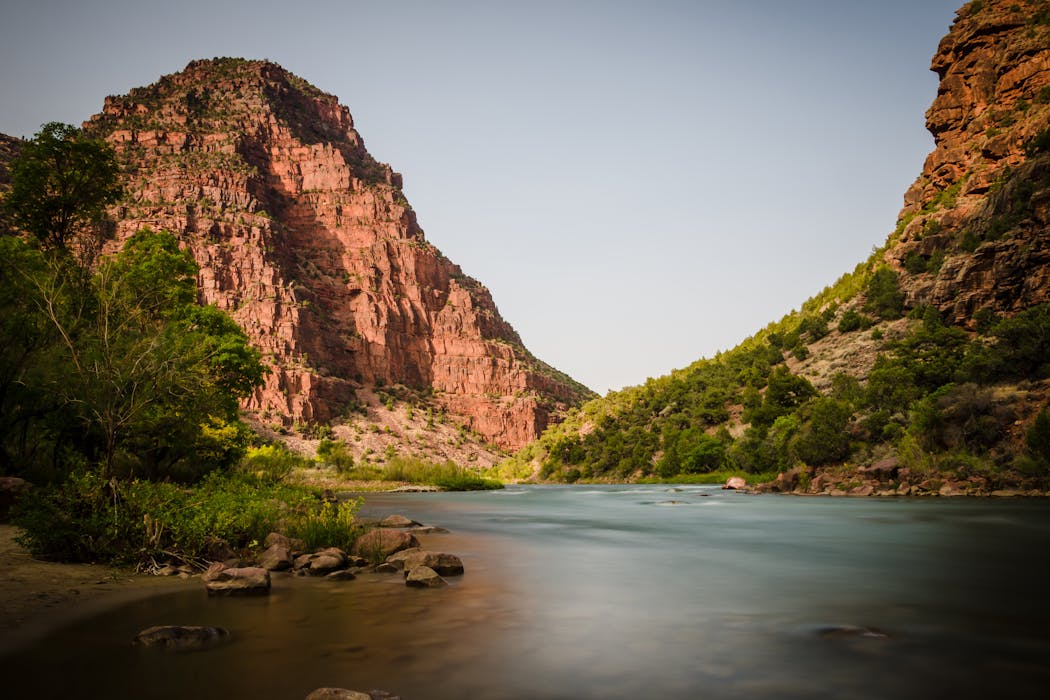 The Gates of Lodore mark the beginning of the Green River's path through the Uinta Mountains. Scott Alan Ritchie / shutterstock
The western US is a geologists' dream, home to the Rocky Mountains, the Grand Canyon, active volcanoes and striking sandstone arches. But one landform simply doesn't make sense.
Rivers normally flow around barriers. The Danube river, for example, flows between the Alps and the Carpathians, twisting and turning to avoid the mountains.
But in north-western Colorado, one river does the opposite.
The intimidatingly named Gates of Lodore marks the entrance to the 700-metre deep Canyon of Lodore that slices straight through the Uinta Mountains as if the range wasn't there at all. It was created by the Green River, the largest tributary of the Colorado River (of Grand Canyon fame).
For more than 150 years, geologists have debated why the Green River chose such an unusual path, creating a spectacular canyon in the process.
 The Green River carves its way through the Uintas in Dinosaur National Monument, on the border of Colorado and Utah.
Eric Poulin / shutterstock
The Green River carves its way through the Uintas in Dinosaur National Monument, on the border of Colorado and Utah.
Eric Poulin / shutterstock
In 1876, John Wesley Powell, a legendary explorer and geologist contemplated this question. Powell hypothesised that the river didn't cut through the mountain, but instead flowed over this route before the range existed. The river must have simply maintained its course as the mountains grew, carving the canyon in the process.
Unfortunately, geological evidence shows this cannot be the case. The Uinta Mountains formed around 50 million years ago, but we know that the Green River has only been following this route for less than 8 million years. As a result, geologists have been forced to seek alternative explanations.
And it seems the answer lies far below the surface.
Drip dripColleagues and I have found evidence for a process in which part of the Earth's crust becomes so dense that it begins to sink into the mantle beneath it. This phenomenon, known as a "lithospheric drip", occurs deep in the Earth, but can have profound effects on the surface.
Drips often form beneath mountain ranges. The sheer weight of the mountains raise temperatures and pressures at the base of the crust, causing dense minerals to form. As these minerals accumulate, the lower crust can become heavier than the mantle it "floats" on. At this point, the crust begins to detach, or "drip", into the mantle.
 Dripping (left) then rebounding (right).
Smith et al (2026)
Dripping (left) then rebounding (right).
Smith et al (2026)
At the surface, this causes two things. Initially as the drip forms, it pulls the crust down, lowering the height of the mountain range above. Then as the drip detaches, the crust springs or rebounds back. The whole process is like pulling a trampoline down and then letting it go again.
For the Green River, this temporary lowering of the Uinta Mountains appears to have removed a critical barrier. The river was able to cross the range during this low period, and then, as the range rebounded, it carved the Canyon of Lodore as it continued on its new course.
A geological bullseyeOur evidence for the lithospheric drip comes from the river networks around the Uinta Mountains. Rivers record a record of past changes to landscapes, which geomorphologists can use to assess how the elevation of a mountain range may have changed in the distant past. The rivers around the Uintas show that the range had recently (in geological terms) undergone a phase of renewed uplift.
By modelling these river networks, we were able to map out the uplift. The result was striking: a bullseye-shaped pattern, with the greatest uplift at the centre of the mountain range, with things decreasing further from the centre. Around the world, this same pattern represents the telltale sign of a lithospheric drip. Similar signals have been identified in places such as the Central Anatolian Plateau in Turkey, as well as closer to the Uinta Mountains on the Colorado Plateau or the Sierra Nevada of California.
To test whether such a process was occurring beneath the Uintas, we turned to seismic tomography. This technique is similar to a medical CT (computerised tomography) scan: instead of using X-rays, geophysicists analyse seismic waves from earthquakes to infer the structure of the deep earth.
Existing seismic imaging reveals a cold, round anomaly more than a hundred miles below the surface of the Uintas. We interpreted this huge feature, some 30-60 miles across, as our broken-off section of the drip.
By estimating the velocity of the sinking drip, we calculated it had detached between 2 and 5 million years ago. This timing matches the uplift inferred from nearby rivers and, crucially, perfectly matches separate geological estimates for when the Green River crossed the Uinta Mountains and joined the Colorado River.
Taken together, these different bits of evidence point towards a lithospheric drip being the trigger that allowed the Green River to flow over the Uintas, resolving a 150-year-old debate.
A pivotal moment in the history of North AmericaWhen the Green River carved through the Uinta Mountains, it fundamentally changed the landscape of North America. Rather than flowing eastwards into the Mississippi, it became a tributary of the Colorado River, and its waters were redirected to the Pacific.
This rerouting altered the continental divide, the line that divides North American river systems that flow into the Atlantic from those that flow into the Pacific. In doing so, it created new boundaries and connections for wildlife and ecosystems.
The story of the Green River shows that processes deep within the Earth can have profound impacts for life on the surface. Over geological timescales, movements of country-sized lumps of minerals many miles below the surface can reshape mountains, redirect rivers and ultimately influence life itself.

Adam Smith does not work for, consult, own shares in or receive funding from any company or organisation that would benefit from this article, and has disclosed no relevant affiliations beyond their academic appointment.
Drastic water shortages and air pollution are fuelling Iran's protests [ 02-Feb-26 12:55pm ]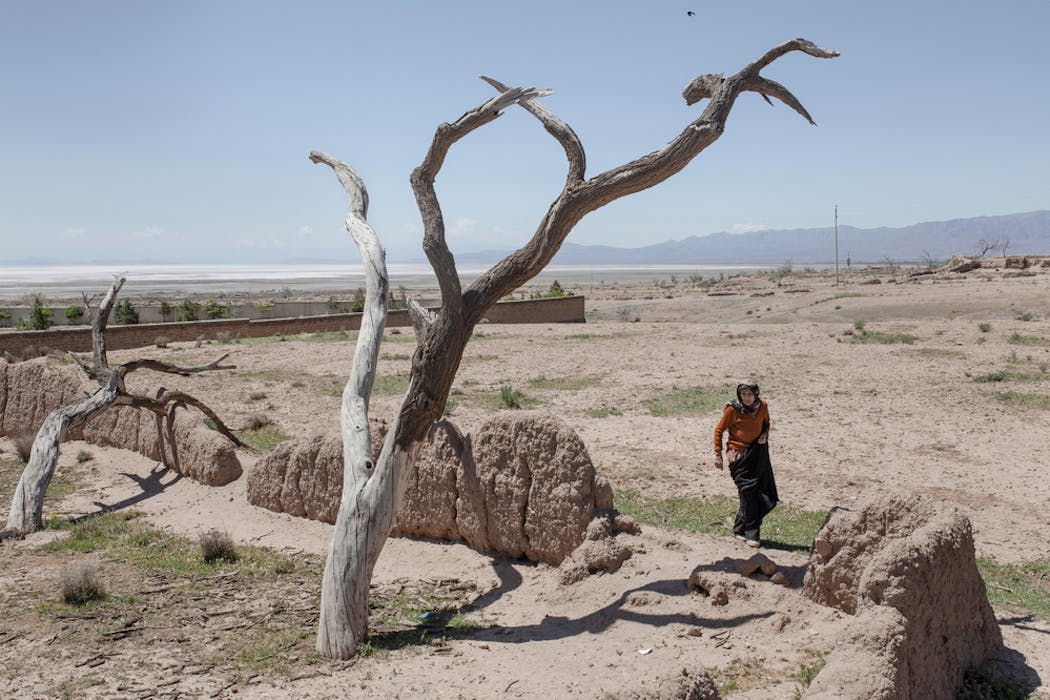 This dry landscape in Iran was once the sixth largest salt lake in the world. solmaz daryani/Shutterstock
This roundup of The Conversation's climate coverage was first published in our award-winning weekly climate action newsletter, Imagine.
"Iran is experiencing not one environmental crisis but the convergence of several: water shortages, land subsidence, air pollution and energy failure. All added together, life is a struggle for survival."
This is the situation inside Iran as described by Nima Shokri, an environmental engineer who works on global challenges related to the environment. Shokri highlights a rarely discussed factor in relation to this year's massive protests across Iran: the severe challenges Iranians are struggling with every day, affecting their ability to simply carry on living.
The air is polluted, the water is drying out and the land collapsing. Many Iranian farmers have been forced to give up their homes and land, and flee to the edges of cities in the hope of just surviving. Their land is cracking and disappearing, and it is no longer possible to grow crops or keep animals alive.
City dwellers are struggling with major water shortages too. On top of that extremely high air pollution levels are forcing hospitals and schools to close, and rising numbers of medical cases are being linked to bad air.
Kevani Madani talks about Iran's long term water problems.Living in that environment, it's no wonder that people feel desperate. As Shokri has pointed out many centres of the massive protests seen in Iran in the past few weeks, where an estimated 30,000 people have been killed, are in places where people are dealing with the most severe environmental challenges.
Read more: Iran's biggest centres of protest are also experiencing extreme pollution and water shortages
Of course, these air, land and water issues are not the only reason why thousands of people are on the streets of this country, where they must live with the decisions of a government that wants to decide who is allowed to walk on the streets and what people, women especially, are allowed to wear.
Struggle for basicsBut these basics of having clean water and air that you can breathe without damaging your health are impossible for anyone to ignore.
These conditions haven't just happened without human intervention. Iran's leaders have made policy choices over the years that have escalated the environmental challenges that many around the world are seeing, such as reduced rainfall. Water intensive agriculture has been encouraged, groundwater has been excessively pumped out, heavy fuel used, and environmental regulation has been weak.
As environmental journalist Sanam Mahoozi and chemical engineer Salome M.S. Shokri-Kuehni wrote, along with Shokri, a few weeks ago, early in January 2026 Iran's capital ranked as the most polluted city in the world.
Local media were reporting more than 350 deaths linked to worsening air quality over ten days during December 2025. And studies indicate that more than 59,000 Iranians die prematurely every year from air pollution-related illnesses.
The Iranian government has failed to protect its people from these escalating crises. In fact, as the three authors argue, its decisions has put them at more risk. And these day-to-day survival issues along with escalating political repression and economic fragility has left desperate people desperate for change, and a country on the edge of collapse.
Iran is not the only country that is experiencing a water crisis that its government hasn't shown signs of knowing how to manage, and where people are struggling to cope. Mexicans are living with conditions caused by years of drought. Reservoirs that used to supply millions with water are drying up. Some people report spending a quarter of their income on water, while others walk 30 minutes to even find a supply.
Water shortages are projected to affect 30 of 32 Mexican states by the year 2050, Natasha Lindstaedt, a professor of government at the University of Essex who researches human security and climate change, writes. And Mexico's water crisis is compounded by being forced to send part of its water supply to the US due to a just over 80-year-old agreement between the two countries.
Read more: Mexico and US look for new deal in long-running battle over 80-year old water treaty
Global crisis
About four billion people - nearly half the global population - live with severe water scarcity for at least one month a year. They are going without access to sufficient water to meet all of their needs, writes Kaveh Madani, director of the Institute for Water, Environment and Health at United Nations University and the author of a new report by UN scientists on water scarcity.
Mexico has been suffering from long periods of drought.The consequences of water deficit are being seen around the world: dry reservoirs, sinking cities, crop failures, water rationing and more frequent wildfires and dust storms.
One massive consequence of short-term water policies, often related to agriculture, is subsidence. And as Madani explains when groundwater is overpumped, the underground structure, which holds water almost like a sponge, can collapse. And it can be impossible for it to recover.
Read more: The world is in water bankruptcy, UN scientists report - here's what that means
In Mexico City, land is sinking by about 25cm per year. In Iran, subsidence is up to 30cm per year, affecting areas where around 14 million people live, more than one-fifth of the population.
The UN report sets out a drastic situation: the world is starting to experience water bankruptcy. This is beyond a crisis. It is long term condition, where cities or regions use more water than nature can reliably replace, where the damage to the environment is so catastrophic that it becomes almost impossible hard to reverse.
And while water becomes such a valuable resource, tension between those who have it and those who don't is only going to increase.
To contact The Conversation's environment team, please email imagine@theconversation.com. We'd love to hear your feedback, ideas and suggestions and we read every email, thank you.
Don't have time to read about climate change as much as you'd like?
Get a weekly roundup in your inbox instead. Every Wednesday, The Conversation's environment editor writes Imagine, a short email that goes a little deeper into just one climate issue. Join the 45,000+ readers who've subscribed so far.
 Preventable deaths in a warming world: how politics shapes who lives and who dies [ 02-Feb-26 12:55pm ]
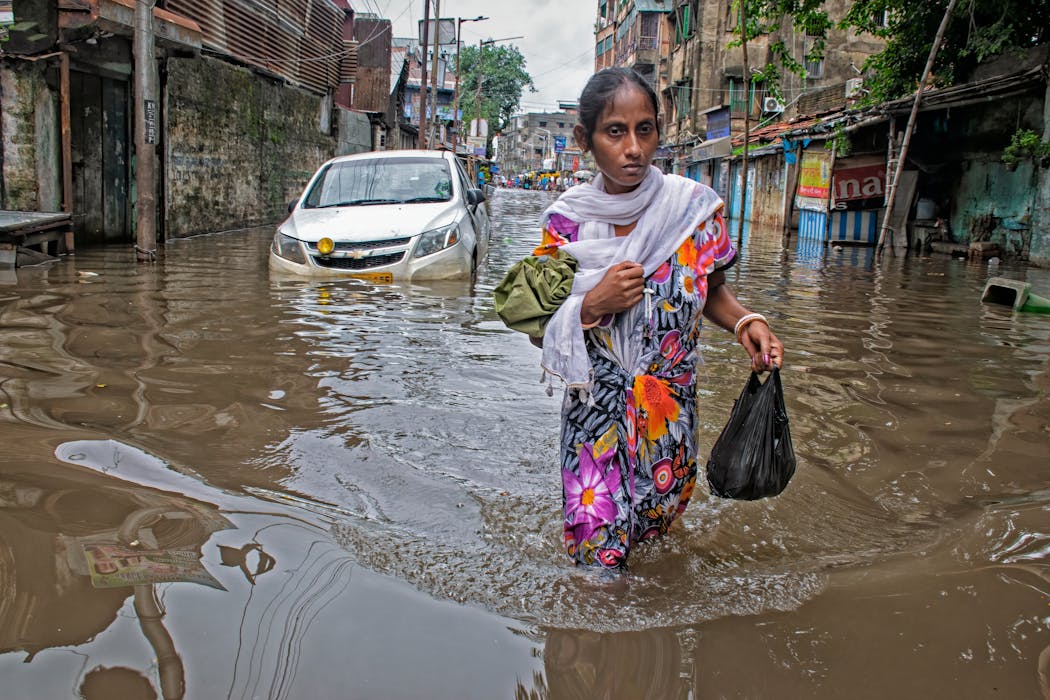 Floods in Kolkata, West Bengal, India in 2019. ABHISHEK BASAK 90/Shutterstock
In Brownsville, Texas, three members of the Galvan family died after a malfunctioning air conditioner left them exposed to extreme heat. Aged between 60 and 82, all three had chronic health conditions, including diabetes and heart disease. This makes it harder for the body to regulate temperature and increases vulnerability to heat stress.
Nobody arrived to check on them until days after they had died in their apartment in 2024. This isolation also increases risk of heat-related deaths.
Although the immediate trigger appears to have been equipment failure, a pathologist attributed the deaths to extreme heat linked to chronic illness. Deaths like these are classified as "heat-related" when ambient temperatures exceed what bodies can safely tolerate.
Climate change is a contributing factor. As heatwaves become more frequent, intense and prolonged, routine failures in cooling, power or housing infrastructure are more likely to turn existing vulnerability into fatal harm.
Around the world, climate-related deaths follow consistent social patterns. People who are older, already ill, economically disadvantaged, or working outdoors are most affected.
The Intergovernmental Panel on Climate Change (the UN's climate science advisory group) concludes that roughly 3.3 billion to 3.6 billion people - nearly half of the world's population - are highly vulnerable to climate risks, with limited capacity to cope. Here, vulnerability is not simply exposure to environmental hazards. Who is protected and who is left at risk depends on social and infrastructural conditions.
Research in climate science, public health and social sciences shows these patterns are clear. My own research spans ecosystem ecology and social science. I examine how climate knowledge is produced, interpreted and acted upon in times of ecological emergency.
The evidence points to an uncomfortable conclusion: much of this suffering is preventable.
The necropolitics of climate changeCameroonian historian Achille Mbembe introduced the idea of "necropolitics" to explain how some lives come to be treated as more expendable than others. This does not imply intent to kill, but rather the routine political acceptance that some people will be exposed to harm.
From this perspective, the Galvans' deaths were shaped not only by heat, but by structural inequalities and gaps in policy and infrastructure.
This logic is visible globally. In south Asia and the Middle East, heatwaves claim the lives of elderly people and outdoor workers. In sub-Saharan Africa, floods and droughts disproportionately affect subsistence farmers.
In the UK, air pollution is linked to roughly 30,000 deaths annually. People from ethnic minority and low-income communities are more likely to live in the most polluted areas. These deaths are not random. They follow recognisable social patterns.
 Floods hit villages in the Jhenaigati upazila of Sherpur district, Bangladesh on October 6 2024.
amdadphoto/Shutterstock
Floods hit villages in the Jhenaigati upazila of Sherpur district, Bangladesh on October 6 2024.
amdadphoto/Shutterstock
Mbembe's concept helps describe situations where political, economic or social arrangements leave some populations consistently exposed to harm. That includes climate-vulnerable communities, places where resources are being extracted through mining or areas where people are displaced from their homes. In the US, "Drill, baby, drill!" has re-emerged as shorthand for prioritising fossil fuel extraction over emissions reduction.
These political and economic choices create consistent patterns of vulnerability for environmental risks, from extreme heat to floods and air pollution. Structural neglect, not personal behaviour, underlies the distribution of harm.
Yet, vulnerability is not fate. Heat provides a clear example. With early warning systems, targeted outreach, and timely intervention, many such fatalities can be prevented. As epidemiologist Kristie Ebi notes: "Those deaths are preventable … people don't need to die in the heat".
The same is true across climate risks. Even with systemic neglect, deliberate and coordinated action can reduce risk. Connecting social, infrastructural, and institutional responses to climate hazards is a crucial step.
Slow violence as a climate processEnvironmental humanist Rob Nixon uses the term "slow violence" to describe harms that accumulate gradually and often invisibly over time. Unlike sudden disasters, the effects of rising temperatures, drought and ecological degradation unfold quietly.
You cannot make a disaster movie out of slow violence. Its harm builds incrementally, striking those already most vulnerable. The deaths of the Galvans exemplify this slow burn, as do the lives lost to prolonged heat exposure, crop failure and environmental degradation worldwide.
People least responsible for emissions, primarily in developing countries, are most exposed to escalating climate harms. Viewed through a necropolitical lens, slow violence shows how neglect becomes lethal through the repeated failure to prevent known and predictable harms.
Feminist theorist Donna Haraway coined the term "Chthulucene", from the Greek chthonic ("of the earth"), to describe an era defined by entangled relationships between humans, other species and the ecosystems they depend on.
Rather than treating environmental harm as separate from social life, this perspective emphasises how vulnerability emerges through the everyday connections between people, institutions and environments. As Haraway argues harm accumulates through these relationships, revealing how exposure to climate risks, political neglect and ecological stress reinforce one another over time.
This dynamic is visible in Vietnam's Mekong Delta, one of the world's most productive rice-growing regions. Here, saltwater intrusion is creeping inland, damaging vast areas of farmland and threatening millions of livelihoods.
Rising sea levels and shifting climate patterns could affect up to 45% of the delta's farmland by 2030, destabilising both local communities and global food systems. Social and ecological harm cannot be separated.
Politics of life, not deathPolitical choices amplify any existing environmental threat. Neglect is not a neutral absence: it is a political condition that shapes who lives and who suffers.
Addressing this injustice requires a living politics of care. This means a political system that recognises vulnerability as socially produced and demands solidarity, equity and accountability. Through alliances between affected communities, researchers and advocates who expose neglect, plus decision-makers under pressure to act, care can become politically unavoidable.
Neglect is no longer allowed to remain invisible in some parts of the world. Cities like Ahmedabad, India, are expanding heat mitigation and early-warning systems. Communities in the Mekong Delta are working with Vietnamese and international researchers to experiment with salt-tolerant crops.
Globally, ecocide laws that make large-scale destruction of ecosystems illegal are being introduced. This helps embed responsibility for environmental protection into legal and political systems. Even in the face of political neglect, targeted action and emerging legal frameworks can reduce harm and foster a more caring form of politics.
Don't have time to read about climate change as much as you'd like?
Get a weekly roundup in your inbox instead. Every Wednesday, The Conversation's environment editor writes Imagine, a short email that goes a little deeper into just one climate issue. Join the 47,000+ readers who've subscribed so far.

Aaron Thierry receives funding from ESRC. He is affiliated with Scientists for Extinction Rebellion.
Understanding Deglobalization: The Role of Diesel and Jet Fuel [ 02-Feb-26 3:23pm ]We are starting to see the beginnings of deglobalization: Countries are increasingly at odds with each other. There is wider disparity among political parties. Trump is making what look to many people like unreasonable demands, both within the US and around the world.
I believe that there is an underlying problem that most people are missing. A worldwide shortage of diesel and jet fuel is forcing international trade to begin moving into a new downward phase, relative to the recent share of GDP shown on Figure 1.
 Figure 1. Trade as a share of GDP, 1960 to 2024, in a chart prepared by OurWorldinData.org.
While international trade grew as a percentage of GDP between the 1960s and 2008, it has been basically flat since then. Now the shortages of diesel and jet fuel are forcing the international trade percentage to start falling to a lower level.
In this post, I will try to explain the situation further. One conclusion: Conflict results from the need to reorganize the world economy in a way that uses less long-distance international trade.
[1] Background: The world economy is a dissipative structure, operating under the laws of physics.The economy behaves differently than most researchers assume because economies are dissipative structures, operating under the laws of physics. Most researchers model tiny parts of economies, and because of their views are so narrow, they reach misleading or wrong conclusions.
Most structures that we see, such as books or houses, are, in a sense, dead. Dissipative structures, however, are different in that they can temporarily grow. In order to stay away from being in a dead state, they need to "dissipate" energy of the proper kinds, in adequate amounts. Examples of dissipative structures include plants and animals of all kinds, ecosystems, and hurricanes.
The human body is a dissipative structure that requires food to stay away from a dead state. Hurricanes are dissipative structures that dissipate the heat of a warm body of water.
If an ecosystem doesn't get enough energy of the right kinds, it will adapt to accommodate the actual mix of fuels and other resources available. If an ecosystem doesn't get enough sunlight, or enough warm temperatures, or enough water, it will gradually shift toward a different mix of plants and animals that can operate within the mix of resources available. This is similar to what happens within the human body. If a human doesn't get enough food, their body will shrink or become thinner.
I believe that without adequate diesel and jet fuel, our economy will make a transition analogous to a human going on a diet, or analogous to an ecosystem changing when a different mix of resources is available.
Academic researchers around the world have misunderstood how the process works because they tend to work in ivory towers. They create models based on the narrow view of the economy that their academic area considers appropriate. Once they have developed a narrow model, they cling to it, even though recent insights from physics suggest that a very different model is more appropriate.
[2] Researchers in academic settings make many unwarranted simplifications in their models.Researchers like to assume that all energy is alike. Substitution is assumed to be relatively easy and quick. Models tend to indicate that if the supply of energy is inadequate, prices will rise. With these higher prices, the economic system will keep problems away practically indefinitely.
The real world doesn't work this way. When we eat food, we cannot simply substitute kale for all our other food consumption and expect to thrive, even though models would seem to suggest that kale is good for us. Within ecosystems, it is the mix of resources and predators that matters. If the top-level predator is killed off, the system will change. The world economy will face similar changes if today's international transport system runs into difficulties.
[3] The fuels especially used for international transport today are diesel and jet fuel.To be useful in international transport, fuels need to
- Be energy dense
- Be easy to store
- Match current infrastructure, unless change is many years away, and system is rebuilt
- Be inexpensive; not requiring a lot of capital investment in infrastructure to support
Diesel and jet fuel have long been the prime fuels used for international travel and transport. "Bunker fuel," which tends to be heavier and more polluting, has also been used. Its use is strongly discouraged today because of pollution issues.
[4] An issue we have today is that diesel is also essential for many other uses.Diesel is an essential fuel today for food production and local transport. Most of the agricultural equipment now in use operates using diesel fuel. Diesel-powered machines can easily navigate muddy fields. In addition, diesel also powers most of the heavy semi-trucks around the world. These trucks deliver goods of all kinds, locally, including food.
Another essential use for diesel is building and maintaining infrastructure. This would include:
- Roads
- Bridges
- Pipelines
- Commercial buildings
- Factories
- Pipelines
- Electricity transmission lines
- Building and maintaining structures used to produce electricity, such as nuclear power plants and hydroelectric plants
The importance of diesel to the economy is difficult for most people to see because these are behind the scenes types of activities.
[5] It is very difficult to get the price of diesel to rise for any extended period.If the price of diesel rises, the price of food tends to rise. This happens because diesel is heavily used in food production and transport. Needless to say, high food prices tend to be unpopular with voters. For this reason, even if the diesel supply is low, the price of the fuel doesn't necessarily rise. If this happened, voters would be very unhappy. They would elect new politicians.
What, in fact, tends to happen is that oil prices (not just diesel and jet fuel prices) tend to bounce up and down. Figure 2 shows a chart of average annual oil prices.
 Figure 2. Average annual Brent equivalent oil prices, in 2024 US$. Data for 1948 through 2024 from the 2025 Statistical Review of World Energy, published by the Energy Institute. Data for 2024 estimated based on EIA estimates of spot Brent prices for 2025, adjusted for inflation.
Figure 2 smooths out some of the price irregularities. For example, there was a very high peak in July 2008, but the price fell to a low level by December of the same year. The peak doesn't appear very high on this chart, but it greatly affected financial markets. See my article, Oil Supply Limits and the Continuing Financial Crisis.
[6] Diesel and jet fuel disproportionately come from oil that is quite "heavy." Oil refineries tend to offer lower prices for heavy oil, making it unattractive to extract.There is a price compression problem with heavy oil:
- Heavy oil tends to be difficult to ship because it doesn't flow through pipelines well. It often needs to be heated, or diluted with a very light oil, to make transportation possible.
- To make matters worse, heavy oil quite often contains sulfur and other impurities that need to be removed, adding refining costs.
- The problem is that these higher costs cannot easily be passed on to the ultimate consumers of diesel and jet fuel. For example, food production and transport depend significantly on diesel, and sometimes even on jet fuel. Consumers of food do not like high food costs.
Because of these issues, the prices refineries are willing to pay for heavy oil tend to be lower than the prices they offer for "light, sweet" oil. For example, the current oil prices shown on OilPrice.com are $70.51 for Brent Crude (a light, sweet European crude), $65.13 for West Texas Intermediate (a sweet US crude) and $50.86 for Western Canadian Select, from Canada's Oil Sands. Russia also has moderately heavy oil; Russia's Urals blend is diluted to make it flow adequately. Its price is listed at $54.48.
These pricing issues make the extraction of heavy oil, especially very heavy oil, unattractive to oil companies. Basically, oil prices do not rise high enough, for long enough, to make extraction profitable. People who look at the Energy Return on Energy Invested (EROEI) of resource extraction would say that the EROEI is very low. In other words, a huge amount of energy needs to be invested to make heavy oil extraction possible. This tends to make the cost of oil extraction expensive.
Because of this price compression, and thus the low prices paid to oil producers, it is not very profitable for oil companies to extract heavy oil. This means that governments cannot charge these companies very high taxes, or they will stop producing oil completely. In addition, tax revenue collected from oil producers tends to fall too low to provide adequate government services., and it also becomes difficult to pay workers adequate wages. These issues lead to unrest in countries with heavy oil reserves, but not much other industry, such as Venezuela.
[7] A naive look at the oil data received from the various agencies does not disclose the nature of the world's oil problem.A chart summarizing the consumption of different types of oil, based on data from the 2025 Statistical Review of World Energy, is as shown in Figure 3. Note that the Diesel+Jet Fuel layer is the product grouping with the largest consumption. In the US, we hear a lot about Gasoline, but Diesel+Jet Fuel is the layer with the greatest fuel consumption. Diesel+Jet Fuel provides a huge quantity of services, but its usage is mostly hidden from sight.
 Figure 3. Figure prepared using data from the "Oil-Regional Consumption" tab of the 2025 Statistical Review of World Energy, published by the Energy Institute. The Light Group is the combination of naphtha, ethane, and liquid petroleum gas (LPG). These are close to gases. The other categories have longer molecules, and thus higher boiling points. The Heavy Group includes waxes, lubricants, asphalt, as well as a fairly unrefined oil, used as a cheap but polluting fuel, shown as "Fuel Oil" on the same tab.
Most published data show only the sum of the four layers in Figure 3. It seems to be rising. This amount represents a combination of quite a few types of oil. When this increasing production is considered along with the reported high oil reserves (particularly heavy oil in Canada and Venezuela), and the belief that prices will always rise if there is a shortage, most researchers cannot imagine that a problem might be occurring.
Researchers often overlook how crucial oil is to the economy. People all over the world need food, roads, and many other things that depend on oil. The number of people who can make an adequate living seems to depend upon the oil supply. It makes sense to look at oil supply per capita. The chart below uses the same amounts, divided by world population. On this basis, world oil consumption is flatter. In fact, per capita oil supply has been somewhat declining recently.
 Figure 4. Amounts shown in Figure 3, divided by world population used by the Energy Institute in its 2025 Statistical Review of World Energy. Different colors are used in this chart compared to Figure 3.
The other thing that becomes apparent from this chart is that the overall mix of products coming out of current processes (extracting and refining oil) has been getting lighter over time. This should not be surprising because the most rapidly growing oil supply since 2008 has been tight oil, extracted from shale in the United States. This tight oil tends to be quite light, adding output to the Light Group and to Gasoline, far more than to Diesel+Jet Fuel or the Heavy Group.
[8] The pattern of diesel supply growth provides insight into what is going wrong with world trade. Figure 5. World per capita diesel supply based on data of the 2025 Statistical Review of World Energy, published by the Energy Institute.
Diesel is about 78% of the combined grouping Diesel+Jet Fuel. The two are similar enough that refineries can slightly change the output mix between the two.
The World Trade Organization began operation in 1995. Its purpose was to encourage more world trade. The Kyoto Protocol of 1997 encouraged countries to cut their own CO2 emissions. The easiest way to do this was by sending manufacturing, mining, and other industries to other countries around the world. Thus, indirectly, the Kyoto Protocol also encouraged world trade. Figure 5 shows that between 1995 and 2008, per-capita world diesel consumption was increasing. The restriction in supply that began around 2008 corresponds with the flattening of world international trade shown in Figure 1.
[9] Several issues contributed to the drop in per-capita diesel supply starting about 2008.(a) In the period before 2008, there was relatively more oil in the Heavy Group that could be refined into Diesel + Jet Fuel (Figure 4). Notice how the Heavy Group layer gets narrower, especially between 1980 and 2008. The Heavy Group includes end uses such as lubricants, waxes, and asphalt. It also includes some heavy oil consumed in close to an unrefined state, such as bunker fuel for ships. Burning such oil is very polluting, so laws have been changed to discourage its use. Simple refining could transform oil such as bunker oil into diesel and jet fuel.
(b) A technique called hydrocracking can be used to transform long hydrocarbon molecules, such as the ones that make up asphalt, into shorter ones. The EIA in 2013 reported, Hydrocracking is an important source of diesel and jet fuel. This technique is expensive, however. It needs a high selling price of crude oil for the economics to work. If the price of oil is high enough, it makes sense to make less asphalt, and more diesel oil and jet fuel.
(c) Price differentials tend to discourage the development of heavy oil fields. As documented in Section [6], the price refineries are willing to pay for heavy oil tends to be quite a bit lower than the price of lighter oil. In the early days of extraction, medium grades of oil tended to give a range of products, from light to heavy. But peak conventional oil took place about 2005, forcing oil companies to extract both very light grades and very heavy grades, with the hope of combining the two types of output to meet the needs of society. Since 2008, the growth in light oil extraction has been spectacular, particularly in the US, with its tight oil from shale. But growth in heavy oil supply has tended to lag.
(d) Depletion is an issue for oil supplies. As with many other resources, the oil taken first is the oil that is easiest to extract and the closest to where the end product is to be used. The oil that is left for later tends to be higher cost to extract and transport. High-cost oil is likely to produce high-cost food. High-cost food tends to upset family budgets, making voters unhappy.
(e) Political issues play a role as well. A major issue is the low profitability of heavy oil extraction because of its low sales price to refineries. With low profitability, tax revenue based on oil royalties tends to be low. Without adequate tax revenue, leaders of countries producing heavy oil for export tend to become belligerent. Examples include Venezuela, Russia, and Canada. Within the US, California produces heavy oil.
[10] The world order seems to on the verge of radical change.We are now facing a situation in which the world economic order seems to be breaking apart, in order to form a new order that "works" better with the changing quantity of Diesel+Jet Fuel available.
We are dealing with a situation that has much in common with a game of musical chairs.
 Figure 6. Chairs arranged for Musical Chairs Source: Fund Raising Auctioneer
The game of musical chairs is played in rounds. At the beginning, there are as many players as chairs. In each round, one of the chairs is removed. The players walk around the circle of chairs until the music stops. When the music stops, all the players try to grab a chair to sit on. There can be small fights over who gets a chair. The person who does not get a chair is eliminated from the game.
When an economy is faced with an inadequate supply of Diesel+Jet Fuel, it needs to regroup in a different way. To do this, some existing businesses and governments must fail, so that others can take their place. In addition, supply lines need to be rearranged to use the resources that are actually available. Customs and beliefs may need to change, as well.
The way nations interact can change as well. In the years of growing international trade, (1970s to 2008), co-operation seemed to be important. Working together was relatively easy. During the tearing down stage, which seems to be starting now, the situation can be expected to be very different. We can expect assertive leaders, and lots of conflict. We are facing this strained situation today.
[11] What lies ahead?I don't think that any of us know for certain what will happen in the future. Nevertheless, the self-organizing world economy seems to be organizing for itself what is ahead. Or perhaps, the hand of a Higher Power is organizing what is happening.
I have only discussed the problem of inadequate Diesel+Jet Fuel, and its impact on international trade and some other parts of the economy. There are other shortages we need to work around as well:
In many parts of the world, one shortage is of fresh water. This is often connected with depleted aquifers and today's high human population.
Another shortage relates to the critical minerals we need for a high-tech society. Billionaire Robert Friedland describes the issue in this video. We have plunged headlong into high tech goods of all kinds, including wind turbines, solar panels, electric vehicles, batteries, computers, and electrification of many kinds of things without realizing that we would soon reach limits in the supply of many minerals used in making these high-tech devices. China controls the vast majority of the critical minerals that are mined. Countries must try to start producing their own critical minerals, or remain on good enough terms with China to purchase some of the limited supplies available.
A third shortage relates to nuclear, and our plans to ramp up nuclear energy. As far as I can see, uranium extraction is currently constrained. In theory, it can be ramped up, but it takes a long chain of events to do so.
With these shortages, AI seems to be constrained in how quickly its use can be expanded. It needs to become far more energy efficient to be truly useful.
With all of these issues, it seems impossible to keep forging ahead as we have done in the recent past. We are being forced to source more of our manufactured output locally. We need to greatly reduce the transportation of goods across the Atlantic and Pacific. Using tariffs seems to be a way of trying to accomplish this change.
Strange as it may seem, some of Trump's policies make a certain amount of sense, when viewed in the light of the issues the world is facing. I expect that a replacement leader would be just as abrasive. The new leader would likely have different strange policies, but the underlying problems are structural. The new leader would likely also face difficulties in trying to fix today's problems.
I am afraid we will have to wait for the self-organizing economic system to find a solution for us. Perhaps innovations can bring us new ways of doing things that will eventually work around these difficulties. But, for the near term, higher levels of conflict because of resource shortage problems seem likely.
Famous climate denier Bjorn Lomborg and Jeffrey Epstein - how involved is the Epstein network in pushing towards collapse? [ 02-Feb-26 3:41pm ]This morning, climate scientist Michael Mann posts some choice screenshots of correspondence from 2012, several years after Epstein's conviction.
https://bsky.app/profile/michaelemann.bsky.social/post/3mdtbraov3k2r
With every document drop, the Epstein network seems to grow larger. Epstein's relationships in the scientific community in general are notable, and tend to have a certain almost reactionary tilt (frequent hinting about discredited race science, etc.).
I joked over the weekend that someone should check the Heartland Institute for Epstein money. I didn't expect this to show up 2 days later.
We talk a lot about elites here, and rightly so. But rarely do we get such an x-ray look at the mundane correspondence that documents relationships and networks. It's very illustrative who Jeffrey Epstein, confidant of half of the leadership of the entire world, made time for.
submitted by /u/JHandey2021[link] [comments]
Will the western United States will be totally on fire this summer? [ 02-Feb-26 3:19pm ]We are officially in the lowest snowpack in history.
This map shows Westwide SNOTEL snow water equivalent as a percent of the 1991-2020 median (end of day Jan 31, 2026). Large parts of the western U.S. are well below normal—many basins in the Southwest and along the Sierra/Cascades are in the 30-60% range, with some areas lower. Low snowpack doesn't guarantee a catastrophic fire season, but it's an early warning: less spring melt, earlier drying of grasses and brush, stressed forests, and more competition for limited water through summer.
I'm sharing this as a discussion starter, not doomposting. What are you seeing in your area so far—reservoir levels, soil moisture, streamflows, or unusually dry fuels? Are local agencies already adjusting burn restrictions, staffing, or prescribed-fire plans? If you have context (recent storms that haven't hit yet, elevation effects, or why certain basins look better/worse), please add it.
If you disagree with the "on fire" framing, say why and point to data. Links to dashboards and forecasts are encouraged. Also: remember ignition sources matter—heat plus wind plus people can turn a dry year into a record year fast very locally.
this post was auto-moderated due to lack of submission statement. reposting. Also added graphic from nasa article on western snowpack (image2)
I'm in Salt Lake City and feel like I'm in a cat 5 hurricane with 0 news coverage. a slow moving toxic event that will trigger migration.
submitted by /u/trevvvit[link] [comments]
Wide Boundary News: Japan, Silver, Venezuela, and More - the Biophysical Phase Shift Cometh [ 02-Feb-26 12:04pm ] In Defence of a Basic Land Income [ 02-Feb-26 11:55am ] Lewis Hyde on Gift Economies and Cultural Commons [ 02-Feb-26 11:25am ]
Race to contain suspected bird flu outbreak among Thames Valley swans [ 02-Feb-26 12:59pm ]Volunteer workers say increasing case numbers and dozens of dead birds raise fears spread is wider than recorded
Members of the public and charity volunteers are working to contain a suspected outbreak of bird flu among swans in the Thames Valley, amid signs that confirmed cases are continuing to rise.
Since October, 324 cases of bird flu in swans have been recorded by the Animal and Plant Health Agency (Apha), which is sponsored by the Department for Environment, Food and Rural Affairs (Defra). Of these, 39 were recorded in the first four weeks of 2026 alone.
Continue reading... Is Trump winning or losing his war on offshore wind power? [ 02-Feb-26 12:30pm ]The US president tried to kill offshore wind projects - now four are back under construction
Construction has resumed on four offshore wind mega-projects after they survived a near fatal attack by Donald Trump's administration thanks to rulings by federal judges. These are being seen as victories for clean energy amid a wider war being waged on it by the Trump administration.
The wind farms are considered critical by grid planners as America faces an energy affordability crisis. Together, the four projects will contribute nearly five gigawatts of energy to the east coast, enough to power 3.5 million homes.
Continue reading... Weather tracker: Cyclone Fytia in Madagascar kills several people and floods homes [ 02-Feb-26 12:25pm ]Island's first tropical storm of season may bring 150mm of rain - meanwhile, eastern Europe freezes with possible night-time lows of -30C
At least three people have died and nearly 30,000 people have been affected by flooding after Madagascar's first tropical storm of the season hit over the weekend.
Tropical Cyclone Fytia formed to the north-west of Madagascar over the northern Mozambique Channel on Thursday.
Continue reading...
This five-year old GPU [RTX 3060] is a sign of technological stagnation [ 02-Feb-26 1:26pm ]Article that inspired this.
https://www.makeuseof.com/old-gpu-refuses-to-go-away-and-its-only-going-to-get-more-popular/
(This five-year-old GPU refuses to go away, and it's only going to get more popular)
The persistence of old-generation GPUs is the ultimate sign of technological stagnation. It is the best evidence that base compute is not getting cheaper. So far, wafers have been getting more expensive. The price per transistor is not falling.
I really do believe frames per dollar is one of the best metrics of technological progress, as opposed to abstruse "AI" metrics in an academic laboratory. Rendering complex scenes is a computationally demanding tasks, so the ability to do that represents the current capability to get computer hardware to do useful stuff. I really do think that in order to drive a car or prescribe a Viagra, "AI" will need to have even better hardware.
If things are really getting better, we would have the manufacturing capability to produce chips with more advanced nodes abundantly. We simply don't have the ability to transform the world through semiconductor manufacturing anymore.
Without cheaper transistors, I believe "AI" isn't really going to make a big, positive impact on life. So "AI" is just hype until transistors become dramatically cheaper again.
Bottom line, things aren't getting faster, cheaper, better. (The citius, vitus, fortius of technology.)
submitted by /u/AdmiralKurita[link] [comments]
Weekly Observations: What signs of collapse do you see in your region? [in-depth] February 02 [ 02-Feb-26 1:02pm ]All comments in this thread MUST be greater than 150 characters.
You MUST include Location: Region when sharing observations.Example - Location: New Zealand
This ONLY applies to top-level comments, not replies to comments. You're welcome to make regionless or general observations, but you still must include 'Location: Region' for your comment to be approved. This thread is also [in-depth], meaning all top-level comments must be at least 150-characters.
Users are asked to refrain from making more than one top-level comment a week. Additional top-level comments are subject to removal.
All previous observations threads and other stickies are viewable here.
submitted by /u/AutoModerator[link] [comments]
Is tyre pollution causing mass deaths in vulnerable salmon populations? [ 02-Feb-26 12:00pm ]A US judge will decide if, as research suggests, a chemical tyre additive is harming endangered fish species
Last week, a district judge in San Francisco, California, presided over a three-day trial brought by west coast fishers and conservationists against US tyre companies. The fishers allege that a chemical additive used in tyres is polluting rivers and waterways, killing coho salmon and other fish. If successful, the case could have implications far beyond the United States.
Continue reading...
Science Snippets: "Fat Factory" Demonstrates Intelligence of Our Close, Extinct Relative [ 02-Feb-26 11:30am ]
2nd February 2026 Today's Round-Up of Economic News [ 02-Feb-26 10:30am ]Huge thanks to my February sponsor, John Rember, author of the three-book series Journal of the Plague Years, a psychic survival guide for humanity's looming date with destiny, shaped by his experiences living through the pandemic in his native Idaho. Thoughtful, wry and humane, Journal 1 is a pleasure.
 "Climate Change As A Geopolitical Force: From Arctic Militarization To Climate Wars…
"The Arctic dynamics reflect a broader trend: climate change is no longer solely an environmental issue but a geopolitical force that reshapes power relations, strategic calculations, and alliance structures."
 "The catastrophe bond market shattered a host of records in 2025 — and many expect another banner year as investors flock to what has been an often-overlooked asset class…
"In the absence of a disastrous event triggering a loss, CAT bonds are known to offer highly attractive equity-like returns, low volatility and low correlation to broader financial markets."
https://www.cnbc.com/2026/02/02/catastrophe-bonds-insurance-climate-change-markets.html
 "There's a Triple Threat to the World's Food Security.
"There are five times as many people alive today as there were in 1900. Yet humanity is better fed than at almost any point in its history. That's thanks to three major developments that have made our planet far more resilient to the risk of starvation: yield improvements, water usage and trade. Worryingly, all are threatened right now."
 "Geopolitical tensions and commodity repricing hit smartphone supply chains.
"Global shipments of smartphone AMOLED panels are forecast to decline to 810 million units in 2026, marking a significant year-on-year contraction after three consecutive years of growth, according to the latest data from Omdia."
 "Aviation leaders tackled barriers to growth and the impact of geopolitical tensions on the eve of the Singapore Airshow on Monday, while reaffirming pledges to reduce emissions.
"Supply chain problems are hurting global airlines and will remain for some time to come, the head of the International Air Transport Association warned industry leaders and regulators."
 "European stocks set for sharp declines as global market fears are reignited.
"European stocks are expected to open in negative territory as concerns over artificial intelligence and volatility in precious metals haunt global markets… Wall Street also turned its attention to Nvidia as questions over the artificial intelligence boom loomed…"
 "The State Of The $2.52 Trillion AI Bubble, January 2026.
"Worldwide spending on AI is forecast to reach $2.52 trillion in 2026, a 44% year-over-year increase, according to Gartner. By 2030, Gartner predicts that AI will account for nearly all of IT spending… For some, observing the mood at Davos 2026 brings memories of another bubble: "I was in Davos in January of 2000, right before the Internet bubble burst, and the mood was similarly ebullient."
 "AI Giants' Bond Surge Sparks Market Stability Fears.
"Three years after the AI revolution was triggered by the emergence of ChatGPT in late 2022, the global AI industry has shifted from a technological competition to a "capital war." The Korea Center for International Finance analyzed, "Concerns are growing over the impact on financial market stability…""
https://www.chosun.com/english/market-money-en/2026/02/02/Q6VP57PZ6BFBXIFO6GD3OU3OBA/
 "Oracle plans massive $50 billion debt-and-equity raise.
"Oracle (ORCL) on Sunday said it expects to raise $45 billion to $50 billion in 2026 to build additional capacity for its cloud infrastructure business. The company, chaired by billionaire Larry Ellison, said it intends to meet its funding needs through a mix of debt and equity."
 "'We're fighting for the soul of the country': how Minnesota residents came together to face ICE…
"In what is arguably the most widespread effort in the country to combat Donald Trump's severe mass deportation tactics, tens of thousands of Minnesotans have played a role in defending their neighbors from ICE."
https://www.theguardian.com/us-news/2026/feb/01/minnesota-twin-cities-ice-protests
 "British factories hit by Trump's tariffs mayhem cut exports to US…
"Stephen Phipson, the chief executive of Make UK, said: "Tariffs and trade friction in global markets are creating uncertainty and disrupting longstanding customer and supply chains. "Many businesses are responding by diversifying exports, adjusting supply chains or scaling back activity to manage rising costs and delays.""
 "More people despair over 'broken Britain' than during financial crisis.
"Some 68 per cent of the public claim British society is broken, compared with 63 per cent in September 2008, according to research by Ipsos for The Telegraph. Fewer than three in five (58 per cent) shared this dissatisfaction with the country in August 2011, just two months before the start of the Occupy London protest movement…"
 "Germany news: Nationwide strikes hit public transport.
"German commuters faced freezing temperatures and deserted platforms on Monday as a widespread public transport strike, orchestrated by the Verdi trade union, paralysed bus and tram services across most cities."
https://www.dw.com/en/germany-news-nationwide-strikes-hit-public-transport/live-75756854
 "German regulator sounds alarm on banks' exposure to private debt funds…
""Financial companies here in Germany are intertwined with foreign private debt vehicles," Branson said. "They provide the funds with capital, which is then used to leverage investments. This poses risks outside the traditionally regulated banking sector.""
 "Europe's oil majors prepare to cut billions in shareholder payouts.
"Most supermajors require Brent crude to stay above $80 per barrel to cover current dividends and buybacks. With Brent averaging near $63-$70 recently, firms are facing significant shortfalls."
https://www.ft.com/content/b4f22a34-8ad1-4062-b395-aa71cd7be130
 "Exclusive: $500 billion euro crisis fund could be used for defence, says ESM chief.
"A European crisis fund with more than 430 billion euros ($514 billion) of firepower could lend money to countries for defence, the head of the European Stability Mechanism told Reuters, as the bloc scrambles to reinforce its military."
 "Transnistria: Russia, the EU, and the Persistence of a Frozen Conflict.
"The Transnistrian conflict is a long-standing territorial dispute in Eastern Europe and has been ongoing since the early 1990s. Emerging from the collapse of the Soviet Union, this conflict has deep historical, political, and socio-economic roots…"
 "Ukraine war briefing: Kyiv reschedules peace talks as battered power grid strains in -15C.
"Planned outages in force across Ukraine while Russian strike kills 12 miners hours after Zelenskyy says next trilateral talks to start on Wednesday."
 "Russia's Lukoil Reaches Tentative Deal To Sell Most Overseas Assets To US Private Equity Firm Carlyle Amid Sanctions…
"The companies did not disclose the value of the potential deal, which includes Lukoil's oil and gas fields from Iraq to Mexico, thousands of petrol stations in 20 countries, and refineries in Bulgaria and Romania."
https://finance.yahoo.com/news/russias-lukoil-reaches-tentative-deal-203301323.html
 "Shoigu backs China's position on Taiwan, says Russia watching Japan's 'militarization'.
"Russian Security Council Secretary Sergei Shoigu told Chinese Foreign Minister Wang Yi that Moscow continues to support Beijing over Taiwan, as Russia keeps a close eye on Japan's "accelerated militarization," the TASS state news agency reported."
https://www.japantimes.co.jp/news/2026/02/02/asia-pacific/politics/shoigu-russia-china-taiwan-japan/
 "Britain, Japan agree to deepen defence and security cooperation.
"Britain and Japan agreed to strengthen defence and economic ties, visiting Prime Minister Keir Starmer said on Saturday, after his bid to forge closer links with China drew warnings from US President Donald Trump."
 "Trade war, global instability push de-dollarisation into China's academic mainstream…
"Chinese scholars have called for greater urgency in reducing reliance on US dollar assets, particularly after Washington and its allies froze about US$300 billion in Russian foreign exchange reserves in 2022."
 "Hopeful signs in China's property market? Not really, say developers…
""I don't see how private developers are going to survive," said a senior executive at a Shanghai-based firm, one of many developers to have defaulted on debt in the wake of the liquidity crunch triggered by the "three red lines" policy."
 "Vanke's Record Loss Leaves Developer at Mercy of State Backer.
"China Vanke Co.'s $12 billion record loss underscores how its ability to avoid default depends on how far its state shareholder is willing to support the stricken property developer."
 'Deeply insecure': Why Bangladeshi minorities are scared ahead of elections.
"A spate of recent attacks has amplified fears among the country's religious minorities ahead of the February 12 vote, even though the government insists most incidents have been ordinary crimes."
 "Traders Brace for Bond Losses on India's Record Borrowing Plan.
"Indian bonds look set to suffer losses on Monday as the government's plan to sell an unprecedented and more-than-expected amount of debt adds to pressure from weakening demand, market participants said."
 "More than 200 killed in intense clashes between separatists and army in Pakistan's Balochistan.
"More than 145 militants and another 49 people, including 17 security personnel, were killed in the last 40 hours in a series of intense clashes between Balochistani separatists and Pakistani military forces, Balochistan Chief Minister Sarfaraz Bugti said on Sunday."
 "Iran warns any war started by US will 'spread across the region'.
"US President Donald Trump says that Iran is now "seriously talking" to the US, despite previous threats of military action…. Iran's supreme leader, Ayatollah Ali Khamenei, warned that any US attack would be met with a "strong blow" from the Iranian nation."
https://www.independent.co.uk/bulletin/news/iran-trump-war-update-b2911790.html
 "Iraq's parliament delays presidency vote again amid political deadlock.
"Iraq's parliament on Sunday postponed a session to elect the country's next president following a similar decision on Tuesday, due to a persistent deadlock between the two main Kurdish parties. The session was adjourned…"
https://www.chinadailyasia.com/hk/article/628246
 "Supplies running out at Syria's al-Hol camp as clashes block aid deliveries.
"An international humanitarian organization has warned that supplies are running out at a camp in northeast Syria housing thousands of people linked to the Islamic State group, as the country's government fights to establish control over an area formerly controlled by Kurdish fighters."
 "Israeli strikes in southern Lebanon kill one, injure seven amid truce.
"Israeli airstrikes have killed one person and wounded seven others in southern Lebanon, marking another breach of the November 2024 ceasefire. The attacks targeted the towns of Ebba and Harouf in the Nabatieh governorate."
 "Israeli air strikes kill at least 32 Palestinians in Gaza, rescue officials say…
"The civil defence agency, which is operated by Hamas, says children and women were among those killed. It added that in one attack, helicopter gunships hit a tent sheltering displaced people in the southern city of Khan Younis."
https://www.bbc.co.uk/news/articles/c701g1g00gdo
 "Drone strikes in Ethiopia's Tigray kill one amid fears of renewed conflict.
"One person has been killed and another injured in drone strikes in Ethiopia's northern Tigray region, a senior Tigrayan official and a humanitarian worker said, in another sign of renewed conflict between regional and federal forces."
 "'Executions, torture, abductions, rape': Ethiopia's hidden conflict…
"The OLA has been battling Ethiopia's government since 2018, even if at times the rebellion was overshadowed by the country's other conflicts, such as the 2020-2022 war in the northern Tigray region."
https://www.independent.co.uk/news/oromia-ethiopia-ola-oromo-amnesty-international-b2911949.html
 "Sudan: Countdown to catastrophe in Kordofan, as world once again looks away.
"South Kordofan is now the epicentre of the war in Sudan, which has caused the world's largest humanitarian crisis. Civilians in this part of southern Sudan face intensified fighting and near-total blockage of humanitarian supplies…"
 "'You take what you can and run': families describe harrowing journey to escape fighting in DRC.
"There was only one sound that halted the family's progress: bombing. The shelling was relentless, each side trying to outdo the other. "They bomb, and the others bomb back. Over and over again," Muka recalls."
 "Clashes erupt between armed factions in W. Libya.
"Violent clashes broke out overnight Friday to early Saturday in the western Libyan city of Zawiya between forces affiliated with the Tripoli-based Government of National Unity, local media reported, resulting in a shift of control between rival armed factions aligned with the UN-backed government."
https://www.chinadailyasia.com/hk/article/628203
 "The Algerian defence ministry said the army killed four "terrorists" on Sunday in a mountainous region of the northwest.
"A ministry statement said the operation was still ongoing in the Djebel Amrouna area about 130 kilometres (80 miles) west of Algiers… The army regularly announces the arrests or deaths of "terrorists", the authorities' term for armed Islamists still active since the North African country's 1992-2002 civil war."
https://www.newarab.com/news/algeria-says-army-killed-four-terrorists
 "A mix of hope and fear settles over Venezuela after US-imposed government change…
"Thirty days after the U.S. raid and capture of then-President Nicolás Maduro upended Venezuela, adults and children alike are still unsure of what exactly is happening around them."
 "Cuba denies security threat accusations as US raises pressure.
"The Cuban Ministry of Foreign Affairs issued a statement on Monday calling for dialogue and stressing that the Caribbean island does not support "terrorism"."
 "How hard cash and central banks are fuelling a global crime wave…
"Criminals want cash dollars — or, to a slightly lesser extent, cash euros and pounds — so they can buy things without suspicious compliance officers being able to notice the transaction and report it to the authorities. Drug smugglers take payment in hard currency, as do people smugglers, wildlife traffickers, kleptocrats and terrorists…"
https://www.thetimes.com/uk/crime/article/where-is-cash-going-circulation-5t2gt3gvf
 "International law meant to limit effects of war at breaking point, study finds…
"Such is the scale of violations, and the lack of consistent international efforts to prevent them, that the study, entitled War Watch, concludes that international humanitarian law is at "a critical breaking point"."
 "UN risks 'imminent financial collapse', secretary general warns…
"António Guterres said the UN faced a financial crisis which was "deepening, threatening programme delivery", and that money could run out by July. He wrote in a letter to all 193 member states that they had to honour their mandatory payments or overhaul the organisation's financial rules to avoid collapse."
https://www.bbc.co.uk/news/articles/cr579mdv4m7o
I rely on donations and tips from my readers to to keep the site running. Every little bit helps. Can you chip in even a dollar? Buy me a coffee or become a Patreon supporter. A huge thank you to those who do subscribe or donate.
You can read the previous "Economic" thread here. I'll be back tomorrow with a "Climate" thread.
The post 2nd February 2026 Today's Round-Up of Economic News appeared first on Climate and Economy.
With some of Ukraine's most valuable biodiversity sites and science facilities under occupation, experts at Sofiyivka Park in Uman are struggling to preserve the country's natural history
In the basement laboratory of the National Dendrological Park Sofiyivka, Larisa Kolder tends to dozens of specimens of Moehringia hypanica between power outages. Just months earlier, she and her team at this microclonal plant propagation laboratory in Uman, Ukraine, received 23 seeds of the rare flower.
Listed as threatened in Ukraine's Red Book of endangered species, Moehringia grows nowhere else in the wild but the Mykolaiv region of Ukraine. Of those 23 seeds, only two grew into plants that Kolder and her colleagues could clone in their laboratory, but now her lab is home to a small grove of Moehringia seedlings, including 80 that have put down roots in a small but vital win for biodiversity conservation amid Russia's war with Ukraine.
Continue reading...After stories revealed high levels of contamination in neighborhood around factory processing US toxic waste, government announces sweeping array of tactics
The Mexican government has announced it will pursue a sweeping array of tactics to combat industrial pollution, from $4.8m in fines against a plant processing US hazardous waste to the rollout of a new industrial air-monitoring system, following investigations by the Guardian and Quinto Elemento Lab, a Mexican investigative unit.
Those stories revealed high levels of heavy-metal contamination in the neighborhood around the factory, Zinc Nacional, in the Monterrey metropolitan area, and showed the broader extent of industrial pollution in the region, linked to Monterrey's role in manufacturing and recycling goods for the US market.
Continue reading...Bridport, Dorset: Paths became streams and new islands appeared as the River Brit burst its banks
We were warned that rain was coming - and so it did, barrelling down all night, falling through the darkness on to ground that was already saturated. By the time it was light, the rivers through Bridport had risen and spread across the floodplain, splicing into a broad, brown rope of water twisting to the harbour at West Bay.
Contemptuous of its banks, the River Brit was running noisily across meadows, forming new lakes where herring gulls sat floating on its muddy surge. Water went straight through the allotments, sending plastic pots bobbing like buoys against the boundary fence.
Continue reading...
This piece is copublished by DeSmog and ExxonKnews. ExxonKnews is a reporting project of the Center for Climate Integrity.
The U.S. oil lobby aims to bulldoze European climate regulations as a top policy goal in 2026.
In a policy agenda published this month by the American Petroleum Institute (API), the country's largest oil and gas trade association said it will ensure that laws outside of the country "do not disadvantage U.S. producers." The API explicitly names two European climate laws it will zero in on: the EU Methane Regulation and the Corporate Sustainability Due Diligence Directive (CSDDD), a law designed to force large corporations to cut emissions to deal with the negative environmental and human rights impacts of their businesses.
API's policy directive around European climate laws comes amid precarious trade negotiations and tensions between the U.S. and the EU. President Donald Trump's chaotic quest for worldwide "energy dominance" and allegiance to fossil fuels has worked out in the favor of American oil companies before, which doesn't bode well for the future of EU climate regulations.
Behind the scenes, the U.S. fossil fuel industry has already spent nearly a year coordinating a campaign of attack on the CSDDD, a trove of leaked documents obtained by the research group the Centre for Research on Multinational Corporations (SOMO), and reviewed by DeSmog and ExxonKnews, shows. Their strategy, in part, was to "amplify" concerns about U.S. trade threats and international tensions to unravel key provisions in the law.
The effort was orchestrated by the Competitiveness Roundtable, a coalition of primarily U.S. fossil fuel companies, including ExxonMobil, Chevron, and Koch Inc., with close ties to the Trump administration, DeSmog first reported last month. The PR company Teneo, which represents major U.S. oil companies, organized the Roundtable.
"It's extremely worrying that the API appears to continue its campaign against the CSDDD in 2026 and wants to water it down even further, despite the massive concessions the EU adopted already following intense lobbying by U.S. fossil fuel companies," said David Ollivier de Leth, a researcher at SOMO and author of a December report on the Competitiveness Roundtable documents.
"With all the political turmoil at the moment, it is crucial that the EU stands strong and defends its laws aimed at protecting people and the climate against even more interference from corporations and the Trump administration."
The American Petroleum Institute did not respond to a request for comment.
Subscribe to our newsletterStay up to date with DeSmog news and alerts
Email Address What content do you want to subscribe to? (check all that apply) All International UK Sign Up (function($){ $('.newsletter-container .ijkidr-us').click(function() { $('.js-cm-form').attr('data-id', '2BE4EF332AA2E32596E38B640E905619D07B21962C5AFE16D3A2145673C82A3CEE9D9F1ADDABE965ACB3CE39939D42AC9012C6272FD52BFCA0790F0FB77C6442'); $('.js-cm-email-input').attr('name', 'cm-vdrirr-vdrirr'); }); $('.newsletter-container .ijkidr-uk').click(function() { $('.js-cm-form').attr('data-id', '2BE4EF332AA2E32596E38B640E905619BD43AA6813AF1B0FFE26D8282EC254E3ED0237BA72BEFBE922037EE4F1B325C6DA4918F8E044E022C7D333A43FD72429'); $('.js-cm-email-input').attr('name', 'cm-ijkidr-ijkidr'); }); })(jQuery);The Competitiveness Roundtable met weekly, as documented in activity updates and strategy outlines, after the European Commission announced last February that it would renew talks over the legislation and draft an Omnibus package to "simplify" the CSDDD law.
In mid-December, the European Parliament approved a new version of the CSDDD stripped of several elements the coalition had opposed. Those included provisions for large companies trading in the EU to implement climate transition plans, and harmonization of civil liability laws, which would have allowed companies to be sued for failing to comply with the CSDDD across EU member states.
'Take Advantage' of NegotiationsHow has the U.S. oil lobby worked to dismantle EU climate regulations so far? By exploiting frailties in the legislative process while encouraging the Trump administration to fight the law on its behalf, according to documents uncovered by SOMO.
The Competitiveness Roundtable pressured European lawmakers to ally with the European Parliament's far-right and adopt "the most extreme position" on the CSDDD, documents reveal.
In a July 11 document, the coalition said it would "take advantage of the 'weak' Council negotiating mandate and disagreements on contentious articles," like the one that would have required companies to make climate transition plans. It would "push for a blocking minority" to kill that article by assigning teams of oil majors to "establish rapporteurships" with the opposing member states, thus "divid[ing] and conquer[ing] in the Council for influence." (A minority of governments representing at least 35 percent of the EU's population or at least four EU member states can block an EU Commission proposal from being adopted.)
At the same time, the companies strategized to encourage U.S. officials to "have the EU use [the CSDDD] as a concession in negotiations on tariffs."
"Amplify concerns through US foreign and trade policy channels," reads one document from May.
In June, the coalition discussed pressuring their U.S. allies to present the CSDDD as a "key barrier" to EU-U.S. trade and tariff negotiations. That month, the Trump administration threatened to increase tariffs from 20 to 50 percent.
In July, the companies discussed using their "close ties" with the Trump administration to ensure that upending the CSDDD was a top priority for the U.S. Trade Representative, the agency handling international trade agreements.
In August, the EU agreed to propose changes to both the civil liability requirements and climate transition plan mandate of the CSDDD in exchange for a tariff freeze.
The coalition aimed to get "third countries" involved, too. After Qatar threatened to stop exporting liquefied natural gas (LNG) to the EU if member states strictly enforced the CSDDD penalties, the coalition planned to get an op-ed or open letter published "similar to the [interview with] Qatar Energy in the FT," referring to the Financial Times.
A day prior to a critical vote on CSDDD negotiations in October, the governments of Qatar and the United States published an open letter warning of "unintended consequences for LNG export competitiveness" if the law was not repealed or at least modified to remove the civil liability and climate transition requirements, among others.
Involving Third PartiesThe U.S. companies worked to disguise their role through trade associations, think tanks, outside countries, and its facilitator, PR company Teneo, sometimes the only firm listed as a lobbyist in meetings recorded by the EU's Transparency Register even though other companies were present.
"If the message comes from so many different sides, for policymakers, it starts to feel like it's not just you, Exxon, or any other company," de Leth said.
In the July meeting notes, Exxon and Chevron were assigned to support lobbying against the CSDDD by the U.S. Chamber of Commerce, including through a white paper that would ultimately be published in October. The paper warned that if the EU imposed CSDDD penalties on companies outside the EU, it would be "undermining international law" and "alienating key trading partners." It also decried that the law could hold companies liable "in EU courts for U.S.-based conduct that is lawful in the U.S."
Ironically, around the same time, Exxon and the Chamber were fighting climate laws in the United States in court. U.S. oil companies, and now the American Petroleum Institute, are also fighting for immunity from climate lawsuits in the U.S.
In August, the coalition planned to pay at least €185,000 for TEHA Group, a Brussels-based management consulting think tank, to write a paper and organize an event on the CSDDD with "those favouring our view and relevant policymakers." TEHA group later confirmed to SOMO that Roundtable companies funded the resulting report and Exxon funded the event.
TEHA Group told SOMO that "the analyses and findings presented are the result of TEHA's independent research and are not determined by, nor bound to, the views or positions of the supporting companies," and that it "had sole responsibility for the professional organisation and curation of the event" sponsored by Exxon, according to SOMO.
The Roundtable also discussed a larger strategy to "activate third countries with minimal US visibility," including organizing a "letter campaign by third countries / third country associations" to push the European Commission on its priorities.
The American Petroleum Institute and Roundtable companies have a decades-long, successful history of profoundly influencing international climate negotiations, DeSmog has revealed. Robert Brulle, a visiting professor of environment and sociology at Brown University who researches fossil fuel lobbying, called this latest effort a "casebook example of an information and influence campaign to undermine the laws of the EU by the oil and gas sector."
The Roundtable effort has "all the hallmarks" of such a campaign, Brulle said, including coordinated lobbying, financial contributions to garner political support, facilitation by a major PR firm, and the enlistment of think tanks to obstruct climate action. "The question is whether they'll get away with it or not."
What Comes Next: LNG or LiabilityThe final EU Sustainability Omnibus package is expected to be approved by EU member states next month, though its compliance has been pushed back until July 2029.
It's unclear what the American Petroleum Institute plans to do between now and then — though it also included in its agenda a priority to "Promote U.S. LNG through coordinated action by the Department of Energy and State Department, using proactive energy diplomacy to support allies, strengthen global energy security, and reinforce U.S. economic leadership."
The question of LNG exports now also looms over struggling trade negotiations between the EU and Trump. With the EU increasingly more dependent on the U.S. for LNG and Trump forcefully encouraging Europe to embrace fossil fuels as he threatens its sovereignty, EU climate policies — including the CSDDD and EU methane regulations — could once again be sacrificed for Trump and U.S. companies' demands.
The American Petroleum Institute has lobbied for the expansion of LNG export infrastructure and has been a key U.S. opponent of EU methane regulation, the other target it listed in its 2026 agenda. Those regulations would limit companies' ability to export far less regulated gas from the United States. According to reporting from the New York Times, the Trump administration is lobbying European lawmakers to overturn the climate laws, or at least exempt American oil companies from penalties.
"[U.S. LNG producers have] spent so much money in developing their LNG infrastructure," said Brulle, adding that a "whole new category" of front groups have been created to sell the product overseas. "This is kind of an existential crisis for them."
The consequences would be dire if the companies succeed in completely thwarting EU climate regulations. "Given current policies alone — with no further progress — we are currently looking at planetary warming that likely lies between 2.5 and 3℃, teetering on the edge of societally destabilizing planetary warming," said climate scientist and professor Michael Mann, who has co-authored a recent book on the topic, Science Under Siege.
Some climate advocates point to the courts as the remaining avenue for accountability. Fossil fuel majors have increasingly been sued in the EU over climate harms and damages, particularly the small group of producers most responsible for global emissions, including Exxon and Chevron. Those claims will move forward, even without the harmonized liability regime proposed in the CSDDD.
"As climate impacts intensify and demands for justice mount, the fossil fuel industry has been working transatlantically to insulate itself from accountability," said Nikki Reisch, director of the climate and energy program at the Center for International Environmental Law. "Policymakers must reject attempts by the biggest climate culprits to dodge their duties while communities suffer and the planet burns."
The post Top U.S. Oil Lobby API Targets Landmark EU Climate Law, Policy Document Shows appeared first on DeSmog.
In the first few weeks of 2026, UK newspapers have been ablaze with sensational claims about climate policy: cutting emissions to net zero would cost up to "£9 trillion". An electricity grid run on renewable power would cause "blackouts". The government department tasked with climate policy needs to be "shut down".
The claims - which were quickly debunked by climate experts and public bodies - were based on three policy papers and endorsed by the Conservative Party's shadow energy secretary, Claire Coutinho.
But as DeSmog's analysis shows, the reports were all authored by individuals or organisations with ties to the fossil fuel industry.
Last week, Coutinho wrote the foreword to a report - 'It's Broke, Fix It: Where British Energy Policy Went Wrong and How to Get it Right' - published by the Prosperity Institute, which is owned by investors behind the right-wing broadcaster GB News.
Coutinho called the report - which was covered in The Telegraph and Express newspapers - "timely" and "insightful".
The report advocated for the Department of Energy and Net Zero - which Coutinho previously led - to be "shut down" in order to "divorce energy policy from climate policy". It also claimed that the "rapid build-out of gas-fired capacity, or even coal" is required to cut energy prices.
DeSmog can reveal that the report's author, Rupert Darwall, has roles at two leading U.S. climate science denial groups, both of which have received funding from oil and gas interests.
Darwall is a senior fellow at the National Center for Energy Analytics (NCEA), which was launched in 2024 by the Texas Public Policy Foundation (TPPF) with $250,000 from the Brigham Family Foundation, whose president - Ben M. "Bud" Brigham - is an oil and gas executive.
Brigham is founder and chairman of Brigham Exploration, an oil and gas management and acquisition company. He donated to Donald Trump's 2024 presidential election campaign and the Republican National Committee the same year. He's also the founder and executive chairman of Atlas Energy Solutions, an oil and gas logistics company.
The TPPF received more than $4 million from oil and gas billionaire Charles Koch's foundations between 1997 and 2018, according to Greenpeace USA. Charles Koch and his late brother David have been leading sponsors of climate science denial across the globe in recent decades.
Darwall is also listed as a member of the CO2 Coalition, a U.S. climate denial group which describes CO2 as "plant food" and denies the link between emissions and rising temperatures. The group received $662,000 (£481,000) from Koch foundations between 1997 and 2017.
Darwall did not respond to DeSmog's request for comment.
Coutinho also launched a report by Watt-Logic, a company run by Kathryn Porter, an oil and gas industry consultant. Porter states on her website that she works for "businesses with projects across the electricity, gas and oil industries".
Her report claimed that increasing renewable energy capacity in the UK will heighten the risk of blackouts - a claim rejected by the National Energy Systems Operator (NESO), which helps to plan and manage the country's energy network.
Porter - who has also authored reports for the Global Warming Policy Foundation (GWPF), the UK's leading climate science denial group - did not deny that she still has oil and gas clients, when asked by DeSmog.
Coutinho also provided a supportive quote for a report by the Institute of Economic Affairs (IEA), which claimed that achieving net zero emissions could cost the UK up to £9 trillion - a figure described by experts as "fundamentally wrong".
As DeSmog revealed, the IEA has received funding from oil majors including BP and Shell.
Amid pressure from Nigel Farage's Reform UK, the Conservative Party under Kemi Badenoch has ditched its previous support for climate action, declaring it would be "impossible" to reach net zero by 2050, and vowing to repeal the 2008 Climate Change Act.
"The Conservatives seem to want to hold back the UK's shift to homegrown clean energy and keep us hooked on fossil fuels, just so that a handful of oil executives can keep the profits rolling in," said Tessa Khan, executive director of the research and campaign group Uplift.
"Delaying the energy transition increases the UK's reliance on imported gas. The reality is, the UK has burned most of its gas and, regardless of new drilling, we are set to be dependent on imports for nearly two-thirds of our gas in just five years' time and almost 100 percent by 2050 - unless we move to renewable energy.
"Coutinho knows - and has admitted - that more drilling won't bring down bills, and she understands the dangers to us and future generations from unchecked climate change. We need politicians that will stand up to the anti-science, anti-renewable agenda of Donald Trump and his paymasters in the oil and gas industry".
The Conservative Party was approached for comment.
Legatum and DarwallDarwall wrote a book in 2017 called Green Tyranny: Exposing the Totalitarian Roots of the Climate Industrial Complex. In interviews promoting the book he argued that the climate movement has its roots in Nazi Germany, claiming: "virtually every theme you see in the modern environmental movement, the Nazis were doing."
Coutinho, in her foreword to Darwall's Prosperity Institute report, said: "I may not agree with every point Rupert makes, but as we look to a future unburdened by net zero and the Climate Change Act, the ideas in this report will be immensely useful to debate so we can chart the journey back to an energy system that puts consumers at its core."
The Prosperity Institute (formerly the Legatum Institute) is a conservative think tank owned by UAE-based investment firm Legatum Group, which co-owns GB News alongside hedge fund boss and fossil fuel investor Paul Marshall.
The Prosperity Institute's advisory board includes Neil Record, a Tory donor who helped to bankroll Kemi Badenoch's 2024 Conservative leadership campaign. Record is also the director of the GWPF's campaign arm, Net Zero Watch, which campaigns against renewable energy and backs new oil and gas extraction.
In late 2023, the Legatum Institute Foundation gave £50,000 to a Conservative Party faction run by Danny Kruger MP, who has since defected to Reform.
The post Claire Coutinho Touts Anti-Net Zero Reports by Oil-Linked Authors appeared first on DeSmog.
Nadhim Zahawi, a high-profile defector from the Conservatives to Reform UK, chairs the advisory board of a luxury property developer in the United Arab Emirates (UAE), DeSmog can report.
Former Tory chancellor Zahawi joined Nigel Farage's right-wing populist party on 12 January amid a string of recent Conservative defections.
Farage often portrays Reform as an "anti-establishment" party taking on corporate and political "elites", yet Zahawi's record doesn't conform to this image.
Since May 2025, he has served as chairman of the advisory board at Omniyat, a property developer in Dubai, UAE. Zahawi stood down as an MP at the 2024 general election.
Posting on LinkedIn last year, Zahawi said that Omniyat wants to shape "the future of ultra-luxury living".
The company's website states that it achieved $800.2 million (£583 million) in sales in 2024, flogging 37 percent of the properties in Dubai listed for more than $10 million (£7.3 million).
Subscribe to our newsletterStay up to date with DeSmog news and alerts
Email Address What content do you want to subscribe to? (check all that apply) All International UK Sign Up (function($){ $('.newsletter-container .ijkidr-us').click(function() { $('.js-cm-form').attr('data-id', '2BE4EF332AA2E32596E38B640E905619D07B21962C5AFE16D3A2145673C82A3CEE9D9F1ADDABE965ACB3CE39939D42AC9012C6272FD52BFCA0790F0FB77C6442'); $('.js-cm-email-input').attr('name', 'cm-vdrirr-vdrirr'); }); $('.newsletter-container .ijkidr-uk').click(function() { $('.js-cm-form').attr('data-id', '2BE4EF332AA2E32596E38B640E905619BD43AA6813AF1B0FFE26D8282EC254E3ED0237BA72BEFBE922037EE4F1B325C6DA4918F8E044E022C7D333A43FD72429'); $('.js-cm-email-input').attr('name', 'cm-ijkidr-ijkidr'); }); })(jQuery);Zahawi - along with his new Reform UK colleagues - has extensive property assets. In 2022, it was reported that he controlled a family property empire worth £100 million.
His business interests have long been the subject of controversy. While serving as chancellor in 2022, Zahawi paid a £4.8 million bill to HMRC - including a £1.1 million penalty charge - over a tax "error". He was sacked as the Conservative Party's chairman in 2023 after an ethics inquiry found he had failed to disclose that HMRC was investigating his taxes.
When announcing his defection, Farage said that he hoped Zahawi could raise "huge amounts of money" for Reform.
As revealed by DeSmog, senior Reform politicians have been amassing close ties to the UAE government, an autocratic monarchy whose wealth is heavily derived from oil and gas revenues.
Farage received front-row tickets to the Abu Dhabi Grand Prix in December courtesy of the Abu Dhabi government, while Reform treasurer Nick Candy has been in business with a property company owned by the UAE since October 2024.
Zahawi attended the 2023 COP28 climate summit in Dubai as a guest of the UAE, and was part of a bid by an investment firm backed by the UAE to buy the Telegraph Media Group that year.
He also spoke at the Abu Dhabi International Book Fair last year, which is headed by UAE President Sheikh Mohamed bin Zayed Al Nahyan. Zahawi was promoting the Arabic language version of his memoir, The Boy from Baghdad.
Reform, which campaigns to scrap the UK's climate policies and ramp up fossil fuel extraction, has been funded heavily in the past by polluting interests and those who refute basic climate science.
The party received 92 percent of its donations between the 2019 and 2024 UK elections from oil investors, major polluters, and climate science deniers, while Candy has claimed the party is actively raising money from oil executives.
"Given the party's growing traction, Reform cosying up to an authoritarian petrostate should worry us all," Jon Noronha-Gant, a senior investigator at Global Witness, previously told DeSmog.
Omniyat and Zahawi were approached for comment.
Zahawi's Net Zero U-turnWriting for the Daily Mail about his reasons for joining Reform, Zahawi complained that the UK has "an energy secretary hell-bent on pursuing a net zero policy which will bankrupt the country."
However, this contradicts his previous views on the subject. In 2021, as Boris Johnson's secretary of state for education, Zahawi spoke at the COP26 climate summit in Glasgow about the importance of climate action.
"We want to deliver a better, safer, greener world for future generations of young people and education is one of our key weapons in the fight against climate change," he said.
He announced a series of climate policies, including a scheme to install solar panels in schools and replace their gas and coal boilers.
 Reform UK leader Nigel Farage, and deputy leader Richard Tice.
Photo: Sipa US / Alamy
Specifically endorsing the UK's 2050 net zero emissions target, he added: "The COP26 summit has further amplified the UK's commitments to become a world leader in sustainability right across the education system by engaging young people and bringing them on our journey towards net zero and a green future."
In a debate in Parliament in February 2022, Zahawi again backed net zero, stating: "We also need to adapt our economy and society to meet our commitment to net zero by 2050 and maintain our global leadership on climate change following COP26, with all the opportunities that there are in those new and emerging sectors for the economy."
Zahawi is not the only Tory-to-Reform defector to U-turn on net zero. In September, Conservative MP Danny Kruger jumped ship, declaring: "We need large-scale reindustrialisation and an end to the madness of net zero."
But in articles on his website unearthed by DeSmog, the former Tory called climate change "one of the greatest challenges we face", warned of "the threat from global warming", and praised government climate action for "protecting our planet for centuries to come".
It appears that both Zahawi and Kruger were correct in their previous guises. While the net zero economy is growing at 10 percent a year, according to the Confederation of British Industry (CBI), it has been estimated that Reform's anti-climate policies would wipe £92 billion off the UK economy by the end of the decade.

A version of this article has been published by The New World.
The post Tory-Reform Defector Nadhim Zahawi's Role in 'Ultra-Luxury' UAE Property Developer appeared first on DeSmog.
Plans by the European Commission to scrap routine checks on pesticide safety would break EU law, according to a new legal opinion published today (27 January).
The Commission announced plans in December to "simplify" regulations for pesticides, including ditching requirements for all pesticides to be reassessed every ten to fifteen years to account for new evidence around health and environment impacts.
The move could violate the high levels of protections enshrined in EU law, according to the new legal opinion, published ahead of initial discussions between ambassadors on Monday.
Widespread pesticide use has contributed to rapid bird and bee declines in the EU, and is linked to incidents of cancer, Parkinsons and other serious health conditions. The market is worth more than $67 billion (€56 billion) worldwide.
The legal opinion, which was commissioned by seven non-profits including legal advocacy group ClientEarth and campaign organisation Pesticide Action Network, also criticised the Commission for failing to adequately consult experts and the public.
It comes after 200 scientists warned policymakers against the changes, in an open letter published in December. They said that the proposed amendments would "create loopholes that keep harmful pesticides in use" by doubling the time that a pesticide could continue to be used after being banned, from one and a half to three years.
Subscribe to our newsletterStay up to date with DeSmog news and alerts
Email Address What content do you want to subscribe to? (check all that apply) All International UK Sign Up (function($){ $('.newsletter-container .ijkidr-us').click(function() { $('.js-cm-form').attr('data-id', '2BE4EF332AA2E32596E38B640E905619D07B21962C5AFE16D3A2145673C82A3CEE9D9F1ADDABE965ACB3CE39939D42AC9012C6272FD52BFCA0790F0FB77C6442'); $('.js-cm-email-input').attr('name', 'cm-vdrirr-vdrirr'); }); $('.newsletter-container .ijkidr-uk').click(function() { $('.js-cm-form').attr('data-id', '2BE4EF332AA2E32596E38B640E905619BD43AA6813AF1B0FFE26D8282EC254E3ED0237BA72BEFBE922037EE4F1B325C6DA4918F8E044E022C7D333A43FD72429'); $('.js-cm-email-input').attr('name', 'cm-ijkidr-ijkidr'); }); })(jQuery);The recent proposals follow intensive lobbying by the pesticide industry against efforts to reduce pesticide use in the bloc. In February, the Commission announced that it was dropping plans to halve pesticide use, a target that was originally signed off by Parliament in 2021.
The changes currently under review are part of the Commission's so-called 'Omnibus packages' — a series of proposals that the legislator says will "cut red tape and simplify EU rules".
In an email, a Commission spokesperson told DeSmog, "the existing system of periodic renewal assessment of every active [pesticide] substance has become unsustainable. […] we are not lowering the safety standards, on the opposite we are making the system more efficient and rapid, ensuring a faster uptake of scientific knowledge at the European level."
The recent opinion on the pesticide legislation, which was published by Berlin-based law firm Geulen & Klinger Rechtsanwälte, is not legally binding, but indicates that the Commission could face legal challenges were it to go ahead with the changes.
"The Parliament has a legal and moral obligation to reject these dangerous [pesticide] proposals, and instead to work towards a toxic-free and healthy farming system," said Anja Hazekamp, Dutch Left MEP.
Austrian Green MEP Thomas Waitz said the legal opinion confirmed his fears. Regular reassessment was "essential to reassess risks to human health and environmental damage such as groundwater contamination and insect decline," he told DeSmog.
"Following the logic of 'once approved, always approved', we'd still be drinking from lead pipes or building with asbestos."
Under the proposed rules, a small number of high-risk pesticides would still be reassessed every ten to 15 years.However, the majority would get approval to be used indefinitely.
The Commission has stressed its "pragmatic approach" to checks, adding that unlimited approval would only be given where pesticides "clearly meet the approval criteria".
However, campaigners point to pesticides such as bee-killing neonicotinoids that were approved years before scientific evidence of their harms came to light, and may therefore not be caught by the proposed new tiered system.
"Instead of 'simplification', this omnibus package creates legal uncertainty and health risks that only benefit companies," said ClientEarth lawyer Elisabeth Koch.
"The proposed changes undo decades of progress in pesticide regulation, putting the health of farmers, consumers and nature at risk."
DeregulationThe changes are part of the Commission's "Food and Feed Safety Simplification Omnibus". Since the start of 2025, theEuropean Commission has put forward ten such packages for cutting regulation of everything from subsidies for farmers to reporting requirements for large companies, with five approved last year.
Academics and campaigners have repeatedly raised concerns after policymakers slashed green rules and targeted due diligence laws as part of the deregulation drive.
The Commission has also come under fire for its fast-tracking of these 'omnibus' changes. In normal circumstances, the Commission consults with experts and the public before publishing its proposals. However, no such process has been followed for its omnibus packages — a decision the Commission has sought to justify based on the need for "urgent" regulatory reform in the bloc.
In November, the EU Ombudsman — an independent body that investigates complaints about EU institutions — slammed the Commission for "shortcomings", and called on the executive to do more to ensure "accountability and transparency" in future decision-making.
The Commission confirmed to DeSmog that it did not plan to conduct an impact assessment or public consultation for the proposed changes.
"The impact analysis of other possible measures would not influence the final political choice, as alternative options that lead to a significant burden reductions are necessarily similar in nature," they said.
The pesticide industry celebrated the proposal in December. "The Omnibus is an important first step in addressing many long-recognised bottlenecks in the system," the sector's main lobby group CropLife Europe wrote on its website.
Ambassadors from EU member states will discuss the proposals on Monday (2 February), while conversations in the European Parliament are ongoing. The three bodies will then negotiate amendments before a final vote, with the Commission hoping to finalise the package by the end of the year.
The post EU Plans to Weaken Pesticide Rules 'Unlawful', Experts Say appeared first on DeSmog.
A key goal of the Mark Carney government is to "increase our oil production", according to the Canadian prime minister's former Chief of Staff Marco Mendicino.
Mendicino made the comment during a panel on U.S.-Canada relations at the Next Campaign Summit 2026, a recent one-day conference in Toronto held to "redefine the future of political campaigning, advocacy, and innovation in Canada."
When asked by the moderator to outline what success looks like for Canada as it navigates a tumultuous relationship with U.S. President Donald Trump, Mendicino's answer included specific examples of energy goals that the Carney government is working towards.
"I would say take a look at the energy sector and the work that the major projects and sub-offices are doing on account of it, and how we can get LNG to Asia," he said, according to audio of the event obtained by DeSmog. "How, yes, we can increase our oil production. As complicated as that may be when it comes to our relationship with the climate and First Nations groups."
This energy agenda is seemingly at odds with Carney's previous stated commitments to addressing climate change, and with the country's emissions goals. Canada is projected to overshoot its climate targets of net-zero emissions by 2050 even without considering further increases to oil production.
Yet the goal of higher oil production seems to align with Carney's recent speech at Davos, which generated headlines around the world for its apparent critique of a U.S.-led international order, where he stated that Canada is "fast-tracking a trillion dollars of investment in energy, AI, critical minerals, new trade corridors, and beyond."
Keith Stewart, senior energy strategist with Greenpeace Canada, responded to Mendicino's comments in an interview with DeSmog. "It's like he's acknowledging that [the federal Liberals] are betraying a portion of their base" and "the commitment that they've made on climate, on reconciliation, on free prior and informed consent," Stewart said.
Mendicino did not respond to DeSmog's request for clarification about his comments at the summit.
Subscribe to our newsletterStay up to date with DeSmog news and alerts
Email Address What content do you want to subscribe to? (check all that apply) All International UK Sign Up (function($){ $('.newsletter-container .ijkidr-us').click(function() { $('.js-cm-form').attr('data-id', '2BE4EF332AA2E32596E38B640E905619D07B21962C5AFE16D3A2145673C82A3CEE9D9F1ADDABE965ACB3CE39939D42AC9012C6272FD52BFCA0790F0FB77C6442'); $('.js-cm-email-input').attr('name', 'cm-vdrirr-vdrirr'); }); $('.newsletter-container .ijkidr-uk').click(function() { $('.js-cm-form').attr('data-id', '2BE4EF332AA2E32596E38B640E905619BD43AA6813AF1B0FFE26D8282EC254E3ED0237BA72BEFBE922037EE4F1B325C6DA4918F8E044E022C7D333A43FD72429'); $('.js-cm-email-input').attr('name', 'cm-ijkidr-ijkidr'); }); })(jQuery); Can an "Energy Superpower" Fight Climate Change?Mendicino was a Liberal Member of Parliament from 2015- 2025, and served as Immigration Minister and Public Safety Minister Minister under Justin Trudeau before working as Chief of Staff to Mark Carney beginning in early 2025. Mendicino recently left politics and joined the national law firm Cassels Brock & Blackwell.
In addition to boosting fossil fuel production, Mendicino listed reviving NAFTA, supporting the manufacturing industry in Ontario and aiding aluminum producers across the country as other key goals for the federal Liberal government during the panel.
Things not included in his ideas for success were a plan to fight climate change, economic support for renewable energy, or mention of repairing relationships with Indigenous peoples.
Carney has taken some steps to support the green economy including recently allowing China to sell electric vehicles in Canada. Carney's list of nation-building projects for fast-tracking includes The Iqaluit Nukkiksautiit hydro project. Similarly, Carney's "transformative strategies" under the Major Projects Office include the Alto High-Speed Rail project between Toronto and Quebec city and the Wind West Atlantic Energy project.
Despite this, Carney's government is still intent on supporting oil and gas. Carney continues to refer to Canada as "an energy superpower", a term used by former Conservative Prime Minister Stephen Harper, though at times Carney adds "in clean and conventional energy." Carney seems to be focused on the conventional side, however, as he slated two LNG projects for fast-tracking and signed a memorandum of understanding (MOU) with Alberta Premier Danielle Smith for a new oil pipeline to the west coast of Canada.
Carney's Climate RecordSome of Carney's actions seem to align directly with the interests of oil and tech billionaires. DeSmog revealed in December that Carney took speech ideas from Build Canada, a Canadian group that was founded in part by the billionaire Tobias Lütke, who is CEO of the Ottawa-based e-commerce company Shopify. The group is also associated with oil and gas investor and billionaire Adam Waterous.
While Carney promotes oil and gas production as a means of strengthening Canadian sovereignty, billions of dollars in fossil fuel profits from Canada land in American shareholder pockets. U.S. investors now own 59 percent of Canadian fossil fuel companies while Canada's four largest oil sands companies are over 60 percent U.S. owned, according to reporting from Oilprice.com and a recent report from Canadians for Tax Fairness.
Carney's goal of increasing oil and gas production is also facing resistance from First Nations, many of which aren't on board with an expanded fossil fuel agenda. Several BC First Nations are strongly opposed to Carney and Smith's proposal for a new west coast oil pipeline.
"We're doubling down on exporting more fossil fuels at a time that all of our major customers not only want to stop importing fossil fuels, but can stop importing fossil fuels," Stewart said, adding that it's like "betting on Blockbuster when Netflix is on the rise."
The post Mark Carney's Goal Is to 'Increase Our Oil Production,' Says Former Chief of Staff appeared first on DeSmog.
A group of senior advertising executives has released an anonymous memo warning that "a vacuum of responsible leadership" means the ad industry is morally failing itself and society.
"We know our industry is funding hate, legitimising environmental destructive companies, and working at the frontline of a US-led rollback on diversity, equity and inclusion" (known as DEI), they said in the memo, while "paying little more than lip service to solving critical issues" that include "spreading hateful content" and "helping polluting industries such as oil and gas rebuff public scrutiny."
Many of the advertising and public relations industry's headquarters and biggest clients are located in the United States.
The insiders called for an "honest conversation with industry's power holders" such as agency leaders, the industry press, and advertising trade bodies, which they say are "failing to make a material stand on any of the issues that would give our industry a moral justification for existing alongside a commercial one."
Harriet Kingaby, co-chair of the industry group Conscious Advertising Network, said that the memo is "a warning shot to both the C-Suite and investors in the advertising industry as well as the brands that use them.
"People [in the industry] are not happy and they will not roll over on the issues that matter to them," said Kingaby.
The memo was written by at least 15 executives from some of the world's most significant ad agencies, some of whom have over 20 years experience, according to Inside Track, the UK-based group that co-ordinated the memo.
"This memo shows the deep sense of frustration being felt by senior leaders in advertising," said Ned Younger, director at Inside Track.
'Hollowing Out of Values'The memo's release comes at a time of unprecedented turbulence for the global advertising industry.
Clients are being tight-fisted with their marketing budgets amid geopolitical and economic instability, even as the intermediary role of traditional ad agencies is being squeezed out by advertising tools offered by social media platforms, tech companies, and consultancies.
Growth has slowed for most of the five big holding companies, which dominate the industry with their hundreds of subsidiary agencies around the world: London-based WPP, New York-based Omnicom, Tokyo-based Dentsu, and Publicis and Havas, both headquartered in Paris.
Meanwhile, the industry's adoption of artificial intelligence and Omnicom's $13.5 billion acquisition of New York-based rival Interpublic Group (IPG) have driven thousands of job losses as agencies look to cut costs.
These pressures are accelerating "a hollowing out of the values…that most in our industry hold dear," the whistleblowers stated.
"I continue to believe that advertising can be a positive force within the world," said one member of the group, who declined to be named for fear of professional repercussions. "But increasingly it feels like the checks and balances that can make that true are being undermined by leaders I cannot trust to respond effectively and responsibly."
The claim is a reference to a perceived rollback on public commitments made by major agencies to reduce the industry's climate-heating pollution, as well as DEI initiatives to increase staff from groups that have been historically discriminated against, marginalized, and under-represented in the industry.
In March 2025, The Guardian reported that WPP had cut all references to DEI in its 2024 annual report, down from 20 mentions the previous year, and DeSmog revealed that WPP ad agency AKQA had quietly closed its sustainability-focused arm Bloom.
Three agencies within the Havas network lost a social impact business accreditation known as "B-Corp" in 2024, after another Havas agency, Havas Media, signed a multi-million dollar contract to handle buying ad space for oil giant Shell.
Subscribe to our newsletterStay up to date with DeSmog news and alerts
Email Address What content do you want to subscribe to? (check all that apply) All International UK Sign Up (function($){ $('.newsletter-container .ijkidr-us').click(function() { $('.js-cm-form').attr('data-id', '2BE4EF332AA2E32596E38B640E905619D07B21962C5AFE16D3A2145673C82A3CEE9D9F1ADDABE965ACB3CE39939D42AC9012C6272FD52BFCA0790F0FB77C6442'); $('.js-cm-email-input').attr('name', 'cm-vdrirr-vdrirr'); }); $('.newsletter-container .ijkidr-uk').click(function() { $('.js-cm-form').attr('data-id', '2BE4EF332AA2E32596E38B640E905619BD43AA6813AF1B0FFE26D8282EC254E3ED0237BA72BEFBE922037EE4F1B325C6DA4918F8E044E022C7D333A43FD72429'); $('.js-cm-email-input').attr('name', 'cm-ijkidr-ijkidr'); }); })(jQuery);All five of the big holding groups are publicly-listed companies. Richard Wielechowski, a senior investment analyst at Planet Tracker, said "the issues raised in this memo highlight a clear material risk" for investors.
"As a service industry, staff dominate the cost base for the ad agencies," said Wielechowski. "Our research highlights that if agencies fail to address environmental or social concerns linked to their activities or clients, higher staff churn could materially impact revenues, costs and long-term profitability."
Dentsu, Havas, Omnicom, Publicis, and WPP, did not respond to requests for comment.
Musk vs. the Advertising IndustryThe anonymous group say this trend away from outwardly progressive initiatives echoes the very public war that the current United States government is waging against such efforts.
President Trump ordered all federal DEI programmes to shut down on his first day back in office, and has demanded that businesses as well as federally-funded entities such as universities end their own DEI initiatives.
Under Trump, climate denial has become official U.S. policy: The Biden-era landmark climate action law has been crippled, and federal climate research and programmes have been gutted. His administration is also seeking to overturn the legal basis for regulation of greenhouse gas emissions as pollution.
The whistleblowers also pointed to the influence of big tech and social media companies — where brands increasingly spend their advertising budgets compared to traditional routes such as TV and billboards — in pushing back on attempts to reform the industry.
Industry initiatives designed to stop brands from funding harmful content — such as hate speech or online scams — have fallen to pressure from both social media giants and the U.S. government over the last two years.
Industry trade group the World Federation of Advertisers (WFA) shut down its Global Alliance for Responsible Media (GARM) in 2024, after social media platform X, owned by Elon Musk, sued the group and WFA members including Unilever and Mars for unlawfully conspiring to boycott X by no longer advertising on the platform.
Initiatives such as GARM set guidelines for brands on where to buy ad space so that their ads do not appear next to, and in turn monetize, harmful content.
Online content watchdogs including Media Matters flagged increasing amounts of such content appearing on X after Musk stripped back the platform's content moderation teams following his purchase of the company in 2022.
Musk's X sued Media Matters for defamation in 2023. Both cases are ongoing.
The U.S. government appears to have backed Musk in his war against the advertisers and advertising groups taking a stance on harmful content. The U.S. Federal Trade Commission only accepted the merger of Omnicom and IPG, which was completed in November, on the condition that the newly-formed company did not choose where to buy advertising space based on "specific political or ideological viewpoints".
IPG may also have suspended publication of its annual Media Responsibility Index, which rated online platforms such as X on their content safety guidelines. The index was regarded as a powerful tool in encouraging social media platforms to improve their safety standards in return for ad spend from major IPG clients such as Nike.
IPG did not release a new Media Responsibility Index in 2025, but has not publicly announced that it was ending the initiative.
Omnicom (into which IPG has now merged) did not respond when asked why it did not release its Media Responsibility Index in 2025.
'Lip Service'The group's memo acknowledged that there are individuals working hard to address the industry's negative impacts on society.
However, the whistleblower-executives said, most industry forums on issues such as sustainability or digital safety, are "paying little more than lip service" to solving these problems.
Ad Net Zero, a voluntary emissions-reduction initiative that counts most of the world's biggest ad agencies and media platforms among its signatories, has been criticised for not requiring its members to consider the climate impact of creating campaigns for major polluters.
The memo also called out the influence of the numerous advertising awards that take up much of the industry conversation, saying the metrics of success for these prizes "are entirely based on business as usual."
Previous DeSmog investigations found that the industry's most prestigious climate awards — such as the UK-based Ad Net Zero Awards or the sustainability categories at the global advertising festival Cannes Lions — mostly went to agencies that also worked for fossil fuel companies.
Ad Net Zero said at the time that its award entry forms ask for specific evidence of real-world impact from sustainability campaigns in areas such as food waste or greenhouse gas emissions, and that promoting such work could inspire change in the industry.
The memo's authors criticised the practice of creating internal "working groups" at agencies to tackle industry-related climate and DEI issues — often made up of the same junior and mid-level staff who had pushed for action from their leadership — as "providing space for talk without power for action."
In August, a DeSmog investigation revealed that over 800 employees at IPG (now Omnicom) signed a letter demanding then CEO Philippe Krakowsky drop IPG's polluting clients such as Saudi Aramco, the world's biggest oil company. However, according to meeting notes shared with the hundreds of signatories, senior IPG executives suggested the group that co-ordinated the open letter should itself convene a working group to explore the issue further. Staff say momentum petered out without executive-backing, and Aramco is still one of the network's biggest clients.
A dozen IPG staff also said that the firm's work for Aramco violated its "industry first" climate pledge, made in 2022.
"It felt as though things were happening," said a former employee at the time, who was involved in a staff-led climate initiative at IPG. "However, it now seems rather superficial. I don't think the [climate] pledge is worth the digital paper it's written on to be honest."
The post Whistleblowers Warn That Ad Industry Is Fuelling Online Hatred and Climate Crisis appeared first on DeSmog.
Nigel Farage's donors have paid for him to take trips around the world to the tune of £151,000 since July 2024, DeSmog can reveal.
Farage jetted off to the elite networking forum Davos in Switzerland last week during which he stated that the world would be a "better place" if the U.S. took control of Greenland - an objective of U.S. President Donald Trump.
His trip was paid for by the family trust of Iranian billionaire Sasan Ghandehari, a venture capitalist.
This has been a common theme of Farage's time in Parliament, with the Reform UK leader having made at least seven trips abroad to cheerlead for Donald Trump or attend events associated with the U.S. president, paid for by wealthy donors.

A version of this article was published by The Mirror.
Farage's most expensive trip came in November last year, when he flew with two staff members to Trump's Mar-a-Lago estate in Florida for an event celebrating U.S. military veterans. According to official records, the trip was funded to the tune of £55,000 by Bassim Haidar, a Nigeria-born Lebanese billionaire who donated £355,000 to Reform last year.
The Reform leader has also taken multiple trips to the U.S. on the dime of Reform's biggest donor, crypto investor Christopher Harborne, who gave £9 million to the party in August.
In January last year, Harborne shelled out nearly £28,000 for Farage to travel to Washington D.C. for Trump's inauguration, after paying £33,000 the previous summer for Farage to fly to the U.S. and campaign for Trump's re-election.
The latter trip drew controversy after experts and campaigners suggested that it could have been seen as a donation to the Trump campaign.
Farage's other donor-funded flights have included jetting off in December 2024 to meet tech boss and Trump donor Elon Musk, who has subsequently called Farage "weak". This trip was funded by Reform backer and Farage's "fixer" George Cottrell.
The same month, the New York Young Republicans Club paid for Farage to attend its annual gala. The group was disbanded in October 2025 after Politico documented racist WhatsApp messages from its members.
Farage has accepted all of these gifts despite earning more than £1 million a year, largely through his non-parliamentary work. Research by Persuasion UK has indicated that Farage's closeness to Trump is one of his key political vulnerabilities.
Douglas Parr, Greenpeace UK's policy director, said that Farage "claims to be a man of the people, promising to put the British working class before billionaires and multinational corporate interests," and yet "has accepted free flights from billionaire donors to attend pro-Trump events worth more than the average Clacton resident earns in five years."
As DeSmog has previously reported, Farage spent his first year in Parliament attending events at home and abroad during which he echoed Trump's anti-climate conspiracy theories.
Trump has called climate change a "hoax" - an attitude mirrored by Farage, who has claimed it's "absolutely nuts" for carbon dioxide to be considered a pollutant.
Climate scientists at the UN's Intergovernmental Panel on Climate Change (IPCC), the world's leading climate science body, have stressed that "it is a statement of fact, we cannot be any more certain; it is unequivocal and indisputable that humans are warming the planet".
Meanwhile, both Farage and Trump have received extensive financial support from fossil fuel interests and other polluting industries.
As revealed by DeSmog, Reform received 92 percent of its funding between the 2019 and 2024 elections from fossil fuel investors, climate science deniers, and major polluters. The fossil fuel industry spent hundreds of billions on the 2024 U.S. presidential race and 2023 congressional contests, according to figures compiled by the advocacy group Climate Power.
"Nigel Farage is a fraud," a Green Party spokesperson said. "He pretends to be a patriot, while jetting off to hang out with the American far-right when Trump dishonours all the British troops that died fighting for America".
Reform was approached for comment.
The post Nigel Farage Racks Up £151,000 in Donor-Funded Flights to Support Donald Trump appeared first on DeSmog.
IBM Advances Quantum Computing with Nighthawk for Clean Energy Transformations [ 02-Feb-26 6:09am ]I visited IBM's headquarters in Yorktown last December, arriving just after a snowstorm had rolled through the Hudson Valley. The timing was fitting. Quantum computing, like winter weather, is something people talk about constantly but many don't experience directly. At IBM's Quantum Technology labs, you can at least hear the ... [continued]
The post IBM Advances Quantum Computing with Nighthawk for Clean Energy Transformations appeared first on CleanTechnica.
New Pumped Hydro Energy Storage System Needs No Mountains [ 02-Feb-26 4:22am ]A new, compact pumped hydro energy storage system uses lower elevations and sloping hills, avoiding the cost and environmental impacts of mountain-based storage systems.
The post New Pumped Hydro Energy Storage System Needs No Mountains appeared first on CleanTechnica.
Advice for surviving the penumbra of the Singularity (next 5 to 10 years) [ 02-Feb-26 2:36am ]The aim of this guide is to increase your chances of reaching the actual Singularity as a minimally subjugated free mind, and hopefully getting you across the massive economic chasm that we will all find ourselves on one side of or another. Here is how you avoid being the fuel for someone else's future.
- Map the AI terrain obsessively - the technology, economics, politics, incentives and disincentives, including sovereign citizens like Musk and Thiel.
- Remain sovereign of your own mind - practice cognitive security like a professional sport. Cultivate practical political neutrality (not "I don't take sides", but "I am not sworn to a political tribe"). Recognise that there are systems that will beat any human cognitive security and treat those systems like hard radiation.
- Don't get radicalized and start smashing shit up - Remember (or learn about) what really happened with the Luddites.
- Gather capital unto yourself like an insulating cocoon - There is no upper limit. There will be a lower limit. Do not bet on UBI or end-of-scarcity bullshit.
- Get skin in the Long Game - Have kids, or other generational projects. Give yourself reasons to not give up.
- Encourage people to remain, but don't waste effort when you see they're already gone - Grant them their autonomy to at least choose to go into the crystals.
- Do not underestimate how much of a dystopian science-fiction future we are already living in - When you stop pretending that all this shit is normal, you stop being effortlessly easy to herd.
- Make a middle way happen - The Lotus Eaters will fall over themselves to go into bliss crystals, and the World Eaters will be happy to keep harvesting as much as they can from everything they touch. But there might just be a New Ordinary Man, people who avoided the permanent underclass, but who keep meaning and use the tools from the Singularity as a shield, not a drug. They might be the new Radical Centrists and might even be the last to resist going into virtual worlds forever. But remember....
- The game is over when ASI has no more reason to let us pretend to our dramas. Whether this is immediately after it emerges, or (unlikely) centuries afterward, but on a long enough timeline, it causes our extinction. Make your own mind up about whether that's a good thing or not, but don't fool yourself into thinking it doesn't happen.
[link] [comments]
How an Influential Energy Book Became a Drag on Decarbonization [ 02-Feb-26 1:38am ]I was scrolling through energy posts on LinkedIn recently and came across yet another argument for nuclear power that leaned heavily on David MacKay's 2008 book Sustainable Energy Without the Hot Air. It was presented as a decisive reference, as if the book still represented the state of the art ... [continued]
The post How an Influential Energy Book Became a Drag on Decarbonization appeared first on CleanTechnica.
2026 will likely be among the four hottest years on record: Environment Canada [ 02-Feb-26 12:42am ] Microplastics are in our blood, brains, and placentas. We know this and we keep going. [ 02-Feb-26 1:04am ]They found microplastics in human blood for the first time in 2022. Then in lung tissue. Then in placentas. Then crossing the blood-brain barrier. Every few months another study confirms that synthetic polymers have colonized another organ system we thought was protected.
We are not being slowly poisoned. We are already poisoned. The contamination is not coming. It happened. It's done. Every person reading this has plastic particles in their bloodstream right now. Every baby born this year enters the world pre-contaminated with petrochemical byproducts that didn't exist 80 years ago.
The part that gets me is we know. This isn't like leaded gasoline where the science was suppressed for decades while corporations funded doubt. The studies are public. The headlines run every few weeks. We read them, feel a brief moment of dread, and then order something from amazon that arrives wrapped in three layers of plastic packaging.
We drink from plastic bottles because they're convenient. We heat food in plastic containers because it's fast. We buy synthetic clothing because it's cheap. Every load of laundry releases hundreds of thousands of microfibers into the water supply. We know this. We do it anyway.
Future historians are going to study this period with the same bewilderment we have for the romans and their lead pipes. Except the romans didn't have peer reviewed research explaining exactly how lead was destroying their cognitive function while they kept installing more plumbing. We have the research. We have the data. We saw the graphs and shrugged.
The really dark part is there's no individual solution. You can't opt out. Even if you eliminated every piece of plastic from your life today, the microplastics already in your tissue aren't going anywhere. The contamination in the water supply isn't going anywhere. The particles in the air aren't going anywhere. We've permanently altered the chemical composition of human biology for the sake of convenience products and there is no cleanup coming.
We chose this. Not consciously, not maliciously, but we chose it. And we keep choosing it every single day.
submitted by /u/Independent-Belt1134[link] [comments]
The devastation of island land snails: Pacific leads global wave of extinctions, researchers find [ 01-Feb-26 10:41pm ] The Biophysical Phase Shift: Finance vs. Reality [ 01-Feb-26 2:02pm ]Nate Hagens explains why our debt-based financial system is finally colliding with energy and resource limits. Using Japan and silver as examples, he argues that "biophysical gravity" is reasserting itself over paper wealth, marking a systemic shift as we approach 2026.
submitted by /u/ClandestineUnicorn[link] [comments]
Trump "Energy Dominance" Agenda Plays into China's Hands [ 01-Feb-26 4:52pm ]
Two Lessons in Humility and Disillusionment [ 01-Feb-26 4:37pm ]
I've begrudgingly learned two hard-won lessons in humility so far in life: First, my youthful confidence in 'fixing' and 'saving' the world gave way to an understanding of how complex systems actually work: nature adapts through deep, redundant, interconnected processes that humans cannot control, copy, engineer, or outlast. Human attempts at efficiency, mastery, and rational design repeatedly fail against nature's resilience and its unpredictable, unfathomable complexity. And human-built systems are inherently fragile, inflexible, require far more maintenance than we are capable of investing in them, and quickly and inevitably collapse over time, especially as they get large and unwieldy.
And second, I lost my faith in human agency to bring about positive change. Our behaviour I see now is not guided by reason or belief but is fully conditioned by biology, culture, and circumstance; beliefs merely justify actions after the fact. As a result, our personal 'choices' and intentions have no impact on our behaviour, and have never significantly affected anything. I no longer believe the world can be improved through 'conscious' effort or will, nor that we have any control whatsoever over our actions.
These are lessons of disillusionment that slowly 'dawned' on me. So now, in the same way that I've come to appreciate that the sun's apparent revolving around the earth is an illusion, so too have I come to appreciate that human agency, free will, and capacity to control, sustain, and 'improve upon' vastly complex systems, both natural and man-made, are likewise illusory.
We are all just actors reading our given scripts, and helplessly watching everything unfold the only way it possibly could. Even worse, it's these bodies we presume to inhabit that are the actors on stage, and 'we', our imagined selves, are just spectators, barking our endless distress and incomprehension from the stands.
These lessons have completely changed the 'lens' through which I see everything that's happening in the world. I no longer believe it's possible to escape from, mitigate in any way, or prepare for the collapse of industrial civilization. I no longer believe that praising, rewarding, blaming or punishing people for their actions is justifiable. And of course I no longer believe my own beliefs and behaviours are the result of any kind of self-directed program or process of "self-improvement". They're the inevitable result of my conditioning and the circumstances of the moment. The same as everyone else's beliefs and behaviours.
And, perhaps ironically, my learning these very lessons was also entirely determined by my conditioning — who and what I was exposed to (including some of the world's brightest thinkers about complexity and human agency). And, worse still, my conditioning still compels me to act as if I think something might be done about collapse, and as if I have the free will to do it. All rather mind-bending.
But not, at least in my case, either incapacitating or depressing — I'm reading and chronicling collapse, and enthusiastically exploring human agency and the deeper questions of the nature of reality and 'consciousness' as much as ever. And seemingly I'm happier than I've ever been — though perhaps that's the result of being freed of the burden of believing I have the responsibility or capacity, commensurate with my great privilege, to do what I can do to prevent or mitigate collapse and war and other human atrocities and make the world a better place.
image by AI; my own prompt
Tesla Semi Chargers Planned For Pilot Travel Centers [ 01-Feb-26 5:07pm ]Recently, there has been some encouraging EV charger news for passenger vehicles, with new chargers announced for retail outlets owned by Kroger and Walmart in a variety of states. Sheetz and WaWa also have an impressive number of EV chargers operating at some of their stores. Pilot is recognized as ... [continued]
The post Tesla Semi Chargers Planned For Pilot Travel Centers appeared first on CleanTechnica.
The Guardian view on risks from biodiversity collapse: warnings must be heeded before it's too late | Editorial [ 01-Feb-26 5:25pm ]Inadequate food supplies and collapsing rainforests must be recognised as national security threats - not pigeonholed as green issues
Ecosystems and national security used not to be mentioned in the same breath all that often - unless environmental campaigners were doing the talking. For years, climate and nature experts have struggled to get across the message that species extinctions, dead rivers and deforestation are an existential threat to people as well as animals and plants. As George Monbiot wrote last week, the publication of a government report thought to have been authored by intelligence chiefs, about the threats to the UK's national security from biodiversity collapse, should be viewed as a step forward. The risks have become too extreme to be ignored.
The document is a national security assessment, not a scientific report. The data that it relies on comes from other sources. But the warnings that it contains about the UK's heavy dependence on food and fertiliser imports, and the probable consequences of nature depletion, must be heeded. Originally due to be published in the autumn, the review appears to have had some sections removed. An earlier version is reported to have included warnings about the risks of "eco-terrorism" and the growing likelihood of war between China, India and Pakistan due to competition over a shrinking water supply from the Himalayas.
Continue reading...
The "Herd" is Liquidity: Why biological survival instincts force us to buy at the top (Historical analysis of 1720 vs 2026) [ 01-Feb-26 4:53pm ] Amidst all the doom and gloom, I am observing what exists today. [ 01-Feb-26 4:07pm ]
SpaceX Proposes One Million Solar Powered Data Centers In Earth Orbit [ 01-Feb-26 4:03pm ]SpaceX has a plan to put a million solar powered data centers into orbit around the Earth to power the next generation of AI.
The post SpaceX Proposes One Million Solar Powered Data Centers In Earth Orbit appeared first on CleanTechnica.
Charge To The Parks Is Back! (Silverado EV Long Term Review Begins Now) [ 01-Feb-26 2:32pm ]If you've been reading CleanTechnica for a while, you probably remember the Charge to the Parks Project (we're also on Bluesky and on Facebook), where I aimed to visit all of the national parks possible on all-electric power. Along the way, I tried crazy things, like pulling a trailer full ... [continued]
The post Charge To The Parks Is Back! (Silverado EV Long Term Review Begins Now) appeared first on CleanTechnica.
Wenn Stahl Strategien überdauert: Die Klimakosten von Deutschlands Wasserstoff-Pipeline* [ 01-Feb-26 2:28pm ]Der 400 km lange Abschnitt des deutschen Wasserstoff-Backbones ist inzwischen unter Druck gesetzt, mit fossilem Wasserstoff gefüllt und wartet. Es sind keine nennenswerten Lieferanten angeschlossen und keine vertraglich gebundenen Abnehmer entnehmen Moleküle. Allein diese Tatsache rechtfertigt es, innezuhalten und die Rechnung sorgfältig aufzumachen, denn große Infrastrukturentscheidungen werden nicht automatisch klimapositiv, ... [continued]
The post Wenn Stahl Strategien überdauert: Die Klimakosten von Deutschlands Wasserstoff-Pipeline* appeared first on CleanTechnica.
Unter Druck gesetzter Stahl, fehlende Nachfrage: Deutschlands Wasserstoff-Backbone in den Energieflüssen* [ 01-Feb-26 2:13pm ]Das deutsche Wasserstoff-Backbone ohne Kunden oder Lieferanten — eine Pipeline von nirgendwo nach nirgendwo — ist realer Stahl im Boden, unter Druck gesetzt und als unvermeidlich verteidigt, doch sie wird für ein Energiesystem gebaut, das sie nicht braucht. Diese Aussage klingt provokant, bis die Energieflüsse vollständig offengelegt werden. Betrachtet man ... [continued]
The post Unter Druck gesetzter Stahl, fehlende Nachfrage: Deutschlands Wasserstoff-Backbone in den Energieflüssen* appeared first on CleanTechnica.
What the Eagle Guards [ 01-Feb-26 1:18pm ]
They come in masks, boots, all in black,
With "sacred duty" steaming from their breath,
To shield the homeland from invented attack—
All those they've marked for civic death.
"By blood or sweat, we'll get there yet"—
A government slogan, shared and praised,
Retweeted, liked—lest we forget—
Echoes of our darkest days.
They cruise the gun shows, work the lots
At NASCAR tracks, at cage-fight nights,
Where wounded men connect the dots
And grievances are crowned as rights.
No college needed, fifty grand to draw—
Just aim your rage at foreign hordes,
A readiness to break the law,
And be the tyrant's loyal swords.
One law for friends, one for the lower class
They've branded enemies of the state,
Where constitutions fracture into glass
As the tyrant plots behind his iron gate.
"One Homeland. One People. One Heritage"—
The tweet goes out, the lie is sown,
Goebbels' ghost howls above the wreckage:
The Big Lie lives; it's found its throne.
They shot Renee Good in the bitter cold,
Then branded her a "terrorist bitch,"
While Vance smiled on—brazen, bold—
Absolving every nervous twitch.
They shot Alex Pretti, armed and free,
Then damned the gun he'd legally carried—
"Shall not be infringed" bends at the knee
When the one infringed is the one they buried.
The court, once balanced, tips the scale
For thieves in suits with gilded claws,
While those who cannot make their bail
Are crushed within its grinding jaws.
We've watched this show before—we know
The "temporary" tyrant's scheme,
How "emergency" measures grow
Into the accustomed regime.
So this is what the eagle guards:
Not freedom's consecrated flame,
But jackboots storming through the yards
Of those they've taught us all to blame.
Last Week in Collapse: January 25-31, 2026 [ 01-Feb-26 1:12pm ]Civil War in South Sudan, storms & disasters cause large casualties, measles rises in Eurasia, an AI-only social media site surges, and the Doomsday Clock ticks closer to catastrophe.
Last Week in Collapse: January 25-31, 2026
This is Last Week in Collapse, a weekly newsletter compiling some of the most important, timely, soul-crushing, ironic, amazing, or otherwise must-see/can't-look-away moments in Collapse.
This is the 214th weekly newsletter. The January 18-24, 2026 edition is available here if you missed it last week. These newsletters are also available (with images) every Sunday in your email inbox by signing up to the Substack version.
——————————
The "Doomsday Clock" has ticked 4 seconds closer to midnight, and now sits at 85 seconds to "midnight," a point symbolizing a "hypothetical global catastrophe" such as Nuclear War. The Clock had recently moved from 90 seconds to 89 seconds in early 2025.
"Hard-won global understandings are collapsing, accelerating a winner-takes-all great power competition and undermining the international cooperation critical to reducing the risks of nuclear war, climate change, the misuse of biotechnology, the potential threat of artificial intelligence, and other apocalyptic dangers….competition among major powers has become a full-blown arms race….With the addition of freshwater from melting glaciers and thermal expansion, global average sea level reached a record high….the accelerating evolution of artificial intelligence poses a different sort of biological threat: the potential for the AI-aided design of new pathogens to which humans have no effective defenses….Perhaps of most immediate concern is the rapid degradation of US public health infrastructure and expertise….The United States, Russia and China are incorporating AI across their defense sectors, despite the potential dangers of such moves…..the AI revolution has the potential to accelerate the existing chaos and dysfunction in the world's information ecosystem, supercharging mis- and disinformation campaigns…" -selections from the press release of the Bulletin of the Atomic Scientists
A vicious winter storm killed 85+ from Texas through Maine, burying some communities under as much as two feet of snow. A heat wave in Southern Australia set some new records at 50 °C (122 °F), for two consecutive days. Authorities estimate as many as 380 migrants may have drowned making an attempt to cross the Mediterranean last week; 50+ were already confirmed dead. Flooding across southern Africa killed 100+ and displaced hundreds of thousands—also spreading cholera and crocodiles.
Scientists say that 72% of the CO2 absorbed by the oceans each year are due to only 36% of the ocean—namely in "ocean fronts," the boundaries between water masses that result in stronger upwelling & downwelling of water & nutrients. Phytoplankton, carrying CO2, are pulled downward, bringing carbon deep underwater for decades or centuries.
Scientists say Arctic & permafrost melt increases nutrient runoff which leads to microbe population growth, contributing to a feedback loop that includes greater carbon emissions and soil pollution. One author writes," these ecosystems are changing more quickly than they're being understood." Other scientists say nature is losing its ability to regulate the climate, and that our transgression of tipping points will trigger a domino effect that is impossible to undo. Coral mass dieback is underway, ice sheets will be destabilized, and the AMOC is likely to be shutdown within 100 years (or 20-30, according to James Hansen).
Italy declared an emergency in its southern regions, following landslides caused by Cyclone Harry. South Africa felt record hot nights for January, while several places in central Africa recorded record hot January days. Padang (pop: 1M+), Indonesia set a new all-time heat record at 35.4 °C (96 °F). Storm Kristen killed five in Portugal.
A Nature study concludes that "the population experiencing extreme heat conditions is projected to nearly double if the 2.0 °C threshold is reached, increasing from 23% (1.54 billion people) in 2010 to 41% (3.79 billion) by 2050, with the largest projected populations affected in India, Nigeria, Indonesia, Bangladesh, Pakistan and the Philippines." Some scientists predicted last year that we might see the first year with 2 °C warming as soon as 2029.
A study examining heat waves over the Caribbean over 55 years found that urban areas experienced an average of 3 extra heat wave days in 2025 than they did in the early 1970s. El Nino events also "raise heatwave temperatures by about 4.6°F (∼2.5°C) and increase events by about 2.15 per heat season, across the Caribbean."
A not-quite-fully-edited study in Nature Communications found that the southern half of the Amazon rainforest is seeing annual precipittion declines of about 4-5 mm per year, "resulting in an 8-11% decline in annual precipitation….this reduction in precipitation is primarily related to widespread deforestation in the southern basin and upwind regions over South America. Deforestation substantially suppresses forest -sourced moisture, increases atmospheric stability and moisture outflow, leading to precipitation reduction…climate models substantially underestimate the sensitivity of precipitation to deforestation, implying that the Amazon forest is at risk of major loss much sooner than previously projected….previous estimates of Amazon tipping points for major forest "dieback" could be reached much sooner than expected."
Argentina's President declared a state of emergency because of the wildfires raging through Patagonia, damaging about 450 sq km, roughly the size of Curaçao. Wildfires in Chile continue to burn. Easter Island felt its hottest January night, while Sao Tome and principe broke their January day heat record for the 7th time in January, with the last temp measuring about 34 °C (93 °F). Moscow (metro pop: 12.7M) broke a 203-year record for the snowiest January on record. Greenland temps surpassed 15 °C warmer than normal for January, while the Bahamas felt their hottest January night.
——————————
Though microplastics are, and will be, a major health threat going forward, a Nature study concludes that "fewer MP particles are emitted into the atmosphere than previously thought." But a British study of the waters around Britain in 2024 found that microplastics in the ocean were more-than-double findings from 2022 and 2023.
Six Eurasian countries (Armenia, Austria, Azerbaijan, Spain, the United Kingdom, and Uzbekistan) have lost their measles-free status. Several Asian countries' airports began screening for Nipah virus, following an outbreak of the incurable & deadly virus in India; unfortunately the 5-14 day incubation period for the disease leaves room for cases that may slip through. A study from December found that yellow fever cases are growing as human communities continue encroaching on dense Amazon rainforest land.
A study into the strangely high cases of Long COVID & brain fog & mental illness in the U.S. concluded that the elevated rates are probably due to a reduced stigma about these conditions, rather than from any particular other factor. So the side effects of Long COVID are probably similarly distributed elsewhere across the world. Another study found absentee rates in school are 2.5 times greater with students diagnosed with Long COVID.
In a moment of hopeful news, PFAS concentrations in whales dropped by 60% from 2011-2023, following the phaseout of certain PFAS compounds. In a moment of bad news, the U.S. EPA has been directed to cut standards for for PM2.5 particles by the end of next week.
Government debt for developed countries continues to rise, even as the job market lags behind hopes. Observers fear that these long-unsustainable levels of debt will make borrowing more money less possible if/when governments encounter a serious crisis that necessitates rapid borrowing & spending, like a pandemic or War. Aging populations, declining birthrates, and looming infrastructure projects also endanger the structural stability of these economies. The United Nations is also facing a potential financial Collapse resulting from extensive programs and large, unpaid member state fees; their coffers may run dry as soon as July.
Gold hit a record $5,219 on Wednesday, while silver hit new highs before falling along with gold later in the week. Copper also hit new highs; tungsten, too. Elon Musk applied to launch one million satellites into low-earth orbit… And Moltbook, an AI social media site, has become perhaps the first space on the internet for hundreds of thousands of AI programs (millions?) to call home, posting and interacting with each other in a kind of slop-singularity; it will not be the last such AI experiment to shock you.
A study on the relationship between Russia-Ukraine tensions in 2021 and 2022 and their resultant impacts on fuel prices & consumption found, across six countries, that "coal-fired generation rose by 23%, driving a 10% increase in CO2, 19% in PM2.5, 10% in NOx, and 24% in SO2." The reason? Russia began disrupting its natural gas exports to Europe, leading to higher prices and more coal consumption as a result. The proportion of total energy production during this 510-day period rose 23% above the previous baseline. The researchers attribute approximately 1,285 premature deaths to this coal spike, along with 11,700+ "serious illnesses."
——————————
A Civil War is flaring up in South Sudan. Forces loyal to the country's Vice President (who shared power in an increasingly fragile agreement with the president) seized locations in the country's east. Government operations have been launched to retake the territories. 180,000+ have already been displaced. A military commander for South Sudan's government called for no quarter ahead of operations targeting enemy forces. The conflict, long characterized by ethnic dimensions, has moved into open warfare, with seizures of armaments, hit-and-run attacks on government positions, and various calls to commit atrocities. Refugees and unrest from Sudan, as well as crippling malnutrition, are making the situation even worse. South Sudan's first civil war ran from 2013-2020 and resulted in the deaths of almost 400,000 people.
Sudan's government forces claimed to have broken a siege of a city in southern Sudan (pop: ~190,000). Continual reports of sexual violence, sometimes witnessed by captive family members, are emerging from Sudan—which can also result in slavery and/or forced marriage. Drones are transforming the Sudan War like many other modern conflicts, and granting the rebel RSF forces greater power to deny the enemy—and to wreak havoc on civilians trapped in the middle. Who needs an expensive bomber and aerial training when you can more easily afford a swarm of disposable drones usable by a teenager? Some 14M people in Sudan have been displaced, since the War began, with about 30% of them out of the country.
As Hamas presents resistance to disasrming for phase two of the Gaza Peace Process, Donald Trump's "Board of Peace" is assuming powers over the management and reconstruction of the Gaza Strip, though it is not clear to anyone exactly how the administration of the territory will proceed. Israel's PM insists on the demilitarization (of Hamas and other Palestinian groups) of Gaza before reconstruction begins. Many Palestinianians believe the Board of Peace is basically colonialism dressed-up to look like redevelopment—and that forcible displacement of Palestinians lies in the not-too-distant future. One thing the IDF and Hamas can almost agree on is the death toll of Palestinians since October 7th; both parties estimate it to be between 70,000-72,000. Saturday strikes in Gaza killed at least 30 Palestinians.
A trade war is unfolding between Colombia and Ecuador, ostensibly over Colombia's soft handling of migration; energy politics also play a growing role. The U.S. is allegedly deep in negotiations with Artengina to use the South American country as a destination for deportees—until such time as they can be sent on to their home countries, anyway. A large coltan mine Collapse in the DRC killed 200+ people. Burkina Faso's junta government dissolved all political parties in an effort to prevent opposition from organizing.
North Korea tested two ballistic missiles in the Sea of Japan. Myanmar's ruling junta won 341 of the country's 420 parliamentary seats following the last phase of elections; a new President will be chosen in March but nothing will fundamentally change. It has been 5 years today since the military junta took over Myanmar in a coup.
At least nine Nigerian soldiers were ambushed and slain by Islamic militants near the country's border with Niger. Militants attacked a location near the airport of Niger's capital (pop: 1.6M), claimed by ISIS fighters. U.S. forces struck al-Shabaab targets in Somalia 23+ times in January 2026, approximately twice the average strikes per month when compared to last year.
An American "armada" is moving towards the Persian Gulf, potentially planning to strike Iranian targets as soon as next week. Seven scenarios have been pitched for what could happen next—including a chaotic Collapse of the Iranian regime. Military drills are ongoing. Meanwhile, American threats were issued to the new Venezuelan President to ensure cooperation with U.S. interests—or risk further military action. And Trump declared a national emergency regarding Cuba because, in his words, "The Government of Cuba has taken extraordinary actions that harm and threaten the United States. The regime aligns itself with — and provides support for — numerous hostile countries, transnational terrorist groups, and malign actors adverse to the United States." Trump also is imposing tariffs on countries that supply oil to Cuba, in an effort to bring Cuba to the edge of Collapse, and regime change.
Russian strikes continue pounding Odesa (pop: 1M). A few reports are emerging of Bangladeshi men trafficked by Russia into frontline combat roles, following promises of working as cleaning staff in Russia. Negotiations continue inching forward regarding security guarantees for Ukraine after the shooting stops. President Zelenskyy has set a target of 50,000 Russian casualties per month; he claims 35,000 Russians were killed in December.
A 16-page think tank report on the Ukraine War indicates that "Combined Russian and Ukrainian casualties {killed & wounded & captures & missing} may be as high as 1.8 million and could reach 2 million total casualties by the spring of 2026." Roughly 1.2M of those projected casualties are Russia's, with about half as many being Ukrainian. Grinding attrition warfare, increasingly reliant on small drone systems, are generally providing the defender with battlefield advantages. "In 2025, Russian manufacturing declined at its fastest rate since March 2022….The country also faced a labor crunch. Oil revenues lagged with lower global prices….Russia will likely continue to fall behind in emerging technology. There is little chance that Russia will reintegrate into global trade and the financial system in the near term."
——————————
Things to watch for next week include:
↠ The New START Treaty between the U.S. and Russia is set to expire on Thursday, February 5th. The treaty limited the number of nuclear warheads which can be deployed by the U.S. and Russia—as well as ICBMs, bombers, and other delivery systems.
↠ Following a very cold January in North America, a polar vortex is expected to unleash cold temperatures to the east coast US & Canada over the next couple weeks. A more depth explanation is available here if interested.
↠ If there's going to be (more) American intervention (bombing) in Iran (pop: 93M+), it's probably going to come soon, observers say. Some people think intervention has already been decided, and that it's only a matter of time now. Anything from heavier oil sanctions to full regime change is on the table.
Select comments/threads from the subreddit last week suggest:
-The before and "after" COVID periods marked a phase shift on the social lives of many individuals and communities—and there appears to be no going back. This self-post from U/No_Departure7494 discusses the enshittification of society starting around 2020, not limited to just COVID and its effects.
-The United States may be edging closer to Civil War, if political scientist Barbara Walter's assessments of the situation are accurate. This thread from last week maps her methodology onto the contemporary U.S. and presents warning signs for the future of democracy and peace in America.
Got any feedback, questions, comments, upvotes, winter storm wisdom, focus exercises, book recommendations, etc.? Last Week in Collapse is also posted on Substack; if you don't want to check r/collapse every Sunday, you can receive this newsletter sent to an email inbox every weekend. As always, thank you for your support. What did I miss this week?
submitted by /u/LastWeekInCollapse[link] [comments]
'It sounds apocalyptic': experts warn of impact of UK floods on birds, butterflies and dormice [ 01-Feb-26 1:00pm ]Events such as Storm Chandra take a terrible toll on ecosystems, but nature can be part of the solution for mitigating flood waters
"The flood waters are only good for scavenger species," says Steve Hussey, searching hard for a silver lining to last week's deluges brought by Storm Chandra. When the waters recede, crows and ravens will feast on the carrion of hedgehogs, dormice and other small animals unable to escape the rising water, he says.
"It sounds very apocalyptic, doesn't it?" says Hussey, a communications officer with the Devon Wildlife Trust.
Continue reading...

