
Volvo is among the EV makers adopting cell-to-body battery technology that saves weight and money while improving battery performance (cropped, courtesy of Volvo).
The post The Cell-To-Body EV Movement Is Leaving Some Automakers Flat-Footed appeared first on CleanTechnica.
Lies about climate and renewable energy permeate the internet. The fact that our planet is warming has been proven in hundreds of different ways. Burning oil and gas, which are the deposits of ancient plants and animals, heats the planet and is destroying the unity of the Earth's biosphere. But ... [continued]
The post Alternative Truths About Climate & Renewable Energy Hurt Us All appeared first on CleanTechnica.
VinFast's expansion in the Philippines is increasingly centered on fleet-led electrification rather than retail EV evangelism. Alongside electric scooters, the company will soon introduce the VF Limo Green, a fully electric seven-seat MPV that will initially be sold to fleet, taxi, and other commercial operators. This approach reflects a deliberate ... [continued]
The post VinFast's Green Strategy Comes Into Focus in the Philippines appeared first on CleanTechnica.
Last autumn, a UK government report warned that climate-driven ecosystem collapse could lead to food shortages, mass migration, political extremism and even nuclear conflict. The report was never officially launched.
Commissioned by Defra - the Department for Environment Food and Rural Affairs - and informed by intelligence agencies including MI5 and MI6, the briefing assessed how environmental degradation could affect UK national security.
At the last minute the launch was cancelled, reportedly blocked by Number 10. Thanks to pressure from campaigners and a freedom of information request, a 14-page version of the report was snuck out (no launch, not even a press release) on January 22.
That report says: "Critical ecosystems that support major food production areas and impact global climate, water and weather cycles" are already under stress and represent a national security risk. If they failed, the consequences would be severe: water insecurity, severely reduced crop yields, loss of arable land, fisheries collapse, changes to global weather patterns, release of trapped carbon exacerbating climate change, novel zoonotic disease and loss of pharmaceutical resources.
In plainer terms: the UK would face hunger, thirst, disease and increasingly violent weather.
An unredacted version of the report, seen by the Times, goes further. It warns that the degradation of the Congo rainforest and the drying up of rivers fed by the Himalayas could drive people to flee to Europe (Britain's large south Asian diaspora would make it "an attractive destination"), leading to "more polarised and populist politics" and putting more pressure on national infrastructure.
The Times describes a "reasonable worst case scenario" in the report, where many ecosystems were "so stressed that they could soon pass the point where they could be protected". Declining Himalayan water supplies would "almost certainly escalate tensions" between China, India and Pakistan, potentially leading to nuclear conflict. Britain, which imports 40% of its food, would struggle to feed itself, the unredacted report says.
The report isn't an outlier, and these concerns are not confined to classified briefings. A 2024 report by the University of Exeter and think-tank IPPR warned that cascading climate impacts and tipping points threaten national security - exactly the risk outlined in the Defra report.
 Melting glaciers in remote mountains ultimately pose a security threat for the UK, say intelligence services.
Hussain Warraich / shutterstock
Melting glaciers in remote mountains ultimately pose a security threat for the UK, say intelligence services.
Hussain Warraich / shutterstock
The government has not publicly explained why the launch was cancelled. In response to the Times article, a Department for Environment, Food and Rural Affairs spokesperson said: "Nature underpins our security, prosperity and resilience, and understanding the threats we face from biodiversity loss is crucial to meeting them head on. The findings of this report will inform the action we take to prepare for the future."
Perhaps there are mundane reasons to be cautious about a report linked to the intelligence services that warns of global instability. But the absence of any formal briefing or ministerial comment is itself revealing - climate risks appear to be treated differently from other risks to national security. It's hard to imagine a report warning of national security risks from AI, China or ocean piracy getting the same treatment.
This episode is not even especially unusual, historically. Governments have been receiving warnings about climate change - and downplaying or delaying responses - for decades.
Decades of warningsIn January 1957, the Otago Daily Times reported a speech by New Zealand scientist Athol Rafter under the headline "Polar Ice Caps May Melt With Industrialisation". And Rafter was merely repeating concerns already circulating internationally, including by a Canadian physicist whose similar warning went around the world in May 1953. Climate change first went viral more than seven decades ago.
By the early 1960s, scientists were holding meetings explicitly focused on the implications of carbon dioxide build-up. In 1965, a report to the US president's Science Advisory Council warned that "marked changes in climate, not controllable though local or even national efforts, could occur".
Senior figures in the UK government were aware of these discussions by the late 1960s, while the very first environment white paper, in May 1970, mentions carbon dioxide build-up as a possible problem.
But the story we see today was the same. Reports are commissioned, urgent warnings are issued - and action is deferred. When climate change gained renewed momentum in the mid-1980s, following the discovery of the ozone hole and the effects of greenhouse gases besides carbon dioxide, the message sharpened: global warming will come quicker and hit harder than expected.
Margaret Thatcher finally acknowledged the threat in a landmark 1988 speech to the Royal Society. But when green groups tried to get her to make specific commitments, they had little success.
Since about 1990, the briefings have barely changed. Act now, or suffer severe consequences later. Those consequences, however, are no longer theoretical.
Why does nothing happen?Partly, it's down to inertia. We have built societies in which carbon-intensive systems are locked in. Once you've built infrastructure around, say, the private petrol-powered automobile, it's hard for competitors to offer an alternative. There's also a mental intertia: it's hard to let go of assumptions you grew up with in a more stable era.
Secrecy plays a role too. As the Defra report illustrates, uncomfortable assessments are often softened, delayed or buried. Then, if you do accept the need for action, you are then up against the problem of responsibility being fragmented across sectors and institutions, making it hard to know where to aim your efforts. Meanwhile, social movements fighting for climate action find it hard to sustain momentum for more than three years.
Here's the final irony. Conspiracy theorists and climate deniers insist governments are exaggerating the threat. In reality, the evidence increasingly suggests the opposite. Official assessments tend to lag behind scientific warnings, and the most pessimistic scenarios are often confined to technical or classified documents.
The situation is not better than we are told. It's actually far worse.
Don't have time to read about climate change as much as you'd like?
Get a weekly roundup in your inbox instead. Every Wednesday, The Conversation's environment editor writes Imagine, a short email that goes a little deeper into just one climate issue. Join the 47,000+ readers who've subscribed so far.

Marc Hudson was employed as a post-doctoral researcher on various industrial decarbonisation projects. He runs a climate histories website called All Our Yesterdays. http://allouryesterdays.info
Researchers say sediment changes due to waste dumping and coastal erosion intensified by climate breakdown
As much as half of some British beaches' coarse sediments consist of human-made materials such as brick, concrete, glass and industrial waste, a study has found.
Climate breakdown, which has caused more frequent and destructive coastal storms, has led to an increase in these substances on beaches. Six sites on the Firth of Forth, an estuary on Scotland's east coast joining the River Forth to the North Sea, were surveyed to better understand the makeup of "urban beaches".
Continue reading...With government action stalled and living in 'inhumane' conditions, families in San José are making plans to relocate
In Emilio Peña Delgado's home, several photos hang on the wall. One shows him standing in front of a statue with his wife and oldest son in the centre of San José and smiling. In another, his two sons sit in front of caricatures from the film Cars. For him, the photos capture moments of joy that feel distant when he returns home to La Carpio, a neighbourhood on the outskirts of Costa Rica's capital.
Delgado migrated with his family from Nicaragua to Costa Rica when he was 10, as his parents sought greater stability. When he started a family of his own, his greatest hope was to give his children the security he had lacked. But now, that hope is often interrupted by the threat of extreme weather events.
Continue reading...
Toynbee's "A Study of History" remains a solid explanation for the met historical cycles that shape the rise and fall of civilizations.
https://en.wikipedia.org/wiki/A_Study_of_History
As meta histories go, this one's not bad and seems to be reasonably accurate in broad brush strokes.
According to Toynbee there are only four remaining "civilizations": Western, Islamic, far Eastern and Hindu. Each existing and extinct civ goes through a predictable cycle of growth and decay:
Challenge and Response- causing the birth of a civilization. For the West that would be the "stimulus of new ground" caused by barbarian volkwanderung at the end of Hellenic Civilization (fall of the Roman Empire).
Cultural growth - led by a creative minority that spurs a civilization to greater heights of artistic, scientific, cultural, economic and political advancement. The majority willing emulates this creative minority. For the West, this stage stared in the so-called Dark Ages and really gathered steam during the Renaissance, Age of Exploration and birth of Science.
A Time of Troubles - when war and the struggle for power leads to destruction of cultural creativity as the leading minority stops being creative and becomes a dominant minority which forces the majority to obey without meriting obedience. The West has seen a time of troubles since the Napoleonic Wars through the World Wars and the Cold War. We can see the continued mutation of the new dominant minority as the uber rich establish an oligarchy which controls the economy and the political process.
Creation of a Universal State - as one competitor (like Rome) achieves total dominance and defeats all rivals to create an empire encompassing its civilization. In the West that is obviously the United States.
Cultural decay - the establishment of a Universal State creates an alienated internal proletariat resentful of being under the thumb of the dominant minority and an external proletariat of barbarians. Such hordes would have to be created by catastrophic climate changes turning those now living within the borders of the American empire into hordes of refugees (which was what many of the barbarians migrating into the Roman empire were). The refugees from Syria entering Europe to escape ISIS and war, which was caused by a prolonged drought, which in turn was caused by climate change may be the first of many.
(YOU ARE HERE)
A Universal Church - created by the alienated internal proletariat as an outlet for its dissatisfaction with its political and economic lot under the dominant minority. It's no accident that Christianity spread through the Roman Empire via slaves, the poor, women and other oppressed minorities and disenfranchised.
Fall of the Universal State - As Toynbee noted, a universal state empire is not a golden age so much as an Indian Summer, a brief rally in an inevitable downward spiral. As the empire finally unravels politically, militarily and economically the external proletariat launches another volkwanderung and the internal proletariat creates a Universal Church which then forms the chrysalis of the next civilization.
submitted by /u/celtic1959[link] [comments]
Watched an interesting documentary on the Bronze Age collapse of 1177 bc.
It was our first age of globalization with multiple civilization, empires, kingdoms and city states all interconnected by trade (especially the tin and copper used to make bronze - the "oil" of their age.
There were as many geopolitical players in the Bronze Age (Hittites, Egyptians, Myceneans, Assyrians, Elamites, Mitanni, Kassites, etc.) as there are today (USA, EU, Russia, OPEC China, Japan India, South Korea, etc.) with interconnected trade routes and sophisticated supporting webs of financial institutions and diplomatic correspondence stretching from Cornwall to Cyprus to Afghanistan.
Like our world it was a multi-polar world with a few super powers (like USA and Egypt), whose collapse was triggered by climate change (natural global cooling then, man-made global warming today) causing megadroughts, famine and climate refugees (aka the Sea Peoples) leading to a chain rection systems collapse across half the globe.
Key parallels include:
Climate Change and Resource Scarcity: Severe, prolonged drought and environmental shifts forced agricultural failures and triggered mass migration (e.g., the "Sea Peoples").
Systemic Interdependence and Cascading Failure: The highly globalized, interdependent nature of the Mediterranean meant that the collapse of one region (e.g., the Hittites) triggered a domino effect across the entire system.
Economic and Political Instability: Widespread disruption of trade routes, economic decline, and internal rebellion destabilized heavily fortified, wealthy cities.
Overextension and Social Unrest: Similar to modern times, elites in the Late Bronze Age faced increasing challenges in maintaining order as crises deepened, sometimes leading to a lurch toward more authoritarian control.
Migration and Conflict: The era saw massive demographic shifts and "invasions" or migrations, often interpreted as refugees fleeing environmental or economic collapse.
What was most interesting is who actually survived the collapse and why.
Essentially Egypt, though battered and shrunken in power, was the only Bronze age civilization to emerge whole after the collapse. The assured water supply of Nile River valley made its agriculture relatively resilient in the face of climate change and its relative isolation shielded it from the worst of the refugee hordes (with Ramses III winning a great victory over the invading Sea Peoples).
The current version of Egypt is America, whose assured water supply of the Great Lakes and Mississippi river system makes us relatively resilient against climate change. Bordered by two oceans and deserts to the south, America is nearly as well situated against mass influx of refuges as Egypt was (a mass migration of millions of refugees would not survive the trek across northern Mexico).
Physically America is as difficult to invade as ancient Egypt and our geography will blunt the worst effects of climate change. IOW, we will still have food when the rest of the world is going hungry or starving.
So don't be surprised if after the digital age collapse of 2077 ad that America is the only nation still standing.
"History Doesn't Repeat Itself, but It Often Rhymes" - Mark Twain
submitted by /u/celtic1959[link] [comments]
Chagossian people would be allowed to fish in area that has teemed with life since ban was introduced in 2010
One of the most precious marine reserves in the world, home to sharks, turtles and rare tropical fish, will be opened to some fishing for the first time in 16 years under the UK government's deal to hand back the Chagos Islands to Mauritius.
Allowing non-commercial fishing in the marine protected area (MPA) is seen as an essential part of the Chagossian people's return to the islands, as the community previously relied on fishing as their main livelihood. But some conservationists have raised the alarm, as nature has thrived in the waters of the Indian Ocean since it was protected from fishing.
Continue reading...
Huge thanks to my February sponsor, John Rember, author of the three-book series Journal of the Plague Years, a psychic survival guide for humanity's looming date with destiny, shaped by his experiences living through the pandemic in his native Idaho. Thoughtful, wry and humane, Journal 1 is a pleasure.
 "Ocean Heat Goes Ballistic…
"In 2025 alone, the ocean gained 23 Zetta Joules …equivalent to every power plant, every car, every light bulb, and every device on Earth continuously in use for 37 years. This is how much extra heat the oceans absorbed in 2025, in one year!"
https://countercurrents.org/2026/02/ocean-heat-goes-ballistic/
 "Natural variability exists, but Global Sea Surface Temperatures being already above pre-2023 records and the daily anomaly now being 0.15°C higher than in 2023 worry me a lot.
"Especially with the main El Niño region still at -0.57°C… Global warming has accelerated!"
[Leon Simons]
https://x.com/LeonSimons8/status/2017630307738890520
 "Meteorologists Warn of an Unusually Early Arctic Breakdown Forming in February…
"Why Is This February Event So Unusual? Arctic disruptions typically occur later in winter or early spring. A breakdown forming in February is unusually early, and scientists say the atmospheric signals triggering this event are rare."
 "Greenland's 'green mining' row highlights the key tensions in the energy transition.
"Green finance is built on a promise: that capital can be redirected to support the transition to a low-carbon economy while avoiding the environmental mistakes of the past. That promise is getting harder to keep."
 "January rainfall in parts of UK breaks more than century-long record…
"With 70% more rain than average Northern Ireland experienced the wettest January for 149 years. Culdrose in Cornwall recorded two and a quarter times its average, while Aboyne in Aberdeenshire had nearly four times its January average of 68.9mm."
https://www.bbc.co.uk/weather/articles/cx2lz3k65w5o
 "Flood warnings as motorists stranded in deep water [Isle of Wight].
"Flooding was being reported extensively across the island on Sunday evening, with people posting on social media that they were having to abandon their vehicles. Homes in Whitwell and Carisbrooke were the among those flooded…"
https://www.bbc.co.uk/news/articles/c98p0l8750lo
 "Mini-tornado damages nearly 200 homes in southwestern France.
"According to ICI Gironde, a violent gust of wind lasting several seconds hit the area around midday, ripping off roofs, collapsing walls, and uprooting trees… Emergency services said around 150 firefighters have been deployed to assist affected residents."
https://www.aa.com.tr/en/europe/mini-tornado-damages-nearly-200-homes-in-southwestern-france/3816593
 "Portugal counts multi-billion euro damage after Storm Kristin.
"Hundreds of homes in central Portugal were left without roofs after last week's storm, and tens of thousands of people lost power as residents queued for basic building materials. The storm struck early on Wednesday (28 January) with wind gusts hitting 200 kph [120mph]…
https://anewz.tv/green/climate/17771/storm-kristin-damage-across-portugal/news
 "Spain braces for floods as Google launches real-time risk map…
"The launch comes at a moment of heightened meteorological tension, with the Spanish State Meteorological Agency (AEMET) warning of several days of potentially severe rainfall and elevated flood risk across large parts of the peninsula."
https://euroweeklynews.com/2026/02/02/spain-braces-for-floods-as-google-launches-real-time-risk-map/
 "As Sicily's Niscemi crumbles, families race to save what the Earth hasn't taken…
"Despite warnings of instability, nothing was done to shore up the town's fragile foundations, and on January 25, following a ferocious storm that drenched the land, a four-kilometre-long (2.5-mile) stretch of hillside collapsed."
 "Severe Weather Batters Greece, Causing Floods and Widespread Damage.
"Heavy rain, powerful winds and flooding have hit large parts of Greece, leaving homes and farmland underwater, disrupting transport, and prompting emergency alerts as authorities warn of more extreme weather."
 "Heat wave in Turkey threatens traditional summer vacations.
"Periods of uninterrupted heat waves in the Mediterranean region have become significantly longer - the number of heat stress days has increased by more than two weeks compared to the 1950s - which could significantly affect familiar summer vacations."
https://logos-pres.md/en/news/heat-wave-in-turkey-threatens-traditional-summer-vacations/
 "NORTH AFRICA HEAT WAVE:
"Unseasonal heat from Central to North Africa. In ALGERIA Tindouf with 30.0C [86F] tied its hottest January day in history. Next days will be crazy: Up to 35C in Algeria and Libya and even some tropical nights."
https://x.com/extremetemps/status/2017672619164938327
 "Relentless rains and floods leave Africa reeling as UN seeks help.
"Severe flooding has intensified across northern and southern Africa since last October. Extreme rainfall has affected many regions, intensifying sharply in January and leading to widespread emergencies. As the situation continues to unfold, the United Nations is appealing for international assistance."
 "Severe weather warnings issued for thunderstorms and heatwaves across South Africa…
"A high fire danger warning has been issued for parts of the Northern Cape, western parts of both the Free State and North West as well as extreme northern parts of the Eastern Cape and Beaufort West Municipality in the Western Cape."
 "Cyclone Fytia: 7 dead and over 54,000 affected in Madagascar.
"The humanitarian crisis in Madagascar has escalated significantly as updated reports from the National Office for Risk and Disaster Management (BNGRC) now confirm at least seven deaths following the passage of Tropical Cyclone Fytia."
https://apanews.net/cyclone-fytia-7-dead-and-over-54000-affected-in-madagascar/
 "Somalia Seeks Global Aid to Tackle Crippling Water Shortages.
"The federal government and regional states on Sunday called on international partners to support efforts to address water shortages linked to prolonged drought conditions. The call was made at the conclusion of a two-day Federal-State Energy and Water Coordination Conference held in Dhusamareb."
https://www.dawan.africa/news/somalia-seeks-global-aid-to-tackle-crippling-water-shortages
 "Weather forecast: after record February heat, temperatures drop as rain and thunderstorms return [Israel].
"After February opened with record-breaking heat for the period, cooler weather is expected along with thunderstorms and strengthening winds that will gradually ease tomorrow afternoon."
https://www.ynetnews.com/environment/article/bkvwp5puzl
 "Water as a Strategic Resource: Kazakhstan Tightens Control Over Water Use.
"As water scarcity intensifies, the issue is no longer confined to environmental policy or agriculture alone - it has become a matter of food security and social stability. This was the key message of an interagency meeting on water resource use chaired by Prosecutor General Berik Asylov."
https://dknews.kz/en/articles-in-english/383732-water-as-a-strategic-resource-kazakhstan-tightens
 "Why China and Europe should care about Central Asia's water crisis…
"…its rivers underpin Eurasian trade corridors, sustain global food markets and power regional energy systems. As water stress worsens, this is no longer just an environmental issue but a strategic threat across Eurasia."
 "Confronting a catastrophic water crisis as millions forced to return to Afghanistan.
"When Arshad Malik visited Kabul earlier this month, a glance up at the Hindu Kush mountain range that surrounds the Afghan capital would fill him with concern. "The amount of snow on the mountains that surround the city was far, far less than I have seen before," the regional director for Save the Children Asia tells The Independent."
https://www.aol.co.uk/articles/confronting-catastrophic-water-crisis-millions-100000186.html
 "Some tropical land may heat up nearly twice as much as oceans under climate change, sediment record suggests…
"…in a region where temperatures are already very high, any increase could push it beyond the threshold of what people and wildlife can tolerate."
https://phys.org/news/2026-02-tropical-oceans-climate-sediment.html
 "RECORD HEAT IN SOUTH ASIA:
"Record heat is sweeping nearly all world tropical countries. Between Myanmar and Bangladesh (Southeast Asia and South Asia) records for January highest Temperatures were broken: 32.4 [90.3F] Teknaf BANGLADESH; 34.6 Sagaing MYANMAR; 25.2 Tiddim MYANMAR."
https://x.com/extremetemps/status/2017587007594369267
 "Prolonged dry weather in Gyeongsang heightens concerns over drought, wildfires [S Korea]…
"According to the Korea Meteorological Administration (KMA), the winter drought has intensified in Gyeongsang, with little rain or snow falling so far this season."
 "Scientists express concern about the ocean's behavior: "I don't even know if 'surprised' is the right word".
"The ocean surrounding Japan is changing at a rate that baffles experts, with consequences affecting local fishing and culture… The northernmost edge of the Kuroshio has shifted as much as 480 kilometers toward the pole, creating unprecedented warm-water conditions in the region."
 "Endless record heat in the PHILIPPINES:
"Scorching hot nights continue and records fall every day. Catarman just recorded its February hottest night in history with a Minimum Temperature of 25.8C [78.4F]. In Just 2 days of February, hundreds of heat records have fallen all over the tropics."
https://x.com/extremetemps/status/2018529404197142720
 "Watch: Indonesia Storm Rips Roof Off School; Students Scramble.
"An episode of sheer terror occurred this weekend in East Java province, Indonesia, with the country still reeling under the wrath of severe weather. Dozens of young students scrambled for their lives as the roof of the Nuris Jaban Boarding School was sheared off…"
 "Death toll in Indonesian landslide reaches 80 after 10 days of searching…
"The landslide struck the Cisarua area in West Bandung regency on Jan. 24, affecting 158 people, displacing 564 individuals from 164 families, and damaging 48 homes."
 "Endless record heat in INDONESIA - 36.5C [97.7F] at Manokwari, West Papua ALL TIME RECORD pulverized.
"Eastern Indonesia has been breaking heat records no-stop for years EVERY SINGLE DAY and some areas have never seen a colder than average month for over 10 years!"
https://x.com/extremetemps/status/2018299901059465652
 "Queensland expecting storms and winds up to 90km/h after heatwave, flooding up north could last for weeks.
"Queensland is set for another week of extreme weather as thunderstorms and severe winds of up to 90 kilometres per hour break through the heatwave, while the flooding in north Queensland could last for weeks."
https://www.abc.net.au/news/2026-02-02/queensland-facing-storms-after-heatwave/106292962
 "Deep Inside an Antarctic Glacier, a Mission Collapses at Its Final Step.
"Scientists lost their instruments within Antarctica's most dangerously unstable glacier, though not before getting a glimpse at the warming waters underneath… Scientists fear that if Thwaites sheds too much ice, it could cause more of the vast West Antarctic ice sheet to start sliding rapidly into the sea, swamping coastal communities worldwide…"
https://www.nytimes.com/2026/02/02/climate/antarctica-thwaites-glacier-drilling.html
 "Microplastics in fish found in one-third of samples from remote Pacific islands.
"About one-third of fish living in the coastal waters of Pacific Island Countries and Territories contain microplastics, with particularly high contamination levels found in Fiji, according to a recent scientific analysis."
 "Fires in Patagonia continue: with four national parks under threat, more than 50,000 hectares have already been devastated.
"Currently, the fires in Patagonia are simultaneously affecting four protected areas. In Chubut, besides Los Alerces, there are also hotspots in Lago Puelo, where new fires were started by lightning strikes."
 "Flooding caused by heavy rain and hail this Saturday in Santiago [Chile].
"The phenomenon was captured by social media users, where several flooded streets could be observed, especially in Maipú and on the road to Melipilla, due to the rains that fell in a short period of time."
 "The intense rains that fell on Friday marked one of the most severe weather events in Mendoza in the last three decades [Argentina].
"In just a few hours, the rainfall far exceeded the historical averages for January , causing flooding, downed trees, damage to homes, and serious traffic disruptions in various parts of the province."
 "The São Francisco River exceeds the alert level, causing flooding in cities in Minas Gerais and Bahia [Brazil]…
"Approximately 150,000 people live in the four affected cities. With the São Francisco River and its tributaries overflowing, the National Center for Monitoring and Alerts of Natural Disasters (Cemaden) assesses the possibility of flash floods…"
 "'Pure apocalypse': a photographer's journey through the Pantanal wildfires…
"I had seen many fires in the Amazon, but nothing compared to this. The saddest thing was seeing the number of animals killed by the fire. Even worse were the injured, burned and orphaned animals. 2020 was a tragedy."
 "Amazon deforestation may rise 30% as major traders exit historic soy pact…
"The coup de grâce to the 20-year-long soy moratorium, under which companies voluntarily agreed to ban soy grown in areas deforested after 2008, came from the Brazilian Association of Vegetable Oil Industries."
 "Harsh heat wave in NE Brazil with Temperatures up to 40C in The States of Rio Grande do Norte, Parnaiba and Piaui…
"1 February a new monthly record of highest Temperature was set in Rio Grande do Norte State with 40.0C [104F] in Caicò.."
https://x.com/extremetemps/status/2018496306176573705
 "CARIBBEAN is splits between very cold in the Northwest and Record heat in The South and East.
"Exceptional warm nights with widespread Minimums 25C/28C TYPICAL OF AUGUST. Charlotte Amalie had another Min 81F/27.2C - US VIRGIN ISLANDS FEBRUARY HOTTEST NIGHT IN HISTORY."
https://x.com/extremetemps/status/2018333798421987688
 "This is something you don't see every day… Actually, hardly ever…
"Last night was a record cold night in Guantanamo Bay US Military station and a record hot night in US Virgin Islands (St Thomas AP)."
https://x.com/extremetemps/status/2018353944209277051
 "[1 Feb] Max 10.8C/51.4F Freeport LOWEST MAX. TEMPERATURE EVER RECORDED IN THE BAHAMAS.
"Min. 5.4C [41.7F] Gallon Jug lowest Temperature in BELIZE since 1968; lowest in February since 1895. 57F/13.9C Guantanamo Bay Military Base - All time low tied."
https://x.com/extremetemps/status/2018347331842957518
 "Florida colder than Iceland after record low temperatures and all flights grounded at major international airport.
"…in the Sunshine State, the Tampa-St. Petersburg area saw snow flurries, while temperatures dropped to the low 20s on Sunday. That was colder than Iceland which saw temps of up to 39 degrees Fahrenheit, according to the Met Office."
https://www.the-sun.com/news/15876072/florida-weather-airport-grounds-flights-snow-forecast/
 "Bomb cyclone brings freezing temperatures and snow to millions in US…
"…the bomb cyclone, known to meteorologists as an intense, rapidly strengthening weather system, contributed to nearly a foot (30cm) of snow in and around Charlotte, North Carolina's largest city… North Carolina's governor, Josh Stein, said that more than 1,000 collisions on snowy roads had resulted in two fatalities."
https://www.theguardian.com/us-news/2026/feb/01/bomb-cyclone-snow-cold-weather-storm-us
 "Record Warmth for First Week of February [Montana].
"Thursday will likely be the warmest day this week, and maybe one of the warmest days ever recorded in Montana in February. Numerous locations will likely set daily highs, but some towns like Great Falls and Lewistown could set their all-time warmest February temperature ever record with afternoon temps near 70."
https://www.ktvh.com/weather/record-warmth-for-first-week-of-february
 "Snow Drought in the West Reaches Record Levels.
"In many places famed for deep natural snow, including Park City, Utah; Vail, Colo.; and central and eastern Oregon, much of the ground is bare or blanketed with mere inches rather than feet of snow. The extent of snow-covered ground is at a record low."
https://www.nytimes.com/2026/02/01/science/snow-drought-climate-change-west.html
 "Some companies claim they can 'resurrect' species. Does that make people more comfortable with extinction?
"Less than a year ago, United States company Colossal Biosciences announced it had "resurrected" the dire wolf, a megafauna-hunting wolf species that had been extinct for 10,000 years."
I rely on donations and tips from my readers to to keep the site running. Every little bit helps. Can you chip in even a dollar? Buy me a coffee or become a Patreon supporter. A huge thank you to those who do subscribe or donate.
You can read the previous "Climate" thread here. I'll be back tomorrow with an "Economic" thread.
The post 3rd February 2026 Today's Round-Up of Climate News appeared first on Climate and Economy.
Ministers' proposals to tackle 'forever chemicals' fail to match tougher stance taken in Europe, say experts
Environmental campaigners have criticised a "crushingly disappointing" UK government plan to tackle "forever chemicals", which they warn risks locking in decades of avoidable harm to people and the environment.
The government said its Pfas action plan set out a "clear framework" of "coordinated action … to understand where these chemicals are coming from, how they spread and how to reduce public and environmental exposure".
Continue reading...Sector bounces back as consumers focus on provenance and healthy eating, but is still well behind Europe
Consumers searching for healthy food from trusted sources have fuelled the UK organic market's biggest boom in two decades, according to vegetable box seller Riverford.
The delivery business, which sells meat, cheese, cookbooks and recipe boxes alongside vegetables, recorded a 6% increase in sales to £117m in the year to May 2025, as the UK organic food and drink market grew by almost 9% in that year, according to new figures from the Soil Association. The strong growth, significantly outpacing the wider food market, helped the employee-owned business give a £1.1m bonus to workers.
Continue reading...Priestcliffe, Derbyshire: The limestone walls in this parish are festooned with luminous mosses, in a variety that's often beyond our comprehension
The word bryophyte refers to a group of plants that may have colonised terrestrial Earth almost half a billion years ago. They need water to reproduce sexually and they love rain. So it's hardly surprising that Britain is an important archipelago for them, with the two main groups, liverwort and mosses, represented by nearly 300 and 770 species respectively. This is a 20th of all the world's bryophytes.
Perhaps the best summary of the British public's sense of the group was offered by a friend recently, who said that he hadn't been aware that there was more than one bryophyte. Moss doesn't occupy our conscious minds. It lives at the periphery, trembling on the edge of our sense of things. Especially when it rains, because moss is then even more luminous.
Continue reading...
 Von optimistischen Modellen zu leeren Pipelines: Die intellektuelle Geschichte von Deutschlands Wasserstoff-Backbone* [ 03-Feb-26 4:50am ]
Deutschlands Wasserstoff-Backbone existiert heute als Stahl im Boden und als unter Druck stehende Pipeline. Doch die wichtigere Infrastruktur wurde lange vor dem ersten ausgehobenen Graben geschaffen. Diese Infrastruktur war intellektuell. Eine lange Abfolge von Studien, Modellen und politiknahen Analysen erzeugte den Eindruck, dass Wasserstoff für großskalige Energienutzung nicht nur plausibel, ... [continued]
The post Von optimistischen Modellen zu leeren Pipelines: Die intellektuelle Geschichte von Deutschlands Wasserstoff-Backbone* appeared first on CleanTechnica.
NIO Sales Soar 96% in January! [ 03-Feb-26 4:57am ]NIO's recent sales growth has continued in 2026. After a long period of slow growth, in August of last year, NIO's sales jumped up tremendously. Then sales continued to growth throughout the rest of the year. But what about January, with other Chinese EV makers struggling to get rolling this ... [continued]
The post NIO Sales Soar 96% in January! appeared first on CleanTechnica.
Why This Might Be a Grim Week for the Haitians of Springfield, Ohio [ 03-Feb-26 4:57am ]
Why Waiting on Grid Batteries Will Cost Ontario More Than Acting Now [ 03-Feb-26 4:38am ]Recently I took part in a discussion in Ottawa as part of CAFES Network's work to raise local energy literacy, hosted by Invest Ottawa and attended by a mixed audience of residents, municipal and provincial policy observers, students, and people already working in energy and climate. Angela Keller-Herzog, founding executive ... [continued]
The post Why Waiting on Grid Batteries Will Cost Ontario More Than Acting Now appeared first on CleanTechnica.
XPENG Sales Drop 34% in January [ 03-Feb-26 4:35am ]XPENG had a long run of huge sales growth in the past year or two. In January 2025, for example, sales reached 30,350 units, which was a 268% increase over the 8,250 sales of January 2024. However, by December, that growth has slowed down, and 2026 is not kicking off ... [continued]
The post XPENG Sales Drop 34% in January appeared first on CleanTechnica.
Importierte Materialien sind beherrschbar, importierte Energie bepreist Volkswirtschaften neu [ 03-Feb-26 2:55am ]Europas Gaskrise im Jahr 2022 wird häufig als ein geopolitisch getriebener Versorgungsschock beschrieben, doch diese Rahmung verfehlt die zentrale Lehre. Die Krise wurde weder durch Importabhängigkeit im Allgemeinen verursacht noch durch Knappheiten bei industriellen Einsatzstoffen. Sie entstand durch die Abhängigkeit von einem importierten Energieträger, der am Rand der Strom- und ... [continued]
The post Importierte Materialien sind beherrschbar, importierte Energie bepreist Volkswirtschaften neu appeared first on CleanTechnica.
EV Sales Pass Petrol in EU [ 03-Feb-26 2:40am ]
From Dorset to the world: wave of donations helps to secure Cerne giant's home [ 03-Feb-26 12:01am ]Support from more than 20 countries propels National Trust to its target to protect chalk figure and local wildlife
It feels like a very British monument: a huge chalk figure carved into a steep Dorset hillside that for centuries has intrigued lovers of English folklore and legend. But an appeal to raise money to help protect the Cerne giant - and the wildlife that shares the landscape it towers over - has shown that its allure stretches far beyond the UK.
Donations have flooded in from more than 20 countries including Australia, Japan and Iceland, and on Tuesday, the National Trust confirmed it had reached its fundraising target to buy land around the giant.
Continue reading...
'Rush' for new coal in China hits record high in 2025 as climate deadline looms [ 03-Feb-26 12:01am ]Proposals to build coal-fired plants in China reached a record high in 2025, finds a new study.
The report, released by the Centre for Research on Energy and Clean Air (CREA) and Global Energy Monitor (GEM), says that, in 2025, developers submitted new or reactivated proposals to build a total of 161 gigawatts (GW) of new coal-fired power plants.
The new proposals come even as China's buildout of renewable energy pushed down coal-power generation and carbon dioxide (CO2) emissions in 2025, meaning many coal plants are already running at just half of their maximum capacity.
The co-authors argue that while clean-energy growth may limit emissions from coal power in the short term, the surge in proposals could lock in new coal assets, "weaken…incentives" for power-system reform and help keep coal capacity online in spite of China's climate goals.
The high rate of new proposals, the study says, likely reflects a "rush by the coal industry stakeholders" to develop projects before an expected tightening of climate policy in the next five years.
In addition, "misaligned" payment mechanisms are encouraging developers to propose large-scale coal units, which - if developed - could impact the transition of the coal sector from playing the central role in electricity generation to flexibly supporting a system built on clean power.
Significant additions pushing down running hoursThe report finds that the amount of new coal-fired power proposals by Chinese developers, including reactivated applications, hit a new peak in 2025, at 161GW. This is equal to 13% of the coal capacity currently online in China.
The country is continuing to add significant coal-power capacity, with a record 95GW added to the grid last year and another 291GW in the pipeline - meaning units that have been proposed, are actively under construction or have already been permitted.
Moreover, around two-thirds of coal-power capacity proposed in China since 2014 has either been commissioned - meaning it has been completed and started operating - or remains in the pipeline, Christine Shearer, report co-author and research analyst at thinktank Global Energy Monitor, tells Carbon Brief.
She adds that this is the "reverse of what we see outside China, where roughly two-thirds of proposed coal capacity never makes it to construction".
Coal remains a significant part of China's power mix, making the nation's electricity sector one of the world's largest emitters. Indeed, the power sector emitted more than 5.6bn tonnes of carbon dioxide (GtCO2) in 2024 - meaning that if it were its own country, it would have the highest emissions of any country except China itself.
But emissions from the power sector have been flat or falling since March 2024, according to analysis for Carbon Brief by CREA lead analyst Lauri Myllyvirta.
This is largely due to China's rapid installation of renewable power, which is covering nearly all of new electricity demand and pushing coal generation into decline in 2025.
Some parts of the coal-power pipeline are reflecting this shift. In 2025, construction began on 83GW of new coal capacity - down from 98GW in 2024.
In addition, new permitting fell to a four-year low, at 45GW, which could point to tighter controls on coal-plant approvals in the future, says the report.
The chart below shows the amount of new coal-power capacity being proposed in China each year, in GW.
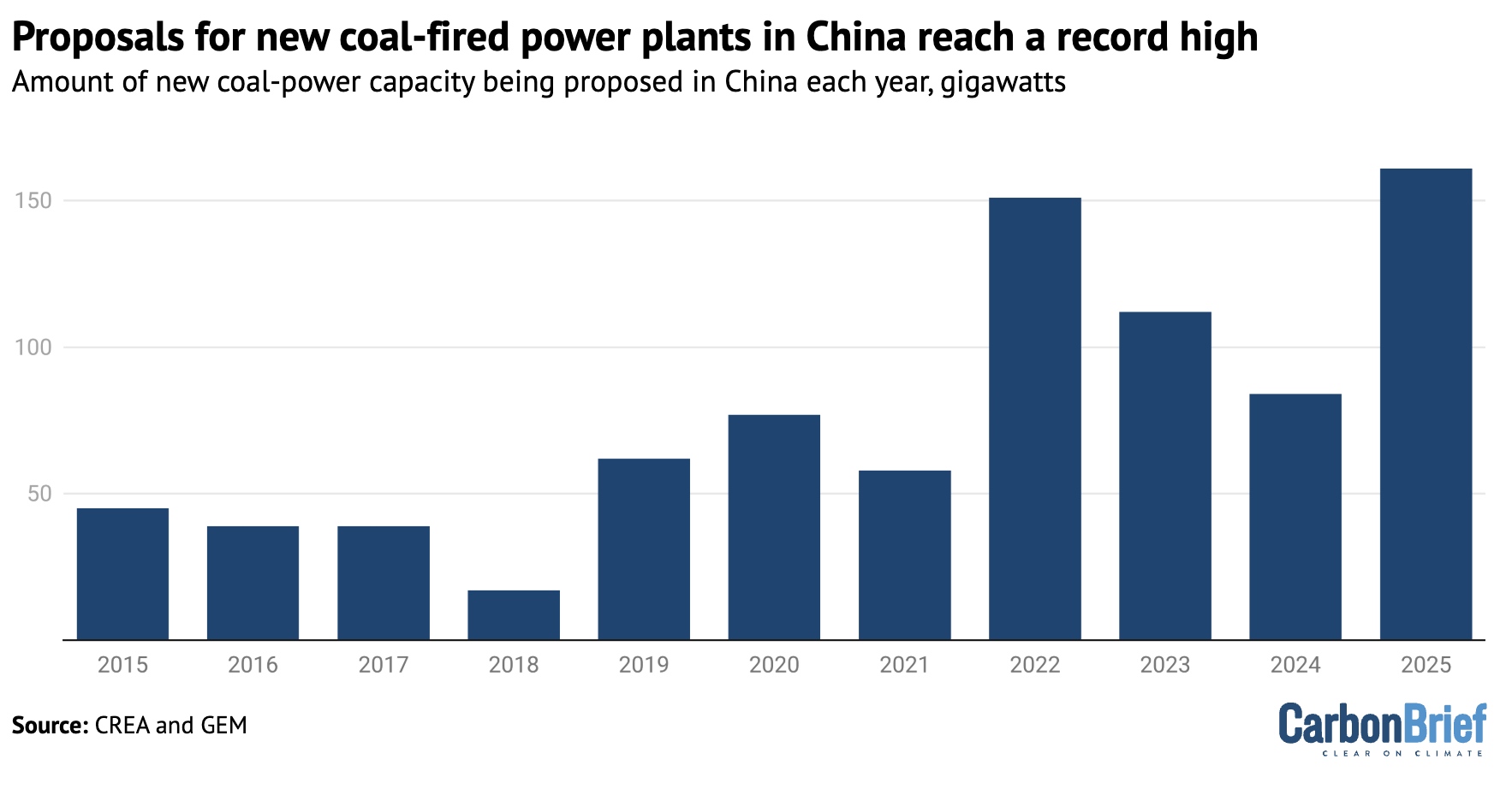 Amount of new coal-power capacity being proposed in China each year, GW, 2015-2025. Source: The Centre for Research on Energy and Clean Air and Global Energy Monitor.
The shift from new power demand being met by coal to being met by renewable energy means any "additional coal power capacity would face structurally low utilisation", the report says, referring to the number of hours that plants are able to operate each year.
This reduces coal-plant earnings needed to cover the cost of investment and makes instances of "stranded [coal] assets and compensation pressures" more likely.
A previous analysis for Carbon Brief finds that "larger additions of coal capacity are often followed by falling utilisation" - meaning that the construction of new coal plants does not necessarily increase emissions.
Utilisation rates for coal-fired power plants have hovered around 51% since 2025, according to the CREA and GEM report.
Shearer argues that while low utilisation rates would "dampen the immediate impact on annual CO2 emissions", in the long-term the buildout "locks capital into fossil fuels" and "weakens incentives to build the cleaner forms of flexibility" needed for a renewables-centred system.
Low utilisation has also not led to coal plant capacity being retired in any notable way, the report notes, with generators instead supported by the coal "capacity payment" mechanism and extending the life of older units.
Delayed retirement of older coal plants causes "persistent overcapacity" and adds to calls for further compensation and policy support, the report says.
Coal generation has "no room to expand" under China's international climate pledge for 2030, it adds, with utilisation rates for coal units likely to fall to 42% if renewables continue to meet all additional demand and if all of the plants currently under construction or permitted are brought online.
Crunch-time for coalThe surge in new proposals reflects a "rush" by the coal industry to ensure their projects are approved before the policy environment tightens, according to the report.
China is expected to introduce absolute emissions targets over the next five years. While these are expected to be aspirational for the first five years - alongside binding targets for carbon intensity, the emissions per unit of GDP - from 2030 they will be binding.
The current five-year period until 2030 will also likely see most of China's energy-intensive industries pulled into the scope of its national carbon market.
In the power sector, government officials have said that coal is expected to shift from playing a major role in power supply to supporting "flexibility" operations.
This would require coal plants to shift between varying load levels and respond quickly to changes in demand and other system needs.
However, the report finds, the approvals for coal power "continue to reflect expectations of high operating hours", instead of flexible operations.
For many of these proposals, planned annual utilisation was stated to be more than 4,800 hours, or 55% of hours in the year. This is greater than the 4,685 utilisation hours (53%) logged in 2023, the year in which the most coal power was generated over the past decade, according to data shared by the report authors with Carbon Brief.
In addition, the report says that many of the new coal-power proposals in 2025 were for "large-scale units", each representing at least 1GW of power, as shown in the figure below.
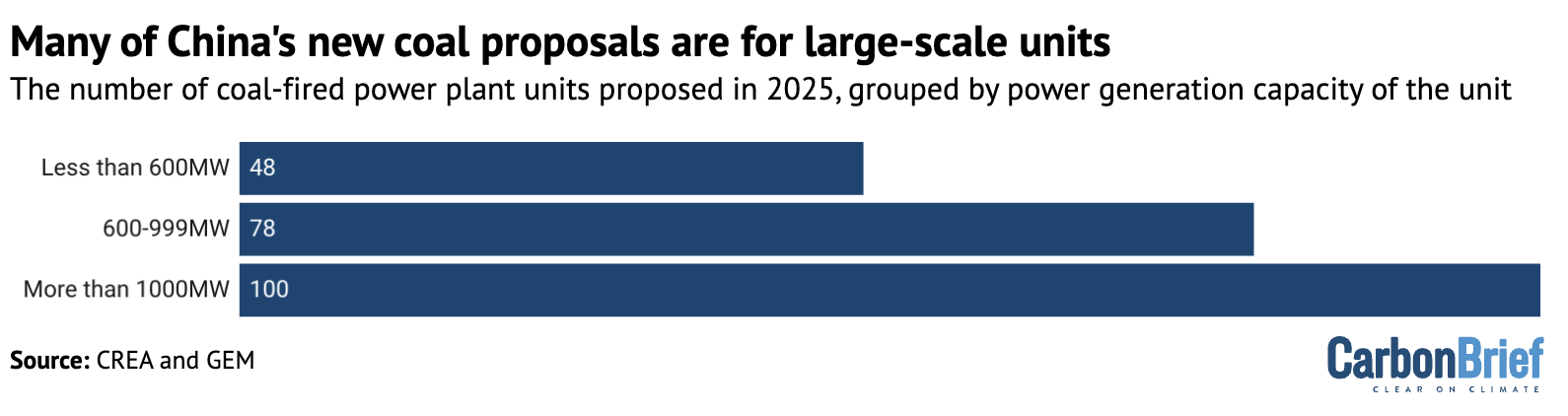 Number of coal-fired power units newly proposed in 2025, grouped by power generation capacity of the unit. Source: the Centre for Research on Energy and Clean Air and Global Energy Monitor.
These larger units are designed for "stable, continuous operation" and are "poorly suited to the type of flexibility increasingly required in a power system dominated by wind and solar", says the report.
This suggests that "project developers still anticipated base-load style operation", it adds, "sitting uneasily" with the fact of higher clean-energy generation and falling coal plant utilisation.
Reliance on sales and subsidiesThis persistence in developing large-scale units could be explained by the financial incentives that govern the coal-power industry.
Coal power plants are cheap to build but risk low profits and high costs, with many current operators already facing losses at recent utilisation rates.
In 2024, the government established a capacity payment mechanism for coal-fired power plants. This mechanism rewards developers for adding "seldom-utilised, backup" capacity to the grid.
These capacity payments, as well as regulated pricing and implicit government backing "can make plants viable on paper even if utilisation and operating margins are weak", Shearer tells Carbon Brief, which may explain the continued appetite for new coal from developers.
More than 100bn yuan ($14bn) in capacity payments were made to coal plants in 2024, although it has not yet had a discernable impact on utilisation.
Large-scale units, the report says, are "particularly well positioned" to benefit from the policy, as it rewards maximising capacity and does not favour plants that are more suited for flexible operations.
(The Chinese government recently announced plans to adjust the mechanism, confirming that in some cases capacity payments could be more than the initial expected threshold of 50% of a benchmark coal plant's total fixed costs.)
Meanwhile, the report adds that coal-fired power plants continue to earn most of their revenue from selling electricity, with only 5% of total income coming from capacity payments.
As such, these "misaligned incentives" encourage producing power and installing significant new capacity, despite the government's aim to shift coal to a supporting role in the system.
Shearer tells Carbon Brief that a better approach to flexibility would be to "adopt technology-neutral flexibility standards", rather than focusing on "flexible coal", which would mean coal would have to "compete directly with storage, demand response, grid upgrades and other clean options". She adds:
"The risk of coal-specific flexibility policies is that they lock in capacity rather than solve the underlying system need."
Explainer: Why gas plays a minimal role in China's climate strategy
China energy
|22.01.26

Experts: What to expect from China on energy and climate action in 2026
China energy
|16.01.26
Analysis: Coal power drops in China and India for first time in 52 years after clean-energy records
China energy
|13.01.26

Q&A: Five key climate questions for China's next 'five-year plan'
China energy
|11.12.25
jQuery(document).ready(function() { jQuery('.block-related-articles-slider-block_fb5bdaff8486d1ba6d1c153b163b15e1 .mh').matchHeight({ byRow: false }); });The post 'Rush' for new coal in China hits record high in 2025 as climate deadline looms appeared first on Carbon Brief.
Europe EV Sales — Record Month! [ 02-Feb-26 11:14pm ]BEVs reach 28% market share! EVs had another strong month in Europe, with a record 453,000 plugin vehicles being registered in Europe in December, blasting through the previous record set three years before, 412,000 units. Of those 453,000 units registered in December, 327,000 of them were BEVs, with pure electrics ... [continued]
The post Europe EV Sales — Record Month! appeared first on CleanTechnica.
Lynk & Co 08 Achieves Guinness World Record by Reaching 293 Kilometers in 100% Electric Mode [ 02-Feb-26 11:12pm ]With an unprecedented electric range in its segment, Lynk & Co's flagship SUV earns global certification for its leadership in engineering, efficiency, and plug-in hybrid technology Lynk & Co has set a new Guinness World Records™ title with the Lynk & Co 08, achieving 293 kilometres in fully electric driving ... [continued]
The post Lynk & Co 08 Achieves Guinness World Record by Reaching 293 Kilometers in 100% Electric Mode appeared first on CleanTechnica.
Trump Goes Zero for Five Against Offshore Wind [ 02-Feb-26 11:01pm ]Washington, D.C. — Today, the Trump administration lost yet another legal battle in the U.S. District Court for the District of Columbia. This is the fifth and final offshore wind project that has successfully challenged the administration's stop-work order. In December—three days before Christmas—Donald Trump's Department of the Interior halted ... [continued]
The post Trump Goes Zero for Five Against Offshore Wind appeared first on CleanTechnica.
Deutschlands Wasserstoff-Backbone ohne Kunden und ohne Lieferanten ist in dieser Reihe aus mehreren Blickwinkeln untersucht worden. Ausgangspunkt war die Pipeline von nirgendwo nach nirgendwo selbst und die Energie- und sonstigen Nachfrageflüsse, die sich nicht materialisieren werden. Darauf folgten die fehlgeleiteten deutschen Analysen, die zu ihr geführt haben, die Auswirkungen regulierter ... [continued]
The post Deutschlands Wasserstoffstrategie verzögerte die Elektrifizierung, indem sie die Arbeitskräfte in die falsche Richtung lenkte appeared first on CleanTechnica.
Several accounts on Chinese social media app Xiaohongshu (RedNote) have revealed images of the next generation of BYD "Flash Chargers" (aka "megawatt chargers"). According to the label on the plastic wrap surrounding the charge gun, the 1000V DC chargers offer up to 1200 kW of charging power, presumably for each ... [continued]
The post BYD's Turquois T-Shaped Second-Generation Flash Chargers Seen At Dealers Ahead Of Launch appeared first on CleanTechnica.
Ontario Power Generation (OPG) has asked the Ontario Energy Board to approve a sharp increase in regulated nuclear payment amounts, including a year over year jump of more than 40% in 2027. The weighted average regulated payment amount rises from about $78/MWh in 2026 to roughly $110/MWh in 2027, driven ... [continued]
The post Ontario's Nuclear Rate Shock Reveals a Deeper Affordability Problem appeared first on CleanTechnica.
John Howe on one child per woman: still too high to stay under limits to growth curves [ 02-Feb-26 12:06pm ]
The Tyranny of "We" (2026 Update) [ 02-Feb-26 7:38pm ]
For those who followed Crisis Report/ Richard Crim [ 02-Feb-26 7:20pm ]Who I believe posted in Reddit as u/tuneglum. A note in his substack says he passed away in November.
I enjoyed his writing, his style, and learning from him.
Much of what he wrote is far more pessimistic than you hear from other sources, though all he did was compile published work into a digestible theme.
Of all he has done, highlighting the declining albedo, or reflectivity of the earth has been the most troubling, equivalent to an additional 100ppm of CO2e according to Hansen. That and the trailing rate of warming, perhaps 0.26 C per decade is already very dangerous, and the acceleration beyond that is quite a thing to ponder.
I will miss seeing his work, and will try to take some inspiration from what he did. He was not in a cheerful business, but he wrote with clarity and passion, and anger.
submitted by /u/Stillcant[link] [comments]
Resilience and Acceptance in the Face of Collapse [ 02-Feb-26 7:23pm ]Hello, my collapse-aware friends.
I learned about this free 9-week course on "Resilience and Acceptance in the Face of Collapse" on this subreddit and enrolled. This weekend, I got an email from one of the organizers requesting help getting the word out about this program. Here is the email:
I'm Steve Simmer, the course offering coordinator for the Resilience and Acceptance in the Face of Collapse course. The course offering you signed up for is scheduled to start next Thursday, February 5. I've spoken to the course leaders, and they are very excited about leading another course experience. However, at present the enrollment for this course offering is a little low, and in danger of cancellation. We ask your help in getting the word out about the course to a few more people. We have a new introductory video that briefly describes the course experience: Intro Video. Watch it, and if you know someone else who might be interested in the course, share the link with them along with a link to our website, www.acceptingcollapse.com, so that they can explore the course further and register if they're interested.
I'll put more info about the course objectives and syllabus in the comments.
If this sounds like something you are interested in, I encourage you to visit the website and consider enrolling in a course.
Thanks <3
Mods: my apologies if this counts as spam. Let me know if this post violates the subreddit rules. I'm just trying to get the word out.
submitted by /u/essenceofnutmeg[link] [comments]
Greenland's 'green mining' row highlights the key tensions in the energy transition [ 02-Feb-26 5:50pm ] pathdoc/Shutterstock
Green finance is built on a promise: that capital can be redirected to support the transition to a low-carbon economy while avoiding the environmental mistakes of the past. That promise is getting harder to keep.
The technologies needed for decarbonisation of electric vehicles, wind turbines, batteries and grid infrastructure rely on large quantities of critical minerals. Extracting those materials, even from remote places such as Greenland, remains environmentally disruptive, socially contested and politically fraught.
Sustainable finance shapes investment decisions across energy, infrastructure and manufacturing. The ethical frameworks this finance is based on often assume that environmental harm can be minimised through better disclosure, cleaner technologies and improved governance.
The extraction of critical minerals challenges that assumption. Mining is land intensive, energy hungry and often polluting. Recycling of existing batteries, electronics and turbines, and substitution away from scarce materials can reduce demand.
But most projections from the world's energy watchdog, the International Energy Agency, show that demand for critical minerals will rise sharply under clean energy transitions . Similar bodies show that extraction of raw materials such as lithium, cobalt, nickel and rare earth elements will rise sharply over the next two decades.
This is because the transition away from fossil fuels depends on large volumes of new infrastructure including electric vehicle batteries, wind turbines and grid storage, which cannot be supplied from recycled materials alone.
Recent research and policy assessments suggest this contradiction is becoming more acute, not less. Recent analyses of critical mineral supply chains show that extraction and processing remain highly concentrated in a few countries particularly China, Australia, Chile and the Democratic Republic of Congo.
These supply chains are environmentally intensive, involving significant land use, water consumption and pollution. These supply chains are slow to scale because it takes years to obtain permits for new mines, requires large upfront investment, and depends on the construction of extensive infrastructure. Yet global climate targets assume rapid expansion of clean-energy technologies.
In Greenland, environmental regulation and local political decisions have delayed or halted mining projects that are often considered key to the green transition.
Greenland is geologically rich. The island is home to significant deposits of rare earth elements, graphite, zinc and other minerals considered critical by both the EU and the US. These materials are central to clean-energy supply chains and have become strategically important as governments seek to reduce dependence on China, a superpower which dominates global processing capacity.
At the same time, Greenland's environment is exceptionally fragile. Arctic ecosystems recover slowly from industrial disruption, infrastructure is limited and mining projects face high logistical and financial costs. These constraints have already shaped political choices.
In 2021, Greenland's government introduced restrictions on uranium mining, effectively blocking the development of the large Kvanefjeld rare earth project. That decision reflected environmental and social priorities. It also highlighted the economic and legal pressures that arise when sustainability policies collide with global demand for transition minerals.
When green finance meets geopoliticsIn a world of geopolitical competition, governments are increasingly treating access to critical minerals as a matter of national security as well as climate policy. Policy statements and strategy documents from the US, the EU and other major economies now frame mineral supply not just as an environmental issue, but as essential to economic resilience, defence capability and technological leadership.
This shift has encouraged public financial support, diplomatic engagement and strategic partnerships aimed at securing future supply, including increased foreign interest in Greenland's mineral sector. While Greenland retains control over its resources, international attention reflects the growing geopolitical importance of potential new supply sources.
Projects justified as supporting the energy transition may be driven as much by geopolitical urgency as by environmental benefit. Academic research on critical mineral supply chains shows that when geopolitical and industrial priorities shape governance frameworks, local environmental risks and community consent are often marginalised in favour of strategic and economic goals
Read more: The economics of climate risk ignores the value of natural habitats
Tension in Greenland
Despite international interest, large-scale mining in Greenland has not taken off. Environmental safeguards, political opposition, infrastructure gaps and high costs have slowed development. This reality complicates the assumption that new mineral frontiers can quickly solve clean-energy supply bottlenecks through investment alone.
For investors, Greenland raises difficult questions about how environmental, social and governance (ESG) standards apply to transition minerals. Financing a rare earth mine may reduce long-term emissions by enabling renewable technologies, yet still impose immediate environmental damage. Standard ESG metrics struggle to capture this trade-off. They are better suited to assessing corporate behaviour than to resolving conflicts between global climate goals and local environmental harm.
 Current geopolitical dynamics have huge consequences for Greenland's environment.
Kedardome/Shutterstock
Current geopolitical dynamics have huge consequences for Greenland's environment.
Kedardome/Shutterstock
In Greenland, the debate over "green mining" (the idea that mineral extraction can be made environmentally acceptable through cleaner technologies, higher standards and better governance) is not a case of poor regulation or weak oversight. Instead, it reflects a jurisdiction that has deliberately placed environmental limits on extraction, even as it faces economic and strategic pressure as a result.
As governments continue to pursue ambitious climate targets under national and international commitments, similar dilemmas will emerge elsewhere. Green finance cannot avoid the material foundations of the energy transition.
Sustainable finance frameworks must evolve to handle situations where environmental protection constrains access to strategically important resources. Greenland shows how protecting the environment can clash with efforts to secure the minerals needed for the energy transition, and that this tension is far from resolved.
Without clearer rules on how to balance climate benefits against local ecological costs and without genuine respect for sovereignty and community choice, green finance risks becoming reactive, stretched between environmental principles and geopolitical realities.
The transition to a low-carbon economy requires minerals. But Greenland highlights that how those minerals are sourced and who bears the environmental cost remains unresolved.
Don't have time to read about climate change as much as you'd like?
Get a weekly roundup in your inbox instead. Every Wednesday, The Conversation's environment editor writes Imagine, a short email that goes a little deeper into just one climate issue. Join the 47,000+ readers who've subscribed so far.

Narmin Nahidi does not work for, consult, own shares in or receive funding from any company or organisation that would benefit from this article, and has disclosed no relevant affiliations beyond their academic appointment.
Winter Storms Wreak Havoc — Blame Fossil Fuels, Not Renewables [ 02-Feb-26 5:47pm ]Weather is big news these days, and winter storms make for great clickbait. (Okay, I'll admit that I'm a bit culpable here.) The US Eastern seaboard is in the midst of a rolling series of winter storms — wind, ice, sleet, and snow have caused upheavals in communities. Sure, the ... [continued]
The post Winter Storms Wreak Havoc — Blame Fossil Fuels, Not Renewables appeared first on CleanTechnica.
CATL Shares Details Of Next Generation 5C Battery [ 02-Feb-26 5:24pm ]CATL keeps pushing the boundaries of battery technology. Its latest announcement is about batteries that can charge at 5C.
The post CATL Shares Details Of Next Generation 5C Battery appeared first on CleanTechnica.
Electric MINI Countryman Gets Range Boost To 311 Miles [ 02-Feb-26 5:19pm ]The 2026 MINI Countryman E range has been boosted from about 286 miles per charge to 311, on the WLTP cycle. This should be plenty of range for many drivers, and is generally sufficient for a small SUV that frequently is driven on work commutes and around town, urban areas, ... [continued]
The post Electric MINI Countryman Gets Range Boost To 311 Miles appeared first on CleanTechnica.
Another Climate Denier Caught up in Epstein Files [ 02-Feb-26 5:05pm ] Texas "Test Bed" Weathered Cold Snap with Diverse Generation,Wind, New Batteries. [ 02-Feb-26 4:48pm ] Chinese EVs WILL Come to the US [ 02-Feb-26 4:10pm ]
Why does this river slice straight through a mountain range? After 150 years, scientists finally know [ 02-Feb-26 4:33pm ]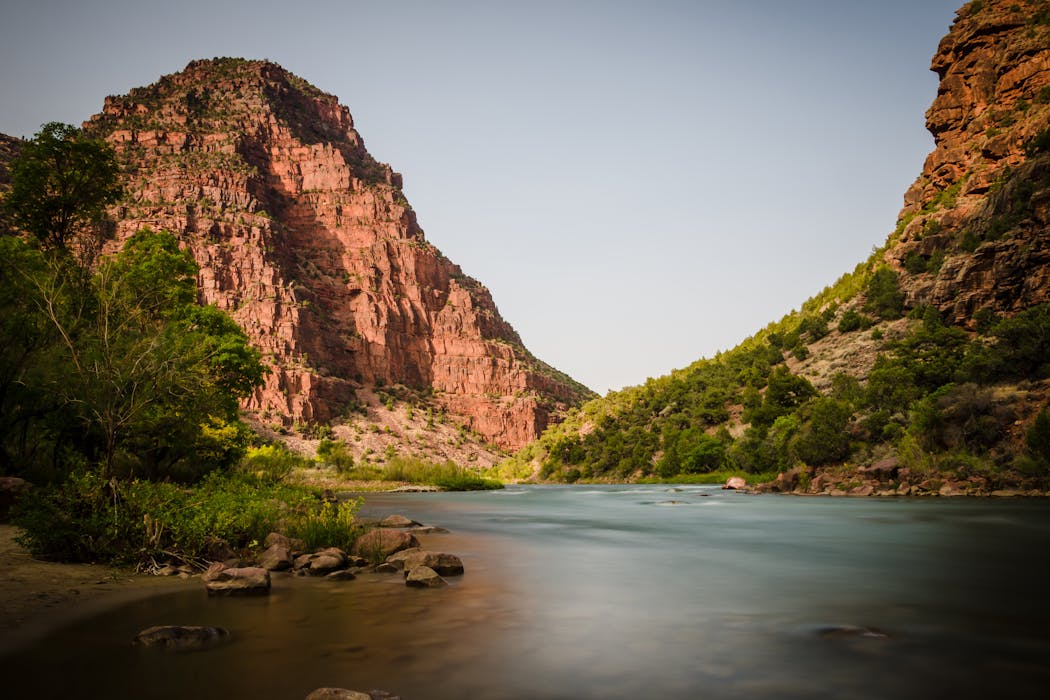 The Gates of Lodore mark the beginning of the Green River's path through the Uinta Mountains. Scott Alan Ritchie / shutterstock
The western US is a geologists' dream, home to the Rocky Mountains, the Grand Canyon, active volcanoes and striking sandstone arches. But one landform simply doesn't make sense.
Rivers normally flow around barriers. The Danube river, for example, flows between the Alps and the Carpathians, twisting and turning to avoid the mountains.
But in north-western Colorado, one river does the opposite.
The intimidatingly named Gates of Lodore marks the entrance to the 700-metre deep Canyon of Lodore that slices straight through the Uinta Mountains as if the range wasn't there at all. It was created by the Green River, the largest tributary of the Colorado River (of Grand Canyon fame).
For more than 150 years, geologists have debated why the Green River chose such an unusual path, creating a spectacular canyon in the process.
 The Green River carves its way through the Uintas in Dinosaur National Monument, on the border of Colorado and Utah.
Eric Poulin / shutterstock
The Green River carves its way through the Uintas in Dinosaur National Monument, on the border of Colorado and Utah.
Eric Poulin / shutterstock
In 1876, John Wesley Powell, a legendary explorer and geologist contemplated this question. Powell hypothesised that the river didn't cut through the mountain, but instead flowed over this route before the range existed. The river must have simply maintained its course as the mountains grew, carving the canyon in the process.
Unfortunately, geological evidence shows this cannot be the case. The Uinta Mountains formed around 50 million years ago, but we know that the Green River has only been following this route for less than 8 million years. As a result, geologists have been forced to seek alternative explanations.
And it seems the answer lies far below the surface.
Drip dripColleagues and I have found evidence for a process in which part of the Earth's crust becomes so dense that it begins to sink into the mantle beneath it. This phenomenon, known as a "lithospheric drip", occurs deep in the Earth, but can have profound effects on the surface.
Drips often form beneath mountain ranges. The sheer weight of the mountains raise temperatures and pressures at the base of the crust, causing dense minerals to form. As these minerals accumulate, the lower crust can become heavier than the mantle it "floats" on. At this point, the crust begins to detach, or "drip", into the mantle.
 Dripping (left) then rebounding (right).
Smith et al (2026)
Dripping (left) then rebounding (right).
Smith et al (2026)
At the surface, this causes two things. Initially as the drip forms, it pulls the crust down, lowering the height of the mountain range above. Then as the drip detaches, the crust springs or rebounds back. The whole process is like pulling a trampoline down and then letting it go again.
For the Green River, this temporary lowering of the Uinta Mountains appears to have removed a critical barrier. The river was able to cross the range during this low period, and then, as the range rebounded, it carved the Canyon of Lodore as it continued on its new course.
A geological bullseyeOur evidence for the lithospheric drip comes from the river networks around the Uinta Mountains. Rivers record a record of past changes to landscapes, which geomorphologists can use to assess how the elevation of a mountain range may have changed in the distant past. The rivers around the Uintas show that the range had recently (in geological terms) undergone a phase of renewed uplift.
By modelling these river networks, we were able to map out the uplift. The result was striking: a bullseye-shaped pattern, with the greatest uplift at the centre of the mountain range, with things decreasing further from the centre. Around the world, this same pattern represents the telltale sign of a lithospheric drip. Similar signals have been identified in places such as the Central Anatolian Plateau in Turkey, as well as closer to the Uinta Mountains on the Colorado Plateau or the Sierra Nevada of California.
To test whether such a process was occurring beneath the Uintas, we turned to seismic tomography. This technique is similar to a medical CT (computerised tomography) scan: instead of using X-rays, geophysicists analyse seismic waves from earthquakes to infer the structure of the deep earth.
Existing seismic imaging reveals a cold, round anomaly more than a hundred miles below the surface of the Uintas. We interpreted this huge feature, some 30-60 miles across, as our broken-off section of the drip.
By estimating the velocity of the sinking drip, we calculated it had detached between 2 and 5 million years ago. This timing matches the uplift inferred from nearby rivers and, crucially, perfectly matches separate geological estimates for when the Green River crossed the Uinta Mountains and joined the Colorado River.
Taken together, these different bits of evidence point towards a lithospheric drip being the trigger that allowed the Green River to flow over the Uintas, resolving a 150-year-old debate.
A pivotal moment in the history of North AmericaWhen the Green River carved through the Uinta Mountains, it fundamentally changed the landscape of North America. Rather than flowing eastwards into the Mississippi, it became a tributary of the Colorado River, and its waters were redirected to the Pacific.
This rerouting altered the continental divide, the line that divides North American river systems that flow into the Atlantic from those that flow into the Pacific. In doing so, it created new boundaries and connections for wildlife and ecosystems.
The story of the Green River shows that processes deep within the Earth can have profound impacts for life on the surface. Over geological timescales, movements of country-sized lumps of minerals many miles below the surface can reshape mountains, redirect rivers and ultimately influence life itself.

Adam Smith does not work for, consult, own shares in or receive funding from any company or organisation that would benefit from this article, and has disclosed no relevant affiliations beyond their academic appointment.
Drastic water shortages and air pollution are fuelling Iran's protests [ 02-Feb-26 12:55pm ]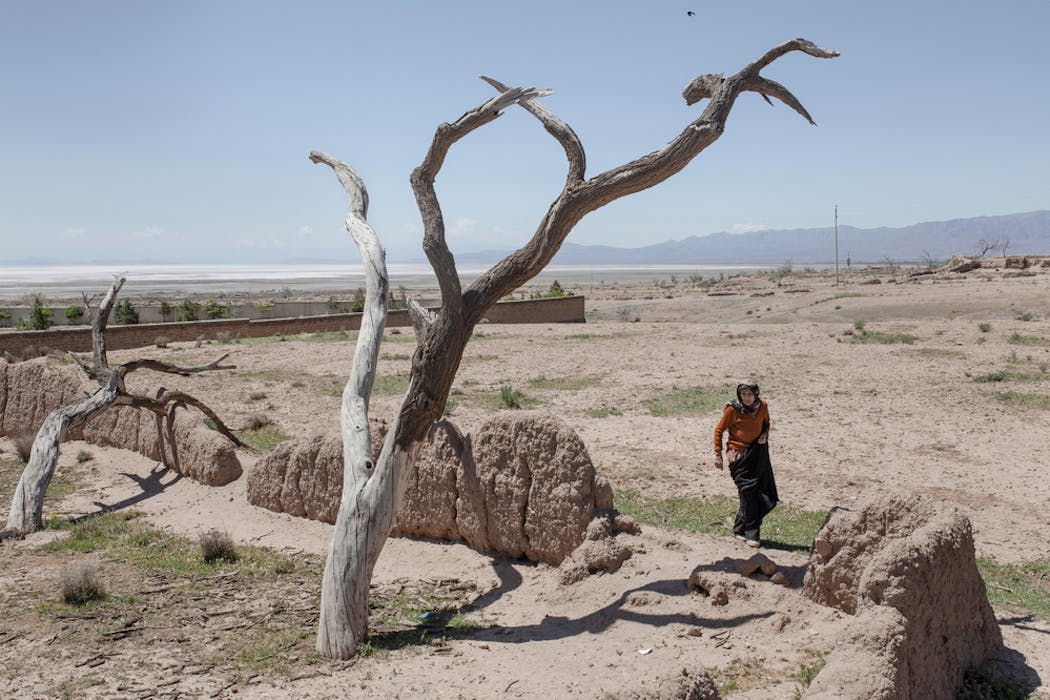 This dry landscape in Iran was once the sixth largest salt lake in the world. solmaz daryani/Shutterstock
This roundup of The Conversation's climate coverage was first published in our award-winning weekly climate action newsletter, Imagine.
"Iran is experiencing not one environmental crisis but the convergence of several: water shortages, land subsidence, air pollution and energy failure. All added together, life is a struggle for survival."
This is the situation inside Iran as described by Nima Shokri, an environmental engineer who works on global challenges related to the environment. Shokri highlights a rarely discussed factor in relation to this year's massive protests across Iran: the severe challenges Iranians are struggling with every day, affecting their ability to simply carry on living.
The air is polluted, the water is drying out and the land collapsing. Many Iranian farmers have been forced to give up their homes and land, and flee to the edges of cities in the hope of just surviving. Their land is cracking and disappearing, and it is no longer possible to grow crops or keep animals alive.
City dwellers are struggling with major water shortages too. On top of that extremely high air pollution levels are forcing hospitals and schools to close, and rising numbers of medical cases are being linked to bad air.
Kevani Madani talks about Iran's long term water problems.Living in that environment, it's no wonder that people feel desperate. As Shokri has pointed out many centres of the massive protests seen in Iran in the past few weeks, where an estimated 30,000 people have been killed, are in places where people are dealing with the most severe environmental challenges.
Read more: Iran's biggest centres of protest are also experiencing extreme pollution and water shortages
Of course, these air, land and water issues are not the only reason why thousands of people are on the streets of this country, where they must live with the decisions of a government that wants to decide who is allowed to walk on the streets and what people, women especially, are allowed to wear.
Struggle for basicsBut these basics of having clean water and air that you can breathe without damaging your health are impossible for anyone to ignore.
These conditions haven't just happened without human intervention. Iran's leaders have made policy choices over the years that have escalated the environmental challenges that many around the world are seeing, such as reduced rainfall. Water intensive agriculture has been encouraged, groundwater has been excessively pumped out, heavy fuel used, and environmental regulation has been weak.
As environmental journalist Sanam Mahoozi and chemical engineer Salome M.S. Shokri-Kuehni wrote, along with Shokri, a few weeks ago, early in January 2026 Iran's capital ranked as the most polluted city in the world.
Local media were reporting more than 350 deaths linked to worsening air quality over ten days during December 2025. And studies indicate that more than 59,000 Iranians die prematurely every year from air pollution-related illnesses.
The Iranian government has failed to protect its people from these escalating crises. In fact, as the three authors argue, its decisions has put them at more risk. And these day-to-day survival issues along with escalating political repression and economic fragility has left desperate people desperate for change, and a country on the edge of collapse.
Iran is not the only country that is experiencing a water crisis that its government hasn't shown signs of knowing how to manage, and where people are struggling to cope. Mexicans are living with conditions caused by years of drought. Reservoirs that used to supply millions with water are drying up. Some people report spending a quarter of their income on water, while others walk 30 minutes to even find a supply.
Water shortages are projected to affect 30 of 32 Mexican states by the year 2050, Natasha Lindstaedt, a professor of government at the University of Essex who researches human security and climate change, writes. And Mexico's water crisis is compounded by being forced to send part of its water supply to the US due to a just over 80-year-old agreement between the two countries.
Read more: Mexico and US look for new deal in long-running battle over 80-year old water treaty
Global crisis
About four billion people - nearly half the global population - live with severe water scarcity for at least one month a year. They are going without access to sufficient water to meet all of their needs, writes Kaveh Madani, director of the Institute for Water, Environment and Health at United Nations University and the author of a new report by UN scientists on water scarcity.
Mexico has been suffering from long periods of drought.The consequences of water deficit are being seen around the world: dry reservoirs, sinking cities, crop failures, water rationing and more frequent wildfires and dust storms.
One massive consequence of short-term water policies, often related to agriculture, is subsidence. And as Madani explains when groundwater is overpumped, the underground structure, which holds water almost like a sponge, can collapse. And it can be impossible for it to recover.
Read more: The world is in water bankruptcy, UN scientists report - here's what that means
In Mexico City, land is sinking by about 25cm per year. In Iran, subsidence is up to 30cm per year, affecting areas where around 14 million people live, more than one-fifth of the population.
The UN report sets out a drastic situation: the world is starting to experience water bankruptcy. This is beyond a crisis. It is long term condition, where cities or regions use more water than nature can reliably replace, where the damage to the environment is so catastrophic that it becomes almost impossible hard to reverse.
And while water becomes such a valuable resource, tension between those who have it and those who don't is only going to increase.
To contact The Conversation's environment team, please email imagine@theconversation.com. We'd love to hear your feedback, ideas and suggestions and we read every email, thank you.
Don't have time to read about climate change as much as you'd like?
Get a weekly roundup in your inbox instead. Every Wednesday, The Conversation's environment editor writes Imagine, a short email that goes a little deeper into just one climate issue. Join the 45,000+ readers who've subscribed so far.
 Preventable deaths in a warming world: how politics shapes who lives and who dies [ 02-Feb-26 12:55pm ]
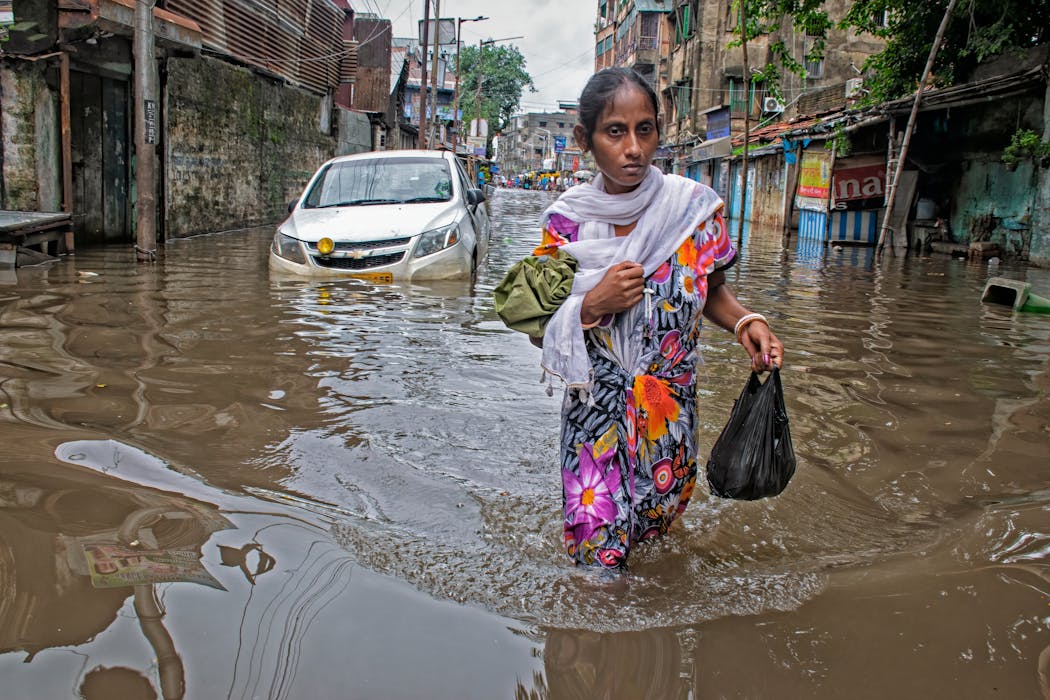 Floods in Kolkata, West Bengal, India in 2019. ABHISHEK BASAK 90/Shutterstock
In Brownsville, Texas, three members of the Galvan family died after a malfunctioning air conditioner left them exposed to extreme heat. Aged between 60 and 82, all three had chronic health conditions, including diabetes and heart disease. This makes it harder for the body to regulate temperature and increases vulnerability to heat stress.
Nobody arrived to check on them until days after they had died in their apartment in 2024. This isolation also increases risk of heat-related deaths.
Although the immediate trigger appears to have been equipment failure, a pathologist attributed the deaths to extreme heat linked to chronic illness. Deaths like these are classified as "heat-related" when ambient temperatures exceed what bodies can safely tolerate.
Climate change is a contributing factor. As heatwaves become more frequent, intense and prolonged, routine failures in cooling, power or housing infrastructure are more likely to turn existing vulnerability into fatal harm.
Around the world, climate-related deaths follow consistent social patterns. People who are older, already ill, economically disadvantaged, or working outdoors are most affected.
The Intergovernmental Panel on Climate Change (the UN's climate science advisory group) concludes that roughly 3.3 billion to 3.6 billion people - nearly half of the world's population - are highly vulnerable to climate risks, with limited capacity to cope. Here, vulnerability is not simply exposure to environmental hazards. Who is protected and who is left at risk depends on social and infrastructural conditions.
Research in climate science, public health and social sciences shows these patterns are clear. My own research spans ecosystem ecology and social science. I examine how climate knowledge is produced, interpreted and acted upon in times of ecological emergency.
The evidence points to an uncomfortable conclusion: much of this suffering is preventable.
The necropolitics of climate changeCameroonian historian Achille Mbembe introduced the idea of "necropolitics" to explain how some lives come to be treated as more expendable than others. This does not imply intent to kill, but rather the routine political acceptance that some people will be exposed to harm.
From this perspective, the Galvans' deaths were shaped not only by heat, but by structural inequalities and gaps in policy and infrastructure.
This logic is visible globally. In south Asia and the Middle East, heatwaves claim the lives of elderly people and outdoor workers. In sub-Saharan Africa, floods and droughts disproportionately affect subsistence farmers.
In the UK, air pollution is linked to roughly 30,000 deaths annually. People from ethnic minority and low-income communities are more likely to live in the most polluted areas. These deaths are not random. They follow recognisable social patterns.
 Floods hit villages in the Jhenaigati upazila of Sherpur district, Bangladesh on October 6 2024.
amdadphoto/Shutterstock
Floods hit villages in the Jhenaigati upazila of Sherpur district, Bangladesh on October 6 2024.
amdadphoto/Shutterstock
Mbembe's concept helps describe situations where political, economic or social arrangements leave some populations consistently exposed to harm. That includes climate-vulnerable communities, places where resources are being extracted through mining or areas where people are displaced from their homes. In the US, "Drill, baby, drill!" has re-emerged as shorthand for prioritising fossil fuel extraction over emissions reduction.
These political and economic choices create consistent patterns of vulnerability for environmental risks, from extreme heat to floods and air pollution. Structural neglect, not personal behaviour, underlies the distribution of harm.
Yet, vulnerability is not fate. Heat provides a clear example. With early warning systems, targeted outreach, and timely intervention, many such fatalities can be prevented. As epidemiologist Kristie Ebi notes: "Those deaths are preventable … people don't need to die in the heat".
The same is true across climate risks. Even with systemic neglect, deliberate and coordinated action can reduce risk. Connecting social, infrastructural, and institutional responses to climate hazards is a crucial step.
Slow violence as a climate processEnvironmental humanist Rob Nixon uses the term "slow violence" to describe harms that accumulate gradually and often invisibly over time. Unlike sudden disasters, the effects of rising temperatures, drought and ecological degradation unfold quietly.
You cannot make a disaster movie out of slow violence. Its harm builds incrementally, striking those already most vulnerable. The deaths of the Galvans exemplify this slow burn, as do the lives lost to prolonged heat exposure, crop failure and environmental degradation worldwide.
People least responsible for emissions, primarily in developing countries, are most exposed to escalating climate harms. Viewed through a necropolitical lens, slow violence shows how neglect becomes lethal through the repeated failure to prevent known and predictable harms.
Feminist theorist Donna Haraway coined the term "Chthulucene", from the Greek chthonic ("of the earth"), to describe an era defined by entangled relationships between humans, other species and the ecosystems they depend on.
Rather than treating environmental harm as separate from social life, this perspective emphasises how vulnerability emerges through the everyday connections between people, institutions and environments. As Haraway argues harm accumulates through these relationships, revealing how exposure to climate risks, political neglect and ecological stress reinforce one another over time.
This dynamic is visible in Vietnam's Mekong Delta, one of the world's most productive rice-growing regions. Here, saltwater intrusion is creeping inland, damaging vast areas of farmland and threatening millions of livelihoods.
Rising sea levels and shifting climate patterns could affect up to 45% of the delta's farmland by 2030, destabilising both local communities and global food systems. Social and ecological harm cannot be separated.
Politics of life, not deathPolitical choices amplify any existing environmental threat. Neglect is not a neutral absence: it is a political condition that shapes who lives and who suffers.
Addressing this injustice requires a living politics of care. This means a political system that recognises vulnerability as socially produced and demands solidarity, equity and accountability. Through alliances between affected communities, researchers and advocates who expose neglect, plus decision-makers under pressure to act, care can become politically unavoidable.
Neglect is no longer allowed to remain invisible in some parts of the world. Cities like Ahmedabad, India, are expanding heat mitigation and early-warning systems. Communities in the Mekong Delta are working with Vietnamese and international researchers to experiment with salt-tolerant crops.
Globally, ecocide laws that make large-scale destruction of ecosystems illegal are being introduced. This helps embed responsibility for environmental protection into legal and political systems. Even in the face of political neglect, targeted action and emerging legal frameworks can reduce harm and foster a more caring form of politics.
Don't have time to read about climate change as much as you'd like?
Get a weekly roundup in your inbox instead. Every Wednesday, The Conversation's environment editor writes Imagine, a short email that goes a little deeper into just one climate issue. Join the 47,000+ readers who've subscribed so far.

Aaron Thierry receives funding from ESRC. He is affiliated with Scientists for Extinction Rebellion.


