
Clean, renewable energy is cost competitive with fossil fuels, and in some cases costs less. Factoring in all the costs, including climate change impacts and harm to human health from fossil fuels, clean renewables make even more sense. In some cases where remote communities need to be able to generate ... [continued]
The post Solar Power Provides Benefits To Northern Cheyenne & Kenyan Communities appeared first on CleanTechnica.
Rammed earth sourced from, or near, the grounds of a proposed building site is attracting attention as an eco-friendly construction material
From afar, the low-rise homestead perched in the Wiltshire countryside may look like any other rural outpost, but step closer and the texture of the walls reveal something distinct from the usual facade of cement, brick and steel.
The Rammed Earth House in the Cranborne Chase is one of the few projects in the UK that has been made by unstabilised rammed earth - a building material that consists entirely of compacted earth, and which has been used as far back as the Neolithic period.
Continue reading...On a recent trip to Lake Geneva in Switzerland, biodiversity reporter Phoebe Weston witnessed the impact of one of the planet's most potent invasive species, the quagga mussel. In just a decade the mollusc, originally from the Ponto-Caspian region of the Black Sea, has caused irreversible change beneath the surface of the picturesque lake. While ecologists believe invasive species play a major role in more than 60% of plant and animal extinctions, stopping them in their tracks is almost impossible. Phoebe tells Madeleine Finlay how invasive species spread, how conservationists are trying combat them and why some think a radical new approach is needed.
'It's an open invasion': how millions of quagga mussels changed Lake Geneva for ever
Support the Guardian: theguardian.com/sciencepod
Continue reading...
Disclaimer: SS: Related to Collapse because it address the loss of biodiversity on the planet and overpopulation, with the link between the two.
Growth in human population increase demand for food, home and products, and how agriculture is unsustainable with modern methods, but without those methods the amount of food needed to sustain the poulation would not be enough.
Also human population will either have high consumption like on first world countries or enable overconsumption by working on third world factories to produce what is consumed on the first world.
submitted by /u/Toguro_Ototo_1[link] [comments]
Charity praises effort to stop Ramsgate's Pie Factory Music closing but calls for more youth services in coastal towns
The last remaining youth centre in one of England's most deprived coastal places has been saved from being sold after a long campaign by the charity that has for 13 years called it home.
In November the Guardian revealed how the centre in Ramsgate on the Kent coast was facing being auctioned off by Kent county council, despite an independent report that estimated the centre was saving the council more than £500,000 a year in costs, including for services in mental health, youth justice and social care.
Continue reading...
Recent storms washed away large sections of roads in the UK after sea defences were damaged. For residents, it was a shock. But for coastal scientists, it was not unexpected.
Parts of the A379 between Torcross and Slapton, in south Devon, collapsed leaving a 200-metre stretch of road broken apart and part of a nearby car park destroyed. Engineers say even steel-reinforced protection failed under repeated wave action.
The road runs along the crest of a shingle barrier beach, with the sea on one side and Slapton Ley, a freshwater lake, on the other. Recent monitoring shows the beach has become narrower and steeper as storms move sediment along and away from the shoreline.
With less material in front of it, waves now break closer to the road and can undercut the edge of the carriageway. In places like this, the problem is not a single extreme storm. Rather, it is the gradual loss and redistribution of beach material that leaves the road increasingly exposed.
Hard defences such as seawalls and rock armour are often the first response. They can hold the line for a while, but they do not remove the force of incoming waves. The energy simply moves elsewhere, often speeding up erosion further along the coast. The risk is diverted rather than resolved.
As sea levels rise and storms intensify, these defences simply cannot keep up. What they usually provide is time, not lasting protection.
Even the science used to inform coastal management decisions comes with caveats. Computer models help estimate how beaches might change in the future, but real coastlines are messy and constantly evolving. Small differences in the assumptions of these models can produce very different forecasts, which makes long-term planning difficult.
Natural ways to manage the coastline are increasingly put forward as alternatives. Restoring dunes, saltmarshes or wetlands can help absorb wave energy while supporting biodiversity and storing carbon. These natural landscapes can adapt, hard defences cannot.
However, they are not quick fixes. They take time and space to establish, and their protection varies. Studies show they can reduce wave energy, but often only modestly reduce flooding during extreme events.
Public expectations often pull the other way. In the UK, natural ways to manage the coastline are popular in principle, yet when storms threaten, people tend to favour hard defences because they offer immediate, visible protection, even if it does not last.
The economics add another layer.
Flood and erosion risks affect where people live and invest. When people see flood maps, they often look elsewhere and pay less for homes in exposed areas. Property prices and insurance costs reflect that. But these maps are usually treated as certain, even though they are not, so prices can fall suddenly after major storms.
In practice, that means money and development often remain concentrated in places that science suggests will become increasingly vulnerable.
A wake-up callThe situation at Slapton brings all of this into focus. Rebuilding the same stretch of road after every storm may not be physically or financially realistic.
Some shoreline plans already acknowledge this potential reality through policies such as managed realignment or "no active intervention", allowing the coast to move inland and creating natural buffers such as mudflats and marshes. In some places, relocating development inland may simply be safer and cheaper than trying to defend an increasingly exposed shoreline.
But these decisions come with real trade-offs.
Roads may need to be rerouted. Farmland may flood more often. Homes and businesses may have to relocate. Existing habitats may be lost before new ones establish. In areas dominated by high-value waterfront properties or second homes, decisions about who receives protection, and who does not, quickly become political as well as practical.
The alternative is a costly cycle of damage, repair and rebuild, with less benefit each time.
Slapton is not simply an engineering failure. It is a reminder that coastlines are inherently dynamic and cannot always be pinned in place. Seawalls can buy time. Nature can help soften impacts. Better information can guide smarter decisions. But none of these removes risk altogether.
Long-term resilience means accepting how coasts really behave and being practical about where to defend, where to adapt and where it may be wiser to step back and let the shoreline reshape itself.
Don't have time to read about climate change as much as you'd like?
Get a weekly roundup in your inbox instead. Every Wednesday, The Conversation's environment editor writes Imagine, a short email that goes a little deeper into just one climate issue. Join the 47,000+ readers who've subscribed so far.

The authors do not work for, consult, own shares in or receive funding from any company or organisation that would benefit from this article, and have disclosed no relevant affiliations beyond their academic appointment.
Huge thanks to my February sponsor, John Rember, author of the three-book series Journal of the Plague Years, a psychic survival guide for humanity's looming date with destiny, shaped by his experiences living through the pandemic in his native Idaho. Thoughtful, wry and humane, Journal 1 is a pleasure.
 "Flawed economic models mean the accelerating impact of the climate crisis could lead to a global financial crash, experts warn.
"Recovery would be far harder than after the 2008 financial crash, they said, as "we can't bail out the Earth like we did the banks"."
 "Greenland shatters temperature record, redrawing economy from fishing to minerals.
"Greenland, the Arctic island coveted by U.S. President Donald Trump, experienced its warmest January on record this year, as a rate of warming four times faster than the global average redraws the outlook for sectors from fishing to mining."
 "What is groundwater flooding and why Dorset is seeing 'historical highs' [UK]
""When the water table rises and reaches ground level, water starts to seep through to the surface and flooding can happen," the EA says. That means it may rise up through floors or underground rooms such as cellars and basements."
https://www.bbc.co.uk/news/articles/cj4l7rlxzjxo
 "A UK climate security report backed by the intelligence services was quietly buried - a pattern we've seen many times before…
"This episode is not even especially unusual, historically. Governments have been receiving warnings about climate change - and downplaying or delaying responses - for decades."
 "Europe's public finances in a warming world.
"Climate change is increasingly shaping macro-fiscal outlooks. Extreme weather events, chronic damages from global warming, and decarbonisation efforts all have growing implications for public finances and the economy."
https://cepr.org/voxeu/columns/europes-public-finances-warming-world
 "Photos: exceptional storm floods Antibes streets. Three weeks' worth of rain fell in just a few hours…
"Locals took to social media to share images and videos of the continuous rainfall, lightning, and hailstones which caused streets to quickly fill with water…"
https://www.connexionfrance.com/news/photos-exceptional-storm-floods-antibes-streets/767706
 "Rising rivers and deadly floods slam Portugal as Storm Leonardo hits.
"Portugal faces floods and evacuations as Storm Leonardo swamps rivers and streets, after deadly weather in Spain and weeks of storms across Iberia… Portuguese civil protection said thousands of incidents were reported…"
 "Andalucian mountain town soaks in an astonishing 500mm of rain in just 24 hours - obliterating 78-year record [Spain].
"Grazalema, the picturesque pueblo blanco in the Cadiz mountains, recorded a staggering 512.5mm [20+ inches] of rain in a single 24-hour period ending at 8pm on Wednesday…. it has annihilated the town's previous daily rainfall record - which had stood for nearly eight decades."
https://www.theolivepress.es/spain-news/2026/02/04/grazalema-rain-record-24-hours/
 "Tornado Strikes Corfu as Heavy Rain Triggers Flooding in Kefalonia.
"Severe weather hit the Ionian Islands with force, as a tornado struck a village in Corfu and caused extensive damage, while heavy rainfall in Kefalonia triggered flooding in several areas… Authorities continue to closely monitor the evolving conditions."
 "Morocco evacuates over 100,000 people from 4 provinces after floods.
"Authorities set up emergency shelters and reception centers and provided essential assistance to those affected by the floods, the ministry said, adding that the measures aim to reduce the impact of the disaster and ensure public safety."
 "EXTRAORDINARY. >170 countries are breaking heat records. In Particular the tropics of all Continents are with unprecedented heat.
"Central Africa has been with record heat for months, every single day. Last record: 35.7 [96.3F] Franceville GABON. February record smashed."
https://x.com/extremetemps/status/2019076799502963010
 "Prolonged rainfall delays harmattan, disrupts crop fruiting season [Nigeria].
"The unusually prolonged rainfall recorded in January and February 2026, well outside the typical 2025 rainy season cycle, has raised concerns among farmers, who fear it could disrupt the fruiting cycle of key economic trees…"
 "SOUTH AFRICA RECORD HEAT: one after another like an unstoppable factory, South Africa keeps breaking records continuously.
"February hottest night in history in many stations; MINIMUMS: 22.2 Stillbaai, 22.9 Somerset East, 23 Grahamstown, 23 [73.4F] Cape St Francis, 24.2 Uitenhage, 25.3 Pennington."
https://x.com/extremetemps/status/2019059864186605973
 "South Africa classifies drought, water shortages as national disaster…
"Elias Sithole, head of the National Disaster Management Center in the CoGTA, said that the decision was made "after having considered reports submitted on drought and the possible interruption of large scale water provision by organs of state in terms of the potential impact and magnitude in the Eastern Cape, Western Cape and Northern Cape.""
https://english.news.cn/20260205/9e515e9b923041b28bfea1cb35a5c5ac/c.html
 "'We have to rebuild': Mozambique flood victims persevere in face of loss…
"This season, heavy rains and overflowing rivers have resulted in floods, which authorities say are some of the worst in decades, killing more than 150 people and affecting an estimated 800,000 people…"
 "HISTORIC HEAT all over the tropics continue… 35.5 [95.9F] Juan de Nova Island. FRENCH SOUTHERN TERRITORY HOTTEST FEBRUARY DAY IN HISTORY.
"The area has been with relentless record heat since early 2014 breaking and rebreaking records continuously."
https://x.com/extremetemps/status/2019056633511641462
 "Amid worsening drought and crop failure, Zimbabweans support government investment in climate-resilient infrastructure, green energy.
"The country's major challenges include reduced and erratic rainfall (Government of Zimbabwe & UNDP, 2017). Whereas droughts occurred in one in 10 growing seasons between 1902 and 1979, their frequency increased to one in four between 1980 and 2011."
 "Why Israel's Vulture Population Isn't Recovering…
"Poisoning has been harming Israel's vultures for roughly three decades, with cumulative damage pushing the species toward critical endangerment. A series of mass poisonings over the years wiped out, among other sites, the country's largest breeding colony at the Gamla Nature Reserve in the Golan Heights."
 "On Wednesday, February 4, the Mehr News Agency reported that Tehran is approaching what officials call "water tension," a situation where supply can no longer meet demand.
"The warning comes after months of recurring water cuts across different parts of the city, with residents experiencing outages lasting several hours at a time."
 "FAO Warns of Unseasonably Warm Conditions Across Afghanistan.
"The United Nations Food and Agriculture Organization (FAO) has warned that unusually warm temperatures are expected across much of Afghanistan in the coming days, raising concerns about water availability and long-term agricultural impacts."
https://kabulnow.com/2026/02/fao-warns-of-unseasonably-warm-conditions-across-afghanistan/
 "A dam threatens Nepal's Indigenous community; they want it on the ballot.
"Residents of Mulkharka, largely from the Indigenous Tamang community, learned only in 2023 about plans for the Nagmati Dam near their settlement on the northern edge of Kathmandu and now strongly oppose it…"
 "Compound Heat-Drought Threatens China's Oil Crops…
"A groundbreaking study led by Guo, S., Zhao, C., Jin, Z., and colleagues delves into this alarming phenomenon with a specific focus on oil crop production across China, revealing how the interplay of temporal and spatial extremes critically undermines crop yields and threatens agricultural sustainability."
https://bioengineer.org/compound-heat-drought-threatens-chinas-oil-crops/
 "At least 35 killed after weeks of heavy snowfall in Japan.
"At least 35 people have been killed and nearly 400 injured after an extended period of extreme snowfall dumped up to 6.5 feet (about 2 meters) of snow across parts of northern Japan, with authorities now warning that rising temperatures could trigger dangerous avalanches"
 "Flash floods hit parts of Lahad Datu following hours of heavy rain. [Malaysia].
"On social media, the situation appeared serious, with videos and photos showing vehicles being swept away by strong currents, along with a wooden stilt house reportedly carried off by floodwaters."
 "Floods Inundate Pemalang Again [Java].
"Heavy rain that pounded Pemalang Regency on Wednesday night (February 4, 2026) again triggered flooding in several areas. This incident, the third recorded in February 2026, underscores the ongoing challenges of flood control…"
 "More than 80% of flying fox colony wiped out as January heatwaves kill thousands of bats [South Australia]…
""It's a devastating loss of numbers," said Judith Bemmer, a carer at Bat Rescue SA. Among the surviving 180 animals, about 34 underweight and dehydrated babies were rescued, and would face months of recovery."
https://www.theguardian.com/environment/2026/feb/05/flying-foxes-january-heatwaves-kill-thousands
 "Heat waves kill thousands of fish in Australia.
"Most of the dead fish, found at Sunset Strip on the banks of Lake Menindee, were native bony bream, along with some carp, ABC News reported. The die-off followed last week's record-breaking temperatures that peaked near 50 degrees Celsius (122 Fahrenheit)."
https://www.aa.com.tr/en/asia-pacific/heat-waves-kill-thousands-of-fish-in-australia/3819850
 "After the historic January heat wave, February started with some cold records in AUSTRALIA:
"February records low: 0.8 Coonawarra, 3.0 Windy Harbour, 3.9 King Island; Low maxes: 23.9 Victoria River Downs, 22 Lajamanu. Cool also in New Zealand with afternoon temps in the 10s in the South."
[Extreme Temps]
https://x.com/extremetemps/status/2018644629269442665
 "Melting Antarctic ice may weaken a major carbon sink.
"Melting ice from West Antarctica once delivered huge amounts of iron to the Southern Ocean, but algae growth did not increase as expected. Researchers found the iron was in a form that marine life could not easily use. This means more melting ice does not automatically boost carbon absorption."
https://www.sciencedaily.com/releases/2026/02/260204042457.htm
 "'Doomsday Glacier' is melting faster than we thought. Can a 150-metre wall stop it flooding Earth?
"Located on the West Antarctic Ice Sheet, Thwaites Glacier earned its apocalyptical name due to its potential impact on sea levels. Covering a vast 192,000 km², making it comparable in size to Great Britain… can the consequences of climate change really just be barricaded off?"
 "HISTORIC WARMTH IN OCEANIA. Min 28.3C [82.9F] Majuro is FEBRUARY HOTTEST NIGHT EVER RECORDED IN MARSHALL ISLANDS.
"Also, record warm night again in MICRONESIA. The Min of 28.0 on Feb 2nd in Pohnpei was the February warmest night in history."
https://x.com/extremetemps/status/2018876888958271776
 "2025 was Hawai'i's second driest, warmest year on record, new report confirms.
"Hawai'i experienced its second driest year in more than a century. Alongside drought, the state saw persistently above-average temperatures throughout the year, according to the inaugural Hawai'i Annual Climate Report for 2025."
 "Austerity hinders fight against wildfires in Argentina's Patagonia.
"Wildfires are sweeping through Argentina's Patagonia region, consuming more than 450sq km (175sq miles) of native forests, including parts of the UNESCO World Heritage Site of Los Alerces National Park."
 "Severe storm floods Itaperuna and raises alert for climate disasters in Northwest Fluminense [Brazil].
"In less than an hour, rain gauges recorded 76 millimeters of rain, a volume almost four times greater than the 19 millimeters predicted by Civil Defense for the entire period. The extreme rainfall transformed streets into muddy rivers, and images recorded by residents show vehicles being swept away…"
 "70% of the department of Córdoba is flooded due to the winter storm. [Colombia].
"The National Federation of Cattle Ranchers (FEDEGAN) issued an urgent warning about the millions of dollars in losses that the winter storm is causing to cattle ranchers on the Caribbean Coast."
 "Cuba records first freezing temperature amid deepening energy crisis.
"Cuba experienced its coldest temperature on record on February 3 when the mercury dropped to zero degrees Celsius, an unprecedented event for the Caribbean island nation that comes as it faces an acute energy crisis triggered by dwindling oil supplies and mounting US pressure…"
 "This week's cold blast was a total freak-show. Dozens of record lows were broken. That just doesn't happen in Florida anymore - until now.
"Since 2020, Tampa and Miami have only had 1 record low each - both this season. Ft Myers 2. But each city has had well over 100 record highs! Yeah, record highs are outnumbering record lows ~100 to 1 there. That's how freakish this week's cold has been." [Jeff Berardelli]
https://x.com/WeatherProf/status/2019033879026213364
 "The cold arriving in the Northeast and Mid-Atlantic this weekend will be next level.
"Here's why: The incoming air mass comes all the way from the Russian Arctic and will be passing the North Pole en route to the United States. This is known as cross-polar flow."
[Ben Noll]
https://x.com/BenNollWeather/status/2019037095948693557
 "Lake Erie Nears 100% Ice Coverage After Record Cold Stretch.
"It has been 30 years since the last time Lake Erie was 100% frozen over in February 1996. This year, however, Cleveland's Great Lake has come extremely close… As of Feb. 3, 2026, Lake Erie is 94% frozen over…"
https://clevelandmagazine.com/articles/lake-erie-nears-100-ice-coverage-after-record-cold-stretch/
 "Colorado River Negotiators Are Nearly Out of Time and Snowpack.
"With another federal deadline only weeks away and record-low snowfall further drying out the watershed, states have begun talking about whether they are prepared for litigation… as the Feb. 14 deadline looms, basin states, particularly Arizona and Colorado, have begun discussing the prospect of settling their disputes in court."
https://insideclimatenews.org/news/04022026/colorado-river-record-low-snow-litigation/
 "Ohio farmers face weather whiplash.
"Last spring, many Ohio farmers struggled to plant their corn and soybeans because persistent rain made their fields too soggy to work. But by August, many farmers faced the opposite problem. Drought plagued much of the state."
https://yaleclimateconnections.org/2026/02/ohio-farmers-face-weather-whiplash/
 "All-time driest January for two Okanagan cities [BC, Canada].
"It's s been a drier-than-normal January in many parts of B.C., but particularly in the Okanagan. Two cities set all-time records. As Travis Lowe reports, if the pattern continues, it could be cause for concern on the wildfire front."
https://globalnews.ca/video/11653298/all-time-driest-january-for-two-okanagan-cities/
 "EXCEPTIONAL WARMTH IN CANADA. Summer day with temperatures up to 20.6C [69.1F] in Alberta and 19.5C in British Columbia.
"Several records of February high Temperature pulverized: 20.3 Bow Island, 19.5 Bella Bella, 18.5 Brooks, 18.1 Tatlayoko Lake etc."
https://x.com/extremetemps/status/2019230031579607468
 "Record warmth moves into Alaska, with colder weather along the Slope…
"Following record warmth through parts of Southeast Tuesday, another warm stretch of weather remains with the panhandle. We'll keep waves of rain in the forecast through the close of the week, with some dry time between each passing storm."
 "January's record snowfall in Southcentral Alaska has created dangerous avalanche conditions across Alaska's backcountry, burying weak snow layers that could trigger deadly slides even for experienced snowmachine riders.
""We've got three inches of precipitation and 40 inches of snow in town. So that's really unusual," John Sykes, Avalanche Forecaster for Chugach National Forest Avalanche Center, said."
 "January 2026 Arctic sea ice extent was statistically tied (with last year) for the 2nd lowest on record for the month…
"This was 1,310,000 km² below the 1981-2010 average. January ice extent is decreasing at about 2.85% per decade." [Zack Labe]
https://bsky.app/profile/zacklabe.com/post/3mdymqznbhc24
 "Critical moment when El Niño started to erode Russia's Arctic sea ice discovered.
"Scientists discover a tipping point that took place in 2000, where El Niño's effect on sea ice loss in Siberia was amplified… After the year 2000, the transitions out of El Niño started to speed up, possibly due to interactions with the Pacific Decadal Oscillation…"
 "El Niño update: Westerly wind bursts during January were very unusual and record-breaking in some areas.
"Warm water is now moving across the subsurface Pacific and will probably start to surface in February and March. By mid-2026, ocean-atmosphere El Niño coupling is possible. [Ben Noll]
https://x.com/BenNollWeather/status/2019070943969128835
 "Daily global Sea Surface Temperatures are now 0.18°C above 2023, with identical La Niña temperatures in the tropical Pacific.
"Hold on to your hats." [Leon Simons]
https://x.com/LeonSimons8/status/2018716403759542705
 "Don't put blind faith in climate models:
""Because tipping points are hard to model with any precision, and harder still to predict, they are often left out of climate projections — and hence are still largely ignored by climate negotiators"".
https://x.com/LeonSimons8/status/2019228790593839231
 "Extreme Weather Fuels Volatility Across the Global Olive Oil Market.
"Localized extreme climate events are increasingly triggering cascading effects across the global olive oil market, with irregular harvests feeding price volatility, trade tensions and subtle shifts in traditional diets."
 "I'm a prepping expert - this is how I'm getting ready for water shortages.
"Start with some Jerry cans. "I have a couple of 20 litre Jerry cans [they look like petrol containers] for water. You can get them from army surplus stores [for around £30 depending on the brand, and the World Health Organisation recommends two litres per person per day."
https://inews.co.uk/inews-lifestyle/prepping-expert-getting-ready-for-water-shortages-4209449
I rely on donations and tips from my readers to to keep the site running. Every little bit helps. Can you chip in even a dollar? Buy me a coffee or become a Patreon supporter. A huge thank you to those who do subscribe or donate.
You can read the previous "Climate" thread here. I'll be back tomorrow with an "Economic" thread.
The post 5th February 2026 Today's Round-Up of Climate News appeared first on Climate and Economy.
Industry bigger than all but seven world economies, and accounts for more than third of China's economic growth
China's clean energy industries drove more than 90% of the country's investment growth last year, making the sectors bigger than all but seven of the world's economies, a new analysis has shown.
For the second time in three years, the report showed the manufacture, installation and export of batteries, electric cars, solar, wind and related technologies accounted for more than a third of China's economic growth.
Continue reading...Baroness Sheehan challenges refusal to remove 25,000 tonnes of waste by school causing 'grave environmental hazard'
A 25,000 tonne illegal waste dump next to a primary school in Wigan presents "a grave environmental hazard" and should be cleared, the chair of the Lords environment committee has told the government.
Baroness Sheehan challenged the refusal of the Environment Agency to clean up an illegal waste dump in Bolton House Road, Wigan, given the agency was spending millions clearing up illegal waste deposited in Kidlington, Oxfordshire.
Continue reading...States and financial bodies using modelling that ignores shocks from extreme weather and climate tipping points
Flawed economic models mean the accelerating impact of the climate crisis could lead to a global financial crash, experts warn.
Recovery would be far harder than after the 2008 financial crash, they said, as "we can't bail out the Earth like we did the banks".
Continue reading...At a party event in a school hall in Lewisham, people told me how disillusionment with Labour has led to this moment
"How many?"
On the end of the phone is a nice press officer for the Greens, head full from a long day in Gorton, Manchester, showing off their would-be MP. And now, as Friday's sky turns indigo, I'm calling about reports from Lewisham, south London, that tomorrow they're expecting a flood of 500 Green activists. This comes as a surprise to the party's own news machine.
Aditya Chakrabortty is a Guardian columnist
Continue reading...Castletown Bay, Isle of Man: The smell is unpleasant, but these slimy mounds are full of flies, molluscs and sand hoppers - all vital winter food
My British Trust for Ornithology wetland bird survey includes patrolling a storm beach, which, at this time of year, has huge piles of rotting wrack thrown up by the gales. They're made up of hand-like fronds of laminaria, bladderwrack with its buoyant bubble vesicles, sugar kelp and the long "washing line" strands of non-native sargassum seaweed that arrived from Japan on Pacific oysters and ships' hulls in recent years.
These slimy, smelly heaps are generally unpopular with passersby - some even call for their removal - but for wildlife they are a food source of the highest quality.
Continue reading...
The leaked European Commission recommendation on electricity taxation landed quietly, but it said something that European energy policy has avoided stating plainly for decades. Electricity is still taxed and loaded with levies as if it were a polluting end product rather than the clean energy carrier Europe increasingly depends on ... [continued]
The post Europe Is Finally Admitting Electricity Is Overtaxed appeared first on CleanTechnica.
European Investment Bank approves ETS2 Frontloading Facility The European Investment Bank (EIB) board has approved a €3bn Frontloading Facility which provides revenues to countries to spend on preparing citizens for higher fuel costs, once the EU's carbon price on heating and fuel (ETS2) kicks in. A further €3bn could be ... [continued]
The post European Investment Bank Gives Green Light to €3bn for Clean Transition appeared first on CleanTechnica.
Thanks to ZEMO, we are back with our second report on Latin America! This time, with over 110,000 registrations in the fourth quarter of 2025, EV sales have reached a new record in our region! This result pulls 24% ahead of the previous records (Q4 2024 and Q3 2025, which ... [continued]
The post Latin America EV Sales Report: Over 100,000 Units Sold in Q4! appeared first on CleanTechnica.
The publication of a new study by researchers associated with the University of Exeter and Carbon Tracker has reopened a debate that many policymakers and economists falsely assumed was settled. The study argues that widely used economic models underestimate the risks of climate change because they smooth impacts over time, ... [continued]
The post How Climate Economics Got the Risks Wrong appeared first on CleanTechnica.
WASHINGTON, D.C. — A coalition of health, consumer and environmental groups told the National Highway Traffic Safety Administration (NHTSA) that its plan to gut fuel-economy standards for cars, SUVs, and pickup trucks is irrevocably flawed and should be withdrawn. Comments submitted today from NRDC (Natural Resources Defense Council), the Sierra Club, Environmental Defense ... [continued]
The post NHTSA Urged to Maintain Fuel Economy Standards appeared first on CleanTechnica.
ARE WE LIVING IN A TRANCE OF SOME SORT? WHY DOES IT FEEL LIKE EVERYTHING IS HAPPENING BEFORE OUR EYES BUT WE JUST CANNOT CARE?
EPSTEIN FILES IN USA WASN'T ENOUGH, 3.5 MILLION PAGES WITH NEGLIGIBLE INVESTIGATION WASN'T ENOUGH. ONLY A CERTAIN AMOUNT OF PEOPLE ARE TALKING ABOUT IT. IT DOESN'T EVEN END THERE.
NEW DELHI, CAPITAL OF INDIA, WHERE 24000 PEOPLE WENT MISSING IN 2025 AND 800+ PEOPLE WENT MISSING IN THE FIRST 15 DAYS OF 2025 ALONE??? WHY AREN'T MORE PEOPLE TALKING ABOUT IT?
I EVEN TRIED TELLING MY PALS ABOUT IT BECAUSE SOMEONE REALLY CLOSE TO ONE OF MY CLOSEST PALS STAYS THERE BUT EVERYONE JUST BRUSHES IT OFF??
WHAT ARE WE WAITING FOR EVEN? WE DON'T CARE ABOUT THE PEOPLE THAT WENT MISSING BECAUSE THEY WEREN'T "OUR PEOPLE"? WHY DON'T PEOPLE UNDERSTAND THAT IF IT'S HAPPENING TO THEM TODAY SOMEDAY IN THE FUTURE IT COULD HAPPEN TO YOU TOO! IT COULD HAPPEN TO YOUR FAMILY AS WELL, AND I HOPE NOT BUT WHEN THE DAY COMES EVERYONE FEEL AS HOPELESS AS I'M FEELING RN THINKING ABOUT THEM.
FOR ONE MINUTE OF YOUR LIFE PLEASE TRY IMAGINING THE SISTER/BROTHER WHO YOU'VE SPENT YOUR WHOLE LIFE WITH SUDDENLY GONE WITHOUT A TRACE WITH NEITHER YOU AND YOUR FAMILY HAVING ANY IDEA WHAT THEY'RE GOING THROUGH OR IF THEY ARE EVEN ALIVE? COULD YOU LIVE A DAY LIKE THAT? WHAT WOULD YOU FEEL IF SOMETHING LIKE THAT HAPPENED AND PEOPLE PAID NO HEED TO IT?? WHO WOULD YOU GO TO???
I REPEAT DO NOT MAKE THE MISTAKE OF THINKING IT COULD NEVER HAPPEN TO YOU. RAPE, KIDNAPPING, MURDERS, TRAFFICKING EVERYTHING BOTHERS USSSS AND NOTTTT THE PEOPLE WHO ARE SITTING AT THE TOP OF THE GAME. THERE'S NO NECESSITY OF THEM TAKING ACTIONS.
BUT IF WE COLLECTIVELY DON'T RAISE OUR VOICES, WE WILL BE THE ONE TO SUFFER, NOONE ELSE BUT WE,
TALK ABOUT IT ONCE AND YOU'LL REALISE WE ARE REALLY LIVING IN A TRANCE. PLEASE START CARING OR THE DAY YOU START CRYING ISN'T FAR AWAY. THIS HELPLESSNESS WILL NEVER TRULY VANISH BUT IT CAN SURE AS HELL LESSEN A BIT IF THE VICTIMS FEEL A BIT HEARD.
if we don't do it now, we'll jus end up as mere numbers and statistics on the charts, just an inconvenience to the people who are so grown to treat those numbers as just numbers and not individuals who were snatched off the opportunity of life.
TL;DR:- The number you see on the screens be it the Epstein files, the people missing, the number of murders, the number of rape victims, they are not just numbers, those are real people and EVERY life counts.
submitted by /u/thenextsupremeleader[link] [comments]
CleanTechnica is back in Las Vegas for yet another Faraday Future product launch. In 2026, Faraday Future invited us out to NADA, the North American automotive dealerships annual meeting, to show off a trio of AI-enabled robots. Disclaimer: Faraday Future paid for the author's travel and accommodations to attend this ... [continued]
The post Faraday Future Pushes Into the AI Future With Three New Robots appeared first on CleanTechnica.
CAMERON PARISH, Louisiana — Yesterday, Cameron Parish was rocked by an explosion along the Delfin LNG pipeline near Holly Beach and Johnson Bayou that has left one person injured, a stark reminder of the dangers of fossil fuel infrastructure. In response, the Sierra Club and For a Better Bayou released ... [continued]
The post LNG Explosion in Louisiana appeared first on CleanTechnica.
In January 2026, over 12,000 Australian motorists joined the electric vehicle ecosystem. Out of 87,092 light vehicles sold, 7,409 were battery electric vehicles (BEVs) and 5,161 were plugin hybrids (PHEVs). That is a penetration rate of 16%. Not too shabby to start the year off. Remember that the penetration rate ... [continued]
The post Australia EV Sales — January 2026 Update, Spotlight on the BYD Atto 1 appeared first on CleanTechnica.
With 2025 numbers in and the more basic US EV sales reports out, now is the time for one of my favorite topics of exploration — how fast different automakers are electrifying. Yes, it just hit me that we should really do an analysis like this for global sales — ... [continued]
The post Which Automakers Are Electrifying Fastest In USA? appeared first on CleanTechnica.
XPENG's sales abroad (outside of China) have been a very strong point of growth for the company in the past year. There are several markets outside of the main auto markets we typically talk about that are eager to electrify and actually doing so quite fast. XPENG is one of ... [continued]
The post Indonesia Gets Its First 480 kW Charging Station — Thanks To XPENG appeared first on CleanTechnica.

They sold us sunrise, draped in stars and stripes,
A gilded lie that crooned of liberty—
That if we bled beneath the factory lights,
The harvest would be ours, eventually.
"Give us your tired," the brazen promise rang,
While slave patrols kept order in the dark;
From the same tree the fruit of freedom hangs,
Each body branded on the nation's heart.
We built the rails, we picked the cotton clean,
We mined the dark and left our fathers there;
Our sweat and blood still oiled the grand machine,
While marble men declared the ledger fair.
The postwar children climbed the gilded rung,
Their houses white, bright futures theirs to keep—
The Dream a hymn upon their grateful tongues,
While others bled to sow what they'd not reap.
A house once thrice a worker's yearly wage
Now asks for six, then eight, to drain us dry;
We followed every rule through every age—
They sold the ladder, told us we could fly.
They swore the cap and gown would set us free,
Would part the gates that labor couldn't breach—
We signed away our futures trustingly
For keys that fit no lock we'd ever reach.
The worker who gave forty years of labor
Now drowns in bills no pension can afford—
He trusted the company, the job, the neighbor,
And died in the ICU's indifferent ward.
They swore our citizenship was ironclad,
Our sacred bill of rights, they guaranteed—
Now sons and daughters, stripped of all they had,
Disappear to cells where shareholders feed.
A child goes hungry for the bottom line
While yachts drift past the bodies in the stream—
Ten men hold more than half of humankind,
And call this plunder the American Dream.
We walked upon the graves and claimed our place,
To raise our steeples over stolen ground—
The Dream required a veil across the face,
Amnesia where the nation's roots were found.
The Dream was never meant for huddled masses,
Just bodies burned to keep the engines hot—
The velvet rope is held by working classes,
For masters safe above the common lot.
And still we stand where fantasy must break,
Where stars and stripes reveal their threadbare seams—
The only freedom left for us to take:
To wake our children from the poisoned dreams.
Solar power, electric vehicles (EVs) and other clean-energy technologies drove more than a third of the growth in China's economy in 2025 - and more than 90% of the rise in investment.
Clean-energy sectors contributed a record 15.4tn yuan ($2.1tn) in 2025, some 11.4% of China's gross domestic product (GDP) - comparable to the economies of Brazil or Canada.
The new analysis for Carbon Brief, based on official figures, industry data and analyst reports, shows that China's clean-energy sectors nearly doubled in real value between 2022-25 and - if they were a country - would now be the 8th-largest economy in the world.
Other key findings from the analysis include:
- Without clean-energy sectors, China would have missed its target for GDP growth of "around 5%", expanding by 3.5% in 2025 instead of the reported 5.0%.
- Clean-energy industries are expanding much more quickly than China's economy overall, with their annual growth rate accelerating from 12% in 2024 to 18% in 2025.
- The "new three" of EVs, batteries and solar continue to dominate the economic contribution of clean energy in China, generating two-thirds of the value added and attracting more than half of all investment in the sectors.
- China's investments in clean energy reached 7.2tn yuan ($1.0tn) in 2025, roughly four times the still sizable $260bn put into fossil-fuel extraction and coal power.
- Exports of clean-energy technologies grew rapidly in 2025, but China's domestic market still far exceeds the export market in value for Chinese firms.
These investments in clean-energy manufacturing represent a large bet on the energy transition in China and overseas, creating an incentive for the government and enterprises to keep the boom going.
However, there is uncertainty about what will happen this year and beyond, particularly for solar power, where growth has slowed in response to a new pricing system and where central government targets have been set far below the recent rate of expansion.
An ongoing slowdown could turn the sectors into a drag on GDP, while worsening industrial "overcapacity" and exacerbating trade tensions.
Yet, even if central government targets in the next five-year plan are modest, those from local governments and state-owned enterprises could still drive significant growth in clean energy.
This article updates analysis previously reported for 2023 and 2024.
Clean-energy sectors outperform wider economyChina's clean-energy economy continues to grow far more quickly than the wider economy. This means that it is making an outsize contribution to annual economic growth.
The figure below shows that clean-energy technologies drove more than a third of the growth in China's economy overall in 2025 and more than 90% of the net rise in investment.
 Contributions to the growth in Chinese investment (left) and GDP overall (right) in 2025 by sector, trillion yuan. Source: Centre for Research on Energy and Clean Air (CREA) analysis for Carbon Brief.
In 2022, China's clean-energy economy was worth an estimated 8.4tn yuan ($1.2tn). By 2025, the sectors had nearly doubled in value to 15.4tn yuan ($2.1tn).
This is comparable to the entire output of Brazil or Canada and positions the Chinese clean-energy industry as the 8th-largest economy in the world. Its value is roughly half the size of the economy of India - the world's fourth largest - or of the US state of California.
The outperformance of the clean-energy sectors means that they are also claiming a rising share of China's economy overall, as shown in the figure below.
 Share of China's GDP contributed by clean-energy sectors, %. Source: CREA analysis for Carbon Brief.
This share has risen from 7.3% of China's GDP in 2022 to 11.4% in 2025.
Without clean-energy sectors, China's GDP would have expanded by 3.5% in 2025 instead of the reported 5.0%, missing the target of "around 5%" growth by a wide margin.
Clean energy thus made a crucial contribution during a challenging year, when promoting economic growth was the foremost aim for policymakers.
The table below includes a detailed breakdown by sector and activity.
SectorActivityValue in 2025, CNY blnValue in 2025, USD blnYear-on-year growthGrowth contributionValue contributionValue in 2025, CNY trnValue in 2024, CNY trnValue in 2023, CNY trnValue in 2022, CNY trn EVsInvestment: manufacturing capacity1,64322818%10.4%10.7%1.61.41.20.9 EVsInvestment: charging infrastructure1922758%2.9%1.2%0.1920.1220.10.08 EVsProduction of vehicles3,94054829%36.4%25.6%3.943.0652.261.65 BatteriesInvestment: battery manufacturing2773835%3.0%1.8%0.2770.2050.320.15 BatteriesExports: batteries72410151%10.1%4.7%0.7240.480.460.34 Solar powerInvestment: power generation capacity1,18216415%6.3%7.7%1.1821.0310.8080.34 Solar powerInvestment: manufacturing capacity50670-23%-6.5%3.3%0.5060.6620.950.51 Solar powerElectricity generation4916833%5.1%3.2%0.4910.3690.260.19 Solar powerExports of components6819521%4.9%4.4%0.6810.5620.50.35 Wind powerInvestment: power generation capacity, onshore6128547%8.1%4.0%0.6120.4170.3970.21 Wind powerInvestment: power generation capacity, offshore961398%2.0%0.6%0.0960.0480.0860.06 Wind powerElectricity generation5107113%2.4%3.3%0.510.4530.40.34 Nuclear powerInvestment: power generation capacity1732418%1.1%1.1%0.170.150.090.07 Nuclear powerElectricity generation216308%0.7%1.4%0.2160.20.190.19 HydropowerInvestment: power generation capacity547-7%-0.2%0.3%0.050.060.060.06 HydropowerElectricity generation582813%0.6%3.8%0.5820.5670.510.51 Rail transportationInvestment9021256%2.1%5.8%0.9020.8510.7640.714 Rail transportationTransport of passengers and goods1,0201423%1.3%6.6%1.020.990.9640.694 Electricity transmissionInvestment: transmission capacity644906%1.5%4.2%0.640.610.530.5 Electricity transmissionTransmission of clean power52714%0.3%0.3%0.0520.0460.040.04 Energy storageInvestment: Pumped hydro5375%0.1%0.3%0.050.050.040.03 Energy storageInvestment: Grid-connected batteries2323252%3.3%1.5%0.2320.1520.080.02 Energy storageInvestment: Electrolysers11229%0.1%0.1%0.0110.00900 Energy efficiencyRevenue: Energy service companies6208617%3.8%4.0%0.620.5280030.520.45 TotalInvestments7,198100115%38.2%46.7%7.206.286.004.11 TotalProduction of goods and services8,2161,14322%61.8%53.3%8.226.735.584.32 TotalTotal GDP contribution15,414214418%100.0%100.0%15.4113.0111.588.42 EVs and batteries were the largest drivers of GDP growthIn 2024, EVs and solar had been the largest growth drivers. In 2025, it was EVs and batteries, which delivered 44% of the economic impact and more than half of the growth of the clean-energy industries. This was due to strong growth in both output and investment.
The contribution to nominal GDP growth - unadjusted for inflation - was even larger, as EV prices held up year-on-year while the economy as a whole suffered from deflation. Investment in battery manufacturing rebounded after a fall in 2024.
The major contribution of EVs and batteries is illustrated in the figure below, which shows both the overall size of the clean-energy economy and the sectors that added the most to the rise from year to year.
 Contribution of clean-energy sectors to China's GDP and GDP growth, trillion yuan, 2022-2025. Source: CREA analysis for Carbon Brief.
The next largest subsector was clean-power generation, transmission and storage, which made up 40% of the contribution to GDP and 30% of the growth in 2025.
Within the electricity sector, the largest drivers were growth in investment in wind and solar power generation capacity, along with growth in power output from solar and wind, followed by the exports of solar-power equipment and materials.
Investment in solar-panel supply chains, a major growth driver in 2022-23, continued to fall for the second year. This was in line with the government's efforts to rein in overcapacity and "irrational" price competition in the sector.
Finally, rail transportation was responsible for 12% of the total economic output of the clean-energy sectors, but saw relatively muted growth year-on-year, with revenue up 3% and investment by 6%.
Note that the International Energy Agency (IEA) world energy investment report projected that China invested $627bn in clean energy in 2025, against $257bn in fossil fuels.
For the same sectors as the IEA report, this analysis puts the value of clean-energy investment in 2025 at a significantly more conservative $430bn. The higher figures in this analysis overall are therefore the result of wider sectoral coverage.
Electric vehicles and batteriesEVs and vehicle batteries were again the largest contributors to China's clean-energy economy in 2025, making up an estimated 44% of value overall.
Of this total, the largest share of both total value and growth came from the production of battery EVs and plug-in hybrids, which expanded 29% year-on-year. This was followed by investment into EV manufacturing, which grew 18%, after slower growth rates in 2024.
Investment in battery manufacturing also rebounded after a drop in 2024, driven by new battery technology and strong demand from both domestic and international markets. Battery manufacturing investment grew by 35% year-on-year to 277bn yuan.
The share of electric vehicles (EVs) will have reached 12% of all vehicles on the road by the end of 2025, up from 9% a year earlier and less than 2% just five years ago.
The share of EVs in the sales of all new vehicles increased to 48%, from 41% in 2024, with passenger cars crossing the 50% threshold. In November, EV sales crossed the 60% mark in total sales and they continue to drive overall automotive sales growth, as shown below.
 Production of combustion-engine vehicles and EVs in China, million units. EVs include battery electric vehicles and plug-in hybrids. Source: China Association of Automobile Manufacturers data via Wind Financial Terminal.
Electric trucks experienced a breakthrough as their market share rose from 8% in the first nine months of 2024 to 23% in the same period in 2025.
Policy support for EVs continues, for example, with a new policy aiming to nearly double charging infrastructure in the next three years.
Exports grew even faster than the domestic market, but the vast majority of EVs continue to be sold domestically. In 2025, China produced 16.6m EVs, rising 29% year-on-year. While exports accounted for only 21% or 3.4m EVs, they grew by 86% year-on-year. Top export destinations for Chinese EVs were western Europe, the Middle East and Latin America.
The value of batteries exported also grew rapidly by 41% year-on-year, becoming the third largest growth driver of the GDP. Battery exports largely went to western Europe, north America and south-east Asia.
In contrast with deflationary trends in the price of many clean-energy technologies, average EV prices have held up in 2025, with a slight increase in average price of new models, after discounts. This also means that the contribution of the EV industry to nominal GDP growth was even more significant, given that overall producer prices across the economy fell by 2.6%. Battery prices continued to drop.
Clean-power generationThe solar power sector generated 19% of the total value of the clean-energy industries in 2025, adding 2.9tn yuan ($41bn) to the national economy.
Within this, investment in new solar power plants, at 1.2tn yuan ($160bn), was the largest driver, followed by the value of solar technology exports and by the value of the power generated from solar. Investment in manufacturing continued to fall after the wave of capacity additions in 2023, reaching 0.5tn yuan ($72bn), down 23% year-on-year.
In 2025, China achieved another new record of wind and solar capacity additions. The country installed a total of 315GW solar and 119GW wind capacity, adding more solar and two times as much wind as the rest of the world combined.
Clean energy accounted for 90% of investment in power generation, with solar alone covering 50% of that. As a result, non-fossil power made up 42% of total power generation, up from 39% in 2024.
However, a new pricing policy for new solar and wind projects and modest targets for capacity growth have created uncertainty about whether the boom will continue.
Under the new policy, new clean-power generation has to compete on price against existing coal power in markets that place it at a disadvantage in some key ways.
At the same time, the electricity markets themselves are still being introduced and developed, creating investment uncertainty.
Investment in solar power generation increased year-on-year by 15%, but experienced a strong stop-and-go cycle. Developers rushed to finish projects ahead of the new pricing policy coming into force in June and then again towards the end of the year to finalise projects ahead of the end of the current 14th five-year plan.
Investment in the solar sector as a whole was stable year-on-year, with the decline in manufacturing capacity investment balanced by continued growth in power generation capacity additions. This helped shore up the utilisation of manufacturing plants, in line with the government's aim to reduce "disorderly" price competition.
By late 2025, China's solar manufacturing capacity reached an estimated 1,200GW per year, well ahead of the global capacity additions of around 650GW in 2025. Manufacturers can now produce far more solar panels than the global market can absorb, with fierce competition leading to historically low profitability.
China's policymakers have sought to address the issue since mid-2024, warning against "involution", passing regulations and convening a sector-wide meeting to put pressure on the industry. This is starting to yield results, with losses narrowing in the third quarter of 2025.
The volume of exports of solar panels and components reached a record high in 2025, growing 19% year-on-year. In particular, exports of cells and wafers increased rapidly by 94% and 52%, while panel exports grew only by 4%.
This reflects the growing diversification of solar-supply chains in the face of tariffs and with more countries around the world building out solar panel manufacturing capacity. The nominal value of exports fell 8%, however, due to a fall in average prices and a shift to exporting upstream intermediate products instead of finished panels.
Hydropower, wind and nuclear were responsible for 15% of the total value of the clean-energy sectors in 2025, adding some 2.2tn yuan ($310bn) to China's GDP in 2025.
Nearly two-thirds of this (1.3tn yuan, $180bn) came from the value of power generation from hydropower, wind and nuclear, with investment in new power generation projects contributing the rest.
Power generation grew 33% from solar, 13% from wind, 3% from hydropower and 8% from nuclear.
Within power generation investment, solar remained the largest segment by value - as shown in the figure below - but wind-power generation projects were the largest contributor to growth, overtaking solar for the first time since 2020.
 Value of new clean-power generation capacity, billion yuan, by year added. Source: CREA analysis for Carbon Brief.
In particular, offshore wind power capacity investment rebounded as expected, doubling in 2025 after a sharp drop in 2024.
Investment in nuclear projects continued to grow but remains smaller in total terms, at 17bn yuan. Investment in conventional hydropower continued to decline by 7%.
Electricity storage and gridsElectricity transmission and storage were responsible for 6% of the total value of the clean-energy sectors in 2025, accounting for 1.0 tn yuan ($140bn).
The most valuable sub-segment was investment in power grids, growing 6% in 2025 and reaching $90bn. This was followed by investment in energy storage, including pumped hydropower, grid-connected battery storage and hydrogen production.
Investment in grid-connected batteries saw the largest year-on-year growth, increasing by 50%, while investments in electrolysers also grew by 30%. The transmission of clean power increased an estimated 13%, due to rapid growth in clean-power generation.
China's total electricity storage capacity reached more than 213GW, with battery storage capacity crossing 145GW and pumped hydro storage at 69GW. Some 66GW of battery storage capacity was added in 2025, up 52% year-on-year and accounting for more than 40% of global capacity additions.
Notably, capacity additions accelerated in the second half of the year, with 43GW added, compared with the first half, which saw 23GW of new capacity.
The battery storage market initially slowed after the renewable power pricing policy, which banned storage mandates after May, but this was quickly replaced by a "market-driven boom". Provincial electricity spot markets, time-of-day tariffs and increasing curtailment of solar power all improved the economics of adding storage.
By the end of 2025, China's top five solar manufacturers had all entered the battery storage market, making a shift in industry strategy.
Investment in pumped hydropower continued to increase, with 15GW of new capacity permitted in the first half of 2025 alone and 3GW entering operation.
RailwaysRail transportation made up 12% of the GDP contribution of the clean-energy sectors, with revenue from passenger and goods rail transportation the largest source of value. Most growth came from investment in rail infrastructure, which increased 6% year-on-year
The electrification of transport is not limited to EVs, as rail passenger, freight and investment volumes saw continued growth. The total length of China's high-speed railway network reached 50,000km in 2025, making up more than 70% of the global high-speed total.
Energy efficiencyInvestment in energy efficiency rebounded strongly in 2025. Measured by the aggregate turnover of large energy service companies (ESCOs), the market expanded by 17% year-on-year, returning to growth rates last seen during 2016-2020.
Total industry turnover has also recovered to its previous peak in 2021, signalling a clear turnaround after three years of weakness.
Industry projections now anticipate annual turnover reaching 1tn yuan in annual turnover by 2030, a target that had previously been expected to be met by 2025.
China's ESCO market has evolved into the world's largest. Investment within China's ESCO market remains heavily concentrated in the buildings sector, which accounts for around 50% of total activity. Industrial applications make up a further 21%, while energy supply, demand-side flexibility and energy storage together account for approximately 16%.
Implications of China's clean-energy betOngoing investment of hundreds of billions of dollars into clean-energy manufacturing represents a gigantic economic and financial bet on a continuing global energy transition.
In addition to the domestic investment covered in this article, Chinese firms are making major investments in overseas manufacturing.
The clean-energy industries have played a crucial role in meeting China's economic targets during the five-year period ending this year, delivering an estimated 40%, 25% and 37% of all GDP growth in 2023, 2024 and 2025, respectively.
However, the developments next year and beyond are unclear, particularly for solar power generation, with the new pricing system for renewable power generation leading to a short-term slowdown and creating major uncertainty, while central government targets have been set far below current rates of clean-electricity additions.
Investment in solar-power generation and solar manufacturing declined in the second half of the year, while investment in generation clocked growth for the full year, showing the risk to the industries under the current power market set-ups that favour coal-fired power.
The reduction in the prices of clean-energy technology has been so dramatic that when the prices for GDP statistics are updated, the sectors' contribution to real GDP - adjusted for inflation or, in this case deflation - will be revised down.
Nevertheless, the key economic role of the industry creates a strong motivation to keep the clean-energy boom going. A slowdown in the domestic market could also undermine efforts to stem overcapacity and inflame trade tensions by increasing pressure on exports to absorb supply.
A recent CREA survey of experts working on climate and energy issues in China found that the majority believe that economic and geopolitical challenges will make the "dual carbon" goals - and with that, clean-energy industries - only more important.
Local governments and state-owned enterprises will also influence the outlook for the sector. Their previous five-year plans played a key role in creating the gigantic wind and solar power "bases" that substantially exceeded the central government's level of ambition.
Provincial governments also have a lot of leeway in implementing the new electricity markets and contracting systems for renewable power generation. The new five-year plans, to be published this year, will therefore be of major importance.
About the dataReported investment expenditure and sales revenue has been used where available. When this is not available, estimates are based on physical volumes - gigawatts of capacity installed, number of vehicles sold - and unit costs or prices.
The contribution to real growth is tracked by adjusting for inflation using 2022-2023 prices.
All calculations and data sources are given in a worksheet.
Estimates include the contribution of clean-energy technologies to the demand for upstream inputs such as metals and chemicals.
This approach shows the contribution of the clean-energy sectors to driving economic activity, also outside the sectors themselves, and is appropriate for estimating how much lower economic growth would have been without growth in these sectors.
Double counting is avoided by only including non-overlapping points in value chains. For example, the value of EV production and investment in battery storage of electricity is included, but not the value of battery production for the domestic market, which is predominantly an input to these activities.
Similarly, the value of solar panels produced for the domestic market is not included, as it makes up a part of the value of solar power generating capacity installed in China. However, the value of solar panel and battery exports is included.
In 2025, there was a major divergence between two different measures of investment. The first, fixed asset investment, reportedly fell by 3.8%, the first drop in 35 years. In contrast, gross capital formation saw the slowest growth in that period but still inched up by 2%.
This analysis uses gross capital formation as the measure of investment, as it is the data point used for GDP accounting. However, the analysis is unable to account for changes in inventories, so the estimate of clean-energy investment is for fixed asset investment in the sectors.
The analysis does not explicitly account for the small and declining role of imports in producing clean-energy goods and services. This means that the results slightly overstate the contribution to GDP but understate the contribution to growth.
For example, one of the most important import dependencies that China has is for advanced computing chips for EVs. The value of the chips in a typical EV is $1,000 and China's import dependency for these chips is 90%, which suggests that imported chips represent less than 3% of the value of EV production.
The estimates are likely to be conservative in some key respects. For example, Bloomberg New Energy Finance estimates "investment in the energy transition" in China in 2024 at $800bn. This estimate covers a nearly identical list of sectors to ours, but excludes manufacturing - the comparable number from our data is $600bn.
China's National Bureau of Statistics says that the total value generated by automobile production and sales in 2023 was 11tn yuan. The estimate in this analysis for the value of EV sales in 2023 is 2.3tn yuan, or 20% of the total value of the industry, when EVs already made up 31% of vehicle production and the average selling prices for EVs was slightly higher than for internal combustion engine vehicles.

China energy
|05.02.26
'Rush' for new coal in China hits record high in 2025 as climate deadline looms
China energy
|03.02.26

Explainer: Why gas plays a minimal role in China's climate strategy
China energy
|22.01.26

Experts: What to expect from China on energy and climate action in 2026
China energy
|16.01.26
jQuery(document).ready(function() { jQuery('.block-related-articles-slider-block_c6a9262f1c35c01f898c7be52e312d1e .mh').matchHeight({ byRow: false }); });The post Analysis: Clean energy drove more than a third of China's GDP growth in 2025 appeared first on Carbon Brief.
2025年,太阳能、电动汽车及其他清洁能源技术对中国经济增长的贡献已超过三分之一,并拉动超过九成的投资增长。
中国清洁能源行业产值在2025年达到创纪录的15.4万亿元人民币(约合2.1万亿美元),约占国内生产总值(GDP)的11.4%,该数字相当于巴西或加拿大的经济规模。
Carbon Brief基于官方数字、行业数据及分析师报告进行的最新分析显示,2022年至2025年间,中国清洁能源行业的实际规模几乎翻了一番;若将其视为一个独立经济体,其规模可位列全球第八。
该分析的其他主要成果包括:
- 清洁能源行业支撑中国实现了"5%左右"的GDP增长目标,若排除清洁能源行业,2025年GDP实际增速仅为3.5%。
- 清洁能源产业的扩张速度持续快于整体经济,其年增长率从2024年的12%提升至2025年的18%。
- 电动汽车、电池和光伏"新三样"仍是中国清洁能源经济贡献的核心,创造了约三分之二的增加值,并吸纳了一半以上的行业投资。
- 2025年,中国在清洁能源领域的投资达7.2万亿元人民币(约1万亿美元),约为同期化石燃料开采与煤电投资(2600亿美元)的四倍。
- 尽管2025年清洁能源技术出口保持了快速增长,但对中国企业而言,国内市场在价值规模上仍显著大于出口市场。
这些投向清洁能源制造业的资金,代表着对中国乃至全球能源转型的重大押注,也为政府和企业保持这一发展势头提供了动力。
然而,未来的长期走势仍然存在不确定性,尤其是在太阳能领域。受136号文件下的新定价机制影响,太阳能发电装机增速已有所放缓,而中央政府设定的相关目标也明显低于近几年的实际扩张水平。
如果放缓趋势持续下去,这些产业或将从经济增长的驱动力转变为拖累因素,同时加剧工业领域的"产能过剩"问题,并进一步恶化国际贸易摩擦。
但即便中央政府对清洁能源未来五年的目标设定较为谨慎,地方政府和国有企业的规划与投资力度,仍有可能推动清洁能源产业继续实现显著增长。
本文在此前对2023年和2024年清洁能源经济贡献分析的基础上进行了更新。
清洁能源行业表现优于整体经济中国的清洁能源经济持续高速增长,远超整体经济增速。这意味着它对年度经济增长的贡献尤为显著。
下图显示,2025年,清洁能源技术贡献了中国超过三分之一的GDP增量,并推动了超过90%的新增投资增长。
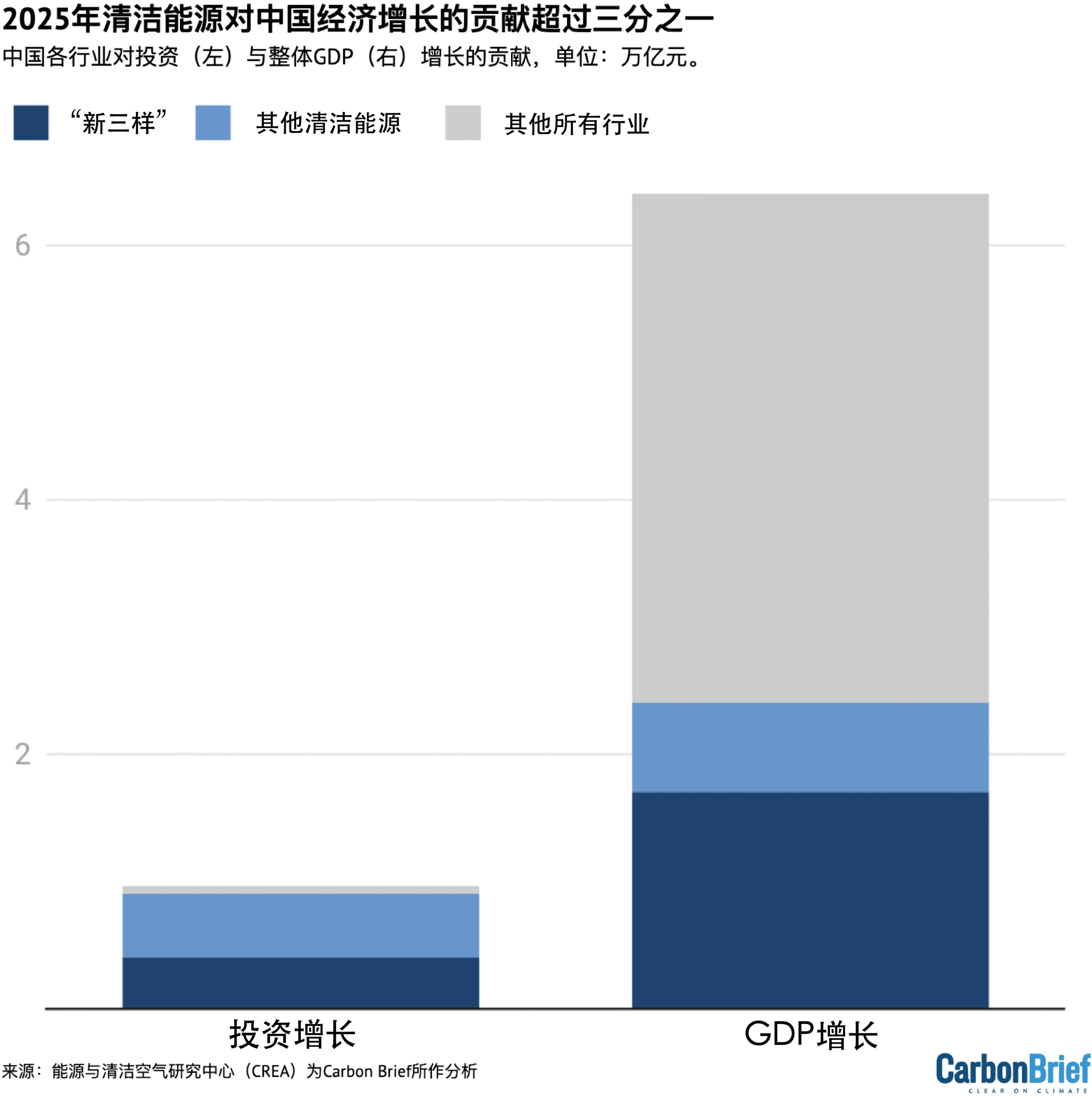 中国各行业对投资(左)与整体GDP(右)增长的贡献,单位:万亿元。来源:能源与清洁空气研究中心(CREA)为Carbon Brief所作分析。
2022年,中国清洁能源经济规模约为8.4万亿元人民币(1.2万亿美元)。到2025年,这一规模几乎翻了一番,达到15.4万亿元人民币(2.1万亿美元)。
这一体量相当于巴西或加拿大的经济总量,使中国的清洁能源产业堪比全球第八大经济体,产值约为世界第四大经济体印度经济总量的一般,也大致相当于美国加利福尼亚州经济规模的一半。
由于清洁能源产业持续跑赢整体经济,其在中国经济中的占比也在不断上升,从2022年占中国GDP的7.3%上升至2025年的11.4%。
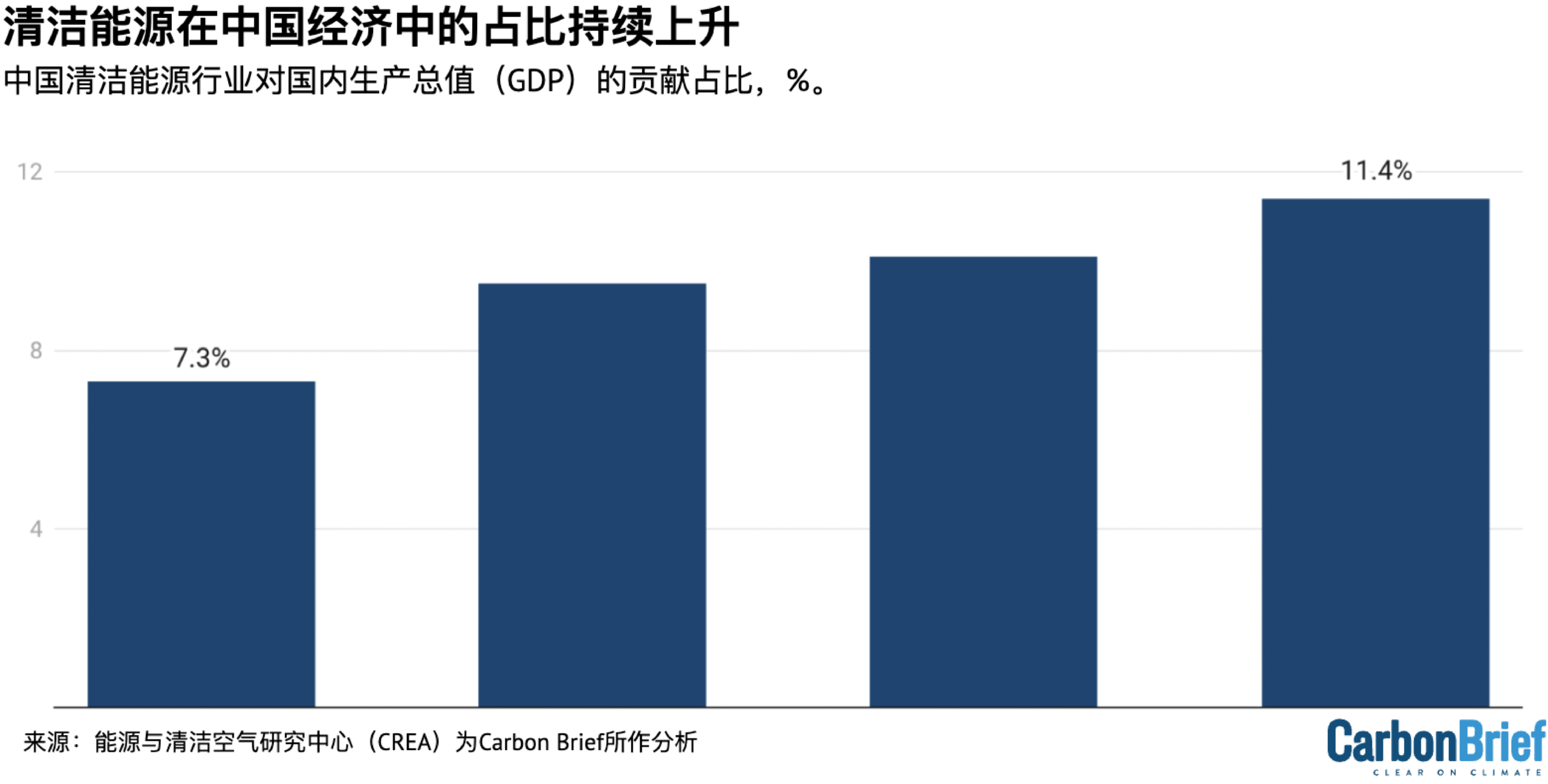 中国清洁能源行业对国内生产总值(GDP)的贡献占比,%。来源:能源与清洁空气研究中心(CREA)为Carbon Brief所作分析。
如果没有清洁能源行业,中国2025年的GDP增速将仅为3.5%,因此,在经济稳定增长为中国首要目标之一的2025年,清洁能源做出了至关重要的贡献。
下表按行业和活动进行了详细分类。
电动汽车和电池是GDP增长的最大驱动力2024年,电动汽车和太阳能是最大的增长驱动力。而到了2025年,电动汽车和电池则占据了主导地位,合计贡献了44%的经济效益,以及清洁能源行业一半以上的增长。这主要得益于产出和投资的同步强劲增长。
在未剔除通胀因素的名义GDP口径下,电动汽车的贡献甚至更为突出。这是因为电动汽车价格同比保持相对稳定,而整体经济仍处于通缩环境中。同时,电池制造投资在2024年下滑后于2025年出现反弹。
下图展示了电动汽车和电池的主要贡献,既反映了清洁能源经济的整体规模,也显示了各子行业对年度增量的具体贡献情况。
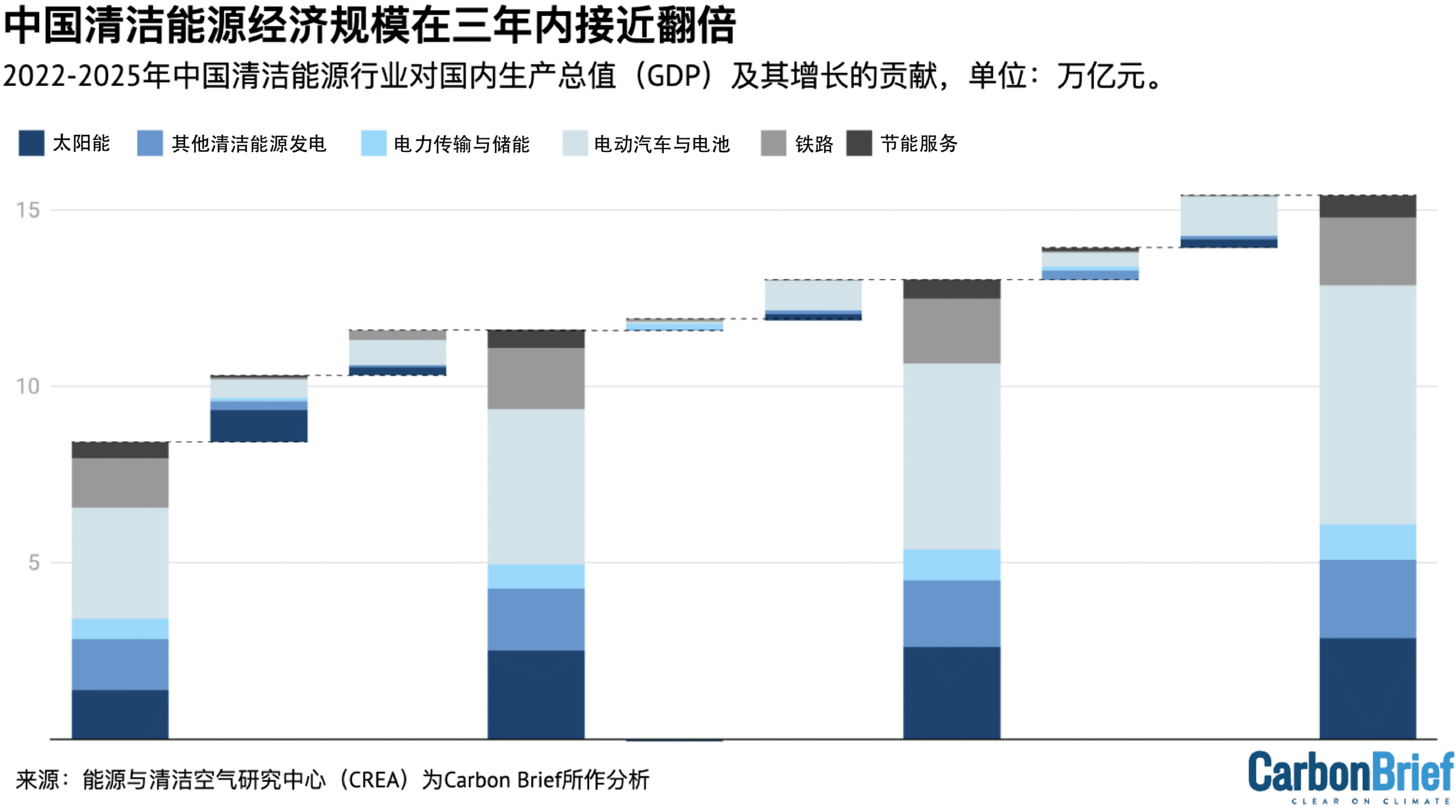 2022-2025年中国清洁能源行业对国内生产总值(GDP)及其增长的贡献,单位:万亿元。来源:能源与清洁空气研究中心(CREA)为Carbon Brief所作分析。
第二大子行业是清洁能源发电、输电和储能,在2025年占清洁能源对GDP贡献的40%,并贡献了清洁能源产业当年约30%的增长。
在电力领域内部,最主要的增长动力来自风电和太阳能发电装机投资的扩大,以及风电和太阳能发电量的增长;其次是太阳能设备及材料的出口。
作为2022-2023年的重要增长引擎,太阳能组件产业链投资在2025年连续第二年下降,这与政府遏制产能过剩和行业"非理性"价格竞争的政策导向一致。
此外,铁路运输约占清洁能源行业总经济产出的12%,但其同比增长相对温和,2025年其营业收入增长3%,投资增长6%。
需要指出的是,国际能源署(IEA)在其《世界能源投资报告》中估计,中国2025年清洁能源投资为 6270亿美元,而化石能源投资为 2570亿美元。
在采用与IEA一致的行业口径进行测算时,本研究对2025年中国清洁能源投资的估计为 4300亿美元,低于IEA的数值。而本文中所呈现的1万亿美元清洁能源投资总规模,并非源于更激进的单项假设,而是由于纳入了更为广泛的产业和活动范围,超出了IEA报告所覆盖的口径。
电动汽车和电池2025年,电动汽车与动力电池成为中国清洁能源经济中最大的贡献部分,约占清洁能源行业总值的44%。
其中,纯电动汽车和插电式混合动力汽车的生产在价值规模和当年增长贡献两方面均居首位,产量同比增长29%。排在其后的是电动汽车制造领域的投资,在2024年增速放缓后,2025年投资规模同比增长 18%
电池制造投资在2024年出现下滑后也迎来反弹,这主要得益于电池新技术的涌现以及国内外市场的强劲需求。电池制造投资同比增长35%,达到2770亿元人民币。
到2025年底,电动汽车在全国汽车保有量中的占比预计达到12%,高于一年前的 9%,而在五年前这一比例还不足 2%。
在新车销售中,电动汽车占比进一步提升至 48%,高于2024年的 41%,其中乘用车电动汽车渗透率已突破50%。2025年11月,电动汽车在当月汽车总销量中的占比更是首次突破 60%,并持续成为拉动整体汽车销量增长的主要动力,如下图所示。
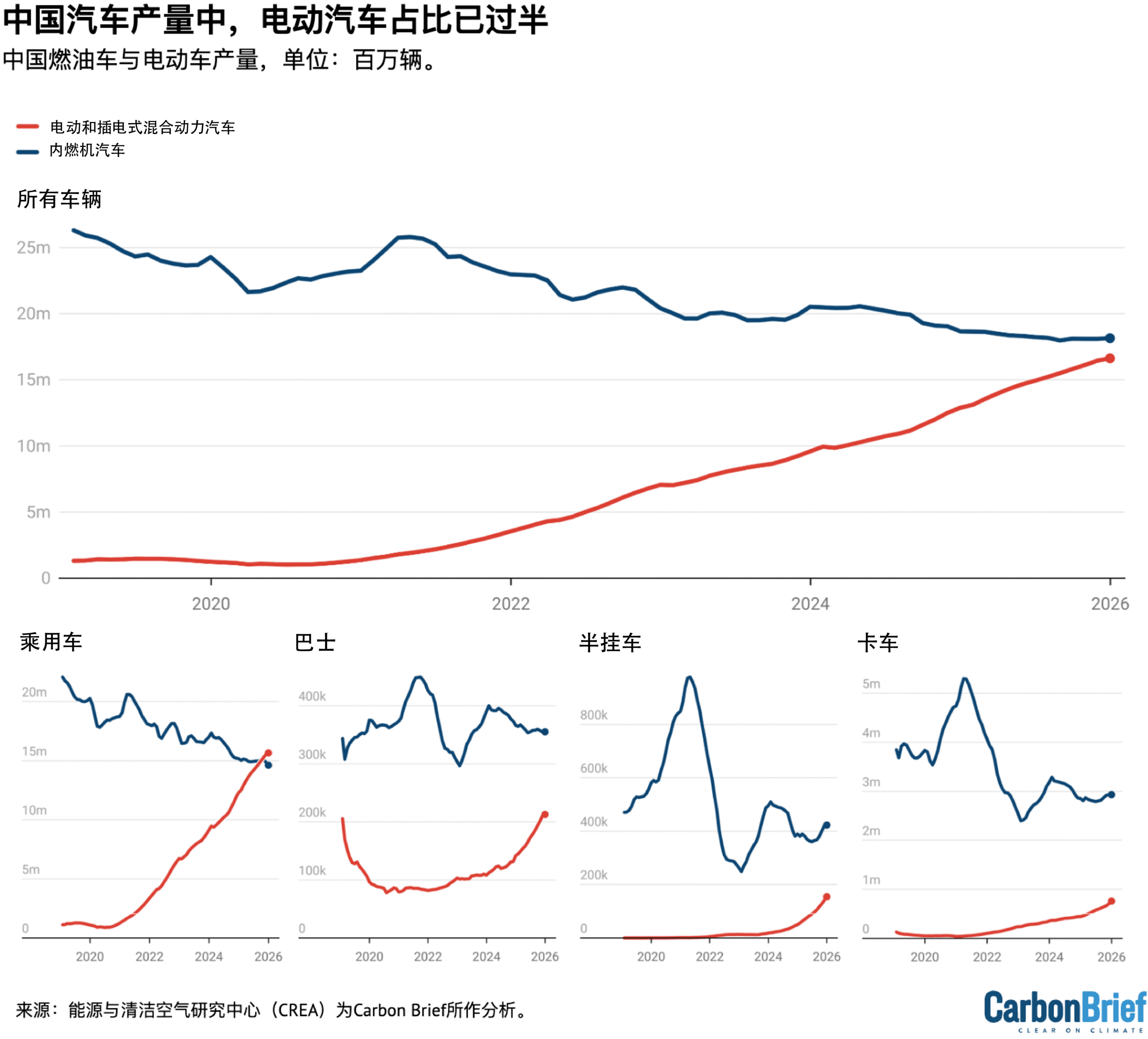 中国燃油车与电动车产量,单位:百万辆。电动车包含纯电动车及插电式混合动力车。数据来源:中国汽车工业协会,经Wind金融终端汇总整理。
电动卡车市场取得突破性进展,其市场份额从2024年前九个月的8%,增长至2025年同期的23%。
政府对电动汽车的政策支持仍在持续,例如,一项最新政策提出,未来三年内充电基础设施规模将接近翻倍,以支撑电动汽车进一步普及。
在电动汽车市场中,出口增速快于国内销售增速,但整体销售仍以国内市场为主。2025年,中国电动汽车产量达到 1660万辆,同比增长 29%。其中,出口约340万辆,占总产量的 21%,但同比增速高达 86%。中国电动汽车的主要出口目的地包括西欧、中东和拉丁美洲。
电池出口额同样实现快速增长,同比上升 41%,成为推动GDP增长的第三大动力来源。电池出口主要流向西欧、北美和东南亚市场。
与许多清洁能源技术价格呈现的通缩趋势不同,2025年电动汽车的平均售价保持稳定,新车型在折扣后的平均加个甚至略有上涨。在全社会工业品出厂价格同比下降 2.6% 的背景下,这意味着电动汽车产业对名义GDP增长的贡献尤为突出。相比之下,电池价格仍延续下降趋势。
清洁能源发电2025年,太阳能发电行业贡献了清洁能源产业总值的19%,为国民经济创造2.9万亿元人民币(约合410亿美元)的价值。
其中,新建太阳能发电厂的投资额达1.2万亿元人民币(约合1600亿美元),是清洁能源发电板块最大的驱动力;其次是太阳能技术出口额和太阳能发电本身创造的电力价值。太阳能制造业投资在2023年产能扩张浪潮结束之后持续下降,至0.5万亿元人民币(约合720亿美元),同比下降23%。
2025年,中国风电和太阳能发电新增装机容量再创新高。全国新增太阳能发电装机315吉瓦,新增风电装机119吉瓦,其中太阳能发电装机容量比全球其他地区总和还要多,而风电装机容量更是后者两倍之多。
在电力投资结构中,清洁能源占发电领域投资的90%,其中光伏一项就占到约50%。在此推动下,非化石能源发电量占全国总发电量的比重提升至42%,高于2024年的 39%。
不过,新出台的新能源定价政策以及相对谨慎的装机目标,也为这一轮增长能否持续带来了不确定性。在136号文件新政策框架下,新建风电和太阳能发电项目需要在电力市场中与既有煤电直接进行价格竞争,而在若干关键制度设计上仍处于相对不利的位置。
与此同时,电力市场本身仍处于建设和发展阶段,这也带来了投资的不确定性。
太阳能发电投资同比增长6%,但期间波动剧烈。开发商赶在新定价政策于6月生效前加速完成项目,第三季度放缓后,在年底再次赶工,以赶在"十四五"规划期内达成目标。
总体来看,太阳能产业整体投资规模与上一年大致持平:制造环节投资下降,被发电侧的增长所抵消。这在一定程度上支撑了制造产能利用率,也符合政府遏制行业"无序竞争"和价格内卷的政策目标。
2025年底,中国太阳能制造产能预计已达到每年1200吉瓦,远超2025年全球新增装机容量约650吉瓦的水平。目前,中国太阳能产业制造能力已显著超过全球市场吸收能力,激烈竞争导致行业盈利水平处于历史低位。
自2024年中期以来,中国的政策制定者已开始正面应对这一问题,包括警示"内卷式竞争"、出台监管措施,并召开行业会议向企业施压。相关举措已初见成效,2025年第三季度行业亏损有所收窄。
2025年,太阳能电池板及组件出口量再创历史新高,同比增长19%。其中,电池片和硅片出口量分别快速增长94%和52%,而电池板出口量仅增长4%。
这反映出,在关税压力上升、更多国家加快本土制造布局的背景下,全球太阳能供应链正日益趋向多元化。然而,由于平均出口价格下跌,以及出口产品结构从成品电池板向上游中间产品转移,出口名义价值反而同比下降了8%。
2025年,水能、风能和核能合计贡献了清洁能源行业总产值的约15%,为中国GDP带来约2.2万亿元人民币(3100亿美元)的增加值。
其中近三分之二(1.3万亿元人民币,1800亿美元)来自水电、风电和核电的发电价值,其余部分则来自新建发电项目的投资。
从发电量增速来看,2025年太阳能发电量增长33%,风电增长13%,水电增长3%,核电增长8%。
在发电投资领域,太阳能仍是价值规模最大的板块(如下图所示),但风电项目在2025年首次成为投资增长的最大贡献者,这是自2020年以来风电投资首次在增量上超过太阳能。
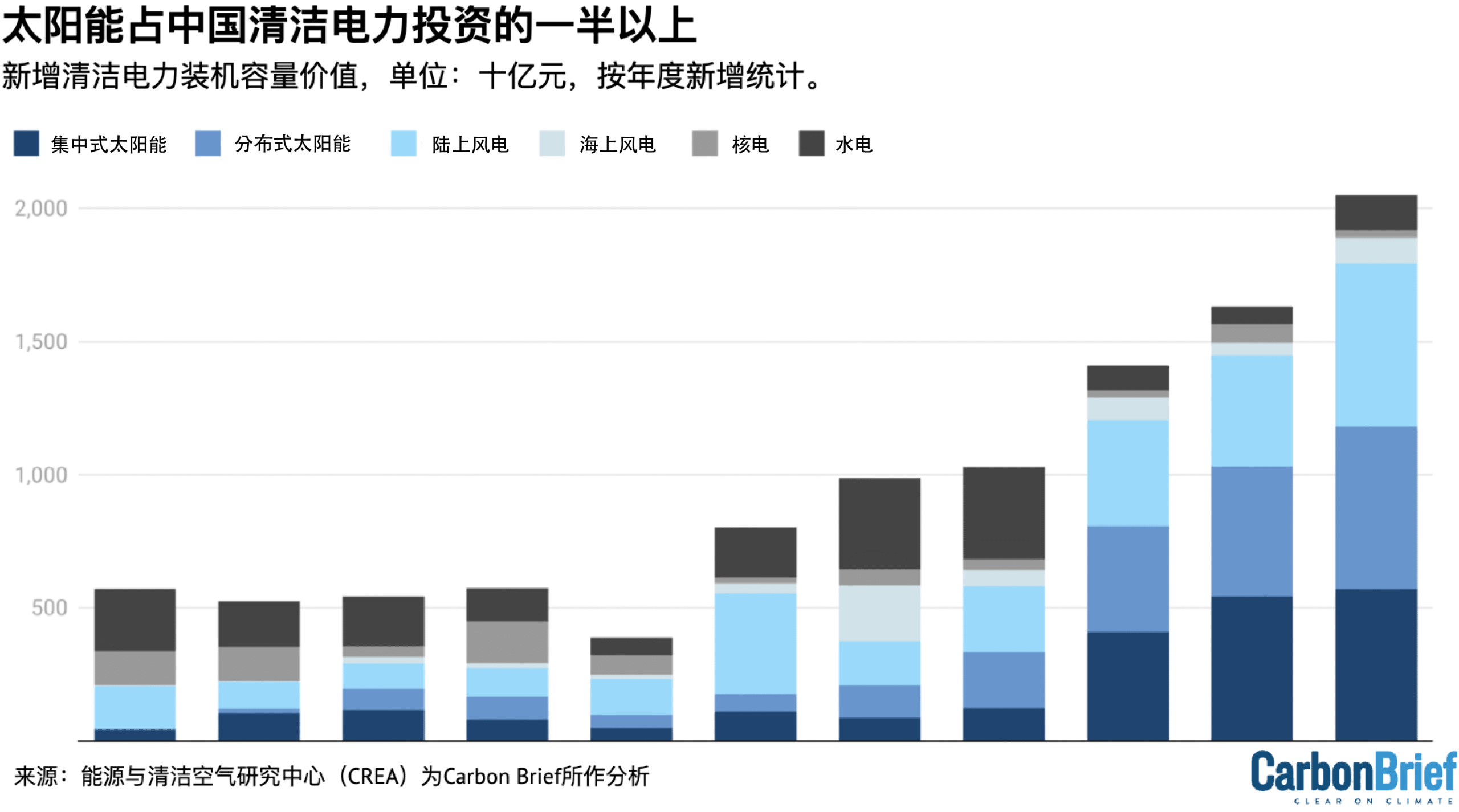 新增清洁电力装机容量价值,单位:十亿元,按年度新增统计。来源:能源与清洁空气研究中心(CREA)为Carbon Brief所作分析。
特别是海上风电装机投资如预期般反弹,在2024年大幅下降后,2025年实现翻倍增长,成为清洁电力投资中的一个亮点。
核电项目投资持续增长,但总体规模仍然较小,2025年投资额约为170亿元人民币。常规水电投资则延续下行趋势,同比下降7%。
储能和电网2025年,输电和储能占清洁能源行业总产值的6%,规模达到1万亿元人民币(1400亿美元)。
其中,电网投资2025年增长了约6%,达到900亿美元。储能投资(涵盖抽水蓄能、新型储能和氢气制备)2025年达到约500亿美元。
新型储能投资同比增长幅度达50%,电解槽投资也增长了30%。受清洁能源发电快速增长推动,清洁能源输送规模预计增长13%。
中国电力储能总装机容量超过213吉瓦,其中新型储能容量超过145吉瓦,抽水蓄能容量为69吉瓦。预计2025年中国新增约66吉瓦新型储能装机容量,同比增长52%,占全球新增装机容量的40%以上。
值得注意的是,下半年新型储能装机增速加快,达43吉瓦,而上半年新增装机容量为23吉瓦。
在政策层面,136号文件规定在5月后取消了新能源配套储能的强制要求,曾一度导致新型储能市场增速放缓,但这一影响很快被"市场驱动型增长"所取代。省级电力现货市场的推进、分时电价机制以及太阳能弃光率上升,共同改善了储能项目的经济性。
到2025年底,中国前五大太阳能制造商均进入了新型储能市场,标志着行业战略的重要转变。
与此同时,抽水蓄能投资保持增长,仅2025年上半年,就有15吉瓦的项目获批,新增3吉瓦抽水蓄能投入运营。
铁路铁路运输占清洁能源行业GDP的12%,其中客货运输收入是最主要的价值来源。行业增长主要来自铁路基础设施投资,2025年同比增长6%。
交通电气化不仅限于电动汽车,铁路客运、货运及相关投资规模也持续增长。2025年,中国高铁总里程约达5万公里,占全球高速铁路总里程的70%以上。
节能服务2025年,节能服务投资强劲反弹。以大型节能服务公司(ESCO)的产值衡量,市场规模同比增长17%,恢复至2016-2020年期间的增长水平。
行业产值也已恢复到2021年的峰值水平,这表明在经历三年低迷后,行业已明显回暖。
行业预测显示,节能服务行业年产值有望在2030年达到1万亿元人民币,而行业经历低迷前曾预期这一目标将在2025年实现。
中国已发展成为全球最大的节能服务公司市场。其投资高度集中于建筑领域,约占业务总量的50%;工业应用占21%,而能源供应、需求侧灵活性与储能相关业务合计约占16%。
中国清洁能源布局的影响中国持续向清洁能源制造业投入数千亿美元,代表着对全球能源持续转型的一项规模巨大的经济与金融押注。
除本文所涵盖的国内投资外,中国企业还在海外制造业领域展开了大规模投资布局,进一步加深了这一押注的全球化属性。
在十四五规划期间,清洁能源产业对中国实现经济增长目标起到了关键作用,在2023年、2024年和2025年分别贡献了约40%、25%和37%的GDP增长。
然而,长期的发展前景仍存在不确定性,尤其是在太阳能发电领域。136文件下新的可再生能源发电定价机制已导致短期投资增速放缓,并显著增加了市场不确定性;与此同时,中央政府设定的清洁电力新增装机目标也相对保守,远低于当前实际增长水平。
2025年下半年,太阳能发电和光伏制造领域的投资均出现下降,尽管从全年来看,发电投资保持了增长。这反映出在当前电力市场制度仍偏向煤电的框架下,清洁能源产业面临结构性风险。
清洁能源技术价格下降幅度显著,以致在未来核算GDP时,这些行业对实际GDP(经通胀或通缩调整后的GDP)的贡献可能会被向下修正。
尽管如此,清洁能源产业在宏观经济中的关键地位,本身就构成了维持这一轮清洁能源发展势头的强烈政策和经济动机。如果国内市场增长出现明显放缓,不仅可能削弱遏制产能过剩的努力,或将迫使更多产能转向出口,从而加剧国际贸易摩擦。
能源与清洁空气研究中心近期针对中国气候与能源领域专家开展的一项调查显示,多数专家认为,在经济和地缘政治挑战加剧的背景下,"双碳目标"及其所依托的清洁能源产业,只会变得更加重要。
地方政府和国企同样将深刻影响该行业的发展前景。在十四五期间,正是地方政府和国企的积极推进,促成了规模空前、且显著超出预期的"风光大基地"建设。
同时,各省在落实新电力市场机制和可再生能源购电合同安排方面拥有较大的自主空间,因此,将于今年发布的十五五规划,将成为决定清洁能源产业中长期走势的关键。
关于数据本文分析尽可能采用已公布的投资与销售数据。若数据不可得,则依据实际数量(如装机容量、汽车销量等)结合单位成本或价格进行估算。
为衡量实际增长贡献,相关数据已按2022-2023年价格进行通胀或通缩调整。全部计算过程与数据来源详见附表。
估算范围涵盖清洁能源技术对上游原材料(如金属、化学品)的需求贡献。
该方法不仅能够反映清洁能源行业对整体经济活动的拉动作用,也能提现其对相关产业活动的带动作用,因此可适用于估算:若该行业未曾增长,经济增速可能降低多少。
为避免重复计算,仅计入价值链中不重叠的环节。例如,电动汽车的生产产值与储能电池的投资额均予计入,但不包含作为上述活动中间投入的、面向国内市场的电池生产价值。
同理,国内市场的太阳能电池板产值已包含在中国光伏发电装机容量的价值中,故不重复统计;然而,太阳能电池板及电池的出口价值则纳入计算。
2025年,两项关键投资指标出现明显背离:据报道,固定资产投资下降3.8%,为35年来首次下滑;而同期资本形成总额虽增速放缓至近年最低,但仍保持2%的正增长。
本研究采用资本形成总额作为投资衡量指标,因其是GDP的组成部分。但由于无法全面追踪库存变动,对清洁能源投资的估算仍基于各行业的固定资产投资数据。
本分析未专门考虑进口因素——其在清洁能源产品与服务生产中所占比例较小且持续下降。这意味着结果可能略微高估对GDP的贡献,但同时低估了对GDP增量的贡献。
例如,中国在电动汽车中对高端计算芯片仍存在较高的进口依赖。一辆典型电动汽车的芯片价值约1000美元,而该类芯片的进口依赖度高达90%,但这仍进展整车生产价值的3%以内。
在某些方面,本研究的估算可能相对保守。例如,彭博新能源财经(BNEF)估计2024年中国"能源转型投资"规模约为8000亿美元。彭博估算的行业覆盖范围与本分析大致相当,但未包含制造业产值。在相同口径下,本研究对应的投资规模约为6000亿美元。
根据中国国家统计局数据,2023年全国汽车产业总产值与销售额合计约11万亿元人民币。本分析估算,同年电动汽车销售额约为2.3万亿元,约占行业总值的20%。当时,电动汽车产量已占汽车总产量的31%,且其平均售价略高于传统燃油汽车。
Analysis: Clean energy drove more than a third of China's GDP growth in 2025
China energy
|05.02.26
'Rush' for new coal in China hits record high in 2025 as climate deadline looms
China energy
|03.02.26
Explainer: Why gas plays a minimal role in China's climate strategy
China energy
|22.01.26
Experts: What to expect from China on energy and climate action in 2026
China energy
|16.01.26
jQuery(document).ready(function() { jQuery('.block-related-articles-slider-block_4a11b3482ebf808c5beb94a5eeae35f3 .mh').matchHeight({ byRow: false }); });The post 分析:清洁能源2025年为中国GDP增长贡献超过三分之一 appeared first on Carbon Brief.
One month after the Philippines' Land Transportation Office (LTO) began strict enforcement of its ban on light electric vehicles along major Metro Manila roads, officials have been quick to frame the policy as a win for traffic order. Fewer apprehensions are being reported. Selected corridors appear to be moving faster. ... [continued]
The post OPINION: A Month After e-Trike Ban In Manila: Has It Made Manila's Streets Safer? appeared first on CleanTechnica.
It's taken some time, but we've finally crunched the numbers for the US electric vehicle market in terms of auto brands and auto groups. (That's full battery-electrics, not inclusive of plugin hybrids.) Here's our report on how different auto brands and auto groups did in the EV market in 2025. ... [continued]
The post Tesla Had 46% of US EV Market in 2025 (Down from 49% in 2024) — GM 13%, Ford 7% appeared first on CleanTechnica.
On 1 February, India's finance minister Nirmala Sitharaman unveiled the government's budget for 2026, which included a new $2.2bn funding push for carbon capture technologies.
In the absence of its new international climate pledge under the Paris Agreement, the budget offers a glimpse into the key climate and energy security priorities of the world's third-largest emitter, amid increasing geopolitical tensions and trade challenges.
While Sitharaman's budget speech did not mention climate change directly, she said: "Today, we face an external environment in which trade and multilateralism are imperilled and access to resources and supply chains are disrupted."
Sitharaman emphasised that "new technologies are transforming production systems while sharply increasing demands on water, energy and critical minerals".
The budget sets out: support for the mining and processing of critical minerals and rare earths; import duty exemptions for nuclear power equipment; and support for renewables, particularly rooftop solar.
However, unlike in some previous years, the 2026 budget does not include specific climate adaptation measures.
Below, Carbon Brief runs through five key climate- and energy-focused announcements from the budget.
- Carbon capture, utilisation and storage
- Critical minerals and rare earth 'corridors'
- Nuclear energy
- Renewables
- Adaptation
The biggest climate-related budget announcement was $2.2bn to support carbon capture, utilisation and storage (CCUS) technologies in India over the next 5 years.
These are technologies that capture carbon dioxide (CO2) as it is released, then use or store it underground or under the sea.
This funding is aimed at decarbonising five of India's high-emitting industrial sectors - power, steel, cement, refineries and chemicals. These sectors are "staring at the risk" of coming under the EU's carbon adjustment mechanism (CBAM), even after a recent EU-India trade deal, according to Sitharaman.
The funding is meant to align with a roadmap released last year that sees CCUS as a "core technological pillar" of India's 2070 net-zero strategy, particularly for "decarbonising sectors where viable alternatives are limited", notes the government's roadmap.
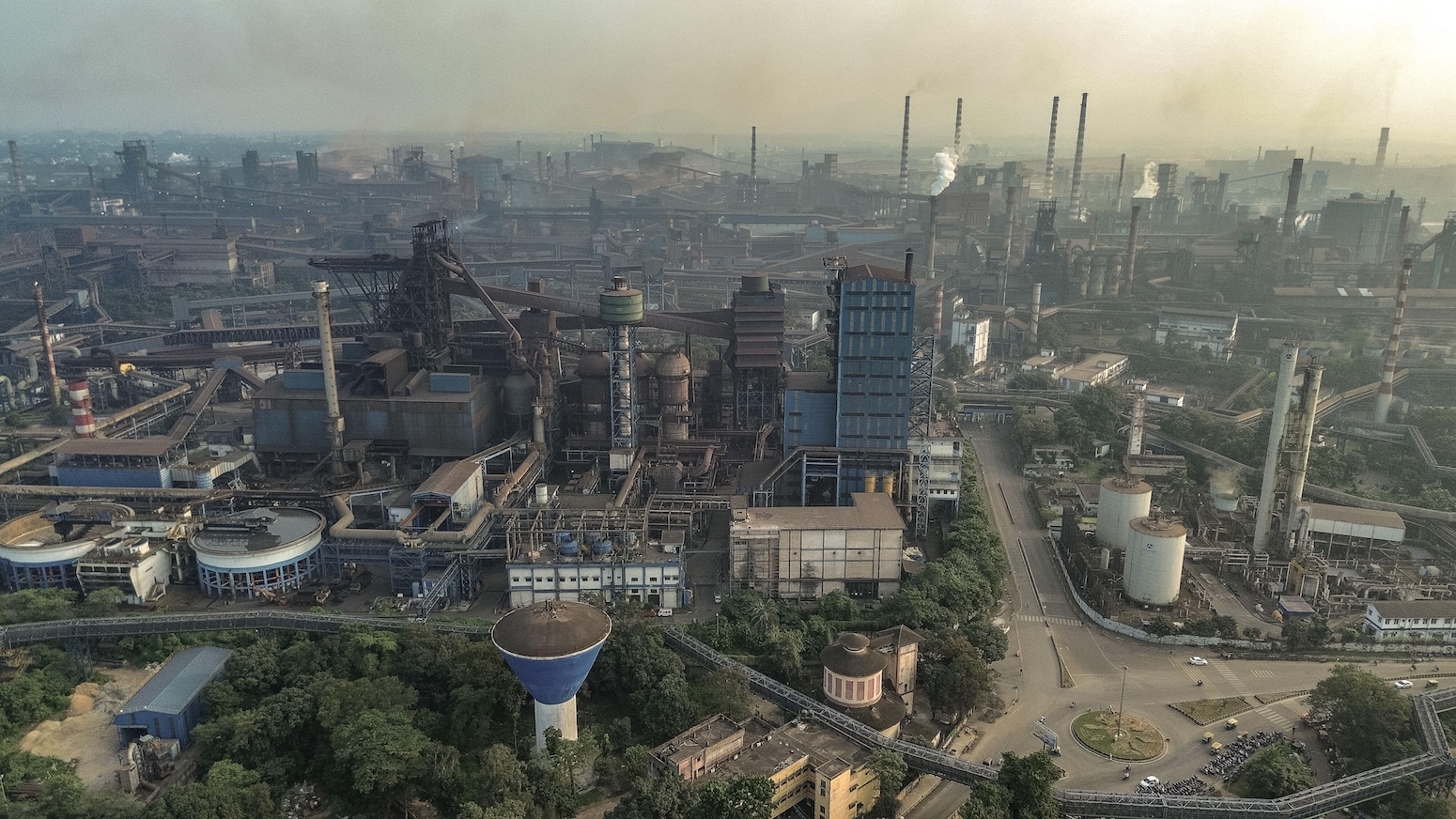 An aerial view of steel plants in Jamshedpur, described as India's "steel city". Credit: ZUMA Press / Alamy Stock Photo
According to the Intergovernmental Panel on Climate Change (IPCC) sixth assessment report, however, the need for CCUS to mitigate industrial emissions "may be overestimated", compared to measures such as energy and material efficiency and electrification.
Speaking to Carbon Brief, Dr Vikram Vishal, a professor of earth sciences at the Indian Institute of Technology, Bombay (IIT-B),, describes the budget move as a "big welcome step for industrial decarbonisation and India's net-zero ambitions as a whole".
Vishal says that the funding could go towards getting "big demonstration plants to near-commercial plants" that could entail even bigger investments in the future.
He tells Carbon Brief:
"India is blessed with both onshore and offshore availability for carbon storage. But while utilisation exists, storage has not happened, per se, even at a decent scale. We [would] need to build transportation infrastructure from the point source of capture at scale, on land and offshore. While offshore storage is very low risk, onshore presents a closer proximity to emission sources."
However, that could also mean closer proximity to densely populated or protected areas.
Vishal adds that India has a very large theoretical storage potential, even a quarter of which would allow for up to 150bn tonnes of CO2 to be stored. This could sustain CCUS for hundreds of years, Vishal says, adding: "And by that time, the energy transition would have happened, right?"
Critical minerals and rare-earth 'corridors'Mining, sourcing and processing "critical minerals" and rare earths is another key area of India's 2026 budget.
It proposes establishing "dedicated rare-earth corridors" in the "mineral-rich" coastal states of Odisha, Kerala, Andhra Pradesh and Tamil Nadu to "promote mining, processing, research and manufacturing". These corridors are intended to complement a $815m rare-earth permanent-magnet scheme announced in November.
In addition, the budget supports "incentivising prospecting and exploration" for rare-earth minerals, such as monazite, as well as others that the government wants to include in its list of "critical minerals".
Last week, for instance, India classified coking coal - which is predominantly used in making steel - as a "critical and strategic mineral", removing regulatory measures such as the need to consult affected communities before developing new mines.
Sehr Raheja, programme officer at New Delhi thinktank Centre for Science Environment, tells Carbon Brief that "moving up the critical-minerals value chain" is "increasingly essential" for the energy transition in developing countries.
She adds that some of the measures announced in India's budget "point in that direction", explaining:
"Globally, developing countries often stay stuck in the extraction stages of value chains and capture the least value. While duty exemptions for critical mineral processing and battery manufacturing signal intent to build domestic manufacturing capacity, the extent to which these new efforts deliver sustained value will only become apparent over time."
Rahul Basu, research director at the Goa Foundation, which advocates for "intergenerational equity" in mining, tells Carbon Brief:
"Rare earths are not particularly rare. What is difficult is separating and refining them. China imports ore from around the world, including [the] US. Their competitive advantage lies in processing, including the ability to tolerate high pollution levels.
Nuclear energy"India should perfect the processing technology with imported ores first. It is the critical piece. Not mining. We seem to want to mine the same beaches that are already seeing sea-level rise."
The Indian government has also lifted customs duties on imports of nuclear power equipment within the 2026 budget.
Under the changes, equipment for all nuclear power plants will not be subject to customs duties until 2035, irrespective of capacity.
The announcement follows India enacting a landmark new nuclear act, dubbed the "Shanti" act, in December 2025. This seeks to privatise and invite foreign participation in the country's nuclear energy sector, which has been largely state-run for decades and has a long history of public protests over safety and land-acquisition concerns.
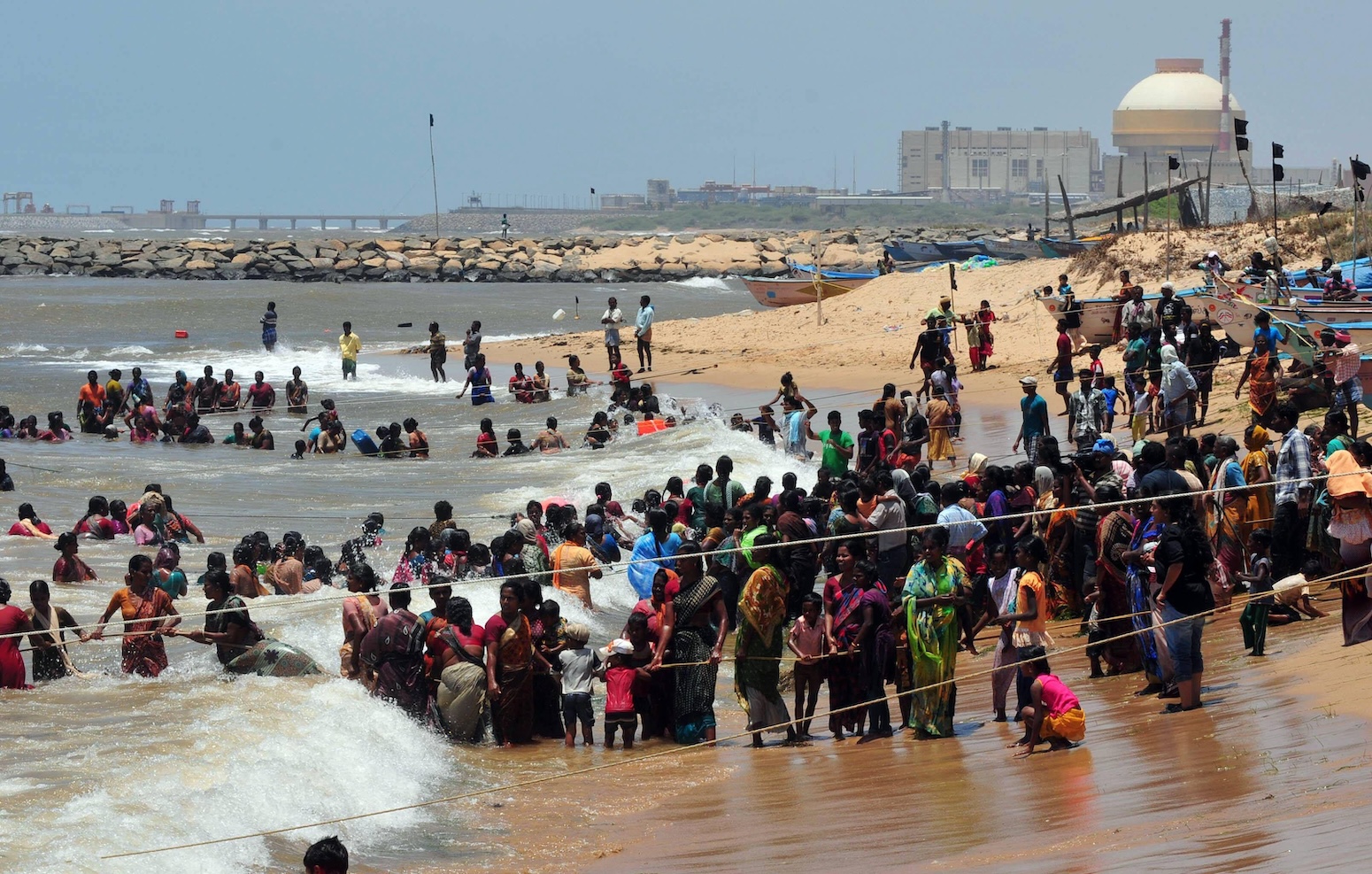 Protests against India's Kudankulam nuclear power plant in Tamil Nadu. Credit: Imago/Xinhua / Alamy Stock Photo
The Shanti act - which is an acronym for "sustainable harnessing and advancement of nuclear energy for transforming India" - aims to help India increase its nuclear capacity tenfold to 100 gigawatts (GW) by 2047.
This coincides with 100 years since India's independence and is "the year India aims to attain developed-nation status", according to prime minister Narendra Modi.
RenewablesSupport for renewables in India's budget this year is significant, but "uneven", experts tell Carbon Brief.
Allocations to India's Ministry of New and Renewable Energy (MNRE) grew by 24% to a "record high" in the 2026 budget, with the bulk going to the prime minister's flagship rooftop solar scheme. The government also cut import duties on lithium-ion cells for battery storage systems, as well as on inputs for solar-panel glass manufacturing.
However, Vibhuti Garg, South Asia director for the Institute for Energy Economics and Financial Analysis, tells Carbon Brief that spending on wind energy and - "more critically" - on transmission and energy storage has either "stagnated or declined" this year.
Garg says grid infrastructure is "fundamental" to renewable expansion. She explains:
Adaptation"Transmission infrastructure and storage are fundamental to integrating higher shares of renewable energy into the grid. As renewable penetration rises, these elements become not optional but indispensable, and the current level of support falls short of what is required."
The budget does not announce any specific adaptation measures or schemes, although it does mention a plan to develop and rejuvenate reservoirs and water bodies and to "strengthen" fisheries value chains in coastal areas.
The budget does not mention or include measures related to heat stress or its impact on productivity and workers in sectors such as agriculture.
According to India's national economic survey tabled ahead of the budget, adaptation and "resilience-related" domestic spending "surged" from 3.7% of the country's GDP in 2016-17 to 5.6% in 2022-23.
 Salt pan workers in south India endure high occupational heat stress. Credit: Alex Armitage / Alamy Stock Photo
Yet, unlike earlier budgets, allocations to and expenditure from India's National Adaptation Fund for Climate Change are not separately visible in the 2026 document.
Harjeet Singh, climate adaptation expert and founding director at the Satat Sampada Climate Foundation, tells Carbon Brief that this budget was a "missed opportunity" and a response "not commensurate to the needs [for adaptation] on [the] ground or investment at the scale of crisis that we are facing".
Singh adds that it fails to recognise the "huge" economic impacts already being felt in India. He says:
"If a budget doesn't recognise how climate change is already eroding India's development - causing huge economic losses - and is going to affect our GDP growth, it means that you aren't really acting, or nudging states to do more.
"It was a missed opportunity to tell the world that we do see adaptation as a problem and we are acting on it, but we also need international cooperation."

Q&A: How countries are using biofuels to meet their climate targets
Energy
|08.10.25

Explainer: What is China's 'Shenzhen model' for low-carbon transition in cities?
China Policy
|03.06.25

Infographic: How 'digital sequence information' can generate funds for biodiversity
Explainers
|20.02.25

Q&A: How Denmark plans to tax agriculture emissions to meet climate goals
EU policy
|09.07.24
jQuery(document).ready(function() { jQuery('.block-related-articles-slider-block_fcbf82c97ba1a3fc190cc03732d9bf9a .mh').matchHeight({ byRow: false }); });The post Five key climate and energy announcements in India's budget for 2026 appeared first on Carbon Brief.
 The downtown district of Hong Kong city. Lee Yiu Tung/Shutterstock
When structural engineers design a building, they aren't just stacking floors; they are calculating how to win a complex battle against nature. Every building is built to withstand a specific "budget" of environmental stress - the weight of record snowfalls, the push of powerful winds and the expansion caused by summer heat.
To do this, engineers use hazard maps and safety codes. These are essentially rulebooks based on decades of historical weather data. They include safety margins to ensure that even if a small part of a building fails, the entire structure won't come crashing down like a house of cards.
The problem is that these rulebooks are becoming obsolete. Most of our iconic high-rises were built in the 1970s and 80s - a world that was cooler, with more predictable tides and less violent storms. Today, that world no longer exists.
Climate change acts as a threat multiplier, making the consequences of environmental stress on buildings much worse. It rarely knocks a building down on its own. Instead, it finds the tiny cracks, rusting support beams and ageing foundations and pushes them toward a breaking point. It raises the intensity of every load and strain a building must weather.
To understand the challenge, I have been studying global hotspots where the environment is winning the battle against engineering.
The 2021 collapse of Champlain Towers South in Miami, Florida, killed 98 people. While the 12-storey building had original design issues, decades of rising sea levels and salty coastal air acted as a catalyst, allowing saltwater to seep into the basement and garage.
When salt reaches the steel rods inside concrete that provide structural strength (known as reinforcement), the metal rusts and expands. This creates massive internal pressure that cracks the concrete from the inside out — a process engineers call spalling. The lesson is clear: in a warming world, coastal basements are becoming corrosion chambers where minor maintenance gaps can escalate into catastrophic structural failure.
While the Miami case affected a single building, the historic coastal city of Alexandria, Egypt, is more widely at risk. Recent research shows that building collapses there have jumped from one per year to nearly 40 per year in the past few years.
Not only is the sea rising, the salt is liquefying the soft ground beneath the city foundations. As the water table rises, saltwater is pushed under the city, raising the groundwater level. This salty water doesn't just rust the foundations of buildings; it changes the chemical and physical structure of soil. As a result, there are currently 7,000 buildings in Alexandria at high risk of collapse.
 The historic city of Alexandria, Egypt, is widely affected by the retreating coastline.
muratart/Shutterstock
The historic city of Alexandria, Egypt, is widely affected by the retreating coastline.
muratart/Shutterstock
In Hong Kong during Super Typhoon Mangkhut in 2018, wind speeds hit a terrifying 180 miles per hour. When strong winds hit a wall of skyscrapers, they squeeze between the buildings and speed up — like water sprayed through a narrow garden hose.
This pressure turned hundreds of offices into wind tunnels, causing glass windows to pop out of their frames and raining broken glass onto the streets below. With 82 deaths and 15,000 homes destroyed across the region, skyscrapers became "debris machines", even if they didn't fully collapse.
Supercomputer simulations of Japan's river systems show that in a world warmed by 2°C, floods of today's "once in a century" magnitude could recur about every 45 years. With 4°C of warming, they could be every 23 years. These surges in water volume will expand flood zones into areas previously considered safe, potentially overflowing sea walls and flood defences. In a critical region like Osaka Bay, storm surges could rise by nearly 30%.
In the US, a study of 370 million property records from 1945 to 2015 found over half of all structures are in hazard hotspots. Nearly half are facing multiple threats like earthquakes, floods, hurricanes and tornadoes. In the UK, climate-driven weather claims hit £573 million in 2023, a 36% rise from 2022. Annual flood damage to non-residential properties in the UK is also projected to nearly double from £2 billion today to £3.9 billion by the 2080s.
Maintenance is our best defenceMuch of the world's building stock is therefore entering its middle age under environmental conditions it was never designed to face. Instead of panicking or tearing everything down, the solution is to adapt and treat building maintenance as a form of climate resilience - not as an optional extra.
Mid-life building upgrades can help protect our skylines for the next 50 years. Our hazard maps must look at future climate models — not just historical weather — to set new safety standards. Regular structural health monitoring is essential - by using sensors to track invisible stresses in foundations and frames before they become fatal, dangerous situations can be foreseen.
Buildings can stay strong by focusing retrofits on the weakest and most vulnerable parts. This includes glass facades, the underground drainage, the foundation piles and corrosion protection.
Climate change isn't rewriting the laws of engineering, but it is rapidly eating away at our margins of safety. If we want our cities to remain standing, we must act now - before small, invisible stresses accumulate into irreversible failure.
Don't have time to read about climate change as much as you'd like?
Get a weekly roundup in your inbox instead. Every Wednesday, The Conversation's environment editor writes Imagine, a short email that goes a little deeper into just one climate issue. Join the 47,000+ readers who've subscribed so far.

Mohamed Shaheen does not work for, consult, own shares in or receive funding from any company or organisation that would benefit from this article, and has disclosed no relevant affiliations beyond their academic appointment.
Arthur Bus's collapse in Poland marks the end of a story that had been quietly unraveling for some time. A hydrogen bus startup backed by public funding, municipal orders, and a planned manufacturing footprint failed before delivering a single customer vehicle. Twenty buses ordered by the city of Lublin were ... [continued]
The post The Hidden Cost of Europe's Hydrogen Bus Experiment appeared first on CleanTechnica.
My dad, John Barkham, who has died aged 82, was an inspirational teacher of ecology and a lifelong naturalist. As the first ecologist to join the new University of East Anglia in 1969, he taught students over three decades in the pioneering School of Environmental Sciences.
After studying the person-centred theories of Carl Rogers, whom he visited in California, John experimented with bold new teaching techniques, one year informing baffled students that they would design their own syllabus and teach themselves.
Continue reading...
 Arctic ice samples show how concentrations of an abundant forever chemical have changed over recent decades. WizartoProduction/Shutterstock
When the phaseout of ozone-destroying chlorofluorocarbons (CFCs) was first agreed in 1987, the world narrowly avoided an environmental catastrophe. However, the replacement of CFCs is causing the pollution of the Earth's surface with a "forever chemical" that could remain in the environment for centuries.
The chemical trifluoroacetic acid (TFA) is a breakdown product of numerous chemicals, including CFC replacement gases used in refrigeration and air conditioning, pharmaceuticals such as gases used in inhalation anaesthesia, pesticides, solvents and other forever chemicals from a class known as per-and polyfluoroalkyl substances (PFAS).
Concentrations of TFA have been increasing in rainwater, drinking water, soil and plants over the past two decades. Environmental removal of any of the thousands of different PFAS chemicals is extremely challenging because existing removal technology is difficult to scale up.
If emissions aren't restricted, the projected cost of PFAS removal has been estimated at €100 billion (£86 billion) per year for Europe. Some researchers have labelled TFA as a "planetary boundary threat" which means it could disrupt Earth's natural systems beyond repair and threaten our survival.
While some PFAS have been linked to numerous cancers and fertility problems, the long-term health effects of TFA on humans and wildlife remains unknown. However, it has been detected in human blood, breast milk and urine, and is being considered for classification as toxic to reproduction by German government agencies.
While understanding of its consequences continues to develop, increasing TFA pollution urgently needs to be addressed.
Read more: The last ozone-layer damaging chemicals to be phased out are finally falling in the atmosphere
A better understanding of the many TFA sources and their relative contributions to environmental levels is required to inform targeted policy.
Evidence from ice cores can offer clues to help detangle these sources. TFA concentrations in Arctic ice over recent decades match the their increasing use. In 2020, Canadian researchers hypothesised that some CFC replacement gases which are known to break down to produce TFA in the atmosphere could be a major source.
These CFC replacements - known as hydrochlorofluorocarbons (HCFCs) and hydrofluorocarbons (HFCs) - are commonly used in refrigeration, air conditioning and for making insulating foams. They eventually leak into the atmosphere as gases and can travel vast distances. These CFC replacements break down to form TFA and other gases. TFA can be either dissolved in clouds then washed out of the atmosphere through rain or deposited directly from air onto the Earth's surface.
Our new study, published in the journal Geophysical Research Letters, quantified the contribution of these CFC replacements and also inhalation anaesthetics to global TFA production. We found that one-third of a million tonnes of TFA (335,500 tonnes) has been deposited to the Earth's surface from these sources between 2000 and 2022.
 The forever chemical TFA is transported vast distances in the air and can end up washing back to the Earth's surface in rain.
Astrid Gast/Shutterstock
The forever chemical TFA is transported vast distances in the air and can end up washing back to the Earth's surface in rain.
Astrid Gast/Shutterstock
HCFCs and HFCs have now been phased down under various amendments to the 1987 Montreal protocol on substances that deplete the ozone layer, because they are potent greenhouse gases. Despite this, TFA production increased over the period with the peak production projected to be anywhere between 2025 and 2100.
By comparing the amounts of TFA in our model to Arctic ice core records, we found that these sources can explain virtually all of the TFA deposited in the Arctic. This is particularly concerning because it highlights the ability of TFA pollution to spread around the globe. Emissions from highly populated regions in the northern hemisphere can have a big effect on far-flung regions once considered to be pristine, such as the Arctic.
Read more: What's the forever chemical TFA doing in the UK's rivers?
Peak TFA
However, when we compared our model results to rainwater concentrations closer to emissions regions in developed countries with extensive infrastructure or manufacturing, we found that the sources in our model could not explain all the observed TFA. We questioned whether this missing TFA could be explained by a refrigerant known as HFO-1234yf. This chemical is increasingly used in vehicle air-conditioning because of its low impact on global warming.
While often promoted as a sustainable climate-friendly alternative to HFCs, hydrofluoroolefins (HFOs) can produce TFA much more quickly than HFCs (this process takes days for HFOs and years for HFCs). This may mean that the HFOs don't travel as far in the atmosphere before breaking down, so more TFA gets deposited back on land closer to the regions they are emitted from.
By adding estimated emissions of HFO-1234yf to the model, we were able to considerably explain the gap between the predicted and actual measurements of TFA.
Emissions of HFOs are highly uncertain, so there may be other unknown sources contributing to the TFA observed in rainwater. But with the increasing use of HFOs, TFA will certainly continue to accumulate in the environment. The peak of TFA emissions from these sources will be well into the future if left unregulated now.
Given the risk of its irreversible accumulation in the environment, animals and people, plus a growing understanding of its effects on human health and nature, preventing pollution at source is the safest and healthiest option.
Don't have time to read about climate change as much as you'd like?
Get a weekly roundup in your inbox instead. Every Wednesday, The Conversation's environment editor writes Imagine, a short email that goes a little deeper into just one climate issue. Join the 47,000+ readers who've subscribed so far.

Lucy Hart receives funding from Natural Environment Research Council ECORISC CDT.
Ryan Hossaini receives funding from the Natural Environment Research Council
Another day, another big move for the US solar industry as Voltage Energy announces expansion in North Carolina.
The post US Solar Industry Innovators Are Quiet-Quitting US Energy Policy appeared first on CleanTechnica.
Orion Energy Systems recently announced it will install 105 fast EV chargers for Boston Public Schools on a $4 million contract. EV chargers at schools often means chargers for electric buses, not hybrids, and that's the case here. CleanTechnica has published many articles about electric school buses because they have ... [continued]
The post 105 Fast EV Charging Stations Coming To Boston Public Schools appeared first on CleanTechnica.


