
 6 Takeaways from an Actuarial Warning on Planetary Insolvency [ 20-Jan-26 5:45pm ]
In the world of finance and insurance, actuaries are pragmatists. They are highly trained professionals who analyze data, probability distributions, and long-term solvency. Their job is to look at the range of realities and calculate how much it will cost when things go wrong. Actuaries are probably one of the only groups of people embedded within the corporate world that are least tainted by optimism bias, politics, and shareholder demands.
A group of actuaries recently released a report on the fate of human survival called "Parasol Lost".
The report was produced by a collaboration between the Institute and Faculty of Actuaries (IFoA) and the University of Exeter. Led by authors including Sandy Trust, Oliver Bettis, James Orr, and Professor Sir David King (former Chief Scientific Adviser to the UK Government), the team brings together experts in climate science and risk management.
Sign up for Collapse 2050The unspoken truth about humanity's frightening future.
Subscribe .nc-loop-dots-4-24-icon-o{--animation-duration:0.8s} .nc-loop-dots-4-24-icon-o *{opacity:.4;transform:scale(.75);animation:nc-loop-dots-4-anim var(--animation-duration) infinite} .nc-loop-dots-4-24-icon-o :nth-child(1){transform-origin:4px 12px;animation-delay:-.3s;animation-delay:calc(var(--animation-duration)/-2.666)} .nc-loop-dots-4-24-icon-o :nth-child(2){transform-origin:12px 12px;animation-delay:-.15s;animation-delay:calc(var(--animation-duration)/-5.333)} .nc-loop-dots-4-24-icon-o :nth-child(3){transform-origin:20px 12px} @keyframes nc-loop-dots-4-anim{0%,100%{opacity:.4;transform:scale(.75)}50%{opacity:1;transform:scale(1)}} Email sent! Check your inbox to complete your signup.No spam. Unsubscribe anytime.
6 things you need to know:1. The Termination Shock of Cleaner AirSulphate aerosols from fossil fuel burning have acted as a hidden sunshade, reflecting sunlight and cooling the Earth by roughly 0.5°C. As we clean up air pollution, we lose that cooling. This unmasking is contributing to a termination shock—a rapid, violent spike in warming that we are already starting to feel.
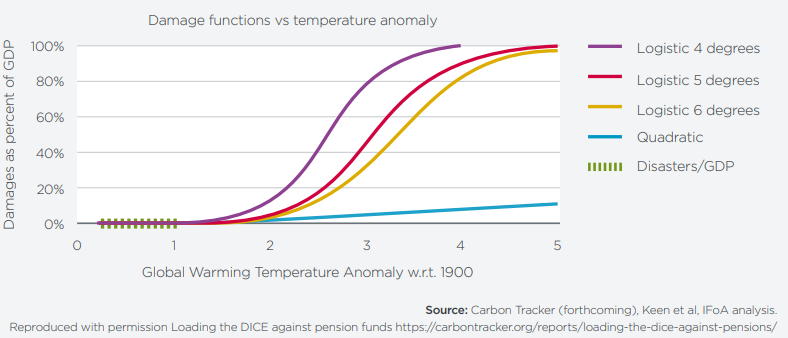
2. A 50% Drop in Global GDPTraditional economic models have often treated climate change as a manageable speed bump. The actuaries disagree, using reverse stress testing (a technique used to see what would ruin a bank or insurance company) to look at the real impact.
Unmitigated climate change could lead to a 50% drop in global GDP later this century. The higher the temperature anomaly, the closer we get to complete collapse.
A plausible scenario could cause a 15% to 20% global GDP contraction in just a five-year period—an economic shock far greater than the Great Depression or the 2008 Financial Crisis.
 3. We Are Approaching Planetary Insolvency
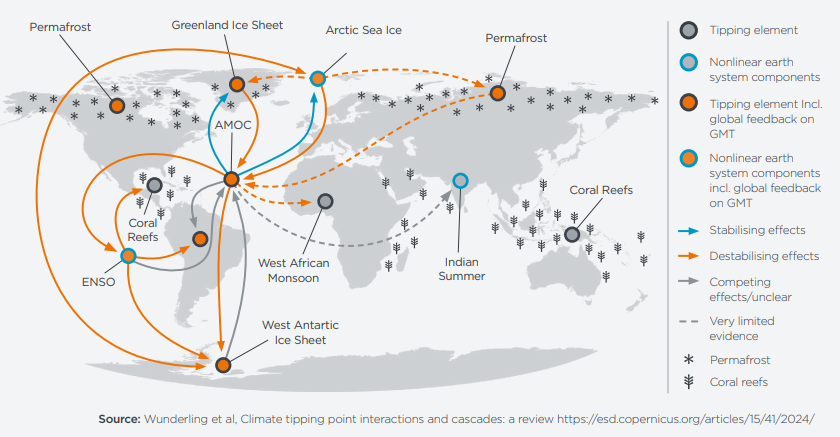
The report defines Planetary Insolvency as significant societal disruption driven by climate and nature risks. The decadal warming average is already at 1.4°C. At current rates, we are likely to hit 2°C mark before 2050. Once we pass 1.5°C, we enter the danger zone for irreversible tipping points, including the collapse of the West Antarctic ice sheet and the dieback of the Amazon rainforest.
 4. The Earth is Absorbing Energy at an Insane Rate
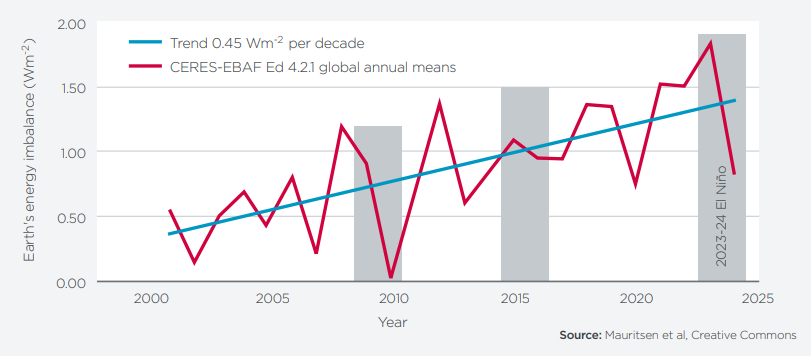
The Earth's Energy Imbalance (EEI) has doubled in recent decades. In early 2023, the rate of solar energy absorption was equivalent to every person alive on Earth continuously boiling 60 kettles. Since 1971, the Earth has accumulated 500 times more energy than the world's total primary energy consumption in 2024. 93% of this heat is currently being stored in the oceans, a thermal debt that will eventually be paid.
 5. The Human Cost: Mass Mortality and Migration
Beyond economic figures, the report warns of a severe humanitarian crisis. Unchecked climate change is expected to lead to mass mortality events and involuntary mass migration as populations are displaced by rising sea levels, heat stress, and the collapse of food and water systems. This is identified as a national security issue where the foundational stability of political systems is threatened by cascading failures in essential services.
6. The End of InsurabilityInsurance is the invisible lubricant of the global economy. Without it, you can't get a mortgage, start a business, or ship goods. Insured losses from natural catastrophes have nearly doubled in the last decade, from $77 billion in 2015 to $145 billion in 2024. These losses are currently doubling every 10 to 15 years. The report warns we are approaching a point where large swaths of the planet become simply uninsurable, leading to a total collapse of local economies. Insurance is the canary in the coalmine.
I won't waste your time adding in the usual "but here's what we can do" stuff that is obligatory for these kinds of reports. Still, it's worth the read.
Read the full report:Parasol-Lost-FinalParasol-Lost-Final.pdf10 MB.a{fill:none;stroke:currentColor;stroke-linecap:round;stroke-linejoin:round;stroke-width:1.5px;}download-circleThe site is free for all. No ads or corporate sponsors. Paid subscribers and one-time contributors help keep the site going. So do your kind words and comments. Thank you. Sarah.
Why an invasion of Greenland might cause the end of Canada [ 16-Jan-26 7:44pm ]
Until last week, the notion of the United States Marines storming the beaches of Nuuk seemed the stuff of bad Tom Clancy fan fiction.
Then came the Caracas raid.
The extraction of Nicolas Maduro by American special forces, an operation Washington hailed as a masterstroke against tyranny and everyone else decried as piracy, has recalibrated the global sense of the possible. If a sovereign head of state can be snatched from his palace in the tropics, a sparsely populated island in the Arctic hardly seems out of bounds.
Donald Trump has never made secret his desire to acquire Greenland. Having been rebuffed by Denmark during his first term, he now appears ready to dispense with the asking. The island is a treasure chest of dysprosium and neodymium, rare-earth elements essential for everything from iPhones to F-35s, and currently monopolized by China. It also sits atop the "GIUK gap", the naval choke-point through which Russian submarines must pass to threaten the Atlantic if a war with the West were to ever occur.
But for military planners in Washington, the Greenland operation is about more than just rare earths. As the Arctic melts, new shipping lanes are opening that offer Russia and China unpoliced backdoors into the Western Hemisphere, exposing North America to strategic vulnerabilities. In this context, the push north is the act of an empire scrambling to maintain its grip on hegemony.
For some, the operation also quietly represents a two-for-one gain. By provoking a crisis in the High North to maintain control over the GIUK gap and new arctic routes, the United States creates a dilemma that Ottawa cannot solve, turning Canada from a neighbouring ally into a vassal US state.
In Europe, the diplomatic mood is sour. Copenhagen has instructed its troops in Greenland to "shoot first and ask questions later" should American boots touch the ground. European allies, terrified of abandoning a NATO member but terrified equally of fighting the United States, have pledged a tripwire force of French and German troops to the island.
A clash over Greenland might remain a localized skirmish or cascade into a global conflagration. Such is the inherent unpredictability of war.
This puts Canada in an impossible position. Denmark is a NATO ally. If it invokes Article 5, Canada is treaty-bound to come to its aid. Yet Canada is geographically fused to the aggressor. If Ottawa honours its NATO obligations, it effectively declares war on the superpower next door. This is a suicidal gesture for a country whose military is chronically underfunded and whose population is clustered within a hundred miles of the American border.
If Canada refuses to honour its NATO obligations, declaring neutrality, it falls into another trap. Under the Hague Convention, a neutral state must prevent belligerents from using its territory. Realistically, Canada cannot do this and would be deemed unable or unwilling to enforce its neutrality. Canada would be at the mercy of American military strategy.
Either through force or cooperation, the US needs access to Canada to support any prolonged incursion into Greenland. To project power into Greenland effectively, the US Air Force needs to fly directly over Canada. Canada lacks the interceptors, surface-to-air missiles, or radar density to stop advanced American aircraft. Canada literally cannot close its own sky. Sustaining a war also requires massive logistics—fuel, munitions, staging grounds. The most efficient routes to the high north utilize Canadian rail, roads, and airbases (like CFB Goose Bay). Without Canadian cooperation, the US supply chain is stretched thin over open ocean; with forced cooperation, Canada becomes a forward operating base.
This becomes a precursor to annexation. Canada, trying to stay out of a war between NATO allies (US vs. Denmark), could refuse access to maintain neutrality. The US, deeming the Greenland mission critical to national security, ignores the refusal and uses Canadian airspace anyway. Once the US is actively ignoring Canadian sovereignty to move troops, it effectively controls the territory.
To secure these supply lines permanently against interference, Washington might decide it's safer to formalize that control, either by installing a compliant government or legally integrating the territory under defense acts. This effectively ends Canada as an independent sovereign entity.
Sign up for Collapse 2050The unspoken truth about humanity's frightening future.
Subscribe .nc-loop-dots-4-24-icon-o{--animation-duration:0.8s} .nc-loop-dots-4-24-icon-o *{opacity:.4;transform:scale(.75);animation:nc-loop-dots-4-anim var(--animation-duration) infinite} .nc-loop-dots-4-24-icon-o :nth-child(1){transform-origin:4px 12px;animation-delay:-.3s;animation-delay:calc(var(--animation-duration)/-2.666)} .nc-loop-dots-4-24-icon-o :nth-child(2){transform-origin:12px 12px;animation-delay:-.15s;animation-delay:calc(var(--animation-duration)/-5.333)} .nc-loop-dots-4-24-icon-o :nth-child(3){transform-origin:20px 12px} @keyframes nc-loop-dots-4-anim{0%,100%{opacity:.4;transform:scale(.75)}50%{opacity:1;transform:scale(1)}} Email sent! Check your inbox to complete your signup.No spam. Unsubscribe anytime.
Should Canada be designated a hostile entity the consequences would be immediate. The assets of Canadian banks in the United States could be frozen. Snowbirds in Florida might find their condos locked and their bank accounts inaccessible. The Canadian dollar and Canadian assets could collapse, wiping out savings and pensions, and raising the cost of living. An envelope of financial, legal, military aggression would rapidly squeeze the life out of Canada.
The timing is auspicious for Washington. Canada is currently politically brittle. The re-election of Trump has emboldened separatist movements that had been dormant. In Alberta, frustration with the federal Liberal government's policies and perceived hostility to the oil industry has boiled into a passionate conversation about separation.
The White House knows this. A two-for-one strategy would likely involve a side deal for Alberta: support the American play (or at least stay out of it), and face no tariffs, gain a new pipeline, and enjoy the protection of the American security umbrella. It is a seductive offer for a province that feels underappreciated by the rest of Canada.
Meanwhile, Quebec has long teased separation, a sentiment that could easily be re-inflamed. The province controls the St. Lawrence Seaway, the industrial artery of the continent. A deal that recognizes Quebec's distinct sovereign status in exchange for American military rights over the seaway would neuter Ottawa's control over its own economy.
Canada would be hollowed out, leaving a rump state of coastal provinces and Ontario, separated by large landmasses. This is both economically and politically unviable, with each remaining scrap of the country either allying with the US or forming it's own distinct country.
We don't know the precise outcome of the Whitehouse's desire to aquire Greenland. Perhaps its all bark and no bite.
But what was once unthinkable is now possible, so we must look at all hypotheticals. As of today, there is a possibility Canada ceases to exist and North America effectively becomes a US fortress.
Greenland is Canada's problem.
Thanks for reading. My name is Sarah and I run Collapse2050. It is a place for the collapse-aware community to learn, debate and connect. Please consider subscribing.
The site is free for all. No ads or corporate sponsors. Paid subscribers and one-time contributors help keep me going. Support also goes towards my shift to full time writing and helping people manage their future. Thank you. Sarah.
Are we just letting this happen again? [ 11-Jan-26 4:56am ]How do ordinary people rationalize the unthinkable? As authoritarianism knocks on the door of American democracy, the history of the Third Reich offers a haunting reflection not of monsters, but of ourselves.
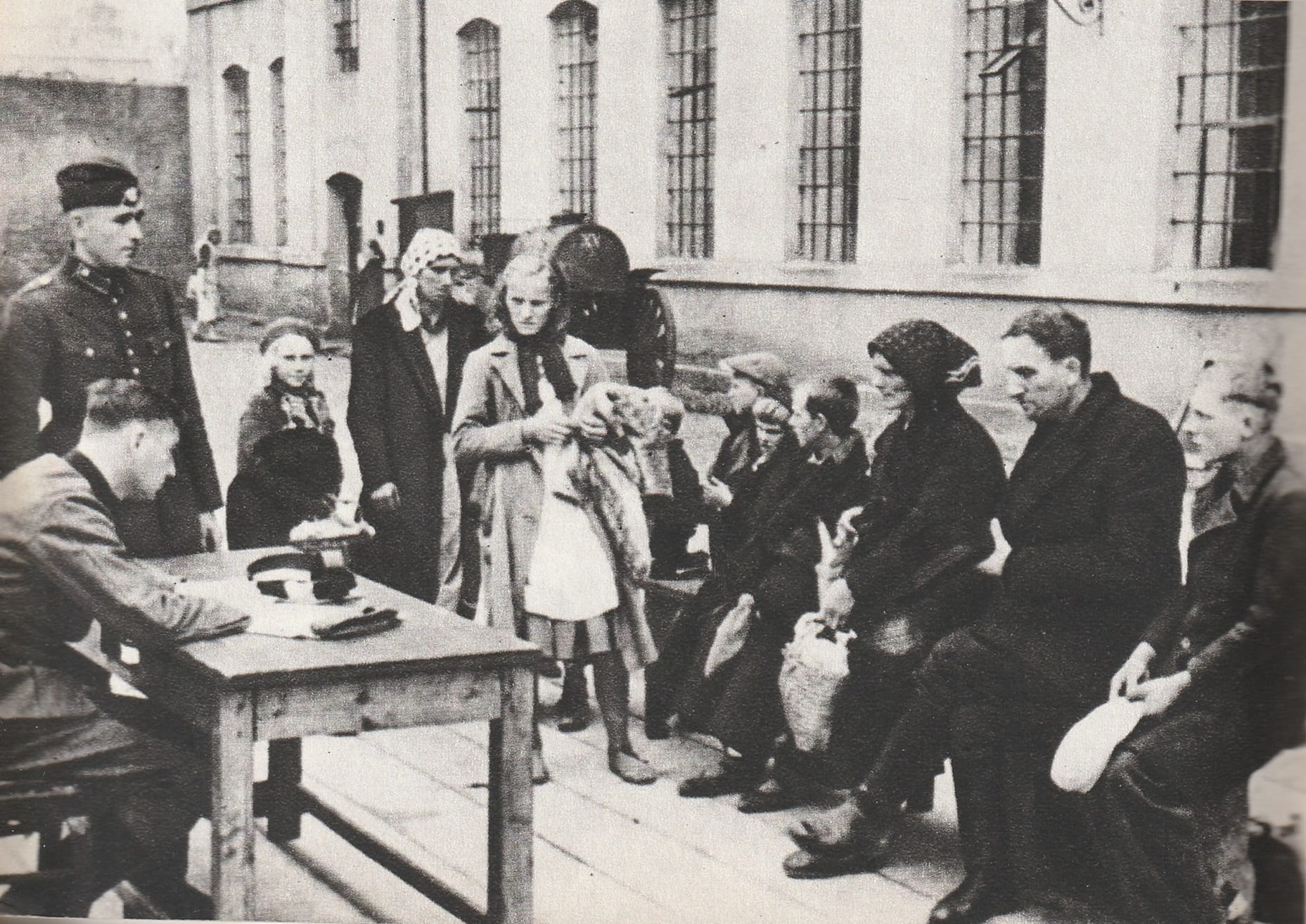
It begins with a feeling of unease. A scroll through a newsfeed, a clip of a rally where the rhetoric feels sharper, the threats more explicit. Until the spear of fascism is pointed at your neck.
We aren't letting this happen again, are we?
For many Americans, the escalating political volatility of the last few years has moved the history of the 1930s from the dusty shelves of academic abstraction into the urgent territory of a survival guide. We watch the polarization, the scapegoating of minorities, and the testing of institutional guardrails, and we ask the inevitable question: Is this how it happens?
Sign up for Collapse 2050The unspoken truth about humanity's frightening future.
Subscribe .nc-loop-dots-4-24-icon-o{--animation-duration:0.8s} .nc-loop-dots-4-24-icon-o *{opacity:.4;transform:scale(.75);animation:nc-loop-dots-4-anim var(--animation-duration) infinite} .nc-loop-dots-4-24-icon-o :nth-child(1){transform-origin:4px 12px;animation-delay:-.3s;animation-delay:calc(var(--animation-duration)/-2.666)} .nc-loop-dots-4-24-icon-o :nth-child(2){transform-origin:12px 12px;animation-delay:-.15s;animation-delay:calc(var(--animation-duration)/-5.333)} .nc-loop-dots-4-24-icon-o :nth-child(3){transform-origin:20px 12px} @keyframes nc-loop-dots-4-anim{0%,100%{opacity:.4;transform:scale(.75)}50%{opacity:1;transform:scale(1)}} Email sent! Check your inbox to complete your signup.No spam. Unsubscribe anytime.
But the more haunting question is about those going along, and the millions staying quiet at home.
For decades we've comforted ourselves with the idea that the German people of 1933 were uniquely susceptible to hateful fascism. Brainwashed. Uninformed. Evil. We imagine that we would be different...that we would speak up, that we would resist.
Yet, Third Reich shows that the rise of fascism relies less on a nation of monsters and more on a nation of neighbors. It was built on the banal, terrifying architecture of social conformity, professional ambition, and the human need to belong. To understand how a modern democracy collapses, we must look away from Hitler and toward the ordinary citizen navigating the gray zone between complicity and survival.
The Seduction of the In-GroupIf you were a "pure" German in 1933, the onset of the dictatorship might have felt like the lights coming back on. After the humiliation of World War I and the crushing poverty of the Great Depression, the Nazis promised a return to order and the Volksgemeinschaft ("People's Community").
This was the regime's most potent psychological weapon. It offered a seductive bargain: equality, status, and belonging for the "in-group," purchased at the price of the "out-group's" exclusion. Participation was made to feel like a festival. The Winter Relief drives and the Strength Through Joy vacations were communal. They made the average citizen feel seen and valued.
But this belonging was brittle. It required constant maintenance through what sociologists call "ritualistic conformity." The "Heil Hitler" greeting was a social signal. To refuse it was to mark oneself as difficult, a grumbler, an outsider. Most people performed the salute because it was awkward not to. They did it to avoid the friction of social deviance. Over time, however, a psychological mechanism known as cognitive dissonance took hold. It is exhausting to act one way and believe another. Eventually, many aligned their internal beliefs with their external actions. They became what they pretended to be.
The Ordinary Men in the WoodsThe most chilling dismantling of the "monster" myth comes from a study of Reserve Police Battalion 101. This group was made up of middle-aged, working-class family men from Hamburg, too old for the front lines. In 1942, they were ordered to round up and execute the Jewish inhabitants of the Polish village of Józefów.
Their commander, Major Trapp, weeping and visibly shaken, made an extraordinary offer: any man who did not feel up to the task could step out of line and be assigned other duties. There would be no punishment.
Out of 500 men, only about a dozen stepped forward.
Why? They weren't all driven by a bloodthirsty antisemitism, though that was part of the cultural air they breathed. They were driven by the fear of looking weak in front of their friends. They didn't want to leave the "dirty work" to their comrades. They killed out of social deference and peer pressure. The same mundane social glues that keep a high school clique together.
This dynamic appeared even in the highest echelons of society. German doctors performed a psychological process called "doubling." An Auschwitz doctor could supervise the gas chambers by day, selecting thousands for death, and then return home to be a loving father and husband by night. He partitioned his soul, creating an "Auschwitz Self" to handle the horror, keeping his "Prior Self" unpolluted. It was a functional adaptation to evil.
For the millions who were neither killers nor true believers, the primary coping mechanism was Inner Emigration. This was the retreat into the private sphere. You stopped reading the papers. You focused on your garden, your music, your children. You told yourself that by not participating in the worst excesses, you were remaining decent.
The diaries of Victor Klemperer, a Jewish professor in Dresden, document how this silence felt from the other side. He recorded the "mosquito bites" of tyranny and the slow accumulation of indignities. A colleague crossing the street to avoid saying hello. The grocer who apologetically refused to sell him an apple. Fascism didn't require fanatics. Rather, it just needed the population to keep quiet, either through fear or complacency.
For those afraid the terror was real, but it was often self-inflicted. We often imagine the Gestapo as an omniscient surveillance state, but it was surprisingly understaffed and overworked. It relied almost entirely on rats. A neighbor settling a grudge over a shared laundry room, or a colleague eyeing a promotion. The regime weaponized petty envy. It turned the "community" into a panopticon where no one could trust anyone, enforcing a "spiral of silence" where dissent felt dangerous and singular, as if you were the only one who felt that way.
Perhaps the most insidious victory of the regime was its invasion of the family. Through the Hitler Youth, the state offered children power, a rare commodity for the young. It gave them uniforms, purpose, and authority over their parents.
The presence of indoctrinated children blocked the free-flow of communication even within the family home. Parents fell silent at the dinner table, afraid that a grumble about food rationing would be repeated by their son at a Hitler Youth meeting, leading to a knock on the door. Worse, some feared their children would purposefully sell them out. The family was no longer a fortress of truth against the state. Without that, bemoaning of circumstances gradually extinguished.
Was this descent inevitable?Looking back from the ruins of 1945, it seems so. But history is a series of choices, and there was a moment when the machine could have been stopped.
Consider the Kapp Putsch of 1920. When a right-wing faction tried to overthrow the Weimar government, the response was swift and unified. The trade unions called a general strike. Berlin stopped. Trains didn't run, water stopped flowing, bureaucrats refused to sign papers. The coup collapsed in days because the ordinary machinery of society refused to cooperate.
In January 1933, Hitler is appointed Chancellor. What if the unions had called a general strike then? By then, however, the voice of the opposition was fatally fractured. The Communists and Social Democrats hated each other more than they feared Hitler. With mass unemployment, workers were terrified of losing their jobs. The psychological moment for collective action had passed.
Also consider the Rosenstrasse Protest of 1943. In the depths of the war, the Gestapo rounded up nearly 2,000 Jewish men who were married to non-Jewish German women. These women marched to the detention center on Rosenstrasse and screamed for their husbands. They refused to leave, even when threatened with machine guns.
And they won. Goebbels, fearing public unrest in the capital, ordered the men released.
Leopold Gutterer, who was Goebbels's deputy at the Propaganda Ministry, later stated in an interview:
"Goebbels released the Jews in order to eliminate that protest from the world. That was the simplest solution: to eradicate completely the reason for the protest. Then it wouldn't make any sense to protest anymore. So that others didn't take a lesson [from the protest], so others didn't begin to do the same, the reason [for the protest] had to be eliminated. There was unrest, and it could have spread from neighborhood to neighborhood ... Why should Goebbels have had them [the protestors] all arrested? Then he would have only had even more unrest, from the relatives of these newly arrested persons." Gutterer also stated: "That [protest] was only possible in a large city, where people lived together, whether Jewish or not. In Berlin were also representatives of the international press, who immediately grabbed hold of something like this, to loudly proclaim it. Thus news of the protest would travel from one person to the next."
It was a demonstration that the regime was not impervious to public pressure, especially from "Aryans." It suggests that the point of no return was further away than we think. Perhaps peaceful, coordinated resistance could have jammed the gears of the Holocaust, had it happened earlier, and on a larger scale.
The tragedy of the Third Reich is that it could have been prevented if it was resisted early enough. Instead, ordinary people did nothing, or did just enough to get by, until the cost of resistance became fatal and complicity was the safest option.
The point of no return was the moment when the fear of social isolation outweighed the moral imperative to speak. It was the moment when the professional civil service decided that swearing an oath to Hitler was preferable to losing a pension. It was the moment when neighbors decided that the apartment of the deported Jewish family was an opportunity to steal their goods, space, job.
As we wonder why fascism is rising once again, the lesson from Germany is that we should look at the mirror. Authoritarian tendencies exist in any society that values order over justice, and comfort over courage. Occasionally socioeconomic circumstances deteriorate to a point at which these tendencies explode. We are not there yet, as we can see from the massive protests in Minneapolis. Resistance is still an option. A must. But it has a shelf life. It works when the press is still free, when the courts are still independent, and when the unions can still stop the trains.
Once those firewalls burn down, the cost of saying "no" rises from social awkwardness to physical destruction. That day is may come soon, unless we persist.
We'll know all is lost when people stop talking.
We are living through collapse. This blog is my personal project to deliver unadulterated information about humanity's final period. If you'd like to support my work, please subscribe or make a one time contribution. Thanks, Sarah
Venezuela attack raises WW3 risk [ 03-Jan-26 7:13pm ]The transition from peace to a state of war in the year 2026 results from the failure of deterrence and the convergence of systemic crises.
Early on January 3, 2026, United States forces executed a high-stakes strike on Caracas, successfully capturing the Venezuelan president in an operation now known as Operation Southern Spear. While Washington frames this intervention as a necessary response to rampant drug trafficking and regional instability, the reality is far more transactional: this is an aggressive bid to secure the world's largest oil reserves and reshape global energy flows.

This strike extends a violent reorganization of the global order. By seizing control of Venezuelan energy, the US administration intends to grant Western oil companies direct access to reserves, effectively insulating the West from volatile Eastern markets. It is a bold, perhaps desperate, move to secure resource sovereignty in an era defined by a worldwide poly-crisis.
The fallout was immediate. For Russia and China, Venezuela is a strategic foothold in the Western Hemisphere. China, which relies on Venezuelan crude for a significant portion of its imports, now faces what Beijing termed a sovereign default by force.
Removing the leadership in Caracas threatens years of investment and billions in outstanding loans. Russia and China now face a stark choice: accept the loss of influence or respond in theaters where the US is overextended. We are entering a phase of asymmetric debt recovery, where Moscow and Beijing will seek compensation through territorial and economic aggression elsewhere.
The strike has shattered the illusion of strategic ambiguity. In a world of interconnected dependencies, the Caracas catalyst could force a rigid "bloc-logic" back onto the map. Moscow and Beijing, once wary partners, now stand side by side. For every dollar of Venezuelan asset frozen by Washington, Beijing and Moscow could synchronize their military posture, effectively forcing every middle power, from Brazil to Turkey, to choose a side.
As the US commits its carrier groups to the Caribbean and its logistics to a South American occupation, the global "deterrence shield" thins. This provides a window of opportunity for regional powers to settle old scores under the cover of a great power distraction.
In South Asia, the most dangerous of these opportunistic flashpoints has simmered for years. New Delhi, sensing Beijing's preoccupation and the potential for a Pacific front, might strike while the iron is hot. The objective is the pre-emptive securing of the Yarlung Tsangpo (Brahmaputra) headwaters.
In a world where oil is being seized by the West, India views water as its existential red line. If China is perceived as weakened or distracted by the American gambit in Caracas, India may move to seize control of the Tibetan hydrological infrastructure. This "Water War" could extend into multi-front continental conflict, and is just one of many examples of potential knock-on effects of a conflict between China, Russia and US.
As the US pivots its focus toward Venezuela, the architecture of deterrence in Europe is beginning to crumble. The reduction of support for Ukraine's defense has already created a power vacuum that Russia is eager to fill. Moscow is now looking toward the Suwalki Gap, the narrow corridor connecting the Baltic states to their NATO allies.
If Russia moves on the Gap while the US is bogged down in a Venezuelan counter-insurgency, Washington may be forced to choose between its own hemisphere and its European allies. This realization is pushing Poland and the Baltic states toward independent, perhaps desperate, defense sub-alliances as they realize that US hegemony has finally found its limit.
In the Pacific, the Venezuelan strike has set a dangerous precedent. Beijing's logic is simple: if the US can seize oil to secure its future, China can seize semiconductors. From the perspective of the competing powers, Taiwan remains the ultimate prize, holding the keys to the next century's industrial intelligence.
The regional response could involve Japan. Under Prime Minister Sanae Takaichi, Tokyo has officially invoked its "Red Line" protocols. Any Chinese move to fill the vacuum left by the US Seventh Fleet in the Philippine Sea is now classified as a Survival-Threatening Situation (STS). This legally triggers Japan's right to collective self-defense, marking the end of its post-war pacifism. As Japan rearms beyond the limits of its constitution, the Pacific has become a powderkeg where neutrality is no longer an option.
Western economic hegemony is also under attack. On January 1, 2026, China launched Digital RMB 2.0, a smart-contract-based currency designed to bypass the SWIFT system entirely. Combined with the mBridge project, this allows for international trade settlement without any reliance on US infrastructure.
This technological shift is a weapon. In response to the Caracas strike, China could freeze Western assets within the mBridge ledger, treating the US intervention as a seizure of Chinese property. When the systems of finance fail to clear, the economic war ends and the shooting war begins. The petrodollar system, which allowed the US to fund its national debt and military for decades, is effectively on life support.
Would the world's manufacturing floor ever go to war with its best customer?
We have been here before. In 1914, leaders believed that the high volume of trade between the UK and Germany would prevent a total war. They were wrong. When states fear their supply chains will be cut, they strike to secure the source.
The January 3rd strike in Venezuela proves that financial wealth is secondary to survival. The US holds the oil, China seeks the chips, and Russia wants the land. We live in a system in disequilibrium where resource scarcity (including energy, water, food) dictates policy, and could rapidly push the world towards global chaos.
Collapse2050 is a personal project to deliver unadulterated information and a space for honest communication about humanity's final period. If you'd like to support my work, please subscribe or make a one time contribution.
Thanks, Sarah
How to: Solitude during collapse [ 29-Dec-25 9:50pm ]
People choose solitude when the cost of belonging exceeds the benefit of cooperation. For the collapse-aware, this calculation stems from a realization that the modern social contract is anchored to a sinking ship.
Sign up for Collapse 2050The unspoken truth about humanity's frightening future.
Subscribe .nc-loop-dots-4-24-icon-o{--animation-duration:0.8s} .nc-loop-dots-4-24-icon-o *{opacity:.4;transform:scale(.75);animation:nc-loop-dots-4-anim var(--animation-duration) infinite} .nc-loop-dots-4-24-icon-o :nth-child(1){transform-origin:4px 12px;animation-delay:-.3s;animation-delay:calc(var(--animation-duration)/-2.666)} .nc-loop-dots-4-24-icon-o :nth-child(2){transform-origin:12px 12px;animation-delay:-.15s;animation-delay:calc(var(--animation-duration)/-5.333)} .nc-loop-dots-4-24-icon-o :nth-child(3){transform-origin:20px 12px} @keyframes nc-loop-dots-4-anim{0%,100%{opacity:.4;transform:scale(.75)}50%{opacity:1;transform:scale(1)}} Email sent! Check your inbox to complete your signup.No spam. Unsubscribe anytime.
Staying within the system requires a daily performance of normalcy that feels like a lie. Leaving the system, yet remaining tethered to people who still believe in it, creates a friction that burns through mental energy.
Those entrenched in normalcy bias often view collapse awareness as a pathology. To avoid constant gaslighting or the burden of carrying others' denial, the aware individual steps away.
Yet, community-building remains an integral part of managing collapse. The common argument for community centers on survival. A group provides a labor force and constant security.
However, this assumes that the people in the group are reliable. In reality, groups introduce internal risks like theft, betrayal, and incompetence.
A solo person has a smaller physical footprint. They consume fewer calories and leave less evidence of their presence. In a scenario of systemic decline, being invisible is often a better defense than being fortified. Solitude eliminates the need for consensus, allowing for instant movement and adaptation.
There is a frequent conflation between solitude and independence. Independence is the ability to provide for oneself; solitude is the state of being alone. One can be independent while living in a city, and one can be in solitude while remaining entirely dependent on a dying system for supplies. True independence requires a wide array of skills, whereas solitude is merely a spatial and social arrangement.
The distinction between a hermit and a solitary person lies in the relationship with the outside world. A hermit typically retreats for spiritual reasons, cutting off all ties. Solitude, in the context of collapse awareness, is a tactical choice. A solitary person remains an observer, gathering information and maintaining tools to interact with the world when the benefits outweigh the risks.
Physiological and mental trade-offs are significant. Solitude lowers cortisol levels by removing social conflict and the stress of managing others' expectations. It provides a clarity of mind that is difficult to achieve in a crowd. However, the human brain requires social feedback. Without external verification, an individual can drift into obsessive thought patterns or paranoia. The brain can treat minor internal anxieties as major external threats. Chronic loneliness triggers a sustained inflammatory response, which can accelerate cognitive decline and weaken the immune system. The absence of touch and verbal exchange leads to hyper-vigilance where the mind never rests, eventually leading to burnout.
Physically, the greatest risk is a minor injury becoming fatal. A broken leg is a manageable event for a duo but a death sentence for a lone actor.
A hybrid strategy addresses these risks by creating a network of solitary individuals. This decentralized community involves people living independently while maintaining functional ties. Unlike a traditional commune, this network relies on distance as a buffer. Members might trade skills via drop points or scheduled check-ins without the obligation of shared living. This model provides the security of a collective without the interpersonal friction of shared space.
It is also possible to remain solitary within a larger community without appearing anti-social by framing the behavior as personal discipline. This involves setting clear boundaries regarding time. One can participate in essential functions (e.g. local governance or maintenance) while opting out of high-friction social engagements. By being consistently helpful but socially brief, an individual gains a reputation for being reliable rather than reclusive. This preserves the benefits of a group while maintaining psychological autonomy.
While soing this, one must reconcile the need for a network with the reality that most people remain trapped in normalcy bias.
Finding a group of like-minded collapse-aware individuals is often impossible. However, a functional network does not require shared ideology; it only requires shared interests or mutual dependencies. One can build a distant community by connecting with people who possess tangible skills or trades without discussing systemic decline. In these cases, the bond is transactional or based on a common hobby. A solitary person can be a member of a local gardening club, a radio group, or a volunteer fire department. These people do not need to be aware to be useful.
By engaging on the basis of skill rather than philosophy, a soloist avoids the friction of debating the future while securing a place within a web of capable individuals.
To maintain this network, a soloist focuses on low-frequency, high-value interactions. Interactions revolve around a purpose that aids your objectives. Furthermore, establishing a mutual aid agreement with a few trusted neighbors (where the agreement is limited to specific emergencies) creates a functional bond that does not require friendship.
After deciding on a solitary path, the priority is redundancy. Since there is no partner to provide backup, every critical system or network connection must have a secondary fail-safe. It's better to have 3 carpenters in your network than one.
Critically, regardless of one's network, self-reliance remains a cornerstone to living in any form of solitude. Skills development today will benefit you in the future.
If you found this useful, please consider subscribing or buying me a snifter of whiskey.
3 Action Items for 2026 [ 24-Dec-25 1:58pm ]
The unspoken truth about humanity's frightening future.
Subscribe .nc-loop-dots-4-24-icon-o{--animation-duration:0.8s} .nc-loop-dots-4-24-icon-o *{opacity:.4;transform:scale(.75);animation:nc-loop-dots-4-anim var(--animation-duration) infinite} .nc-loop-dots-4-24-icon-o :nth-child(1){transform-origin:4px 12px;animation-delay:-.3s;animation-delay:calc(var(--animation-duration)/-2.666)} .nc-loop-dots-4-24-icon-o :nth-child(2){transform-origin:12px 12px;animation-delay:-.15s;animation-delay:calc(var(--animation-duration)/-5.333)} .nc-loop-dots-4-24-icon-o :nth-child(3){transform-origin:20px 12px} @keyframes nc-loop-dots-4-anim{0%,100%{opacity:.4;transform:scale(.75)}50%{opacity:1;transform:scale(1)}} Email sent! Check your inbox to complete your signup.No spam. Unsubscribe anytime.
If you feel paralyzed by the scale of what is happening, understand that movement is the only cure for dread. Taking a single step replaces abstract fear with concrete agency. Doing something real alleviates the depression that comes from watching a screen and waiting for the end.
As we move into 2026, I want to offer three specific goals to focus on throughout the coming year.
These are continuous efforts to build optionality as our systems lose their reliability. We are watching a slow-motion descent into who knows what. Survival in this context is about buying yourself the choice to pivot when a specific path closes off. These actions do not guarantee you make it through the decade, but they unlock the door to try.
3 suggestions:First, you must store food. I am not talking about a bunker mentality, but about decoupling your daily existence from the immediate volatility of the grocery store. Throughout 2026, make it a habit to expand your baseline. When prices spike or logistics chains snap, a deep pantry acts as a buffer. It buys you weeks or months to think while others are panicking.
Start by identifying the dry goods you already eat (grains, beans, fats) and buying them in bulk until you have a six-month reserve. Rotate what you use so nothing rots. This stash is a physical insurance policy that pays out in calories. The act of filling your shelves provides an immediate, tangible sense of security that lowers your daily anxiety.
Second, you need to develop a useful skill. Most of us occupy roles in the service economy that vanish the moment discretionary spending dries up. You need a capability that remains relevant when the bullshit jobs disappear. Spend the months of this year practicing one skill that produces a tangible result.
This might be small engine repair, basic carpentry, or sewing. You learn this by doing the work now, while parts and tools are still available and you have the luxury of time.
Skills gives you the optionality of strategy. If you can fix a pump or mend a coat, you have something to trade for the things you cannot produce yourself. Focusing your mind on a physical task also interrupts the cycle of existential worry and gives you back a sense of competence.
Third, you must build a localized social mesh. Individualism is a luxury of high-functioning industrialism. As that fades, your ability to survive depends on the people living within walking distance of your front door.
You do this by intentionally meeting neighbors and identifying shared vulnerabilities over the course of the year. Not everyone has to be collapse-aware. That will come on its own. Rather, community network is about knowing who has a ladder, who knows medicine, and who will watch your back. Nobody needs to know why you have stepped up to become more outgoing.
When the time comes, this provides the optionality of collective defense and shared resources. You cannot pull a twenty-four-hour watch alone, and you cannot know every skill.
You may even meet some like minded people along the way. Breaking your isolation is the most effective way to combat the hopelessness of collapse. A network scales your chances and reminds you that you are not facing this alone.
None of these goals ensure long-term safety. A large enough hurdle will still break most people. However, these actions prevent you from being forced into a desperate move during the first wave of a crisis.
They provide the time necessary to assess the new reality and choose a different path.
Start today, because the simple act of preparing is the best you can do for today's mental health and tomorrow's longevity.
What are you doing in 2026?
James Hansen: A "Super" Record is Coming in 2027 [ 21-Dec-25 6:00pm ]"We project a global temperature record of +1.7C in 2027, which will provide further confirmation of the recent global warming acceleration."
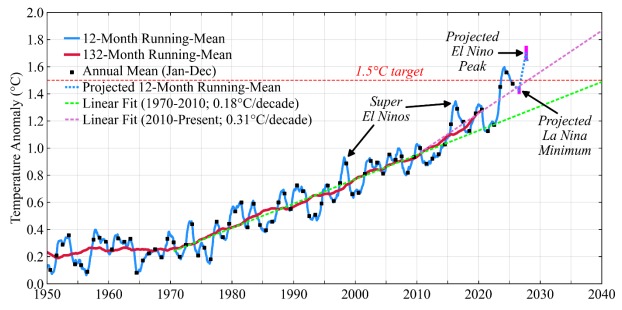 Projected global temperature in 2026 and 2027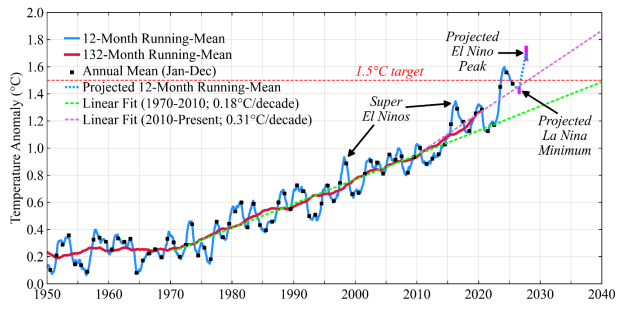
The "father of climate change awareness" is sounding the alarm again. James Hansen, the former NASA scientist who famously testified to Congress about the greenhouse effect in 1988, has released a chilling new update alongside colleagues Pushker Kharecha, Dylan Morgan, and Jasen Vest.
Their latest report, dated December 18, 2025, reveals that we have hit dangerous thresholds for humanity.
Here is what you need to know:- The 1.5°C Barrier Has Been Breached: The average global temperature for the three-year period of 2023-2025 has reached +1.5 C relative to the 1880-1920 base period.
- 2025 is the Second Hottest Year on Record: While slightly cooler than the freakishly hot 2024, 2025 clocked in at +1.47 C.
- A "Super" Record is Coming in 2027: Hansen and his team project that 2027 will shatter records, reaching a staggering +1.7 C global temperature anomaly.
- Warming has Nearly Doubled in Speed: Since 2010, the rate of global warming has accelerated to 0.31C per decade, compared to just 0.18C per decade between 1970 and 2010.
- The "Aerosol Shift": The unexpected surge in heat is partially due to the loss of the "cooling effect" from human-made aerosols, which have recently shifted from masking warming to potentially accelerating it.
While the team expects a brief dip in temperatures in early 2026 as the current La Nina phase concludes, it is merely the "calm" before the next heat storm. Models indicate a new El Nino will begin in the second half of 2026, acting as a slingshot to propel 2027 into uncharted, record-breaking territory.
Read the full report:GlobalTemperaturePrediction2025.12.18GlobalTemperaturePrediction2025.12.18.pdf780 KB.a{fill:none;stroke:currentColor;stroke-linecap:round;stroke-linejoin:round;stroke-width:1.5px;}download-circleCollapse2050 is a personal project to deliver unadulterated information and a space for honest communication about humanity's final period. If you'd like to support my work, please subscribe or make a one time contribution.
Thank you,
Sarah
11 Warnings for 2026 [ 16-Dec-25 2:39am ]
The shit storm around us - none of it should come as a surprise. They told us their plans and now they're acting on them. It was all clearly laid out in Project 2025, the Republican playbook released in 2024.
Want to know what will happen in 2026?
Well, they're telling us again.
Sign up for Collapse 2050The unspoken truth about humanity's frightening future.
Subscribe .nc-loop-dots-4-24-icon-o{--animation-duration:0.8s} .nc-loop-dots-4-24-icon-o *{opacity:.4;transform:scale(.75);animation:nc-loop-dots-4-anim var(--animation-duration) infinite} .nc-loop-dots-4-24-icon-o :nth-child(1){transform-origin:4px 12px;animation-delay:-.3s;animation-delay:calc(var(--animation-duration)/-2.666)} .nc-loop-dots-4-24-icon-o :nth-child(2){transform-origin:12px 12px;animation-delay:-.15s;animation-delay:calc(var(--animation-duration)/-5.333)} .nc-loop-dots-4-24-icon-o :nth-child(3){transform-origin:20px 12px} @keyframes nc-loop-dots-4-anim{0%,100%{opacity:.4;transform:scale(.75)}50%{opacity:1;transform:scale(1)}} Email sent! Check your inbox to complete your signup.No spam. Unsubscribe anytime.
Next year's plans have all been documented in The Heritage Foundation's 2025-2026 Policy Priorities and the November 2025 National Security Strategy (NSS). These two reports spell out the operational objectives for the administration's second year.
Contained within these reports are 11 warnings about our near future:
1. The Border War Goes Hot: U.S. Troops Will Strike Land Targets in South America.
The NSS confirms the U.S. military was deployed to stop the "invasion" and declared drug cartels and gangs as Foreign Terrorist Organizations. Following deadly airstrikes on alleged drug boats that have killed over 80 people, the U.S. is poised to follow through on explicit threats to launch "land operations" inside sovereign countries like Venezuela. (BTW, Venezuela is about oil, not drugs.)
The escalation, demonstrated by the massive U.S. military buildup in the Caribbean, will likely trigger severe, retaliatory actions that destabilize the entire region. The ultimate constitutional crisis will center on whether the President has unilaterally established a permanent, undeclared war in the Western Hemisphere. Moreover, clashes will escalate over using the military for domestic law enforcement and violating the Posse Comitatus Act.
2. Civil Rights Are Dead: The Legal End of Equality Enforcement.
The policy agenda includes a quiet but devastating legal maneuver: eliminating the ability of federal agencies (like the Department of Education's Office for Civil Rights) to administratively investigate and enforce civil rights law. Enforcement duties would be transferred to the DOJ, but restricted only to costly, slow litigation in the courts.
This action effectively ends proactive federal protection for civil rights in schools, workplaces, and public spaces. Because litigation is prohibitively expensive and resource-intensive, most victims of discrimination (e.g., disabled students, victims of racial bias) will be unable to obtain relief, allowing discrimination to flourish while remaining technically illegal.
3. NATO's Breaking Point: The 5% Defense Fee Demands Immediate Payment.
The U.S. has demanded its allies adopt the Hague Commitment, raising their defense spending from 2% to an unprecedented 5% of GDP.
Allies who cannot afford the fee will cut vital domestic programs, leading to political instability and anti-American sentiment across Europe. Failure to comply will see the U.S. withdraw security guarantees, forcing major European powers to seek independent defense strategies and accelerating the dissolution of the postwar global order, thereby rewarding Russian strategic aggression.
4. The Ideological Loyalty Test: Firing the 'Deep State' and Purging 'Woke' Beliefs.
Watch for the mass removal of career civil service employees under the agenda to dismantle the administrative state and eliminate "radical gender ideology and woke lunacy" from the Armed Forces and government agencies.
The loss of institutional expertise across critical federal agencies will cripple the government's capacity to manage complex crises, from financial meltdowns to health emergencies. The long-term consequence is the permanent politicization of the bureaucracy, where official action is guided by political loyalty rather than objective data, fundamentally breaking the mechanism of expert governance.
5. The End of Universal Suffrage: Will the U.S. Restrict Voting Rights?
The Heritage agenda prioritizes "Ensure Election Integrity" by advocating for commonsense reforms like requiring proof of U.S. citizenship to vote.
This measure disproportionately disenfranchises marginalized communities who often lack ready documentation, leading to a narrower, less representative democracy. The ultimate constitutional crisis will center on whether the government can legally use its power to enforce one set of political views by making it harder for opposing groups to vote.
6. The New American Empire: Forcing Allies to Sign Exclusive Contracts.
The U.S. is aggressively implementing the "Trump Corollary" to reassert dominance and demand that dependent nations provide "sole-source contracts for our companies".
The seizure of an oil tanker off Venezuela exemplifies this coercion. The immediate result is Latin American resentment toward U.S. economic colonialism. The severe long-term consequence is that these nations will aggressively seek investment from China and Russia, accelerating the decline of U.S. influence and the primacy of the U.S. dollar in the hemisphere.
7. The Global Economic Backlash Against U.S. Climate Policy.
The NSS explicitly rejects "disastrous 'climate change' and 'Net Zero' ideologies" and champions "Energy Dominance" via fossil fuels. The Heritage plan calls for repealing "toxic renewables subsidies".
European Union and other major trading blocs will likely impose carbon border adjustments (tariffs) on U.S. goods manufactured using high-carbon energy, risking a new trade war. The devastating third-order effect is that the U.S. will sabotage international climate efforts, ensuring that the world fails to meet critical emissions targets, locking in catastrophic long-term consequences from climate change.
8. The Nuclear Precedent: The Fallout from Obliterating Iran's Capacity.
The NSS confirms the U.S. military "obliterated Iran's nuclear enrichment capacity" with "Operation Midnight Hammer".
Iran and its proxies will initiate severe, asymmetrical retaliatory attacks against U.S. assets or allies in the Middle East. The most profound repercussion is that this action further establishes a new, dangerous precedent for preemptive military strikes against sovereign nations, destabilizing international norms and making the world dramatically less secure from war.
9. The Battle for Europe: U.S. Support for Nationalist Political Parties.
The NSS encourages the "growing influence of patriotic European parties" and is critical of allies for "civilizational erasure".
U.S. funds and diplomatic support will be channeled to populist, nationalist parties, actively destabilizing the current political structures of key democratic allies. The ultimate consequence is the internal political fracturing of Europe, which could lead to a sudden withdrawal of support for Ukraine or an immediate normalization of relations with Russia, fundamentally undermining NATO unity and rewarding Russian aggression.
10. Targeting the Nuclear Family and Individual Autonomy.
The "Put Family First" priority seeks to restore the nuclear family, reduce the supply and demand for abortion, and combat "radical ideologies".
Legislation will be passed to restrict abortion and challenge LGBTQ+ rights. This will trigger a new wave of internal migration as individuals move to states where their civil and reproductive rights are protected. The ultimate consequence is that the federal government will use its power to enforce specific moral and religious viewpoints as national policy, infringing on individual privacy and autonomy.
11. The Looming Threat of Eliminating the Education Department.
The Heritage policy explicitly calls for "ultimately eliminating the U.S. Department of Education" and replacing its role with state block grants without federal oversight.
The loss of federal oversight and funding, including the Office for Civil Rights, will lead to an increase in discriminatory practices against minority and disabled students (as mentioned in point 2). Beyond civil rights, the end result is the fragmentation of national academic standards and a massive decline in national educational quality and competitiveness.
No ads. No pop-ups. No pay-wall. Just me and my keyboard. Please support my efforts with a one time contribution.
Thank you,
Sarah
Affairs, ego and housework [ 11-Dec-25 9:57pm ]
The unspoken truth about humanity's frightening future.
Subscribe .nc-loop-dots-4-24-icon-o{--animation-duration:0.8s} .nc-loop-dots-4-24-icon-o *{opacity:.4;transform:scale(.75);animation:nc-loop-dots-4-anim var(--animation-duration) infinite} .nc-loop-dots-4-24-icon-o :nth-child(1){transform-origin:4px 12px;animation-delay:-.3s;animation-delay:calc(var(--animation-duration)/-2.666)} .nc-loop-dots-4-24-icon-o :nth-child(2){transform-origin:12px 12px;animation-delay:-.15s;animation-delay:calc(var(--animation-duration)/-5.333)} .nc-loop-dots-4-24-icon-o :nth-child(3){transform-origin:20px 12px} @keyframes nc-loop-dots-4-anim{0%,100%{opacity:.4;transform:scale(.75)}50%{opacity:1;transform:scale(1)}} Email sent! Check your inbox to complete your signup.No spam. Unsubscribe anytime.
I've sat in the meetings. I've read the internal memos. I've watched the corporate executives deliver the official gospel on the Return to Office (RTO). The public message is always the same: "culture," "collaboration," and the vague urgency of "spontaneous innovation."
From my vantage point, the stated reasons for this aggressive mandate are a thin veneer over a few, deeply personal needs rooted in the very sickness of power that defines Corporate America. RTO is an ego mandate that willingly sacrifices the financial stability of the middle class and the health of the environment to satisfy the psychological comfort of the ruling class.
The remote environment was a profound threat to the executive ego because it stripped away the traditional means of control. It forced a transition from management by sight to management by result. For leaders whose authority has long rested on physical presence, this was intolerable.
RTO is an attempt to reclaim what was lost.
Power, in the traditional corporate structure, is maintained through visible, physical presence. This allows for Coercive Power (the latent threat of reprimand) and Legitimate Power (authority derived from title) to be instantly applied. Remote work forced managers to trust the outcome because they could not control the process. The RTO mandate is a regression demanding compliance in the form of presence because physical surveillance is easier than results-based leadership.
The office also serves as the executive's stage. During WFH, executives lose the constant, reaffirming stream of employees seeking their counsel or attention. They are no longer constantly in demand.
When an executive speaks in-person, the room goes quiet. People laugh at their jokes. These exchanges are often a substitute for actual, substantive work; they validate the executive's importance. When the professional identity shrinks down to a laptop screen, the executive ego isn't nurtured. RTO is required to feed this narcissistic need for immediate, visible affirmation.
When executives champion the cause of "culture," they are employing Referent Power. The power derived from being admired and seen as a role model. "Culture" becomes a euphemism for the executive's personal sphere of influence. They need people physically present to generate unearned social capital. The spontaneous gatherings fuel immediate loyalty that comes from proximity. By mandating RTO under this banner, they ensure employees comply out of fear of being branded as disloyal or not a "team player."
The mandate forces participation in the executive's preferred social ritual. It tells employees: your value is not just in your work, but in your visible participation in the shared physical ritual. This active suppression of employee autonomy is a powerful demonstration of the core belief that the executive's personal comfort is an organisational necessity and takes priority.
The RTO drive has another practical dimension: The office is a sanctuary from the domestic responsibility.
Before the pandemic, the act of "going to the office" provided an unimpeachable, geographically defined exemption from sharing the burden of household responsibilities, childcare, cleaning, and emotional labour. When remote work brought the professional and personal into the same space, the executive was suddenly expected to put a load in the washer and get the kids from school. Moreover, they were being asked to do so by an equal.
The RTO mandate creates a geographical firewall. The commute, the long hours, the spontaneous dinners become legitimate, socially acceptable justifications for total absence from domestic duty. The commute to the office is, for some, a daily escape route, and the mandate forces thousands of others onto the roads to preserve this vital convenience for the person at the top.
Overall, the RTO mandate preserves the status quo. Those in power refuse to accept a beneficial change that improved the lives and autonomy of the less powerful. The individual, ego-driven needs of a few hundred executives translate directly into massive, hidden costs for the masses and the planet.
The RTO mandate pushes everyone back into a destructive system. The mandate forces millions of vehicles back onto congested roads every day. The environmental damage and push for the status quo mindset, one that accepts the damage in pursuit of personal resource accumulation, is a direct result of the executive's desire to see a full parking lot and manage by sight.
The damage doesn't end with the commute. High-volume corporate headquarters require immense energy. Forcing employees back means shifting energy use from decentralised, often reduced consumption at home to centralised, energy-intensive consumption in commercial buildings. The RTO decision actively chooses to increase the carbon footprint by the same companies that were setting "net zero by 20xx" mandates at the height of the pandemic. (We knew it was bullshit then, but now we have proof.)
The RTO mandate is, in practical terms, a tax on the middle class, immediately clawing back the only financial relief many have seen in years. The RTO mandate imposes a hidden cost of hundreds of dollars per month on the average employee for fuel, fares, parking, and daily expenses. This is an involuntary salary reduction that impacts the middle class while financing the executive's comfort.
By removing flexibility, the RTO instantly restores the need for full-time, expensive childcare. This actively pushes mothers and caregivers out of the workforce or sinks middle-class families further into precarity, undermining gender equity gains achieved during the pandemic.
RTO also closes the escape hatch of geographical freedom, forcing the middle class back into the expensive housing markets surrounding corporate centres. This props up the commercial real estate values that enrich the 1% while simultaneously creating unsustainable burdens for the 99%.
The simple, cold truth is that the RTO mandate is a policy of power. It is a perfect distillation of the corporate pathology where the personal, psychological needs of the ruling class override objective data, environmental stewardship, and the financial well-being of the workforce.
The decision to pollute our air and drain the savings of the middle class is made in service of the executive's desire to hear people laugh at their jokes, to avoid stacking their own dishwasher, and to have their status affirmed by the sight of compliant, physically present bodies.
We are reminded, yet again, that the systems we inhabit are always engineered to prioritise the comfort, control, and ego of the powerful. The masses live at the whim of the few, and in this case, that whim costs us money, health, and a habitable planet.
No ads. No pop-ups. No pay-wall.
Just the truth about humanity's frightening future.
Please support my efforts by subscribing, sharing, or making a one time contribution.
Thanks, Sarah.
My Shepherd, my shadow, my regret [ 09-Dec-25 3:11pm ]
No ads. No pop-ups. No pay-wall. Just truth.
Support collapse2050 with a one time contribution.
Every morning starts with my dog, Atlas. Rain or shine, we go out to play for about an hour.
She's my shadow, my furry therapist, and honestly, the best alarm clock I've ever had. But I can't help but think I made a mistake.
As you know, I spend a lot of time thinking about the state of collapsing systems, the climate crisis, and the resource hunger of modern life. And I look at Atlas, 70-something pounds of muscle and brain, and I have to ask: Is it ethical to have a pet?
I got her for companionship, security, and the pure, uncomplicated joy only a dog can provide. But now, I'm deep in the weeds of environmental guilt, and I need to figure out what her true cost is.
The numbers, when you actually look at them, are staggering. Atlas is a big dog. She eats a lot. And that food is overwhelmingly meat-based. I've read articles suggesting that the average medium-to-large dog has an environmental impact comparable to driving a small SUV, or even, creating another human child. I'm not sure about that - my dog lives a fairly minimalist lifestyle, mostly using what I already have.
Stull, that last comparison sticks in my throat. We talk about reducing births, reducing consumption, shrinking our footprint, yet here I am, caring for a creature that generates a massive resource demand. It feels deeply contradictory. Am I sacrificing my principles for companionship? Given the inevitability of our predicament, does it even matter?
This is where the second-guessing really hits. If we are genuinely committed to living lightly on the earth, must we deprive ourselves of all non-human companionship?
Dogs ground you. This means that the anxieties about abstract global futures are instantly replaced by a tangible, immediate reality. Atlas doesn't care about the collapse of the global economy; she cares that the sun is shining and she needs to pee.
Dogs require me to be present. I can't ignore the walk, the feeding schedule, or the sudden need for a belly rub. This forces presence, breaking the cycle of obsessive worry and returning my attention to the here and now.
Their world is simple: safety, food, love, work and play. This simplicity provides a necessary mental contrast to the complexity of human life. You shift your focus from massive, unsolvable problems to small, solvable tasks—caring for another being. This daily, rhythmic focus on a non-human creature is a massive aid to my emotional stability.
Studies show that petting a dog releases oxytocin and lowers cortisol in both the human and the dog. We literally become calmer, better-regulated people because of this physiological feedback loop. We may not become "better" people in a moral sense, but we become healthier and more resilient people.
Beyond the emotional grounding, the pet relationship provides practical skills and benefits that speak directly to the mindset of preparedness and independence. In a solitary life, caring for a dependent creature provides a sense of mission and importance outside of your own survival. Perhaps that is a selfish view.
The dog's sensory world is orders of magnitude better than ours. She alerts me to changes in the environment, acting as an essential early warning system. When social contracts break down, the unconditional loyalty of a dog is an unwavering psychological anchor. There is no negotiation, no betrayal, just partnership.
The individual preparing for collapse is typically self-reliant, often skeptical of crowds, and often focused on maintaining independence. A dog, particularly a highly intelligent, working breed like a German Shepherd, becomes the quintessential partner in this scenario. A large dog is an excellent, non-lethal deterrent to human and animal threats, providing a line of defense.
Breeds like Shepherds thrive on having a job. In a collapse scenario, that job becomes vigilance, resource guarding, or tracking. This satisfies both the human's need for security and the dog's need for purpose, making the relationship transactional in the best sense.
Unlike a human partner, a dog requires no complex emotional negotiation, political alignment, or resource sharing debate—only clear direction and provision. This suits the temperament of someone who values solitude and simple, efficient partnership.
I'm not sure if I regret getting my dog. She's here, she's my responsibility, and her life matters. But the fact that she is here makes me pay closer attention to how I live.
Despite the benefits, next time (and there might not be a "next time" if I'm honest) will require closer analysis of the tradeoffs. The pet-human relationship is complex. It's a profound benefit for us, but it's a costly choice for the planet.
Still, I am drawn to dogs more than other humans. Am i being selfish and hypocritical wanting a working dog and companion?
I'm still trying to figure that out.
Sign up for Collapse 2050The unspoken truth about humanity's frightening future.
Subscribe .nc-loop-dots-4-24-icon-o{--animation-duration:0.8s} .nc-loop-dots-4-24-icon-o *{opacity:.4;transform:scale(.75);animation:nc-loop-dots-4-anim var(--animation-duration) infinite} .nc-loop-dots-4-24-icon-o :nth-child(1){transform-origin:4px 12px;animation-delay:-.3s;animation-delay:calc(var(--animation-duration)/-2.666)} .nc-loop-dots-4-24-icon-o :nth-child(2){transform-origin:12px 12px;animation-delay:-.15s;animation-delay:calc(var(--animation-duration)/-5.333)} .nc-loop-dots-4-24-icon-o :nth-child(3){transform-origin:20px 12px} @keyframes nc-loop-dots-4-anim{0%,100%{opacity:.4;transform:scale(.75)}50%{opacity:1;transform:scale(1)}} Email sent! Check your inbox to complete your signup.No spam. Unsubscribe anytime.
"Laughing at our self destruction" [ 06-Dec-25 5:13pm ]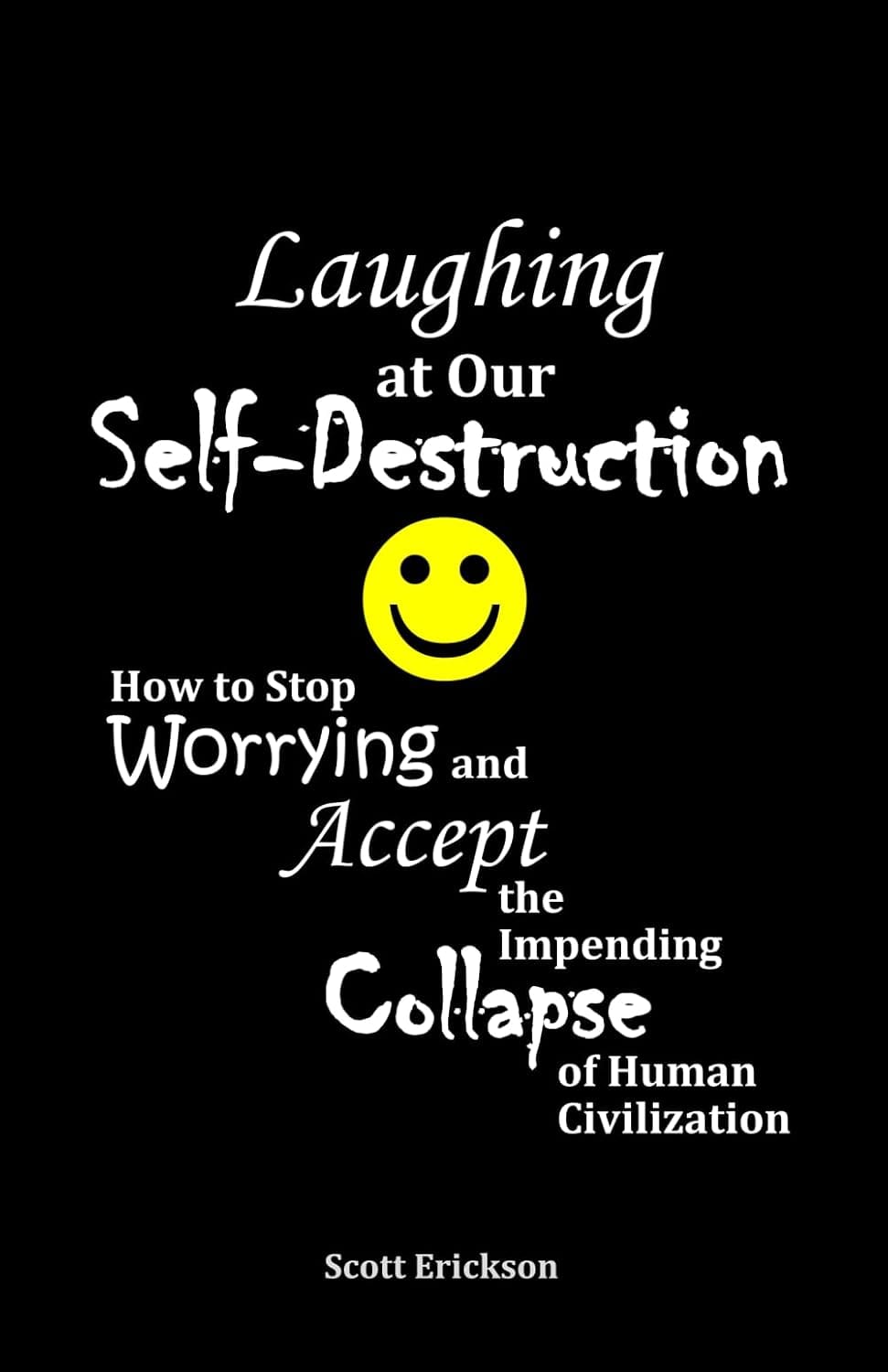
Scott Erickson is an award-winning writer of humour and satire. His latest book is entitled: LAUGHING AT OUR SELF-DESTRUCTION; How to Stop Worrying and Accept the Impending Collapse of Human Civilization.
It's a book for people who suspect that humanity is doomed and are looking for confirmation that they're not crazy. It offers a way to avoid despair and depression by showing readers how to stop worrying and laugh at our self-destruction.
The book will be officially released in January 2026, but Erickson is offering a pre-release "Doomer Discount" (30% off) to collapse-oriented groups (such as the Collapse 2050 community). The book is currently at the discount price, and in January will increase to $14.99/paperback, $9.99/ebook.I recently had the opportunity to ask Scott a few questions about his book:
Q: Given the improbable shift away from the "ego-based paradigm," is traditional activism anything more than a band-aid solution delaying inevitable collapse?Erickson: It's my opinion that collapse is imminent, whether a "hard collapse" of total social breakdown followed by the zombie apocalypse, or a "soft collapse" in which some vestiges of civilization survive. But even this outcome would be anything but "soft." It would be catastrophic, and would involve a massive amount of death and destruction. I don't advocate giving up on activism. But since I don't see any activism that's addressing the roots of our collective problems, my opinion is the best it can do is give us more time, and potentially lead to a less drastic collapse.
Q: If human extinction is the ultimate outcome, what is the deeper, life-affirming purpose of choosing humour and detachment beyond simple coping?Erickson: The main goal of my book is to help people cope with our situation. Humour gives us the option of laughing at things that would otherwise make us curl up into a ball and refuse to eat. The subtitle of the book is a reference to Stanley Kubrick's 1964 movie Dr. Strangelove. Or: How I Learned to Stop Worrying and Love the Bomb. The movie used a darkly comic approach to help people cope with the prospect of nuclear Armageddon. My book follows the same strategy of using humour to help people deal with the impending collapse of human civilization.
Q: Assuming the debt-based economy guarantees collapse, what is the most effective and safest way for an individual to fight this economic addiction locally?Erickson: I'm not sure if it's possible to fight our addiction to economic growth on the individual level. I suppose it's possible to adapt to some degree by getting out of the financial economy as much as possible. But when the economy can no longer grow, that's something none of us will be able to deal with - other than the billionaires who can fly to their fortified escape properties. The problem is that our addiction to economic growth is such a tremendous "elephant in the room" that it can't be acknowledged. Just for fun, I'd like to see a member of Congress introduce legislation called "The End our Addiction to Economic Growth Act," just to see what happens. I imagine politicians denying the problem, saying things like, "We're not addicted to economic growth! It's just that if the economy doesn't grow it will collapse and take human civilization with it."
Q: How do you reconcile your "philosophy of life based on life" and the choice not to have children with critics who view intentionally opting out of reproduction as selfish?Erickson: Talk about a controversial subject! I find myself in the strange situation of not telling a lot of people I know about my book. Even some close friends. My book has many controversial views, such as the question of whether we should have children, and many of my friends have children. To me, the core of the problem is how we interpret the idea of "affirming life." I'm looking at the bigger picture of our entire civilization, and asking, "Does our civilization affirm life?" The answer is "no." We're doing the opposite. We're at war with life. So the question is: Does adding another passenger to the sinking ship affirm life? In my book I have an imaginary conversation with a parent that insists that the more babies we have, the bigger chance that one of them will grow up to solve all our problems. To which I ask, "Even the overpopulation problem?" To which the parent, of course, says, "Yes."
Q: Given your view that American politics is a "broken bicycle" determined by the corporate-government complex, does voting for either major party contribute to the collapse rather than solve it?Erickson: Another controversial subject! At least you didn't ask me about religion! As for politics, I vote, but seldom with any enthusiasm. My view is that, as for the two major parties, the Democrats frustrate me and the Republicans scare me. And I guess I'd rather be frustrated than scared. Especially at this point in history, when a vote against the Republicans is a vote against fascism. Not that the Democrats are addressing the roots of our problems. But it's not really their fault, since the public doesn't want to address the roots of our problems. It would be great if there was widespread support for a new party called the Let's Create a Civilization Aligned with Life Party. But I'm not holding my breath.
Special thanks to Scott Erickson for answering my questions. Please consider purchasing his book in December - perhaps as a gift for a fellow realist.
 Trump Tries to Cancel Millions More for EV Charging — Illegally, Of Course [ 06-Feb-26 4:53am ]
One of the first things Donald Trump did when he got into office (the second time) was try to stop funding for and development of cleantech. Honestly, it's one of the most ridiculous things one could imagine a president focusing on, but then again, that list is long with this ... [continued]
The post Trump Tries to Cancel Millions More for EV Charging — Illegally, Of Course appeared first on CleanTechnica.
Wood burners may treble children's exposure to pollution in homes, study finds [ 06-Feb-26 6:00am ]Research in Wales found that home, not outdoor travel, was largest contributor to children's daily exposure
Children living in homes with wood burners could be exposed to over three times more pollution than those in non-wood-burning homes. The results come from a study that looked at air pollution experienced by primary schoolchildren in Wales.
Fifty-three children from two primary schools in Anglesey (Ynys Môn) were given backpacks equipped with air pollution sensors. They took the packs home and carried them during their journeys to and from school.
Continue reading...
New Sierra Club Map Shows Expensive U.S. Gas Buildout [ 06-Feb-26 4:50am ]Washington, D.C. — Today, the Sierra Club released a new tracker which shows that while Americans are grappling with soaring costs, utility companies are planning to add nearly 500 more expensive and polluting gas-fired power plants across the country. Over the past year, electricity prices increased at double the rate of inflation. Rather than investing in ... [continued]
The post New Sierra Club Map Shows Expensive U.S. Gas Buildout appeared first on CleanTechnica.
Waymo Entering Boston & Sacramento — Where Next? [ 06-Feb-26 3:58am ]We already knew that Waymo was going to be entering several new markets in 2026. With the company raising $16 billion to expand more rapidly, I also expected we'd see some announcements about such expansions this week. And now we have them. The company has announced that it is now ... [continued]
The post Waymo Entering Boston & Sacramento — Where Next? appeared first on CleanTechnica.
The Solution For US Critical Minerals: Geopolitical Minefield Vs. Recycling [ 06-Feb-26 3:14am ]A new, 3-D printed, reusable sponge-like cartridge can soak up critical minerals from domestic mining, industrial, and electronic waste.
The post The Solution For US Critical Minerals: Geopolitical Minefield Vs. Recycling appeared first on CleanTechnica.
Why Sodium-Ion Batteries Are Happening Now [ 06-Feb-26 2:59am ]CATL is the largest battery producer in the world. Any move it makes is noteworthy. While CATL has been making sodium-ion batteries for some time, production commitment has increased dramatically in 2026. CATL introduced its Naxtra line of batteries earlier in 2025 and has now announced plans for volume production ... [continued]
The post Why Sodium-Ion Batteries Are Happening Now appeared first on CleanTechnica.
19 C in February: Heat records fall across British Columbia, Canada, raising questions about winter's future [ 06-Feb-26 2:39am ] Since 1950 the Nutrient Content in 43 Different Food Crops has Declined up to 80% [ 06-Feb-26 1:07am ]https://hrnews1.substack.com/p/study-since-1950-the-nutrient-content?r=1t17zr
submitted by /u/thehomelessr0mantic[link] [comments]
Michigan Sues Big Oil For Antitrust Violations [ 06-Feb-26 12:29am ]The state of Michigan has sued several oil companies, claiming they have conspired to keep EV and renewable energy prices high.
The post Michigan Sues Big Oil For Antitrust Violations appeared first on CleanTechnica.
BYD Electric Bus & Truck Sales Actually Up! [ 06-Feb-26 12:04am ]BYD passenger vehicle sales are in a tough spot, as just discussed. However, BYD's commercial vehicle sales are going swimmingly. Compared to December, naturally, sales were down last month (in general, December is a much bigger sales month than January), but they weren't even down much month over month. Meanwhile, ... [continued]
The post BYD Electric Bus & Truck Sales Actually Up! appeared first on CleanTechnica.
BYD Sales Down 30.7% in January — Can It Revive Sales Growth? [ 05-Feb-26 11:24pm ]BYD did not have a great start to 2026. Presumably, due to growing competition on the Chinese EV market, the ending of new energy vehicle (NEV) purchase tax exemptions in the country, and the natural market weakness at the beginning of the year, BYD's sales in January were the lowest ... [continued]
The post BYD Sales Down 30.7% in January — Can It Revive Sales Growth? appeared first on CleanTechnica.
Ancient sediments suggest that parts of the tropics will heat up much faster than expected [ 05-Feb-26 10:50pm ]
Sweden's Journey to Producing 100% Fossil-Free Steel for Volvo & Beyond [ 05-Feb-26 9:57pm ]Here at CleanTechnica, we talk a lot about building things, but it's not very often that we dig into the raw materials they're made of. The reality is that many of the raw materials used in clean tech are responsible for some of the most significant emissions in the world. ... [continued]
The post Sweden's Journey to Producing 100% Fossil-Free Steel for Volvo & Beyond appeared first on CleanTechnica.
'Stark warning': pesticide harm to wildlife rising globally, study finds [ 05-Feb-26 10:35pm ]
How the UK government plans to limit 'forever chemical' pollution - and what's missing [ 05-Feb-26 6:12pm ] Forever chemicals known as Pfas are often found in waterproof, stain-resistant or iron-easy clothing, including school uniforms. Pixel-Shot/Shutterstock
The UK government has published its first national plan to deal with per- and polyfluoroalkyl substances, better known as Pfas or "forever chemicals". These chemicals have been used for decades in products such as firefighting foams, non-stick cookware, clothing, electronics and many industrial processes. Because many Pfas do not break down easily, they are now widely detected in the environment and in human blood and tissues.
The policy document, Pfas Plan: Building a Safer Future Together, follows growing public concern, media investigations and years of pressure from scientists calling for stronger controls. This marks an important moment for UK chemicals policy. The plan represents a step forward, but it avoids many of the hardest regulatory choices associated with Pfas.
In practical terms, this could include restricting Pfas-treated finishes from school uniforms and children's clothing. In parts of the US, including California, state-level rules have already restricted or banned Pfas in textiles, effectively eliminating their use in everyday clothing, including school uniforms.
Unlike many pollutants, Pfas are not a single substance. There are several thousand Pfas in use or in circulation, each with different properties and behaviours. Some have been linked to health effects, such as liver toxicity, developmental problems and negative effects on the immune system. For many others, evidence remains sparse or uncertain.
Pfas are also highly mobile. They can be transported through air, deposited onto land or water, and then re-enter the atmosphere or food chain. Contamination measured in one location may originate from industrial activity, waste handling, consumer products or historic uses far away. This transboundary behaviour is well known in environmental science, but Pfas amplify the challenge because of their persistence.
In the UK, regulation has so far focused on a small number (fewer than a dozen) of well-studied Pfas, mainly through drinking water standards. This has left the wider group of Pfas, and their long-term accumulation in air and soil, largely outside the scope of formal regulation.
The new Pfas plan is intended to provide that framework. Rather than introducing sweeping new bans, it sets out how Pfas risks should be assessed and managed over time, with a strong emphasis on coordination across government, regulators, researchers and industry.
A central element of the plan is its focus on evidence. It recognises that Pfas pollution is not limited to water and soil, but also includes air emissions from manufacturing, industrial processes and waste treatment. Expanding monitoring across air, land and water is intended to improve understanding of sources, pathways and exposure, and to support more targeted controls in future.
The plan also commits to reviewing existing regulatory tools. This includes consultation on limits for Pfas in drinking water, closer scrutiny of industrial emissions and assessment of how current chemicals legislation could be applied more effectively to Pfas as a group. Research into the toxicity of Pfas in food and food packaging, plus more effective detection methods and safer alternatives forms part of this longer-term approach. Some Pfas uses such as medical devices are acknowledged as difficult to replace in the short term.
 Until now, Pfas have traditionally been monitored and regulated through drinking water.
Boris023/Shutterstock
A starting point
Until now, Pfas have traditionally been monitored and regulated through drinking water.
Boris023/Shutterstock
A starting point
At the same time, the new plan leaves many hard decisions for later. It does not ban Pfas as a class, set timelines for phase-outs or define which uses should ultimately be considered essential. Much depends on future consultations and how quickly new evidence emerges.
This caution has attracted criticism, but it reflects a real constraint. New Pfas continue to enter the market, sometimes as replacements for substances that have already been restricted. Others occur as impurities or degradation products that are not routinely monitored. Regulating a group of chemicals that continues to evolve is inherently difficult, particularly when emissions are diffuse and exposure pathways complex.
In July 2025, the EU adopted a new Chemicals Industry Action Plan to support a transition away from Pfas through measures such as innovation, substitution, and improved data generation. In parallel, the European Chemicals Agency is assessing a proposed Pfas group restriction - its opinion is expected to be announced by the end of 2026 to inform a subsequent European Commission proposal to phase out Pfas.
The UK's new plan acknowledges that historic Pfas contamination already exists and commits to developing guidance and technical tools to support its management. What remains unclear is how large-scale remediation would be prioritised or funded. Experience from heavily contaminated areas in Belgium, particularly around industrial hotspots near Antwerp, shows that cleaning up legacy Pfas pollution can take decades and involve very high costs.
Taken together, the UK's Pfas plan is best seen as a starting point rather than a solution. It brings air, water and land into a single policy debate and recognises that Pfas pose a long-term challenge rather than a short-term compliance issue.
Whether it leads to meaningful reductions in exposure will depend on what follows: how quickly methods capable of addressing the many thousands of Pfas in commerce and the environment are developed and validated; how monitoring data is used; how rapidly regulatory reviews translate into enforceable standards; and whether future decisions prevent new Pfas problems from emerging.
For now, the plan does not solve the Pfas problem. But it makes clear that Pfas are no longer a peripheral issue, and that dealing with them will require sustained scientific effort and difficult policy choices over many years.
Don't have time to read about climate change as much as you'd like?
Get a weekly roundup in your inbox instead. Every Wednesday, The Conversation's environment editor writes Imagine, a short email that goes a little deeper into just one climate issue. Join the 47,000+ readers who've subscribed so far.

Ivan Kourtchev does not work for, consult, own shares in or receive funding from any company or organisation that would benefit from this article, and has disclosed no relevant affiliations beyond their academic appointment.
A rising number of American homeowners are ready relocate this year due to extreme weather events and other climate-related concerns.
Some 49 percent of those who own a house are considering moving in 2026 due to climate events, according to a survey of 1,000 American adults by insurance provider Kin Insurance. Also a concern among homeowners is the rising cost of homeownership, the study noted.
"Kin uncovered that climate is driving decisions about where people live and the rising costs of homeownership are changing when and how people buy homes," the study noted. The study also found that nearly all homeowners are concerned about severe weather damaging their homes.
Kin's survey found that within the 49 percent of homeowners who want to move, 19 percent "definitely" are considering it, while 30 percent are "somewhat" considering it. Some 45 percent said they were not considering a move.
As for how far away they want to move, Kin broke up respondents' intentions into three groups:
- Moving within their current city or community: 41 percent
- Moving to a different city or community in their state: 35 percent
- Moving to another state: 25 percent.
That 60 percent considering a move would relocate outside of their current city or community, is a trend confirmed in the aftermath of the 2025 Los Angeles wildfires.
"Last year, homeowners who suffered catastrophic losses in the Los Angeles wildfires followed a similar pattern when they 'ended up in neighborhoods at least a half-hour's drive away' from their previous homes," Kin noted.
For those considering a move to another state, more than half of respondents wanted to avoid disaster-prone states like Florida and California and preferred to move to what they perceived as low-risk states, including Vermont, New Hampshire, Delaware, and Connecticut.
submitted by /u/ClimateResilient[link] [comments]

If you were to show the verbatim text of any of Trump's recent messages and declarations — from his speeches, memos to foreign leaders, and social media blatherings — to anyone who has no predetermined assessment of the man and his motivations, it would be absurdly obvious that the man is in the advanced, and dangerous, stages of senile dementia. As I've said earlier, these are not the missives of an ideological extremist, but rather the disconnected ravings of a man who has totally lost touch with reality.
So why are his political opponents, and the media, scrupulously refraining from calling a loon a loon?
My guess is that the media think their role is to interpret what he means, not report what he says, because if they did the latter (ie their jobs), the public's reaction, around the world and across the political spectrum would clearly be: WTF? And then they'd be in the difficult spot of explaining why they didn't do their jobs years ago and tell their readers how dangerous it would be to allow a severely traumatized and mentally ill man to even run for nomination for high office. Total cowardice.
As for his political opponents, they've gone 'all in' on painting him as a steadfast ideologue and doctrinaire fascist, and hence painted themselves into a corner as the 'moderate' anti-Trumpians. The last thing they want is to let him, and the dim-witted party that nominated him, off the hook on the 'technicality' that he was and is mentally ill and incapable of understanding his actions. They want him to do crazy and dangerous things, and be seen to be doing so 'deliberately', to strengthen their talk-big-and-do-nothing platform of mediocrity, and give voters even less choice than the corporatized US political duopoly already presents them with.
And everyone is afraid to think what it means to have a madman who's been allowed to ignore the legislative function of Congress, ignore all judicial attempts to reverse and block his actions, ignore the US constitution, and ignore international law, running amok, appointing similarly mentally handicapped and incompetent people to key offices, and seemingly free to do whatever his deranged mind and the voices speaking to him are saying.
It took two years for the paralytic, zombified politicians and media to finally state the obvious about Biden's mental state and his unfitness for office. What is going to have to happen before they state the same about the dodderer-in-chief?
image by AI; my own prompt
CAA's guidance also including booking sites to enable passengers to make 'more informed travel decisions'
Airlines and booking firms should give UK customers information about the environmental impact of their flights, the regulator has said.
The Civil Aviation Authority urged booking sites to enable passengers to make "more informed travel decisions" by setting out estimates for carbon emissions for flights landing or taking off from British airports.
Continue reading...
A pickup truck version of the Kia PV5 battery electric mulit-purpose vehicle is now available to customers in South Korea.
The post KIA PV5 Pickup Launched In South Korea, Van Spied Testing In US appeared first on CleanTechnica.
"The road is pocked from the hurricane," the driver says, "so don't blame me for the bumps." Claeon laughs with us, then continues. "I don't know why they don't fix it." As we leave the port, I see a warehouse next to the dock with a collapsed roof. It's filled ... [continued]
The post Back To Nature: A Post-Hurricane Visit To Jamaica appeared first on CleanTechnica.
Does anyone know of a compilation of "Mainstream Collapse/Doomer Predictions" - predictions and analysis from key players "inside the mainstream socioeconomic system" who can't just be brushed off as "radical climate doomers" (as they tend to do with Hansen et al).
By that, I mean quotes like the one below from Dr. Günther Thallinger, Board Member, Allianz, that "capitalism as we know it ceases to be viable" above 3C of climate change?
"Once we reach 3°C of warming, the situation locks in. Atmospheric energy at this level will persist for 100+ years due to carbon cycle inertia and the absence of scalable industrial carbon removal technologies. There is no known pathway to return to pre-2°C conditions. (See: IPCC AR6, 2023; NASA Earth Observatory: "The Long-Term Warming Commitment")
At that point, risk cannot be transferred (no insurance), risk cannot be absorbed (no public capacity), and risk cannot be adapted to (physical limits exceeded). That means no more mortgages, no new real estate development, no long-term investment, no financial stability. The financial sector as we know it ceases to function. And with it, capitalism as we know it ceases to be viable." https://www.linkedin.com/pulse/climate-risk-insurance-future-capitalism-g%C3%BCnther-thallinger-smw5f/ Dr. Günther Thallinger, Board Member, Allianz
Or the Insititure of Actuaries ">2Bn deaths if we hit 2C by 2050" from https://actuaries.org.uk/media/wqeftma1/planetary-solvency-finding-our-balance-with-nature.pdf
If a compilation doesn't already exist, post your your favourites as replies and I'll compile the list. If you do have a suggestion please link to the original source for verification/validation.
submitted by /u/DueObjective7475[link] [comments]
Welcome to Carbon Brief's China Briefing.
China Briefing handpicks and explains the most important climate and energy stories from China over the past fortnight. Subscribe for free here.
Key developments Solar and wind eclipsed coal'FIRST TIME IN HISTORY': China's total power capacity reached 3,890 gigawatts (GW) in 2025, according to a National Energy Administration (NEA) data release covered by industry news outlet International Energy Net. Of this, it said, solar capacity rose 35% to 1,200GW and wind capacity was up 23% to 640GW, while thermal capacity - which is mostly coal - grew 6% to just over 1,500GW. This marks the "first time in history" that wind and solar capacity has outranked coal capacity in China's power mix, reported the state-run newspaper China Daily. China's grid-related energy storage capacity exceeded 213GW in 2025, said state news agency Xinhua. Meanwhile, clean-energy industries "drove more than 90%" of investment growth and more than half of GDP growth last year, said the Guardian in its coverage of new analysis for Carbon Brief. (See more in the spotlight below.)
上微信关注《碳简报》
DAWN FOR SOLAR: Solar power capacity alone may outpace coal in 2026, according to projections by the China Electricity Council (CEC), reported business news outlet 21st Century Business Herald. It added that non-fossil sources could account for 63% of the power mix this year, with coal falling to 31%. Separately, the China Renewable Energy Society said that annual wind-power additions could grow by between 600-980GW over the next five years, with annual additions of 120GW expected until 2028, said industry news outlet China Energy Net. China Energy Net also published the full CEC report.
STATE MEDIA VOICE: Xinhua published several energy- and climate-related articles in a series on the 15th five-year plan. One said that becoming a low-carbon energy "powerhouse" will support decarbonisation efforts, strengthen industrial innovation and improve China's "global competitive edge and standing". Another stated that coal consumption is "expected" to peak around 2027, with continued "growth" in the power and chemicals sector, while oil has already peaked. A third noted that distributed energy systems better matched the "characteristics of renewable energy" than centralised ones, but warned against "blind" expansion and insufficient supporting infrastructure. Others in the series discussed biodiversity and environmental protection and recycling of clean-energy technology. Meanwhile, the communist party-affiliated People's Daily said that oil will continue to play a "vital role" in China, even after demand peaks.
Starmer and Xi endorsed clean-energy cooperationCLIMATE PARTNERSHIP: UK prime minister Keir Starmer and Chinese president Xi Jinping pledged in Beijing to deepen cooperation on "green energy", reported finance news outlet Caixin. They also agreed to establish a "China-UK high-level climate and nature partnership", said China Daily. Xi told Starmer that the two countries should "carry out joint research and industrial transformation" in new energy and low-carbon technologies, according to Xinhua. It also cited Xi as saying China "hopes" the UK will provide a "fair" business environment for Chinese companies.
Subscribe: China Briefing- .listing{background: #f4f4f4} .listing ul{list-style:none; margin:0} ol {background: #F4F4F4; padding: 0px;} .listing ul {background: #F4F4F4; padding: 0px;} .listing li{font-size:0px;}
Sign up to Carbon Brief's free "China Briefing" email newsletter. All you need to know about the latest developments relating to China and climate change. Sent to your inbox every Thursday.
OCTOPUS OVERSEAS: During the visit, UK power-trading company Octopus Energy and Chinese energy services firm PCG Power announced they would be starting a new joint venture in China, named Bitong Energy, reported industry news outlet PV Magazine. The move "marks a notable direct entry" of a foreign company into China's "tightly regulated electricity market", said Caixin.
PUSH AND PULL: UK policymakers also visited Chinese clean-energy technology manufacturer Envision in Shanghai, reported finance news outlet Yicai. It quoted UK business secretary Peter Kyle emphasising that partnering with companies "like Envision" on sustainability is a "really important part of our future", particularly in terms of job creation in the UK. Trade minister Chris Bryant told Radio Scotland Breakfast that the government will decide on Chinese wind turbine manufacturer Mingyang's plans for a Scotland factory "soon". Researchers at the thinktank Oxford Institute for Energy Studies wrote in a guest post for Carbon Brief that greater Chinese competition in Europe's wind market could "help spur competition in Europe", if localisation rules and "other guardrails" are applied.
More China news
- LIFE SUPPORT: China will update its coal capacity payment mechanism, which will raise thresholds for coal-fired power plants and expand to cover gas-fired power and pumped and new-energy storage, reported current affairs outlet China News.
- FRONTIER TECH: The world's "largest compressed-air power storage plant" has begun operating in China, said Bloomberg.
- PARTNERSHIP A 'MISTAKE': The EU launched a "foreign subsidies" probe into Chinese wind turbine company Goldwind, said the Hong Kong-based South China Morning Post. EU climate chief Wopke Hoekstra said the bloc must resist China's pull in clean technologies, according to Bloomberg.
- TRADE SPAT: The World Trade Organization "backed a complaint by China" that the US Inflation Reduction Act "discriminated against" Chinese cleantech exports, said Reuters.
- NEW RULES: China has set "new regulations" for the Waliguan Baseline Observatory, which provides "key scientific references for the United Nations Framework Convention on Climate Change", said the People's Daily.
New or reactivated proposals for coal-fired power plants in China totalled 161GW in 2025, according to a new report covered by Carbon Brief.
Spotlight Clean energy drove China's economic growth in 2025New analysis for Carbon Brief finds that clean-energy sectors contributed the equivalent of $2.1tn to China's economy last year, making it a key driver of growth. However, headwinds in 2026 could restrict growth going forward - especially for the solar sector.
Below is an excerpt from the article, which can be read in full on Carbon Brief's website.
Solar power, electric vehicles (EVs) and other clean-energy technologies drove more than a third of the growth in China's economy in 2025 - and more than 90% of the rise in investment.
Clean-energy sectors contributed a record 15.4tn yuan ($2.1tn) in 2025, some 11.4% of China's gross domestic product (GDP)
Analysis shows that China's clean-energy sectors nearly doubled in real value between 2022-25 and - if they were a country - would now be the 8th-largest economy in the world.
These investments in clean-energy manufacturing represent a large bet on the energy transition in China and overseas, creating an incentive for the government and enterprises to keep the boom going.
However, there is uncertainty about what will happen this year and beyond, particularly due to a new pricing system, worsening industrial "overcapacity" and trade tensions.
Outperforming the wider economyChina's clean-energy economy continues to grow far more quickly than the wider economy, making an outsized contribution to annual growth.
Without these sectors, China's GDP would have expanded by 3.5% in 2025 instead of the reported 5.0%, missing the target of "around 5%" growth by a wide margin.
Clean energy made a crucial contribution during a challenging year, when promoting economic growth was the foremost aim for policymakers.
In 2024, EVs and solar had been the largest growth drivers. In 2025, it was EVs and batteries, which delivered 44% of the economic impact and more than half of the growth of the clean-energy industries.
The next largest subsector was clean-power generation, transmission and storage, which made up 40% of the contribution to GDP and 30% of the growth in 2025.
Within the electricity sector, the largest drivers were growth in investment in wind and solar power generation capacity, along with growth in power output from solar and wind, followed by the exports of solar-power equipment and materials.
But investment in solar-panel supply chains, a major growth driver in 2022-23, continued to fall for the second year, as the government made efforts to rein in overcapacity and "irrational" price competition.
Headwinds for solarOngoing investment of hundreds of billions of dollars represents a gigantic bet on a continuing global energy transition.
However, developments next year and beyond are unclear, particularly for solar. A new pricing system for renewable power is creating uncertainty, while central government targets have been set far below current rates of clean-electricity additions.
Investment in solar-power generation and solar manufacturing declined in the second half of the year.
The reduction in the prices of clean-energy technology has been so dramatic that when the prices for GDP statistics are updated, the sectors' contribution to real GDP - adjusted for inflation or, in this case deflation - will be revised down.
Nevertheless, the key economic role of the industry creates a strong motivation to keep the clean-energy boom going. A slowdown in the domestic market could also undermine efforts to stem overcapacity and inflame trade tensions by increasing pressure on exports to absorb supply.
Local governments and state-owned enterprises will also influence the outlook for the sector.
Provincial governments have a lot of leeway in implementing the new electricity markets and contracting systems for renewable power generation. The new five-year plans, to be published this year, will, therefore, be of major importance.
This spotlight was written for Carbon Brief by Lauri Myllyvirta, lead analyst at Centre for Research on Energy and Clean Air (CREA), and Belinda Schaepe, China policy analyst at CREA. CREA China analysts Qi Qin and Chengcheng Qiu contributed research.
Watch, read, listenPROVINCE INFLUENCE: The Institute for Global Decarbonization Progress, a Beijing-based thinktank, published a report examining the climate-related statements in provincial recommendations for the 15th five-year plan.
'PIVOT'?: The Outrage + Optimism podcast spoke with the University of Bath's Dr Yixian Sun about whether China sees itself as a climate leader and what its role in climate negotiations could be going forward.
COOKING FOR CLEAN-TECH: Caixin covered rising demand for China's "gutter oil" as companies "scramble" to decarbonise.
DON'T GO IT ALONE: China News broadcast the Chinese foreign ministry's response to the withdrawal of the US from the Paris Agreement, with spokeswoman Mao Ning saying "no country can remain unaffected" by climate change.
$6.8tn
The current size of China's green-finance economy, including loans, bonds and equity, according to Dr Ma Jun, the Institute of Finance and Sustainability's president,in a report launch event attended by Carbon Brief. Dr Ma added that "green loans" make up 16% of all loans in China, with some areas seeing them take a 34% share.
New science
- China's official emissions inventories have overestimated its hydrofluorocarbon emissions by an average of 117m tonnes of carbon dioxide equivalent (mtCO2e) every year since 2017 | Nature Geoscience
- "Intensified forest management efforts" in China from 2010 onwards have been linked to an acceleration in carbon absorption by plants and soils | Communications Earth and Environment
China Briefing is written by Anika Patel and edited by Simon Evans. Please send tips and feedback to china@carbonbrief.org

China Briefing 22 January 2026: 2026 priorities; EV agreement; How China uses gas
China Briefing
|22.01.26
China Briefing
|11.12.25
China Briefing 27 November 2025: COP30 wraps; Climate and critical minerals at G20; Coal use up
China Briefing
|27.11.25
China Briefing 13 November 2025: COP30 special
China Briefing
|13.11.25
jQuery(document).ready(function() { jQuery('.block-related-articles-slider-block_577da249233af249886f397aae143b48 .mh').matchHeight({ byRow: false }); });The post China Briefing 5 February 2026: Clean energy's share of economy | Record renewables | Thawing relations with UK appeared first on Carbon Brief.
Animal Equality says two surprise inspections in three years suggests 'embarrassingly poor' level of scrutiny
Scottish salmon farmers recorded more than 35m unexpected salmon deaths in just under three years but there were only two unannounced inspections of facilities over the same period.
In December, the Scottish government's secretary for rural affairs, Mairi Gougeon, said that there was "a really robust regulatory regime when it comes to fin-fish aquaculture" but animal welfare campaigners say the figures call that claim into question.
Continue reading...A mangrove conservation project in Guanabara Bay has shown how a dying ecosystem can be transformed into a thriving sanctuary
With deep blue waters flanked by dramatic peaks, Guanabara Bay is the postcard view of Rio de Janeiro - but it is also one of Brazil's most polluted coastal environments. Raw sewage and solid waste flow into the bay from surrounding cities, home to more than 8 million people. Cargo ships and oil platforms chug in and out of commercial ports, while dozens of abandoned vessels lie rotting in the water.
But at the head of the bay, between the cities of Itaboraí and Magé, the environment feels different. The air is purer, the waters are empty but for small fishing canoes, and flocks of birds soar overhead.
Continue reading...
Related to collapse as the current political climate in the US is very detrimental to nuclear safety. The risks of someone doing something very idiotic leading to use of nukes is very much worse in a multipolar unregulated 'might makes right' world.
submitted by /u/RBZRBZRBZRBZ[link] [comments]
Clean, renewable energy is cost competitive with fossil fuels, and in some cases costs less. Factoring in all the costs, including climate change impacts and harm to human health from fossil fuels, clean renewables make even more sense. In some cases where remote communities need to be able to generate ... [continued]
The post Solar Power Provides Benefits To Northern Cheyenne & Kenyan Communities appeared first on CleanTechnica.
Rammed earth sourced from, or near, the grounds of a proposed building site is attracting attention as an eco-friendly construction material
From afar, the low-rise homestead perched in the Wiltshire countryside may look like any other rural outpost, but step closer and the texture of the walls reveal something distinct from the usual facade of cement, brick and steel.
The Rammed Earth House in the Cranborne Chase is one of the few projects in the UK that has been made by unstabilised rammed earth - a building material that consists entirely of compacted earth, and which has been used as far back as the Neolithic period.
Continue reading...On a recent trip to Lake Geneva in Switzerland, biodiversity reporter Phoebe Weston witnessed the impact of one of the planet's most potent invasive species, the quagga mussel. In just a decade the mollusc, originally from the Ponto-Caspian region of the Black Sea, has caused irreversible change beneath the surface of the picturesque lake. While ecologists believe invasive species play a major role in more than 60% of plant and animal extinctions, stopping them in their tracks is almost impossible. Phoebe tells Madeleine Finlay how invasive species spread, how conservationists are trying combat them and why some think a radical new approach is needed.
'It's an open invasion': how millions of quagga mussels changed Lake Geneva for ever
Support the Guardian: theguardian.com/sciencepod
Continue reading...
Disclaimer: SS: Related to Collapse because it address the loss of biodiversity on the planet and overpopulation, with the link between the two.
Growth in human population increase demand for food, home and products, and how agriculture is unsustainable with modern methods, but without those methods the amount of food needed to sustain the poulation would not be enough.
Also human population will either have high consumption like on first world countries or enable overconsumption by working on third world factories to produce what is consumed on the first world.
submitted by /u/Toguro_Ototo_1[link] [comments]


