
 There is a lot of convenient amnesia about Peter Mandelson's New Labour days. Let's jog some memories | George Monbiot [ 10-Feb-26 6:07pm ]
Yes, he betrayed the national interest in his dealings with Jeffrey Epstein - but also in his sanctioned role as enabler of corporate power
History is being rewritten. The story we are told is that an evil man called Peter Mandelson, pursuing his own interests, went rogue to collaborate with a serial abuser of girls and women, undermining the good work of people seeking to defend the public interest. All this is true. But - and I fear many will find this hard to accept - it is only half the story.
The much harder truth is that Mandelson's disgraceful dealings with Jeffrey Epstein were less a betrayal of his brief than an unauthorised extension of it. In 2009 - just as, we now know, Mandelson was passing sensitive information to Epstein - I argued that the government department he ran, called Business, Enterprise and Regulatory Reform (Berr), "functions as a fifth column within government, working for corporations to undermine democracy and the public interest".
George Monbiot is a Guardian columnist
Do you have an opinion on the issues raised in this article? If you would like to submit a response of up to 300 words by email to be considered for publication in our letters section, please click here.
Continue reading... If Reform ever wins power in Westminster, it will be because of Labour's cowardice | George Monbiot [ 04-Feb-26 8:00am ]Starmer could improve our unfair electoral system to stop the hard right, but he won't. All the party has left are threats about 'splitting the vote'
Don't let the Labour party say one more word about "splitting the vote", in the forthcoming byelection or at any other time. With proportional representation, no one would ever need to worry about splitting the vote again. No one would need to choose the lesser evil to keep the greater evil out of office. We could vote for the parties we actually wanted. But the Labour government won't hear of it. It insists we retain the unfair, ridiculous first-past-the-post system, then blames us for the likely results.
This is not because proportional representation is unpopular - far from it. Last year's British Social Attitudes survey showed that 36% of people want to keep the electoral system as it is, while 60% want to change it. But as we are not allowed to vote on how we should vote, the decision is left in the hands of the corrupt old system's beneficiaries.
George Monbiot is a Guardian columnist
Continue reading... The UK government didn't want you to see this report on ecosystem collapse. I'm not surprised | George Monbiot [ 27-Jan-26 4:52pm ]It took an FOI request to bring this national security assessment to light. For 'doomsayers' like us, it is the ultimate vindication
I know it's almost impossible to turn your eyes away from the Trump show, but that's the point. His antics, ever-grosser and more preposterous, are designed to keep him in our minds, to crowd out other issues. His insatiable craving for attention is a global-threat multiplier. You can't help wondering whether there's anything he wouldn't do to dominate the headlines.
But we must tear ourselves away from the spectacle, for there are other threats just as critical that also require our attention. Just because you're not hearing about them doesn't mean they've gone away.
George Monbiot is a Guardian columnist
Continue reading... At the root of all our problems stands one travesty: politicians' surrender to the super-rich | George Monbiot [ 16-Jan-26 1:00pm ]There are many excuses for failing to tax the ultra-wealthy. The truth is that governments don't tackle the problem because they don't want to
There is one political problem from which all others follow. It is the major cause of Donald Trump, of Nigel Farage, of the shocking weakness of their opponents, of the polarisation tearing societies apart, of the devastation of the living world. It is simply stated: the extreme wealth of a small number of people.
It can also be quantified. The World Inequality Report (WIR) 2026 shows that about 56,000 people - 0.001% of the global population - corral three times more wealth than the poorest half of humanity. They afflict almost every country. In the UK, for example, 50 families hold more wealth than 50% of the population combined.
George Monbiot is a Guardian columnist
Continue reading... Let's be clear: if the Palestine Action hunger strikers die, the government will bear moral responsibility | George Monbiot [ 07-Jan-26 8:00am ]The three remaining hunger strikers have been convicted of nothing. Yet with astonishing cruelty, ministers refuse to listen to their reasonable demands
They are far into the lethal zone. Three people who are being held in prison on charges connected with the protest group Palestine Action have been on hunger strike for 45, 59 and 66 days. A fourth prisoner, Teuta Hoxha, ended her strike this week, after 58 days. She could suffer lifelong health effects. The remaining strikers, Heba Muraisi, Kamran Ahmed and Lewie Chiaramello, could pass away at any time. The 10 IRA and INLA hunger strikers who died in 1981 survived for between 46 and 73 days. Muraisi, whose strike has lasted the longest, is, according to supporters, now struggling to breathe and suffering uncontrollable muscle spasms - possible signs of neurological damage. Yet the government refuses to engage.
It created this situation. The Crown Prosecution Service states that the maximum time a prisoner can spend on remand is 182 days (six months). Yet Muraisi and Ahmed were arrested in November 2024, and are not due to be tried until June at the earliest, which means they will be remanded for 20 months. Chiaramello, who was arrested in July 2025, has a provisional court date in January 2027, which means 18 months in prison without trial.
George Monbiot is a Guardian columnist
Do you have an opinion on the issues raised in this article? If you would like to submit a response of up to 300 words by email to be considered for publication in our letters section, please click here.
Continue reading... A conversation between Joe Rogan and Mel Gibson summed up 2025 for me - and not in a good way | George Monbiot [ 27-Dec-25 8:00am ]From merrily dismissing climate science, to promoting irresponsible health claims, the podcast was an unintentional warning for our times
Looking back on this crazy year, one event, right at the start, seems to me to encapsulate the whole. In January, recording his podcast in a studio in Austin, Texas, the host, Joe Rogan, and the actor Mel Gibson merrily dissed climate science. At the same time, about 1,200 miles away in California, Gibson's $14m home was being incinerated in the Palisades wildfire. In this and other respects, their discussion could be seen as prefiguring the entire 12 months.
The loss of his house hadn't been confirmed at the time of the interview, but Gibson said his son had just sent him "a video of my neighbourhood, and it's in flames. It looks like an inferno." According to World Weather Attribution, January's fires in California were made significantly more likely by climate breakdown. Factors such as the extreme lack of rainfall and stronger winds made such fires both more likely to happen and more intense than they would have been without human-caused global heating.
Continue reading... When is a sausage not really a sausage? Ask the meat lobby | George Monbiot [ 20-Dec-25 6:00am ]European legislators may ban plant-based products from using the name to prevent 'confusion'. Just don't mention beef tomatoes or buffalo wings
Most of what you eat is sausages. I mean, if we're going to get literal about it. Sausage derives from the Latin salsicus, which means "seasoned with salt". You might think of a sausage as a simple thing, but on this reading it is everything and nothing, a Borgesian meta-concept that retreats as you approach it.
From another perspective, a sausage is an offal-filled intestine, or the macerated parts of an electrocuted or asphyxiated pig or other animal - generally parts that you wouldn't knowingly eat - mixed with other ingredients that, in isolation, you might consider inedible. For some reason, it is seldom marketed as such.
Continue reading... The facts are stark: Europe must open the door to migrants, or face its own extinction | George Monbiot [ 12-Dec-25 6:00am ]Plummeting birth rates mean that without attracting immigration, many countries are sliding towards collapse
I know what "civilisational erasure" looks like: I've seen the graph. The European Commission published it in March. It's a chart of total fertility rate: the average number of children born per woman. After a minor bump over the past 20 years, the EU rate appears to be declining once more, and now stands at 1.38. The UK's is 1.44. A population's replacement rate is 2.1. You may or may not see this as a disaster, but the maths doesn't care what you think. We are gliding, as if by gravitational force, towards the ground.
Civilisational erasure is the term the Trump administration used in its new national security strategy, published last week. It claimed that immigration, among other factors, will result in the destruction of European civilisation. In reality, without immigration there will be no Europe, no civilisation and no one left to argue about it.
Continue reading... Over a pint in Oxford, we may have stumbled upon the holy grail of agriculture | George Monbiot [ 05-Dec-25 6:00am ]I knew that a revolution in our understanding of soil could change the world. Then came a eureka moment - and the birth of the Earth Rover Program
It felt like walking up a mountain during a temperature inversion. You struggle through fog so dense you can scarcely see where you're going. Suddenly, you break through the top of the cloud, and the world is laid out before you. It was that rare and remarkable thing: a eureka moment.
For the past three years, I'd been struggling with a big and frustrating problem. In researching my book Regenesis, I'd been working closely with Iain Tolhurst (Tolly), a pioneering farmer who had pulled off something extraordinary. Almost everywhere, high-yield farming means major environmental harm, due to the amount of fertiliser, pesticides and (sometimes) irrigation water and deep ploughing required. Most farms with apparently small environmental impacts produce low yields. This, in reality, means high impacts, as more land is needed to produce a given amount of food. But Tolly has found the holy grail of agriculture: high and rising yields with minimal environmental harm.
George Monbiot is a Guardian columnist
Continue reading... Hello, foreign oligarchs and corporations! Please come and sue the UK for billions | George Monbiot [ 01-Dec-25 8:00am ]The case of a planned Cumbrian coalmine shows how governments around the world are being threatened by litigation in shadowy offshore courts
How do you reckon our political system works? Perhaps something like this. We elect MPs. They vote on bills. If a majority is achieved, the bills becomes law. The law is upheld by the courts. End of story. Well, that's how it used to work. No longer.
Today, foreign corporations, or the oligarchs who own them, can sue governments for the laws they pass, at offshore tribunals composed of corporate lawyers. The cases are held in secret. Unlike our courts, these tribunals allow no right of appeal or judicial review. You or I cannot take a case to them, nor can our government, or even businesses based in this country. They are open only to corporations based overseas.
George Monbiot is a Guardian columnist
Continue reading... There's a catastrophic black hole in our climate data - and it's a gift to deniers | George Monbiot [ 21-Nov-25 8:00am ]Climate sceptics tell us that more people die of extreme cold than extreme heat. What's the truth?
I began by trying to discover whether or not a widespread belief was true. In doing so, I tripped across something even bigger: an index of the world's indifference. I already knew that by burning fossil fuels, gorging on meat and dairy, and failing to make even simple changes, the rich world imposes a massive burden of disaster, displacement and death on people whose responsibility for the climate crisis is minimal. What I've now stumbled into is the vast black hole of our ignorance about these impacts.
What I wanted to discover was whether it's true that nine times as many of the world's people die of cold than of heat. The figure is often used by people who want to delay climate action: if we do nothing, some maintain, fewer will die. Of course, they gloss over all the other impacts of climate breakdown: the storms, floods, droughts, fires, crop failures, disease and sea level rise. But is this claim, at least, correct?
George Monbiot is a Guardian columnist
Continue reading... Dark forces are preventing us fighting the climate crisis - by taking knowledge hostage | George Monbiot [ 14-Nov-25 6:00am ]The fundamental problem is this: that most of the means of communication are owned or influenced by the very rich
If this were just a climate crisis, we would fix it. The technology, money and strategies have all been at hand for years. What stifles effective action is a deadly conjunction: the climate crisis running headlong into the epistemic crisis.
An epistemic crisis is a crisis in the production and delivery of knowledge. It's about what we know and how we know it, what we agree to be true and what we identify as false. We face, alongside a global threat to our life-support systems, a global threat to our knowledge-support systems.
George Monbiot is a Guardian columnist
Continue reading... I wish we could ignore Bill Gates on the climate crisis. But he's a billionaire, so we can't | George Monbiot [ 08-Nov-25 8:00am ]Money talks - and his essay denouncing 'near-term emissions goals' at Cop30 mostly argues the case for letting the ultra-rich off the hook
Let's begin with the fundamental problem: Bill Gates is a politics denier. Though he came to it late, he now accepts the realities of climate science. But he lives in flat, embarrassing denial about political realities. His latest essay on climate, published last week, treats the issue as if it existed in a political vacuum. He writes as if there were no such thing as political power, and no such thing as billionaires.
His main contention is that funds are very limited, so the delegates at this month's climate summit in Brazil should direct money away from "near-term emissions goals" towards climate "adaptation" and spending on poverty and disease.
George Monbiot is a Guardian columnist
Continue reading... We must act now: without a written constitution, Reform UK will have carte blanche to toxify our nation | Goerge Monbiot [ 23-Oct-25 6:00am ]It means breaking with hundreds of years of tradition, but it can't wait. As hard-right figures spread division and laud autocrats, a fail-safe is vital
After two years in Brazil, I felt I understood its political system better than I understand the UK's. The reason is a short book in simple language that almost everyone owned: the constitution, published in 1988. Admittedly, I discovered the document's limitations while trying to explain its principles to a furious captain of the military police with a pump-action shotgun. But at least I knew exactly which of my rights he was infringing.
To achieve a similar grasp of rights and powers in the UK, you'd need to be a professor of constitutional law. They are contained in a vast and contradictory morass of legal statutes, court precedents, codes of conduct, scholarly opinions, treaties, traditions, gentlemen's agreements and unwritten rules. They are rendered still less intelligible by arcane parliamentary procedures and language so opaque that we need a translation app.
George Monbiot is a Guardian columnist
Continue reading... Wage war on nature to build new homes: that's Labour's offer, but it's a con trick | George Monbiot [ 16-Oct-25 6:00am ]The government's new planning bill is tearing down environmental protections to benefit developers. This nation of nature lovers won't stand for it
Crucial to the government's war on nature is the "cauldron principle". If a species is to be blamed for "holding up development", it must be one you might find in a witch's cauldron. The culprits are never dormice, otters, water voles, nightingales, turtle doves or orchids, widely considered cute or beautiful. They are bats, newts, snails and spiders.
Bats and newts have been blamed by successive governments for nastily "standing in the way" of growth. In March, Keir Starmer claimed that "jumping spiders" had stopped "an entire new town". He added: "I've not made that example up." I think you can guess what comes next.
Continue reading... Here's what you need to know about Starmer's illiberal protest curbs: they would have killed the Labour party at birth | George Monbiot [ 13-Oct-25 3:23pm ]The rights we enjoy in the UK, and the movement the PM purports to lead, were built on protest. Those rights are in dire peril
Imagine a movement arising in this country that seeks to overthrow established power. Imagine that it begins with a series of rebellions, in Scotland and south Wales perhaps, that shut down workplaces, confront police and soldiers (sometimes peaceably, sometimes with crude weapons), set up roadblocks and lay siege to the places where fellow protesters are imprisoned and government officials are meeting.
Imagine that this movement goes on to smash or disable machinery across the country. Imagine that it organises a general strike, nixing much of the UK's economic activity for three months. Imagine that it keeps protesting in the same places by the same means, gradually eroding the resistance of the state.
George Monbiot is a Guardian columnist
Do you have an opinion on the issues raised in this article? If you would like to submit a response of up to 300 words by email to be considered for publication in our letters section, please click here.
Continue reading... It hurt when I crashed my bike into a pothole - and it taught me the true price of austerity | George Monbiot [ 04-Oct-25 6:00am ]Fixing that hole could have cost under £100; the cost of not doing so is limitless. My prang highlights the neoliberal folly of false economies
I was lucky. Last week, I was cycling downhill when I hit a pothole. The front wheel folded into an infinity symbol. I went over the handlebars and, with no time to put my hands out, landed on my face. My helmet and glasses took most of the impact. I emerged, remarkably, with just a few cuts and bruises.
My glasses were banjaxed, my bike needed major repairs and my clothes were torn. Altogether, that pothole has cost me about £450. Again, I'm lucky - I can afford it. But the point is this: fixing a pothole costs us between £45 and £90. Not fixing it costs us far more. God knows how many other people have pranged their bikes or wrecked their car tyres in the same hole. Between us, we may have paid hundreds of times the cost of its repair. If people have suffered significant injuries, so must the NHS. One of my correspondents tells me: "I'm three months into recovery from a cycling accident with a pothole that left me being airlifted to hospital with potentially life-threatening injuries. As well as a brain haemorrhage (despite a helmet), I had numerous broken bones and can't yet walk without crutches." The cost to the health service must be huge; the cost to him incalculable.
George Monbiot is a Guardian columnist
Continue reading... Israel's ecocide in Gaza sends this message: even if we stopped dropping bombs, you couldn't live here | George Monbiot [ 27-Sep-25 6:00am ]Consider the annihilation of agricultural land alongside the genocide - and grasp the chilling totality of this attempt to eliminate all life
A landless people and a peopleless land: these, it appears, are the aims of the Israeli government in Gaza. There are two means by which they are achieved. The first is the mass killing and expulsion of the Palestinians. The second is rendering the land uninhabitable. Alongside the crime of genocide, another great horror unfolds: ecocide.
While the destruction of buildings and infrastructure in Gaza is visible in every video we see, less visible is the parallel destruction of ecosystems and means of subsistence. Before the 7 October atrocity that triggered the current assault on Gaza, about 40% of its land was farmed. Despite its extreme population density, Gaza was mostly self-sufficient in vegetables and poultry, and met much of the population's demand for olives, fruit and milk. But last month the UN reported that just 1.5% of its agricultural land now remains both accessible and undamaged. That's roughly 200 hectares - the only remaining area directly available to feed more than 2 million people.
George Monbiot is a Guardian columnist
Do you have an opinion on the issues raised in this article? If you would like to submit a response of up to 300 words by email to be considered for publication in our letters section, please click here.
Continue reading... I have now been a journalist for 40 years. The forces ranged against my profession have never been so powerful | George Monbiot [ 20-Sep-25 5:00am ]Once, I believed that humanity's problem was an information deficit. Now, I know you can't speak truth to power if power controls your words
The BBC I joined on my first day of professional journalism - 40 years ago this week - is unrecognisable today. While, for most of its history, the corporation had largely defended the status quo, under the director general at the time, Alasdair Milne, its journalists were sometimes allowed to stick it to power. This, I believe, is what journalism exists to do - and seldom does.
As a student, I'd hammered on the doors of the BBC's Natural History Unit, insisting there was a major gap in its coverage: investigative environmental reporting. If they took me on, I argued, I could help them fill it. The phone rang as I was leaving the house for one of my final exams. It was the head of the unit, saying: "You're so fucking persistent you've got the job."
George Monbiot is a Guardian columnist
Continue reading... Warning! The rightwing junktanks behind the Tories' worst disasters still have the keys to No 10 | George Monbiot [ 11-Sep-25 6:00am ]Who is running the government's 'growth school' for civil servants? The answer surpassed my worst fears
Forgive me if I've got this wrong, but I seem to recall the country voting the Tories out last year. Part of the reason, if I remember correctly, was their staggering incompetence and insouciance, epitomised by Liz Truss's mini-budget. That catastrophe was, like Truss's political career, formed and steered by the neoliberal junktanks of Tufton Street.
But now I begin to doubt my recollections. We booted them out through the front door, right? Yet they still appear to be in the house. Perhaps they came round the back. After taking an interest in the Department for Business and Trade's "growth school" speaker sessions for civil servants, I sent a freedom of information request. Given that Keir Starmer, like Truss, has placed his growth "mission" at the centre of policy, and that this department is responsible for delivering it, the instruction given to its officials is crucial to the economic and political direction the country takes.
George Monbiot is a Guardian columnist
The Guardian's climate assembly with George Monbiot and special guests On 16 September, join George Monbiot, Mikaela Loach, Emma Pinchbeck and Zack Polanski as they discuss the forces driving the big climate pushback, with a welcome from Katharine Viner and special address from Feargal Sharkey
Continue reading...
Report says common agricultural policy provides 'unfair' levels of support to unhealthy, meat-heavy diets
Beef and lamb receive 580 times more in EU subsidies than legumes, a report has found, despite scientists urging people to get more of their protein from less harmful sources.
Analysis by the charity Foodrise found the EU's common agricultural policy (CAP) provides "unfair" levels of support to meat-heavy diets that doctors consider unhealthy and climate scientists consider environmentally destructive.
Continue reading...While most hybrids are said to use one to two litres of fuel per 100km, a study claims they need six litres on average
Plug-in hybrid electric cars (PHEVs) use much more fuel on the road than officially stated by their manufacturers, a large-scale analysis of about a million vehicles of this type has shown.
The Fraunhofer Institute carried out what is thought to be the most comprehensive study of its kind to date, using the data transmitted wirelessly by PHEVs from a variety of manufacturers while they were on the road.
Continue reading...Extinction Rebellion says some members have been visited by agents claiming to be FBI amid Trump's threats toward liberal groups
Environmental group Extinction Rebellion said on Wednesday it was under federal US investigation and that some of its members had been visited by FBI agents, including from the agency's taskforce on extremism, in the last year.
Asked for comment, the FBI said it could neither confirm nor deny conducting specific investigations, citing justice department policy.
Continue reading...22 February 2001: How the Guardian first covered the national crisis that unfolded as a result of the virus that spreads like wildfire
An outbreak of the highly infectious animal transmitted foot-and-mouth disease in the UK was one of the worst in the world. Roughly 6 million cattle, sheep, and pigs were culled, and mass funeral pyres became a striking image of the British countryside. Rural communities were shut off, tourism devastated, and movement across the countryside severely restricted. The crisis was so serious that the 2001 UK general election had to be postponed.
Continue reading...Forth River, Ligoniel, north Belfast: A riverfly monitoring survey involves rapt focus on these tiny creatures, whose presence is an indicator of water health
I wish I'd worn kneepads. But then I hadn't imagined that a riverfly monitoring survey would require this much genuflection. Like the followers of an undine creed, we kneel on the riverbank, bent over the Forth's secrets. What is her message? How do we understand it?
With me are Patricia Deeney and Geoff Newell, conservation officers from Belfast Hills Partnership (BHP), an environmental charity, and we're in a wooded glen below Wolf Hill, close to the former mill village of Ligoniel. Like many community groups and angling clubs, BHP uses the riverfly survey (a citizen science protocol) to monitor local rivers.
Continue reading...Wet fields drive away rodents, leaving barn owls without much prey, but gulls of all kinds are attracted by the water
The Somerset Levels flood regularly - but this year, after very heavy winter rains, the fields and moors are overflowing with water. So what effect does this have on wintering birds?
Like most extreme weather events, there are winners and losers. Huge flocks of gulls are gathering in the flooded fields to feed, with scarcer Mediterranean and little gulls joining the regular black-headed, herring and common varieties. These have attracted a white-tailed eagle from the Isle of Wight reintroduction project, although it does not appear to have caught any victims yet.
Continue reading...
One thing is clear: Either you are in lockstep with the US pro-fossil fuel energy policy, or you are the enemy and will pay the price. Created in the 1970s after the OPEC oil embargoes, the International Energy Agency was designed to collect data on who was producing oil and ... [continued]
The post IEA Focus On Clean Energy Gives US Officials Heartburn appeared first on CleanTechnica.
Abandoned beaches, public health warning signs and seagulls eating human waste are now features of the popular coastline in New Zealand
A tide of anger is rising in New Zealand's capital, Wellington, as the city's toilets continue to flush directly into the ocean more than two weeks after the catastrophic collapse of its wastewater treatment plant.
Millions of litres of raw and partially screened sewage have been pouring into pristine reefs and a marine reserve along the south coast daily since 4 February, prompting a national inquiry, as the authorities struggle to get the decimated plant operational.
Continue reading...
Washington, DC — A broad coalition of health and environmental groups sued the Environmental Protection Agency today over its illegal determination that it is not responsible for protecting us from climate pollution and its elimination of rules to cut the tailpipe pollution fueling the climate crisis and harming people's health. The case, ... [continued]
The post Sierra Club, Partners Sue EPA Over Illegal Repeal of Climate Protections appeared first on CleanTechnica.
The updates are projected to save Oregonians hundreds of dollars each month on utility bills SALEM, Ore. — Today, the Oregon Building Code Division's Residential and Manufactured Structures Board (RMSB) voted to approve a package of updates to the state's residential energy code, including a requirement that new homes be built ... [continued]
The post Oregon Adopts New Building Codes to Reduce Energy Costs and Increase Energy Efficiency in Newly Constructed Homes appeared first on CleanTechnica.
Weakening the hydrogen framework would threaten climate goals, grid stability, and the investment certainty needed to build a truly sustainable hydrogen market. 2025 marked an important milestone for EU hydrogen policy: with the entry into force of the Delegated Regulation (EU) 2025/2359 ('Low-Carbon fuel Delegated Act'), the EU hydrogen regulatory ... [continued]
The post Green NGOs & Renewable Fuel Producers: Commission Must Resist Pressure to Reopen the Rules Governing Renewable Hydrogen appeared first on CleanTechnica.
I just caught up on comments under an article I wrote several days ago, "Is Tesla Really In Trouble This Time?" There were many great comments from readers, but a few jumped out at me to stimulate this followup piece. The first one came from vensonata, who wrote: "The combined ... [continued]
The post Tesla Market Cap More Than Market Cap of Toyota, BYD, GM, Ford, Hyundai, Kia, Mercedes-Benz, Stellantis, Geely, Ferrari, BMW, Volkswagen Group, Honda, Nissan, Renault, XPENG, and NIO Combined appeared first on CleanTechnica.
Joseph Schumpeter wrote that creative destruction is the essential fact about capitalism. He was not describing a gentle process. He was describing waves of innovation that dismantle capital stock, reprice assets, and reorganize entire industries. In the Chinese zodiac, the Year of the Fire Horse we have just entered symbolizes ... [continued]
The post The Fire Horse Energy Transition & Creative Destruction appeared first on CleanTechnica.
When Tesla showed off its Cybercab concept vehicle in October 2024 at its "We, Robot" event, the question was when this would actually get produced. Another question was whether it would really be sold for $30,000 or less. After all, the Cybertruck was revealed at much lower pricing per range ... [continued]
The post Elon Musk Says Tesla Will Sell Cybercab to Customers for $30,000 or Less This Year appeared first on CleanTechnica.
Humanity has "lost the fight against climate change". [ 18-Feb-26 9:09pm ]
An Electric Chevy BrightDrop Van For 50% Off? [ 18-Feb-26 8:29pm ]The other day, watching the below video, there was a little excitement to find out about an electric RV, but that quickly turned to dismay to find out it uses a gas generator to provide extra electricity. The RV in question is the 2026 Entegra Electric Class A Motorhome, which ... [continued]
The post An Electric Chevy BrightDrop Van For 50% Off? appeared first on CleanTechnica.
5 soundbites from James Hansen's latest warning [ 18-Feb-26 6:16pm ]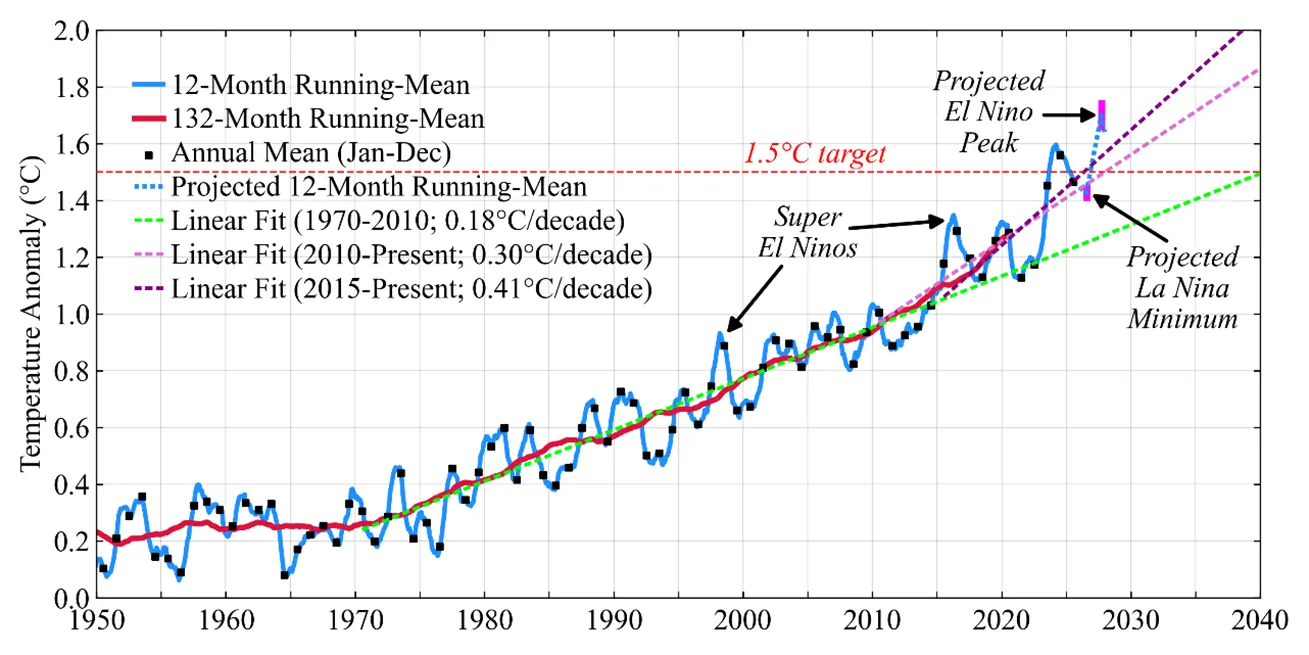
James Hansen released his latest insights the other day. Reading them, I wondered how digestible the information is to the average person going about their day.
So, below I created a short summary where the headings are simple soundbites anyone can repeat at rally, birthday party, or wherever.
I also drafted an email, Bluesky post and text message. Feel free to copy and share Hansen's valuable information with a broader audience.
This is a bit of an experiment for me. Let me know what you think.
Hansen's article organized into five soundbites:1. Global warming is happening faster.
For decades, the Earth warmed at a steady, predictable rate. Most people assume that pace hasn't changed, but Hansen's data shows that since 2010, the speed of warming has increased by about 50%. We have moved out of a period of steady rise and into a phase of acceleration. As Hansen directly states in the report: "We are now in the period of accelerated global warming."
2. Cleaner air is making the ocean hotter.This sounds counterintuitive, but for years, heavy shipping fuel created sulfate pollution in the air that reflected sunlight away from the Earth, acting like a giant shade for the ocean. In 2020, new regulations cleaned up that fuel. While this was positive for air quality, it removed that protective shade. Without those particles to bounce heat back into space, the oceans are now absorbing solar energy much faster than before.
3. We have already passed the 1.5°C limit.World leaders still talk about keeping 1.5°C alive as a future goal. Hansen argues that based on the physics of the heat already trapped in our system, we have already reached that milestone. He states: "The 1.5°C limit is deader than a doornail." We are now on a fast track toward 2°C much sooner than official models originally predicted.
4. The Earth is holding onto twice as much heat.For a stable climate, the amount of energy the Earth takes in from the sun should roughly equal the amount it sends back out into space. Hansen's research shows that the energy imbalance has nearly doubled in just the last decade. The planet is soaking up excess energy, and that heat is being stored directly in our oceans.
5. Natural cooling cycles are no longer working.In the past, natural weather patterns like La Niña would temporarily lower global temperatures. However, the background warming is now so intense that even these cooling phases are seeing record-high temperatures. The natural cycles of the Earth are being overwhelmed by greenhouse gases, meaning the cool years of the future will likely be hotter than the warm years of the past.
Tools to help share the info:
Email DraftSubject: Important update on climate acceleration
Hi [Name],
I've been reading some recent analysis from James Hansen—the scientist who originally testified to Congress about the greenhouse effect in the '80s—and his latest report is significant. I am sharing a few key takeaways that help explain why global heating is accelerating.
- Since 2010, the rate of warming has increased by about 50%. Hansen notes: "We are now in the period of accelerated global warming."
- Ironically, cleaning up shipping fuel pollution removed a layer of particles that were reflecting sunlight away from the Earth. Without that shade, the oceans are absorbing heat much faster.
- Hansen suggests we have already moved past the 1.5°C goal. We are now likely on a path to 2°C much sooner than expected.
- Natural cycles that used to cool the planet are being overwhelmed by the sheer volume of trapped heat.
I found this helpful for making sense of the current climate data. Here's a link to Hansen's article.
Best,
[Your Name]
BlueSky Post
James Hansen's latest update is a wake-up call. Since 2010, warming has accelerated by 50%. Hansen: "The 1.5°C limit is deader than a doornail." We're on a fast track to 2°C; even natural cooling cycles can't offset the trapped heat.
https://jimehansen.substack.com/p/another-el-nino-already-what-can
Personal Text Message
I recently looked into a report by James Hansen regarding new climate data. Essentially, his research shows that global warming has accelerated by 50% since 2010. He says the 1.5°C goal is effectively behind us and we are approaching 2°C more quickly than anticipated. I thought you might find this interesting given recent trends. https://jimehansen.substack.com/p/another-el-nino-already-what-can
Thank you for reading.
My name is Sarah and I run Collapse2050 by myself. It is a passion project to explore humanity's frightening future - a topic traditional media ignores.
The site is free for all, as I believe this information shouldn't be locked behind a paywall. I also don't accept corporate advertising so I remain totally free to tear the kleptocracy a new one.
To fund this site, I depend on the kindness of strangers. Paid subscribers and one-time contributors to help me cover hosting and production costs.
Thank you.
Sarah
The Hydrogen Workshop Transit Agencies Actually Need [ 18-Feb-26 8:18pm ]On March 20, 2026 in Mississauga, Ontario, CUTRIC is hosting a hydrogen fuel cell bus readiness workshop sponsored by Mississauga's transit agency, MiWay. The framing is straightforward. As Canada moves toward a greener future, agencies are invited to prepare for the arrival of hydrogen buses on site. The assumption is ... [continued]
The post The Hydrogen Workshop Transit Agencies Actually Need appeared first on CleanTechnica.
I Didn't Want to Make This Video. [ 18-Feb-26 8:19pm ] America's Economy Soars, But Jobs Lag Behind [ 18-Feb-26 6:55pm ]
Balcony solar in the UK [ 18-Feb-26 7:03pm ]In the long list of new technologies that might help reduce carbon emissions 'plug-in solar' sits towards the bottom. A small array of PV panels perched on the garage roof, or perhaps fixed to the railings of a balcony or laid on supports in the garden, and then directly connected into an ordinary plug in the wall, is never going to make a major difference to the course of climate change.

Source: Svea Solar, the supplier of balcony solar to IKEA in Germany
Nevertheless, the UK should encourage this form of power generation, joining all the major European countries bar Sweden in removing regulatory restrictions that block householders from connecting PV directly into the household electricity supply.
Today, all solar panels that have been installed on the roofs of UK houses are connected into the distribution panel with a separate fuse. The major difference introduced by plug-in solar is that the electricity is delivered directly into the home power network via an existing socket. This makes it possible for the homeowner or tenant to install a simple PV array without the use of an electrician and at very much lower cost than fixing panels on the roof of a house. When necessary, the panels can be moved to a different flat or switched to a different position in the home.
Plug-in solar dramatically widens the potential for installing solar panels, making cheaper electricity available to far more UK homes than the 1.6 million which benefit from the technology now. A well-designed system, along with an app for a mobile phone, can be put in place in under half an hour. Relatively few householders have balconies in the UK because more people live in single family houses than in Germany. But many homes have gardens, sheds or garage roofs on which the panels can be placed.
The UK government commissioned research into the safety of plug-in solar in mid 2025. This work appears to have been completed this month. We should now push for rapid deregulation of this way of reducing emissions and household electricity bills.
The German experience.
Plug-in solar is best developed in Germany as a result of deregulation in 2019. At the end of last year, just over 1.2 million households had registered PV panels that are fed directly into the house's electricity circuit. This figure had risen by over 430,000 in 2025 alone.[1]
The German regulator estimates that plug-in solar, or 'balcony solar' as it is usually called there, provides about 1.2 GW of capacity or just one per cent of total national PV installations.
However these plug-in solar figures are frequently said to be far too low by experts in the field. Many householders haven't bothered to fill in the forms at the German regulator and so aren't recorded in these estimates. I've seen figures for plug-in penetration as high as 4m homes, or over three times as much as officially recorded.
Even using the more substantial informal estimates, plug-in solar probably accounts for less than 2% of total German electricity production. (We can be confident that the typical productivity of a kilowatt of plug-in solar will be less than the equivalent amount of capacity in an open field and facing due south).
Despite the name, one estimate, albeit dating from 2022, was about only about 29% of 'balcony solar' units are actually placed on balconies. It is more usual to have the panels in the garden or on a garage roof, tilted towards the sun.
The typical size of a plug-in solar unit is about 1 kW, composed of two of three panels, an inverter that turns the DC output into AC and cabling that takes the output to a conventional socket in the wall. The panels are usually far lighter than conventional roof panels and
Depending on the region in which the panels are installed, a balcony solar unit of 1 kW might generate around 700-1000 kWh a year. This will vary according to whether the panels are facing south, the losses from shading and whether the unit is positioned vertically or at a more appropriate 35 degrees to the horizontal. (For comparison, the average household consumption in the UK is around 3,000 kWh).
Not all the electricity produced will be used in the house or flat. On a sunny day in June a 1 kW installation will be generating far more than the property needs and the surplus will flow out into the local grid even if the householder is careful and runs major appliances only when the sun is shining. Most published estimates (and some seem to be little more than guesses because the number is difficult to measure accurately) suggest a typical saving of 10-15% of electricity bills in countries such as Germany.
The possible impact in the UK
In the UK, with its very high domestic electricity prices, a cut of 15% in bills might be worth £100 or more. Is this worthwhile? In terms of payback time, the answer is 'yes'. 800 Watt units on sale in Germany and elsewhere are priced at around €400, or about £350. (We recently bought a much smaller 440 Watt unit for a house in France for €299, or around £260).

Lightweight slim solar panels, plugged into a house socket and waiting to be attached to the wall of our house.
These prices imply a payback period of around 4 years and some protection against the likely future rises in electricity prices.
Perhaps more importantly, the anecdotal evidence from around Europe seems to be that 'balcony solar' is effective at improving support for renewables more generally. Owners become happier to support the energy transition..
Perhaps of particular note was a comment from our French supplier that it believed that the purchasers of its units were often aged over 60. This group is usually less well informed about climate change and less eager to back a renewables-based economy. So plug-in solar may be helpful in building wider support for increasing the speed of the transition. Also many of these older people are retired and have the time to schedule their electricity using activities such as turning the washing machine on at times when the sun is out. In my personal experience, this is exactly the sort of activity that provides enjoyment to the older types who have bought these solar kits.
So why is the UK almost the last country in Europe to allow balcony solar?
A domestic solar system pushing electricity back into the local network needs to disconnect immediately if the grid goes down. Otherwise someone working on repairing the network might receive an electric shock from the home solar. Each type of inverter that is given permission to be sold to domestic consumers needs to show that it will automatically shut down with a tiny number of milliseconds if the grid itself has ceased to operate. Other countries have all done this work and 25 out of 27 EU states allow plug-in solar. It is time the UK comes into line and also authorises sale and installation. Any other choice is just delaying the government's achievement of a carbon-free grid.
[1] German data on balcony solar can be found in these documents
https://www.bundesnetzagentur.de/SharedDocs/Pressemitteilungen/EN/2026/20260108_EEG.html
Trump claims his pollution rollback will save Americans money - but climate change is raising household costs [ 18-Feb-26 5:01pm ] NadyGinzburg/Shutterstock
Climate change is usually assessed in scientific terms - rising temperatures, sea levels and carbon emissions. But increasingly, it can also be measured in household bills - higher insurance premiums, steeper energy charges and growing costs to protect homes, travel and health. So when US President Donald Trump said recently that abandoning a key government ruling on greenhouse gases would make cars cheaper for Americans, he was focusing on a tiny piece of a huge picture.
That is because climate change is not a local problem that hits one place at a time. It is increasingly a widespread financial risk, pushing on several parts of household finances at once. When risks become systemic, people cannot simply "insure it away" or plan around it.
When Trump announced he was revoking the US's 2009 "endangerment finding", which set out how greenhouse gas buildup harms human health and wellbeing, he said the move would save Americans "trillions of dollars".
But climate change shows up directly in household budgets as pressures converge. These pressures could include insurance becoming unaffordable or even unavailable, which can then have knock-on effects on property values. On top of that, utility costs can creep up, wages may become less reliable, and retirement savings are exposed to climate-driven shocks.
For many families, their home is their largest financial asset. But climate risk is increasingly being priced into property markets. Research suggests that in the United States, homes exposed to flood risk may be overvalued by between US$121 billion and US$237 billion (£89 billion and £174 billion). The First Street Foundation, an independent climate risk research organisation, estimates that climate risk could wipe out as much as US$1.47 trillion in US home values by 2055.
In the UK, evidence shows that house prices in English postcodes affected by inland flooding fell by an average of 25% compared with similar non-flooded areas. Coastal flooding in England has been associated with price reductions of roughly 21%. The Environment Agency estimates that one in four homes in England could be at risk of flooding by the middle of the century.
Insurance is expensive - or unavailableMany governments have tried to prevent climate risk from pricing people out of insurance by creating schemes of last resort. These government-backed initiatives keep policies available when the market would otherwise withdraw. But this safety net is now under growing financial strain.
In the US, the National Flood Insurance Program (NFIP) has accumulated more than US$22 billion in debt to the US Treasury after repeated borrowing to cover claims.
Meanwhile, in the UK, Flood Re was designed to buy time for adaptation while keeping flood insurance affordable. Yet rising claims have driven up reinsurance costs by around £100 million for 2025/26. France also had to increase the mandatory surcharge on its national "Cat Nat" natural catastrophe scheme from 12% to 20% from January 2025 to maintain financial stability.
Climate change affects households even if they do not own property. As utilities invest in stronger, more resilient infrastructure, those costs are usually recovered through higher standing charges and tariffs. In other words, the price of adaptation is quietly passed on through monthly bills. In California, for example, wildfire-related grid upgrades added 7% to nearly 13% to household energy bills in 2023.
The same logic applies to cars. Rolling back US vehicle emissions rules is being sold to American consumers as cutting US$2,400 off the price of a new car. But that sum isn't a cheque to ordinary Americans. Carmakers are not required to pass the saving on, petrol drivers can end up paying more at the pump, and EVs still come with a high upfront price tag.
In reality, the figure is best understood as an estimated reduction in manufacturers' compliance costs, not a guaranteed discount at the dealership.
Climate change doesn't only put pressure on household budgets. It also threatens the thing many families rely on most: a steady pay cheque. Large parts of the economy worldwide still depend on work that happens outdoors from agriculture and construction to tourism, deliveries and logistics. The 2022 California drought cost farming around US$1.7 billion in revenue and nearly 12,000 job losses.
There are also direct health costs. The International Labour Organization warns that climate hazards expose workers to a "cocktail" of risks, including heat stress, air pollution, ultraviolet radiation and physical injury.
It estimates that 2.4 billion workers around the world could be exposed to climate-related health hazards. Excessive heat already affects about 70% of the global workforce, contributing to 18,970 work-related deaths and roughly 23 million workplace injuries each year.
Climate change is increasingly seen by regulators and investors as a systemic risk that can undermine the pensions people rely on in retirement. Risk management technology firm Ortec Finance warns that failing to transition to a low-carbon global economy could reduce pension fund returns worldwide by around 33% by 2050.
Physical risks (floods, heatwaves and storms) can damage assets and disrupt productivity. Transition risks (policy shifts and sudden repricing of carbon-intensive assets) can hit valuations. Together, they weaken the performance of equities, property and infrastructure.
When climate risk is systemic, there's no bargain to be made: short-term "savings" don't reduce household costs, they are repaid soon through higher bills. Rather than driving up the cost of living, climate policy helps to stop climate shocks from raising prices even faster.

The authors do not work for, consult, own shares in or receive funding from any company or organisation that would benefit from this article, and have disclosed no relevant affiliations beyond their academic appointment.
Nathan wolfe in the epstein email like 500 times [ 18-Feb-26 5:50pm ]
The 2026 Winter Olympics are the most geographically dispersed ever - here's why that could be a good thing [ 18-Feb-26 1:11pm ]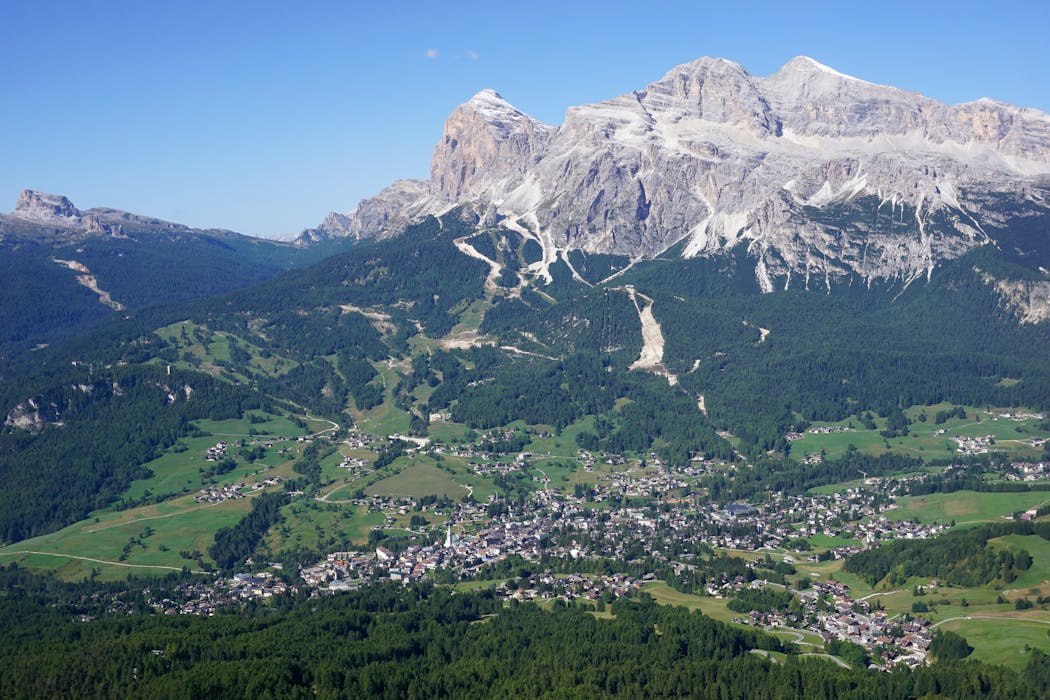 Mount Faloria rises above Cortina d'Ampezzo, one of the host towns for the 2026 Winter Olympics. kallerna / Wikimedia, CC BY
Italy's 2026 Winter Olympics have been described as the most regionally distributed Winter Games ever staged. Events are spread across more than 22,000 km², taking in Milan, as well as the towns of Cortina d'Ampezzo, Valtellina, Val di Fiemme and Livigno in the Alps.
Geographical dispersion is not entirely new. In 1956, the equestrian events of the Melbourne summer Olympics were actually held 15,500 km away, in Stockholm, Sweden, five months before the rest of the games. This was due to Australia's quarantine rules. More recently, surfing during Paris 2024 was done in Tahiti, 15,727km from the French capital. The competition was duly labelled "most distant Olympic event ever".
As a sports management specialist with a human geography background, my research looks at how new spatial solutions and distribution of sport activities and events across a territory increases their sustainability and long-term viability. What distinguishes Milano-Cortina is the way it has been organised across the regions of Lombardy, Veneto and the autonomous provinces of Trento and Bolzano. This represents a strategic shift towards what geographers would term a "dispersed, multinodal model". More than 90% of the venues being used already existed or are temporary. The goal is to reduce construction, minimise environmental impact and reduce any long-term maintenance burdens. In other words, the games have adapted to the territory rather than reshaping it.
Learning from past GamesThe approach adopted for this year's games indicates that national organising committees, and the International Olympic Committee (IOC), are willing to adapt. Research shows such a shift is long overdue.
Olympic planning has long involved sustainability rhetoric. Recent reforms emphasise reduced environmental footprints and the use of existing facilities. Yet, events including the Paris 2024 summer games, have been accused of greenwashing.
Italy's own experience, during the Torino 2006 winter games, highlighted the risks of overbuilding in fragile mountain environments. Many of those purpose-built facilities faced long-term operational and ecological challenges.
Organisers are getting much better at designing flexible venues that can be adapted by the host city for use after the event. In Paris, 95% of the venues were either pre-existing or temporary. The games notably transformed the river Seine into a venue for the opening ceremony and aquatic events. It was expensive to pull off, but as a demonstration of public space reuse and long-term urban ecological investment, it was symbolically powerful. The Place de la Concorde was also converted into a temporary street-sport hub. This showcased how urban environments can host dynamic youth events that blend competition with city life.
Winter games, of course, face different constraints. Where summer hosts can absorb scale, winter hosts rely on natural landscapes that are already under severe climatic pressure. This increases both the stakes and the complexity of sustainable design.
On one hand, spreading events across regions makes them more accessible to multiple communities. It involves more municipalities and regional bodies in planning, implementation, and legacy building, which in turn can foster stronger local engagement and a more distributed sense of ownership.
On the other hand, the model requires robust coordination between diverse actors. It also poses the risk of a fragmented Olympic identity. And it makes media coverage more complex. While this drives innovation in terms of hybrid reporting tools and local storytelling, it can lead to platforms prioritising some events over others.
The transport challengeThe most significant sustainability challenge remains transport. A dispersed model inherently requires athletes, officials, media and spectators to travel more between places. According to the IOC, Milano-Cortina 2026 relies heavily on trains and shuttle systems to minimise private car use, with the goal of reducing car use by 20%, compared to Torino 2006.
Overall travel demand is, however, more complex. A 2022 study on preparations for Milan-Cortina, showed that the larger the host territory, the more complex its mobility planning. Participants still have to get to events and the people who live there, meanwhile, "still expect to inherit benefits from any investments made". Infrastructure upgrades, from rail modernisation to enhanced alpine transit, are duly central to the 2026 games' legacy strategy.
Long-distance spectator travel, in particular, remains a huge factor in the games' carbon footprint, whether the event is geographically concentrated or dispersed. Research published by the French government showed that international travel accounted for almost 50% of the Paris 2024 summer games's carbon footprint.
In sum, from a resource, climate and environmental perspective, Olympic winter games are not justifiable. They inevitably intrude into the natural landscape and despite all sustainability-led reforms, implementation on the ground is spotty. Milano-Cortina 2026 has included some infrastructure projects which reportedly lack environmental assessments or long‑term utility. To what extent this will be offset by the benefits of its geographical dispersion model remains to be determined.
But the public loves them. The Milano-Cortina 2026 approach signals a vital willingness to adapt. As snowpacks retreat, temperatures rise and young people scrutinise what leaders are doing to the environment with ever greater acuity, this might well be the only thing keeping this event alive.

Karin Book does not work for, consult, own shares in or receive funding from any company or organisation that would benefit from this article, and has disclosed no relevant affiliations beyond their academic appointment.
Asia-Pacific Takes The Lead In Global Wind Expansion As The Philippines Moves Into The Investment Spotlight [ 18-Feb-26 4:18pm ]The global wind industry's next growth phase is being written in Asia-Pacific, and the shift is happening faster than many expected. The Global Wind Energy Council's latest market signals show that the region is no longer an emerging contributor but the central driver of record installations, new supply chains and ... [continued]
The post Asia-Pacific Takes The Lead In Global Wind Expansion As The Philippines Moves Into The Investment Spotlight appeared first on CleanTechnica.
Ford Still Holds A Torch For EVs, Now With An F1 Twist [ 18-Feb-26 4:16pm ]The Ford Motor Company is moving forward with plans to launch an affordable electric pickup truck, pursuing a "bounty" strategy to optimize EV design.
The post Ford Still Holds A Torch For EVs, Now With An F1 Twist appeared first on CleanTechnica.


