
Doyne Farmer says a super-simulator of the global economy would accelerate the transition to a green, clean world
It's a mind-blowing idea: an economic model of the world in which every company is individually represented, making realistic decisions that change as the economy changes. From this astonishing complexity would emerge forecasts of unprecedented clarity. These would be transformative: no more flying blind into global financial crashes, no more climate policies that fail to shift the dial.
This super simulator could be built for what Prof Doyne Farmer calls the bargain price of $100m, thanks to advances in complexity science and computing power.
Continue reading...Torcross, Devon: 2026 has been defined by storms here. My job of repairing a thatched roof is simple compared with the wider recovery
During the storm, the waves sounded like bombs going off under the house, Bonni Breeze Lincoln tells me. She lives on the seafront of Torcross, a Devon village that is accustomed to weathering storms, but even she is not used to waves shattering her storm shutters, or sending seawater down the chimney.
I've come to Torcross to repair the thatch on Bonni's roof. Up the ladder, I tie bundles of reed, called "wads", to pack them into the holes; the thatch is riddled with shingle, fragments of seaweed and even limpet shells. Looking down the seafront to torn up paving slabs and slate roofs that yawn open to the sky, it's clear that this house - the oldest in the village - has come off comparatively well. The soft, springy nature of thatch allows it to absorb even the impact of breaking waves.
Continue reading...
As noted earlier today, Donald Trump is continuously engaging in assaults on US human health due to Trump's incessant push for fossil fuels and against cleantech. The policies go beyond normal subsidies. Trump and his team are basically forcing the use of old coal power plants. And that will come ... [continued]
The post Will Trump's Assault on Human Health Matter in Texas? appeared first on CleanTechnica.
Intricate ice formations can grow on frozen lakes and seas when relatively warm ice is exposed to still air
Intricate fern-like "frost flowers", said to be painted on windows and windscreens by Jack Frost, are a familiar feature of British winter. In Arctic regions there is an even prettier three-dimensional version.
These frost flowers are typically 3-4cm across and whole gardens of them grow on frozen lakes and seas. Like the window version, they are the result of ice crystals growing in a slow, orderly fashion.
Continue reading...The government has not made enough of a dent in emissions, but global trends and a shambolic opposition offer a rare opportunity to act
Want to get this in your inbox when it publishes? Sign up for the Clear Air Australia newsletter here
There is good news out there, even if it feels like scraps in a world on the brink. Some came last week - with plenty of caveats - when analysts at the Paris-based International Energy Agency (IEA) found coal-fired power generation decreased in both China and India last year.
This is a potentially big shift. Among other things, it exposes the hollowness of arguments in Australia that there is no point doing anything about the climate crisis because the big Asian economies are building endless new coal plants.
Continue reading...A dozen red roses may say 'I love you', but many conventional bouquets carry an environmental price, having been imported by air, dipped in chemicals and wrapped in plastic. Guardian Australia's Petra Stock explains how you can choose flowers that show you care for both a valentine and the environment
Continue reading...
Meanwhile, its sales rose significantly in Spain, Italy, Sweden, and Finland. I hadn't seen anything about Tesla's 2026 sales so far, and US sales are impossible to come by at this stage, so I decided to go have a look at how Tesla is doing in various European markets. Using ... [continued]
The post Tesla Down Dramatically in UK, Norway, Netherlands, Switzerland appeared first on CleanTechnica.
The US startup SOLRITE is opening up a new energy storage opportunity for residential ratepayers to participate in money-saving VPPs, whether or not they have rooftop solar panels.
The post Now Anyone Can Join A VPP, With or Without Rooftop Solar appeared first on CleanTechnica.
This started as a response to Zach's recent article asking "Why Have Automakers Written Off $55 Billion In EV Investments?" Zach encouraged me to flesh it out a little and post it as a followup article. Here are a few reasons why Detroit automakers were able to rack up such ... [continued]
The post Reasons For The Legacy EV Retreat appeared first on CleanTechnica.
There's a feeling of powerlessness we all feel while staring into the climate/war/violence abyss of our smartphone screens. We tend to ask "What can I do?" before succumbing again to despair and distraction. This is becoming more and more fraught as civil liberties are being taken away and surveillance reaches new technological highs.
I wrote the following arguments as one answer to the question "What can I do?" I would love to hear others' thoughts.
Please note: I know that individual needs vary tremendously. The scale of this strategy is obviously different for everyone (e.g. those with dependents, those with disabilities, etc).
Voluntary participation in capitalism
- The powerful perpetuate systemic misery through the voluntary engagement of people in Western markets.
- Voluntary engagement continues because we all tend to desire what capitalism provides - comfort, convenience, entertainment, numbing. Capitalism has also walled off or monetised many previously free activities, thus fostering dependence.
- Obviously, some participation in the system is needed to 'get by' - to support ourselves with food, shelter and medicine, particularly because these are only available through the system. But we participate far beyond this - we partake in luxury, comfort, entertainments.
- This voluntary engagement is a massive contributor to the global crises we see. An obvious example is social media - the common people build the wealth of the owners of these platforms through their voluntary engagement. Less obvious is fossil fuels - much of fossil fuel use is for necessities such as food production or medicine, but we also make these businesses even more powerful through unnecessary consumption.
Necessities and strategies for change
- The current state of the world demands some sort of behavioural change from the average person. Either this occurs voluntarily, or change will be involuntary and far worse, 10, 20, 30 years hence.
- Challenging state and corporate power directly has become ineffective, if not suicidal, due their fusion with eachother (centralisation) and with technological advances. Protests and even democratic processes are largely akin to therapy to assuage the feelings of powerlessness and guilt of the participants. They do little to cause real-world change at the scale needed.
- Non-violence must be essential in any opposition, from both an ethical and tactical standpoint. The violent will be killed and their violence will be used in state propaganda to destroy any movement.
- The only leverage that remains, therefore, is a mass of people removing themselves as much as is feasible from that system. This is the only way to undermine globalized capital, slow the economy and ease environmental destruction.
Non-participation as a strategy
- Non-participation is a strong, ethical, and necessary use of one's agency for collective purposes. At scale, it is also effective for changing the future in a positive direction.
- It is similar to a strike. However, unlike a strike, there are no demands as there is no belief that the current system in place can provide what people really need. We are not looking for higher wages to buy things we don't need. We are looking for freedom from exploitation, and to have agency over our lives. Additionally, unlike a strike, it can be done individually. One does not need to wait for others to get on board to start living in a better way.
- An underlying principle is the recognition that the system largely does not provide what we need, after basics are met. It fills our time with work or vapid entertainments and isolates us from those around us. Once one lets go of capitalistic dreams of 'success' or 'fame' or 'wealth' or even Hollywoodized 'love', one is free to change one's lifestyle to something more aligned with reality. Much of this is simply ending behaviours that we already know are destructive.
- Self-removal from the system can include:
- Reduced work hours as much as possible
- Reducing most luxury consumption
- Reducing debt (e.g. refusal to enter the housing market)
- Ceasing most or all social media use
- Engaging in lower-stimulation leisure activities (e.g. art or reading or socialising instead of gaming, social media and Netflix)
- Refusing to work for national or multinationals corps
- Living in sharehouses instead of alone
- Self removal at a collective scale opens up more options such as rental strikes, boycotts, community planning and mutual aid.
- Such behaviour change would require or lead to the dismantling of remaining habits, belief systems and dreams that keep one tied to the system. Such beliefs include:
- My safety can be guaranteed by wealth (e.g. in retirement)
- Money/success/fame will lead to my satisfaction or happiness or wellbeing
- My prime value in life is how much I earn or own
- I need [insert addiction here] to function (e.g. alcohol, social media, online gaming)
- I need to be working to be useful or worthy or 'deserving'.
Benefits
- Mass non-participation, paired with thoughtful use of one's individual time, would have unbelievable benefits on the mental, physical and cultural health of individuals and communities. Given the unpredictability of future society, the strength of one's circle and wider community may be the biggest factor in determining one's outcomes in the decades ahead.
- Mass non-participation would wreak havoc on the economy and productivity, forcing a response. One option that the powerful could take would be to force people to consume and work. While this is not out of the question, it is anathema to the principles of capitalism's mythical "free market", and could destroy any remaining credibility in the past system.
- Mass non-participation would lower energy use and climate destruction.
- Even solo non-participation is a far healthier and happier lifestyle than the alternative (speaking from experience!)
[link] [comments]
China's carbon dioxide (CO2) emissions fell by 1% in the final quarter of 2025, likely securing a decline of 0.3% for the full year as a whole.
This extends a "flat or falling" trend in China's CO2 emissions that began in March 2024 and has now lasted for nearly two years.
The new analysis for Carbon Brief shows that, in 2025, emissions from fossil fuels increased by an estimated 0.1%, but this was more than offset by a 7% decline in CO2 from cement.
Other key findings include:
- CO2 emissions fell year-on-year in almost all major sectors in 2025, including transport (3%), power (1.5%) and building materials (7%).
- The key exception was the chemicals industry, where emissions grew 12%.
- Solar power output increased by 43% year-on-year, wind by 14% and nuclear 8%, helping push down coal generation by 1.9%.
- Energy storage capacity grew by a record 75 gigawatts (GW), well ahead of the rise in peak demand of 55GW.
- This means that growth in energy storage capacity and clean-power output topped the increases in peak and total electricity demand, respectively.
The CO2 numbers imply that China's carbon intensity - its fossil-fuel emissions per unit of GDP - fell by 4.7% in 2025 and by 12% during 2020-25.
This is well short of the 18% target set for that period by the 14th five-year plan.
Moreover, China would now need to cut its carbon intensity by around 23% over the next five years in order to meet one of its key climate commitments under the Paris Agreement.
Whether Chinese policymakers remain committed to this target is a key open question ahead of the publication of the 15th five-year plan in March.
This will help determine if China's emissions have already passed their peak, or if they will rise once again and only peak much closer to the officially targeted date of "before 2030".
'Flat or falling'The latest analysis shows China's CO2 emissions have now been flat or falling for 21 months, starting in March 2024. This trend continued in the final quarter of 2025, when emissions fell by 1% year-on-year.
The picture continues to be finely balanced, with emissions falling in all major sectors - including transport, power, cement and metals - but rising in the chemicals industry.
This combination of factors means that emissions continue to plateau at levels slightly below the peak reached in early 2024, as shown in the figure below.
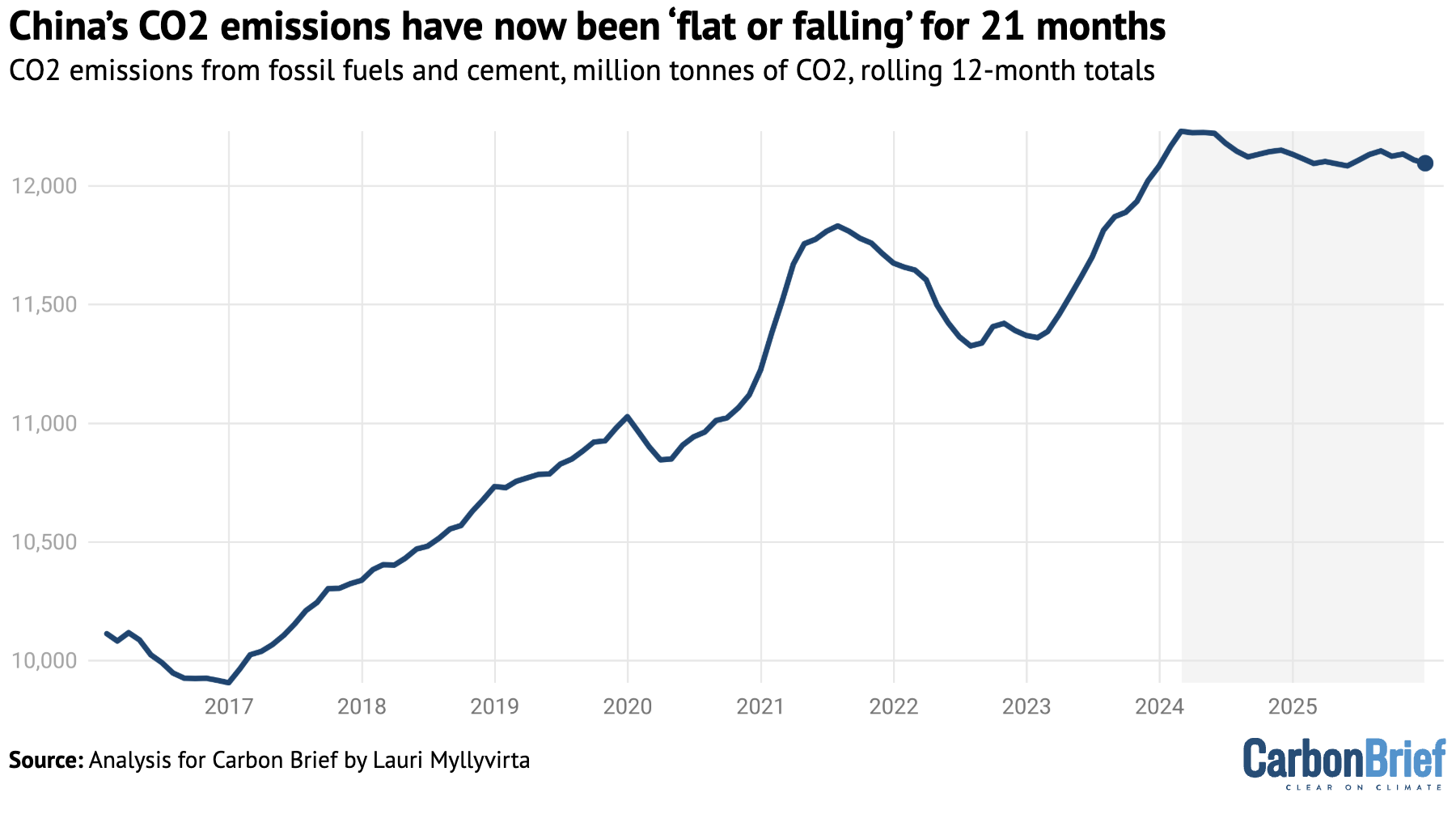 China's CO2 emissions from fossil fuels and cement, million tonnes of CO2, rolling 12-month totals until September 2025. Source: Emissions are estimated from National Bureau of Statistics data on production of different fuels and cement, China Customs data on imports and exports and WIND Information data on changes in inventories, applying emissions factors from China's latest national greenhouse gas emissions inventory and annual emissions factors per tonne of cement production until 2024. Sector breakdown of coal consumption is estimated using coal consumption data from WIND Information and electricity data from the National Energy Administration. The consumption of petrol, diesel and jet fuel is adjusted to match quarterly totals estimated by Sinopec.
Power sector emissions fell by 1.5% year-on-year in 2025, with coal use falling 1.7% and gas use increasing 6%. Emissions from transportation fell 3% and from the production of cement and other building materials by 7%, while emissions from the metal industry fell 3%.
These declines are shown in the figure below. They were partially offset by rising coal and oil use in the chemical industry, up 15% and 10% respectively, which pushed up the sector's CO2 emissions by 12% overall.
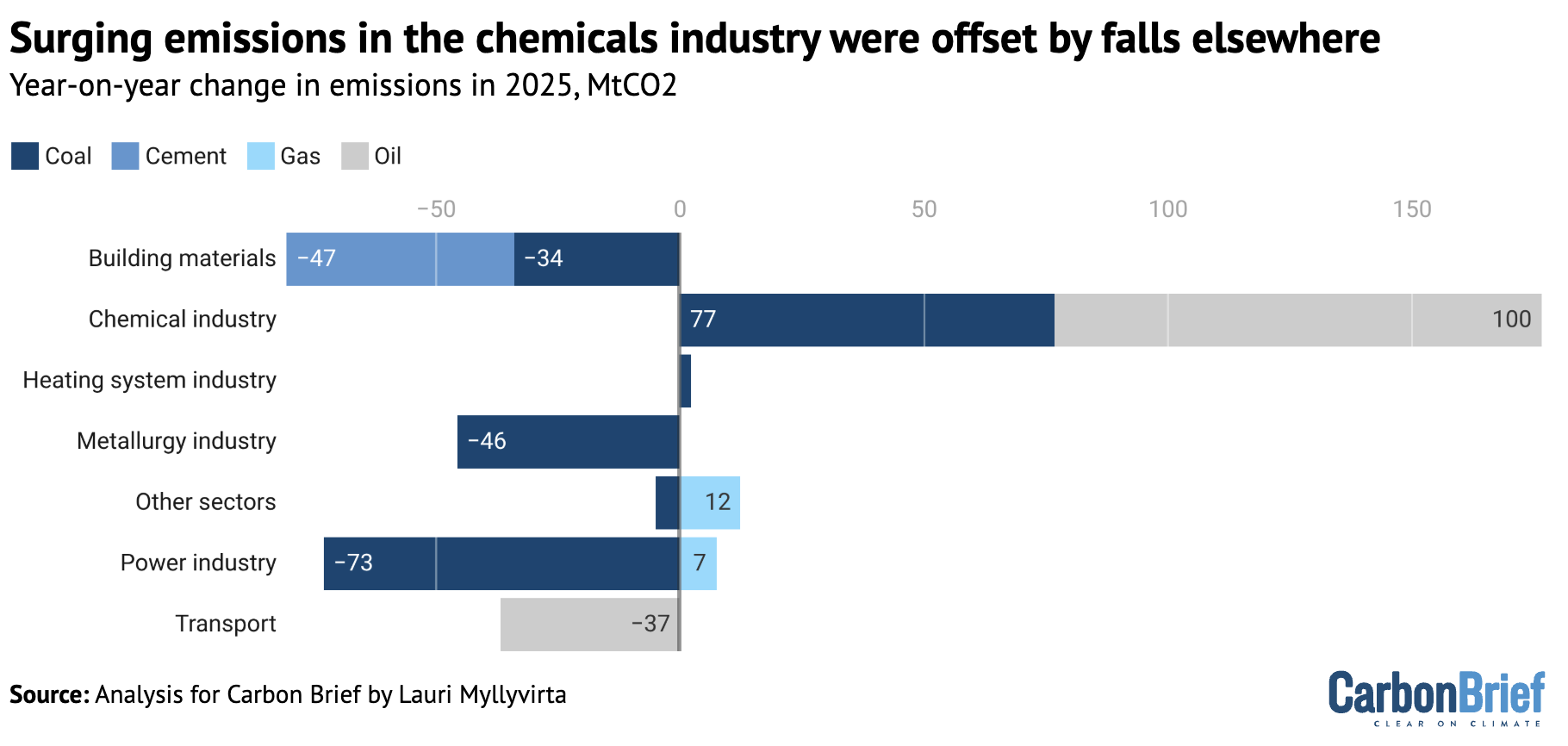 Year-on-year change in China's CO2 emissions from fossil fuels and cement, for the period January-September 2025, million tonnes of CO2. Source: Emissions are estimated from National Bureau of Statistics data on production of different fuels and cement, China Customs data on imports and exports and WIND Information data on changes in inventories, applying emissions factors from China's latest national greenhouse gas emissions inventory and annual emissions factors per tonne of cement production until 2024. Sector breakdown of coal consumption is estimated using coal consumption data from WIND Information and electricity data from the National Energy Administration. The consumption of petrol, diesel and jet fuel is adjusted to match quarterly totals estimated by Sinopec.
In other sectors - largely other industrial areas and building heat - gas use increased by 2%, more than offsetting the reduction in emissions from a 3% drop in their coal consumption.
Clean power covers electricity demand growthIn the power sector, which is China's largest emitter by far, electricity demand grew by 520 terawatt hours (TWh) in 2025.
At the same time, power generation from solar increased by 43% and wind power generation by 14%, delivering 360TWh and 130TWh of additional clean electricity. Nuclear power generation grew 8%, supplying another 40TWh. The increased generation from these three sources - some 530TWh - therefore met all of the growth in demand.
Hydropower generation also increased by 3% and bioenergy by 3%, helping push power generation from fossil fuels down by 1%. Gas-fired power generation increased by 6% and, as a result, power generation from coal fell by 1.9%.
Furthermore, the surge in additions of new wind and solar capacity at the end of 2025 will only show up as increased clean-power generation in 2026.
On the other hand, the growth in solar and wind power generation has fallen short of the growth in capacity, implying a fall in capacity utilisation - a measure of actual output relative to the maximum possible. This is highly likely due to increased, unreported curtailment, where wind and solar sites are switched off because the electricity grid is congested.
If these grid issues are resolved over the next few years, then generation from existing wind and solar capacity will increase over time.
Developments in 2025 extended the trend of clean-power generation growing faster than power demand overall, as shown in the top figure below. This trend started in 2023 and is the key reason why China's emissions have been stable or falling since early 2024.
In addition, 2025 saw another potential inflection point, shown in the bottom figure below. It was the first year ever that energy storage capacity - mainly batteries - grew faster than peak electricity demand in 2025 and faster than the average growth in the past decade.
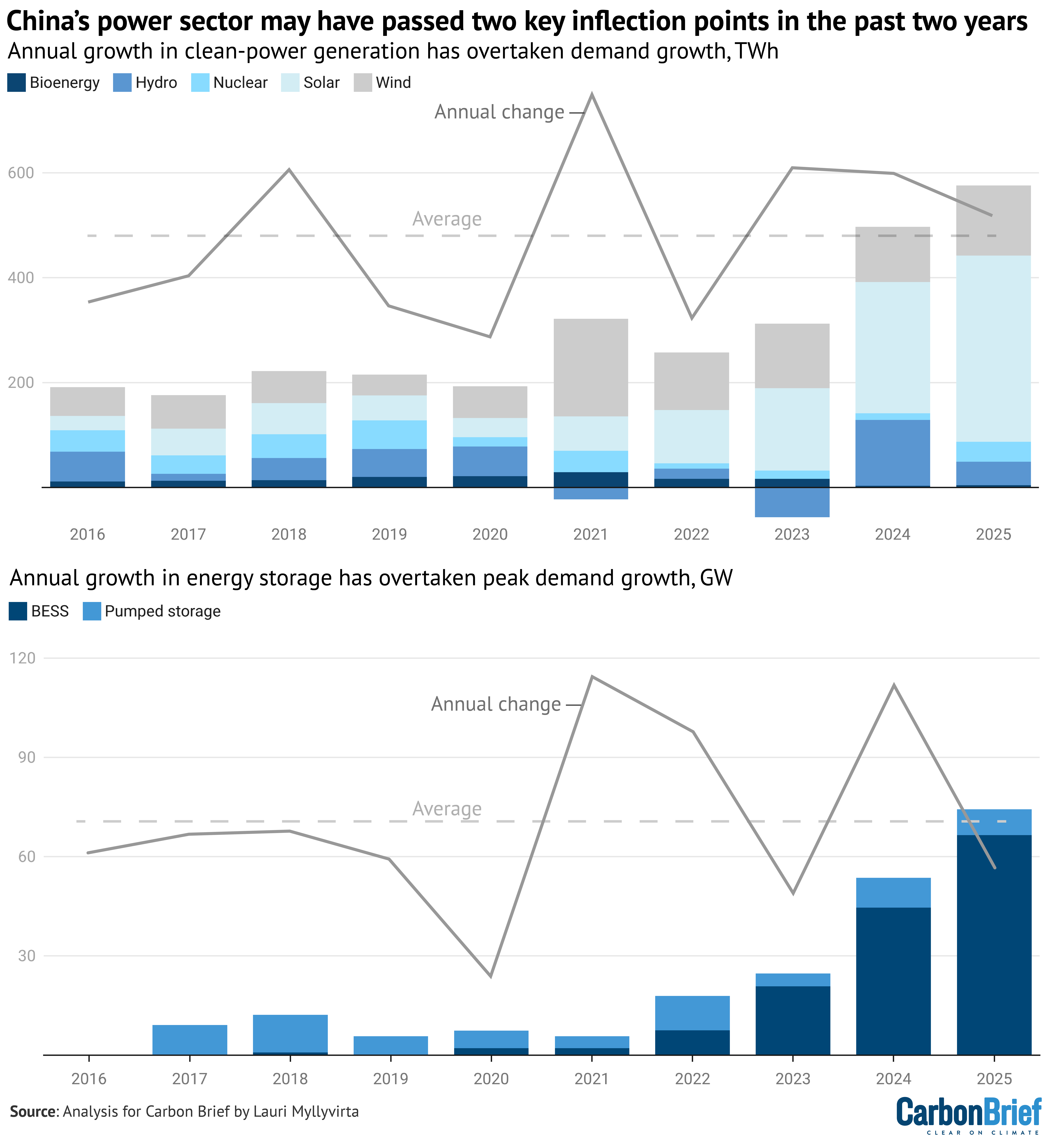 Top columns: Year-on-year change in annual electricity generation from clean energy excluding hydro, terawatt hours. Left solid and dashed line: Annual and average change in total electricity generation, TWh. Bottom columns: Year-on-year change in energy storage capacity, gigawatts. Right solid and dashed line: Annual and average change in peak electricity demand. Sources: Power generation and demand from Ember; peak loads from China Electric Power News since 2020; peak loads until 2019 and pumped hydro capacity from Wind Financial Terminal; battery storage capacity from China Energy Storage Alliance; analysis for Carbon Brief by Lauri Myllyvirta.
China's energy storage capacity increased by 75GW year-on-year in 2025, while peak demand only increased by 55GW. The rise in storage capacity in 2025 is also larger than the three-year average increase in peak loads, some 72GW per year.
Peak demand growth matters, because power systems have to be designed to reliably provide enough electricity supply at the moment of highest demand.
Moreover, the increase in peak loads is a key driver of continued additions of coal and gas-fired power plants, which reached the highest level in a decade in 2025.
The growth in energy storage could provide China with an alternative way to meet peak loads without relying on increased fossil fuel-based capacity.
The growth in storage capacity is set to continue after a new policy issued by China's top economic planner the National Development and Reform Commission (NDRC) in January.
This policy means energy storage sites will be supported by so-called "capacity payments", which to date have only been available to coal- and gas-fired power plants and pumped hydro storage.
Concerns about having sufficient "firm" power capacity in the grid - that which can be turned on at will - led the government to promote new coal and gas-fired power projects in recent years, leading to the largest fossil-fuel based capacity additions in a decade in 2025, with another 290GW of coal-fired capacity still under construction.
Reforming the power system and increasing storage capacity would enable the grid to accommodate much higher shares of solar and wind, while reducing the need for new coal or gas capacity to meet rising peaks in demand.
This would both unlock more clean-power generation from existing capacity and improve the economics and risk profiles of new projects, stimulating more growth in capacity.
Peaking power CO2 requires more clean-energy growthChina's key climate commitments for the next five-year period until 2030 are to peak CO2 emissions and to reduce carbon intensity by more than 65% from 2005 levels. The latter target requires limiting CO2 emissions at or below their 2025 level in 2030.
The record clean-energy additions in 2023-25 have barely sufficed to stabilise power-sector emissions, showing that if rapid growth in power demand continues, meeting the 2030 targets requires keeping clean-energy additions close to 2025 levels over the next five years.
China's central government continues to telegraph a much lower level of ambition, with the NDRC setting a target of "around" 30% of power generation in 2030 coming from solar and wind, up from around 22% in 2025.
If electricity demand grows in line with the State Grid forecast of 5.6% per year, then limiting the share of wind and solar to 30% would leave space for fossil-fuel generation to grow at 3% per year from 2025 to 2030, even after increases from nuclear and hydropower.
Such an increase would mean missing China's Paris commitments for 2030.
Alternatively, in order to meet the forecast increase in electricity demand without increasing generation from fossil fuels would require wind and solar's share to reach 37% in 2030.
Similarly, China's target of a non-fossil energy share of 25% in 2030 will not be sufficient to meet its carbon-intensity reduction commitment for 2030, unless energy demand growth slows down sharply.
This target is unlikely to be upgraded, since it is already enshrined in China's Paris Agreement pledge, so in practice the target would need to be substantially overachieved if the country is to meet its other commitments.
If energy demand growth continues at the 2025 rate and the share of non-fossil energy only rises from 22% in 2025 to 25% in 2030, then the consumption of fossil fuels would increase by 3% per year, with a similar rise in CO2 emissions.
Still, another recent sign that clean-energy growth could keep exceeding government targets came in early February when the China Electricity Council projected solar and wind capacity additions of more than 300GW in 2026 - well beyond the government goal of "over 200GW".
Chemical industryThe only significant source of growth in CO2 emissions in 2025 was the chemical industry, with sharp increases in the consumption of both coal and oil.
This is shown in the figure below, which illustrates how CO2 emissions appear to have peaked from cement production, transport, the power sector and others, whereas the chemicals industry is posting strong increases.
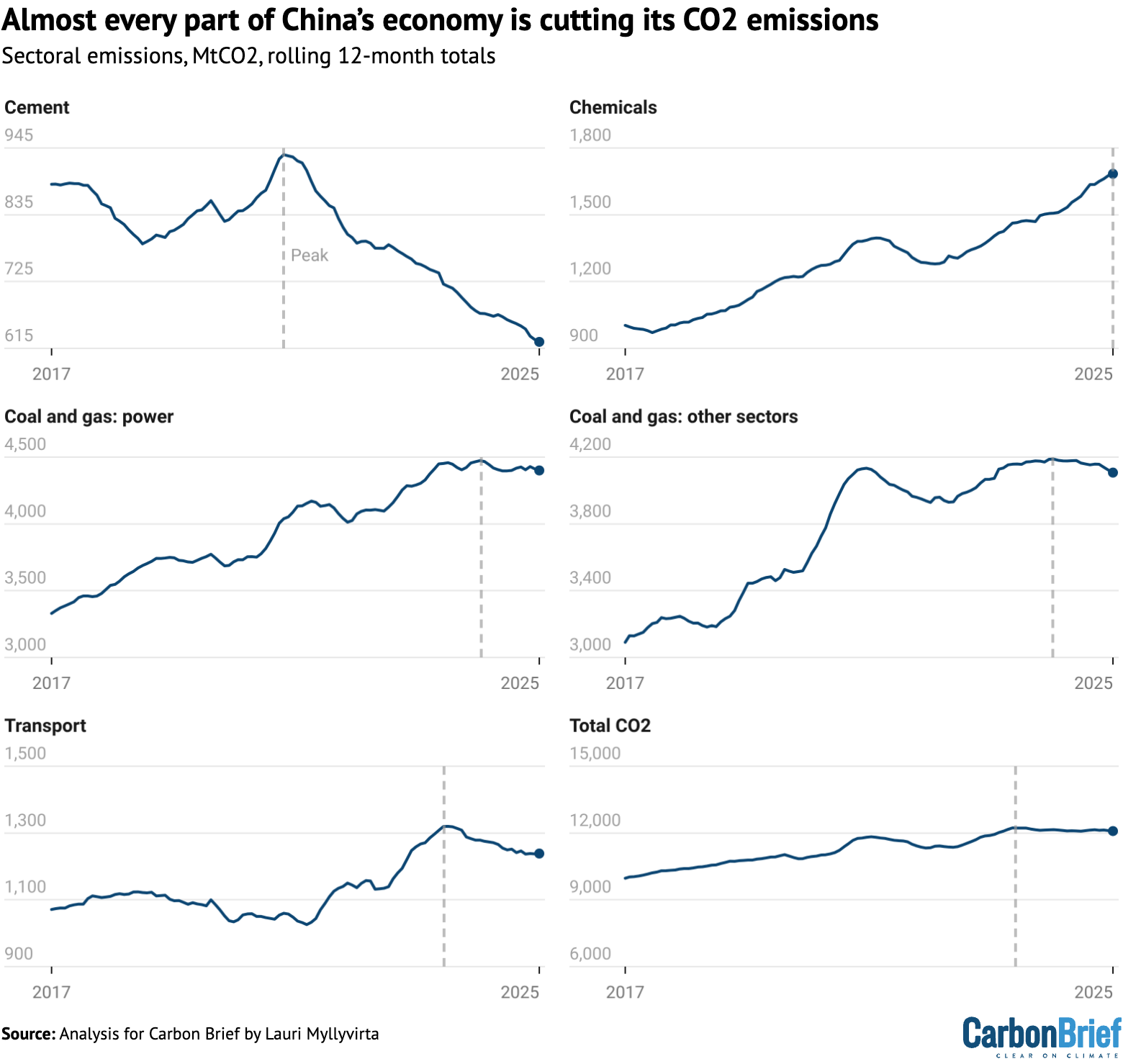 Sectoral emissions from fossil fuels and cement, million tonnes of CO2, rolling 12-month totals. Source: Emissions are estimated from National Bureau of Statistics data on production of different fuels and cement, China Customs data on imports and exports and WIND Information data on changes in inventories, applying emissions factors from China's latest national greenhouse gas emissions inventory and annual emissions factors per tonne of cement production until 2024. Sector breakdown of coal consumption is estimated using coal consumption data from WIND Information and electricity data from the National Energy Administration.
Even though chemical-industry emissions are small relative to other sectors - at roughly 13% of China's total - the pace of expansion is creating an outsize impact.
Without the increase from the chemicals sector, China's total CO2 emissions would have fallen by an estimated 2%, instead of the 0.3% reported here.
Without changes to policy, emission growth is set to continue, as the coal-to-chemicals industry is planning major increases in capacity.
Whether these expansion plans receive backing in the upcoming five-year plan for 2026-30 will have a major impact on China's emission trends.
Another key factor is the development of oil and gas prices. Production in the coal-based chemical industry is only profitable when coal is significantly cheaper than crude oil.
The current coal-to-chemicals capacity in China is dominated by plants producing higher-value - and therefore less price-sensitive - chemicals such as olefins and aromatics, as feedstocks for the production of plastics.
In contrast, the planned expansion of the sector is expected to be largely driven by plants producing oil products and synthetic gas to be used for energy. For these products, electrification and clean-electricity generation provide a direct alternative, meaning they are even more sensitive to low oil and gas prices than chemicals production.
Outlook for China's emissionsThis is the latest analysis for Carbon Brief to show that China's CO2 emissions have now been stable or falling for seven quarters or 21 months, marking the first such streak on record that has not been associated with a slowdown in energy demand growth.
Notably, while emissions have stabilised or begun a slow decline, there has not yet been a substantial reduction from the level reached in early 2024. This means that a small jump in emissions could see them exceed the previous peak level.
China's official plans only call for peaking emissions shortly before 2030, which would allow for a rebound from the current plateau before the ultimate emissions peak.
If China is to meet its 2030 carbon intensity commitment - a 65% reduction on 2005 levels - then emissions would have to fall from the peak back to current levels by 2030.
Whether China's policymakers are still committed to meeting this carbon intensity pledge, after the setbacks during the previous five-year period, is a key open question. The 2030 energy targets set to date have fallen short of what would be required.
The most important signal will be whether the top-level five-year plan for 2026-30, due in March, sets a carbon intensity target aligned with the 2030 Paris commitment.
Officially, China is sticking to the timeline of peaking CO2 emissions "before 2030", which was announced by president Xi Jinping in 2020.
According to an authoritative explainer on the recommendations of the Central Committee of the Communist Party for the upcoming five-year plan, published by state-backed news agency Xinhua, coal consumption should "reach its peak and enter a plateau" from 2027.
It says that continued increases in demand for coal from electricity generators and the chemicals industry would be offset by reductions elsewhere. This is despite the fact that China's coal consumption overall has already been falling for close to two years.
The reference to a "plateau" in coal consumption indicates that in official plans, meaningful absolute reductions in emissions would have to wait until after 2030. Any increase in coal consumption from 2025 to 2027, before the targeted plateau, would need to be offset by reductions in oil consumption, to meet the carbon intensity target.
Moreover, allowing coal consumption in the power sector to grow beyond the peak of overall coal use and emissions implies slowing down China's clean-energy boom. So far, the boom has continued to exceed official targets by a wide margin.
In addition, the explainer's expectation of further growth in coal use by the chemicals industry indicates a green light for at least a part of its sizable expansion plans.
The Xinhua article recognises that oil product consumption has already peaked, but says that oil use in the chemicals industry has kept growing. It adds that overall oil consumption should peak in 2026.
Elsewhere, the article speaks of "vigorously" developing non-fossil energy and "actively" developing "distributed" solar, which has slowed down due to recent pricing policies.
Yet it also calls for "high-quality development" of fossil fuels and increased efforts in domestic oil and gas production, suggesting that China continues to take an "all of the above" approach to energy policy.
The outcome of all this depends on how things turn out in reality. The past few years show it is possible that clean energy will continue to overperform its targets, preventing growth in energy consumption from fossil fuels despite this policy support.
The key role of the clean-energy boom in driving GDP growth and investments is one key motivator for policymakers to keep the boom going, even when central targets would allow for a slowdown. It is also possible that the five-year plans of provinces and state-owned enterprises could play a key role in raising ambition, as they did in 2022.
About the dataData for the analysis was compiled from the National Bureau of Statistics of China, National Energy Administration of China, China Electricity Council and China Customs official data releases, as well as from industry data provider WIND Information and from Sinopec, China's largest oil refiner.
Electricity generation from wind and solar, along with thermal power breakdown by fuel, was calculated by multiplying power generating capacity at the end of each month by monthly utilisation, using data reported by China Electricity Council through Wind Financial Terminal.
Total generation from thermal power and generation from hydropower and nuclear power were taken from National Bureau of Statistics monthly releases.
Monthly utilisation data was not available for biomass, so the annual average of 52% for 2023 was applied. Power-sector coal consumption was estimated based on power generation from coal and the average heat rate of coal-fired power plants during each month, to avoid the issue with official coal consumption numbers affecting recent data.
CO2 emissions estimates are based on National Bureau of Statistics default calorific values of fuels and emissions factors from China's latest national greenhouse gas emissions inventory, for the year 2021. The CO2 emissions factor for cement is based on annual estimates up to 2024.
For oil, apparent consumption of transport fuels - diesel, petrol and jet fuel - is taken from Sinopec quarterly results, with monthly disaggregation based on production minus net exports. The consumption of these three fuels is labeled as oil product consumption in transportation, as it is the dominant sector for their use.
Apparent consumption of other oil products is calculated from refinery throughput, with the production of the transport fuels and the net exports of other oil products subtracted. Fossil-fuel consumption includes non-energy use such as plastics, as most products are short-lived and incineration is the dominant disposal method.

China energy
|05.02.26
Analysis: Clean energy drove more than a third of China's GDP growth in 2025
China energy
|05.02.26
'Rush' for new coal in China hits record high in 2025 as climate deadline looms
China energy
|03.02.26
Explainer: Why gas plays a minimal role in China's climate strategy
China energy
|22.01.26
jQuery(document).ready(function() { jQuery('.block-related-articles-slider-block_f2f428e18d17c60b86ceb33db0d653ab .mh').matchHeight({ byRow: false }); });The post Analysis: China's CO2 emissions have now been 'flat or falling' for 21 months appeared first on Carbon Brief.
Donald Trump has a handful of clear areas of focus in his second term as president. One of those is to force old, polluting, expensive fossil fuel power plants on the American people. And he's taking it to new extremes this week. "Based on reporting, today Donald Trump will give ... [continued]
The post Donald Trump to Give Coal Industry Another Massive Handout — via Department of Defense appeared first on CleanTechnica.
The Environmental Protection Agency has approved pesticides containing PFAS "forever chemicals" for widespread use on American crops, and scientists, environmental advocates, and public health experts are sounding alarms about what this means for food safety and environmental contamination.
Since the Trump administration took office, the EPA has already approved two PFAS pesticides and is looking to give the thumbs-up to a total of five before the year is out. The newly approved pesticides, cyclobutrifluram and isocycloseram, will be used on a wide range of food crops.
submitted by /u/thehomelessr0mantic[link] [comments]
DETROIT, Michigan — This week, the Trump Administration is expected to announce a suite of rollbacks that bolster the coal and fossil fuel industries, threatening to keep our coal plants online longer and make our environment and climate dirtier. The administration is expected to revoke the Environmental Protection Agency's longstanding ... [continued]
The post Sierra Club: Trump's Latest Environmental Rollbacks Are Yet Another Move To Cut Corners For The Coal And Fossil Fuel Industries appeared first on CleanTechnica.

ChatGPT knows me pretty well. I've asked it hundreds of questions by now, and told it my reactions. It's saved me hundreds of hours of time, and given me information, quite quickly and precisely, that no search engine could ever have managed. The tool is trained with one purpose in mind: To make you want to use it more and make it impossible for you to do things without it. That's not cynicism; that's business.
AI is following the same enshittification model that, as Cory Doctorow has explained, just about every other online tool has used: Suck you in with free or cheap offerings, then jack up the price, move all the free stuff to the expensive 'premium' versions, and then steal and re-sell your data to unethical corporations for predatory surveillance pricing, and clutter all the responses with ads 'curated' especially for what it has discerned you are most likely to buy from its real customers, big corporations.
In short, this is the honeymoon stage of AI, at least for 'consumers'. The misunderstandings, unpleasant surprises, ultimata and abuses will soon follow, leading, for all but the ultra-rich customers who can afford un-enshittified versions, to an angry and bitter divorce. As I keep saying, use it while you can.
Yesterday, I asked it what I thought was an innocuous question:
If unrelated people who live together in a house are called 'housemates', what is the term for unrelated people who live together in an apartment?
Here was its response. If you're impatient, skip to the part I highlighted and underlined:
It's… still housemates
 The Thames Barrier in east London. Jorge Elizaquibel/Shutterstock
More than 1,000 properties flooded in London in 2021, resulting in insurance losses of more than £281 million. Record-breaking floods continue to hit the UK.
In the capital, 13% of properties have been classed as having a high or medium risk of flooding. Danger-to-life warnings could soon become a reality, especially for people living in east London on low-lying land next to the river Thames.
Boroughs like Tower Hamlets, Newham and Hackney are built on former marshland. These areas would have originally absorbed water naturally, but have been used for urban development. More than 85% of London marshland was lost during the 20th century. London has lost the natural buffer that used to help water drain away. As the sea level rises and storm surges get more prevalent, chances of flooding are greater.
London is one of the most urbanised cities across the world with 78% of land being urban. With significant impermeable surfaces made of concrete, asphalt and rooftops, water is prevented from draining into the ground. Rapid surface water runoff overwhelms drainage systems and surface water runoff flooding is one of the greatest threats to east London.
Large-scale infrastructure like the Thames Barrier and tidal flood defences protect London from large-scale river flooding, but they cannot prevent surface water flooding from local storms. As these structures age, maintenance costs rise. Relying solely on them is a risky strategy for the future, especially as storm surges become more intense due to climate change.
Read more: Britain is at bursting point and its flood barriers need to be updated
Specialist bodies like the Environment Agency monitor water quality in rivers to reduce infection risks when water is contaminated. However, many parts of east London have Victorian-era sewer systems designed for much lower rainfall, so they are easily overwhelmed. This means the chance of sewage contamination is heightened in these areas. Around 39 million tonnes of untreated sewage are estimated to be discharged into the Thames every year.
East London also faces high levels of deprivation. Many people lack the resources to cope with floods and possible water contamination, often due to being constrained by socioeconomic inequities. High child poverty rates in east London boroughs like Tower Hamlets (47%), Newham (45%) and Hackney (45%) mean that flood preparation is often overlooked.
Aside from strengthening infrastructure and physical barriers, there are natural ways to manage flood risk.
Our research shows that merging nature with urban infrastructure improves the protective capacities and flood resilience of an urban river like the Thames. And initial insights from our ongoing social research show that creative ways of communicating with people can help people better understand - and support - natural flood solutions.
 Planting wetland areas along riverbeds can help improve flood resilience.
Abdul_Shakoor/Shutterstock
Natural barriers
Planting wetland areas along riverbeds can help improve flood resilience.
Abdul_Shakoor/Shutterstock
Natural barriers
Planting suitable wetland species alongside rivers and roof tops helps delay surface water runoff by up to 90%. Plants absorb water and release it over several hours rather than releasing it immediately like impermeable surfaces such as concrete and tarmac. This slows down the flow of water into the drainage system and reduces the risk of overwhelming the sewers and pollution spills.
In the Netherlands, there are hundreds of green roofs on bus stops. Data shows that each square metre green of roof cover absorbs 20 litres of water, reducing how much water enters the drains. More natural solutions like these can also improve air quality, attract pollinators and provide shade (which prevents the sun from heating up buildings or walkways).
Green roofs on bus stops are now a common sight in some UK cities, including Brighton and Cardiff. Introducing them to east London would be a good first step.
 Green roofs on bus stops in Netherlands.
PixelBiss/Shutterstock
Green roofs on bus stops in Netherlands.
PixelBiss/Shutterstock
One charity-led initiative, East London Waterworks Park, involves rewilding a former depot. By converting land covered by concrete into swimming ponds, with reedbeds for filtration, this project provides more space to hold floodwater and a place for the local community to socialise and engage with nature.
At the Queen Elizabeth Olympic Park in London, an area that used to be a depository for building rubble has been transformed into a large-scale sustainable urban drainage system. This involves the creation of open spaces interspersed with natural features like reedbeds, wetlands and swales (marshy channels) that slow down runoff.
This helps slow down the flow of water into rivers, especially during intense rainfall. Studies show that improved water management at the park has saved 4,000 homes from flood risk since it opened in 2014.
London's population is increasing. This constrains its resources and exacerbates the effects of increased urbanisation. Socioeconomic inequities raise the level of vulnerability of London's population. Flood risk is a national security threat, not just an environmental issue.
Including nature in urban resilience plans helps reduce risk and empower people. But policymakers need evidence of which solutions are more effective before they'll act.
Don't have time to read about climate change as much as you'd like?
Get a weekly roundup in your inbox instead. Every Wednesday, The Conversation's environment editor writes Imagine, a short email that goes a little deeper into just one climate issue. Join the 47,000+ readers who've subscribed so far.

Ravindra Jayaratne receives funding from the Royal Society, UK.
Maciej Pawlik is affiliated with the Green Party of England and Wales.
Eight thousand new EV chargers will be installed in Canada at a cost of $84 million. At the moment, Canada has about 35,000 public EV chargers. Canada also supports the transition to zero-emissions vehicles with EV incentives and the country has huge sustainable transition goals, as stated here: "To help ... [continued]
The post 8,000 New EV Chargers To Be Installed In Canada appeared first on CleanTechnica.
The endangerment finding is about to be removed from official US policy, thanks to the tireless efforts of hard core activists.
The post The Four People At The Center Of The Endangerment Finding Storm In The US appeared first on CleanTechnica.
This article from 2023 is collapse related because it poses social and philosophical questions about how ordinary people might eventually respond to climate breakdown and global pollution. The main cast of the movie is a group of young people with fairly diverse backgrounds, yet all sharing a common goal.
The movie is loosely based on the premise of a book with the same name, written by Andreas Malm in 2021. Malm is currently an associate professor at the prestigious Lund University in Sweden.
This article is not advocating violence or destruction of property in any way and neither am I - that would break the rules. It merely wonders how bad things must get before ordinary people begin doing what was previously unthinkable. It considers what the rationales and criticisms could be based on what happens in the movie.
submitted by /u/Fast_Performer_3722[link] [comments]
My father, Alex Kirby, who has died of cancer aged 86, was a well-respected journalist - at the BBC and elsewhere - and, despite beginning his career in the church, ended up dedicating much of his life to chronicling the climate crisis.
Following a degree in theology at Keble College, Oxford, he trained for the priesthood at the Anglo-Catholic theological college in Mirfield, Yorkshire, and after ordination, became a deacon in the Isle of Dogs, east London.
Continue reading...
When Lucid Motors announced plans to build its first manufacturing facility outside the United States in 2022, the move was framed as both symbolic and strategic. The plant in King Abdullah Economic City (KAEC) would not only become Saudi Arabia's first car factory, but also a cornerstone of the kingdom's ... [continued]
The post Lucid Is Finishing A Greenfield EV Plant For The Next Phase Of Global Manufacturing appeared first on CleanTechnica.
BYD recently announced the revised Atto 3 EVO in Europe, ahead of its official release in China. While there is no official pricing yet, deliveries are expected soon, with the car already appearing on the website. Cosmetically, the changes are minor, and we have already seen many of them in ... [continued]
The post BYD Launches RWD & AWD Atto 3 EVO In Europe First appeared first on CleanTechnica.
Continued global heating could set irreversible course by triggering climate tipping points, but most people unaware
The world is closer than thought to a "point of no return" after which runaway global heating cannot be stopped, scientists have said.
Continued global heating could trigger climate tipping points, leading to a cascade of further tipping points and feedback loops, they said. This would lock the world into a new and hellish "hothouse Earth" climate far worse than the 2-3C temperature rise the world is on track to reach. The climate would also be very different to the benign conditions of the past 11,000 years, during which the whole of human civilisation developed.
Continue reading...
Something subtle but significant is happening across the U.S. economy, and it looks less like normal market evolution and more like an early-stage collapse dynamic.
Brands that were explicitly built to serve price-sensitive consumers, Chipotle, Southwest Airlines, and much of fast-casual dining and domestic travel, are steadily pivoting away from affordability and toward higher-income customers.
This isn't just inflation. It's a customer base shift.
The average consumer can't absorb the price increases required to keep stock prices growing. Shrinkflation and quality degradation are largely exhausted. What remains is the widespread push toward "premium" tiers, add-ons, and pay-to-access basics as the final lever to extract more revenue.
The result is increasingly clear:
Affordable, dependable, and healthy options are becoming rare especially for lower-middle and middle-income households that don't qualify as poor, yet aren't wealthy enough to weather constant price increases.
What's left is a hollowed-out market:
- Luxury and convenience for the top
- Bare-minimum, low-quality options for the bottom
- A rapidly shrinking middle where "good enough at a fair price" used to exist
From a collapse perspective, this matters because social stability depends on predictable, affordable systems, food, transportation, and everyday services, that people can rely on without chronic financial stress. When those systems are reoriented toward higher earners, resentment grows, trust erodes, and people feel quietly excluded from normal participation in society.
This isn't a sudden crash.
It's managed degradation.
We're still early in the process. Collapse doesn't happen in a single generation, it unfolds gradually, and it looks like this:
Today
- Lower class: Losing access to affordable, suitable options
- Middle class: Forced to pay more for what used to be standard
Tomorrow
- Lower class: Systemic failure and exclusion
- Middle class: Those unable to climb into the upper-middle are absorbed downward, as the middle effectively disappears
[link] [comments]
We handpick and explain the most important stories at the intersection of climate, land, food and nature over the past fortnight.
This is an online version of Carbon Brief's fortnightly Cropped email newsletter. Subscribe for free here. This is the last edition of Cropped for 2025. The newsletter will return on 14 January 2026.
Key developments Economic risks from nature lossRISKY BUSINESS: The "undervaluing" of nature by businesses is fuelling its decline and putting the global economy at risk, according to a new report covered by Carbon Brief. The Intergovernmental Science-Policy Platform on Biodiversity and Ecosystem Services (IPBES) "business and biodiversity" report "urg[ed] companies to act now or potentially face extinction themselves", Reuters wrote.
BUSINESS ACTION: The report was agreed at an IPBES meeting in Manchester last week. Speaking to Carbon Brief at the meeting, IPBES chair, Dr David Obura, said the findings showed that "all sectors" of business "need to respond to biodiversity loss and minimise their impacts". Bloomberg quoted Prof Stephen Polasky, co-chair of the report, as saying: "Too often, at present, what's good for business is bad for nature and vice-versa."
Tensions in deep-sea mining Subscribe: Cropped- .pull-left{background: #f4f4f4} .listing ul{list-style:none; margin:0} ol {background: #F4F4F4; padding: 0px;} .listing ul {background: #F4F4F4; padding: 0px;} .listing li{font-size:0px;}
Sign up to Carbon Brief's free "Cropped" email newsletter. A fortnightly digest of food, land and nature news and views. Sent to your inbox every other Wednesday.
JAPAN'S TAKEOFF: Japan's prime minister, Sanae Takaichi, announced on 2 February that the country became the first in the world to extract rare earths from the deep seabed after successful retrievals near Minamitori Island, in the central Pacific Ocean, according to Asia Financial. The country hailed the move as a "first step toward industrialisation of domestically produced rare earth" metals, Takaichi said.
URGENT CALL: On 5 February, the International Seabed Authority (ISA) secretary general, Leticia Reis de Carvalho, called on EU officials to "quickly agree on an international rule book on the extraction of critical minerals in international waters", due to be finalised later this year, Euractiv reported. The bloc has supported a proposed moratorium on deep-sea mining. However, the US has "taken the opposite approach", fast-tracking a single permit for exploration and exploitation of seabed resources, and "might be pushing the EU - and others" to follow suit, the outlet added.
CAUTIONARY COMMENT: In the Inter Press Service, the former president of the Seychelles and a Swiss philanthropist highlighted the important role of African leadership in global ocean governance. It called for a precautionary pause on deep-sea mining due to the potential harmful effects of this extractive activity on biodiversity, food security and the economy. They wrote: "The accelerating push for deep-sea mining activities also raises concerns about repeating historic patterns seen in other extractive sectors across Africa."
News and views- ARGENTINE AUSTERITY: The Argentinian government's response to the worst wildfires to hit Patagonia "in decades" has been hindered by president Javier Milei's "gutting" of the country's fire-management agency, the Associated Press reported. Carbon Brief covered a new rapid-attribution analysis of the fires, which found that climate change made the hot, dry conditions that preceded the fires more than twice as likely.
- CRISIS IN SOMALIA: The Somali government has begun "emergency talks" to address the drought that is gripping much of the country, according to Shabelle Media. The outlet wrote that the "crisis has reached a critical stage" amid "worsening shortages of water, food and pasture threatening both human life and livestock".
- FOOD PRICES FALL: The UN Food and Agriculture Organization's "food price index" - a measure of the costs of key food commodities around the world - fell in January for the fifth month in a row. The fall was driven by decreases in the price of dairy, meat and sugar, which "more than offset" increasing prices of cereals and vegetable oil, according to the FAO.
- HIGH STANDARDS: The Greenhouse Gas Protocol launched a new standard for companies to measure emissions and carbon removals from land use and emerging technologies. BusinessGreen said that the standard is "expected to provide a boost to the expanding carbon removals and carbon credit sectors by providing an agreed measurement protocol".
- RUNNING OUT OF TIME: Negotiators from the seven US states that share the Colorado River basin met in Washington DC ahead of a 14 February deadline for agreeing a joint plan for managing the basin's reservoirs. The Colorado Sun wrote: "The next agreement will impact growing cities, massive agricultural industries, hydroelectric power supplies and endangered species for years to come."
- CORAL COVER: Malaysia has lost around 20% of its coral reefs since 2022, "with reef conditions continuing to deteriorate nationwide", the Star - a Malaysian online news outlet - reported. The ongoing decline has many drivers, it added, including a global bleaching event in 2024, pollution and unsustainable tourism and development.
This week, Carbon Brief reports on the impacts of the US withdrawal from the global nature-science panel, IPBES.
The Trump administration's decision to withdraw the US from the world's main expert panel that advises policymakers on biodiversity and ecosystem science "harms everybody, including themselves".
That's according to Dr David Obura, chair of the Intergovernmental Science-Policy Platform on Biodiversity and Ecosystem Services, or IPBES.
IPBES is among the dozens of international organisations dealing with the fallout from the US government's announcement last month.
The panel's chief executive, Dr Luthando Dziba, told Carbon Brief that the exit impacts both the panel's finances and the involvement of important scientists. He said:
"The US was one of the founding members of IPBES…A lot of US experts contribute to our assessments and they've led our assessments in various capacities. They've also served in various official bodies of the platform."
Obura told Carbon Brief that "it's very important to try and keep pushing through with the knowledge and keep doing the work that we're doing". He said he hopes the US will rejoin in future.
Carbon Brief attended the first IPBES meeting since Trump's announcement, held last week in Manchester. At the meeting, countries finalised a new "business and biodiversity" report.
For the first time in the 14-year history of IPBES, there was no US government delegation present at the meeting, although some US scientists attended in other roles.
Cashflow impactsDziba is still waiting for official confirmation of the US withdrawal, but impacts were being felt even before last month's announcement.
Budget information [pdf] from last October shows that the US contributed the most money to IPBES of any country in 2024 - around $1.2m. In 2025, when Trump took office, it sent $0, as of October.
Despite this, IPBES actually received around $1.2m extra funding from countries in 2025, compared to 2024, as other nations filled the gap.
The UK, for example, increased its contribution from around $367,000 in 2024 to more than $1.7m in 2025. The EU, which did not contribute in 2024 but tends to make multi-year payments, paid around $2.7m last year. These two payments made up the bulk of the increase in overall funding.
Wider effects of US exitDziba said IPBES is looking at other ways of boosting funds in future, but noted that lost income is not the only concern:
"For us, the withdrawal of the US is actually much larger than just the budgetary implications, because you can find somebody who can come in and increase the contribution and close that gap.
"The US has got thousands of leading experts in the fields where we undertake assessments. We know that some of them work for [the] government and maybe [for] those it will be more challenging for them to continue…But there are many other experts that we hope, in some way, will still be able to contribute to the work of the platform."
One person trying to keep US scientists involved is Prof Pam McElwee, a professor of human ecology at Rutgers University. She told Carbon Brief that "there are still a tonne of American scientists and other civil society organisations that want to stand up".
McElwee and others have looked at ways for US scientists to access funding to continue working with the Intergovernmental Panel on Climate Change, which the US has also withdrawn from. She said they will try and do the same at IPBES, adding:
"It's basically a bottom-up initiative…to make the message clear that scientists in the US still support these institutions and we still are part of them.
Watch, read, listen"Climate science is what it is and we can't deny or withdraw from it. So we'll just keep trying to represent it as best we can."
UNDER THE SEA: An article in bioGraphic explored whether the skeletons of dead corals "help or hinder recovery" on bleached reefs.
MOSSY MOORS: BBC News covered how "extinct moss" is being reintroduced in some English moors in an effort to "create diverse habitats for wildlife".
RIBBIT: Scientists are "racing" to map out Ecuador's "unique biological heritage of more than 700 frog species", reported Dialogue Earth.
MEAT COMEBACK: Grist examined the rise and fall of vegan fine dining.
New science- Areas suitable for grazing animals could shrink by 36-50% by 2100 due to continued climate change, with areas of extreme poverty and political fragility experiencing the highest losses | Proceedings of the National Academy of Sciences
- The body condition of Svalbard polar bears increased after 2000, in a period of rapid loss of ice cover | Scientific Reports
- Studies projecting the possibility of reversing biodiversity loss are scarce and most do not account for additional drivers of loss, such as climate change, according to a meta-analysis of more than 55 papers | Science Advances
- 9-12 February: Climate and cryosphere open science conference | Wellington, New Zealand
- 18 February: International conservation technology conference | Lima, Peru
- 22-27 February: American Geophysical Union's ocean sciences meeting | Glasgow, UK
Cropped is researched and written by Dr Giuliana Viglione, Aruna Chandrasekhar, Daisy Dunne, Orla Dwyer and Yanine Quiroz. Please send tips and feedback to cropped@carbonbrief.org

Cropped 28 January 2026: Ocean biodiversity boost; Nature and national security; Mangrove defence
Cropped
|28.01.26
Cropped 14 January 2026: Wildfires scorch three continents; EU trade; Food and nature in 2026
Cropped
|14.01.26
Cropped 17 December 2025: 'Deadly' Asia floods; Boosting London's water birds; UN headwinds
Cropped
|17.12.25
Cropped 3 December 2025: Extreme weather in Africa; COP30 roundup; Saudi minister interview
Cropped
|03.12.25
jQuery(document).ready(function() { jQuery('.block-related-articles-slider-block_183c70ba7f47fc3975e918264be21563 .mh').matchHeight({ byRow: false }); });The post Cropped 11 February 2026: Aftershocks of US withdrawals | Biodiversity and business risks | Deep-sea mining tensions appeared first on Carbon Brief.
XPENG has aggressively overhauled its Southeast Asian strategy in early 2026, transitioning from a niche importer to a regional powerhouse with localized manufacturing and an integrated infrastructure backbone. Central to this shift is a blueprint established in Indonesia: the integration of world-class ultra-fast charging to eliminate the primary barrier to ... [continued]
The post XPENG Isn't Just Entering ASEAN—It's Assembling an Operating System appeared first on CleanTechnica.
The UK government has secured a record 7.4 gigawatts (GW) of solar, onshore wind and tidal power in its latest auction for new renewable capacity.
It is the second and final part of the seventh auction round for "contracts for difference" (CfDs), known as AR7a.
In the first part, held in January 2026, the government agreed contracts for a record 8.4GW of new offshore wind capacity.
This makes AR7 the UK's single-largest auction round overall, with its 14.7GW of new renewable capacity being 50% larger than the previous record set by AR6 in 2024.
In AR7a, 157 solar projects secured contracts to supply electricity for £65 per megawatt hour (MWh) and 28 onshore wind projects were contracted at £72/MWh.
This means they will help cut consumer bills, according to multiple analysts.
Energy secretary Ed Miliband welcomed the outcome of the auction, saying in a statement that the new projects would be "50% cheaper" than new gas:
"These results show once again that clean British power is the right choice for our country, agreeing a price for new onshore wind and solar that is over 50% cheaper than the cost of building and operating new gas".
In addition to cutting costs, the new projects will help reduce gas imports.
In total, AR7 will cut UK gas demand by around 95 terawatt hours (TWh) per year, enough to cut liquified natural gas (LNG) imports by three-quarters, according to Carbon Brief analysis.
Below, Carbon Brief looks at the seventh auction results for onshore wind, solar and tidal, what they mean energy for bills and the impact of the UK's target of "clean power by 2030".
- What happened in the latest UK renewable auction?
- What does the solar and onshore wind auction mean for bills?
- What does it mean for energy security, jobs and investment?
- What does the auction mean for clean power by 2030?
The latest UK government auction for new renewable capacity is the second and final part of the seventh auction round, known as AR7a.
It secured a record 4.9GW of new solar capacity across 157 projects, as shown in the figure below, as well as 1.3GW of onshore wind across 28 projects.
In addition, four tidal energy projects totalling 21 megawatts (MW) secured contracts, included within "other" in the figure below.
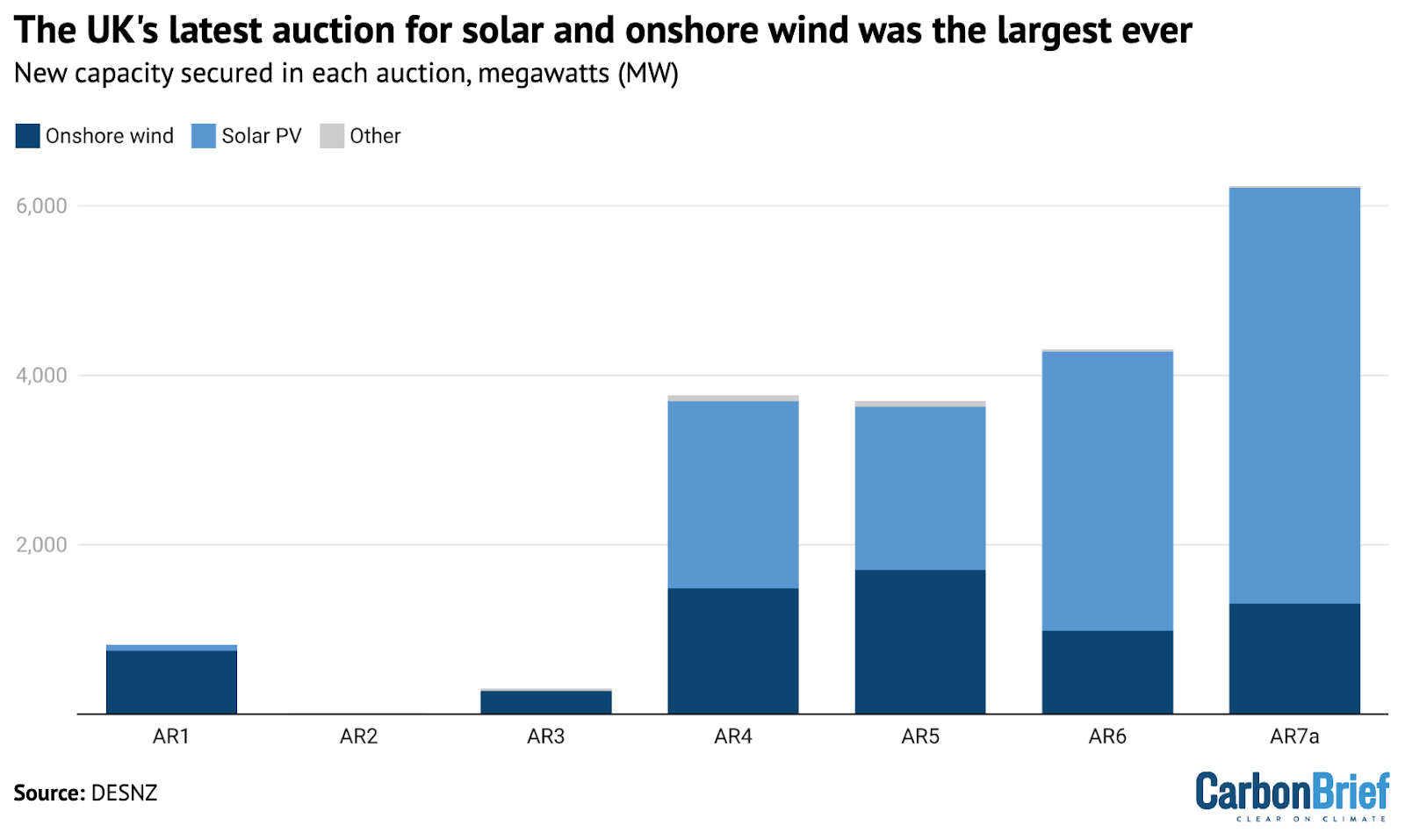 Capacity of solar, onshore wind and other technologies (including tidal) secured at each CfD auction in megawatts. Source: Department of Energy Security and Net Zero.
Most of the solar that secured a contract has a capacity of less than 50MW. This is the cut-off point for projects to be approved by the local council. Larger schemes must instead go through the "nationally significant infrastructure project" (NSIP) process, subject to approval by the secretary of state for energy.
For the first time, one 480MW solar project - approved via this NSIP process - won a CfD in AR7a. The West Burton Solar NSIP is being developed in Lincolnshire and Nottinghamshire by Island Green Power. It is named after the grid connection it will use, freed up by the shuttering of the coal-powered West Burton plant.
However, Nick Civetta, project leader at Aurora Energy Research notes on LinkedIn that this site was only one of four eligible solar NSIPs to secure a contract.
Civetta adds that "wrangling these large projects into fruition is proving more painful than expected".
Solar projects secured a "strike price" of £65/MWh in 2024 prices, some 7% cheaper than the £70/MWh agreed in the previous auction round.
In previous auction rounds CfD contracts were expressed in 2012 prices. For comparison, AR6 and AR7a solar contracts stand at £50/MWh and £47/MWh in 2012 prices, respectively.)
Alongside solar, 28 onshore wind projects secured contracts in the latest CfD auction, with a total capacity of 1.3GW.
This includes the Imerys windfarm in Cornwall, which at nearly 20MW is the largest onshore wind farm in England to secure a contract in a decade.
(Shortly after taking office in 2024, the current Labour government lifted a decade-long de facto ban on onshore wind in England.)
Overall, Scotland still dominated the auction for onshore wind, with 1,093MW of projects in the country in comparison to 38MW in England and 185MW in Wales.
.cb-tweet{ width: 65%; box-shadow: 3px 3px 6px #d3d3d3; margin: auto; } .cb-tweet img{ border: solid 1.25px #333333; border-radius: 5px; } @media (max-width:650px){ .cb-tweet{ width:100%; } }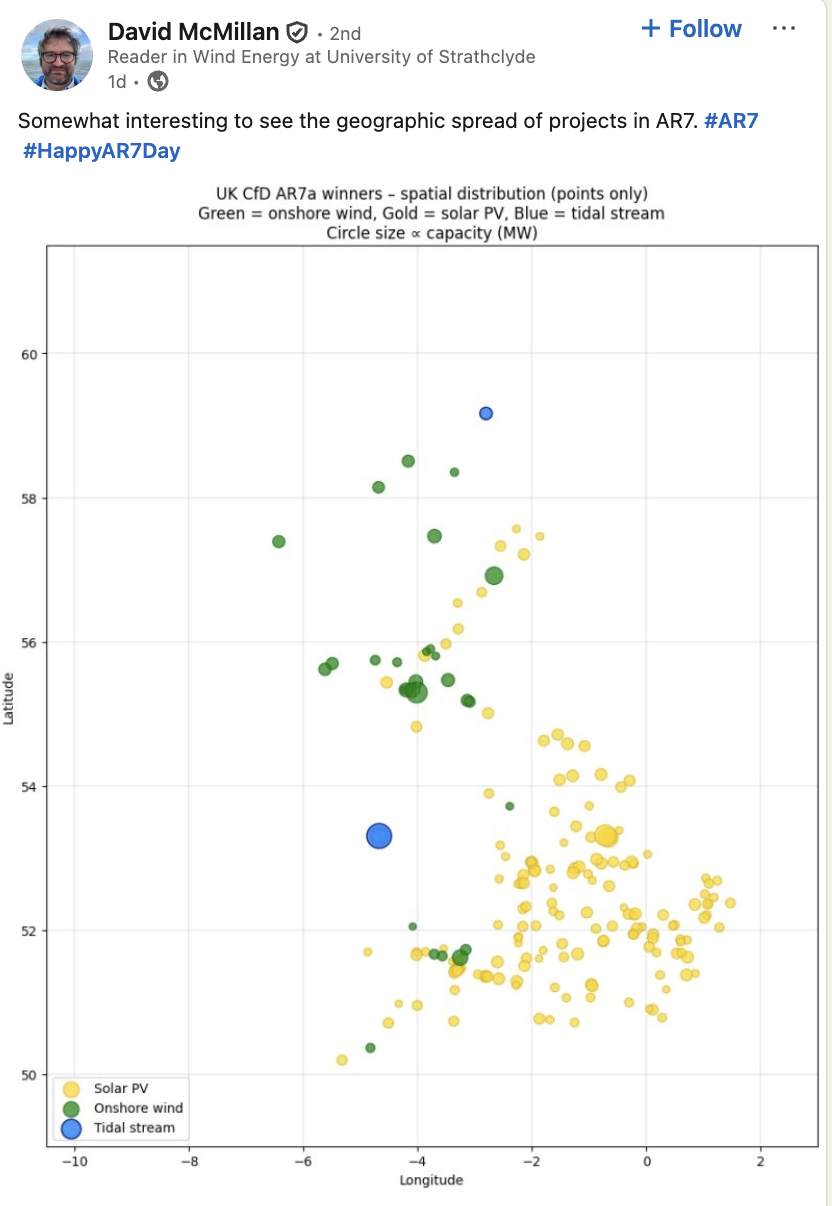
This includes the Sanquhar II windfarm in Dumfries and Galloway in Scotland, which will become the fourth-largest onshore wind farm in the UK at 269MW.
In total, Wales secured contracts for 20 renewables projects in AR7a, with a capacity of more than 530MW. This is the largest ever number of Welsh projects to get backing in a CfD auction, according to a statement from the Welsh government.
Onshore wind secured a strike price of £72/MWh, up slightly from £71/MWh in the previous auction in 2024.
The prices for solar and onshore wind were 13% and 21% below the price cap set by Department of Energy Security and Net Zero (DESNZ) for the auction, respectively.
In its press release announcing the results, the government noted that the results for solar and onshore wind were less than half of the £147/MWh cost of building and operating new gas power stations.
Finally, four tidal energy projects secured contracts with a total capacity of 21MW at a strike price of £265/MWh, up from £240/MWh in 2024.
In total, taken together with the 8.4GW of offshore wind secured in the first part of the auction, AR7 secured a total of 14.7GW of new clean power, as shown in the chart below.
This is enough to power the equivalent of 16 million homes, according to the government. It also makes AR7 the single-largest auction round by far, at more than 50% larger than the previous record set by AR6 in 2024.
This means that the two auction rounds held since the Labour government took office in July 2024 - AR6 and AR7 - have secured a total of 24GW of new renewable capacity. This is more than the 22GW from all previous auction rounds put together.
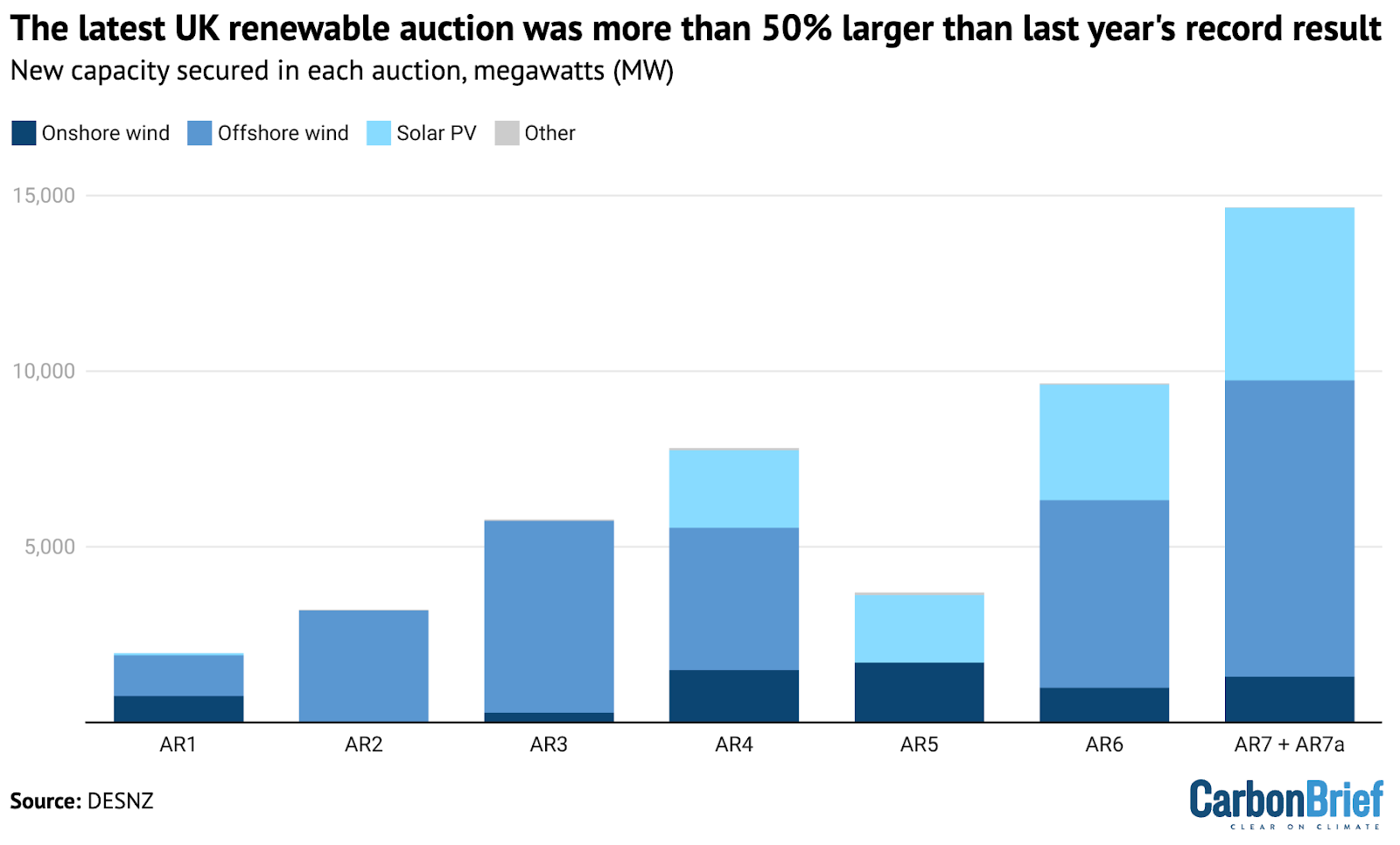 New onshore wind, offshore wind, solar PV and other technologies' capacity secured in each CfD auction, in megawatts. Source: DESNZ.
However, several analysts noted that the AR7a results did not include any old onshore windfarms looking to replace their ageing turbines with new equipment - so-called "repowering projects" - despite the auction being open to them for the first time.
What does the solar and onshore wind auction mean for bills?Onshore wind and solar are widely recognised as the cheapest sources of new electricity generation in almost every part of the world.
The latest auction shows that the UK is no exception, despite its northerly location.
The prices for onshore wind and solar in the latest auction, at £72/MWh and £65/MWh respectively, are comfortably below recent wholesale power prices, which averaged £81/MWh in 2025 and £92/MWh in January 2026.
This means that the new projects will cut costs for UK electricity consumers, according to multiple analysts commenting on the auction outcome.
.cb-tweet{ width: 65%; box-shadow: 3px 3px 6px #d3d3d3; margin: auto; } .cb-tweet img{ border: solid 1.25px #333333; border-radius: 5px; } @media (max-width:650px){ .cb-tweet{ width:100%; } }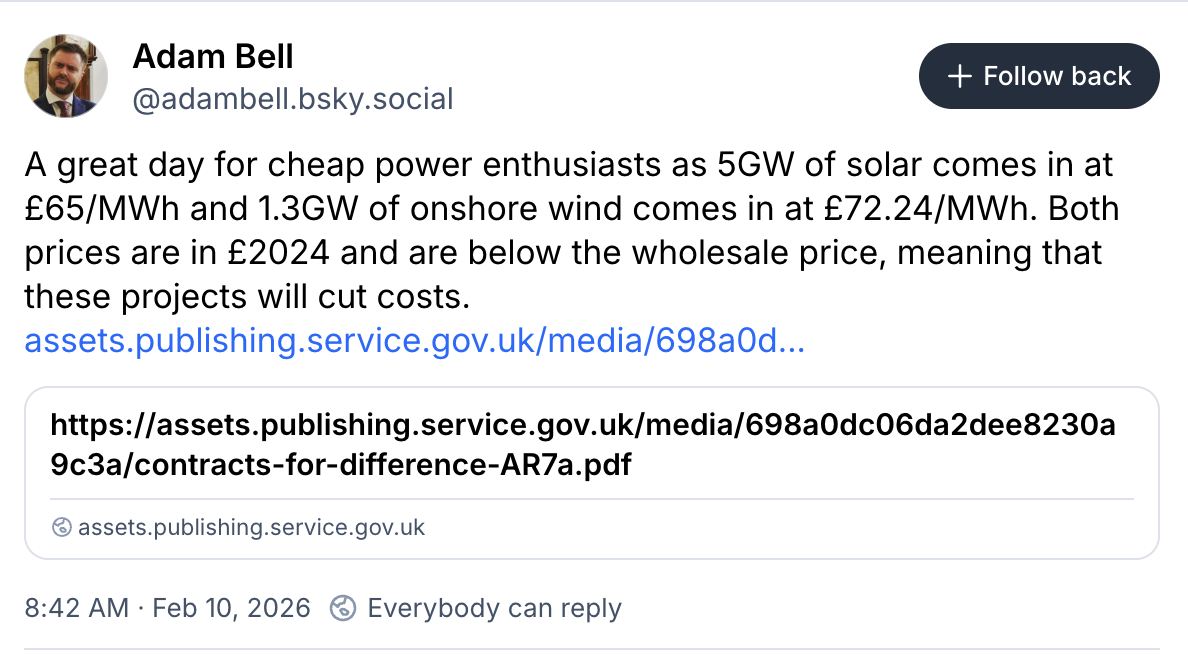
The government lauded the results of AR7a for securing "homegrown energy at good value for billpayers - once again proving that clean power is the right choice for energy security and to meet rising electricity demand".
In a statement, Miliband added:
"By backing solar and onshore wind at scale, we're driving bills down for good and protecting families, businesses, and our country from the fossil fuel rollercoaster controlled by petrostates and dictators. This is how we take back control of our energy and deliver a new era of energy abundance and independence."
As noted in Carbon Brief's coverage of the offshore wind results under AR7 in January, electricity demand is starting to rise as the economy electrifies and many of the UK's existing power plants are nearing the end of their lives.
Therefore, new sources of electricity generation will be needed, whether from renewables, gas-fired power stations or from other sources.
In his statement, quoted above, Miliband said that the prices for onshore wind and solar were less than half the £147/MWh cost of electricity from new gas-fired power stations.
(This is based on recently published government estimates and assumes that gas plants would only be operating during 30% of hours each year, in line with the current UK fleet.)
Trade association RenewableUK also pointed to the cost of new gas, as well as the £124/MWh cost of the Hinkley C new nuclear plant, in its response to the auction results.
In a statement, Dr Doug Parr, policy director for Greenpeace UK, said:
"These new onshore wind and solar projects will supply energy at less than half the cost of new gas plants. Together with the new offshore wind contracts agreed last month, these cheaper renewables will lower energy bills as they come online."
Strike prices for solar dropped by 6% compared to last year and while onshore wind prices rose, this was by less than 2% despite a "difficult environment for wind generation", according to Bertalan Gyenes, consultant at LCP Delta.
In a post on LinkedIn, he noted that "extending the contract length [for onshore wind projects] by five years seems to have helped keep this increase low".
The January offshore wind round secured 8.4 GW at £91/MWh, as such, the onshore and solar projects are 25% cheaper per unit of generation.
(The offshore wind projects secured in January are nevertheless expected to cut consumer bills relative to the alternative, or at worst to be cost neutral.)
Parr added that while the AR7a auction results "show we're getting up to speed" ahead of the clean power 2030 target (see below), "an even faster way for the government to make a really big dent in bills would be to change the system that allows gas to set the overall energy price in this country". He adds:
What does it mean for energy security, jobs and investment?"That would allow us to unshackle our bills from unreliable petrostates and get off the rollercoaster of volatile gas markets once and for all."
The onshore wind and solar projects secured in the latest auction round will generate an estimated 9 terawatt hours (TWh) of electricity, according to Carbon Brief analysis.
This is equivalent to roughly 3% of current UK electricity demand.
Combined with the estimated 37TWh from offshore wind secured during the first part of the auction, AR7 projects will be able to generate 46TWh of electricity, 14% of current demand.
If this electricity were to be generated by gas-fired power plants, then it would require around 95TWh of fuel, because much of the energy in the gas is lost during combustion.
This is several times more than the 25TWh of extra gas that could be produced in 2030 if new drilling licenses are issued, according to thinktank the Energy and Climate Intelligence Unit (ECIU). As such, AR7 will significantly cut UK gas imports, ECIU says, reducing exposure to volatile international gas markets.
Furthermore, ECIU says that the impact of renewables in driving down gas demand - and subsequently electricity prices - is already being seen in the UK.
Five years ago, gas was setting the wholesale price of power in the UK 98% of the time due to the way the electricity market operates.
This price-setting dominance is being eroded by renewables, with recent analysis from the UK Energy Research Centre showing that gas set power prices 90% of the time in 2025.
A further effect of new renewables is that they push the most expensive gas-fired power plants out of the system, reducing prices. This is known as the "merit-order effect".
Recent analysis from ECIU found that large windfarms cut wholesale electricity prices by a third in 2025.
Lucy Dolton, renewable generation lead at Cornwall Insight, said in a statement that the AR7a results will provide a "surge in momentum as [the UK] pushes toward secure, homegrown energy", adding:
"These investments ultimately strengthen the UK's position against volatile gas markets. If the past few years have shown us anything, it's that remaining tied to international energy markets comes with consequences."
The projects that secured CfDs will help the UK avoid burning significant quantities of gas, "the bulk of which would have been imported at a cost which the UK cannot control", said RenewableUK in its statement.
Together with previous CfD auction rounds, the latest new renewable projects are expected to generate some 153TWh of electricity once they are all operating, according to Carbon Brief analysis. This is around half of current UK demand.
Generating the same electricity from gas would require some 311TWh of fuel, which is similar to the 339TWh of gas produced by the UK's North Sea operations in the most recent 12-month period for which data is available. This figure can also be compared with the 130TWh of gas that was imported by ship as liquified natural gas (LNG) in the same period.
The government added that the AR7a projects will support up to 10,000 jobs and bring £5bn in private investment to the UK.
(In total, the new projects secured via AR7 are expected to bring investments worth around £20-23bn to the UK, according to Aurora.)
Additionally, the onshore wind projects are expected to generate over £6.5m in "community benefit" funds for people living near them, according to RenewableUK.
The AR7a results were released alongside the publication of the Local Power Plan by the government and Great British Energy.
This is designed to provide £1bn in funding for communities to own and control their own clean energy projects across the UK.
What does the auction mean for clean power by 2030?The AR7a results put the UK "on track for its 2030 clean power target", according to the government.
Over AR6 and AR7, several changes have been made to the CfD process to help facilitate more projects to secure contracts.
A total of 24GW has been secured over the last two auction rounds - which have taken place under the current Labour government - compared to 22GW across the five auction rounds previously.
As part of its goal for clean power to meet 100% of electricity demand by 2030 and to account for at least 95% of electricity generation, the UK government is aiming for 27-29GW of onshore wind and 45-47GW of solar by the end of the decade.
As of September 2025, the UK had 16.3GW of installed onshore wind capacity and more than 21GW of solar capacity. Taken together, the onshore technologies therefore need to double in operational capacity over the next four years to reach the 2030 targets.
Analysis by RenewableUK suggests that the government will need to procure between 3.85GW to 4.85GW of onshore wind in the next two auctions for the 2030 goal to remain possible.
Writing on LinkedIn, Aurora's Civetta said that the onshore clean power 2030 targets "remain a long way off".
He continued that the gap for solar to reach its 45-47GW target is still a "whopping 18GW", but added that there may be other ways for new capacity to be secured, beyond the CfD auctions.
He said these included a growing market for corporate "power purchase agreements" (PPAs), economic incentives for homes and businesses to install solar and the government's recently released "warm homes plan", all of which "should drive further procurement".
.cb-tweet{ width: 65%; box-shadow: 3px 3px 6px #d3d3d3; margin: auto; } .cb-tweet img{ border: solid 1.25px #333333; border-radius: 5px; } @media (max-width:650px){ .cb-tweet{ width:100%; } }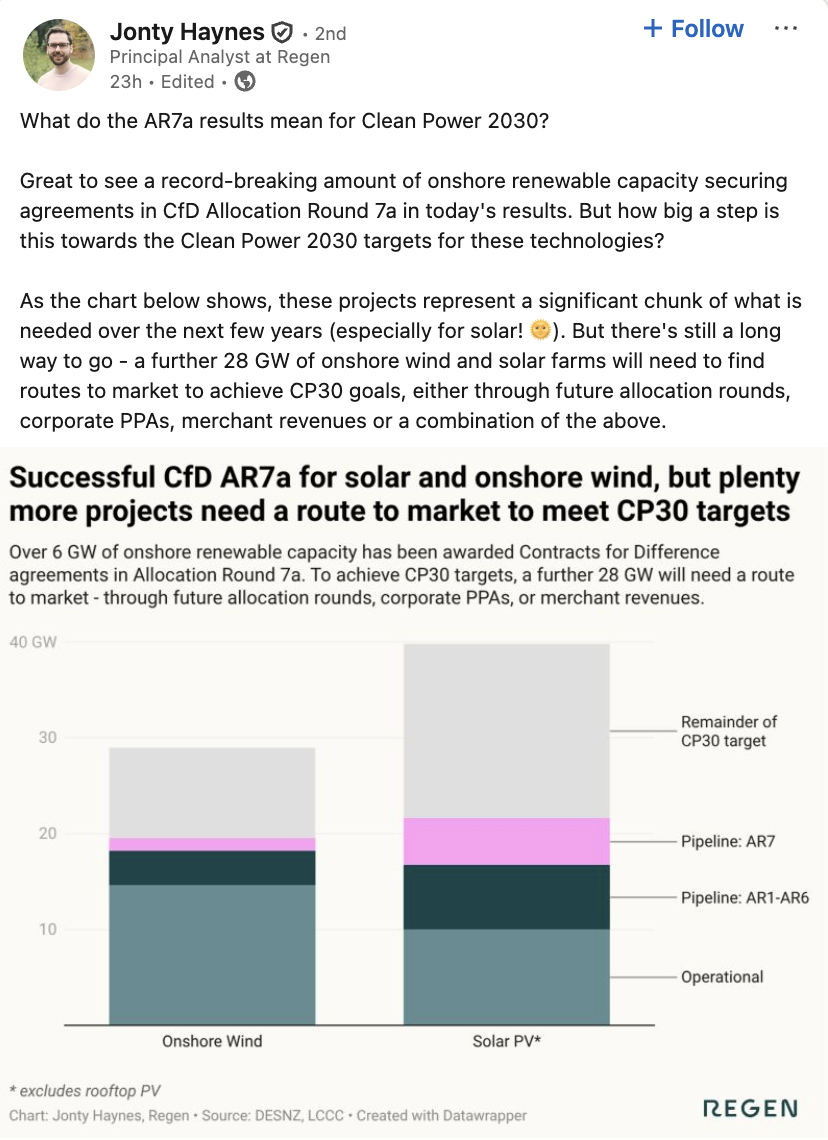
Dolton from Cornwall Insight adds that "the challenge now is delivery", continuing:
"2.5GW of the winners have a delivery year of 2027/28, and over half - 3.7GW - have a delivery year of 2028/29, which brings them very close to the government's 2030 clean power target.
"Historically, renewable projects in the UK have faced delays, often due to grid connection backlogs and planning holdups. With AR7 and some of AR8 representing the only realistic pipeline for pre-2030 capacity, keeping to schedule will be essential."
When built, the projects announced today will help to bring the total capacity of CfD-supported wind and solar to 50.6GW, according to Ember.
While solar and onshore wind are expected to play an important role in decarbonising the electricity system, offshore wind is set to be the "backbone".
The government is targeting 43-50GW of offshore wind by 2030, up from around 17GW of installed capacity today.
This leaves a gap of 27-34GW to the government's target range.
Prior to the AR7 auction, a further 10GW had already secured CfD contracts, excluding the cancelled Hornsea 4 project.
The 8.4GW secured in January brings the gap to reach the minimum of 43GW over the four years to just 7GW.
G7 'falling behind' China as world's wind and solar plans reach new high in 2025
International policy
|10.02.26
Five key climate and energy announcements in India's budget for 2026
Explainers
|04.02.26
Analysis: EVs just outsold petrol cars in EU for first time ever
Energy
|27.01.26

Q&A: What UK's 'warm homes plan' means for climate change and energy bills
Energy
|23.01.26
jQuery(document).ready(function() { jQuery('.block-related-articles-slider-block_99e53f1f9dc00f79a153af73a2fd69dd .mh').matchHeight({ byRow: false }); });The post Q&A: New UK onshore wind and solar is '50% cheaper' than new gas appeared first on Carbon Brief.
The Trump administration's decision to withdraw the US from the intergovernmental science panel for nature "harms everybody, including them", according to its chair.
Dr David Obura is a leading coral reef ecologist from Kenya and chair of the Intergovernmental Science-Policy Platform on Biodiversity and Ecosystem Services (IPBES), the world's authority on the science of nature decline.
In January, Donald Trump announced intentions to withdraw the US from IPBES, along with 65 other international organisations, including the UN climate science panel and its climate treaty.
In an interview with Carbon Brief, Obura says the warming that humans have already caused means "coral reefs are very likely at a tipping point" and that it is now inevitable that Earth "will lose what we have called coral reefs".
A global goal to halt and reverse biodiversity loss by 2030 will not be possible to achieve for every ecosystem, he continues, noting that a lack of action from countries means "we won't be able to do it fast enough at this point".
Despite this, it is still possible to reverse the "enabling drivers" of biodiversity decline within the next four years, he adds, warning that leaders must act as "our economies and societies fully depend on nature".
The interview was conducted at the sidelines of an IPBES meeting in Manchester, UK, where governments agreed to a new report detailing how the "undervaluing" of nature by businesses is fuelling biodiversity decline and putting the global economy at risk.
- On US leaving IPBES: "Any major country not being part of it harms everybody, including themselves."
- On reversing nature loss by 2030: "We won't be able to do it fast enough at this point."
- On the value of biodiversity: "Nature is really the life support system for people. Our economies and societies fully depend on nature."
- On coral reefs: "We will lose what we have called coral reefs up until this point."
- On nature justice: "The places that are most vulnerable don't have the income, or the assets, to conserve biodiversity."
- On IPBES's latest report: "One of the key findings is all businesses have impacts and dependencies on nature."
- On the next UN nature summit: "We need acceleration of activities and impact and effectiveness, more than anything else."
Carbon Brief: Last month Trump announced plans for the US to exit IPBES and dozens of other global organisations. You described this at the time as "deeply disappointing". What are your thoughts on the decision now and what will be the main impacts of the US leaving IPBES?
David Obura: Well, part of the reason that I've come to IPBES is because, of course, I believe in the multilateral process, because we bring 150 countries together, we're part of the UN and the multilateral system and we're based on knowledge [that provides] inputs to policymaking. We have a conceptual framework that looks from the bottom up on how people depend on nature. I'm also doing a lot of science on Earth systems at the planetary level, how our footprint is exceeding the scale of the planet. We have to make decisions together. We need the multilateral system to work to help facilitate that. It has never been perfect. Of course, I come from a region [Kenya] that hasn't been, you know, powerful in the multilateral process.
But we need countries to come together, so any major country not being part of it harms everybody, including themselves. It's very important to try and keep pushing through with the knowledge and keep doing the work that we're doing, so that, over time, hopefully [the US will] rejoin. Because, in the end, we will really need that to happen.
CB: This is the first IPBES meeting since Trump made the announcement. Has it had an impact so far on these proceedings and is there any kind of US presence here?
DO: This plenary is like every plenary that we have had. The current members are here. Some members are not. And, of course, we have some states here as observers working out if they're going to join or not. And then we have a lot of private sector observers and universities and so on. The impact of a country leaving - the US in this case - has no impact on the plenary itself, because they're not here making decisions on the things that we do.
We, of course, don't have US government members attending in technical areas, but we do have institutions and universities and academics here attending as they have in the past. So, in that sense, the plenary goes on as it goes on - the science and the knowledge is the same. The decision-making processes we have here are the same. And, as I said earlier, what has an impact is the actual action that takes place afterwards, because a lot of the recommendations that we make are based on enabling conditions that governments put in place, to bring in place sustainability actions and so on. When governments are not doing that, especially major economic drivers, then the whole system suffers.
CB: When you were appointed as chair of IPBES more than two years ago, you said that your aim was to strengthen cohesion and impact and also get the findings of IPBES in front of more people. So how would you rate your progress on this now that it's been about a couple of years?
DO: Well, like any intergovernmental process, we have a certain amount of inertia in what we do and it takes a few years to consult on topics for assessments and then to do them and to improve them and get them out.
One of the main things we're discussing right now is we have had a rolling work programme from when IPBES started until 2030 and we need to decide on the last few deliverables and how we work in that period. We are asking for a mandate to spend the next year really considering the multiple options that we have in proposing a way forward for the last few years of this work programme. I feel that the countries are very aligned. We have done a lot of work, produced a lot of outputs. It is challenging for governments and other stakeholders to read our assessments and reach into them to find what's useful to them. They make constant calls for more support, in uptake, in capacity building and in policy support.
The second global assessment in 2028 will be our 17th assessment [overall]. We would like to focus on really bringing all this knowledge together across assessments in ways that are relevant to different governments, different stakeholder groups, different networks to help them reach into the knowledge that's in the assessments. And I think the governments, of course, want that as well, because many of them are calling for it. Many of the governments that support us financially, of course, want to see a return of investment on the money that they have put in.
CB: Nations agreed to halt and reverse biodiversity loss by 2030. Back in 2023 we had a conversation for Carbon Brief and you said that you were "highly doubtful" this goal could be achieved for every ecosystem by that date. Where do you stand on this now?
DO: I work on coral reefs and part of the reason I've come to IPBES platform is because the amount of climate change we're committed to with current fossil fuel emissions and the focus on economic growth means that corals will continue to decline 20, 30, 40 years into the future. I think of that there's no real doubt. The question is how soon we put in place the right actions to halt climate change. That will then have a lag on how long it takes for corals to cope with that amount of climate change.
We can't halt and reverse the decline of every ecosystem. But we can try and bend the curve to halt and reverse the drivers of decline. So, that's some of the economic drivers that we talk about in the nexus and transformative change assessment, the indirect drivers and the value shifts we need to have. What the Global Biodiversity Framework [GBF, a global nature agreement made in 2022] aspires to do in terms of halting and reversing biodiversity decline - we absolutely need to do that. We can do it and we can put in place the enabling conditions for that by 2030 for sure. But we won't be able to do it fast enough at this point to halt [the loss of] all ecosystems.
We're now in 2026, so this is three years plus after the GBF was adopted. We still need greater action from all countries and all stakeholders and businesses and so on. That's what we're really pushing for in our assessments.
CB: Biodiversity loss has historically been underappreciated by world leaders. As the world continues to be gripped by geopolitical uncertainty, conflict and financial pressures, what are your thoughts on the chances of leaders addressing the issue of biodiversity loss in a meaningful way?
DO: What are the chances of addressing biodiversity loss? I mean, we have to do it. It's really our life support system and if we only focus on immediate crises and threats and don't pay attention to the long-term threats and crises, that only creates more short-term crises down the line, we make it harder and harder to do that. I hope that what I'm hoping we get to understand better through IPBES science, as well as others, is that we're not just reporting on the state of biodiversity because it's nice to have it, but it's [because] diversity of nature is really the life support system for people. Our economies and societies fully depend on nature. If we want them to prosper and be secure into the long-term future, we have to learn how to bring the impact and dependencies of business, which is a focus of this assessment, in line with nature. And until we do that, we will just continue to magnify the potential for future crises and their impacts.
CB: You mentioned already that your expertise is in coral reefs. A report last year warned that the world has reached its first climate tipping point, that of widespread dying of warm water coral reefs. Do you agree with that statement and can you discuss the wider state of coral reefs across the world at this present moment?
DO: The report that came out last year in 2025 was a global tipping point report and it's actually in 2023 the first one of those [was published]. I was involved in that one and we basically took what the IPCC [Intergovernmental Panel on Climate Change] has produced, which [is] compiled from the [scientific] literature [which said] that 1.5-2C was the critical range for coral reefs, where you go from losing 70-90% to 90-99% of coral reefs around the world. [It is] a bit hard to say exactly what that means. What we did was we actually reduced that range from 1.5C-2C to 1-1.5C, based on observations we've already made about loss of corals. In 2024, the world was 1.5C above historical conditions for one year. The IPCC number requires a 20-year average [for 1.5C to be crossed]. So, we're not quite at the IPCC limit, but we're very close. Also, with not putting in place fast enough emission reductions, warming will continue.
Coral reefs are very likely at a tipping point. And, so, I do agree with the statement. It means that we lose the fully connected regional, global system that coral reefs have been in the past. There will still be some coral reefs in places that have some natural protection mechanisms, whether it's oceanographic or some levels of sedimentation in green water from rivers can help. And there's resilience of corals as well. Some corals will be able to adapt somewhat, but not all - and not all the other species too. We will lose what we have called coral reefs up until this point. We'll still continue to have simpler coral ecosystems into the future, but they won't be quite the same.
It is a crisis point and my hope is that, in coming out from the coral reef world, I can communicate that this is, this has been a crisis for coral reefs. It's a very important ecosystem, but we don't want it to happen to more and more and more ecosystems that support more [than] hundreds of millions and billions of people as well. Because, if we let things go that far, then, of course, we have much bigger crises on our hands.
CB: Something else you've spoken about before is around equity being one of the big challenges when it comes to responding to biodiversity loss. Can you explain why you think that biodiversity loss should be seen as a justice issue?
DO: Well, biodiversity loss is a justice issue because we are a part of biodiversity and - just like the loss of ecosystems and habitats and species - people live locally as well. People experience biodiversity loss in their surroundings.
The places that are most vulnerable and don't have the income, or the assets, to either conserve biodiversity, or need to rely on it too much so they degrade it - they feel the impacts of that loss much more directly than those who do have more assets. Also, the more assets you have, the more you can import biodiversity products and benefits from somewhere else.
So, it's very much a justice issue, both from local levels experiencing it directly, but then also at global levels. We are part of it [biodiversity], we don't own it. It's a global good, or a common public good, so we need to be preserving it for all people on the planet. In that sense, there are many, many justice issues that are involved in both loss of biodiversity and how you deal with that as well.
CB: How would you say IPBES is working towards achieving greater equity in biodiversity science?
DO: One of the headline findings of our values assessment in 2022, which looked at multiple values different cultures have and different worldviews around the planet, [was that] by accommodating or considering different worldviews and different perspectives, you achieve greater equity because you're already considering other worldviews in making decisions.
So, that's an important first step - just making it much more apparent and upfront that we can't just make decisions, especially global ones, from a single worldview and the dominant one is the market economic worldview that we have. That's very important.
But, then, also in how we do our assessments and the knowledge systems that are incorporated in them. We integrate different knowledge systems together and try and juxtapose - or if they can be integrated, we do that, sometimes you can't - but you just need to illustrate different worldviews and perspectives on the common issue of biodiversity loss or livelihoods or something like that.
We hope that our conceptual framework and our values framework really help bring in this awareness of multiple cultures and multiple perspectives in the multilateral system.
CB: When this interview is published, IPBES will have released its report on business and biodiversity. What are some of the key takeaways from this?
DO: Our assessments integrate so much information that the key messages are actually, in retrospect, quite obvious in a way. One of the key findings it will say is that all businesses have impacts and dependencies on nature.
Of course, when you think about it, of course they do. We often think, "oh, well ecotourism is dependent on nature", but even a supermarket is dependent on nature because a lot of the produce comes from a natural system somewhere, maybe in a greenhouse or enhanced by fertiliser, but it still comes from natural systems. Any other business will have either impacts on the nature around it, or it needs tree shade outside so people can walk in and things like that.
So, that's one of the main findings. It's not just certain sectors that need to respond to biodiversity loss and minimise their impacts. All sectors need to. Another finding, of course, is that it's very differentiated depending on the type of business and type of sector.
It's also very differentiated in different parts of the world in terms of responsibilities and also capabilities. So small businesses, of course, have much less leeway, perhaps, to change what they're doing, whereas big businesses do and they have more assets, so they can deal with shifts and changes much better.
It's a methodological assessment, rather than assessing the state of businesses, or the state of nature in relation to businesses [and] they pull together a huge list of methodologies and tools and things that businesses can access and do to understand their impacts and dependencies and act on them. Then [there is] also guidance and advice for governments on how to enable businesses to do that with the right incentives and regulations and so on. In that sense, it helps bring knowledge together into a single place.
It has been fantastic to see the parallel programme that the UK government has organised [at the IPBES meeting in Manchester]. It has brought together a huge range of British businesses and consultancies and so on that help businesses understand their impacts on nature. There's a huge thirst.
To some extent, I would have thought, with so much capacity already in some of these organisations, what would they learn from our assessments? But they're really hungry to see the integration. They really want to see that this really does make a big difference, that others will do the same, that the government will really support moving in these directions. There's a huge amount of effort in the findings coming out and I'm sure that that will be felt all around the world and in different countries in different ways.
CB: As we're speaking now, you're still in the midst of figuring out exactly what the report will say and going through line-by-line to figure this out. Something we've seen at other negotiations…has been these entrenched views from countries on certain key issues. And one thing I did notice in the Earth Negotiations Bulletin discussion of yesterday's [4 February] negotiations was that it said that some delegations wanted to remove mentions of climate change from the report. Has this been a key sticking point here or have there been any difficulties from countries during these negotiations?
DO: The nature of these multilateral negotiations is that the science is, in a way, a central body of work that is built through consensus of bringing all this knowledge together. It's almost like a centralising process. And, yes, different countries have different perspectives on what their priorities are and the messages they want to see or not.
We still, of course, deal with different positions from countries. What we hope to do is to be able to convene it so that we see that we serve the countries best by having the most unbiased reporting of what the science is saying in language that is accessible to and useful to policymakers, rather than not having language or not having mention of things in in the agreed text.
How it'll work out, I don't know. Each time is different from the others. I think one of the key things that's really important for us is that you do have different governance tracks on different aspects of the world we deal in. So, the [UN] Sustainable Development Goals, as well [as negotiations] on climate change - the UNFCCC, the climate convention, is the governing body for that. There's two goals on nature - the Convention on Biological Diversity and other multilateral agreements are the institutions that govern that part.
We have come from a nature-based perspective, with nature's contributions to a good quality of life for people…We start in the nature goals, but we actually have content that relates to all the other goals. We need to consider climate impacts on nature, or climate impacts on people that affect how they use nature. The nexus assessment was, in a way, a mini SDG report. It looked at six different Sustainable Development Goals.
We try and make sure that while on the institutional mechanisms, certain countries may try and want us to report within our mandate on nature, we do have findings that relate to climate change that relate to income and poverty and food production and health systems [and] that we need to report [outwardly] so that people are aware of those and they can use those in decision-making contexts.
That's a difficult discussion and every time it comes out a little bit differently. But we hope we move the agenda further towards 2030 in the SDGs. We have an indivisible system that we need to report on.
CB: The next UN biodiversity summit COP17 is taking place later this year. What are the main outcomes you're hoping to see at that summit?
DO: The main outcomes I would hope to see from the biodiversity summit is greater alignment across the countries. We really need to move forward on delivering on the GBF as part of the sustainable development agenda as well. So there will be a review of progress. We need acceleration of activities and impact and effectiveness, more than anything else.
That means, of course, addressing all of the targets in the GBF. Not equally, necessarily, but they all need progress to support one another in the whole. We work to provide the science inputs that can help deliver that through the CBD [Convention on Biological Diversity] mechanisms as well. We hope they use our assessments to the fullest and that we see good progress coming out.
CB: Great, thank you very much for your time.

Prof Ben Santer: Trump administration is 'embracing ignorance' on climate science
Interviews
|15.01.26

Interview: How 'mid-level bureaucrats' are helping to shape Chinese climate policy
China energy
|09.12.25

The Carbon Brief Interview: UK Met Office chief executive Penny Endersby
In Focus
|23.10.25

The Carbon Brief Interview: UK Climate Change Committee's Emma Pinchbeck
Interviews
|16.10.25
jQuery(document).ready(function() { jQuery('.block-related-articles-slider-block_9e2ddb3c7a408710af03dd93037138ec .mh').matchHeight({ byRow: false }); });The post IPBES chair Dr David Obura: Trump's US exit from global nature panel 'harms everybody' appeared first on Carbon Brief.
The hot, dry and windy weather preceding the wildfires that tore through Chile and Argentina last month was made around three times more likely due to human-caused climate change.
This is according to a rapid attribution study by the World Weather Attribution (WWA) service.
Devastating wildfires hit multiple parts of South America throughout January.
The fires claimed the lives of 23 people in Chile and displaced thousands of people and destroyed vast areas of native forests and grasslands in both Chile and Argentina.
The authors find that the hot, dry and windy conditions that drove the "high fire danger" are expected to occur once every five years, but that these conditions would have been "rarer" in a world without climate change.
In today's climate, rainfall intensity during the "fire season" is around 20-25% lower in the areas covered by the study than it would be in a world without human-caused emissions, the study adds.
Study author Prof Friederike Otto, professor of climate science at Imperial College London, told a press briefing:
'Significant' damage"We're confident in saying that the main driver of this increased fire risk is human-caused warming. These trends are projected to continue in the future as long as we continue to burn fossil fuels."
The recent wildfires in Chile and Argentina have been "one of the most significant and damaging events in the region", the report says.
In the lead-up to the fires, both countries were gripped by intense heatwaves and droughts.
The authors analysed two regions - one in central Chile and the other in Argentine Patagonia, along the border between Argentina and Chile.
For example, in Argentina's northern Patagonian Andes, the last recorded rainfall was in mid-November of 2025, according to the report. It adds that in early January, the region recorded 11 consecutive days of "extreme maximum temperatures", marking the "second-longest warm spell in the past 65 years".
Dr Juan Antonio Rivera, a researcher at the Argentine Institute of Snow Science, Glaciology and Environmental Sciences, told a WWA press briefing that these weather conditions dried out vegetation and decreased soil moisture, which meant that the fires "found abundant fuel to continue over time".
In the northern Patagonian Andes of Argentina, wildfires started on 6 January in Puerto Patriada and spread over two national parks of Los Alerces and Lago Puelo and nearby regions. These fires remained active into the first week of February.
The fires engulfed more than 45,000 hectares of native and planted forest, shrublands and grasslands, including 75% of native forests in the village of Epuyén, notes the study.
At least 47 homes were burned, according to El País. La Nación reported that many families evacuated themselves to prevent any damage.
In south-central Chile, wildfires occurred from 17 to 19 January, affecting the Biobío, Ñuble and Araucanía regions.
They started near Concepción city, the capital of the Biobío region, where maximum temperatures reached 26C. In the nearby city of Chillán, temperatures reached 37C.
From there, the fires spread southwards to the coastal towns of Penco-Lirquen and Punta Parra, in the Biobío region.
The event left 23 people dead, 52,000 people displaced and more than 1,000 homes destroyed in the country, according to the study.
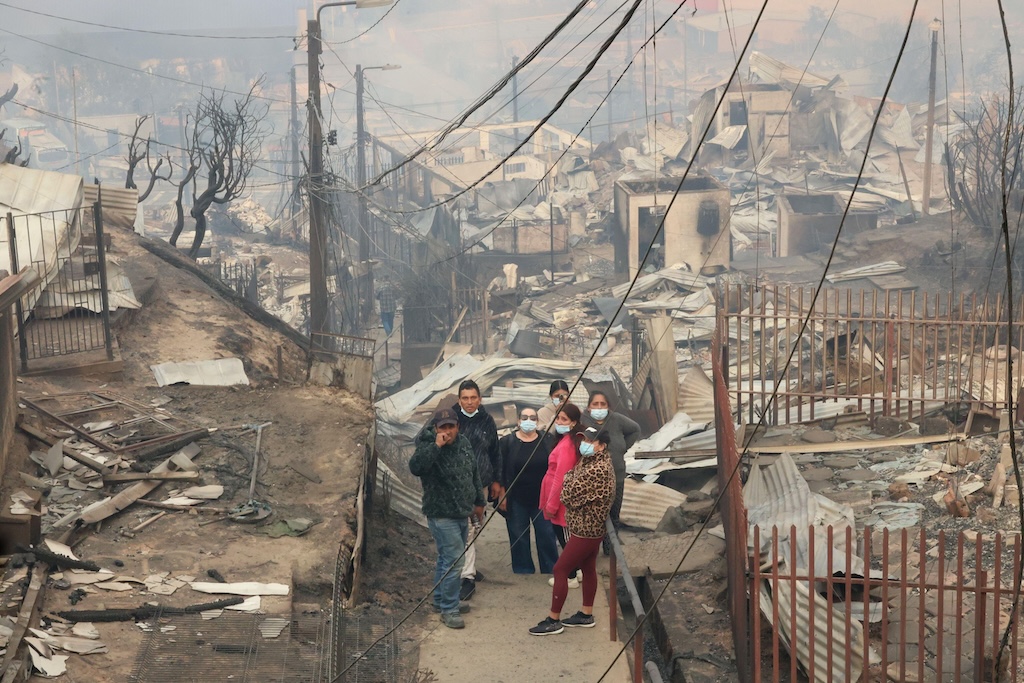 Inhabitants of Lirquen, in Chile, walk through the homes consumed by the flames in January 2026. Credit: UNAR Photo / Alamy Stock Photo.
These wildfires burnt more than 40,000 hectares of forests, "tripling the amount of land burned in 2025" across the country, reported La Tercera.
The study adds that more than 20,000 hectares of non-native forest plantations, including Monterey pine and Eucalyptus trees, were consumed by the blaze and critical infrastructure was affected.
A WWA press release points out that the expansion of non-native pines and invasive species "has created highly flammable landscapes in Chile".
Hot, dry and windyWildfires are complex events that are influenced by a wide range of factors, such as atmospheric moisture, wind speed and fuel availability.
To assess the impact of climate change on wildfires, the authors chose a "fire weather" metric called the "hot dry windy index" (HDWI). This combines maximum temperature, relative humidity and wind speed.
While this metric does not include every component that could contribute to intense wildfires, such as land-use change and fuel load data, study author Dr Claire Barnes from Imperial College London told a press briefing that HDWI is "a very good predictor of short-term, extreme, dry, fire-prone conditions".
The authors chose to analyse two separate regions. The first lies along the coast and the foothills of the Andes around the Ñuble, Biobío and La Araucanía regions in central Chile. The second sits across the Chilean and Argentine border in Patagonia.
These regions are shown on the map below, where red circles indicate the wildfires recorded in January 2026 and pink boxes represent the study areas.
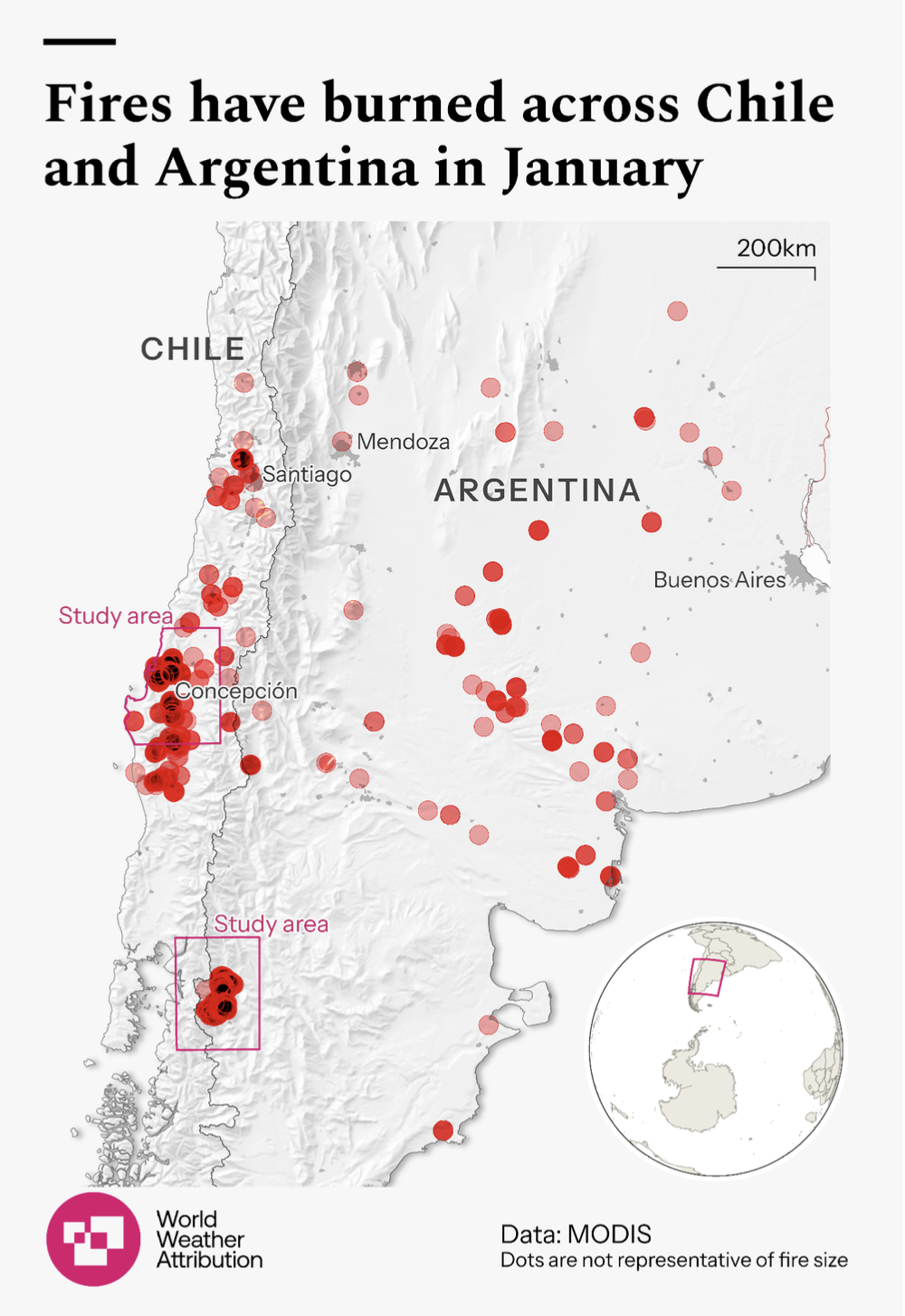 Location of forest fires in Chile and Argentina in January 2026 (red circles) and the study areas (pink boxes). Source: WWA (2026).
The authors also selected different time periods for the two study regions, to reflect the "different lengths of peak wildfire activity associated with the fires in each region".
For the central Chilean study area, the authors focus their analysis on the two most severe days of HDWI, 17-18 January. For the Patagonian region, they focus on the most severe five-day period, which took place over 2-6 January.
To put the wildfire into its historical context, the authors analyse data on temperature, wind and rainfall to assess how HDWI over the two regions has changed since the year 1980.
They find that in both study regions, the high HWDI recorded in January is not "particularly extreme" in today's climate and would typically be expected roughly once every five years. However, they add that the event would have been "rarer" in a world without climate change, in which average global temperatures are 1.3C cooler.
The authors also use a combination of observations and climate models to carry out an "attribution" analysis, comparing the world as it is today to a "counterfactual" world without human-caused climate change.
They find that climate change made the high HDWI three-times more likely in the central Chilean region and 2.5-times more likely in the Patagonian region.
The authors also conduct analysis focused solely on November-January rainfall.
Both study regions experienced "very low rainfall" in the months leading up to the fires, the authors say. They find that fire-season rainfall intensity is around 25% lower in the central Chilean region and 20% lower in the Patagonia region in today's climate than it would have been in a world without climate change.
Finally, the authors considered the influence of climatic cycles such as the El Niño-Southern Oscillation (ENSO), a naturally occurring phenomenon that affects global temperatures and regional weather patterns.
They find that a combination of La Niña - the "cool" phase of ENSO - combined with another natural cycle called the Southern Annular Mode, led to atmospheric circulation patterns that "favoured the hot and dry conditions that enhanced fire persistence and severity in parts of the region".
However, they add that this has a comparably small effect on the overall intensity of the wildfires, with climate change standing out as the main driver.
(These findings are yet to be published in a peer-reviewed journal. However, the methods used in the analysis have been published in previous attribution studies.)
Vulnerable communitiesThe wildfires affected native forests, national parks and small rural and tourist communities in both countries.
A 2025 study conducted in Chile, cited in the WWA analysis, found that 74% of survey respondents did not have appropriate education and awareness on wildfires.
This suggests that insufficient preparedness on early warning signs, response measures and prevention can "exacerbate the severity and frequency of these events", the WWA authors say.
Aynur Kadihasanoglu, senior urban specialist at the Red Cross Red Crescent Climate Center, said in the WWA press release that many settlements in Chile are close to flammable pine plantations, which "puts lives and livelihoods at risk".
Additionally, the head of Chile's National Forest Corporation pointed to "structural shortcomings" in fire prevention, such as lack of regulation in lands without management plans, reported BioBioChile.
In Argentina, the response to the fires has been hampered by large budget cuts and reductions in forest rangers, according to the WWA press release. Experts have criticised Argentina's self-styled "liberal-libertarian" president Javier Milei for the cuts and the delay to declaring a state of emergency in Patagonia.
According to the Associated Press, "Milei slashed spending on the National Fire Management Service by 80% in 2024 compared to the previous year". The service "faces another 71% reduction in funds" in its 2026 budget, the newswire adds.
Argentinian native forests and grasslands are experiencing "intense pressure" from wildfires, according to the study. Many vulnerable native animal species, such as the huemul and the pudú, are losing critical habitat, while birds, such as the Patagonian black woodpecker, are losing nesting sites.
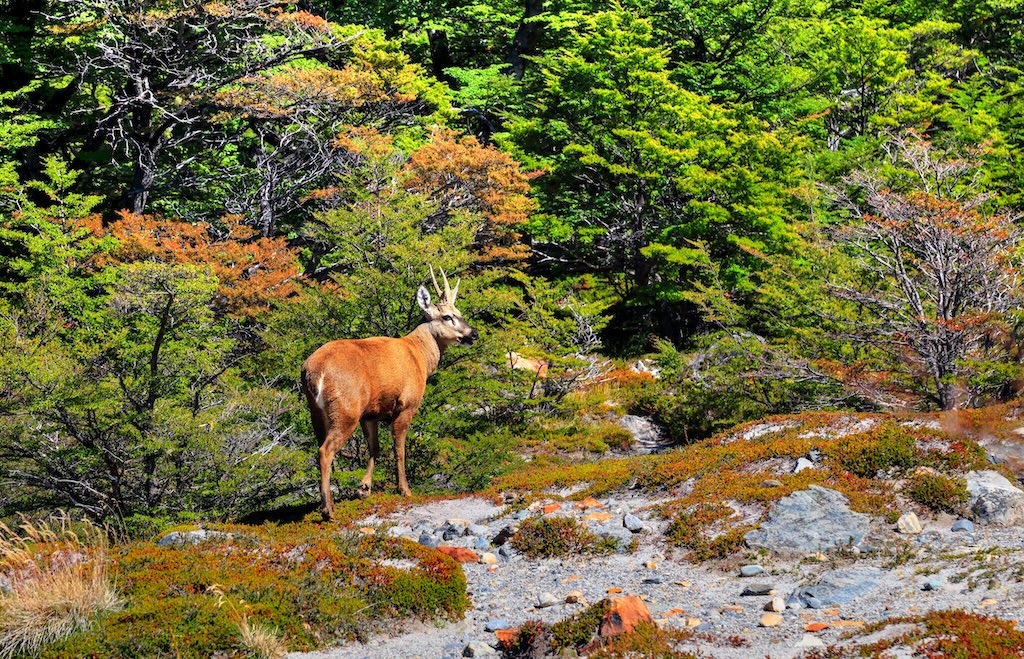 Huemul deer in Argentine Patagonia, one of the vulnerable animal species to wildfires in the region. Credit: Bernardo Galmarini / Alamy Stock Photo.
Climate change and La Niña made 'devastating' southern African floods more intense
Attribution
|29.01.26

Analysis: What are the causes of recent record-high global temperatures?
El Niño
|10.12.25

Met Office: Ten years of naming UK storms to warn the public
Guest posts
|13.11.25
Global wildfires burned an area of land larger than India in 2024
Land and soils
|16.10.25
jQuery(document).ready(function() { jQuery('.block-related-articles-slider-block_61678c92e1affd8869aa7a79297160f3 .mh').matchHeight({ byRow: false }); });The post Climate change made 'fire weather' in Chile and Argentina three times more likely appeared first on Carbon Brief.
 In Europe: Elon Musk Must Answer for Grok's "Spicy" Algorithm [ 11-Feb-26 2:36pm ] France Will Electrify with Renewables and New Nuclear [ 11-Feb-26 2:03pm ]
Will artificial snow save the ski industry in the long run - or curse it? [ 11-Feb-26 1:16pm ]
In Europe: Elon Musk Must Answer for Grok's "Spicy" Algorithm [ 11-Feb-26 2:36pm ] France Will Electrify with Renewables and New Nuclear [ 11-Feb-26 2:03pm ]
Will artificial snow save the ski industry in the long run - or curse it? [ 11-Feb-26 1:16pm ]At the Winter Olympics, athletes race down immaculate white slopes. The snow looks perfect. But it is largely manufactured.
In Italy, where rising temperatures and declining snowfall were felt earlier than in other Alpine regions, technological fixes began in the 1990s. Today, reliance on artificial snow is widespread: around 95% of Italian ski resorts use snowmaking, and more than 70% of slopes are covered by artificial snow during the season.
Modern snowmaking uses a large fan-like "snow canon" to spray tiny droplets of water into cold air, where they freeze before landing on the ground. Vehicles known as piste bashers (in Europe) or snowcats (in North America) then compress and groom that new snow until it forms a more stable base. The process does not rely on chemical additives. It has become so effective that it can now guarantee competition-grade conditions even when natural snowfall is increasingly unreliable.
Together with colleagues at the Universities of Oxford and Trento, I have been part of the Hot Snow project, investigating what all this means for the ski industry.
 A 'snow canon' blasts tiny droplets into the air, where they freeze into snowflakes before landing.
Gherzak / shutterstock
A 'snow canon' blasts tiny droplets into the air, where they freeze into snowflakes before landing.
Gherzak / shutterstock
We know that continuous innovation - often referred to by the industry as "technical snow" - has helped protect winter sports. Yet we found it also carries a less visible risk: successful adaptation through artificial snow can make the ski industry complacent about climate change.
How artificial snow really worksIn leading resorts, artificial snowmaking process is data-driven and highly automated. At the touch of a tablet, operators can adjust the quality and density of new snow, depending on temperature, humidity and the sort of surface they want to create. This produces snow that can be more controllable and durable than natural snowfall.
Snowmaking systems have become more energy efficient over time. Production is optimised to exploit the coldest possible weather windows, reducing energy use per cubic metre of snow. In regions such as the Dolomites, where the Olympic ski races are being held, resorts largely rely on renewable electricity and rainwater stored in artificial basins.
 A snow cannon fires out water mist that will fall as snow.
Beekeepx / shutterstock
A snow cannon fires out water mist that will fall as snow.
Beekeepx / shutterstock
Even so, artificial snow remains energy intensive. In Italian ski resorts, snowmaking accounts for around 30-40% of total energy consumption, with annual costs of €50 million to €100 million (£44 million to €88 million). Across the Alps, total energy demand for artificial snow is estimated at around 2,100 gigawatt-hours per winter season - roughly equivalent to the total annual domestic electricity use of Milan.
The water footprint is just as significant. Artificial snow production in Italy alone consumes around 100-150 million cubic metres of water each year - roughly equivalent to the annual water use of between 1 million and 1.5 million people.
In regions where winter precipitation is becoming less reliable and summers are growing hotter and drier, this growing competition for water adds another layer of pressure, particularly for mountain communities and downstream users. For this reason, ski resorts increasingly rely on artificial reservoirs to store water which, though useful in dry seasons, are often harmful to mountain landscapes and ecosystems.
When adaptation becomes a trapThe effectiveness of snowmaking is both a blessing and a curse.
Across Europe, artificial snow now underpins much of the ski industry. In many regions, slopes depend on it to open at all. This technological success creates what economists call a lock-in effect. Resorts continue to invest heavily in snow cannons, reservoirs and grooming vehicles, even in areas where artificial snow may soon become unviable.
 In a dry or warm winter, snowmaking is crucial. This photo was taken in the Dolomites in January 2018: a bare mountainside with machine-made snow.
Stefano Politi Markovina / shutterstock
In a dry or warm winter, snowmaking is crucial. This photo was taken in the Dolomites in January 2018: a bare mountainside with machine-made snow.
Stefano Politi Markovina / shutterstock
At the same time, rising infrastructure costs requires a constant increase in consumer prices. Ski pass prices have increased by around 40% since 2021, further turning skiing into a sport accessible only to those with deep pockets. Each new investment further entrenches this trajectory, making it progressively harder to step back and rethink alternatives for the future of these resorts.
The illusion of controlSome snowmaking systems can technically operate even when air temperatures rise above freezing, albeit at a very high energy cost. One manufacturer has demonstrated technology capable of producing snow at ambient temperatures of up to 20°C. That possibility reinforces a dangerous narrative: that innovation alone will solve the problem.
But climate projections suggest there will come a point when even artificial snow cannot compensate for warming conditions at many altitudes. In Italy, most resorts located around 1,000 metres above sea level have abandoned hopes of operating consistently, while skiing in the Apennines - once a preferred destination for central and southern Italy - has largely shut down.
When artificial snow stops being viable, the transition is often abrupt. Resorts are left with stranded assets and communities face sudden economic shocks. This is what we describe as an "expiring industry", one that can appear economically healthy today while facing a clear climate-driven end date.
The danger is not collapse tomorrow, but delay today. As long as slopes remain open and bookings stay strong, there is little incentive to invest in alternatives. After all, winter tourism is still worth over €11 billion (£9.6 billion) a year to the Italian economy alone.
What should changeThose who benefit from the status quo are unlikely to propose alternative futures. Public policy therefore plays a crucial role in shaping which futures remain possible.
Continuing to subsidise ski infrastructure may keep slopes open for a few more seasons, but it also deepens reliance on winter snow in places where long-term viability is increasingly uncertain. It risks diverting public money, attention and political capital away from transitions that could actually endure.
A different approach would make public support conditional. Resorts could be required to disclose water and energy use transparently, and to present credible plans to diversify beyond winter-only tourism rather than simply extending it. This would also mean scrutinising claims that lift infrastructure can function as sustainable, year-round transport — a justification often used to secure public funding, but rarely realised in practice.
I'm a passionate skier myself. As a Veneto native, the Dolomites are my favourite place to ski. So this is not about blaming skiers or dismissing snowmaking technology, which has helped sustain jobs in the mountain communities of my region.
The problem is mistaking successful short-term adaptation for a viable long-term strategy. When technological fixes stand in for long-term planning, they delay investment in alternatives and leave regions more exposed when climate limits are finally reached.
As long as artificial snow keeps slopes white against an increasingly green landscape, it is easy to believe alpine skiing will always be there. But this is not simply kicking the can down the road. It is pushing it uphill. And metre by metre, the slope is getting steeper.

Paolo Aversa works on the Hot Snow project with professor Juliane Reinecke at the University of Oxford and professor Alberto Nucciarelli and Dr Edoardo Trincanato at the University of Trento. The research has been supported by The Center of Sustainable Business at King's Business School, The Fondazione CARITRO, and the Center for Sports and Business at the Stockholm School of Economics.
Faraday Future Follows Tesla's EV Playbook, Only Better [ 11-Feb-26 2:09pm ]The US startup Faraday Future is positioning its new Super One BEV as a stepping-stone to more affordable EVs, targeting the domestic market among others.
The post Faraday Future Follows Tesla's EV Playbook, Only Better appeared first on CleanTechnica.
A Consumer Choice Gap in the Computer Market — And a Simple Fix [ 11-Feb-26 1:41pm ]AI is advancing fast. Digital education is expanding. Skills training, technical work, small business digitization, and creator economies are growing across the world — especially across Global South markets. But all of these futures share one very practical dependency: affordable computing devices. Phones connect people. Computers enable them to build, ... [continued]
The post A Consumer Choice Gap in the Computer Market — And a Simple Fix appeared first on CleanTechnica.
Plastic Fantastic (documentary review) [ 11-Feb-26 12:11pm ] On A Lark [ 11-Feb-26 11:50am ] Crazy Town: Episode 119. Getting Real about Resiliency with Emily Schoerning [ 11-Feb-26 11:05am ]
Op-Ed: VinFast is Refocusing on Asia, Planning to Sell 300,000 Vehicles [ 11-Feb-26 12:28pm ]VinFast's Retreat From America Was Inevitable A recent Nikkei Asia report said that Vietnamese carmaker VinFast was targeting a 300,000 annual vehicle sales in the coming years, with India and Southeast Asia positioned as core growth markets. That global total still has Europe and North America in mind, and underscores ... [continued]
The post Op-Ed: VinFast is Refocusing on Asia, Planning to Sell 300,000 Vehicles appeared first on CleanTechnica.
'The normal should be darkness': why one Belgian national park is turning off 'pointless' streetlights [ 11-Feb-26 12:00pm ]The radical project is an attempt to preserve wildlife in one of Europe's most light-polluted countries, but can they persuade local people they will still feel safe?
Two yellowing street lamps cast a pool of light on the dark road winding into the woods outside Mazée village. This scene is typical for narrow countryside roads in Wallonia in the south of Belgium. "Having lights here is logical," says André Detournay, 77, who has lived in the village for four decades. "I walk here with my dog and it makes me feel safe and gives me some protection from theft."
Belgium glows like a Christmas decoration at night, as witnessed from space. It is one of the most light-polluted countries in Europe, with the Milky Way scarcely visible except in the most remote areas.
Continue reading...

