
As I wrote yesterday, Tesla's sales are down considerably in several European markets so far this year. Now we have news out of China, and it isn't any better. In fact, whereas Tesla's sales were down 23% across the 12 markets analyzed in Europe, the company's EV sales in January ... [continued]
The post Tesla's Sales in China Drop 45% Year over Year appeared first on CleanTechnica.
This week's best wildlife photographs from around the world
Continue reading...Scientists believe we're seeing the largest loss of life since the dinosaurs - and it's a risk to the global economy. Governments and companies need to work together on solutions
• Don't get Down to Earth delivered to your inbox? Sign up here
It feels like groundhog day: another week, another warning about the seriousness of the biodiversity crisis. This time it was the financial sector's turn, as on Monday a major report, approved by more than 150 governments, said that many companies face collapse unless they better protect nature.
From healthy rivers to productive forests, the natural world underpins almost all economic activity. But human consumption of the Earth's resources is unsustainable, driving what many scientists believe is the largest loss of life since the dinosaurs. And companies are not immune to the consequences.
'We've lost everything': anger and despair in Sicilian town collapsing after landslide
'It sounds apocalyptic': experts warn of impact of UK floods on birds, butterflies and dormice
Indonesia takes action against mining firms after floods devastate population of world's rarest ape
'We thought they would ignore us': how humans are changing the way raptors behave
Continue reading... Weatherwatch: The surprisingly complex science of ice skating [ 13-Feb-26 6:00am ]
Pressure, frictional heating and a disordered layer of molecules on top of the ice make skating possible
Ice skating is counterintuitive: why should a narrow blade make it easier to slide over the ice? The science is surprisingly complex, but unscientific people worked out the practical application a long time ago.
William FitzStephen described how Londoners entertained themselves in freezing conditions in 1173: "Crowds of young men go out to play on the ice. Some of them fit shinbones of cattle on their feet, tying them round their ankles … and are carried along as fast as a flying bird."
Continue reading...
Electric Vehicle Sales Fell As Hybrid Vehicle Sales Continued To Rise In 2025 [ 13-Feb-26 4:51am ]About 22% of light-duty vehicles sold in 2025 in the United States were hybrid, battery electric, or plug-in hybrid vehicles, up from 20% in 2024. Among those categories, hybrid electric vehicles have continued to gain market share while battery electric vehicles and plug-in hybrid vehicles decreased, according to estimates from ... [continued]
The post Electric Vehicle Sales Fell As Hybrid Vehicle Sales Continued To Rise In 2025 appeared first on CleanTechnica.
Using Taxpayer Money, Trump Bails Out Coal Power Plants in Kentucky, Ohio, West Virginia, & North Carolina [ 13-Feb-26 4:50am ]Aside from denying that long established climate science is real, and the threats to humanity from global heating are great, the Trump administration is intent on doing all kinds of absurd things to pretend that fossil fuels are better than they are, and to line the pockets of fossil billionaires ... [continued]
The post Using Taxpayer Money, Trump Bails Out Coal Power Plants in Kentucky, Ohio, West Virginia, & North Carolina appeared first on CleanTechnica.
Big Tech's $700B AI buildout is draining aquifers faster than communities can respond. Here's the systems analysis. [ 13-Feb-26 3:59am ]
Xiaomi Targeting 550,000 Sales This Year [ 13-Feb-26 3:41am ]In an EV market where so many companies are trying to break through, make their mark, and stand out from the crowd, one new entrant has jumped ahead of the rest in the past two years. That company is Xiaomi, of course. Better known for its phones, it decided to ... [continued]
The post Xiaomi Targeting 550,000 Sales This Year appeared first on CleanTechnica.
Trump Administration Guts Clean Vehicle Standards and Wipes Out Longstanding Climate Finding [ 13-Feb-26 1:41am ]Rollback Will Make Americans Sicker, Raise Costs for Families WASHINGTON, D.C. — Today, Lee Zeldin will finalize a federal regulation that would obliterate the Environmental Protection Agency's greenhouse gas (GHG) emission standards for light-duty, medium-duty, and heavy-duty vehicles. As a part of the Trump administration's wholesale attack on the EPA's ... [continued]
The post Trump Administration Guts Clean Vehicle Standards and Wipes Out Longstanding Climate Finding appeared first on CleanTechnica.
Sierra Club Statement on Trump Administration's Elimination of the EPA's Endangerment Finding [ 13-Feb-26 1:30am ]Washington, DC — Today, in a brazen assault on the health and welfare of the American public, the Trump administration announced its rule revoking the Environmental Protection Agency's longstanding greenhouse gas endangerment finding under the federal Clean Air Act. With the stroke of a pen at a White House, Donald Trump ... [continued]
The post Sierra Club Statement on Trump Administration's Elimination of the EPA's Endangerment Finding appeared first on CleanTechnica.
Uber Expands Robotaxi Service to Downtown Abu Dhabi with WeRide [ 13-Feb-26 1:05am ]Commercial robotaxi service continues to expand in city after city. In Abu Dhabi, Uber and WeRide just expanded driverless commercial robotaxi service into downtown. WeRide and Uber launched robotaxi service in Abu Dhabi a little more than a year ago. With this expansion into downtown, the partners now serve about ... [continued]
The post Uber Expands Robotaxi Service to Downtown Abu Dhabi with WeRide appeared first on CleanTechnica.
Ron Paul Warns 'Bad Stuff' Is Coming for America As US Debt and Gold Flash Alarms [ 13-Feb-26 1:15am ]Former US Congressman Ron Paul warns that a monetary shift made more than five decades ago is now reaching its breaking point.
In a new interview with Tucker Carlson, Paul revisits the moment in 1971 when President Richard Nixon ended the dollar's convertibility into gold and warned that the consequences are still unfolding.
submitted by /u/Secure_Persimmon8369[link] [comments]
The risk of a hothouse Earth trajectory - 11 February 2026 [in-depth] [ 13-Feb-26 12:10am ] Scientists Warn Earth May Be Entering an Unstoppable Hothouse Phase [ 12-Feb-26 11:32pm ] EPA reverses long-standing climate change finding, stripping its own ability to regulate emissions [ 12-Feb-26 10:36pm ]
"Hal, Open the Pod Bay Doors"-Kubrick Nailed AI Terror in 1968 [ 12-Feb-26 10:02pm ]
Volkswagen Group Produces 5 Millionth Electric Drive Unit [ 12-Feb-26 9:23pm ]Volkswagen Group has achieved another electric vehicle milestone this week. The German auto giant has just produced its 5 millionth electric drive unit. This was achieved across a handful of factories. "The Volkswagen Group has reached a milestone in producing five million electric drive units worldwide. This collective achievement by ... [continued]
The post Volkswagen Group Produces 5 Millionth Electric Drive Unit appeared first on CleanTechnica.
Kenya Power Says Consumption From EV Charging Was Up 188% In Kenya In 2025 [ 12-Feb-26 9:08pm ]Electricity consumption from customers connected to Kenya Power's E-Mobility tariffs surged 188% in 2025. Consumption rose from 2,922,692 kWh in 2024 to 8,433,437 kWh in 2025. This led to an increase in revenue from EVs charging to KShs. 190,800,016 ($1,479,069.89) from KShs. 64, 843,181 ($502,660.32) in 2025. Kenya Power says ... [continued]
The post Kenya Power Says Consumption From EV Charging Was Up 188% In Kenya In 2025 appeared first on CleanTechnica.
Most white collar jobs to be automated within the next 12-18 months [ 12-Feb-26 8:49pm ] "Faith" [ 12-Feb-26 8:47pm ] Why Your "Culture" is Becoming Content [ 12-Feb-26 7:54pm ]We've reached a strange point in the simulation where we are obsessed with documenting "the real" precisely because we are losing our grip on it.
You've seen the videos: the grainy filter, the slow pan over a family dinner, the old men playing dominoes in white plastic chairs, the caption reading "THIS is culture." It looks beautiful. It feels nostalgic. But there is a silent tragedy happening behind the lens.
The moment we frame a tradition to "show it off," we have fundamentally altered it. We have taken a living, breathing ritual, one that used to exist only for the people in the room, and converted it into Social Capital. We aren't just sharing a moment; we are feeding the algorithm the raw data of our souls so it can sell a "vibe" back to us.
Jacques Ellul warned us that Technique would eventually move from our factories into our private lives. He was right. We have turned our heritages into "cores" and "aesthetics."
-Culture is a way of being.
-Content is a product for consumption.
When we commodify our upbringing for the For You Page, we flatten the texture of our lives. The algorithm doesn't care about the weight of your grandfather's stories or the specific smell of the coffee; it only cares that the "aesthetic" generates a 10% higher retention rate.
We are watching the "washing out" of humanity in real-time. We are trading the messy, slow, unpolished reality of community for a high-definition simulation of it. We are becoming a society that knows how to look like we belong, while we sit increasingly alone, heads buried in phones, watching videos of people pretending to be together.
The only way to save a culture is to let it be invisible again.
Real culture is inefficient. It is slow. It is often boring. It doesn't have a soundtrack, and it certainly doesn't have a "share" button. If you want to find the "real thing," you have to put the camera away. You have to sit at the table, drink the coffee, and play the game without needing the world to validate that you were there.
submitted by /u/clust10[link] [comments]
Three decades on from Wales' biggest oil spill, how the Sea Empress disaster changed shipping [ 12-Feb-26 5:19pm ]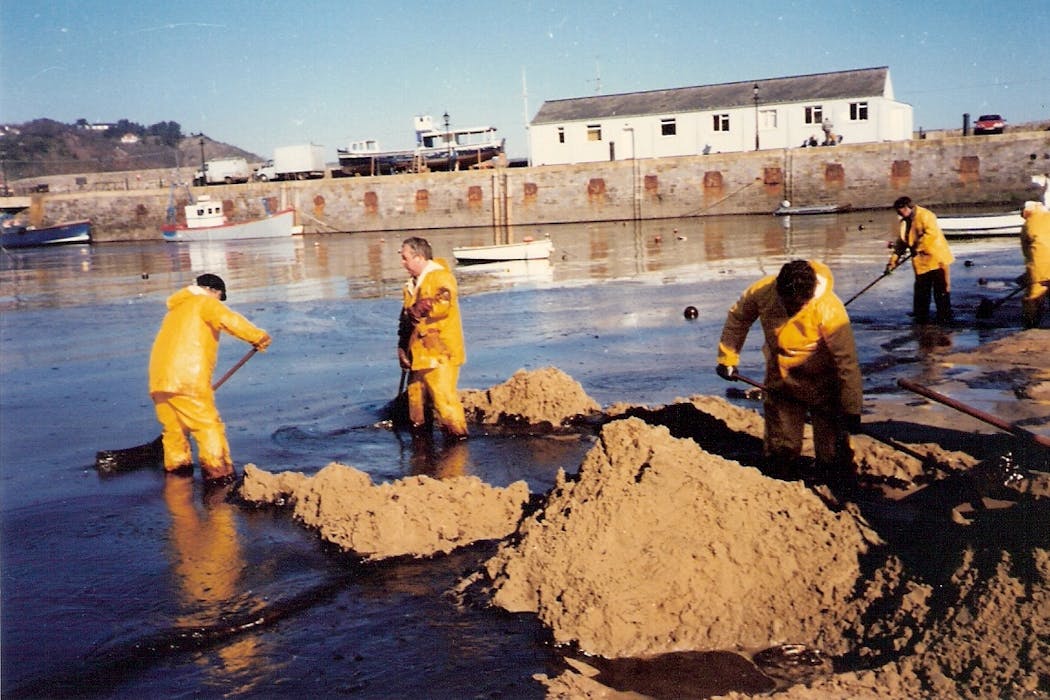 Volunteers cleaning Tenby's Harbour Beach after the oil spill in 1996. Scott Grant, CC BY-NC-ND
I grew up on the beaches of Pembrokeshire in south-west Wales. Visits to Tenby were my family's summer ritual: sand between our toes, paddling in rockpools, strawberry syrup on ice cream.
But 30 years ago, I vividly remember walking along Tenby's North Beach with my mother and grandmother. No crowds. No laughter. Just the hush of waves sliding over dark, tar‑smudged sand. The holiday postcards had gone grey.
At about 8pm on February 15 1996, the Sea Empress oil tanker missed her tug escort into port by minutes. The ship veered inside the mouth of Milford Haven and struck rocks near St Ann's Head.
Over the next stormy week, it grounded and re‑grounded many times, creating more damage to the hull each time. About 72,000 tonnes of North Sea crude oil were spilled. This was Britain's worst coastal oil disaster in a generation.
The fightback was messy. Weather worsened. Control systems to manage the spill were strained. Nine separate releases of oil stained the sea as wind and tide shoved a wounded tanker around the edges of the Pembrokeshire Coast national park.
Aircraft spread dispersants to try to break up the oil spill. Rough seas helped break oil into smaller droplets. This kept oil suspended in the water (not just floating on the surface), which can increase exposure and toxicity for sea and plant life, even as the visible surface layer declined.
At the same time, because the spilled oil contained a lot of relatively volatile petrol components and the weather was windy and the sea choppy, an estimated 35-45% evaporated in the first two days.
 Oil from Tenby's Harbour Beach is pumped into a tanker for removal in 1996.
Scott Grant, CC BY-NC-ND
Oil from Tenby's Harbour Beach is pumped into a tanker for removal in 1996.
Scott Grant, CC BY-NC-ND
In all, 11,000-16,000 tonnes of water-in-oil emulsion are estimated to have reached the shore - far less than the 72,000-120,000 tonnes of emulsion that could have beached. But even so, more than 120 miles (190km) of coastline were oiled. Birds, shellfish, marine and coastal habitats and the local tourism industry all took a hammering.
The UK government's Marine Accident Investigation Branch found the immediate cause was pilot error - compounded by weak training, poor use of leading marks to help the tanker's navigation, and no agreed master-pilot plan.
Salvage overseen by the Marine Pollution Control Unit (part of the UK Coastguard Agency) unfolded amid a stormy week. Muddled control was an issue alongside insufficient tug power and limited expert knowledge of the tidal streams. When big ships are in trouble, authority must be clear and tugs must be strong.
What's changed since the disaster?A lot has improved since the Sea Empress disaster.
The line of command is now much more direct. The UK created a single, empowered decision-maker - the secretary of state's representative - to cut through competing interests in a major maritime emergency. The role dates from 1999 and exists because of lessons from the Sea Empress.
There's also a clearer response plan in place. The national contingency plan for marine pollution incidents sets out who does what from the first call to the last waste bag. It links government, ports, regulators and science advisers, and outlines how to quickly set up a joint response centre for a coordinated approach to complex incidents.
Prevention of oil spills is high on the agenda. The UK government has identified marine environmental high-risk areas, including Pembrokeshire, to warn where a mistake can become a catastrophe.
Ships have also evolved to reduce the risk of big spills like this happening again. After the 1990s, single‑hull tankers were phased out under an amendment to international and national laws. New tankers had to be double‑hulled - designed with two completely watertight layers of steel - to reduce the risk of oil spills as the result of an accident.
By the mid‑2010s, single‑hull tankers were effectively gone from mainstream trade - a quiet revolution that prevented countless spills.
But not everything moved forward in a positive way.
In the 2000s, the UK stationed powerful government‑funded tugs around the coast. But in 2011, this fleet was axed on cost grounds, with a limited Scottish provision later restored and extended. A 2020 government‑commissioned study acknowledged that commercial towage hasn't filled every gap, and that some sea areas are still at high risk of an oil disaster.
Risk has shifted, not vanished. Milford Haven is now one of Europe's key liquefied natural gas (LNG) gateways. The South Hook and Dragon terminals, opened in 2009, can together meet up to a quarter of UK gas demand on peak days. That keeps homes warm and industry running. It also concentrates critical energy infrastructure in the same magnificent but exposed seascape that the Sea Empress scarred.
 An oil boom across Tenby Harbour tries to clean up the spill.
Scott Grant, CC BY-NC-ND
Lessons learnt
An oil boom across Tenby Harbour tries to clean up the spill.
Scott Grant, CC BY-NC-ND
Lessons learnt
Three aspects of the handling of this disaster still guide my thinking as an environmental scientist today.
Hitting the oil hard at sea - and early on - can make a big difference. With the Sea Empress's cargo of light crude in winter, rapid evaporation and dispersant‑aided dilution reduced shoreline oiling dramatically. It is often better to keep oil off beaches than have to scrape it off later - but you need surveillance, and then aircraft and trained people to be ready immediately.
 Oiled seabirds wait to be cleaned after the Sea Empress spillage.
Scott Grant, CC BY-NC-ND
Oiled seabirds wait to be cleaned after the Sea Empress spillage.
Scott Grant, CC BY-NC-ND
Coasts need to be cleaned in a methodical way, for as long as it takes. Buried oil re‑emerges. Heavy machinery can drive residues deeper if you rush. Quiet persistence beats flashy photo ops.
The government's Sea Empress environmental evaluation programme found that, while many habitats recovered faster than feared, some wildlife communities - from limpets to cushion stars - needed continued protection.
Prevention always costs less than compensation. Fines, funds and court cases don't restore trust or nature quickly. Investing upfront - in trained pilots, rehearsed joint command, powerful tugs in the right places, modern kit and transparent science - is cheaper than rebuilding a reputation for clean beaches, safe seafood and thriving wildlife. That was true in 1996. It is truer now.
Thirty years on, I still see Tenby's empty beaches when they should have been busy. I can still picture the sad faces of Pembrokeshire's people. Wales has deep ties to the sea: trade, holidays, food, fun.
With better ships, clearer command and smarter plans, the risk of major oil spills can be minimised. But complacency is a fair‑weather friend. LNG cargoes, bigger vessels, tighter budgets and busier coasts all raise the stakes. Anything can happen after dark in a gale, when radios crackle, information is scarce, and decisions must be made quickly.
Don't have time to read about climate change as much as you'd like?
Get a weekly roundup in your inbox instead. Every Wednesday, The Conversation's environment editor writes Imagine, a short email that goes a little deeper into just one climate issue. Join the 47,000+ readers who've subscribed so far.

Ian Williams receives funding from UK Research Councils, including the Engineering and Physical Sciences Research Council's Impact Acceleration Account.
Some glaciers can suddenly surge forward - with dangerous consequences [ 12-Feb-26 5:19pm ]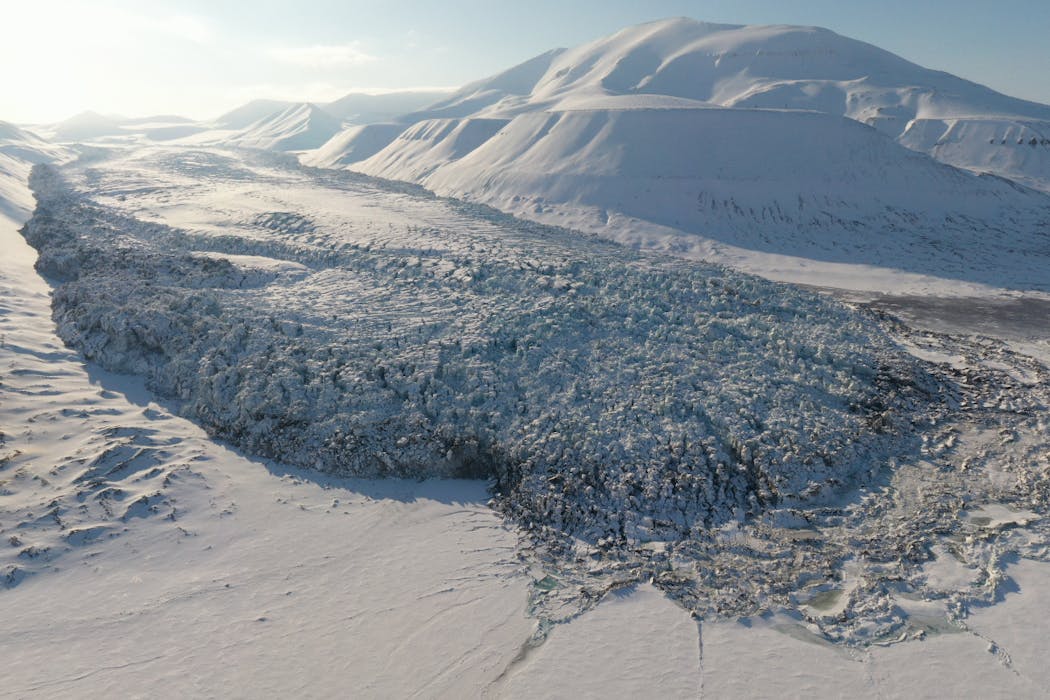 The surging Scheelebreen glacier in Svalbard advances into the frozen fjord, April 2022. Erik Schytt Mannerfelt, CC BY
It's difficult to forget standing in front of a glacier that is advancing towards you, towering ice pillars constantly cracking as they inch forward. The motion is too slow to see in real time, but obvious from one day to the next.
One of us (Harold) experienced this during fieldwork in 2012 at Nathorstbreen on the Arctic archipelago of Svalbard, which was moving forwards more than 10 metres per day.
Encounters like this are rare. Most of the world's glaciers are retreating rapidly as the climate warms, and thousands are likely to disappear altogether within the next few decades.
However, a small fraction of glaciers do the opposite, and repeatedly speed up and advance for months or years after a long period of stagnation and retreat. This is known as glacier surging, and it has long puzzled scientists.
It might be tempting to view advancing ice as an antidote to the gloomy picture of disappearing glaciers, but the polar opposite is true. Surges can accelerate ice loss, make glaciers more vulnerable to climate change, and create serious hazards for people living downstream of them.
We have just published a global study of over 3,000 surging glaciers to find out what's causing them to move like this. Our work also summarises, for the first time, the hazards caused by these glaciers, and how surging is being affected by climate change.
Why some glaciers surgeDuring surges, glaciers accelerate from a slow crawl to tens of metres per day - sometimes within weeks. The fastest phase, when ice can flow at over 60 metres a day, typically lasts a year or more - although some glaciers have surged for up to 20 years. The return to low speeds and even stagnation can happen abruptly over days, or over several years.
Nathorstbreen dramatically advanced more than 15 kilometres in roughly a decade during its surge, which began in 2008 - transforming the entire landscape in a matter of years.
 Field investigations at the surging front of Nathorstbreen, Svalbard in July 2012.
Harold Lovell
Field investigations at the surging front of Nathorstbreen, Svalbard in July 2012.
Harold Lovell
The onset of surging is thought to be controlled by changes beneath the glacier. In surge-type glaciers, water generated by melting ice does not immediately drain away, but gathers at the bottom of the glacier. This reduces friction between ice and the ground, making it easier for ice to slide faster.
When that water eventually drains, the glacier slows again. Some glaciers experience repeated surges separated by years or decades of low ice flow - but the exact timing of surges is hard to predict.
The sound of surging ice at Vallåkrabreen, Svalbard in May 2023. Erik Schytt Mannerfelt. Erik Schytt Mannerfelt, Author provided (no reuse)1.63 MB (download) Global hotspots of surging ice
Our study shows that at least 3,000 glaciers have surged at some point. That's only about 1% of all glaciers in the world, but they tend to be large, so represent about 16% of the global glacier area.
Notably, they are found in dense geographical groupings across the Arctic, the Himalayas and other high mountains in Asia, and the Andes - but are largely absent elsewhere. This is primarily controlled by the climate: surges do not generally happen where conditions are currently too warm, such as in the European Alps or mainland Scandinavia, or too cold and dry, such as Antarctica.
Other factors such as size and underlying geology are also important for determining which glaciers surge in a region and which do not.
Some of the hotspots are found in populated regions, where surging glaciers can become hazards. The advancing ice can overrun infrastructure and farmland, and block rivers to form dangerous lakes that can release devastating floods when the ice breaks. An unstable lake formed by a surge of Shisper Glacier in the Karakoram mountain range drained multiple times from 2019 to 2022, causing extensive damage to the Karakoram Highway, a key connection between Pakistan and China.
A flood from a lake dammed by the surging Shisper Glacier destroys Hassanabad bridge on the Karakoram Highway in May 2022.Fast-moving ice can cause deep cracks (crevasses) to form, affecting travel in regions such as Svalbard where glaciers provide highways between isolated human settlements. It also disrupts tourism and recreation activities, such as where climbers use glaciers to approach peaks. When glaciers surge into the sea, they release numerous icebergs in a short space of time that could present a risk to shipping and tourism.
Surging is changing as the climate warmsClimate warming is already reshaping how and when glaciers surge. In some regions, surges are becoming more frequent; in others, they are declining as glaciers thin and lose the mass needed to build towards a surge. Heavy rainfall, intense melt periods or other extreme weather have also been shown to trigger earlier-than-expected surges, and these factors may become more important in a warming climate.
Together, this paints a picture of the increasing unpredictability of glacier surges. Some regions might experience less surging as the world warms, while others might see an increase. It is feasible that glaciers that have never surged before may begin to, including in areas where there are no records of past surges, such as the fast-warming Antarctic peninsula.
Surging glaciers remind us that ice does not always respond to warming in simple and predictable ways. Understanding these exceptions, and managing the hazards they create, is critical in a rapidly changing world.

Harold Lovell receives funding from NERC.
Chris Stokes receives funding from the NERC.
The new Highlander EV is a big deal for Toyota -- a big three-row SUV built in the US and battery-powered exclusively.
The post Automotive Press Heaps Praise On Toyota Highlander EV appeared first on CleanTechnica.
Solid-state batteries for electric vehicles potentially have some significant improvements over lithium-ion and lithium-ion-phosphate batteries. They are less prone to combustion, can charge faster and can provide longer driving ranges. Some progress recently has been made with solid-state batteries: February 5: Karma Automotive agreed with Factorial Energy to launch the first ... [continued]
The post Solid-State Battery Milestones Appear Encouraging For Near Future appeared first on CleanTechnica.
This is quite a notable milestone that has gone under the radar! BYD delivered 4.6 million vehicles to customers in 2025. That was actually not a great result for BYD. However, it did mark BYD flying past Tesla in BEV sales, which got a lot of attention. Something that has ... [continued]
The post BYD Passed Up Ford In Global Auto Sales In 2025 appeared first on CleanTechnica.
Continuing extreme weather has caused deaths of 16 people, evacuation of thousands and destruction of homes
Portugal is under pressure to draw up plans to adapt to the climate emergency as the country continues to be lashed by an unprecedented series of storms that have killed at least 16 people and left tens of thousands without electricity.
More than 3,000 people were evacuated from the Coimbra area of central Portugal on Wednesday as the Mondego River reached critical levels, while part of the country's main motorway, the A1, collapsed after a dyke on the Mondego gave way under the weight of flood water.
Continue reading...
Stuart Vevers wants the luxury brand to keep championing upcycled materials and reduce landfill waste
Stuart Vevers, the British designer of the American mass luxury brand Coach, is working to keep sustainability in the spotlight at New York fashion week. Not an easy task, when environmental concerns are slipping down the global agenda and fashion, perennially a mirror to the world we live in, has reverted to putting profits first.
"I'm an optimist, but it's not a blind optimism. There's a lot of tension in optimism, because the world is challenging and I am not ignoring that. My optimism comes from believing that the young people of today are going to make this world better," he said before Wednesday's show, held in the historic Cunard building in downtown New York.
Continue reading...
Hi r/collapse -- I recently spoke with David Wengrow on his best-selling book "The Dawn of Everything", co-authored with the late David Graeber. Our conversation spans a vast historical survey that highlights many instances of human societies voluntarily disbanding their hierarchical forms of sedentary agriculture; sites like Poverty Point or cereal farming at Stone Henge. In particular, we focus on the the expansion of empire during the early stages of globalization. The authors question the conventional wisdom of today's socioeconomic forms to open up new and unexplored pathways for human society.
submitted by /u/joshuacitarella[link] [comments]
Donald Trump has overseen more retirements of coal-fired power stations than any other US president, according to Carbon Brief analysis.
His administration's latest efforts to roll back US climate policy have been presented by interior secretary Doug Burgum as an opportunity to revive "clean, beautiful, American coal".
The administration is in the process of attempting to repeal the 2009 "endangerment" finding, which is the legal underpinning of many federal climate regulations.
On 11 February, the White House issued an executive order on "America's beautiful clean coal power generation fleet", calling for government contracts and subsidies to keep plants open.
On the same day, Trump was presented with a trophy by coal-mining executives declaring him to be the "undisputed champion of beautiful clean coal".
These words are in sharp contrast to Trump's record in office, with more coal-fired power plants having retired under his leadership than any other president, as shown in the figure below.
This is because coal plants have been uneconomic to operate compared with cheaper gas and renewables - and because most of the US coal fleet is extremely old.
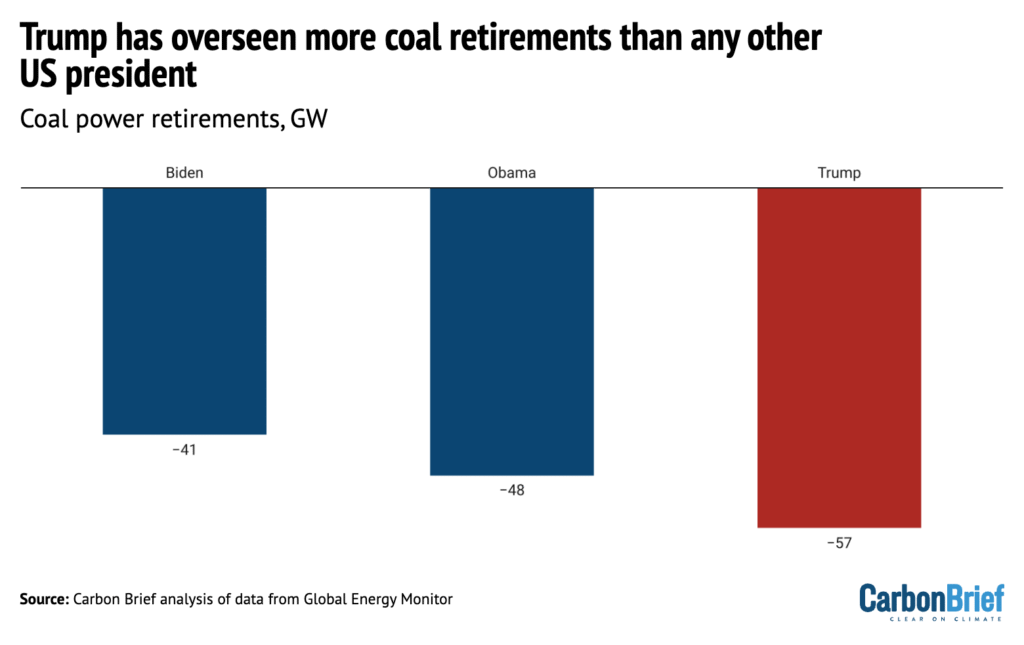 Capacity of coal-fired power plants retiring under recent US presidents, gigawatts (GW). Source: Carbon Brief analysis of data from Global Energy Monitor.
In total, some 57 gigawatts (GW) of coal capacity has already been retired during Trump's first and second terms in office, compared with 48GW under Obama's two full terms and 41GW under Biden's single term.
Even in relative terms, the US has lost a larger proportion of its remaining coal fleet for each year of Trump's presidencies than for either of his recent predecessors.
Trump's record hints at the many practical and economic factors that have driven US coal closures, regardless of the preferences of the president of the day.
Indeed, Trump made variousefforts to prop up coal power during his first term in office. These were ultimatelyunsuccessful, as the figure below illustrates.
 Coal-fired power capacity in the US, GW. Source: Global Energy Monitor.
Coal plants have been retiring in large numbers over the past 20 years because they were uneconomic relative to cheaper sources of electricity, including renewables and gas.
These unfavourable market conditions, alongside air pollution regulations unrelated to climate change, have resulted in a steady parade of coal closures under successive presidents.
By 2024, wind and solar were generating more electricity in the US than coal.
More recently, analysis from the US Energy Information Administration shows that surging power prices have improved the economics of both coal and gas-fired power plants.
These rising prices have been driven by increasing demand, including from data centres, and by higher gas prices, due to increasing exports at liquefied natural gas (LNG) terminals.
These factors saw coal-power output increase by 13% year-on-year in 2025, only the second rise in a decade of steady decline for the fuel, according to the Rhodium Group.
Nevertheless, many utilities have still been looking to shutter their ageing coal-fired power plants.
The vast majority of US coal plants are nearing retirement. Three-quarters of US coal capacity is more than four decades old and only 14% is less than 20 years old, as shown in the figure below.
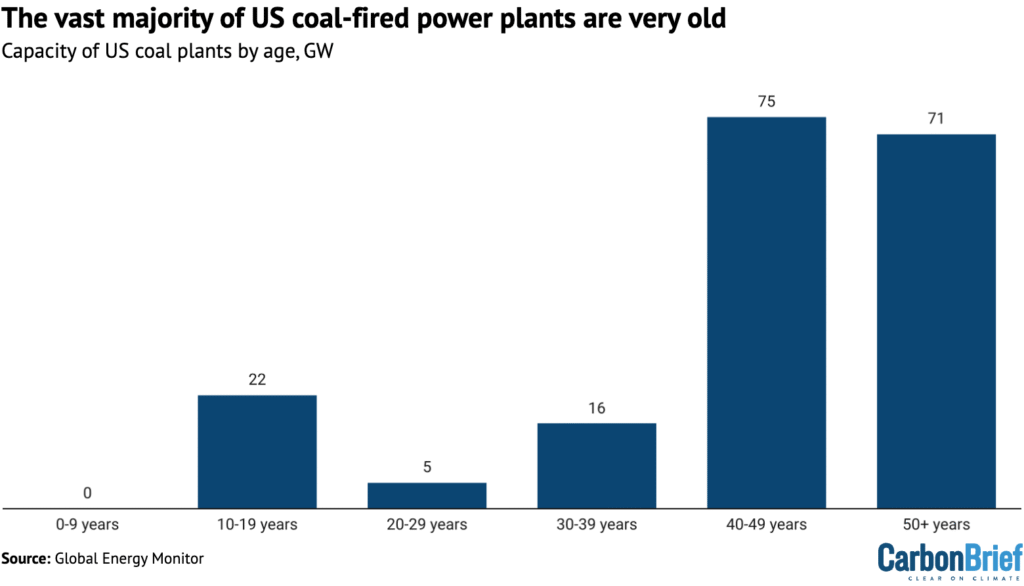 Capacity of US coal plants by age group, GW. Source: Global Energy Monitor.
In response, the Trump administration has recently invoked legislation designed for wartime emergencies to force a number of uneconomic coal plants to remain open.
Despite Trump's efforts, clean energy made up 96% of the new electricity generation capacity added to the US grid in 2025. None of the new capacity came from coal power.
Analysis: Coal power drops in China and India for first time in 52 years after clean-energy records
China energy
|13.01.26

IEA: Declining coal demand in China set to outweigh Trump's pro-coal policies
Coal
|17.12.25
Guest post: China and India account for 87% of new coal-power capacity so far in 2025
China energy
|27.08.25
Guest post: Why China is still building new coal - and when it might stop
China energy
|12.08.25
jQuery(document).ready(function() { jQuery('.block-related-articles-slider-block_5652fce17545da9da37eb0d8c1dfa16c .mh').matchHeight({ byRow: false }); });The post Analysis: Trump has overseen more coal retirements than any other US president appeared first on Carbon Brief.
Nigel Farage has announced Reform UK's first policy pledge of the Welsh election campaign in May: to scrap the default urban speed limit of 20mph introduced by the Labour Welsh government in 2023.
Like the Welsh Conservatives, who are also committed to reversing the legislation, Reform UK have identified frustration with the 20mph limit in Wales as a widespread and emotive issue that it hopes will help to propel the party to seat gains in the election. It is currently second in the polls, behind the centre-left Welsh nationalist party Plaid Cymru.
Reform said it will scrap the "blanket approach" to the speed limit, but would still have it around schools and hospitals. Welsh Labour have also said that some roads will return to 30mph under its plans.
Meanwhile, the Wales Green party leader Anthony Slaughter suggested that the party could push for extensions to 20mph coverage in local government, speaking to the BBC Radio 4 Today programme in January.
Polling by More in Common shows that the 20mph limit is the best known of the current Welsh government's policies, with 90% of respondents confirming awareness, but also the second most unpopular. Some 55% of people polled considered that the change reflected negatively on Welsh Labour, compared with 21% who viewed it positively.
Yet, for others the 20mph limit is a flagship achievement. Lee Walters, the former transport minister who introduced the legislation, has admitted mistakes in the way it was introduced, but told BBC Wales: "The data and evidence shows that it will save lives, and in time it will settle down."
The history of 20mph limitsThe legislation reduced the default speed limit on so-called "restricted roads" in Wales (essentially roads in built-up areas) from 30mph to 20mph.
Part of the aim was to reduce the number of collisions and injuries from road collisions (as well as the cost to the National Health Service of treating these casualties), encouraging walking and cycling, and improving health and wellbeing.
As elsewhere in Britain, 20mph zones already existed in high-risk sites such as outside schools. Exceptions also applied to the 20mph default, with local authorities identifying roads where a 30mph limit would remain.
There's a division of opinion over 20mph speed limits in Wales.Overall, the 20mph limit currently applies to 37% of the road network in Wales. The policy featured in both the Labour and Plaid Cymru manifestos for the 2021 Senedd (Welsh parliament) election. It was also supported by the sole Liberal Democrat Senedd member, when introduced.
Conservative Senedd members voted against the legislation. The measure was controversial, with noisy opposition from sections of the public.
A petition to repeal the law attracted 469,571 signatures and new 20mph road signs were defaced in many parts of Wales.
There was widespread media coverage describing confusion over the speed limit and claiming negative effects on bus timetables, tourism and businesses.
A lack of consistent polling makes it difficult to track public opinion on the issue. Polls in October 2023 and July 2024 recorded 54% and 72% of Welsh voters opposed to the 20mph limit respectively, but no more recent poll has directly asked about the policy.
However, a softening of attitudes over time was identified by an analysis of posts on the social media platform X at implementation in September 2023 and six months later. Not only did comments become less negative towards the change, but the content also evolved. Right after implementation, tweets focused on politics, especially criticisms of Welsh government.
Six months later, discussion shifted toward everyday impact: improved safety around schools and residential streets, benefits for pedestrians and cyclists and urban mobility such as buses and traffic flow. Although political criticism remained, misinformation decreased and conversation became more grounded in lived experience, with safety, especially for children and communities, more prominent.
Psychologists refer to this movement as the Goodwin Curve: when behaviour people are anxious about doesn't materialise, their attitudes soften and they become more accepting of policy change.
Early reports on the impact of the 20mph speed limit were anecdotal. More than two years after implementation, however, there is a growing body of objective evidence on its effects, especially around speed and collision data. The most recent figures show that average speeds for road traffic in Wales have fallen by 3.3 mph.
Relatedly, there has been a marked reduction in both collisions and casualties on roads where the speed limit changed from 30mph to 20mph. In 2024, the first full year after the change, collisions on 20mph and 30mph roads combined were down 23.5% compared with 2022, and casualties were down by 25.8%.
Evidence of environmental and social impacts is less conclusive. Early monitoring shows no material change in air quality (NO₂, PM₁₀ or PM₂.₅) in pilot areas up to April 2024, and analysis of CO₂ emissions is still ongoing. Impacts on walking and cycling also remain unclear, as post-implementation active travel data has not yet been reported.
Speed and the SeneddSo, why are speed limits back on the election agenda? Reform and the Conservatives both cite the cost of the policy, estimated at £32 million. Yet, as journalist Will Hayward points out, this spend has already happened and returning to 30mph would also be expensive.
The significance of 20mph to Reform and the Conservatives is about setting the tone of the election. It is an issue that speaks to the continuing scepticism of some of the Welsh electorate towards devolution.
What's more, the issue encapsulates different visions for Welsh society. For the rightwing parties, opposition to the 20mph limit reflects a championing of individualism and "common sense" against the perceived intrusive paternalism of the left. As Farage told journalists in Newport: "It's an example of government saying we know what is best for you, and you must comply with us."
Reform UK has targeted car drivers as a potential voting base before. Reform-led councils in England have vowed to dismantle low-traffic neighbourhoods, for instance, even in areas that didn't actually have them.
For some leftwing politicians, on the other hand, the 20mph speed limit is emblematic of a devolved Welsh government taking bold, pioneering action for health and environmental wellbeing. Reductions both in collisions and in motor insurance premiums could be presented as evidence of delivering benefits to Welsh people.
Labour and Plaid Cymru are unlikely to want the 20mph speed limit to be a major topic in the election, and would prefer to focus on issues around jobs, education, health care and public transport. Whether they can achieve a swing to those issues as the primary topic of discussion will be down to the public's interest, and possibly media coverage.

Michael Woods receives funding from UKRI. He is a member of the Liberal Democrats.
Charles Musselwhite received funding from Health & Care Research Wales. Charles Musselwhite is currently Chair of the Transport Studies Research Group and a Vice Chair of the Transport and Health Science Group.
A pilot scheme in Brooklyn is giving businesses batteries to form an electricity storage network - part of a growing number of innovative DIY energy ideas around the world
In the back of Black Seed Bagels in northern Brooklyn is a giant catering kitchen filled with industrial-size condiments and freezers full of dough.
A tall, silver electric oven, named the Baconator, stands in a far corner, cooking thousands of pounds of meat every week to accompany Black Seed's hand-rolled, wood-fired bagels. The Baconator is connected to a battery the size of a carry-on suitcase, which is plugged into the wall.
Continue reading...Capitalism cares about our species' prospects as much as a wolf cares about a lamb's. But democratise our economy and a better world is within our grasp
We have an urgent responsibility. Our existing economic system is incapable of addressing the social and ecological crises we face in the 21st century. When we look around we see an extraordinary paradox. On the one hand, we have access to remarkable new technologies and a collective capacity to produce more food, more stuff than we need or that the planet can afford. Yet at the same time, millions of people suffer in conditions of severe deprivation.
What explains this paradox? Capitalism. By capitalism we do not mean markets, trade and entrepreneurship, which have been around for thousands of years before the rise of capitalism. By capitalism we mean something very odd and very specific: an economic system that boils down to a dictatorship run by the tiny minority who control capital - the big banks, the major corporations and the 1% who own the majority of investible assets. Even if we live in a democracy and have a choice in our political system, our choices never seem to change the economic system. Capitalists are the ones who determine what to produce, how to use our labour and who gets to benefit. The rest of us - the people who are actually doing the production - do not get a say.
Continue reading...
Huge thanks to my February sponsor, John Rember, author of the three-book series Journal of the Plague Years, a psychic survival guide for humanity's looming date with destiny, shaped by his experiences living through the pandemic in his native Idaho. Thoughtful, wry and humane, Journal 1 is a pleasure.
Thank you, all, for bearing with me in my absence, and to Kali for covering so ably.
 "Scientists thought they understood global warming. Then the past three years happened.
"…in the last few years, something changed. 2023, 2024 and 2025 were far warmer than the previous trend… "There is greater acceptance now that there is a detectable acceleration of warming," said Zeke Hausfather, a climate scientist…"
 "We are changing the climate of our planet faster than in the known history of our world.
"Methane reached a record high of 1946.5 ppb! That's already much higher than the peak of the mid range climate scenario (SSP2-4.5)!"
[Leon Simons]
https://x.com/LeonSimons8/status/2021419093769978119
 "Point of no return: a hellish 'hothouse Earth' getting closer, scientists say.
"The world is closer than thought to a "point of no return" after which runaway global heating cannot be stopped, scientists have said. Continued global heating could trigger climate tipping points, leading to a cascade of further tipping points and feedback loops, they said."
 "Despite Eastern U.S. cold, January 2026 was one of the world's warmest Januaries on record…
"Africa had its warmest January; Oceana, its third-warmest; North America, its sixth-warmest; and South America, its ninth-warmest. Asia had above-average temperatures, while Europe was near average in temperature."
 "Greenland ice melt opens sea routes for critical minerals.
"Record sea temperatures and sea ice lows near Greenland in January followed Arctic air temperatures soaring up to 15°C above average in parts of the region, with experts warning of security implications."
https://www.ft.com/content/e3b8c6fd-e55c-49d5-b727-59d7e4104174
 "2024 recorded the most negative mass balance at Aldegondabreen (Svalbard) since end of the Little Ice Age!
"As of 2025, the glacier's mean ice thickness has been estimated at 39 m (33 m w.e.). The loss of 10 m w.e. in just the last 5 yrs is a dramatic change!" [Melaine Le Roy]
https://x.com/subfossilguy/status/2021665992322298133
 "Misery for many as rain falls for 40 days in some parts of UK…
"People who live in parts of Devon, Cornwall and Worcestershire have been dodging deluges or showers for 40 days - the same number of days that it rained in the Bible's Noah's ark story…"
 "British bread under threat as wheat fields flooded…
"Wheat plants can only withstand being submerged in water for four days before experiencing significant damage but some farms have experienced rain every day of the year so far."
https://www.telegraph.co.uk/business/2026/02/12/british-bread-under-threat-wheat-fields-flooded/
 "The 'culture war' on net zero: Why have Brits stopped supporting climate policies?
"…The UK's "sense of urgency" on achieving net zero and supporting climate policies has taken a drastic tumble, according to a new survey. In 2021, surveys found that 54 per cent of the British public believed the UK government should achieve net zero before the 2050 target. Now, this has fallen to just 29 per cent."
 "Portugal floods force 3,000 evacuations as motorway collapses and interior minister resigns.
"At least 15 people died in weeks of storms in Portugal, as fresh flooding forced the evacuation of around 3,000 residents, triggered the collapse of a motorway, and led to the resignation of the interior minister."
 "Coimbra in crisis; "Dam can't take any more water"…
"Authorities in Coimbra have been working to avoid today's crisis for weeks. But suddenly it is looking as if the Aguieira dam can take no more water. With no let up in rainfall expected in the next few hours, the probability is of a rupture: millions of litres of water spilling into parts of the region."
https://www.portugalresident.com/coimbra-in-crisis-dam-cant-take-any-more-water/
 "Parts of Spain just saw a year's worth of rain in 20 days…
"In the mountainous southwestern part of the country, Grazalema — in the Andalusia region — has recorded over 90 inches of rain so far this year, including 78 inches in just the last 20 days alone. Meteorologist Nahel Belgherze called it a "hydrologically absurd" amount."
https://www.washingtonpost.com/weather/2026/02/10/grazalema-spain-record-rain/
 "EXTRAORDINARY EVENT. "EUROPEAN CLIMATIC HISTORY TOTALLY REWRITTEN:
"SUMMER IN SPAIN - TROPICAL NIGHTS: National record of February highest Minimum 20.9 [69.6F] Aguilas. Dozens of records pulverized with insane margins."
https://x.com/extremetemps/status/2021606060239241392
 "Tornado frequency in Türkiye increases by approximately 60% due to climate change.
"Professor Murat Turkes says number of tornadoes, affected areas in Türkiye increase with climate change, threatening greenhouse farming. Tornadoes, whose number and intensity increase with climate change, affect agricultural production, especially greenhouse farming."
 "Morocco struggles to evacuate thousands amid unprecedented floods.
"The Moroccan army has provided helicopters, military trucks, fast boats, drones, bulldozers and other equipment to reach isolated villages in the country's northwest."
https://middle-east-online.com/en/morocco-struggles-evacuate-thousands-amid-unprecedented-floods
 "Torrential rain destroys Homes in Asante Jamasi [Ghana]…
"in a related development, a devastating windstorm swept through Nkodum in the Akontombra District of the Western North Region on Monday, February 2, 2026, at about 4:00 p.m., ripping off the roofs of 37 buildings and affecting at least 135 residents."
 "Three Key South African Cities Hit by Water-Supply Shortages…
"Officials said water supply was low in Pretoria because of depleted levels at key reservoirs, which were unable to keep up with consumer demand amid high summer temperatures."
 "'Monstrous': Cyclone Gezani hits Madagascar, leaving at least 31 dead…
"Authorities issued red alerts for several regions warning of possible floods and landslides as the storm made landfall late Tuesday with wind speeds of more than 195km/h (121 mph). It then roared across the large island of 31 million people…"
 "EXTRAORDINARY EVENT:
"Thousands of records are being pulverized with extreme margins all over… North Africa and Middle East. Iraq, Iran and Kuwait are having their hottest February night in history."
https://x.com/extremetemps/status/202142410032201751
 "During the Chinese New Year period, a crazy and prolonged super warming will sweep across East Asia.
"Around February 15th & 20th, many parts of China will break the record for the highest temperature in February!"
https://x.com/yangyubin1998/status/2021546851980525786
 "Six all-time cold records broken in one day as death toll from record snow climbs to 46, Japan.
"At least six locations in Japan recorded record-breaking cold on the morning of February 9, 2026, as temperatures fell below -3°C (26.6°F) for the first time since 1984. The death toll from the record-breaking snowfall since January 20 has climbed to 46 as of February 10."
 "Indonesia's BNPB warns 108 watersheds in critical condition.
"The National Disaster Mitigation Agency (BNPB) revealed that 108 river drainage basins (DAS) across Indonesia are in critical condition and may trigger recurring disasters if landscape rehabilitation and ecosystem restoration are not carried out."
https://en.antaranews.com/news/403962/indonesias-bnpb-warns-108-watersheds-in-critical-condition
 "Slow-moving landslide damages hundreds of homes in Padasari, Central Java, Indonesia.
"A slow-moving landslide has damaged hundreds of homes in Padasari village, Tegal, Central Java, Indonesia, forcing large-scale evacuations since early February 2026. Local reporting indicates that ground deformation remains active, preventing residents from returning to affected areas."
 "Millions of litres lost: fire and drought leave north-east farmers on the brink [Victoria].
"After more than two years of drought, and a catastrophic bushfire that ravaged more than 140,000 hectares, farmers in north-east Victoria say water is now their biggest concern."
 "4 lessons NZ should take from another summer of weather disasters.
"Another summer of extreme weather has destroyed and damaged homes, cut off communities and, in the most tragic cases, left families mourning their loved ones. It reminds us that New Zealand is one of the most natural-hazard-exposed countries on Earth."
https://theconversation.com/4-lessons-nz-should-take-from-another-summer-of-weather-disasters-275437
 "Widespread loss of marine sponges possible if heat waves intensify by just 1°C [New Zealand]…
"Marine heat waves are increasing as the climate warms. In 2022, a marine heat wave was linked to the mass bleaching of more than 50 million Cymbastella lamellata sponges in Fiordland and caused almost half to die."
https://phys.org/news/2026-02-widespread-loss-marine-sponges-1c.html
 "Climate crisis linked to fall in southern right whale birth rates as researchers raise 'warning signal'.
"After decades of recovery, southern right whales are showing signs of a climate-driven decline in breeding rates, which scientists say is a "warning signal" about changes in the Southern Ocean."
https://www.theguardian.com/environment/2026/feb/11/climate-crisis-southern-right-whale-birth-rates
 "Some of world's oldest trees hit by climate-fuelled wildfires in Patagonia…
"Dr Juan Antonio Rivera, of the National Scientific and Technical Research Council in Mendoza, Argentina, who is part of the WWA team, said: "Ancient forests were devastated, as was the unique biodiversity in the area."
 "Record heat again in PARAGUAY:
"40.0C [104F] at Quyquyhó tied again its record of highest temperature ever recorded in February. Over 42C in The Chaco and more heat to come in the next 3 weeks."
https://x.com/extremetemps/status/2021779541170266140
 "At least six people have been killed and five others injured in landslides caused by heavy rains in southeastern Brazil, local authorities said Tuesday.
"The tragedies were reported in Minas Gerais and Rio de Janeiro states. Children were among the victims, according to the authorities."
https://english.news.cn/20260211/8528bc306aa045f5ba00dc201755b385/c.html
 "Torrential rain in Colombia kills 22, thousands displaced…
""We've lost everything, all our belongings, all our appliances. And we are very worried because we don't know what will happen," Enid Gomez, who lives in Cordoba's capital Monteria, told AFP."
 "NEVER ENDING RECORD HEAT IN MEXICO:
"Absolute insane hot nights continue, never happened in winter: Minimum 23.0C [73.4F] at Mazatlan - hottest winter night in history. Sinaloa and Sonora States have broken all warm nights records non-stop every month of 2025 and now 2026 with huge margins."
https://x.com/extremetemps/status/2020879504277983317
 "Tampa Bay watering limits tighten as Florida drought deepens.
"A drought has taken hold across Florida, with some areas experiencing extreme conditions… "The driest fall-winter period to date since record keeping in much of the Tampa Bay Area and other parts of Florida as well [Jeff Berardelli]."
https://www.axios.com/local/tampa-bay/2026/02/10/florida-drought-2026-watering-restrictions
 "Sixth year of drought in Texas and Oklahoma leaves ranchers bracing for another harsh summer…
"Many cattle producers and rangelands were still recovering from a severe 2010-2015 drought when a flash drought hit western Texas in spring 2020, marking the beginning of the current multibillion-dollar, multiyear and multistate drought."
 "Western US gripped by extreme snow drought: 'I've never seen a winter like this'.
"A record snow drought is plaguing the western US, leaving some of the thirstiest states bracing for less water and elevated fire risks through the drier months to come… The dire conditions are fueled by an extremely warm winter, according to federal forecasters…"
https://www.theguardian.com/us-news/2026/feb/11/snow-drought-oregon-colorado-utah
 "'Unprecedented fires, unprecedented response': Chaffee Fire's wildland division expands to meet community, environmental needs [Colorado]...
""It's becoming the perfect storm," Chaffee County Fire Protection District Wildland Division Captain Ben Brack said. "Whatever the cause, I think we can all agree it's getting warmer and drier…"
 "Three days left: Arizona faces deeper Colorado River cuts as federal deadline looms.
"Arizona and six other southwestern states have just three days to reach an agreement on sharing Colorado River water before the federal government steps in with its own plan."
https://www.yahoo.com/news/videos/three-days-left-az-faces-015106125.html
 "Hurricane Helene did not shift US climate views or votes, study finds…
"This is shown in a new study from the University of Gothenburg. "Attitudes unchanged: no support for increased climate change beliefs, concerns, or voting intentions after Hurricane Helene" is published in Environmental Research Communications."
https://phys.org/news/2026-02-hurricane-helene-shift-climate-views.html
 "Trump to undo legal basis for US climate rules.
"President Donald Trump is poised Thursday to revoke a landmark scientific finding that greenhouse gases endanger public health by driving climate change — a determination that underpins US regulations aimed at curbing planet-warming pollution."
https://www.france24.com/en/live-news/20260212-trump-to-undo-legal-basis-for-us-climate-rules
 "Wildfires in northern Alaska are the worst they've been in 3,000 years.
"An analysis of peatland soil samples and satellite images has found that wildfires on Alaska's North Slope are more frequent and severe now than they were at any point over the past 3,000 years."
 "Over half of world's coral reefs are bleached; 'irreversible' damage warned: study…
""Ocean warming is increasing the frequency, extent, and severity of tropical-coral bleaching and mortality," researchers, including C. Mark Eakin, an oceanographer with the National Oceanic and Atmospheric Administration, wrote in the new report published Feb. 10."
https://eu.usatoday.com/story/news/world/2026/02/11/coral-reef-bleaching-study-death/88621624007/
 ""This engine is grinding to a halt" - Nature slowing down as climate change gains pace.
"The findings suggest that a lack of change in local species composition should not be mistaken for stability or ecosystem health. Instead, the widespread slowdown may indicate that the internal engines of biodiversity are losing momentum due to the depletion of regional life."
I rely on donations and tips from my readers to to keep the site running. Every little bit helps. Can you chip in even a dollar? Buy me a coffee or become a Patreon supporter. A huge thank you to those who do subscribe or donate.
You can read the previous "Climate" thread here. I'll be back tomorrow with an "Economic" thread.
The post 12th February 2026 Today's Round-Up of Climate News appeared first on Climate and Economy.
Marineland Antibes, the French government and animal welfare groups all agree on the need to rehome the listless killer whales but no one can agree where
In a sprawling aquarium complex in south-eastern France that once drew half a million visitors a year, only a few dozen people now move between pools that contain the last remaining marine mammals of Marineland Antibes. Weeds grow on walkways, the stands are empty and algae grows in the pools, giving the water a greenish hue.
It is here that Wikie and Keijo, a mother and son pair of orcas, are floating. They were born in these pools, and for decades they performed in shows for crowds. But since the park's closure in January 2025, they no longer have an audience. When they are alone, they "log", or float at the water's surface, according to a court-ordered report released last April.
Continue reading...
Doyne Farmer says a super-simulator of the global economy would accelerate the transition to a green, clean world
It's a mind-blowing idea: an economic model of the world in which every company is individually represented, making realistic decisions that change as the economy changes. From this astonishing complexity would emerge forecasts of unprecedented clarity. These would be transformative: no more flying blind into global financial crashes, no more climate policies that fail to shift the dial.
This super simulator could be built for what Prof Doyne Farmer calls the bargain price of $100m, thanks to advances in complexity science and computing power.
Continue reading...Torcross, Devon: 2026 has been defined by storms here. My job of repairing a thatched roof is simple compared with the wider recovery
During the storm, the waves sounded like bombs going off under the house, Bonni Breeze Lincoln tells me. She lives on the seafront of Torcross, a Devon village that is accustomed to weathering storms, but even she is not used to waves shattering her storm shutters, or sending seawater down the chimney.
I've come to Torcross to repair the thatch on Bonni's roof. Up the ladder, I tie bundles of reed, called "wads", to pack them into the holes; the thatch is riddled with shingle, fragments of seaweed and even limpet shells. Looking down the seafront to torn up paving slabs and slate roofs that yawn open to the sky, it's clear that this house - the oldest in the village - has come off comparatively well. The soft, springy nature of thatch allows it to absorb even the impact of breaking waves.
Continue reading...

