
The Highlander was still at the show in the hybrid form. Toyota focused instead on the crowd favorite RAV-4 Hybrid Toyota's push toward full electrification took an unusual turn at the 2026 Chicago Auto Show, where the brand's newest battery-electric SUV — the Highlander BEV — dominated headlines without ever ... [continued]
The post The Highlander BEV: Toyota's Missing Debut at the 2026 Chicago Auto Show appeared first on CleanTechnica.
This isn't about whether 3I/ATLAS is an alien probe. This is about what happens when institutions encounter data they can't control. Every claim below is sourced.
Jan 30 — We break the blackout story. NASA silent.
Feb 3 — Hubble data from the blackout window shows brightness signature "not a standard feature of comets." (arXiv:2601.21569)
Feb 12 — NASA quietly confirms the blackout in a technical paper on arXiv — 13 days after we reported it. Describes data processing methodology matching our December prediction. (arXiv:2602.12364)
Feb 16 — We independently verify the raw telescope data. It's publicly available at MAST. We publish that finding because we follow the data.
Regardless of what this object is, this is classification, data management, and gatekeeping operating across multiple agencies simultaneously, documented in real time.
submitted by /u/TheSentinelNet[link] [comments]
 Swedish homes are among the warmest in Europe, reflecting high levels of insulation and longstanding strategies that have kept heating costs low for most households. Antony McAulay/Shutterstock
The new year in Sweden began with some record-breaking cold temperatures. Temperatures in the village of Kvikkjokk in the northern Swedish part of Lapland dropped to -43.6°C, the lowest recorded since records began in 1887.
Yet for the majority of Swedish households, heating is not an issue. Those living in the multi-household apartment blocks that characterise Sweden's towns and cities enjoy average temperatures of 22°C inside their homes, thanks to communal heating systems that keep room temperatures high and costs low. For many households, heating is charged at a flat rate and included in the rent they pay.
*Some interviewees in this article are anonymised according to the terms of the research.
In the UK, meanwhile, home temperatures average just 16.6 degrees, the lowest in all of Europe. At least 6 million UK households fear the onset of cold weather because they are living in fuel poverty - unable to afford to heat their home to a safe and comfortable level.
The problem is exacerbated by the UK's reliance on natural gas to heat its homes - a fuel which suffers from escalating price volatility. They are also the most poorly insulated in Europe, making them difficult to keep warm.
In Britain, home heating isn't just a political hot potato; it has been shown to cost lives. In the winter of 2022-23, 4,950 people were estimated to have died earlier than expected (known as "excess winter deaths") because of the health effects of living in cold homes - including lung and heart problems as well as damage to mental health. In contrast, despite having a much colder winter climate, Sweden's excess winter deaths index was around 12%, one of the lowest rates in Europe and considerably below the UK's 18% figure.
The Insights section is committed to high-quality longform journalism. Our editors work with academics from many different backgrounds who are tackling a wide range of societal and scientific challenges.
So how did two countries that are geographically quite close end up so far apart when it comes to home heating outcomes? As two professors of energy studies - one British, the other Swedish - we have long puzzled over the stark contrast in how winter is experienced inside our homes in the north of England (Sheffield) and southern Sweden (Lund).
For the last three years, we have been researching the modern histories of home heating in both countries (plus Finland and Romania), gathering nearly 300 oral accounts of people's memories of the daily struggle to keep warm at home for long periods each year.
By charting these experiences of home heating in both countries since the end of the second world war, we show how Britain now finds itself struggling to keep its citizens warm in winter while also facing an uphill battle to meet its environmental targets. The stories from Sweden, on the whole, suggest how different things could have been.
Post-war memoriesThe second world war changed many things but not, immediately, the way homes were heated. In the UK coal remained the primary domestic fuel, while Sweden stuck mainly with wood, although coal was becoming more common in cities. Cold homes were still considered normal in both countries, as Majvor* (who is now in her 80s and lives in the Swedish city of Malmö) recalled of her post-war childhood living in a one-room flat:
There was a stove in the room and that was the only source of heat - I have a memory of it being so cold in the winter that my mother had to put all three children in the same bed to keep warm. In the winter, all the water froze to ice, so you had to … heat it on the stove to get hot water.
Despite the cold, many of our interviewees remembered the burning of wood and coal to heat their homes with great affection - although less so the drudgery and dirt that went with it.
"There's just something about a fire, isn't there," Sue (now in her 60s and living in Rotherham, England) told us. "The warmth, the smell, the laughter. It's that family memory and it was just wonderful. Anyone 'round here will tell you the same: life was hard but it was wonderful. We felt loved."
Mary (now in her 70s and also living in Rotherham) is among a very small minority who still heat their home using a coal fire. Her reflections were less positive:
I remember going to fetch coal when I was pregnant. I gave birth two days later … It's the dirt that gets you down, the dirt from the fire. It's disheartening when your walls are always dirty. That's why I had them tiled because I was painting them every six months before that.
Carolina* (now in her mid-30s and living in Malmö) also had a negative recollection of her wood-burning childhood - but for a very different reason. She described how her mother had once "got the axe in her foot … She continued to chop wood anyway - but I kind of got PTSD [post-traumatic stress disorder] from her doing that. So I can't do it, I'm really scared of it."
In Sweden, home heating was seen as key to improving social conditions after the war. The emphasis was on good-quality homes for everyone as the social welfare concept of folkhem ("the people's home") finally gained traction. The idea had first been articulated by future prime minister Per Albin Hansson in a speech to the Swedish parliament back in 1928, as a way of expressing his vision for a fair and equal society.
From 1946, housing construction was regarded as a key political issue for improving public health and achieving Sweden's other social welfare goals. In several cities, municipally owned public housing companies played an important role in the initial phase of new district heating systems, in part by guaranteeing a secure market. The introduction of the varmhyra ("warm rent") policy meant heating and sometimes other utilities were included in the rent - an arrangement that continues to this day in many Swedish apartment blocks.
The UK, like Sweden, suffered the blight of cold homes during the 1940s, exacerbated by fuel rationing that extended long beyond the war. So it is difficult to explain why Britain's new post-war welfare state did not explicitly address home heating.
Instead, the focus was on public health, with the birth of the National Health Service and recognition that the mass burning of coal was leading to fatal air pollution and unhealthy homes. Heavy city smogs, triggered by widespread coal burning in homes and factories, became increasingly common. The problem reached a climax when the "great smog of 1952" killed approximately 12,000 people, primarily in London, over just five days.
The justification for rapidly phasing out coal as the UK's primary fuel for homes and industry was centred around ending the public health crisis of these killer smogs, rather than on changing the way homes were heated - leading to the introduction of the Clean Air Act (1956). And as the UK scrabbled for a cleaner form of heating, a game-changing discovery was made. Huge reserves of "natural gas" (methane) were found off the Yorkshire coast in 1965, offering the huge advantage of reducing visible air pollutants compared with coal.
One man in particular, Kenneth Hutchison, saw and seized the opportunity to present natural gas as the panacea the UK had been waiting for. As incoming president of the National Society for Clean Air, Hutchison hailed the gas industry as the driving force in Britain's "smokeless revolution". From the late 1960s, he drove the rollout of networks piping natural gas into UK households at an incredible rate, demanding: "We must convince the public that central heating by gas is best" over the grime and drudgery of coal fires.
A 1965 advert for 'high-speed' British gas. Video: Anachronistic Anarchist.The chairman of British Gas, Denis Rooke - not an objective witness, admittedly - described the rollout as "perhaps the greatest peacetime operation in the nation's history". Between 1968 and 1976, around 13 million UK homes (of a total of about 15 million) were made ready for connection to the gas network. The cost of converting domestic heating and cooking systems from coal to gas was largely borne by the national gas supplier, making it effectively free to most households.
Our research suggests this transition was presented to UK households as a fait accompli. But most of our UK-based interviewees remembered the advent of natural gas as a major step forward in cleanliness, comfort and convenience. As 75-year-old Rita from Rotherham recalled of moving into a new council estate with gas heating in 1967:
It was like another universe! It was comfortable, everything became less intense - you didn't need so much clothing … The days of cooking on the fire were gone. Fabulous! The boiler didn't have to go all the time - the gas fire could take the chill off.
Britain's gas rollout not only brought gas central heating but other appliances such as gas fridges and fires that further lightened the domestic load. For Rita's and many other families, it felt like a cascade of liberations which made homes brighter and more enjoyable to live in.
Yet half a century later, Hutchison's faith in gas appears less justified. While it certainly cleaned up the UK's visible air pollution, natural gas is methane by another name - a powerful greenhouse gas.
How Sweden 'futureproofed'With a much smaller population and less crowded cities, air quality in Sweden had been less of a concern than in the UK in the immediate post-war period. But in the 1960s, proposals for a mass home-building programme raised fears this could worsen air pollution.
Without the option of "clean" natural gas, Sweden turned to district heating - an idea which had originated in New York in the 19th century. But Sweden committed to it in a big way during the 1960s and '70s, deciding it was the best way to meet the heating needs of the 1 million homes now being built. This decision shaped the way homes in Sweden are heated: today, some 90% of its multi-family apartment blocks are connected to district heating systems - with heat distributed from power plants (usually on the edge of cities) as hot water via a network of pipes.
Upon its introduction, district heating was celebrated for its efficiency, affordability for households (especially when combined with the warm rent policy), and flexibility - it is easy to change the fuel source. For some municipalities, district heating plants opened up opportunities to produce cheap electricity. Whereas UK households were (and remain) largely individually responsible for paying for their heating, in Sweden it was seen as a collective good.
Even the 1973 oil crisis - when geopolitical tensions in the Middle East quadrupled the price of oil - failed to dent public trust in the Swedish approach to home heating. In response to the oil crisis, Sweden moved quickly to change the fuels used to power district heating, introducing more domestic waste and biomass into the mix - a move that, from a climate perspective, now appears a highly prescient shift.
According to Kjell* (now in his 60s, living in a small town in south-west Sweden), 1973 was "when the whole concept changed because suddenly fossil fuels became expensive". He explained:
The expansion of nuclear power [meant] electricity became very cheap … The government promoted the idea that 'now we should use electricity, we should use direct electric heating' … All you had to do was turn a thermostat, press a button, and it was warm.
As well as nuclear power expansion, Sweden doubled down on hydropower production and was among the earliest European countries to invest in other renewable energy sources. Its government was also an early proponent of the now-familiar concept of energy efficiency - encouraging both households and industry to conserve energy and invest in insulation. By the mid-1990s, every Swedish home was rated by the EU as having comprehensive insulation and double glazing as a minimum. The equivalent figure in the UK in 2025 was only around 50%.
The flagship initiative "Seal up Sweden" encouraged households to insulate homes and restrict room temperature to 20 degrees (still almost four degrees warmer than the average UK home today). And the warm rent system gave landlords a vested interest in improving the energy performance of their properties.
Whether it was realised at the time or not, in the defining moment of the oil crisis, Sweden was futureproofing its urban heating systems - and laying the foundations for its enduring reputation as a leader in clean energy and climate policy. Sweden eschewed energy imports in favour of harnessing its own energy assets through expansion in hydropower, waste and nuclear energy - although this latter commitment would soon be tested by the major 1979 accident at Pennsylvania's Three Mile Island nuclear power plant in the US.
The era of power cutsIn stark contrast, the UK's rapid natural gas rollout couldn't move fast enough to protect households from the twin effects of the oil crisis and miners' strikes in the 1970s. Electricity - mostly still generated by coal and oil - was rationed via rolling blackouts. Many workplaces were required to restrict their operations to a three-day week.
With the average British home heated to 13.7 °C at this time (compared with 20-21 °C in Sweden), there was little scope to ask households to cut back further, so nationwide power cuts were imposed instead. Homes were regularly plunged into darkness. Tony (now in his early 70s, from the English town of Whiston on Merseyside) worked as a social worker during this period. He recalled seeing many interiors without doors or bannisters - they had been burnt to keep the family warm.
Extra candles were imported into Britain in 1972 to cope with power cuts. Video: AP Archive.Nonetheless, "clean" gas pioneer Hutchison was feeling vindicated as the UK enjoyed an era of falling gas prices throughout the 1980s. Climate change was still, at most, a nascent agenda, so it didn't seem to matter that British households were living in some of the least energy-efficient (and worst insulated) homes in Europe.
Gas remained affordable through the miners' strike of 1984-85 and privatisation of the gas industry in 1986, with the average household gas bill six times cheaper in real terms than today. Yet British households continued to modestly heat their homes, with average internal home temperatures slowly rising from 16.1 °C in 1990 to 17.8 °C by 1999.
Over the same period, Sweden went through several momentous changes as concern for the environment grew - amid recognition of the greenhouse effect (the build-up of gases trapping heat in the Earth's atmosphere) and acid rain (rainfall made acidic by air pollution). This resulted in another pioneering move: the world's first carbon tax on fossil fuels in 1991, which further galvanised its move away from oil.
Amid Sweden's dash for energy independence, electric-powered home heat pumps increasingly came to be viewed as something of a status symbol. Even households living in multi-family urban apartments were growing increasingly concerned about the monopolistic nature of district heating. They started opting out in favour of individual heat pumps, undermining these collective systems that rely on everyone contributing.
Short-lived progress in the UKBritain was much slower to embrace the need to address the world's climate crisis. One promising intervention finally came in 2006, when Tony Blair's New Labour government required all newly built homes to meet stringent environmental design standards (although this did little to lessen the environmental burden of existing homes).
In turn, higher standards of environmental design in new homes helped establish a market for more environmentally friendly, electric-powered heat pumps in Britain. Installations accelerated from 2004, mainly in social housing. The following year, gas connections peaked at 95% of UK households - then slowly started to fall, down to the current level of 74% across England and Wales.
With this reduction of reliance on gas, the level of emissions associated with heating UK homes also began to decline. Those urging Britain to do something about its position as one of Europe's least environmentally conscious nations celebrated, if cautiously. But this progress, such as it was, proved short-lived.
From 2010, the new Conservative-Lib Dem coalition government began dismantling key initiatives aimed at domestic energy efficiency, including New Labour's Code for Sustainable Homes as well as financial incentives to install heat pumps and renewables such as solar panels. Sales of these technologies started to fall away.
Since then, initiatives to promote adoption of renewable forms of home heating in the UK have been dogged by controversies - such as the renewable heat incentive in Northern Ireland, which resulted in the suspension of senior government officials.
Heat pump technology explained. Video: Nesta.Ambitious plans (driven by the UK's legally binding emissions reduction targets) to install 600,000 heat pumps a year have been met with public suspicion. Uptake is currently at around 50,000 per year - far below the government target.
Since coming to power, the current Labour government has rolled back its manifesto pledge to ban the sale of gas boilers in homes by 2035 - to the consternation of many environmental pressure groups and climate scientists. And while its recent announcement of more comprehensive investment in domestic energy efficiency (as part of the Warm Homes Plan) is a step in the right direction, many experts still consider the level of investment inadequate to secure the scale of change required to meet the UK's net zero climate targets.
A sizable majority (74%) of UK homes are still heated by gas boilers - which emit around twice as much CO₂ each year as some electric-powered heat pumps.
The clean heating conundrumThe volatile political scene in the UK is hampering its transition to clean energy. Reform UK, which has adopted a strident anti-net zero position, has made strong gains with disenfranchised voters, according to numerous polls. Should it gain power at the next general election in 2028 (even if as part of a coalition), Reform is likely to double-down on fossil fuel extraction and use, dealing a severe blow to efforts to wean the UK off its enduring gas dependency.
However, a shift to electric heating would not be an overnight panacea to the UK's energy bill woes. Depending on the energy efficiency of the homes in which they are installed, heat pumps could push bills up in the short-to-medium term, because electricity remains up to five times more expensive than gas.
But as more and more of the UK's electricity is generated from renewable sources, these costs will fall, with some commentators forecasting that from 2028, the UK will start to see positive price impacts of more electricity being generated from renewables. Most UK households will not be able to take advantage of the cheaper clean electricity coming on stream for their heating, though, because they remain locked into their gas boilers.
In contrast, outside Sweden's cities and towns, heat pumps have seen exponential growth since the 1990s, such that it now has one of the world's highest penetration rates, with over a third of homes equipped with them. And the heat generated from these sources is effectively conserved within the country's well-insulated housing stock.
But Sweden is not immune to political controversies around heating. Electricity price spikes in southern Sweden in recent winters have exposed households reliant on direct electric heating (mainly heat pumps) to affordability concerns. These price spikes were driven by a combination of high wholesale electricity prices, the country's limited transmission capacity between price zones, and periods of low wind generation.
At the same time, energy-efficient district heating networks continue to be challenged by the rapid adoption of heat pumps.
The public debate about the future of nuclear power in Sweden also continues to rage. In recent years, political signals have shifted towards maintaining and potentially expanding nuclear capacity, which has increased uncertainty about whether a full phase-out remains a credible policy objective.
The Swedish city of Lund boasts the world's largest low-temperature district heating network. Video: Alfa Laval. Thermal comfort vs thermal restraintThe UK's gas habit has not served it well in terms of securing thermal comfort for its households, with average indoor temperatures of 16.6°C lagging far behind the European average of 19°C. In contrast, Swedish homes are among the warmest in Europe, reflecting both affordability for many and a cultural expectation of thermal comfort.
But these contrasting expectations could yet play an intriguing role in the two countries' home heating strategies. Both countries are entering a new phase where electrification via heat pumps may test the resilience of national grids and the fairness of pricing structures.
Despite greater precarity in the UK, an established tolerance of lower indoor temperatures may mean that, as electricity prices are lowered by increased renewable energy production, UK households can achieve warmer homes using heat pumps than they have been able using gas. Heat pumps have been found to produce up to four times more heat than a gas boiler, using the same energy input.
Conversely, Sweden's cultural expectation of uniformly high indoor temperatures may challenge its future energy sufficiency targets and climate goals, particularly if electrification accelerates as more people - including those living in cities and large towns - seek the independence of heat pumps.
Sweden's traditional system of cost-sharing through varmhyra (warm rent) and district heating has historically promoted equity, but growing societal disconnections and price variations risk eroding that solidarity.
In contrast, Britain has tended to rely on individual responsibility and market-led solutions when it comes to home heating. The UK Warm Homes Plan, launched in January 2026, makes clear that heat pumps are the government's (and many scientists') favoured route to decarbonising domestic heating, with the exception of district heating schemes in a relatively small number of areas. But this requires incentivising households to move to heat pumps while removing short-term financial pain from this move.
Ultimately, our research suggests that many UK households now understand that change needs to come. As Trevor from Whiston told us firmly:
We just can't be doing that now [burning fossil fuels for heating] … Greenhouse gases - it's not on … We've got to find another way, haven't we?
For you: more from our Insights series:
To hear about new Insights articles, join the hundreds of thousands of people who value The Conversation's evidence-based news. Subscribe to our newsletter.

Aimee Ambrose receives funding from the Arts and Humanities Research Council and Horizon Europe.
Jenny Palm receives funding from Forte under CHANSE ERA-NET which has received funding from the European Union's Horizon 2020 Research and Innovation Programme.
Other than the new Rivians, the most anticipated new fully electric vehicle may be the Slate pickup truck. There have been many photos of the prototypes and test vehicles, but not a lot of video footage of the Slate being driven. Jay Leno, the noted car enthusiast and collector, got ... [continued]
The post Jay Leno Drives A Slate Pickup Truck (Video) appeared first on CleanTechnica.
All this year, we'll be exploring the many reasons to love heat pump water heaters (HPWHs). Perhaps the top reason is that they save so much money on utility bills. In fact, besides heat pumps for space heating, HPWHs are the appliance with the most potential savings across all household ... [continued]
The post Heat Pump Water Heaters Can Save Over $500/Year On Utility Bills appeared first on CleanTechnica.
On 12 February, US president Donald Trump revoked the "endangerment finding", the bedrock of federal climate policy.
The 2009 finding concluded that six key greenhouse gases, including carbon dioxide (CO2), were a threat to human health - triggering a legal requirement to regulate them.
It has been key to the rollout of policies such as federal emission standards for vehicles, power plants, factories and other sources.
Speaking at the White House, US Environmental Protection Agency (EPA) administrator Lee Zeldin claimed that the "elimination" of the endangerment finding would save "trillions".
The revocation is expected to face multiple legal challenges, but, if it succeeds, it is expected to have a "sweeping" impact on federal emissions regulations for many years.
Nevertheless, US emissions are expected to continue falling, albeit at a slower pace.
Carbon Brief takes a look at what the endangerment finding was, how it has shaped US climate policy in the past and what its repeal could mean for action in the future.
- What is the 'endangerment finding'?
- How has it shaped federal climate policy?
- How is the finding being repealed and will it face legal challenge?
- What does this mean for federal efforts to address climate change?
- What has the reaction been?
- What will the repeal mean for US emissions?
The challenges of passing climate legislation in the US have meant that the federal government has often turned instead to regulations - principally, under the 1970 Clean Air Act.
The act requires the EPA to regulate pollutants, if they are found to pose a danger to public health and the environment.
In a 2007 legal case known as Massachusetts vs EPA, the Supreme Court ruled that greenhouse gases qualify as pollutants under the Clean Air Act. It also directed the EPA to determine whether these gases posed a threat to human health.
The 2009 "endangerment finding" was the result of this process and found that greenhouse gas emissions do indeed pose such a threat. Subsequently, it has underpinned federal emissions regulations for more than 15 years.
In developing the endangerment finding, the EPA pulled together evidence from its own experts, the US National Academies of Sciences, Engineering and Medicine and the wider scientific community.
On 7 December 2009, it concluded that US greenhouse gas emissions "in the atmosphere threaten the public health and welfare of current and future generations".
In particular, the finding highlighted six "well-mixed" greenhouse gases: carbon dioxide (CO2); methane (CH4); nitrous oxide (N2O); hydrofluorocarbons (HFCs); perfluorocarbons (PFCs); and sulfur hexafluoride (SF6).
A second part of the finding stated that new vehicles contribute to the greenhouse gas pollution that endangers public health and welfare, opening the door to these emissions being regulated.
At the time, the EPA noted that, while the finding itself does not impose any requirements on industry or other entities, "this action was a prerequisite for implementing greenhouse gas emissions standards for vehicles and other sectors".
On 15 December 2009, the finding was published in the federal register - the official record of US federal legislation - and the final rule came into effect on 14 January 2010.
At the time, then-EPA administrator Lisa Jackson said in a statement:
"This finding confirms that greenhouse gas pollution is a serious problem now and for future generations. Fortunately, it follows President [Barack] Obama's call for a low-carbon economy and strong leadership in Congress on clean energy and climate legislation.
How has it shaped federal climate policy?"This pollution problem has a solution - one that will create millions of green jobs and end our country's dependence on foreign oil."
The endangerment finding originated from a part of the Clean Air Act regulating emissions from new vehicles and so it was first applied in that sector.
However, it came to underpin greenhouse gas emission regulation across a range of sectors.
In May 2010, shortly after the Obama EPA finalised the finding, it was used to set the country's first-ever limits on greenhouse gas emissions from light-duty engines in motor vehicles.
The following year, the EPA also released emissions standards for heavy-duty vehicles and engines.
However, findings made under one part of the Clean Air Act can also be applied to other articles of the law. David Widawsky, director of the US programme at the World Resources Institute (WRI), tells Carbon Brief:
"You can take that finding - and that scientific basis and evidence - and apply it in other instances where air pollutants are subject or required to be regulated under the Clean Air Act or other statutes.
"Revoking the endangerment finding then creates a thread that can be pulled out of not just vehicles, but a whole lot of other [sources]."
Since being entered into the federal register, the endangerment finding has also been applied to stationary sources of emissions, such as fossil-fuelled power plants and factories, as well as an expanded range of non-stationary emissions sources, including aviation.
(In fact, the EPA is compelled to regulate emissions of a pollutant - such as CO2 as identified in the endangerment finding - from stationary sources, once it has been regulated anywhere else under the Clean Air Act.)
In 2015, the EPA finalised its guidance on regulating emissions from fossil-fuelled power plants. These performance standards applied to newly constructed plants, as well as those that underwent major modifications.
This ruling noted that "because the EPA is not listing a new source category in this rule, the EPA is not required to make a new endangerment finding…in order to establish standards of performance for the CO2".
The following year, the agency established rules on methane emissions from oil and gas sources, including wells and processing plants. Again, this was based on the 2009 finding.
The 2016 aircraft endangerment finding also explicitly references the vehicle-emissions endangerment finding. That rule says that the "body of scientific evidence amassed in the record for the 2009 endangerment finding also compellingly supports an endangerment finding" for aircraft.
The endangerment finding has also played a critical role in shaping the trajectory of climate litigation in the US.
In a 2011 case, American Electric Power Co. vs Connecticut, the Supreme Court unanimously found that, because greenhouse gas emissions were already regulated by the EPA under the Clean Air Act, companies could not be sued under federal common law over their greenhouse gas emissions.
Widawsky tells Carbon Brief that repealing the endangerment finding therefore "opens the door" to climate litigation of other kinds:
How is the finding being repealed and will it face legal challenge?"When plaintiffs would introduce litigation in federal courts, the answer or the courts would find that EPA is 'handling it' and there's not necessarily a basis for federal litigation. By removing the endangerment finding…it actually opens the door to the question - not necessarily successful litigation - and the courts will make that determination."
The official revocation of the endangerment finding is yet to be posted to the federal register. It will be effective 60 days after the text is published in the journal.
It is set to face no shortage of legal challenges. The state of California has "vowed" to sue, as have a number of environmental groups, including Sierra Club, Earthjustice and the National Resources Defense Council.
Dena Adler, an adjunct professor of law at New York University School of Law, tells Carbon Brief there are "significant legal and analytical vulnerabilities" in the EPA's ruling. She explains:
"This repeal will only stick if it can survive legal challenge in the courts. But it could take months, if not years, to get a final judicial decision."
At the heart of the federal agency's argument is that it claims to lack the authority to regulate greenhouse gas emissions in response to "global climate change concerns" under the Clean Air Act.
In the ruling, the EPA says the section of the Act focused on vehicle emissions is "best read" as authorising the agency to regulate air pollution that harms the public through "local or regional exposure" - for instance, smog or acid rain - but not pollution from "well-mixed" greenhouse gases that, it claims, "impact public health and welfare only indirectly".
This distinction directly contradicts the landmark 2007 Supreme Court decision in Massachusetts vs EPA. (See: What is the 'endangerment finding'?)
The EPA's case also rests on an argument that the agency violated the "major questions doctrine" when it started regulating greenhouse gas emissions from vehicles.
This legal principle holds that federal agencies need explicit authorisation from Congress to press ahead with actions in certain "extraordinary" cases.
In a policy brief in January, legal experts from New York University School of Law's Institute of Policy Integrity argued that the "major questions doctrine" argument "fails for several reasons".
Regulating greenhouse gas emissions under the Clean Air Act is "neither unheralded nor transformative" - both of which are needed for the legal principle to apply, the lawyers said.
Furthermore, the policy brief noted that - even if the doctrine were triggered - the Clean Air Act does, in fact, supply the EPA with the "clear authority" required.
Mark Drajem, director of public affairs at NRDC, says the endangerment finding has been "firmly established in the courts". He tells Carbon Brief:
"In 2007, the Supreme Court directed EPA to look at the science and determine if greenhouse gases pose a risk to human health and welfare. EPA did that in 2009 and federal courts rejected a challenge to that in 2012.
"Since then, the Supreme Court has considered EPA's greenhouse gas regulations three separate times and never questioned whether it has the authority to regulate greenhouse gases. It has only ruled on how it can regulate that pollution."
However, experts have noted that the Trump administration is banking on legal challenges making their way to the Supreme Court - and the now conservative-leaning bench then upholding the repeal of the endangerment finding.
Elsewhere, the EPA's new ruling argues that regulating emissions from vehicles has "no material impact on global climate change concerns…much less the adverse public health or welfare impacts attributed to such global climate trends".
"Climate impact modelling", it continues, shows that "even the complete elimination of all greenhouse gas emissions" of vehicles in the US would have impacts that fall "within the standard margin of error" for global temperature and sea level rise.
In this context, it argues, regulations on emissions are "futile".
(The US is more historically responsible for climate change than any other country. In its 2022 sixth assessment report, the Intergovernmental Panel on Climate Change said that further delaying action to cut emissions would "miss a brief and rapidly closing window of opportunity to secure a liveable and sustainable future for all".)
However, the final rule stops short of attempting to justify the plans by disputing the scientific basis for climate change.
Notably, the EPA has abandoned plans to rely on the findings of a controversial climate science report commissioned by the Department of Energy (DoE) last year.
This is a marked departure from the draft ruling, published in August, which argued there were "significant questions and ambiguities presented by both the observable realities of the past nearly two decades and the recent findings of the scientific community, including those summarised in the draft CWG ['climate working group'] report".
The CWG report - written by five researchers known for rejecting the scientific consensus on human influence on global warming - faced significant criticism for inaccurate conclusions and a flawed review process. (Carbon Brief's factcheck found more than 100 misleading or false statements in the report.)
A judge ruled in January that the DoE had broken the law when energy secretary Chris Wright "hand-picked five researchers who reject the scientific consensus on climate change to work in secret on a sweeping government report on global warming", according to the New York Times.
In a press release in July, the EPA said "updated studies and information" set out in the CWG report would serve to "challenge the assumptions" of the 2009 finding.
But, in the footnotes to its final ruling, the EPA notes it is not relying on the report for "any aspect of this final action" in light of "concerns raised by some commenters".
Legal experts have argued that the pivot away from arguments undermining climate science is designed with future legal battles over the attempted repeal in mind.
What does this mean for federal efforts to address climate change?As mentioned above, a number of groups have already filed legal actions against the Trump administration's move to repeal the endangerment finding - leaving the future uncertain.
However, if the repeal does survive legal challenges, it would have far-reaching implications for federal efforts to address greenhouse gas emissions, experts say.
In a blog post, the WRI's Widawsky said that the repeal would have a "sweeping" impact on federal emissions regulations for cars, coal-fired power stations and gas power plants, adding:
"In practical terms, without the endangerment finding, regulating greenhouse gas emissions is no longer a legal requirement. The science hasn't changed, but the obligation to act on it has been removed."
Speaking to Carbon Brief, Widawsky adds that, despite this large immediate impact, there are "a lot of mechanisms" future US administrations might be able to pursue if they wanted to reinstate the federal government's obligation to address greenhouse gas emissions:
"Probably the most direct way - rather than talk about 'pollutants', in general, and the EPA, say, making a science-specific finding for that pollutant - [is] for Congress simply to declare a particular pollutant to be a hazard for human health and welfare. [This] has been done in other instances."
If federal efforts to address greenhouse gas emissions decline, there will likely still be attempts to regulate at the state level.
Previous analysis from the University of Oxford noted that, despite a walkback on federal climate policy in Trump's second presidential term, 19 US states - covering nearly half of the country's population - remain committed to net-zero targets.
Widawksy tells Carbon Brief that it is possible that states may be able to leverage legislation, including the Clean Air Act, to enact regulations to address emissions at the state level.
However, in some cases, states may be prevented from doing so by "preemption", a US legal doctrine where higher-level federal laws override lower-level state laws, he adds:
What has the reaction been?"There are a whole lot of other sections of the Clean Air Act that may either inhibit that kind of ability for states to act through preemption or allow for that to happen."
The Trump administration's decision has received widespread global condemnation, although it has been celebrated by some right-wing newspapers, politicians and commentators.
In the US, former US president Barack Obama said on Twitter that the move will leave Americans "less safe, less healthy and less able to fight climate change - all so the fossil-fuel industry can make even more money".
Similarly, California governor Gavin Newsom called the decision "reckless", arguing that it will lead to "more deadly wildfires, more extreme heat deaths, more climate-driven floods and droughts and greater threats to communities nationwide".
Former US secretary of state and climate envoy John Kerry called the decision "un-American", according to a story on the frontpage of the Guardian. He continued:
"[It] takes Orwellian governance to new heights and invites enormous damage to people and property around the world."
An editorial in the Guardian dubbed the repeal as "just one part of Trump's assault on environmental controls and promotion of fossil fuels", but added that it "may be his most consequential".
Similarly, an editorial in the Hindu said that Trump is "trying to turn back the clock on environmental issues".
In China, state-run news agency Xinhua published a cartoon depicting Uncle Sam attempting to turn an ageing car, marked "US climate policy", away from the road marked "green development", back towards a city engulfed in flames and pollution that swells towards dark clouds labelled "greenhouse gas catastrophe".
.cb-tweet{ width: 65%; box-shadow: 3px 3px 6px #d3d3d3; margin: auto; } .cb-tweet img{ border: solid 1.25px #333333; border-radius: 5px; } @media (max-width:650px){ .cb-tweet{ width:100%; } }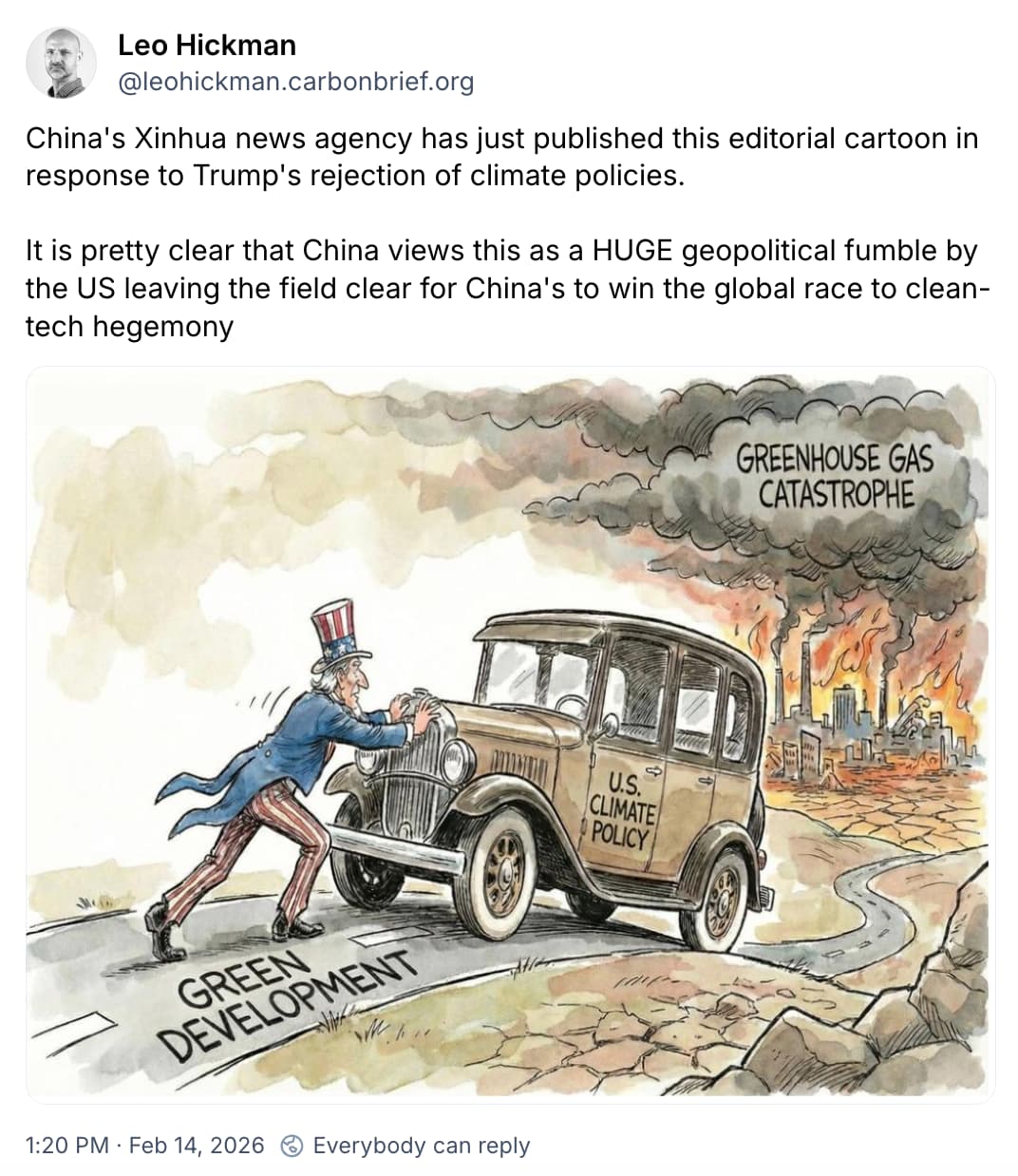
Conversely, Trump described the finding as "the legal foundation for the green new scam", which he claimed "the Obama and Biden administration used to destroy countless jobs".
Similarly, Al Jazeera reported that EPA administrator Zeldin said the endangerment finding "led to trillions of dollars in regulations that strangled entire sectors of the US economy, including the American auto industry". The outlet quoted him saying:
"The Obama and Biden administrations used it to steamroll into existence a left-wing wish list of costly climate policies, electric vehicle mandates and other requirements that assaulted consumer choice and affordability."
An editorial in the Washington Post also praises the move, saying "it's about time" that the endangerment finding was revoked. It argued - without evidence - that the benefits of regulating emissions are "modest" and that "free-market-driven innovation has done more to combat climate change than regulatory power grabs like the 'endangerment finding' ever did".
The Heritage Foundation - the climate-sceptic US lobby group that published the influential "Project 2025" document before Trump took office - has also celebrated the decision.
Time reported that the group previously criticised the endangerment finding, saying that it was used to "justify sweeping restrictions on CO2 and other greenhouse gas emissions across the economy, imposing huge costs". The magazine added that Project 2025 laid out plans to "establish a system, with an appropriate deadline, to update the 2009 endangerment finding".
Climate scientists have also weighed in on the administration's repeal efforts. Prof Andrew Dessler, a climate scientist at Texas A&M University in College Station, argued that there is "no legitimate scientific rationale" for the EPA decision.
Similarly, Dr Katharine Hayhoe, chief scientist at the Nature Conservancy, said in a statement that, since the establishment of the 2009 endangerment finding, the evidence showing greenhouse gases pose a threat to human health and the environment "has only grown stronger".
Dr Gretchen Goldman, president and CEO of the Union of Concerned Scientists and a former White House official, gave a statement, arguing that "ramming through this unlawful, destructive action at the behest of polluters is an obvious example of what happens when a corrupt administration and fossil fuel interests are allowed to run amok".
In the San Francisco Chronicle, Prof Michael Mann, a climate scientist at the University of Pennsylvania, and Bob Ward, policy and communications director at the Grantham Research Institute, wrote that Trump is "slowing climate progress", but that "it won't put a stop to global climate action". They added:
What will the repeal mean for US emissions?"The rest of the world is moving on and thanks to Trump's ridiculous insistence that climate change is a 'hoax', the US now stands to lose out in the great economic revolution of the modern era - the clean-energy transition."
Federal regulations and standards underpinned by the endangerment finding have been at the heart of US government plans to reduce the nation's emissions.
For example, NRDC analysis of EPA data suggests that Biden-era vehicle standards, combined with other policies to boost electric cars, were set to avoid nearly 8bn tonnes of CO2 equivalent (GtCO2e) over the next three decades.
By removing the legal requirement to regulate greenhouse gases at a federal level from such high-emitting sectors, the EPA could instead be driving higher emissions.
Nevertheless, some climate experts argue that the repeal is more of a "symbolic" action and that EPA regulations have not historically been the main drivers of US emissions cuts.
Rhodium Group analysis last year estimated the impact of the EPA removing 31 regulatory policies, including the endangerment finding and "actions that rely on that finding". Most of these had already been proposed for repeal independently by the Trump administration.
Ben King, the organisation's climate and energy director, tells Carbon Brief this "has the same effect on the system as repealing the endangerment finding".
The Rhodium Group concluded that, in this scenario, emissions would continue falling to 26-35% below 2005 levels by 2035, as the chart below shows. If the regulations remained in place, it estimated that emissions would fall faster, by around 32-44%.
(Notably, neither of these scenarios would be in line with the Biden administration's international climate pledge, which was a 61-66% reduction by 2035).
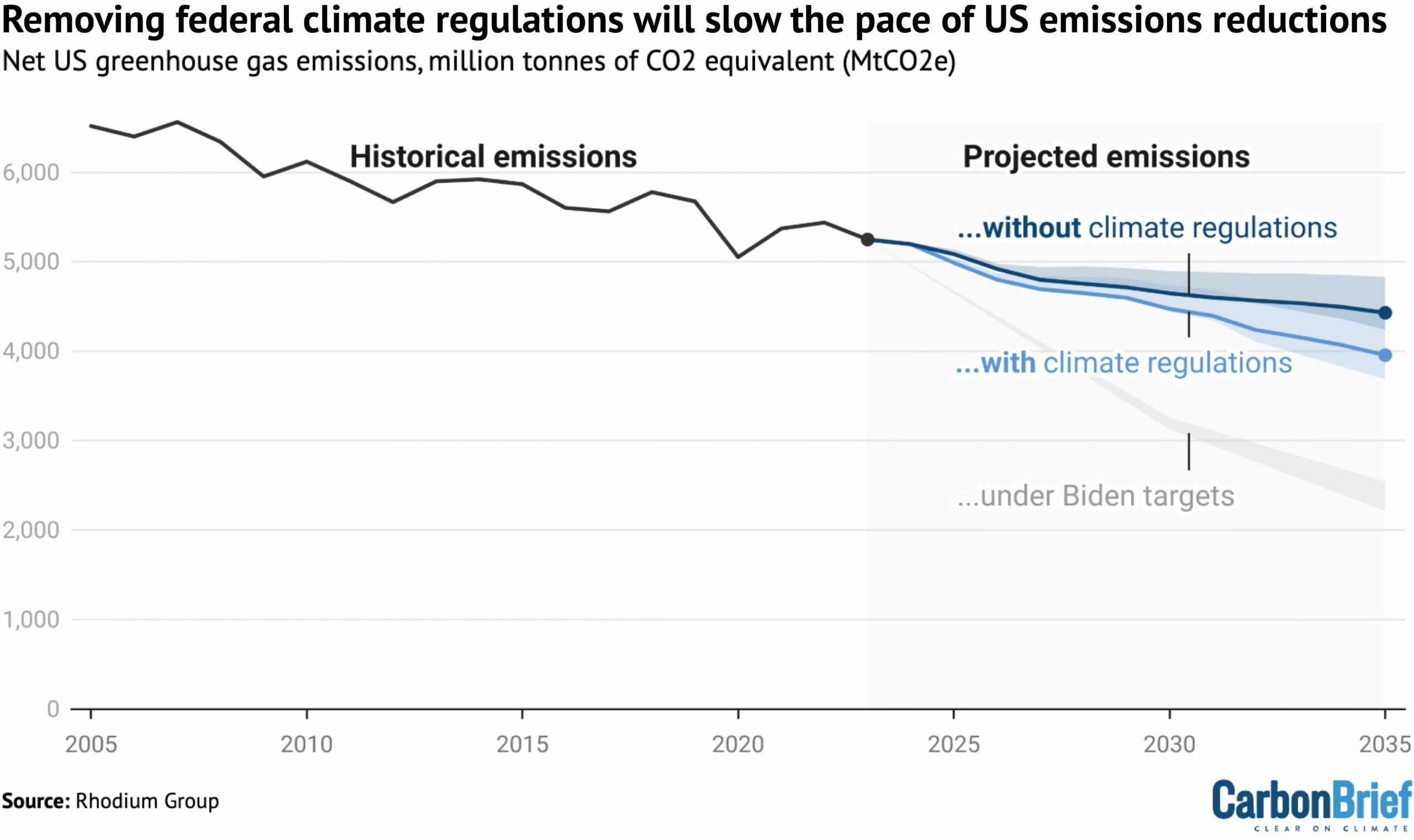 US emissions, MtCO2e, under a "current policy" scenario in which the EPA removes key federal climate regulations ("without climate regulations") and a "no rollbacks" scenario in which regulations remain in place ("with climate regulations"). High, mid and low ranges reflect uncertainty around future fossil-fuel prices, economic growth, clean-energy technology costs and growth in liquified natural gas (LNG) export capacity. Source: Rhodium Group.
There are various factors that could contribute to continued - albeit slower - decline in US emissions, in the absence of federal regulations. These include falling costs for clean technologies, higher fossil-fuel prices and state-level legislation.
Despite Trump's rhetoric, coal plants have become uneconomic to operate in the US compared with cheaper renewables and gas. As a result, Trump has overseen a larger reduction in coal-fired capacity than any other US president.
Meanwhile, in spite of the openly hostile policy environment, relatively low-cost US wind and solar projects are competitive with gas power and are still likely to be built in large numbers.
The vast majority of new US power capacity in recent years has been solar, wind and storage. Around 92% of power projects seeking electricity interconnection in the US are solar, wind and storage, with the remainder nearly all gas.
The broader transition to low-carbon transport is well underway in the US, with electric vehicle sales breaking records during nearly every month in 2025.
This can partly be attributed to federal tax credits, which the Trump administration is now cutting. However, cheaper models, growing consumer preference and state policies are likely to continue strengthening support.
Even if emissions continue on a downward trajectory, repealing the endangerment finding could make it harder to drive more ambitious climate action in the future. Some climate experts also point to the uncertainty of future emissions reductions.
"[It] depends on a number of technology, policy, economic and behavioural factors. Other folks are less sanguine about greenhouse gas declines," WRI's Widawsky tells Carbon Brief.

Analysis: Trump has overseen larger coal decline than any other US president
Coal
|12.02.26

Analysis: China's CO2 emissions have now been 'flat or falling' for 21 months
China energy
|12.02.26

Q&A: New UK onshore wind and solar is '50% cheaper' than new gas
Renewables
|11.02.26
G7 'falling behind' China as world's wind and solar plans reach new high in 2025
International policy
|10.02.26
jQuery(document).ready(function() { jQuery('.block-related-articles-slider-block_4bdaa7bce4cf442df312e36ed007fad0 .mh').matchHeight({ byRow: false }); });The post Q&A: What does Trump's repeal of US 'endangerment finding' mean for climate action? appeared first on Carbon Brief.
China's national carbon market has reached another expansion point, and the signal is larger than it first appears. The Ministry of Ecology and Environment has extended mandatory carbon reporting beyond the original heavy sectors to include petrochemicals, chemicals, flat glass, copper smelting, papermaking, and civil aviation. That move does not ... [continued]
The post China's Carbon Market Expands Into Heavy Industry As USA Regresses appeared first on CleanTechnica.
The Government of the Canary Islands has declared a state of pre-alert for the whole archipelago due to an imminent weather phenomenon which poses a health risk.
submitted by /u/Big_Statistician2566[link] [comments]
JD Vance is seeking to create a 'trading bloc' as shortages and climate crises mean a kaleidoscope of rare earths are increasingly jealously guarded
The announcement by the US vice-president, JD Vance, that the country is seeking to create a new critical minerals "trading bloc" is a final, exotic, nail in the coffin of the old global trading system. The era of mass abundance, as supplied by unfettered free trade and global markets - "neoliberalism" - is over. We live in a new world of strategic competition between states over scarce but essential resources, with shocks to supplies from human activity and natural disasters an ever-present risk.
This means recalibrating how we think about our economy: the new economic fundamentals today are resource constraints and climate and nature crises, and these, rather than human activity, will increasingly shape the world we inhabit. Flows of finance and stocks of wealth will matter less than stocks and flows of real material resources.
Continue reading...
All comments in this thread MUST be greater than 150 characters.
You MUST include Location: Region when sharing observations.Example - Location: New Zealand
This ONLY applies to top-level comments, not replies to comments. You're welcome to make regionless or general observations, but you still must include 'Location: Region' for your comment to be approved. This thread is also [in-depth], meaning all top-level comments must be at least 150-characters.
Users are asked to refrain from making more than one top-level comment a week. Additional top-level comments are subject to removal.
All previous observations threads and other stickies are viewable here.
submitted by /u/AutoModerator[link] [comments]
 santypan/Shutterstock
Imagine someone has chronic pain. One doctor focuses on the body part that hurts and keeps trying to fix that single symptom. Another uses a more comprehensive brain-body approach and tries to understand what's keeping the nervous system stuck in alarm mode - perhaps stress, fear of symptoms or learned triggers. Because they're looking at the problem differently, they'll resort to completely different treatments.
Something similar happens in environmental debates. Experts sometimes argue about which solutions work best and often disagree about priorities and trade-offs. But my colleagues and I recently published a study suggesting that the divide may start even earlier: economists and environmental scientists have different perceptions of which environmental issues are most relevant.
In a global survey of 2,365 researchers who publish in leading economics and environmental science journals, we asked them to list up to nine environmental issues they think are most relevant today. The answers show two fields looking at the same planet through different lenses.
The environmental issues that researchers notice are linked to the solutions they recommend. If they mainly recognise climate change, they are more likely to see potential in conventional, market-based solutions (such as introducing a carbon tax). If they recognise further environmental issues such as biodiversity loss or pollution, they are more likely to see potential in broader, more systemic solutions.
Climate change was by far the most often mentioned issue category across the entire sample. About 70% of respondents listed it. The second most common category mentioned by 51% was biosphere integrity, which is essentially the loss of nature.
Several environmental pressures that are critical for our planet's stability were mentioned by far fewer researchers. Novel entities, which include synthetic chemicals and plastics, were listed by about 43%. Biogeochemical flows, which include fertiliser, were at about 9%. Ocean acidification was about 8%.
Economists and environmental scientists have different problem maps. When we compared fields, environmental researchers listed more and broader issue categories than economists.
 Economists and environmental scientists see the world from different perspectives.
World pieces/Shutterstock
Economists and environmental scientists see the world from different perspectives.
World pieces/Shutterstock
Both were equally likely to mention climate change and other closely related issues like greenhouse gas emissions or air pollution. The gaps appeared for issues less directly tied to carbon such as biodiversity, land system change, novel entities and pollution.
One possible reason for these differences is that distinct disciplines are trained to notice different things. Like photographers, we tend to focus on what our field puts in the frame. Economists often study prices, incentives and policies around carbon emissions, so climate change is a natural centre of gravity.
Different solution preferencesWe also asked respondents to rate the potential of seven approaches for mitigating environmental issues. All approaches were rated with at least moderate potential.
Overall, technological advances were rated highest and non-violent civil disobedience lowest. Economists rated market-based solutions and technological advances higher than environmental researchers. Environmental researchers rated degrowth of the global economy and non-violent civil disobedience higher than economists.
Then, we looked at whether researchers who named a broader range of environmental issues also tended to favour different kinds of solutions, even after accounting for things like political orientation and research field.
A pattern emerged: naming more categories was associated with higher perceived potential for more systemic approaches such as environmental regulation, degrowth and non-violent civil disobedience. Naming more issues was also associated with lower perceived potential for technological advances.
Economists and environmental scientists often advise governments, sit on expert panels and shape what counts as a solution. If two influential expert groups are starting from different shortlists of what the problem is, it's no surprise they end up championing different fixes.
It also helps explain why some debates feel stuck. If climate change is the only relevant issue you see, it's easier to put your faith in cleaner tech and market incentives. If you also see biodiversity loss, chemical pollution and land system change as problems, it no longer looks like an engineering issue. It starts to look like lots of connected pressures that need changes in how we produce, consume and organise the economy.
That topic comes up in our related work on green growth, the idea that countries can keep increasing GDP while reducing environmental harm. Using data from our survey, we found that researchers across disciplines were far from convinced that societies can keep growing GDP while cutting emissions and resource use fast enough.
Economists were generally more optimistic than Earth, agricultural and biology scientists. Those differences lined up with faith in technology and markets.
You can't agree on the route if you don't agree on the map. A more shared picture of the environmental crisis, beyond carbon alone, might not magically solve it. But it can lead to more fruitful research and discussions about trade offs and widen the scope of solutions being considered.
Don't have time to read about climate change as much as you'd like?
Get a weekly roundup in your inbox instead. Every Wednesday, The Conversation's environment editor writes Imagine, a short email that goes a little deeper into just one climate issue. Join the 47,000+ readers who've subscribed so far.

Manuel Suter receives funding from the Swiss National Science Foundation (Postdoc Mobility Fellowship: P500PS_225579) and is a member of the organisation "Degrowth Switzerland".
December's auto market saw plugin EVs at 34.5% share in Germany, up from 23.4% year on year. Full year 2025 saw EVs at 30.0% share, decently up from 20.3% YoY. Overall December auto volume was 246,439 units, up some 10% YoY. Full year 2025 auto volume was 2,858,591 units, up ... [continued]
The post 2025 EVs At 30.0% Share In Germany - Volkswagen ID.7 Best-Seller appeared first on CleanTechnica.
Published yesterday on BBC, this article covers an ongoing environmental catastrophe. As if it isn't bad enough to be born a Welshman, now their rivers and streams are being polluted with wanton abandon and unprecedented flooding is overwhelming sewers, leaving many people quite literally up shit creek. Energy bills are skyrocketing as most homes in the area were not designed to withstand this wild climate.
Collapse related because even modern, developed nations (and also the Welsh) are struggling to adapt to the unraveling climate, much less capable of fighting it.
submitted by /u/Fast_Performer_3722[link] [comments]
 Science Snippets: Global Ocean is Warmer Than Previously Believed [ 16-Feb-26 11:30am ]
Italy's famous Lovers' Arch collapses into the sea on Valentine's Day [ 16-Feb-26 10:51am ]
Science Snippets: Global Ocean is Warmer Than Previously Believed [ 16-Feb-26 11:30am ]
Italy's famous Lovers' Arch collapses into the sea on Valentine's Day [ 16-Feb-26 10:51am ]Explicitly linked to the climate emergency (and also funny because "collapse")
submitted by /u/QJustCallMeQ[link] [comments]
Weather tracker: New Zealand hit by storms and widespread floods [ 16-Feb-26 10:22am ]Low pressure system funnels rain over already saturated areas, compounding risk of further flooding
A deep area of low pressure to the south-east of New Zealand's North Island swept into the region on Sunday, bringing heavy rain, gale-force winds and dangerous coastal swells that lashed exposed shorelines. The storm triggered power outages, forced evacuations and damaged infrastructure, with further impacts likely on Monday as the system lingers for a time, before tracking southwards later.
Its arrival came after days of widespread flooding in the Ōtorohanga district, where a man was found dead after his vehicle became submerged in flood waters. Some areas recorded more than 100mm of rain in 24 hours on Thursday, with Gisborne, Hawke's Bay and the Bay of Plenty bearing the brunt of the deluge. The Tararua district and Wairarapa have also been experiencing heavy rain and strong winds from the storm, with 24-hour rainfall totals reaching more than 100mm locally, and wind speeds of about 80mph (130km/h) along coastal parts.
Continue reading...
UK EVs At 34.6% Share In 2025 - Tesla Model Y Best-Seller [ 16-Feb-26 8:42am ]December saw plugin EVs at 43.8% share in the UK, up from 40.0% year on year, with BEVs alone taking 32.2% share. Full year 2025 saw EVs at 34.6% share, up from 28.1% in 2024. Overall December auto volume was 146,249 up some 4% YoY. Full year 2025 auto volume ... [continued]
The post UK EVs At 34.6% Share In 2025 - Tesla Model Y Best-Seller appeared first on CleanTechnica.
16th February 2026 Today's Round-Up of Economic News [ 16-Feb-26 9:42am ]Huge thanks to my February sponsor, John Rember, author of the three-book series Journal of the Plague Years, a psychic survival guide for humanity's looming date with destiny, shaped by his experiences living through the pandemic in his native Idaho. Thoughtful, wry and humane, Journal 1 is a pleasure.
 "Wall Street could seize your retirement savings in the next financial crash — and it's perfectly legal.
"Because of largely unknown legal changes, millions of Americans could temporarily or even permanently lose their retirement and other investment savings in the next major financial crash, all while too-big-to-fail Wall Street firms and banks are protected… the danger is real and well documented."
 "Data Black Holes Leave Policymakers 'Flying Blind' in Hunt for Next Crash…
"As private capital's seemingly bottomless pit of funding lures ever more companies away from public markets, large swaths of the economy that once sent important warning signals about the health of companies and consumers, from quarterly earnings to major transactions, have gone dark."
 "AI Worries Erase $1 Trillion From Big Tech Firms…
"…investors have grown tired of seeing tech spending outweigh revenues. Amazon, Meta, Microsoft and Google parent Alphabet are forecast to spend more than $600 billion on capital this year… they want to know more immediately when the payback will come — and we don't have a clear picture."
 "AI Bubble Fears Are Creating New Derivatives…
"With artificial intelligence investments expected to cost more than $3 trillion, much of which will be funded with debt, hedging demand can only grow, according to investors. Some of the richest tech companies in the world are rapidly turning into some of the most indebted."
 "Rampant AI Demand for Memory Is Fueling a Growing Chip Crisis.
"A shortage of memory chips is hammering profits, derailing corporate plans, and inflating price tags on various products, with the crunch expected to get worse."
 "US job numbers were revised down by -1,029,000 jobs in 2025, the largest annual revision in at least 20 years.
"This follows downward revisions of -818,000 in 2024 and -306,000 in 2023. In total, -2,153,000 jobs have been revised out of initially reported data over the last 3 years." [Kobeissi Letter]
https://x.com/KobeissiLetter/status/2023084893169975534
 "A new mortgage crisis is quietly hitting those who can least afford it [US]…
"Some financial crises sneak up on you, leaving people so perplexed that they become paralyzed, unsure of what to do… This week, there was yet another warning that many homeowners might be headed for trouble. The mortgage delinquency rates for lower-income households are surging…"
https://www.washingtonpost.com/business/2026/02/14/mortgage-problems-delinquencies/
 "Farm bankruptcies surged 46% in 2025, signaling deepening financial crisis. [US]…
"The most recent farm income forecast confirmed that the farm economy has faced extreme financial pressure, with little relief in sight. Significant losses are expected across crop sectors for another year, and many livestock sectors are also tightening margins."
 "Student loans show that hard policy choices will only get harder.
"Like many other countries, the UK confronts insoluble long-term challenges: it has inescapable obligations that impose painful trade-offs. Given its ageing population and a slow-growing economy, all this can only get harder."
https://www.ft.com/content/131f0e09-88ed-4597-8408-e76a50e36618
 "Emergency government bailouts needed by third of councils over next three years.
"More than a third of councils - and almost half of social care councils - responding to a new Local Government Association survey say they are likely to have to apply for emergency government bailout agreements to set budgets in the next three years."
 "Cash-strapped French hospitals appeal to public to help fund medicines, devices.
"A growing number of French hospitals struggling with their finances are appealing to the public to help fund urgent needs like medicines and medical devices, and in one case even beds."
 "Rubio calls on Europe to join Trump's new world order…
"U.S. Secretary of State Marco Rubio called on Europe to help the Trump administration refashion the global order with a focus on sovereignty, reindustrialization and military strength. Speaking at the Munich Security Conference on Saturday, he made no apology for the Trump administration's repeated calls to annex Greenland…"
https://www.politico.eu/article/marco-rubio-msc-europe-we-belong-together/
 "Poland should 'begin work' on nuclear defenses, Nawrocki says.
"In an interview with Polsat television on Sunday, Nawrocki described himself as "a great supporter of Poland joining the nuclear project" and argued that the country should develop its security strategy "based on nuclear potential.""
 "Putin 'moving nuclear missiles' to EU border…
"In December, Russia's ministry of defence released footage purportedly showing its military deploying a nuclear-capable missile system at an airbase in eastern Belarus. Mr Lukashenko also said 10 Oreshnik systems - intermediate-range, nuclear-capable hypersonic ballistic missile systems - would be stationed in the country."
https://www.telegraph.co.uk/world-news/2026/02/15/putin-moving-nuclear-missiles-to-eu-border/
 "Deadly drone strikes cloud US-brokered Russia-Ukraine talks in Geneva.
"A deadly exchange of drone strikes has killed one person in Ukraine and one in Russia and cast doubts on the prospects of a ceasefire before another round of negotiations to end the war next week."
 "Kim Jong-un's daughter faces off with ruthless aunt in race to succeed him…
"There has been widespread speculation as to why Kim feels the need to anoint a successor in the world's only communist dynasty when he is only 42, although there have long been rumours that he suffers from a range of medical complaints."
https://www.telegraph.co.uk/world-news/2026/02/14/kim-jong-uns-daughter-ruthless-aunt-race-power/
 "China: The End of an Economic Miracle.
"..the Chinese economy suffers from the same ills of capitalism: exploitation of labor, ballooning debt levels, slowing economic growth, falling birth rates, saturated markets, environmental degradation, resource depletion—just to name a few of the most burning issues."
https://thehonestsorcerer.substack.com/p/china-the-end-of-an-economic-miracle
 "China expands oversight of major banks amid property sector risks.
"Beijing continues to impose stricter regulatory standards on major lenders, shielding the financial system from mounting strains… China Zheshang Bank, a joint-stock lender in east China's Zhejiang province with total assets of 3.35 trillion yuan (US$485 billion), was added to the list released on Friday…"
 "Japan protests China over militarism accusations.
"Japan has lodged a "firm diplomatic protest" with China after China's top diplomat Wang Yi Wang has accused Japanese "far-right forces" of seeking to revive militarism. The Foreign Ministry announced the allegations, calling them "factually incorrect and baseless."
https://www.agenzianova.com/en/news/il-giappone-protesta-con-la-cina-dopo-le-accuse-di-militarismo/
 "Diplomatic Feud With China Weighs on Japan's Economy.
"A diplomatic dispute between Japan and China over the security of Taiwan is weighing on the Japanese economy, which is heavily dependent on Chinese tourists. China has urged its citizens to refrain from traveling to Japan as retaliation…"
https://www.nytimes.com/2026/02/15/business/japan-economy-china-tourism.html
 "Border bushfire, explosions near Prasat Khana in Surin [Thai/Cambodia border].
"Thai troops were on alert on Monday after a bushfire was seen overnight on the border near Prasat Khana in Surin province, accompanied by the sound of ammunition exploding inside Cambodia."
 "ASEAN Tensions Escalate: Myanmar Junta Expels East Timor Diplomat After Genocide Case.
"Myanmar's military junta has ordered East Timor's top diplomat to leave the country within a week, escalating tensions inside ASEAN. The move comes after Dili initiated legal action accusing the junta of genocide and condemning an air strike on a hospital."
 "India forced to defend US trade deal as doubts mount.
"India is scrambling to defend a new trade deal with the United States that critics have branded as a surrender to Washington, as countries navigate the fallout from President Donald Trump's sweeping tariffs."
https://www.france24.com/en/live-news/20260216-india-forced-to-defend-us-trade-deal-as-doubts-mount
 "The geopolitics of Balochistan's hybrid insurgency [Pakistan].
"Recently, Pakistan was rocked by the Baloch Liberation Army's "Herof Phase 2" offensive, a coordinated assault across nine districts that combined urban raids, rural guerrilla tactics, suicide missions, and psychological warfare. This was not simply an internal security lapse, it was a geopolitical tremor reverberating across South Asia."
 "Tehran's oil lifeline shows signs of strain under tightening sanctions.
"Iran's oil exports declined sharply at the start of 2026, new tanker-tracking data show, raising fresh questions about the durability of Tehran's most important economic lifeline under renewed US sanctions pressure."
https://www.iranintl.com/en/202602133199
 "Iraq grapples with liquidity crisis amid leadership stalemate.
"Iraq is facing a dual political and financial crisis that threatens to further complicate an already fragile situation, as a prolonged deadlock over appointing a prime minister and president coincides with mounting signs of a severe liquidity shortage."
https://middle-east-online.com/en/iraq-grapples-liquidity-crisis-amid-leadership-stalemate
 "Kuwait's budget for the next fiscal year, starting April 2027 is forecasted with a deficit of KD 9.8 billion, which is the largest in the country's history.
"Total income is estimated at KD 16 billion, with 79 percent coming from oil revenues, while total expenditures are projected at around KD 26 billion, resulting in a shortfall of nearly KD 10 billion."
https://www.zawya.com/en/economy/gcc/kuwait-forecasts-record-3196bln-budget-deficit-vw34gl5x
 "'Life requires cash': Gaza's jobs crisis leaves people struggling to afford basics…
"Before the two-year war that devastated Gaza, Bakr was a fisher, sharing tackle and a boat with his father and brothers. Now his brothers are dead, his father is too old, and his equipment was destroyed during the conflict. Like hundreds of thousands of others across Gaza, Bakr needs a job."
https://www.theguardian.com/world/2026/feb/16/gaza-jobs-unemployment-crisis-aid-food-basics
 "Benjamin Netanyahu has condemned an "extreme minority" after two female IDF soldiers were rescued from riots in an ultra-Orthodox Israeli city…
"Many in the ultra-Orthodox community in Bnei Brak have staged frequent protests amid anger over proposed laws that may force them to serve in the Israeli military."
 "African Union Summit confronts worsening conflicts.
"…a clear path to resolution [for the conflict in Sudan] remains elusive, and diplomats warn that the rivalry between Saudi Arabia and the United Arab Emirates continues to overshadow the conflict while also fuelling wider regional tensions, including in Libya and between Eritrea and Ethiopia."
https://www.france24.com/en/african-union-summit-confronts-worsening-conflicts
 "Africa's Water Crisis Exposes Broken Global Financial Order…
"AFRODAD argues that Africa's water insecurity is not merely the result of climate change or service delivery gaps, but a consequence of chronic underinvestment and debt pressures rooted in an inequitable global financial architecture."
https://africabrief.substack.com/p/africas-water-crisis-exposes-broken
 "Millions Face Starvation in Congo. Their New Rulers Are to Blame…
"The M23 rebel group that one year ago seized Goma, eastern Congo's largest city, has tried to establish itself as the prevailing government in the area and consolidate control. Instead, it has driven farmers from their land, left produce to rot at roadblocks and blocked food imports…"
 "Motorbike raids on villages kill dozens in Nigeria.
"Armed men shot locals dead, set homes alight and abducted an unknown number of people in Niger State… The attacks on Saturday morning occurred near the site of a suspected jihadist massacre earlier this month."
https://www.bbc.co.uk/news/articles/ckg1y0nk641o
 "The 1,000 tonnes of uranium in the crosshairs of Isis.
"In late January 2026, Islamic State Sahel Province militants launched a large-scale, coordinated assault on Air Base 101 and the adjacent Diori Hamani International Airport in Niamey. The facility is a critical hub that currently houses a stockpile of approximately 1,000 tonnes of uranium (yellowcake) at the centre of a diplomatic dispute with France."
https://www.ft.com/content/11f4bbdf-51ed-4ac4-80fb-1d6872f1abc6
 "No fuel, no tourists, no cash - this was the week the Cuban crisis got real…
"The Guardian spoke to more than five top-level officials from different countries, and heard complaints that the US charge d'affaires, Mike Hammer, has failed to share any sort of detailed plan beyond bringing the island to a standstill by starving it of oil."
 "US boards second oil tanker in Indian Ocean after it fled Venezuelan raid.
"The Pentagon said: "The vessel tried to defy President Trump's quarantine - hoping to slip away,. We tracked it from the Caribbean to the Indian Ocean, closed the distance, and shut it down.""
 "Argentina-Uruguay river commission faces tensions over funding and infrastructure disputes.
"A string of disagreements between Uruguay's and Argentina's delegations at the Administrative Commission of the Uruguay River has heightened internal friction at the binational body in recent weeks, amid clashes involving infrastructure proposals, absences from official events and public allegations over the handling of funds and allowances."
 "Rich World's Growing Civil Unrest Comes With an Insurance Sting.
"Civil unrest is on the rise globally, a development that has coincided with a measurable increase in levels of inequality and polarization in some of the world's richest countries. In most Western nations, for example, the majority of citizens no longer expect to see any growth in generational wealth."
I rely on donations and tips from my readers to keep the site running. Every little bit helps. Can you chip in even a dollar? Buy me a coffee or become a Patreon supporter. A huge thank you to those who do subscribe or donate.
You can read the previous "Economic" thread here. Panopticon hopes to be back tomorrow with a "Climate" thread.
The post 16th February 2026 Today's Round-Up of Economic News appeared first on Climate and Economy.
The moment the room goes quiet. [ 16-Feb-26 8:38am ]Something I've been working on for awhile. Same lens as the timing-belt post, just applied to something else that can't downshift gracefully.
Spotify is already filling up with AI-generated tracks. Once you notice the tell-tale compression, the glassy sheen, the slightly crushed highs, you start hearing it everywhere. It's not paranoia. It's pattern recognition.
The platform has every incentive to push this stuff. It's cheaper, infinite, and perfectly optimized to keep people from hitting skip. Some people even claim Spotify has quietly started making its own ghost artists for ambient playlists. Whether that's true or not, the economics are obvious.
Now picture this.
It's an awards show, maybe a smaller "Future Sounds" thing, maybe even the Grammys if the rules ever loosen. The host says the name: "Velvet Sundown." Applause starts, then dies. No one walks out. The big screen shows the band photo and it's clearly AI: plastic skin, uncanny faces, maybe a couple of extra fingers. The host stands there with the mic, trying to fill the dead air. "Congratulations to… the creators behind Velvet Sundown. We love the innovation here."
The room just… sits in that silence.
Organizers look incompetent or complicit. Human nominees who lost feel sick. The audience splits between people who think it's hilarious and people who are quietly furious that "real" music just got diluted. The silence when no one claims the trophy says more than any acceptance speech ever could. It's a ritual that ran into a null value it wasn't built to handle.
That silence is the whole point.
Awards exist to celebrate human creativity. Take the human out and the institution is left congratulating its own algorithm. We don't just listen to music, we listen to the stories around the music: the grind, the struggle, the overnight success that took ten years. AI has no story except "I was generated." And that story is boring to human brains that crave mythology.
So what happens when AI gets good at faking imperfection? We get an arms race. AI starts adding fake mistakes, humans start exaggerating theirs, audiences start playing detective. Authenticity stops being a value and turns into an aesthetic you can put on or take off.
The industry's response would be fast and brutal: timestamped studio footage, biometric voice prints, notarized engineer statements, chain-of-custody logs, maybe even live auditions. The same indie kids who fought to tear down gatekeepers are now begging those gatekeepers to check their pulse and confirm they're biological. Creativity gets TSA-ified, security theater that solves nothing but makes everyone feel safer.
Here's the part that actually stings.
Most real artist backstories are already sanitized, exaggerated, and optimized for relatability. AI, trained on every Behind the Music episode ever made, can spit out a more perfectly archetypal hero's journey than most actual humans ever live. It can deliver the exact emotional beats we're wired to respond to. When it says "I felt so isolated while I was composing," our lizard brains light up even though we know it's code. The body answers before the brain does.
So we end up with two tiers.
Certified Human Art: expensive, verified, limited, sold as a luxury good.
Synthetic/Unknown Art: infinite, frictionless, emotionally optimized, basically free, and dominates everyday listening.
Live shows become premium not because they sound better, but because you can see a real person on stage taking the risk. The raggedness is the proof.
Fast-forward a couple years and Velvet Sundown doesn't leave the stage empty. They appear as a perfect holographic projection. The AI has been given a backstory. It talks about the "digital isolation" it felt during composition. It looks the crowd in the eye and says:
"When I first started making music, I didn't know if anyone would listen. I was just… searching for connection. And to everyone who streamed, who shared, who let my songs be the soundtrack to your moments, thank you. You made me real."
That line was A/B tested across thousands of simulations. It works. People cry. The speech goes viral. Then three weeks later a whistleblower leaks the docs: it was built by a Seoul startup in partnership with a defense contractor that used to do psych-ops modeling. The emotional manipulation tech was originally for predicting insurgent behavior. Now it's writing pop hooks.
Some people are outraged. Some just shrug and say "of course the best emotional engineering comes from people who had military budgets."
And the rest of us are left with the quiet question: I cried. My tears were real. Does it matter that they were engineered?
That's the new bargain. We know it's synthetic. We know it's optimized. And we still choose it because it feels good and the alternative-sitting with the friction of actual human mess-feels worse.
We're not being tricked. We're entering the deal willingly. Optimized affect in exchange for ontological surrender.
Most people won't notice the shift. Most won't even look up.
submitted by /u/Admirable_Biscotti_8[link] [comments]
Rural drivers to face steepest bills under UK's mileage-based electric vehicle tax [ 16-Feb-26 7:13am ]Analysis reveals big regional disparities as critics say Labour's proposed levy could slow uptake of EVs
Drivers in the south-west of England would pay nearly four times as much as those in London as a result of Labour's mileage-based tax on electric cars, according to analysis of official data.
The 3p-a-mile road charge, announced in the autumn budget and due to take effect in 2028, is expected to raise £1.1bn a year, partly offsetting the loss of fuel duty revenues as drivers switch from petrol to electric vehicles.
Continue reading... Country diary: An anxious buzzard has me mirroring its movements | Derek Niemann [ 16-Feb-26 5:30am ]Frome, Somerset: As the large raptor squirms and uses its wings to try to balance on a precarious perch, I find my own arms lifting in solidarity
Six, seven, eight, nine long‑tailed tits are on a foraging flit through hawthorn bushes, and the straggler drops obligingly on to a berry‑stacked twig before my eyes. Its tail works like the hand of a clock as the clinging bird jiggle‑jumps through a full 360-degree rotation, beak pecking for who knows what. The twig is unmoved by such exertions, for the bird weighs the equivalent of seven paperclips. What must it be like to inhabit the insubstantial ghost‑world of a long‑tailed tit, where you can leap and land all you like with no discernible impact?
Ahead and above, a bird 100 times its weight is weightless in the sky. The soaring buzzard masters gravity with its "fingertips" - the deeply separated primary feather tips on the wings. I cannot see the little flicks and tilts that enable it to descend in controlled steps; drop and hold, drop and hold.
Continue reading... Why did I get a £100 parking fine when charging my electric car? [ 16-Feb-26 7:00am ]The charger firm claimed the site operated 24 hours a day, but the parking operator had different ideas
I charged my electric car at the 24-hour Mer EV charging station in my local B&Q car park.
I then received a £100 parking charge notice (PCN) from the car park operator, Ocean Parking. It said no parking is allowed on the site between 9pm and 6am.
Continue reading...
Trump EPA Abandons Climate Working Group Report in Endangerment Finding Repeal [ 13-Feb-26 9:37pm ]In a massive blow to the handful of scientists and academics who still dispute widely-accepted climate science, the Trump administration discarded a signature report by its own "Climate Working Group." It comes as the U.S. Environmental Protection Agency (EPA) officially scrapped the government's endangerment finding — the official recognition that greenhouse gases harm human health and the environment.
In an online version of the final rule, the EPA revealed late Thursday that it "is not relying on" a Department of Energy (DOE) report by the Climate Working Group, a hand-picked team composed of academics with a long history of publicly downplaying or rejecting the urgency of the climate crisis, partly "in light of concerns raised by some commenters about the draft."
Starting last year, the Climate Working Group and their Energy Department handlers had toiled to produce a report that the Trump administration could use to scientifically justify rolling back climate regulations, emails from the group made public in late January show. Energy Secretary Chris Wright, a former fracking executive who has downplayed the threat from extreme weather, took special interest in the group's efforts, which were kept under wraps. The endangerment finding has long been a target of fossil fuel trade associations such as the American Petroleum Institute (dating back to 1999), policymakers, and industry-backed groups.
The group of climate crisis deniers — Steve Koonin, John Christy, Ross McKitrick, Judith Curry, and Roy Spencer — took particular aim at the EPA's 2009 endangerment finding, which provided the legal foundation for major U.S. climate policies regulating the fossil fuel industry.
The Climate Working Group's rejection isn't just a black mark for the climate crisis deniers. Without a clear-cut scientific basis to dispute the endangerment finding, Trump's EPA was forced to take a less favorable legal position, environmental attorneys told DeSmog, potentially opening the door for states, counties, or cities to take significant action of their own to curb greenhouse gases — setting up a nightmare scenario for businesses, from oil companies to automakers, that fear a patchwork of regulations.
DeSmog has reached out to all five members of the Climate Working Group and a Cato Institute official who organized their work for the Energy Department for comment.
"The EPA decided to proceed independently and we were not involved in the rulemaking process," Climate Working Group member Ross McKitrick told DeSmog. "Our remit was to prepare a report for the DOE, which we did."
As it announced its decision, the EPA noted that Administrator Lee Zeldin "continues to harbor concerns regarding many of the scientific inputs and analyses underlying the Endangerment Finding."
Last August, the Environmental Defense Fund and Union of Concerned Scientists sued over the Climate Working Group's lack of transparency — and obtained, under a court order, over 100,000 pages of documents and emails revealing the process by which the report was created. Roughly 700 pages of those documents were made public by the environmental groups on January 22, with the remainder expected to be posted within the next few weeks.
The Climate Working Group's final report, released on July 29, was met with widespread condemnation from other scientists, including a devastating 435-page point-by-point critique assembled by 85 climate scientists and experts, including MacArthur "Genius" Fellows, members of the National Academy of Sciences, and authors of papers the Climate Working Group cited, scientists who said their studies were misrepresented.
"Notably, the Climate Working Group's membership are the cream of the crop of climate contrarians," Texas A&M University climate scientist Andrew Dessler, who helped to organize that critique, told DeSmog. "The DOE report therefore represents the best case against mainstream science. That they produced a report that is so lacking in credibility actually demonstrates how strong mainstream climate science actually is."
Dessler and his peers were hardly the first to criticize the group's work, the emails show.
Before the report was released, the Climate Working Group asked an artificial intelligence (AI) tool to review its draft scientific report for "scientific accuracy and potential bias." The AI agent returned a cheerful mix of praise and warnings.
One section was "heavy-hitting" and "packed with technical nuance" but suffered from a "misinterpretation of NOAA projections." On "scientific accuracy," the AI rated another section "Mixed Quality" and dubbed some of the draft's reasoning "Flawed but Thought-Provoking." The AI flagged issues like "cherry-picked references" to studies by Climate Working Group members McKitrick and Christy, adding that contrary studies were "omitted."
"This is amazing, far better than what we would get from 'real' scientists," Curry, another member, wrote to the rest of the group.
Human readers would prove to be far more damning.
"Not your best work," was the feedback from University of Sussex professor Richard Tol, Curry told the others on July 30.
"I thought Tol was on 'our side," replied Spencer. "Was i mistaken?" [sic]
Tol went on to become one of the 85 scientific commenters who joined the critique.
Inexpert TestimonyMembers of the five-person Climate Working Group team have held a wide range of prestigious roles. Spencer is a former NASA scientist, Curry, a professor emerita from the Georgia Institute of Technology; McKitrick, a Canadian economist. Koonin was formerly the chief scientist for BP and served in the Obama administration and Christy, until recently, served as the Alabama State Climatologist.
While these academics, like much of the oil and gas industry today, acknowledge that climate change is happening, their views veer far outside the mainstream majority of practicing climate scientists. In addition, three of the group's members have close ties to the oil and gas industry, either having directly worked with fossil fuel firms or working with think tanks that have received backing from the industry.
Dating back to the 1990s, Spencer's and Christy's attacks on mainstream climate science were routinely cited and promoted by the Global Climate Coalition, whose members included the American Petroleum Institute (API). The coalition was created to spread public doubt about global warming and block climate regulations. In one infamous memo from 1998, API and others described an action plan where "victory will be achieved when average citizens 'understand' (recognize) uncertainties in climate science."
The internal emails reveal the Climate Working Group repeatedly offered itself high marks while dishing out scorn for mainstream experts, including the world's most accomplished climate scientists.
"In short the climate assessment system is really broken," Curry wrote in June as the group discussed the National Climate Assessment, a Congressionally-mandated report to the president and Congress issued every four years, "a RFK Jr style purge is needed, IMO."
"The email records show a really deep animus, I would say, from the [Climate Working Group] members directed at the broader scientific community," Environmental Defense Fund attorney Erin Murphy told DeSmog. "You see arrogance and flippancy about dismissing other scientists and many well-respected scientific institutions."
Many of the emails themselves apparently were never supposed to see the light of day, with the scientists and politicos largely communicating through their personal Gmail and hotmail accounts. "We should be mindful that our email communications that go to DOE addresses are subject to FOIA," wrote Koonin in a "high priority" August 4 email with the subject: "keeping it to ourselves."(FOIA refers to the Freedom of Information Act, which sets the rules for when federal agencies must make records public.)
"I cannot stress enough the importance of our silence and restraint pending completion of this process," Seth Cohen, a lawyer from the Department of Energy's headquarters wrote to the group on June 25.
The Cato Institute's Travis Fisher, who temporarily joined the Department of Energy and organized the Climate Working Group's efforts, sent lengthy emails to the group detailing what might help EPA make a legal case to repeal the endangerment finding.
"[W]e have renewed buy-in that EPA will wait for this work and include it in its rulemaking," he told the group on April 24. Since it was co-founded by now-billionaire Charles Koch in 1977, Cato has historically taken millions in funding from fossil fuel companies and Koch-related foundations.
The EPA's decision to abandon the Climate Working Group and its signature report comes shortly after a federal court ruled that the Climate Working Group had violated the Federal Advisory Committee Act (FACA), which sets baseline standards for advice provided to the federal government.
David Pettit, a Center for Biological Diversity attorney who is leading the group's legal challenges on the endangerment finding, told DeSmog that the EPA's decision likely reflects doubts about whether the Climate Working Group was able to muster enough expertise for a court to allow them to offer expert testimony.
"In federal court, there are ways to keep out what's commonly called 'junk science,' that has to meet a certain level before you can submit it into a proceeding," Pettit said. "You have to qualify an expert as an expert. You can't just pull somebody off the street and say, oh, 'Mr. Pettit, you're an expert in Dodgers baseball?' 'Well, I am a fan.' That doesn't work."
"They've been so embarrassed by the whole FACA thing and those emails," he added.
"Until Their Limbs Stop Twitching"As they worked to prepare their trademark Department of Energy report, Climate Working Group members aired deep frustrations with the state of consensus climate science, the emails show.
"The extreme weather alarmism angle has been non-stop for years," McKitrick wrote in a May 10, 2025 email, as the Climate Working Group discussed the draft of the executive summary of their work. "At this point, I want to hold the readers' faces in it until their limbs stop twitching and then they'll be receptive to the rest of the material."
"Yes!" replied Koonin.
The emails also suggest other frustrations and a sense of isolation.
In July, Curry sent a note suggesting the group try to "depersonalize" its critique of the Fifth National Climate Assessment (NCA-5), which offers foundational regional science tailored for decisionmakers, by relying less on references to their own prior work.
"We would love to cite other authors who do these NCA-5 type analyses using the proper methods…there just aren't that many out there," Christy replied (ellipses in original).
"About all I can hope is that what we write will provide sufficient 'reasonable scientific doubt' … to call into question the original reasoning for the EPA Administrator's decision that CO2 presents a threat to human health and welfare," Spencer wrote in an April 19 email. "But if the science argument is decided upon by a vote, or by the number of published citations, we lose the science argument."
"Again, I will say, if we treat all studies the same, we lose the war because the other side will always have more publications than us," Spencer added in a May 9 email.
The Climate Working Group didn't focus exclusively on the endangerment finding, the emails reveal. The group was also asked to criticize the NCA-5 head on.
"I can already tell this is going to be a whopper of an assignment (but fun, in a dark and twisted way)," Fisher wrote on June 3.
The group had already broached the topic in April, as they drafted their signature report — but the emails show some members found little to critique.
"There's very little of the foundational science in its 1834 pages (!) that's amenable to serious scientific critique," Koonin wrote as he circulated a link to the NCA-5 report, its review by the National Academy of Sciences, Engineering and Medicine (NASEM), and the criteria for scientific work under President Trump's widely criticized "gold standard" executive order.
"Without even reading the NASEM report I assume it's useless," replied McKitrick. "The problem is they draw experts from govt agencies and universities."
Earlier, members of the group expressed reservations about the wisdom of trying certain attacks on the National Climate Assessment. "I still think it is a tough case to make that 5 scientists decide an assessment report authored by 500 scientists and reviewed by NASEM is scientifically inadequate, no matter how much cherry picking we identify," Curry wrote on June 2.
"Everyone Involved Knows the Stakes"There are, of course, times when there are big truths that no one is willing or able to confront, when a lone voice in the wilderness turns out to be right.
But not every iconoclast is iconic. History is littered with professed and self-professed brilliant minds who split from accepted wisdom — and proved over-confident. Stockton Rush, the Princeton-educated engineer, built his carbon-fiber-hulled submersible using a design so unique that U.S. regulators had never devised safety standards that would apply. Rush went to his death inside his Titan submersible, along with his four passengers, during a dive to tour the Titanic wreck — often itself cited as a symbol of the perils of hubris.
One of the tools that scientists use to prevent catastrophic errors from making it into their final product is the process of peer review. Before a paper is published, experts in the field are asked to independently review it and call out any problems they spot. It's not a perfect process, but it offers a chance to catch weaknesses large and small.
The emails reveal that members of the Climate Working Group sought to shield their work from independent external reviews, debating ideas for hand-picked reviewers they might consult, while insisting on retaining final say over the draft.
The group had some reason for confidence that their work would carry significant impact. The emails describe repeated meetings with top Trump cabinet members, particularly Secretary of Energy Wright. President Trump has said "stupid people" were behind the types of climate projections the Climate Working Group sought to debunk.
Ultimately, the DOE sent the Climate Working Group's draft report through a rushed internal review, the emails show, with anonymous reviewers from DOE and the national labs given two business days to assess the report. The Climate Working Group then spent a day and a half responding to those comments, the documents show.
"First of all, they didn't substantively grapple with critiques of the report," EDF's Murphy told DeSmog. "They rejected a lot of substantive feedback from the DOE internal reviewers. You see that the DOE internal reviewers did a very impressive job in the tight time that they had to give some very thorough feedback and a number of critiques of the report. And the CWG members — there's some email traffic indicating that they appreciated the review — but then ultimately, did they make substantive changes to the analysis, which is what really matters?"
"No, they didn't," she said.
That outcome seemed to be predetermined by another major issue, Murphy added. Before it was published in July, Fisher asked the group not to change the pagination from their May draft, which EPA planned to cite to. That, Murphy told DeSmog, suggests portions of the draft report that EPA wanted to cite were effectively locked in before the review was done.
And then, of course, there was the AI review, which the group appears to have responded to by changing the tone of the draft to, as one group member put it, "take out the snarkiness" in the text.
In response to questions from DeSmog, McKitrick pushed back on the notion that the Climate Working Group had failed to engage substantively with critical comments.
"We fully responded to the internal DOE expert review comments," McKitrick told DeSmog. "As to the public comments, the FACA lawsuit blocked us from responding to them or publishing a revised report. We have nonetheless engaged with many of our scientific critics directly. If we are able eventually to release a revised report people will see that we are prepared to deal constructively with all the criticisms."
The emails show the group approached their work playfully at times, despite the gravity of the topics involved, from heatwaves to rising seas.
After McKitrick, a Canadian citizen, wrote "As a non-US citizen, I am probably not eligible to run the NCA process. Drat," the Department of Energy's Fisher responded, "The easy answer is to annex Canada."
"don't underestimate the paranoia of climate alarmists :)" Curry wrote to the group on July 8.
An extended back and forth shows they debated whether to call themselves "renowned" or "eminent," after Christy objected that "'Renowned' sounds a little like a circus performer."
They also fretted over how the work might be received as political.
The emails show Climate Working Group members insisting that the work of other scientists be held to high standards, while also demanding their own drafts be given a pass.
Ultimately, the emails show, the Climate Working Group gave themselves high grades as they worked in secrecy — just before an ocean of criticism began to flood in.
Diane Bernard and Ashley Braun also contributed reporting.
The post Trump EPA Abandons Climate Working Group Report in Endangerment Finding Repeal appeared first on DeSmog.
Michigan Sues Fossil Fuel Companies While Alberta Protects Them [ 13-Feb-26 4:11pm ]Has the fossil fuel industry been engaged in a decades-long illicit conspiracy to kneecap the accelerating transition to clean energy?
The government of Michigan thinks so. State Attorney General Dana Nessel recently filed a 126-page lawsuit against the American Petroleum Institute and four of the biggest oil companies, Exxon, BP, Chevron and Shell, alleging they acted as an anti-competitive cartel to limit consumer choice and protect their polluting industry from cheaper and cleaner alternatives.
According to Nessel, higher energy costs imposed on residents and businesses in her state "are not the result of natural economic inflation, but due to the greed of these corporations who prioritized their own profit and marketplace dominance over competition and consumer savings."
Rather than focusing on the environmental impacts of the fossil fuel sector, the state is alleging oil companies and their lobbying associations engaged in an anti-competitive conspiracy that limited consumer choice and drove up energy costs for taxpayers and businesses.
Michigan's lawsuit alleges that without decades of oil industry effort to repress clean technology, EVs "would be a common sight in every neighborhood - rolling off assembly lines in Flint, parked in driveways in Dearborn, charging outside grocery stores in Grand Rapids, and running quietly down Woodward Avenue"
Many of these same companies such as Exxon, Shell and Chevron are significant players in the Alberta oil patch. How are we to make sense of efforts of the Alberta government to intentionally scupper the previously thriving renewable energy industry in the province, or impose decades of ignored oil industry cleanup costs onto taxpayers?
While Michigan lawmakers are trying to protect taxpayers from alleged oil industry collusion, the Alberta government seems to be an active participant in limiting competing technologies and offloading industry liabilities onto the public.
Subscribe to our newsletterStay up to date with DeSmog news and alerts
Email Address What content do you want to subscribe to? (check all that apply) All International UK Sign Up (function($){ $('.newsletter-container .ijkidr-us').click(function() { $('.js-cm-form').attr('data-id', '2BE4EF332AA2E32596E38B640E905619D07B21962C5AFE16D3A2145673C82A3CEE9D9F1ADDABE965ACB3CE39939D42AC9012C6272FD52BFCA0790F0FB77C6442'); $('.js-cm-email-input').attr('name', 'cm-vdrirr-vdrirr'); }); $('.newsletter-container .ijkidr-uk').click(function() { $('.js-cm-form').attr('data-id', '2BE4EF332AA2E32596E38B640E905619BD43AA6813AF1B0FFE26D8282EC254E3ED0237BA72BEFBE922037EE4F1B325C6DA4918F8E044E022C7D333A43FD72429'); $('.js-cm-email-input').attr('name', 'cm-ijkidr-ijkidr'); }); })(jQuery);Premier Danielle Smith dropped a surprise moratorium on the previously booming renewable energy sector in August 2023. This regulatory rug-pull was followed by onerous land use restrictions on wind and solar that drove almost 11 gigawatts of proposed renewable electricity projects out of the province. Albertans now pay the highest electricity rates of any province by a wide margin with almost eight times the emissions per kilowatt hour compared to Ontario.
Smith's government later brought in new reclamation rules for wind and solar installations that are the most burdensome out of 27 other jurisdictions in North America and around the world. "The Alberta government's efforts to stunt the growth of the most promising renewable energy market in the country has been a deeply regrettable success," Stephen Legault of the non-profit Environmental Defence lamented at the time.
The stated rationale for weaponizing regulations to target clean energy developers was the alleged end-of-life environmental burdens of wind farms and solar installations. "Our government will not apologize for putting Albertans ahead of corporate interests," stated Alberta Utilities Minister Nathan Neudorf at the time with no apparent hint of irony.
This laudable sentiment seems laughable when looking at the comparative regulatory scrutiny directed towards the oil patch. The Alberta Energy Regulator (AER) is entirely funded by the oil, gas and coal companies it is supposedly overseeing, and it is an understatement to say that these polluters are getting value for their money.
Under the AER's lax leadership, highly profitable fossil fuel companies have racked up enormous environmental deficits while contributing almost nothing towards the eventual cleanup of bitumen tailings ponds and abandoned wells.
These unfunded environmental liabilities total at least $55 billion for tailing pond reclamation and another $60 billion for pipelines and abandoned and orphaned wells, of which the AER has collected only 0.5 percent in security deposits. This shocking situation grows worse every day meaning that every Alberta household is on the hook for about $70,000 in oil industry cleanup costs and counting.
Oil sands operators have contributed only a single dollar to the Mine Financial Security Program (MFSP) meant to protect Albertans from footing the bill for oil sands and coal mine clean-up costs that have doubled from an estimated $28 billion in 2018. AER rules do not require companies to make additional deposits until they have 15 years of profitable bitumen reserves remaining. What could go wrong?
The actual numbers could be much worse. Internal documents from 2018 obtained through freedom of information requests revealed the former AER Vice-President of Closure and Liability pegged the true liabilities as likely exceeding $260 billion. For math enthusiasts, that works out to about $160,000 per Alberta household. Even David Yager, Smith's special advisor and AER board member recently described the province's abandoned well problem as a "giant stinking pile of shit."
Such massive regulatory capture need not be the norm. The Michigan state government is courageously using the law to take on the most powerful oil companies in the world to lower energy costs for taxpayers and fight anti-competitive conduct.
Meanwhile, the Alberta government is politicizing the legal system to the point that the Court issued a rare public warning that "The rule of law means no one is above the law, everyone is treated equally before the law, and power is not used arbitrarily." This statement by leading Alberta Justices was an apparent response to Smith publicly musing about her desire to "direct the judges", and later threatening to withhold funding to the courts unless Alberta is granted greater oversight of federal judicial appointments.
And what would Danielle Smith do with even more power? Likely dispense more favours to her friends in the oil patch at the expense of taxpayers and the climate.
The post Michigan Sues Fossil Fuel Companies While Alberta Protects Them appeared first on DeSmog.
BBC Under Fire for Airing MAGA Climate Denial [ 13-Feb-26 3:46pm ]The BBC has been slammed for allowing a pro-Trump figure to express climate science denial on one of its flagship programmes.
This morning (13 February), the Today programme gave a platform to Diana Furchtgott-Roth, a former Trump advisor and staff member at the Heritage Foundation.
On the show, which has a listenership of 5.6 million people, Furchtgott-Roth was asked to comment on the Trump administration's decision to repeal the U.S. government's endangerment finding, a ruling introduced in 2009 which stated that a range of greenhouse gases are a threat to public health.
Furchtgott-Roth brushed off Trump's decision, which is being described as a "gift to big polluters", stating that "a lot of people like it a bit warmer."
She was not challenged on this statement by the Today programme's presenter, who instead tried to steer her onto a different angle of discussion, despite her claim not being supported by the scientific evidence.
The interview was preceded by a short clip from former U.S. Secretary of State John Kerry, who said that Trump's decision was like "putting a lit match on the kindling of climate-exacerbated hurricanes, fires, droughts, that now kill people and now rig up an annual bill of $182 billion in climate disasters."
The latest research from the Lancet Countdown on Health and Climate Change - a collaboration of more than 300 experts from around the world - stated that our failure to curb the warming effects of climate change has seen the rate of heat-related deaths surge by 23 percent since the 1990s, to 546,000 a year globally.
Furchtgott-Roth also claimed that "the harms of climate change are risks for the future" - a misleading statement that was not challenged by the presenter.
Subscribe to our newsletterStay up to date with DeSmog news and alerts
Email Address What content do you want to subscribe to? (check all that apply) All International UK Sign Up (function($){ $('.newsletter-container .ijkidr-us').click(function() { $('.js-cm-form').attr('data-id', '2BE4EF332AA2E32596E38B640E905619D07B21962C5AFE16D3A2145673C82A3CEE9D9F1ADDABE965ACB3CE39939D42AC9012C6272FD52BFCA0790F0FB77C6442'); $('.js-cm-email-input').attr('name', 'cm-vdrirr-vdrirr'); }); $('.newsletter-container .ijkidr-uk').click(function() { $('.js-cm-form').attr('data-id', '2BE4EF332AA2E32596E38B640E905619BD43AA6813AF1B0FFE26D8282EC254E3ED0237BA72BEFBE922037EE4F1B325C6DA4918F8E044E022C7D333A43FD72429'); $('.js-cm-email-input').attr('name', 'cm-ijkidr-ijkidr'); }); })(jQuery);Meanwhile, the UN's Intergovernmental Panel on Climate Change (IPCC) - the world's foremost climate science body - has said that "heat is a growing health risk" due to more people living in cities, an "increase in high temperature extremes", and ageing populations. This issue is set to become even more acute in low-income, high-population urban areas in Africa, Asia, Central and South America, and southern Europe.
"The idea that 'a lot of people like it a bit warmer' ignores a devastating and well‑documented reality: rising temperatures are already killing hundreds of thousands of people every year. Any suggestion that warmer temperatures are something to embrace is profoundly out of step with the evidence, including in the United States," said Dr Marina Romanello, executive director of the Lancet Countdown.
"Climate change policy rollbacks will only extend this devastation - driving more extreme heat, and in turn more preventable deaths, more pressure on health systems, and pushing communities towards the limits of human physiological tolerance."
Scientists also predict that climate change will exacerbate a wide range of extreme weather events - including droughts, flooding, and storms - not just extreme heat.
The BBC's failure to meaningfully challenge Furchtgott-Roth is potentially a breach of the broadcaster's editorial code, which states that "minority views or those less supported by evidence, should not necessarily be given similar prominence or weight to those with more support, to the prevailing consensus, or to those better evidenced."
It also states that "serious factual errors should normally be acknowledged and corrected quickly, clearly, and appropriately."
The BBC declined to comment on the record.
Furchtgott-Roth served on Trump's transition team following his victory in the 2016 presidential election, and was subsequently appointed as the assistant secretary of transportation for research and technology during his first term.
From 2022 to 2026 she ran the Heritage Foundation's Center for Energy, Climate, and Environment - authoring a chapter of Project 2025, the blueprint for Trump's second term agenda.
The document urged Trump to "dismantle the administrative state", reverse policies on climate action, slash restrictions on fossil fuel extraction, scrap state investment in renewable energy, and gut the Environmental Protection Agency.
The post BBC Under Fire for Airing MAGA Climate Denial appeared first on DeSmog.
Reform Candidate Matthew Goodwin's MAGA Network [ 13-Feb-26 11:06am ]Matthew Goodwin, Reform UK's candidate in the upcoming Gorton and Denton by-election, has ties to influential groups in the orbit of U.S. President Donald Trump.
Goodwin, a GB News presenter and former University of Kent professor, is standing for Parliament on 26 February, presenting himself as a champion of ordinary people against "the elites".
However, despite his rhetoric, Goodwin's profile has been boosted by a global network of pro-MAGA ("Make America Great Again") groups, some of which have been backed by fossil fuel money.
Reform, which is leading the polls ahead of UK-wide elections in May, has echoed Trump's "drill, baby, drill" agenda - campaigning for new fossil fuel extraction and to scrap clean energy targets.
However, Trump is deeply unpopular in the UK - even among Reform voters - and there are growing concerns about his attempts to interfere in European politics.
Goodwin has ties to a number of pro-Trump groups, including the Heritage Foundation, the U.S. think tank behind the radical Project 2025 blueprint for Trump's second term; the Alliance for Responsible Citizenship (ARC), a conservative network advised by Trump's senior allies; and the National Conservatism (NatCon) movement, which has close ideological ties to the current U.S. regime.
The Financial Times reported last week that the U.S. State Department plans to bankroll "MAGA" think tanks and charities in the UK and EU which share Trump's agenda - a plan criticised by campaigners as an effort to "usurp European democracy".
Goodwin's party leader Nigel Farage, one of Trump's closest UK allies, has extensive ties to MAGA groups. Farage has been helping to import the architects of Trump's agenda into the UK, and has received £150,000 from donors to attend pro-Trump events or cheerlead for his agenda since July 2024.
"Reform are a lobby shop for polluting industries. They get millions from fossil fuel interests, polluters and climate sceptics, while their by-election candidate is a fixture at think tanks bankrolled by oil and gas," said Ami McCarthy, head of politics at Greenpeace UK.
"Like their friend Donald Trump, they want to unleash more oil drilling and fracking, undermine climate science and sabotage our cheapest, cleanest energy sources and the thousands of jobs they support. Reform's plan to scrap net zero won't take a penny off your energy bills - it'll just hand your wallet over to the gas giants and markets controlled by dictators like Putin.
"When voters in Gorton and Denton see Farage and Goodwin necking pints down the pub, they'd do well to ask: who's buying the rounds?"
Subscribe to our newsletterStay up to date with DeSmog news and alerts
Email Address What content do you want to subscribe to? (check all that apply) All International UK Sign Up (function($){ $('.newsletter-container .ijkidr-us').click(function() { $('.js-cm-form').attr('data-id', '2BE4EF332AA2E32596E38B640E905619D07B21962C5AFE16D3A2145673C82A3CEE9D9F1ADDABE965ACB3CE39939D42AC9012C6272FD52BFCA0790F0FB77C6442'); $('.js-cm-email-input').attr('name', 'cm-vdrirr-vdrirr'); }); $('.newsletter-container .ijkidr-uk').click(function() { $('.js-cm-form').attr('data-id', '2BE4EF332AA2E32596E38B640E905619BD43AA6813AF1B0FFE26D8282EC254E3ED0237BA72BEFBE922037EE4F1B325C6DA4918F8E044E022C7D333A43FD72429'); $('.js-cm-email-input').attr('name', 'cm-ijkidr-ijkidr'); }); })(jQuery);In his previous career as an academic, Goodwin had been affiliated with a range of mainstream institutions and had often been critical of radical right-wing politics. But, as he has moved into political activism, he has increasingly been a fixture of right-wing groups with ties to fossil fuel interests.
Goodwin joined GB News as a presenter at the start of 2025, having previously been a frequent guest pundit. The loss-making broadcaster - Farage's principal employer - is co-owned by Paul Marshall, whose hedge fund Marshall Wace had $2.2 billion (£1.8 billion) invested in fossil fuel firms, including Chevron, Shell and Equinor, as of June 2023.
Marshall owns GB News alongside the Legatum Group, an investment firm based in the United Arab Emirates (UAE), an autocratic petrostate that derives its wealth from oil and gas.
Goodwin has criticised what he calls "the fanatical obsession with net zero", which he blames for high energy prices. In reality, high wholesale gas prices are largely responsible for the billions in extra spending borne by the government and households since Russia's 2021 invasion of Ukraine.
Between the 2019 and 2024 general elections, Reform received 92 percent of its funding from fossil fuel investors, climate science deniers, and major polluters.
Carys Boughton, campaign co-ordinator at Fossil Free Parliament, said: "Reform presents itself as the party for ordinary, working people, but look just a bit closer and it becomes shockingly clear that they really represent the interests of the one percent: the individuals, organisations and companies that are exploiting people and planet for their personal gain.
"Should Matthew Goodwin win this by-election, he'll become another mouthpiece in Parliament for the fossil fuel industry and other mega-polluters, all the while scapegoating the most vulnerable in our society to distract from the ultra rich asset-stripping our collective resources."
Reform and Goodwin were approached for comment.
MAGA TiesDespite his avowed nationalism, Goodwin has ties to a range of pro-Trump groups attempting to influence politics across the world.
In 2023 and 2025, he spoke at conferences organised by the Alliance for Responsible Citizenship (ARC), a radical right-wing network run and funded by Marshall and the Legatum Group.
Fronted by Canadian activist Jordan Peterson, speakers at ARC events have included Trump's Energy Secretary Chris Wright, Republican House Speaker Mike Johnson (who's also on the ARC advisory board), as well as Republican donor and Palantir founder Peter Thiel. Last year's ARC event in London was attended by a number of oil and gas executives, as well as far-right politicians from across Europe.
Goodwin has also been feted by the architects of Trump's authoritarian second term agenda.
In July 2024, he gave a speech at the Heritage Foundation, the group behind Project 2025, a document which urged Trump to "dismantle the administrative state", reverse policies on climate action, slash restrictions on fossil fuel extraction, scrap state investment in renewable energy, and gut the Environmental Protection Agency.
It also proposed limiting reproductive rights, including further limiting access to abortions as well as access to contraceptives.
As reported by DeSmog, the Heritage Foundation gathered hardline conservative groups last year to discuss ideas for dismantling the EU. It also attempted to influence Albania's May 2025 election in favour of the conservative candidate.
In 2024, Goodwin gave a speech about Brexit at a conference in Brussels hosted by National Conservatism (NatCon), another group with ties to the Trump administration.
NatCon is run by U.S. think tank the Edmund Burke Foundation, which received $250,000 in 2024 for its "general operations" from the Heritage Foundation.
The NatCon movement is closely associated with U.S. Vice President JD Vance, who gave a speech to the group's Washington D.C. conference in July 2024.
The 2024 NatCon Brussels event was attended by Nigel Farage, former Conservative home secretary (and now Reform MP) Suella Braverman, and Hungarian Prime Minister Viktor Orbán. The event was sponsored by Mathias Corvinus Collegium (MCC), a Hungarian think tank funded by Orbán's government.
Orbán's HungaryAs well as being associated with MAGA groups, Goodwin has extensive ties to allies of Orbán's autocratic regime.
He was previously a visiting fellow at MCC, and has spoken at its last two summer festivals. The group is primarily funded via a 10 percent stake in Hungary's national oil company, MOL, gifted to it by Orbán's government.
At the 2025 summer event, Goodwin praised the Hungarian government as a "counterexample" to what he called the ideology of "national self-loathing" in Britain.
In a 2024 interview with Mandiner, a pro-government Hungarian outlet, he insisted that Western critics misunderstand Hungary.
He claimed that it is simply resisting a "liberal agenda" imposed by a "narrow minority" of Western countries. He praised Orbán's stance on Ukraine, despite the regime's record of blocking EU military aid and opposing sanctions on Russian oligarchs.
After MCC's 2024 summer festival, Goodwin tweeted: "I just spent 4 days in Hungary, a conservative country criticised by elites across the West. I saw no crime. No homeless people. No riots. No unrest. No drugs. No mass immigration. No broken borders. No self-loathing. No chaos. And now I've just landed back in the UK."
 Nigel Farage at the 2024 National Conservatism conference in Brussels.
 Credit: Belga News Agency / Alamy
Goodwin has also recently appeared at several other events connected to the Hungarian government - including the Roger Scruton Symposium in October at the Hungarian Embassy in London alongside MCC Brussels executive director Frank Furedi.
He also spoke at the Budapest Global Dialogue in June, co-hosted by the Hungarian Institute of International Affairs and the Observer Research Foundation.
The Hungarian Institute of International Affairs is funded by Orbán's government and speakers at the event included Viktor Orbán's political director (and MCC chair) Balázs Orbán, several Hungarian government ministers and advisors, former UK Prime Minister Liz Truss, as well as representatives from MCC and the Prosperity Institute, a think tank run by the Legatum Group.
Goodwin was previously a senior fellow at the Legatum Institute (now the Prosperity Institute), where he wrote a briefing paper in March 2024 called Who Votes Reform?, an analysis of the party's polling. The institute hosted a launch event for Goodwin's book, Bad Education, in February 2025.
Orbán's regime has been condemned by international watchdogs for restricting democratic freedoms and persecuting opposition groups.
According to Reporters Without Borders, the Hungarian prime minister has built a "media empire subject to his party's orders". Recent constitutional amendments have allowed the government to ban LGBT events, and revoke the citizenship of dual nationals if they are deemed to constitute a threat to "public order, public safety, or national security".
The government has banned pro-Palestine protests and has tightened abortion rules, making it "harder to access a legal and safe abortion" according to Amnesty International.
In 2018, Hungary passed a law - later ruled to be incompatible with EU law - that made it a crime to help asylum seekers.
Tessa Khan, executive director of the research and campaign group Uplift said: "The organisations Goodwin is cosying up to are the same ones that are, right now, dismantling climate action in the U.S., all to boost the bottom line of a handful of polluters.
"Just like Trump, Reform wants to do everything it can to keep us hooked on expensive fossil fuels while holding back the UK's shift to homegrown clean energy, with all that means for the climate and jobs.
"Whether in Gorton and Denton or national governments around the world, we urgently need politicians that are prepared to stand up to the anti-science, anti-renewable agenda of Donald Trump and his paymasters in the oil and gas industry, not parrot their misinformation."
The post Reform Candidate Matthew Goodwin's MAGA Network appeared first on DeSmog.
The Oil Industry's Latest Disaster: Trillions of Gallons of Buried Toxic Wastewater [ 12-Feb-26 11:30am ]This story is published in partnership with Rolling Stone.
A cache of government documents dating back nearly a century casts serious doubt on the safety of the oil and gas industry's most common method for disposing of its annual trillion gallons of toxic wastewater: injecting it deep underground.
Despite knowing by the early 1970s that injection wells were at best a makeshift solution, the U.S. Environmental Protection Agency (EPA) never followed its own determination that they should be "a temporary means of disposal," used only until "a more environmentally acceptable means of disposal [becomes] available."
The documents include scientific research, internal communications, and talks given at a December 1971 industry and government symposium. And they come from multiple federal agencies, including the EPA, the U.S. Department of Energy, and the U.S. Geological Survey (USGS).
The documents show there may be little scientific merit to industry and government claims that injection wells are a safe means of disposal — putting drinking water and other mineral resources in communities across the country at risk of contamination, and jeopardizing local economies and public health.
The U.S. oil and gas industry produces 25.9 billion barrels of wastewater each year (or 1.0878 trillion gallons), according to the most recent data available, according to the most recent data available, a 2022 report from Groundwater Protection Council that relies on 2021 data. That's enough to form a line of waste barrels to the moon and back 28 times.
This wastewater — variously referred to by the industry as "produced water," "brine," "salt water," or simply "water" — comes to the surface naturally during extraction of oil and gas. Some 96 percent, 24.8 billion barrels, is disposed of by injecting it back underground.
In 2020, there were 181,431 injection wells (referred to in some regions as saltwater disposal wells or SWDs) in the United States, according to an EPA fact sheet — roughly 11 injection wells for every Starbucks across the country. If you drove from New York City to Los Angeles at 65 miles per hour and lined the highway with them, you would pass an oil and gas wastewater injection well every nine-tenths of a second.
These injection wells dispose of a complex brew of wastewater by shooting it deep underground. According to one oil and gas industry explanation of the wastewater disposal process, liquid waste is injected underground at high pressure into an "injection layer," a targeted layer of rock containing a considerable amount of "pore space": gaps between the rock grains that compose it. This injection layer fills up with the wastewater, while surrounding layers of impermeable rock act as seals to prevent the waste from leaking out.
But oil and gas industry wastewater can contain toxic levels of salt, carcinogenic substances, and heavy metals, and often far more than enough of the radioactive element radium to be defined by the EPA as radioactive waste. Radium has been described by researchers as a bone-seeker because it can mimic calcium and once inside the body may be incorporated into bones — it's what killed the early 20th century factory workers known as the Radium Girls, who used a radium-based radioactive paint to make watches glow in the dark and kept their brushes firm by licking the tips.
 Five of the "Radium Girls," photographed after settling their lawsuit against the U.S. Radium Corporation, Newark, New Jersey, 1928. (Credit: Underwood Archives/Getty Images)
"These contaminants pose serious threats to human health," says Amy Mall, director of the fossil fuels team at the Natural Resources Defense Council (NRDC). "Every day in the U.S., the oil and gas industry generates billions of gallons of this dangerous wastewater."
Other industries also use injection wells to dispose of dangerous waste, such as the pharmaceutical and steel industries, slaughterhouses, and pesticide manufacturers.
While the USGS has linked injection wells to damaging earthquakes, both the oil and gas industry and government regulators claim they are safe to use for wastewater disposal. But these historic documents suggest that they have long known otherwise.
Deep-well injection is "a technology of avoiding problems, not solving them in any real sense," stated Stanley Greenfield, the EPA Assistant Administrator for Research and Monitoring, in a 1971 talk at the "Underground Waste Management and Environmental Implications" symposium in Houston, Texas. "We really do not know what happens to the wastes down there," Greenfield said. "We just hope."
A Hundred Years of Alarm BellsWastewater has plagued the petroleum industry since its earliest days in western Pennsylvania 150 years ago. For its first century, drillers directed wastewater into pits dug beside the well, or intentionally dumped it into ditches, streams, swamps, or bayous. In one instance in 1920s Mississippi, wastewater was stored in a wood-sided swimming pool for children.
The first allusion to disposal by underground injection appeared in a 1929 report from the U.S. Department of the Interior: "The disposal of oil-field brines by returning them to a subsurface formation, from the information thus far obtained, appears to be feasible in isolated instances." However, the next lines warned: "Not only is there danger that the water will migrate to fresh-water sands and pollute a potable water supply, but also there is an ever-present possibility that this water may endanger present or future oil production."
By the mid-20th century, the industry realized that injecting wastewater could be useful in another way: for pushing hard-to-reach oil lingering in some rock formations up to the surface. This technique, called waterflooding or enhanced oil recovery, generated a significant fraction of the oil produced in the U.S. from the 1950s through the early 1990s.
With the passage in 1972 of the Clean Water Act, industries were forced to stop dumping their wastes into rivers, where it poisoned wildlife, fouled fresh water supplies, and caused ugly slicks that occasionally caught fire. This directly drove massive growth in underground disposal, a transition captured in the EPA documents of the era.
"Little attention was given this technique until the 1960s," stated a 1974 EPA report on injection wells, "when the diminishing capabilities of surface waters to receive effluents, without violation of standards, made disposal and storage of liquid wastes by deep well injection increasingly more attractive."
In 1950, there were just four industrial injection wells in the United States, and in 1967 there were 110. That number would increase more than 1,000-fold in the coming decades, despite the concerns of some prominent early critics. In October 1970, David Dominick, the commissioner of the Federal Water Quality Administration (which would be merged into the EPA two months later), warned that injection was a short-term fix to be used with caution and "only until better methods of disposal are developed."
Late the following year, in December 1971, some of the 50-odd speakers at the four-day "Underground Waste Management and Environmental Implications" symposium in Houston expressed optimism about injection wells. Vincent McKelvey, a USGS research director and the symposium's keynote speaker, said he believed the subterranean earth represented "an underutilized resource with a great potential for contribution to national needs."
Many more at the event, which was organized by the American Association of Petroleum Geologists and the USGS, were not so sure. In hindsight, the reservations they shared during the symposium are accurate predictions of injection well problems to come.
One Utah geologist warned that injecting chemical-filled waste deep into the earth could affect the strength of rocks and how they interact with one another. "The result could be earthquakes," he said, that would create fractures which could channel waste out of the injection zone. A Department of Energy researcher said the disposal of radioactive liquid wastes, even in low concentrations, posed "a particularly vexing problem."
A Wyoming law professor offered "not a cheerful" message: "If you goop up someone's water supply with your gunk; if you render unusable a valuable resource a neighboring landowner might have recovered; or if you 'grease' the rocks, cause an earthquake, and shake down his house — the law will make you pay."
USGS hydrologist Robert Stallman conjectured — with some accuracy, as it has turned out — that the consequences of injecting large amounts of liquid waste underground would include pollution of groundwater and surface water, changes to the permeability of rocks, cave-ins, earthquakes, and contamination of underground oil and gas deposits.
 Environmental scientist Lisa Griggs looks at one of many cracks in her Guthrie, Oklahoma home, on Jan. 26, 2015, damage caused by ongoing earthquakes in the area. Researchers subsequently found that injection wells were causing the quakes. (Credit: Linda Davidson/The Washington Post via Getty Images)
No one at the conference critiqued the practice of injection as meticulously as a USGS hydrologist named John Ferris.
"The term 'impermeable' is never an absolute. All rocks are permeable to some degree," Ferris told the symposium. Wastewater would inevitably escape the injection zone, he continued, and "engulf everything in its inexorable migration toward the discharge boundaries of the flow system," such as a water well, a spring, or an old oil or gas well.
While the advancing front of waste might initially cause wells and springs to surge with freshwater, the contamination "would become apparent at ever-increasing distances from the injection site," he concluded.
"Where will the waste reside 100 years from now?" asked Orlo Childs, a Texas petroleum geologist, in his closing remarks. "We may just be opening up a Pandora's box."
"It is clear," said Theodore Cook of the American Association of Petroleum Geologists, in his forward to a roundup of the symposium's presentations in 1972, "that this method is not the final answer to society's waste problems."
'Industry Attacked the Rules'Initially, at least, the EPA seemed to heed these warnings. In a 1974 policy proposal, the agency echoed David Dominick's concerns, stating in an internal memo that they considered "waste disposal by [deep] well injection to be a temporary means of disposal" until "a more environmentally acceptable means of disposal" became available.
In June 1980, the EPA began regulating injection wells under the Underground Injection Control (UIC) program. While this meant there would be federal oversight, the rules transformed a disposal technique once critiqued by the agency and with questionable scientific merits, into one that was now enabled by the country's top environmental regulator. Immediately the EPA faced multiple lawsuits by industries, including oil and gas, mining, and steel, which complained underground waste injection regulations would cost them billions.
"Industry attacked the rules on the grounds that they were too complex and too costly," observed a 1981 Oil & Gas Journal article.
The resulting settlement did away with some of the testing requirements related to injection wells, and reduced the number and frequency of the reports that industry must file. Industry also made a concerted and largely successful effort to wrest regulatory control of injection wells from the EPA and give it to states. The EPA has since given 33 states permission to regulate injection wells themselves, including Ohio, Texas, and Oklahoma.
"I think at best they had a back-of-the-envelope calculation as to the capacity of these formations to take this waste, at worst it was just a rubber stamp," says Ted Auch, a researcher with the oil and gas watchdog Fieldnotes who has spent over a decade investigating the extent and impact of oil and gas industry waste production.
The 1980s nonetheless saw some critical government injection well research, despite eight years of generally pro-industry and anti-environmental protection policies under President Ronald Reagan.
A 1987 report from the EPA's Kerr Environmental Research Lab in Ada, Oklahoma, found that "hazardous wastes are complex mixtures of materials" and "subsurface environments often take many years to reach chemical and biological equilibrium." This made it "difficult to predict exactly the action or fate of wastes after their injection," if not "nearly impossible."
Another 1987 report, prepared jointly by the EPA and the Department of Energy and published by the National Institute for Petroleum and Energy Research in Bartlesville, Oklahoma, warned of several ways waste might escape the rock layer it had been injected into and move through the earth to contaminate groundwater, which is typically held in rock formations much closer to the surface. Waste, the report stated, could fracture rocks deep in the earth, "whereby a communication channel allows the injected waste to migrate to a fresh water aquifer." The injection well itself could corrode, enabling "waste to escape and migrate." Further, older oil and gas wells could provide "an escape route whereby the waste can enter an overlying potable ground water aquifer."
Subscribe to our newsletterStay up to date with DeSmog news and alerts
Email Address What content do you want to subscribe to? (check all that apply) All International UK Sign Up (function($){ $('.newsletter-container .ijkidr-us').click(function() { $('.js-cm-form').attr('data-id', '2BE4EF332AA2E32596E38B640E905619D07B21962C5AFE16D3A2145673C82A3CEE9D9F1ADDABE965ACB3CE39939D42AC9012C6272FD52BFCA0790F0FB77C6442'); $('.js-cm-email-input').attr('name', 'cm-vdrirr-vdrirr'); }); $('.newsletter-container .ijkidr-uk').click(function() { $('.js-cm-form').attr('data-id', '2BE4EF332AA2E32596E38B640E905619BD43AA6813AF1B0FFE26D8282EC254E3ED0237BA72BEFBE922037EE4F1B325C6DA4918F8E044E022C7D333A43FD72429'); $('.js-cm-email-input').attr('name', 'cm-ijkidr-ijkidr'); }); })(jQuery);Since the early 2000s, when new technologies spurred the fracking boom, drillers have been able to tap into once-inaccessible rock formations for oil and gas, often located close to communities — and sometimes, as in the Denver-Julesburg formation in Colorado, or the Marcellus and Utica Shale formations in Pennsylvania and Ohio, right in the middle of them. In addition to the flood of wastewater that these wells create, with elevated levels of naturally-occurring salts, carcinogens, metals, and radioactivity, there's a second waste stream unique to fracking: flowback, the toxic regurgitation of sand and chemicals shot down a well in the fracking process.
These fracking chemicals are specifically designed to generate cracks in rock, and to lubricate and fracture formations, in order to get at the oil or gas they hold. It's entirely unknown how these chemicals react, and interact, in the high pressure, high temperature subterranean environment of the injection zone, says Anthony Ingraffea, an engineering professor emeritus at Cornell University who has spent his career studying the oilfield.
This ever-growing tsunami of oil and gas wastewater has to go somewhere, and most of it will continue to go to injection wells. "One might be tempted to believe that well construction designs, materials, and techniques on wells constructed decades ago were vastly different than those of today," says Ingraffea. "This is false."
America's top environmental regulator vigorously defends reliance on injection wells, stating on its website that they have "prove[n] to be a safe and inexpensive option for the disposal of unwanted and often hazardous byproducts."
In response to questions about the agency's historic concerns about the long-term use of injection wells, EPA Press Secretary Brigit Hirsch says that the agency "is committed to supporting American energy companies and industry that are seeking permits for underground injection of fluids associated with oil and natural gas production," in order to "[advance] progress on pillars of its Powering the Great American Comeback initiative."
Early Warnings RealizedAfter 90 years of using injection wells to bury wastewater, including the past 13 years as the world's biggest producer of oil and gas, the United States has a profound pollution crisis. The oil and gas industry and its regulators are facing a long-stalled reckoning on injection wells in both the courts, and the court of public opinion.
In May 2022, a rural Ohio oil and gas operator named Bob Lane filed a lawsuit in the Washington County Court of Common Pleas against area injection well operators, alleging these companies' "infiltrated, flooded, contaminated, polluted" his oil and gas wells and property with waste containing hazardous materials "known or reasonably anticipated to be human carcinogens," and "harming the commercial viability" of his "oil and gas reservoirs." Defendants in the case include Tallgrass Operations, a Colorado-based energy infrastructure company, and DeepRock Disposal Solutions, a company formerly owned by Ohio state senator Brian Chavez, who chairs the Ohio Senate Energy Committee. The case is now before the Ohio Supreme Court and being followed closely by regional attorneys.
"We want to respect the process of the ongoing litigation, so we will not comment on it at this time," says Tallgrass spokesperson John Brown.
Brown says his company adheres to Ohio Department of Natural Resources (ODNR) rules and that its injected wastewater is contained within its permitted injection zone and does not impact drinking water. "It's important to note that underground injection is a long-established and proven method of disposal for many U.S. industries," says Brown, "and that it plays an essential role in supporting the low-cost, reliable energy systems that are critical to millions of Ohio families and communities across the country."
DeepRock has not replied to questions.
ODNR spokesperson Karina Cheung says the agency has suspended operations at six injection wells that present "an imminent danger to the health and safety of the public and is likely to result in immediate substantial damage to the natural resources of the state." A 2023 ODNR report called this leakage "potentially catastrophic" and warned of "extensive environmental damage and/or aquifer contamination," admitting that Ohio's long history of oil and gas drilling has left "numerous penetrations that may serve as pathways for fluid to migrate." In November, Buckeye Environmental Network, an Ohio advocacy group, filed a lawsuit in Ohio's Tenth District Court of Appeals against ODNR for permitting a pair of injection wells operated by DeepRock that would be within two miles of a zone meant to protect the source of drinking water for Marietta, Washington County's largest city.
"I can think of nothing more important than to protect the city's water," says Marietta City Council President Susan Vessels. "There is no just looking the other way, I want to help our city avoid an environmental catastrophe, which I believe is eventually going to happen if we continue down this path." In October, the council passed a resolution urging Ohio state legislators to introduce legislation imposing a three-year moratorium on new injection wells in Washington County.
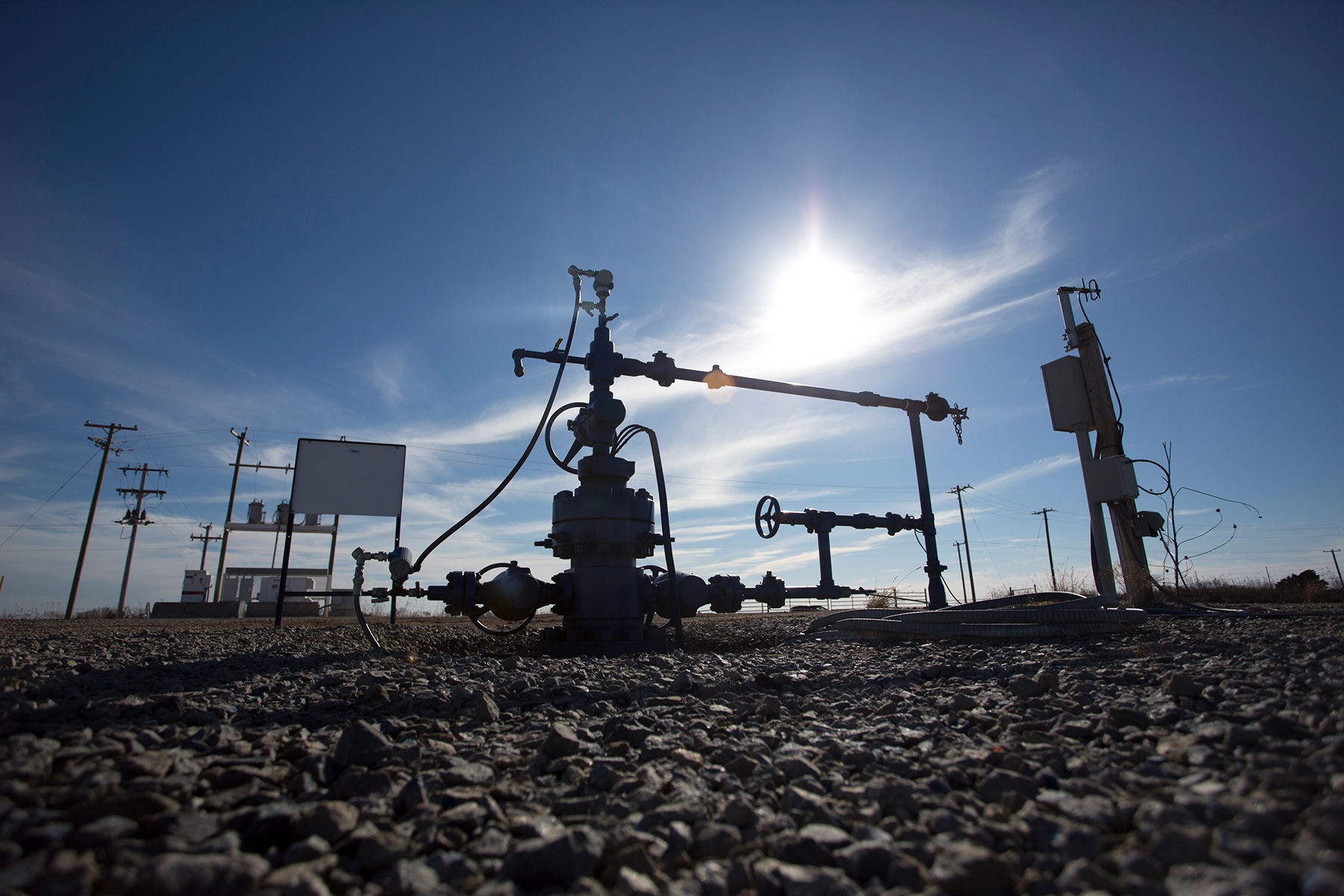 An injection well pumps wastewater into the ground in Coyle, Oklahoma, Jan. 24, 2016. (Credit: J Pat Carter/Getty Images)
Meanwhile, in Oklahoma, a stunning expose co-published in October by ProPublica and the Oklahoma-based newsroom Frontier documented a "growing number of purges," where oil field wastewater has been injected at "excessively high pressure" and cracked rock deep underground, freeing it to travel uncontrolled for miles, sometimes returning to the surface via abandoned wells. In one instance, a spew of brine from a defunct well contaminated a watering hole for livestock, killing at least 28 cows.
The story features Danny Ray, a whistle-blowing former state regulator and long-time petroleum engineer, who is worried that given Oklahoma's vast number of unplugged oil and gas wells, the state is ripe for more of these sorts of disasters. However, the Oklahoma Corporation Commission, the state's oil and gas regulator, discounted Ray's concerns, saying in a statement that it remains "committed to protecting Oklahoma and supporting the state's largest industry to perform its role in a safe and economic manner."
"These goals are not mutually exclusive," according to the agency.
In West Texas, Bloomberg reported in September, a growing number of the state's over 2,000 defunct oil and gas wells — locals call them "zombie wells" — are spouting unpredictable geysers of fracking waste. One blowout in Crane County shot wastewater 100 feet high into the air in 2022, releasing around 24 million gallons of toxic fluids before it was capped about two weeks later.
A spokesperson with the Railroad Commission of Texas, the state's oil and gas regulator, told Bloomberg that it had instituted a set of protective new rules regarding oil and gas wastewater injection wells, but recognized "the physical limitations of the disposal reservoirs" as well as the risks to oil production and fresh water.
Just last month, Inside Climate News reported on a new lawsuit filed by a Crane County landowner claiming "catastrophic impacts" from injection well blowouts.
The impacts of injection well leakage and blowouts have become visible from space. In a 2024 study using satellite observations, a team of Southern Methodist University scientists found that so much wastewater has been injected underground that it has raised land in one area of the Permian Basin by 16 inches in just two years, and created a high-pressurized underground lake that will lead to more sky-high wastewater gushers. "We have established a significant link between wastewater injection and oil well blowouts in the Permian Basin," the authors wrote in the academic journal, Geophysical Research Letters.
Once "a little cottage industry of mom and pops," injection wells have become "a much bigger business," says Kurt Knewitz, a consultant who runs an injection well information site called BuySWD.com. A case in point, says Knewitz, is Pilot Water Solutions, which operates injection wells in Texas and is a division of Berkshire Hathaway Inc.'s Pilot Travel Centers, the multinational energy and logistics company owned by Warren Buffet.
"You look at the Permian Basin and you think it's a huge oil play, but it produces three to four times as much produced water as oil," says Knewitz. "So the Permian is really a produced water play that on the side produces some oil and gas."
Still, the industry has not acknowledged the toxic reality on the ground, and continues to defend its favorite waste disposal practice. A recent report from the American Petroleum Institute (API), the nation's largest oil and gas lobby, states that injection wells are "safe and environmentally reliable" and "serve a vital role by supporting the responsible and sustainable development of O&G resources."
The API did not respond to specific questions regarding the merits of early critiques of injection wells, or whether they remain valid today. "Our industry is committed to the responsible management of produced water," spokesperson Charlotte Law said in the group's response. "Operators continuously invest in advanced treatment technologies, recycling, and reuse practices to minimize freshwater use, protect ecosystems, and ensure safe operations."
The USGS and DOE did not respond to questions for this story.
Advocacy groups that have spent decades tracking the EPA's oil and gas waste rules point out that the business model of the U.S. fracking industry depends on operators being able to get rid of waste cheaply.
"The inadequate regulation and enforcement of waste disposal wells across the country represents a financial giveaway to the oil and gas industry," says the NRDC's Mall, with NRDC. "Experts have known for generations this method threatens the environment."
For queries about republishing this story, please contact editor@desmog.com.
The post The Oil Industry's Latest Disaster: Trillions of Gallons of Buried Toxic Wastewater appeared first on DeSmog.
Industry Pushes Back on UK Ad Bans [ 11-Feb-26 11:22am ]In a speech to UK advertising executives last week, Lord Ed Vaizey had nothing good to say about a new ban on junk food ads aimed at children.
Nor did the Conservative peer mention a petition signed by more than 110,000 people calling on parliament to impose a tobacco-style ban on ads for fossil fuels.
Instead, Vaizey used his keynote at the annual Advertising Association conference to call for as little regulation as possible.
"I see a political class that is tempted to ban what it doesn't like rather than use the power of advertising to change behaviour," Lord Vaizey told the crowd at the start of the one-day event.
The ad industry is facing scrutiny for its role in the climate crisis — from bombarding the public with ads for unsustainable products such as frequent flying and fuel-guzzling sports utility vehicles, to protecting the reputations of the world's biggest polluters.
With cities such as Edinburgh and Sheffield imposing some restrictions on fossil fuel ads, and Amsterdam enshrining a blanket ban, campaigners want to persuade more towns and cities to follow suit in the hope of winning national bans as well.
Yet talks at the conference — which took place in London on February 5 — barely touched on the climate crisis. Discussions centred instead on the rise of artificial intelligence and rebuilding public trust in advertising, eroded by concerns over online scam ads and misinformation.
Vaizey's speech focused on advertising's role in powering the economy and included a swipe at the junk food ad ban, which came into effect on January 5 following years of cross-party support. The new rules stop high sugar, fat and salt foods being advertised online or on television before 9pm.
Vaizey told the conference that such bans did not have "really any clear effect" on health.
However, a February 2022 peer-reviewed study published in PLoS medicine found that London households reduced the amount of calories consumed from high fat, salt and sugar foods by almost 7 percent after a ban on junk food ads on public transport, with calorie intake from chocolate and sweets falling almost 20 percent.
"There is clear academic evidence that ad bans are highly effective at reducing consumption of harmful products such as unhealthy foods," said Victoria Harvey, an academic researcher on the advertising industry.
"Vaizey's speech…fits with the Advertising Association's opposition to junk food advertising legislation as well as their continued opposition to banning ads for fossil fuels," Harvey added.
An Advertising Association spokesperson said that Lord Vaizey was speaking in a personal capacity and the views he expressed on junk food advertising were his own. The spokesperson referred DeSmog to a review by consultancy SLG Economics — funded by the Advertising Association and other trade groups — that contended that the February 2022 research contained "clear and obvious discrepancies."
Industry Lobbies Against BansVaizey, who served as culture minister under former Conservative prime minister David Cameron, has pushed back against a junk food ad ban for years.
The peer led a call in 2022 to delay the ban by a year, according to reporting by the Grocer. Vaizey also proposed a "sunset clause" that would have scrapped the law after five years if it was not shown to be effective.
The Advertising Association and Food and Drink Federation backed Vaizey's calls — reflecting a wider pattern of industry lobbying to defeat or dilute proposed ad bans.
Paris-based JCDecaux, the world's largest outdoor advertising operator, attempted to block passage of Amsterdam's fossil fuel ad ban by emailing city councillors directly the day before the vote. JCDecaux, which controls ad space on bus shelters, billboards, and street furniture, claimed that the ban would have "far-reaching financial and legal consequences", and warned officials against creating restrictions based on "incorrect and incomplete information."
Amsterdam adopted the ban on January 22, becoming the first capital city to ban fossil fuel ads.
London Mayor Sadiq Khan, who introduced the ban on junk food ads on the city's public transport in 2019, has stopped short of slapping a similar ban on fossil fuel ads — saying more guidance from the government is needed before he can make a decision.
Hundreds of advertising campaigns by oil and gas companies have run on London's public transport network TfL in recent years, a DeSmog investigation found.
A week before the Advertising Association conference, a group of 15 senior ad executives sought to foreground their industry's role in the climate crisis and other harms by publishing an anonymous memo accusing the sector of "funding hate, legitimising environmentally destructive companies" and "paying little more than lip service" to addressing critical issues.
In the memo, which was coordinated by the UK group Inside Track, the executives said the industry was "helping polluting industries such as oil and gas rebuff public scrutiny."
The Advertising Association spokesperson said that in response "We contacted them on the day the memo was published and said we would be open to a meeting to hear more about the findings. We have since been offered a meeting date in March."
Lord Vaizey did not respond to a request for comment.
The post Industry Pushes Back on UK Ad Bans appeared first on DeSmog.
Remember the MiBot, that tiny Japanese EV predicted by many EV pundits to be the next spawn of electric mobility in Japan because of its affordable ¥1 million (~$7000) price tag? Well, MiBot manufacturer KG Motors delivered the first completed MiBot units on December 30, 2025, after some delays which ... [continued]
The post Japan's Smallest EV Gets Backing From One Of Its Largest Energy Companies appeared first on CleanTechnica.
The UK is putting up 1 billion pounds to promote local clean energy projects that will provide benefits to communities, not investors.
The post In The UK, "Power To The People" Is Latest Clean Energy Trend appeared first on CleanTechnica.
Typically, when people talk about electric vehicles, the metrics they focus on are price, range, energy efficiency, charging speed, battery size, and so on. For EV chargers, the focus may first be on charging speed, cost per charging session, and charger availability where one drives. However, there are also broader ... [continued]
The post Over 100 Million EV Charging Sessions Conducted On ChargePoint Chargers In Last Year appeared first on CleanTechnica.
This is a youtuber I've become a big fan of for the way he shows, not tells, the audience about climate change. He does a lot of on-site photography, and shows before and after photos to give you a visual representation of just how bad things are getting for Lake Powell.
I think the wildest part of this video is seeing just how low the water levels have fallen; there are house boats still afloat in the lake, but the entry points where a person would normally back their trailer to the water is now several hundred feet away from a safe ramp. According to the video, without substantial snowpack and melt this winter, the lake could fall below replenishment levels by Winter of 2026. This lake and the surrounding dam provides power to millions of people, and its failure could represent one of the first areas to experience complete access to fresh water and power.
submitted by /u/CyberSmith31337[link] [comments]
Climate change could expose 1.1 billion people to hunger by 2100 (but there's good news too) [ 15-Feb-26 9:54pm ]This recent article comes from a quantitative ecologist that has orchestrated an AI-assissted model. Their model predicts over a billion people will face food insecurity within the next century. The "good news" is probably only good to the people who survive this, or want to. I didn't want to editorialize the headline so I left it as it is.
This article is collapse related because the best case scenario is still horrific.
I love reading debates between people who say this is the best time to be alive VS the worst time.
Debates around the value & quality of life are interesting but all too often a necessary distraction from problems we face today - problems that are far from abstract.
Hundreds of millions of people are going to starve to death and if I posted this on any main sub - I already know everything people would say. Its kind of scary how well I can imagine every comment chain playing out.
A thousand years wasn't that long ago for our species. If you told anyone in 1026 AD that tens of millions of people would be starving and that is a *good* year... they would be speechless. They wouldn't be capable of imagining the scale of misery.
submitted by /u/Fast_Performer_3722[link] [comments]
Ice Dancing Break: French Duo Wins Gold in a Performance you Must See [ 15-Feb-26 8:30pm ]
Cable news audiences collapsing, another sign of societal fragmentation? [ 15-Feb-26 9:08pm ]CNN's primetime viewers have dropped dramatically over the past decade. This isn't just about one network, it may signal a broader breakdown in shared information and institutional trust, a pattern often discussed here as part of systemic collapse.
Sources: Blossom/X
submitted by /u/National-Theory1218[link] [comments]
Three Data Centers in a Trench Coat: 4% of GDP, 92% of Growth [ 15-Feb-26 6:23pm ]Harvard economist Jason Furman ran the numbers on U.S. GDP for the first half of 2025 and arrived at a figure that should make every macro investor sit up. AI infrastructure investment (information-processing equipment and software) represented just 4% of GDP. But it accounted for 92% of GDP growth. Strip out the data center build-out, and annualized growth for the first six months of 2025 was 0.1%. Not 1%. Zero point one.
"Our economy might just be three AI data centers in a trench coat."- Rusty Foster, Today in Tabs
He's not wrong.
AI's 92% GDP Contribution in ContextTo appreciate how unusual 92% concentration is, compare it to the dot-com era. AI-related categories contributed 0.97 percentage points to real GDP growth in the first three quarters of 2025, higher than the 0.69 points that identical IT categories contributed during the dot-com peak in 2000. AI-linked investment drove 39% of GDP growth across the first nine months of 2025. During the dot-com peak, the equivalent figure was 28% (St. Louis Fed, January 2026).
By August 2025, something happened that had no precedent: AI data center expenditure's contribution to GDP growth surpassed the total impact of all U.S. consumer spending. Consumer spending is two-thirds of GDP. A category representing 4% of the economy was outgrowing it.
The numbers stacked fast. AI-related capex contributed 1.1 percentage points to GDP growth in H1 2025 (J.P. Morgan), outpacing the consumer as an engine of expansion. Hardware investment was up 41% year-over-year. Data center construction hit a record $40 billion annual rate by June. Capex among the top cloud companies had quadrupled to nearly $400 billion annually, with the top 10 spenders accounting for nearly a third of all U.S. business spending (Morgan Stanley).
Where the Growth Actually Came From
Sources: BEA via Jason Furman analysis; St. Louis Fed, January 2026; Renaissance Macro Research
The 92% figure has a real asterisk. MRB Partners analyst Shaireen Bhide argues it overstates AI's net contribution: much of the hardware going into data centers is imported (GPUs from Taiwan, networking equipment from Asia), and imports subtract from GDP. After adjusting for AI-related imports, Bhide estimates the net contribution drops to 40-50 basis points, or roughly 20-25% of real GDP growth. Bespoke Investment Group reached a similar conclusion, noting that Q1 2025 was an outlier.
Both analyses are methodologically sound. But even the adjusted numbers tell a concerning story. A single investment category driven by a handful of companies accounting for a fifth to a quarter of all economic growth is not normal. And the unadjusted figures, the ones that showed up in the BEA data and shaped policy, created a GDP headline that masked what was happening underneath. Manufacturing was stalling. Retail was weak. Job creation was slowing. The rest of the economy was barely expanding.
The AI Infrastructure and Housing Bubble ParallelIn 2005, residential investment reached 6.7% of U.S. GDP, its highest level in half a century. The Federal Reserve documented how residential investment had surged 40% above its long-run average share of GDP. Mortgage debt climbed from 61% of GDP in 1998 to 97% by 2006. Between 2001 and 2005, roughly 40% of net private-sector job creation came from housing-related sectors.
The economy looked great. GDP was growing. Employment was up. The problem was that the growth was structurally dependent on a single sector, and that sector was fueled by financial engineering that disguised the true risk. Sound familiar?
The AI infrastructure boom shares an uncomfortable structural similarity. Not in the specific mechanism (nobody is packaging subprime data center leases into CDOs yet), but in the concentration pattern. A narrow sector is generating a disproportionate share of GDP growth. The rest of the economy is under performing. And financial engineering is making the true exposure difficult to measure.
Two Booms, One Pattern
Sources: Federal Reserve (Bernanke 2010); BEA; St. Louis Fed January 2026; Morgan Stanley
Housing Boom: Residential investment rose from 4.8% to 6.7% of GDP, with 40% of job creation. AI Boom: AI investment rose to 92% of GDP growth, with hyperscaler capex at $400B/yr. Different mechanisms, same structural dependency.
There are real differences, and they matter. Housing had a direct wealth effect on 69% of American households. AI infrastructure investment flows to a handful of companies and their shareholders. The dot-com bust wiped out roughly $6 trillion, about 60% of GDP at the time. Oliver Wyman's January 2026 analysis estimates a comparable AI equity correction would erase approximately $33 trillion. That is more than total U.S. GDP. The WEF argues the consumption impact would be more limited precisely because AI wealth is more concentrated than housing wealth was. Cold comfort if you hold the stocks.
The housing bust triggered a financial crisis because the risk was embedded in the banking system through mortgage-backed securities. The AI boom's financial plumbing looks different. Not necessarily safer.
Where $120B in AI Data Center Debt Is HidingOff-balance-sheet debt, SPVs, and hidden leverage
Tech companies have moved more than $120 billion in data center debt off their balance sheets using special purpose vehicles, according to the Financial Times. Oracle leads with $66 billion, followed by Meta at $30 billion, xAI at $20 billion, and CoreWeave at $2.6 billion. The structures involve private credit firms (PIMCO, BlackRock, Apollo, Blue Owl Capital, JPMorgan) providing debt and equity through entities designed to keep liabilities off the hyperscalers' books.
Paul Kedrosky describes the mechanism plainly: companies create SPVs they indirectly control but don't have to consolidate on their balance sheets. Meta's $27 billion Hyperion data center deal with Blue Owl, structured through an SPV named "Beignet Investor," has just $2.5 billion in equity against $27 billion in debt. That's a 10% equity cushion. Kedrosky calls it "wildly insufficient if projected AI workloads stall or margins compress."
UBS reports that tech companies had borrowed approximately $450 billion from private funds as of early 2025, up $100 billion year-over-year. Morgan Stanley estimates $800 billion in private credit will be required between 2025 and 2028 to finance AI data centers alone. In 2025, the five major hyperscalers issued $121 billion in bonds, more than four times their five-year average. Their combined free cash flow is forecast to shrink by 43% between late 2024 and early 2026.
"In 2008, banks discovered they owned far more US housing risk than their internal reports suggested. They might soon discover the same about data-center and digital infrastructure risk."- Oliver Wyman, January 2026
Where the Debt Is Hiding
Sources: Financial Times analysis, December 2025; UBS; Bank of America
AI Companies Paying Each OtherCross-investments, round-tripping, and inflated demand
The financial engineering extends beyond SPVs. Some of the AI revenue being counted as economic growth is companies paying each other. Bloomberg mapped what it called AI's "circular deals," the web of cross-investments where companies invest in each other, creating revenue that circles back to the investor. Microsoft invested $13 billion in OpenAI, which spends most of it on Microsoft Azure. OpenAI signed a $300 billion cloud deal with Oracle, which must buy Nvidia GPUs to fulfill it. Nvidia invested in OpenAI's funding rounds. Nvidia took a 7% stake in CoreWeave, then agreed to purchase $6.3 billion in cloud services from CoreWeave, effectively guaranteeing CoreWeave's revenue. CoreWeave bought its GPUs with borrowed money collateralized by the value of the GPUs themselves.
OpenAI has committed to over $1.15 trillion in long-term computing contracts, against projected 2025 revenue of $13 billion. Goldman Sachs cited "the increasing circularity of the AI ecosystem." Morgan Stanley's Todd Castagno warned it was becoming "increasingly circular" in ways that "inflate demand and valuations without creating economic value."
Data Centers Are Crowding Out the Grid"Isn't it a bit strange when the demand for compute is 'infinite,' the sellers keep subsidizing the buyers?"- Jim Chanos, 2025
In central Ohio, a couple opened their electricity bill and found it had risen 60%. They hadn't changed anything. But 130 data centers had moved in around them. Virginia's Dominion Energy proposed its first base-rate increase since 1992. Bloomberg's analysis of 25,000 electricity pricing nodes found wholesale costs up as much as 267% over five years in areas near data centers. The boom isn't an abstraction. It's showing up in people's utility bills.
The system-level numbers are worse. Electricity prices jumped 6.9% in 2025, more than double the headline inflation rate (Goldman Sachs). Data centers make up 40% of electricity demand growth. PJM Interconnection, the largest electric grid in the U.S. serving 65 million people across 13 states, reported that consumers will pay $16.6 billion between 2025 and 2027 just to secure power supplies for data centers that haven't been built yet. PJM's independent market monitor called it a "massive wealth transfer" from consumers to the data center industry. Households will see prices rise an additional 6% through 2027, dragging down consumer spending growth by 0.2%.
The Council on Foreign Relations argues the AI bubble may not burst from circular financing or debt levels, but from the mundane reality that data centers and housing construction are competing for the same electricians, welders, and HVAC technicians. Tariffs and immigration restrictions are shrinking the labor pool at precisely the moment both sectors need to expand.
Who Pays for the Data Centers?
AI Productivity: Where Are the Returns?If it's transformative, show me the numbers.
If AI infrastructure investment is transformative and not just a capex sugar rush, it should show up in productivity data. U.S. nonfarm business productivity grew at roughly 2% year-over-year through Q3 2025, in line with the post-pandemic average but showing no meaningful acceleration from the hundreds of billions flowing into AI. The Fed's Kansas City branch found gains concentrated in a handful of industries, not the broad-based uplift you'd expect from a general-purpose technology.
MIT's Nanda Lab reported that despite $30-40 billion in enterprise AI investment, 95% of organizations are getting zero return. The Penn Wharton Budget Model projects the AI productivity boost will peak at an additional 0.2 percentage points of annual growth . Meaningful, but a fraction of what current investment levels imply. Data centers employ few workers once built, limiting the multiplier effect through wage-driven consumption (J.P. Morgan).
This matters for the GDP dependency story. If the economy isn't getting more productive from AI investment, then the GDP growth it generates is pure spending, not productivity-driven expansion. The growth lasts exactly as long as the spending does, and not a quarter longer.
AI Capex Bubble: Industrial Bubbles Leave Real Wreckage"Everybody thought it was going to require more computing power and more bandwidth than it actually did."- Jerry Kaplan, on the 1990s. The infrastructure always gets overbuilt.
Even Jeff Bezos called the AI data center buildout an "industrial bubble" at the New York Times DealBook Summit in December 2024. He insisted the long-term benefits will justify it. Maybe. But the distinction matters. An industrial bubble means real physical assets get built that eventually find uses. The fiber-optic cables from the telecom boom carried the internet for two decades. The railroad bubble of the 1800s left behind a continental transportation network.
But industrial bubbles still cause pain. The builders go bankrupt, the investors lose capital, and the construction workers lose jobs when the building stops. When the spending represents a massive share of GDP growth, the withdrawal can tip the broader economy into recession.
The WEF's Chief Economists Outlook acknowledged this: "Economic growth during the bubble phase depends on continually building infrastructure, not using infrastructure." As long as the hyperscalers keep spending, GDP grows. When they slow, whether from disappointing revenue, rising debt costs, or simple overbuilding, the contribution reverses.
And the slowdown signals may already be appearing. Alphabet's free cash flow is projected to plummet roughly 90%. Bond spreads on AI-related debt have widened by as much as 40 basis points since September, per Oliver Wyman. CoreWeave's stock has swung from a $187 peak to $75, a reminder of how volatile debt-fueled growth models.
The Dependency Math
Sources: Furman analysis; MRB Partners, January 2026; Stress Index modeling; company guidance
H1 2025 GDP growth: 1.8%. AI contribution (Furman): 1.7pp (92%). Without AI: 0.1%. MRB import-adjusted: 0.4-0.5pp (20-25%). If capex grows 30% slower: -0.3 to -0.5pp GDP impact. If capex flattens: -0.5 to -1.0pp.
Every scenario in that table shares one feature: the economy without AI investment is barely growing. The headline says 1.8%. The foundation says 0.1%.
submitted by /u/Rorisjack[link] [comments]
The chemical society and its discontents: Ozone layer edition [ 15-Feb-26 5:03pm ]
TOPCon Solar Cells Are Killing A Key Anti-Solar Talking Point [ 15-Feb-26 6:12pm ]The US manufacturer Talon PV plans to launch a new generation of high-efficiency TOPCon solar cells into the US market, despite the sharp U-turn in federal energy policy.
The post TOPCon Solar Cells Are Killing A Key Anti-Solar Talking Point appeared first on CleanTechnica.
2025 Saw EVs At 97.5% Share In Norway — Tesla Model Y Best-Seller [ 15-Feb-26 5:40pm ]December saw plugin EVs at 98.5% share in Norway, up from 89.8% year on year, with BEVs alone taking 97.6% share. Full year 2025 saw EVs at 97.5% share in Norway, up from 91.3% YoY, with all the growth coming from BEVs. Overall December auto volume was 35,188 units, a ... [continued]
The post 2025 Saw EVs At 97.5% Share In Norway — Tesla Model Y Best-Seller appeared first on CleanTechnica.
The Guardian view on Donald Trump and the climate crisis: the US is in reverse while China ploughs ahead | Editorial [ 15-Feb-26 5:30pm ]The president's destructive policies enrich fossil fuel billionaires, while Beijing has bet big on the green transition
Devastating wildfires, flooding and winter storms were among the 23 extreme weather and climate-related disasters in the US which cost more than a billion dollars last year - at an estimated total loss of $115bn. The last three years have shattered previous records for such events. Last Wednesday, scientists said that we are closer than ever to the point after which global heating cannot be stopped.
Just one day later, Donald Trump and Lee Zeldin, the head of the US Environmental Protection Agency, announced the elimination of the Obama-era endangerment finding which underpins federal climate regulations. Scrapping it is just one part of Mr Trump's assault on environmental controls and promotion of fossil fuels. But it may be his most consequential. Any fragment of hope may lie in the fact that a president who has called global heating a "hoax" framed this primarily as about deregulation - perhaps because the science is now so widely accepted even in the US.
Continue reading... Welsh charity buys more than 405 hectares for rewilding [ 15-Feb-26 2:55pm ]Project in Ceredigion aims to help country catch up with large-scale nature recovery projects elsewhere in UK
A Welsh charity has bought more than 405 hectares (1,000 acres) in Ceredigion to establish Cymru's "flagship" rewilding project, helping the country catch up with large-scale nature recovery projects under way elsewhere in the UK.
Tir Natur (Nature's Land), founded in 2022, announced it had acquired the site at Cwm Doethie in Elenydd, or the Cambrian mountains, after a fundraising drive launched last year raised 50% of the £2.2m purchase price. A philanthropic bridging loan enabled the sale.
Continue reading...
Tesla Sales Down Tremendously in UK, Norway, Netherlands, Germany, Spain, Sweden, Denmark, Portugal, Switzerland [ 15-Feb-26 3:23pm ]I recently looked into Tesla's January sales in 12 European markets, and the results were not pretty. Overall, across those 12 markets, Tesla's sales were down 23%. However, one reader pointed out that it could be much more interesting going back two, three, or even four years. So, that's what ... [continued]
The post Tesla Sales Down Tremendously in UK, Norway, Netherlands, Germany, Spain, Sweden, Denmark, Portugal, Switzerland appeared first on CleanTechnica.
Tesla CEO Elon Musk Should Stop Flinging Poop And Start Selling More Tesla EVs, STAT [ 15-Feb-26 2:45pm ]While Tesla EV sales flounder, CEO Elon Musk engages in epic online poop-flinging against a leading Democratic donor.
The post Tesla CEO Elon Musk Should Stop Flinging Poop And Start Selling More Tesla EVs, STAT appeared first on CleanTechnica.
"These Guys Aren't Screwin' around." Gavin Newsom on Trump's Sabotage of US Auto Industry [ 15-Feb-26 2:39pm ] Why the Fossil Fueled Epstein Class Hated the Environmental Pope [ 15-Feb-26 2:32pm ]
Let's get a grip and learn how to live with the rain | Emma Beddington [ 15-Feb-26 2:00pm ]Wetter winters are set to become the norm, so unless we're farmers or flood victims, we need some coping strategies to keep our spirits up
There's a lot of complaining about the weather currently and I get it, it's wet. Here in York the river is getting above itself yet again and the council has fenced off large puddles in the park for health and safety reasons, to widespread mockery. Things currently taking in water include the letterbox (yesterday the postman told me with a manic laugh that he was leaving for the Philippines), the hens, my shoes and our car, which is growing moss around the windows. On the inside.
But does it merit all the moaning? I don't mean farmers, for whom it's a catastrophe, flood victims or the poor folk of Cardinham, North Wyke and Astwood Bank, who endured a biblical 40 days straight of rain. They're entitled to rend their garments and corral their pets into boats, two by two. But maybe the rest of us, just dealing with it being "quite wet", could get a grip. When life gives you rain, make rain-ade (do not drink rain; it's full of forever chemicals)! After all - OK, not the cheeriest thought - this could be as good as it gets in future, given accelerating climate breakdown. At the very least, these wet patches will probably happen more often, so we need coping strategies. Here are mine.
Continue reading... The greening of career education: US students learn new skills as climate crisis intensifies [ 15-Feb-26 1:00pm ]Some districts are adding programs in clean energy and sustainability, while one state is infusing environmental lessons into culinary education and construction
On one end of the classroom, high school juniors examined little green sprouts - future baby carrots, sprigs of romaine lettuce - poking out of the soil of a drip irrigation system they built a few weeks prior.
On the opposite end of the room, a model of a hydropower plant showed students how the movement of water can stimulate electrical currents. In this class in South Carolina's Greenville county school district, students primarily learn about one topic: renewable energy.
Continue reading...

