

"Behold, You desire truth in the innermost being,
And in the hidden part You will make me know wisdom."
Ps 51:6 (NASB)
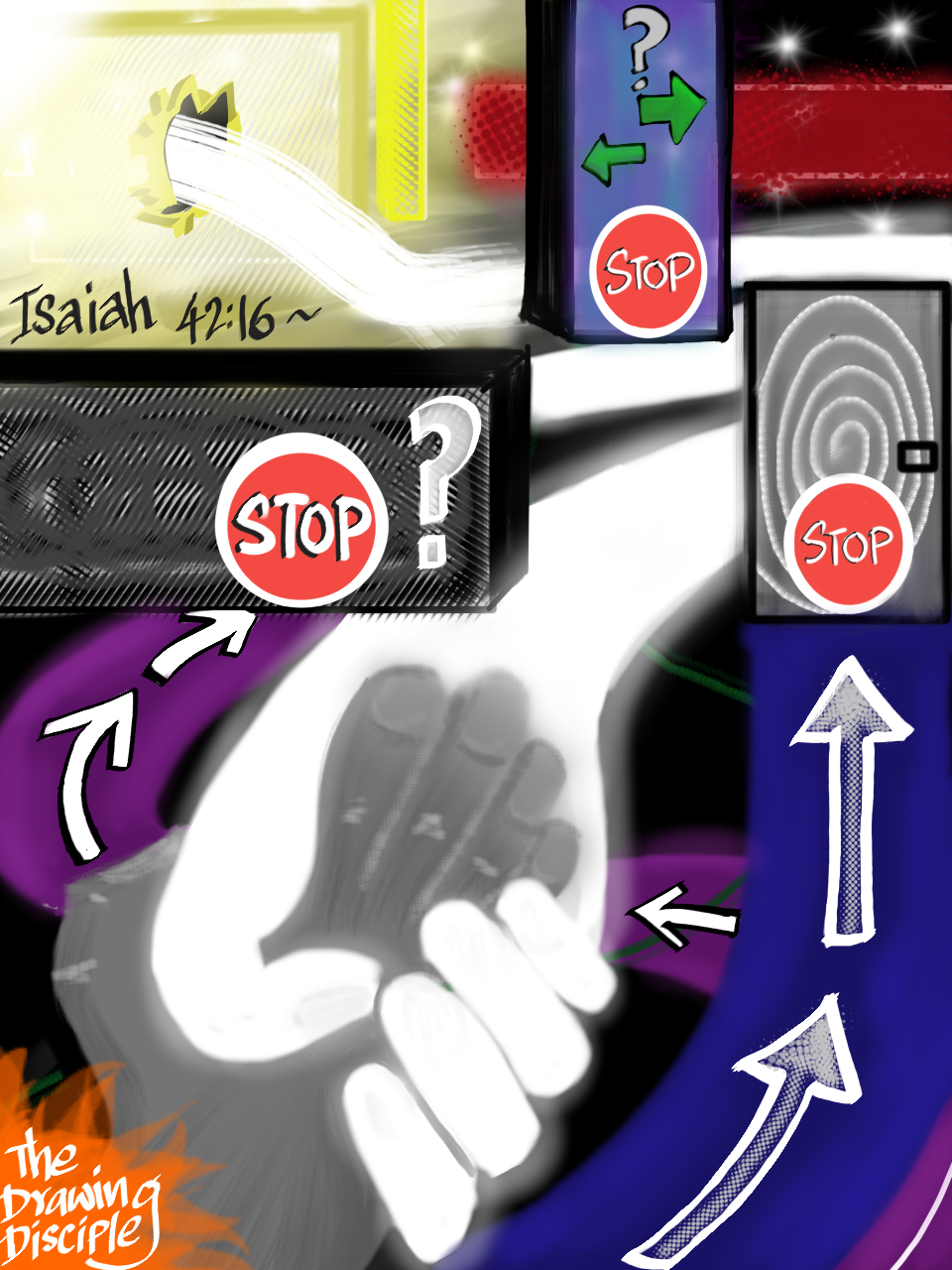
ISAIAH 42:16
I will lead the blind by a way they did not know;
I will guide them on paths they have not known.
I will turn darkness to light in front of them
and rough places into level ground.
This is what I will do for them,
and I will not forsake them.
Ever felt like the directions in your life are all messed up?Like there are no proper 'sign boards' and you seem to be aimlessly wandering?Cling on to this promise... your real breakthrough might be just around the corner... Do not give up just yet.. His right hand is never too short to reach yours.. And the Lord will never fail to perfect that which concerns you... (Psalm 138:8)
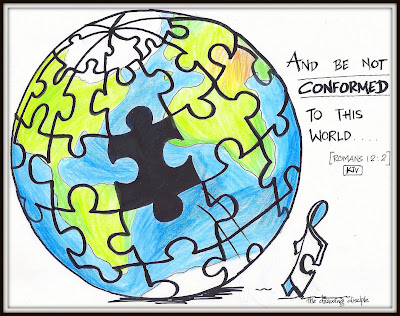

I have always felt these words belonged to different canvases. We were totally out of the picture, but God in His great mercy chose to paint another canvas, so that He could add us to the final bigger work of art!
This piece is based on the song "Amazing love".. by songwriter Billy James Foote and performed by different artists from around the world..
"I'm forgiven because you were forsaken
I'm accepted, You were condemned
I'm alive and well
Your spirit is within me
Because you died and rose againAmazing love, how can it be
That You, my King, should die for me?
(Amazing love)
Amazing love, I know it's true
And it's my joy to honor You
In all I do, to honor You"
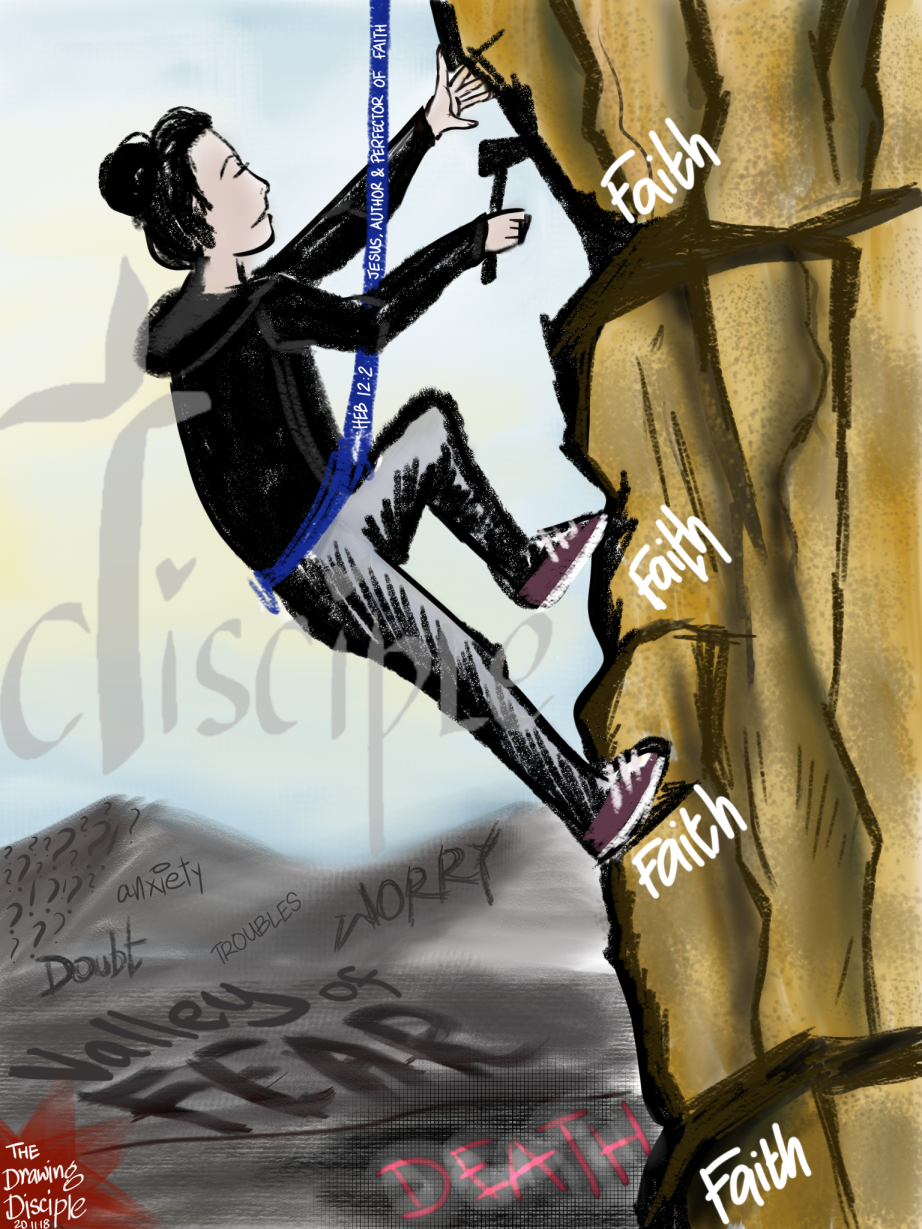
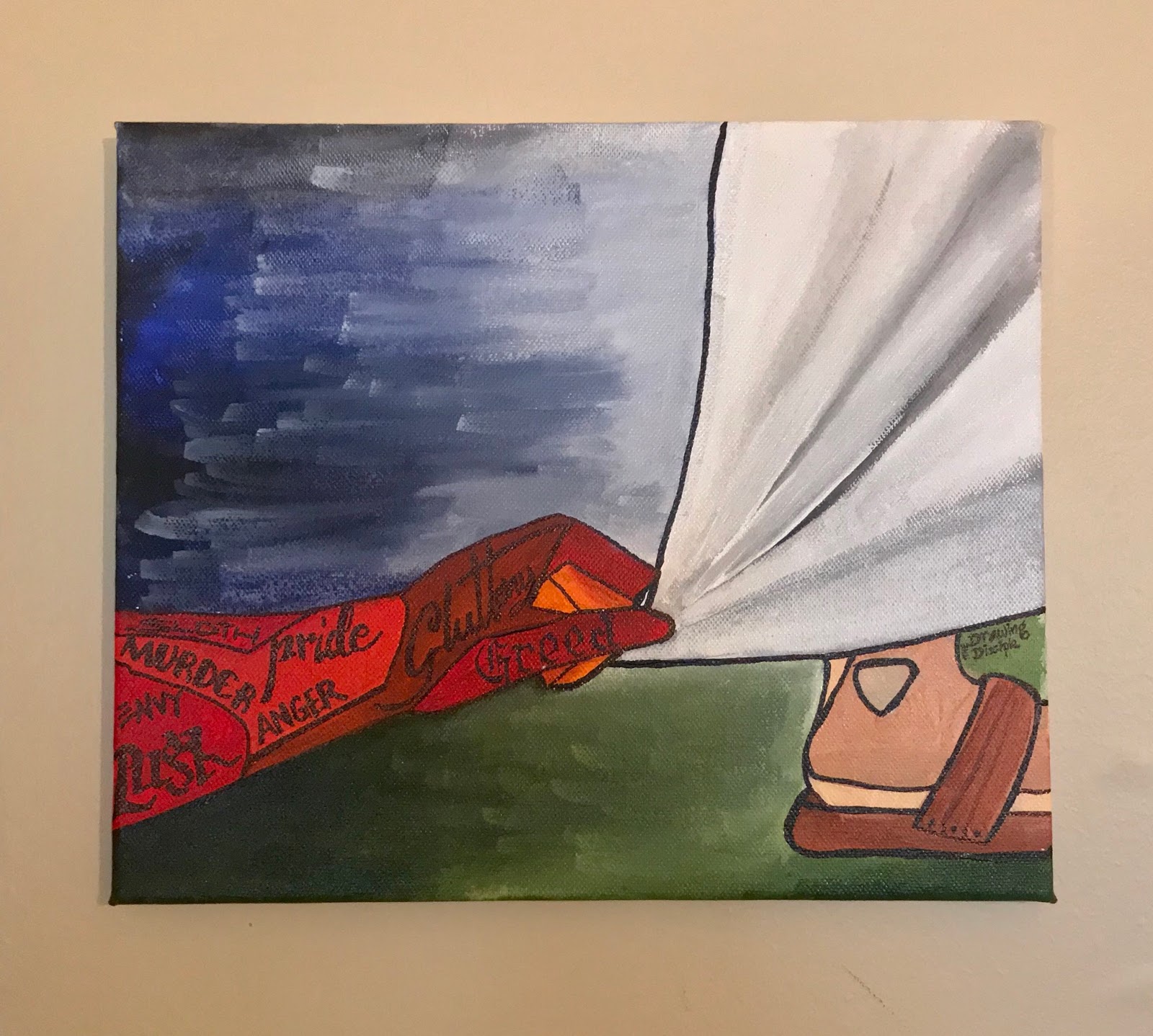
"If only I may touch His garment, I shall be made well."
Experimenting with canvas...
This is a picture that I have always wanted to draw. The inspiration is from the story of the woman who had an issue of increased bleeding since 12 years. (Matthew 9:20-22 NKJV)
It depicts a faith that is so simple.. that appears so naive that the world may consider it dumb or even foolish.
Oh but the power of that simple act of faith! Let it inspire us to believe like a child.. and trust like a baby at it's mother's bosom.. that even the reaching out to Jesus with a humble and contrite spirit..Is all that is needed to be healed and be made complete today.
The whole world is protesting against racism in the wake of the death of George Floyd. You may think from my last post, that I am skirting around the subject and you are probably right. I empathise completely and I deplore violence and racism. But as my son points out, I have almost definitely said things that could be construed as racist in my life. For that I am sorry.
But this blog is always about action and moving forward. Its about finding solutions and taking small steps and promoting big ones. I know that I don't have any of the answers. I see the protests and I don't know where the solutions lie and how the change can come about. I am hoping to get a guest post from someone I trust to deal with this subject better than I can.
In the meanwhile I saw part of an interview with Russell Brand and Professor Kehinde Andrews, Professor of Black Studies at Birmingham City University. They were saying that part of the underlying problem is that there is a surplus of workers.
The idea was always that manual work would be automated and robots would become the cheap labour of the future, in order to make life easier for people. For example if machines can do the hard part of mining, then less people need to risk life and limb underground. It sounds like a good idea.
The intention was that people would then need to work less, would have more leisure time and could do more creative roles, but this is where it has all fallen down. Automation has been used to reduce the need for manual labour and the resulting surplus of workers has decreased wages for low skilled jobs. This has just led to widespread poverty. As the interview above has pointed out, this disproportionately affects Black and Minority communities the most.
We need a 4 day week. I am not the first to think or say this by a long shot. Apparently British economist John Maynard Keynes predicted back in the 1930s that a century later the average work week would be just 15 hours (Economic Possibilities for our Grandchildren, John Maynard Keynes, 1930).
There is a lot to be said for a 4 day week, not least that it should create 25% more jobs. The video below highlights more of the benefits, such as less illness and more family time.
The benefits of a 4 day week don't really materialise until the change is made by the majority. It also has to come hand in hand with a rise in the minimum wage. It seems to me like the highest earners in society are holding the purse strings too tightly to allow that to happen without a fair bit of persuasion.
Reading further through Keynes predictions, he sees a time when the pursuit of wealth over everything else will end. (I have included another extract from the same source below) I hope in this aspect he is right and that within the next 10 years (100 years since his prediction) it becomes a reality. Then at least we may have a more level playing field to deal with the issues of racial equality.
There are changes in other spheres too which we must expect to come. When the accumulation of wealth is no longer of high social importance, there will be great changes in the code of morals. We shall be able to rid ourselves of many of the pseudo-moral principles which have hag-ridden us for two hundred years, by which we have exalted some of the most distasteful of human qualities into the position of the highest virtues. We shall be able to afford to dare to assess the money-motive at its true value. The love of money as a possession - as distinguished from the love of money as a means to the enjoyments and realities of life - will be recognised for what it is, a somewhat disgusting morbidity, one of those semi-criminal, semi-pathological propensities which one hands over with a shudder to the specialists in mental disease. All kinds of social customs and economic practices, affecting the distribution of wealth and of economic rewards and penalties, which we now maintain at all costs, however distasteful and unjust they may be in themselves, because they are tremendously useful in promoting the accumulation of capital, we shall then be free, at last, to discard. Of course there will still be many people with intense, unsatisfied purposiveness who will blindly pursue wealth - unless they can find some plausible substitute. But the rest of us will no longer be under any obligation to applaud and encourage them. For we shall inquire more curiously than is safe to-day into the true character of this "purposiveness" with which in varying degrees Nature has endowed almost all of us. For purposiveness means that we are more concerned with the remote future results of our actions than with their own quality or their immediate effects on our own environment.
The company I work for is being shut down, and I am waiting to hear whether there is a position available for me within the parent company, or if I will be made redundant. There will be plenty of you out there who have experienced or are experiencing the same situation right now.
I am grateful, because it was a lovely company to work for and they were very good to me. I felt able to express my views and enjoyed working with the rest of the team. It had a good balance of trust and respect, even though we were frequently under pressure to deliver projects. However the journey of life continues onward to new opportunities and experiences.
I am announcing my news to everyone quickly because the standard response is "Oh I'm sorry you are redundant", "How dreadful", "That's tough because it will be impossible to find a job right now". All these negative responses I have put in a box and sealed shut, so they can't poison my thoughts or decisions. Will I ever meet anyone who says "Wow that's exciting!", "You are free to discover a new adventure", "There are so many options, what will you choose to do next?"
Hmmm….what will I choose to do next?
I have spent the last 2 months on Furlough, which means being paid 80% of my wages to stay at home and not work. If it wasn't for the current circumstances this would have been bliss. I have enjoyed getting the garden and house back in order after a year of it being virtually untouched. Having time to meditate, cycle and enjoy the sunshine and my family. I have even had time to watch some interesting series like Chernobyl, The Durrells and Afterlife. Life has been rather full on, so time to breathe and reflect has been very welcome.
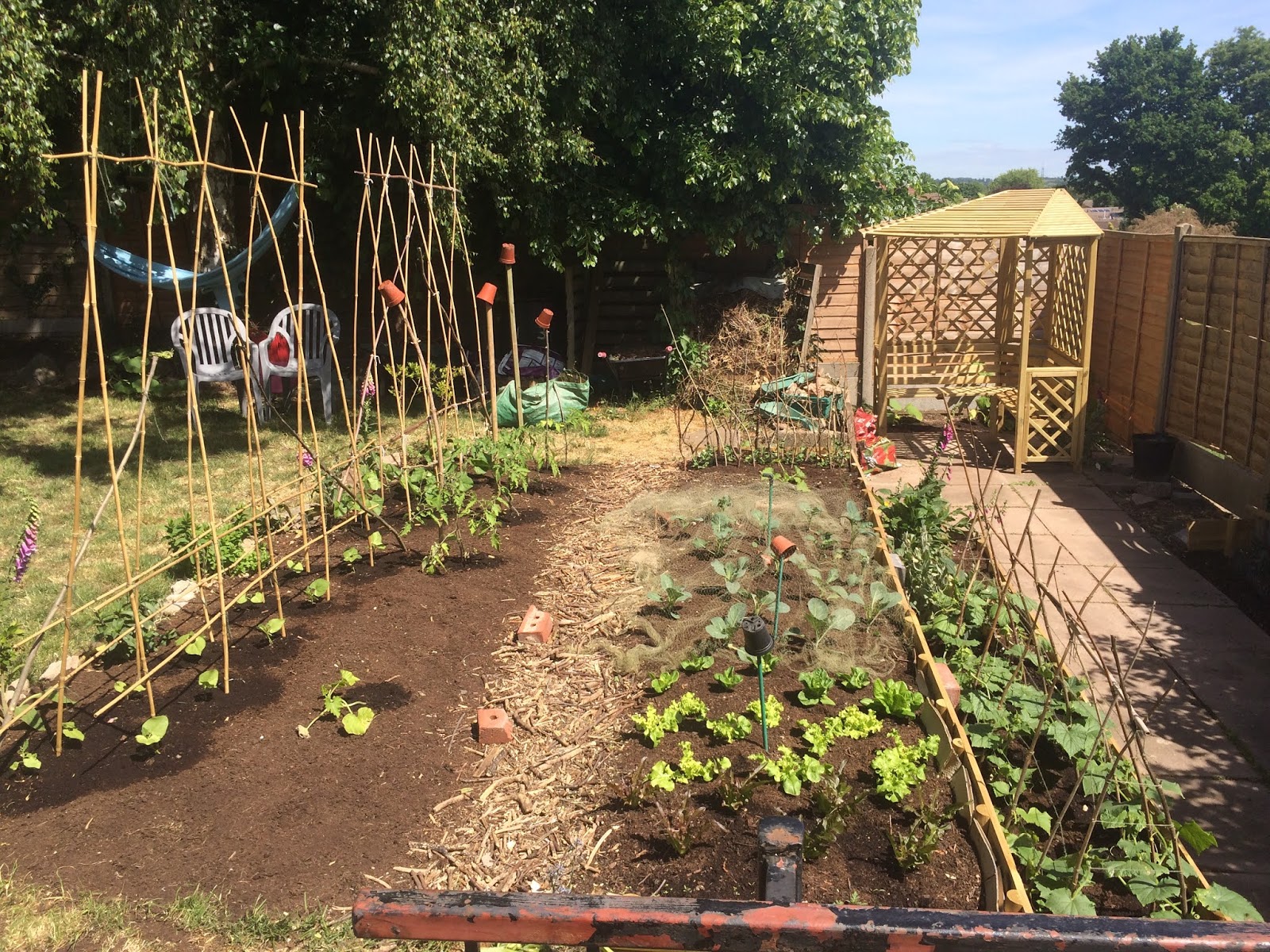
My garden is coming along nicelyEven so, I know that this is not an option that I am happy doing long term. I get bored easily and am always happier with a challenge or mental stimulation. I need to find that balance where I can do some mentally intense work but still have time for gardening and family in between. Working from home cuts out hours of commute a week and really facilitates getting a good work life balance, so will be something I wish to continue. Having managed so well on 80% of my income, I am also wondering whether a 4 day week may be a viable option. It is slightly tempting to sell up and live somewhere by the coast or travel in a campervan, but my youngest daughter still has one more year at school, so those dreams will have to wait for now. Which means I am looking for a new job locally.
I am an engineer and a woman. The UK has one of the worst rates in Europe for employing women engineers. Women make up 51% of the population, yet less than 10% of engineering professionals are women according to the Statistics on Women In Engineering (WES, Jan 2018) as shown in their graph below. This is the lowest in Europe, whereas Latvia, Bulgaria and Cyprus lead with nearly 30%.

In my current workplace 4 out of 9 technical staff are women and it made for a good mix. In other engineering roles I was always the only one. The chances of finding new work for a company with any other female engineers is fairly slim. That red band at the bottom of the graph above is spread rather thinly. What is the problem with that?
What this large blue expanse translates to in the workplace is that you don't fit in. You have to fight to get your views heard, and you are last on the list to be asked what you think about any issue. You will be overlooked for key projects where there is an opportunity to shine, even when you are the only volunteer stepping forward. And if you can't shine it's a hard slog to progress up the ladder. You will never be the "blue-eyed boy" on a fast track for promotion. It is far more likely that you will earn less than your colleagues for doing the same work and be regularly overlooked despite your competence.
20 years ago as the only female engineering manager in a team of 70 engineers that was me. The most memorable incident was in a meeting with the Operations Manager, Principal Engineer, and all the other engineering managers. Earlier in the day, I had inducted some contractors that were working for Pat the Site Services Manager, because he was busy. Now they had finished their work and needed their permits signing off before they could leave. I saw them through the glass walled meeting room as they walked past a few times trying to find Pat. Pat was often in the bowels of the factory where no phone signal would ever find him. I ducked down in my seat to try and avoid being seen, but they spotted me. They tapped on the door and then stuck a head round. The Operations Manager stopped mid-flow. "We just need Pat's secretary to sign off our permits please". The rest of the room cracked up with hysterical laughter, as I jumped up and tried to escape whilst glowering my worst scowl at these bloody contractors. Only the Operations Manager wasn't laughing. "She is not a secretary, she is one of our engineering managers!", he managed to get out before I had reached the door, grabbed the contractors and marched off down the corridor. As if a secretary would be able to sign off safety permits! Duh! But to them it was a natural assumption that any woman was there to do admin, as they had never met a female engineer before.
And it is from these little assumptions, casual remarks and minor actions that inequality grows into a problem. It is parents that tell their friends that their daughter is a scientist because it sounds better than an engineer. It is the apprentices who are taught and influenced by male engineers, so any prejudices are perpetuated. It is the free calendars of half-naked women, sent as a 'perk' from the supplier, that hang in the engineering stores and engineers workshop - because only engineers aka men ever enter these areas. There is nothing that makes your position more uncomfortable than standing in front of the storeman to discuss delivery dates for essential parts, with the engineers behind discussing their favourite features from the latest pinup. (Well apart from a boss who stares at your breasts while he talks to you.) Why would this be fit for any workplace when your mind should be on work? It does not build respect for the female workforce. And for that matter it doesn't build respect for male engineers either.
20 years later and you would hope the situation has changed, but really it hasn't. Progress is as flat as the red band in the above graph. There is an equal opportunities policy now, but it just states the obvious - that you shouldn't treat people differently because of gender, race, disability, age, sexual orientation etc. In my view it does little to stop discrimination, especially as most discrimination is subtle, underlying or hidden.
For instance how do
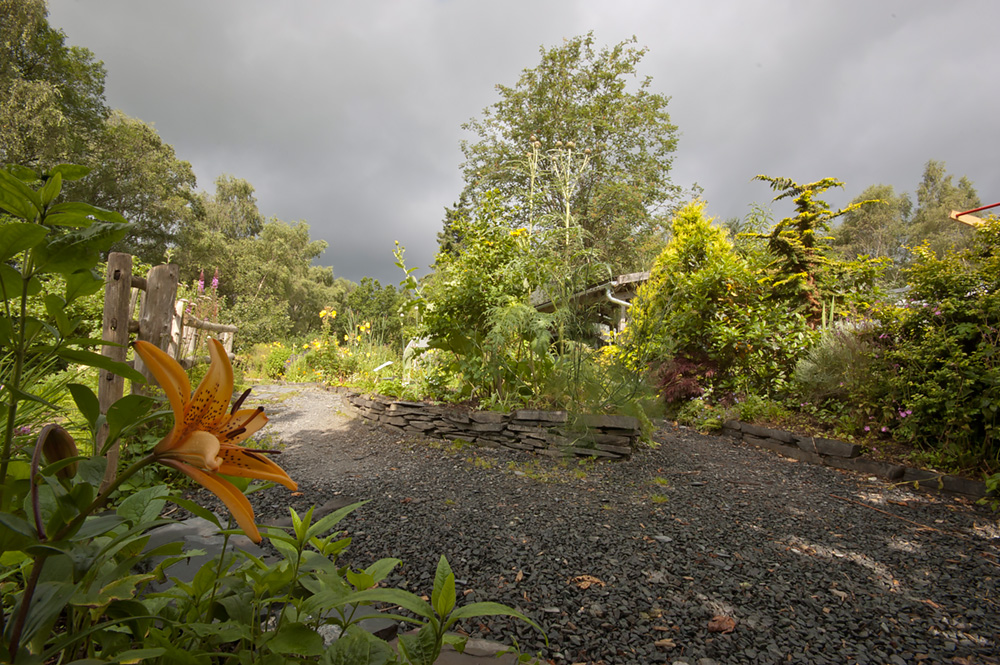
The remarkable beauty of an old slate quarryAfter my 4th child was born, I made the commitment that I didn't want to work long hours in a stressful career anymore, for a company that just churned out products as cheaply as possible. I wanted to have an interesting, fulfilling and meaningful career, which was completely flexible around my family and allowed me to spend more quality time with them, when I chose to. Securing a future for all our children, by acting to prevent catastrophic climate change, felt like a worthwhile goal, so I signed onto a masters course, to arm me with the knowledge to go out into the world and battle greenhouse gas emissions.
The University of East London (UEL) had teamed up with the Centre for Alternative Technology (CAT) to provide the perfect hands on course for me. For each module you spent a week living at CAT, having lectures and practicals all day, often until late in the evening, then the rest of the month was spent at home preparing essays and presentations before the next module.
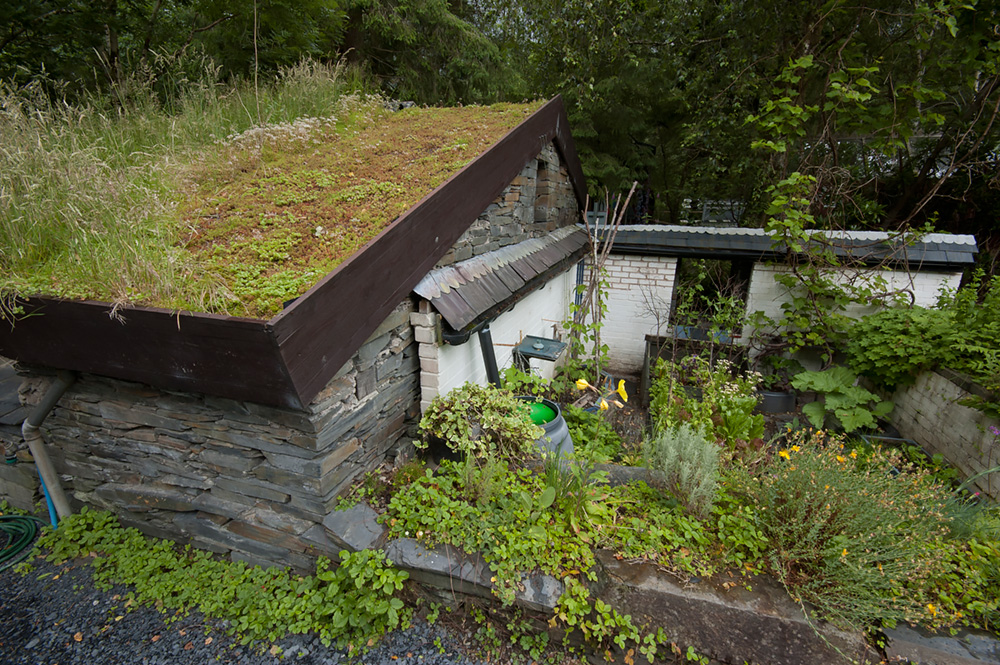
Old stone building with a green sedum roof and sunken garden at CAT.At this point I need to describe CAT. It started out life with a small community transforming an old slate quarry on a very wet hillside into a beautiful, organic, sustainable, off-grid home. 30 years on the focus had shifted to being an educational facility promoting a low impact lifestyle, powered by micro-hydro turbines, wind turbines, solar panels and biomass. The award winning cafe on site served vegetarian food, a lot of which was grown intensively on site, and included an abundance of seasonal vegetables, herbs and flowers. The traditional thick stone-walled buildings, that had served the quarry many years before, were renovated to make them more efficient, but also opened up to bring in lots of natural daylight, improving the feel of the indoor spaces. Additional buildings demonstrated different techniques of timber and straw bale construction, but my favourite was the shop. The beautiful rammed earth walls, with their striated texture felt so warm and grounded, and designed with natural light flooding through the rooflights, it was a peaceful and calming space. Even more so because it was packed with hundreds of amazing and inspiring books that you wouldn't see anywhere else! (CAT publish their own books) The weeks were always so full that there barely seemed enough time for really enjoying this space.
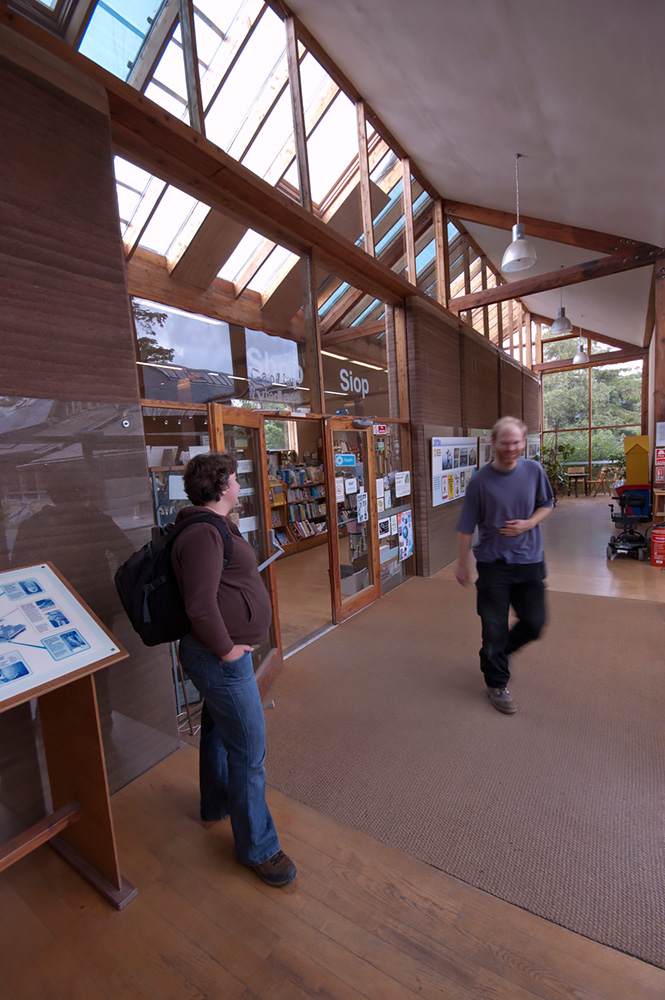
Rammed earth walls and large roof lights for natural light in CAT's shopWith no mobile signal and very poor internet, we spent the week cut off from the outside world. I remember the shock of many arriving to find themselves with quite basic shared accommodation, completely cut off without news, TV, processed food or meat, in the constant downpour of cold, deepest, darkest Wales. A few jumped back in their cars and drove straight back home. But there was delicious hot food waiting for us and as we all sat on long benches full of strangers, from the most varied backgrounds you could imagine, aged from 18 to 70. Yet it was noisier than a playground full of primary school children. Everyone was immediately drawn into deep conversations with their neighbours, because suddenly you were surrounded by people who share your passion and dreams for a better world and are eager to learn more, yet have a lot they can teach you. These conversations only stopped whilst we listened attentively to the absorbing lectures, or when overcome by sleep in the early hours of the morning.
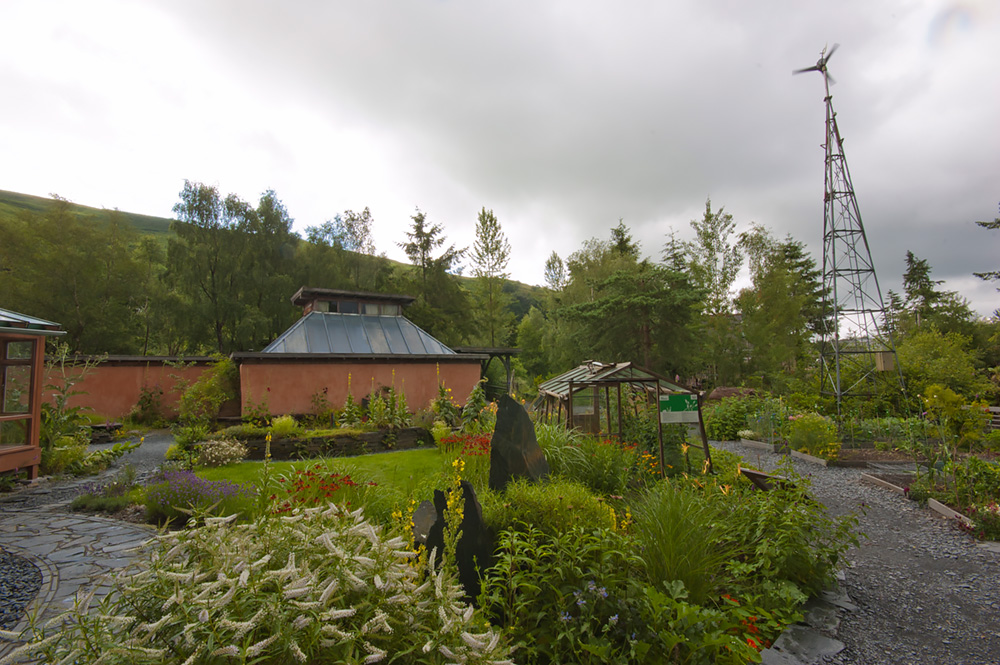
The strawbale lecture theatre, surrounded by welcoming open spaces.After just one week I was filled with the confidence that we can do so much.... I can do so much. The negativity of climate change was blown away, by the knowledge that so much has already been demonstrated and achieved. I felt it wasn't good enough to just try and save energy as a job, but I needed to try and incorporate sustainability into every aspect of my life. Its funny that it all seemed such a big challenge then, like how could I ever grow my own food with a small garden and 4 young kids, yet I started growing just a few tomatoes in pots, then some peas and beans, and now I have an allotment full of vegetables.
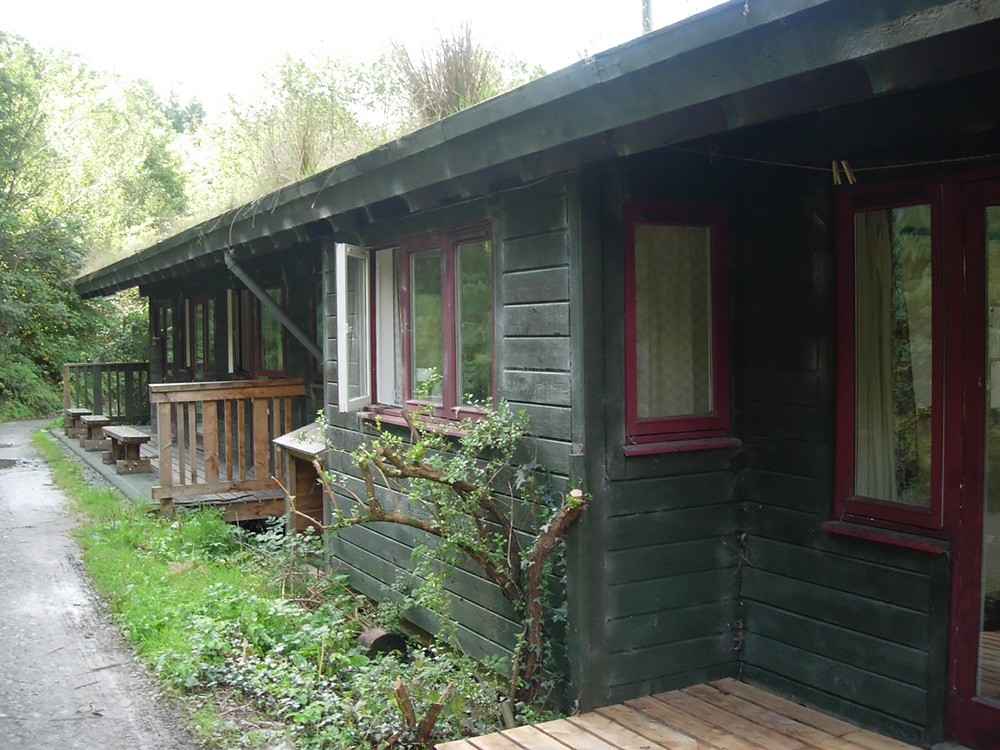
The eco-cabins at CATI was really inspired to leave our cramped, 1980's "noddy house", devoid of character and not designed to support a sustainable lifestyle. I wanted to design and build a home for ourselves. Not just a home, but a lifelong home, designed to be flexible to our needs at every stage of ours and our children's lives, whatever changes befell us. Internal walls would not be structural and would be constructed in panels to allow the spaces to be re-arranged as easily as changing the decor. The doors would be wide and spaces would be clean and flowing to enable wheelchairs or baby walkers to access all areas. Walls would be super-insulated and glazing would maximise solar gain in winter, so it could keep us warm and sheltered even in the event of severe poverty. There would be a garden to give freedom for children to play, and that was sufficient to produce food when times were hard. Materials would be local and sustainable, so that maintenance involved digging up some clay to patch up the walls or replacing timbers. And when the world moved on and our home no longer met the needs of future generations, then the roof could be removed and the house would be washed away by rain or slowly decompose, so that a few years later little more than a weedy mound would show where our home had once stood.
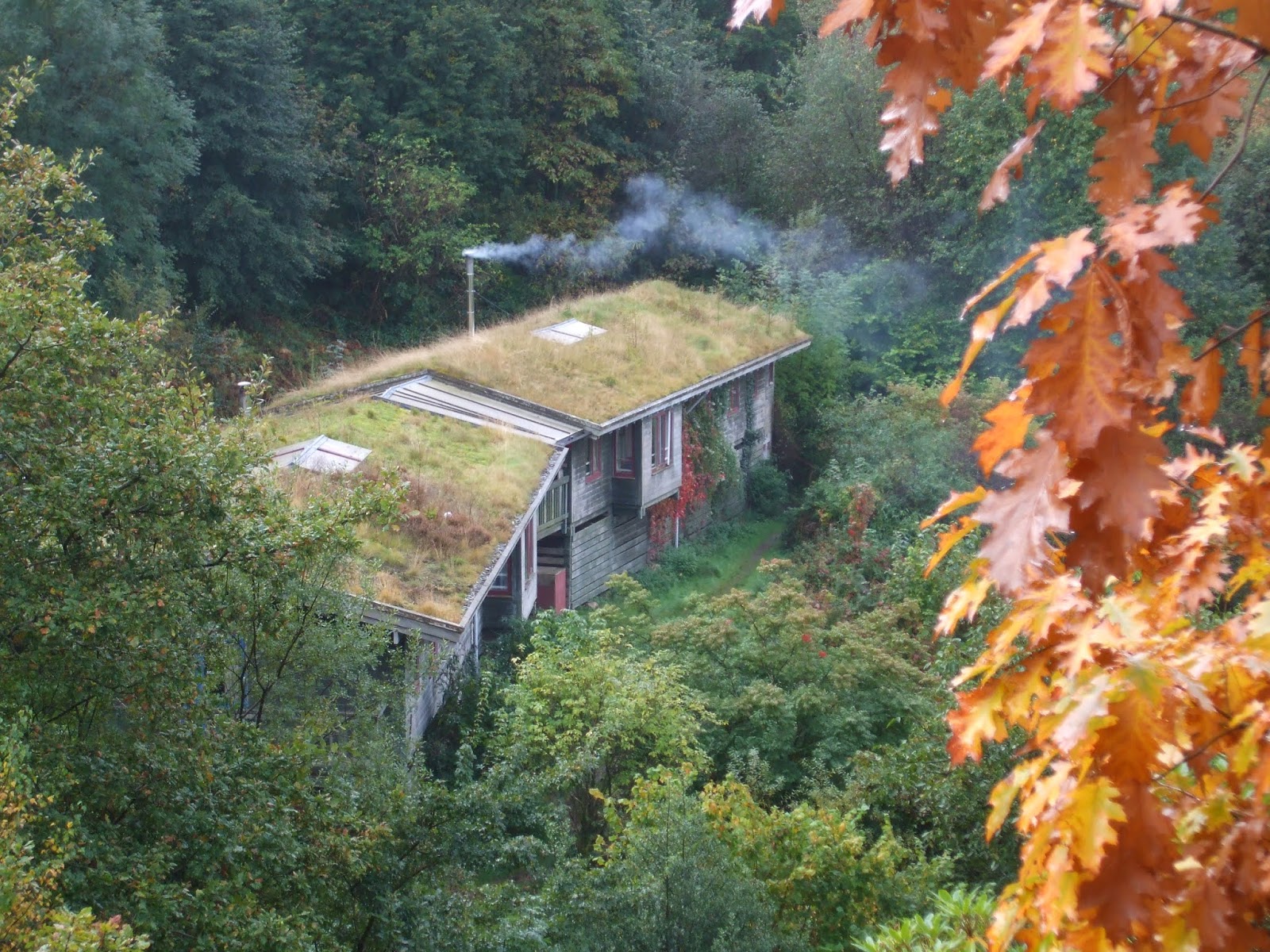
The eco-cabins at CAT
It would be nice to place all the blame for not achieving this dream on the planning system, one that allows low impact buildings when they are intended to be used as holiday homes, but makes it extremely difficult to build something similar as a home to be lived in. Or place blame on the predominance of large house builders, who buy up the land and smother it with ugly developments of roads, drives and brick buildings, that concrete over nature and just leave handkerchief-sized lawns, with no space for trees or wildlife or craftsmanship and beauty. But if I am honest, and I do try to be, it is scary to step out of the comfort, security and conformity of that noddy house, and into unfamiliar territory filled with self-doubt, with a family in tow. So here I remain stuck until my courage and resolve return.
And so, in a very long-winded way, I come to addressing the comment from Rory on my last post regarding the lack of affordable housing in the UK, and the first step of my solution would be Land Stewards.
The Native American people have a belief system that we don't and can't own the land. In the millions of years that the earth has heaved and turned, we are but a passing whim. How can we own the land when our time here is so short and who owned it before us to say that we are now the owners? The earth had no borders before we evolved and will not after us, these are figments of our own invention, rules and constrictions that we have made for ourselves that form our own chains.
Ownership has allowed the rentier class to develop. Most people earn a living working each day, providing goods or services, such as nurses, plumbers and factory workers. The money they earn is constricted by the hours they have available to work. The rentier class earn money by owning things, whether land or property or money, their income comes from loaning them out and charging a fee for it. So we pay them to live in their property or for the use of their money, not for the work that they do. Their earnings are not relative to the work they put in, but are more dependent on how desperately people need a place to live.
I would like councils to be able to apportion 1 acre plots of land to people who wish to be Land Stewards. As a Land Steward you are responsible for looking after that land in a sustainable manner and are entitled to use of the land for as long as you continue to do so, but you do not own the land. When you die your partner or children can apply to be the Land Steward in your place, or the land can be returned to the council to be re-allocated to another person. You would be entitled to build one dwelling and outhouses on the land as long as they are low impact, so that they can either be wheeled away or left to melt back into the landscape when you leave, with no long term damage to the land. No concrete would be allowed, not even for foundations, so drives would need to be gravel or wood chip or just tracks. Do you see where I am going with this?
If you offered a homeless person, or anyone, the right to their own piece of land, there is the potential that with support and hard work that they could make a life for themselves. Land gives people the opportunity to grow or raise some food for themselves and to build a shelter, but also the opportunity to learn new skills in the process. It encourages creativity and craftsmanship and re-skilling. It won't be everyone's cup of tea, but that's fine. If all people get a basic income as discussed here and there are more flats and properties becoming available in the cities due to the surge in working from home, then there will already be a boost to city accommodation and reduction in demand should help affordability too. Then a shift for some people back to the countryside, and becoming self-builders or using local tradesmen, would enable a boost to rural communities.
In addition the housing that Land Stewards build could not be tied to a mortgage, a loan of money from the rentier class, because there is no land ownership as a security to back it. This would mean that most stewards would have to build truly 'affordable' homes, using local materials or recycling. It would give people a chance to have shelter without the need to be on the property ladder. If people can build something special for themselves, then the demand for noddy houses would diminish.

Individual beach houseIf you are wondering what this kind of affordable house building would look like, then walk along many of the beach roads in the UK. There are wooden beach houses, temporary holiday dwellings, often unique and individual and beautiful, even if sometimes in a shabby rundown sort of way. Or walk along the river bank and there are similar properties.

Another beach house in NorfolkThe landscapes that were painted by Constable showed small cottages dotting the landscape made of local materials with their thatched roofs. It is the surviving quirky, individual dwellings that we love, that makes a scene picturesque, something that our housing estates will never be. Let us give people back the opportunity to build beautiful homes and celebrate the diversity that will come from it. Lets do something that reduces peoples burden to the rentier class. Lets promote living sustainably from the land without damaging it for future generations

Simple riverside cottages
As governments are starting to lift lockdown, or are at least asking about it here in the UK, lots of people are wondering what this new reality will look like.
I don't think anyone is expecting everyone to go back to the normal commute and book a mini-break in Venice as soon as lockdown is lifted. Yes, there may be some businesses that don't open again. Almost all companies will have taken this opportunity to re-evaluate staffing levels and possibly made some employees redundant to "streamline" going forward. Some may have made a business decision to close the office and work from home permanently, or move to online sales, to reduce overheads and give them a competitive advantage. I think most of us would expect to see a quieter city centre and more closed shops when we emerge from our isolation.
Looking beyond the local impact what could happen on a global scale? If you have been reading past the coronavirus headlines, you will see that oil prices dropped into negative figures for the first time ever. I was left scratching my head - people were willing to pay $37 to take a barrel of oil off their hands?
It is down to storage capacity - it is full. So even at rock bottom prices no one can squeeze any more in their storage until consumption starts to pick up. There were apparently more fully laden oil tankers at sea than there has ever been before and with few customers they had nowhere to dock. Most countries have agreed to production cuts, but at those prices facilities will be closing due to bankruptcies if they haven't been mothballed. Production won't ramp back up until the price increases to a level that is profitable.
If that doesn't ring the financial meltdown alarm bells, then Germany announcing a recession that will take 8 years to come out of should. Firstly because all countries are cautious about announcing the full extent of their financial problems and secondly Germany was not one of the most Covid-19 infected countries in Europe, with only 87 deaths per million people compared to over 400 for Italy and UK ( taken from https://www.worldometers.info/coronavirus/on 7/5/20).
Then you have to look at what the US are doing - I know it's a mixture of horrifying and farcical watching the words fall out of President Trump's mouth, but as the dominant global player it's important.
War Games. The last few weeks there has been more antagonism with Iran in the Gulf, they have encroached into China's territory in the South China Sea, and they are carrying out naval drills with the UK on Russia's doorstep. Plus they have continued meddling in Venezuela which has the biggest oil reserves in the World. These provocations aren't really new, but interesting to see there has been no pause during the pandemic.
Historically wars have been seen to follow recession. Given that just the announcement of "tensions" from the US normally results in a boost to oil prices, a new war would have the added bonus of boosting GDP and providing plentiful contracts for re-building to US contractors, after the unfortunate country has been plundered.
There's never much public support for war without a trigger. There needs to be a catalyst for governments to "react" to. Remember how slowly and ineffectually the UK government responded to the threat of Covid-19? Or how it took 3 days to comment after the Grenfell Tower disaster? This is normal, government is a ponderous beast to manoeuvre. When the response is fast and they immediately know conclusively who is to blame before the dust has settled and an investigation has even begun, then strap yourself in to be taken for a ride. This is where observing reports from different media outlets helps. When the media have been fed a story from government, they all describe it with the same wording and there is little variation from the national channels.
I'm just saying that overseas development and military hardware are likely growth industries, and that it's not a good time for your potentially unemployed kids to sign up for military service.
High unemployment doesn't necessarily mean there are no jobs around. Even in lockdown there is an increase in demand for delivery drivers and businesses supplying bikes and table tennis tables have been booming. Amazon is thriving, and as much as I avoid them and try to buy local, I can't see this declining anytime soon. Unless we take action like France - to fine them for every non-emergency supply delivery that they make until they have ensured their workers are being protected from Covid-19. What we really need is a fairer tax system that taxes all turnover made in the UK, rather than a complicated tax on "profits" with lots of official loopholes, so that Amazon pay the same percentage of tax as all the small businesses they are wiping out ( I touched on this in my last very old post).
In the UK we may also see the trend of declining manufacturing industries reverse as we start to manufacture more essential goods at home. This is because countries will always protect supplies for their own citizens first. Plus transport of cargo has become more complicated, with borders more protected.
Flexible working and 4 day weeks may be more in demand, as people reassess their priorities after lockdown. If you can survive on 80% of your wages when you have time for cooking from scratch and no commute costs, then why not carry on with a more relaxed way of living? Part time working also provides more flexibility for businesses to have 20% of their labour hours in reserve if work starts slowly, so they are prepared if it ramps up again. This way they are retaining more of their trained staff with a broader expertise base, rather than opting for layoffs and then a recruitment drive once things pick up.
If the trend for homeworking continues then we could see the demand for properties in London decrease with more people choosing to live further afield. Whilst new office developments may slow, there could be bargains around for companies who can re-purpose them for higher value domestic units. Renting out hot-desking and meeting facilities could be a new growth area, to cater for companies with no main office space. I can imagine this gap being filled by Universities who may find online courses have become more popular for overseas students.
Once news outlets run out of Covid-19 drama, they will return to the normal fear-mongering about increases in crime due to the unemployed masses, so security products will be as popular as ever. I would like to hope that the new community spirit lasts and there are increases in the voluntary sector. The vacancies in the NHS may even get filled, as NHS workers are now getting the respect they deserve and there will be plenty of pressure from the public for more investment and fair pay rises. We can probably expect lots more from Extinction Rebellion too, as this pandemic has proved that the way to get change is to force a reaction.
I would love to hear about your experiences. What are your thoughts for the changes we are likely to see over the coming year?
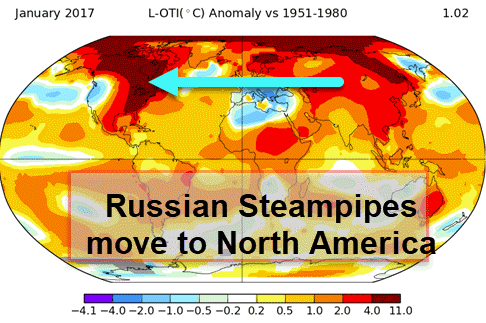 Every three or four years Anthony Watts (who owns a conspiracy blog called Watts Up with That, or WUWT) claims steam pipes in vast empty spaces in remote and largely unpopulated areas of Russia are what's causing global warming. This year he's at it again.
I don't need to write much about this, you can see it in pictures. In fact, Anthony himself put up a photo of steam pipes in a small town called Omyakon (population ~500), one of the coldest permanently inhabited places on earth.
The map below shows where the tiny settlement of Omyakon is located on the GISTEMP January temperature map . It's not in the middle of where the highest temperature anomalies were recorded.
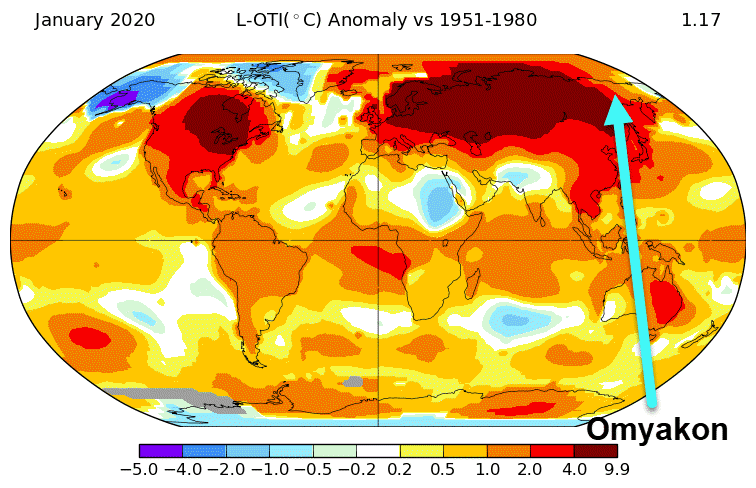
Figure 1 | Temperature anomalies for January 2020 from the 1951-1980 mean, showing the location of Omyakon and its steampipes that conspiracy nutters blame for global warming. Data source: NASA GISTEMP
In fact, most of the huge hot area over Russia and parts of Europe has very low population density as you can see when you move the arrow to the right over the images below. (I've lined up the maps but it's a bit rough.)


Figure 2 | Maps showing mean surface temperature anomalies for January 2020 from the 1951-1980 mean; and population density. Data sources: GISS NASA and SEDAC, NASA
Anthony Watts decided there's a Russian conspiracy at NOAA, and wrote:
In a report generating substantial media attention this month, the National Oceanic and Atmospheric Administration (NOAA) claimed January 2020 was the hottest January on record. In reality, the claim relies on substantial speculation, dubious reporting methods, and a large, very suspicious, extremely warm reported heat patch covering most of Russia.
How (and why) does Russia keep moving its steampipes?
Anthony doesn't explain how or why Russia moves its steampipes around the world each January - from sparsely populated regions of Russia to North America and further, then back again. I'll let you try to figure out for yourself how and why they do this.
In January 2019 Russia turned its steampipes down a bit and shifted their Russian steampipes they'd installed in the USA and Canada a bit west. (Move the arrow to the right to compare January 2020 with January 2019).


Figure 3 | Maps showing mean surface temperature anomalies for January 2020 and January 2019 from the 1951-1980 mean. Data source: GISS NASA
In 2018, Russia turned of quite a few of its steampipes, leaving any residents to suffer the freeziing cold. There were quite a few more Russian steampipes in North America in 2018.

Figure 4 | Maps showing mean surface temperature anomalies for January 2020 and January 2018 from the 1951-1980 mean. Data source: GISS NASA
In 2017 Russia had cut down its steampipe operations, but it didn't turn them off altogether. That was probably so it could vastly expand its steampipes in North America.

Figure 5 | Maps showing mean surface temperature anomalies for January 2020 and January 2017 from the 1951-1980 mean. Data source: GISS NASA
In 2016, when there was a big El Nino and the temperature anomaly was just a smidgen below that of this January (with no El Nino), Russia got rid of most of its steampipes, moving them from Russia to North America.

Figure 6 | Maps showing mean surface temperature anomalies for January 2020 and January 2016 from the 1951-1980 mean. Data source: GISS NASA
The WUWT waste heat conspiracy
Anthony finished his article with this, and no, he didn't tag it as satire:
It appears that the "warmest ever" January might simply have been influenced by Russian temperature data warmed up by waste heat. Maybe the U.S. House of Representatives will start an inquiry into Russian collusion to interfere with global temperature data and climate change legislation - but don't hold your breath.That reminds me of his "waste heat from the little warm pockets of humanity" he found in a tent in a remote and isolated part of the remote continent of Antarctica.
From the HotWhopper archives
- Denier weirdness: Russian steam pipes are causing global warming, sez Anthony Watts @wattsupwiththat - December 2013
- Those Russian steampipes are back at WUWT - February 2016
- Tectonic Anthony Watts moves continents using waste heat from little pockets of humanity! - September 2014
 An interesting if ominous paper was recently published in Nature Climate Change. It came out just before Christmas, at the height of the holiday season here in Australia while fires were raging. For some weeks I've been meaning to write about it. That moment has finally arrived.
The authors of the Nature Climate Change paper, Andrew D. King, Todd P. Lane, Benjamin J. Henley and Josephine R. Brown (from The University of Melbourne) tell us that it's up to us to a large degree (excuse the word play). We know that already, and we also know that recent history and current weather-related events in Australia, the UK, Africa and elsewhere demonstrate we've not yet been willing to take enough action.
However the authors weren't writing about our reluctance to do enough to save ourselves. They were in effect exploring what will happen if we can slow down global warming compared to if we let it continue to warm as quickly as it is. It probably won't surprise HotWhopper readers that the rate of warming makes quite a difference.
You may have seen the excellent series of articles in the Washington Post late last year: 2°C: Beyond the Limit: Dangerous new hot zones are spreading around the world. These articles were describing the impact of global warming in different parts of the world, where warming has already exceeded 2°C. On average, the world has warmed maybe a bit more than 1.1 °C above pre-industrial temperatures; however, some places are warming faster than others. This includes some ocean areas as well as land areas. Most of us live on land, so what happens on land is of particular interest.
As you may know, when the world is heating up, the land heats up faster than the ocean. This is because very large bodies of water have to absorb a huge amount of energy (heat) for the temperature to rise much whereas it doesn't take much energy to warm up the land surface. Specific heat capacity is a measure of a substances capacity to absorb energy compared to how hot it gets. It is defined as the amount of heat needed to raise the temperature of 1 gram of a substance 1 degree Celsius (°C). Water needs a lot of heat to raise its temperature. Land doesn't need nearly as much.
The faster it warms the hotter we get
The authors of King19 decided to look at the different effects around the world when the climate is warming compared to when it's more or less stable. It's clear that the rate of warming makes a big difference. Their results indicate that as it warms it gets hotter on land compared to how hot it would be on land at the same global average temperature when the climate is in equilibrium. In other words, the land gets hotter the faster it warms. (I'm putting words into the authors' mouths here. It's fair IMO.)
A difference between 1.5 °C warmer at equilibrium and 2 °C warmer at equilibrium would certainly be noticed. However, it's the difference between how hot it gets during the transition to equilibrium that we'd notice a whole lot more.
As described in the abstract:
...more than 90% of the world's population experiencing a warmer local climate under transient global warming than equilibrium global warming. Relative to differences between the 1.5 °C and 2 °C global warming limits, the differences between transient and quasi-equilibrium states are substantial. For many land regions, the probability of very warm seasons is at least two times greater in a transient climate than in a quasi-equilibrium equivalent. In developing regions, there are sizable differences between transient and quasi-equilibrium climates that underline the importance of explicitly framing projections.
Transient vs quasi-equilibrium
The transient state refers to the state while change is happening, while the world is getting hotter. The quasi-equilibrium state is, as you can probably work out, a state where the climate is unchanging, is more or less steady.
Say the world is on average 2 °C hotter than in pre-industrial times. Now if it's come from 1 °C hotter (like now) and just hit 2 °C hotter on its way to 3 °C hotter, it's in a transient state. If it's been sitting at around 2 °C above and not varying much over time (no major forcings, just some internal variability) it's in a state of equilibrium. [The term "quasi-equilibrium" is used because that state is based on CMIP5 models for 2300 (mid-range greenhouse gas emissions - ECP4.5). The climate of the 2300s is not in full equilibrium, but getting close, hence "quasi-equilibrium".]
The land gets hotter faster until we reach equilibrium, then it cools a bit
What does this all mean? It means much of where we live will get a lot hotter until we stop warming the planet, then the land will cool down a bit as it reaches equilibrium with the ocean. That is, even while global surface temperature is steady, after warming stops, the hotter areas of land will cool a bit and the cooler parts of the oceans will keep warming a bit until equilibrium is reached.
The lead author, Andrew King, put it simply in an email, saying:
"For a given level of global warming, in a transient climate most land areas are warmer and experience more heatwaves than in an equivalent equilibrium climate with the same global temperature. So, if we were to hold the global temperature constant then most land areas would cool over time."
Land vs oceans
Consider what happens at 1.5 °C and 2 °C while the world is heating up, compared to the situation if the global surface temperature is more or less steady. While the world is heating up, land warms quickly and is out of sync with the oceans. In the transient 1.5 °C world, the continental land regions are warmer than they would be in a quasi-equilibrium 2 °C world. It's different for the slow warming oceans. With slow-warming ocean areas, the transient 2 °C world is cooler than the quasi-equilibrium 1.5 °C world.
The impact is illustrated below. The maps show the difference in temperature between transient warming and how warm it would be in a stable climate. Some of the oceans are cooler while most of the land is warmer in the transient climate compared to a climate at equilibrium.
Move the arrow to the right to see what happens in June to August and in the December to February period.



Figure 1 | Transient minus quasi-equilibrium difference. In a transient climate, where the world is rapidly warming, land areas are warmer and ocean areas cooler than in a stabilised climate. These two figures shows the pattern of temperature difference between a transient scenario relative to an equilibrium climate for both the June-August period (l) and December-February period (r). Data source: Article by Dr Andrew King in Pursuit (The University of Melbourne)
More heat waves and hot seasons as the world warms
The research also indicates that there'll be a lot more severe heat events while the world is heating up than there will be after some sort of steady state temperature is reached. Where a hot season may be a one-in-ten year event in a quasi-equilibrium climate, in a transient climate this could be a one-in-five year event.
From the paper (my para break):
This is particularly true in boreal summer where, for almost all land regions of the world, the likelihood of a hot season is significantly higher in a transient climate compared with the equivalent quasi-equilibrium state. Regions with at least a doubling in the probability of hot summers in a transient climate compared with a quasi-equilibrium world of equivalent global warming encompass major cities including New York City, Istanbul, Baghdad, Seoul and Tokyo.
Although this is a global-scale analysis, one could infer that for these densely populated locations, the heat-related impacts of human-induced climate change would be lessened in a stabilized climate compared with a rapidly warming climate at the same level of global warming.
It's the coming generations who'll be hardest hit
Think what that means while global heating continues. If it keeps warming as it has, then the land will warm up faster, there will be more and worse heat waves, more severe fires, worse droughts etc. After the new climate approaches equilibrium, things should settle down a bit. The biggest upheaval will be during the transition. If society can survive that, generations far into the future will have a fighting chance.
This is an important piece of work because policy and planning people need to think about what's going to happen in their region over coming decades. If they merely focus on the likely scenario should the global temperature stabilise at 1.5 °C, 2 °C, 3 °C and hotter, they'll not be prepared for what happens along the way. Like the Australian Government this year, countries could be woefully unprepared for the changes to come during the transition to a new climate equilibrium.
The only comment I'll add is that the researchers discussed 1.5 °C and 2 °C. The world has not yet taken sufficient action to limit warming to 2 °C. We are still heading for 3 °C and hotter over the coming decades. It's time to take action and slow things down to limit the number and frequency of worse disasters than the ones we're now experiencing.
References and further reading
King, Andrew D., Todd P. Lane, Benjamin J. Henley, and Josephine R. Brown. "Global and regional impacts differ between transient and equilibrium warmer worlds." Nature Climate Change 10, no. 1 (2020): 42-47. https://doi.org/10.1038/s41558-019-0658-7
- How fast the planet warms will be crucial for liveability - article by the lead author, Andrew King, about the paper in Pursuit (The University of Melbourne)
I don't have time to go into her "arguments" in detail. Suffice to say she seems to be hanging on to the failed "stadium wave" theory and has maybe tossed in a few other ideas as well such as the Atlantic Multidecadal Oscillation flavoured with a smidgen of "it's the sun".
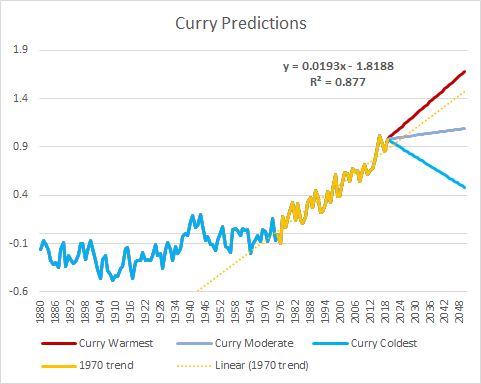
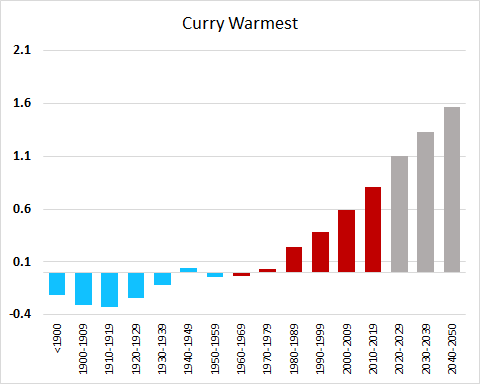
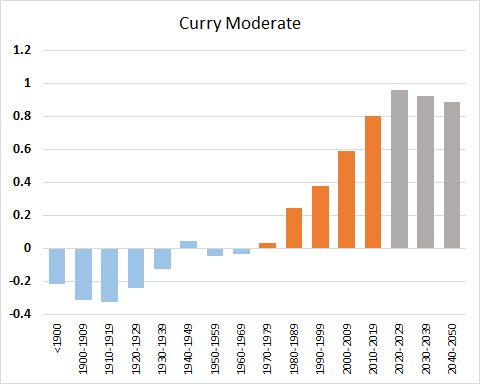
Judith has put up three options for the temperature change over the next 30 years: warmest +0.7C, moderate +0.11C and coldest -0.5C.
What I will do is what she hasn't (for reasons that seem obvious to me). I'll put up some charts showing her guesses. I can't tell from her post what she's used as a baseline, so I've taken it as the average global surface temperature for 2019. I've also made the assumption her predicted change relates to the last year of the prediction. That is, her prediction of 0.5 cooling is that in 2050 the average global surface temperature will be 0.5C colder than it was last year.
I've simplified the predictions by assuming a steady change from 2019 to the final temperature predicted, based on the above.
The charts are below. Not up to my usual standard with captions and labels, as I've not got time for that. Each chart shows the actual mean global surface temperature to 2019 based on NASA GISTEMP and is in Celsius.
First, the annual temperatures, with Judith's predictions. This chart also shows the linear trend line from mid-1970s to 2019 i.e. from the most recent change in trend to the present (0.19 C per decade).
Next her "warmest" prediction, as a decadal chart:
The "moderate" prediction as a decadal chart:
And the "coldest" prediction as a decadal chart:
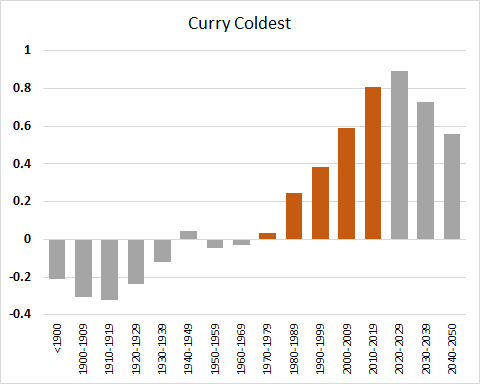
If you're wondering why the next decade in all of them is warmer than the previous actual, it's because of averaging over the decades and the fact I've assumed a steady change with Judith's predictions.
Feel free to add your two bobs worth in the comments.
 I sometimes wonder at the shameless way deniers boast about their ignorance, particularly their lack of understanding of basic science. Willis Eschenbach is a prime example. He doesn't understand science and doesn't make any real effort to understand it. He balks at reading a basic textbook and I doubt he could bring himself to read a science website let alone scientific papers. Yet every now and then he'll decide he's come up with some brand spanking new notion that none of the hundreds of thousands of people who've studied a subject in depth have ever thought of.
Some time ago he figured out what every student (and interested layperson) knew long ago, that storms carry heat from the surface upwards into the atmosphere, thereby cooling the surface; his thunderstorm theory.
This week he's decided there are three what he calls "theories" to the greenhouse effect, demonstrating that he doesn't understand that radiation is the emission or transmission of energy. He was trying to attack a tweet thread by Gavin Schmidt and his attack was laughable (and very very longwinded).
After 1,149 words of what is presumably meant to be an introduction, Willis finally gets down to business and "starts", writing:
Let me start by saying he is badly conflating three very separate and distinct theories.The "he" is Gavin Schmidt, Director of the NASA Goddard Institute for Space Studies (GISS). Dr Schmidt understands more about climate than Willis could ever hope to learn. As you can tell, Willis doesn't even understand what radiation is or he'd never have split the above into "very separate and distinct theories".Here the spoiler alert: I think that the first two of these are true (with caveats), but we have virtually no evidence that the third one is either true or untrue.
- Theory 1) Increasing CO2 increases atmospheric absorption, which affects the overall temperature of the various layers of the atmosphere, and increases downwelling so-called "greenhouse" radiation.
- Theory 2) In the short term, large changes in downwelling radiation change the surface temperature.
- Theory 3) In the long term, small continuing increases in downwelling radiation lead to corresponding small continuing increases in global surface temperature.
In Theory 1, I wonder what Willis thinks is being absorbed by the atmosphere. Whatever it is, he decides it's "affecting" the overall temperature but he doesn't say how. Is it raising the temperature or lowering it? The words he uses are odd: "and increases downwelling so-called "greenhouse" radiation". Does he know what that means? I'd say not because he says that his Theory 2 is quite "separate and distinct" from his Theory 1.
His Theory 2 is that if radiation is transmitted downward it changes the surface temperature. Yet that's a corollary of his Theory 1, not a separate notion. He's already said that Theory 1 includes downwelling of radiation, so how can Theory 1 be separate and distinct from Theory 2. I can only conclude that Willis doesn't know what radiation is.
Going on to his Theory 3, the only difference between that and his Theory 2 is time. What he's saying is that after whatever his "short term" time has elapsed, physics stops working. That is, increases in downwelling radiation no longer warm the surface.
Being of a curious nature, I held my nose and dived into the article further, to see where his self-acclaimed brilliance led him. Well, after a lot more verbiage, Willis finally grandly announces his own notion. He claims the climate is stable. He goes even further and writes:
My theory, on the other hand, arose from my being interested in a totally different question about climate—why is the temperature so stable? For example, over the 20th Century, the temperature only varied by ± 0.3°C.It's clear that Willis hasn't ever looked at what's been happening on this planet. Here's a chart of temperature change over the twentieth century, and I've included the temperature change for the entire record from NASA GISS, right up to the end of last year:
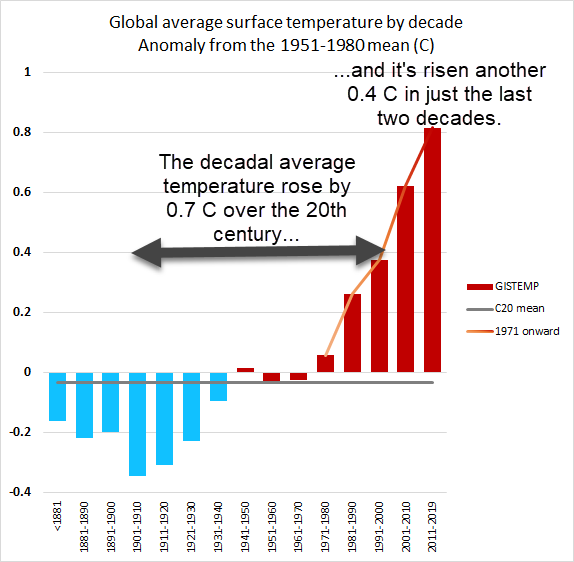
Data source: NASA GISS
Anyone who tries to portray that as "stable" is pulling your leg, making a joke. Anyone who portrays and increase of 0.7 C as varying "by ± 0.3°C" is misleading you. (I can imagine the yarn he tells to his "gorgeous ex-fiancee" when she asks where $20,000 disappeared to. He'll just say - oh, no problem. Our savings just varied by ± $10,000 in the last year. Happens all the time.)
Willis says the climate is stable (huh? No ice ages, no hothouses?) because of what he calls "emergent phenomena". Basically, he's claiming that the planet can't get hot even if less energy leaves the system. He doesn't "believe in" physics. Instead he boasts how he's invented "how the climate works", and points to his "40 or so posts" at the self-same climate conspiracy blog WUWT. I've commented on quite a number of those 40.
The last 670 words could have a heading "ode to Willis", where he argues for why he's a genius, despite being a college dropout, and why he's God's gift to climate science. He ends up with these gems:
I have great confidence in what I've written about my theory, for a simple reason. Watts Up With That is the premier spot on the web for public peer-review of scientific theories and ideas about climate. This doesn't mean that it only publishes things known to be valid and true. Instead, it is a place to find out if what is published actually is valid and true. There are a lot of wicked-smart folks reading what I write, and plenty of them would love to find errors in my work.Ha ha ha - "the premier spot on the web for public peer-review" - oh my! It's a damn conspiracy theory blog, Willis. It's got nothing to do with peer review or science. The fans are scientifically illiterate. Most of them regard WUWT as nothing but their personal notice board on which to randomly pin their various crazed ideas, and which have no relevance to the article above their pinned notion.
So when those smart folks can't find errors in what I've written, I know that I have a theory that at least stands a chance of becoming a mainstream view.
Despite their illiteracy, in the past there were quite a few WUWT fans who didn't like Willis much. They might have left by now. Lots of people, even at WUWT, have pointed to flaws in his "40 or so posts" and all he does is spit the dummy. Very rarely he'll acknowledge an error, but mostly he just gets irate.
From the WUWT comments
I decided to see how deniers react to him effectively saying the climate never changes, when one of their favourite rallying cries is "the climate is always changing". I was disappointed. Nobody picked him up on that one. I have only scanned the comments and, as some of you have noticed, the quality is declining. (Yes, what you thought was impossible is in fact possible.) There was little discussion of Willis' article. Mostly it was used as an excuse to post various conspiracy theories, silly attacks on scientists and the usual denier nonsense.
There was one chap who calls him or herself Burl Henry, who wrote a novel notion (at least I've not come across it before). Instead of "it's the sun" he reckons "it's SO2":
I have yet to find any large change, either increase or decrease, which is not related to changing levels of SO2 in the atmosphere, and this is documented in the reference cited.Nick Stokes found another problem with Willis' article (here) and politely pointed it out. Willis didn't take kindly to that and went off the rails in his usual style. Willis didn't and couldn't deny they were a problem for him. I doubt he understood.
Further reading from the HotWhopper archives
If you want more about Willis' grand theories and other wonderings, there are plenty of HotWhopper articles to choose from.
- Wondering Willis' Original Weather Hypotheses - December 2013
- Wondering Willis Eschenbach's Thunderstorm at WUWT - October 2013
- Denier weirdness: Wondering Willis Eschenbach builds a strawman out of volcanic dust - September 2013
- Wondering Willis as a concerned climate scientist (showing his sexism) - August 2013
- The water vapour penny precipitates, almost, for Willis Eschenbach at WUWT - July 2016
- and many more.
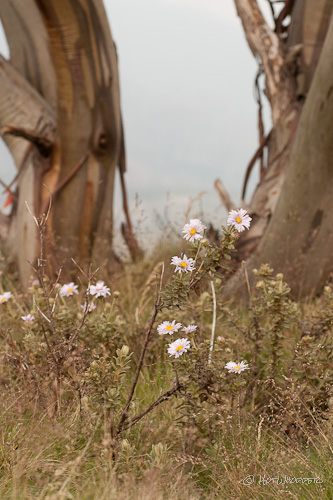
SnowgumThe weird get weirder. A bloke called Paul Driessen, whose job includes telling lies about climate change and bringing back smog to the USA, has come up with a wild idea and it's been posted at WUWT. This time he's really gone bananas. What he's saying is that Australia should get rid of all its trees, or those of the eucalypt species which is pretty much the same thing, and that would stop fires. In other words, he's suggesting we get rid of almost all our forests. That's one solution to stopping fires, though not original.
Don't believe me? Here's what he wrote:
In both California and Australia, people bemoan the loss of eucalyptus trees in fires. But many don't want them removed or even thinned out.
Many don't want them removed? Really? How about almost no-one wants them removed. It's only a few shock jocks in Australia, and Paul Driessen, and probably Rupert Murdoch, who want to chop down all our forests. I can understand that people in California would regard the Australian blue gum as a pest - in California. (That's probably the only eucalypt they know.) What I don't understand is why anyone would want to remove all the eucalypts in Australia. All 894 varieties, coast to coast? (What about the koalas?)
In case anyone is thinking, well, Australia has forests dominated by other species, you'd be right. However, most of our forests are eucalypt forests. Here's a map showing the different types, courtesy the Australian Bureau of Agricultural and Resource Economics and Sciences (ABARES):
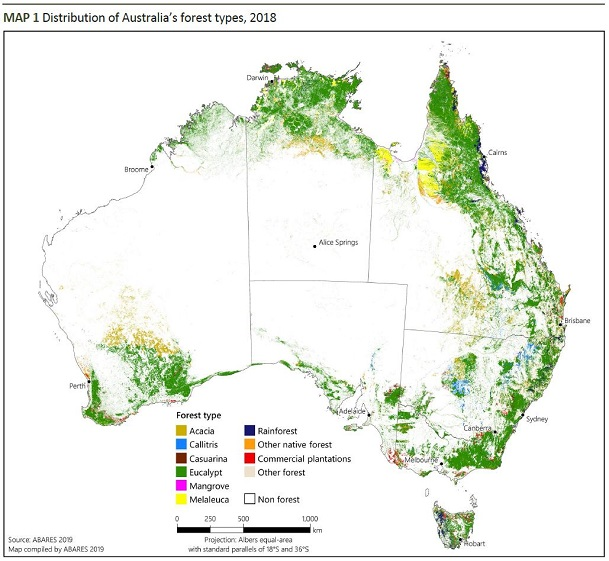
Many of the other species: acacia, melaleuca etc also burn quite readily. Should we chop them down as well? And what about the rainforests that have burnt for the first time in thousands of years? How about the rivers, firebreaks, cleared areas, areas burnt several times already? Maybe we should just cover the country in tar and cement!
Paul Driessen is really and truly suggesting we strip bare our continent of the tree species that defines us and our forests, the eucalypt, destroying the homes of birds, kangaroos, koalas, possums, gliders and protects so many species of other flora.
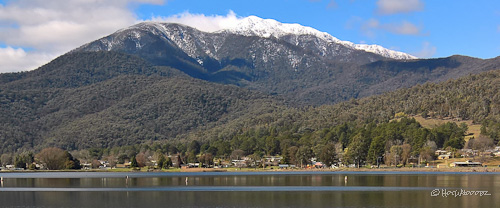
Deniers want us to chop down millions of hectares of forests and become a treeless nation.Deniers really are most peculiar.
BTW, I've been watching out for this and Paul is the first denier I've come across who says "CO2 is plant food" is one reason Australia's fires were so bad (those weren't his exact words).
Oh, and ignore the rest of his article, it's complete and utter nonsense. Paul got most of it from various wacko websites in the USA and people who know nothing about Australia (like himself). It's a mix of lies, conspiracy theories and nut-job politics that WUWT is known for (for anyone who is familiar with the blog). Paul is pushing the crazy line that scores of people spent days hiking and climbing for miles deep into inaccessible parts of the Great Dividing Range, waited till they were caught in the middle of electrical storms, then set the forest alight. These people, he must assume, were highly coordinated and set off fires all over NSW and Victoria at the same time as lightning was shooting about. These arsonists who want to get rid of Australia's forests are very cunning, aren't they.
WUWT is not recommended for the sane.
 It's hard to believe but poor Anthony Watts, despite all the help offered him over the years, is still totally befuddled, perplexed and bamboozled by the notion of temperature anomalies. You know he's not the brightest spark in deniersville yet you'd have thought that by now even he might have learnt something about temperature charts. But no.
The oddest thing is that he's unashamed of being numerically illiterate. He might even regard it as a strength. It means his readers have found someone, somewhere, who's dimmer than they are, and that could be why they keep coming back for more.
Today Anthony wrote about the global average surface temperature for 2019, saying at least in the USA it wasn't another "hottest year". That's a classic conspiratorial diversion tactic, by the way: focus on a detail and try to dispute the big picture.
Back to his troubles with temperature anomalies. Anthony complained he still can't figure them out, even after all these years of running the world's biggest climate conspiracy blog. He wrote:
In my opinion, the NOAA/NASA press release (and slideshow) is inconsistently presented. For example, they can't even agree on a common base period for comparisons. Some graphs use 1951-1980 while others compare to 1981-2010 averages to create anomaly plots. NOAA and NASA owe it to the public to present climate data with a consistent climate period for comparison, otherwise it's just sloppy science. NASA GISS has consistently resisted updating the 1951-1980 NASA GISS baseline period to the one NOAA and other datasets use, which is 1981-2010. GISS stubbornly refuses to change even though they have been repeatedly excoriated for keeping it.As you know, Anthony's opinion isn't worth (I'm trying to think of an alternative to this saying), and his hoity toi attitude makes him look like a fool. Different agencies use different baselines for different reasons. Once a baseline is chosen it's best to keep it. That makes it easier for researchers and others to compare data over time. Otherwise you'd have to keep checking the baseline used each time you went to use the data. It's really not that hard to understand and work with anomalies.
Another big fat lie about temperature
Then comes the lie. Everyone familiar with global surface temperature changes knows that the coldest periods last century were in the first half of the century, yet Anthony wrote something wildly wrong and I don't know that anyone picked him up on it (dimwitted deniers that they are):
That 1951-1980 period just so happens to be the coolest period in the 20th centuryNope. Wrong! That 1951-1980 period was nothing like the coolest. In fact it was around 0.03 C warmer than the average of the 20th century.
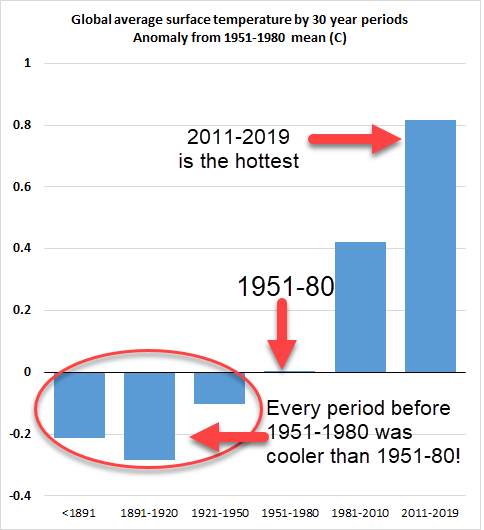
Fig 1 | Global surface temperature for thirty year periods from 1880 to 2019. Data source: GISS NASA
Remember this is from someone who ridiculously pretends to know something about global surface temperatures. He doesn't know the first thing, does he.
Anthony goes on to explain why he doesn't understand anomalies. Or tries to. I think it might be something to do with different colours being used on different maps (NASA and NOAA). He shows one that goes from aqua to reddish brown and one that goes from a deeper blue through to brighter red. The first one has an anomaly scale from -4 K to plus 4 K, the next one from -5C to plus 5C, so maybe Anthony's not just confused by colours, he's confused by Celsius and Kelvin.
Anthony finally realises there's not much difference at all, even if you don't allow for different baselines. Since 1951-1980 average (used by NASA) is 0.03 C higher than the 20th century mean (used by NOAA), you'd expect NOAA's anomaly from the 20th century mean to be around 0.03 C lower than NASA's anomaly from 1951-80 average. And it is, as Anthony points out. He helpfully (or reluctantly) wrote:
The difference between the two analyses is NOAA @ 0.95°C/1.71 ° F and NASA GISS at 0.98 ° C/1.8 ° FJust as expected.
Not daring to compare, So There!
There was little more Anthony could try to milk out of complaining the baselines are different, apart from saying the relentless rise in temperature is "trivial" (with some quote-mining games to show he doesn't understand the American language any more than he understands anomalies and trends). So he moved to the USA, which he said was cooler. So there!
Anthony Watts did a song and dance about the Climate Reference Network in the USA. He loves it it's so "pure" (even though it's homogenised). He wrote, rather Trumpishly:
NOAA's U.S. Climate Reference Network (USCRN) has the best quality climate data on the planet, yet it never gets mentioned in the NOAA/NASA press releases. Commissioned in 2005, it has the most accurate, unbiased, and un-adjusted data of any climate dataset.Well, of course it wouldn't get a mention when reporting global temperatures, or even when reporting historical temperature changes for the USA. CRN temperature analysis only begins in 2005, whereas other analysis dates back to 1895.
Another thing Anthony couldn't bring himself to do was show any chart comparing the analysis of these 114 or so weather stations to that for the hundreds of weather stations in the nClimDiv, which NOAA uses for historical data to the present. That's because they are almost identical. So, let me do it for him. (Note, the 2019 data for nClimDiv hasn't been added yet.)
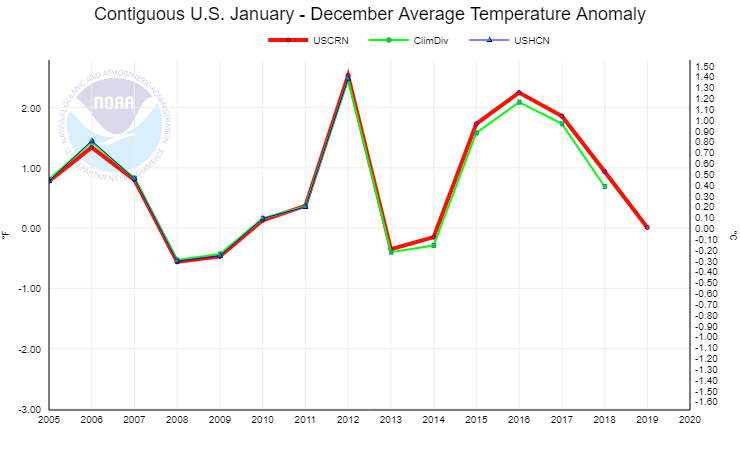
Fig 2 | NOAA temperature anomalies for USA with CRN, nClimDiv and USHCN, from 2005 to 2019. Data source: NOAA
Almost no difference at all! I guess that means the historical data is fine as well.
So let's take a peep at that:
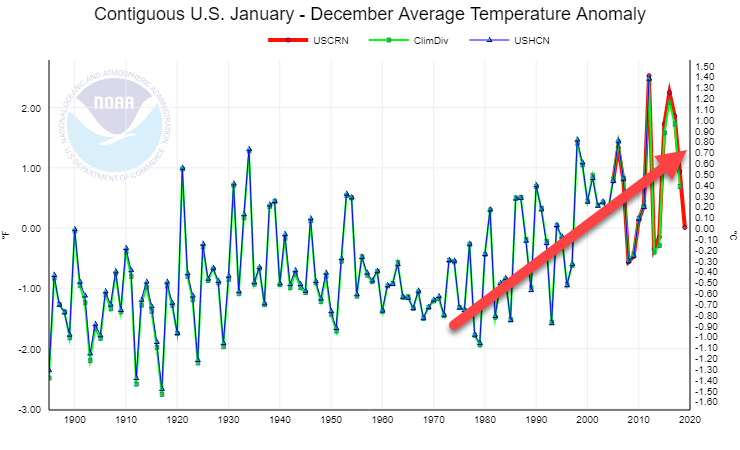
Fig 3 | NOAA temperature anomalies for USA with CRN, nClimDiv and USHCN, from 1895 to 2019. Data source: NOAA
I'm not going to spend time plotting the actual trend. If you want to do that the data is on the NOAA website. It's fairly clear there were some ups and downs but overall not much change until the 1970s. The hottest year for the USA was 2012 and the coldest year was 1917.
Now for the conspiracy theory
Not content to avoid plotting historical temperature data for the USA, and not content to avoid showing there's little difference between his "pristine" data set and the larger ones, Anthony proceed to set out his conspiracy theory and wrote:
While the U.S. isn't the world, and the dataset is shorter than the requisite 30 year period for climate data, the lack of warming in the contiguous United States since 2005 shown in the graph above suggests that the data NOAA and NASA use from the antiquated Global Historical Climate Network (GHCN) reflects warmer biases due to urbanization and adjustments to the data.He then highlighted a poster he got someone to prepare for him back in 2015. It's now seven and a half years since he promised a paper on the topic, and it's not yet surfaced (do you like the wordplay?). Anthony promises a lot of things that he can't deliver. Remember the Open Atmospheric Society?
He's wrong and he must know it. Lots of people have told him so. Urbanisation makes no difference to the global or the USA temperature data once it's been processed. There have been studies of the US record (e.g. here) that demonstrate this, including one by Anthony Watts himself!
If you're scared by global heating, just change the scale
I'm fairly sure this comment from Anthony wasn't meant as a joke but it sure looks like one:
But here's also something interesting. All of the temperature plots used to represent climate change are highly magnified. This is so variations of one degree or less are highly visible. Unfortunately, these huge variation often scare the public since they perceive them as "massive" temperature increases.Right. I'll bet that's what deep sea explorers do when contemplating going deep into the Mariana Trench. No biggie!
Fortunately, the NOAA online plotter allows adjustment of the vertical axis, and when the vertical axis of the climate data is adjusted to fit the scale of human temperature experience, they look less alarming.
He added:
"Climate change" certainly looks a lot less scary when the temperature change is presented in the scale of human experience.This is from the person who was close to the Camp Fire in California. And surely he's read about what's been happening in Australia - the deniers are all over those (they aren't real, they've happened before, it's arson, it's rained up north etc etc)
Seriously, these climate deniers will go to their grave swearing global warming is no big deal. They hate being scared so much they'd rather deny wildfires, floods, rising seas, melting ice, food price rises, climate migration and more rather than admit they are wrong.
CRN vs nClimDiv
By the way, you can compare the number of stations in CRN vs nClimDiv by moving the arrow across the image below. I haven't lined them up perfectly, it's just to give you the idea.


Figure 4 | Maps showing weather stations used by NOAA in nClimDiv and CRN. Data sources: NOAA - CRN and NOAA - nClimDiv
From the WUWT comments
I'm still getting back into the swing of blogging and don't have the energy or inclination to go through the comments. In any case, I'd best keep an eye on the local fire situation. A favourite spot of mine seems to be in the path of the fire. You may peruse them yourself. What I did see showed WUWT is getting worse the more the world warms.
From HotWhopper archivesSome of the links to images in some the older articles are broken. They still have gems in the text :D
- Anthony Watts has discovered pristine US temperature (and MS Excel) - June 2015
- On Plain Denial: Watts Dismisses His Own Evidence That is Counter to His Viewpoint - March 2013
- Desperate Deniers Part 5 - Anthony "surface station" Watts flunks NOAA temperature chart 101 - January 2016
- Improving the temperature record vs conspiracy theories at WUWT - September 2015
- Desperate Deniers Part 4: Anthony Watts is shame-proof despite all his bloopers about NOAA - January 2016
- Anthony Watts is foxed yet again by temperature anomalies - June 2017
- Update: Anthony Watts Classic: those baffling temperature anomalies - May 2013
- Confirmation bias and anomalous anomalies at WUWT - June 2013
- On GISTemp, baselines and anomalies - June 2013
 Summary: 2019 was the second hottest year on record. December 2019 was the second hottest December on record. The last decade was the hottest decade on record.
According to GISS NASA, the average global surface temperature anomaly for 2019 was 0.98 °C, which is just 0.04 °C cooler than the previous hottest - 2016.
Below is a chart of the average of 12 months to December each year. 2019 was 0.06 °C hotter than the 12 months to December 2017, which is the third hottest year.
Figure 1 | Annual global mean surface temperature anomaly - 12 months to December each year. The base period is 1951-1980. Data source: GISS NASA
Next is a chart of the month of December only. This December was 1.11 °C above the 1951-1980 average and was the second hottest December on record. It was 0.05 °C hotter in December 2015 which, unlike this past year, was in the middle of a strong El Nino:
Figure 2 | Global mean surface temperature anomaly for the the month of December only. The base period is 1951-1980. Data source: GISS NASA
The decades are getting hotter
As you would know, each decade is getting hotter and hotter. Each of the five decades since 1971-1980 has been hotter than the previous one. The chart below shows what's happening. It includes a line showing the mean for the 20th century. Note the last column only includes nine years - to 2019. Let's see what next year brings.
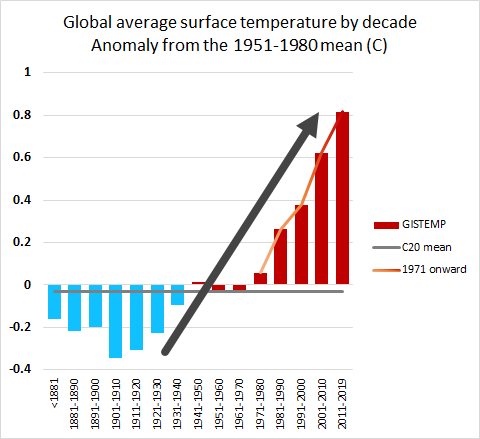
Figure 3 | Global mean surface temperature anomaly by decade. The base period is 1951-1980. Data source: GISS NASA
Where was it hot?
Last year was hot almost everywhere. The only year that was hotter was 2016, but that year there was more contrast. In 2016 there were hotter parts and colder regions compared to last year. The hot Arctic helped drive the average temperature in 2016.
Move the arrow at the left to the right to compare this year with 2016. Check out Australia, too, where 2019 was the hottest year on record.


Figure 4 | Maps showing mean surface temperature, anomalies for 2019 and 2016, from the 1951-1980 mean. Data source: GISS NASA
July 2019 was the hottest month on record
The chart below confirms July this year was the hottest month on record, hotter than August 2016. The chart indicates the changes in monthly temperatures and shows the hottest months of the year are in July and August. (Sometimes it's July that's the hottest month and sometimes it's August.) I added a dotted line to the chart to make it easier to see. As I said previously, that's especially notable because there was no El Nino this year, unlike back in 2016.
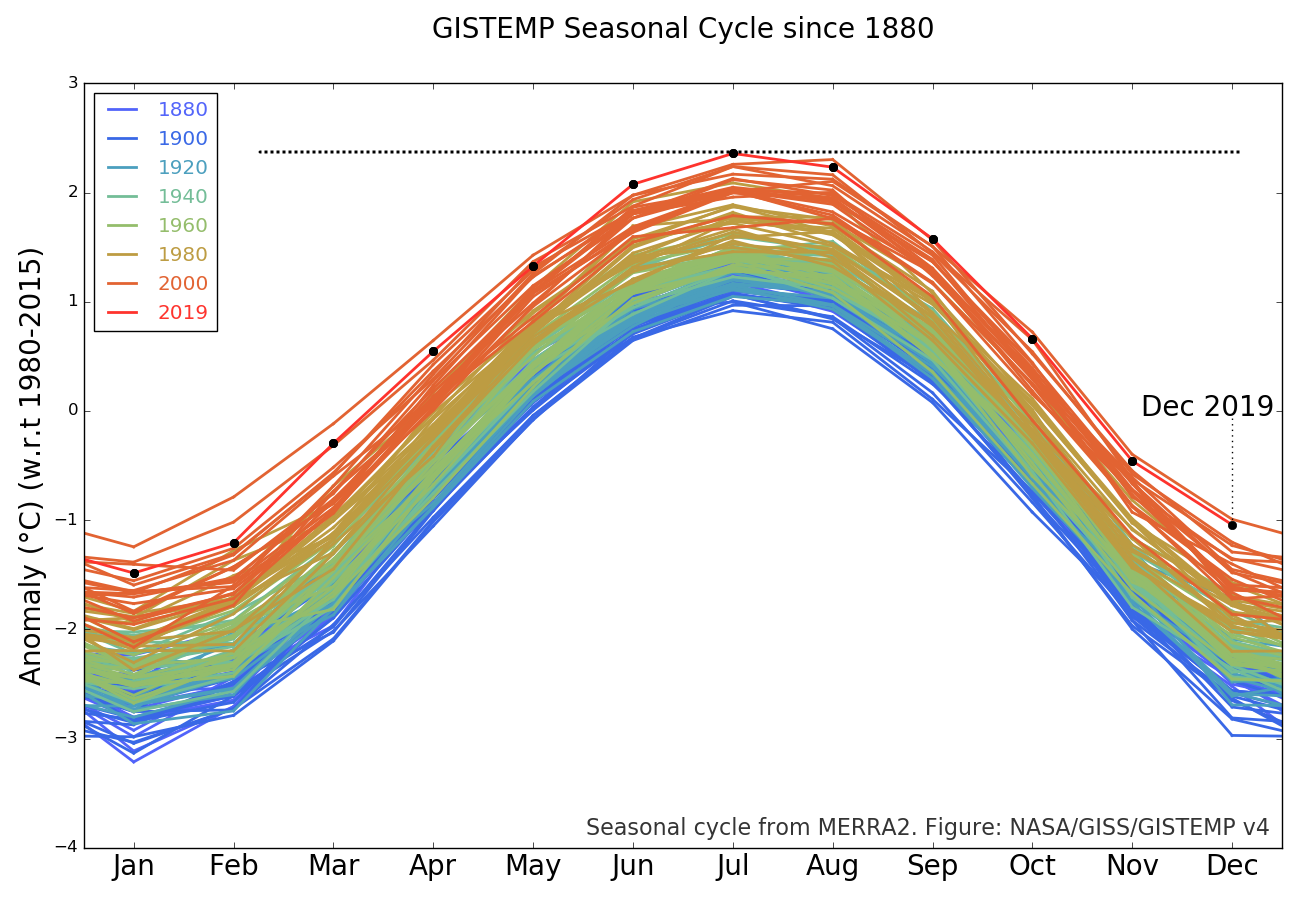
Figure 5 | Seasonal cycle of global surface temperature anomaly. The chart shows the temperature anomaly with respect to the 1980-2015 (°C) mean. It is derived from the MERRA2 reanalysis over 1980-2015 and shows how much warmer is each month of the GISTEMP data than the annual global mean. Source: GISS NASA
Year to date chart
Below is the final year to date progressive chart for 2019. What it shows is the average temperature for the year at each point on each separate line on the chart. The topmost line is 2016. The fat black line with dots is 2019.
For each year at January, the point is just the anomaly for January. At February, the point is the average anomaly for January and February. At July, it's the average of January to July inclusive - all the way to December, which is the average for the whole year.
Back in July I wrote:
It's not out of the question that 2019 will end up the second warmest year on record, ahead of 2017. (The temperature anomaly for the rest of the year would have to average 0.87 C for 2019 to equal 2017.)The temperature anomaly for the rest of the year, from August to December, averaged 1 °C, so it easily beat 2017 for second place.
The 2019 line shows that the average for the year is 0.98 °C (the last big dot on the 2019 line). This is just 0.04 °C lower than the 2016 (1.02 °C). Unlike 2015/16, there was no El Nino this past year, at least not using Australia's BOM criteria.
Figure 6 | Progressive year to date global mean surface temperature anomaly. The base period is 1951-1980. Data source: GISS NASA
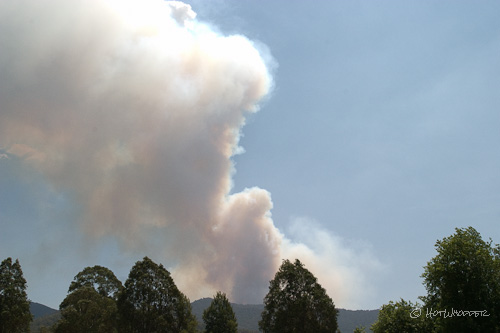 Know what? If I see another know-nothing denier try to claim "it's not climate change it's arson" or "backburning" or "not enough prescribed burns" or "it's not happening", I'll scream.
I was going to deal quickly with "it's arson", then move onto prescribed or controlled burns. However, I'll now devote this article just to the arson furphy, because the false meme is appearing all over the place, even being insinuated in mainstream media. Some people are suggesting it's an organised disinformation campaign. I don't know about that, but it is being fanned by the usual crowd of deniers, including many from the USA and other places outside Australia.
Let me be clear. Arson is not the reason for the catastrophic fires this summer. There has always been arson but never a fire season as bad as this one. These major fires are there because the bush is so dry and because it's been so hot. Fires need ample fuel, wind and an ignition. The fuel is ample, because even though there's not been much growth in vegetation because of the drought, what's there is dry and easily ignited. There's been enough windy days to fan the flames and spread the fires further. And there's been ignition, obviously. Mostly (in the case of the major fires), the ignition has been lightning.
Most major bushfires in Australia are started by lightning
Most major bushfires (forest fires) in Australia are ignited by lightning. They typically start in bushland that is difficult to access.
At a recent community meeting we were told the fires around here in north eastern Victoria were ignited by lightning. I saw some of the lightning.
The fire in Mallacoota was also reportedly started by lightning.
The huge Gospers Mountain fire in Wollemi National Park in NSW was started by lightning.
On 8 January 2003 there were 87 fires ignited by lightning, eight of which persisted and led to the with huge Alpine fires that year.
Lightning fires are a risk in summer in south eastern Australia. We can get lightning at any time of the year. In winter, which is our wet season, fires don't normally take hold. In winter, lightning is usually accompanied by rain and, in any case, the temperature is low and the bush is not as dry so fires don't spread far.
Summer is our dry season. Lightning storms can pass through with very little or no rain. Not every lightning strike will cause a fire. It depends on what's been struck. However, it only takes one tree catching fire and it will spread quickly if conditions are right.
This summer has seen the hottest weather ever and much of south eastern Australia is very dry, with large parts having been in drought for some years. Conditions for wildfires have been almost perfect. This has resulted in a huge increase in the number of fires in NSW. There has also been an enormous area burnt in eastern Victoria though the charts (see below) from GFED to 3 January 2020 doesn't reflect this. (It shows number of fires not area burnt.)
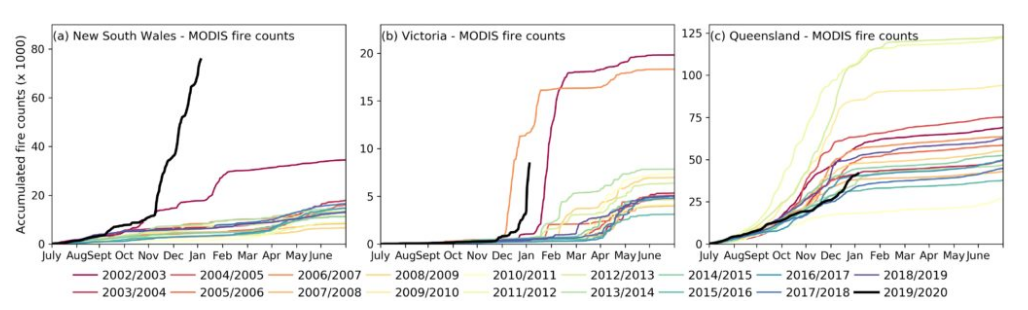
The area burnt in Victoria in 2003 (>1.3 million ha or 3.2m acres) can be seen here, and the area burnt in 2006 (~1.2 million ha or 3m acres) is shown here. So far this year, it's estimated the fires in Victoria have burnt more than 1.2 million hectares. The fires in Australia this season are estimated to have burnt at least 8.4 million hectares including 4.9 million ha in NSW.
Bushfires also create their own weather, and can even make lightning as described in an article by the Bureau of Meteorology:
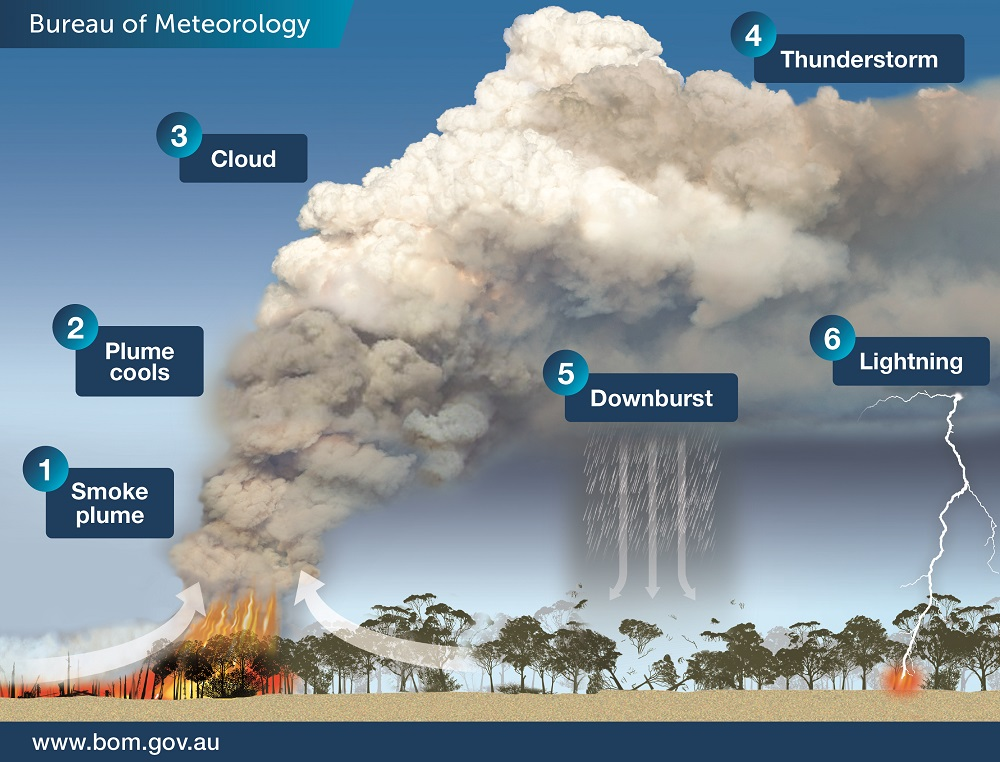
Let me stress again, most of these large fires this summer were ignited by lightning. They have been exacerbated by climate change. Regardless, no matter what the source of ignition, whether natural, accidental, careless, reckless or deliberate, if conditions (dryness, heat and wind) had not been what they are, there would not have been anything like the catastrophe the world has seen unfolding in Australia.
Another thing worth considering is that sources of ignition are unlikely to have changed much over time. On the other hand, fire response has improved out of sight over the years, with huge advances in communications, fire-fighting technology and equipment, training and response management. If not for climate change making bad conditions worse, these fires would not have been anything like they are.
Why the deflection from deniers?
I don't know why some people are promoting the "it's arson" meme. Is it they can cope with the idea that people are capable of burning Australia by lighting a match but can't cope with the idea that people are capable of changing the climate by burning fossil fuels? Who knows.
I'm not saying there are not people who deliberately light fires. There are. There are also people who accidentally cause fires. When caught, all such people are subject to heavy penalties. In my home state, a person who intentionally or recklessly causes a bushfire can be locked away for up to 15 years (in NSW it's up to 21 years). A person caught lighting a fire that causes death can be sent to jail for up to 25 years.
Human activity can cause fires. Every year there could be hundreds of fires ignited by people, whether deliberately or inadvertently. Arsonists, people who deliberately light fires for whatever reason, exist and have probably always existed. They might want to collect insurance on a failed business or because they've overstretched their mortgage. They might be after revenge against someone so set their home or car alight. A few people just like fire, and set them in urban, peri-urban or, occasionally, rural areas. There have been homes burnt after arsonists lit fires.
There are fires caused accidentally by human activity. There were scores of lives lost in the East Kilmore fires after powerlines sparked a fire in strong winds on a catastrophic fire danger day. A recent fire that burnt Binna Burra Lodge in a precious area in Lamington National Park in Queensland has been attributed to a cigarette butt dropped by teenagers. The powerline fire and the cigarette fire wouldn't have taken hold or caused so much damage if conditions had not been so extreme.
Most fires lit deliberately or accidentally by people are quickly contained
Few people would hike into virtually inaccessible areas to deliberately start a major bushfire. They'd have to be suicidal as well as pyromaniacal. Most people who deliberately light fires do so near areas of population, and they are generally grass fires that are extinguished fairly quickly. Not always, but mostly. A 2006 report states (my emphasis):
Human action - most deliberate bushfires occur within or near the most densely populated regions of Australia. Consequently, the majority of deliberate fires occur along the coastal fringe, where climatic conditions are generally milder, and the period of adverse bushfire weather is shorter. Although they have the potential to burn out of control and cause immense damage, overall, the majority of deliberately lit fires are small in area (less than one to two hectares).
Analysis of a number of different data sources indicates that the highest rates of recorded deliberately lit fires during adverse bushfire weather occur in areas, regions or jurisdictions with highest rates of recorded deliberate fires generally.
A key question for bushfire arson prevention is whether there is a greater risk of deliberate fire lighting during periods of extreme weather conditions. This is a difficult question to answer with any degree of accuracy, as many fires are suspicious but not confirmed as arson incidents, and the intention of those who light fires is rarely known. A range of data shows that as the fire danger rating increases, recorded deliberate fires account for a smaller proportion of all bushfires. The increased risk of accidental and natural fires under more adverse conditions and the absence of definitive data on causal factors means that there is a lack of conclusive evidence to indicate a systematic increase in deliberate firesetting during these peak periods of risk.
Use and abuse of statistics
Although by far the majority of "it's arson" claims are unsubstantiated (and nonsense), I've seen people quote and misquote statistics from various sources, including some people who should know better. Let's have a look.
Below is a chart on arson offenses recorded, from the Crime Statistics Agency (Victorian Government). The bushfire arson is the bottom line (light grey). It peaks in the summer season, but that would probably be in part because fires lit in summer attract attention whereas fires lit at other times of the year go out quickly and/or don't spread. (As always, click to enlarge.)
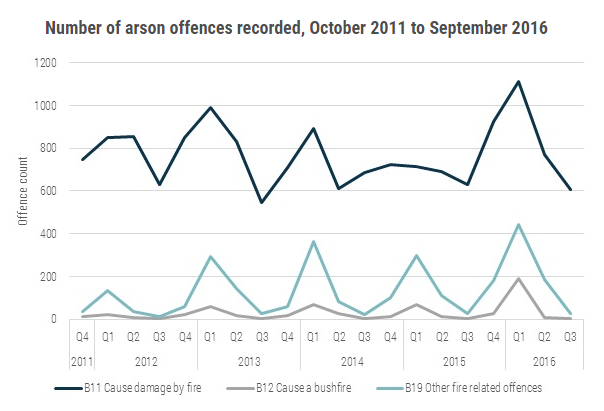
In the year ending 30 September 2016, "there were 46 unique offenders apprehended by police for bushfire offences. Of these offenders, more than half (n=26) were known to police for prior offending before committing their bushfire offence, and 16 had previously committed an arson or criminal damage offence before causing a bushfire. Bushfire offenders were predominantly male, making up 91.3 per cent (n=42) of all offenders, and 56.5 per cent (n=26) were aged between 10 and 19, with the mean age of 23.6."
This number represents around 0.0074% of the population of Victoria at the time (6.2 million). There would also have been suspicious incidents where no-one was charged with an offense.
In NSW it's been reported that 24 people have been charged with deliberately lighting bushfires this fire season. In addition, action has been taken against 53 people "for failing to comply with a total fire ban and against 47 people for discarding a lighted cigarette or match on land."
There are suggestions a fire at Jindabyne last Friday may have been deliberately lit.
The report said that none of the fires currently on the south coast of NSW were related to those charges.
Although it was 24 people who've been charged with lighting fires, that SMH report said a total of 183 people had legal action taken against them, which might be the source of the mysterious "200 arsonists" that keep popping up. I don't know what the missing numbers relate to (24+53+47=124), it could be that some people were charged with more than one offense.
Another point worth making is to reiterate that most fires lit by people occur near populated areas, unlike the major fires currently in Victoria and NSW. The word "bushfire" is often applied to mean any fire, including grass fires. I prefer to reserve the term bushfire to a fire in the bush (a forest). Grass fires are quite different. They travel much faster than bushfires but can also be contained more easily. (In remote areas of the outback, grassfires and desert scrub fires will usually be left to burn themselves out.)
More to come
There is a lot more that could be and is being written about this year's fire season. There will be inquiries and maybe a Royal Commission or two. I'll possibly write more myself. (I'm thinking about an article to dispel another lie that's being pushed. Some deniers are blaming hazard reduction so as to avoid confronting how badly we're changing the climate. Maybe I'll get to that later.)
Note: Where I live there's a Watch and Act in effect. That's one step up from Advice and one step down from Evacuate Now. Our town, which should be full of tourists, feels strangely quiet. Visitors have left and so have a lot of residents. It's not just the fire risk, it's also the smoke which has prompted people to leave. We can avoid the fire risk by driving to a safe town 90 km or more distant. It's not as easy to avoid the smoke because those same towns are also affected by smoke.
References and further reading
Arson in NSW - an article from January 1990 from the NSW Bureau of Crime Statistics and Research (Arson is nothing new!)
Spotlight: Arson Offences - Crime Statistics Agency, Victoria, 2016
Bushfire weather - Bureau of Meteorology, Australia
When bushfires make their own weather - Bureau of Meteorology, Australia, January 2018
Bots and trolls spread false arson claims in Australian fires 'disinformation campaign' - article by Christopher Knaus at The Guardian, 7 January 2020
Ducat, Lauren, Troy McEwan, and James RP Ogloff. "Comparing the characteristics of firesetting and non-firesetting offenders: are firesetters a special case?." The Journal of Forensic Psychiatry & Psychology 24, no. 5 (2013): 549-569. https://doi.org/10.1080/14789949.2013.821514 (pdf here)
2019-20 Australian bushfire season - MODIS data on the recent fires with historical comparisons, from the Global Fire Emissions Database. (h/t Graham Readfearn)
Record-breaking 4.9m hectares of land burned in NSW this bushfire season - article by Naaman Zhou at The Guardian, 7 January 2009
Fires in Victoria destroy estimated 300 homes, former police chief to lead Bushfire Recovery Victoria - ABC News, 7 January 2019
Bushfires lit deliberately during adverse bushfire weather - Bushfire Arson Bulletin, Australian Institute of Criminology, December 2006
Patterns in bushfire arson - Bushfire Arson Bulletin, Australian Institute of Criminology, November 2009
Past bushfires - A chronology of major bushfires in Victoria from 2013 back to 1851 - Forest Fire Management, Victoria
Bushfire - Alpine Region and north-eastern Victoria - Australian Institute for Disaster Resilience, January 2003
Fire Scars in Australia's Simpson Desert - NASA Earth Observatory, November 2002
I've plotted all these on the same vertical axis for comparison. Scroll over the charts to see the data labels:
Figure 1 | All Australia annual maximum surface temperature anomaly. The base period is 1961-1990. Data source: Bureau of Meteorology, Australia
Figure 2 | All Australia annual mean surface temperature anomaly. The base period is 1961-1990. Data source: Bureau of Meteorology, Australia
Figure 3 | All Australia annual minimum surface temperature anomaly. The base period is 1961-1990. Data source: Bureau of Meteorology, Australia
The trend in the maximum temperature since 1951 is 2.2 C / century, in the mean is 2.0 C/century and in the minimum is 1.8 C/century. I figure that means our days are heating more quickly than the nights and heat waves are getting hotter. Well, we know heat waves are getting hotter. We've just had the record broken twice in one week, and by a long way. It could also reflect seasonal changes. I'll see if I can find out more from the good people at the Bureau or do some more digging myself.
The chart below shows the change in the decadal temperature for maximum, mean and minimum.
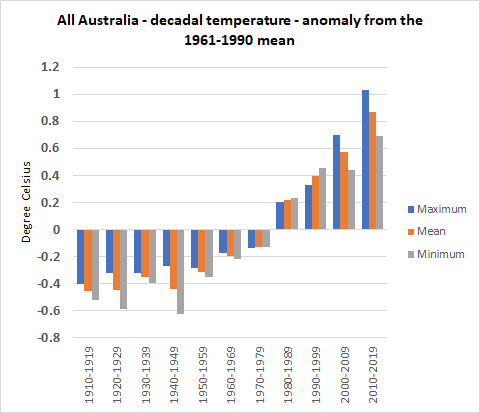 Figure 4 | All Australia decadal temperature anomalies. The base period is 1961-1990. Data source: Bureau of Meteorology, Australia
The "bangs" in the title is a reference to the horrific fires here. People in seaside towns along the coast in eastern Victoria and south-eastern NSW could hear the LPG gas bottles exploding along with houses and trees, as the fires tore through the townships. (In places where there's no natural gas piped in, people usually have gas cylinders next to the house.)
Some people who I thought would have known better were sceptical of the warning from Emergency Services to leave Far East Gippsland. After all, it's a huge area, was jam-packed with holiday-makers, and it's on the coast (water puts out fire, right?). They may have neglected to factor in a number of things:
First, the fire services know what they are doing. If they tell people to leave they have good reason for doing so. Their worst nightmares became real, as you've probably heard by now.
Second, there is only one major road through that whole area, the Princes Highway. It's around 250 km from Bairnsdale (the Victorian town just outside the evacuation zone) to Mallacoota, the easternmost town in Victoria. Much of the road is through national and state forest and densely wooded. The road has some sections where there are three lanes (two going, one coming) but it's mostly just two lanes. Towns are small and far apart. The road is mostly winding and hilly. You'd normally need to allow at least three hours to traverse it, then it's another three and a half hours to Melbourne. (The nearest town to the north from Mallacoota is Pambula, about 1 1/2 hours drive but the roads north are also closed.)
Thirdly, and this is related to the second point, it's common to get stuck behind a large vehicle that slows down going uphill, or a car towing a caravan that travels below the speed limit (100 kph except through towns). The number of people in this picturesque coastal region swells by tenfold or more over the school summer holidays. Imagine having ten thousand visitors leaving Mallacoota to head to Melbourne, plus more from all the other small towns on the way, and getting trapped by fire on the highway.
Right now, the tiny town of Club Terrace on the main highway was burnt out. Cann River on the main highway remains inaccessible and the people trapped there have run out of food and have no power or communications. Mallacoota is almost 30 km off the main highway, and the road has just been cleared for emergency vehicles only. Normal traffic can't get through and even if it could, people would not be able to get down the highway. The only other route would be north, but that road is also closed. You can see how people are trapped where they are on the VicRoads map below, with the red dots being road closures (click to enlarge it).
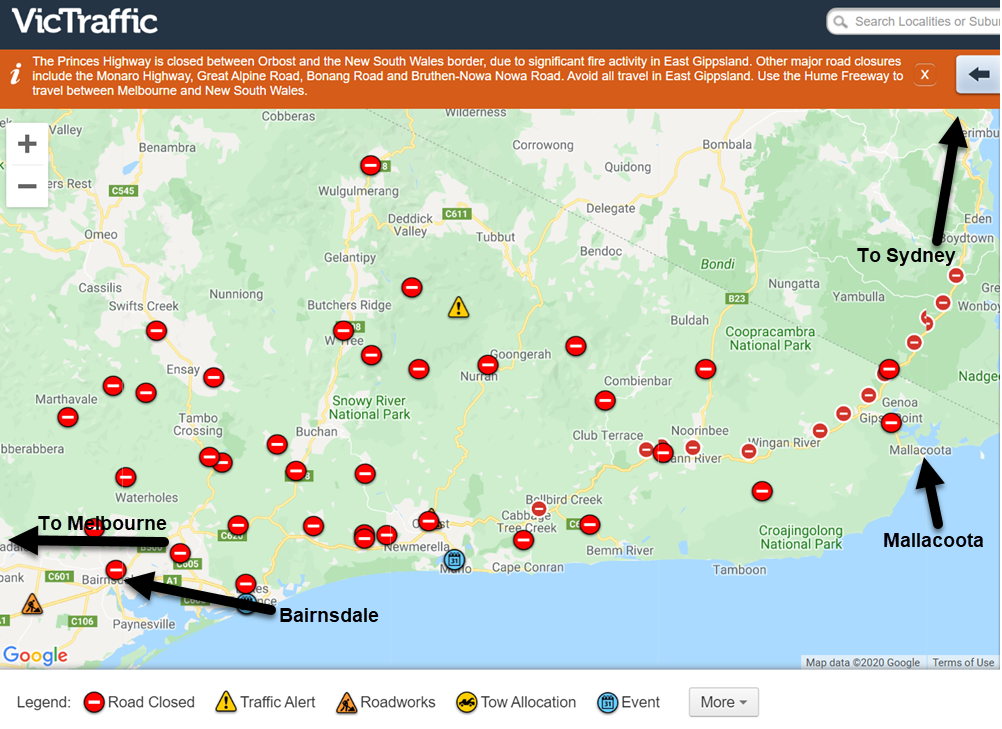
In the map above I've shown the direction of Melbourne and Sydney, but this is the scenic route, not the normal route between those two cities. Most people driving from Melbourne to Sydney or vice versa would take the more direct inland route up the Hume Freeway, which bypasses towns and is a four lane divided highway once you leave either city (could be six or eight lanes in Melbourne and Sydney).
On top of the terror of raging fires, a lot of power is out as well, which affects phones, refrigerators, air con etc. It could be out for days yet. The backup batteries on some mobile towers also ran out or maybe the towers got burned. Until it's safe to go in and assess the situation, the telcos and electrical distributors won't be able to begin repairs.
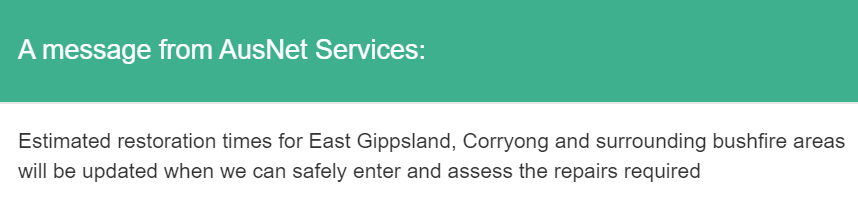 Because these fires are mostly in bushland they will go on for weeks, like the ones in NSW that are smoking up Canberra and Sydney. It's dangerous and difficult to get into the forests. Firefighters focus on protecting lives and property, but can't protect all property (or lives). These areas are sparsely populated normally so there wouldn't be a lot of local volunteers compared to the need. That means there'll be volunteers from distant areas and heaven help their own local communities if fires break out there.
That's not to say people will be stuck away from home for weeks. There are ships going to pick up people trapped in Mallacoota, for example, and maybe some other towns; and there's talk of helicopter rescues. A top priority will be to open the roads again and hope there are not too many more days like Monday this summer. (This Sunday isn't looking too promising and there's a lot of summer to go, so no guarantees). For residents who've lost their homes and farms and businesses, it will be a long road to recovery. Hopefully there will be tradespeople willing to relocate temporarily to help rebuild. The forests will take even longer to recover. Some might not.
I've not yet mentioned the awfulness of the fires in our own region. The Walwa fire not far to the northeast of here has caused a huge amount of destruction in Corryong and the news is just starting to trickle in. [Apart from a very smoky summer, we're fine here in the Kiewa Valley. There have been a few fires this summer, but nothing too dramatic and they are either "contained" (i.e. not spreading), "controlled" (i.e. whole perimeter is secured and no breakouts expected) or extinguished.]
There's a good article by Nerilie Abram in Scientific American about climate change and fires. The tweet about it showed there are still a few deniers floating about. Few firefighters would doubt the world is warming and fire behaviour is changing. (WUWT hasn't mentioned the fires. Whoever's writing for and running the blog these days probably wants to avoid any clear evidence that would upset climate conspiracy theorists.)
Most deniers know next to nothing about wildfire. Some make up stuff about "lack of backburning", confusing it with prescribed burns for hazard reduction. (Backburning is where firefighters fight fire with fire, setting the forest alight ahead of the main fire when conditions allow it, to "burn back" into the fire.) Some blame it on the "greens" (who don't run any government in Australia so can't be blamed for anything, let alone a non-existent "crime"). I believe the allegation is along the lines of "greens won't let us beer-swilling or more likely cocoa-drinking deniers chop down all the trees and cover the entire country with concrete". As if these cocoa-drinking deniers would know what to do with a chainsaw or have a clue about mixing concrete anyway. Some deniers say "we've always had fires", which is like being in the middle of the worst cyclone on record saying "but we've always had rain and wind". There are probably some deniers who doubt there are any areas burning in Australia.
I've dug out some old images of fires from past years. 2013 was known as "the angry summer". 2020 will be the angrier summer, with worse heatwaves and worse fires. The big difference this year is not just the number of fires, but the location and the ferocity. The east coast of Australia is heavily populated.

There is a lot more that could and will be written about this summer, including the abysmal non-reaction from the Australian government. Scott Morrison is the Prime Minister who trotted off for a holiday in Hawaii while his home state was burning to a crisp. He came back, got some photo ops with a few firefighters then, having figured he'd done enough on that score, threw a new year's eve party and went to the cricket. He is adamant he's not going to do anything more to reduce carbon emissions. (Some speculate it's on religious grounds. He's a member of a fairly small and suspect "religious" congregation.)
On that unpromising note, let me change the subject and wish you all a Happy New Year, or at least a fulfilling and satisfying year.
References and further reading
Australia's Angry Summer: This Is What Climate Change Looks Like - article by Nerilie Abram, Scientific American, December 31, 2019
Australia's Angry Summer - HotWhopper, March 2013
Corryong fires - via Australia's national broadcaster, the ABC
NSW fires - via the Sydney Morning Herald
'Not like other bushfires' - from The Age
Thousands forced to take refuge on Australian beach as deadly wildfires close in - from Washington Post
Why the Fires in Australia Are So Bad - from the New York Times
Australia fires: nine dead and hundreds of properties destroyed, with worse to come - The Guardian
Australia fires: Death toll rises as blazes destroy 200 homes - BBC
I'm sorry I've not been blogging much this past couple of years, but fear not (or fear, depending who you are), I shall return in 2020.
Here is a picture of my most Christmas-y plant - Little John Callistemon, which keeps getting better and better each year and thrives on very light pruning and general neglect.
And another, this time a snapshot of the next door neighbours' decorations. They have been entertaining the local children (large and small) and raising money for local charities for decades and continue to do so despite the fact that Santa suffered a stroke some time ago, which has been quite debilitating for him. The photo doesn't do justice to the lights, which look amazing. Santa's daughter made the kangaroos :)
Happy holidays wherever and whoever you are, especially to all the courageous men and women fighting fires around the country and not forgetting all the people supporting them.
Stay safe.
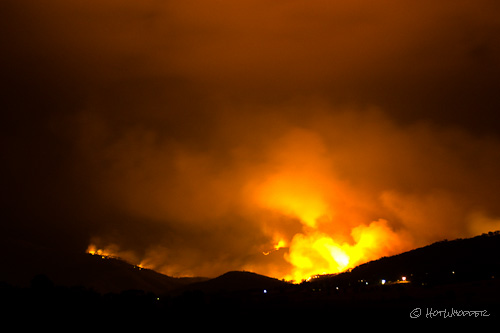
From Mount Beauty Dec 2006The fires across Australia this year are horrific. Because the smoke is inundating the biggest capital city (not good), people are taking notice (which is good). The fires this season are probably vying for the worst ever experienced in this country. There will be worse to come with more global warming, so it's important to be prepared.
I expect there are a lot of people who've never had an up close and personal experience with fires or smoke, so I figured I'd put some thoughts down from my own experience. I'm not a fire expert but I've been through a few huge fires in my time, including three big ones this century. (If you've got better or different advice, based on your knowledge and experience, don't hesitate to say in the comments below.)
Unlike the current fires, the big ones that threatened our town were large and slow burning in the main, with some exceptions. Like most of the current fires, two were started by lightning. More on that in a bit.
Smoke hazard: One thing with fires in the bush that seem to go on forever (weeks not days), is the smoke. This causes problems for communities - you can't see flames if you can't see, which adds to anxiety. Visibility can get to a few metres some days. You can't breathe properly, your lungs hurt and your eyes suffer. Community meetings can be frustrating when you're told - well we can't see the fire front so we can't say how far it is from anywhere.
Smoke from a local fire.Smoke also causes problems for firefighters. Planes and helicopters have trouble with visibility and might not be able to be used. Everyone, especially firefighters, suffer smoke inhalation. Firefighters might not know where to best target their efforts.
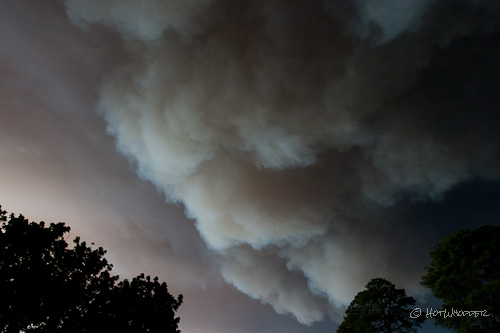
Smoke cloud - Mount Beauty 2006I'd advise wearing a P2 mask, which filters out the worst smoke contaminants. Don't worry about looking uncool - you might even set a trend and make mask-wearing the latest and greatest fashion. It beats damaging your lungs and worse.
Embers: Especially when it's windy, embers can be carried kilometers from the fire. On a (relatively) clear day, you can see the spot fires starting up ahead of the main fire. If you're trying to protect your home and there's an ember storm, it will be almost impossible to keep up.
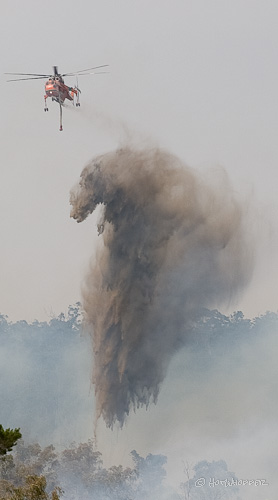
Dropping fire retardant on a fire
on a hill behind our house.Water: It can be tempting to stay to protect your home. You've got hoses out and bins and buckets filled with water, and lots of towels or hessian bags or blankets. You've filled every bath and basin. You've blocked and filled all the gutters with water. You think you'll be fine if you stay. The problem comes if you're relying on town water coming out of the tap, and everyone else in town does the same. Then, because everyone's pouring out gallons of water at the same time, the town's water pressure drops or dries up altogether.
Or maybe you're in a region where there's drought (much of Australia), and there's little to no water available. Helicopters and planes use water from local dams, but in a drought the dams might all be empty. Or maybe you're relying on water in a tank - except it's so hot the tank has melted. Or it could be you're using a pump to get water, but the pump stops working.
After the fire passes, the town water supply might be contaminated, especially after the next rain that washes everything that burnt into the water supply. Be prepared to get bottled water or, if you're lucky and there's still tap water, to boil it for the next few weeks.
Heat: I'm not talking about hot weather. Yes, indeed, hot weather can be deadly. Some places here are seeing maximum temperatures approaching 50C (122F). What I'm talking about is heat from the fire. If you've ever been near a bonfire you'll understand what I mean.
Whatever you do, make sure you wear protective clothing. (Look at what the firies wear even in unbelievable heat.) Don't wear thongs (flip flops), or shorts and singlet. Don't wear clothes made of flammable material. Go for wool or some other fire-resistant material with some insulating property. Wear long sleeves, long pants, gloves, boots and socks, and a mask. You'll get hot but you'll be less likely to get radiation burns. (If you've got a working hose then, as a last resort, spray the water to form a barrier between you and the flames.)
Wind: There is the normal wind that comes from changes in air pressure. A shift in that wind will change the direction of fire. It could change a fire front from being 200 m wide and heading east (fanned by a westerly wind) to a fire front 5 km wide and heading north (fanned by a strong southerly change).
There is also the wind created by the fire itself. When the fire is vigorous or fast moving, it can create its own weather. This makes an already unpredictable fire extremely unpredictable and dangerous.
Roads: You've finally decided enough is enough and it's too dangerous to remain, so you jump in the car or sturdy ute and head for anywhere but the fire. Problems you might encounter are that you can't see where you're going because of the smoke; or worse, you can't get through the road because of fallen trees. This is a huge problem if there are only one or two roads, which is the case in many areas.
The moral is, don't wait. Leave early.
Communications & electricity: We're used to picking up the phone, getting on the internet, watching television or tuning into the radio. In a big fire, communications towers can be destroyed and there can be power outages. You've been warned.
Firefighters: In much of Australia, fires on properties outside of the major cities are fought by organised volunteers, except for government land, where they are fought by government workers. Volunteer firefighters, like Victoria's CFA and NSW RFS are mostly men and women who live and work in country towns and on farms. It used to be they'd go out and put out a haystack fire, or a grass fire that might burn for a day or so. Now they can be giving up their work and income for weeks on end, fighting fires in their own district or traveling far from home and helping protect private property from megafires elsewhere. Not only are they giving up income, their employers (if they aren't fighting fires) are having to do without staff. Families have to make do on less income and with less support.
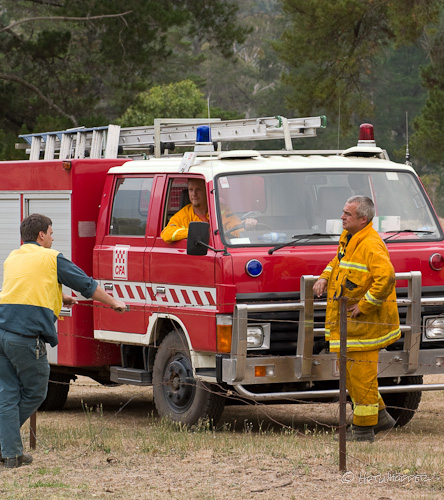
Some of our local fire fighters looking after us while there's a fire up the hill. Thank you.Then there's a problem that probably occurs too often. The local fire crew is off fighting a fire in the next valley (or another one 500 km away), and a fire breaks out in their home district, but there aren't enough people or equipment to fight it because they're all off fighting a fire elsewhere.
You rarely hear firefighters complain. Firefighting and emergency services are what they volunteer to do, and they are committed to it. In my view the system will need to change long term, and we should be compensating them. Until then (and after then), just bear in mind that firefighters (whether volunteers or government) will probably be tackling the fires with the following priorities: save lives first, then save property, then save bushland and, occasionally, wildlife.
Most people are aware and responsible when it comes to bushfires. Sometimes people can be unthinking, however. People who put themselves in harm's way, resulting in firefighters coming to their rescue, might be not just risking their own lives, they might be preventing the firefighters from saving lives elsewhere.
On that note, don't go gawking. You'll not just be risking your own life, you'll be cluttering up the road and endangering emergency responders as well as people who may be fleeing for their lives.
Managing emotions: Unless you've got no emotional capacity, you'll most likely be affected in one way or another if you've been through a fire or know people who are. Long drawn out fires take their toll. You're woken in the night by the loud cracking of exploding trees, or you can't get a decent night's sleep for weeks on end because you never know if the fire is far enough away or if it's working it's way down the hill behind you. You'll probably also find yourself becoming addicted to the radio. (You'll have dug out that old transistor radio and picked up some spare batteries, to tune into the emergency broadcast service on the local ABC.)
While long drawn out fires can heighten anxiety, immediate fire danger can elicit panic, or maybe a deceiving calm. You might think you're behaving rationally and with a clear head. Unless you're trained and have experience with disasters (and maybe even then), despite feeling calm and rational you risk making poor decisions.
If you've already got a plan (and you know you should) then follow it. Don't change things at the last minute.
Weeks, months, even years after living through a disaster, people can be affected. It might be post-traumatic stress or it might be a shadow of PTSD (not full blown). (Be prepared the following autumn to get a rush of adrenalin when you see leaves fall from trees, before you realise they are just autumn leaves not embers.)
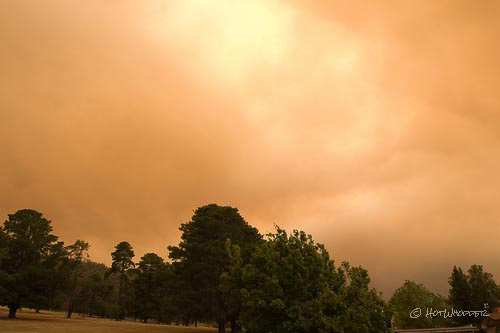
Eerie colours - 2006 fires.
Implement your fire plan: If you're advised to get the hell out, do so. Grab your pre-packed bag that has water, masks, survival gear, protective clothing. Round up your family and put all your pets in their cages and into the car. Check you've got your wallet and phone and car keys. Jump in the car (which you've kept charged or full of fuel), do a final head count, and head for the nearest safe place. (You have looked up the designated safe places, haven't you. You know where they are.)
Whatever you do, don't go back home until the all clear has been given. That could kill you (and has killed people).
Before finishing, a word about deniers. They are dangerous (as well as all their other flaws). I've seen deniers claim "this is nothing new". That's wrong. Fires today are worsened by climate change. Each decade brings worse fires. The fires this season could well be the worst in Australia's history. The more prepared we are, the better the chance that while they might be the worst by many measures, they won't be the deadliest.
Another thing I've seen is deniers still trying to argue there's some sort of scientific conspiracy and that Australia isn't really that hot, or the records have been altered to make out it's got hotter than it really has - which is as ridiculous a notion as it sounds.
Then there are people claiming the fires were lit by people. Maybe some were, but the biggest and worst fires were caused by lightning. In any case, in catastrophic fire conditions it doesn't matter where the spark comes from. When weather conditions are not conducive to fires, whether they are started by lightning, a train, a power line, an angle grinder or an arsonist, they cause a lot less harm.
Final word: Lives are worth a lot more than houses, or art works, or photographs, or jazz collections, or whatever might cause you to delay or hesitate to leave. Too many people have lost their lives by remaining. Few people lose their lives by leaving early when a fire threatens.
Final final word: I hesitated a bit before writing this up. I'm not an expert on fire or disaster management. However, I've been through some major fires in recent years and I've not seen anything much like this on the web, despite the fires raging. It might be food for thought to someone.
-- John Michael Greer
 What on earth is an RCP? [ 30-Jan-15 11:35pm ]
If you're reading beyond the headlines about the recent climate change report, you'll quickly hit lots of references to emissions scenarios called Representative Concentration Pathways (RCPs). I'd heard of these, but they were different from the scenarios used in the previous reports by the IPCC in 2001 and 2007. Here's my summary of these scenarios based on an excellent guide by Graham Wayne at skepticalscience.com
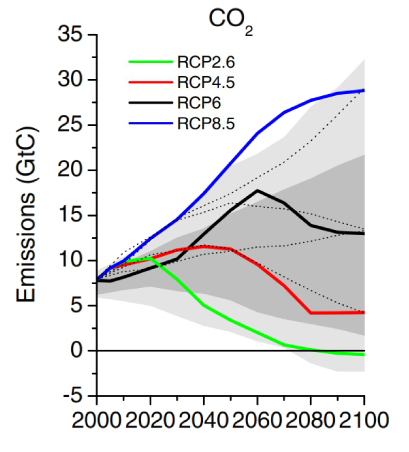 Figure 1. Global carbon dioxide emissions (gigatonnes of carbon per year) under 4 scenarios with different population and economic growth and climate policies (van Vuuren etal, 2011)
RCPs are scenarios that describe alternative trajectories for carbon dioxide emissions and the resulting atmospheric concentration from 2000 to 2100. They encompass the range of possible climate policy outcomes for the 21st century. By agreeing on a limited set of scenarios, researchers (especially climate modelers) can be more sure they are comparing apples with apples when conducting their research and communicating their results.
The RCPs describe 4 different scenarios based on different assumptions about population, economic growth, energy consumption and sources and land use over this century. Details can be found at skepticalscience.com or the source for much of Wayne's document ie van Vuuren etal (2011).
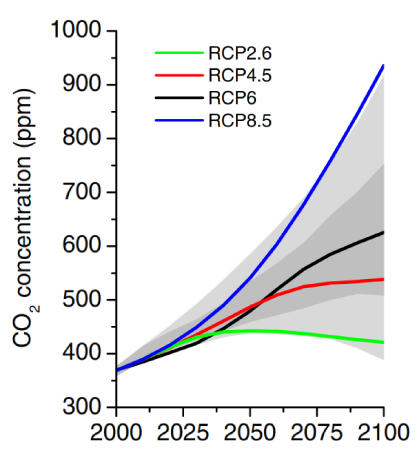 Figure 2. Atmospheric concentration of carbon dioxide (parts per million) under 4 scenarios
The scenarios are named after the level of "radiative forcing" that each scenario produces (measured in watts per square metre). While crucial to describing the mechanics of climate change, I've found that an understanding this term is not needed to comprehend the problem of climate change, its scale and its implications.
Notice how concentration continues to increase even after emissions slow and then drop. Carbon dioxide accumulates in the atmosphere and stays there for decades. Even if emissions start reducing in 2020, the concentration continues increasing and starts falling very slowly only after 2050. Understanding this relationship between our emissions today and the CO2 concentration experienced by our grandchildren is key to grokking the problem of climate change.
So now a brief look at each of the scenarios.
RCP 2.6This scenario might be described as the best case for limiting anthropogenic climate change. It requires a major turnaround in climate policies and a start to concerted action in the next few years in all countries, both developing and developed.
Global CO2 emissions peak by 2020 and decline to around zero by 2080. Concentrations in the atmosphere peak at around 440 ppm in mid century and then start slowly declining.
Global population peaks mid century at just over 9 billion and global economic growth is high. Oil use declines but use of other fossil fuel increases and is offset by capture and storage of carbon dioxide. Biofuel use is high. Renewable energy (eg solar & wind) increases but remains low.
Cropping area increases faster than current trends, while grassland area remain constant. Animal husbandry becomes more intensive. Forest vegetation continues to decline at current trends.
RCP 4.5Emissions peak around mid century at around 50% higher than 2000 levels and then decline rapidly over 30 years and then stabilise at half of 2000 levels. CO2 concentration continues on trend to about 520 ppm in 2070 and continues to increase but more slowly.
Population and economic growth are moderate but slightly lower than under scenario RCP 2.6
Total energy consumption is slightly higher than RCP 2.6 while oil consumption is fairly constant through to 2100. Nuclear power and renewables play a greater role.
Significantly, cropping and grassland area declines while reforestation increases the area of natural vegetation.
RCP 6In this scenario, emissions double by 2060 and then dramatically fall but remain well above current levels. CO2 concentration continues increasing, though at a slower rate in the latter parts of the century, reaching 620 ppm by 2100.
Population growth is slightly higher peaking at around 10 billion. This scenario assumes the lowest GDP growth of the four.
Energy consumption increases to a peak in 2060 then declines and levels out to finish the century at levels similar to RCP2.6. Oil consumption remains high while biofuel and nuclear play a smaller role than in the other 3 scenarios.
Cropping area continues on current trend, while grassland area is rapidly reduced. Natural vegetation is similar to RPC4.5
RCP 8.5This is the nightmare scenario in which emissions continue to increase rapidly through the early and mid parts of the century. By 2100 annual emissions have stabilised at just under 30 gigatonnes of carbon compared to around 8 gigatonnes in 2000.
Concentrations of CO2 in the atmosphere accelerate and reach 950 ppm by 2100 and continue increasing for another 100 years.
Population growth is high, reaching 12 billion by centuries end. This is at the high end of the UN projections. Economic growth is similar to RCP6 but assumes much lower incomes and per capita growth in developing countries.
This scenario is highly energy intensive with total consumption continuing to grow throughout the century reaching well over 3 times current levels. Oil use grows rapidly until 2070 after which it drops even more quickly. Coal provides the bulk of the large increase in energy consumption
Land use continues current trends with crop and grass areas increasing and forest area decreasing.
Climate forecastsWith this information on board I can try to make at least some sense of the forecasts included in the IPCC's latest report. Figure 3 below is a chart showing forecast temperature change under the best (RCP2.6) and worst (RCP8.5) scenario.
 Figure 3. Projected global surface temperature change under different emissions scenarios. Zero is set at the average of 1986-2005 levels (Figure SPM.7(a). IPCC Working Group I Assessment Report, Summary for Policy Makers, 2013)
If we get it together and emissions peak by 2020 and reduce to zero this century (ie RCP2.6), global temperature could be stabilised at around 1°C above levels in the late 1900's. The IPCC say it is unlikely (<33% probability) that the rise will exceed 2°C.
On the other, hand if we carry on as if there is no problem without even a slow down in emissions growth until late in the 21st century (ie RPC8.5) , the forecast outcome is not pretty. Temperatures are forecast to continue increasing and by 2100 and reach around 4°C higher than late 20th century levels. The likely range of outcomes for 2100 is approximately 3°C to 5.5°C higher.
While these projections are similar to those produced by the IPCC in 2007, the prospect of a +4° or higher world seems more possible or even probable now 5 years later. The colossal impacts and implications of a +4° or +6° world are better understood now than in 2007. The IPCC's Working Group II will release their report on impacts, adaptations and vulnerability in March 2014. I don't expect it to be fun reading.
ReferencesWorking Group I Contribution to the IPCC Fifth Assessment Report. Climate Change 2013: The Physical Science Basis. Summary for Policymakers (draft 27 September 2013) (pdf)
Wayne, G.P. (2013) The Beginner's Guide to Representative Concentration Pathways, Version 1.0 August 3013 www.skepticalscience.com
van Vuuren, D.P. et al (2011), The representative concentration pathways: an overview. Climatic Change, Vol 109, Issue 1-2, pp 5-31 Springerlink Open Access
why I care so damn much about climate change [ 19-Feb-14 7:15pm ]jdeboi.com & goCaptainPlanet.com
1. Katrina
Katrina hit when I was a junior in high school, flooding my home, my school, my city— rendering my family, like thousands of other families, homeless 21st century climate refugees. My hurricane experience was unequivocally the most emotionally traumatic, significant, and life-defining experience of my life to date. And the mental scars associated with watching my home and its citizens get swallowed alive by one of the most destructive natural disasters in American history is the reason I decided to study climate change and is the number one reason why I am so passionate about combating the climate crisis.
I could spend hours talking about this subject, but for the sake of holding your attention, I'm going to share just a few particularly vivid memories.
The first is about my father. As the Medical Director of the Intensive Care Unit at Charity Hospital, a public hospital and a long-time sanctuary for less fortunate New Orleanians, he had to remain in the city to keep the hospital running during the storm.
There were 11 patients in the Medical ICU at the time, 9 of whom were on breathing machines- all of them very, very sick. When the levees broke on Tuesday, the day after the eye of the storm passed, water rushed into the city, flooding the hospital and destroying the backup up generators. All of the infusion pumps, defibrillators, monitors, and batteries started to fail.
For four days, they were forgotten; they were left without food, without water, without electricity, air-conditioning,flushing toilets, or any way to communicate with the outside world. At one point my father had to perform surgery on a young man in the back up a pickup truck— without anesthesia— using a flashlight and a scalpel. And while they were struggling to keep their patients alive with limited resources, refugees from the city were coming to the hospital for a safe haven.
Here's a pic of my dad in a Black Hawk with a patient when FEMA finally showed up:
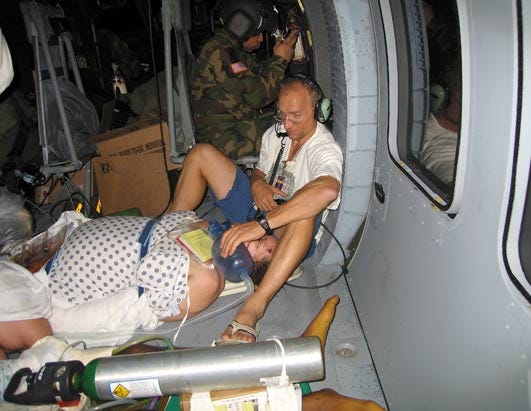
In the interest of time, I'll leave you with a link to the ABC story written about his experience.
Needless to say, I didn't hear from my father for over a week, a horrendously agonizing experience, especially when every news outlet was reporting rampant looting, and chaos, and fire, and deluge. I'll share a few more — I came back to New Orleans for the first time in November (the storm was in August). At the time, the national guard was only allowing first responder type personnel into the city, so my best friend and I had to hide under blankets in the back of her minivan while my father drove through the security checkpoint. We left really early to make sure we could get into the city. It was probably about 4:30 in the morning when we rolled into the CBD, and I pulled my head out from under the blanket for the first time. Here are some imagery bullet points:
- completely unlit skyscrapers; an early morning sky pocked with stars
- thick brown sludge coated every car, plant, surface.
- a desolate, sepia post-apocalyptic war zone; the only sign of life— National Guard trucks
- brown water marks circling every home like the rings of Saturn
- spray-painted neon Xs, a sign the National Guard had searched for bodies
- interiors: mold-infested, black oozy, smelly alien planets
There's one thing that no New Orleanian who returned after the storm will ever forget: the smell. I don't know how to do it justice. It's reminiscent of mildew or some other type of mold, but it had a faintly sweet scent- almost like pine sap. Or spoiled eel sauce- sweet and noxious at the same time. I'll stop there and finish with a conclusion:
Katrina gave me a truly visceral understanding of the destructive capacity of nature as well as the fragility of modern society.
And so senior year of high school when I learned that climate change had the potential to create more frequent and more powerful storms- storms like Katrina- I knew that combatting climate change was my calling.
2. Sandy
After graduating from college, I moved to New York City and started working for a software company. I had been there for about a year when Hurricane Sandy, the second costliest hurricane in US history, hit the East Coast.
If Katrina was my wakeup call, Sandy was the fire the under my ass. This "superstorm" marks my transition from environmentalist to activist.
I'll share a few Sandy stories that really hit home. I lived in Brooklyn, but I evacuated to my office building in SoHo- a trick I learned in New Orleans to prevent cabin fever (which was critical in New York since I lived in a tiny studio). When the lights went out Monday afternoon, I was afraid to be in the building by myself (and technically, I wasn't supposed to be there at all), so I decided to go across the street and stay with a coworker at his uncle's SoHo apartment. As a seasoned hurricane pro, I itched to experience the storm on the ground, and so at 10pm that night, as the storm made landfall on the coast of New Jersey, with sturdy boots and thick parkas my coworker and I ventured out into the city.
Exploring the southern tip of Manhattan as the rain and the wind whipped through man made glassy steel canyons, was oddly reminiscent of my experience entering New Orleans for the first time after Katrina. The streets of Manhattan- streets that never sleep, streets continuously packed with busy bodies, luminous advertisements, pungent smells and sounds— a deluge of stimuli— these streets were desolate; the starry steel skyline— completely black. Eerie to the core.
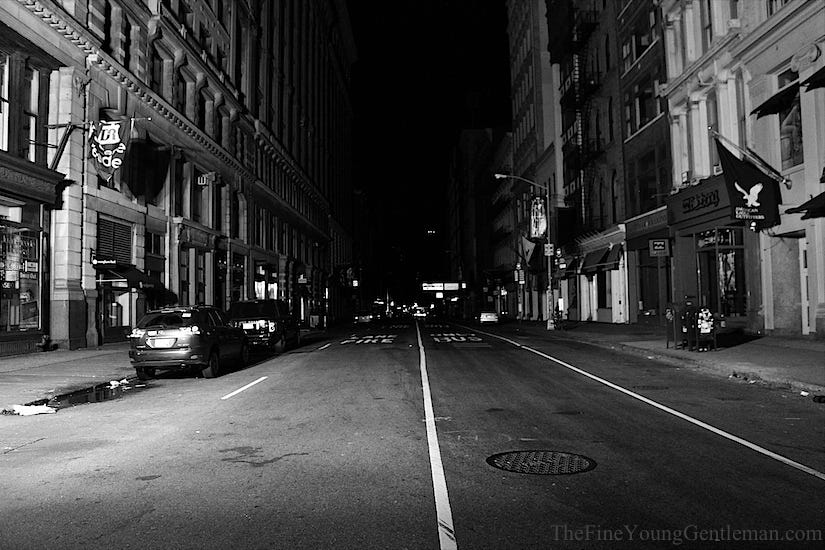
At that moment I realized a natural disaster had the power to render the world's most vibrant metropolis completely silent, empty, and lifeless.
But even more profound was the following morning's revelation. When we woke up on Tuesday there was no power, no internet, no cellphones, no way to communicate with the outside world whatsoever. We had no idea when the power was going to come back on. And we quickly realized that we had enough food to comfortably feed the group for one or two days, which was especially frightening considering the fact that most of the grocery stores were already empty. There was no leaving the city. The subways weren't running, and very few New Yorkers have cars. Even if we did have a car, it probably would have been easier to walk out of the city given the traffic insanity that would undoubtedly ensue.
And that's when it hit me: 9 million people trapped on a tiny rock without food, running water, electricity, or communication with the outside world. And I experienced, for the second time, the fragility of modern society; self-subsistence is a thing of the past. I felt certain that if all of New York City- not just the southern tip of Manhattan- had lost power for multiple days, the situation could have easily devolved into mass chaos.
Last story. While New York was in a limbo state (no subways or electricity or work), I decided to do some exploring. I walked around the tip of the island and up the west side along the Hudson River. When it was time to head back, I had to cross Lincoln Highway. Cars were barreling down the West Side at 40 mph, blazing through intersections DESPITE THE LACK OF TRAFFIC LIGHTS (which were completely defunct without electricity). The cars were traveling fast enough and the traffic was thick enough that one driver's decision to tread cautiously and politely through an intersection might actually lead to a massive pile up. So who's to blame?
So there I was, playing a very difficult level of human Frogger with no brake [pun intended] in sight. Several minutes later a pool of pedestrians had formed around me- all of us wondering how we might make it across the road to tell the tale. After five minutes, I was fed up (perhaps not realizing that East Coasters weren't accustomed to post-hurricane driving etiquette). I took a bold step into the highway, jabbed the palm of my hand at the windshield of an oncoming car, and stared the driver in the eyes. I felt like Moses parting the waters, and I got my people across. Why did I choose to tell this story?
For a second time I recognized that modern society's resiliency is diminishing while nature's propensity for destruction burgeons.
I was very upset after Sandy (and a little insane in the membrane), and to get some of these intense emotions off my chest, I wrote a letter to the American people:
3. New Orleans
4. I ♥ Science
academic background
- major: physics
- minor: Environmental Analysis
research experience
- organic photovoltaics— here's my senior thesis
- chemical and environmental engineering research at the University of Arizona
- studied lithium-ion battery technology for electric vehicles in the Advanced Technologies Division of Southern California Edison- one of the largest utility companies in the nation
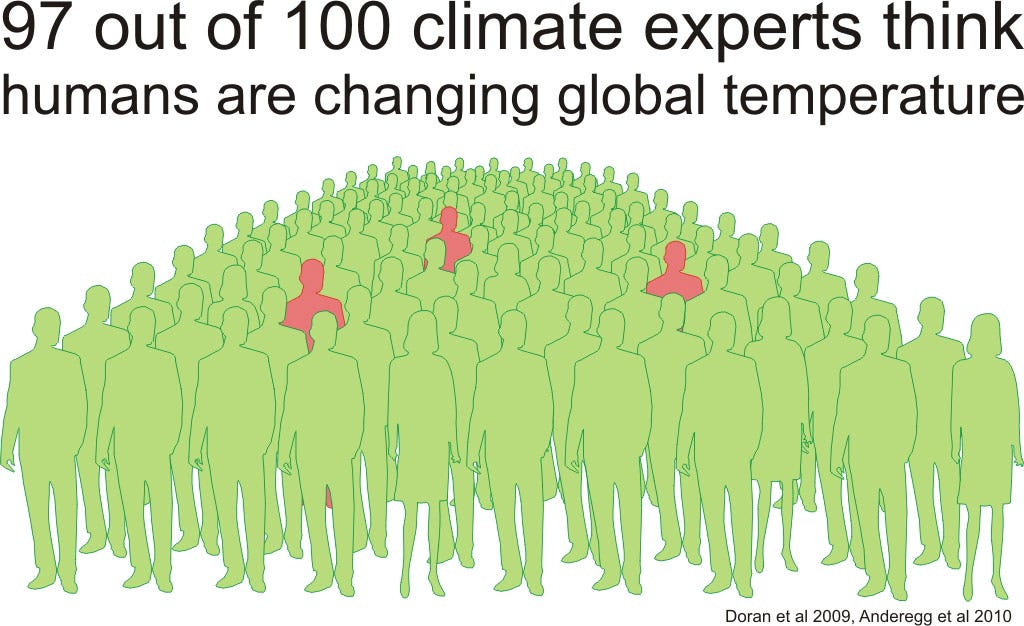 long story short: I love science; I heed science; the science is clear.
5. Hot Music Festivals
I'll keep this section short. I've had the same eye-opening experience at two very hot (>95° F) music festivals— Electric Zoo in NYC and Coachella in CA. It's blazing hot, lots of kids are on drugs, lots of kids are sweaty, and lots of kids need water. And here's the problem: these stupid effing music fests have 1 or 2 watering holes for thousands of people. The lines in the middle of the day are insanely long- about a 40 minute wait to get to a hose.
Let me say this again: it's 100°F. Lots of kids on drugs. Lots of sweating. HUGE WATER LINE. Everyone's a little bit afraid that the waters going to run out (probably irrational fear, but it's damn hot and the line's damn long), and eventually the bros get tired of waiting. So what do they do? Cut the line. Then guess what happens…fights.
In the water lines at hot music festivals I have witnessed the devolution of humanity, precipitated by the scarcity of a basic necessity: water.
Climate change means more frequent droughts and food shortages. Droughts and food shortages lead to unrest. Period.
6. BP Oil Spill
 Fishing with my pops
As a Gulf Coast resident who grew up fishing, hunting, and camping in the Louisiana marshes, BP oil spill, "considered the largest accidental marine oil spill in the history of the petroleum industry" (wiki), was a heart-wrenching, maddening reminder of dirty energy's detrimental impacts on our region.

The negative implications of the oil spill on Gulf Coast wildlife and communities were overwhelming. I immediately recognized the need to internalize the environmental and health costs of fossil fuels, which are enormous in accidents like this, and when considered, render renewables dirt cheap. So I'll conclude with one poignant question:
Why are we putting the very existence of civilization at risk for a filthy, finite, deleterious, and ultimately, uneconomic form of energy?
It's Like An Enron, But For Insurance [ 26-Jan-14 11:46pm ] Creative Commons (C) 2012 by flickr/atmospheric-infrared-sounderGet Rich From Climate Denial and Free Markets
Congratulations!
From your recent letter to the editor, I understand that you question the science proving human-caused climate change.
I have an incredible opportunity that could make you more wealthy than Bill Gates.
I meet far too many otherwise intelligent people who refuse to believe in human-caused climate change either because their politics or their religious beliefs lead them to deny it. If this is you, then you are missing out on billions of dollars.
Let me explain.
There is not even a single insurance company in the world which accepts the premise that climate change is fake. Every insurance company is raising rates or even completely pulling out of insurance markets like Florida and the United Kingdom which are known to have high climate risk.
There is a HUGE potential for a disruptive, start-up insurance company to enter those markets and undercut all of their competitors. If you are right about climate change, then you can be richer than anyone else on Earth.
Why are you still working at your menial job?
Are you brighter than the Oracle of Omaha? You are if climate change turns out to be a hoax.
The most successful investors on Earth like Warren Buffett and Prem Watsa became rich by running large insurance companies and investing their corporate treasuries on Wall Street. All of these leading Wall Street wizards made their business decisions based upon the belief that climate change is real and is caused by human activities.
If you are right about your belief that climate change is a massive hoax, then everyone else in the insurance industry is wrong. You know more than the six million Americans working in the insurance industry.
You are truly one in a million.
Your privileged information allows you to undercut your competitors on price and win markets they concede. If you are right, you could beat them all.
You could sell insurance at lower rates along the coastlines of every continent. In this way, you would win all of those insurance markets.
You could beat every insurance industry expert at their game if you're right.
Of course, I should add an important disclaimer.
If you turn out to be wrong, you will likely be jailed like Ex-Enron CEO Jeffrey Skilling.
If you are wrong, chances are almost certain that you will commit fraud to reassure investors and the media that your company was right about its bets. You would tell them that your company will remain solvent. It's human nature.
If you turn out to be wrong, your company will become so bankrupt from climate disaster claims that even an insurance bailout cannot save it. The claims will keep coming and will increase in size and volume.
If you are wrong, you will likely need to declare personal bankruptcy. Your mortgage will go unpaid as you languish in jail. No one will want to hire you again when you finally emerge from prison.
Are you willing to bet your freedom and your reputation for the potential to become insanely rich from your climate denial?
Or is this fantasy too hot to handle?
Park your igloo here [ 05-Jan-14 5:54pm ]I'm a bit amazed at the weather forecast for the next upcoming week. Could be one of coldest temperatures for an NFL playoff game. Lots of snow coming down? Oh, what about freezing rain and planes skidding off the runway?
When I was a kid, I had to trek a mile in the snow uphill, both ways. (When I left school, I had to walk to the public library to work, thus trekking up the hill again. Gotcha.) It wasn't so bad…
Yet, what about super storm Sandy? Or record hot temperatures in Australia last year?
Just to warp your brain a little more, the earth in 2014 was closest to the Sun…its perihelion…yesterday. Which really doesn't matter because its the Earth's axis tilt gives us our four seasons — not how close we are to a ball of flaming gas. Bet you didn't know that.
Don't think the global warming is causing this? According to NASA, it is. They also say—
This has been the result of the "Arctic oscillation" -- a see-sawing pressure system over the North pole -- that has driven cold air into more southern latitudes.
So, we're on a tilt, close to the sun, yet our weather patterns are like seesawing with a guy who's trying to throw you off because he's just a mean old bitch.
When someone says well, there's no global warming because we're freezing — I really have to ask…are you serious?
To help those who know what's going on, my suggestion today is to rename global warming as global chaos. Already in use by me for more than a year. Keeping calling it warming and I'll make fun of you—
Get the 75 SPF sunscreen and larger than life hats before they goes out of stock. Also get them wool sweaters purchased more because you'll be getting more bone-chilling winters for years to come.
After all, a little chaos is fun. Right?
Convincing Congress to Act on Climate Change [ 19-Dec-13 8:49pm ]Compelling arguments for Congressional climate change action were offered by Ernie Cohen in his Nov. 22 letter to the editor, but he omitted the strongest argument: Justice.
Scientists agree carbon dioxide emissions must be reduced to stabilize the climate and protect the long-term health and security of future generations, our children and grandchildren. However, cutting fossil fuel usage might hurt short-term interests of some businesses, investors, politicians, utility customers and trade associations.
Those with short-term financial interests in maintaining the status quo pressure Congress not to act, resulting in our children's long-term well-being unjustly compromised.
Is Congress biased against children? Of course, not. But we — parents, grandparents, nurses, doctors, teachers, clergy, firefighters, newspaper editors — must work harder to convince Congress the political will exists for equitable climate change legislation. Without demonstrable public support, Congress hesitates.
Become an activist
How can you persuade Congress that the political will exists? Attend marches to close coal-fired power plants. Protest pipelines. Divest. Or join me as a volunteer with Citizens Climate Lobby. We serve as a counterweight to paid, corporate fossil fuel lobbyists.
By writing letters to the editor, meeting with newspaper editorial boards, and visiting our Senators and representatives, we advocate for legislation for emissions reductions via energy efficiencies, the development of clean energy and other solutions the free market will support.
Our approach is straightforward, administratively easy, transparent, and fair. We want Congress to charge fossil fuel producers a fee based on the amount of emissions their products cause. Justice requires paying for one's pollution.
The government would collect the fees and send rebates to households so it would not be unjustly regressive, or drag the economy down by going into government coffers.
International effort
With an emissions fee, the private sector will shift investments into clean energy. The fee would also apply to imported goods to encourage international cooperation against climate change. Justice requires that nations work together.
CCL members understand that government will only protect us from climate change if we spend time studying the issue and informing our elected officials about optimal solutions. CCL has chapters nationwide, including Bridgeport, Providence and Boston. Please contact us for more information.
The Bible commands: Justice, Justice, you shall pursue. Justice must be pursued both by courtroom judges, and ordinary people, in the short- and long-term, for one's own family and others.
We might add: Justice must be sought in the streets and in the halls of Congress, for those already suffering from climate change droughts, rising seas, health impacts and severe weather, and for those at risk in the future.
Rabbi Judy Weiss of Brookline, Mass., is a member of the Citizens Climate Lobby
WEBLINK: http://www.norwichbulletin.com/article/20131202/OPINION/131209999/0/SEARCH
___________________________________________________________
If you like this click "Recommend" below. Thanks!
FALSE CHOICE AND CLIMATE CHANGE [ 08-Oct-13 4:54am ]I have come to believe that there is a false choice represented in the debate around climate change these days. On the one hand, we are told, we may choose environmental conservation and productive moderation. And on the other, we are told, we may choose social and ecological adaptation along with unfettered development. Either we keep carbon at bay and India and China languish, or we allow the World's populations to continue pursuing prosperity and bear the consequences of its externalities.
This analysis, obscured itself by the juvenile pre-occupation with the debate concerning the validity of global warming, obscures alternative possibilities that might preferably balance our valued commitments. Indeed, we need neither sacrifice ecological conservatism nor global prosperity.
Our attitude to China, as one example, is essentially this: if you want to deliver yourselves from poverty, you must devote yourselves to the production of endless junk that we over here do not actually need. Rather than collaborating to redistribute global resources and to harness the varied powers residing in your people, we'd prefer to relegate them to machine-like tasks for the time being, thereby subsidizing the cost of junk for us with a sacrifice in the meaning of individual lives by them. It is apparent to me that this cannot last; it is merely the most recent in a lineage of eager populations that we have mesmerized with the promise of development for a brief time. Once they have transcended the basic thresholds of industrial and urban life they, like we once did, will inevitably refuse to submit to this lifeless work.
The pollution assumed to inhere in China's development, in short, is unnecessary, but to obviate it would require the rest of the World's proposing an alternative path, one befitting the natural aspirations of a billion people who seek lives as full of opportunity, health, and nominal freedom as ours. Such an alternative would call upon us to sacrifice, but perhaps to sacrifice very little in the way of real freedom, real happiness, or real prosperity. It would mean that we perhaps think of our phones as more than disposable commodities. It would mean that we restrain our pursuit of bigger and bigger homes and cars, not by some arbitrary ascetic devotion but by a respect for what we know to be the limits of incremental gains in happiness. We would need to view the admission of the World's bottom billions into our modern digital community as a far greater realization of value than incessant, and incessantly disappointing, iOS upgrades.
As always, our choices are far more plentiful than the binaries that have ossified our discourse suggest. Those who advocate adaptation and those who advocate conservation ought to commit themselves to a collaborative and dispassionate accounting of the costs associated with different blended approaches, including more radical reorientations of the global economy of the sort that I'm proposing. Creativity, generosity, and imagination — paired with a reckless disregard for scarcity — can unlock a third path around climate and development that I am eager to embrace.
Next stop....Prime Minister! [ 23-Feb-17 10:12am ]Engineers are trained as problem solvers. Something is broken and needs fixing you call an engineer. Need to find a way to manufacture a new product, then an engineer can turn your ideas into reality. Building a new fancy glass office block, then it is the engineers that turn it into something safe and habitable. It is the whole mindset of thinking through problems from all angles and finding an actual solution, not just talking about it.
So lets pull away the safety nets and move aside the politicians, and see what kind of manifesto we can come up with that solves our problems rather than skating over the issues or making them worse.
Having recently watched the brilliant film "I, Daniel Blake", a moving portrayal of the workings of our benefits system and the struggles of those for whom it should be a lifeline, this has to be the place to start. The words of Daniel Blake describe the current benefits system pretty well.
"It's a monumental farce isn't it. Looking for non-existent jobs and all it does is humiliate me."
1. Provide a basic income to all residents of the UK.
It seems vital to me to value every single person, whether they are rich or poor, working or unemployed, young or old, sick or healthy and just provide a security net for everyone. I don't want to walk round town and see homeless sitting in the doorways, neither do I want children to be hungry or the elderly to be cold. These are all signs of a failed system. Isn't this what the welfare system is supposed to be eliminate? But it does it in the most complicated and degrading way possible, and many people seem to be falling through the net.
How simple would it be if everyone was entitled to £100 a week, £200 to cover rent too. (I am just using rough figures here) Everyone could understand that - one figure for every man woman and child. Cutting out the bureaucracy will make huge savings and reduce time and worry for those involved. I am talking about scrapping tax credits, housing benefit, child benefit, disability living allowance, income support, incapacity benefit, jobseekers allowance and council tax benefit to name just a few. The saving in paper alone would be incredible, let alone the man hours wasted on form filling.
Job centres would become skills centres, and everyone would have a choice whether to live on a basic income and have the freedom of time to raise kids, grow vegetables, study, paint masterpieces, or to get a job. The jobs then would have to pay more than the minimum wage and treat the workers with respect otherwise no one would want to do them. I am fairly convinced that most people would still choose the job option, but the key here is choice and respect.
This is not a new idea, but one that the Green Party promote and has already been trialed around the world, including in parts of the Netherlands and US, with generally positive results for peoples health.
Of course it would also require a simplification of the tax system too. Our current system allows big corporations such as Amazon to dodge tax through legal loopholes. The ethical consumer has a long list of other companies that play the same games. Clearly our tax system is way too over-complicated and, as far as the job of making sure taxation is fair, it is clearly broken.
2. Tax income not profit
Is this so obvious that I am missing something? Workers pay income tax in the UK - that is currently a basic rate of 20% of the money they earn. There is no option to reduce your declared income by taking out your running costs of energy bills, mortgage payments and childcare fees first and just being taxed on what is left (your 'profit'). Yet this is how corporations are charged tax. They generate an income, then employ accountants to discount as much of that income as they can, then transfer the remaining 'profits' to a sister company in a tax haven, so that the actual tax paid is minuscule. According to an article in the guardian Amazon paid only 0.1% tax on their £420 billion revenues in the UK for 2013.
This is a lot easier to track - that any sales in the UK generate tax in the UK, no matter what tax haven the company is registered in. I would just love to see a tax system that everyone can understand at first glance like this. Even with a tax rate of just 1% of all revenue in the UK - that would still mean companies like Amazon paying 10 times what they currently get away with. Neither do I believe that 1% would be high enough.
You may say that higher taxes would drive companies like Amazon away, but before they arrived on the scene the same services were provided by hundreds of smaller businesses, from small bookshops to places like Woolworths. Giants like Amazon have changed the shape of our high street whilst depriving our government of taxes. Smaller businesses who pay their taxes (and generally employ more people), need to have a level playing field. Making the tax system a lot simpler would encourage and sustain more start up businesses.
You may think that we have this tax already in the form of VAT (Value Added Tax) on most of the products we buy. But to my mind the VAT ends up being another tax on the individual when they buy a product. For instance if you buy a new kettle, 20% of what you are paying is VAT, a tax that has been added on top of the original price. If Amazon buy a new kettle for the board room, they get to claim the VAT back, by deducting it from the VAT they have already collected from their own sales. In essence companies don't pay any VAT they only charge VAT - it is just another tax for us mugs at the bottom.
The list below shows the UK governments income from tax for 2013/14 from the Economics Help website.
Type of tax Revenue £ million Income Tax 156,898 32.0% NICs 107,690 22.0% VAT 104,718 21.4% Corporation Tax 39,274 8.0% Fuel duties 26,881 5.5% Alcohol taxes 19,986 4.1% Stamp Duty Land 9,273 1.9% Capital Gains 3,908 0.8% Inheritance tax 3,402 0.7% Shares 3,108 0.6% Insurance premium tax 3,014 0.6% Air passenger duty 3,013 0.6% Betting + gaming 2,098 0.4% Landfill Tax 1,189 0.2% Petroleum Revenue tax 1,118 0.2% Climate Change levy 1,068 0.2% Tax Credits -2,743 -0.6% Total HMRC receipts 489,850
Top is income tax, paid by individuals based on their earnings. Followed by NICs (National Insurance Contributions), partially taken from the employees earnings and partial paid by the employer based on the employees earnings, but it is essentially a labour tax on individuals wages. Then comes VAT which I have already demonstrated is only paid by individuals and micro businesses that are not VAT registered. So already 75% of tax revenue is gathered from individuals, but then comes Corporation Tax at a paltry 8%. If we can afford to pay all that tax from the wages we receive from these companies, then their income must be vastly more, yet their contribution considerably less.
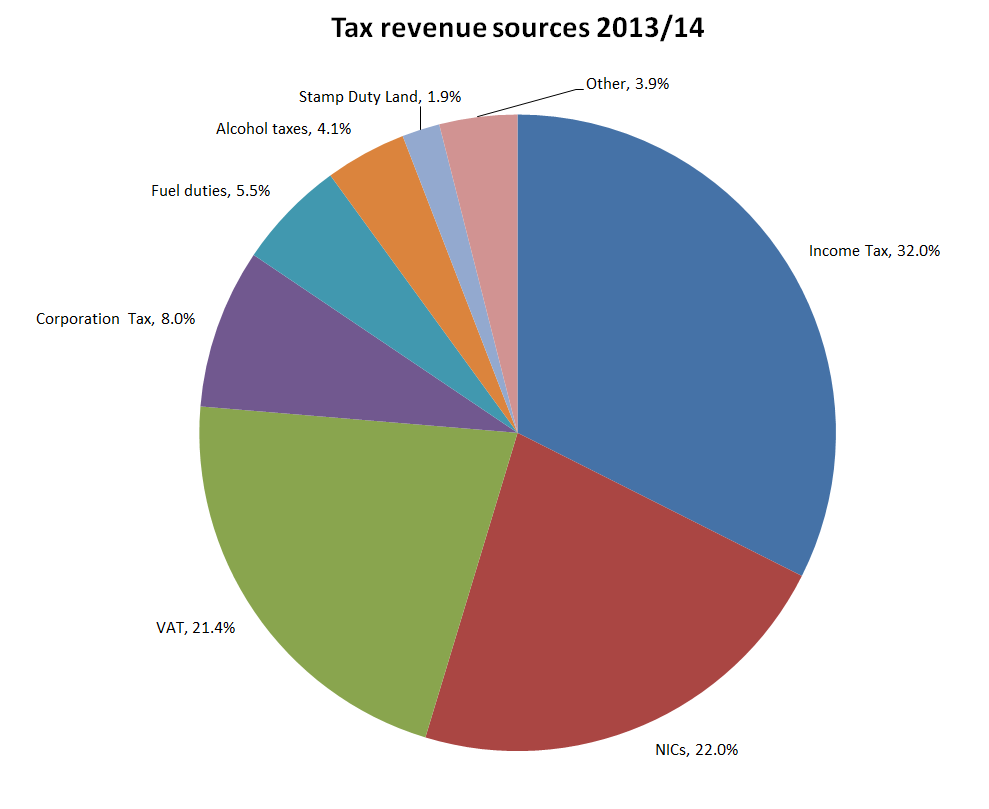
The whole tax system currently benefits the big companies over small businesses, at the expense of individuals. I say turn it on its head, so that all businesses pay the same percentage tax, with no discounts or benefits for the companies that can afford the most accountants, or that use tax havens. Are you with me on this one?
And while we are discussing money I would like to be sure that the finance sector don't continue to abuse their power either....
3. Remove the power to create money from the banks
This is best explained by Positive Money, who have created a whole series of snippets explaining how money is created by the banks every time we take out a loan and why it is so bad for 90% of the population.
In essence when your bank approves you a loan or mortgage they type the numbers into their computer, thereby creating the money for your loan from thin air, and then proceed to charge you interest on it for the next 5 - 25 years. It is a genius scheme to make money from nothing, no wonder their profits are so high (although obviously their profits for tax purposes in the UK are abysmal). There is no pot of grannies savings that you are borrowing from, this kind of banking went out the window with the dawn of computers and the removal of the gold standard by Nixon in the 1970's. The only thing holding the whole system up is our belief, which is probably why they are constantly measuring 'consumer confidence'.
Imagine if that money creation potential is taken away from the banks and given to the government. The money could be created to build hospitals and clean energy systems, providing jobs and improving services. The trouble is governments don't tend to think long term either, so an independent group is needed, that isn't under the influence of bankers or politicians, and this is what Positive Money propose.
Lets have money creation controlled by an independent group, not the banks, who's only motive is increasing their profits. They really aren't interested in whether the economy is stable, that the austerity measures are hurting the very fabric of society or that people are overwhelmed with mountains of debt. The money created can then be used to fund services and infrastructure, rather than to create investment and housing bubbles.
Phew! Just 3 policies that would deal with some of the fundamental issues underlying the fabric of society. Please let me know if you can see any flaws or have some more policies to propose to deal with some of the big issues that the politicians skirt over or ignore. Debate, discussion and differing opinions is very welcome, though personal insults won't make it through my approval.
Please take from this that there is hope. It is possible to defeat the life-sucking 'dementors' of poverty, austerity, greed, inequality, homelessness, debt and environmental destruction, and the solutions really aren't that drastic or impossible to imagine.
Plastic waste [ 09-Feb-17 10:14pm ]It is devastating how little respect we have shown for the ecosystems that support life and the other creatures who share our planet. I am as guilty as anyone of enjoying this convenient disposable lifestyle. Just because I put some things into the recycle bin, it still doesn't make my waste Ok.
So immediately I signed a petition or two, but this really isn't going to cut the mustard if we want to prevent a whole pod of whales dying from our plastic rubbish. And it isn't just whales. Surfers Against Sewage state that
Over 100,000 marine mammals and over 1 million seabirds die every year from ingestion of and entanglement in marine litter.
So I went to the supermarket with my bundle of canvas bags for my shopping, and marvelled at some of the beautiful shopping bags people were using since the 5p charge for carrier bags took effect. This has definitely been a positive change, but it was delayed for far too long. Several European countries had taken action more than 10 years earlier, Ireland being one of the first. 90% of consumers in Ireland switched to reusable bags back in 2002, so their waters would be much safer for marine life..... if it wasn't for England 'sharing' their plastic waste. Whoever pollutes the sea, creates a problem for everyone.
At the checkout I was offered a free carrier bag to pack my already plastic wrapped meat products in. I have been accepting these bags recently, because it is virtually my only source of bags and I use them as bin liners. I really don't want to start buying bin liners, so now the question is can I manage without any? Would it really be so bad to tip all my rubbish loose into the big black wheelie bin? Or can I reduce my non-recyclable rubbish down to virtually nothing? I don't think either of those are practical at present, but maybe I can find some kind of paper bin liner alternative?
I had automatically used a small clear plastic bag on my broccoli - now I know I can cut those bags out. My home grown produce travels home in my wicker basket packaging free, except for salad leaves which I put in plastic bags that I wash and reuse repeatedly. This is a good motivator to grow even more veg myself this year. A year ago I was buying the rest of my fruit and veg from the market early on a Saturday morning. Some of the stalls use traditional brown paper bags for cherries or apples, and even if they have plastic bags you can ask not to use one and bring canvas bags instead. I have other activities on a Saturday morning now, but I need to find another suitable time to support my local market.
I have grown a new and unsustainable habit. I drive my kids to clubs and to save petrol travelling back and forth, I wait in the McDonalds round the corner. Bear in mind that it is winter and my parked car is cold and dark, so the one cup of tea, that I eke out for over an hour, is just an excuse to sit indoors and use the toilets. The 'cardboard' cups are of course lined with plastic, making them non-recyclable. I have some lovely mugs I can bring, but the frugal side of me likes collecting the stickers on the cups, so that I get a free cup of tea for every 6 cups I buy. I will bring my own mug from now on, or maybe even look for a cozy coffee shop that is open those hours instead.
Bottled water still occasionally sneaks into our lives, mainly when there is not enough forward planning, but we re-use the empty bottles and once they are in a fairly distressed state they go to the allotment to become cloches or end protectors for support posts. (They aren't any good for storing an excess of home made comfrey tea fertiliser in, as I learnt the hard way. The decomposing comfrey tea forms gases, that caused the bottles to explode all over my shed, smelling unbearable for weeks.)
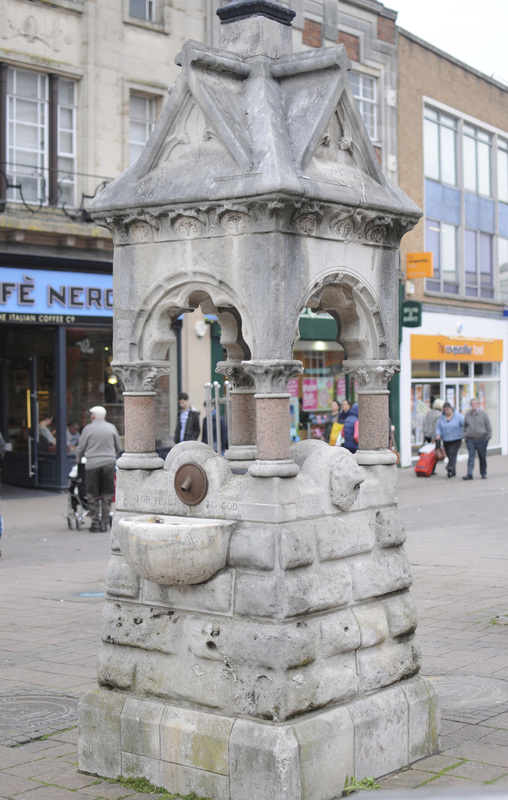
Luckily you can ask for free tap water in most restaurants or bars in the UK. We used to have these lovely drinking fountains in every town or village, but sadly they have fallen out of use. You can look up water refill stations near you in the UK using this handy website. None are listed in Loughborough yet, but there are plenty in London. It was a surprise to find that I can refill my water bottle in Lush for example, who are not a restaurant but sell bath bombs and lotions. It makes me think that there are quite a few places that I can ask for water in future.
Then there is the food packaging itself.Why can't nuts and lentils be packaged in paper bags like flour is? I have all these lovely jars to keep my food fresh, yet the products still come home from the shop wrapped in plastic, so I am still creating plastic waste. I would be quite happy to bulk buy things like oats in sacks, but my problem is where can I get them from? If I order them online they arrive smothered in bubble wrap. Does anyone have an answer to this?
On a more positive note, a young inventor Boyan Slat has a designed a way to collect the plastic at sea and recycle it. It is great that the young people can find ways out of the mess we have created for them, but I feel there is too much at stake to rely on this alone to save our oceans from all our plastic waste.
If I were Minister of Energy [ 17-Dec-16 9:58pm ]Just read that new department title again......slowly.......it is FOR business and energy. And the energy that they are FOR is more energy consumption to profit the Big Six energy suppliers, along with Fracking. Not FOR the energy efficiency measures that reduce consumption and fuel poverty, or make our industry more efficient and competitive. Climate Change has been completely dropped from the title, along with any pretence that this government gives a damn about reducing carbon emissions.
"The Department of Energy & Climate Change (DECC) works to make sure the UK has secure, clean, affordable energy supplies and promote international action to mitigate climate change."
The old mission statement replaced with.....
"The department brings together responsibilities for business, industrial strategy, science, innovation, energy, and climate change."
So there is no Minister for Energy and Climate Change in the UK, but if there was one, that was not tied in to business and industry growth targets, there really are plenty of things that they could do to reduce carbon emissions.
One of the cost effective measures to reduce energy would be to send the office workers home. If one person in the office works from home, they will still use energy for their technology at home and in winter some lighting and heating. However they will not be commuting and in summer it is most likely that their home will not have cooling (we don't tend to in UK homes) and the lights wont be on continuously.
Technology has come so far that we can work anywhere. There is really no need to have a separate 'office' to work in when documents can be stored on the cloud, conversations held on skype or facetime and work carried out on 'pocket-sized' portable devices. Wouldn't you rather work from a park bench or sat on the promenade in summer, than in a stuffy office space?
Now if all the workers in the office worked from home the benefits increase dramatically. That company may no longer need to lease a building or maybe just a smaller building that contains meeting rooms and hotdesks, but no permanent desk spaces. Instantly there are less corridors and toilets being lit all day, besides the massive saving in cooling and ventilating many of these densely packed office spaces, so a big energy saving.
Additional carbon savings would be from the reduction in traffic congestion - if you only had to go in to work for a meeting once a week, you would probably avoid first thing Monday morning, right. Traffic congestion is an appalling waste of energy, engines running whilst going nowhere, and a significant contributor to air pollution. Reducing the number of commuters will ease the situation for the people who can't work from home, like nurses, retail workers, police officers and politicians. And of course you could always hold your weekly meeting in your local coffee shop or curry house, which would benefit small businesses outside of the central district.
There is also a community benefit as it would bring more able-bodied adults back into communities during the day, making them a safer place for the elderly. Not to mention how many hours a week extra you could spend with your family or friends if you are not commuting. There are a whole host of other benefits, such as reductions in absenteeism, improved mental health, better work-life balance etc. but you get my point.
And if you think that you can't send people home because they won't get any work done, then you are soooo wrong. Trust me on this. I thought that I am getting a bit slow with work and not as efficient as I used to be, after 8 years working from home, but once I stepped back into an office environment I was vindicated. It is far more distracting working with other people. You are obliged to ask them how they are, get distracted by other peoples phone calls, then discuss any query/decision/irritation/success with everyone, just because they are there. At home you get distracted hanging the washing out or walking the dog, but in between you get to concentrate. There is also the incentive that if you finish all your work quickly you are free to relax, instead of watching the clock until home time.
And if you think you may miss the social aspect, just ask yourself if you have any genuine friends at work? If you do you will stay in touch, but chances are there are a good few people that you would happily not sit next to every day. Do you get up to speak to the people in the office next door or just email them? I rest my case!
It would be a win for the government because less investment would be needed on infrastructure if the roads are slightly emptier, and reductions in carbon emissions and air pollution would help meet some of our legal reduction targets. They could also see significant savings by sending government workers home. The demand for new office buildings would drop, and government support for converting them to dwellings, would help landlords to re-coup their losses and give a good opportunity to require energy efficiency improvements, along with easing the housing shortage.
This is really a biggie and is the next logical step given the way technologies are heading. It is the kind of solution the government likes because it doesn't cost them very much, just a bit of change management required. All it needs is some dynamic companies to demonstrate the potential for reducing their overheads or a Minister of Energy to promote the change! Please feel free to nominate me for that role ;-)
Stand Up Like A Mountain [ 30-Nov-16 10:39am ]The oil companies seem to have the upper hand with the media, but if this year has shown anything, it is that no one believes the media lies any more. People are making decisions on their gut instinct. Ask yourself how you feel about climate change and see if you feel that sense of unease, that sinking feeling in your chest. There lies the truth.
It seems like such a significant time and such a charged atmosphere, yet into the arena come the Native American Tribes, protectors of the water and mother earth. It is the biggest tribal gathering in 100 years that has come together at Standing Rock to oppose the Dakota Access Pipeline, which is passing through their treaty lands close the Sioux reservation and under the Missouri River.
You can get an idea of the Dakota Access Pipeline compared to the Keystone XL pipeline that got denied here. It seems to have had a lot less publicity though. I was also shocked to find that there are an average of 560 'incidents' a year in the US regarding oil spills. So it is not a matter of if there is an oil spill, but more like when.
I know what you are thinking, it seems so hopeless for this small unarmed group to stand up with prayer against the wealthy oil companies with their political power and militarised police force. But it is really when things look completely hopeless, yet we do it anyway, that there is a chance of success.
This is the part where David defeats Goliath or Harry Potter thwarts Voldemort. Where Gandhi defeats the British Empire. Or where a small team like Leicester City become champions of the Premier League. So lets support the Water Protectors anyway, even if it may seem a bit hopeless.
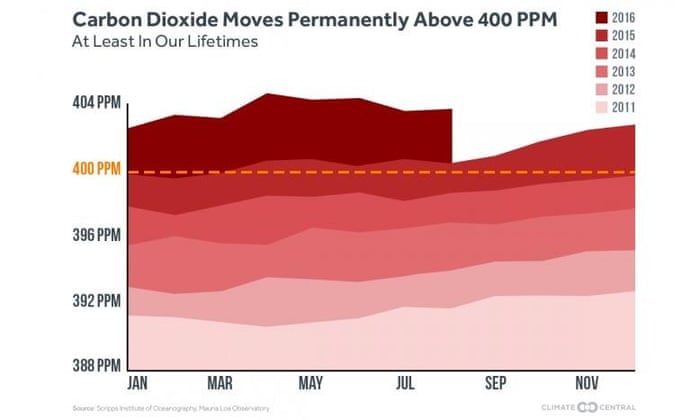
Image from The Guardian, 28 Sept 2016 https://www.theguardian.com/environment/2016/sep/28/the-world-passes-400ppm-carbon-dioxide-threshold-permanentlyThe carbon emissions have reached that critical point of over 400ppm where we are standing on an edifice with only catastrophic climate disasters ahead of us. Do you want to close your eyes and keep going or stand up and save the world?

So I will be praying with Standing Rock on Sunday December 4th at 4pm in the UK. Already I have been asked what good will my prayer do from here. Truthfully I don't know, but I am going to do it anyway and I really hope that you can all join me with this and support the Standing Rock Water Protectors in every way that you can.
Black swan events [ 02-Nov-16 1:51pm ]A black swan event is supposed to be an unpredictable event, a surprise that changes our current reality, that we were not expecting. A curve ball that comes out of nowhere. An example would be the attack on the twin towers, which caught most of the world by surprise and sparked a huge number of changes, from military action to the curbing of civil liberties.
When you have an election with just 2 main contenders, the foreseeable outcome is that one of the 2 candidates will win the election - there is nothing unpredictable about that. Unless you are closing your eyes to the possibility that your chosen candidate may not win, in which case you deserve to be in for a shock.
The financial markets should be prepared for either Hilary Clinton or Donald Trump to win the US elections. If someone else wins, then that would be a black swan. For instance if Bernie Sanders ends up as president, because Hilary is suddenly out of the running, then that would be a black swan event. But Trump winning is a predictable outcome....unless you have rigged the election so that he can't win, which would then make it a black swan if he won.
Reading between the lines the financial markets are warning of trouble, whoever wins the election. You can count on them blaming the presidential election for causing instability, whichever candidate wins.
War - the most stupidest crazy thing ever [ 31-Oct-16 9:00am ]I remember watching this film when I was at school and thinking that war is the most stupidest, crazy thing ever. If you just watch a few minutes of the play, take a look at the young performers and know that, if they had been born 100 years earlier, many of them would have been old enough to serve at the front line, before the war was over. How scary is that?
My history knowledge is shockingly bad, but I still know there were several lessons to come out of WWI. One of those was that everyone expected the war to be 'over by summer', and yet it dragged on for 4 years. The 2003 invasion of Iraq was the same - all 'over by the summer' in theory, but the reality was completely different.
The release of the Chilcott Report this summer was great news for those like me, who were furious that Tony Blair led the UK to invade Iraq. The BBC have a summary of the main points here, the first 3 of which are below.
I felt this all along, did you? That we invaded Iraq because Tony Blair wanted to be best buddies with George Bush, with souped up 'intelligence' and undermining the UN security council's decision. Many people could see this, which is why there was the biggest protest in UK history, but frustratingly it didn't have an impact. What would have had an impact? Tony Blair made the commitment to go to war in July 2002, would anything have been able to stop him?
As much as I would like to see Tony Blair face justice, he is the least of our worries now. The lies, finger-pointing and propaganda are all churning again, have you noticed? Same posturing and misinformation, just a different target.
In an interview with the BBC on Hardtalk 20th June 2016, General Ben Hodges, the head of the US Army in Europe, said that since "...Russia invaded Ukraine..." they are now a threat, and the NATO drills that were being held in Poland, shown in the programme, were staged against the "Red" enemy.
Russia invaded Ukraine ???!!! Have I missed something?
The invasion of Iraq was pretty obvious, it was talked about beforehand and announced as such. The media filmed the allied air force bombing Iraq, then we saw the tanks roll in, and the regular army invade and overthrow the government. It would be difficult to describe it as anything other than an invasion. But in Ukraine....... there were protests and a coup, which led to President Yanukovych fleeing, and further internal divisions and fighting.
I can't imagine that Ukraine's closest neighbours could just sit back and watch without having some hand in helping their favoured side, but that is not the same as sending in the airforce to bomb key infrastructure, and rolling up in a convoy of tanks. There wasn't even a definitive sign of uniformed Russian troops 'invading' and the Russian government, though acknowledging that civilians were in Ukraine aiding the rebels, vehemently denied sending any troops to the country. Once the OSCE was in place monitoring the situation, they pretty much backed this up, finding no evidence of Russian troops or weapons crossing the border.
I am pretty sure that the media would have reported on a Russian invasion, as they did seem to enjoy pointing the finger at Russia, by using words such as 'Russian-backed seperatists' and 'Russian aggression'. Maybe I just missed it, but just like the 'Weapons of Mass Destruction' in Iraq, the evidence of an invasion seems a bit thin on the ground. Finding a handful of Russians in Ukraine bearing arms cannot be called an 'invasion'. There are a handful of Brits that have joined IS, but that doesn't implicate the whole country as terrorists. Please feel free to dispute this and share any links that show the contrary, because a Russian invasion is a pretty serious event, and if we are drilling NATO soldiers for WWIII with Russia, based on the 'invasion' of Ukraine, then I would like to be totally convinced.
What about Crimea? To me this provides even less evidence of an invasion. Imagine for instance that England decided to invade Ireland. "Over my dead body!" cry my Irish followers and they are right, it would - literally - entail a massacre of the Irish before they would concede to becoming part of England. Then there would still be strife from resistance fighters, suicide bombers and the like.
So I really don't understand how Russia can 'invade' Crimea with no bloodshed, uprising or resistance, and within days persuade 80% of all registered voters to vote to become part of Russia supposedly against their will, then to live happily without any signs of a counter insurgency. Unless of course it wasn't an invasion, and the people of Crimea, who are made up of 60% Russians anyway, requested that they get taken back under Russia's wing to protect them from the instability, fascism and violence that the media was displaying in mainland Ukraine.
Making up an invasion, with a few dodgy satellite images, photos of soldiers in unmarked uniforms that are claimed to be the enemy but could be from either side, weapons manufactured by the enemy but used by all sides, and US Generals calling it an invasion, really isn't enough proof for me.
And a war against Russia is one that would definitely not be 'over by summer'. Unlike Iraq who had their military destroyed in the 1991 Gulf War, and had severe economic sanctions in place for years after, Russia has a strong military force and plenty of WMD which Europe is well within range of. Plus China has announced that they support Russia's actions.
Russia's military might has been demonstrated in Syria. The US started the bombing campaign in September 2014 (with no UN approval or any go ahead from the Syrian government - yes I am intimating another illegal war) and IS continued to grow in numbers and area controlled. It was only after September 2015, when the Russians announced they had been asked for support from the legitimate Syrian government, and commenced a mission against IS, that IS has been retreating and is now reduced to only 25% of their former size. Notice how the media is a lot quieter about IS now?
Of course instead of saying "Good job old chaps" we have painted Putin as the bad guy and accused them of bombing civilians and of humanitarian atrocities. See how easily we can forget that IS were beheading, torturing, raping and enslaving the Syrian population. This is the same IS that was formed as a direct consequence of the Iraq invasion, according to documents from the Chilcott report and the recent admission of the then Foreign Secretary Jack Straw.
I can understand if you have missed all this going on, when the farce of the US presidential election is far more entertaining and worrisome. I mean which of the 2 main candidates is least likely to start a war? Hacked-off Hilary, who has openly blamed Russia for all the leaked emails and supported all the previous invasions, or Tantrum Trump, who seems to offend people every time he opens his mouth and displays a temperamental and unpredictable nature. I wouldn't want that choice.
Just don't assume when your politicians talk of countering Russian aggression by sending more of our young men and women to be stationed on their doorstep, that they have your best interests at heart. Question everything and look for 2 sources of evidence. Because we are all losers in the stupid crazy war game.
Debt [ 10-Oct-16 11:33pm ]As kids we are taught that banks are places where people keep their savings and the bank then lends that money out to people who want to borrow money. If money is based on gold or silver then this idea works. The amount of gold available doesn't change much. A little more is mined each year but the total amount of gold on the planet is finite. This means that the banks would only have money (gold) to lend to people, if they had deposits from people who have savings or excess gold.
Paper money has no physical limits. It literally grows on trees. We can chop down more trees, make more paper and print more money. But the government has put in strict controls to limit who can print money and how much is printed.
There are no controls at all over digital money.
Digital money represents 97% of the money supply according to positive money (who have lots of simple videos to help people understand how money really works). The banks create digital money by typing the numbers into a computer every time a loan is made, then they charge interest on it. No wonder bankers get such big bonuses and have no concern about gambling millions on stock markets and currency speculation, because they can just create more money at the tap of a key.
If you are still struggling to believe this, then ask yourself how the world can be $152 trillion in debt otherwise? Where did all this money come from to lend to people, businesses and countries?
How are we going to pay back all this debt? Create more money of course. But the banks charge interest on all the money they create so in effect you need more money than has been created to be able to repay the debt and interest. The debt can only continue to grow.
If you are personally in debt, which most people in the UK are if they have been to university or have a mortgage, there is a certain amount of stigma and guilt attached to it, along with pressure to pay it back. Partly this comes from the general feeling that we have borrowed someone else's savings, when in reality this money is created by the banks from thin air (not requiring savings or even trees to grow it).
It is important to understand that it is IMPOSSIBLE for everyone to pay back that debt in the current system, because of the interest attached, which means there will always be more money owed than money created. Not unless we change the system so that money creation is controlled and created without any interest attached. Until then people are debt slaves, working all their lives in the hope of paying off their debts so that they can enjoy their old age. Just know that when you pay off your debts they are just getting passed on to the next generation of debt slaves and their burden will always be heavier.
Please don't get stressed or beat yourself up if you are in debt. Money in its current form is a trap and even most countries with all their financial advisors are in debt. See how fast the UK's debt is growing here. That is currently equivalent to £48,000 for every tax payer, with an average salary of £27,000, which may put your personal debt into proportion. Some point soon there will need to be a reset - governments going bankrupt and wiping the slate clean. (Only we had best hope that we are out of the EU before then, otherwise they will force the UK to take on more debt, whilst expecting a 'bail-in' payment from anyone with savings over £200,000, followed by a sell-off of all assets, such as ports, monuments, and the NHS, whilst simultaneously cutting pensions and welfare payments. Just saying!)
If you want to reduce your personal debt TheMoney Saving Expert website can provide helpful tips to help you budget and save money.
The way I see it is that money no longer represents any kind of barter or exchange. It is purely used as a tool to create debt to the banks (debt slavery). On the flip side barter and exchange rates are not linked to money. Think about it. Anything you want can be bartered or exchanged without money. Money was originally created to make it easier to collect tax. The government struggles to tax 20% of the runner beans that I gave my neighbour or 20% of the jar of jam she gave me in return.
You would be surprised how many exchanges are used every day. For instance, instead of me paying for a taxi or train, my friend gave my son a lift when I wasn't able to, knowing that I will return the favour (or complete my side of the exchange) for her daughter in the future. If you want to free yourself from debt then increase your exchange, barter, favours and gifts with family, friends and neighbours. From grouping together to provide childcare, carpooling, to couch surfing, hitch-hiking, house swapping and various other ways of cutting money out of your everyday transactions. Focus on developing new and existing skills such as growing vegetables, carpentry, playing music, hairdressing or anything that gives you something to trade with others for the things you need. This kind of currency promotes trust and respect - something lost from our banking system.
Do you need a new bike? [ 25-Sep-13 12:13pm ] Un-seasonal [ 09-Feb-16 10:59pm ]
 Blue sky makes all the differenceThe sky was blue today after yet another storm hit the UK. This was the 9th storm this winter which is more than the average.
 Rain approachingStorms in the UK are certainly not international news, no twisters or snowmaggedons. Just rather dull and continuous rain, accompanied by howling winds. There hasn't even been thunder and lightening to add some excitement. Some areas have experienced flooding or downed power lines, yet it is theunusual pattern of weather that makes it news-worthy for me.
 Very wet and muddy dog walksIt is an El Nino year, which has spread a mixed bag of extreme weather across the world. Even so, I can't just shrug it off and expect next year to be 'normal' again. Have we had a 'normal' year in the last decade? A year when rainfall or temperature records haven't been broken?
 I wish rainbows were the only thing coming from this coal-fired power station.The climate change predictions for the UK (that I read a good few years ago now), indicated that winters would be milder and wetter, with much less frequency of snow. Summers would also be milder and wetter, except for in the Southeast. This describes 2015 pretty well. Last summer was warm, but can anybody remember a day that was actually hot, like sunbathing-on-the-beach hot? We kept wondering when summer would start. And this winter has been exceptionally mild so far, though very wet and stormy.
Are we moving to a 'season-less' climate in the UK, with far less definition between spring and summer or autumn and winter? That is not to say that every year will be like that, just that a trend may be emerging. I mean we can't expect to ignore all the danger signs about climate change and not have to face the consequences.
 Lovely traditional stone terraced housingThe good news is that buildings in the UK are built to withstand this kind of weather, at least most of the dwellings are. The majority of dwellings are built of brick or stone, and feel solid and secure whilst the wind is howling round them. The style is for low-rise, compact and often terraced dwellings. Even hurricane strength winds only result in a few chimney pots being toppled, trees falling and power lines being damaged. Watch the scenes in other areas of the world and whole streets of homes get reduced to matchsticks.
 Old brick built factory still looking amazingThis is also why we have some of the oldest housing stock - brick houses are expensive and slow to build (compared to timber) and as they last well and are expensive to replace, we keep them. Even more so with stone dwellings. My friend's cottage is over 300 years old, and the thick stone walls would have taken an enormous amount of energy to demolish.
 Any excuse for more nice photosNow I know that old houses get a bad name for not being energy efficient, but that is not entirely true. They tend to be small, so have less volume to heat, and if they are terraced they reduce heat loss by having less external wall area. Houses were built with good natural light in all rooms, before we had electricity and had a cellar and a pantry instead of a fridge or freezer.
That is not to say that older buildings don't feel cold and draughty, but it is worth bearing in mind that a new efficient double-glazed window provides no more insulation than an old solid brick wall. Modern buildings with vast glazed areas are really not a great idea if you wish to reduce your heating bills. You will find that there is more focus on building houses airtight these days, to reduce unwanted draughts, and adding additional insulation to any building will always improve the thermal comfort and efficiency.
 Survived since 1483Other bloggers have noticed changes in their weather patterns too, sometimes major scary events like the forest fires and drought in Tasmania that Jo mentioned, or even small signs of change such as still picking raspberries in November as Mrs Thrift noted. I would love to hear of any changes that you may have noticed, wherever you are. It may be plants flowering earlier or areas flooding that have never been flooded before. It all helps to build up a picture of how the climate is changing and prepare us for what might come next. Night walk discoveries [ 02-Feb-16 11:37pm ]
Where daytime walks offer the opportunity for foraging, photos, ball throwing and chatting with other dog walkers, dark evening walks are....well dark....though somehow still very lovely.
To start with I tried my normal walk through the muddy woods, but slipping and sliding through the mud and tripping over roots that I couldn't see was downright dangerous. I could have taken a torch, but it only lights a short distance and spoils my night vision. After a spectacular fall off a wet slippery stile, I headed for more open spaces, where on a cloudy night or with the moon out, visibility is fair.
And now the cold crisp evenings are wonderful, and blissfully quiet with all the people tucked up in their cosy warm houses. Even rainy evenings are really not that bad, but the best are when the stars come out.
 The bright stars at Orion's belt are easy to spotMy knowledge of stars is rubbish, but I really wanted to know if what I thought was Orion's belt really was. So I got a stargazing app, and I'm loving it. Yes, if you ever see the silhouette of a woman stood out in the dark staring up at her mobile held above her head - it's me :-) Of course it is easier to just lay in bed and aim it at the ceiling and the app still shows you the stars, but I like standing alone on the hill overlooking all the twinkly lights from the town and feeling like a speck in this vast universe.
 I could always find the saucepan shape but didn't know it was Ursa Major, the Great BearAnother night-walk discovery is that all the trees have dog tags. On a windy night they jingle at you as you walk past. It did take me a while to realise that we were not being followed everywhere by a cat with a bell on its collar.
I have known for a while that the bigger, older trees, that maybe need protecting have numbered tags, and I am sure this must help to keep track of which tree is which, and find them when they get lost. But all the trees? Right down to the scrawny little things, that are more of a large shrub? Surely not!
If anyone knows the purpose then please do share it, as I am sure there must be some good intentions somewhere behind this madness? Is someone watching and recording all the trees being wiped out by climate change? Or maybe it is just part of the council's maintenance program? It just seems a waste to me. The time and money spent hammering tags into trees and recording them all, could surely have been better spent on planting new trees, to help our degraded landscape heal.
Next time you listen to the wind whispering through the trees, don't be surprised to find that they jingle now instead!
Almond croissants [ 21-Jan-16 10:54pm ]
I popped out to the supermarket at 8pm, and found lots of lovely reduced items, including croissants for 40p. Croissants always remind me of holidays in France, though these would be but a pale comparison of the freshly baked croissants from the boulangerie.
This summer my cousin had told me how delicious almond croissants were - they are truly divine. To use up leftover croissants, they are filled with frangipane and baked again to make more of a sweet Danish.
I used a simple frangipane recipe shown below, but it used vanilla essence, whereas I will be using almond essence in future for a stronger almond flavour. This is my first attempt, but next time I will also spread more mixture on top to stop the croissants getting too dark. And maybe a sprinkle of sliced almonds to top them off.
100g ground almonds100g butter80g golden caster sugar
1 egg
1 tbsp. vanilla extract (or almond)
Mix all the ingredients together. Stuff and spread your croissants, then bake them for 18 mins at around 180 deg C. This made enough mixture to generously stuff 4 croissants and would have stretched to 6.
I also bought 3 packets of dill reduced to 10p each. I have hung them in the kitchen to dry out, so that I can chop and store them for sprinkling on salmon. It is nice to feel that I have got a bargain and saved some food from being wasted.
I should probably mention that I have started a new job and I am back working the 9 to 5 again. 2015 was so busy for my little consultancy, that I had been working days and nights to try and keep up. Now that I am starting to get my evenings back I can enjoy cooking and blogging again.
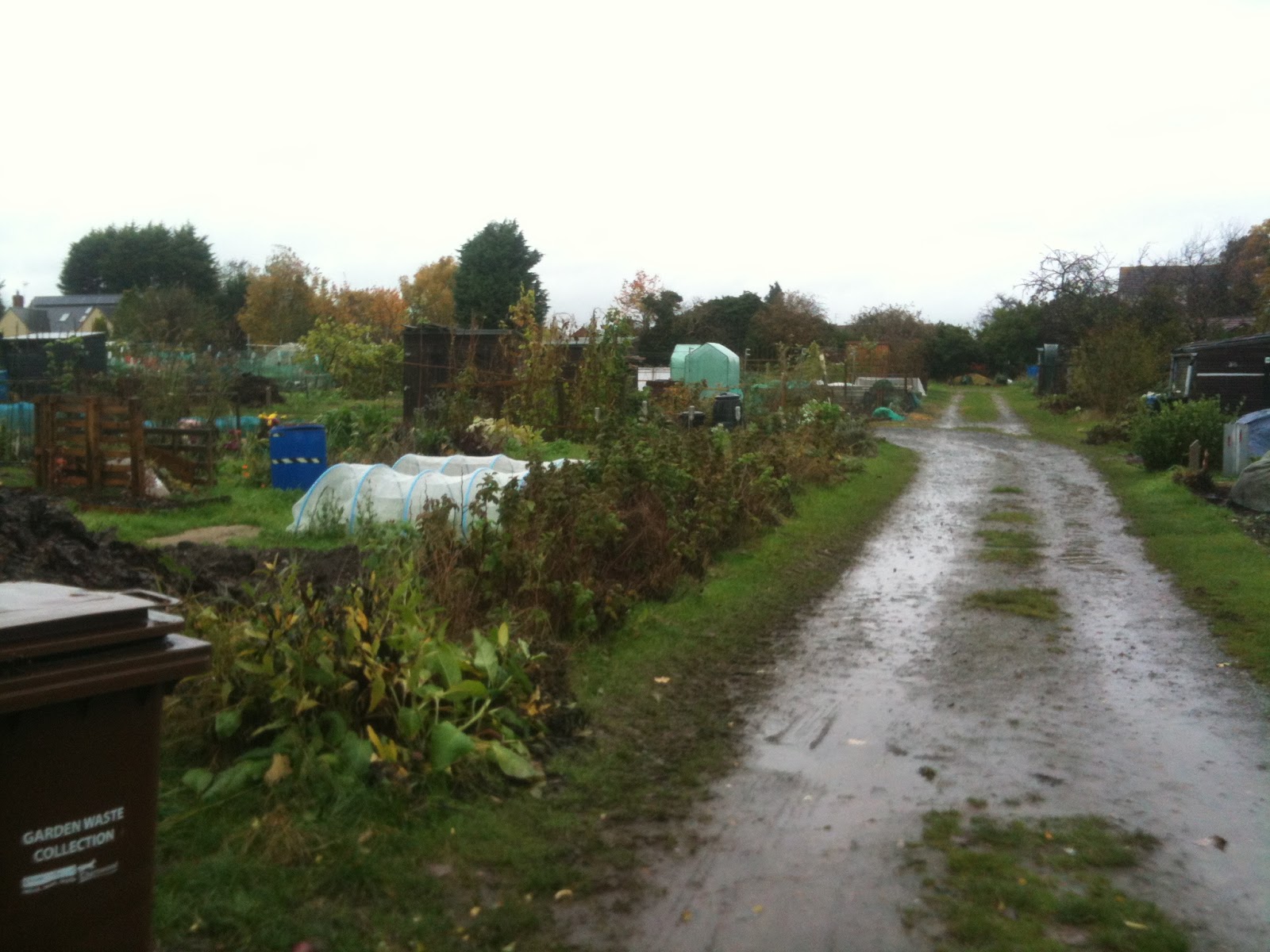
I am not sure how things will work out with my allotment. Spring is fast approaching and I have barely started the gardening jobs that were due back in the Autumn! I am not ready to give up on it yet though. I just love that I still have a supply of my home grown potatoes and squash in the garage, and raspberries and runner beans in the freezer. It is so nice to announce at each meal that I have grown the cabbage, or the tomatoes in the sauce.

What began as a journey to be more green, by eating organic, locally grown food and reducing waste, seemed like hard work from the outset. Yet it has turned out to be rather enjoyable. Food makes me happy. I enjoy growing it, shopping for it, cooking it and sharing the end result with family and friends. I love that I substituted a handful of weeds for parsley in my stuffing at Christmas and no one was the wiser. But most of all I love..... almond Croissants ;-)
What do you love about food?
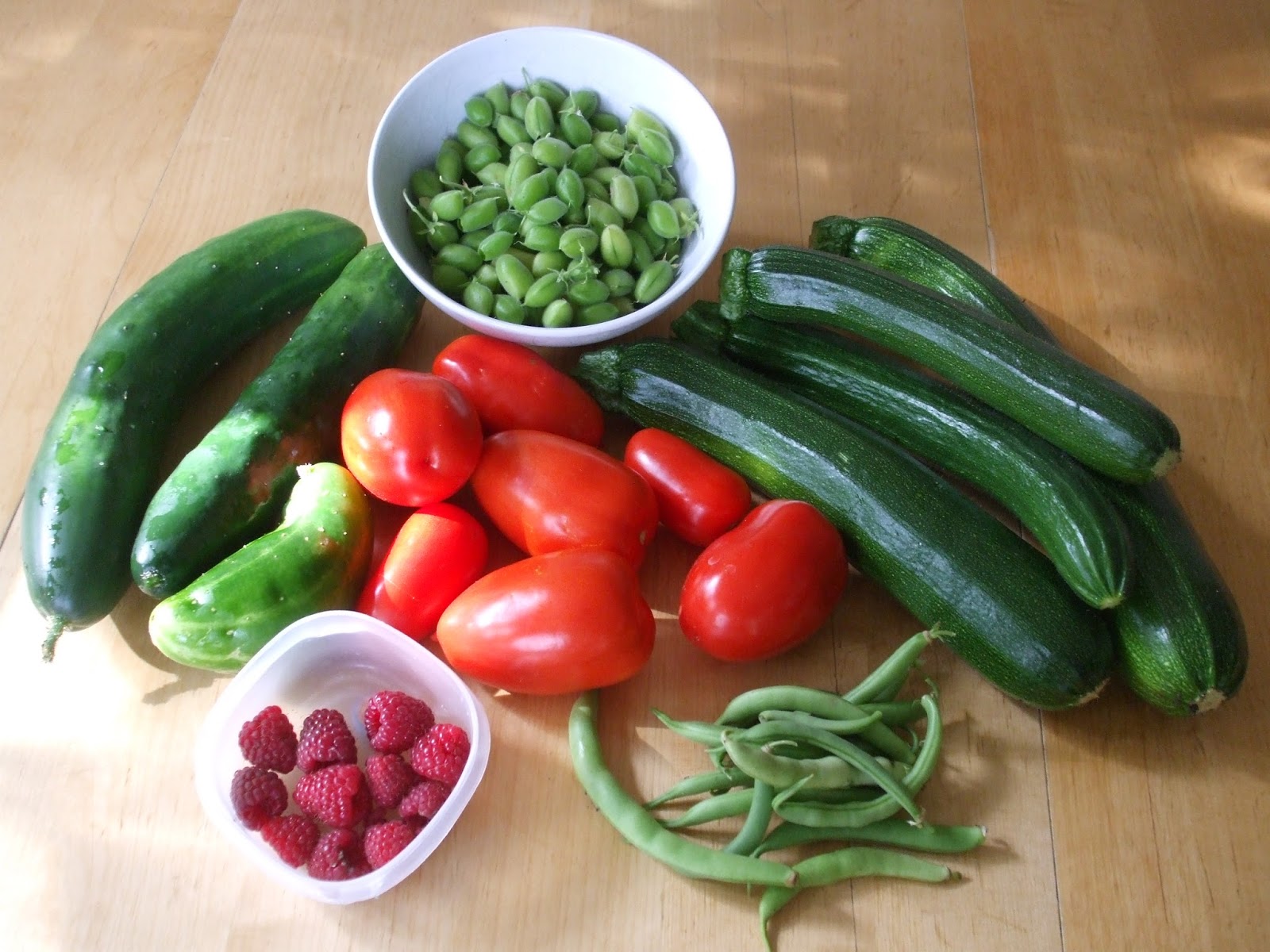
Produce from my garden, including chickpeas.
This week I went to the car boot sale with my eldest daughter, who has just returned from finishing Uni. She was delighted to find several nearly new tops, a dress and a skirt all with labels from her favorite shops. Her little sister liked the dress too and has commandeered it!

In addition we bought some unopened gift sets with body lotions and shower gels, some from the body shop, which were all small travel size bottles, so very handy.
I only bought 2 items for me, but I love them both. One was an egg run, that I had seen for £17 in the Organic Gardening Catalogue and had decided it was too expensive for me to buy when a cardboard egg box does the trick for nothing. But when I spotted it at the car boot and the lady only wanted £1....well it seemed like fate.
I have always kept my eggs in the fridge, but as my fridge is in need of replacing and I am hoping to downsize it, to save money and energy, it is time to keep the eggs out. And don't you love my multi-coloured eggs too? I buy them from a friend each week and love that they are green and white as well as brown :-)
Then I spotted a purse. Not just any purse, but a Ness purse and it was brand new, complete with label for £24.95. Aren't the materials gorgeous? It was mine for just £2.50, so how could I pass that up?
When my husband and I visited the Isle of Skye for his birthday many years ago, I found a lovely little Ness shop and bought myself a purse. You may think that the lovely tartan material might not be as hard wearing as leather, but it lasted me 5 years! I like that the company is based in Scotland, aims to source materials from the UK where it can, and centers its designs on traditional Scottish tartan. Buying local twice over, so no consumer guilt about this purchase. I haven't decided whether to keep it, as it is a larger design than I normally go for, but it would make a lovely gift if not.
As well as all the goodies already mentioned, I bought some books and toys for my cousin's children. We spent a total of £15 and made it home with no packaging, not even a carrier bag! Ethical shopping is bliss :-)
But as Jo at All the blue day has pointed out, a 'one in, one out' policy is required, as buying is only one side of the story.
We had already had a big clearout of clothes. I gave some to friends, sold some at the car boot sale, donated some to charity and took less sale-able clothes to the '£5 a bag' shop. I felt like I had cleared out so much stuff.......but then my daughter arrived home from Uni with all her cooking utensils, clothes and furnishings and we had to have an even bigger sort out to make some space. this time it was the shoe drawers, coat rack, teddies, craft stuff and kitchen equipment that was under the spotlight.
It is a great idea to have a clear out and get rid of all the items that are not used regularly, but on the other hand there is an element of being prepared that seems to oppose this idea. For instance I have a stock of old woollen blankets. Some of them get used when we go camping, but most haven't been touched for years. Yet a few years before we moved to Loughborough there was a cold snowy winter where they had a powercut, and many homes had no alternative heating source. So in the interest of preparedness, the blankets are staying.
It is funny how many things about living lightly on the planet clash. Such as being frugal and supporting local organic producers. Or being prepared for the climate change future we face and living a minimalist lifestyle. Or even just storing all your home-grown produce and trying to reduce disposable plastic bags and containers. How else can I store my fresh lettuce or frozen blackberries? It is all a choice between what means the most to you.
Lovely homegrown veg stored for winter....in PLASTIC!!!!Well, we have 4 bags for selling at the carboot sale and a couple of boxes of kitchen equipment to donate to refugees. I am just loving how organised and clutter free the house is starting to feel, lets see if I can keep it up :-)
Keeping cool [ 06-Jul-15 8:00am ]
The UK has a relatively mild climate. Being surrounded by sea and benefiting from the warm Gulf Stream, means that our winters and summers are not as extreme as for mainland Europe. This is reflected in the design of our buildings. For instance French buildings traditionally have shutters. These aren't purely decorative, but have a functional purpose, to prevent solar gain. When the sun shines in through the window, it heats the building up like a greenhouse. The shutters on the outside of the house are more effective than blinds, because they stop the sun's rays before they get inside.

Typical French shuttered windowsClosing the shutters at night and then waking up to throw them open to the daylight is one of the delicious moments of staying in a French house. If you have tried this you will notice that just opening the shutters a slit will still bathe the room in daylight, and often keep most of the hot sun out. The strategy is to use the shutters in the daytime to prevent the suns ray from heating up the house. In addition the shutters can often be closed at night, but with the glass windows inside left open, so that the cooler night air can cool the building down and help to slow down the process of warming during the day.
Traditionally English townhouses were close together, providing a shady walkwayBritish buildings don't have shutters as a feature, because we don't get a lot of hot days and love it when we do. But it is not pleasant to work or live in a hot building, so here are some strategies that may help to keep buildings cooler and more comfortable.
Aptly named 'Thrift House' with the curtains drawn1. Shut your blinds and curtains during the day to keep out the suns rays. This is especially important for South and West facing windows. If you are worried what your neighbours may think of your curtains being closed all day, then try using net curtains, as they are effective at blocking the sun too. By standing in front of a sunny window with the sun's rays on you, you can feel the difference when the curtains are shut. It won't stop the house warming up, but at least it will be less of a greenhouse. Canopies, overhanging roofs or trees can all be used externally to shade the building in summer too.
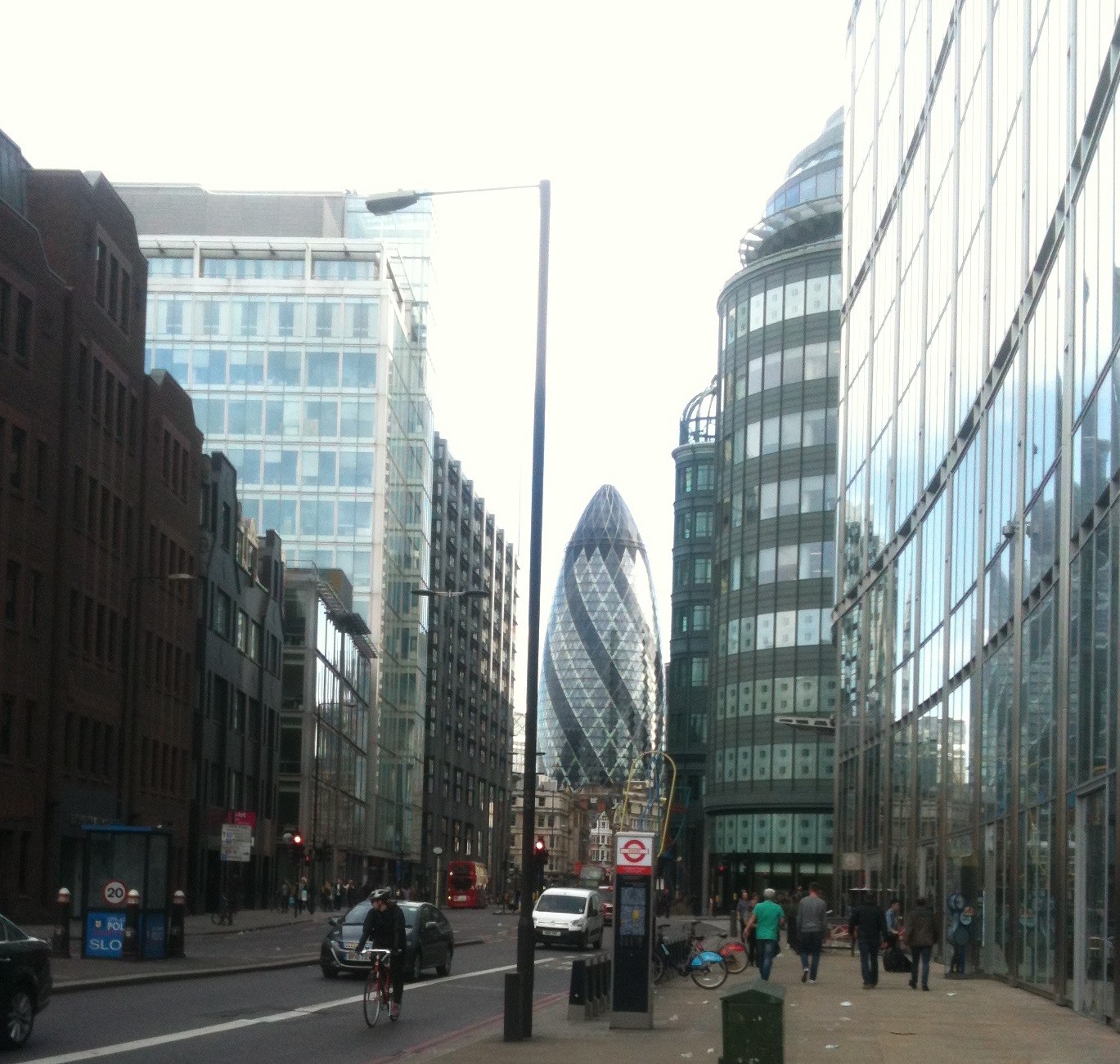
Glass greenhouses in central London ;-)2. Keep windows closed if the air inside your home feels cooler than the air outside. It is an automatic reflex when you feel hot to open the windows, but if it is the hottest part of the day you could just be bringing in hot air from outside and making things more uncomfortable. Stand in the doorway and check first, because then you can feel whether the air outside is actually cooler or not.
3. Open your windows at night (if you can without inviting burglars) or early in the morning for an hour or two, to help flush out the warm air and allow the building fabric to cool down again. The bricks, concrete, tiles, fixtures and fittings all retain heat. so often you will find that when the air outside has cooled, the building still feels warm on the inside. You can use the cooler morning air to purge the heat, so that you start the day with a cool building. I throw open the windows at 6:30am, before everyone else is up, and once the stone tiles on my kitchen floor feel cold again, I shut my windows against the rising temperature outside. This helps the house to stay cooler for longer.
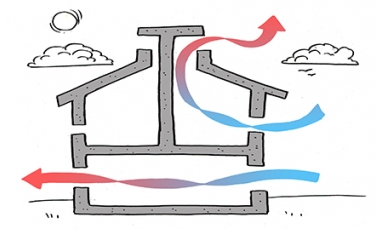 The majority of dwellings in the UK are constructed with brick, stone or concrete and these materials are all good for holding heat or coolth. Lightweight timber constructions tend to heat up a lot quicker and cool down faster too, so you may find that point 3 doesn't help much. You can try incorporating some more heavyweight materials in a lightweight house, by adding stone tiles to floors.
4. Every appliance that is switched on, from a light to a mobile phone charger, will be kicking out waste heat, into your lovely cool building, so make sure that everything possible is switched off. Fridges and freezers may be keeping the food cool, but in doing so they kick out a lot of heat from the coils at the back, which is adding to the heat in your house. The higher the air temperature the harder they have to work and the more heat is emitted, so try not to open them unnecessarily. You could also try using timers to run dishwashers or breadmakers in the early hours of the morning when it is cooler (unless you have PV panels and want to make use of the solar energy).

Landline phone that only works when it is plugged inIncidentally, you are also kicking out waste heat energy that is created when you breath or move. Only an average 100W if you are resting but that increases to 250W if you are dancing around. Save the workout or physical housework for the mornings or late evening, when the temperature has dropped, to avoid overheating yourself and your house.
5. If you get to the point where it is too hot inside and you need to get a breeze going to help cool you down, then remember to get a crossflow of air. This means trying to open windows or rooflights on at least 2 faces of the building, with an open flow between them. Heat tends to rise, so it will gather at high points. Opening a rooflight or upstairs window will allow the hottest air to escape, whilst opening a window on a lower level will draw in cooler air to replace it. I have seen lots of hot offices this week where the office windows are open, but the office door is kept shut for privacy. This means that the air cannot flow across the building, so the occupants don't benefit from getting a breeze from their windows.
6. Putting a fan near your window can help to draw in fresh air from outside, but if the air outside is hot already then it makes more sense to aim the fan at you. A fan blows air across your body, encouraging the heat to transfer from your hot skin to the marginally cooler air. Hence it makes you feel cooler.
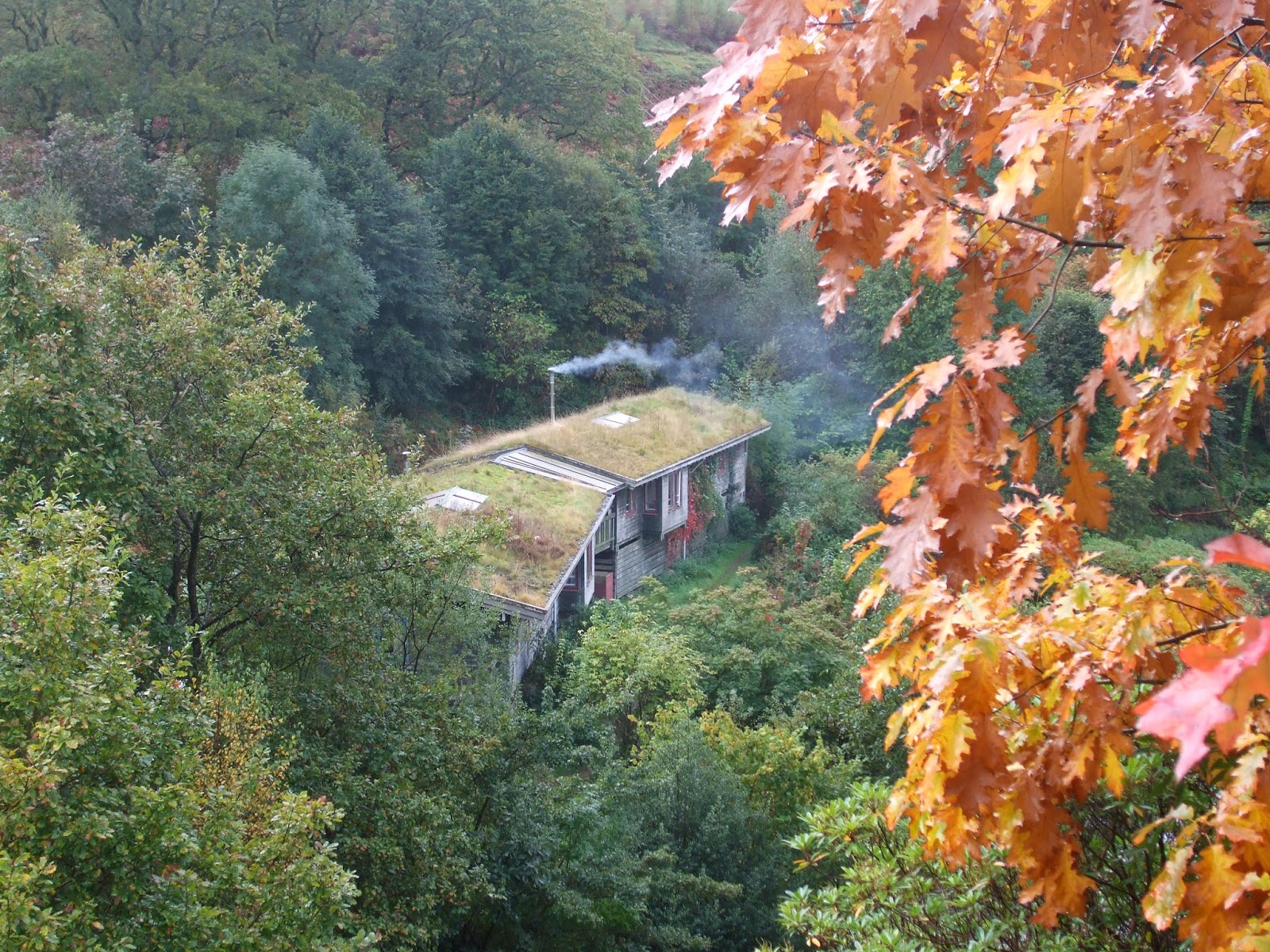
Trees for company7. Have you ever noticed that the air around trees feels cooler? This is because they act like an evaporative cooler. Their roots suck moisture from the soil and when the sun shines on the leaves the water evaporates. This process uses heat energy from the surrounding air and works faster on a hotter day, leaving cooler air around the trees. Planting trees and shrubs near windows and in courtyards can help to keep the air around the building cooler (as well as providing some shading). A fountain works in a similar manner and was why they were popular in Roman courtyards.
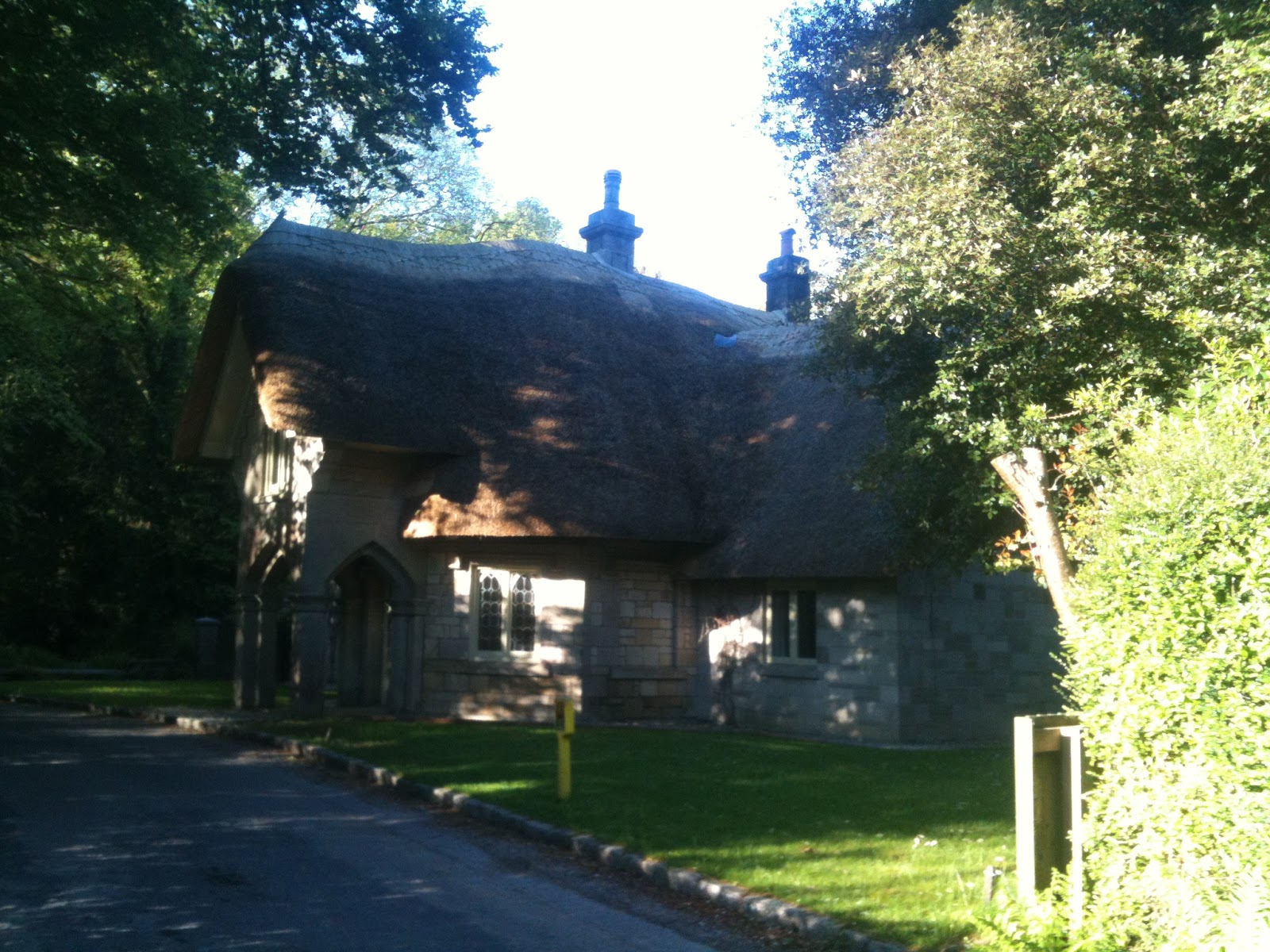
Stone house surrounded by trees for shade and cooling8. Insulation in lofts and walls helps to protect buildings from the heat, as they are another layer that the heat needs to pass through. Insulation helps to make the building feel more comfortable in the summer and winter, with the added benefit of leading to reduced energy bills.
9. Hot air rises, so if you are having trouble sleeping in your bedroom upstairs, then camp out on the ground floor or even in the basement if you have one. This will help you stay cool and get a good nights rest.
10. I heard on the radio today (for the first time) an advertisement for air-conditioning for homes and it made me groan. Air-conditioning is expensive and uses a lot of electricity to provide you with artificial cooling, so please try some of the cheap and easy methods to stay cool first. If you are a 'battery-farmed' office worker, in a large open plan office with only a couple of square metres of space, then the chances are that you will have cooling provided, and on a hot day it will be working flat out. If you can, take this opportunity to request to work from home. The less bodies in the office and computers in use, the less heat is being produced. This will save energy, reduce the load on the air-conditioning and help everyone to stay cooler.
Remember to always switch air-conditioning off in an empty room and to keep windows shut whilst it is in use, otherwise your expensive chilled air will be escaping. How many of you have walked past an open shop door and felt the rush of cooled air coming from within?
You may already do all of these things, but hopefully someone may find the odd tip helpful. Hope you have a lovely sunny summer where you are, with a nice cool house to retreat into when it gets too hot :-)
Allotment progress [ 22-Jun-15 7:58pm ]
The plan had been to carry on with Charles Dowding's No Dig method, where you add a layer of compost or manure on the soil and let the worms do the work of digging it in for you. In my usual fashion I didn't get round to ordering another delivery of cow manure in the Autumn, and given how long the last batch took to breakdown I decided not to get any this spring. This has worked out for the best, as many of the other plot-holders believe the manure is contaminated with pesticides. The hormonal weedkiller used on grassland apparently goes through the cows without causing harm, but contaminates the manure. It may be that the manure I had last year was contaminated, which could explain a lot, but I really hope not. I am trying to grow healthy organic produce, so a hidden dose of chemicals is the last thing I want.
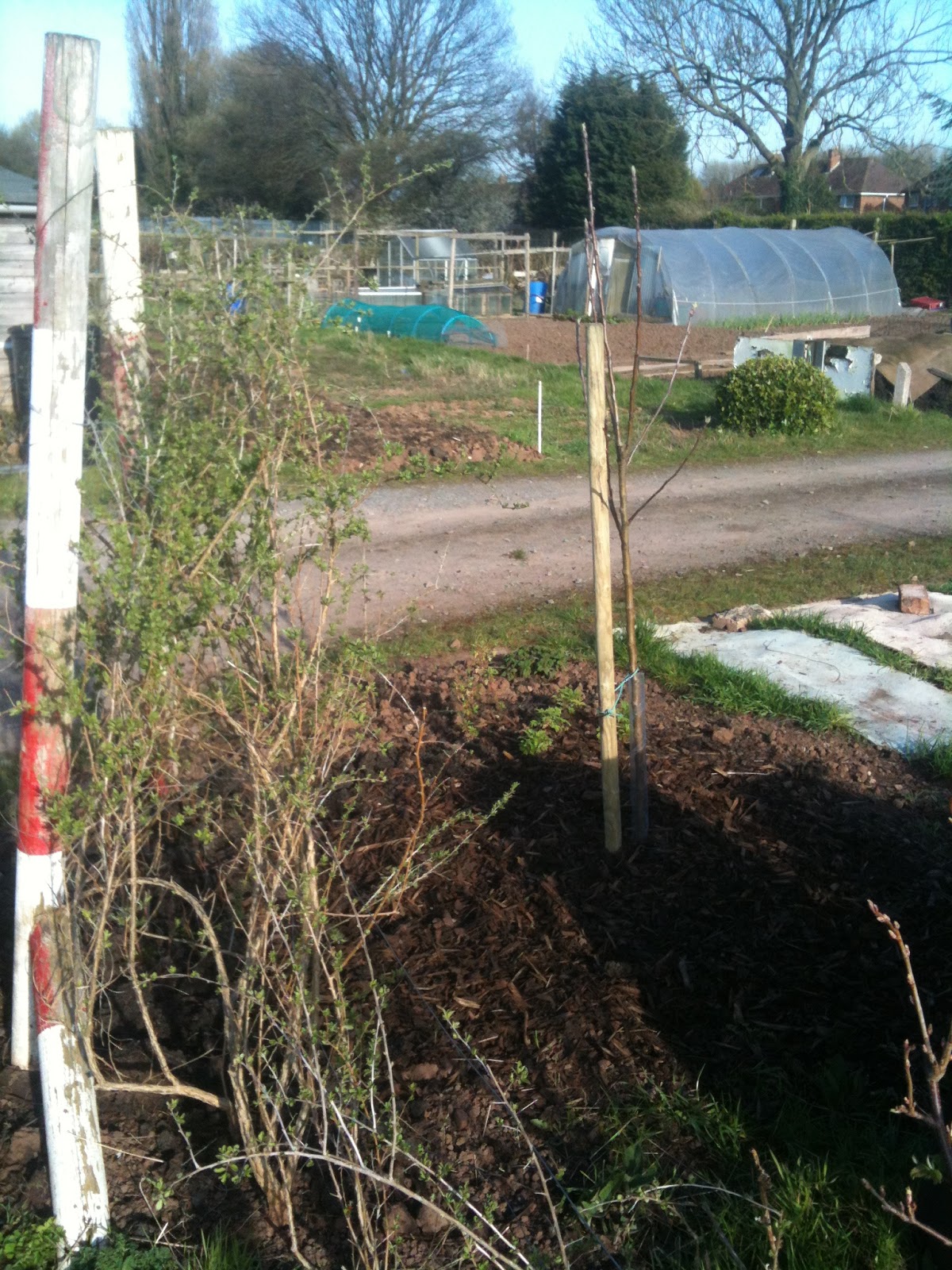
Instead, I have collected some horse manure from my friend Suella, who cares too much about the environment and her horse, than to cover her grazing land with chemicals. It is a peaceful setting, with some friendly conversation, so filling sacks and trugs with manure isn't a job that I mind doing. When I get back to the allotment though, the manure never seems to be enough.
I have had plenty of lovely compost for my garden from the double compost bin I made last year. I want to construct a compost bin made from pallets at the allotment, but I only managed to scrounge 3 pallets before my big car broke down and I need to find some smaller ones to fit in my smaller car. meanwhile the weeds are taking over!
I also have a 'dalek' compost bin, but it is full of ants. At the Composting Workshop held at the Transition Community Allotment a fortnight ago, I found out that this means that my mix is too dry and can be remedied by adding more greens. It was a very useful workshop even though I couldn't stay for it all. My plot has lots of comfrey now, some a gift from Suella last year, and some I found on the new half when I was clearing all the weeds.
I followed Mrs Thrifts recipe and made my first Comfrey Tea to feed my tomato plants. It really stinks, and if you get it on your hands you will need to wash them repeatedly to get rid of the smell. Every time I turned my back the dog was drinking it! Maybe she knows it is full of nutirents.
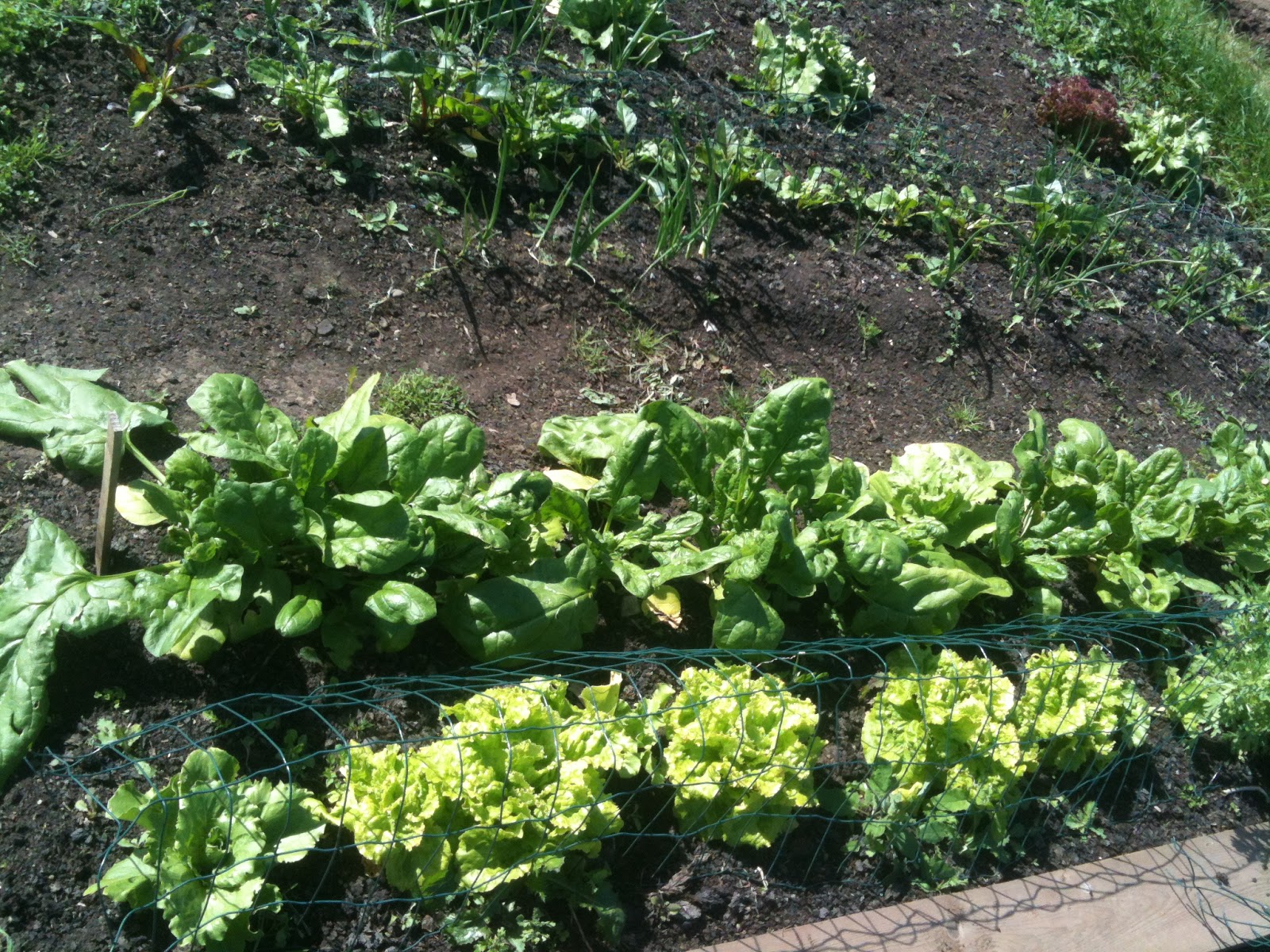
We have been eating lettuces and spinach for weeks, and it is so nice not to need to buy any from the supermarket. The spring onions are ready too, but I need to find a way to stop them going limp in the fridge. Any ideas?
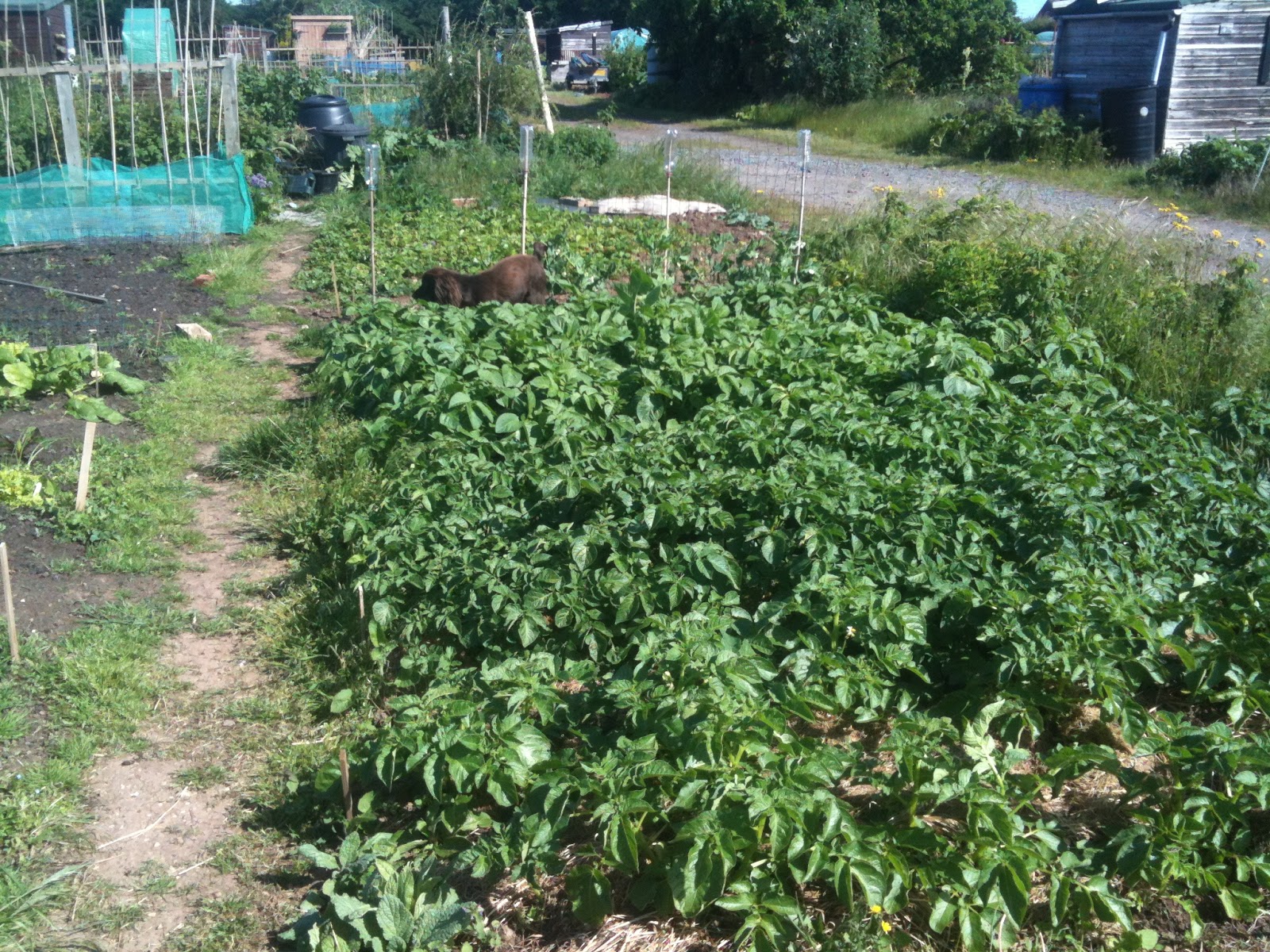
I bought lots of seed potatoes from the Transition Loughborough Potato Day earlier in the year, and they are looking healthy despite the dog charging through them.
The grapevine that I pruned very hard has survived. The blackcurrant bush also seems to have relished the hard prune and is covered in berries. Plus the little gooseberry bush hidden under all the weeds has a handful of fruit nearly ripe.
I have built a couple of frames for netting, which have now been transferred from protecting the garlic and onions to covering the young brassicas. The garlic, gifted by another plot-holder, has been the first casualty this year, as it has white rot. Most of the other plot-holders seem to have suffered the same fate, but luckily my onions still seem healthy......for now.
I have peas growing in my garden at home where I have never needed to net them from the pesky pigeons. Yet at the allotment I risked leaving them unprotected and of course they have been gobbled. Enough have survived for me to have eaten my first peas today.
My kind neighbour has given me some chickpeas to grow this year. To play things safe I sowed them in 2 separate locations at the allotment and in my garden. The garden ones are doing the best. I can't wait for the soft little pods to grow, though if this cool weather continues I ma not get any.
I am not sure whether I mentioned that I planted some fruit trees, which were a gift from my parents. After lots of reading I decided on a Nashi pear and a sweet eating apple, along with some blueberry bushes and new raspberry canes.

The fruit trees both seem to be doing well and had lots of blossom and baby fruit, most of which I have removed. I surrounded them with bark to try to keep the weeds back, but really there is no chance of keeping them down..
The weeds seem to grow at double the speed that my plants grow so it is a constant battle to keep each area under control once I have cleared it. Plus the areas that I haven't yet managed to clear are now going to seed. I have put out a request on freecycle for chippings as bark is too expensive to cover large areas, but had no response yet. Old carpet is my best weed control for now, until I get on top of things (Will that ever happen?)
Anyway, most of my seedlings, that covered every windowsill for weeks, are planted out now. Just waiting for some more netting to be delivered so the last of the brassicas can go out protected from pigeons and butterflys. Then I can just sit back and wait for them to grow :-) Well..........apart from the watering, weeding, pinching out shoots, feeding, hoeing, tying and harvesting!
Happy growing!
Frantic spring [ 20-Jun-15 8:36pm ]It started with my old faithful car breaking down. It was over 20 years old, with over 200,000 miles on the clock, but we had had it for 12 years and it was the most brilliant car. It didn't look much, but a car that can fit 5 people, dog, camping gear and 3 full size bikes inside it with room to spare is really worth its weight in gold........except when it is broken and will cost it's weight in gold to repair. So we bid it a sad farewell :-(
It was swiftly followed by my printer, computer, collapsing shelves in the garage and now the perpetually leaking fridge. In the midst of that the dog had fleas, my son completed his bronze Duke of Edinburgh training expedition and final expedition, my youngest daughter had guide camp and was away for a school trip, and my niece and nephew cashed in their Christmas vouchers for me to take them on a camping trip (an awfully tight squeeze without my old faithful car) and a day at Alton Towers (a week before the terrible crash).
I
Yet, thankfully, here I am on the other side of a frantic spring. Summer is here, the first strawberries are ripe and I have cleared all my windowsills of seedlings (I am not saying that they are all planted yet though). And despite being at the allotment until 10pm for 2 nights this week, and having 2 parents evenings to attend things seem just that little bit calmer..........for now :-)
The Pigeon Dilemma [ 11-Jun-15 11:28pm ]I'm back! Well it seems like I haven't posted much in ages as there just hasn't been a spare minute. Bear's challenge has gone out of the window for another month, although there was some closure on the pigeon front.....
I had the opportunity to go for a walk in Bramcote Park in Nottingham, which is quite lovely despite the background hum of traffic. I chatted with friendly dog walkers, spotted a few familiar wild foods and was just generally enjoying the evening, when there was a 'plop'. I was walking through some trees and something small had fallen out of one of the trees. I turned round to investigate and found a dead pigeon on the ground with a bundle of soft fluffy feathers beside it. The bundle of fluff was a baby pigeon still clearly alive, but with a cracked beak and it must have literally dropped out of the tree just as I walked past.
Dilemma. The parent bird had clearly been killed by a cat or fox ( I am thinking cat, because it wasn't eaten whereas a fox would have had it for dinner). The young pigeon's feathers were not mature enough to fly and it would no doubt die without a parent bird, even if the damaged beak recovered. Why did it plop down next to me?
I could see the nest in the tree and it was too high up for me to reach, but with my heart thumping I grabbed the scared little bird and tried to balance it on a lower branch in the hope it would climb back. Plop!
Now I stood for several minutes thinking this through. There was absolutely no way I could save this bird or any hope it would survive. I have saved baby blue tits before, but they had fully fledged wings that had got wet in a shower, so lifting them into a hawthorn bush until their wings dried out meant they had a good chance of surviving. This pigeon had none. Plus they are classified as a pest (for good reason) so you are not supposed to rescue them.
Could I kill it? It was clearly going to die anyway, so a quick bash with a stick would save it from suffering. I still couldn't do it and just walked away. Let nature take its course and no doubt something will come and eat it.....just not me.
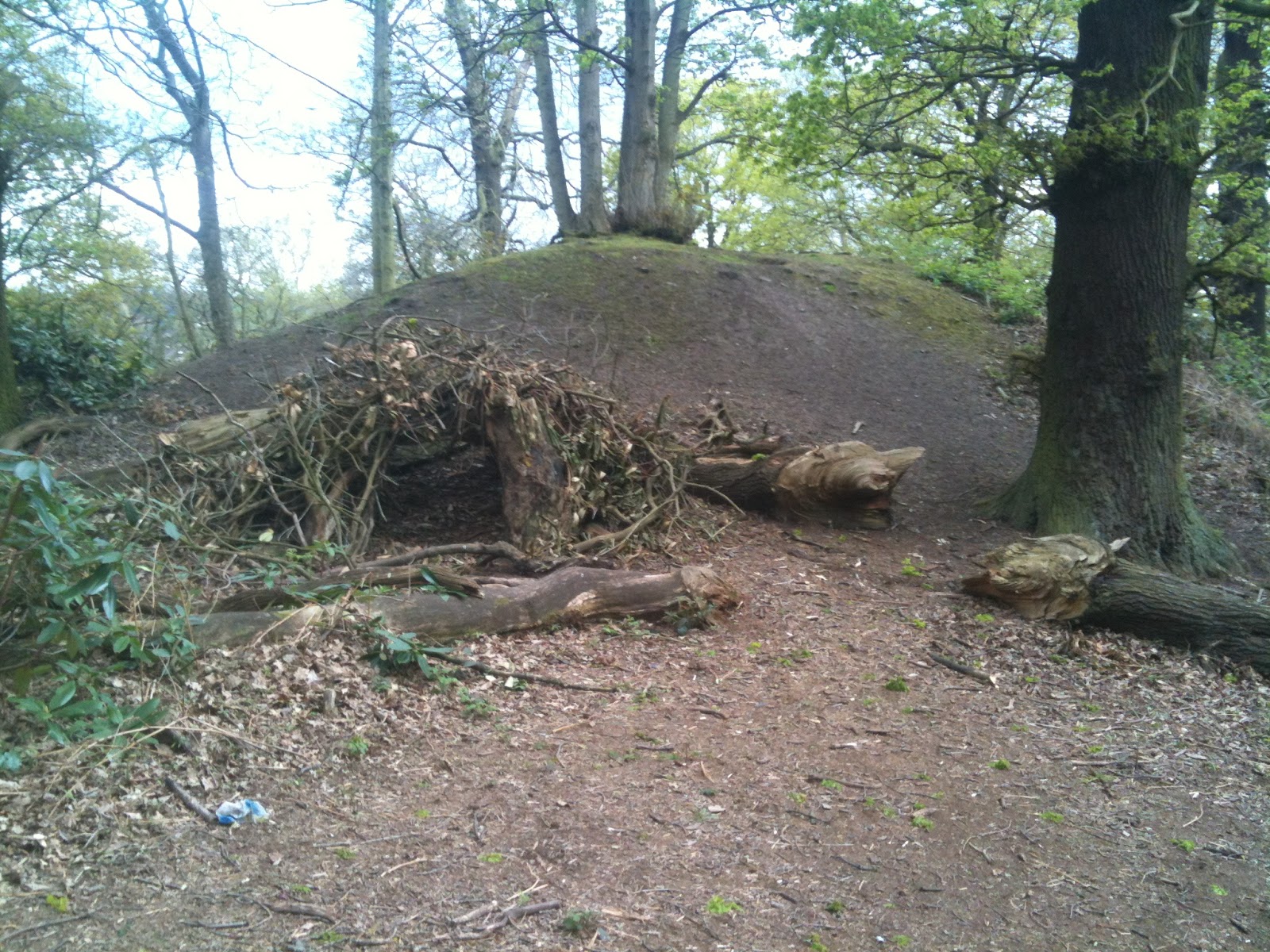
And so the great pigeon question has been answered - roadkill I can just about handle. Killing is something I am still not ready for. It does seem rather pathetic, but I am being honest with myself, which would be fine if I was a vegetarian, and wasn't expecting other people to kill animals for me to eat.

I have watched some of 'The Island with Bear Grylls' series 2, where a group of women and a group of men were left to survive on separate desert islands. It was interesting to see the women struggling with the dilemma of killing their adopted pet piglets (episode 6), which they aptly named Sage and Onion. In a situation where you are starving hungry your survival instinct clearly kicks in and they describe not thinking of them as animals anymore, just food. If you think you have the strength for this then you can apply for the next series here.
I started watching The Trews - the news if it were true. I admit that I used to find it extremely uncomfortable to watch Russell Brand, but on his own for 10 minutes he seems a lot calmer and he has been saying the kind of things that I want to hear. I even watched his new film with Michael Winterbottom The Emperors New Clothes that came out recently. It was really hard to track down a cinema to watch it in, so in the end we paid Amazon and watched it at home. (It is all about not supporting big corporations who don't pay tax like....Amazon!)
Honestly, it is brilliant and well worth watching. Like Russell says, there is nothing in the film that you don't already know, but he puts it across in a way that is powerful, easy to understand and with humour, especially when he drives around in his 'Shop a Banker' van. (In this meaning 'shop' a banker means to grass them up and turn them in to the police, and mimics the government's campaign after the London riots when they used 'Shop a Looter' vans to try to catch people who had stolen a pair of trainers, rather than bankers who cost the country millions.)
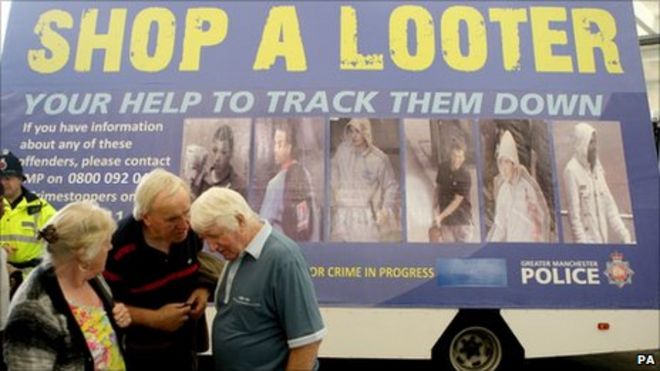
Well I was coming round to Russell's idea, that "things can change" and his stance on voting was not to vote for anyone because they are all the same and none of them stand for real change. For instance the labour party didn't regulate the banks or prosecute any bankers before they lost the last election and the conservative and liberal democrat coalition hasn't acted to rectify this since. They all support the bankers, they all listen to big corporations and put their interests above working people and they are all for austerity measures.
I think Russell has lost sight of this recently and has been charmed by Ed Miliband into advocating voting for his party if you are not in Scotland or Brighton! The Ed Miliband interview looked like Russell was hypnotised, but for the rest of us it was just Ed Miliband saying the same non-committal political spiel that he used in the TV debates.
I haven't followed much of the politics, but I watched the TV debate with 7 candidates, and although we don't usually vote for the same parties, both hubby and I agreed that we would both vote SNP (Scottish National Party) if we could, which of course we can't.... unless we move to Scotland. Nicola Sturgeon had a clear strong message that was anti-austerity, abolishing tuition fees and the bedroom tax - the kind of policies I would really want and expect to see labour supporting. Plus she came across as a strong determined women. There would be no more childish name-calling and bullying in parliament if she was in charge, which I detest from our current prime minister.
I will NEVER vote for conservative, not because of David Cameron or any of their policies, but because I remember growing up during Margaret Thatcher's government. Neither will I ever vote for labour after Tony Blair took us to war with Iraq based on lies. People seem to have forgotten that the labour party didn't regulate the banks and continued privatisation with underhand PFI schemes. They didn't build more council houses, strengthen the unions, or re-nationalise anything. They are not the same party that Clement Attlee led after the war. They are just slightly more left than the conservatives. (As the Green party political broadcast points out)
I read the Liberal Democrats manifesto last time round and it sounded good, so they got my vote. However Nick Clegg completely sold out to the conservatives just to be in a coalition government. There is no point being part of a coalition government if you are not going to stand up for the policies that matter to you. The real joke is that Nick Clegg still thinks that they did. Yes - they have been added to my never-forget-not-to-vote-for-them list!
I am fairly certain that they will be part of a new government though, because they have shown how weak they are. If I was going to try to make a coalition with another party, I would choose one that will go along with everything I say, and the Liberal Democrats have proved they fit this role perfectly!
Thinking about coalitions made me wonder whether Russell was onto something in suggesting voting for labour. For English voters we can't vote for the SNP, but if we want to see them as part of a coalition then really the most likely scenario would be if labour won marginally more seats than the conservatives, though not a full majority. Is there any possibility of SNP, Plaid Cymru and the Green party forming a coalition? Wouldn't that be amazing?
I think Russell was wrong to throw his weight behind labour. He apparently had 10 million followers and if he had supported the Green party or Left Unity that could have made a difference and that could have brought these parties onto the playing field, ready for a Syriza style victory at the following election. Even supporting the "don't vote because they are all a bunch of liars" stance is better than suggesting more of the same. So much for wanting a revolution.
I want a revolution. For the first time I have a local green candidate that I can vote for, called Mark Sissons, who has written a book that sounds rather interesting. I am voting for the green party, because they are anti-austerity, anti-trident and support environmental policies that may yet mean that the planet is still inhabitable for future generations. I am voting Green for what they stand for and my vote still counts even if the Green party don't win the seat, because my vote is about being true to my feelings and views. I vote for change.
Tastier Than Bear's 6: Meat on the Menu [ 23-Apr-15 10:33pm ]Well................I still haven't killed a pigeon, though I bought Hugh Fearnley-Whittingstall's 'The River Cottage Cookbook' (at the carboot sale for 50p) which follows his early antics at River Cottage. He has a whole chapter on Hedgerow, including wild meats, and is informative on preparing pigeon, rabbit, squirrel and ......snails (Hugh and Bear would get on a treat!). So having read more on the subject, I am feeling much more prepared for the pigeon-caught-in-a-net day to arrive.
 But all was not lost on the meat front. Driving along a country lane I spotted some road kill. It was a cock pheasant and looked in very good condition, considering it had been hit by a car. I quickly jumped out and having some compost sacks in the boot, I stuffed the pheasant inside one and drove off full of excitement. This was it - true foraging with my first road kill dinner!
I was heading to collect horse manure from Suella, who is always very generous at sharing her horses' produce and there was quite a gathering. So I consulted with the wise Suella, Janet and Martha on my road kill and the first question was 'Is it still warm?' Why did that not occur to me? I had managed to bag the carcass without touching it, so I tentatively reached inside and yes it was warm, so very fresh. It was a bit smelly, but as they pointed out 'All living creatures are smelly'. Here it is.
Note to self: Don't stuff it in a bag next time, lay it flat! Nice how David Cameron is thoughtfully positioned to be consulting with my dead pheasant ;-)
Hugh doesn't mention pheasant, so I checked out some simple techniques on YouTube for removing feathers and gutting, but they all had shot birds whereas mine was already a bit damaged with guts spilling out. I was quickly losing my nerve, as a pre-packaged chicken doesn't come with the same smell, feathers, feet and undigested corn falling out. So I just dived in and cut out the breasts and quickly discarded the rest. I know it was such a waste, but I was overcome with squeamishness. Bear just rips off the head, feet and wings and skewers it for the fire, but I am not up to that yet (if ever).

I calmed down once faced with just the 2 pieces of breast and chopped them up for a stir-fry. I then dashed out to the woods (not shops) for some accompaniments - more wild garlic, hogweed shoots and stinging nettles.
I decided to break the rules and use some olive oil for frying as it is much easier than to keep adding dribbles of water. The hogweed shoots are absolutely delicious fried and were the best tasting part of the meal still. I may have forgotten to mention that I ate them last week on a bed of dandelion leaf salad, and they are so much more delicious fried than steamed.
The pheasant wasn't gamey (probably because it was too fresh), but rather plain and overcooked. I had thought to cook the breasts whole, so that I could leave them pink in the middle, but this was road kill and overcooked seemed a far safer option, if somewhat less appetising.
So I have eaten foraged meat and I survived ;-) There may be more meat menus to follow, if I can catch one of those darn pigeons.
The first is pignuts. Not only do these involve a bit more pre-meditation than just pulling a few leaves while I am out walking, because I need tools for digging up the root and permission to dig, but I am having trouble identifying them without digging up the root. There are loads of plants with similar leaves in my woods, but they may also be something nasty like Hemlock, which is somewhat similar. So I need to take a mat and some plant identification books and sit and investigate, which needs the luxury of time and weather.
The second is pigeons. Yes I am carnivore and though I am not keen on eating bitter wiggly worms like Bear Grylls, I am game for some pigeon. A google search for pigeon brings up some really mouth-watering recipes. The wood pigeons we get in the garden have been grazing on locally grown vegetables, bird seed and other delights from the fields nearby, whereas city birds scavenge on rubbish so may not be a good idea. The problem of course is how to catch one and kill it. Road kill is definitely an appealing option, as I am used to dealing with dead carcasses, rather doing any slaughtering myself, but I have not been in luck.
 Mr Twit used Hugtight Sticky Glue, pasted on the branches of a tree to trap birds for his bird pie. I must admit that it does seem a simple idea, not requiring any skill in the catching, but it is also indiscriminate. We really get some of the fattest pigeons in our garden, so a couple of years back, son and hubby decided to rig a trap. It involved my washing basket, propped on a stick. There was a rope tied to the stick and the other end was held by my son, who was sat in a camouflaged hide a few metres away. It was very entertaining, and as you might imagine totally unsuccessful! The pigeons were far too wily to walk under the basket. It was also somewhat of a relief because I didn't really think that either of them would be happy with killing their victim, and I did not want to be the one to do it.
So my mind had moved from traps to weapons. Eldest son has offered to shoot them with his bow and arrow, but having such a small garden with a public path along the side, I am scared of stray arrows causing harm. Maybe I could learn to master a slingshot, although I am the most appalling aim, and slow to boot. Look at these fancy ones which you can buy with seedball ammunition! At worst I would scare the pigeons off my vegetables, and if I got lucky, dinner would hopefully be dead from the impact.
But what if the pigeon was just injured and I had to catch it and kill it? There was only one thing for it. I needed help from an expert. The allotment is full of such experts. The netting designed to protect tender plants from the voracious appetite of greedy pigeons, is not always pigeon proof. A couple of times last spring I saw pigeons that had found a hole to get in, then couldn't escape .......the perfect pigeon traps! I have enlisted the help of an allotment friend and the next time a pigeon is trapped she will guide me to catch it and kill it. She seems quite an expert despite being a vegetarian, and has already dispelled my image of breaking it's neck, as apparently it is too easy to pull the head off - yuk! Bashing it over the head is her preferred technique. You really are going to have to stay tuned for a few more weeks to see whether I have the nerve to pull this one off.

There were several foraging successes this month though, although not a completely foraged meal. The wild garlic leaves are out everywhere now, so I felt no guilt in picking a bag full of leaves and making a batch of wild garlic pesto, following the recipe in the River Cottage Handbook No. 7: Hedgerow by John Wright which is shown below.
50g Wild garlic leaves
30g Pignuts/ cobnuts/ pine nuts, lightly toasted in a pan (I doubled this amount)
30g Parmesan cheese grated
80ml Olive oil plus extra to cover
Salt and pepper to taste
Put in a food processor and blitz, slowly adding the oil. Transfer to a jar and make sure the pesto is covered with olive oil. Keep in fridge for several weeks.
Having not found any pignuts, I roasted some of my remaining cobnut stash, but the resulting pesto was like extremely strong raw garlic. I threw in an equal amount of pine nuts, which balanced out the flavour enough so that I could taste it without burning my mouth. A small spoonful added to pasta sauce is great! Or even as a substitute for garlic butter in garlic bread or very sparingly in a salad dressing.
I also picked a bag full of nettle tops. I think I suffer with mild arthritis in the joints in my hands and have found that nettle stings seem to help. I run my hands through the nettles until they are stung all over, then quickly rub some chewed up plantain over my hands to stop the stinging. The stings still tingle for up to 24 hours, but after that scrubbing the bathroom or weeding the garden doesn't make my joints ache.
The nettle tops were so bright and fresh looking. I made them into nettle soup using another River Cottage recipe. It tasted good, though was not thick enough for my liking, so I will add more potato or some swede next time.
Half a carrier bag of stinging nettle tops
50g butter
1 large onion peeled and chopped
I litre vegetable or chicken stock
1 large potato, peeled and cubed (or maybe 2 if you like a thicker soup)
1 large carrot, peeled and chopped
Salt and pepper to taste
2 tbsp. crème fraiche
A few drops of extra virgin olive oil
A few drops of Tabasco
Melt the butter and cook the onion until soft. Add stock, nettles, potatoes and carrots. Simmer for about 15 mins until potato is soft. puree with a stick blender and season to taste. Spoon into bowls with a teaspoon of crème fresh and drizzle of olive oil and tabasco.
I also picked some hogweed shoots and had them steamed with some chicken risotto. They do resemble asparagus in the texture, though not quite as delicious. Certainly very edible and something I will pick again.
I am still learning new plants all the time and keeping my eyes peeled for any delicious morsels, but growing vegetables is more productive and has to take priority for me over spring, whilst there is so much to be done.
Gold-plated DEC [ 21-Mar-15 2:03pm ]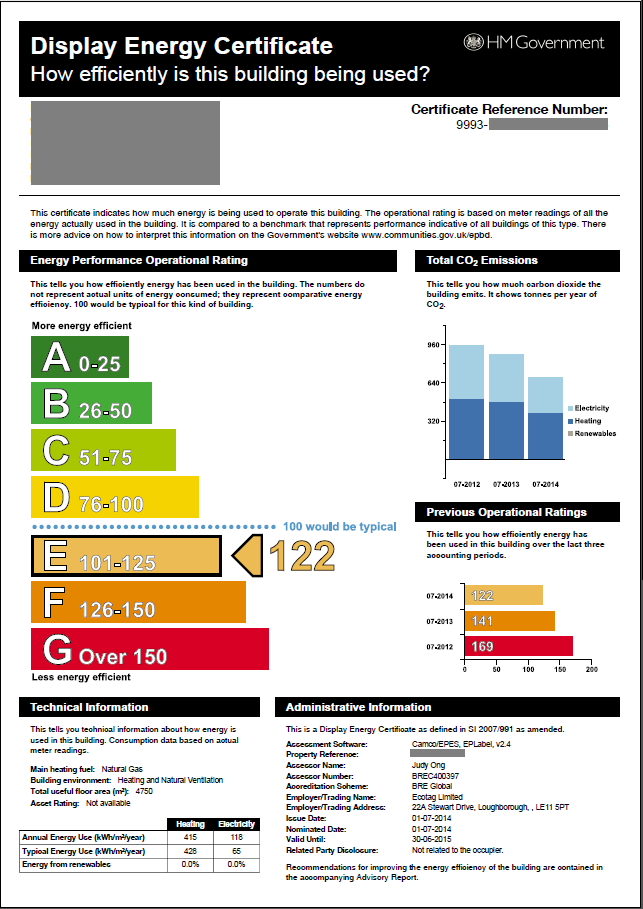
Display Energy Certificates, known as DEC, provide an energy rating for public building such as schools and hospitals over a certain size. This A to G rating is based on the actual energy consumption for the building, so if the energy consumption decreases, the rating will improve. For the DEC shown above, the graphs on the right show that the energy rating has improved significantly each year for this building, from a G in 2012 to an E in 2014.
The DEC need to be displayed in a prominent place, so that if you walk into your local town hall or hospital you can see how much energy they consume compared to the average for that building type. They are a good way of raising awareness, and staff walking past these ratings on a daily basis may become more active in reducing their energy waste.
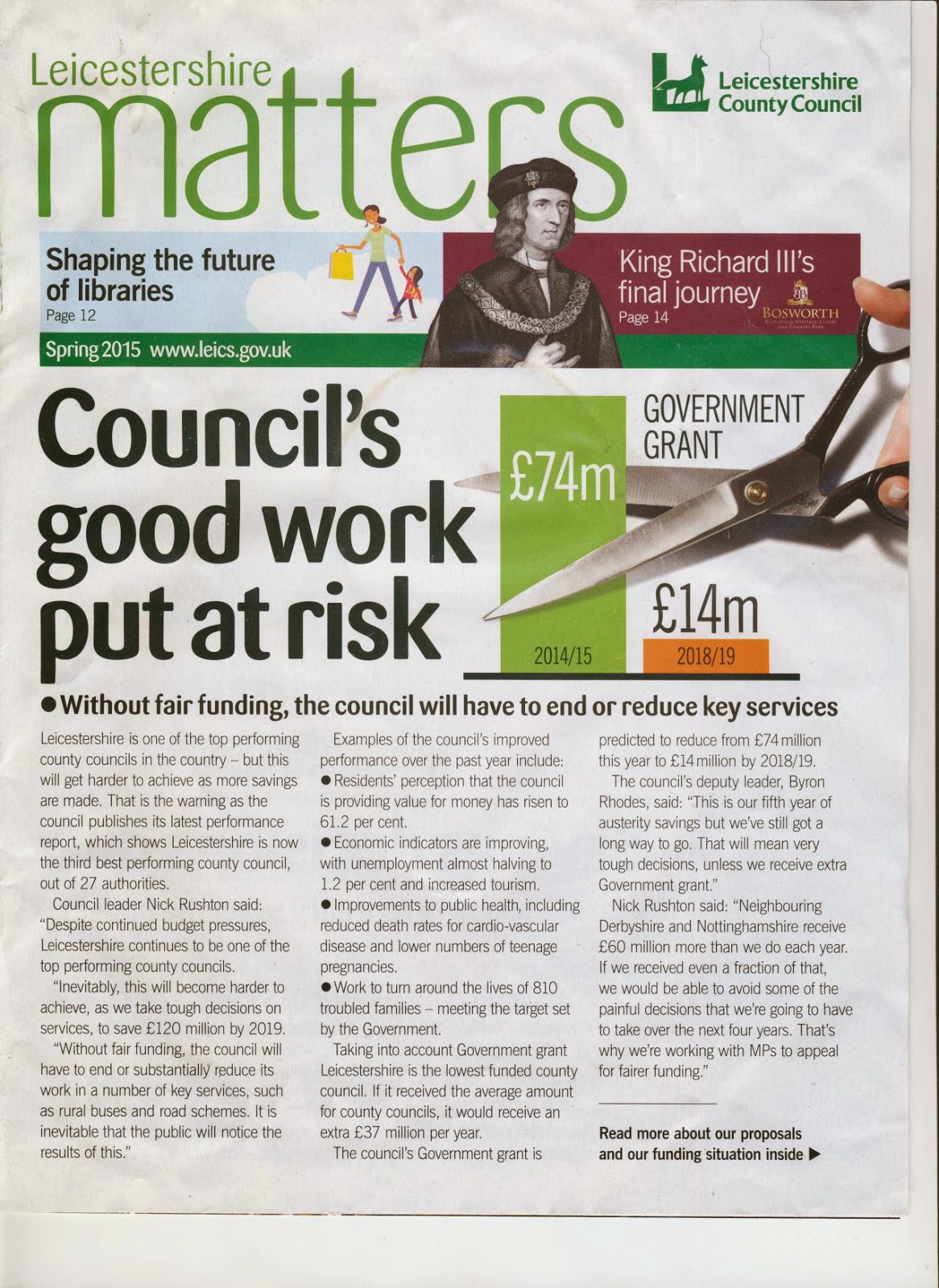
At the same time Leicestershire County Council's newsletter dropped through the door and the extent of cuts they are facing over the next few years as a result of austerity measures is horrendous. The cost of DEC is only a very small slice of the budget, but the focus is clearly going to be on keeping essential services going.
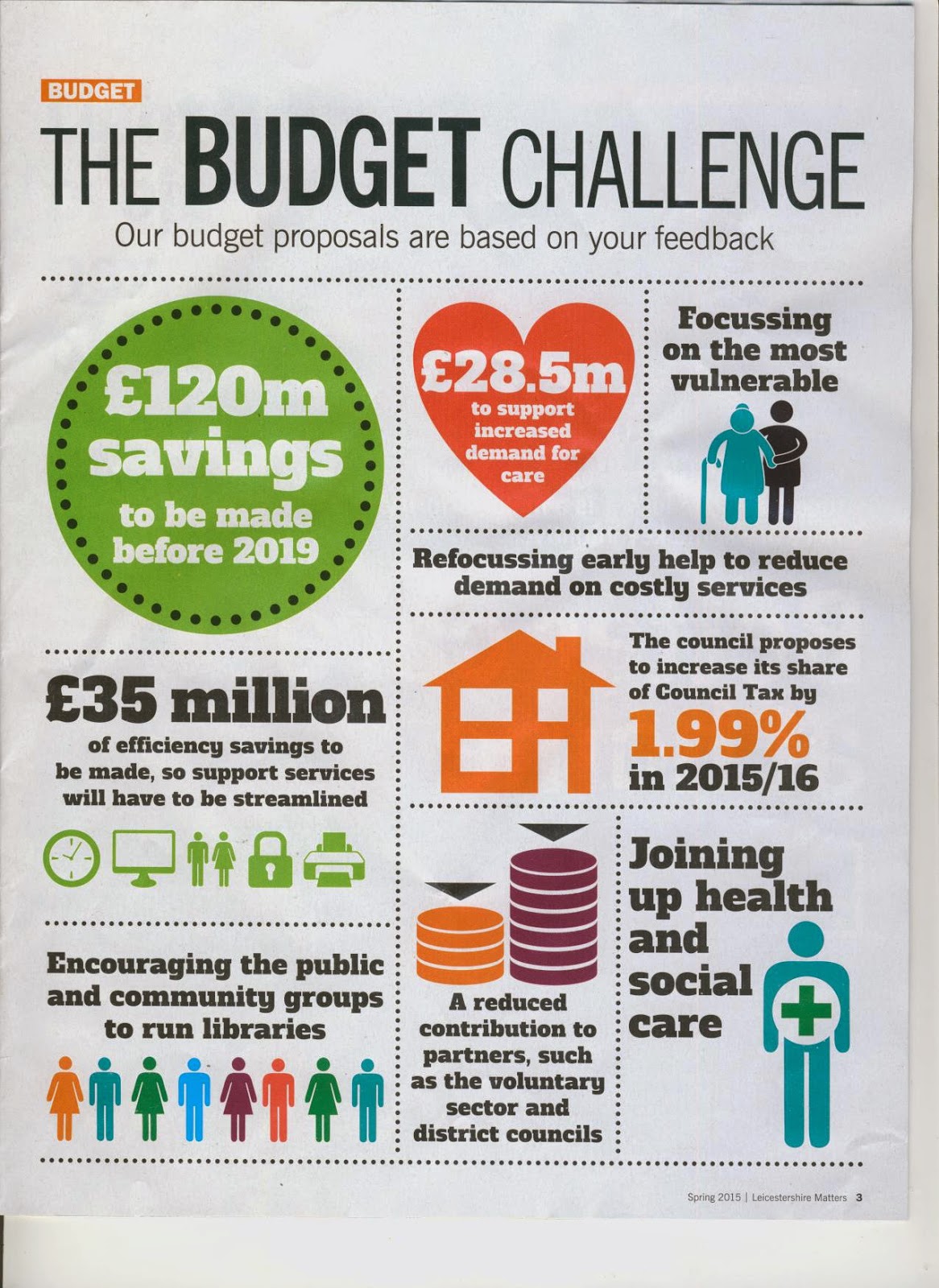
Whatever the responses were to the consultation document, it was already clear that there was a very negative slant towards DEC in the document, referring to them as a 'burden'. DEC have been a large part of my work for the last 7 years, but the picture painted was that they no longer had a future. I was left feeling rather gloomy, that I would inevitably have to find an alternative way to make a living.
Then some of my old colleagues kicked me back into touch. (Thanks Phil, Nick and Bryony!)
In 2008 the legislation forced DEC onto reluctant building managers. Gathering all the data needed was a pain the first few years, because in many cases energy wasn't being managed. Where energy was being managed well, the DEC seemed somewhat superfluous. But over the last 7 years building managers have adapted to using DEC as a tool. The DEC is an independent, annual energy review resulting in a visible, clearly understandable, and easily comparable energy rating. It provides useful information to help building managers make decisions on maintenance, justify investment in efficiency projects and target awareness campaigns.
I know of County Councils who use the DEC energy ratings to help them monitor the energy consumption of their buildings and to target their improvement measures - improvement measures that save them money on energy bills. They want to keep using the DEC as they are a valuable tool.
Headteachers, who have far more to worry about than tracking their complicated energy bills, can see at a glance how their school performs compared to an average school. And yes - they do check out the DEC rating in other schools that they visit! Displaying the energy rating in reception means that a poor G rating cannot be ignored, and is visible for parents, governors and teachers to see. It is a powerful motivation for making improvements.
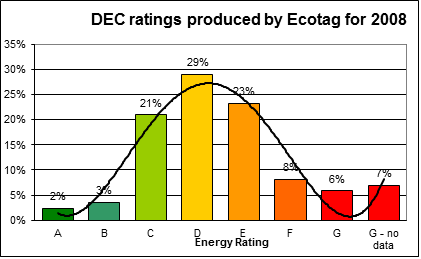
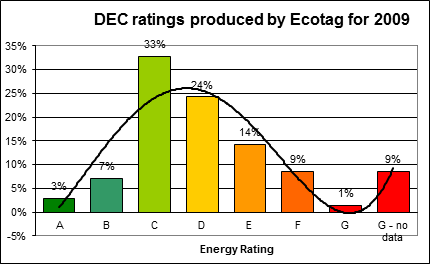
Back in 2009 I compared how the DEC ratings I had produced had changed from the previous year. You can see that in general there was a shift towards the higher A, B and C rated certificates. The graphs above show that even in just one year there was an improvement in energy ratings, which means my clients actually reduced their energy consumption.

The above DEC is for a leisure centre, where the CHP (combined heat and power unit) was old and the efficiency was deteriorating. The effect of replacing it for a new CHP unit and additional improvements can be seen with the increase in the energy rating for the building from a D to a C. The cost saving was over £20,000 the following year, even after allowing for the effect of weather. What part the DEC played can't really be quantified, but raising the awareness and priority of energy efficiency improvements can have some significant financial benefits.
DEC aren't a financial burden, they are a money saving tool. Evidence from the Department of Energy and Climate Change, shows significant energy efficiency improvements between 2008 and 2012, which outweighs the cost of providing DEC. Shame that CLG, sees DEC as a 'burden' and wants to reduce or eliminate DEC requirements. Many of the proposed changes in the consultation would undermine DEC and make them almost useless as a tool for encouraging energy efficiency. CLG must understand that, yet they continue to push for dismantling them.
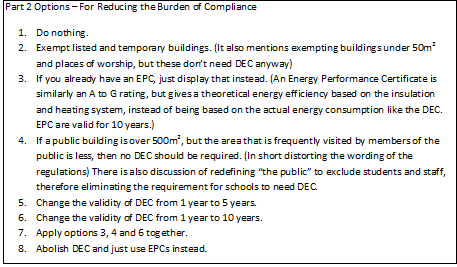 All the options DCLG provide in the consultation (my summary above) are to cut corners, whilst trying to stay just within the boundaries of the mandatory EU Directive. If the intention was to save money rather than reduce the 'burden', there could have been several options for improving the DEC to make an even bigger impact on reducing energy consumption. This would be a win-win for public bodies looking for efficiency savings, and also the government who has a legally binding carbon reduction target to meet. I get the impression this has all been tossed aside in favour of protecting energy company profits instead, as they are the only ones to lose out from further energy efficiency measures.
Well, if you have been following for a while, you may know that I am not a 'cut and run' type of person. If I can't make a stand and act when it is about DEC, which I am an expert on, then when will I ever make a stand on anything? So......... I have made a decision. I am not waiting for any of these bad outcomes to be enforced by people who are really rather ignorant about energy certificates.
Saving energy is hard. It is an uphill struggle, with investment seen as the lynch pin. My clients want things that are easy and that work to reduce energy consumption, and for this the current DEC aren't good enough. With some small tweaks, they could be so much better - Gold-Plated in fact, but with little to no change to the clients 'burden'.
For example, the value on the current energy certificates is a carbon ratio, quite meaningless to most people. But in the process of gathering all the energy data, I end up with all the cost data too. Displaying the cost of energy consumption as well would help understanding. As in the leisure centre example above, a £20k saving has a much bigger impact on people than seeing a C rating. Equating that cost into something real, like how many nurses or teachers that money could employ if it wasn't spent on energy, would help to hit the message home. For an individual, using the stairs instead of the lift may seem like a tiny insignificant amount of energy in a large hospital, but when that energy is equated into real people and jobs saved (or climate change and lives) it is energy that is well worth saving.
I can't change the actual DEC certificate, but I can change how it is presented and provide additional information with it. I can't change the legal requirements of DEC, but I can demonstrate the benefits of having them, and encourage voluntary DECs. Already I have clients who have decided to go beyond the minimum requirements. And as an energy assessor I always strive to provide more value than the basic energy certificates require, with advice on energy bills and added details for recommendations.
Working with my regular clients I will be setting up some trials to see what improvements to the DEC give the best results for the least additional burden. My target is that within 3 years, every DEC I produce will be a Gold-Plated. I will also make all the results and Gold-Plated DEC templates freely available for everyone to benefit from. So if you are a disenchanted energy assessor, accreditation body or building manager and want more than CLG are offering, spread the word - Gold-Plated DEC will be coming your way soon!


