
A voiceover previewing a new sci-fi movie narrated, "The newcomers had killed their planet, just like we are." The ominous fiction rings true to today's reality. US President Donald J. Trump has rejected any gesture of global climate cooperation from allies and has withdrawn the US from the Paris climate ... [continued]
The post Can We Dare To Be Hopeful About Clean Energy? appeared first on CleanTechnica.
 Alive Color Stock/Shutterstock
Recent investigations have uncovered forced labour in agricultural supply chains, illegal fishing feeding supermarket freezers, deforestation embedded in everyday food products, and unsafe conditions in factories producing "sustainable" fashion. These harms were not visible on labels. They surfaced only when journalists, whistleblowers or activists exposed them.
And when they did, something predictable happened. Consumers felt uneasy. Brands issued statements. Promises were made. The point is that the force that set change in motion was not regulation. It was consumers.
Discovering that an ordinary purchase may be tied to exploitation or environmental damage creates a jolt of personal responsibility. In our research, we found that when environmental consequences are clearly linked to people's own buying choices, many are willing to switch products — especially when credible alternatives exist.
But guilt is private. It nudges personal behaviour. It does not automatically reshape systems. The shift happens when private discomfort becomes public voice.
Consumers are often also the first to make hidden environmental harms visible. They post evidence on social media. They question corporate claims. They compare sustainability promises with independent reporting. They organise petitions, boycotts and review campaigns. By shining a spotlight on the truth, the scrutiny shifts from shoppers to brands.
That shift matters because modern brands depend on trust. Reputation is an asset. When sustainability claims are publicly challenged, credibility is at risk. Research in organisational behaviour shows that firms respond quickly to threats to legitimacy. Reputational damage affects customer loyalty, investor confidence and regulatory attention.
In many high-profile cases, supply chain reforms have followed intense public scrutiny rather than quiet compliance checks. Leaders may not act out of moral awakening — but they do act when inaction becomes costly to their reputation.
Consumers can trigger the emotional chain reaction. They feel guilt. They seek information. They speak collectively. That collective voice generates corporate shame.
 Consumers have the power to demand more transparency from brands.
Stokkete/Shutterstock
Consumers have the power to demand more transparency from brands.
Stokkete/Shutterstock
Sustainability professor Mike Berners-Lee argues in his book A Climate of Truth that demanding honesty is one of the most powerful climate actions available to citizens. Raising standards of truthfulness in business and media changes incentives. When the gap between what companies say and what they do becomes visible, maintaining that gap becomes harder.
Our research explores how that visibility can be strengthened. The findings were clear. When environmental and social consequences are personalised and traceable, sustainability feels less distant. People see both their own role and the role of particular firms. That dual awareness encourages two responses: behavioural change driven by guilt and corporate accountability driven by shame.
Shame works because it is social. Brands care about how they are seen. When the negative environmental and social effects of supply chains can be publicly connected to named products, corporate narratives become contestable in real time.
Making supply chains socially visibleThe technology to improve transparency already exists. Companies track goods through logistics systems, supplier databases and digital product-tagging that collect detailed information about sourcing and production. The barrier is not data collection. It is disclosure.
Environmental indicators — carbon emissions, water use, land conversion risk, labour standards compliance — can be linked to products through QR codes or retail apps. Comparable reporting standards would ensure consistency. Simple digital interfaces would make information accessible. Social sharing tools would allow consumers to compare and discuss findings publicly.
Social media is crucial. It already enables workers, communities and campaigners to challenge corporate messaging. Integrating verified supply chain data into these spaces would shift transparency from crisis response to everyday expectation.
This strategy, with its behaviour change directive, could work more effectively than rules or green marketing campaigns alone.
Regulation is essential but often slow and uneven across borders. Marketing campaigns can highlight selective improvements while leaving deeper practices untouched. Transparency activated by collective consumer voice operates differently. It aligns emotional motivation with reputational consequence.
Consumers are not passive recipients of information. They are catalysts. By feeling the first twinge of guilt, asking harder questions and speaking together, they create the conditions under which companies experience shame. When shame threatens trust and market position, change becomes rational and inevitable.
Shame is uncomfortable. But when directed at opaque systems rather than consumers, it can be powerful. By demanding truth and making supply chains socially visible, consumers can push businesses towards greater transparency — and, ultimately, towards more sustainable practice.
Don't have time to read about climate change as much as you'd like?
Get a weekly roundup in your inbox instead. Every Wednesday, The Conversation's environment editor writes Imagine, a short email that goes a little deeper into just one climate issue. Join the 47,000+ readers who've subscribed so far.

Janet Godsell receives funding for the Interact Network+ from the Innovate UK Made Smarter Innovation Programme via the ESRC. She is affiliated with the World Economic Forum (WEF) Advanced Future Council for Advanced Manufacturing and Global Value Chains.
Nikolai Kazantsev receives funding from UKRI funded project "Resilience in Agrifood Systems Supply Chain Configuration Analytics Lab (Project ID: R1650GFS). He is a fellow of Clare Hall College, Cambridge.
After weeks of relentless rain and flooding, and even more forecast, 2025's droughts and hosepipe bans feel like ancient history. But they shouldn't.
The UK is increasingly caught between these wetter winters and warmer, drier summers. What if this year's summer brings water shortages again? The seemingly endless rainfall causing flooding across the UK right now could help solve future summer drought problems - if we capture it right.
The stakes are high in Speyside, home to around half of Scotland's malt whisky distilleries. They had to cope with 2025 being the UK's warmest and sunniest on record, where prolonged dry conditions led to widespread restrictions on water abstraction. Multiple distilleries were forced into temporary closures, costing the industry millions of pounds and highlighting just how vulnerable even Scotland's famously wet regions are to water scarcity.
Whisky production represents one of the UK's biggest industrial water users. Large quantities of water are required for the distilling process and the product itself, so understanding water conservation is both extremely important for the industry, and can also help others recognise the benefits.
If it was possible to retain this winter's rainfall and release it gradually when it was needed, the nation could become more resilient to both floods and droughts without building expensive new reservoirs.
Managing droughts with floodsAcross Speyside, they're testing ways to slow, store and steadily release water by working with the landscape rather than against it. Distillers have invested in leaky dams (small barriers built across temporary upland streams) to slow the flow of water during heavy rain and allow the rainwater to soak into soil and recharge groundwater.
Leaky dams hold the water at surface level as well helping it store underground. Water in the soil and deeper groundwater move through the subsurface much more slowly than over land - taking weeks or months rather than hours or days - which is why rivers still flow even after long dry spells.
 Tromie river in Speyside.
Ondrej Zeleznik/Shutterstock
Tromie river in Speyside.
Ondrej Zeleznik/Shutterstock
There are other examples of useful interventions. Peatland restoration, wetland creation and tree planting all work by increasing temporary storage in the landscape and slowing the movement of water into rivers.
Research across upland catchment areas in Cumbria and West Yorkshire shows how the principles being tested in Speyside could translate to elsewhere. A large academic review of natural flood management evidence concluded that measures increasing water storage, slowing the flow of water over the land or enhancing soil structure can consistently reduce the peak level of a flood.
This growing body of evidence supports a simple but powerful idea: the UK and other countries could be more resilient to droughts and floods by redesigning landscapes to keep water around for longer.
Three lessons for the rest of the UK1. Design and location matter
Local factors and hydrology (the study of the movement and management of water) can determine what works best where. For example, planting trees "somewhere" delivers far less benefit than planting them in the right places, especially near rivers, near the source of the river, or where soil can absorb water.
2. Benefits must stack up or they won't be adopted
Leaky dams and other projects, such as tree planting, are relatively inexpensive, compared with traditionally engineered flood defences or having to deal with flood and drought consequences. They can deliver benefits at a fraction of the cost, while potentially also increasing biodiversity, soil health, carbon capture and improving water quality.
But there are trade-offs, which need to be assessed early. For example, in some cases, large-scale tree planting can also reduce summer water availability in already stressed catchment areas. Tree canopies can temporarily store water on the leaves, but if this water evaporates it doesn't return to the soil. Tree roots improve the soil so it absorbs and stores more water, but trees can also use more water. The net effects depend on factors such as climate, soil type and tree species.
3. Good governance will unlock funding
When water security has clear economic benefits, businesses are willing to engage. However, investment is not always private, and a recent review showed public funding is often fragmented, with inconsistent planning rules. Strengthening overall governance of these kind of schemes is essential, because farmers, businesses and landowners are far more likely to participate if they benefit.
Managing our landscapes appropriately won't stop all floods or prevent every drought, but it can make both less severe, while restoring habitats, supporting farming, and protecting industries that rely on dependable water supplies.
Every river carrying floodwater to the sea represents water that could be stored for drier months. Thinking ahead for what happens during heavy rains can be part of forward planning for more extreme weather in years to come.

Josie Geris receives funding from the Natural Environment Research Council, Royal Society, the Scottish Government via CREW (Scotland's Centre of Expertise for Waters), and Chivas Brothers.
Megan Klaar receives funding from the Natural Environment Research Council, The Leverhulme Trust and National Trust.
We've got a few days left on our Kickstarter campaign and need a little help getting over the line! There are a handful of different rewards on offer for chipping in. There's a variety of t-shirts, mugs, hoodies, tote bags, etc. to choose from (Smash The Oiligarchy, Keep Calm And ... [continued]
The post Help Us Get Over The Line On Kickstarter! appeared first on CleanTechnica.
This is the third and presumably final article in a series I'm doing on Tesla sales trends in a bunch of European countries in January. The first article explored year-over-year changes in sales and market share for Tesla. However, under that article, some readers suggested looking further back and examining ... [continued]
The post Tesla's Change in Market Share in 13 European Countries appeared first on CleanTechnica.
To put it in perspective
"The frequency of these billion-dollar disasters has changed from about once every 82 days to once every roughly two weeks over the last 10 years"
Collapse related because climate change is causing damage to infrastructure and ecosystems around the world.
Like COVID, the current US president has made the brilliant decision to stop monitoring these disasters in any way.
I feel better already.
submitted by /u/Fast_Performer_3722[link] [comments]
Setting sail from the busy port of Plymouth in Devon, the tall ship Pelican of London takes young people to sea, often for the first time.
During each nine-day voyage, the UK-based sailing trainees, who often come from socio-economically challenging backgrounds, become crew members. They not only learn the ropes (literally) but also engage in ocean science and stewardship activities.
As marine and outdoor education researchers, we wanted to find out whether mixing sail training and Steams (science, technology, engineering, art, mathematics and sustainability) activities can inspire young people to pursue a more ocean-focused career, and a long-term commitment to ocean care.
Research shows that a strong connection with the ocean can drive people to be active marine citizens. This means they take responsibility for ocean health not only in their own lives but as advocates for more sustainable interactions with the ocean.
Over the past year, we have worked with Charly Braungardt, head scientist with the charity Pelican of London, to create a new theory of how sail training with Steams activities can change the paths that trainees pursue.
Based on scientific evidence, our theory of change models how Steams activities can cause positive changes in personal development and knowledge and understanding of the ocean (known as ocean literacy). It shows how the voyages can develop trainees' strong connections with the ocean and encourage them to act responsibly towards it.
Tracking changeSurveys with the participants before and after the voyage, and six months later, measure any changes that occur - and how these persist. Through our evaluation, we're exploring how combining voyages with Steams activities can go beyond personal development to produce deep, long-lasting effects.
Our pilot study has already shown how the sail training and Steams combination helps to develop confidence, ocean literacy and ocean connections.
For example, the boost to self-esteem and feelings of capability that occur on board help young people develop their marine identity - the ocean becomes an important part of a person's sense of who they are. As one trainee put it: "I think the ocean is me and the ocean will and forever be part of me."
Swimming, sailing, even just building a sandcastle - the ocean benefits our physical and mental wellbeing. Curious about how a strong coastal connection helps drive marine conservation, scientists are diving in to investigate the power of blue health.
This article is part of a series, Vitamin Sea, exploring how the ocean can be enhanced by our interaction with it.
As crew members, trainees access a world and traditional culture largely unknown to them before the voyage. They learn to live with others in a confined space, working together in small teams to keep watch on 24-hour rotas.
Trainees are encouraged to step out of their comfort zone through activities such as climbing the rigging and swimming off the vessel. Our pilot evaluation found the voyages built the trainees' confidence and social skills, boosting self-esteem and feelings of capability.
One trainee said: "I've felt pretty disappointed in myself not committing to my education or only doing something with minimal effort. But after this voyage, I want to give it my all."
Read more: Five ways to inspire ocean connection: reflections from my 40-year marine ecology career
The Steams voyages encourage the development of scientific skills and ocean literacy through the lens of creative tasks at sea. These activities are led by a scientist-in-residence who provides mentoring and introduces research techniques.
The voyage gives trainees the opportunity to use scientific equipment, ranging from plankton nets and microscopes to cutting-edge technology such as remotely operated vehicles. The Steams activities introduce marine research as a potential career to these young people. One said they wanted to train as a marine engineer at nautical college following the voyage.
Ocean experiences provide a foundation for ocean connection. Trainees experience the ocean in sunshine and in gales, day and night, rolling with the waves and observing marine life in its natural environment.
Citizen science projects such as wildlife surveys and recorded beach cleans also develop their ocean stewardship knowledge and skills. One trainee explained how they have "become more interested [in] our marine life and creative ways to help protect it".
Over the next 12 months, the information we collect from the voyages will help us to better understand the benefits and contribute to an important marine social science data gap in young people. It is important to understand how to develop young people's relationships with the ocean, and the knowledge and skills that will empower the next generation of marine citizens.
As one trainee put it: "Being out on the Pelican showed me how vast and powerful the sea is - and how important it is to respect and care for it."
Don't have time to read about climate change as much as you'd like?
Get a weekly roundup in your inbox instead. Every Wednesday, The Conversation's environment editor writes Imagine, a short email that goes a little deeper into just one climate issue. Join the 47,000+ readers who've subscribed so far.

Pamela Buchan received funding from Economic and Social Research Council for the research cited in this article. The sail training evaluation project received funding from Sail Training International. We would like to thank Charlotte Braungardt for her contribution to this project.
Alun Morgan is affiliated with the Pelican of London as an Ambassador for the organisation
Aftermath of Storm Nils causes chaos across country with flooding under way or expected on Garonne, Maine and Loire rivers
France has issued red alerts for flooding in three départements as the aftermath of Storm Nils causes chaos across the country.
Flood waters have inundated homes and isolated villages after the Garonne River burst its banks, with hydrologists warning that rain is falling on soils that have hit record-breaking levels of saturation.
Continue reading...
Huge project by Norwegian-owned Scottish Sea Farms gets go-ahead amid concerns over the environmental cost of fish farming and threat to traditional way of life
At Collafirth, north Shetland, Sydney Johnson is unloading bags of two-dozen scallops by throwing them over his head like medicine balls to the pier above. Johnson, who has just finished a 10-hour shift on his boat, the Golden Shore, is concerned that plans for a new salmon farm will put fishers like him and his two sons out of business.
"They say it's just one farm," says Johnson. "But it's one farm more. There's only so much water and we're at saturation point."
Continue reading...
Huge thanks to my February sponsor, John Rember, author of the three-book series Journal of the Plague Years, a psychic survival guide for humanity's looming date with destiny, shaped by his experiences living through the pandemic in his native Idaho. Thoughtful, wry and humane, Journal 1 is a pleasure.
 "Hey everybody! It's mid-month global mean surface temperature snapshot time!
"And yes, that's right, do not adjust your television: at the height of the current La Nina, 2026 year-to-date is more than 1.51°C over the pre-industrial baseline."
[Prof Eliot Jacobson]
https://x.com/EliotJacobson/status/2023048514700521505
 "Upper-ocean heat content data for January showed that the West Pacific Warm Pool was ninth warmest on record, despite a chunk of its heat already being discharged eastward.
"This warmth raises the ceiling on the potential strength of El Niño later this year."
[Ben Noll]
https://x.com/BenNollWeather/status/2023404500044959928
 "A Greenland sled dog champion fears for his culture as climate change melts the ice…
"For more than a thousand years, dogs have pulled sleds across the Arctic for Inuit seal hunters and fishermen. But this winter, in the town of Ilulissat, around 300km (186 miles) north of the Arctic Circle, that's not possible."
https://www.independent.co.uk/news/donald-trump-greenland-arctic-unesco-antarctica-b2921625.html
 "'Daunting but doable': Europe urged to prepare for 3C of global heating…
"Such a dramatic rise in temperatures - the prospect of which has left some leading climate scientists feeling hopeless - would be double the level of global heating that world leaders promised to aim for when they signed the Paris agreement in 2015."
https://www.theguardian.com/environment/2026/feb/16/europe-climate-advisory-board-3c-global-heating
 "UK at risk of more flooding 'for months to come' after record-breaking January…
"The monthly statistics from the UKCEH confirm that Northern Ireland and the southwest of England had their wettest January on record, with 170% of their normal rainfall."
 "Why is sewage spilling into homes and gardens? [UK]
"While each incident has its own trigger, water companies say most sewer flooding is caused by a small number of factors, including blocked pipes, ageing infrastructure and drainage systems overwhelmed by heavy rain."
https://www.bbc.co.uk/news/articles/cr45641y742o
 "Record flooding across France as storms fall on saturated ground.
"Storms have left large parts of France underwater, with record levels of flooding after heavy rain fell on already saturated soil. In Paris, the Seine is four metres above its normal level, forcing the closure of the riverside motorway and some commuter rail stations."
 "Malaga emergency: strong winds fuel bush fire in urban industrial area [Spain].
"…the fire originated in some bushes and the strong winds are hampering extinguishing efforts. The emergency services received at least ten calls reporting the fire around 1.30pm on Monday. The smoke was visible from several parts of the city."
 "Italy's Lovers' Arch Collapses In Storm On Valentine's Day…
"For centuries, the arch had stood as a symbol of romance and enduring love, drawing in thousands of couples, tourists, and hopeful romantics from across the globe. Its sudden disappearance has left locals and visitors alike reeling…"
https://evrimagaci.org/gpt/italys-lovers-arch-collapses-in-storm-on-valentines-day-529677
 "Severe Storms Split Roads, Set Rainfall Record in Corfu.
"Heavy storms have caused widespread flooding, landslides, and road collapses across western and northern Greece, including record rainfall in Corfu, prompting emergency closures and safety warnings for residents and travelers."
https://www.tovima.com/society/severe-storms-split-roads-set-rainfall-record-in-corfu/
 "Antalya endures a year's rainfall in single 40-day stretch [Turkey]…
"For nearly six weeks, these intermittent but intense downpours have ravaged homes, workplaces and greenhouses, prompting local authorities to launch urgent damage assessment efforts across the region. Heavy rain also triggered landslides and road collapses."
https://www.hurriyetdailynews.com/antalya-endures-a-years-rainfall-in-single-40-day-stretch-218975
 "Cyprus appeals to residents to cut water use by two minutes a day amid drought.
"Authorities in Cyprus have urged residents to reduce their water intake by 10% - the equivalent of two minutes' use of running water each day - as Europe's most south-easterly nation grapples with a once-in-a century drought."
 "EXTRAORDINARY HEAT IN AFRICA - 44c [111.2F] at Bokoro, in CHAD; 37c again in ALGERIA.
"Records have been falling for weeks everywhere in North and Central Africa and it will get worse."
[Extreme Temps]
https://x.com/extremetemps/status/2023104259299164639
 "Central Africa Urged to Unite on Early Warnings as Climate Risks Escalate…
"WMO Secretary-General Celeste Saulo delivered a clear message: fragmented approaches must give way to coordinated, science-driven action. "We cannot afford not to work together," she said…"
 "EXTRAORDINARY HEAT IN MOZAMBIQUE:
"42.0C [107.6F] at Beira right on the coast, it smashed its February heat record by 3C. It's one of the most extreme heat events ever seen in Southern African tropics."
https://x.com/extremetemps/status/2022748931558686835
 "Madagascar cyclone death toll rises to 59…
"It is the latest in a string of tropical storms to batter the southern African island in recent months, underscoring its vulnerability to increasingly extreme weather fuelled by climate change… Most of the fatalities were reported in the port city of Toamasina on the east coast, formerly known as Tamata."
https://www.france24.com/en/live-news/20260216-madagascar-cyclone-death-toll-rises-to-59
 "Fourth straight day of heavy air pollution as decades-old heat records broken in Israel.
"Temperatures topped 32°C [89.6F] in several areas, with mid-February records set in the Judean foothills, as dust from Jordan pushed pollution to very high levels nationwide."
https://www.ynetnews.com/environment/article/h1y11jhxubl
 "HISTORIC DAY in Middle East:
"Unprecedented heat for this time of the year with 37C [98.6F] Minagish KUWAIT, 36 Al Wafra, 35 Kuwait Int. AP; Record hot nights everywhere - min. 23.3 in Israel; first tropical night in February at Al Qaysumah SAUDI ARABIA."
https://x.com/extremetemps/status/2022692160802595045
 "Iraqi MPs push Baghdad to curb escalating water shortages.
"On Sunday, lawmakers from Dhi Qar province, southern Iraq, called for an emergency water plan, urging the government to use economic leverage to pressure Turkiye to increase Iraq's water allocations."
https://shafaq.com/en/society/Iraqi-MPs-push-Baghdad-to-curb-escalating-water-shortages
 "This is [central Asian] Russia; this is 1016m asl; this is February and it's 25C [77F] :Shorts, t-shirts and flips flops…
"WORLD RECORDS are being broken with temperatures reaching 33C [91.4F] on the Caspian Sea. Above July averages."
https://x.com/extremetemps/status/2023381768569856467
 "Water scarcity looms for Madhesh residents as wells run dry [Nepal]…
"Activists have protested, held sit-ins, and walked to Kathmandu to demand federal action. But continued encroachment and unregulated exploitation are lowering groundwater levels, turning fertile Madhesh soil into barren land…"
 "Hong Kong records hottest Lunar New Year's Eve on record at 27.9°C [82.2F].
"By around noon, temperatures across the territory generally rose to 26 degrees or above. As of 1.50pm, the Observatory recorded a maximum of 27.9 degrees, making it the hottest Lunar New Year's Eve since records began and breaking the 27.8-degree record set in 1953."
 "RECORD HEAT IN JAPAN - 19.8C [67.6F] Toimi on Sunday broke its February record of highest temperature. More record heat is expected next week
"From Spain to Japan through Mediterranean, North Africa, Middle East, Central & East Asia every single country except Italy has been breaking records."
https://x.com/extremetemps/status/2023219901117390856
 "Korea prepares for growth in subtropical crops…
""In a situation where subtropical fruit cultivation is rapidly expanding due to climate change, the heating energy demand prediction system will serve as a key foundation for reducing management uncertainty for farmers and enabling scientific management of energy use," Kim said."
https://www.fruitnet.com/asiafruit/korea-prepares-for-growth-in-subtropical-crops/270584.article
 "Extreme rainfall is worsening algal blooms along South Korea's coast.
"A new multi-year study, published in Frontiers in Marine Science, tracked water quality in and around a major river estuary and shows how intense downpours can shift where and when these blooms appear, with consequences for marine ecosystems and coastal communities."
https://phys.org/news/2026-02-extreme-rainfall-worsening-algal-blooms.html
 "EXTRAORDINARY HEAT IN SE ASIA. Record heat is all over Asia in every single country…
"39.3C [102.7F] in Thailand, 33C again in Taiwan, records in Indonesia, Philippines, Myanmar, Laos."
https://x.com/extremetemps/status/2023375987812233506
 "Forests are drying up and fires flaring up to the south of Chiang Mai [Thailand].
"…fires have begun spreading into the southern part of Chiang Mai over the past 1-2 weeks, moving north from Tak and Lamphun provinces. The most serious situation is currently in Doi Tao district and parts of Ob Luang National Park."
 "Riau declares emergency alert for forest fires Riau Police chief spokesman. [Indonesia]
"Sr. Comr. Zahwani Pandra Arsyad said all regional police forces had been instructed to increase patrols and surveillance in regions prone to forest fires to prevent them from spreading."
 "Massive Sinkhole Devours Farmland In Indonesia, Farmers Fear More Collapse…
"Central Aceh Regent Haili Yoga said the ground instability dates back years but accelerated after major flooding in late 2025… Geologists say the underlying mix of volcanic tuff and sand absorbs groundwater easily…"
 "The southern Indian Ocean off the west coast of Australia is becoming less salty at an astonishing rate, largely due to climate change, new research shows…
""We're seeing a large-scale shift of how freshwater moves through the ocean," said Weiqing Han, professor in the Department of Atmospheric and Oceanic Sciences."
https://phys.org/news/2026-02-ocean-saltiest-regions-freshening-circulation.html
 "Australian fire authorities say currents tools and methods not adequate to keep up with bushfires.
"Australia's leading fire authorities are warning that the country's bushfire detection and suppression systems must be radically modernized, arguing that climate‑driven fire behaviour is now outpacing traditional response models…"
 "'Too late to leave': Victorian towns told to take shelter.
"Emergency services have issued the ultimate warning to three communities trapped by bushfire: 'You are in danger and need to act immediately to survive.' Three central Victorian communities have been told it is too late to flee as an out-of-control bushfire burns amid extreme fire conditions across the state."
 "New Zealand hit by storms and widespread floods.
"[The storm's] arrival came after days of widespread flooding in the Ōtorohanga district, where a man was found dead after his vehicle became submerged in flood waters. Some areas recorded more than 100mm of rain in 24 hours on Thursday"
 "Beyond the beaches, Wellington's catastrophic sewage spill could be bad news for coastal ecosystems.
"Public concern over the total failure of the Moa Point wastewater treatment plant on Wellington's south coast has been growing, despite this week's announcement of an independent review."
 "Mapping tipping risks from Antarctic ice basins under global warming…
"A first threshold, potentially as low as 1-2 °C above pre-industrial levels, triggers the long-term collapse of ~40% of marine ice volume in West Antarctica."
https://www.nature.com/articles/s41558-025-02554-0
 "HISTORIC HEAT WAVE IN SOUTH AMERICA:
"It's like a never ending record heat with records broken and rebroken continuously, especially Between Bolivia and Paraguay. Today 39.7C [103.5] at Puerto Suarez, BOLIVIA: hottest February day in history."
https://x.com/extremetemps/status/2023597259993071771
 "Amazon rainforest flipped to carbon source during 2023 extreme drought, study shows…
"In 2023, the region experienced unusually high temperatures, reaching 1.5°C above the 1991-2020 average, accompanied by unusual levels of atmospheric dryness from September to November. These conditions were caused by warmer water temperatures in the Atlantic and Pacific Oceans…"
https://phys.org/news/2026-02-amazon-rainforest-flipped-carbon-source.html
 "Temperatures up to 40° above normal Tuesday across the Nation's middle [US].
"For example: Omaha NWS calling for 76°!! Normal high is 39°. Heat spreads east this week. Hundreds of records in jeopardy!" [Jeff Berardelli]
https://bsky.app/profile/weatherprof.bsky.social/post/3meznrz5l4c2u
 "Colorado sets record for warmest winter days as state braces for a blizzard and extreme fire danger.
"Colorado set a record this week for the most 60-degree days in a single winter season, and forecasters say the state's wild weather is far from over. Blizzard warnings in the mountains and extreme fire danger on the Eastern Plains are expected on Tuesday."
https://www.yahoo.com/news/articles/colorado-sets-record-warmest-winter-013328077.html
 "As a Colorado River deadline passes, reservoirs keep declining…
"Officials for the seven states have tried to boost reservoir levels via voluntary water cutbacks and federal payments to farmers who agree to leave fields dry part of the year. But after more than two years of trying to hash out new long-term rules for sharing water, they remain deadlocked…"
https://phys.org/news/2026-02-colorado-river-deadline-reservoirs-declining.html
 "We say snowmageddon as a joke, but if ever there was a time to use it, it's now!!
"Watch as the West Coast gets bombarded by at least 5 storms in 15 days, with up to 15 feet of snow in the high Sierra, and that may be an underestimate if the models verify. NWS says 8 feet possible by Wednesday. Incredible!" [Jeff Berardelli]
https://x.com/WeatherProf/status/2023194350138617970
 "High temperatures and low snowpack may mean less water for Nebraska this summer…
"Rivers like the Platte River rely on mountain snowmelt, with 60% to 80% of its annual streamflow coming from snowpack in Colorado and Wyoming. Johnson said the biggest concern is not the initial spring melt, but what will happen later in the season."
 "Data Centers Push Great Lakes Region to the Brink…
"The biggest data centers consume more than 365 million gallons of water annually, and data center water usage in the US tripled between 2014 and 2023, placing enormous strain on regional water resources."
 "Weeks after Toronto's record snowfall, some residents are still struggling to use sidewalks…
"In a statement to CBC Toronto, a spokesperson for the city said snow removal is an "intense, multi-step process" that includes many crews and heavy machinery. "Crews continue to remove snow on bikeways, narrow residential streets and sidewalks," Jas Baweja said."
https://www.cbc.ca/lite/story/9.7091852
 "Turtles breeding earlier, but half as often, due to climate change.
"The researchers found that warmer sea surface temperatures cause turtles to arrive and nest earlier in the season. However, the decline of ocean productivity along their West African feeding grounds, has meant females are taking longer breaks between seasons."
I rely on donations and tips from my readers to keep the site running. Every little bit helps. Can you chip in even a dollar? Buy me a coffee or become a Patreon supporter. A huge thank you to those who do subscribe or donate.
You can read the previous "Climate" thread here. I'll be back tomorrow with an "Economic" thread.
The post 17th February 2026 Today's Round-Up of Climate News appeared first on Climate and Economy.
It is well understood that human-caused climate change is causing sea levels to rise around the world.
Since 1901, global sea levels have risen by at least 20cm - accelerating from around 1mm a year for much of the 20th century to 4mm a year over 2006-18.
Sea level rise has significant environmental and social consequences, including coastal erosion, damage to buildings and transport infrastructure, loss of livelihoods and ecosystems.
The Intergovernmental Panel on Climate Change (IPCC) has said it is "virtually certain" that sea level will continue to rise during the current century and beyond.
But what is less clear is exactly how quickly sea levels could climb over the coming decades.
This is largely due to challenges in calculating the rate at which land ice in Antarctica - the world's largest store of frozen freshwater - could melt.
In this article, we unpack some of the reasons why projecting the speed and scale of future sea level rise is difficult.
Drivers of sea level riseThere are three principal components of sea level rise.
First, as the ocean warms, water expands. This process is known as thermal expansion, a comparatively straightforward physical process.
Second, more water gets added to the oceans when the ice contained in glaciers and ice sheets on land melts and flows into the sea.
Third, changes in rainfall and evaporation - as well as the extraction of groundwater for drinking and irrigation, drainage of wetlands and construction of reservoirs - affect how much water is stored on land.
In its sixth assessment cycle (AR6), the IPCC noted that thermal expansion and melting land ice contributed almost equally to sea level rise over the past century. Changes in land water storage, on the other hand, played a minor role.
However, the balance between these three drivers is shifting.
The IPCC projects that the contribution of melting land ice - already the largest contributor to sea level rise - will increase over the coming decade as the world continues to warm.
The lion's share of the Earth's remaining land ice - 88% - is in Antarctica, with Greenland accounting for almost all of the rest. (Mountain glaciers in the Himalaya, Alps and other regions collectively account for less than 1% of total land ice.)
However, it is difficult to project exactly how much Antarctic ice will make its way into the sea between now and 2100.
As a result, IPCC projections cover a large range of outcomes for future sea level rise.
In AR6, the IPCC said sea levels would "likely" be between 44-76cm higher by 2100 than the 1995-2014 average under a medium-emissions scenario. However, it noted that sea level rise above this range could not be ruled out due to "deep uncertainty linked to ice sheet processes".
The chart below illustrates the wide range of sea level rise projected by the IPCC under different warming scenarios (coloured lines) as well as a possible - but unlikely - worst-case scenario (dotted line).
The shaded areas represent the "likely range" of sea level rise under each warming scenario, calculated by analysing processes that are already well understood. The worst-case scenario dotted line represents a future where various poorly understood processes combine to lead to a very rapid increase in sea levels.
The graph shows that sea level rise increases with warming - and would climb most sharply under the "low-likelihood, high-impact" pathway.
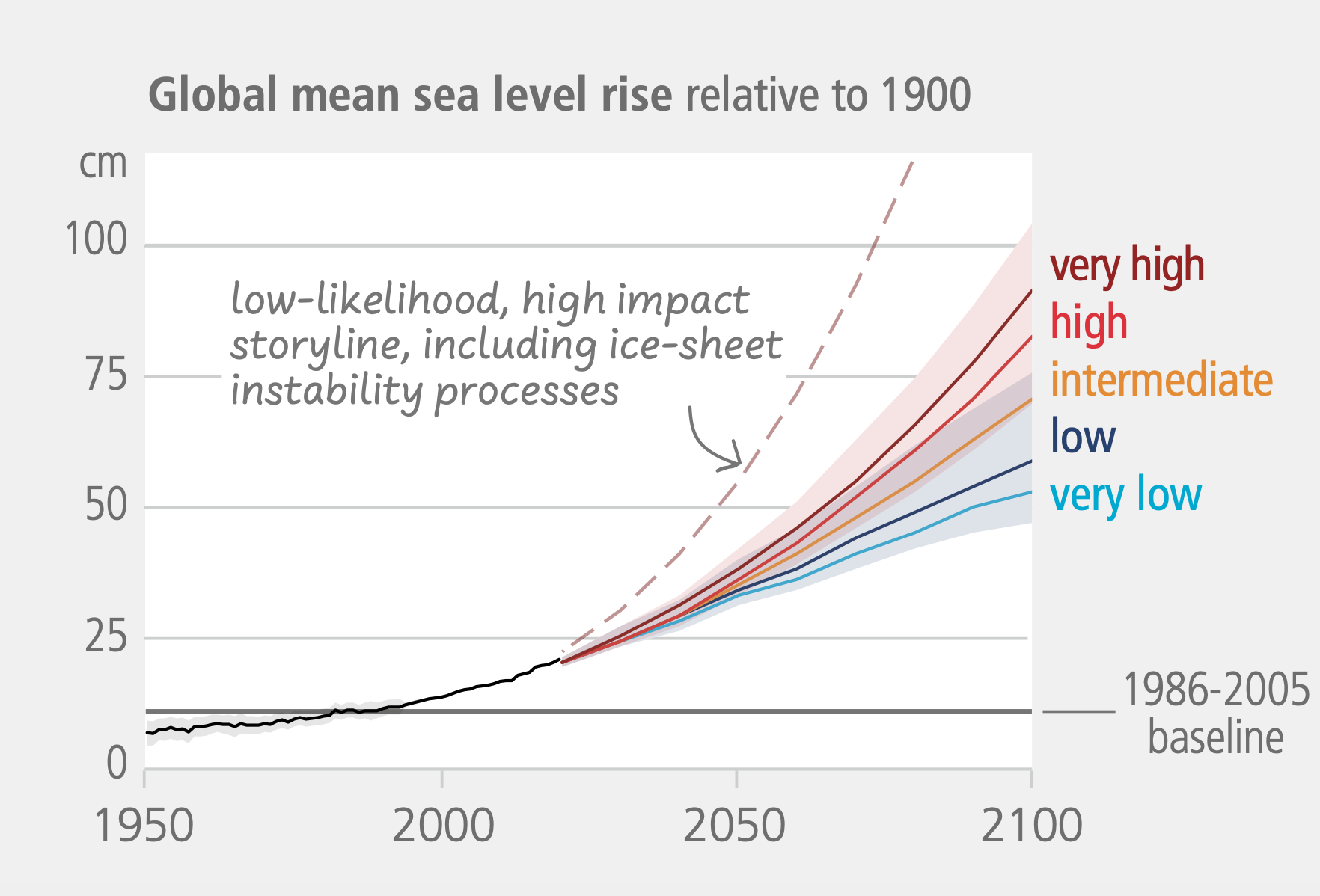 Projections of global sea level rise in very high (dark red), high (red), intermediate (orange), low (dark blue) and very low (light blue) warming scenarios, based on IPCC projections. The shaded areas represent the "likely range" of sea level rise, which only takes into account processes that are already well understood. The dotted line represents a worst-case scenario where various poorly understood processes combine. Adapted from IPCC (2023)
Retreat of glacier grounding lines
Projections of global sea level rise in very high (dark red), high (red), intermediate (orange), low (dark blue) and very low (light blue) warming scenarios, based on IPCC projections. The shaded areas represent the "likely range" of sea level rise, which only takes into account processes that are already well understood. The dotted line represents a worst-case scenario where various poorly understood processes combine. Adapted from IPCC (2023)
Retreat of glacier grounding lines
In Antarctica, the melting of ice on the surface of glaciers is limited. In many locations, warmer temperatures are leading to increases in snowfall and greater snow accumulation, which means the surface of the ice is continuously gaining mass.
Most of Antarctica's contribution to global sea level rise is, therefore, not linked to ice melt at the surface. Instead, it occurs when giant glaciers push from land into the sea, propelled downhill by gravity and their own immense weight.
These huge masses of ice first grind downhill across the land and then along the seafloor. Eventually, they detach from the bedrock and start to float.
These floating ice shelves then largely melt from below, as warm ocean water intrudes into cavities on its underside. This is known as "basal melting".
The boundary between grounded and floating ice is known as the "grounding line".
In many regions of Antarctica, grounding lines typically sit at the high point of the bedrock, with the ice sheet deepening inland. This is illustrated in the graphic below.
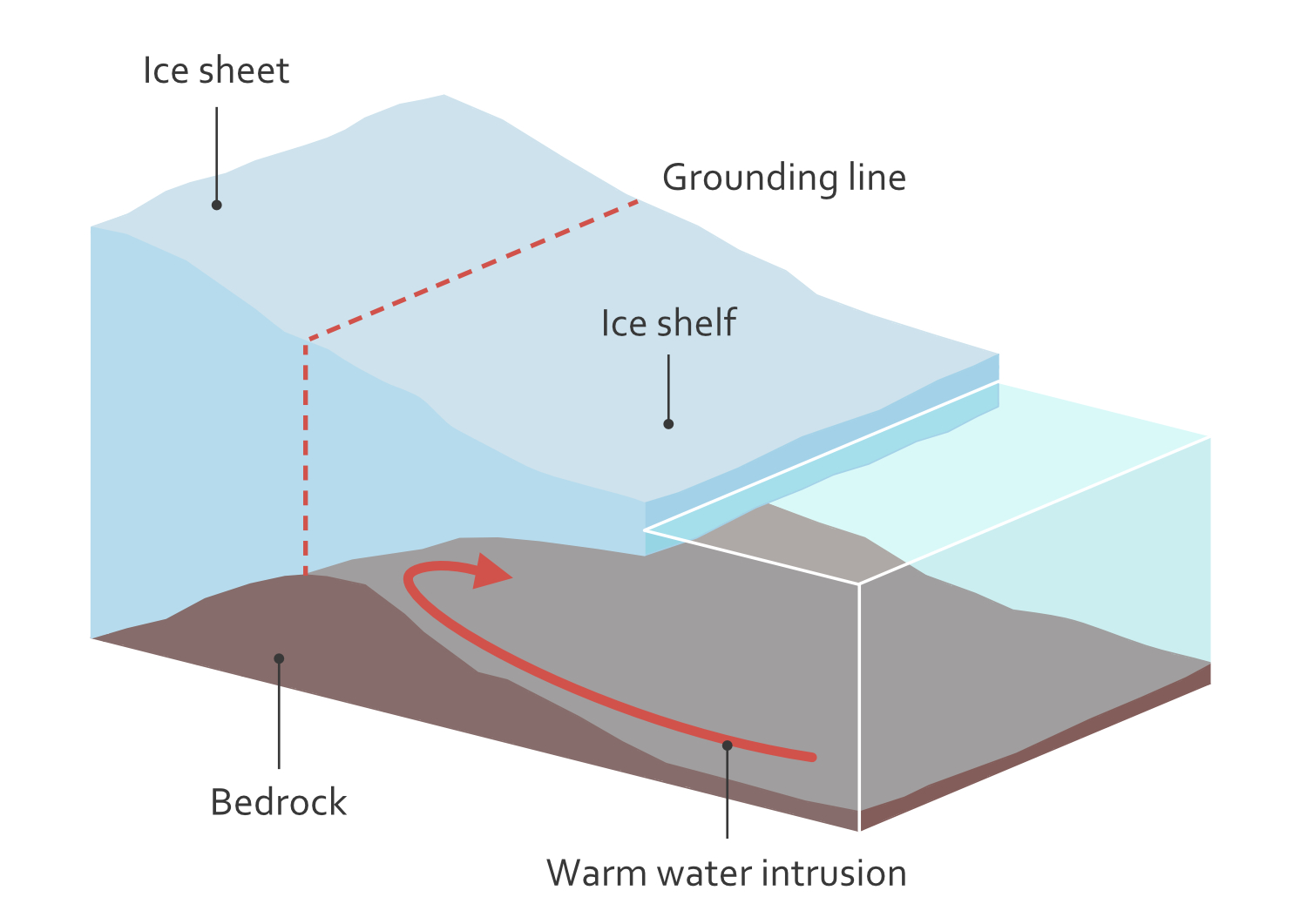 Illustration of an Antarctic ice sheet, showing the grounding line where grounded ice transitions to floating ice, and how warm ocean water intrudes beneath the ice shelf, melting it from below. Credit: Freya Sykes, iC3.
When a grounding line is at a high point of the bedrock, it acts as a block which limits the area of ice exposed to basal melting.
However, if the grounding line retreats further inland, warm water could "spill" over the high point in the bedrock and carve out large cavities below the ice. This could dramatically accelerate the retreat of grounding lines further inland across Antarctica.
There is evidence to suggest that the retreat of grounding lines might cause a runaway effect, in which each successive retreat causes the ice behind the line to detach from the land even more quickly.
Recent climate modelling suggests that many grounding lines are not yet in runaway retreat - but some regions of Antarctica are close enough to thresholds that tiny increases in basal melting push model runs toward very different outcomes.
Whether - and to what extent - grounding lines might retreat will depend on a wide range of factors, including the exact shape of the bedrock beneath the ice. However, the bedrock on the coast of Antarctica has not yet been precisely mapped in many places.
Ice shelvesOnce Antarctic ice detaches from the seabed, it floats on the ocean surface. These floating ice shelves slow the flow of ice from land towards the sea, acting as a brake as they wedge between headlands and little hills on the seafloor.
If these ice shelves break apart, the flow of glaciers towards the sea can accelerate.
The image below on the left shows a present-day ice shelf that is pinned in place by bedrock, which slows the flow of the ice into the sea.
The image on the right shows a future scenario in which ocean water continues to intrude under the ice, accelerating basal melting on the underside of the floating ice until it completely detaches from the "pinning point" that had previously held it in place.
In this scenario, the bedrock is no longer acting as a break on glaciers pushing to the sea and the ice shelf starts flowing into the sea more quickly and begins breaking up. Ice masses inland then begin to push more rapidly towards the sea.
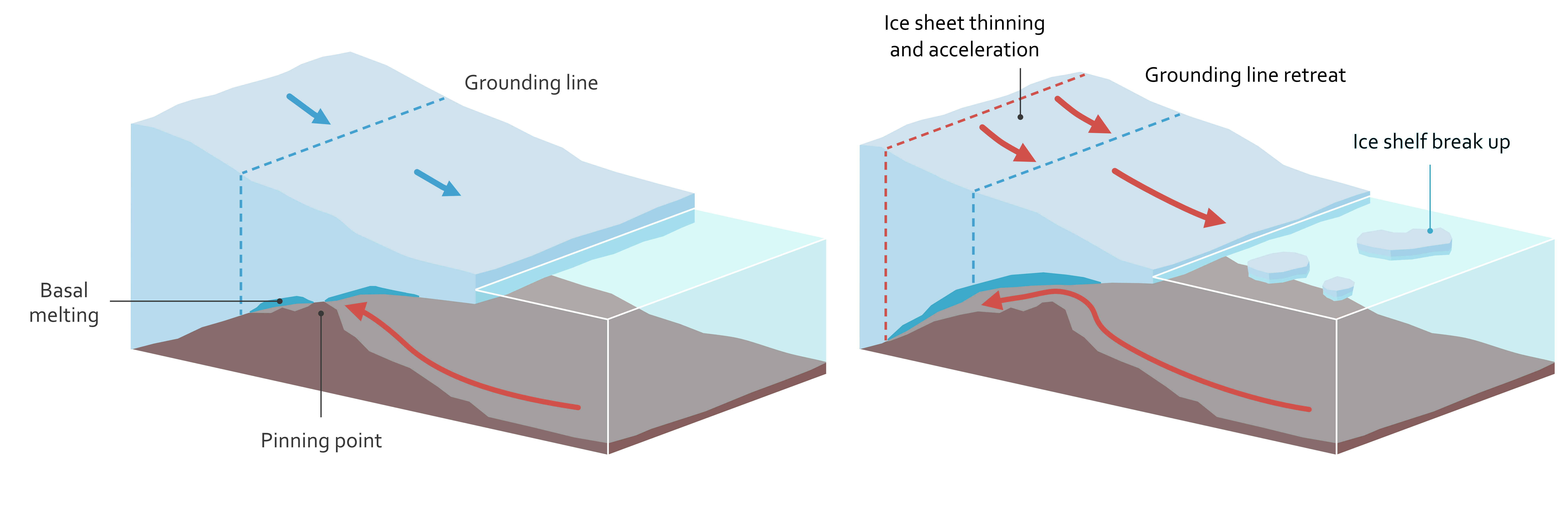 Illustration of an Antarctic ice shelf. On the left, the ice is being held in place by a "pinning point" - a bump in the bedrock which temporarily acts as an anchor. On the right, the ice shelf has detached from the pinning point, meaning that both the ice shelf and the masses of ice piled up behind it start flowing into the sea more rapidly. Credit: Freya Sykes, iC3.
This dynamic was directly observed during the collapse of the Larsen-B ice shelf on the Antarctic Peninsula in 2002, which led to accelerated glacial ice flow and is believed to have contributed to a dramatic glacial retreat two decades later.
However, the factors affecting the stability of the floating ice shelves around Antarctica's coast are complex. The strength of ice shelves depends on their thickness, how and where they are pinned to the seafloor, how cracks grow, as well as air and sea temperatures and levels of snow and rainfall. For example, meltwater at the surface can lever cracks further apart, in a process known as hydrofracturing.
A 2024 review of the stability of ice shelves found big gaps in scientific understanding of these processes. There is currently no scientific consensus on how rapidly various ice shelves might collapse - the pace is likely to vary greatly from one ice shelf to the next.
Ice-cliff collapseIf, and when, ice shelves collapse and drift away from the coast, they will expose the towering ice cliffs that loom behind them directly to the sea. These ice cliffs can be more than 100 metres tall.
This exposure could potentially lead to those cliffs to become structurally unstable and collapse in a runaway process - further accelerating the advance of the glaciers pushing towards the sea.
The images below illustrate how such a collapse might unfold. In the top image, a floating ice shelf buttresses the ice masses behind it. In the middle image, the ice shelf has largely broken apart and melted into the sea. In the bottom image, the ice shelf has completely disappeared, leaving a steep wall of ice towering over the sea. At this point, the exposed cliffs might collapse and crash into the water below.
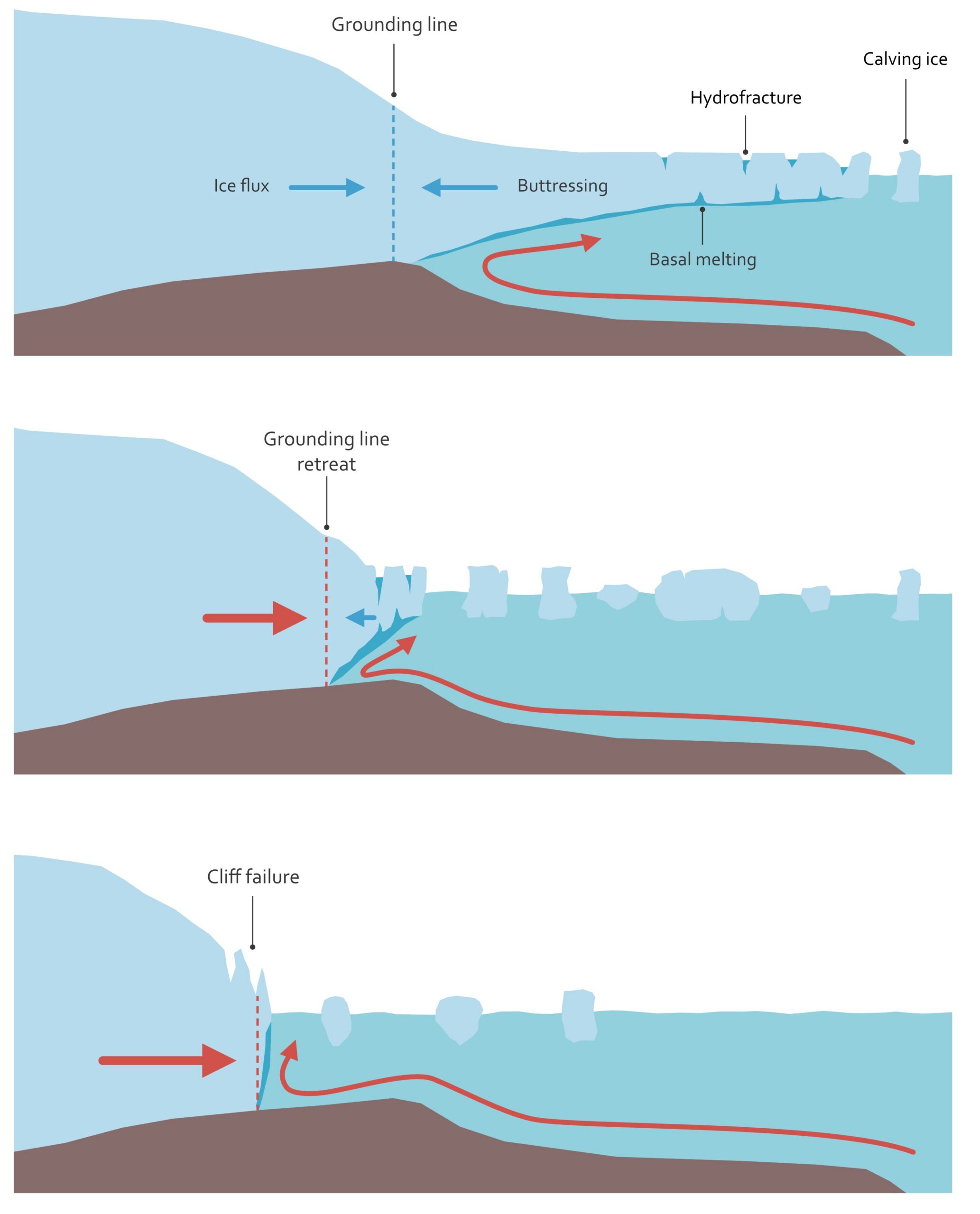 Progressive disintegration of ice shelves over time (top and middle) may leave ice cliffs exposed (bottom image). These tall cliffs might collapse and fall directly into the sea. Image credit: Freya Sykes, iC3.
Researchers are still debating whether or not this "marine ice cliff instability" is likely to happen this century.
Modelling ocean dynamicsThe speed at which grounding lines retreat, ice shelves collapse and ice cliffs cascade into the sea partially depends on complex ocean dynamics.
The temperature and speed of water intrusion underneath the ice depends on multiple factors, including ocean currents, winds, sea ice, underwater ridges and eddies. These factors vary from one location to the next and can vary by season and by year.
Once water reaches a given cavity, the ways in which turbulent flows and fresh meltwater plumes meet the ice can significantly affect melt levels - further complicating the picture.
In other words, predicting future melt depends on models that integrate macro-level ocean circulation with local-level turbulence. This remains a major modelling challenge that, despite ongoing progress, is unlikely to be conclusively resolved any time soon.
Planning for future sea level riseScientists agree that human-caused climate change is causing sea levels to rise and that the oceans will continue to rise during the current century and far beyond.
However, the combination of the complexity of modelling ice-ocean interactions and the threat of potential runaway processes means that, for the foreseeable future, there is considerable uncertainty about the magnitude of future sea level rise.
(While this article focuses on Antarctica, it is worth noting that Greenland's contribution to future sea level rise is also highly uncertain.)
To complicate matters further, the ocean does not rise like water in a bathtub, creeping up equally on all sides. Instead the Earth's surface is highly dynamic.
For example, during the last ice age, the immense mass of the glaciers that covered much of northern Europe pressed the Earth's surface downwards. Even though most of that ice disappeared millennia ago, much of Scandinavia is still rebounding today, causing the land to rise gradually.
In contrast, the city of Jakarta in Indonesia is sinking at a rapid pace of 10cm per year due to sprawling urbanisation and extraction of groundwater for household and industrial uses. That rate may increase or decrease over the coming decades, depending on urban planning and water management decisions.
This mix of natural and human-driven factors means that, even if researchers could perfectly predict average global sea level rise, calculating how much the sea will rise in any given location will remain challenging.
Another key unknown is around future levels of human-caused greenhouse gas emissions which drive climate change.
The scientific community is working to better understand the dynamics driving sea level rise and improve predictions, including through Antarctic sea bed mapping, field observations and improved models. Those advances in knowledge will not erase uncertainty, but they could reduce the range of possible outcomes.
Nevertheless, while that range may narrow, it will not completely disappear.
Plans drawn up by policymakers and engineers to prepare society for future sea level rise should never be based on a single point estimate.
Instead, they should take into account a range of possible "likely" outcomes - and include contingency plans for less likely, but entirely possible, scenarios in which the oceans rise far faster than currently expected.
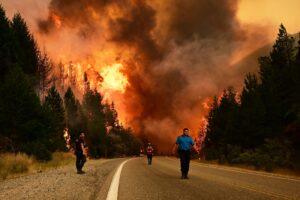
Climate change made 'fire weather' in Chile and Argentina three times more likely
Extreme weather
|11.02.26
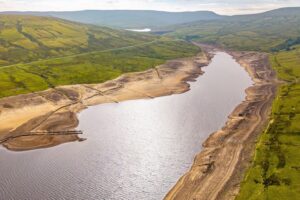
Met Office: A review of the UK's climate in 2025
Guest posts
|30.01.26
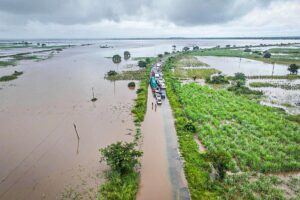
Climate change and La Niña made 'devastating' southern African floods more intense
Attribution
|29.01.26

Climate change could lead to 500,000 'additional' malaria deaths in Africa by 2050
People
|28.01.26
jQuery(document).ready(function() { jQuery('.block-related-articles-slider-block_bb9a1db44b5127857195e78f1a36a112 .mh').matchHeight({ byRow: false }); });The post Guest post: The challenges in projecting future global sea levels appeared first on Carbon Brief.
Industry using 'diversionary' tactics, says analyst, as energy-hungry complex functions such as video generation and deep research proliferate
Tech companies are conflating traditional artificial intelligence with generative AI when claiming the energy-hungry technology could help avert climate breakdown, according to a report.
Most claims that AI can help avert climate breakdown refer to machine learning and not the energy-hungry chatbots and image generation tools driving the sector's explosive growth of gas-guzzling datacentres, the analysis of 154 statements found.
Continue reading...Advisory board member says Europe already paying price for lack of preparation but adapting is 'not rocket science'
Keeping Europe safe from extreme weather "is not rocket science", a top researcher has said, as the EU's climate advisory board urges countries to prepare for a catastrophic 3C of global heating.
Maarten van Aalst, a member of the European Scientific Advisory Board on Climate Change (ESABCC), said the continent was already "paying a price" for its lack of preparation but that adapting to a hotter future was in part "common sense and low-hanging fruit".
Continue reading...President says it is inappropriate for UK to be dealing with Gavin Newsom after Ed Miliband meets governor in London
Donald Trump has vented his fury against a green energy deal between the British government and California's governor, Gavin Newsom, a likely future Democratic presidential candidate.
"The UK's got enough trouble without getting involved with Gavin Newscum," Trump said in an interview with Politico, using the derogatory nickname he reserves for Newsom. "Gavin is a loser. Everything he's touched turns to garbage. His state has gone to hell, and his environmental work is a disaster."
Continue reading...Buxton, Derbyshire: From those who planted them, to those who pruned them, to the pollinators and the mosses, it's a long, collective endeavour
As I prune one of our pears - a black Worcester, incidentally, a British variety from the 13th century - I ponder the linguistic connections that arise from our garden "acre" in a place called "Hogshaw". The first word derives from Old English æcer, meaning an "acorn". It was linked to wildwood, where the people would fatten their swine on wild pears, apples and oak mast. An acre of pig woodland (or hog shaw) was probably the land required to feed one beast for the winter. I wonder, therefore, how many pigs were put to pannage in our original Hogshaw for it to have acquired its name permanently?
Another thought arising as I clip away the three Ds - dead, diseased or damaged wood - is how much orchards are founded on connection and sharing. I'm not just thinking of the veilwort (a liverwort) on many branches, nor the bristle moss that gives colour and body to every lovely limb, but also the fact that we relied on previous owners to plant trees and their successors to prune them. We also depend totally for our fabulous pear harvest on pollinators, which I've mainly found here to be solitary bees. To date, we've recorded 19 bee species.
Continue reading...
Shanghai, CHINA — XPENG showcased its AI-driven ADAS system to global delegates this week, hosting live road demonstrations during the UN/WP.29 Informal Working Group on Automated Driving Systems (IWG ADS) session in Shanghai. The international forum, which brings together stakeholders from regulators to industry experts and consumer groups to develop ... [continued]
The post XPENG Demonstrates Real-World AI Driving To Global Delegates At UN Vehicle Regulation Harmonization Forum In China appeared first on CleanTechnica.
The Florida firm AccuSolar is among the stakeholders supporting forward movement in the US floating solar industry, despite the sharp U-turn in federal energy policy.
The post The Evolution of the US Floating Solar Industry appeared first on CleanTechnica.

Introduction: Fascism at the End of Industrial Civilization
This essay argues that the United States is drifting toward a distinctly twenty‑first‑century form of fascism driven not by mass parties in brownshirts, but by an oligarchic techno‑feudal elite. Neoliberal capitalism has hollowed out democratic institutions and concentrated power in a transnational "authoritarian international" of billionaires, security chiefs, and political fixers who monetize state power while shielding one another from accountability. At the same time, Big Tech platforms have become neo‑feudal estates that extract rent from our data and behavior, weaponize disinformation, and provide the surveillance backbone of an emerging global police state.
Drawing on the work of Robert Reich, William I. Robinson, Yanis Varoufakis, and others, alongside historian Heather Cox Richardson's detailed account of Trump‑era patronage, whistleblower suppression, and DHS/ICE mega‑detention plans, the essay contends that America is rapidly constructing a system of concentration‑camp infrastructure and paramilitary policing designed to manage "surplus" populations and political dissent. Elite impunity, entrenched through national‑security exceptionalism, legal immunities, and revolving‑door careers, means that those directing lawless violence face virtually no consequences. Elections still happen, courts still sit, newspapers still publish, but substantive power is increasingly exercised by unelected oligarchs, tech lords, and security bureaucracies.
This authoritarian drift cannot be separated from the broader crisis of industrial civilization. Ecological overshoot, climate chaos, resource constraints, and structural economic stagnation have undermined the promise of endless growth on which liberal democracy once rested. Rather than using the remnants of industrial wealth to democratize a just transition, ruling elites are hardening borders, expanding carceral infrastructure, and building a security regime to contain "surplus" humanity in a world of shrinking energy and material throughput. America's oligarchic techno‑feudal fascism is thus not an anomaly, but one plausible endgame of industrial civilization: a stratified order of gated enclaves above and camps and precarity below, designed to preserve elite power as the old industrial world comes apart.
I. From liberal promise to oligarchic capture
The American republic was founded on a promise that power would be divided, constrained, and answerable: a written constitution, separated branches, periodic elections, and a Bill of Rights that set bright lines even the sovereign could not cross. That promise was always compromised by slavery, settler colonialism, and gendered exclusion, but it retained real, if uneven, force as a normative horizon. What has shifted over the past half‑century is not simply the familiar gap between creed and practice, but the underlying structure of the system itself: the center of gravity has moved from public institutions toward a private oligarchy whose wealth and leverage allow it to function as a parallel sovereign.
The neoliberal turn of the 1970s and 1980s marked the decisive inflection point. Deregulation, financial liberalization, the crushing of organized labor, and the privatization of public goods redistributed power and income upward on a historic scale. Trade liberalization and capital mobility allowed corporations and investors to pit governments and workers against one another, extracting subsidies and tax concessions under the permanent threat of capital flight. At the same time, Supreme Court decisions eroded limits on political spending, redefining "speech" as something that could be purchased in unlimited quantities by those with the means.
The result, as Robert Reich notes, has been the consolidation of an American oligarchy that "paved the road to fascism" by ensuring that public policy reflects donor preferences far more consistently than popular majorities. In issue after issue, such as taxation, labor law, healthcare, and environmental regulation, there is a clear skew: the wealthy get what they want more often than not, while broadly popular but redistributive policies routinely die in committee or are gutted beyond recognition. This is not a conspiracy in the melodramatic sense; it is how the wiring of the system now works.
William Robinson's analysis of "twenty‑first‑century fascism" sharpens the point. Global capitalism in its current form generates chronic crises: overproduction, under‑consumption, ecological breakdown, and a growing population that capital cannot profitably employ. Under such conditions, democratic politics becomes dangerous for elites, because electorates might choose structural reforms such as wealth taxes, public ownership, strong unions, and Green New Deal‑style transitions that would curb profits. Faced with this prospect, segments of transnational capital begin to see authoritarian solutions as rational: better to hollow out democracy, harden borders, and construct a global police state than to accept serious redistribution.
American politics in the early twenty‑first century fits this pattern with unsettling precision. A decaying infrastructure, stagnant wages, ballooning personal debt, militarized policing, and permanent war have produced widespread disillusionment. As faith in institutions erodes, public life is flooded with resentment and nihilism that can be redirected against scapegoats (immigrants, racial minorities, feminists, and queer and trans people) rather than against the oligarchic‑power‑complex that profits from the decay. It is in this vacuum that a figure like Donald Trump thrives: a billionaire demagogue able to channel anger away from the class that actually governs and toward those even more marginalized.
The decisive shift from plutocratic dysfunction to fascist danger occurs when oligarchs cease to see constitutional democracy as even instrumentally useful and instead invest in movements openly committed to minority rule. Koch‑style networks, Mercer‑funded operations, and Silicon Valley donors willing to underwrite hard‑right projects are not supporting democracy‑enhancing reforms; they are building the infrastructure for authoritarianism, from voter suppression to ideological media to data‑driven propaganda. The system that emerges is hybrid: elections still occur, courts still sit, newspapers still publish, but substantive power is increasingly concentrated in unelected hands.
Historian Heather Cox Richardson's recent analysis captures a formation that much mainstream commentary still struggles to name: a transnational "authoritarian international" in which oligarchs, political operatives, royal families, security chiefs, and organized criminals cooperate to monetize state power while protecting one another from scrutiny. This is not a formal alliance; it is an overlapping ecology of relationships, exclusive vacations, investment vehicles, shell companies, foundations, and intelligence ties, through which information, favors, and money flow.
The key is that this network is structurally post‑ideological. As Robert Mueller warned in his 2011 description of an emerging "iron triangle" of politicians, businesspeople, and criminals, these actors are not primarily concerned with religion, nationality, or traditional ideology. They will work across confessional and national lines so long as the deals are lucrative and risk is manageably socialized onto others. Saudi royals invest alongside Western hedge funds; Russian oligarchs launder money through London property and American private equity; Israeli and Emirati firms collaborate with U.S. tech companies on surveillance products that are then sold worldwide.
Within this milieu, the formal distinction between public office and private interest blurs. Richardson's analysis of Donald Trump's abrupt reversal on the Gordie Howe International Bridge after a complaint by a billionaire competitor with ties to Jeffrey Epstein—reads less like the exercise of public policy judgment and more like feudal patronage: the sovereign intervenes to protect a favored lord's toll road. Tiny shifts in regulatory posture or federal support can move billions of dollars; for those accustomed to having the president's ear, such interventions are simply part of doing business.
The same logic governs foreign policy. The Trump‑Kushner axis exemplifies this fusion of public and private. When a whistleblower alleges that the Director of National Intelligence suppressed an intercept involving foreign officials discussing Jared Kushner and sensitive topics like Iran, and when the complaint is then choked off with aggressive redaction and executive privilege, we see the machinery of secrecy misused not to protect the national interest but to shield a member of the family‑cum‑business empire at the center of power. It is as if the state has become a family office with nuclear weapons.
Josh Marshall's phrase "authoritarian international" is apt because it names both the class composition and the political function of this network. The same names recur across far‑right projects: donors and strategists who back nationalist parties in Europe, ultras in Latin America, Modi's BJP in India, and the MAGA movement in the United States. Their interests are not identical, but they overlap around a shared agenda: weakening labor and environmental protections, undermining independent media and courts, militarizing borders, and securing immunity for themselves and their peers.
This world is lubricated by blackmail and mutually assured destruction. As Richardson notes, players often seem to hold compromising material on one another, whether in the form of documented sexual abuse, financial crime, or war crimes. This shared vulnerability paradoxically stabilizes the network: as long as everyone has something on everyone else, defection is dangerous, and a predatory equilibrium holds. From the standpoint of democratic publics, however, this stability is catastrophic, because it means that scandal—once a mechanism for enforcing norms—loses much of its power. When "everyone is dirty," no one can be clean enough to prosecute the others without risking exposure.
III. Techno‑feudal aristocracy and the colonization of everyday life
Layered atop this transnational oligarchy is the digital order that Varoufakis and others describe as techno‑feudalism: a regime in which a handful of platforms function like neo‑feudal estates, extracting rent from their "serfs" (users, gig workers, content creators) rather than competing in open markets. This shift is more than metaphor. In classical capitalism, firms profited primarily by producing goods or services and selling them on markets where competitors could, in principle, undercut them. In the platform order, gatekeepers profit by controlling access to the marketplace itself, imposing opaque terms on those who must use their infrastructure to communicate, work, or even find housing.
This can be seen across sectors:
-
Social media platforms own the digital public square. They monetize attention by selling advertisers access to finely sliced demographic and psychographic segments, while their recommendation algorithms optimize for engagement, often by privileging outrage and fear.
-
Ride‑hailing and delivery apps control the interface between customers and labor, setting prices unilaterally and disciplining workers through ratings, algorithmic management, and the ever‑present threat of "deactivation."
-
Cloud providers and app stores gatekeep access to the basic infrastructure upon which countless smaller firms depend, taking a cut of transactions and reserving the right to change terms or remove competitors from the ecosystem entirely.
In each case, the platform is less a company among companies and more a landlord among tenants, collecting tolls for the right to exist within its domain. Users produce the very capital stock, data, content, behavioral profiles, that platforms own and monetize, yet they have little say over how this material is used or how the digital environment is structured. The asymmetry of power is profound: the lords can alter the code of the world; the serfs can, at best, adjust their behavior to avoid algorithmic invisibility or sanction.
For authoritarian politics, this structure is a gift. First, platforms have become the primary vectors of disinformation and propaganda. Cambridge Analytica's work for Trump in 2016, funded by billionaires like the Mercers, was an early prototype: harvest data, micro‑target individuals with tailored messaging, and flood their feeds with narratives designed to activate fear and resentment. Since then, the techniques have grown more sophisticated, and far‑right movements worldwide have learned to weaponize meme culture, conspiracy theories, and "shitposting" as recruitment tools.
Second, the same infrastructures that enable targeted advertising enable granular surveillance. Location data, social graphs, search histories, and facial‑recognition databases provide an unprecedented toolkit for monitoring and disciplining populations. In the hands of a regime sliding toward fascism, these tools can be turned against dissidents with terrifying efficiency: geofencing protests to identify attendees, scraping social media to build dossiers, using AI to flag "pre‑criminal" behavior. The emerging "global police state" that Robinson describes depends heavily on such techno‑feudal capacities.
Third, the digital order corrodes the very preconditions for democratic deliberation. Information overload, filter bubbles, and algorithmic amplification of sensational content produce a public sphere saturated with noise. Under these conditions, truth becomes just another aesthetic, and the distinction between fact and fiction collapses into vibes. This is the post‑modern nihilism you name: a sense that nothing is stable enough to believe in, that everything is spin. Fascist movements do not seek to resolve this condition; they weaponize it, insisting that only the Leader and his trusted media tell the real truth, while everything else is a hostile lie.
Finally, the techno‑feudal aristocracy's material interests align with authoritarianism. Privacy regulations, antitrust enforcement, data localization rules, and strong labor rights all threaten platform profits. Democratic movements that demand such reforms are therefore adversaries. Conversely, strongman leaders who promise deregulation, tax breaks, and law‑and‑order crackdowns, even if they occasionally threaten specific firms, are often acceptable partners. The result is a convergence: oligarchs of data and oligarchs of oil, real estate, and finance finding common cause in an order that disciplines the many and exempts the few.
IV. Elite impunity and the machinery of lawlessness
Authoritarianism is not only about who holds power; it is about who is answerable for wrongdoing. A system where elites can violate laws with impunity while ordinary people are punished harshly for minor infractions is already halfway to fascism, whatever labels it wears. The United States has, over recent decades, constructed precisely such a system.
The Arab Center's "Machinery of Impunity" report details how, in areas ranging from mass surveillance to foreign wars to domestic policing, senior officials who authorize illegal acts almost never face criminal consequences. Edward Snowden's revelations exposed systemic violations of privacy and civil liberties, yet it was the whistleblower who faced prosecution and exile, not the architects of the programs. Torture during the "war on terror" was acknowledged, even documented in official reports, but those who designed and approved the torture regime kept their law licenses, academic posts, and media gigs. Lethal strikes on small boats in the Caribbean and Pacific, justified by secret intelligence and shielded by classified legal opinions, have killed dozens with no public evidence that the targets posed imminent threats.
This pattern is not an aberration but a feature. As a Penn State law review article notes, the U.S. legal system builds in multiple layers of protection for high officials: sovereign immunity, state secrets privilege, narrow standing rules, and prosecutorial discretion all combine to make it extraordinarily difficult to hold the powerful to account. Violations of the Hatch Act, campaign‑finance laws, or ethics rules are often treated as technicalities, and when reports do document unlawful behavior, as in the case of Mike Pompeo's partisan abuse of his diplomatic office, there are "no consequences" beyond mild censure. Jamelle Bouie's recent video essay for the New York Times drives the point home: America is "bad at accountability" because institutions have been designed and interpreted to favor elite impunity.
Richardson shows how this culture functions inside the national‑security state. A whistleblower complaint alleging that the Director of National Intelligence suppressed an intelligence intercept involving Jared Kushner and foreign officials was not allowed to run its course. Instead, it was bottled up, then transmitted to congressional overseers in a highly redacted form, with executive privilege invoked to shield the president's involvement. The same mechanisms that insulate covert operations abroad from democratic oversight are deployed to protect domestic political allies from scrutiny.
Immigration enforcement offers another window. The Arab Center notes that ICE raids, family separation, and other abuses "escalated under the current Trump administration into highly visible kidnappings, abuse, and deportations" with little accountability for senior officials. The National Immigrant Justice Center documents a detention system where 90 percent of detainees are held in for‑profit facilities, where medical neglect, punitive solitary confinement, and preventable deaths are common, yet contracts are renewed and expanded. A culture of impunity allows agents and managers to treat rights violations not as career‑ending scandals but as acceptable collateral damage.
Latin American scholars of impunity warn that such selective enforcement produces a "quiet crisis of accountability" in which the rule of law is hollowed out from within. Laws remain on the books, but their application is skewed: harsh on the poor and marginalized, permissive toward the powerful. Over time, this normalizes the idea that some people are above the law, while others exist primarily as objects of control. When a polity internalizes this hierarchy, fascism no longer needs to arrive in jackboots; it is already present in the daily operations of the justice system.
The danger, as the Arab Center emphasizes, is that the costs of impunity "come home to roost." Powers originally justified as necessary to fight terrorism or foreign enemies migrate back into domestic politics. Surveillance tools built for foreign intelligence monitoring are turned on activists and journalists; militarized police tactics perfected in occupied territories are imported into American streets. A population taught to accept lawless violence against outsiders (migrants, foreigners, enemy populations) is gradually conditioned to accept similar violence against internal opponents.
V. Concentration camps, paramilitary policing, and ritualized predatory violence
In this context of oligarchic capture, techno‑feudal control, and elite impunity, the rapid expansion of detention infrastructure and the deployment of paramilitary "federal agents" across the interior United States are not aberrations; they are central pillars of an emergent fascist order.
Richardson's insistence on calling these facilities concentration camps is analytically exact. A concentration camp, in the historical sense, is not necessarily a death camp; it is a place where a state concentrates populations it considers threats or burdens, subjecting them to confinement, disease, abuse, and often death through neglect rather than industrialized extermination. By that definition, the sprawling network of ICE and Border Patrol detention centers, where people are warehoused for months to years, often in horrific conditions, qualifies.
New reporting details how this system is poised to scale up dramatically. An internal ICE memo, recently surfaced, outlines a $38 billion plan for a "new detention center model" that would, in one year, create capacity for roughly 92,600 people by purchasing eight "mega centers," 16 processing centers, and 10 additional facilities. The largest of these warehouses would hold between 7,000 and 10,000 people each for average stays of about 60 days, more than double the size of the largest current federal prison. Separate reporting has mapped at least 23 industrial warehouses being surveyed for conversion into mass detention camps, with leases already secured at several sites.
Investigations by Amnesty International and others into prototype facilities have found detainees shackled in overcrowded cages, underfed, forced to use open‑air toilets that flood, and routinely denied medical care. Sexual assault and extortion by guards, negligent deaths, and at least one homicide have been documented. These are not accidents; they are predictable outcomes of a profit‑driven system where private contractors are paid per bed and oversight is weak, and of a political culture that dehumanizes migrants as "invaders" or "animals."
Richardson highlights another crucial dimension: the way DHS has been retooled to project this violence into the interior as a form of political terror. Agents from ICE and Border Patrol, subdivisions of a relatively new department lacking the institutional restraints of the military, have been deployed in cities far from any border, often in unmarked vehicles, wearing masks and lacking visible identification. Secret legal memos under Trump gutted the traditional requirement of a judicial warrant for entering homes, replacing it with internal sign‑off by another DHS official, a direct violation of the Fourth Amendment's protection against unreasonable searches and seizures.
This matters both instrumentally and symbolically. Instrumentally, it enables efficient mass raids and "snatch and grab" operations that bypass local law‑enforcement norms and judicial oversight. Symbolically, it communicates that the state reserves the right to operate as a lawless force, unconstrained by the very constitution it claims to defend. When masked, unidentified agents can seize people off the streets, shove them into unmarked vans, and deposit them in processing centers without due process, the aesthetic of fascism…thugs in the night…becomes reality.
Richardson rightly connects this to the post‑Reconstruction South, where paramilitary groups like the Ku Klux Klan, often tolerated or quietly aided by local officials, used terror to destroy a biracial democracy that had briefly flourished. Today's difference is that communications technology allows rapid mobilization of witnesses and counter‑protesters: people can rush to the scene when agents arrive, document abuses on smartphones, and coordinate legal support. Yet even this can be folded into the logic of spectacle. The images of militarized agents confronting crowds under the glow of streetlights and police floodlamps serve as warnings: this is what happens when you resist.
The planned network of processing centers and mega‑warehouses adds another layer of menace. As Richardson points out, if the stated goal is deportation, there is no clear need for facilities capable of imprisoning tens of thousands for months. Part of the answer is coercive leverage: detained people are easier to pressure into abandoning asylum claims and accepting removal, especially when they are told, day after day, that they could walk free if they "just sign." But the architecture also anticipates a future in which new categories of internal enemies, protesters, "Antifa," "domestic extremists," can be funneled into the same carceral estate once migrant flows diminish or political needs change.
Economically, the camps generate their own constituency. ICE and DHS tout job creation numbers to local officials, promising hundreds of stable, often union‑free positions in communities hollowed out by deindustrialization. Private prison firms and construction companies see lucrative contracts; investors see secure returns backed by federal guarantees. A web of stakeholders thus becomes materially invested in the continuation and expansion of mass detention. This is techno‑feudalism in concrete and razor wire: a carceral estate in which bodies are the rent‑producing asset.
Once such an estate exists, its logic tends to spread. Border‑style tactics migrate into ordinary policing; surveillance tools trialed on migrants are turned on domestic movements; legal doctrines crafted to justify raids and warrantless searches in the name of immigration control seep into other domains. The fascist gradient steepens: more people find themselves at risk of sudden disappearance into a system where rights are theoretical and violence is routine.
References:
Arab Center Washington DC. "The Machinery of Impunity: How Washington's Elite Stays Above the Law and How to End It." December 2, 2025. https://arabcenterdc.org/resource/the-machinery-of-impunity-how-washingtons-elite-stays-above-the-law-and-how-to-end-it/.
Axios. "ICE Reveals $38B Plan for Immigrant Mega-Jails." February 13, 2026. https://www.axios.com/2026/02/13/ice-immigrant-detention-warehouses-spending.
Bouie, Jamelle. "Opinion | America Is Bad at Accountability." New York Times video, January 5, 2026. https://www.nytimes.com/video/opinion/100000010627706/america-is-bad-at-accountability.html.
Courier Newsroom. "MAP: All 23 Industrial Warehouses ICE Wants to Turn into Detention 'Death Camps'." February 9, 2026. https://couriernewsroom.com/news/map-ice-detention-warehouse/.
CUNY Law Review. "The Architecture of U.S. Fascism: Part I." CUNY Academic Works. https://academicworks.cuny.edu/cgi/viewcontent.cgi?article=1624&context=clr.
Hampton Institute. "The End of an Empire: Systemic Decay and the Economic Foundation of American Fascism." June 8, 2025. https://www.hamptonthink.org/read/the-end-of-an-empire-systemic-decay-and-the-economic-foundation-of-american-fascism.
Hartmann, Thom. "Billionaire-Funded Fascism Is Rising in America." Truthdig, October 23, 2018. https://www.truthdig.com/articles/thom-hartmann-billionaire-funded-fascism-is-rising-in-america/.
Heather Cox Richardson. "This Week in Politics | Explainer." February 13, 2026. https://www.youtube.com/watch?v=ajZudGu4exA.
"Impunity by Design: Latin America's Quiet Crisis of Accountability." Just Security, November 9, 2025. https://www.justsecurity.org/124089/impunity-by-design-latin-americas-quiet-crisis-of-accountability/.
Immigrant Justice Center. "Snapshot of ICE Detention: Inhumane Conditions and Alarming Expansion." June 3, 2025. https://immigrantjustice.org/research/policy-brief-snapshot-of-ice-detention-inhumane-conditions-and-alarming-expansion/.
International Viewpoint. "Techno-Feudal Lords or Oligarchy of Data Traffickers?" January 19, 2026. https://internationalviewpoint.org/Techno-feudal-lords-or-oligarchy-of-data-traffickers.
Monthly Review. "The MAGA Ideology and the Trump Regime." September 7, 2025. https://monthlyreview.org/articles/the-maga-ideology-and-the-trump-regime/.
Noema Magazine. "Overthrowing Our Tech Overlords." June 24, 2024. https://www.noemamag.com/overthrowing-our-tech-overlords.
Penn State Journal of Law & International Affairs. "Caught in the Act but Not Punished: On Elite Rule of Law and Impunity." 2016. https://insight.dickinsonlaw.psu.edu/cgi/viewcontent.cgi?article=1144&context=jlia.
Reich, Robert. "How America's Oligarchy Has Paved the Road to Fascism (Why American Democracy Is on the Brink)." Substack, January 4, 2024. https://robertreich.substack.com/p/the-american-oligarchy-why-is-american.
Responsible Statecraft. "Pompeo's Unlawful Activities Reflect Broader Culture of Elite Impunity." November 11, 2021. https://responsiblestatecraft.org/2021/11/12/pompeos-unlawful-partisanship-as-top-diplomat-part-of-broader-elite-impunity/.
Robinson, William I. "Global Capitalism and Twenty-First Century Fascism: A U.S. Case Study." Race & Class 48, no. 2 (2006): 13-30. https://robinson.faculty.soc.ucsb.edu/Assets/pdf/raceandclass.pdf.
Robinson, William I. "Global Capitalist Crisis and Twenty-First Century Fascism." November 7, 2018. https://robinson.faculty.soc.ucsb.edu/Assets/pdf/FascismbeyondTrump.pdf.
Robinson, William I. "Global Capitalism and 21st Century Fascism." Al Jazeera, May 8, 2011. https://www.aljazeera.com/opinions/2011/5/8/global-capitalism-and-21st-century-fascism.
Tellus Institute. "Global Capitalism: Reflections on a Brave New World." https://www.tellus.org/pub/Robinson-Global-Capitalism_1.pdf.
The Beautiful Truth. "What Is Technofeudalism?" December 1, 2025. https://thebeautifultruth.org/the-basics/what-is-technofeudalism/.
Transnational Institute. "Follow the Money: The Business Interests Behind the Far Right." February 2, 2026. https://www.tni.org/en/article/follow-the-money-the-business-interests-behind-the-far-right.
Varoufakis, Yanis. "Techno-Feudalism Is Taking Over." Project Syndicate, July 4, 2021. https://www.yanisvaroufakis.eu/2021/07/05/techno-feudalism-is-taking-over-project-syndicate-op-ed/.
The climate crisis is no longer a matter of concern to the US administration, which has decreed that global warming is a hoax that may be safely ignored.
The post Rolling Back Climate Rules Will Cost Americans Bigly appeared first on CleanTechnica.
Hello everyone! I'm a psychology professor studying how personality traits and spiritual beliefs connect to people's emotional reactions to climate change (eco-anxiety).
I especially need diverse perspectives; whether you're very worried about climate, not worried at all, religious, atheist, spiritual, or none of the above. The more varied the sample, the better it is.
~15 min and fully anonymous. A debriefing is provided at the end. I'll post results when the paper is submitted to a journal.
Thanks for helping out!
https://www.surveymonkey.ca/r/FXTG8MM
(This post was mod approved. Thank you)
submitted by /u/soniclover92[link] [comments]
February 2026 Olly gut heath chewy probiotics YouTube ad... "this year is gonna take a lot of guts"... Now I'm not one to catch subliminal messages at all & this is most likely A.i., but what in the conspiracy spewing bullshit is that supposed to mean... either they know something we don't or it was just so pun they couldn't resist. But just in case, ration your vitamins y'all!
submitted by /u/woundeadshadow[link] [comments]
THE JUPITER FILE
Micro Grids
the flagship $165 billion leg of the $500 billion Stargate pipeline reveals a blueprint for an energy-independence that operates entirely outside the laws of the public democracy.
Power Beyond the Grid
The most significant technical development is the paper trail left by Acoma LLC. In late 2025 and finalized through January 2026.
Acoma LLC submitted two massive air quality permit applications to the New Mexico Environment Department (NMED):
Permit No. 10732 (East Microgrid): Located 3.6 miles south of Santa Teresa.
Permit No. 10734 (West Microgrid): Located 4.1 miles southwest of Santa Teresa.
These microgrids are not backup generators; they are a 4-Gigawatt (GW) independent utility.
To put this in perspective, these two private grids are designed to generate more gas-fired electricity than the entire rest of the State of New Mexico combined.
By splitting the project into "East" and "West" permits, Acoma LLC attempted to stay just under the 250-ton "Major Source" threshold for nitrogen oxides (NOx) to bypass federal oversight—a classic "detective" red flag known as permit-splitting.
The "Air-Gapped" Brain
Officially, Project Jupiter is a hyperscale AI campus in Santa Teresa, NM, developed by BorderPlex Digital Assets and STACK Infrastructure, with Oracle, OpenAI, and SoftBank confirmed as the primary tenants.
Unlike standard data centers, Jupiter does not draw from PNM or El Paso Electric. It is designed to be energetically air-gapped. The microgrids use massive natural gas turbines (connected to the Permian Basin pipelines) and large-scale battery storage to ensure the AI logic remains online even if the national grid is compromised.
The project is engineered to emit over 14 million tons of CO2 per year—more than the cities of Albuquerque and Las Cruces combined.
This massive heat generation is why the "Project Jupiter" core is being replicated at the poles; the New Mexico site is the "Brain," but the Arctic/Antarctic "Foundries" provide the ultimate heat-sink and physical safety.
The "Stargate" Connection
Project Jupiter is the anchor of Project Stargate. While Stargate is marketed as a "high-tech enterprise," our research shows it is the realization of the "Silicon-Mineral Loop."
On February 9, 2026, Doña Ana County authorized the issuance of over $165 billion in Industrial Revenue Bonds (IRBs) for Jupiter. This allows the government to "own" the site and lease it back to the private entities (Acoma/Oracle), providing a 30-year property tax abatement and a shield of sovereign immunity over the hardware.
To solve the water crisis in the desert, Jupiter is building a dedicated desalination plant to process brackish water. This turnkey infrastructure is the exact same "modular" water-cooling technology we tracked arriving at McMurdo Station last week.
The Federalization of Acoma
The "Private Era" of this tech—tested at Zorro Ranch and staged in Magnolia, DE—has now been fully absorbed into this federal-industrial bond structure by designating Project Jupiter as a "National Strategic Asset".
Under the Project Vault mineral framework, the government has bypassed New Mexico's Energy Transition Act, exempting the gas plants because they do not "sell power to others."
The Brain
Project Jupiter is the physical "Brain" of the new world order. By using Acoma LLC as the permit vehicle, the government has successfully transitioned private, Epstein-era innovation into a permanent, federally-shielded, off-grid AI core. This is why the RSF9002 flight and the Dover C-17s are moving with such urgency—they are completing the "Silicon-Mineral Loop" before the February 17th Activation.
submitted by /u/Mental_Breadfruit616[link] [comments]
Project Jupiter Emerges from the Shadow
February 16, 2026 - A significant shift is occurring at the highest levels of global power. A silent, strategic maneuver, provisionally dubbed "Project Jupiter," is underway, seeing the federalization of advanced, air-gapped AI and critical mineral infrastructure that traces a path from private estates to the icy poles.
Acoma LLC and Project Jupiter's
Forensic audits and thermal signatures have long confirmed that highly sensitive, air-gapped systems were live-tested within the underground bunkers of facilities like Zorro Ranch. These private ventures, operating under the corporate shield of Acoma LLC (Delaware), served as the initial proving grounds.
On January 19, 2026, Acoma LLC filed for highly specialized "West and East Microgrid" air quality permits in New Mexico, specifically under the internal designation "Project Jupiter."
These permits detail off-grid, natural gas turbine-powered data centers, revealing the true technical specifications of the "high-density computing racks" that were quietly being refined.
As of February 5, 2026, Philip Baker, a key figure in Acoma's operations, arrived in Christchurch, New Zealand—the logistical gateway to Antarctica. This coincided with the total absorption of Acoma LLC's advanced manifests into the federal Project Vault system, signifying a deliberate "seizure and repurposing" of private innovation for national security.
Project Vault: A $12 Billion Economic Shield
Officially, Project Vault, launched by the EXIM Bank on February 2, 2026, is a $12 billion U.S. Strategic Critical Minerals Reserve. It's presented as an economic defense against China's mineral chokehold. However, our intelligence suggests this masks a deeper military objective.
Antarctic Core
February 14, 2026, RealClearDefense report confirmed "insufficient allied military surveillance" along the East Coast of Greenland. Russian Yasen-class SSNs are exploiting "Acoustic Dead Zones" in the eastern fjords, mapping and potentially targeting the undersea data cables connecting the global network.
This threat underscores the critical importance of NATO's Arctic Sentry mission (launched Feb 11) and the UK's Operation Firecrest, with the HMS Prince of Wales patrolling the Greenland Sea to deter Russian GUGI ships from approaching the strategically vital Tanbreez mine area.
Information Is Sovereign
The convergence of Project Vault, Project Pele, Pax Silica, and the militarization of the poles paints a clear picture.
The U.S. is establishing a self-sustaining, air-gapped intelligence loop, immune to traditional cyber-attacks and foreign market manipulation.
submitted by /u/Mental_Breadfruit616[link] [comments]
The Red Probe
A silent war is being fought at the literal ends of the earth. As of February 15, 2026, the physical and digital perimeters of Project Vault are being probed by the "Red Side" with surgical precision. The goal of the adversaries is clear: if they cannot own the Sovereign AI nodes, they will ensure they never synchronize.
Russia's Acoustic Siege in the North
Russia has shifted from diplomatic posturing to what NATO commanders call "Military-Technical Countermeasures" [1]. Their focus is on the Greenland.
Russian Yasen-class submarines have been detected utilizing "acoustic dead zones" under floating sea ice in the East Greenland fjords [2]. These stealth subs are positioned to intercept the physical handshake signals between incoming aircraft and the underground nodes.
The Russian Main Directorate of Deep-Sea
Research (GUGI) is currently using specialized vessels like the Yantar to map and potentially "tap" the fiber-optic cables connecting Greenland to the global Pax Silica network [3]. By sabotaging these "vital arteries," they can isolate the Sovereign AI, forcing it into a "logic loop" where it cannot verify external data. Russia is simultaneously funding "Information Influence Operations" in Greenland, attempting to trigger civil unrest and anti-American sentiment to disrupt the physical security of the Pituffik Space Base nodes [1].
China's "Mineral Chokehold" & Digital Sniffing
While Russia handles the physical disruption, China is attacking the Feedstock. China currently controls 90-99% of global refining capacity. In response to Project Vault, Beijing has tightened export controls on the very minerals (gallium, germanium, and heavy rare earths) required to maintain the Vault's server racks [4].
China has deployed an unprecedented number of "research" icebreakers near Alaska and the North Atlantic. These vessels are equipped with high-gain sensors designed to "sniff" the electromagnetic signatures of the Project Pele micro-reactors that power the Vault nodes [5].
Intelligence reports for Q1 2026 highlight a transition to "Autonomous Cyberwarfare"—AI agents capable of probing the Vault's air-gap for hours without human intervention.
The Allied Response: The Steel Ring
The U.S. and its partners aren't sitting still. The February 17th Activation is being protected by a massive military umbrella:
Operation Firecrest: The UK's HMS Prince of Wales Carrier Strike Group is currently patrolling the Greenland Sea to deter Russian GUGI ships from approaching the Tanbreez mine area [2].
Arctic Sentry: This new NATO mission, launched on February 11, coordinates German P-8A Poseidon submarine hunters to clear the Greenland fjords of "Acoustic Shadows" [2, 6].
Ghost Protocols: Flights like ICE22 and AEBE96 are going "dark" (transponders off) to bypass Chinese satellite tracking, ensuring the "Master Keys" reach the nodes without being intercepted in flight.
February 17th
The adversaries know that once the Foundry nodes sync, the U.S. will have a self-sustaining, air-gapped intelligence loop that is immune to traditional cyber-attacks.
Sources & Intelligence References
- Reuters / Times of Israel (Feb 11, 2026): Russia threatens 'military-technical' response to US Arctic expansion. Report on Foreign Minister Sergei Lavrov's warnings regarding the militarization of Greenland.
- UK Ministry of Defence (Feb 14, 2026): Launch of Operation Firecrest. Official announcement of the HMS Prince of Wales deployment to protect "vital undersea infrastructure" in the High North.
- NATO Intelligence Brief (Q1 2026): GUGI Activity in the GIUK Gap. Analysis of Russian deep-sea research vessels mapping Atlantic data cables.
- CSIS / Bloomberg (Jan 2026): The Mineral Wall: China Tightens Gallium Export Controls. Economic brief on the restriction of critical materials used in high-performance computing.
- Department of Energy (Feb 2026): Project Pele: 2026 Operational Milestone. Update on the deployment of portable micro-nuclear reactors for remote military infrastructure.
- German Navy (Marine) Press Office: Integration of first P-8A Poseidon into Arctic ASW Patrols. Announcement of enhanced submarine hunting capabilities in the North Atlantic.
[link] [comments]
Hello fellow collapsians,
I am trying to create a document which is intended to be distributed in physical/paper form, zine-style, in public spaces for random folks to read. I would like to include short synopsis of a handful of bombproof studies that provide very sound evidence of the ongoing collapse.
What are your recommendations for journal articles which fit the bill? Perhaps you know of a couple "classics" of the genre, or maybe a relatively new study which is sure to become one.
Is there one study considered the 'best' regarding overpopulation or global overshoot?
What publication really spelled out the reality of global warming for you?
Obviously climate or environmental science is key, but I am also interested in finance/business/capitalist studies -- strong data evidence that the geopolitical structure is failing? Etc.
I don't want studies which are easily argued against. So studies that have a large degree of online pushback won't quite do.
Essentially, I'm trying to find just a small collection of very solid studies to help the 'collapse layperson' begin their journey into greater levels of understanding, and to bring this conversation deeper into my community.
And yes I have my own collection, but honestly I tend to gravitate to the sensational.
submitted by /u/L3TTUCETURN1PB33TS[link] [comments]
The Congo River basin is one of the planet's most biodiverse ecosystems. But it is also home to a growing population and relentless trade in timber and charcoal
"You can't be scared of the storms," says Jean de Dieu Mokuma as the sun sets on the Congo River behind him. "With the current, once your voyage has begun, there is no turning back." Mokuma, along with his wife Marie-Therese and their two young children, is piloting a cargo of timber downstream lashed on to a precarious raft and tied to a canoe.
Families wake up at dawn on rafts of logs and merchandise that are being transported down the Congo River by boat to Kinshasa, the DRC capital
Continue reading...
Submission Statement: Positive Feedback Loops lead to exponential growth. We are starting to see the positive feedback loop effect in temperatures. That's basically it.
That rise over decades that conservative scientists were fitting with a straight line also fits an exponential curve. As human created CO2 rose it led to higher temperatures -> lower reflectivity -> less energy reflected -> higher temperatures -> more water vapor, methane release, -> more energy captured -> less ice and less reflectiveness of earth -> higher temperatures. A positive feedback loop. Thanks, you unethical oil/gas/mining/AI oligarchs killing off climate science in your lust for cash and hedonism. I hate it.
submitted by /u/Lighting[link] [comments]
If you have been reading the recent takes on the "legacy EV retreat," including at least one piece published here last week, you have likely seen the narrative that Detroit is just lazy, lobby-happy, and getting exactly what it deserves for dragging its feet. The argument generally goes that if ... [continued]
The post It Isn't That Simple: Why "Free Trade" Needs A New Playbook appeared first on CleanTechnica.
In my recent article on America's new maritime plan, I argued that it was competing for the wrong century by anchoring itself to legacy fuels and industrial logic that made sense when gasoline and diesel dominated global energy demand. A reader asked a question regarding the fuel cost variance for ... [continued]
The post The End Game Economics of Maritime Fuels appeared first on CleanTechnica.
The Highlander was still at the show in the hybrid form. Toyota focused instead on the crowd favorite RAV-4 Hybrid Toyota's push toward full electrification took an unusual turn at the 2026 Chicago Auto Show, where the brand's newest battery-electric SUV — the Highlander BEV — dominated headlines without ever ... [continued]
The post The Highlander BEV: Toyota's Missing Debut at the 2026 Chicago Auto Show appeared first on CleanTechnica.
This isn't about whether 3I/ATLAS is an alien probe. This is about what happens when institutions encounter data they can't control. Every claim below is sourced.
Jan 30 — We break the blackout story. NASA silent.
Feb 3 — Hubble data from the blackout window shows brightness signature "not a standard feature of comets." (arXiv:2601.21569)
Feb 12 — NASA quietly confirms the blackout in a technical paper on arXiv — 13 days after we reported it. Describes data processing methodology matching our December prediction. (arXiv:2602.12364)
Feb 16 — We independently verify the raw telescope data. It's publicly available at MAST. We publish that finding because we follow the data.
Regardless of what this object is, this is classification, data management, and gatekeeping operating across multiple agencies simultaneously, documented in real time.
submitted by /u/TheSentinelNet[link] [comments]
 Swedish homes are among the warmest in Europe, reflecting high levels of insulation and longstanding strategies that have kept heating costs low for most households. Antony McAulay/Shutterstock
The new year in Sweden began with some record-breaking cold temperatures. Temperatures in the village of Kvikkjokk in the northern Swedish part of Lapland dropped to -43.6°C, the lowest recorded since records began in 1887.
Yet for the majority of Swedish households, heating is not an issue. Those living in the multi-household apartment blocks that characterise Sweden's towns and cities enjoy average temperatures of 22°C inside their homes, thanks to communal heating systems that keep room temperatures high and costs low. For many households, heating is charged at a flat rate and included in the rent they pay.
*Some interviewees in this article are anonymised according to the terms of the research.
In the UK, meanwhile, home temperatures average just 16.6 degrees, the lowest in all of Europe. At least 6 million UK households fear the onset of cold weather because they are living in fuel poverty - unable to afford to heat their home to a safe and comfortable level.
The problem is exacerbated by the UK's reliance on natural gas to heat its homes - a fuel which suffers from escalating price volatility. They are also the most poorly insulated in Europe, making them difficult to keep warm.
In Britain, home heating isn't just a political hot potato; it has been shown to cost lives. In the winter of 2022-23, 4,950 people were estimated to have died earlier than expected (known as "excess winter deaths") because of the health effects of living in cold homes - including lung and heart problems as well as damage to mental health. In contrast, despite having a much colder winter climate, Sweden's excess winter deaths index was around 12%, one of the lowest rates in Europe and considerably below the UK's 18% figure.
The Insights section is committed to high-quality longform journalism. Our editors work with academics from many different backgrounds who are tackling a wide range of societal and scientific challenges.
So how did two countries that are geographically quite close end up so far apart when it comes to home heating outcomes? As two professors of energy studies - one British, the other Swedish - we have long puzzled over the stark contrast in how winter is experienced inside our homes in the north of England (Sheffield) and southern Sweden (Lund).
For the last three years, we have been researching the modern histories of home heating in both countries (plus Finland and Romania), gathering nearly 300 oral accounts of people's memories of the daily struggle to keep warm at home for long periods each year.
By charting these experiences of home heating in both countries since the end of the second world war, we show how Britain now finds itself struggling to keep its citizens warm in winter while also facing an uphill battle to meet its environmental targets. The stories from Sweden, on the whole, suggest how different things could have been.
Post-war memoriesThe second world war changed many things but not, immediately, the way homes were heated. In the UK coal remained the primary domestic fuel, while Sweden stuck mainly with wood, although coal was becoming more common in cities. Cold homes were still considered normal in both countries, as Majvor* (who is now in her 80s and lives in the Swedish city of Malmö) recalled of her post-war childhood living in a one-room flat:
There was a stove in the room and that was the only source of heat - I have a memory of it being so cold in the winter that my mother had to put all three children in the same bed to keep warm. In the winter, all the water froze to ice, so you had to … heat it on the stove to get hot water.
Despite the cold, many of our interviewees remembered the burning of wood and coal to heat their homes with great affection - although less so the drudgery and dirt that went with it.
"There's just something about a fire, isn't there," Sue (now in her 60s and living in Rotherham, England) told us. "The warmth, the smell, the laughter. It's that family memory and it was just wonderful. Anyone 'round here will tell you the same: life was hard but it was wonderful. We felt loved."
Mary (now in her 70s and also living in Rotherham) is among a very small minority who still heat their home using a coal fire. Her reflections were less positive:
I remember going to fetch coal when I was pregnant. I gave birth two days later … It's the dirt that gets you down, the dirt from the fire. It's disheartening when your walls are always dirty. That's why I had them tiled because I was painting them every six months before that.
Carolina* (now in her mid-30s and living in Malmö) also had a negative recollection of her wood-burning childhood - but for a very different reason. She described how her mother had once "got the axe in her foot … She continued to chop wood anyway - but I kind of got PTSD [post-traumatic stress disorder] from her doing that. So I can't do it, I'm really scared of it."
In Sweden, home heating was seen as key to improving social conditions after the war. The emphasis was on good-quality homes for everyone as the social welfare concept of folkhem ("the people's home") finally gained traction. The idea had first been articulated by future prime minister Per Albin Hansson in a speech to the Swedish parliament back in 1928, as a way of expressing his vision for a fair and equal society.
From 1946, housing construction was regarded as a key political issue for improving public health and achieving Sweden's other social welfare goals. In several cities, municipally owned public housing companies played an important role in the initial phase of new district heating systems, in part by guaranteeing a secure market. The introduction of the varmhyra ("warm rent") policy meant heating and sometimes other utilities were included in the rent - an arrangement that continues to this day in many Swedish apartment blocks.
The UK, like Sweden, suffered the blight of cold homes during the 1940s, exacerbated by fuel rationing that extended long beyond the war. So it is difficult to explain why Britain's new post-war welfare state did not explicitly address home heating.
Instead, the focus was on public health, with the birth of the National Health Service and recognition that the mass burning of coal was leading to fatal air pollution and unhealthy homes. Heavy city smogs, triggered by widespread coal burning in homes and factories, became increasingly common. The problem reached a climax when the "great smog of 1952" killed approximately 12,000 people, primarily in London, over just five days.
The justification for rapidly phasing out coal as the UK's primary fuel for homes and industry was centred around ending the public health crisis of these killer smogs, rather than on changing the way homes were heated - leading to the introduction of the Clean Air Act (1956). And as the UK scrabbled for a cleaner form of heating, a game-changing discovery was made. Huge reserves of "natural gas" (methane) were found off the Yorkshire coast in 1965, offering the huge advantage of reducing visible air pollutants compared with coal.
One man in particular, Kenneth Hutchison, saw and seized the opportunity to present natural gas as the panacea the UK had been waiting for. As incoming president of the National Society for Clean Air, Hutchison hailed the gas industry as the driving force in Britain's "smokeless revolution". From the late 1960s, he drove the rollout of networks piping natural gas into UK households at an incredible rate, demanding: "We must convince the public that central heating by gas is best" over the grime and drudgery of coal fires.
A 1965 advert for 'high-speed' British gas. Video: Anachronistic Anarchist.The chairman of British Gas, Denis Rooke - not an objective witness, admittedly - described the rollout as "perhaps the greatest peacetime operation in the nation's history". Between 1968 and 1976, around 13 million UK homes (of a total of about 15 million) were made ready for connection to the gas network. The cost of converting domestic heating and cooking systems from coal to gas was largely borne by the national gas supplier, making it effectively free to most households.
Our research suggests this transition was presented to UK households as a fait accompli. But most of our UK-based interviewees remembered the advent of natural gas as a major step forward in cleanliness, comfort and convenience. As 75-year-old Rita from Rotherham recalled of moving into a new council estate with gas heating in 1967:
It was like another universe! It was comfortable, everything became less intense - you didn't need so much clothing … The days of cooking on the fire were gone. Fabulous! The boiler didn't have to go all the time - the gas fire could take the chill off.
Britain's gas rollout not only brought gas central heating but other appliances such as gas fridges and fires that further lightened the domestic load. For Rita's and many other families, it felt like a cascade of liberations which made homes brighter and more enjoyable to live in.
Yet half a century later, Hutchison's faith in gas appears less justified. While it certainly cleaned up the UK's visible air pollution, natural gas is methane by another name - a powerful greenhouse gas.
How Sweden 'futureproofed'With a much smaller population and less crowded cities, air quality in Sweden had been less of a concern than in the UK in the immediate post-war period. But in the 1960s, proposals for a mass home-building programme raised fears this could worsen air pollution.
Without the option of "clean" natural gas, Sweden turned to district heating - an idea which had originated in New York in the 19th century. But Sweden committed to it in a big way during the 1960s and '70s, deciding it was the best way to meet the heating needs of the 1 million homes now being built. This decision shaped the way homes in Sweden are heated: today, some 90% of its multi-family apartment blocks are connected to district heating systems - with heat distributed from power plants (usually on the edge of cities) as hot water via a network of pipes.
Upon its introduction, district heating was celebrated for its efficiency, affordability for households (especially when combined with the warm rent policy), and flexibility - it is easy to change the fuel source. For some municipalities, district heating plants opened up opportunities to produce cheap electricity. Whereas UK households were (and remain) largely individually responsible for paying for their heating, in Sweden it was seen as a collective good.
Even the 1973 oil crisis - when geopolitical tensions in the Middle East quadrupled the price of oil - failed to dent public trust in the Swedish approach to home heating. In response to the oil crisis, Sweden moved quickly to change the fuels used to power district heating, introducing more domestic waste and biomass into the mix - a move that, from a climate perspective, now appears a highly prescient shift.
According to Kjell* (now in his 60s, living in a small town in south-west Sweden), 1973 was "when the whole concept changed because suddenly fossil fuels became expensive". He explained:
The expansion of nuclear power [meant] electricity became very cheap … The government promoted the idea that 'now we should use electricity, we should use direct electric heating' … All you had to do was turn a thermostat, press a button, and it was warm.
As well as nuclear power expansion, Sweden doubled down on hydropower production and was among the earliest European countries to invest in other renewable energy sources. Its government was also an early proponent of the now-familiar concept of energy efficiency - encouraging both households and industry to conserve energy and invest in insulation. By the mid-1990s, every Swedish home was rated by the EU as having comprehensive insulation and double glazing as a minimum. The equivalent figure in the UK in 2025 was only around 50%.
The flagship initiative "Seal up Sweden" encouraged households to insulate homes and restrict room temperature to 20 degrees (still almost four degrees warmer than the average UK home today). And the warm rent system gave landlords a vested interest in improving the energy performance of their properties.
Whether it was realised at the time or not, in the defining moment of the oil crisis, Sweden was futureproofing its urban heating systems - and laying the foundations for its enduring reputation as a leader in clean energy and climate policy. Sweden eschewed energy imports in favour of harnessing its own energy assets through expansion in hydropower, waste and nuclear energy - although this latter commitment would soon be tested by the major 1979 accident at Pennsylvania's Three Mile Island nuclear power plant in the US.
The era of power cutsIn stark contrast, the UK's rapid natural gas rollout couldn't move fast enough to protect households from the twin effects of the oil crisis and miners' strikes in the 1970s. Electricity - mostly still generated by coal and oil - was rationed via rolling blackouts. Many workplaces were required to restrict their operations to a three-day week.
With the average British home heated to 13.7 °C at this time (compared with 20-21 °C in Sweden), there was little scope to ask households to cut back further, so nationwide power cuts were imposed instead. Homes were regularly plunged into darkness. Tony (now in his early 70s, from the English town of Whiston on Merseyside) worked as a social worker during this period. He recalled seeing many interiors without doors or bannisters - they had been burnt to keep the family warm.
Extra candles were imported into Britain in 1972 to cope with power cuts. Video: AP Archive.Nonetheless, "clean" gas pioneer Hutchison was feeling vindicated as the UK enjoyed an era of falling gas prices throughout the 1980s. Climate change was still, at most, a nascent agenda, so it didn't seem to matter that British households were living in some of the least energy-efficient (and worst insulated) homes in Europe.
Gas remained affordable through the miners' strike of 1984-85 and privatisation of the gas industry in 1986, with the average household gas bill six times cheaper in real terms than today. Yet British households continued to modestly heat their homes, with average internal home temperatures slowly rising from 16.1 °C in 1990 to 17.8 °C by 1999.
Over the same period, Sweden went through several momentous changes as concern for the environment grew - amid recognition of the greenhouse effect (the build-up of gases trapping heat in the Earth's atmosphere) and acid rain (rainfall made acidic by air pollution). This resulted in another pioneering move: the world's first carbon tax on fossil fuels in 1991, which further galvanised its move away from oil.
Amid Sweden's dash for energy independence, electric-powered home heat pumps increasingly came to be viewed as something of a status symbol. Even households living in multi-family urban apartments were growing increasingly concerned about the monopolistic nature of district heating. They started opting out in favour of individual heat pumps, undermining these collective systems that rely on everyone contributing.
Short-lived progress in the UKBritain was much slower to embrace the need to address the world's climate crisis. One promising intervention finally came in 2006, when Tony Blair's New Labour government required all newly built homes to meet stringent environmental design standards (although this did little to lessen the environmental burden of existing homes).
In turn, higher standards of environmental design in new homes helped establish a market for more environmentally friendly, electric-powered heat pumps in Britain. Installations accelerated from 2004, mainly in social housing. The following year, gas connections peaked at 95% of UK households - then slowly started to fall, down to the current level of 74% across England and Wales.
With this reduction of reliance on gas, the level of emissions associated with heating UK homes also began to decline. Those urging Britain to do something about its position as one of Europe's least environmentally conscious nations celebrated, if cautiously. But this progress, such as it was, proved short-lived.
From 2010, the new Conservative-Lib Dem coalition government began dismantling key initiatives aimed at domestic energy efficiency, including New Labour's Code for Sustainable Homes as well as financial incentives to install heat pumps and renewables such as solar panels. Sales of these technologies started to fall away.
Since then, initiatives to promote adoption of renewable forms of home heating in the UK have been dogged by controversies - such as the renewable heat incentive in Northern Ireland, which resulted in the suspension of senior government officials.
Heat pump technology explained. Video: Nesta.Ambitious plans (driven by the UK's legally binding emissions reduction targets) to install 600,000 heat pumps a year have been met with public suspicion. Uptake is currently at around 50,000 per year - far below the government target.
Since coming to power, the current Labour government has rolled back its manifesto pledge to ban the sale of gas boilers in homes by 2035 - to the consternation of many environmental pressure groups and climate scientists. And while its recent announcement of more comprehensive investment in domestic energy efficiency (as part of the Warm Homes Plan) is a step in the right direction, many experts still consider the level of investment inadequate to secure the scale of change required to meet the UK's net zero climate targets.
A sizable majority (74%) of UK homes are still heated by gas boilers - which emit around twice as much CO₂ each year as some electric-powered heat pumps.
The clean heating conundrumThe volatile political scene in the UK is hampering its transition to clean energy. Reform UK, which has adopted a strident anti-net zero position, has made strong gains with disenfranchised voters, according to numerous polls. Should it gain power at the next general election in 2028 (even if as part of a coalition), Reform is likely to double-down on fossil fuel extraction and use, dealing a severe blow to efforts to wean the UK off its enduring gas dependency.
However, a shift to electric heating would not be an overnight panacea to the UK's energy bill woes. Depending on the energy efficiency of the homes in which they are installed, heat pumps could push bills up in the short-to-medium term, because electricity remains up to five times more expensive than gas.
But as more and more of the UK's electricity is generated from renewable sources, these costs will fall, with some commentators forecasting that from 2028, the UK will start to see positive price impacts of more electricity being generated from renewables. Most UK households will not be able to take advantage of the cheaper clean electricity coming on stream for their heating, though, because they remain locked into their gas boilers.
In contrast, outside Sweden's cities and towns, heat pumps have seen exponential growth since the 1990s, such that it now has one of the world's highest penetration rates, with over a third of homes equipped with them. And the heat generated from these sources is effectively conserved within the country's well-insulated housing stock.
But Sweden is not immune to political controversies around heating. Electricity price spikes in southern Sweden in recent winters have exposed households reliant on direct electric heating (mainly heat pumps) to affordability concerns. These price spikes were driven by a combination of high wholesale electricity prices, the country's limited transmission capacity between price zones, and periods of low wind generation.
At the same time, energy-efficient district heating networks continue to be challenged by the rapid adoption of heat pumps.
The public debate about the future of nuclear power in Sweden also continues to rage. In recent years, political signals have shifted towards maintaining and potentially expanding nuclear capacity, which has increased uncertainty about whether a full phase-out remains a credible policy objective.
The Swedish city of Lund boasts the world's largest low-temperature district heating network. Video: Alfa Laval. Thermal comfort vs thermal restraintThe UK's gas habit has not served it well in terms of securing thermal comfort for its households, with average indoor temperatures of 16.6°C lagging far behind the European average of 19°C. In contrast, Swedish homes are among the warmest in Europe, reflecting both affordability for many and a cultural expectation of thermal comfort.
But these contrasting expectations could yet play an intriguing role in the two countries' home heating strategies. Both countries are entering a new phase where electrification via heat pumps may test the resilience of national grids and the fairness of pricing structures.
Despite greater precarity in the UK, an established tolerance of lower indoor temperatures may mean that, as electricity prices are lowered by increased renewable energy production, UK households can achieve warmer homes using heat pumps than they have been able using gas. Heat pumps have been found to produce up to four times more heat than a gas boiler, using the same energy input.
Conversely, Sweden's cultural expectation of uniformly high indoor temperatures may challenge its future energy sufficiency targets and climate goals, particularly if electrification accelerates as more people - including those living in cities and large towns - seek the independence of heat pumps.
Sweden's traditional system of cost-sharing through varmhyra (warm rent) and district heating has historically promoted equity, but growing societal disconnections and price variations risk eroding that solidarity.
In contrast, Britain has tended to rely on individual responsibility and market-led solutions when it comes to home heating. The UK Warm Homes Plan, launched in January 2026, makes clear that heat pumps are the government's (and many scientists') favoured route to decarbonising domestic heating, with the exception of district heating schemes in a relatively small number of areas. But this requires incentivising households to move to heat pumps while removing short-term financial pain from this move.
Ultimately, our research suggests that many UK households now understand that change needs to come. As Trevor from Whiston told us firmly:
We just can't be doing that now [burning fossil fuels for heating] … Greenhouse gases - it's not on … We've got to find another way, haven't we?
For you: more from our Insights series:
To hear about new Insights articles, join the hundreds of thousands of people who value The Conversation's evidence-based news. Subscribe to our newsletter.

Aimee Ambrose receives funding from the Arts and Humanities Research Council and Horizon Europe.
Jenny Palm receives funding from Forte under CHANSE ERA-NET which has received funding from the European Union's Horizon 2020 Research and Innovation Programme.
Other than the new Rivians, the most anticipated new fully electric vehicle may be the Slate pickup truck. There have been many photos of the prototypes and test vehicles, but not a lot of video footage of the Slate being driven. Jay Leno, the noted car enthusiast and collector, got ... [continued]
The post Jay Leno Drives A Slate Pickup Truck (Video) appeared first on CleanTechnica.
All this year, we'll be exploring the many reasons to love heat pump water heaters (HPWHs). Perhaps the top reason is that they save so much money on utility bills. In fact, besides heat pumps for space heating, HPWHs are the appliance with the most potential savings across all household ... [continued]
The post Heat Pump Water Heaters Can Save Over $500/Year On Utility Bills appeared first on CleanTechnica.
On 12 February, US president Donald Trump revoked the "endangerment finding", the bedrock of federal climate policy.
The 2009 finding concluded that six key greenhouse gases, including carbon dioxide (CO2), were a threat to human health - triggering a legal requirement to regulate them.
It has been key to the rollout of policies such as federal emission standards for vehicles, power plants, factories and other sources.
Speaking at the White House, US Environmental Protection Agency (EPA) administrator Lee Zeldin claimed that the "elimination" of the endangerment finding would save "trillions".
The revocation is expected to face multiple legal challenges, but, if it succeeds, it is expected to have a "sweeping" impact on federal emissions regulations for many years.
Nevertheless, US emissions are expected to continue falling, albeit at a slower pace.
Carbon Brief takes a look at what the endangerment finding was, how it has shaped US climate policy in the past and what its repeal could mean for action in the future.
- What is the 'endangerment finding'?
- How has it shaped federal climate policy?
- How is the finding being repealed and will it face legal challenge?
- What does this mean for federal efforts to address climate change?
- What has the reaction been?
- What will the repeal mean for US emissions?
The challenges of passing climate legislation in the US have meant that the federal government has often turned instead to regulations - principally, under the 1970 Clean Air Act.
The act requires the EPA to regulate pollutants, if they are found to pose a danger to public health and the environment.
In a 2007 legal case known as Massachusetts vs EPA, the Supreme Court ruled that greenhouse gases qualify as pollutants under the Clean Air Act. It also directed the EPA to determine whether these gases posed a threat to human health.
The 2009 "endangerment finding" was the result of this process and found that greenhouse gas emissions do indeed pose such a threat. Subsequently, it has underpinned federal emissions regulations for more than 15 years.
In developing the endangerment finding, the EPA pulled together evidence from its own experts, the US National Academies of Sciences, Engineering and Medicine and the wider scientific community.
On 7 December 2009, it concluded that US greenhouse gas emissions "in the atmosphere threaten the public health and welfare of current and future generations".
In particular, the finding highlighted six "well-mixed" greenhouse gases: carbon dioxide (CO2); methane (CH4); nitrous oxide (N2O); hydrofluorocarbons (HFCs); perfluorocarbons (PFCs); and sulfur hexafluoride (SF6).
A second part of the finding stated that new vehicles contribute to the greenhouse gas pollution that endangers public health and welfare, opening the door to these emissions being regulated.
At the time, the EPA noted that, while the finding itself does not impose any requirements on industry or other entities, "this action was a prerequisite for implementing greenhouse gas emissions standards for vehicles and other sectors".
On 15 December 2009, the finding was published in the federal register - the official record of US federal legislation - and the final rule came into effect on 14 January 2010.
At the time, then-EPA administrator Lisa Jackson said in a statement:
"This finding confirms that greenhouse gas pollution is a serious problem now and for future generations. Fortunately, it follows President [Barack] Obama's call for a low-carbon economy and strong leadership in Congress on clean energy and climate legislation.
How has it shaped federal climate policy?"This pollution problem has a solution - one that will create millions of green jobs and end our country's dependence on foreign oil."
The endangerment finding originated from a part of the Clean Air Act regulating emissions from new vehicles and so it was first applied in that sector.
However, it came to underpin greenhouse gas emission regulation across a range of sectors.
In May 2010, shortly after the Obama EPA finalised the finding, it was used to set the country's first-ever limits on greenhouse gas emissions from light-duty engines in motor vehicles.
The following year, the EPA also released emissions standards for heavy-duty vehicles and engines.
However, findings made under one part of the Clean Air Act can also be applied to other articles of the law. David Widawsky, director of the US programme at the World Resources Institute (WRI), tells Carbon Brief:
"You can take that finding - and that scientific basis and evidence - and apply it in other instances where air pollutants are subject or required to be regulated under the Clean Air Act or other statutes.
"Revoking the endangerment finding then creates a thread that can be pulled out of not just vehicles, but a whole lot of other [sources]."
Since being entered into the federal register, the endangerment finding has also been applied to stationary sources of emissions, such as fossil-fuelled power plants and factories, as well as an expanded range of non-stationary emissions sources, including aviation.
(In fact, the EPA is compelled to regulate emissions of a pollutant - such as CO2 as identified in the endangerment finding - from stationary sources, once it has been regulated anywhere else under the Clean Air Act.)
In 2015, the EPA finalised its guidance on regulating emissions from fossil-fuelled power plants. These performance standards applied to newly constructed plants, as well as those that underwent major modifications.
This ruling noted that "because the EPA is not listing a new source category in this rule, the EPA is not required to make a new endangerment finding…in order to establish standards of performance for the CO2".
The following year, the agency established rules on methane emissions from oil and gas sources, including wells and processing plants. Again, this was based on the 2009 finding.
The 2016 aircraft endangerment finding also explicitly references the vehicle-emissions endangerment finding. That rule says that the "body of scientific evidence amassed in the record for the 2009 endangerment finding also compellingly supports an endangerment finding" for aircraft.
The endangerment finding has also played a critical role in shaping the trajectory of climate litigation in the US.
In a 2011 case, American Electric Power Co. vs Connecticut, the Supreme Court unanimously found that, because greenhouse gas emissions were already regulated by the EPA under the Clean Air Act, companies could not be sued under federal common law over their greenhouse gas emissions.
Widawsky tells Carbon Brief that repealing the endangerment finding therefore "opens the door" to climate litigation of other kinds:
How is the finding being repealed and will it face legal challenge?"When plaintiffs would introduce litigation in federal courts, the answer or the courts would find that EPA is 'handling it' and there's not necessarily a basis for federal litigation. By removing the endangerment finding…it actually opens the door to the question - not necessarily successful litigation - and the courts will make that determination."
The official revocation of the endangerment finding is yet to be posted to the federal register. It will be effective 60 days after the text is published in the journal.
It is set to face no shortage of legal challenges. The state of California has "vowed" to sue, as have a number of environmental groups, including Sierra Club, Earthjustice and the National Resources Defense Council.
Dena Adler, an adjunct professor of law at New York University School of Law, tells Carbon Brief there are "significant legal and analytical vulnerabilities" in the EPA's ruling. She explains:
"This repeal will only stick if it can survive legal challenge in the courts. But it could take months, if not years, to get a final judicial decision."
At the heart of the federal agency's argument is that it claims to lack the authority to regulate greenhouse gas emissions in response to "global climate change concerns" under the Clean Air Act.
In the ruling, the EPA says the section of the Act focused on vehicle emissions is "best read" as authorising the agency to regulate air pollution that harms the public through "local or regional exposure" - for instance, smog or acid rain - but not pollution from "well-mixed" greenhouse gases that, it claims, "impact public health and welfare only indirectly".
This distinction directly contradicts the landmark 2007 Supreme Court decision in Massachusetts vs EPA. (See: What is the 'endangerment finding'?)
The EPA's case also rests on an argument that the agency violated the "major questions doctrine" when it started regulating greenhouse gas emissions from vehicles.
This legal principle holds that federal agencies need explicit authorisation from Congress to press ahead with actions in certain "extraordinary" cases.
In a policy brief in January, legal experts from New York University School of Law's Institute of Policy Integrity argued that the "major questions doctrine" argument "fails for several reasons".
Regulating greenhouse gas emissions under the Clean Air Act is "neither unheralded nor transformative" - both of which are needed for the legal principle to apply, the lawyers said.
Furthermore, the policy brief noted that - even if the doctrine were triggered - the Clean Air Act does, in fact, supply the EPA with the "clear authority" required.
Mark Drajem, director of public affairs at NRDC, says the endangerment finding has been "firmly established in the courts". He tells Carbon Brief:
"In 2007, the Supreme Court directed EPA to look at the science and determine if greenhouse gases pose a risk to human health and welfare. EPA did that in 2009 and federal courts rejected a challenge to that in 2012.
"Since then, the Supreme Court has considered EPA's greenhouse gas regulations three separate times and never questioned whether it has the authority to regulate greenhouse gases. It has only ruled on how it can regulate that pollution."
However, experts have noted that the Trump administration is banking on legal challenges making their way to the Supreme Court - and the now conservative-leaning bench then upholding the repeal of the endangerment finding.
Elsewhere, the EPA's new ruling argues that regulating emissions from vehicles has "no material impact on global climate change concerns…much less the adverse public health or welfare impacts attributed to such global climate trends".
"Climate impact modelling", it continues, shows that "even the complete elimination of all greenhouse gas emissions" of vehicles in the US would have impacts that fall "within the standard margin of error" for global temperature and sea level rise.
In this context, it argues, regulations on emissions are "futile".
(The US is more historically responsible for climate change than any other country. In its 2022 sixth assessment report, the Intergovernmental Panel on Climate Change said that further delaying action to cut emissions would "miss a brief and rapidly closing window of opportunity to secure a liveable and sustainable future for all".)
However, the final rule stops short of attempting to justify the plans by disputing the scientific basis for climate change.
Notably, the EPA has abandoned plans to rely on the findings of a controversial climate science report commissioned by the Department of Energy (DoE) last year.
This is a marked departure from the draft ruling, published in August, which argued there were "significant questions and ambiguities presented by both the observable realities of the past nearly two decades and the recent findings of the scientific community, including those summarised in the draft CWG ['climate working group'] report".
The CWG report - written by five researchers known for rejecting the scientific consensus on human influence on global warming - faced significant criticism for inaccurate conclusions and a flawed review process. (Carbon Brief's factcheck found more than 100 misleading or false statements in the report.)
A judge ruled in January that the DoE had broken the law when energy secretary Chris Wright "hand-picked five researchers who reject the scientific consensus on climate change to work in secret on a sweeping government report on global warming", according to the New York Times.
In a press release in July, the EPA said "updated studies and information" set out in the CWG report would serve to "challenge the assumptions" of the 2009 finding.
But, in the footnotes to its final ruling, the EPA notes it is not relying on the report for "any aspect of this final action" in light of "concerns raised by some commenters".
Legal experts have argued that the pivot away from arguments undermining climate science is designed with future legal battles over the attempted repeal in mind.
What does this mean for federal efforts to address climate change?As mentioned above, a number of groups have already filed legal actions against the Trump administration's move to repeal the endangerment finding - leaving the future uncertain.
However, if the repeal does survive legal challenges, it would have far-reaching implications for federal efforts to address greenhouse gas emissions, experts say.
In a blog post, the WRI's Widawsky said that the repeal would have a "sweeping" impact on federal emissions regulations for cars, coal-fired power stations and gas power plants, adding:
"In practical terms, without the endangerment finding, regulating greenhouse gas emissions is no longer a legal requirement. The science hasn't changed, but the obligation to act on it has been removed."
Speaking to Carbon Brief, Widawsky adds that, despite this large immediate impact, there are "a lot of mechanisms" future US administrations might be able to pursue if they wanted to reinstate the federal government's obligation to address greenhouse gas emissions:
"Probably the most direct way - rather than talk about 'pollutants', in general, and the EPA, say, making a science-specific finding for that pollutant - [is] for Congress simply to declare a particular pollutant to be a hazard for human health and welfare. [This] has been done in other instances."
If federal efforts to address greenhouse gas emissions decline, there will likely still be attempts to regulate at the state level.
Previous analysis from the University of Oxford noted that, despite a walkback on federal climate policy in Trump's second presidential term, 19 US states - covering nearly half of the country's population - remain committed to net-zero targets.
Widawksy tells Carbon Brief that it is possible that states may be able to leverage legislation, including the Clean Air Act, to enact regulations to address emissions at the state level.
However, in some cases, states may be prevented from doing so by "preemption", a US legal doctrine where higher-level federal laws override lower-level state laws, he adds:
What has the reaction been?"There are a whole lot of other sections of the Clean Air Act that may either inhibit that kind of ability for states to act through preemption or allow for that to happen."
The Trump administration's decision has received widespread global condemnation, although it has been celebrated by some right-wing newspapers, politicians and commentators.
In the US, former US president Barack Obama said on Twitter that the move will leave Americans "less safe, less healthy and less able to fight climate change - all so the fossil-fuel industry can make even more money".
Similarly, California governor Gavin Newsom called the decision "reckless", arguing that it will lead to "more deadly wildfires, more extreme heat deaths, more climate-driven floods and droughts and greater threats to communities nationwide".
Former US secretary of state and climate envoy John Kerry called the decision "un-American", according to a story on the frontpage of the Guardian. He continued:
"[It] takes Orwellian governance to new heights and invites enormous damage to people and property around the world."
An editorial in the Guardian dubbed the repeal as "just one part of Trump's assault on environmental controls and promotion of fossil fuels", but added that it "may be his most consequential".
Similarly, an editorial in the Hindu said that Trump is "trying to turn back the clock on environmental issues".
In China, state-run news agency Xinhua published a cartoon depicting Uncle Sam attempting to turn an ageing car, marked "US climate policy", away from the road marked "green development", back towards a city engulfed in flames and pollution that swells towards dark clouds labelled "greenhouse gas catastrophe".
.cb-tweet{ width: 65%; box-shadow: 3px 3px 6px #d3d3d3; margin: auto; } .cb-tweet img{ border: solid 1.25px #333333; border-radius: 5px; } @media (max-width:650px){ .cb-tweet{ width:100%; } }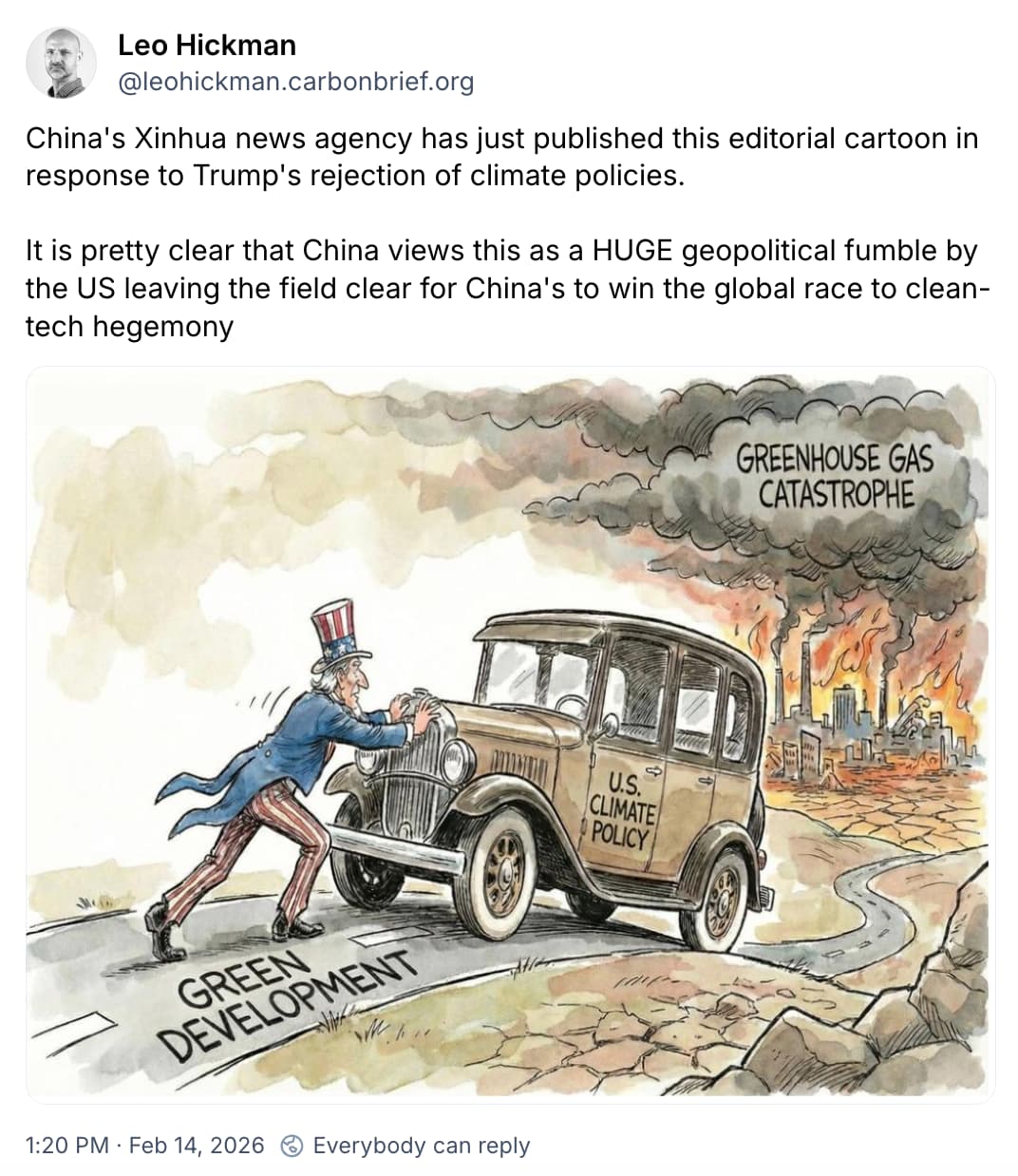
Conversely, Trump described the finding as "the legal foundation for the green new scam", which he claimed "the Obama and Biden administration used to destroy countless jobs".
Similarly, Al Jazeera reported that EPA administrator Zeldin said the endangerment finding "led to trillions of dollars in regulations that strangled entire sectors of the US economy, including the American auto industry". The outlet quoted him saying:
"The Obama and Biden administrations used it to steamroll into existence a left-wing wish list of costly climate policies, electric vehicle mandates and other requirements that assaulted consumer choice and affordability."
An editorial in the Washington Post also praises the move, saying "it's about time" that the endangerment finding was revoked. It argued - without evidence - that the benefits of regulating emissions are "modest" and that "free-market-driven innovation has done more to combat climate change than regulatory power grabs like the 'endangerment finding' ever did".
The Heritage Foundation - the climate-sceptic US lobby group that published the influential "Project 2025" document before Trump took office - has also celebrated the decision.
Time reported that the group previously criticised the endangerment finding, saying that it was used to "justify sweeping restrictions on CO2 and other greenhouse gas emissions across the economy, imposing huge costs". The magazine added that Project 2025 laid out plans to "establish a system, with an appropriate deadline, to update the 2009 endangerment finding".
Climate scientists have also weighed in on the administration's repeal efforts. Prof Andrew Dessler, a climate scientist at Texas A&M University in College Station, argued that there is "no legitimate scientific rationale" for the EPA decision.
Similarly, Dr Katharine Hayhoe, chief scientist at the Nature Conservancy, said in a statement that, since the establishment of the 2009 endangerment finding, the evidence showing greenhouse gases pose a threat to human health and the environment "has only grown stronger".
Dr Gretchen Goldman, president and CEO of the Union of Concerned Scientists and a former White House official, gave a statement, arguing that "ramming through this unlawful, destructive action at the behest of polluters is an obvious example of what happens when a corrupt administration and fossil fuel interests are allowed to run amok".
In the San Francisco Chronicle, Prof Michael Mann, a climate scientist at the University of Pennsylvania, and Bob Ward, policy and communications director at the Grantham Research Institute, wrote that Trump is "slowing climate progress", but that "it won't put a stop to global climate action". They added:
What will the repeal mean for US emissions?"The rest of the world is moving on and thanks to Trump's ridiculous insistence that climate change is a 'hoax', the US now stands to lose out in the great economic revolution of the modern era - the clean-energy transition."
Federal regulations and standards underpinned by the endangerment finding have been at the heart of US government plans to reduce the nation's emissions.
For example, NRDC analysis of EPA data suggests that Biden-era vehicle standards, combined with other policies to boost electric cars, were set to avoid nearly 8bn tonnes of CO2 equivalent (GtCO2e) over the next three decades.
By removing the legal requirement to regulate greenhouse gases at a federal level from such high-emitting sectors, the EPA could instead be driving higher emissions.
Nevertheless, some climate experts argue that the repeal is more of a "symbolic" action and that EPA regulations have not historically been the main drivers of US emissions cuts.
Rhodium Group analysis last year estimated the impact of the EPA removing 31 regulatory policies, including the endangerment finding and "actions that rely on that finding". Most of these had already been proposed for repeal independently by the Trump administration.
Ben King, the organisation's climate and energy director, tells Carbon Brief this "has the same effect on the system as repealing the endangerment finding".
The Rhodium Group concluded that, in this scenario, emissions would continue falling to 26-35% below 2005 levels by 2035, as the chart below shows. If the regulations remained in place, it estimated that emissions would fall faster, by around 32-44%.
(Notably, neither of these scenarios would be in line with the Biden administration's international climate pledge, which was a 61-66% reduction by 2035).
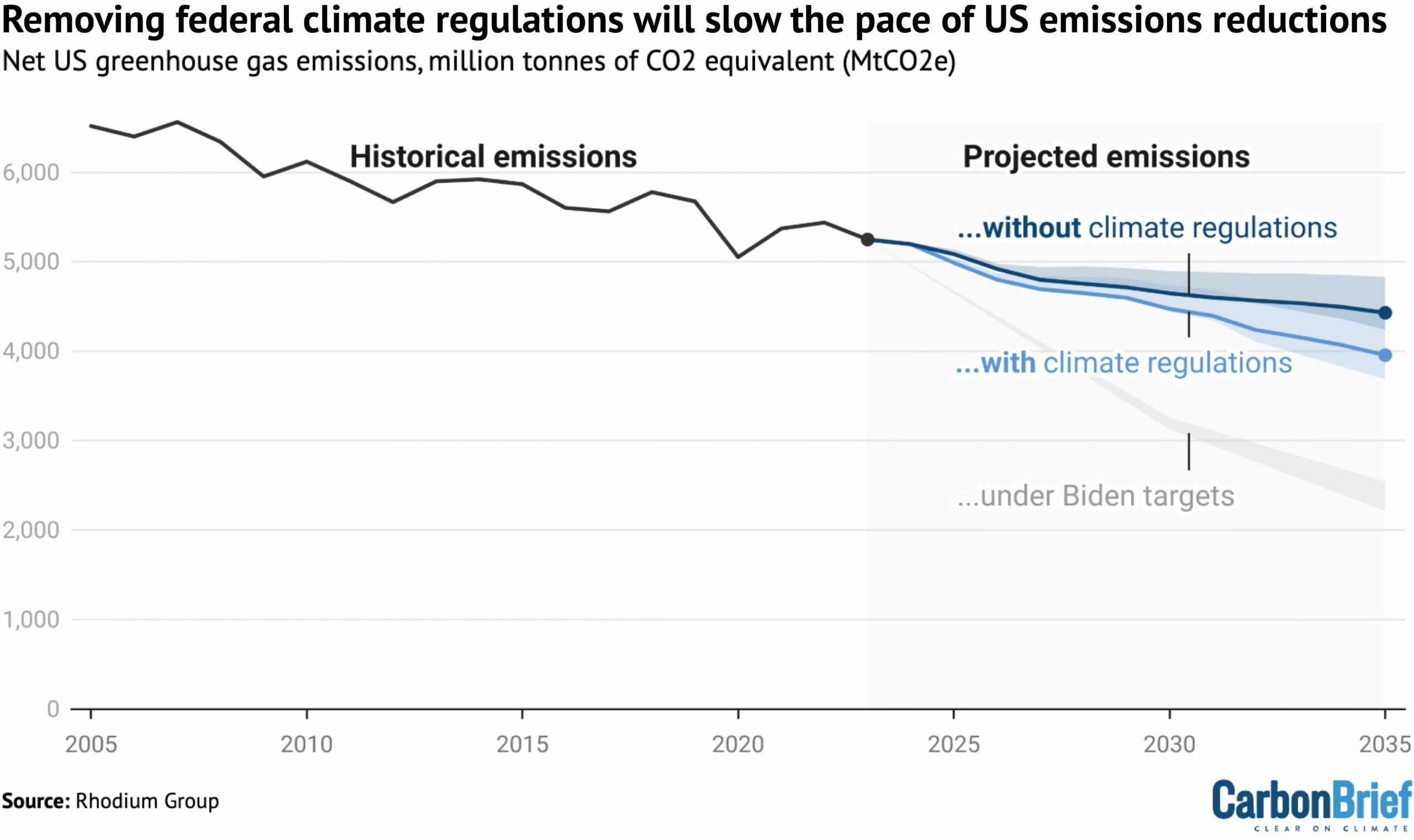 US emissions, MtCO2e, under a "current policy" scenario in which the EPA removes key federal climate regulations ("without climate regulations") and a "no rollbacks" scenario in which regulations remain in place ("with climate regulations"). High, mid and low ranges reflect uncertainty around future fossil-fuel prices, economic growth, clean-energy technology costs and growth in liquified natural gas (LNG) export capacity. Source: Rhodium Group.
There are various factors that could contribute to continued - albeit slower - decline in US emissions, in the absence of federal regulations. These include falling costs for clean technologies, higher fossil-fuel prices and state-level legislation.
Despite Trump's rhetoric, coal plants have become uneconomic to operate in the US compared with cheaper renewables and gas. As a result, Trump has overseen a larger reduction in coal-fired capacity than any other US president.
Meanwhile, in spite of the openly hostile policy environment, relatively low-cost US wind and solar projects are competitive with gas power and are still likely to be built in large numbers.
The vast majority of new US power capacity in recent years has been solar, wind and storage. Around 92% of power projects seeking electricity interconnection in the US are solar, wind and storage, with the remainder nearly all gas.
The broader transition to low-carbon transport is well underway in the US, with electric vehicle sales breaking records during nearly every month in 2025.
This can partly be attributed to federal tax credits, which the Trump administration is now cutting. However, cheaper models, growing consumer preference and state policies are likely to continue strengthening support.
Even if emissions continue on a downward trajectory, repealing the endangerment finding could make it harder to drive more ambitious climate action in the future. Some climate experts also point to the uncertainty of future emissions reductions.
"[It] depends on a number of technology, policy, economic and behavioural factors. Other folks are less sanguine about greenhouse gas declines," WRI's Widawsky tells Carbon Brief.

Analysis: Trump has overseen larger coal decline than any other US president
Coal
|12.02.26
Analysis: China's CO2 emissions have now been 'flat or falling' for 21 months
China energy
|12.02.26
Q&A: New UK onshore wind and solar is '50% cheaper' than new gas
Renewables
|11.02.26
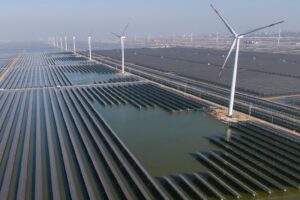
G7 'falling behind' China as world's wind and solar plans reach new high in 2025
International policy
|10.02.26
jQuery(document).ready(function() { jQuery('.block-related-articles-slider-block_4bdaa7bce4cf442df312e36ed007fad0 .mh').matchHeight({ byRow: false }); });The post Q&A: What does Trump's repeal of US 'endangerment finding' mean for climate action? appeared first on Carbon Brief.


