Sorry for not following up my last post sooner. There'll be another climate post shortly.
 My excuse is being consumed by the Delta variant of SARS-CoV-2. Not me personally, I hasten to add. It's a big problem in the state next door, NSW, and has slipped from there into my home state, Victoria, a couple of times (and other parts of Australia). That's meant lockdowns to get us back to zero COVID-19. Having a slightly obsessive tendency, I've been spending too much time on the endless press conferences, news articles and tweets about the subject. This has been at the expense of writing blog articles about climate change, I'm sorry to say.
 While I'm preparing the next article (or procrastinating on its writing) I want to alert people who signed up for email alerts to new articles here on HotWhopper. The normal emails will stop because Feedburner is being shut down this month. Here's the notice:
Recently, the Feedburner team released a system update announcement , that the email subscription service will be discontinued in August 2021.
After August 2021, your feed will still continue to work, but the automated emails to your subscribers will no longer be supported. If you'd like to continue sending emails, you can download your subscriber contacts.
If you'd like to continue to receive email alerts, please let me know directly, using the email address to which you want them sent. You can do the same if you no longer want alerts, although the subs will be opt-in, not opt-out. That is, if you don't let me know you want to continue, you will no longer receive email updates.
You can let me know either way by sending an email to subscribeHW at HotWhopper.com (replacing the "at" with @) or clicking on the link. If you're already a subscriber, you should be receiving this article as an email already, but the emailed articles will only continue if I set it up. I'll probably use mailchimp, which AFAIK is reliable and secure.

What would be worse than a Republican US government that doesn't believe in climate change? Perhaps, a Republican US government that does believe in climate change.
Try a thought experiment. Assume Republicans fully accept human activity, in particular burning fossil fuel, causes global warming. Now, I'm not a political scientist, but it seems to me that a major plank of US right wing philosophy is "preserve the American way of life", and that their foreign policy gives primacy to US interests. (Of course many other countries have a similar philosophy, but don't have the firepower to back it up.)
Now, continue the thought experiment: How can these Republican Climate Hawks square the circle of reducing the impact of global warming on the US, while preserving the American Way of Life?
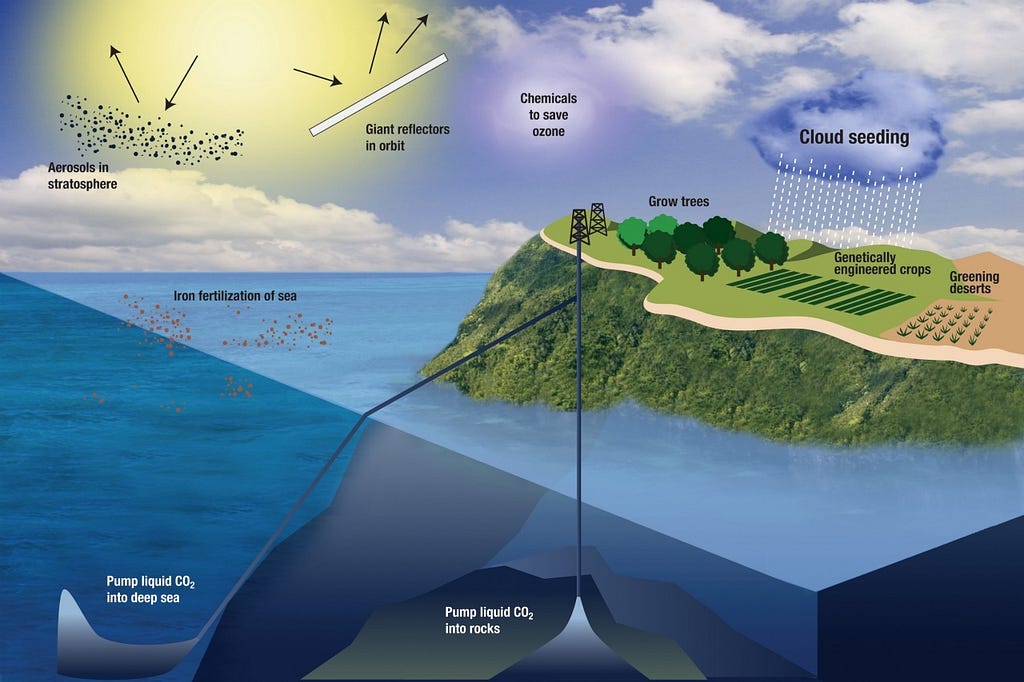
Geo-engineering looks like a really attractive option. Not only does it — in theory — avoid the need to reduce fossil fuel consumption, but it also creates huge opportunities for space technology, defence contractors etc. And if the rest of the world doesn't agree? The US will have to save the rest of the world for their own good.
The chances of success of geo-engineering, and the possible side effects, are impossible to know. But that argument hasn't held back the war on drugs or the war on terror. Of course, if we changed track with those policies, we could try new ones.
Today I'm going to tackle a difficult but important topic - internal conflict. Given the number of people involved, the number and complexity of the issues, and the decades over which the climate movement is likely to be needed, it's a pipe dream to think there will always be harmony. At the same time, if the sort of problems mentioned here aren't acknowledged and, preferably, dealt with well, they can spread and become very destructive. Sweeping things under the carpet, pretending conflict doesn't exist, only allows it to fester and grow.
When a large number of people are working toward a common purpose, it is inevitable there will be internal politics. (If you prefer "virtually inevitable" or "almost inevitable", I'd love you to point out an instance that's been free of this.)
In this article, I'll use the word "movement". I don't like to apply that term to mitigating and adapting to climate change (which is bigger than any movement); however, in the context of this article it's the best word I've been able to come up with.
Everyone who works in an organisation for even a short time, understands internal politics have an influence on decisions, behaviour, alliances, staff promotions and so on. The same goes for any movement, whether it's related to broad social justice, climate change, anti-litter, health, equal opportunity, local politics or anything where a dozen or more people come together around a common purpose.
Conflicts can arise for any number of reasons, some that could be regarded as fundamental, and some are confusingly petty and vindictive. Here are several to watch out for:
- "Means and methods" camps - opposing camps can emerge having fundamentally different and, perhaps, opposing views on how to achieve the common purpose (nuclear vs anti-nuclear; all adaptation no mitigation vs mitigation plus adaptation etc.)
- Personalities and personal ambition - with camps emerging based on individuals within the overall movement (personality cults). These can arise if it's thought there will be personal reward for the personality or the follower (such as fame, career progression, book contracts, committee posts, awards, or other personal recognition). I'm not having a dig at our climate champions. We need them and most leaders in the climate movement are above petty politics. It's wannabes and people scrambling to position themselves where this can become a problem.
- Ideology and political leanings - dismissing and therefore alienating large segments of society based on their politics or ideology (hard left vs left vs centre vs right vs extreme right).
- Position on other causes - dismissing and alienating individuals or segments of society based on their opinions or actions or perceived level of support for other causes - e.g. do they give equal or better attention to social causes (feminist, BLM, gender issues, voting rights etc) and if it's not seen as good enough, if they're seen to be mainly focused on climate, they must be bad people.
- Personal attributes - dismissing or alienating people on the basis of attributes such as sex, gender, skin colour, ethnic origin, cultural background, religion or lack of, sexual preference, education level, political allegiance, friends, colleagues, profession, or opinions expressed on matters unrelated to that common purpose. E.g. all men are bastards, particularly if they are white baby boomers.
The most toxic behaviours I see are related to points 1 and 2 above, and to a lesser extent points 4 and 5. These can (usually by intent) elicit emotive rather than rational responses - anger, hurt feelings, public naming and shaming of individuals whether deserved or not (i.e. straight up defamation). All of this leads to a weakening of the movement making it less able to focus on the common purpose. It can result in fragmentation, a muddying of the waters. It can cause hard-working, committed people to be disillusioned and give up. It can confuse the general public if it spills over into the mass media, reducing their understanding of the important issues.
I'm no mediator. That's not my training or talent. I think I am able to see most things clearly but when it comes to helping people work through personal differences, I defer to people who are expert in that area. I'm not a political animal either, normally being more of an onlooker than a participant. At the same time, as you know, I'm not likely to do nothing when I see good people being unfairly maligned. (Mostly I've addressed malinging by climate science deniers, yet this sort of ugliness has been happening within the climate movement too.)
I don't really want to say much more on this topic. These matters need to be dealt with internally by the more responsible and able members of the movement, rather than airing all the gory details in public (which can in turn cause a lot of harm). I know I've sometimes been a bit intemperate myself, dashing off an angry tweet or two and maybe going a bit overboard in articles here from time to time. I'll keep trying to do better, though I still won't hesitate to call out and ridicule climate science denial.
This article is more by way of reminder and a caution. If you're tempted to join a camp or become a groupie to a personality - just take care you're doing it with your eyes wide open and with good reason. Avoid taking at face value everything someone you might admire says. Do what you can to keep the movement healthy. Stay focused on the common purpose.
Then all the usual things - be prepared to change your mind if the information changes. Forgive individuals if they make what you regard as a mistake now and then. At the same time, watch out for people who exhibit ongoing patterns of toxic behaviour, who may not be as trustworthy or authentic as all that (to use another word I very much dislike), who might be using you and/or abusing others for their own purposes. Remember, you might very well become their next target.
In the end, people come and go, but the issues remain. Harnessing yourself to a particular individual may not be the most productive path in the long term. In the same vein, tying yourself to a particular and very narrow means of achieving the goal could limit the chances of getting there.
Welcome - and please help the world address the problems of climate changeThe climate movement must remain broad and diverse, welcoming people from all over, with all our flaws, with all our brilliant ideas including conflicting ones, and with all our efforts - if it is to achieve the results we must.
-------------------------
We've had a tough few months with more and worse fires, drought, floods, heat waves, disappearing glaciers, water supply problems, rising seas and a global pandemic.
There's much more to be done.
It's nice to be back, and quite lovely to read your words of welcome here and on Twitter. Thank you.
Further readingHere are some relevant articles I came across in a Google search. I don't know if they're among the best examples. Although I've done some work to improve social justice over the years, I've never regarded myself as an activist so this is not my field. Given the sensitivies of social justice movements, the references might or might not be politically acceptable! If you know of other good articles, please add them in the comments.
Three Ways to Reduce Internal Conflict in Civil Resistance Movements - by Joel Preston Smith, September 20, 2018.
Conflict and Movements for Social Change: The Politics of Mediation and the Mediation of Politics - by Kenneth Cloke, July 2013
Crises and Conflicts in Social Movement Organisations by Jo Freeman, published in Chrysalis: A Magazine of Women's Culture, No. 5, 1978, pp. 43-51 - (just to show that internal conflict is timeless).
I spent a lot of time in western Canada in the early 1970s. That's 50 years ago for all you young ones. The world was very different then. Edmonton was experiencing it's longest winter since, almost, forever. It was a long cold winter. In the summer in British Columbia they kidnapped whoever happened to be in the local pubs to fight the annual forest fires, but the temperatures rarely exceeded 80F. It was what people thought of as a bit unusual but not completely abnormal.
Today the world is different. Hard to believe this week, but this is what we should have expected.
#Canada just had a temperature of nearly 50°C (Lytton, 49.6°C)
— World Meteorological Organization (@WMO) June 30, 2021
"Without human-induced climate change, it would have been almost impossible ...as the chances of natural occurrence is once every tens of thousands of years," says @metoffice scientist
Details https://t.co/fb1nIF8wny pic.twitter.com/rxKGmQqZZM
Western Canada is wondering if it has been relocated to Death Valley.
There was famine somewhere in the world back then as there is now, but today, all of a sudden we need to find food for three times as many people.
We're trying to get on top of a global pandemic that everyone says was anticipated but that no-one prepared for.
We've accepted and supported and elected leaders who aren't game to read the writing on the wall, aren't able to act, and keep pointing the finger at someone else for their inadequacies - anyone else will do.
We're looking to evangelical pastor's wives to "save the world", when they can't even stick up for their own supporters.
Alright - it's not all gloom and doom. There are some elected leaders in various countries around the world who are realists and who are keen to make sure the human race survives until at least 2100.
There are journos and communicators who are still quite sure, or at least hopeful, the message coming from the harbingers of knowledge and science will make its way through to political leaders, if not the general population. And that we'll act on it.
For even more good news - I'm coming back, soon, with some analysis and information about where we are today and what's in store. It won't be pretty.
Are you up for it?
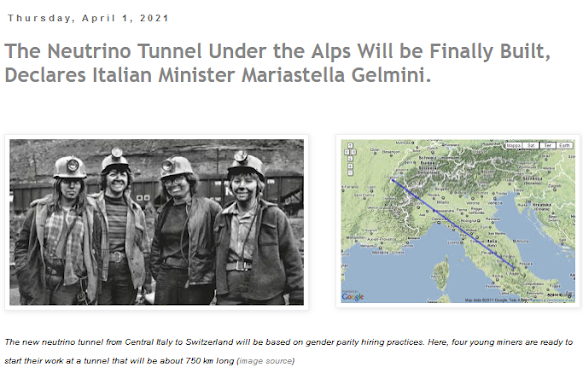
Ugo Bardi's latest post on "The Seneca Effect"
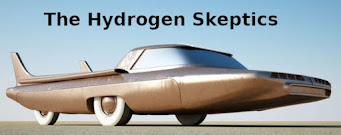
I just started a new blog titled "The Hydrogen Skeptics." It is about the hydrogen economy and hydrogen as a fuel and it is a little technical as a subject. So I thought it was not appropriate to discuss it in a somewhat philosophical blog like "The Seneca Effect." Yet, there are points in common, as I am arguing in this post. Above: the nuclear-powered car "Ford Nucleon", unfortunate technological prodigy of the 1950s, that never was turned into anything practical.
Professor Sabine Hossenfelder engages in a performance about Cassandra. Nice song, well sung, and it catches something of Cassandra's story and character. Although I am reasonably sure that Cassandra would not wear that kind of clothes.
Cassandra's blog is closed. It will remain on line, but it will not be updated anymore. Ugo Bardi has moved to a new site called "The Seneca Effect." It may be a bit more philosophical than the old Cassandra blog, but it will not be very different.
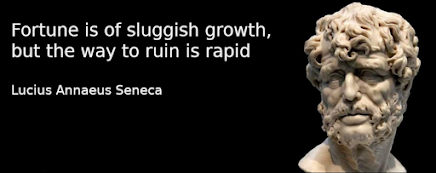
You may also follow Ugo Bardi at "The Proud Holobionts" blog, a more optimistic blog dedicated to -- you guess to what! -- holobionts! A new concept that favors collaboration over competition in the evolution of the biosphere.
And don't forget Ugo Bardis' musings about history and myths at the Chimera blog, with some fictional interpretations of Cassandra's story: An Interview with Cassandra and "The True Story of the Fall of Troy"
Finally, if you like to hear Ugo Bardi rather than reading what he writes, you can find his youtube channel. It is still al little experimental, but it may grow to something interesting in the future.
Thank you to all those who followed this blog for nearly ten years. It was a pleasure, but things keep moving and we have to move, too!
UB
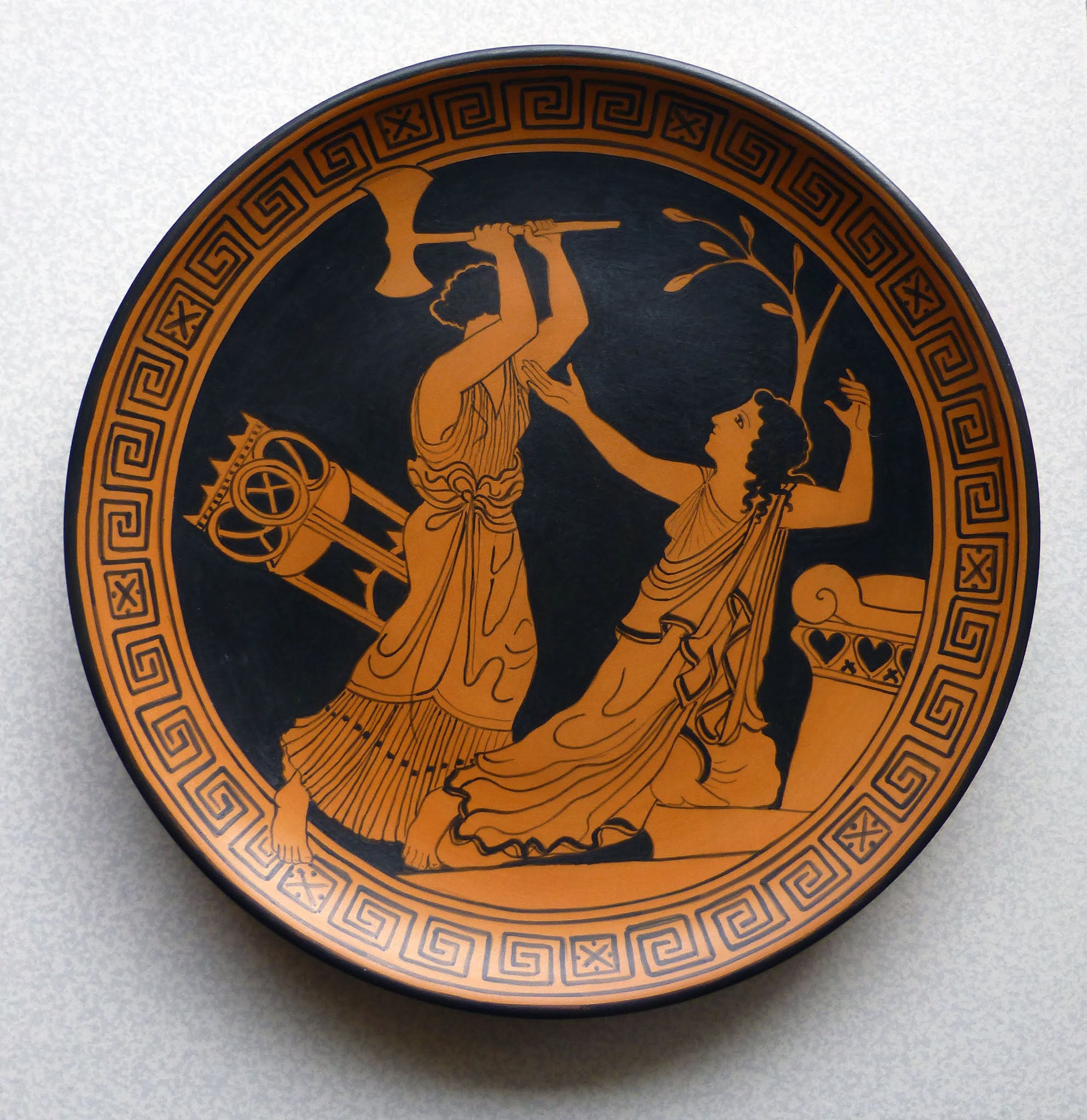
After the fall of Troy, Cassandra was taken as Agamemnon's "pallake" (concubine) and taken to Mycenae where she was killed by Clytemnestra, Agamemnon's wife. The destiny of prophetesses is never so bright, especially when they turn out to have been right. Something similar, although fortunately much less tragic, is happening to the Cassandra blog, censored on Facebook by the powers that be. So, I guess it is time to call it quits. But Cassandra is not dead! She will return in some form.
On March 2, 2011, I started the blog that I titled "Cassandra's Legacy." 10 years later, the blog had accumulated 974 posts, 332 followers, and more than 5 million visualizations (5289.929). Recently, the blog had stabilized at around 2,000-3,000 views per day.
A small blog, by all means, but I always had the sensation that it was not without an impact on the nebulous constellation of the people, high up, whom we call "the powers that be." It is a story that reminds me the legend that George W. Bush decided to invade Iraq in 2003 after he had learned about peak oil. Reasonably, it can't be but a legend, but are we sure? After all, the people who take decision are not smarter than us, just way richer. And they can misunderstand things just like we all do. Of course, their blunders make much more noise.
And so, it may well be that many things that we are seeing around us have a logic. For sure, a certain kind of message cannot be eliminated simply by ignoring it anymore. It has to be actively suppressed. And that seems to be what's happening, with censorship rampant in the social media. Even the Cassandra blog, even though not important in itself, attracted the wrath of the powers that be. It was censored on Facebook and it seems to me that it is also kept nearly invisible in the search engines. As I discussed in a previous post on Cassandra, we knew it was going to happen and it did.
Of course, this blog could survive even while boycotted by Facebook, but when you discover that you are in the crosshairs of someone big and powerful, it is better to take notice, duck down, and take cover. It makes little sense to insist to keep an indefensible position. It is time for Cassandra to fold.
But this is not a defeat. It is, on the contrary, a badge of honor that the PTBs noticed this blog and acted against it (O.K., maybe it was just a glitch of some complicated AI program, who knows?). In any case, closing the blog simply means recognizing that the memetic war follows the standard rules of war. It is all about movement. And that's what Cassandra is doing. It is moving. We all do. The only things that never move are the dead, and we are still very much alive! And "Cassandra's Legacy" will remain on line, although it won't be updated anymore.
I am working at renewing a blog that I had already created, called "The Seneca Trap." It will be online soon with the name "The Seneca Effect". We'll see if it becomes another target for the PTBs!
In the meantime, I am passing to you a few paragraphs that I took from Dmitry Orlov's book "The Five Stages of Collapse." (2013) where he correctly predicted how the West was moving along a path that's taking it to follow the steps of the old Soviet Union, even in terms of censorship. Orlov describes how, at that time, people defended themselves from an obtrusive and obtuse regime. I guess we'll have to adopt the same techniques.
The Rise of Steganographyby Dmitry Orlov -- From "The Five Stages of Collapse" (2013)
I am sure that certain readers will at this point recollect schlocky American Cold War novels they wasted their time reading, or automat-ically conjure up secret codes and communications technologies used Financial Collapse45to play a spy vs. spy cat-and-mouse game with the KGB, while others will want to think that the KGB was sufficiently incompetent and/or demoralized to just let all that secret communication slip by (I assure you that it was not). Well, having seen how it all works in practice, I am happy to disabuse you of all such notions. The only technologies involved were spoken word and pen and paper; the good results were achieved thanks to mental fortitude and solidarity.
The technique I saw used was an instance of steganography, which "is the art and science of writing hidden messages in such a way that no one, apart from the sender and intended recipient, suspects the existence of the message, a form of security through obscurity. The word is of Greek origin and means 'concealed writing' from the Greek words steganos (στεγανός), meaning 'covered or protected', and graphei (γραφή), meaning 'writing.'"10 There is the outer, public message, which is innocuous or insipid or annoyingly redundant (except for a few easily overlooked details); then there is the inner, private message, which can only be discerned by the intended recipient, who has prior knowledge. The key security feature is that the recipient needs to know that the message is a message at all, never mind decipher it.
My mother and my grandmother kept up a voluminous correspondence augmented by regular telephone conversations. They discussed everything from the weather to their reading to what they ate for break-fast. They also seemed to be curiously obsessed with pieces of porcelain: which tea set was a present from whom, who would have liked it, who had owned a similar one at one time or another, from whom they may have purchased it and how much they may have paid for it, how many cups were cracked or broken, whether they could be repaired, who was the clumsy one and broke a cup, who had been particularly skillful at gluing together a broken cup so that it is now as good as new and so on and so forth, all seemingly innocent prattle between two dotty women reminiscing about sentimental bits of bric-à-brac—but for someone in the know, laden with secret meanings. Cups were thou-sands of dollars. Tea sets were tens of thousands. Cracked cups were expenses incurred. Broken cups were deals that had fallen through. Any persons mentioned were not referred to by full name but by informal diminutives and endearments and referenced not to actual places and times but to private, shared memories. But there were also passages of general interest, such as soup or cake recipes, sometimes supplied with a passing comment addressed directly to the KGB censor, such as "Others who are reading this might find this interesting as well." Who could possibly suspect secret, nefarious, conspiratorial intent in some-one so seemingly guileless? Not even the KGB!

A message I received from Facebook on Jan 29, 2021. Five of my posts were deemed "spam" and erased. Some were somewhat "political" although non-partisan, but two were purely technical. That these posts were erased is an indication that censorship is by now applied to all forms of dissent, not just political ones. It was not unexpected, but it was still somewhat shocking after decades of propaganda that had convinced most of us that the Western world was a place where you could enjoy "freedom of expression." But we are quickly moving toward a Soviet-style management of public information, as Dmitry Orlov noted already in 2013. It had to happen and it did.
Last year, a Spanish climatologist, a friend of mine, had one of his posts censored by Facebook, apparently because it was deemed as too "catastrophistic" (or for whatever reason had caused the opaque fact-checkers of Facebook to erase it). He protested and he also tried to convince other climatologists to start worldwide a boycott of Facebook.
The answer was a little disappointing, to say the least. It may be best described as a resounding worldwide "meh." Those climatologists who bothered to answer him expressed the concept that, yes, censorship is bad, but, you know, you can't allow deniers to diffuse their fake science around. It was on this occasion that I discovered that most people like censorship. It is just that it should be applied to those they disagree with. In that case, they actually love it and protest because Facebook doesn't censor enough (you can read that here).
Playing with censorship is a little like playing the apprentice sorcerer: once you start the mechanism, you don't know how to stop it. What's happening now is that censorship is becoming widespread, wide-ranging, and pervasive. Everyone can be affected and it takes unexpected forms. I was surprised when Facebook decided to erase two rather technical posts that were critical of the concept of a hydrogen-based economy. Apparently, censoring dissent doesn't just apply to political dissent. Every dissent is considered bad and can be censored.
But I shouldn't have been surprised. It was expected, we knew that it was coming. Already in 2009, Dmitry Orlov had noted in his book "Reinventing Collapse" how the Soviet and the American Empires had been moving along parallel tracks, with the American Empire poised for collapse just a few decades after the Soviet one. In a later book, "The Five Stages of Collapse" (2013), Orlov described the mechanisms of censorship in the Soviet Union and discussed many remarkably prescient concepts on how electronic surveillance in the West would dwarf anything that the old and clumsy Soviet system could do to spy their citizens.
And so, there we are. The comparison of the Soviet and American styles of censorship is a very interesting exercise that not even Orlov covered exhaustively in his books. I can't claim to be an expert in these matters, but let me just note that censorship in Russia was a nuanced story, not just a clumsy dictatorship dictating to people what they had to believe. In part, yes, censorship was imposed by the government but, in part, it was also enforced "from below." Russian newspapers often carried comments by the "korrespondents" (Корреспондент), people who were not professional journalists but had a certain leeway in criticizing the government, as long as they didn't express doubts about the founding myths that kept the state together. They were similar to our commenters on newspapers and social media who have a list of no-no's that's probably as long as they had. The Soviet Union had an efficient trolling system that could demolish a dissenter, just like our trolls can. (the story of how Boris Pasternak was demonized for his "Doctor Zhivago" novel is a good example of the mechanism)
Overall, it is clear that censorship is developed by societies under stress to try to keep the social fabric together as much as possible. If you think that Russia had been invaded 4 times by powerful Western armies over less than two centuries, you can also understand that the fear of the West was not paranoia, but a reasonable attitude for Russians. And that many of them preferred to support a bad government rather than risking that the US would bring democracy to them by the usual methods.
About the West, nowadays, I don't think we need to note how stressed we are. And, as a result, we are clearly heading in the direction of a Soviet-style management of public information. Is it unavoidable? Most likely yes. It is mostly a desperate, last-ditch effort to keep together a political system that's rapidly crumbling away, but which is doomed in the long run (perhaps even in the short run).
And what should we expect for the future? The analogy with the Soviet Union holds only up to a certain point. In Soviet times there was no Internet, or it was in its infancy. The new communication technologies are disrupting everything, as we saw in the recent "Gamestop" story (see this interesting discussion by Chuck Pezeshky) and we may well be moving toward some completely different information exchange system that, for the time being, remains difficult for us to understand. Maybe it would be something like the glasnost (transparency), that Mikhail Gorbachev introduced in the Soviet Union in 1986. But glasnost didn't prevent (and perhaps eased) the collapse of the Union. Eventually, if collapse has to come, it comes.
To conclude, a recommendation from Dmitry Orlov's book "The Five Stages of Collapse" on how to cope with the present situation. I think it is wise enough.
And so, if you want to achieve a serious political effect, my suggestion is that you sit back Buddha-like, fold your arms, and do some deep breathing exercises. Then you should work on developing some inter-personal skills that don't need to be mediated by electronics. Chances are, you will get plenty of opportunities to practice them when the time comes,
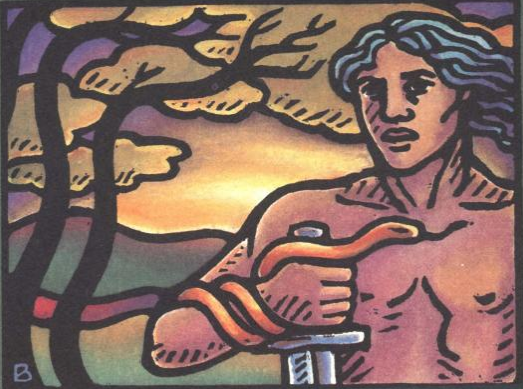
"In antiquity this sylvan landscape was the scene of a strange and recurring tragedy. On the northern shore of the lake, right under the precipitous cliffs on which the modern village of Nemi is perched, stood the sacred grove and sanctuary of Diana Nemorensis, or Diana of the Wood. .. In this sacred grove there grew a certain tree round which at any time of the day, and probably far into the night, a grim figure might be seen to prowl. In his hand he carried a drawn sword, and he kept peering warily about him as if at every instant he expected to be set upon by an enemy. He was a priest and a murderer; and the man for whom he looked was sooner or later to murder him and hold the priesthood in his stead. Such was the rule of the sanctuary. A candidate for the priesthood could only succeed to office by slaying the priest, and having slain him, he retained office till he was himself slain by a stronger or a craftier."
From "The Golden Bough" - by James G. Frazer
Post by "Mon Seul Desir"
Hello Ugo
You once asked, what was the meaning of Trump, it crossed my mind that without anybody's planning or intentions, Trump became an immense collective scapegoating ritual where all the sins and impurities of the tribe are placed upon the king, who is then ceremonially driven out to purify the tribe. Since the 1960s this seems to have increasingly become the function of the American Presidency superseding its previous role which it has held since the days of George Washington, that of a near omnipotent God-Emperor who incarnates American collective power. It's certainly corresponds to the sacred geometry of Washington DC, enclosed by its pomerium, the sacred regalias on display, the Temples to the Divine Emperors, the Axis Mundi rising through the centre of the Capitol's rotunda. I personally visited the place a decade ago and was absolutely struck by the mystical religious layout of the place. It was effectively the centre of a secular City of God, destined to extend to, and redeem the entire world. I would say that Americanism is in fact the world's dominant religious system, erecting its theocracy over the ruins of the British World Empire just as the theocracy of Diocletian Jovius was erected over the ruins of the Roman-Hellenistic Mediterranean Empire.
Now I must point to the Ancients warnings against hubris and the prophecies of Christian mystics that the reign of God can only come with the return of Christ. When one pushes too hard against the Cosmos, it pushes back. Alexander declared himself greater than Hercules, he was assassinated, his family exterminated and Ptolemy Soter was one of the few of his Companions who lived to found a dynasty and die in his bed.
I think that when the history of the USA over the past century is written several generations from now, it will describe not the March of Progress towards the future, the description will be of an ever increasing surrender to hubris culminating in overreach and collapse.
This is the consequence of giving the powers of an advanced culture to an archaic one, they see what they can do with the new powers, not what they shouldn't do. The social structure is overwhelmed by the new powers, the effect is that of Dr Erskine's Supersoldier Serum, what is good becomes better, what is bad, worse.
Homeric society started out as heroic warrior communities ruled by chiefs and freemen's councils, their cosmology was of Primordial Chaos forged into Order by the Will of the Gods, the earthly rulers were shades of the Gods, ordering the human community as the Gods ordered the Cosmos. As their knowledge advanced, they studied the Order imposed by the Gods, the regularities they shaped, the ordered structures, from this they developed basic mechanics, observations of nature and the skills to create ordered organizations of their own, the concepts of objective law and disciplined organizations led to basic state bureaucracy and when merged with the fury of the Iron Age warrior led to the Greek Phalanx and the Roman Legion. The Homeric kings who in the past had commanded a few thousands warriors who were the freemen of his kingdom became massively powerful monarchs who had armies of tens to hundreds of thousands supported by workshops and officials who could undertake campaigns for years and where bound to absolute obedience. They became the Incredible Hulk's of the Ancient World capable of smashing through everything in their paths, the humanistic ethic of the original Homeric world was overwhelmed by a power system stronger than it, the exercise of power became increasingly arbitrary, society turned into a regime of slavery and terror, the lacks of ancient culture became evident, the lack of a deep sense of ethics, no real work ethic, the absence of culturally integrated large scale structures, even the rulers enjoyed no security, any courtier could be a possible assassin, simply eating lunch was a terrifying adventure, their own relatives couldn't be trusted, the guards who protected them one day could butcher them the next...
One sees this in Seneca who discussed the ethics of committing suicide under a despotism, of Boudicca who revolted and was massacred after she and her daughters were tortured by petty officials who had the power of life and death over even provincial aristocrats, the Gospels can be read as the testimony of common people living under the arbitrary will of the powerful. Boudicca could torture and kill any commoner under her power, imperial officials could do the same to her, the officials could be ordered by the Emperor to kill themselves on a whim and the Emperor themselves had to watch everyone... The Homeric values of personal freedom and dignity had lost any meaning and increasingly it became impossible to do science under the constraints of Hesiod's metaphysics, the whole concept of a civilization ordered under its own collective will was dying.
Ultimately this became unsustainable, the reaction came, the Christians stated power comes only from God, the Cosmos is not ordered by the Emperor or any God he represents, it was created by God as an intrinsically ordered structure, there no law of Man, only the law of God which Man can only discover and interpret, all this apparatus of temporal power is just the product of ambition and greed, there is no divine purpose here, a counterfeit of the true City of God. The theology of the Glory of Rome died, abandoned by a people that could not bear its weight anymore and just wanted to breathe freely. Deprived of the faith that sustained it, Rome collapsed under its weight its ruins to become spolia to its heirs who had turned to the City of God.
Now Medieval Man stepped into the world with the certainty that it was God's and that he had to live by His rules. Everything moved by His eternal laws, that could be understood and applied to both the human and natural realms. Rulers were as completely under God's law as the beggar, a new institution was born, Medieval Kingship and Feudalism organized with the support of God's Church, a massive body of law and customs was created to modulate, contain and control power, lord and vassal relationships, knighthood, the Estates, the Guilds, the Communes, ultimately reaching its fullest development in the great Medieval Courts like Versailles, war was codified into the sport of Kings instead of the genocidal total wars of the late Classical world. The much ridiculed Versailles functioned as a containment structure for power, the King could reign without ruling, he didn't need to constantly torture and kill people to show he was in charge, he simply distributed perks and honours, he had great fringe benefits compared to a Classical ruler, greater personal comforts, minimal risks of assassination, eating his meals in peace, no worries about his guards, outside the palace a massive array of autonomous institutions ran the whole society without royal intervention, the king's subjects lived in security and prosperity, the much maligned costs of Versailles were insignificant compared to the costs of despotism. The so-called Enlightenment pseudo philosophers could never have survived in Ancient Rome, they would have been lion food, in a 20th century tyranny it would have been concentration camps and bullets in the back of the head, they were in fact free because the containment structures of the Versailles system protected them, they thought France could be made into a better country if it was ruled by a Caesar, they got Napoleon who used up the wealth and manpower of France the way Alexander used up Macedon, people don't realize what they have until they lose it...
Now armed with the concept of God's law, the development of philosophy took new directions first under the scholastics and then under the natural philosophers taking the development of science well beyond that of ancient world, a new Christian work ethic fostered the Guilds of free craftsman who took technology beyond that the classical era with the clock, navigation skills, new architecture and art and eventually an Italian named Volta but together the first electric battery, opening a new unsuspected realm to science, knowledge that would overturn the Medieval metaphysics and lead to the Quantum Realm and the world of Relativity.
By the 19th century the world saw the emergence of a new form of organization, Technocracy, to manage the new railways and telegraph system, the first components that would grow into the Technosphere and a schizophrenic type of Man, Medieval Man in family and public life and Technospheric Man at the railway station, telegraph office and engineering and science lab.
The concept of regularity and intrinsic order in Homeric society lead to technologies and forms of organization that overwhelmed its ethics and social structure, the Roman Empire was a supersized Homeric chiefdom with the bureaucracy and military of King Philippe the Second but without the customs and institutions that restrained and stabilized his regime, before the power system Homeric society was completely helpless, only the replacement of its values by Medieval ones, accompanied by the collapse of the Roman system allowed the people to become free.
Today Technospheric Man has carried out a similar revolution, Technocracy, Quantum Mechanics, Relativity, it's technology, it's conception of Man as taught by Freud and Jung, its achievements that have obliterated the old sense of limits, the Atomic bombs that can level mountains in minutes, the contraceptives that have removed immemorial fundamentals of the relations between the sexes, the medical advances, the communication systems and so much more. Today's Western system is simply a collection of decayed Medieval courts surrounded by the modern equivalent of the Fuggers and Medecis in the corporate lobbyists attempting to use structures taken from Black Panther's Wakanda and Doom's Latveria to create some sort of City of God on Earth, they're as completely overwhelmed as the Classical rulers were, they wanted absolute power, they have it and everything that goes with it, they're afraid of each other and of the people they rule, they're quickly finding that absolute power burns the hands that attempt to wield it. But do they even truly understand what they're attempting to wield? Does their Medieval mentalities even contains the concepts and cognitive patterns that would allow them to understand?
That the problems the world is facing are problems in managing the Technosphere, they're not political and the accepted techniques of financial and legal manipulation don't work, traditional assumptions are obsolete, essentially what is required is Apollo Mission Control style technocratic management. Do these skills even exist in the current elites? Or they will simply persist in enforcing superstitious rituals of purity and redemption?
Today I point out the Internet, consider what the printing press did to the power of the Medieval Church, the first printed books came in 1455, 62 years later in 1517 Martin Luther posted his 95 theses and the rest is history. The Internet is the printing press on gamma rays, it's Big, Mean and Green, consider that the properties of any substance is dependent on the nature of its bonding patterns whether its chemical or social bonds, the current system is dependent on vertical bonds converging on small groups of people, the Internet allows the creation of very large numbers of horizontal bonds across this structure, eventually sufficient to overwhelm the vertical structure and cause it to collapse. I don't think their pathetic attempts at censorship will work anymore than burning printed tracts and heretics worked for the Church. Can the current governments even survive into the age of the Internet?
Now this was a long one Ugo, when I start writing I'm never sure how it's going to come out!
 Anthony Watts has set up a new website for climate disinformers and wilful deniers. (H/t CJ in the comments here at HotWhopper.)
His disinformation website is called Everything Climate. Translating its stated aim from denier-speak, it is to hook people who aren't yet knowledgeable about climate to recruit them as conspiracy theorists for the climate disinformation cult.
Anthony Watts is known in climate science denier circles as a climate science disinformer and conspiracy theorist. True to form, he made a number of questionable claims in his introductory article. He wrote "We have four categories at the moment, and a few dozen sub-titles covering specific claims/arguments that are commonly in the news and are contentious." The bit about "a few dozen sub-titles" is weird, because I can only see 23 articles. I've no idea what the "few dozen sub-titles" relate to. As for the topics he claims are all contentious, some of them are so well-established they are indisputable, some are the topic of active scientific research, and some are strawmen (i.e. the Everything Climate topic is not a claim or argument in scientific circles).
Anthony claimed he "wanted a site that was entirely a factual website", and has failed badly right from the word go. Apparently it took himself and (probably mostly) Charles Rotter "months" to get it up and running. I guess they must have had too many other things going on over the past year because that's a helluva long time to get such a piddly little website up and running.
Driven by jealousy? Competing with his employer, the Heartland Institute?
His decision months ago was probably because he was peeved at how a teenage denier from Germany stole his thunder at the Heartland Institute. (She reportedly only lasted there around 3 months before disappearing, deciding to not renew her three month contract with Heartland.)
Anthony is going head to head in competition with his recent employer, the Heartland Institute. His new disinformation website is modeled on that teenage deniers website, which was ostensibly set up by her in the short time she was employed by Heartland. It's a lookalike. WUWT's Everything Climate doesn't cover anything near the amount of science denial put up on the Heartland website, though. It's a pale imitation.
WUWT is taking tips from Skeptical Science. Will it backfire?His Everything Climate website has also taken tips from Skeptical Science. To wit: the "familiarity backfire effect" is when people hear a falsehood so often they accept it as fact. This is from from Skeptical Science, on how to overcome that effect:
There are several simple techniques to avoid the familiarity backfire effect. First, put the emphasis on the facts rather than the myth. Lead with the science you wish to communicate rather than the myth. Unfortunately, most debunking articles take the worst possible approach: repeat the myth in the headline.
Second, provide an explicit warning before mentioning the myth. This puts people cognitively on guard so they're less likely to be influenced by the myth. An explicit warning can be as simple as "A common myth is…".
Third, explain the fallacy that the myth uses to distort the facts. This gives people the ability to reconcile the facts with the myth. A useful framework for identifying fallacies is the five characteristics of science denial (which includes a number of characteristics, particularly under logical fallacies):

Pulling this all together, if you debunk misinformation with an article, presentation or even in casual conversation, try to lead with a sticky fact. Before you mention the myth, warn people that you're about to mention a myth. Then explain the fallacy that the myth uses to distort the facts.
What Anthony has picked up from Skeptical Science is to emphasise the false claim right up front to try to get it embedded in readers' minds. He does this through sub-headings. For example, everyone knows by now (or should know) that it's the greenhouse effect that keeps our planet at a liveable temperature. By increasing greenhouse gases at an alarming rate, we're making the planet much, much hotter.
Anthony Watts and Charles Rotter don't want you to believe this well-known fact, so to try to get readers to wrongly think the greenhouse effect isn't real, they wrote "Most Observed Warming is Natural" as a sub-heading. It's ridiculous and hardly pushed by even the most ardent of deniers anymore. Their myth barely rates at Skeptical Science these days. The popularity among deniers of their "it's natural" argument is now way down the scale at number 56. No-one but a Climate Disinformer would make that false claim and no-one except a Wilful Denier would "believe" them.
Everything climate disinformation has already been debunkedI won't bother going through each bit of disinformation for now. If you haven't come across a topic at "Everything Climate" before I suggest you look at denier myths at Skeptical Science.
You can also use the search bar here. Although I've not published much these past few months, from what I can see, Anthony Watts' Everything Climate disinformation website is just a rehash of tired old debunked memes, so the chances are, if you look up a topic, you'll find I've written something about it.
References and further reading- Global Warming & Climate Change Myths - the most used climate science denier myths with links to articles at SkepticalScience.com
- Busting myths: a practical guide to countering science denial - an article on how to counter climate disinformation at SkepticalScience.com
- Debunking Handbook 2020 - a new version of the Debunking Handbook, written in collaboration with numerous experts - from the Center for Climate Change Communication at George Mason University
- Article about the not-so-sensational sensation adopted by the Heartland Institute, which was shortly thereafter rejected by that same "sensation" - from DeSmogBlog
- Climate Change: How Do We Know? - the Number One website returned in a Google search of "climate change", which Anthony Watts is laughingly trying to replace - from NASA
Climate science deniers can be grouped in different ways. Having observed them for more than a decade now, this is how I see them:

- The uninformed - ignorant about climate, doesn't read articles on climate. Strictly speaking the uninformed are not science deniers. They just don't know anything about climate.
- The misinformed - previouly uninformed who've read & unwittingly accepted climate disinformation.
- Wilful deniers (aka wilfully ignorant) - previously misinformed but have since been exposed to climate science findings and rejected them (usually for ideological or other reasons). All of this category by definition are conspiracy theorists.
- Climate disinformers - know the facts but are in the business of spreading lies to feed the previous categories (usually for monetary gain and/or ideological reasons). All of this category are by definition weavers of conspiracy theories.
Why categorise deniers?
It can be useful to categorise climate science deniers. You may be having a discussion with a stranger you thought was uninformed or misinformed, so you go full on with the facts. If it turns out they are Wilful Deniers or Climate Disinformers, your efforts will be in vain, at least as far as helping out the person with whom you're conversing. You can then decide whether to stop talking with them and block them or whatever is the equivalent on whatever platform, continue the discussion to hone your own knowledge or benefit lurkers, or change tactics and use another form of persuasion. (Facts make no difference to Wilful Deniers and Climate Disinformers. Appealing to decency or "values" usually doesn't work either.)
If the climate science denier is a friend or family member, that's a whole different matter. One-on-one personal engagements are very different to talking with some random person on the internet. You'll need to decide for yourself whether to try to influence their notions and, if so, how (and why). I will say you've a much higher chance of influencing someone you know than of influencing some random science denier in cyberspace :)
I've written a bit more about each category. Most climate hawks will be familiar with all these types, but it might be useful to someone, perhaps as a social research topic. For example, I expect that there's a scale of Covidiots that's somewhat similar.
1. The uninformed
I don't regard the uninformed as science deniers. Having said that, it's hard for anyone to remain in this category these days. News articles on climate change and global warming are appearing more and more. With each new and more extreme weather event, it is very difficult for responsible journalists to address the question "why and how did this happen" without referring to climate change.
What this means is if you come across someone you'd like to think is merely uninformed, the chances are that's not the case any more. They are much more likely to be in category 3 (wilful deniers) or category 4 (a disinformer).
How to pick the uninformed?
If a person is only uninformed, they will either demonstrate their willingness to learn about climate or they will quickly lose interest in the topic.
They won't make a huge effort to try to persuade you that scientists of the past two centuries are wrong, that physics and chemistry is a hoax, that their false understanding of the second law of thermodynamics is right and all modern thermodynamics is wrong. They won't spend endless tweets and blog comments trying to dissuade you from the evidence that ice is melting, heat waves are getting worse, seas are rising, average global temperature is going up and up and up. They won't chant "CO2 is plant food".
If a person appears uninformed but brings up denier arguments then you know they are one of:
- misinformed,
- wilfully ignorant or
- a disinformer.
2. The misinformed
As with the uninformed, these days the chances of one being able to remain merely "misinformed" is very low. There is a vast amount of information available and many people willing to point a misinformed person toward good information. There's ample information written for all levels of science education as well as no level of science education.
If you come across someone who you think may be merely misinformed, it won't take many interactions with them to find out. They'll demonstrate fairly quickly if they are wilfully ignorant or a disinformer.
How to pick the misinformed?If they are misinformed, they will not keep coming up with denier arguments (see above). If they won't check their information sources and show no willingness to verify their (mis)information they are not unintentionally spreading misinformation, they are doing so deliberately.
If a person appears misinformed but refuses to check facts, and/or counters any point you make with a tired denialist meme, pulls up unsourced "charts", silly pictures and spurious quotes from climate disinformation blogs, and/or starts ranting and raving incoherently (not uncommon), then you know they are one of:
- wilful deniers (including the wilfully ignorant) or
- a disinformer.
3. Wilful deniers (including wilfully ignorant)
This category has the largest number of climate science deniers. They are the group the disinformers want to expand, to apply group pressure. Most of these people entered as misinformed and (rarely) as open-minded uninformed. They were looking for arguments to bolster their belief that science is a hoax.
It's not uncommon to read comments like "I knew there was something wrong with climate science. I'm so glad I found this [name of disinformation blog] blog." (There "must be something wrong" vaguely and inappropriately applied is one of the markers of a conspiracy theorist.)
These people are inclined toward conspiratorial thinking in realms beyond climate science. Some of them are evolution deniers. Many of them were Trump supporters and QAnon followers, or adherents to the previous versions of the conspiracy theories QAnon adapted and adopted as their own. You'll still today hear "Agenda21 [sic]", "HAARP", "chemtrails", "child trafficking", "Rothschilds", "Pope", "Prince Philip", "Hillary", "UN"; and more.
The wilful deniers tend to band together in cult-like groups on climate disinformation blogs, on Facebook, Twitter, Reddit and (for a short time) Parler. They'll put up unsourced, uncaptioned and usually wrong charts they can't explain, which they got from one of the disinformers. They'll make false and defamatory claims against climate scientists and others as if to say "this woman/man is a bad person therefore science is a hoax". Most of them demonstrate ignorance and often downright stupidity.
These people could be called gullible. I don't see that as their defining trait, though. I see them primarily as conspiracy theorists, scared people afraid of the world and particularly scared ot knowledge, epitomised in Bob Altemeyer's The Authoritarians.
How to pick a wilful denierWilful deniers are the people who've commented on or lurked at climate denial blogs and discussion boards for years or even decades, so they've no excuse for not checking the facts. Even on the most rabid science denial blogs they can see actual science in one form or another. That is, they have seen the evidence, the facts of what's happenig to the world and why, but have chosen to not "believe" them. They are pointed to articles about science and to scientific papers.
It's not that they are ignorant. They have no valid excuse for rejecting science. It's that they choose to embrace nonsense and gobbledegook. They choose to reject science despite all they've read or been given the opportunity to read. Science denial is a wilful, deliberate action on their part.
If a person appears to be a wilful denier but you discover their job (whether paid or unpaid) is to spread climate science denial, then you can bet they are a climate disinformer. Climate science denying blogs are run by climate disinformers. Almost all the guest posts there will be written by climate disinformers.
4. Climate disinformersClimate disinformers are the worst. These people knowingly spread disinformation for benefit. They may be any or all of the following:
- It's their job. They work for a right wing lobby group or think tank in a paid or unpaid capacity.
- They run a climate science disinformation blog or write guest articles or share cross-posts between blogs. Many of these blogs are a source of income for the disinformer, and the owners are continually pleading for donations to keep it going, often with false promises (e.g. will be publishing a paper that never appears, will be getting arrested for being a disinformer which never happens, will be starting a journal/society of deniers that never gets off the ground, etc.)
- They claim to be a contrarian scientist but actually speak to and promote climate science disinformers (usually running a disinformation blog). In the US, some of these are easily identified because they're called by denier politicians to testify on record for House and Senate committee hearings; and, more recently, were appointed by the Trump administration to key positions in science agencies in an attempt to misdirect climate science.
- They are often quoted by other climate science deniers and disinformers. (Note: disinformers will also misquote legitimate scientists. It's important to check sources.)
- They will write chapters and books to spread climate science disinformation. Even though hardly anyone will read these books, they are seen as useful to pepper blogs with denier quotes.
- They will go on speaking tours (usually paid) to spread nonsense about climate.
- They have written no or few scientific papers on the topic of their disinformation, or not in reputable journals.
- Promising to publish science denying papers in scientific journals (then it doesn't happen) - e.g. Anthony Watts and Jo Nova;
- Claiming they'll be persecuted for being a denier (persecuted victim/hero complex),
- Promising to start a journal/society of deniers to get large donations, and it never gets to first base
- Cadging donations to go on an overseas jaunt to attend a scientific meeting overseas to "ask questions" of scientists. Then squibbing on the questions - asking none.
By their actions, climate disinformers aim to stop the world from taking action to keep the planet habitable and aim to stop the world from adapting to climate change. (Some of them are so far into denial they will even try to deny this most obvious of conclusions.)
Without hard and fast evidence, I'll speculate climate disinformation is mostly spread by social media and the tabloid press. It doesn't have many other avenues. There's the occasional denier conference (gabfest) but these get little or no publicity outside of climate denier circles and are often poorly attended. It's social media where most of the recruitment is done, and the tabloid press is used to spread ignorance to the already ignorant.
And then there's the Murdoch empire
The US (and to a lesser extent Australia) has been a special case. The Murdoch-owned news media has been waging a war against the world for decades now, and continues to this day. Rupert and Lachlan Murdoch have a huge platform for recruiting climate science deniers, and is a whole other story.
References and Further Reading
- Some sciency questions, plus a note on etiquette - HotWhopper article about Anthony Watts squibbing on his promise to question scientists
- On Plain Denial: Watts Dismisses His Own Evidence That is Counter to His Viewpoint - HotWhopper article about Anthony Watts' promising a paper still hasn't seen the light of day - nine years later!
- How Anthony Watts, persecuted victim and hero, valiantly thwarts imaginary roadblock throwers - an article about the much vaunted Open Atmospheric Society, which Anthony Watts used to cadge costly donations ($500 a pop) but has still never appeared - even the website seems to have disappeared now (here's the archived version).
- Table showing the various predictions made by David Evans (on Jo Nova's blog), which led to his promised papers, none of which never eventuated including his promised papers.
- Curses! It's a conspiracy! The Fury is Back Thrice Over - a long HotWhopper article about a research paper on conspiracy theories (Stephan Lewandowsky et al 2015).

Ishi, (c. 1861 - 1916), the last member of the Native American Yahi people, photographed as he was in 1911 when he came out of the woods. How did the Yahi react when they saw that the Whites were going to exterminate them? Perhaps not differently from the way we are reacting to the prospect of the collapse of our civilization: going crazy. The reaction to the current Covid pandemic is just the first stage of the wave of madness that's engulfing humankind.
Imagine you are a Native American living before the arrival of the Whites. Maybe you are a Lakota, hunter of the central plains. Or maybe a Yahi, living in the thick forests of California. Or a member of any of the many Native American nations that existed back then.
As a Native American, you have your family, your friends, your day-to-day routine of things and tasks. And you are busy with that, except for one thing: you know that there is a big problem. A VERY big problem. There is an entire nation, out there, bent on exterminating you and your people: the Whites.
At first, you try to ignore the problem: those Whites are far away. Or maybe you'll deny that they are coming, or that they are so many as they are said to be. But, at some moment, the truth cannot be anymore ignored or denied. The Whites are there. They are coming for you, for your family, your children, your friends, your people. And you know that there is really no way to stop them. So, what do you do?
You go crazy. And so does everyone else. Suddenly, you are catapulted into a "new normal," a world where the routines of everyday life have disappeared. You are now into a sort of "heroic space" where you are supposed to go through weird mystic rituals that involve dancing yourself to a trance, wearing "ghost shirts" that are supposed to protect you from the Whites' bullets, and even more extreme dances, called "sun dances" that involve hanging oneself to a pole with a rope with hooks at the end that pierce one's breast. That is supposed to make warriors braver in the coming fight
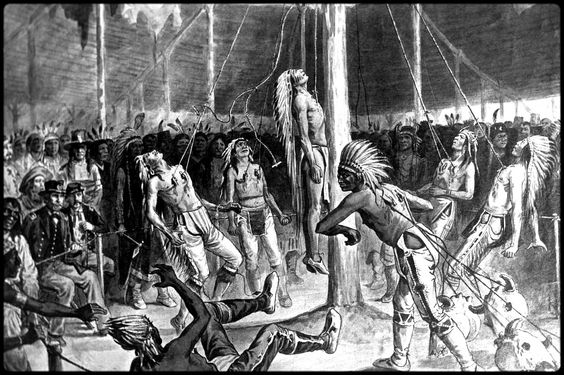
A contemporary representation of the "sun dance" involving people hanging themselves to poles with metal hooks stuck inside their breasts and other forms of self-inflicted tortures. This image was probably made with the purpose of emphasizing the "barbaric" aspect of these rituals, but it is true that the Native American society, under heavy stress, had developed these bloody self-punishing dances.
We don't know how exactly the Native Americans of those times saw these bloody rituals. Did they really believe that ghost shirts made them invulnerable? Did they really think that their problem was that their warriors were not brave enough and they needed to hang themselves to poles by the breasts? We can't know, and we can't know if someone understood that it was way too late, that the Native American peoples should have acted much earlier to face the Whites as a united nation, instead of scattered tribes. But so moves the great wheel of history, mercilessly crushing everything and everyone when their time has come. After the massacre of Wounded Knee (1890), nobody could anymore think that ghost shirts were a solution.
The Native Americans were not the only culture that went crazy when facing their own demise: Mon Seul Desir (see the text below) calls this phenomenon the "Indian Reservation Syndrome" and he lists other cases of societies gone into a frenzy of mysticism and rituals when they faced problems that they could not solve. One was the Nongqawuse cattle-killing cult in South Africa, another was the Boxer Rebellion in China (the latter also believed that their spiritual powers made them invulnerable to bullets).
And then, of course, there is our civilization. We are facing a disaster even worse than anything the Native Americans ever faced: the collapse of the whole planetary ecosystem. And, like them, we are going crazy.
You can see the ongoing craziness everywhere in its many forms, but the overreaction to the Covid-19 pandemic is perhaps the most pervasive, the most destructive, and the most misunderstood form of craziness that has hit us. The parallels with the rituals of the Native Americans are evident, with the role of the ghost shirts taken by the face masks as a visible garment signaling the beliefs of the wearer and by vaccines as magic tools making people invulnerable to the enemy.
The most evident parallel is in the penance factor of the current rituals that include various forms of personal punishment. Western citizens are not hanging themselves by the breasts, but they undergo segregation, limitations to movement, loss of personal freedom, and economic ruin, and more. The idea is to turn the whole story into an obsessive-compulsive ritual carried out with the same stoicism and indifference that Native Americans showed while hanging by hooks from their breasts.
It is part of the way the human mind works: when things go bad, the first reaction is to look for someone to blame. But, sometimes, when things go not just bad, but truly rotten, then the culprit may turn out to be yourself. So, that's the reason for the general acceptance of rules and laws that, in other times, would have caused howls of dissatisfaction and, at the minimum, a general riot. It explains the demonization and the mistreatment of those who are the victims and not the perpetrators of what's happening: single human beings, treated as the one cause of everything.
It was probably unavoidable. The Covid is not the real problem, we all know that. The problem is another: it lurks in the background, but it is there. No ghost shirt (and no vaccine) will send away the ecosystem collapse that we are facing.
_________________________________________________________________
The message from "Mon Seul Desir" that inspired this post
Thanks for the data, it confirms what I've was perceiving through feel and anecdotes, you've put hard numbers on it. It's something I've been observing building up for a number of years, increasing drug use, alcoholism, and mental illness, I call it the Indian Reservation Syndrome, it's the product of cultural collapse. I think you have heard of how primitive people can leave themselves to die when they lose their traditional way of life, it was hubris to say that this is confined to allegedly primitive tribes. Any culture can collapse when it comes into contact with a more advanced one.
A couple of years ago I started having the feeling that collapse would start with massive mass psychoses, like the Nongqawuse cattle-killing cult, the Ghost dance, the Boxers, and the Cargo cults, I've been amazed by the Covid cult, it has turned into a collective obsessive-compulsive disorder, disconnected from any reality and resembling witchcraft and demonic possession hysteria, it has the common factor of having been embraced by the elites and much of the educated, with Mr. Fauci and Ferguson in the role of Herr Kramer and Sprenger. And it's not isolated but part of a massive collective frenzy extending into every aspect of society. The processes that led to this, I'll take up in a later message...
Now for the Galla Placidia text, I see you as pointing to a non-linear transition, a complete change of state of the system, where the Homeric world gave way to the Medieval World, the City of God replacing the Glory of Rome. For this to occur implies that Medieval potentialities already existed in Late Rome, the collapse of the Empire allowed actualization of them. We are all chimeras, modernity is a chimera with a younger culture as a ghost in the shell of an older one. The Late Bronze Age had the Homeric world growing within itself, the Roman Empire had the Medieval world within and the modern West which is simply Medievalism in its late form has the Technospheric world growing within itself.
How do you recognize the new culture? When its mythology emerges in a recognizable form, in pagan Rome the Gospels were regarded as crude tales for the credulous and uneducated, in the Bronze Age, Homer was probably seen as folklore for simple soldiers and sailors. I needed to find something similar, in December 2017 Me and my wife purchased movie tickets and sat down to watch Thor Ragnarok and I found it, Technospheric Mythology right in front of my eyes, it's regarded as just entertainment for children, I thought about the utterly alien feel compared to movies from the 1950s like the 1959 Ben Hur movie. That earlier movie represents the Medieval Myth, you could show it to an audience from centuries ago and it would be fully comprehensible, but show Thor to even a 1959 audience and it would be surreal and insane, the motivations and morality of the characters would be mostly incomprehensible.
I've seen the way many people react to it, it's just special effects, it's action, they can't see why these movies are so popular. The Christian Myths are the Neoplatonic- Aristotlean weltanschauung turned into a narrative, the Marvel, DC, Inception and so on are the Relativistic-Quantum-Jungian weltanschauung similarity turned into narrative.
_____________________________________________________________
This is a moving and beautiful song by the Italian singer Fabrizio de Andre (1940, 1999) inspired by the massacre of Sand Creek of 1864.
Sotto una luna morta piccola dormivamo senza paura
Fu un generale di vent'anni
Occhi turchini e giacca uguale
Fu un generale di vent'anni
Figlio d'un temporale See'è un dollaro d'argento sul fondo del Sand Creek.
I nostri guerrieri troppo lontani sulla pista del bisonte
E quella musica distante diventò sempre più forte
Chiusi gli occhi per tre volte
Mi ritrovai ancora lì
Chiesi a mio nonno è solo un sogno
Mio nonno disse sì A volte I pesci cantano sul fondo del Sand Creek
Sognai talmente forte che mi uscì il sangue dal naso
Il lampo in un orecchio nell'altro il paradiso
Le lacrime più piccole
Le lacrime più grosse
Quando l'albero della neve
Fiorì di stelle rosse Ora I bambini dormono nel…
After some 10 centuries of existence, universities have arrived to the end of their historical cycle. It is the way things are: it is the great cycle of life, even Simba the lion knew that. The universities will be gone, something else will come that will help people who want to learn and people who love to teach to find each other. And the cycle of life will continue. Here, Sinéad Murphy has kindly given me the permission to reproduce her recent post "Requiem for Universities" on "Cassandra's Legacy." Her conclusions are similar to mine, as expressed in the post I wrote with the title of "The Fall of the Citadels of Science."
by Sinéad Murphy
Universities have been dying for some time. As their prospectuses have grown glossier, their gateway buildings more spectacular and their accommodation for students more stunningly luxurious, the Humanities subjects have been gradually hollowed out.Academics' intellectual work has been streamlined by the auditing procedures of the 'Research Excellence Framework' and by growing pressure to bid for outside funding, which is distributed to projects that address a narrow range of approved themes - Sustainability, Ageing, Energy, Inequality…
Student achievement has been dumbed down by the inculcation of a thoughtless relativism - Everybody's different; That's just my interpretation - and by the annual inflation of grades.
The curriculum has begun to be tamed by continual revision - never broad enough, never representative enough - and by the drive for 'equality and diversity'.And teaching has been marginalized by the heavy requirements that it represent itself on ever proliferating platforms and review itself in endless feedback loops.
Universities, in short, have been gradually transforming into what they proudly trumpet as a Safe Space, a space that has been cleared at greatest expense to Humanities subjects, a space in which the slightest risk - that a thought might lead nowhere, that a student might be uninterested, that an idea might offend or that a teacher might really persuade - has been mitigated by so many layers of bureaucratic procedure that most of everyone's time is spent in wading through them.
Safe Space universities have been divesting themselves of real educational content, their plush marketing ploys concealing the decline - of their Humanities subjects at least - into little more than holding patterns for directionless youths.
But up until March of last year, there was still some space and time to act as if. To attempt, in the midst of the decline, to teach, to learn, to think, as if it were really possible to do so.
Because you could still meet your students, and use the small chance you had to teach them to introduce ideas which they might just be taken by and which you, in the process, might deepen your understanding of. And because students could still meet each other, form friendships, gather together, lift themselves out of the lives they grew up with, if only as a temporary reprieve.
It was not much, that is true. And acting as if can too easily collapse into the corruption of an all-out cynicism - quoting Heidegger in the original German to students who are visibly disengaged.
But acting as if can also, sometimes, work; the pretence can actually catch on. Two centuries and a half ago, Kant urged us to act as if human beings are rational, convinced that that would eventually make us so; and it did seem to work… for a while, at least.
But even the pretence is over now; even acting as if, no longer an option. Safe Space universities have come to their culmination. No space is safer than an empty space. And universities are empty at last. The shell has cracked and fallen away. The university is no more.
A couple of weeks ago, following a year's leave, I stood in a tiny office on the tenth floor of a university tower.
From here, all teaching for the coming semester was to be done.
Lectures were to be given into the void, recorded for access in a space and at a time of students' choosing. Hour-long tirades, with only your Panopto reflection for your guide, without even commonplace reference points to scaffold the event - the time of day, the weather outside, the furnishings, quirks in the technology: no experience shared, nothing to bind you to your crowd.
Seminars were to be run from here too. These, at least, were to be 'live'; when it was morning for you, it would be morning for everyone else too. But - open and earnest discussion with students locked up in their family home, sitting on the bed they tossed in as a child? I am told that they turn off their video, sometimes their audio too, attending the class in name only, suspended in a box on the screen.
A brand new desktop computer blighted the tiny office on the tenth floor. Its oversized screen: the black hole into which teaching and learning were set to disappear.
For how long? Long enough, I am sure, for the sheer implausibility of the prospect to lose its edge. Long enough for what is now deemed necessary - the remote university - to begin, at last, to seem possible.
But it is not possible. Philosophy, at least, cannot be taught by giving a speech to yourself in a room on the tenth floor. Philosophy cannot be taught by orchestrating a grid of nametags. Philosophy cannot be taught on a screen.
The classic model of Western Philosophy is Socrates, who wandered about asking questions of those who would listen, inviting his fellow citizens to discussion of the good life. The gadfly method, it is called - meant to get under your skin. Exactly the opposite of Covid-compliant.
Philosophy does have other models - the grand treatise, or, most suitable now, the solitary meditation. But for teaching Philosophy, dialogue has never been bettered. And dialogue is live, up close, and between bodies.
In any dialogue, most of what is communicated is non-verbal, even if the dialogue is formal, even if it is aimed at instruction. You pause for effect, your muscles stilled. You raise your eyebrows in scepticism. You circle your hands in approximation. You deepen your tone for emphasis. You move from side to side to keep your thoughts in train. You repeat yourself at the sight of a furrowed brow. You re-energise at slumped shoulders. You play for laughs. You stop for hands in the air.
And philosophical dialogue goes even deeper, making your stomach churn with existential abandon, your heart beat at the reason of humanity, your head throb at the nature of the sublime.
Add to this the surface body-language of dialogue generally - the still muscles, the raised eyebrows, the circling hands and the rest - and the room in which Philosophy is taught should be a theatre of bodied intensity, a far cry from the tenth floor with its grotesque blank screen.
In the tiny office on the tenth floor, you cannot begin your lecture with a question, or an accusation, or a taunt, or anything else that might get your students involved. There is no one there and you cannot be a gadfly alone. You must speak instead as if from the podium, body hemmed in, a talking head. Except that, from the podium, you might still at least feel your audience there, and what you say might still have a chance of sinking in.
In the tiny office on the tenth floor, you cannot act as if. There is no one to play to, nothing to get the show on the road.
And what must it be like, to sit on your bed in a room in your parents' house and switch on a tirade-from-nowhere? With your social life (or what passes for it) pulsing through competing portals, does the window to your Philosophy class let in any light at all?
Real learning is done by our bodies - by heart, it used to be said, though the phrase is out of favour. An argument should be grasped, rhetoric should be savoured, and metaphysical truths should make our hairs stand on end. Anything else is just words.
And just words are not only lifeless and cold; they suck the life from you, they leave you cold. Remote teaching and learning actually do you harm.
The university now continually directs its students to its twenty-four-hour support service, in implicit acknowledgement of the harmful effects of its remote provision, which does not merely fall short of the mark but imposes the kind of out-of-body experience that most students find disheartening and many cannot cope with at all.
We are told that it is necessary, the Safe Space university of just words - to save lives. (Our union has just invited us all to an event called "Saving Lives At Work".) But that something is deemed necessary does not suffice to make it possible - of all lessons, that is the one we ought most to learn from this past year.
We are told also that it is temporary. But we will only ensure that it is temporary if we do not act as if it is possible. We should refuse to carry out their exceptional arrangements, or their exceptional arrangements have a chance of becoming the rule.
The Italian philosopher, Giorgio Agamben, as early as May of last year, wrote what he titled a "Requiem For Students", in which he described very well the impossibly corrupted character of the Covid university, whose technological barbarism he called out for what it is, and whose students he exhorted to refuse to enroll.
As educators, we are supposed to lead forth. We should go first, and refuse to teach on screens.
It is time to stop acting as if.
_________________________________________________________________________

Sinéad Murphy teaches philosophy at Newcastle University. She is the author of "Zombie University"
A post by Jacopo Simonetta
"Eco-fascist" is the usual insult directed at anyone who dares to mention overpopulation. This is funny to me because, as far as I know, fascists are usually concerned with denatality, race purity and similar morbid fantasies, but not with overpopulation who is just about the number of persons and not about skin color and so on.
Here, I will not go back over the purely demographic aspects of the issue to which several posts have already been devoted (on "Effetto Cassandra" and on "Apocalottimismo", both in Italian). Instead, I would like to talk about this singular cultural taboo, characteristic (though not exclusive) of industrial civilization.
To understand what we are talking about, let us consider that today there are almost 8 billion of us with a growth rate of about 80 million per year, it means 220,000 per day, over 9000 per hour, 75 per second. This means an estimated human mass of about 400 million tons. The world's average human population density is 55 people per square kilometer (excluding Antarctica), which means a square of not much over one hundred steps per side per head. In Italy we are about 200 per square kilometer, which means half a hectare per person, but if we consider only the agricultural surface the square becomes only 40 steps per side (about 2000 square meters).
However, the number of people is only one of the factors involved because we use livestock, fields, industrial structures, buildings and much more to live. All in all, the 'anthroposphere' (i.e. us with all the trappings) weighs about 40 trillion tons, which is something like 4,000 tons of concrete, metal, plastic, plants, livestock and so on for each of us. On average and very roughly.
But number is not the only element. Since 1800 the population has increased 8 times, but total consumption 140 times, and if it has started to fall in some countries, like ours, it is still growing globally.
The third determining factor, which is related to the other two, is technology, the effects of which are complex, but which, on the whole, makes the most of the remaining resources, but cannot create new ones. Ultimately therefore, technology increases rather than to reduces both consumption and the degradation of the planet. A fact already empirically observed by many authors (starting with Jevons as early as 1865) and scientifically demonstrated by Glansdorff and Prigogine in 1971.
The result is that the biomes, i.e. the great ecological systems into which the Biosphere was divided and which maintained climatic and environmental conditions on the planet compatible with life (including our own), no longer exist and today we speak about Anthromes.
Of the 21 anthromes identified, only 3 are considered "wildlands", i.e. deserts, tundra, and the remains of primary tropical forests, for a total of just over 20% of the earth's surface (excluding Antarctica). But even these territories are subject to severe and very serious degradation phenomena such as wildfires, melting permafrost, droughts and so on.
All the rest, about 80% of the dry land, is occupied by totally artificial ecosystems, such as towns and countryside, or heavily modified ones, such as almost all the surviving forests and grasslands. In the sea it is even worse.
This means that properly 'natural' ecosystems are practically vanished and that what scattered remains of wildlife survives in the interstices of our 'global anthill'. In fact, it is miraculous that so much life still exists on Earth.
The father of the 'Demographic Transition' was Adolphe Landry, a French politician of the radical left, who was repeatedly member of parliament and minister. Decidedly in favor of natalist policies and a staunch detractor of Malthus's work, Landry actually espoused his assumptions, but came to the conclusion that there was no need to reduce the birth rate because a large and dynamic population was a nation's main asset. Instead, economic prosperity should be increased and spread so as to cause a gradual stabilization of the population, but at much higher levels than at the outset. In other words, compared to Malthus, he reversed cause with effect.
Originating in the early 1900s and then reworked by numerous authors, in a nutshell, this theory maintains that there exists a 'traditional' condition in which misery, disease and war lead to a high mortality rate, compensated by a high birth rate, so that the population remains substantially stable. Progress and industrialization increase prosperity and reduce mortality, so that the population increases while, at a later stage, the birth rate decreases until a substantial balance is restored, but at a much higher population levels. Factors such as the availability of resources, the resilience of ecosystems, pollution, etc. have no substantial relevance.
On the basis of the scientific and historical knowledge available until the 1970s, the theory seemed to explain well what had happened in Europe and the USA over the last two centuries, so that it became a reference point for all demographic models.
So far, nothing strange. The point is, however, that over the last 50 years the best knowledge, especially historical and anthropological, has amply demonstrated that there has never been a something such a 'traditional' state similar to that assumed by the theory. On the contrary, populations have adopted very different reproductive strategies in different places and at different times. In very many cases, even in Christian Europe, more or less effective forms of demographic control were practiced, either by limiting the birth rate (with various combinations of infertile ways of having sex, condoms, prolonged breastfeeding, abstinence, abortion, infanticide and abandonment), or by increasing the mortality of the elderly (abandonment and killing).
Those that did not do so earned a place in the history books because they triggered invasions, or died out, crushed by their own numbers. If anything, it was the very special combination of historical and environmental factors that allowed Capitalism to take hold that created the cultural, social and economic conditions that led to two centuries of unprecedented birth and population growth in Europe and the USA.
Looking at the rest of the world, it has been amply documented that, almost always, it was European colonization that first led to a demographic decline, sometimes considerable, and then to the frenzied increase that in some cases still lasts today.
In short, the 'demographic transition' began as a political proposal, grew as a scientific hypothesis and finally became a 'pious legend' in the etymological sense of the term.
So what?So why is this model still used today, not only in school books, but also in the work of the UN and other political bodies, till to a large part of academia? To put it very brutally: because it suits everyone.
It suits the capitalists because it is an excellent viaticum for claiming that capitalism has done a great deal of good and that economic growth must be pushed to the maximum, "conditio sine qua non" for the definitive solution to human problems.
It suits governments because it exempts them from taking difficult and often unpopular measures.
It suits the "right wing", which is obsessed with denatality and the possible extinction of the hypothetical "white race". But also the nationalists of every country and ethnic group, because it denies that the high birth rate they hold dear is a harbinger of disaster.
It appeals to the clergy of the dominant religions, all of them more or less misogynistic and more or less obsessed with sexuality, regarded as intrinsically sinful. The reproductive goal is thus indicated, sometimes openly and sometimes subtly, as the justification for sexual intercourse. The fact that the consequent burden and risk falls entirely, or almost entirely, on women does not seem to be a problem, if anything the opposite.
It appeals alzo to supporters of left-wing ideologies, such as the aforementioned Landry, because it supports the idea that progress is a natural and irreversible phenomenon, as well as exempting the proletariat from any responsibility for any mishaps.
Western racists like it because it makes them feel they are in the vanguard of progress, and other ethnic racists like it because it promises them revenge. And it appeals to militarist and fascists because they like large mass of "cannon fodder", but like it also to pacifists who don't want accept that crisis, violence and war are unavoidable parts of human behavior.
It also appeals to the variegated environmentalist world because it allows them to overlook the most difficult and deadly of our actual predicaments, thinking that it will sort itself out while we deal with renewable energy and recycling.
The advocates of mass immigration like it because it allows them to think that there may be no limits to the number of people living on a given territory, but so do those who oppose it because it allows them to say that the cause of overpopulation is the 10% of people that are coming, rather than the 90% that are already here.
Many feminists even like it, despite the fact that it is women who bear the heavy burden that the lack of anti-natalist policies of governments places on their shoulders. The Third-Worlders like it too, despite the fact that, among the consequences of colonization, high population growth is the one that, more than any other, has by now condemned many populations to centuries of misery, social unrest, wars, etc.
Yes, because overpopulation means environmental degradation and pollution, unemployment, misery and exploitation, competition and conflict. It is never the only factor at play, of course, but it just so happens that it has always been one of the main drivers of the most serious crises in human history. But it is the first time that it has appeared, albeit in different forms, all over the planet at the same time.
Then "Demographic transition theory" suits those who have power and affluence, but at the same time pleases to people sincerely involved with the poor and the weak. And is very useful for those who want to rise to political power or, more modestly, to please their readers. Real poor, women and weak pay for all of them, but nobody care, not even themselves because it is very difficult for facts to make people change their minds when it goes against their feelings, identity believes and personal interests.
However, overpopulation it is not an invention of some eccentric eco-fascist or of a sect of pathological misanthropes, but an objective reality and to have ignored it is, by far, the most formidable obstacle now on the road to a hypothetical transition towards a "sustainable" society in the proper sense, and not just propaganda.
How will it end? This is one of the few safe forecasts: we don't know how or when, but humanity will come back within the carrying capacity of the planet. It certainly will, no questions. Just it is a pity that every day that passes, every mouth and every kWh more contribute to reducing this carrying capacity. So the longer we wait, the worse it will be because in a world where there is no space available for new colonization, migration is not either a solution because it only shifts the acme of the crisis from one place to another.
Where the birth rate and consumption do not fall fast enough, mortality will rise and that is all.
A hopeful image for a hopeful article by Bertrand Piccard. "Blue Hydrogen" seems to be popular, nowadays. But is it enough to paint something in blue to make it green? It turns out that hydrogen is too expensive for what we need to do now in order to move away from fossil fuels and stabilize Earth's climate.
Hydrogen has come a long way since the time when it was discovered by Henry Cavendish as a component of the water molecule in the 1700s and then given its name of "creator of water" by Henry Lavoisier in 1783. It was later discovered that hydrogen is the most abundant element in the universe and the main component of stars.
Using hydrogen as a fuel is an old idea. It was, again, Cavendish who discovered that it can burn. The idea that hydrogen could be cycled as an energy storage medium is probably as old as the "fuel cell," developed by William Grove in the early 1800s. In the 1950s and 1960s, the dream of "energy too cheap to meter" associated with nuclear technologies made it possible to think of hydrogen as an energy vector able to carry energy to the points of use, even vehicles, from a limited number of large nuclear plants. The first explicit mention of the concept of "hydrogen economy" was made by John Bockris in 1970. The nuclear promise never materialized, but the concept of the hydrogen economy was later linked to renewable energy.
The idea of the hydrogen economy gained a lot of traction with the 2002 book by Jeremy Rifkin, titled "The Hydrogen Economy." Conferences were held, research contracts were awarded, and prototypes were built. Sometimes, we saw lavishly illustrated pamphlets of the hydrogen-based world of the future, often depicted as something reminding the science fiction of the 1950s, except that it was quieter and greener. Then, it waned again when it became clear that the promises of clean prosperity could not be maintained except at stellar prices that no one was willing to pay. Today, we may be seeing a "third wave" of interest in the hydrogen economy. But is it a real possibility, or does it still remain in the domain of dreams?
Today, 50 years after the first mention of the concept of the hydrogen economy, and 20 years after Rifkin's book, not a single application of the concept of cycling hydrogen as a fuel is present in the world's economy. The "Hydrogen Car," the fulcrum of the idea, found a recent incarnation in the form of the Toyota Mirai, but that's hardly the kind of car that will replace conventional or battery-operated cars. After 6 years after having been introduced in the world market, there are maybe ten thousand Mirais running today in the world against some 10 million electric cars. Not a good performance for something that was touted to change the way people move in the world.
Things are not better for other facets of the hydrogen economy. Of all the prototype buses that would have used hydrogen as fuel, most can be found today in museums or have been scrapped - just a few seems to be still operational. The idea of using hydrogen as a large-scale storage system for the intermittent energy generated by renewable technology is too expensive to make sense. It simply doesn't exist at present. We lack the network of hydrogen distribution stations envisaged as a necessity: there are maybe a hundred of them in Japan, maybe 30 in California. In the rest of the world, owning a Mirai is not a good idea. And nothing has happened of Rifkin's grand idea that people would exchange hydrogen with each other using pipelines in the same way as people are exchanging data with each other using fiber optics cables.
In short, the hydrogen economy turned out to be 20 years (or even 50 years) of hype, but nothing that helped us to solve the problems that we face in terms of the desperate need we have to decarbonize the economy. It was at best a naïve idea. The costs and the problems involved were evident to everyone who looked at the matter in some depth.
What went wrong, then? A lot of things. Perhaps the main one was a basic misunderstanding in the way the idea was presented to the public. Free hydrogen is not an energy source; it is an energy carrier. Free hydrogen does not exist on this planet, so to create free hydrogen we must break the hydrogen bond in water molecules. That can be done using a technology carried electrolysis. It works, but it is not very efficient, it will always involve an energy loss that depends on various factors, but that is typically around 30%. So, hydrogen is a fuel, but it doesn't come for free. You must pay for it and not so little. In practice, all the commercial hydrogen you buy today comes from the decomposition of natural gas, another process of limited efficiency. And that can't help us much to get rid of fossil fuels since you start with a fossil fuel!
Then, there are lots of problems relative to how to store hydrogen. It is possible but expensive. Conventional steel tanks in which you store gaseous hydrogen suffer from the problem of embrittlement. Hydrogen atoms are so small that they diffuse into the steel making it fragile. You need different materials, typically more expensive ones. But, in any case, high-pressure hydrogen is not a good idea in terms of storage, especially in a vehicle. The tank would be huge, expensive, and dangerous. So, you can use cryogenic liquefied hydrogen that would still require a fuel tank of four times the size of a gasoline tank. In other words, a 30-liter tank of gasoline would be equivalent to a 120-liter tank of hydrogen. And you need to consider the energy needed to compress and liquefy the hydrogen, to say nothing of the unavoidable gradual loss from the tank, and from the danger that it poses. Hydrogen can leak from any container, no matter how well sealed it is. And liquid hydrogen will evaporate at a rate of around 2% per day.
Finally, there is a problem with the opposite side of the cycle, where you turn hydrogen back into water and energy. You can do that by burning hydrogen in a conventional thermal engine, but that's so inefficient that it would make no sense. Indeed, the idea was, from the beginning, to use "fuel cells" - electrochemical devices that turn fuels into electric power. Fuel cells are normally efficient than thermal engines, but their efficiency is still limited, much lower than that of batteries. And fuel cells are expensive, the standard model that works at room temperature (PEM) need platinum as a catalyst at the electrodes. Platinum is a rare element, not only expensive, but that would be impossible to produce in amounts sufficient to replace even a fraction of the current park of road vehicles.
All that doesn't mean that there are no niche applications of hydrogen that could be profitably used in the future. Maybe hydrogen could be a good fuel for ships, which have no problems with the need for a large and heavy tank. Or, hydrogen may be used for planes, although it would be impossible to couple with the current generation of planes that would need to be completely redesigned - not a task for the near future. And perhaps hydrogen could be used for large-scale energy storage. But all this is far away from the dreams of a prosperous and non-polluting hydrogen-based economy that were proposed in the early 2000s.
All this is - or should be - known. Already in 2004, Joe Romm published a book titled "The Hydrogen Hype" directly conceived as a rebuttal of Rifkin's 2002 book. Indeed, by the end of the first decade of the 20th century, the hydrogen economy seemed to be a dead duck. The collapse of the oil prices of 2009 and the advent of the apparently limitless "shale oil" in the US had convinced everyone that there were no problems with the oil supply for the near- and medium-term future. The idea of the hydrogen economy didn't really die but went dormant, disappearing from the horizon of the energy events.
But, today, the situation has changed again. Depletion is making the extraction of fossil fuels more and more expensive. At the same time, we see the pressing need of decarbonizing the economy before it is too late to avoid a disastrous climate change. The fossil fuel industry is under heavy stress and the former miracle of shale oil is turning to be a canard. These are the probable reasons for the evident return of the hydrogen idea that we are witnessing today. It is not because new technologies made possible things that were not possible 20 years ago. It is, mostly a last attempt of the oil industry to propose a pie in the sky to retard the unavoidable demise of the polluting and unsustainable fossil fuels. The fossil lobby hopes that hydrogen will provide a niche for their products, counting on the fact that hydrogen - if we want it in large amounts - will have to come from fossil fuels for a long time.
In short, hydrogen is not a good idea for the world of today. We need first to build up a real renewable infrastructure to produce energy. Only after that's accomplished, we could think of the luxury of using hydrogen to power cars and planes. For the time being, limited numbers of battery-powered vehicles, the concept of "smart grid," and higher efficiency in every field, are the best way to go. We must move in that direction as soon as possible, without waiting for a pie in the sky that might never be within our reach.

One of the Soviet propaganda posters promoting the collectivization of agriculture in the 1930s. On the lower right, you can see a small man opposing the line of the marching peasants, He is recognizable as a "Kulak," one of the local independent farmers who were dispossessed and partly exterminated to leave space for collectivized farms.
In the 1930s, the Soviet Union carried out the "dekulakization" (раскулачивание) of Ukraine. It was the term given to the removal of the relatively wealthy, independent farmers ("kulaki"), to be replaced by collective farms. Their properties were confiscated, many of them were relocated to remote regions, and some were exterminated. We don't know the exact numbers of people involved, but surely we are in the range of a few million. The transition to collectivized farms may have been one of the causes of the great Ukrainian famine of the early 1930s, known as the "Holodomor,"
The reasons for the dekulakization are several. In part, they were related to the belief that large-scale, centrally planned enterprises were more efficient than small family-owned firms. Then, the Kulaki were seen as a potential enemy for the Soviet Government, while the region they occupied was a strategic asset in terms of food production in an age when famines were an effective war weapon.
But these considerations are not enough to explain why the Kulaki were so ruthlessly destroyed in just a few years. It was, rather, just a simple power game: the Soviet Government aimed at controlling all the means of production of the state. It couldn't tolerate that an important section of the economy, food production in Ukraine, was independently managed. And so it intervened with all the might that the state apparatus could muster.
The most interesting part of this story is how the removal/extermination was not just a result of the military might of the Soviet Government. It was an early example of a successful propaganda-based demonization campaign. The Kulaki were consistently portrayed in the media as inefficient and unreliable "enemies of the people." Once it was established that an independent farmer was an enemy of the people, then any attempt to defend the Kulaki would automatically turn defenders into enemies of the people. So, the Kulaki were completely overwhelmed, unable to organize any kind of collective resistance. The best they could do was some degree of passive resistance, for instance by hiding food rather than delivering it to the Soviet authorities. Of course, propaganda exploited that to reinforce the message that they were, indeed, enemies of the people. This is the way propaganda works.
At this point, I guess you understand the point I am making: the similarity of the current situation with the dekulakization of nearly a century ago. This time, the propaganda effort is similar but more subtle. It started from a real problem, the ongoing pandemic, but it has turned it into a tool to target opponents as "deniers" (enemies of the people) and to crush all opposition to the economic operation that we call the "Great Reset."
The first victim of the Great Reset has been retail commerce. Mom and pop shops everywhere are the modern Kulaki, replaced by the onward marching militias of virtual commerce under the Amazon banner. It is impressive how nobody in the field dared to oppose the destruction of the source of their livelihood -- they were overwhelmed just like the Kulaki.
Other victims are waiting for the ax: Universities and schools are going to be defunded, obsolete against the onrush of e-learning. Public transport has become nearly useless with the triumph of virtual work and the fear of boarding a crowded bus. It will be replaced by the smart cars produced by Tesla and using Google's AI software. Mass tourism and mass air travel are already relics of the past, resources that can be saved and used for other purposes. And the pervasive control of everyone is advancing: now just as at the time of the Soviet Union, those who control the message control everything.
Of course, the Silicon Valley Companies are not the same thing as the Soviet Government of the 1930s. But there are similarities. Those companies that dominate the management of information on the Web operate very much Soviet-style: they are large, pyramidal organizations, often dominated by a charismatic leader (Zuckerberg, Gates, Bezos, etc.). In terms of size and planning style, they are not different from the People's Commissariat for Agriculture (Народный комиссариат земледелия) (Narkomzem), established in 1917, the entity that carried out the dekulakization. And they reason mainly in terms of power balance: they don't like and they don't tolerate competition.
The difference is that the Narkomzem was part of the state, whereas the Silicon Valley companies are not. They are best seen as feudal lords, barons if you like, in conflict with the central government. The current situation looks not unlike when King John of England signed the Magna Carta at Runnymede in 1215, forced to do so by England's Barons. Right now, the US government seems to be overwhelmed by the Barons of the Web, not unlike King John of England was. At least, when you see that Twitter can cancel the account of the President of the United States, then you understand who is the boss.
And here we stand: we are seeing a classic situation in history: a central government being challenged by feudal lords. It is typical of when a state starts its downward path toward collapse, it is what's happening with the Western Empire. So, what's going to happen, now? Can history serve as a guide for us?
History, we know, always rhymes, but never repeats itself. In the 1930s, the Kulaki were destroyed by superior powers and that was the end of the story. Today, the situation is much more fluid.
For one thing, there is not a single, monolithic entity involved. We have several Barons who temporarily found a common goal, but which are potentially in conflict with each other. Then, the US government is not so weak yet. It still controls (and is controlled by) the military, and that's the crucial element that may change many things.
It is not clear what the military think of the current situation. Probably they don't have special objections about the elimination of retail commerce and other obsolete economic activities. But they also understand who is paying them: they get their money not from the Web Barons, but from the Government. And they may decide to do something to avoid going the same way as mom and pop shops. A few tanks in front of the Capitol Building would send a much clearer message than that conveyed by a half-naked, horned shaman. On the other hand, nothing prevents the Web Barons from building up their own military forces. Fluid situation, indeed.
The only sure thing is that the decline of the West is ongoing. History rhymes in telling us that it cannot be stopped.

Jake Angeli, high priest of the growing cult of Emperor Donald Trump, dressed as a manifestation of the horned God Cernunnos. The deification of Emperor Trump in Washington, yesterday, didn't go so well, but we are moving along a path that the Romans already followed during the decline of their empire, including the deification of emperors, starting with Caligula. So, comparing Roman history to our current conditions may tell us something about the future.
I already speculated on what kind of Roman Emperor Donald Trump could have been, just after he was elected. I concluded that he might have been the equivalent of Hadrian. The comparison turned out to be not very appropriate.
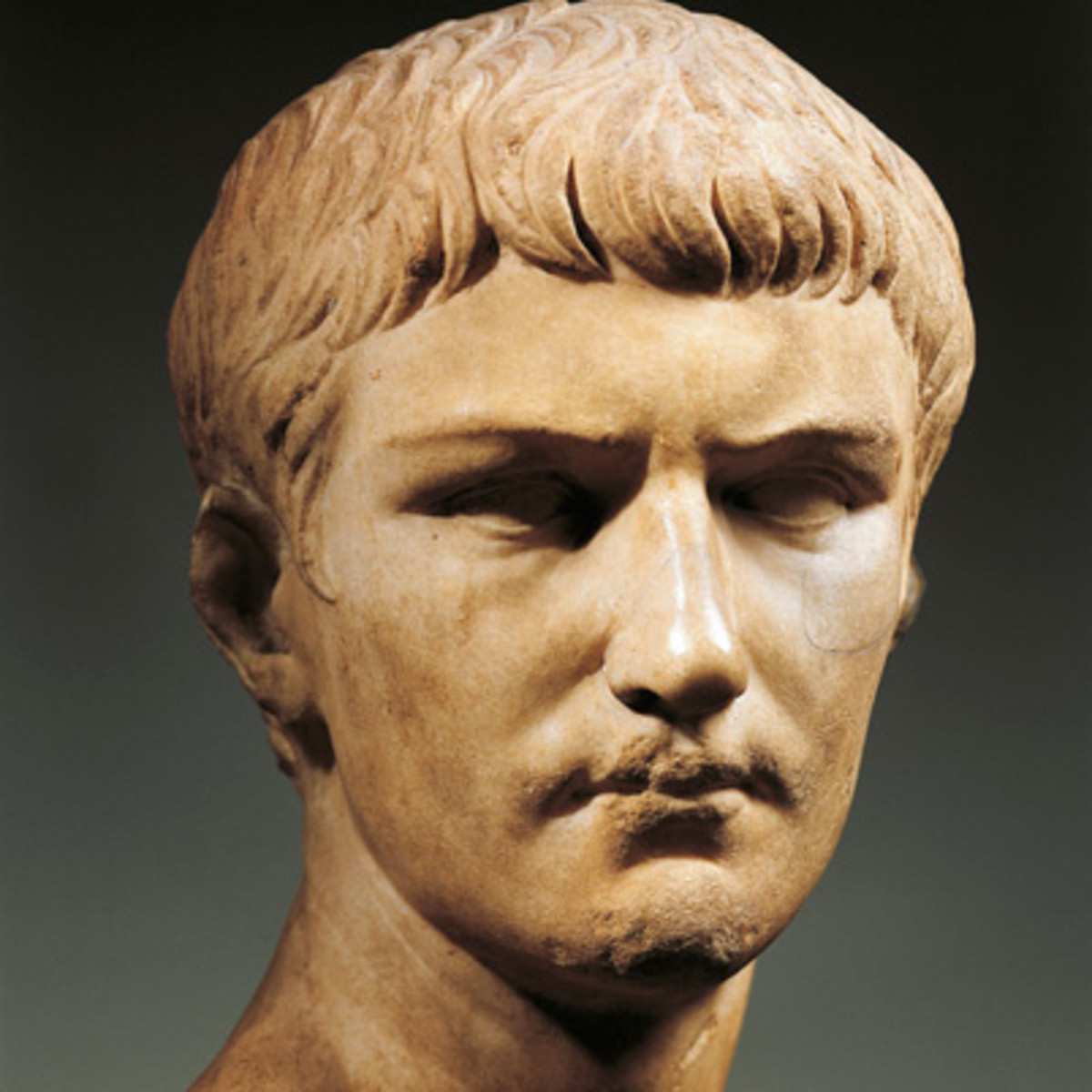 Clearly, Trump was no Hadrian (a successful emperor, by all means). But, after four years, and after the recent events in Washington, I think Trump may be seen as a reasonably good equivalent of Caligula, or Gaius Caesar Augustus Germanicus, who also reigned for 4 years, from 37 to 41 AD.
 Caligula was the prototypical mad emperor -- you probably heard that he nominated his horse consul. And he was not just mad, he was said to be a cruel, homicidal psychopath, and a sexual pervert to boot. In addition, he tried to present himself as a living god and pretended to be worshipped. He even claimed to have waged a war against the Sea God Poseidon, and having won it!
But, really, we know little about Caligula's reign, and most of what was written about him was written by people who had plenty of reasons to slander his memory, including our old friend Lucius Annaeus Seneca (he of the "Seneca Effect"). The Romans knew and practiced the same rules of propaganda we use today. And one typical way to slander a deceased emperor was to accuse him to be a sexual pervert.
But it really doesn't matter so much if Caligula really was so bad as we are told he was. The point is that there is a certain logic in his actions. In Rome just as in almost every ancient empire in history, normally Emperors were far from being warmongers. There are perfectly good reasons for that: imagine you are an emperor: you are the richest person in the world, you can have everything you want, you may order people to do whatever you want to do, and if they refuse you can have them killed. You can even force people to worship you as a God, and many will do that without any need of forcing them. Then, why should you risk all that for the mere pleasure of slaughtering bad-smelling barbarians?
That put emperors in a quandary: their power was based on military might, but the soldiers needed to be paid. And in order to pay them, military adventures needed to be undertaken. This problem was the reason why many emperors didn't end their career in their death bed. Either they were reckless and then defeated, or too prudent, and they were killed by their own troops. The latter was the destiny of Caligula, who refused to engage in the invasion of Britannia. No invasion meant no boot, and no bonus for the troops. And the troops were not happy. In the end, Caligula was killed by officers of the Praetorian Guard, a military corps that was supposed to protect him.
 At this point, I think you can see how Trump's rule can be seen as similar to that of Caligula. Of course, Trump never made senator a horse, but he surely had stormy relations with the US congress -- as you saw in the recent events in Washington. As for considering himself a God, well, Trump may not have gone as far as Caligula, but surely he tended to aggrandize himself more than a little! And the apparition of Trump's follower, Jake Angeli, dressed as the horned God Cernunnos, surely gave a certain theological meaning to the occupation of the Capitol building in 2021.
The main point in the similarity, then, is that both Caligula and Trump did their best to avoid major wars and succeeded, at least in part. Trump had to compromise with the military, providing huge financing for the military apparatus. We don't know if Caligula did the same, but his fake campaign against Britannia may have been an attempt to appease the military without risking a real invasion. Whatever the case, Caligula was eliminated and replaced with an older and more pliant Emperor, Claudius. Something similar occurred with Donald Trump, replaced because he clearly showed that he did not plan any major military campaigns. Unlike Caligula, and luckily for him, Trump was not physically eliminated (so far).
__________________________________________________________________________
 This being how things stand, can we use the Trump-Caligula analogy to conceive future scenarios? The future is always difficult to predict, but it is also a lot of fun to try. So, let's tell first the story of the Roman Empire after the death of Caligula, then we'll see to create a narrative for what the modern Global Empire after the removal of Donald Trump.
 Caligula's successor, Claudius, was a relatively weak emperor who couldn't oppose the military adventure in Britannia that nearly brought the Roman Empire to its doom. Initially, the invasion was successful but, later on, the Romans seriously risked to lose everything when Queen Boudicca led a a revolt against them in 60 AD, nearly succeeding in throwing back the invaders into the sea. Eventually, the Romans managed to quell the revolt, but it was a close call.
The problem was not so much Britannia, but the fact that the Empire had seriously overstretched itself. While Boudica's army scoured Britain, killing and torturing Roman citizens, on the opposite side of the Empire, in Palestine, a revolt was brewing. It exploded with tremendous fury in 66 AD and, this time, the Romans failed to quell it. The XII fulminata legion, sent to retake Jerusalem, was badly defeated. It took nearly eight years of fighting to reestablish the Roman domain in the region and the survival of the Empire itself was at serious risk.
We may imagine that if the Romans hadn't needed to garrison Britain, they could have had more resources to defeat the Jewish insurrection. As it was, instead, the effort of having to control two unruly regions at the two opposite extremes of the Roman domains led to financial problems and to turmoil all over the Empire. Emperor Nero lost control of his generals and was forced to kill himself. For a year, four different generals fought each other for the imperial throne. Eventually, Vespasian, a general who had fought both in Britain and in Palestine, restored order in 69 AD. But the situation remained difficult. One indication of the financial problems of the time is that in modern Romance Languages, urinals are named after Vespasian, probably because for the first time he placed a tax on their use.
In time, the Roman state managed to recover a certain balance and the deep state scored a major victory when they placed a career soldier at the top, Trajan (53-117). Trajan may have seen himself as the successor of Alexander the Great and he maintained his promise to expand the Empire. In 101 AD, he engaged in a successful military campaign against Dacia (more or less modern Romania). Then, in 113 AD he embarked in an ambitious campaign destined to get rid once for all of the competitor Parthian Empire, in the East.
At the beginning, Trajan managed to obtain some major victories. But he was not Alexander the Great. The Romans conquered the region that we call Iraq today, but further advances were simply unthinkable and the Romans had overstretched domains to an extremely dangerous level. In order to finance his campaigns, Trajan had devaluated the Roman currency and a new civil war could have shattered the Empire. Fortunately for the Romans, Trajan died before he could truly wreck the Empire's finances. His successor, Hadrian, reorganized the Empire within militarily sustainable borders. Of course, the Roman empire was doomed anyway, but at least Hadrian had avoided that it would collapse already during the 2nd century AD:
___________________________________________________________________________________________
 Now, let's use these events to create a scenario for our times. Joe Biden is clearly no Trajan, but he has something in common with the weak Claudius. As such, Biden may well engage the US Empire in one or more risky military adventures, for instance attacking Iran, or maybe Syria. The military strength of the US is so large that it is hard to think that this kind of relatively minor campaigns could be unsuccessful, but they would seriously weaken the Empire and generate internal frictions. The attack on the Capitol building already gave us a taste of what these frictions could look like.
 After Biden (and that may come very soon), it is possible to see the Global Empire in the hands an aggressive military leader. Such a leader might decide to do what Trajan did. She might engage in an all-out effort to destroy the rival empire, the Parthians for the Romans, the Chinese for the current Global Empire. (why did I say "she"? Of course, there is a reason!)
Could a warlike Empress succeed in bring the US Empire to global dominance? Unlikely. Just like Trajan nearly wrecked the Roman finances in his attempt, our Empress may well wreck the Western economy -- or the whole world's economy -- forever, with the additional result of wrecking the whole ecosystem as well. But history seems to reason in its own terms that was unavoidable from the beginning, so we can only sit and watch. For one thing, in our times things seem to happen much faster than in Roman times and the fall of Washington to a Barbarian army doesn't seem to be so unthinkable as it was just a few days ago.

During my whole professional life, I always enjoyed teaching. It was part of my life, part of what I am, part of the way I relate with the world. I made mistakes, at times made a fool of myself, sometimes I was ashamed of how poor a teacher I was. But I always did my best. And I think my students, some of them at least, appreciated my effort. And most of them enjoyed being students, just as I did when I was their age. I don't know how it happened, but a few months of folly have been enough to turn universities into jails, the students as prisoners, and teachers as prison guards. And teaching was transformed into an odious chore. A senseless ritual performed in front of a computer screen, the students reduced to small 2-D squares, as real as the characters of a videogame. On the media, everywhere the students were insulted, humiliated, insulted, told over and over that they are little more than walking bags full of viruses, plague-spreaders, irresponsible, vicious, self-centered individuals unable to restrain their instincts and harming their elders because of that. This is truly a disaster. Going to school is one of the few remaining chances that the young have to socialize and become functional adults. Chuck Pezeshki said it very well in his latest post on his blog "If we're to start understanding why the enforced collapse of socialization matters to all students, we're going to have to come to terms with what we actually do in schools. The answer is not "we smart adults tell students a bunch of stuff, they soak it all in, and they're far better off for it." I've been teaching (and winning awards) my whole career for teaching, which is really only a modest part of a relatively modest career. The reality is that students learn mostly from each other. And the lessons they learn, sometimes sweet, sometimes bitter, are mostly about how to relate and listen to each other. We sprinkle the lessons of the venue on top of all of this, of course. But the biggest hunk of everything they learn involves themselves, and their interactions." Here is an excerpt of Chuck's post, but do read all of it. It is an optimistic and inspiring post. Despite the disaster, we must go on and keep teaching and learning.
From "The Empathy Guru"
A New Year's Prayer for our ChildrenJan 1, 2021
.....
Over and over, we've attempted to pin this pandemic on those we disagree with politically. I've written about this here. It's just nuts, and these things have to stop. Or we're going to end up in a civil war. And that will kill far more young people than COVID ever could.
Where we are missing the boat regarding COVID is the damage that the pandemic has done through destruction of relational growth that really fuels how young minds are formed. Primary- and secondary school-age kids get this from going to school, and there is no real risk, despite the histrionic anecdotes pushed by the media, for school children. Yes, there is a smattering of extremely tragic cases that are part of the pandemic. One of the curiously sociopathic angles discussing COVID is the risk to football players for some version of myocarditis as an after-effect of the pandemic — as if the well-established dangers of smacking each other's skulls together weren't enough. There can be no better juxtaposition of how we perceive risk, however. One is a reason to lock down/up our children indefinitely. The latter is merely a continuation of "how we do things around here." The various lockdowns have been done ostensibly to save the old, though, once again, it's not clear that any of this anti-socialization has helped them either. In fact — probably not.
When it comes to college-age kids, living in a university community, I hear the constant berating from the elders about irresponsible college kids are, because they continue to socialize. And it's wild to me that voices of control have been recruited from the student population themselves. I'm not going to name names, because I still have hopes that these young people, though adults, will grow out of the need to please their elders and represent their natural constituencies. There is really functionally no risk to college kids as well. And schools that have opened (I live next to the University of Idaho) have managed to even control spread, as much as it can be contained, than schools that have gone online. Which would, not surprisingly, jibe with the overall statistics — that not much we've done, plus or minus, really matters.
If we're to start understanding why the enforced collapse of socialization matters to all students, we're going to have to come to terms with what we actually do in schools. The answer is not "we smart adults tell students a bunch of stuff, they soak it all in, and they're far better off for it." I've been teaching (and winning awards) my whole career for teaching, which is really only a modest part of a relatively modest career. The reality is that students learn mostly from each other. And the lessons they learn, sometimes sweet, sometimes bitter, are mostly about how to relate and listen to each other. We sprinkle the lessons of the venue on top of all of this, of course. But the biggest hunk of everything they learn involves themselves, and their interactions.
My tagline, since I started my empathy project, has been "as we relate, so we think." The meaning of this is not simply "if you relate nice, then you think nice." The stakes are far higher. The DeepOS lesson of all this is that relating to different people, across varying ages, social statuses, and racial/ethnic variations, creates the conditions in the brain for other complex, more discipline-specific information to get slotted. Without that interaction, though, the brains of young people, while not exactly being frozen, do not thrive. And being that all people, in all walks of life, are spread out on a probability distribution for pretty much any issue/concept you can think of, we will decrease a certain percentage of the population's intellectual and developmental abilities in ways we cannot predict yet. If you say you care about disadvantaged populations in the U.S. this should deeply concern you. Those will be the students whose starting line is moved back once again. My advantaged students, and their parents, can and will find ways around this, and I absolutely do not begrudge them.
But in a time of already-extreme separation between opportunities for rich and poor, those without resources, juggling even furnished iPods in mediocre online classrooms, will be even more screwed. Don't fool yourself. And they also will not have the more evolved social environments that well-off parents are already creating for their children. Mores the pity.
Just so folks know, I'll be back in the classroom myself in 18 days, running students through my curricular vehicle, the Industrial Design Clinic. I'm one of the few that's made that choice. It was not forced on me by my administration. And, no, I haven't had the vaccine. And yes — when I'm told my number's up, I'll get in line, but not before. I already know there are people that need it worse than me. There's a reason I have 2400 hours of sick leave accumulated through my career- it's not because I'm unhealthy.
I'm doing it because, even though it will be a difficult classroom environment, it will give my students to get to know their best teachers — each other. We'll be in masks, we'll be wiping down tabletops, all things of indeterminate efficacy, but part of whatever set of rules we are told to follow. But we'll do it together. And I'm looking forward to a great year.
The devil scene from Walt Disney's 1940 "Fantasia" movie. A fitting representation of the nightmare that 2020 has been.
This clip is especially fitting because you may notice how the devil doesn't really do anything bad during the whole scene. He summons ghosts and demons, they scream, they fly, they dance, but they don't touch anything, don't harm anyone. Evil is a characteristic of our mind: we create evil and we suffer its consequences.
Perhaps we could hear bells dispelling the devil in 2021, as it happens in the movie at 5:40? Maybe, but it is also possible that we'll create even worse ghosts than anything seen in 2020. Whatever the case, as always, we'll remain dominated by the ghost that we ourselves create.
A story from the old Soviet Union, written by the Russian writer Vladimir Dudintsev, still teaching us things today. And here is a written version from a 2013 post.
Some 50 years ago, I received as a Christmas present a book titled "Russian Science Fiction." All the stories in that book made a deep impression on me, but there was one that has remained in my mind more than the others; a curious story titled "A New Year's Tale".
I was, maybe, 12 at that time and, of course, I couldn't understand everything of that story and I didn't pay attention to the name of the author. But, as time went by, I didn't forget it; rather, it became entrenched in my mind, progressively acquiring more meaning and more importance. I reread it not long ago, and it came back to my mind during a recent trip to Russia. So, let me tell you this story as I remember it.
"A New Year's Tale" tells of one year of life of the protagonist, a researcher in a scientific laboratory somewhere in the Soviet Union. Dudintsev manages to tell the story without ever giving specific details about anything: no place names, no names of the characters, not even of the protagonist. It is a feat of literary virtuosity; it gives the story an atmosphere of a fairy tale but, at the same time, it is very, very specific.
It took me time before I could understand the hints that Dudintsev gives all over the text, but after many trips to Russia, everything fell in place. It is curious how Dudintsev managed to catch so well the atmosphere of a research lab in the Soviet Union; he was not a scientific researcher. But that's what makes a great storyteller, after all: understanding what one is describing - and feeling something for it.
The story starts with a debate - rather, a quarrel - that the protagonist has with someone termed "a provincial academic" (we are not told his name). This provincial academic should be nothing more than a nuisance, but the protagonist can't avoid engaging in the debate. He understands that he is losing time, that he should be doing something more useful, more important. But he just can't sit down and do his job.
While the protagonist is entangled in this useless quarrel, the chief of the laboratory (again, we are not told his name) dabbles in archeology and one day he tells his coworkers of some work of his somewhere in the Caucasus, where they found an ancient tomb. There was an owl engraved on the tombstone and an inscription that they could decipher. It says "...and the years of his life were 900...."
Now, what could that mean? Could the man buried there have lived 900 years? No, of course not. But then, what does the inscription mean? Well, someone says, that must mean that this man spent his life so well and so fully that it was like his years had been 900.
The discussion goes on. What does it mean to live such a full life? The researchers try to find an answer but, at some moment, they hear the voice of someone who usually keeps silent at these reunions. We are told that he is from far away, not Russian, that is. We can imagine that this man doesn't have a Russian name, but we are not told names. So, he is an outsider and he comes with a completely different viewpoint; he is "the foreign scientist" even though in the old Soviet Union, theoretically, there was no such distinction. "You see, comrades," he says, "it is very simple. To live a full life, you must always choose the greatest satisfactions, the highest joys you can find."
At this point, we hear the voice of the political commissioner of the lab. Apparently, there was usually someone in the scientific academies in the Soviet Union who was in charge of making sure that Soviet Scientists would not fall into doing decadent capitalist science. So, he stands up and he tells the foreign scientist, "Well, comrade, don't you think one should also work for the people or something like that?" And the foreign scientist answers, "You are so backward, comrade. Don't you understand? The greatest satisfaction, the highest joy one can have in life is exactly that: working for the people!"
After that the discussion is over, the protagonist of the story reflects on the words of the foreign scientist and he resolves to start doing something serious in his life. He decides to start doing experiments, advance his theory. We are not told exactly what he is doing, but we understand that he is working on something important; research that has to do with capturing and storing solar light. And he manages to work on that for some time. Then, his colleagues bring to him another paper written by his provincial antagonist. So, he feels he has to answer that, and then the provincial academician writes a response.... and the protagonist finds himself entangled again into this argument.
Things are back to the silly normalcy of before, but then something happens. The protagonist finds that he is being stalked. Someone, or something, is following him all the time. When he sees it in full he discovers that it is an owl. A giant owl, almost as big as a man, looking at him. He thinks it is a hallucination, which of course it must be. But he keeps seeing this owl over and over.
So, the protagonist goes to see a doctor and he tells him of the owl. The doctor pales. After a thorough physical examination, the doctor tells him: "you have one year to live, more or less." We are not told of what specific sickness the protagonist suffers. He asks, "but why the owl?" And the doctor answers, "we are studying that. You are not the only one. The owl is a symptom." Then, the doctor looks at the protagonist straight in his eyes and he says, "I can tell you something. Those who see the owl, have a chance to be saved."
In the meantime, there had been a long discussion between the protagonist and the foreign scientist, the one who had so well silenced the political commissioner. So, the foreign scientist had told to the protagonist his story, obliquely, yes, but clearly understandable. His fellow countrymen had not liked the idea that he had left the country to become a scientist. They are described as gangsters and criminals, but we have a feeling that there was something more at stake than just petty crimes. This man had made a choice and that had meant to make a clean break from his country and his culture; it had meant to accept the new Soviet Communist society. Now, he was spending his time in this new world trying to get his "greatest satisfactions and highest joys" by working for the people. And, because of that, his former countrymen had condemned him to death. So, he had changed his name and his identity, and he had even surgically changed his face to become unrecognizable. But he knew that "they" were looking for him and they would find him at some moment.
So, the destiny of the protagonist and of the foreign scientist are somehow parallel, they both have a limited time. After having seen the doctor, the protagonist understands the situation and he rushes to search for the foreign scientist. They can work together, they can join forces, in this way, maybe they can.... but in horror, he discovers that the foreign scientist has been killed.
In panic, the protagonist desperately looks for the notes he had collected over the years. But the cleaning lady tells him that she had used them to start the fire in the stove. She had no idea that they could have been important. The protagonist feels like he is walking in a nightmare. Just one year and he has lost his notes. He starts from scratch.... his great discovery.... how can he do? Yet, he decides to try.
He becomes absorbed in his work. He works harder and harder. Staying in the lab night and day and, when he goes home, he keeps working. His colleagues note the change; they are surprised that he doesn't react anymore to the attacks of the provincial academician, but he doesn't care (which is, by the way, a good lesson on how to handle our modern Internet flames). He still sees the owl; always bigger and coming closer to him, the owl has become something of a familiar creature, almost a friend.
Then, someone appears. It is a woman, described as having "well-formed shoulders" (of course, we are not told her name!). The protagonist recognizes her. It is not the first time he has seen her. He remembers having seen her with the now dead foreign Scientist.
The protagonist has no time for a love story. He has to work. He tries to ignore the woman but he is also attracted to her. He can concede her just a few words. Ten minutes, maybe. So they talk and the woman tells him. "It is you, I recognize you! You can't fool me!" The protagonist remembers something that the foreign scientist had told him; that he had his face surgically changed to escape from his enemies. Now, this woman thinks that the protagonist is really her former lover, who changed again face and appearance and didn't tell that not even to her.
The protagonist tries to deny that he is the former lover of the woman but, curiously, he doesn't succeed, not even to himself. In a way, he becomes the other, acting like him in his complete immersion in his work. The protagonist discovers that the foreign scientist had assembled a complete laboratory at home, much better than the lab at the academy. So he moves there, with the woman with the well-formed shoulders (and the owl comes, too, perching on a branch just outside the window). Then, the protagonist even discovers that the foreign scientist was secretly copying his notes and he gave them to the woman, who has kept them for him. With these notes, he can gain months of work. Maybe he can make it in one year, maybe.....
The last part of the story goes on at a feverish pace. The protagonist becomes sicker and sicker; to the point that he has to stay in bed and it is the woman with the well-formed shoulders who takes up the work in the lab. And the owl perches on the bed head. But they manage to get some important results and that's enough to catch the attention of the lab boss. He orders everyone in the lab to come there and help the protagonist (and the woman with the well-formed shoulders) to move on with the experiments.
In the final scene, the year has ended and we see the protagonist in bed, dying. But his colleagues show him the results of the experiment: something so bright, so beautiful, unbelievably bright and beautiful. We are not told exactly what it is, anyway it is a way to catch sunlight in a compact form: a new form of energy, a new understanding of the working of the sun - we don't know, but it is something fantastic. Even the owl looks at that thing, curious. The protagonist hears the sound of bells from the window. A new year is starting. We are not told whether he lives or not, but in any case, it is a new beginning and, whatever it happens, they'll tell of him that the years of his life had been 900.
And here we are. You see, it is a magic story. It keeps your attention; you want to know if the protagonist lives or not and you want to know if he manages to make his great discovery. But it is also the story of the life and of the mind of scientists that I think is not easy to find in novels or short stories. It is curious that Dudintsev did so well because, as I said, he wasn't a scientist, he was a novelist. But he managed to catch so incredibly well the life of a scientist - of a scientist working in the Soviet Union, yes, but not just that. Dudintsev's portrait of science and scientists goes beyond the quirks of the old Soviet world.
Yes, in Soviet science there were things that look strange for us, such as having a political commissioner in the lab to watch what scientists are doing. But that's just a minor feature and today in the West we have plenty of different -- and heavier -- constraints on what we do that don't involve a dumb political commissioner. The point is that scientists often work as if their life were to last just one year; at least during the productive time of their life; when they are trying to compress each year as if it were to be 900 years long. It is their lot: the search for the discovery, being so deeply absorbed in their work, being remote from everyone else; obsessed with owls that they alone can see.
And yet, Dudintsev's story is so universal that it goes beyond the peculiar mind of scientists. It is the story of all men, all over the world, of what we do and how we spend our life. And the key of the story is the woman with the well-formed shoulders. She recognizes her former lover in the protagonist, or she feigns to recognize him. It is him or it is not him - we are not told, but it doesn't matter. What matter is her devotion to her man. It is so touching: you perceive true love in this attitude. In the end, that's the key to the whole story: whatever we do in life, we do it for those we love.
Some of us are scientists, some aren't. But it is not a piece of bad advice to live your life as if you wanted each year to be 900 years long. And every new year is a new beginning.
Christmas of 1914: soldiers from opposite sides met in a friendly manner across the front line. It was a moment in which for a short time the Christian message of love managed to overcome the message of hate that came from national governments. It was just a brief moment for a deed that surely didn't go unpunished, later on. But it was highlighting a deep contradiction that was prefiguring the final collapse of the church, but that would take another century or so. It is coming now.
Sometimes, life is like watching the long needle of an old mechanical watch. No matter how carefully you eye it, it doesn't seem to move -- time seems to be frozen. Then, you look at something else, and when your glance is back to the watch, the needle has moved. Time has passed, and that moment will never come back.
Sometimes, you have the same sensation with history. For a long time, everything seems to be frozen and nothing changes then, suddenly, everything has changed and the world is a different one. It has happened in this 2020 that, suddenly, changed everything, and the world of one year ago will never come back.
I already noted how some institutions have been shattered at their foundations by the COVID crisis of 2020. One was the university, destroyed by the sudden discovery that it was an expensive machine that produced nothing useful for the state. Another illustrious victim is starting to crumble: it is the Church. Primarily, the Catholic Church in its claims of universality, but all Christian Churches have been affected by a crisis that left them stunned, suddenly realizing that they had nothing to say and nothing to do about a disaster that seemed to affect everybody.
The collapse of the university and of the Church is all the more remarkable considering how old they are. The University in Europe has about one thousand years of history -- more if we consider the Islamic versions. The Christian Church is even older than that: it started existing in a recognizable form almost two thousand years ago. Yet, nothing is eternal in human history. Everything moves, changes, crumbles, disappears, is reborn, and disappears again. It is true for empires, and also for institutions that seem to be stronger than even empires: churches, temples, sects, and ideologies. Even the Gods die and are reborn, it is one of their characteristics.
And so, look at the Christian Church in Europe. It was born as the reaction to a state -- the Roman one -- that was crumbling, starting around the 3rd century AD. The Roman state was based on military might -- that was too expensive for the new times. Gradually, the Church replaced the Roman state, mirroring the older institution in a new form, more compatible with the epoch we call the "Middle Ages." The Church didn't govern on the basis of military force, it delegated it to local warlords while trying to reduce their power as much as possible. As all human construction, it was far from being perfect, but it generated an age of relative peace and the end of the worst flaws of the older Roman world: the slavery of millions, the oppression of women, the emphasis on military power, the inequality of the few versus the many, the cruelty of the arena games.
The reign of the Christian Church lasted for several centuries, nearly a millennium. Then, the giant wheel of history made one of its turns. The printing press appeared in the 15th century, the brainchild of a man named Gutemberg who probably would never have imagined what he was creating: nation-states. These were new creatures that had never existed before. Their organization was not anymore based on money, like in the Roman state. And not even on a shared religion and a sacred language (Latin), as it was the case for the Christian Church. Nation-states were based on their national language: an invention of the printing press that created bonds among the people who could understand each other, opposed to those whom they could understand. It was a re-edition of the old Greek concept of the barbarophonoi, those who speak bar-bar, the barbarians. But the new barbarians were not anymore the inhabitants of remote lands, bad-smelling and dressed in animal skins. They were your neighbors who happened to live just on the other side of an imaginary line called "national border." Those some neighbors whom the Church had been telling you to love as yourself, but whom now the state instructed you to hate and despise.
And so there started a conflict that's lasting to this day. As for many features of history, things move slowly, but the fall of Christianity was unavoidable. It all started with the great convulsions of the age we call "renaissance," supposed to replace the earlier "dark ages." It truly started with a bang, the extermination of hundreds of thousands of European women, accused of being witches. Not only the nation-states succeeded in enlisting the Church in the task of helping with the extermination. With the so-called "enlightenment," we saw one of the greatest successes of propaganda in history: not only the Church was accused of a mass extermination that the Church had never approved, but people's perception was modified in such a way to push back the age of witch-hunting to the Middle Ages - turned by propaganda into a "dark age" of superstition and violence. But the Church was not a woman-killing machine, it never had been. It was the state who wanted more cannon fodder for its armies and so it needed to enslave women and turn them into child-bearing machines. But the force of propaganda is enormous, it is one of the wheels that push history forward.
The witch-hunting age, mostly the 16th and 17th centuries, was one of the factors that shattered the unity of the Christian Church. Then, there came the reformation, then the age of colonization when, again, the states managed another master stroke of propaganda, being able to convince everyone that it had been the Church pushing for enslaving and exterminating non-European people.
 Then, there came the 20th century and the age of the European civil wars where, again, the Church found no role and nothing to say on an event that was shattering its very foundations of a universal institution. I wrote an entire book on how people's faith was affected by this tremendous contradiction: Christians were fighting each other all over Europe and, on both sides of the front line, Christian priests were blessing young men to go killing other young men on the other side (you see, in the figure, an Italian military chaplain blessing Italian soldiers before).
 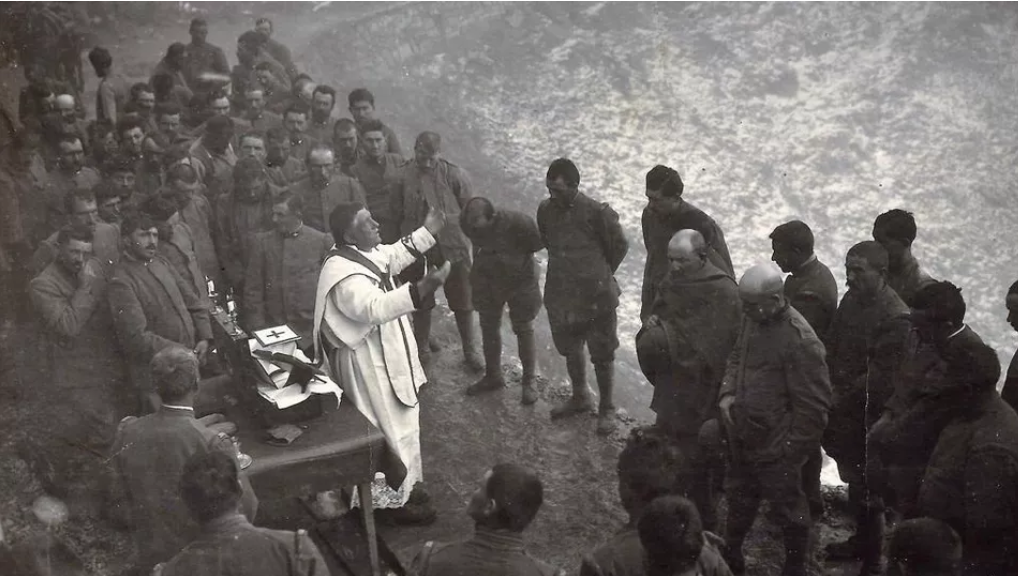 The Church barely survived this tremendous blow, but more were to come. Once, a Japanese friend of mine told me something like "I always found it weird how every week Europeans collect in churches to eat God together." A flash of how strange some things appear when seen from another viewpoint. And, yet, this Japanese man was right: this is one of the elements of the Church rituals. A Church is like a state in many ways: it has rituals just like the state does. The state has military parades, the church has religious processions. The state enlists young men as soldiers, the Church enlists them as choirboys. The state vaccinates children, the Church baptizes them. The state taxes people, the Church asks them for alms. And much more. The Church may ask you to eat the body of the son of God who sacrificed himself for his love for humankind, just like the state may ask you to send your son to die on some remote mountains to show his love for that section of humankind that you call the "nation."
You may see all this as a symmetric battle, but the two sides are not equivalent in power. As I said, the Church had started as an alternative to the crumbling Roman states, but it was to be expected that the wheel would turn around. The State is now much more powerful than the Church and the sermons of the priest had no way to compete with the state news services. It was all going to happen and it happened.
It is curious that such an old and resilient institution was demolished by such a humble creature as a virus labeled SARS-Covid2. But that was how it happened. It was another master stroke of propaganda that worked beautifully. Faced with a greatly exaggerated, although real, threat, the Church found nothing to say, nothing to object, nothing to propose. It meekly submitted to the superior power of the state.
So, in Italy, this Christmas the state ruled that the traditional midnight mass was to be held at 8 pm. Of course, it is hard to believe that a virus would infect people at midnight but not at 8 pm. One could also say that, while nobody can say at what time Jesus Christ was born (probably not even on the day we call "Christmas"), it was the job of the Church and not of the state to decide on this point. But the Church was totally silent and it bowed down to the state. It had already bowed down on many other things. The images of Italian police stopping the celebration of a mass during the lockdown of March was seen by everybody and condemned by almost nobody. On visiting a church, you would find someone at the entrance pointing a laser gun at your forehead. You saw the benches with places crossed with red tape. Instead of holy water fountains, you would find bottles with disinfecting solutions. People hiding their faces in front of God just like Adam had been hiding in the Garden of Eden. And, finally, the final insult was the virtual mass, with the priest turned into a 2D image confined in a little square on a screen, virtually blessing virtual believers.
It was a sacrilege, it was the desecration of a place that, so far, had managed to resist, at least in part, the state's power. And it was, basically, the end of an age. Anything you believe in must be eventually be kept alive by practice. Practice is based on rituals, the Christian church has been existed for so many centuries because among other things, as my Japanese friend said, people would collect every week to eat God together. It may have been silly from a Far-Eastern viewpoint, but it was a ritual. And all rituals are collective -- they have them also in the Far East, even though they don't eat their Gods in the form of wafers.
Without the rituals, or with the rituals compressed on a screen, the structure ceases to exist. It is just like the university: it is no more a university when teachers and students are reduced to 2-dimensional creatures inhabiting a small square of a screen. Without the meeting of people whom we call the "congregation" and that in earlier times was called the "ecclesia," the Church is mute, the faith is gone, the faithful are disbanded, the holy places are desecrated. And that's what's happening and everything that happens happens because it had to happen.
And now? The story will keep going in circles as it has always done. The new state-sponsored rituals to fight the pandemic are triumphant, but there will be new cycles and the triumphant nation-states will see their doom, one day or another, just as the mighty Roman Empire saw its doom -- it happened because it had to. The great wheel of history is turning. It will keep turning.
As we approach the end of this unbelievably horrid year, my greetings are more muted.
I wish all of you a happy time, whether you're with friends, family or on your lonesome. There are better times to come (and undoubtedly worse times, too). Make the most of what you have and be careful. Stay safe.
This day last year (Christmas Eve in south eastern Australia) it was hot and smoky:
This year there's no smoke, just clear skies and a gentle summer breeze blowing. Lovely.
In closing, here's a pic of one of the friends I made this year.


The "hydrogen economy" is like a zombie: no matter how many times it is slain, it keeps coming at you. Like a Hollywood zombie movie, hydrogen seems to exert a tremendous fascination because it is being sold to people as a way to keep doing everything we have been doing without any need for sacrifices or for changing our ways. Unfortunately, the reality is not a movie, and the reverse is also true. Hydrogen is a pie in the sky that delays the real innovation that would make it possible to phase out fossil fuels from the world's energy mix. (image source)
This is a re-worked and updated version of a post that I published in 2007, in Italian, during one more of the periodic returns of the "hydrogen economy," a fashionable idea that leads nowhere. For more technical information on the hydrogen scam, see the exhaustive treatment by Antonio Turiel in three posts on his blog "Crash Oil", in Spanish, "The Hydrogen Fever" One, two, and Three
Confessions of a Former Hydrogenist
Posted by Ugo Bardi
 Quite a few years ago (maybe too many) I was involved in research on the hydrogen economy. It was in 1981 when I arrived in Berkeley, in California, to do a post-doc stage at the Lawrence Berkeley Laboratory. At that time, the worst of the first major oil crisis was over, with the highest historical values of prices had been in 1979. The oil prices were going down, but the shock was still felt, and everywhere in the US and in the world it was a flourishing of research projects dedicated to new forms of energy.
In Berkeley, I worked for more than two years on fuel cells; the technology that was to be used to transform hydrogen into electricity and that was - and still is - essential to the concept of "hydrogen-based economy" (The idea was already well known in the 1980s, Rifkin didn't invent anything with his 2002 book). It was an interesting field, even fascinating, but very difficult. The idea was to study the "core" of the device, the catalyst. How it worked and what could be done to improve its performance. I think we did some good research work, although we found nothing revolutionary.
With the end of my contract at the Lawrence Berkeley Lab arriving, I started looking for a job. I remember that I was told that there was someone in Vancouver, Canada, a certain Geoffrey Ballard, who had set up a company dedicated to developing new fuel cells. I vaguely thought about sending him a resume but, eventually, I didn't. Ballard's firm, at that time, was little more than a garage with some enthusiasts working on strange contraptions inside. Not the kind of thing that promised a bright future for a researcher.
It was a mistake on my part. Later on, as you may know, Ballard's team improved the fuel cell design that had been developed earlier on by NASA with the Gemini program. The result was a major advance; it made possible the first fuel-cell bus in the world (1993). That led to Ballard being nominated "hero of the planet." In the 90s it occurred to me several times that if in 1982 I had sent that resume to Ballard, maybe I could have been one of the developers of what - at the time - seemed to be the revolution of the century: the polymer membrane fuel cell (PEMFC), the device that would have made possible the hydrogen-based economy: clean prosperity for everyone. I would have made a lot of money, too!
But, as it has often happened to me in my life, I found myself in the wrong place and out of sync with the rest of the world. By 1982, when I was looking for a job, oil prices had already fallen sharply. The interest in alternative energies had waned and, with the foresight typical of human beings, the research centers created during the oil crisis, in the 1970s, were being closed. There was little room, as a result, for a fuel cell expert. The best I could find in the US was an offer to work in a research center in Montana. It did not attract me so much and, in the end, I decided to return to Italy. There, I tried to set up a research program on the fuel cells, but nobody was interested (again, the typical foresight of human beings). So after a few years, I moved to different subjects.
In the meantime, the interest in new forms of energy waxed and waned with the vagaries of oil prices. In 1991, the first gulf war was already an alarm bell, but the 9/11 attacks of 2001 made it clear to everyone that the supply of crude oil to the West was not guaranteed as it had seemed to be earlier on. Then, there came Jeremy Rifkin's book "The Hydrogen Based Economy," published in 2002, which had a huge success. For a few years, the idea became extremely popular.
Even though I had not been working on fuel cells in Italy, Rifkin's success caused me to be shining of reflected light. It turned out that I was one of the few researchers in Italy having some hands-on experience with fuel cells and with the concept of the hydrogen economy. I was invited to speak at conferences and public presentations and some people even started calling me "Professor Hydrogen."
I must admit that, in the beginning, I spoke as if I really believed in the idea of the hydrogen-based economy, and maybe I did. But, gradually, I started having serious doubts and I became a skeptic, a "former hydrogenist" just like several of my colleagues. There are many little stories I could tell you on this subject, but let me mention just one.
I think it was in 2004 or 2005 when an Italian company based in Tuscany developed a hydrogen car and organized a presentation for the president of the Tuscan regional government. I was invited to attend the demonstration as the local fuel cell expert.
 So, I showed up in the courtyard of the Tuscan government building where a truck had unloaded the car. It turned out to be a modified Fiat Multipla that you may know as having been awarded the 2014 prize for the ugliest car ever made. Of course, the ugliness of the car was not a problem, but the whole idea was. It was not a fuel cell car, but simply an ordinary car fitted with two compressed hydrogen cylinders under the body. The hydrogen went directly to the carburetor to operate the internal combustion engine.
 Before the President appeared, I had a chance to drive that car. I managed to make a full tour of the courtyard of the building, but it was like riding an asthmatic horse. When the President showed up, he clearly had no idea of what was going on and what he was supposed to do. He sat at the wheel, drove the car for a few meters in heavy bumps, then he gave up and just sat there for a while in order to be photographed by the journalists. Then he left. The day after, the newspaper showed the photos of the president driving the "hydrogen car" and then the car itself disappeared forever in the dustbin of history.
But it was not this unfortunate adventure that led me to change my mind on hydrogen. It was the continuous and shameless hype associated with it. I even had a chance to meet Rifkin in person in 2006 at a conference that I had organized in Tuscany. Not that I expected him to be an expert in technical details, but it seemed clear to me that he had no idea of what he was talking about. When he was asked technical questions, all he could answer was something like "have faith" and then change the subject.
As I started being more and more bothered by the hype on hydrogen, soon I saw what the real problem was. Back in the 1980s, in Berkeley, we already knew that the critical feature of fuel cells of the kind that can work near room temperature (called PEM, polymer electrode membrane cells) is the need for a catalyst at the electrodes. Without a catalyst, the cell just doesn't work and the only catalyst that really works is platinum.
Of course, platinum is expensive and its cost typically makes about 50% of the cost of the whole fuel cell. But the cost is not the main problem, as I discovered when I started getting involved with studies on mineral depletion. If you were to replace the current vehicles with fuel cells, there would be no way to produce enough platinum from mines for the task (for details, you can see this 2014 article of mine).
Indeed, the two years I had spent at Lawrence Berkeley Lab were dedicated to finding ways to use less platinum, or something else in place of platinum, on the electrodes of the cell. It wasn't just me working on it, it was a whole research group, one of the several engaged on the subject.
There are several tricks you can play to reduce the platinum loading in fuel cells. You can use small particles and exploit their large surface to volume ratio. But small particles are highly active, they move, react to each other to form larger particles, and, eventually, your electrode no longer works. Of course, there are tricks to stabilize small particles: one of the things I worked on was platinum alloys. At times, the alloys seemed to be little miracles, leading to great hopes. But the problem was that the alloys worked fine only for a while, then they de-alloyed and good night. Not easy to use them for something that you expect to work on a commercial vehicle for at least ten years.
Today, the problem has not been solved. I looked at a recent review on this subject and I saw that people are still struggling with the same problems I had worked on while a young postdoc in Berkeley: reducing the platinum loading on the electrode by using alloys. I am sure that good progress has been made in nearly 40 years, but technological progress is subjected to diminishing returns, just like many human activities. You can move forward, but the farther you go, the more expensive it becomes. And no way has been found, so far, to replace platinum with some other metal in room temperature fuel cells.
So, without a substitute for platinum, the hydrogen-based economy remains a pie in the sky. After 40 years of talking about "modern" fuel cells (the PEM kind) they are still mainly used for prototypes or toys. There is one commercial hydrogen car, the Toyota Mirai, but it is an expensive and exotic entity in a world where lithium-ion batteries provide the same performance at a much lower cost. That doesn't mean there don't exist niche markets for hydrogen as an energy source, but it is hard to see it as a general use technology. Hydrogen powered planes are a possibility, but they are also an engineering nightmare. Perhaps a good use for hydrogen could be powering marine vessels, although they may be too expensive for this purpose. As energy storage systems, coupling electrolysis and fuel cell systems may do the job, but they are more expensive than batteries and their cycle efficiency is also much smaller.
So, what's left of the grand idea of a "Hydrogen Based Economy"? What remains of the promise of a prosperous world where hydrogen would have allowed us to keep running around in our shiny cars and have all the energy we need? Very little. Nowadays, hydrogen seems to be enjoying a renaissance, at least in terms of the surrounding hype, this time with the label of "blue hydrogen." This is hydrogen that should be created from fossil fuels, while the carbon generated in the process should be captured and stored underground. Not so exciting: it is just a way to make it possible for the fossil fuel industry to keep going for a while longer.
And why "blue" hydrogen? Ah.... well, that's the miracle of our times: propaganda. Karl Hove had understood it so well when he said that "nowadays we create our own reality." It is so powerful that it can turn hydrogen blue and you can read here how this miracle was performed. But it will be harder to create platinum that is just not there.
as I delved more and more in the details of the idea, and I started studying research
reflected Not to say anything bad about Ballard (1932-2008), who I think was a good person by all means. But, maybe calling him "hero of the planet" was a bit of an exaggeration. Apart from that, however,
When the "hurricane Rifkin" began in 2002, I was one of the few people in Italy who really had practical experience on the technical concepts of fuel cells and the hydrogen economy. They invited me to conferences to talk about it. For a time I also spoke well about it, although without great enthusiasm. Today, after thinking about it, I think that devoting my life to hydrogen and fuel cells would not have been a great idea. In fact, I think it would have been a bad idea. I'm not the only one who thinks so. Over the years, I met several people who dedicated years of their life to fuel cells and hydrogen but then left the field, disappointed. We are the "repentant hydrogenists", people who worked on hydrogen technologies and maybe even believed the promise of the hydrogen-based economy but who then realized that - although not exactly a hoax - it is such a difficult thing and distant in time that it has no relevance for the solution of current problems.
There are many problems with the concept of "hydrogen economy" but one of the main ones is the conversion of hydrogen into useful energy - that is, electricity. Doing it with a thermal engine is possible, but the efficiency is terribly low. So the concept revolves a lot around the possibility of using fuel cells that promise much greater efficiencies. But things are not easy.
John 3:16 is one of the most memorized verses in the Bible..
"For God so loved the world, that He gave His only begotten Son,
that whoever believes in Him, should not perish but have everlasting life." (NKJV)
Let us thank God for His love, revealed through His Son - Jesus Christ with a "wider" perspective this Christmas.
What can I say? This is climate change.

Figure 1 | November mean temperature anomaly Australia. Source: Bureau of Meteorology
We're in the midst of a La Niña so it's not meant to be hot like this, let alone the hottest November in the record.
Okay, for the purists and deniers instead of saying this *is* climate change let me say this is *expected* with climate change. No, it's really not expected. It's just what's happening.
How about this is *consistent with* climate change. Is it really? Is this really expected this year, in 2020, when emissions are lower because of the COVID-19 pandemic, when there's a La Niña?
I must ask you, what the heck will be "consistent with" or "expected" for the rest of this decade?
Congratulations to the people of the USA, who turned out in record numbers and finally got rid of Donald Trump, his family and the various remaining hangers on who've occupied the White House for the last (almost) four years.

There has been much celebration in the media, dancing in the streets, hope on Twitter and mockery on SNL. It seems surreal to celebrate a return to sanity. What this to-ing and fro-ing shows is both the fragility and the strength of democracy.
March toward reality or away from it?Now I hate to be a wet blanket but I have to say while this was a terrific result, the march away from reality isn't over. There are populists rearing their heads all over the world, some of whom, like Trump, express views reminiscent of the worst leaders of the twentieth century.
We've seen how easy it is for a wannabe dictator to be elected leader and wreak havoc, including in what is arguably still the most powerful nation in the world today. This week's drawn out US elections demonstrated the fragility. Can you imagine any other country where a person like Donald Trump had 71 million people voting for him as President? If the answer is "yes", you see what I mean. Boris Johnson and Scott Morrison might not behave quite as badly as Donald Trump; however, if the UK and Australian governments were not parliamentary systems and were structured in the same way as the US, perhaps they would be every bit as bad. (Scott Morrison is an evangelical tongue-talker and has fairly close links to Qanon. His government is as inept and corrupt as we've seen for a while. I'll leave it to UK readers to comment on Boris' shortcomings.)
What I fear is similar to the concerns I have in Australia when it comes to COVID19. If you let your guard down you may end up with the world dropping into the agnotological abyss. Not just Dunning Kruger land but deep conspiracy nuttery. More on that in a minute.
So many pandemic experts, and boomer bashersHere in Australia after a scary community outbreak and too many deaths, we've all but got rid of the corona virus - COVID-19. About the only place it's still showing up is in people arriving here from other countries. Those people are already in quarantine and will remain isolated until they get a clean bill of health. Yet as we've seen here in my home state of Victoria, it takes but one transmission beyond quarantine and the virus can run rampant in the community. The more doughnut days we have, the greater the risk we'll become complacent. (A doughnut day is a day with no new cases. A double doughnut day is a day with no deaths and no new cases.)
On the topic of COVID-19, I've been surprised at the number of people who accept (and research or write about) climate science who have bought into epidemiology and public health discussions. I should be more specific. Naturally COVID19 is on everyone's mind so of course it's normal to talk about it. No, what I really mean is how quite a number of people appear to be putting themselves forward as experts and analysts, jumping from climate science to epidemiology and virology. The temptation to do so is undeniable. The risk is that one ends up taking a position without being privy to sufficient facts, without having the depth and breadth of knowledge and experience.
The hottest arguments are around models and lockdowns. Models, well that's understandable. Pretty well all sciences use models. Lockdowns not so much. That's getting into a complicated mix of virology, epidemiology, public health, behavioural science, other social sciences, history, economics and ideology.
Some people have very strong views about what they're prepared to do to stop the virus spreading. I've come across a few people on the internet who would readily trade all boomers, in fact anyone older than 50, for their daily latte, mocha, espresso or flat white from their favourite barista. They'd rather see their parents dead than wear a mask.
I was a bit dismayed to be blackballed by a popular cartoonist, First Dog on the Moon, for a response I made to a Covidiot the other day (shades of Scott Adams). The person I was replying to (not the cartoonist) was of the view they'd rather risk another outbreak of the virus than wait just one more day to hear about loosening of our four months of restrictions. The cartoonist, who up till then followed me and whose cartoons are often terrific (if condescending), jumped into the exchange and told me not to be so patronising to the covidiot, then promptly blocked me for this response. It reminded me that one must be cautious about applying the halo effect. Just because someone agrees with climate scientists it doesn't mean they will agree with experts in other fields such as virology, epidemiology, public health, disease control, behavioural science or economics.
Our civilisation is fragileLots of little signs such as the Trump phenomenon and unexpected reactions to the pandemic, have made me more acutely aware of how fragile is civilisation. It's dawned on me that when it comes to the sort of changes we'll need to make to cope with climate change, we'll not just have to deal with normal deniers, we'll have to deal with people who might accept the science but who who cannot tolerate any constraints, however short-lived and temporary, on their individual freedoms. This will include not only libertarians, it will also include some progressives. It's one thing to talk the talk, we must be aware that not everyone can walk the walk.
Election denial is the same as climate science denialWhile rational people can argue the best response to a pandemic (live with it, eradicate it, try to control it, have lockdowns in fits and starts, let the oldies die, wait for a vaccine, let everyone get it and the fittest survive, hope for eventual and magical herd immunity etc), there will probably always be deniers around. I haven't been to deniersville much this year. I did pop over before writing this article. What I found was election denial is as rampant and idiotic as climate science denial. The little conspiracy theorists at WUWT are convinced the US election results will be overturned as soon as the fraud is discovered. It reminds me how global warming will stop as soon as someone discovers how everyone around the world who recorded weather for the past 150 years or so managed to fiddle the numbers.
Well, that was a bit of a ramble, wasn't it. If it's disjointed that's because I'm out of practice, or that's my excuse for now. If it sounds like a whinge, then parts of it are and it feels good to get things off my chest. If you're keen for me to get back to climate science, I plan to. So much has happened this past year with ENSO, the Arctic and Antarctica, coral reefs, record-breaking temperatures, hurricanes and typhoons, wildfires and floods, and so much more, including deniers being paid far too much for jobs they can't do at NOAA.
Watch this space!
From the thoughts at WUWTBefore you go, do you want to see what's up at WUWT? Nothing much has changed. Charles Rotter, who I think has taken over from Anthony Watts (I could be wrong), is one of the election deniers and has opened an open thread on the US elections with these words:
Most of our readers realize that today's media pronouncements are meaningless and we are in for a month or more of lawfare.
His invitation to conspiracy nutters was quite fruitful, yielding comments such as:
Mario Lento November 7, 2020 at 2:36 pm
Well a recount of fraudulent ballots might not be enough. We need to also figure out which ballots are bogus, and that will be more difficult.
John Galt III November 7, 2020 at 6:36 pm
I'm a chief election judge and Joe's Party committed fraud on a pre-planned, systematic and industrial scale.
Timothy R Robinson November 7, 2020 at 3:49 pm
With Biden's declining health, we don't need to worry about him reaching the white house. Kamala will be sure he isn't sworn in.
Many other things I could say, but the electorate will have final say in December.
Curious George November 7, 2020 at 3:16 pm
Biden decided to take an initiative and declared himself President without waiting for courts. Welcome to Banana Republic USA.
MarkG November 7, 2020 at 5:15 pm
Why are you so desperate to push Biden into the White House right this minute?
Is it because you know that there's no way to hold the fraud together until January?
All it takes is for a few fraudsters to get arrested, and the others will start turning each other in to avoid jail time.
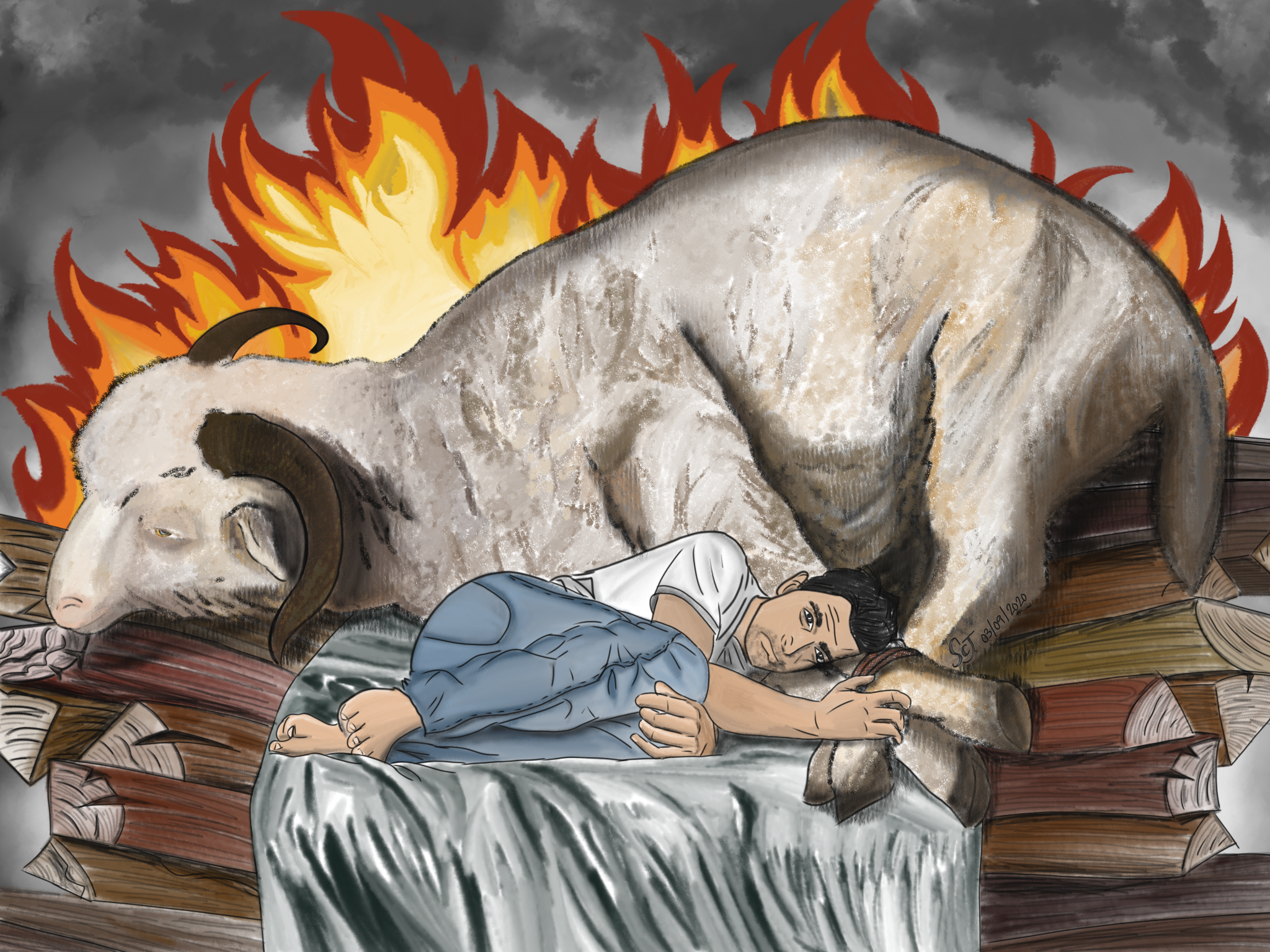
We always tend to trust and believe in things that we can see right? "Seeing is believing"
What if I told you that the one Person who understands everything you are going through is Someone you cannot really see?
The familiarity with this Person is so profound - the depth with which He understands us is so great. He knows our strengths and weaknesses. He sees us through and through. He has also understood suffering on an intense, personal level like no other. Jesus was a Man of Sorrows. Excruciating. Overwhelming. Crushing sorrow.
He is ready to comfort you and be with you during your times of absolute sorrow.
He meets us at our "rock bottom" and gives us grace to see it through. He doesn't ask you to "snap out of it" or to "figure it out" on your own.
His presence is silent but felt nevertheless - even in the blazing fiery trials that we go through.
Depression can chase us away from God. It can make us run in the opposite direction, hide in a corner to nurse our wounds or pick our scabs. Even in our negative thoughts and "feeling low" moments if we choose to sing - we start off.
"Lord you seem so far away,
a million miles or more it feels today.
And though I haven't lost my faith
I must confess right now
that it's hard for me to pray..."
- (Don Moen)
But later find that we cannot really mean it and continue singing the chorus from our hearts..
Are you feeling low today dear friend? Is it like a regular "blah" mood for you today? Are you worried for no tangible reason at all?
I hope this picture will come to your memory during those moments so that you can see Someone apart from yourself in the fire. Cuddle up closer to the Savior now- the slain Lamb of God who understands.
Cast all your cares on Him because He cares for you and would never give up on you..
ROMANS 8:18
For I consider that the sufferings of this present time are not worthy to be compared with the glory that is to be revealed to us
(Just in case you would like to sing the rest today!)
An interview with Naomi Klein in Earth Island Journal this week confirmed what I've been thinking for some time: The Big Green Groups in the environmental movement are almost as problematic as climate deniers. As Klein puts it:
I think there is a very a deep denialism in the environmental movement among the Big Green groups. And to be very honest with you, I think it's been more damaging than the right-wing denialism in terms of how much ground we've lost. Because it has steered us in directions that have yielded very poor results.
Maybe it's because I spent about four years dueling with stupid in North Idaho, but I have to admit some amusement with the recent what-went-wrong analysis of the climate battles in Obama's first term. A recent study (140-page pdf) by a Harvard researcher puts a lot of the blame on the Big Green groups based in Washington, DC and their blindness to the swift radicalization of the Republican Party and their inability to counter it. Indeed, the concentration of policy wonk generals calling the shots in DC without sufficient resources being put into the necessary grassroots army across the country was a fatal flaw that was glaringly obvious from Coeur d'Alene.
It probably shouldn't have required a Harvard political scientist to do so, but researcher Theda Skocpol provides a clear-eyed explanation of how things went wrong, culminating with the Tea Party summer of 2009. It was entirely too easy for Big Greens to dismiss the rantings of right-wingers in flyover states — what with all their misspelled signs and all the Jon Stewart ridicule — but the truism that all politics is local was lost on Big Greens whose strategy was based on coalitions with (selective) Big Businesses far from that summer's town hall shouting matches.
As Skocpol is quoted in a brief Washington Post interview:
Theda Skocpol: Climate-change denial had been an elite industry for a long time, but it finally penetrated down to conservative Republican identified voters around this time. That created new pressures on Republican officeholders and candidates. And I don't think most people noticed that at the time. …
… I think a lot of environmental groups were under the impression that the Republican Party is a creature of business, and that if you can make business allies, you can get Republicans to do something. But I don't think the Republican Party right now is mainly influenced by business. In the House in particular, ideological groups and grassroots pressure are much more influential. And in the research we've done, the two big issues that really revved up primary voters were immigration and the EPA.
The fact that much of the white-hot rhetoric was directed at health care reform served only to mask the equally hot anger at legendary evils of EPA overreach. Indeed, the terms "cap and trade" and "scientific consensus" were no less threatening than Obama's death panels. The DC leadership of the Big Green groups should maybe have gone to an Idaho town meeting or two rather than climate conferences in Copenhagen.
The folks at Grist have provided some superb analysis of the analysis, but I'm hoping that the lessons aren't lost. For one thing, foundation funders and big enviro thinkers could start re-emphasizing grassroots capacity in locations other than big blue cities where the Big Green groups are headquartered.
Furthermore, enviros can't be missing in action on important issues related to climate. This exchange closes out the interview and, with a week or two into my new role with a new group, it doesn't bode well.
Washington Post: The Sandy relief bill is going through the House [on Tuesday], and almost no environmental groups weighed in on that. That's shocking to me. Here we are, a large group of people in New York and New Jersey that environmentalists want to connect to climate change, and the groups aren't there. Why not?
Theda Skocpol: So you do have to build broader coalitions. That was one of the things that health reformers did this time around. They buried hatchets and forged ties with groups they needed to, like medical providers, and reached out to small businesses. Health care reformers spent years talking about what went wrong, what they could do differently. But that also took 15 years, from 1994 to when health care finally made it over the top. I'm not sure climate can wait 15 years.
All I know is if another opportunity comes along to get legislation through Congress, those that are prepared are going to be the ones that will be take advantage. And that's what I don't see yet. I haven't been impressed by the inside-the-movement post mortems I've read. I don't see any thought that there will have to be a lot of rethinking for that to happen.
Indeed, as the House of Representatives was voting on amendments to the delayed Sandy relief legislation, the sacrificial cuts — given up at the altar of the Tea Party gods of debt ceilings, deficit reductions, fiscal cliffs, and deadbeat deadlines — came from $150 million in oceans and coastal programs, and a particularly unlucky wildlife refuge in Connecticut.
Yeah. Like we're ready to fight any climate battles any time soon.
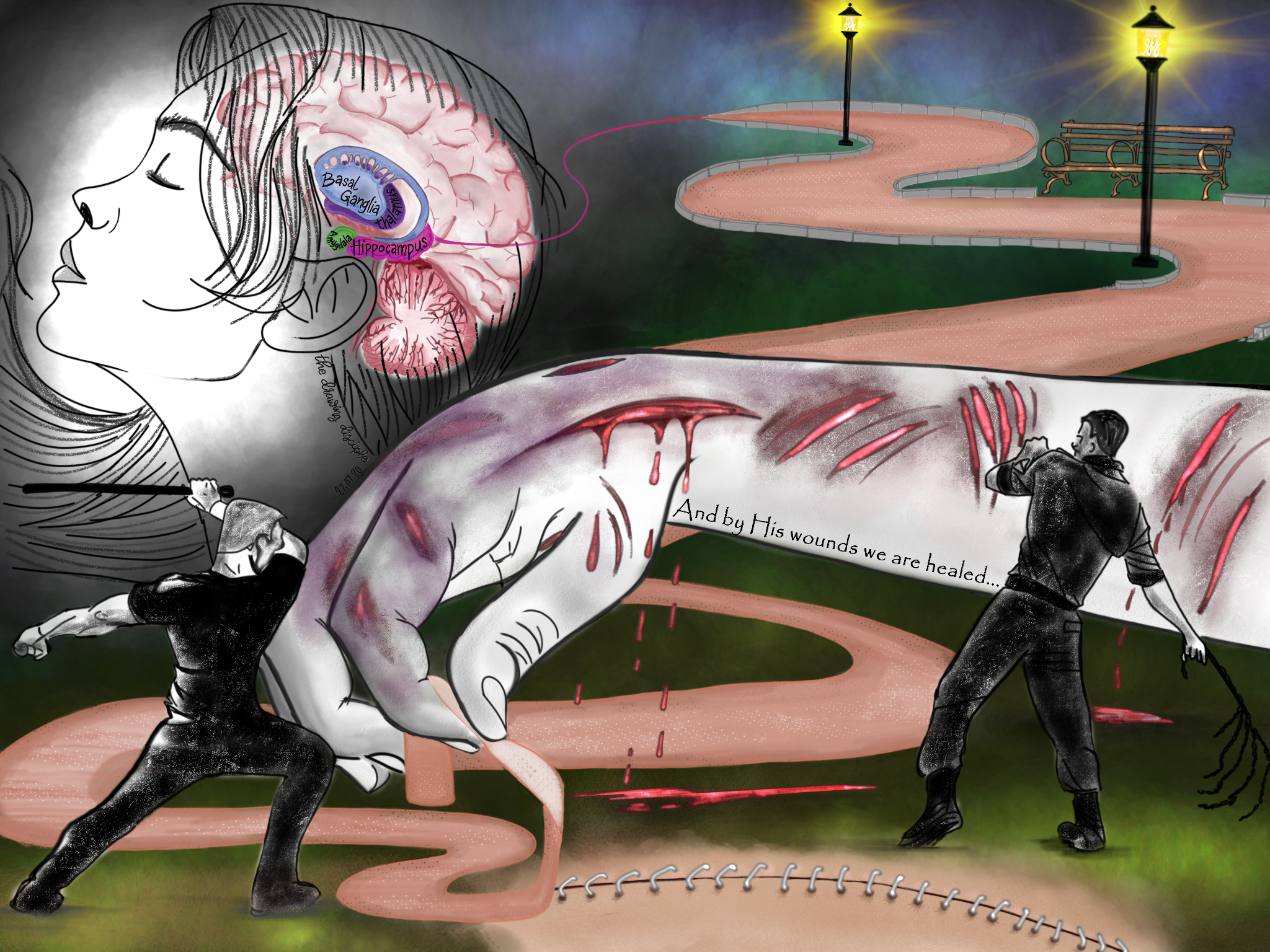
I dare you to decipher what this means! Take your time... :P
(I did hear a couple of versions already, so I am bracing myself for more..)
For those of you who are wondering, "What in the world was she thinking??"…
Read on..
As mentioned in my profile, I enjoy drawing pictures from song lyrics, Bible verses, Quotes from books etc.. This particular Abstract Art was inspired by a combination of the first two mentioned above and a little bit of my medical knowledge .. :)
The Hippocampus is where all our memories are stored.. (FUN FACT #1)
Take a walk down memory lane today and you will see that you have scars from wounds both old and new… Wrong choices, Guilty pleasures, falling for temptations, repetitive sins.. Secret sins that stain scarlet have scarred us all ..
Wounds like these may or may not heal over time.. If there's a chance at complete healing it would be because of a Savior who was wounded for us. (1 Peter 2:24; Isaiah 53:5)
Imagine the contrast in that.. Sounds like acupuncture in one person heals another.. :P (to put it in the mildest sense ever..!)
Well the point I'm trying to make here is… Forgiveness is what heals you..
Allow Him to forgive you..
Allow your own self to forgive you..
Do not be too hard on yourself...
Jesus has forgiven me.. He healed me and gave me that chance to hope again… believe again…
And He will most gladly do the same for you - all you need to do is ask..
Find the song that inspired me and the story behind it here:
Danny Gokey - Tell Your Heart To Beat Again (Live)
The lyrics of the song goes like this:
You're shattered
Like you've never been before
The life you knew
In a thousand pieces on the floor
And words fall short in times like these
When this world drives you to your knees
You think you're never gonna get back
To the you that used to be
Tell your heart to beat again
Close your eyes and breathe it in
Let the shadows fall away
Step into the light of grace
Yesterday's a closing door
You don't live there anymore
Say goodbye to where you've been
And tell your heart to beat again
Beginning
Just let that word wash over you
It's alright now
Love's healing hands have pulled you through
So get back up, take step one
Leave the darkness, feel the sun
'Cause your story's far from over
And your journey's just begun
Tell your heart to beat again
Close your eyes and breathe it in
Let the shadows fall away
Step into the light of grace
Yesterday's a closing door
You don't live there anymore
Say goodbye to where you've been
And tell your heart to beat again
Let every heartbreak
And every scar
Be a picture that reminds you
Who has carried you this far
'Cause Love sees farther than you ever could..
In this moment heaven's working
Everything for your good
Tell your heart to beat again
Close your eyes and breathe it in
Let the shadows fall away
Step into the light of grace
Yesterday's a closing door
You don't live there anymore
Say goodbye to where you've been
And tell your heart to beat again
Your heart to beat again
And so my dear friend.. Hope in the Lord - He is able to restore you..
He has been doing it for years.. Trust Him on this..
DM if you'd like me to send you the original for prints.. :)
And I would love to hear your interpretation of the art in the comments below... There's a chance that you might notice something I didn't.. ;)
I've reverted it to a standard theme so you'll find some things missing (like the menu).
It might be a while before I work this out, along with working out where to take blogging from here on in.
Till then, take care of yourself.

"You cannot always live on the mountain top,but when you walk through the valley,the memory of the mountain will sustain youand give you strength to carry you through.."
- Ravi Zacharias (The Grand Weaver)Buy your copy here :)
DM for original work - if you would like to see this in print...
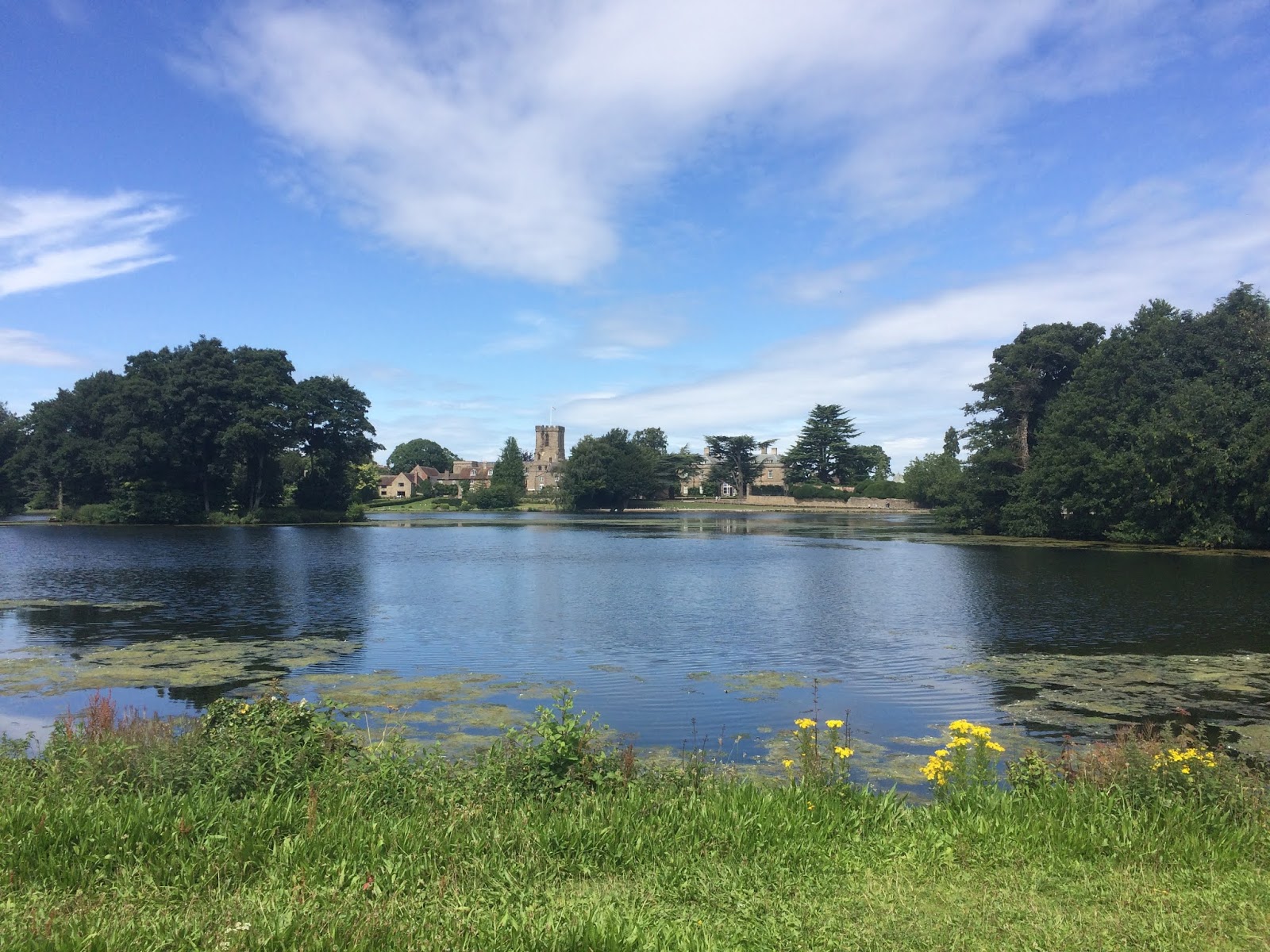
The Pool Melbourne
We had a fabulous time, chatting all the way. It was 7thJuly 2020 and the coronavirus lockdown was starting to lift, but everyone was still being cautious. It was such a joy to be out with a friend again enjoying the English summer at its peak. Did I mention it was raining?
Melbourne HallBy the time we had returned to Melbourne we were soaked and hungry, but the pubs and cafes were still closed. We bought some sandwiches and tea from a bakery and sheltered from the rain under the marketplace pavilion. 'Pavilion' is maybe not the best description but I am at a loss. There were 4 benches facing outwards from the stone centre, the marketcross built in 1889, and a roof over us held up by wooden posts on each corner. We enjoyed sitting in the dry and watching the cars passing by, with a hot drink and some deep discussions, oblivious to the constant downpour.
The market crossMy friend told me about Professor Jem Bendell and 'Deep Adaptation'. Bendell promotes the idea that we are already too far along the climate change route to prevent societal collapse, and that we should focus on enjoying the important things in life for the remaining years.
It doesn't resonate with me. Rapid globalisation has created some big issues for the planet and I think most people recognise that in the core of their being without spending too much time on the over-whelming evidence supporting it, when they could be focusing on the solutions. I just don't accept the 'we are doomed' conclusion, which isn't new and has been pushed for the last 30 years or more. Plus define 'doomed', because it could be anywhere on a scale from a financial recession to extinction, and the most probable outcomes are somewhere between the two.
There is plenty of evidence that indicates doom isn't upon us which I will touch on. I also feel that nothing positive will emerge from that kind of despair. People need hope and there is genuinely a lot to be hopeful for, though I may struggle to get it all in one post, so maybe this is the start of a new series of posts.
I read a few of Bendell's blog posts and watched a couple of youtube videos. I was surprised that one of the proposals was that people concerned about climate change go through a stage of despair followed by a stage of prepping for collapse. I have been through those stages, but I always felt this was a complete anomaly in the UK. Even my friend sitting with me in the rain, who has supported the climate change movement for at least the last 15 years that I have known her, has not experienced that and we know no one else who has. If you have then please do get in touch either in response to this post or by private message to me. For me the stage after prepping is a deep understanding and knowing that there is a lot of hope and optimism for the future.
There is no disputing that there are some climate facts behind Bendell's work, however I feel there are also some simplifications and a denial of progress and human nature, which skew his conclusion of collapse. There is a big difference between fact and theory or projections. Even with regard to facts they can look different dependent on what side of them you come from (your natural bias) and of course they can change with time. For instance the World population is a fact, but the figure changes daily. What I am saying is that nothing is fact and everything is in flux and in particular anything predicated on human behaviours and reactions. Experts struggle to predict next week's weather, so looking further in the future is unreliable. Anything can happen today that could change everything tomorrow… and it frequently does.
What I didn't like about this Deep Adaptation video on youtube is the comment below it that states:
As Dr. Bendell notes, there will be a tendency to want to reject his conclusions in Deep Adaptation since to accept them is so life changing in its repercussions.You may also want to dismiss Deep Adaptation because you simply disagree with their conclusions, but with this sentence Bendell has dismissed every argument against his theory as coming from someone 'in denial'. In addition he talks about the middle classes in his posts, and maybe he means that middle class society is collapsing and if it is hurray, because I am all for a classless society. However it does seem to overlook that it is the working class who are the collective power behind change (as well as being the least burden on the climate) and that there is a lot missing from this research if large parts of the population are overlooked.
My friend took from Bendell that collapse is inevitable, so stop worrying and spend the remaining years on things that have meaning for you. The perception being that Collapse means an end of life/ mass extinction event, rather than an end of a way of life such as a breakdown of current societal norms. Collapse represents fear, and just the word pulls the mind into a fear-driven frenzy where logic and reason jump ship and denial seems like a viable option. So let's replace 'Collapse' with 'Change'. There will be changes, there has to be changes in our society and history shows that there always have been changes.
Tobacco smoke is a killer, and in order to persuade people to quit smoking every packet has a disturbing image of the damage it has inflicted on some smokers. It looks pretty scary and if I were a smoker I would think that I was damned to die of some horrible lung disease or cancer before too long. The emphasis on the worst case scenario is aimed at scaring people into changing their smoking habit. For some people it makes the future look hopeless, so they may as well continue to enjoy smoking as they will be dead soon anyway. And yet we all know of someone who smoked until they were 80 with no sign of ill affect at all. How can that be? Maybe that future is not written in stone?
We are focusing on the worst case scenario for a smoker. That's what we are doing with climate change too. This may scare us into changing our lifestyles or putting legislation in place and on the whole it has had that effect. However it can also cause people to become paralysed by fear or believe any efforts are futile. But there are other ways for positive change to come about and it is far better that we enjoy and embrace those changes because then they will be changes that are here to last.
I was given a book for Christmas "The Uninhabitable Earth - A story of the future" by David Wallace-Wells. It's a shocking title but drew me in with the promise of an envisioned future. I only made it to page 44 and the weight of all the depressing, boring facts and figures that were being driven down to make you feel the full weight of hopelessness was enough. So I skipped to the back to see what the bright future might look like, but it was pretty much more of the same. Now if you have more stamina than me and have read this book in its entirety then please do enlighten me about the good parts that I have missed, or even shout up just to let me know you have not died of despair. I am a solutions person. I wanted to find someone who could envision the future for us and see the solutions - what is the use banging on about the same old stuff?
Wallace-Wells message is the equivalent of the stark image of lung cancer on a cigarette pack, I guess I have grown numb to it. Whereas the solutions such as banning smoking from public spaces worked just as well but without the fear factor. Providing solutions for people is a lot more empowering than just painting a bleak picture and leaving them paralysed. Obviously the fear factor is better for selling books…
Now I don't deny that there is evidence that looks pretty bleak for the planet, but that evidence has been around for years. The Uninhabitable Earth has been compared to the Silent Spring by Rachel Carson published in 1962 and there has not been a silence regarding environmental damage in the years in between. I remember the mistake of bringing study material, Limits to Growth: The 30 Year Update, with me on holiday in 2006 and I sure felt the despair that Bendell talks about then!
The 30 year update was written in 2004 and the data used was from the years preceding that, and, well, things change. I think we only have to look at the growing proportion of renewables in the electricity grid in the UK to see that things change. Or the consistent tightening of energy efficiency targets in Building Regulations. Or the energy efficiency labels for cars, homes and white goods, with the commitments to phase out petrol cars completely. Standards are consistently being raised and maybe progress has started slow, but momentum is growing. The growth in globalisation completely over-shadowed the gains made until recently, and now there are more and more positive reports emerging. It's clear that our perceptions and understandings of where we are need to change constantly and be open to the improvements we see, not just the devastation being caused.
There is definitely a delayed response in the updated facts being interpreted, understood and then disseminated and grasped by the wider community. Population growth is a good example of that and I would urge anyone who hasn't yet seen the fantastic explanation by the late Hans Rosling back in 2013 to watch it. Even though the facts and figures have moved on already and there was more good news about population growth slowing further in the news this week. The message is clear that population is still increasing, but it is no longer accelerating. The continuing growth is down to the increase in life expectancy of people already alive, and is no longer due to birth rate which has dropped considerably (see below).
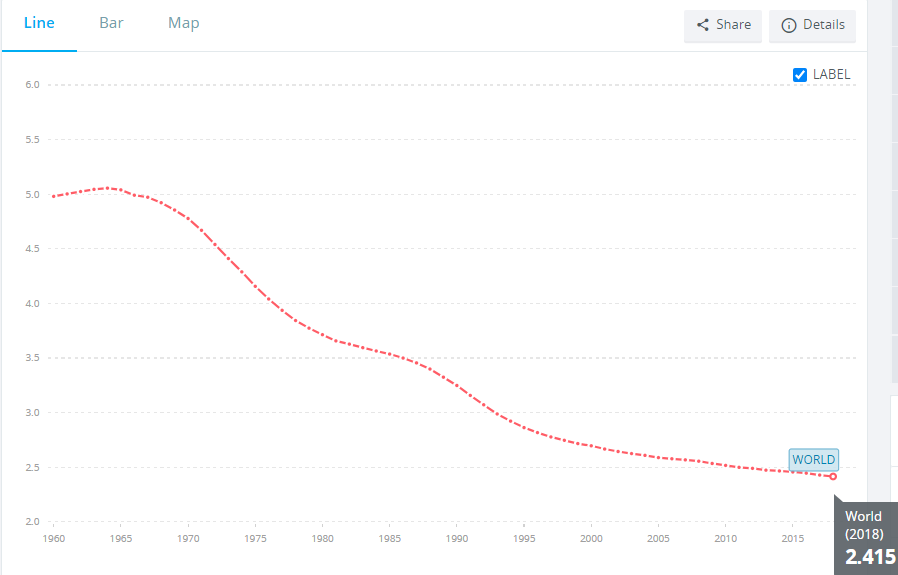
World fertility rates (births per woman), The World Bank,
Birth rate is a clear area where the actual changes have to be taken by individuals. Yes education and access to contraception are vital to enable that, but couples have chosen to move away from the large families of their parents and grandparents. Who would have thought it was possible to change that on a global scale?
The coronavirus pandemic predictions were bleak in the UK. Maybe they needed to be to prod our slow and bumbling government into action. However the 250,000 - 510,000 deaths predicted for the UK on the 16th March by Neil Ferguson's Imperial College team were based on the worst case scenario. That worst case scenario may have been fairly accurate based on the information available at the time and the assumptions made. Those assumptions can make an enormous difference. That's why there will be several scenarios run for different assumptions. The worst case is the do nothing scenario, the best case is that all infections are tracked and everything is under control, which was equally as unlikely in the UK as the worst case, however not totally impossible.
It is the same with the impacts of climate change, there is a range of 'likely' outcomes based on how much or little action is taken to reduce carbon emissions and mitigate the impact. My concern is that human nature seems to be misunderstood in modelling and some of the positive changes happening now are overlooked.
Most of the constructs which govern our society and dictate the actions of the majority are beliefs, traditions or habits. For instance families were large because they were for our ancestors and our neighbours, because there was and still is a belief perpetuated by religion that contraception is bad and because people weren't educated on the choices they had or choices weren't widely available. The barriers that needed to be broken weren't physical (although it all came down to a physical barrier at the basic level J).
Back to coronavirus, the decision of when to lockdown and how far to go, was a human one that made a significant difference on the overall impact of the virus. If you were calculating this based on monetary costs alone then you would not expect a lockdown to be implemented, because the economic risk was enormous and the probability of stopping the virus spreading seemed slim. Those most at risk were the weak and frail members, not the productive worker members of society. Boris Johnson certainly preferred the do nothing approach to start with, talking about 'herd immunity'.
However this was out of kilter with the rest of human nature, which is to protect and care for loved ones. Many companies had already started to voluntarily shut down offices and ask their staff to work from home a few weeks prior to the government instigated lockdown. The pressure for the government to act on behalf of society was immense and of course they had to go with it. So who would you say made the decision in the end? Was it the politicians or was it forced by public opinion? Where does the power really lie?
Whilst there are some people who did not stick to the lockdown rules, the vast majority did. The vast majority have tried to take care of themselves, their loved ones and their community by following government advice, however confusing and pointless some of it seemed at times. This human effect has made a difference. This community response has shifted the outcome away from the worst case prediction. The power of this human response and its influence on decision-makers was under-rated. Similarly Bendell and others mistakenly believe that the natural instinct for humans is to protect only themselves at all costs, but it never has been. We are social animals.
When I read The 5 Stages of Collapse by Dmitry Orlov he discussed a tribe that had lost this community instinct to protect others. It was most disturbing to read of parents with no regard for their off-spring and the extreme conditions that had brought this shift in culture about. It is an anomaly that is so alien to our current culture. I can understand that writing in the age of Brexit the feeling of division and disdain for others was at its peak. However the lockdown has brought a blossoming of communities, just as social interaction and national pride were buoyant during the 2012 Olympics and Queen's Jubilee celebrations. We can choose whether we foster and promote feelings of despair, isolation and fear of others OR encourage community spirit and camaraderie. I know which I prefer.
Another very positive change for the future is the new generation. My climate change fear years were during a time when the Baby Boomers were the dominant decision makers, with their focus on growth. Now 20 years later it is my generation that are taking up the reigns and the focus has moved more to sustainability and there has been a shift in gear. In 20 years' time the decisions will be made by a new generation who have lived through lockdown, protested for Black Lives Matter and get their news from social media, rather than mainstream media. Growth at all costs will no longer be on the agenda. I could argue that we are already there, as for most of the world growth has been demoted and saving lives has become far more important when faced with a pandemic. Money is bailing out people and businesses not financial intuitions - that's an incredible shift away from austerity.
Most of the solutions we need to transition to a low carbon sustainable lifestyle are already available. Many are underway and building up momentum. Just like the shift seen in population growth, individual change is not only possible but is in motion. Your choices have made it so. As shown with lockdown, the people have immense power to instigate the changes needed and are already surging ahead of government legislation.
Over the next few posts I will write you that positive future that I know to be true, with examples of low carbon successes.
Christ is the break-through the wall of darkness that holds you back from a God who is waiting for you on the other side..
I'd like to call this one "REDEMPTIVE ART" simply because this was painted on a torn canvas that I chose to "redeem".. (I stuck a board canvas onto the stretched canvas to create the 3D effect)
"He shall cover you with His feathers, And under His wings you shall take refuge..."
Original idea credits to my dear friend Rini Bejoy... :)
Memories of a place dear to my heart.. with my kindred spirits... :)
"I will give you a new heart and put a new spirit in you; I will remove from you your heart of stone and give you a heart of flesh."
Have you had your heart transplant done yet?The Greatest Cardiothoracic SurgeonIs just a prayer away.. :)

"Prone to wander.. Lord I feel it... Prone to leave the God I love..."- based on the song "Come thou fount of every blessing"
Sometimes, life makes you walk the plank of Faith.. You feel like you are at the edge of a cliff.. You can already hear the sound of crashing waves.. All your options have run out..
You have reached your final limit... You need to take your stand..Make the decision.
And in all that fear and utter hopelessness, we forget to see the bigger picture of life... The one that has God in it...
Don't ever forget in times like these...That Jesus is forever faithful..
No matter how fatal the fall may seem.. Remember you can always choose to fall into His hands..&He will never let you go..
That GOD ANSWERS PRAYERS..
Whether it be a YES, NO or WAIT..
The answer will always be there..

Note: The time duration at the step named "Prayer and absolute surrender" can range from a few minutes to many years and decades.It shows our silent agreement to what the Lord has decided for us leading to the subsequent steps as seen in the flowcharts above.
"For The Lord is my towerAnd He gives me the powerTo tear down the works of the enemy
In a difficult hourHe will crush the devourerAnd bring the powers of darknessUnderneath my feet...."
-Hillsongs United
"Behold, You desire truth in the innermost being,
And in the hidden part You will make me know wisdom."
Ps 51:6 (NASB)
ISAIAH 42:16
I will lead the blind by a way they did not know;
I will guide them on paths they have not known.
I will turn darkness to light in front of them
and rough places into level ground.
This is what I will do for them,
and I will not forsake them.
Ever felt like the directions in your life are all messed up?Like there are no proper 'sign boards' and you seem to be aimlessly wandering?Cling on to this promise... your real breakthrough might be just around the corner... Do not give up just yet.. His right hand is never too short to reach yours.. And the Lord will never fail to perfect that which concerns you... (Psalm 138:8)