
 'The world's ugliest lawn' isn't really that ugly, according to its Australian owner - video [ 23-Jan-26 9:29pm ]
Jarno Coone, the winner of the international 'world's ugliest lawn' competition, says he doesn't let his garden grow wild to annoy his neighbours in the regional Victorian town of Kyneton. He says he is 'proud to get the message out there for water conservation and living more harmoniously with nature'. 'I really do believe it is better for the environment,' he says
Continue reading... Week in wildlife: a proud eagle, an adorable axolotl and a goofy seal [ 23-Jan-26 8:00am ]This week's best wildlife photographs from around the world
Continue reading...
This is #50 in a series of month-end reflections on the state of the world, and other things that come to mind, as I walk, hike, and explore in my local community.

image by AI based on the 'word portrait' below; my own prompt
Sometimes I try to draw a 'portrait' of my community, just as it is. Not as I judge it to be, with my dubious interpretations of the 'meaning' of people's actions. Just writing what I see, in its entirety, uncensored, un-retouched, un-selective.
Do painters, when they make portraits, toy with the truth the same way writers seemingly can't avoid doing? Is this why we are so fascinated by photographs, which purport to represent exactly what we see, nothing more or less?
I'm sitting in my local café, just trying to notice without attaching meaning to what I see.
Two young Korean women are talking excitedly in the café. Lots of animated, unrestrained body language and facial expressions. They're speaking loudly, in English.
I think the above paragraph is factual. No judgement or interpretation or meaning-making. I could have said they were talking "happily", but then I'm adding my own layer on top of what is just, apparently happening. They are smiling, so it wouldn't be an unreasonable assumption. But still, it's an assumption. A puppy watching them, if puppies could speak with us, would not quibble with the paragraph, but would assuredly not judge the women to be necessarily happy, as human observers would be inclined to do. And the AI image the word prompt produced, above, is eerily close to what I am observing at this moment.
It's quite a performance. I find it hard to resist watching them. It's like watching theatre. Confident, seemingly-almost-rehearsed, exaggerated, demonstrative motions. The words, which I catch only intermittently over the café's music system, don't really matter. (A large proportion of them are the single interjection/filler word like, anyway.) The above paragraph captures, I think, more than a photograph could. More like what a video might capture, perhaps. But their actions seem larger than life, more than mere pixels could ever represent.
How would a painter portray this scene? How could she capture more than a photo could? Could she avoid adding her 'interpretation' of what she was watching? Would that be a good thing or a bad thing? She might use colour and framing to suggest dynamic focus and movement. Her painting might simultaneously capture several actions that actually happened separately — artistic licence. How might she draw their faces to capture something that I, a casual observer, miss? Something no camera could convey.
And of course I can't remove you, the reader, from this 'picture' either. As I write, I'm making assumptions about you, like: When will this guy stop with this boring tangential stuff and provide us with some heartwarming anecdotes showing the humanity of his community, and bring a smile to our face or a tear to our eye? Entertain us, Mr Pollard!
I don't suppose you'll buy my 'no-free-will' argument. Not again.
If I were to draw some more unembellished 'word portraits' about what it's like here, now, on a chilly January west-coast winter day, they might include:
Four grizzled-looking men of mixed ages are sitting together, smoking, and drinking from a shared thermos, in a small clearing at the picturesque intersection of two walking paths by the river. They're wearing threadbare coats, some cloth, some 'puffy', against the 5ºC weather. They smile (a bit inauthentically, or apologetically?) as a woman walking a small dog passes by, and again as I pass by.
Damn it's hard to avoid adding 'interpretation'. Words are so f*&$% lame!
At the edge of the kids' play area in the local park, two parents reach down and zip/velcro up their impatient kids' winter coats. The kids race off toward the swings and, laughing, grab the last two unoccupied ones. The boy has already unzipped and tossed his coat aside. The parents stand nearby, gloved and scarved, rocking back and forth. 'Mom' wears a grim smile and raised eyebrows.
———
In the mall, a teenaged girl takes the hand of the boy walking beside her. He shakes it off. She stops walking. He stops walking. They exchange words. He shrugs. She walks around behind him and puts her arms around him from behind, whispering in his ear. Then she walks around beside him and offers her hand. He takes it, and they continue on their way.
———
Walking back from the mall, I see one of the community's 'regulars', to whom I often give small amounts of money, sitting on the cold cement outside the Walmart with his cardboard sign lamenting his illness and poverty. He is being pressed to 'move on' by the security guard. Two women are shouting at the security guard, insisting the homeless guy's not hassling customers, or trespassing, and hasn't the guard something better to do with his time? The guard responds that after 'three warnings' the Walmart boss told him to call the cops if he shows up again. When the women threaten to complain to management or even organize a boycott of the store, the guard asks them to please not do that (he clearly can't afford to lose this miserable job) and to try to understand his position. The women tell the guard that he should try to understand the homeless guy's position.
———
Later that day, I am taking the pre-sorted garbage down from my apartment to the basement garbage room. A woman gets on at a lower floor, likewise laden with bags full of garbage and recycling. She nods and smiles. I comment "It's like an obstacle course, isn't it, navigating the heavy card-controlled security doors with your arms full? Not fun!" She replies: "I don't know. Anything can be fun. It's all about what you make of it." She laughs as she exits the elevator.
———
And my favourite from the past month:
I'm walking outside the mall in an area set up with ping pong tables (usually in use even in the coldest weather) that, in the summer, features a DJ, foosball, and organized games with prizes. In January, it's empty except for ping pong players and people entering and leaving the mall. There's a woman walking with two little girls, one on either side of her, both of them wearing wireless earbuds. Suddenly, the girls break stride and call for the woman to stop. Then, they do a synchronized clap, eight times, and then break into a line dance! Several people (including me) stop to watch. They continue, completely in step with each other (I later found out you can sync bluetooth signals to be heard by more than one listener at the same time). The dance continues for probably a couple of minutes. Then they stop, and announce to the woman "Canadian Stomp!". Applause from the woman and the small audience. Bows from the girls. The woman replies "Why's it called the Canadian Stomp?" to which one of the girls replies: "Shania Twain, duh!".
———
That's what seems to be happening here, now, anyway.
A very short summary of what has been a long and frustrating process:
I'm on the Board of a small American non-profit charity. It has a single product that it sells at cost, raising enough money (about $3,000/year) to enable us to keep adequate stock.
We sell the product using the Shopify e-commerce platform. Since they offered a slightly higher interest rate on 'balances' left with it than our regular bank, we chose to leave our proceeds there, and only withdraw money when we needed to purchase more stock or to pay postage or other charges.
Huge mistake. We didn't realize:
- Shopify (and its competitors all follow the same practice) outsources its banking to a series of 'virtual' banks to save the cost of FDIC registration themselves.
- The #&%(^ management of Shopify (and again, research suggests all its competitors do the same) signed legal agreements with these 'banking partners' that give these banks unrestricted and unlimited access and rights with respect to our money (Shopify's customers' money).
- Those rights include the right to seize moneys in those accounts without notice, without providing cause, without any time limit, and without even identifying to Shopify's customers which bank has seized their funds. Shopify (and its competitors) have to 'front' and deflect their customers' outrage and ire while the banks have absconded with our money.
If this sounds very much like the actions of Trump's goons seizing the bank accounts of anyone in the world they take a dislike to, that's because basically it is. I am astonished that this is legal, even in a corporatized pseudo-democracy like the US.
In our situation, the unidentified bank stole (seized, froze) our entire bank account 'balance' — the working capital we use to keep our little charity going — equal to several years' revenues, and blocked us from accessing it for five months. I spent over 100 hours of my time trying to get an explanation of the seizure and to get our money back. I was required to provide extensive information about our charity to the anonymous bank, via Shopify, a process that was accusatory and intimidating. When the bank finally completed its supposed 'investigation', about which we were told nothing, they released our funds, with no explanation, no apology, and no assurances they wouldn't do it again.
So the lesson is:
If you are using an e-commerce platform for your business' or charity's sales, never under any circumstances leave even a penny of your sales proceeds in the platform's 'balance' account. Transfer it immediately to your organization's own bank or credit union account. Or be prepared to lose it.
Again, to emphasize, this is not specific to Shopify. All the e-commerce platforms I found have similar arrangements with similar anonymous 'banking partners'. In fact, the woman from Shopify assigned to our account was extremely patient and polite in telling us what little they told her. (I can't say the same for Shopify's management, which has IMO a rather unsavoury relationship with Canada's extremist Conservative party, and which wants a "DOGE for Canada", and which of course blocks aggrieved customers from having any access to management.)
This, it seems, is the world we live in now. Incompetent corporations and megalomanic political leaders harassing innocent people and stealing their money and property with impunity.
There oughta be a law. There used to be, I think.

What is it about human nature that once someone becomes extremely famous or powerful, we become somehow incapable of pointing out when they've become simply bonkers, and need to be quickly put out to pasture before they do things that are illegal and dangerous? Dementia happens, you know? It's tragic. But why are we so desperate to pretend it isn't happening?
We grant this unwarranted and misguided adulation to old people who have lost it in every walk of public life from royalty to rock stars. With Biden, it became ridiculous. The brain-dead geezer had to be told where to walk and exactly what to say, and even when he started reading the parenthesized guides on his cue cards ("pause here for applause") as words to be spoken, everyone from party faithful to the cowed media kept looking the other way with nervous embarrassment, or just outright denied that he was simply non compos mentis.
And then we have RFK Jr with his self-admitted "brain worm" and his collection of dead animals, whose own family has admitted he's lost it, wreaking havoc with the already-collapsing US health system, and aside from gentle satire on late-night talk shows, no one will say the obvious, and get him out of there before he causes millions of deaths.
Of course Exhibit A is the orange-faced one, the guy with the "grab 'em by the pussy" philosophy. His dementia was clear even when he was running against Biden. But here's his latest, and his handlers still aren't making a move to rein him in:
Dear Ambassador:
President Trump has asked that the following message, shared with [Norwegian] Prime Minister Jonas Gahr Støre, be forwarded to your [named head of government/state]
"Dear Jonas: Considering your Country decided not to give me the Nobel Peace Prize for having stopped 8 Wars PLUS, I no longer feel an obligation to think purely of Peace, although it will always be predominant, but can now think about what is good and proper for the United States of America. Denmark cannot protect that land from Russia or China, and why do they have a "right of ownership" anyway? There are no written documents, it's only that a boat landed there hundreds of years ago, but we had boats landing there, also. I have done more for NATO than any other person since its founding, and now, NATO should do something for the United States. The World is not secure unless we have Complete and Total Control of Greenland. Thank you! President DJT"
The first time I saw this, I thought it had to be a joke. Surely this isn't actually being sent, unedited, through official diplomatic channels? But it is.
And the only people upset about it, it seems, are those seeing it as part of a coordinated fascist strategy for global domination. When in fact it's just the ravings of a seriously demented man whose handlers seem completely incapable of recognizing and acting on the man's now-dangerous mental illness.
This man is not a fascist. He has never had the cognitive skills, the knowledge of history, or the attention span to hold any kind of consistent, coherent political strategy or philosophy in his head for more than fifteen minutes. He changes his mind every moment like a two-year-old announcing what he wants for supper. He doesn't have policies, he has temper tantrums. These are signs of senile psychosis, not ideological zeal.
I can understand why Republicans continue to support him and deny he is incapable of doing the job they nominated him for. They don't want to be the next victims of his psychosis, and don't want to admit they are responsible for him.
But I don't understand the cowardice of the Democrats to say what they finally got up the courage to admit of their own nominee. And I don't understand the reticence of the US media to call this what it is, either.
What will it take for them to say the obvious — their president is a seriously demented man who quickly needs to be removed from power? The only difference between him and Biden is that Biden was a placid psychotic when he lost it, while Trump is a violent one.
image by AI; my own prompt
This is the second of a series of articles — opinionated, fanciful writings, speculations — about The World After Collapse. It draws on what I've learned about pre-civilization humans and other large-brained creatures, and speculates on how, after civilization's fall is complete — probably centuries from now — the remnants of the human species might be unrecognizably different from how we behave and think now. But they may be also 'recognizably' similar to how we know, deep down inside, we really are, and always have been. The series is not intended to provide hope, or solace, or a prediction, or least of all a pathway to change. Just a speculation about how the world, with a smaller number of us, or without us, might look long after those of us living through the fall have gone.

What's the point, I have been asked, of writing speculations about the world after civilization's collapse, especially when it appears likely that the current collapse is likely to continue for centuries?
I think the 'point' might be as an act of forgiveness. And we all need a little forgiveness.
For 20+ years I've been trying to explain why the accelerating collapse of our civilization was/is inevitable (that's just how complex systems work) and that it's not our 'fault' (we have no free will and our behaviour is entirely conditioned).
Unlike those who approach this realization with a sense of immense grief (with commensurate processes and rituals for dealing with it), I've always tried (and been conditioned) to approach it with a sense of equanimity, the way I think wild animals do. I'm more drawn to the social forgetting process than the truth and reconciliation process. I see dragging up past trauma, assigning blame, and insisting on confession and apology, as an inherently western religion-based pathology, one dependent on belief in intrinsic sinfulness and free will. It is easier to forgive, and to forget, when one accepts that everything that has happened could not have been otherwise.

from the membrary
Assuming it will take centuries, perhaps even millennia, for the current collapse to play out (given the unprecedented size and complexity of our current civilization), what might our post-civ human societies look like?
I think, based on the preponderance of evidence I have read, that there's an uncomfortably high likelihood that the post-civ world will not have any humans in it. We are, after all, a fragile species, naturally suited only to the relatively scarce environments of tropical rainforests and hence utterly dependent, since we left them, on a completely synthetic, prosthetic 'human environment' for our survival. There will not be the resources left to construct such synthetic environments after collapse, and in any case post-civ natural environments are likely to be much less stable and more hostile and volatile than they have been for the past few millennia.
So my sense is that, if there are any human societies left, it will be because they have avoided the tendencies that have doomed our current civilization. One of those tendencies is a proclivity for the kind of specialization that enables the growth of larger and more complex societies at the cost of individual competence, independence and resilience.
The collective recognition and selection of certain of us as being 'better at' doing some things is understandable, and has likely been part of the reason we survived as a species once we had been forced to leave our ancestral forest home. But the purpose of that recognition is to enable the rest to learn from watching and emulating that person.
That specialization however is fetishized in modern society, to the point most of us have become completely incompetent at doing most of the things that are absolutely essential to our survival and health, and hence utterly dependent on those who are competent (if you can still find them), and on the massively complex systems that enable (increasingly feebly) the competent to do things for us that we need done. This dependence is abnormal and completely unsustainable. And those with wealth and power relish and exploit our complete dependence on these massive systems that they control and draw 'rents' from.
If, as I suspect, any post-civ human societies will necessarily be much smaller than today's, they will of necessity also become more egalitarian, and they will not be able to afford dependency. If person X is the only one who knows how to do essential function Y well, then X had better teach the rest of the tribe all about Y before he gets eaten by a creature higher up in the food chain. The upshot is that post-civ humans will, I think, inevitably be competent in everything they need to know to do to survive and thrive, not to be independent, but to be interdependent with their tribe-mates, ensuring maximal capacity and competence for the entire tribe. If they aren't, then our species will quickly go extinct.
A second human tendency that I think has led to our current civilization's demise is a strange and seemingly uniquely belief that life is more important than health, pleasure and happiness. This is, again, an entrained human belief inculcated by most human religions, as well as by loony spiritual cults like Musk's Longtermism.
Most wild creatures, when they lose their health, opt to go off by themselves to die, rather than burden their tribe with support needs that endanger the safety and viability of the whole. And wild creatures (contrary to prevailing and IMO adversarial and wrong-headed 'selfish gene' memes) naturally balance their numbers and the extents of their habitats for the benefit of all life in their environments. That's because they do not conceive of themselves as separate from, or inherently threatened by, the rest of life in their environments. The goal, built into millions of years of evolution, is the survival and thriving of the whole.
Could our species somehow evolve, after collapse, without this traumatizing, horrifically destructive sense of separation and superiority to the rest of the planet's life? That's probably the question that fascinates me the most these days. I've argued that this sense evolved as an accidental spandrel of our species' evolving large brain and specifically the entanglement of parts of our brain that are entirely separate in other species' brains. It would also seem that this entanglement and its traumatizing consequences (including what we call 'consciousness') are recent developments in our species, and co-evolved with language and settlement in large numbers (greater than Dunbar's number).
The development and use of language is a huge, high-maintenance and energy-consuming component of our human metabolism. That language use occupies (and re-wires) a large proportion of our brains' circuitry, and hence 'crowds out' a lot of other brain functions that we have lost in our recent evolution. Recent research suggests we evolved language to strengthen social connections as groups got larger, and not because we 'needed' it for our survival. In fact, there is considerable evidence (see Ludovic Slimak's book) that H. Neanderthalensis didn't need it or develop it, and that we exterminated them because their 'difference' terrified us, while our difference from them didn't faze them at all (all just part of the whole).
I think it is conceivable that, if and when we cease needing abstract language, and our brains once again begin developing from infancy for their primal purposes (maximizing pleasure and minimizing pain, to oversimplify), that we will once again become, like all other life on Earth, creatures that communicate via obvious instinctive gestures and not by complex hard-to-learn abstract language. And maybe, just maybe, our future descendants' brains will then again become incapable of learning abstract languages (see Noam Chomsky et al's work on how children not taught such languages by adolescence become incapable of learning them afterwards — their brain structures have evolved in incompatible ways).
And without language, I think, all of the conceptual baggage that sits on language's scaffolding — including the very ideas of 'self' and 'separation' and the terror and trauma that those concepts inevitably sparked in us — will likewise cease to arise. We will, at last, be as emotionally healthy as the rest of life on Earth. And, with that superior emotional health, we will cease obsessing about sustaining our (conceived, imagined, separate, desperate) lives regardless of our physical health. We (or at least our bodies) will become (like some indigenous peoples still are) far more careful not to endanger our physical health than we are now. A healthy life will become more important than a long one.
So, I think it's possible, or perhaps it's just wishful thinking, that any post-civ societies, as necessarily smaller and simpler than ours as they will be, will be far more competent and far more healthy than our horrifically dependent, narrowly (if at all) competent, sickly species. And they will just be part of the larger organism of all-life-on-Earth.
That hope, that tentative belief, allows me to forgive myself and others for this civilization's collapse and all the damage it has produced and will continue to produce.
After us, the dragons. And if there are some of our species left, we will in any case not be dragon-slayers. After all, there is no separation between us and the dragons. And in any case there is no such thing as a dragon.

In January 1933, Hitler is appointed Chancellor despite only minority support in the election. A few months later, he becomes dictator and all opposition parties are banned. Image via Anne Frank House from Bundesarchiv, 146-1972-026-11/ photograph: R. Sennecke. Source: Wikimedia Commons. Rights: CC-BY-SA 3.0 DE
Word of the day is 'latibulate' (17th century): to hide in a corner in an attempt to escape reality.
— Susie Dent, from the memebrary
It really does seem as if the American Empire, with the complicity of both US parties, most major corporations, the corporate-owned media, and the cowardly, appeasing leaders of the other countries in the larger White Empire, is hell-bent on emulating the 'rise' and world domination aspirations of Germany in the 1930s. The parallels are now too overwhelming to ignore.
Independent Canadian journalist Tod Maffin likens the behaviour of the US Administration to that of a school bully. The analogy is perfectly apt. The UN and the courts are the hapless school authorities. The Canadian/European/Australian 'leaders' are the bully's terrified 'allies' and apologists for the bully's behaviour, out of fear and incomprehension they will be next. They're fine with the brutality and theft as long as it's the poor, weak kids getting beaten up and robbed, not them. I suppose we hope that the bully will 'graduate out' of the school in the next US election, and the problem will magically disappear. That's what the world figured in the early 1930s about Germany.
In the meantime, Canadians are now at least talking about the probability of annexation, military intervention, economic sanctions (sieges) and other hostile actions threatening our sovereignty.
It is absolutely conceivable that the carnage will continue until all of the Americas, and the entire Middle East, has been declared the bully's territory. The bully will continue his behaviour until he stops getting exactly what he wants and demands. Just like in the 1930s. ICE killed 32 people last year, and has over 68,000 locked up, mostly without charges. Just like in the 1930s. Their target is "100 million", to enable an Aryan US Empire "no longer besieged by the third world". Just like in the 1930s.
First they came for the Communists…
COLLAPSE WATCH

photo via Bill Rees' blog, by Emre Ezer on Pexels, free to use
Is the looming financial collapse behind Trump's war-mongering?: Tim Morgan poses an interesting thesis: If as most believe financial 'assets' are ludicrous overvalued (especially AI 'assets'), and if (see Lawrence Wilkerson's article linked below) the massive government and private debt that has been created to try to keep the economy pumping is basically un-repayable when it comes due, then this suggests that countries dependent on financial 'wealth' (the US, and Europe to a lesser extent) are facing catastrophic economic collapse and contraction, while countries that rely on their material resources (China, Russia, Canada, Venezuela, Iran) should be able to weather the storm relatively well. What's a resource-poor, finance-dependent country to do? Well, obviously, steal the resource-rich countries' resources (oil, land, water, minerals) to lessen the blow.
Why collapse is inevitable: A 3-part essay from ecological economist Bill Rees. Bill's summary:
- Part 1 argues that modern humans are maladapted by nature and nurture to the world they themselves have created. Our paleolithic brains are befuddled by the sheer scale, complexity and pace of change of both our socio-cultural and biophysical environments.
- Part 2 suggests that much of our befuddlement is due to unfamiliar behaviours and circumstances that emerge from the internal machinations of large-scale societal organizations and their interactions with the biophysical systems that contain them. Our Paleolithic brains are not up to the challenge. Socially stable, eco-compatible large-scale societies cannot emerge from these turbulent confrontations.
- Part 3 makes the case that what does emerge is something else altogether—gross societal malfunction-to-collapse—which may be at least partially explained by pan-cultural 'psychopathy'.
This month in collapse: Erik Michaels provides a comprehensive and compelling summary of the best new writing on collapse, every week. Definitely worth subscribing or putting in your RSS feed. His latest includes this remarkable paragraph from ecologist Lyle Lewis:
We often end [discussions about extinction] with reassurance; with the idea that we can still choose how deep the crater goes. But history offers little evidence that we can. Knowledge without the capacity to act is irrelevant, and our species has always followed the same imperative: to consume what sustains us until it's gone. The truth is that this extinction isn't a problem we can solve; it's a process we set in motion simply by being what we are. All that remains is to bear witness; to understand what it means to live in the final stages of the unmaking of the world. In truth, every hominin of the last 2.5 million years has lived somewhere along this descent; life will go on, but not the life we've known. We're simply witnesses to its undoing.
Orange rivers as the permafrost melts: A new NOAA study reveals how quickly the Arctic environment is changing as polar temperatures rise 3-5x faster than they are on the rest of the planet. And in the process Canada is quickly and irreplaceably losing its glaciers.
LIVING BETTER

via Stephen Abram, originally from a pro-vaccine site
It starts with humility: Those of us privileged to have obtained advanced degrees and high salaries and powerful-sounding titles can easily begin to believe our own press — that what we have to say is important and invariably right. It came as a shock to me when I retired to discover most of the stuff in my professional bio was just self-serving crap, and that I really had not accomplished anything of enduring value. And that all the people I worked for and with likewise had not accomplished anything of enduring value — and the more they had been paid and the 'higher up' they went, the more that was true. Not because any of us were/are dumb or incompetent (though some were), but because that's not how sustained, lasting change happens in complex systems. It sounds like Mark Eddleston has had a similar epiphany, and he's written an articulate and achingly humble book about it. First chapter is here.
Seven ways to make housing affordable: Now that Vancouver housing prices have stabilized, there's a new opportunity for governments to help residents cut the absurd cost of housing, that apply just about everywhere. "Letting the market" solve the problems has never worked.
Getting religion out of the health care system: Finally, BC's courts have been forced to confront the absurdity of publicly-funded hospitals dictating health care policy based on religious orthodoxy.
POLITICS AND ECONOMICS AS USUAL

produced, apparently by accident, by AI (not my prompt); out of the mouth of bots
Patrick Lawrence's eulogy for the rule of law as the world descends into chaos: Patrick's a wonderful writer, and his three latest essays should be required reading for anyone who wants to understand what's happening in the world. I'm providing multiple links to try to skirt the paywall (let me know if you can't access any of them), and have asked him to 'package' and release them for wider distribution:
- 1. Free Speech and It's Enemies: What we're able and competent to say and write has a powerful impact on what we're able to conceive and think. (CN copy.)
- 2. The Coup: The American Empire baldly announces what has been its covert modus operandi for decades: It claims the entire Western Hemisphere (and the Middle East) as its territory to deal with as it chooses, and recognizes none of these nations' sovereignty. (Alt Substack copy.)
- 3. An Abyss of Lawlessness: In the words of Trump cabinet minister Stephen Miller: "We live in a world in which you can talk all you want about international niceties and everything else, but we live in a world… that is governed by strength, that is governed by force, that is governed by power. These are the iron laws of the world since the beginning of time. The "rule of law" is one of those "international niceties" that has been completely discarded. (CN copy)
Imperialism, Militarism & Fascism: Short takes:
- Lawrence Wilkerson predicts that $3T in US government debt imminently coming due will bring down the US economy, and Trump's military adventures and thefts are all desperate smokescreens to try to cushion the collapse. Quiet backroom deals with China and Russia will be needed to prevent it turning into a global economic collapse.
- And in a related vein, the inevitable shift to a multipolar world is explained by Arnaud Bertrand.
- Indrajit explains why the likely reason China and Russia aren't doing more than condemning the most recent US atrocities is because they're smart enough to realize that those atrocities are backfiring (citing Napoleon: "Never interfere with your enemy when he is making a mistake.").
- Israel bans Doctors Without Borders and dozens of other humanitarian organizations from Palestine.
- The brutal War in Sudan is a civil war between two greedy militias; just follow the money.
- Indrajit Samarajiva's clever analogy to the US/White Empire going "white dwarf" as it explodes and then collapses.
- The son of a Chilean Nazi, who's also an overt supporter of the brutal Pinochet dictatorship, has won the presidency of Chile.
Propaganda, Censorship, Misinformation and Disinformation: Short takes:
- Mossad, whose agents are deployed in large numbers in Iran, and whose infiltration inside Iran crippled the country's response to last summer's US/Israeli bombings, is actively involved in fomenting violence among the protestors demonstrating against shortages in that country, with the goal of turning the protests into anti-regime demonstrations, trying to trigger a violent response from the Iranian government to enable new planned US/Israeli bombings and regime change operations. The western press continues to ignore and censor reports of Mossad's active involvement in creating a smokescreen for another war against Iran. But some "third world" countries are reporting on it. Here's a report from India on Mossad's activities. And of course Caitlin is also all over it. And Larry Johnson has an update. And Moon of Alabama says the pro-government protests now dramatically outnumber the anti-government protests.
- How the US/Israeli propaganda campaign deliberately exploits public confusion, exhaustion, and disbelief, while sowing fear of daring to protest throughout the west.
- Jeremy Corbyn laments Starmer's continued abject submission to the US on its recent war crimes.
- The US/western media refuse to call Trump's attack and war crimes in Venezuela "acts of war".
- Dozens of western media used the identical headline terms in response to the Bondi shooting: "The globalized Intifada comes to Boston". Coincidence?
- The NYT continues to report on the US/Israeli genocide in Palestine as acts of "law enforcement".
Corpocracy & Unregulated Capitalism: Short takes:
- A Goldman exec explains how they encourage the 'pump and dump' scam to exploit uncertainty over the economic situation, and to make a quick buck on AI.
- How to deal with corrupt corporations, and how to fix unions that discriminate against new members (very different problems).
- How the 'financial industry' is just a casino: "In our society the classic three ways of making a fortune still apply: inherit it, marry it, or steal it. But for an ordinary citizen who wants to become rich through working at a salaried job, finance is by an enormous margin the most likely path. And yet, the thing they're doing in finance is useless. I mean that in a strong sense: this activity produces nothing and creates no benefit for society in aggregate, because every gain is matched by an identical loss. It all sums to zero."
- The Skeena Resources mining company offered $10,000 bribes to First Nations members to approve the mine's reopening.
- Cory Doctorow explains in detail why he thinks it's so important for our economy and for tacking inequality to repeal the "anti-circumvention laws" most countries have agreed to sign as part of trade agreements, which funnel staggering amounts of money to giant US corporations for doing essentially nothing, and hamper national innovation in the process. Not an easy read, but this is important to understand.
Administrative Mismanagement & Incompetence: Short takes:
- The US CDC has slashed most of its recommendations for childhood vaccinations, based entirely on RFK Jr's ideology, and contrary to all established science on the benefits and risks of these vaccines, putting millions of children at risk.
Department of Health Prevention: Short takes:
- As a result of the aforementioned RFK Jr incompetence, the public health community has rallied in support of the American Academy of Pediatrics, which continues to advocate for a full slate of safety-proven vaccinations. Many US state health organizations are also supporting them.
- The brain-wormed Health Secretary has also turned the 'food pyramid' of foods recommended for a healthy diet upside down. Red meat and dairy (the country's largest Big Ag lobbies and biggest sources of saturated fats) have been elevated to the wide top of the pyramid, and whole grains and nuts apparently demoted to the very bottom. In delivering its confusing, anti-science, ideological message, the deranged Kennedy said that the stuff at the bottom is also important, but that's not how the bizarre diagram reads. Absolutely appalling, but fortunately most Americans ignore 'food pyramids' anyway; we can only hope they will continue to do so.
- Influenza cases and deaths in the US (and likely Canada) have reached the highest levels since CoVid-19 years.
- Soaring health care insurance costs in the US are forcing some Americans to marry their housemates.
FUN AND INSPIRATION

from the memebrary
Does a mirror reflect a past version of yourself?: Yes, says Hank Green, scientifically that's true. But actually "your self is an illusion, a fake idea created through a process of natural selection to successfully pass on its genes to the next generation… Your body is a prison".
The curious case of Earl Mardle's cow: The cow's behaviour suggests an odd mix of instinctive and 'judgemental' reactions to a challenging situation. The long and complex story is worth a read. It just might contain clues to whether cows do or don't have "selves".
Vancouver's soaring vacancy rates: It's perplexing — the city is one of the world's most popular places to live and retire, and among the world's most expensive, but its rental vacancy rates have jumped from near-zero to 40-year record highs. Why? Not government policy or increased supply, say the experts. The Tyee reports the real reasons: Reduced demand as rental prices stayed high and renters' disposable income dropped (so renters doubled up or moved away). A sharp drop in non-permanent residents, as Canada fell in line with Trump's anti-immigration rhetoric and cut quotas. And "a sluggish retail market" as owners who'd bought properties to speculate on continuing price rises gave up trying to resell them and put them on the rental market. That's not just true in Vancouver, I'd venture to say.
Rick Beato's personal favourite songs of 2025: Taste is so tricky to understand. Rick is an expert, and I do like his choices better than the actual top sellers per Spotify (except for Die With a Smile, which IMO is already a classic). But otherwise, my favourites didn't overlap at all with either list.
What do you mean by 'India'?: Indrajit Samarajiva provides a fascinating explanation of how most people's sense of 'where they live' has nothing to do with what politicians talk about or where mapmakers draw the lines.
What reading does to your brain: OK, so there's the orthodox view on this, how reading makes you think better and improves "attention, memory and empathy", which this video covers. (Thanks to Liz 'Oofdah' for the link.) But I don't think the author realizes that reading crowds out a lot of other potential uses of your brain's capacity (and no, it's a myth that we only use 20% of our brains). And reading can also lead to groupthink, acceptance of propaganda, and entrenchment of beliefs that are simply not true. So much depends on what and how you read.
The "impossible" machines that manufacture the world's most advanced computer chips: Were it not for these machines, decades in the making against high odds and doubts, Moore's Law would have broken by now, and our computers would be much slower and bulkier.
The arrest of Mark Carney will bring peace and prosperity: A clever satirical 'editorial' that draws whole sentences from the official text of Trump's kidnapping of Maduro, to propose that the Canadian PM likewise be 'arrested'.
THOUGHTS OF THE MONTH

from the memebrary — apparently a collaboration between those cited at bottom
From a transcription of Trump's press conference after kidnapping Maduro and bombing Caracas and its port city (thanks to Caitlin Johnstone for telling us what he actually said, rather than what they think he might have meant):
We're gonna take back the oil that frankly we should have taken back a long time ago… We're going to be taking out a tremendous amount of wealth out of the ground, and that wealth is going to the people of Venezuela, and people from outside of Venezuela that used to be in Venezuela, and it goes also to the United States of America in the form of reimbursement for the damages caused us by that country.
We're going to have our very large United States oil companies, the biggest anywhere in the world, go in, spend billions of dollars, fix the badly broken infrastructure, the oil infrastructure, and start making money for the country, and we are ready to stage a second and much larger attack if we need to do so… We have tremendous energy in that country. It's very important that we protect it. We need that for ourselves, we need that for the world…
We're going to run the country until such time as we can do a safe, proper and judicious transition. So we don't want to be involved with having somebody else get in… We're not afraid of boots on the ground. And we have to have, we had boots on the ground last night at a very high level.
[to Fox News] This incredible thing last night… We have to do it again [in other countries]. We can do it again, too. Nobody can stop us.
From the speech by Venezuela's VP and now de facto President Delcy Rodríguez, immediately after Trump's kidnapping of Maduro and the bombing of Caracas and attempted theft of its oil (via Moon of Alabama; once again, you won't find much mention of this in western media):
The objective of this attack is none other than to seize Venezuela's strategic resources, particularly its oil and minerals, in an attempt to forcibly break the nation's political independence. They will not succeed. After more than 200 years of independence, the people and their legitimate government remain steadfast in defending their sovereignty and their inalienable right to decide their own destiny. The attempt to impose a colonial war to destroy the republican form of government and force a "regime change," in alliance with the fascist oligarchy, will fail like all previous attempts.
From Hank Green: A couple of clever remarks from recent Vlogbrothers videos:
AI is Wealth's attempt to gain access to Skill while preventing Skill from having access to Wealth.
[Too much of social media is] grievance-based-attention farming.
From Dorianne Laux's The Book of Men:
DARK CHARMS
Eventually the future shows up everywhere:
those burly summers and unslept nights in deep
lines and dark splotches, thinning skin.
Here's the corner store grown to a condo,
the bike reduced to one spinning wheel,
the ghost of a dog that used to be, her trail
no longer trodden, just a dip in the weeds.
The clear water we drank as thirsty children
still runs through our veins. Stars we saw then
we still see now, only fewer, dimmer, less often.
The old tunes play and continue to move us
in spite of our learning, the wraith of romance,
lost innocence, literature, the death of the poets.
We continue to speak, if only in whispers,
to something inside us that longs to be named.
We name it the past and drag it behind us,
bag like a lung filled with shadow and song,
dreams of running, the keys to lost names.
This is a work of fiction. Note that if you're reading this in an e-newsletter, the table in this story might be hard to read. You can always read the copy on the blog.
"Uh oh. Cat's up to something crazy again. OK, so what's this — a map for solving all the world's problems?
"It's a game board, Dev. I've invented a new game based on ikigai. It can be used as an ice-breaker, to help people who don't know each other discover things they enjoy in common. Or it can be used by people who do know each other to learn more about each other, and see how well they know each other."
"So… an ice-breaker or a relationship-breaker. Sounds very dangerous."
"Maybe if there's things that are important to someone you love, that you're completely unaware of, it might be better to know about them than remain not-so-blissfully ignorant? But the main purpose of the game is to have fun. It's based a little on the old party game "Would You Rather?", and the more recent "Personal Preference" game but this has important differences. Want to know how it works?"
"Sure. One of the things on my ikigai list is making the women I care about in my life happy. Go for it."
"OK, so, this game can be played by any number of players, but this layout you see represents four players. Let's assume they're people who don't know each other that well, like the people at our monthly Vegan Potluck coming up this weekend, since that's when I thought about introducing this game."
"With you so far."
"The game consists of a fixed number of rounds, let's say 24 'cause it divides evenly into lots of different group sizes. Each round consists of one player reading out a sentence that starts with 'Would it bring you joy to: [A]___ [B]___ [C]___?", where A, B and C are three roughly similar activities, at least one of which the questioner really likes — maybe something from their ikigai list. So for example: [A] have a bubble bath by candlelight with someone you love; [B] spend time in a hot tub with a group of friends and a bottle of wine; [C] spend time in a sauna with three friends giving each other massages. And then using tiles with zero, one, or two stars printed on them, each player puts a green tile with the appropriate number of stars on the card in front of them, face down, under each of the three letters, to indicate whether they wouldn't get joy from that (0 stars), would get a little joy from it (1 star), or would get enormous joy from doing it (2 stars)."
"Ooh. Some of those things would merit five stars from me."
"And then, each player (other than the questioner), uses the same scoring system and the blue tiles to guess what the questioner's own preferences for those three things would be (also face down). Your answers can all be two stars, or all zero stars, or any combination of stars. (Except that, if this is the questioner's own question, rather than one from the 'starter' deck, then at least one of the questioner's own preferences has to be two-stars, something on their ikigai list.)"
"What if options [A], [B] and [C} are so different that they're not comparable, like if in your example [B] was eating raspberries and [C] was skydiving?"
"That's why this game is better than the binary-choice 'Would You Rather?' games. They don't have to be comparable, though I think it makes it more interesting if they are. What's important is that the choices have to be concrete and realistic, not theoretical, impossible or silly. So no "Walk on the moon" options or "Find a million dollars on the sidewalk" options. These are about real things that you could quite conceivably do.
"So now, the questioner turns over their green tiles, and then each person in order, around the circle, turns over their green and blue tiles. The key part of the game is now the conversation that ensues about why people answered as they did. And perhaps some expressions of astonishment about what some of us would realistically love the chance to do."
"I can see this working for people who have explored the ikigai idea and put together a list of the things that bring them joy. But what about for people who've never thought about it?"
"Two options: Either have a 'starter' deck of options for the questioner to ask about, at least until players learn to come up with their own, or alternatively have a 'learn about your ikigai' session before you play, to allow players to come up with some real ikigai options of their own that they can then use in the game."
"I love it, though it's going to raise eyebrows among those who don't know about ikigai, and who maybe even don't know what really gives them joy. They might think this is too much brain challenging work and not enough fun. Same for people who don't have very good imaginations."
"Absolutely true. That might make this whole idea a failure. But I think the 'starter deck' of questions, if it's well-done, might get them over the learning hump. Here's my first cut at some questions for the starter deck:
A B C
Lie on the beach in the sun all day Play in a volleyball tournament on a tropical beach Beachcomb for shells, fossils and driftwood
Learn to pole dance Dance naked in the pouring rain Take Latin dance lessons
Talk with friends about politics Talk with friends about favourite characters from novels Talk with friends about philosophy and science
Tell ghost stories by a campfire Roast chestnuts on a hearth fireplace Attend a bonfire party
Drink matcha lattes Drink egg nogs Drink hibiscus tea
Use a weighted blanket for comfort on a cold night Snuggle with a platonic friend on a cold night Snuggle with a cat on a cold night
Walk on a swinging (suspension) bridge Participate in a 'Deep Time' walk Walk alone in a tropical rainforest
Get a deep tissue massage Spend time in a sensory deprivation tank Get an Ayurvedic oil massage
Flirt with someone from a very different culture Engage in a 'speed dating' activity just for fun Spend an entire day with someone without using any form of language
Play a collaborative board game — one with no winner Dress up and engage in 'furry' play with friends
Play a GPS scavenger hunt game
Listen and dance to EDM music Attend a choral concert Listen to K-Pop music
Engage in clever banter at a party with a group Find one interesting new person at a party and spend time with them Ditch the main party activities and play with the host's cat instead
Play laser tag Play Escape Room Play Fortnite
Write short stories Write essays Write poems
Compose music Sing in a choir Play in a band
Watch murder mystery TV shows Do Sudoku puzzles Do crossword puzzles
Fish Stargaze Birdwatch
Learn to make your own clothes Learn to mend your own clothes Learn to fix your own bicycle
Make pottery on a wheel Paint with acrylics Weave on a loom
Go canoeing Go spelunking Go parasailing
Eat a fudge sundae Eat vegan ice cream with raspberries Eat a S'mores crepe
Participate in a yacht race Participate in a polar bear swim Go up in a hot air balloon
Visit Paris Visit New Zealand Visit China
"And I also hope that the learning and discovery about one's own joys, and others', will more than compensate for the mental energy the game demands."
"Yeah, because we have such 'thoughtful' friends, I think it might work well for them. So… scoring?"
"That's the coolest part. I have a blank laptop spreadsheet that handles it all. Key in the questions in the first column, and everybody's 'green tile' and 'blue tile' answers in the other columns, and the spreadsheet automatically computes two things: (1) How well each player did at correctly guessing the questioners' own answers, and (2) How well each player's own answers correlate with every other player's answers. And displays that information as running totals as the game progresses."
"Uh, oh. So what if Lissa's answers and mine correlate 96%, and yours and mine only correlate 75%. Does that mean I'm hanging around with the wrong smart, beautiful woman?"
"Maybe. Wouldn't it be interesting to know? Maybe if hers and mine also correlate very highly, we should just consider including her in some of the things we do, for everyone's happiness. And maybe it means that Lissa and I should organize some canoeing trips together and leave you on shore to make our favourite dinner and have it ready when we finish our trip."
"That sounds good. But the candle-lit bubble bath afterwards might be a bit of a squeeze for three."
"That's OK. I happen to know Xan loves bubble baths, and he's vegan like you. So you can bathe with Lissa and I can bathe with Xan. Come to think of it, I think he has a hot tub too!"

"GOT MINE!" — An AI depiction of corporatism and 'private equity' as vultures; my own prompt
Politicians' current blathering about the "affordability crisis" is basically an attempt to re-characterize the accelerating global political and economic collapse as a 'hiccup' in the current system that merely requires some expert managerial and financial tweaking.
It's a deception in two senses:
- It attempts to divert attention from the understandable outrage of citizens at the current chaos, massive and soaring inequality, overt corruption, and staggering incompetence of our 'leaders', by reframing citizens as mere 'consumers', who should not worry their pretty little heads about matters of state, but instead focus on how they can buy and spend more.
- It conceals the large-scale theft of money and public resources by a small group of rich, powerful, insatiably rapacious, egomaniacal, terrified billionaires, from the rest of the world's struggling citizens. Without this monstrous diversion of wealth from the poor (and the public purse) to the private pockets of the ultra-rich, there would be no (immediate) "affordability" crisis for the billions of victims of this larceny.
A recent article by Evelyn Quartz explains that this deception (and note that the perpetrators of it are often themselves victims of it) stems in part from "a political class that treats politics as a financing and management problem rather than a question of democratic control". By this thinking, government (ie taxpayers') money should be used primarily to "incentivize" the private sector to do things (by giving them tax breaks, loans, outright gifts, subsidies etc), rather than to actually provide goods and services directly to the citizens footing the bill.
This is not just an abrogation of responsibility (and arguably a fraudulent one), it is an acknowledgement that politicians have given up on the idea of government doing anything competently, so instead of administering a huge public service providing absolute essentials cost-effectively to citizens, they're shrugging their shoulders, giving all the money to private interests, and hoping those private interests don't just take the money and run. Which is, for the most part, exactly what those private interests have done — just look at "private" colleges, "private" 'health care', and "private" equity.
This private sector avarice and incompetence then requires the political class to engage in a relentless program of "perception management": Government and the entire public sector needs to be portrayed as inherently and necessarily inefficient and incompetent, so that giving public funds and wealth to private interests can somehow be seen as wise. And the private sector, of course, then kicks back money to the politicians in the form of campaign donations, writes flattering stories about them in the corporate-owned media, and ghost writes the laws in their favour for the politicians to present as theirs, so that the corruption is guaranteed to continue and worsen.
The struggle of most people to put food on the table, pay the rent or mortgage, and deal with falling wages and lost benefits as the prices of essentials soar, is not an "affordability" problem. The problem is that far too much of the wealth being produced by the rest of us is being siphoned off by a tiny ultra-rich minority, and that our utterly oil-dependent economy is now in permanent decline even as the human population and its demands on the economy continue to soar.
The simple truth of increasing numbers and increasing demands in the face of declining capacity to provide even as much each year as in the previous year, means that there is no longer nearly enough to go around, and the situation is rapidly and inexorably worsening.
This tiny minority siphoning off everything they can get their hands on is completely aware of the accelerating collapse of our economy and what it bodes for the world in the coming decades. They're hoarding for the collapse, exactly as the alpha rats in lab experiments do when food supply is increasingly constrained.
If there is an "affordability" problem, it is that the cost of extracting the increasingly-expensive and heavily-depleted hydrocarbon resources that have provided 100% of global economic growth for the last two centuries is now beyond what the users of those resources can afford to pay. In economic terms, the supply and demand curves no longer intersect, and the inevitable consequence is collapse. This is not an affordability problem, it is an affordability predicament. It has no solution. Collapse cannot be avoided.
But of course the citizens don't want to hear this, so the political class won't tell them. It would reflect badly on the political class' 'management'. Instead, the political class will play the blame game. They will invade oil-rich countries and steal their wealth. Or they will stall off the outrage of citizens by saying it's just an "affordability" problem, and, with citizens' continued, patient support, some technical solutions will soon "fix" it.
Eventually, as the precarity and scarcities get worse and worse, even our dumbed-down, lied-to, propagandized, deceived citizens will wise up to the con.
And then, watch out.
Now that the collapse of our political, economic, social and ecological systems is accelerating, the signs of this collapse, including scapegoating, corruption, and social disorder are becoming more obvious. This is the fourteenth of a series of articles on some of these signposts.
For over 20 years, a British filmmaker named Adam Curtis has been producing an odd series of breathless films, mostly under contract to the BBC, consisting of a blizzard of collages of news headlines, speeches, stills and short video clips, with Adam's background narration of 'what it all means'.
And what it all means, he claims, is:
- For decades, western leaders, unable to present a coherent explanation of the state of the world (both because they don't understand it, and because they lack the language and other competencies needed to articulate it), have been managing their societies by describing a "fake", hyper-simplified world.
- These leaders, the administrations they front, and the compliant media their corporate sponsors have bought, now issue an endless barrage of conflicting statements, contradictory policies, and incoherent rhetorical claims, that are designed to confound any understanding and hence any rational response to what these administrations are doing.
- The citizenry is hence controlled by the paralysis this confusion produces, by fear of what 'really' might be going on beneath all the confusion, and by the manufacture of deliberately overstated, ambiguous and oversimplified threats they feel compelled to try, hopelessly, to counter.
- So the utter incoherence of what is coming from our leaders is not 'just' incompetence and inarticulateness, but rather a deliberate strategy of obfuscation and disorientation to maintain a dysfunctional, desperate and corrupt status quo; it is a 'feature' and not a 'bug' of our current political system.
Hanlon's Razor tells us that we should never attribute to malice what is adequately explained by stupidity.
So what are we to make of this? The staggering level of incompetence evinced by our current crop of 'leaders' is pretty hard to deny. Is Adam seeing an (admittedly uncoordinated) conspiracy where there isn't one?
Looking at the complete state of disarray of citizen opposition to the growing political chaos and irrationality of those with the wealth and power to drastically affect our lives (invariably for the worse), this 'strategy' of incoherence, if there is one, would seem to be working remarkably well.
After all, suppose you're the elected 'leader' of a western government as the world accelerates into an increasing state of anxiety, instability, and 'permanent' economic and ecological decline into collapse. You want to stay in power, because you quite fervently believe that the opposition parties, with platforms driven by stirring up anger, hate and fear at seeing everything falling apart, will 'manage' your country even more incompetently than you, the incumbent, has.
But how do you stay in power when all you have to tell the dumbed-down, scared electorate is bad news they don't want to hear, and when your opposition is stirring up that fear, angrily promising simplistic, impossible, 'if you can't fix it smash it' (or privatize it) solutions to Make Your Country Great Again?
If you pull a Biden-Harris and claim things are actually going well when any fool can see that for most citizens they aren't, you'll get what you deserve. But what's the alternative?
Most people, brainwashed with the myths of exceptionalism, progress. and endless unlimited opportunity for the hard-working, are simply not ready to hear the truth of the inevitability of accelerating chaos and inevitable collapse, and the misery that will accompany it.
So instead we get lies, meaningless promises, 'performative' politics and elections that mostly resemble beauty pageants, and fear-mongering of the opposition parties, regardless of who is in power and what the equally bewildered opposition is. Because there is no platform to address collapse. All we can do is wait and see how it unfolds, and deal with it as best we can. There's no planning for it. Nothing any 'central' authority can prepare for (especially since these 'central' authorities will be the first to fall).
This is what chaos looks like, the last, astonishing, awful chapter of human 'civilization' before its final and total collapse. And how could our response to chaos be anything other than incoherent?
Thanks to Graham Stewart for provoking this post.
image by AI; my own prompt
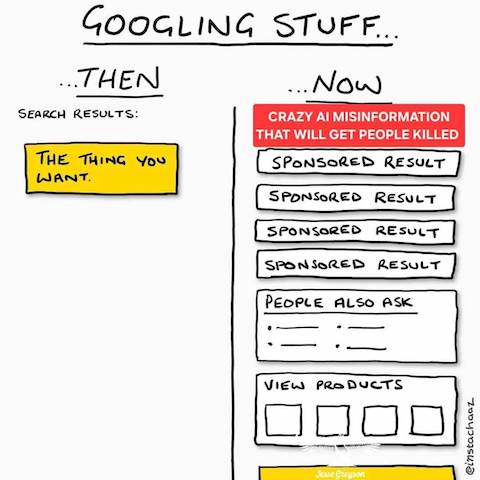
drawing by Chaz Hutton
Now that the internet has degenerated to a sad mishmash of spam, scam, propaganda, disinformation, useless 'apps', and commercial fraud, with a new overlay of AI slop, the question becomes how to best get what we used to get from the internet, through workarounds. Preferably before the stench of the internet's rotting corpse gets too much worse.
Of course the tech bros and their billionaire buddies and corporate oligopolies have thrown everything they can in our paths to prevent this. Through the now thoroughly-documented process of enshittification, they suck us in and lock us down, making it almost impossible to escape their expensive rent-seeking flea market without also losing our links to friends, family and networks, and our held-hostage libraries and content. So what used to save us time, now consumes hours of wasted time navigating the junkyard of sites and apps littered with unwanted, deceptive, and totally fraudulent crap.
As someone both fascinated and appalled by AI, I wondered whether this new 'tool' might not just flood the pathetic remains of the internet with additional oceans of garbage, but also, just maybe, provide us with a way to work around it, to get what we want without having to actually go into it. Let the AI do the garbage-scouring for us.
The possibility for this started to become clear as AI quickly challenged, and then largely rendered obsolete, the enshittified search engines that served as our main 'portals' into the internet. Why use the ad-cluttered, disinformation-ridden, almost-unnavigable search engines satirized in the image above, when AI will (1) give us what we're looking for much faster, more easily, and more accurately, and (2) cite the sources for its answers so we can check out AI's veracity directly without having to search for it.
The big corporations and purveyors of disgusting and lying 'marketing' crap are absolutely terrified just of this development. The SEO vendors have slued furiously to abandon attempts to 'influence' (ie bias and misinform) search result rank, and are now developing tools that 'optimize' their corporate customers' appearance in AI results. If we're not careful, and fast, they'll get away with that, and AI query results will quickly be enshittified to be as horrible as search engine results.
But, at least for the moment, the open-ended nature, and immense power, of AI tools might offer another opportunity.
Suppose we developed ways to use AI to curate our networks and feeds and summarize them, with supporting links, so we completely avoid ads, clickbait, and misinformation — so they just deliver to us, 'clean', exactly what we want, and nothing else?
So AI could maintain a personal, editable, categorized list of 'trusted people' and 'trusted information sources' for us, and use it as a filter for all our AI queries. So that if I asked the AI tool "What are my closest friends up to?", or "What do my trusted sources say about the situation in Sudan (or about the subject of free will)?", or even something subtler like "Any health issues among my family or friends?" or "What are my trusted sources, and my friends' trusted sources, saying about whether multipolarity and the end of US hegemony, and the end of USD dominance, are actually happening, or are just wishful thinking?"
The AI could then scour the wasteland of social media, all the blogs, RSS feeds and other sources for us, and just give us what we're looking for — in seconds. With links if we wanted more right from the 'horse's mouth'. Never again would we have to enter the polluted waters of Farcebook or XTwitter. Put your update on your own site, anywhere, and everyone who you want to find it, and who wants to find it, will find it.
To use an analogy, AI hence becomes our 'shopper' not just our 'delivery service'. We don't have to deal with the flyers, the salespeople, the ads and marketing hype, the mis- and disinformation, and all the clutter of online 'billboards' trying to sell us crap (products and 'what you need to know' lies). Our AI 'shopper' takes our list, asks clarifying questions if needed, navigates the horrors of the web, and returns to us with just what we want.
Or, to put it another way, we can re-disintermediate the internet (as it was originally designed to be) by using our own intermediary to sidestep all the rent-seekers, profit-seekers, and deceptive 'marketers' of everything standing in the way of, and all around, what we actually want to see.
Sabine Hossenfelder has a new video about the 'dead internet', explaining what's happening as the internet becomes more and more focused on producing content for use by 'machines' (AI etc) and less and less focused on producing content for use by people.
I think the curation-and-re-disintermediation idea is an interesting possibility, but we should recognize that this will just be another skirmish in what is likely to be an extended war. Most (but not all) of the current AI tools are owned by rent- and profit-seeking private corporations, most of them desperately unprofitable and not long for this world if they can't monetize their staggering investments. They are going to fight this with everything they have, including putting ads on and in AI responses, and restricting what we can ask 'their' AI agents to do for us that might restrict their buddies' profits.
But this current crisis is the perfect metaphor for the collapse of our entire civilization. The internet has become increasingly dysfunctional and useless as it's grown larger and more complicated and corrupted. If it's not dead already, it soon will be. The question is, will we be able to salvage what's useful in it, and ignore the graveyard of corporate and political and AI garbage and mountains of clutter? Or will we just walk away from it and leave it to rot?
It's going to be interesting to watch.

image by AI; my own prompt
Often young children, puzzled or distressed by the behaviour of their peers and the other people they know, invent imaginary friends — characters who share their joys, who understand and reassure them, who have interesting things to say, and who it seems are just more fun to be around, much of the time, than 'real' people.
It's a way of making sense of the world, carrying on a conversation with oneself from a position of shared context, curiosity and understanding. A way of imagining the world as a healthier, happier, more compassionate place. A way of filling an empty space inside.
Writers of fiction are engaged in a very similar exercise. They invent characters, and make them say and do funny and obvious and quirky things. Sometimes those characters represent aspects of the writer that the writer wants to express and explore. Sometimes they are characters the writer wishes they were more like (or perhaps less like). Sometimes they are characters the writer wishes existed in real life.
These characters are not so different from the imaginary friends that young children invent, that their parents and their 'real' friends later ridicule as childish. So young children will often then 'put away' their imaginary friends, and will talk with them only when they are alone. Or not at all.
We writers have no such shame about our characters, and may even employ them in a whole series of stories, and even include ourselves as the stories' narrators.
The characters in my stories have lives that extend far beyond the page. I sometimes hear them talking to me when I'm thinking about some particular problem, or just daydreaming. They are my delightful, quirky, imaginary friends, my undemanding, wise, lifelong companions, and I don't know what I'd do without them.
We are conditioned to think that we can 'know' another person, and hence we are often shocked when the behaviour that person exhibits seems completely 'out of character'. But what we think we 'know' about other people is no more real than what we 'know' about our imaginary friends or the characters in novels, plays and songs. We make it all up, entirely from our imagination.
No one really knows who you are either, or how you think or how you feel. We don't even really know ourselves. All we can do is try to make sense of our bodies' behaviours, look for patterns, and construct them into the 'story of me'. And that story is just as imaginary as the stories we tell ourselves, and others, about who they are. And just as imaginary as the young child's stories about their make-believe companions.
And because we don't want to appear foolish to others, we nod and agree that these stories we tell and hear are true. We pretend to know ourselves and other people, pretend that we know who we are and who they are, when we're just making it all up, and looking for confirmation that what we've made up is true, especially the 'story of me' we've made up.
Part of what we love about inventing imaginary friends, and story-writing, is the feeling of control we have over our invented characters. And part of it stems, I think, from the despair we feel about our 'real' selves and other 'real' people not being quite up to what we imagine they might or should be capable of, when our imaginary characters can be and can do anything. They are 'perfectly' who we imagine them to be.
Our education system, our workplaces, our political and religious ideologies, and our peers, all pressure us and tell us we can and must be and do better, that we can be and do anything if we strive hard and long and intelligently enough (and stop 'daydreaming'). And Hollywood and literature sell us heroes who can do anything, and people who are our ideals of who we want to be, and of who we want to love. They keep us unhappy, desperately searching, hopelessly striving, and obedient.
And it's all just stories, stuff made up in our, and others', imaginations.
What if we could 'park' our unhappy 'stories of me' and recognize them as the absurd and impossible fictions they are, and refuse to 'own up' to them?
What if we could set aside our stories of who and what others we think we know are, or could be, and just be with them, if that brings us joy, and not be with them, if it does not, without judgement? What if we could just be the wild creatures we remain, underneath all our stories, underneath the fictional 'story of me'? (The cats and dogs we love might remind us how.)
And what if we could shamelessly and happily imagine new characters, dream or write them into being, characters that bring us pleasure and joy, even though they are not 'real', because they fill a little empty space inside us, and help us see through the bewildering and exhausting fiction of our own and others' stories? Why should small children and writers have all the fun?
Our imaginations can cripple us, terrorize us, bleed us dry with regrets about what might have happened, and with dread about what might happen in the future. Many unhappy people are telling us now that we (and this 'we' is never defined, but it presumably includes you and me) have to "create a new story" to replace the simple sad truth of what is happening in the world, and then we have to work furiously to make this new story 'real'.
But this is just another prescription for our continued enslavement and immiseration by stories of what "should be" and "could be", a prison of impossibilities.
Instead, perhaps, our imaginations might liberate us from these terrible stories, by letting us see them for what they are — total fictions, shit made up in our heads, not to be taken seriously.
Perhaps we could rediscover what small children and fiction writers know — that our imaginations can let us create a world of remarkable, delightful characters of our own invention, through whom we can co-create new and wonderful stories, stories that are fun, invigorating, inspiring, joyful, comforting, relieving, entertaining — and, like all stories, completely, perfectly, untrue.
Recently, many people have begun talking about the US having a k-shaped economy. In it, a handful of wealthy people are doing very well financially, while many others are falling further and further behind. I expect that the low wages of the majority of workers will soon lead to adverse impacts on businesses, governments, and international organizations. This phenomenon is likely to lead to a very uneven world economic downturn in 2026.
The world economy is subject to the laws of physics. The world economy seems to be reaching growth limits because there are too few easily extractable energy resources (as well as other resources, such as fresh water), relative to the world's population. The Maximum Power Principle strongly suggests that even as limits are hit, the world economy cannot be expected to collapse all at once. Instead, the most efficient producers of goods and services will be able to succeed as long as resources are available, while less efficient producers will tend to fall by the wayside. Thus, the Maximum Power Principle somewhat limits the speed of the world's economic downturn.
In this post, I will try to explain the challenges the world economy is now facing. I will also provide some thoughts on how 2026 will turn out.
[1] The k-shaped economy that the US and many other countries are experiencing is an indication that resources are, in some way, "running short."Humans all have similar basic needs. They need food to eat, and they need to cook at least some of this food before they eat it. They tend to need transportation services, both for themselves (to get to work) and for goods, such as the food they eat. They also need governments to keep order and to provide basic services, such as roads and schools. All these goods and services require energy of a suitable kind, such as human labor, burned biomass, or fossil fuel energy. They also require arable land, fresh water, and minerals of many kinds.
If there are not enough resources to go around, the easiest way to accomplish this is by creating a k-shaped economy. One example is with farmland. In many traditions, when a farmer dies, his oldest son inherits the farm. Younger children are then forced to find other kinds of employment, such as being a craftsman, farmer's helper, or priest in a church. Wages for these younger children can easily fall lower than the income of their land-holding older brothers, especially if large families become common. Creating jobs that pay well for all the younger children becomes a problem.
A similar phenomenon has been happening in many Advanced Economies (US, UK, and other countries included in the OECD) in recent years. Parents are doing quite well financially, but their children often have difficulty finding jobs that pay well, even after advanced schooling. Some adult children are also left with educational debt to repay. This is a new type of k-shaped economy.
[2] The world's current problem is an ever-rising population paired with resources that are becoming ever-more "expensive" to extract.World population has exploded since fossil fuel consumption became abundant. This has allowed more food to be grown, inexpensive transportation of goods and people, and the development of antibiotics and other drugs.
 Figure 1. Chart made by Gail Tverberg based on several population sources.
At the same time, the most accessible resources were extracted first. For example, fresh water initially came from streams, lakes, and shallow aquifers. As the population grew and industrial needs became increased, wells had to be dug deeper and aquifers began to be drained. In some places, desalination now needs to be used. Each of these advances in producing fresh water became more resource-intensive. It became increasingly difficult to gather enough fresh water using human labor alone. Instead, increasing quantities of physical materials, energy supplies, and debt were needed to make the new systems work.
The reason debt was needed to purchase capital goods, such as those required to obtain high-cost water, was because the devices purchased were expected to provide the desired output (water, in this case) for a long time in the future. Securing this future benefit required advance funding, using an approach such as debt. The sale of shares of stock, which are expected to appreciate over time and pay dividends, provides a similar benefit to debt.
A similar issue arises with the increasing extraction of minerals of many kinds, such as copper, tin, uranium, lithium, coal, and oil. Early on, extraction using manual labor and simple tools was sufficient. However, once the easiest to extract resources were removed, capital goods became necessary to make extraction efficient.
Capital goods, such as coal fired power plants, wind turbines, solar panels, and hydroelectric power plants also allowed electricity to be produced, extending the benefits of fossil fuels. Producing these capital devices requires physical materials and energy supplies, as well as debt or the sale of shares of stock for financing.
[3] A major limit on the system seems to be debt and the interest required on the debt.In an economy, the growth of inexpensive energy supply acts very much like leavening works in making bread; it greatly helps economic growth. With the increasing use of inexpensive energy supply, vehicles can be made ever-less expensively, compared to using much hand labor for manufacturing (literally, making goods by hand). With this growing efficiency, wages rise faster than inflation. In the 1950s and 1960s, young people found that they could marry and live in nicer homes than their parents. Now, the reverse seems to be happening: many adult children are finding it difficult to keep up with the lifestyles of their parents.
Once the inexpensive-to-extract energy supply is depleted, economies tend to add an increasing amount of debt, in an attempt to pull the economy forward. It seems to me that a major limit on the system comes when an economy slows down so much that it can no longer repay its debt with interest.
 Figure 2. The author's view of the analogy of a speeding upright bicycle and a speeding economy. "Debt with its time-shifting ability helps pull the economy forward, but it only works if the economy is moving fast enough."
Political leaders like to believe that growing debt, by itself, will pull the economy forward. In fact, this does work, for a time, as long as interest rates are falling. But falling interest rates stopped happening in 2022.
 Figure 3. Interest rates on 10-year Treasuries (red) and on 3-month Treasuries (blue), based on data of the Federal Reserve of St. Louis.
Of course, all the added debt contributes to the k-shaped economy. The already wealthy disproportionately benefit from debt payments. They also tend to benefit from dividends on shares of stock and from share price appreciation. The poorer people find that an increasing share of their wages goes to paying interest on debt, especially as interest rates rise.
As debt levels grow, governments eventually have a problem with repayment of debt with interest. They need to raise taxes simply to cover their rising interest payments. This is the reason why Donald Trump wants to get interest rates down. Interest payments are rising rapidly, with near-zero interest rates in the rear-view mirror (Figure 3).
[4] Added technology and economies of scale have been adding to the k-shaped economy.Technology requires specialization. People with more training and higher skill levels tend to earn more than others. Economies of scale encourage the growth of ever-larger businesses. The people at the top of huge organizations tend to earn more than those at the bottom. Also, as international trade is added, low-wage people in the hierarchy increasingly compete for wages with workers from countries with much lower wage scales. Thus, the wages of less-skilled individuals are increasingly squeezed down.
Furthermore, both added technology and economies of scale require added debt. Again, the interest on this debt (and dividends on stock) disproportionately benefits those who are already wealthy.
[5] In a sense, artificial intelligence (AI) is simply an extension of added technology, with a huge need for electricity, water, and debt.The hope for AI is that it will make our already k-shaped economy, a great deal more k-shaped. The hope is that AI can eliminate a significant share of jobs, with such high profits that the owners of this technology can become very rich. If it works, the wealth will be even more concentrated at the top than today.
I see the need for electricity, water, and debt as stumbling blocks for AI. I expect that, starting in 2026, the AI rapid growth spurt will seize up because it is already using more resources than are available in some areas. I expect that a significant downshift in AI will adversely affect the US stock market and the rate of growth of the US economy. My hope is that the loss of growth in the AI sphere will not, by itself, bring down the US economy-just nudge it toward recession.
[6] In 2026, with an increasingly k-shaped economy, I expect that world oil prices will drift lower than today."Demand" for oil really means "the quantity of oil that people, businesses, and governments around the world can afford to purchase." As the economy becomes more k-shaped, fewer people can afford to buy vehicles of any kind. Poor people, in the lower part of the k, are hardest hit. They will tend to increasingly rely on low energy approaches, such as ride-sharing, walking, or using a bicycle. They will tend to buy fewer goods that are transported internationally. Governments, as they begin collecting less in tax revenue from the many poorer people, will be inclined to cut back their spending on new buildings and road improvements. These changes work in the direction of reducing oil demand, and thus oil prices.
It is this increasingly k-shaped economy that has been holding world oil prices down in 2025. I expect that prices will drift even lower in 2026 because of the increasingly k-shaped world economy. There aren't enough very rich people to hold up oil and other resource demand by themselves.
Oil production will not immediately drop in response to these low prices, although it may start drifting lower in 2027. The US Energy Information Administration is forecasting that world oil production will rise by 1.1 million barrels per day in 2025 and by 1.2 million barrels per day in 2026. These amounts do not seem unreasonable based on new developments that have already started producing higher amounts of crude oil.
[7] The heavier types of oil, from which diesel and jet fuel are disproportionately made, are in short supply now. They are likely to continue to be in short supply in 2026.World oil production has risen in recent months. When I investigated, I found that the vast majority of the recent growth seems to be in light oil. Thus, the shortfall in diesel and other heavy fuels is likely to continue as in the recent past.
 Figure 4. Chart showing the level of per-capita diesel consumption, relative to the per-capita consumption in 1980. Amounts are based on Diesel/Gasoil amounts shown in the "Oil-Regional Consumption" tab of the 2025 Statistical Review of World Energy, published by the Energy Institute.
This shortage of the heavy types of oil has several impacts:
a. With a shortage of heavy oil, a fairly strong country, such as the US, is tempted to attack Venezuela, which has the world's largest reserves of heavy oil.
b. Island nations without their own fossil fuel supplies tend to use a disproportionately large share of diesel and jet fuel, for several reasons: (1) Such islands often burn diesel fuel for electricity. This is an expensive way to make electricity; goods produced with this electricity become too expensive to export. (2) Imports and exports need to be shipped in by boat or by air, again using limited types of fuel supply. Physics tends to push these economies down by making their products expensive to sell elsewhere. Examples of islands with these problems include Cuba, Puerto Rico, Madagascar, and Sri Lanka. Such places tend to be adversely affected by shortages of heavy oil sooner than other locations.
c. Without enough jet fuel, long distance tourism is likely to be reduced in 2026. One issue is the lack of jet fuel for flying planes. Another issue is that an increasing share of the population will not be able to afford long-distance tourism because of the k-shaped economy.
d. Tariffs are a way of discouraging the shipping of goods long distance, to indirectly save on heavy oil. We should not be surprised by their increasing usage.
[8] In my view, deflation is a greater risk than inflation in 2026.With a k-shaped economy, demand for apartments (especially smaller ones) tends to stay low. As an economy becomes increasingly k-shaped, low-paid workers tend to share an apartment with one or more friends or move in with family members to save money. In a December 23 report, Apartment Advisor writes that the US average asking rent for studio apartments fell by 2.81% in 2025 compared to 2024. The similar comparison for one-bedroom apartments showed a price drop of 1.72% in 2025. In an increasingly k-shaped economy, I would expect this trend toward lower rental prices of smaller apartments to continue and perhaps become more pronounced.
Real estate selling prices may also be an area for downward price pressure. Young people who have not built up equity through prior home ownership tend to find themselves shut out from buying homes. Also, commercial real estate of many kinds seems to be grossly oversupplied in many areas. Given this situation, downward price adjustments seem likely.
Underlying this downward pressure on prices may be some actual cuts in wages. One law firm reports that cuts in wages are becoming increasingly common, especially for employees of smaller companies.
There are precedents for deflation becoming a problem. The US had problems with deflation at the time of the Great Depression. Japan had problems with deflation after its crash in real estate prices in the 1990s, and China (with its real estate price crash) has recently been having problems with deflation.
[9] "Bread and circuses" become more important as the economy becomes more k-shaped.Many readers have heard about bread and circuses. Before the Roman Empire collapsed, it used bread and circuses to keep its citizens from rioting from a lack of food. The way to prevent food riots is by making sure everyone has enough to eat through food distribution programs, described as "bread." Providing circuses offers a distraction from the fact that there are not enough well-paying jobs to go around.
Today, with our increasingly k-shaped economies, leaders have figured out that meeting citizens' basic needs is essential if unrest is to be avoided. Political leaders somehow need to provide food and healthcare to their poorer citizens. They also need to keep people distracted with entertainment. For many years, governments of Advanced Economies have been trying to provide the equivalent of bread and circuses. In the US, legislation providing Social Security for the elderly was enacted in 1935, during the Great Depression. Many other financial support programs have been added over the years. Today's circuses today are provided through televised entertainment and video games.
A major problem is that the costs of these programs have become more expensive than tax revenue can support. This is especially true of the cost of "bread," if its cost is defined as including healthcare and pensions for the elderly, in addition to food. Ultimately, these high-cost programs can bring an economy down. The high cost of bread and circuses is thus a second limiting factor, besides excessive interest payments on government debt, (discussed in Section [3]).
[10] Leaders of many countries are already making plans that can be used to deal with shrinking resources per capita.If there aren't enough resources to go around, what can governments do to prevent riots? Two obvious choices come to mind:
(a) Tighten controls on citizens to prevent riots. China has been a leader in this area, and the UK and US seem to be trending in a similar direction. In a sense, the Covid requirements of 2020 were practice with respect to restrictions on movement.
(b) Develop a rationing system that can be used, in case of a shortfall of essential goods. Many countries are looking at central bank digital currencies (CBDCs). These are a digital form of central bank money that is widely available to the public. In the US, I expect CBDCs will be rolled out initially as a way for those who are entitled to food stamps to easily access their benefits. If these digital currencies work, CBDCs can easily be expanded into a widespread rationing system. Government leaders will then be able to decide who can afford to buy what, rather than depending on the way the k-shaped economy currently allocates buying-power.
[11] What lies ahead in 2026?I don't think any of us know for certain. The general direction of the world economy seems to be toward contraction, but some parts of the world economy will fare better than others.
Europe looks increasingly like it is an "also-ran" behind the US and China in the world economy. I expect its resource use will continue to shrink back in 2026, indirectly benefiting the United States and the rest of the world. I am hoping that with cutbacks in oil usage by island nations and Europe, and the resulting lower world oil prices, the United States will be able to avoid the worst of the recessionary tendencies looming in 2026.
There are some reports that AI, as it is being applied in China, is providing major success in reducing the cost of coal mining in China. If this is true, it may allow China's economy to grow in 2026, despite downturns in many other countries.
I am fairly certain that AI, as it is being developed in the US and Europe, cannot continue its recent exponential growth trajectory, and I expect this to become obvious in the next few months. This shift seems likely to pull down US stock market indices. Here again, I am hoping that despite this issue, the US will be able to avoid the worst of the world's recessionary tendencies.
I don't expect a world war in 2026. For one thing, no country has adequate ammunition capability. I think civil wars and wars against nearby countries are more likely.
It is possible that the EU will collapse in 2026, leaving the individual countries on their own.
At some point in the future, I expect that the central government of the US will also collapse, in the manner of the Soviet Union in 1991. States will likely regroup and issue new local currencies; the new combined governments will likely provide much more limited benefits than the US government provides today.
Many people think that different leadership will change the current trajectory, but I am doubtful about this. Most of the world's problems are "baked into the cake" by resource shortages and by too high a population relative to resources. Keeping immigration down is one way of trying to keep resources and population in closer balance.
All in all, I expect a very uneven world economic downturn in 2026. Economies will continue to become more k-shaped. Governments will do their best to hide problems from the public. Stock markets will likely not do well in 2026, if they can no longer count on AI for an uplift.
- Today's financial system allows many promises of future goods and services. These include debts, pensions, and even prices of shares of stock.
- However, the quantity of actual physical goods and services that can be produced appears likely to be shrinking in future years because of resource depletion.
- This mismatch means that many/most of these promises likely cannot be paid as promised. The economy will somehow change to match what is actually available. We should not be surprised if, one way or another, we receive much less than has supposedly been promised. Even if a high currency amount is provided, it likely will not buy very much. Or a new government may be in power, with virtually no promises of benefits.
- Today's economic system requires both increasing energy supplies and increasing debt to function properly. We are now encountering limits with respect to both world energy supplies and US government debt. The parts of the world economy that are most affected by limits will likely begin to contract soon.
- We don't know precisely how this contraction will take place, but we can examine a list of countries whose GDP has already been contracting to see how they are faring.
- Perhaps we need to be relying more on our families and/or on "villages" made up of extended relatives or friends for our long-term support, rather than on government programs.
The world is filled with financial promises, including loans, pensions, and even the market value of stocks. So far, the system seems to be working, but in a finite world, it is hard to believe that the system will work indefinitely. Governments can create money simply by adding more promises, but they cannot create goods and services in a similar fashion.
We know that actual physical materials are needed to make the goods and services that people depend upon. Energy supplies are particularly important in making goods and services because, according to the laws of physics, energy is required to produce physical goods and services. Forecasts that support current financial promises ignore the fact that we live in a finite world. Eventually, we will run short of easy-to-extract essential materials, including fossil fuels, uranium, lithium, and copper. Economic growth will need to be replaced by economic contraction.
In this post, I will try to explain the situation in more detail, together with some charts showing what is going wrong now, such as Figure 1. In some ways, we already seem to be reaching limits to growth.
 Figure 1. Per capita energy growth rates are based on data from the 2025 Statistical Review of World Energy, published by the Energy Institute, with trend line and note.
[1] At first, added debt is helpful to an economy.
Figure 1. Per capita energy growth rates are based on data from the 2025 Statistical Review of World Energy, published by the Energy Institute, with trend line and note.
[1] At first, added debt is helpful to an economy.
In some sense, added debt pulls an economy forward.
 Figure 2. The author's view of the analogy of a speeding upright bicycle and a speeding economy.
As long as there are plenty of inexpensively available resources and not too much interest to pay, added debt seems to make sense. It pulls the economy forward, in the direction that those resources are to be used. It "feels good" to the recipients of the goods and services made possible by the debt. People like the homes and cars that added debt makes possible.
Ordinary citizens have clear limits on their credit card debt. The limits on government promises seem to be hidden until they are actually reached.
As long as an economy is growing, that growth seems to hide many problems. Carmen Reinhart and Kenneth Rogoff are two well-known US economists. In a 2008 working paper (p.15) examining 800 years of government debt defaults, they remarked, "It is notable that the non-defaulters, by and large, are all hugely successful growth stories." Without "hugely successful economic growth," it is impossible to keep adding debt and repaying it with interest. The growth allows debt to be paid back with interest. It allows the fiction that an economy will continue to grow, and this growth will provide the margin needed to repay the debt with interest.
While the world economy has been an amazingly successful growth story since the industrial revolution, we now seem to be running short of the inexpensively available fossil fuels that have made economic growth so far possible. With this change, the economy is likely to start a major shift from economic growth to economic contraction.
We don't know exactly how this shift from economic growth to economic contraction will take place, but we can hypothesize that the economies that have recently been growing fastest might be farthest from contraction, and the economies that are already struggling with low growth might be the ones most likely to slip into contraction. The countries slipping into contraction can be expected to have special difficulty repaying debt with interest and meeting other financial promises. Some governments may even collapse, perhaps in the way the government of the Soviet Union collapsed in 1991.
[2] Not too surprisingly, given the physics connection stated in the introduction, total world GDP and world energy consumption are highly correlated. Figure 3. Energy based on data from the 2025 Statistical Review of World Energy, published by the Energy Institute; GDP in constant 2015 US$ is as published by the World Bank.
In fact, the growth rate of energy consumption and the growth rate of GDP are also correlated, as can be seen from the similar patterns on Figure 4.
 Figure 4. Three-year average growth rates are used for stability. Energy growth rates are based on energy data from the 2025 Statistical Review of World Energy, published by the Energy Institute; GDP growth rates are based on GDP in constant 2015 US$ as published by the World Bank.
A scatter diagram of the X-Y data used in Figure 4 gives the result shown in Figure 5:

Figure 5. Three-year average growth rates are used for stability. Energy growth rates are based on energy data from the 2025 Statistical Review of World Energy, published by the Energy Institute; GDP growth rates are based on GDP in constant 2015 US$ as published by the World Bank. [3] A major issue is the fact that the growth rate of world energy consumption is trending downward.
 Figure 6. Energy growth rates are based on data from the 2025 Statistical Review of World Energy, published by the Energy Institute.
Figure 6 shows a big upward bump starting not long after the year 2000, driven by the addition of China's inexpensive coal resources to the global energy supply. The low-cost portion of China's coal resources is now mostly depleted. In addition, we don't seem to have any other energy sources that will be available in large quantity in the near future. We have been adding wind and solar, but their impact has been small. Their impact is reflected in the total energy increases shown in Figure 6, and in the other charts above.
[4] Even worse, the rate of growth of world energy consumption per capita is trending downward. In fact, if the trend line were extended to 2025, it would seem to indicate contraction in per capita energy supplies.Figure 7. Per capita energy growth rates are based on data from the 2025 Statistical Review of World Energy, published by the Energy Institute with trend line and note by Gail Tverberg. (Same as Figure 1.)
We know that it takes energy to make physical goods. Even services require some level of physical goods and energy, such as a building to perform these services, electricity to operate tools, and the materials needed to make any tools, such as computers or scissors.
On Figure 7, note that the trend line is dropping below 0% in 2024, and even farther below 0% in 2025. This means that a smaller energy supply is available, relative to the population. If less energy supply is available, fewer physical goods relative to the population are likely to be available, as well. No one announces this, but we see the impact in many ways. For example, we discover that our daily newspaper is no longer being delivered. Or we discover that the products we see in stores are becoming increasingly flimsy. Meanwhile, young people are becoming less able to afford cars, homes, and almost everything else.
Furthermore, with limited total energy supply, international fighting about physical goods becomes more of a problem. The place we see this first is with respect to minerals. With limited energy supply and ores that are increasingly less concentrated, it is becoming difficult to extract enough materials such as uranium, rare earths, and platinum to meet the needs of all countries. Prices may temporarily spike, but they do not rise high enough, for long enough, to allow production to rise to the overall needed level.
[5] Falling interest rates push the economy along; rising interest rates act like putting brakes on the economy.Figure 8. Interest rates on 10-year Treasuries (red) and on 3-month Treasuries (blue), based on data of the Federal Reserve of St. Louis.
Interest rates play a far greater role in the economy, and in economic growth, than many people would expect. Falling interest rates between 1981 and 2022 greatly supported the economy (Figure 8). Since 2022, higher interest rates have acted like a headwind to the economy. This is a concern when it comes to the possibility that the economy is heading into economic contraction because of an inadequate supply of low-cost energy.
Another piece of the picture is the effect of the "yen carry trade." It allows international investors to borrow money at low rates in Japan, and invest this money in the United States and other countries at higher rates. The yen carry trade has been supporting international borrowing, but it now seems to be at the edge of unwinding because Japanese interest rates are now higher. With this change, it is more difficult to borrow yen at a low rate and invest the proceeds elsewhere at a higher rate. The unwinding of the yen carry trade could push US interest rates up, regardless of what the Federal Reserve tries to do.
[6] Interest payments on US government debt are already getting to be a problem.US government debt is now close to $38 trillion, and total interest payments have recently risen because interest rates are no longer near zero. Total payments now exceed $1 trillion per year.
 Figure 9. US federal government interest payments through June 30, 2025.
The US Congressional Budget Office (CBO) is now concerned about the high level of interest payments. When interest rates were very low in the 2008 to 2020 period (Figure 8), it was possible to add debt without substantially raising the amount of interest to be paid. But now, with higher interest rates and the debt balance increasing, interest payments have become very high, to the point where they even exceed defense spending. It becomes difficult to raise taxes enough to cover both interest outlays and other funding shortfalls.
 Figure 10. Chart by CBO showing annual deficit in two pieces-(a) the amount simply from spending more than available income, and (b) interest on outstanding debt. Source.
I talk more about some of these issues in post called "Energy limits are forcing the economy to contract." Clearly, if the US economy is being forced to contract, it is very difficult for it to be a hugely successful growth story.
[7] Which countries of the world seem likely to be most resilient against energy limits?If we believe Reinhart and Rogoff, the countries that would be most resistant to collapse would be the countries that have been growing most rapidly, in recent years. Figure 11 shows a listing of the most rapidly growing countries during the 2019 - 2024 period, based on World Bank GDP data.
 Figure 11. Listing based on World Bank GDP data (in 2015 US$) for the years 2019 to 2024. The average growth rate of these countries was 4.9% per year or higher.
The only country on Figure 11 that is an "Advanced Economy" (member of the OECD) is Ireland. Ireland is known for its pharmaceutical exports and for its unusually low taxes on corporations. Many companies choose to domicile in Ireland to take advantage of the country's low tax rates.
All the other countries are, in some sense, "less advanced economies." Wages are likely lower, giving them an edge in extracting resources and in manufacturing, and then selling the goods to more advanced countries. Some of these countries may have been given loans by the IMF or China to help them develop their resources.
China and India are both known for their coal use; historically, coal has been an inexpensive energy product, allowing countries to make goods inexpensively, for export. The only country listed whose growing GDP is based on oil extraction seems to be Guyana in South America. Its oil extraction started very recently.
 Figure 12. Listing based on World Bank GDP data (in 2015 US$) for the years 2019 to 2024. Average growth rates were strictly less than 0% for shrinking economies, and between 0% and 0.5% (inclusive) for slowly growing economies.
On Figure 12, the list of shrinking economies reads like a list of sad situations that we have read about in the news, way too many times. Many of the countries have recently been in wars or similar situations. None of the countries are Advanced Economies. A few of the countries (Iraq, Libya, Trinidad and Tobago, South Sudan, Venezuela) are oil producing countries.
With respect to the list of slowly growing countries, shown on the right side of Figure 12:
- Austria, Czechia, Estonia, Finland, Germany, and Japan are all Advanced Economies with inadequate energy supplies of their own.
- Puerto Rico is an island territory that has recently had debt problems.
- Thailand is, in some sense, a dropout from the rapidly growing nations of Southeast Asia. My impression when I visited Thailand earlier this year was that a great deal of overbuilding had taken place. Excuses for more debt had mostly stopped.
- Argentina is an oil-producing country with difficulties.
- China tightened its grip on Hong Kong in 2019, leading to much slower economic growth. Presumably, there were underlying issues that caused this tightened grip.
- South Africa has both coal supply problems and inadequate water supplies.
I think that we are already in a world of "not enough to go around," because resource limits are leading to an inadequate supply of finished goods and services for the world economy as a whole. Some countries are already being squeezed out, particularly the countries listed as having "shrinking GDP" in Figure 12. I expect that, over time, an increasing number of countries will be added to the shrinking GDP list. The outcomes may be as bad as seem to be happening to the economies that are shrinking today.
History shows that governments of shrinking countries tend to be overturned by their citizens, or they may collapse on their own. If collapse happens in either of these ways, governmental promises of pensions, and of guarantees on bank accounts, are likely to disappear. Even if the current governments can be maintained, countries will be forced to cut back greatly on the programs they are providing. Pensions may be cut, or they may be inflated away by hyperinflation.
Some governments today talk about possibly introducing Central Bank Digital Currencies (CBDCs). If these currencies are implemented, I would expect that they will be used to ration the increasingly limited supplies of goods and services that are available among their populations.
I do not expect that there will be a formal World War III. Instead, I think the United States is already in a cold war against practically every other country because there cannot be enough goods and services to go around. The US can't go into a formal war against China because it provides parts of the supply chains for many essential goods the US uses today. Even Europe is a competitor for essential goods. For example, the less oil Europe uses, the more oil will be available for other countries.
While new technologies such as artificial intelligence and energy recovery may eventually alleviate our energy problems, it is unlikely that such approaches will solve our problem in the near term. As a result, governments are likely to be less able to keep their promises. Historically, families or "villages" of extended kin have provided safety nets, rather than government programs. Perhaps now is a good time to be thinking about how we can move in this direction, as well.
Economists, actuaries, and others tend to make forecasts as if whatever current situation exists will continue indefinitely or will perhaps improve a bit. No one wants to consider the possibility that things will somehow change for the worse. Politicians want to get re-elected. University presidents want their students to believe that their degrees will be truly useful in the future. Absolutely no one wants to hear unfavorable predictions.
The issue I see is that many promises were made during the period between the end of World War II and 1973, when oil prices were very low, and most people assumed that oil supply could grow endlessly. No one stopped to think that this was a temporary situation that likely could not be repeated. If things didn't work out as planned, debt bubbles could bring down the economy. This was a heading I used in my talk at the recent Minnesota Degrowth Summit:
 Figure 1. Text: Our economy has been built as if a growing supply of $20 oil (EROI of 50 - 100) would continue! Simply add more debt if this isn't true.
In this post, I will provide a few highlights from my recent talk. I also provide a link to a PDF of my Degrowth Summit talk and a link to a Vimeo recording of the summit, which includes a transcript. To access the transcript and an outline of the timings of the various talks, scroll down on the front page of the recording. Joseph Tainter spoke first; there was a recorded section showing clips by other speakers that only online viewers saw, and I spoke last (starting at about 1:55 on the video).
- - - - - - - - - - - - - - - - - -
Between 1920 and 1970, US oil supply grew rapidly. The early oil was easy to extract and close to customers wanting to purchase it. There had been warnings from physicists (including, most notably, M. King Hubbert) that this could not go on indefinitely, but most people assumed that any obstacles were far in the future.
 Figure 2
Of course, there were other countries producing oil besides the US at that time, so it was possible to purchase imported oil. The US still had some oil it could produce, but it tended to require more complex operations. For example, some of the oil was in Alaska. Bringing this oil to market required working in a cold climate, laying a long pipeline, and using ships to transport the oil to locations with refineries.
Low oil prices were very beneficial to the economy, for as long as they lasted.
 Figure 3
We don't appreciate how important low-cost food is to our personal finances. If food purchases amounts to, say, 50% of available income, necessities such as clothing and housing would take nearly all our income. There would be little left over for optional items. On the other hand, if purchases of food require only 5% to 10% of available pay, there would much more likely be money left over for discretionary purchases, such as buying a vehicle or paying for school tuition for a child.
Oil and other energy products are like food for the economy. During the period when oil prices were very low, there was sufficient margin for purchasing all kinds of "extras," such as the items listed in Figure 4 below.
 Figure 4
In the low-priced oil era, small businesses were sufficient for many types of operations. There was little need for a deep organizational hierarchy, or for advanced energy-saving versions of manufactured devices. Most goods used in the US were made in the US.
 Figure 5
Once the economy started to need more complexity, things began to change.
 Figure 6
The economy needs a strong middle class to maintain the buying power needed to purchase goods such as vehicles, motorcycles, and new homes, to keep the price of oil up. If the middle class starts to disappear, or if young people start earning less than their parents did at the same age (adjusted for inflation), then it becomes difficult to keep the prices of oil and other energy products up. Prices must be both high enough for producers and low enough for consumers.
 Figure 7
Recessions took place when oil prices rose. Governments found that they needed to bail out their economies with more debt when oil prices rose. Since 2008, the ratio of US debt to GDP has skyrocketed. Quite a bit of the added debt has been to pay for programs for poor people and the elderly.
 Figure 8. Chart by the Federal Reserve Bank of St. Louis, showing the ratio of US public debt to GDP. The ratios would have been even higher if internal debt, such as debt owed to pay for Social Security benefits, were included.
The current level of debt of the US government is widely viewed as being too high. One analysis suggests that if the ratio of government debt to GDP exceeds 90%, economic growth is inhibited. The US debt to GDP ratio is now 120% on the basis shown, which is well above the 90% threshold. One concern is that interest payments on debt already exceed the amount the US spends on defense each year. Taxes need to rise, simply to pay the interest on the debt.
Growing debt, particularly during the Stagflation Stage, is one of the issues mentioned by researchers into so-called secular cycles, which are long-term cycles that take centuries to complete. In the book Secular Cycles by Peter Turchin and Sergey Nefedov, a group of people somehow obtain possession of an area of land (often by cutting down trees or winning a war) that allows the population of the group to temporarily surge. When the population reaches the carrying capacity of the area, population growth greatly slows in a period referred to as Stagflation. Wage and wealth disparity become more of a problem, as does debt.
Eventually, according to Turchin and Nefedof's study examining eight societies, populations tended to collapse over long periods, ranging from 20 to 50 years. Such cycles are closely related to the periods of growth and collapse analyzed in Prof. Joseph Tainter's book, "The Collapse of Complex Societies."
 Figure 9. This chart is my chart, using information from the book Secular Cycles. The extent of the decline of the in population during the Crisis Period is quite variable.
The time ahead looks worrying, if my analysis is correct.
 Figure 10
 Figure 11
 Figure 12
A few comments for my regular readers:
- My presentation included 51 slides. Look at the PDF to see the full presentation.
- Even though I didn't mention it, having a rapidly growing energy supply at a very high EROI would not be sufficient to forestall collapse indefinitely. Other issues would emerge. Population would rise higher, and pollution would be more of a problem. Eventually, the system would still reach a limit and tend to collapse.
- I only included EROI because I thought a few people would already be aware of the concept. I didn't define it or talk about it.
- My analysis seems to suggest that extenders of fossil fuels, such as wind, solar, and nuclear, need to have very high EROIs. But even with high EROIs, they are unlikely to be helpful for very long because the system would still tend to reach its limits.
We are at a time when there seems to be far more conflict than in the past. At least part of the problem is that slowing growth in the world economy is making it more difficult to repay debt with interest, especially for governments. A related issue is that government promises for pensions and healthcare costs are becoming more difficult to pay. Donald Trump is trying to make numerous changes that are distasteful both to other countries and to many people living within the US. What is going wrong with the economy?
In my view, major cracks are developing in the economy because we are heading toward a collapse scenario of the type that Dr. Joseph Tainter talks about in his book, "The Collapse of Complex Societies." No one has told the general population about the potential problem, partly because they don't fully understand the issues themselves, and partly because the underlying causes are too frightening to discuss with the public. At the root of these collapse-related issues is a physics issue, which is only gradually being fully understood.
In this post, I try to describe some of the issues involved. I don't believe that the situation is hopeless. At the end, I discuss where we are now, relative to historical patterns, and some reasons to be optimistic about the future.
[1] Economies need to "dissipate" energy on a regular basis, just as humans need to eat food on a regular basis.In physics terms, economies and all plants and animals are dissipative structures. So are tornadoes, hurricanes, and ecosystems of all kinds. All these structures have finite lifetimes. They all need to "dissipate" energy to continue performing their expected functions. Humans require a variety of foods to digest; economies require energy types that match their built infrastructure. The amount of energy required by an economy tends to rise with its human population.
Figure 1 shows that since 2008, world energy supply growth has only barely been keeping up with world population growth. Physics tells us that energy dissipation is required to create any part of GDP, so energy consumption that rises with population growth should not be surprising.
 Figure 1. World energy consumption per capita from 1965 through 2024, based on data of the 2025 Statistical Review of World Energy, published by the Energy Institute, with fitted trend lines.
The dips in per capita energy consumption in the latest period correspond to major recessions in 2008 and 2020. Rapid growth in per capita energy consumption seems to take place when growth in some low-priced fuel temporarily becomes available.
[2] Low energy prices are at least as important to the economy as low food prices are to individual households. Low energy prices seem to allow investments that pay back well.If a family spends 10% of its income on food, the family has lots of money left over for non-essentials, such as a vehicle, trips to movies, and even a foreign vacation. If a family spends 50% of its income on food (or even worse, 75%), any little "bump in the road" can cause a crisis. There is little money available to spend on housing or a vehicle.
Figure 2 shows that oil prices were under $20 per barrel (adjusted to today's price level) in the 1948-1972 period. This corresponds quite closely with the rapid-growth early period shown on Figure 1.
 Figure 2. Inflation-Adjusted Brent Oil equivalent oil prices, based on data from the 2025 Statistical Review of World Energy, published by the Energy Institute, for values through 2024. Data for 2025 based on EIA information.
The economy was able to add many types of helpful "complexity" during this early period because of the growing supply of cheap oil. It could add interstate highways and many miles of pipelines. Inventions included television, air conditioning, early computers, and contraceptive pills. Many families were able to buy a vehicle for the first time. Women started to work outside the home in much greater numbers.
Many of these early types of complexity paid back well. For example, interstate highways made travel faster. Early computers could handle many bookkeeping chores. Contraceptive pills made it possible for women to plan their families. Without so many children, working outside the home was more of a possibility for women.
[3] Many indirect changes took place between 1948 and 1970 that would be harder to maintain if oil supplies stopped growing as rapidly and as inexpensively as they did during this early period.If we look back, we know that in the 1600s and 1700s, people worked pretty much all their lives. It was the growth in energy supplies in the 1800s and 1900s that allowed governments to expand their services. They could promise to provide pensions and health care benefits. The rapid growth in oil supplies in the 1948 to 1970 period allowed even more expansion of government benefits, as well as other changes.
 Figure 3, Chart of US crude oil production by the EIA.
US Medicare was added in 1965, providing healthcare benefits to the elderly and disabled. Schools were integrated, promising better education for Black children. After actuarial models started to suggest that pensions could pay out a great deal in pension benefits, businesses started to award pensions to workers, in addition to Social Security.
Social standards started changing, too. Dating couples didn't have to worry about the woman accidentally getting pregnant, at least in theory. No fault divorce became available. Government programs became available to provide funds to single or divorced parents with children.
Of course, if wages of young people started to stagnate, or if there were too many divorces of low-wage people, this whole approach wouldn't work as well. It would be harder to tax wages enough to pay for the many benefits for the elderly, the disabled, and those with low incomes.
[4] Governments facing the problem of high-cost oil did exactly what families with suddenly high-cost food would do, if they had unlimited credit cards. They ran up increasing amounts of debt, to pay for all the promised programs.We know with our own finances that if we are spending too much on food, we can temporarily work around this problem by maxing out our credit cards and adding more debt in other ways. I believe that the world economy has been doing something similar for a long time.
The push toward added debt has become much greater since 2008 (Figure 1), but the general trend toward increased debt started back in the early 1980s, about the time Ronald Reagan and Margaret Thatcher began their terms. Businesses decided that they needed to use what they now called "leverage" to obtain higher profits.
The debt that economies added was a kind of complexity. If the debt was invested in factories or industry that paid back well, everything went well.
But not all the uses of debt went into approaches that paid back well. For example, paying doctors to give high-priced treatments to elderly people who were certain to die within a few months did not provide much benefit to the economy, apart from the money the physician and the rest of the health care system obtained to spend on other goods and services.
Another way the growing debt was used was to invest in international trade. Companies found that they could outsource many kinds of manufacturing processes to low-wage countries in Southeast Asia, leading to cost savings relative to paying for high-priced US labor. (Human labor is a type of energy used by the economy.) In these Southeast Asian countries, coal was used for many processes, making the energy part of manufacturing costs cheaper, too.
The US and other Advanced Economies (defined as members of the Organization for Economic Development (OECD)) seemed to benefit because goods made in Southeast Asia were cheaper than what Advanced Economies could make for themselves. Two major issues arose, however:
a. Wages for the less-skilled workers in the US tended to stagnate or fall.
 Figure 4. Based on data of the Economic Policy Institute.
One reason for stagnating pay was because of wage competition with low-wage countries. As a result, the middle class has tended to disappear. Wage disparity has become a problem.
b. Advanced Economies tended to lose the ability to make many essential goods and services for themselves. If a shortage of inputs were to occur in the future, they would be at a disadvantage.
[5] Now the consequences of too many governmental promises are becoming clear.Advanced Economies around the world are finding their debt levels ballooning. Much of their higher expenditures are on programs citizens expect to continue forever.
 Figure 5. Based on data of the Congressional Budget Office.
US leaders can see that practically the only way that they can fix this situation is by cutting back on many programs the public depends on. If a leader like Trump has a lot of power, he can also try to get a larger share of the world's output by imposing tariffs on the output of other countries. Neither of these approaches will be popular with very many people. If nothing else, there will be conflict over who gets cut out if cuts are necessary.
Other Advanced Nations face similar problems.
[6] Leaders have not told the public about the likelihood of a shortfall of energy supplies and the difficulties this would cause.Physicists have been warning that a shortfall in fossil fuel supplies was likely to occur since the 1950s. More recent models, such as the modeling represented in the 1972 book, The Limits to Growth, gave a similar picture.
Part of the confusion has been that economists have given an optimistic view of what is ahead. Their (oversimplified) models indicate that in the case of a shortfall, prices will rise. With these high prices, a huge amount of difficult-to-extract fossil fuels would shortly become available, or substitutes would be found.
In my opinion, the model of economists is incorrect. With the middle class shrinking, there is not enough "demand" to keep the price of any commodity up for very long. Instead, prices tend to bounce up and down. This can be seen for oil on Figure 2. Pricing represents a two-way tug-of-war: Prices need to be high enough for the producers to make a profit, but end products (including food grown and transported using oil) must be inexpensive enough for consumers to afford.
With one story being told by the physicists and another by the economists, competing belief systems arose:
- One saying that there would be a major shortage of fossil fuels, particularly oil, starting in the first half of the 21st century because the only fossil fuels we can extract are the fairly accessible fossil fuels. There are constraints caused by geology that seem to be difficult to work around, arising from limitations caused by physics.
- The other saying that any such problems lie far in the future. We should be able to develop new techniques quickly. Otherwise, any shortfall should cause prices to rise high enough to pay for more expensive techniques, or to find substitutes.
Both sides could see a need to limit consumption, one side because we appeared not to have enough, and the other because, if we really could extract as much fossil fuels as they considered possible, models suggested that there would be a climate problem.
To try to satisfy both sides, politicians decided to push the "save the world from CO2 emissions" narrative. This approach had an added benefit: Businesses wanting to import low-priced goods and services, made in China and other low-cost countries, very much favored it. The limitation on CO2 emissions of the 1997 Kyoto Protocol was simply a local limitation on emissions, not a limitation on CO2 on imported goods.
[7] The Kyoto Protocol, as implemented, has had the opposite effect from the hoped-for reduction in world CO2 from fossil fuels.What has happened with the 1997 Kyoto Protocol is precisely what businesses, looking to sell low-cost goods made in Southeast Asia, wanted. Manufacturing and other types of industry have tended to move out of the Advanced Economies, and into lower-cost countries.
 Figure 6. Energy consumption separately for OECD and non-OECD countries, based upon data of the 2025 Statistical Review of World Energy, published by the Energy Institute.
Total world CO2 emissions have risen, rather than fallen.
 Figure 7. CO2 amounts related to the burning of fossil fuels, based upon data of the 2025 Statistical Review of World Energy, published by the Energy Institute.
[8] The supposed transition to wind turbines and solar panels is not going well.
Figure 7. CO2 amounts related to the burning of fossil fuels, based upon data of the 2025 Statistical Review of World Energy, published by the Energy Institute.
[8] The supposed transition to wind turbines and solar panels is not going well.
Wind turbines and solar panels, the way that they are now being added to the overall electric grid, are having far less benefit than most people had hoped. Of course, their benefit is only with respect to electricity production. Farming, transportation of many kinds, and other industries use a great deal of oil and coal, in addition to grid electricity.
Figure 8 shows a breakdown of world energy consumption by type. Electricity from wind turbines and solar panels makes up only the tiny reddish portion at the top. It represents only 3% of the total energy consumption.
 Figure 8. Breakdown of world energy consumption by type, based upon data of the 2025 Statistical Review of World Energy, published by the Energy Institute. "Other" includes ethanol, wood chips, sawdust burned for electricity, geothermal, and other miscellaneous types.
We usually hear about wind and solar electricity as a percentage of electricity production. This is a higher percentage, which averages close to 15%.
 Figure 9. Wind and solar electricity share of electricity production, based upon data of the 2025 Statistical Review of World Energy, published by the Energy Institute.
The areas with the highest percentage of wind and solar electricity generation are already experiencing blackouts because differences from grid electricity have not sufficiently been compensated for. For example, Spain experienced a 10-hour blackout on April 28, 2025, because of low "inertia." Inertia usually comes from the rotating turbines used in the production of electricity using coal, natural gas, nuclear, or hydroelectric.
 Figure 10. Wind and solar electricity share of total energy consumption, based upon data of the 2025 Statistical Review of World Energy, published by the Energy Institute.
Figure 10 shows that in 2024, wind and solar electricity amounted to between 5% and 6% of energy consumption in Australia and the EU. Their high level of usage helped to bring the world average up to a little under 3% of total energy.
[9] There are important things about ecosystems in general and our economy in particular that we are not told about.I don't think that educators and politicians are generally aware of the following issues relating to ecosystems and our economy:
a. Ecosystems are built to be resilient. As dissipative structures, ecosystems and economies are "self-organizing structures" powered by energy, just as the human body is. We need not fret that we are responsible for species extinction. Ecosystems, like plants and animals, have short lifetimes. A replacement ecosystem will quickly develop if adequate resources (such as sunlight and water) are available. Furthermore, the waste (or pollution) of one species helps provide the nutrition for other species; CO2 provided by burning fuel helps plants grow. Over the long history of life on earth, 99.9999% of plant and animal species have died out and been replaced by other species.
b. Ecosystems and economies also tend to heal themselves, just as human wounds tend to heal themselves. If a fire, or a type of beetle, destroys an ecosystem, replacement plants and accompanying animals will soon find a way to populate the area. If a major government fails, or banks fail, somehow workarounds will be found to take their place. Human systems need order; if governments fail, religious systems that provide order may become more important.
c. Humans, unlike other animals, have a built-in need for supplemental energy, such as firewood, or fossil fuel energy. Over one million years ago, pre-humans figured out how to cook part of their food. Because of this cooked food, their jaws and digestive apparatus could shrink in size. The improved food supply allowed their brains to improve in complexity. Also, cooked food greatly reduced the time required for chewing, allowing more time for toolmaking and crafts. Heat is also important for killing pathogens in water.
d. Humans are smarter than other animals, allowing the population of humans to grow, while the population of many other species tends to fall. This issue continues today:
 Figure 11. World population, divided between OECD countries and non-OECD Countries, based upon data of the 2025 Statistical Review of World Energy, published by the Energy Institute.
The large rise in the population of the less advanced economies contributes to the huge number of immigrants wanting new homes in higher income countries. The book, Too Smart for our Own Good by Craig Dilworth, discusses this issue further.
e. It is ultimately the rising population issue discussed in (d) that leads to the typical overshoot and collapse situation. The issue is that available resources do not rise fast enough (in the area, or with the technology available) to provide enough physical goods and services for the population. If a new approach can be developed, or a neighboring area with additional resources can be conquered, population can start to grow again. Figure 12 represents my attempt to show the shape of a typical secular cycle (also called overshoot and collapse cycle) based on Turchin and Nefedov's research regarding collapses of agricultural economies.
 Figure 12. Chart by author based on information provided in Turchin and Nefedov's book, Secular Cycles. The extent of the population decline in the Crisis Period varies from greatly among secular cycles. The decline shown likely overstates the typical case.
f. Outgrowing our resource base is not a phenomenon that began with fossil fuels. In 2020, I wrote a post explaining how Humans Left Sustainability Behind as Hunter-Gatherers. In 1796, when world population was about one billion, Robert Thomas Malthus wrote about population growing faster than food production. This was before fossil fuels were widely used. Now, about 230 years later, population has risen to eight billion, thanks to the availability of fossil fuels. We need major innovations, or additional energy resource types, if we want to work around obstacles now.
[10] We seem to be reaching the end of the Stagflation Period in Figure 12. We are likely starting along the long downslope of the Crisis Period.In my opinion, the Stagflation Period began when US oil production peaked, in 1970. The estimated length of the Stagflation Period is 50 to 60 years. The 1970 peak is now 55 years behind us, so the timing is just as expected.
The Crisis period is next, listed as lasting perhaps 20 to 50 years. This is the period when governments and financial systems fail. What we think of as national boundaries can be expected to change, while countries themselves will generally become smaller. With less energy per capita, the quantity of government services provided can be expected to fall. Government organizations can be expected to become smaller and simpler. It is unlikely that democracies can continue; authoritarian rulers with a support staff are more likely. Plagues may cause the overall population to fall.
We don't know if the pattern shown on Figure 12 is the correct model for modern times, but we should not be surprised if things do change in this direction. Governments may fail, and, in fact, the replacement governments may fail repeatedly.
I believe that uranium production is also constrained by prices that never go high enough, for long enough, to increase supply.
To pull us out of this predicament, new energy supplies will need to be developed, or old ones dramatically improved. At the same time, the system will need to reorganize in such a way to use these new, improved energy supplies. I would expect that in the new system, the general trend will once again be toward more complexity. New customs and new variations on religions may also develop.
It is theoretically possible that AI could help us find solutions quickly, so we never go deeply into the Crisis Period.
If much of the world economy does temporarily head downward because of limited fossil fuel supplies, some researchers might continue to work on solutions. Other people may temporarily need to focus on growing enough food, close to where it is needed, and finding sufficient fuel sources to at least cook much of this food. Nice things we are used to, such as home heating and repaving of roads by governments, are likely to be cut back greatly.
[11] Hope for the future.We know that there are many ideas that are being worked on now that might be helpful for the future. They just aren't ready to be scaled up, yet.
At the same time, some energy types we have today might work better if used in a different way. For example, solar panels seem to provide intermittent electricity for a long period, with relatively little maintenance. If they can be made to work where intermittent electricity is sufficient, and their use directed specifically to those locations, perhaps this might be a better use for them than putting them on the grid. Solar panels are made with fossil fuels, but they do act to stretch the electricity from those fuels.
Another possibility for hope comes through greater efficiency in using fossil fuels. History suggests that if we can figure out how to use fossil fuels more efficiently, the price of fossil fuels can rise higher. With a higher (inflation-adjusted) price, more oil and other fossil fuels can perhaps be extracted.
One thing that strikes me is the fact that economies are put together in an amazingly organized manner, with humans seeming to be put in charge of them. Everything I can see seems to suggest that there is a Higher Power, which some might call God, that is behind everything that happens. People talk about economies being self-organizing. However, in a way, it is as if a Higher Power is helping organize things for us. It appears to me that creation is an ongoing process, not something that stopped 13.8 billion years ago or 6,000 years ago.
Seeing how ecosystems heal themselves, and how humans have made it through many secular cycles so far, gives me hope for the future.
One of the chapters of the Sierra Club of Minnesota has asked Joseph Tainter and me to give Keynote speeches on October 25 at what is being billed as Minnesota's First DeGrowth Summit. On site space is pretty limited, but free viewing will be available by internet.
If you want to attend in person, you should probably sign up soon.
This is the notice that the organizers have said that I can share:
Minnesota's First DeGrowth Summit - October 25, 2025
The DeGrowth Summit, hosted by the Sierra Club North Star Chapter's DeGrowth Team, will bring together organizers, artists, gardeners, educators, and community members to share skills, spark collaborations, and celebrate the many ways we're resisting extractive economies and creating thriving local futures.
There are 3 ways to participate in the event: The in-person event is held in Minneapolis, MN where there will be presentations by two keynote speakers, Gail Tverberg and Joseph Tainter. In addition it will bring together organizers, artists, gardeners, educators, and community members to share skills, spark collaborations, and celebrate the many ways we're resisting extractive economies and creating thriving local futures. Expect food, drop-in spaces, workshops, and a vibrant marketplace of ideas—from climate justice to co-ops, repair culture to Indigenous sovereignty. This event is free and you can register at: www.tinyurl.com/degrowthsummit
The second option is a "Watch Party" in Rochester, MN. Here we will gather at the Squash Blossom Farm for lunch and watch the live stream together. After the live stream is done, Gail will be arriving from Minneapolis to have a "Fireside Chat" with the group followed by a bonfire and wiener roast. The cost is $25 which covers the expense of lunch, dinner and the event space. Space is limited to 50 so sign up soon at:
Rochester DeGrowth Summit Watch Party
The final way to participate is to view the live stream online. The live stream will include the keynote presentations and two other presentations TBD. You can register for this at www.tinyurl.com/degrowthsummit . At the bottom of the registration make sure to check the box for virtual and a link will be sent to you prior to the event.
Some additional information:
The Minneapolis Event is at New City Center, 3104 16th Ave S, Minneapolis, MN 55407
The Watch Party at Squash Blossom Farm is at 7499 60th Ave NW, Oronoco, MN 55960
This is the graphic shown in early web material.

I expect to put up a "regular" post in the next few days.


