
 Overshoot: The World Is Hitting Point of No Return on Climate [ 28-Jan-26 12:57pm ] Analysis (Climate Reanalyzer, Earth Nullschool) of the Massive Storm that Hammered Good Ole' USA [ 29-Jan-26 3:05am ] XR Cofounders Release Book on Civilisation's Suicide and Climate Prisoners [ 28-Jan-26 4:40pm ]
During my first months in prison I wrote a book.
It came out of my experience in four Crown Court trials and what they taught me about the state of the law, the criminalisation of truth, and the depth of denial in modern Britain.
While I was inside, the journalist and Pulitzer Prize winner Chris Hedges came to visit me. He later wrote the foreword.
The book is called Suicide and it's being released today.
A group of volunteers and my friend Robin Boardman have spent over a year self-publishing it for me while I was locked up. Any money it makes goes back into the work of telling the truth and resisting a system that punishes those who do.
So if you're able to, please grab a copy and help fund the movement. http://rev21.earth/product/suicide
If you can't afford it right now, drop me a email at roger@rev21.earth for the digital version.
Thanks.
— Roger
submitted by /u/RobinBoardman[link] [comments]
How are you preparing for collapse of the US dollar? [ 28-Jan-26 1:20am ] Australia: Heat records tumble in Victoria as authorities warn against complacency amid significant blazes [ 28-Jan-26 7:16am ] 'The land will be left as ashes': why Patagonia's wildfires are almost impossible to stop [ 27-Jan-26 10:51pm ] It is now 85 seconds to midnight [ 27-Jan-26 3:15pm ] Philly Collapse-Aware Meetup [ 28-Jan-26 1:58am ] Global health impacts of plastics systems set to double by 2040 [ 27-Jan-26 10:40pm ] Climate repricing of homes: the trillion dollar question [ 27-Jan-26 4:56pm ]There are two basic phases of climate repricing:
- Phase 1: Rising physical risk from weather extremes —> damage to homes —> increasing insurance premiums.
- Phase 2: Higher insurance costs —> growing awareness of climate risk —> decreasing consumer demand for climate vulnerable homes —> falling values of vulnerable homes.
The skyrocketing number of billion dollar disasters and the accompanying jump in home insurance premiums have made it clear for years that phase 1 was underway.
But it's phase 2, where home valuations start to decline, that's the key dynamic of the climate repricing, and until recently we didn't have the telemetry to say whether or not it had started. But now we do. Recent cutting-edge research by Professors Ben Keys and Philip Mulder showed the riskiest decile of homes are already worth an average of $43,900 (11 percent) less than they would be without climate risk.
The climate repricing of homes is no longer a prediction about how climate change will affect the housing market in the future, but rather an active and ongoing dynamic that will play out over the coming years.
The post then examines key features of the climate repricing, including the timing uncertainty. Timing is arguably the key variable and it arrives in the form of the trillion dollar question:
Why haven't climate-vulnerable homes declined more significantly in value by now?
submitted by /u/ClimateResilient[link] [comments]
Scientists concerned as Joshua trees bloom months early in the California desert [ 26-Jan-26 8:16pm ] Record Debt in the World's Richest Nations Threatens Global Growth - NYT gift link [ 27-Jan-26 9:45am ]The cost of borrowing is already choking crucial public spending in many developing economies. Now it's raising broader alarms.
This article points out how rising government debt is stifling economic growth in advanced economies, as it had in the past in developing countries.
submitted by /u/No-Papaya-9289[link] [comments]
Number of people living in extreme heat to double by 2050 if 2C rise occurs, study finds [ 26-Jan-26 8:32pm ]The number of people living with extreme heat will more than double by 2050 if global heating reaches 2C, according to a new study that shows how the energy demands for air conditioners and heating systems are expected to change across the world.
No region will escape the impact, say the authors. Although the tropics and southern hemisphere will be worst affected by rising heat, the countries in the north will also find it difficult to adapt because their built environments are primarily designed to deal with a cooler climate.
The new paper, published in Nature Sustainability, is the most detailed study yet of how far and how fast different regions will encounter temperature extremes as human-driven global heating rises from 1C above preindustrial levels 10 years ago, towards 1.5C this decade, to 2C, which many scientists predict could occur around mid-century unless governments make rapid cuts to emissions from oil, gas and coal.
submitted by /u/BobMonroeFanClub[link] [comments]
Prof. William E. Rees: Ecological Overshoot I The Greatest Threat to Humanity I Earth's Boundaries and Climate Change [ 26-Jan-26 9:14pm ] You are probably getting brain damage from all those COVID infections. [ 26-Jan-26 1:51am ] Rain, not snow: Extraordinary warmth leaves mountains less snowy across the West [ 26-Jan-26 5:23pm ] Shipping regulations to reduce pollution may have exacerbated Great Barrier Reef bleaching [ 26-Jan-26 5:35pm ] How Political Scientist Barbara F. Walter Explains Civil War, and How a U.S. Scenario Fits Her Framework [ 25-Jan-26 10:52pm ]Barbara F. Walter is one of the leading academic experts on civil wars and internal conflict. She is a professor of political science at UC San Diego and Deputy Director of the School of Global Policy and Strategy. She received her PhD from the University of Chicago and has spent decades studying why civil wars start, escalate, and become so hard to stop.
Her most accessible synthesis is How Civil Wars Start: And How to Stop Them (2022), which distills findings from political science research and historical case studies (Yugoslavia, Syria, Iraq, Sri Lanka, etc.).
This post summarizes Walter's framework and applies it to a hypothetical scenario involving state-backed paramilitary violence inside a country.
Walter's Core Argument (Very Short Version)
Civil wars are elite-driven, not mass-driven.
They begin when:
- Democratic institutions weaken
- Political competition becomes identity-based
- Elites fear losing power without protection
Once leaders believe losing power means prison, exile, or death, violence becomes rational — even if the population remains largely peaceful.
Walter calls this the "no-exit problem."
Stages of Civil War Escalation (Condensed)
Walter describes civil war as a process, not a sudden explosion:
Stages
Democratic erosion, institutional weakening
Identity polarization (ethnic, racial, religious, partisan)
Collapse of trust in state legitimacy
Emergence of armed non-state or quasi-state actors
Political violence becomes routine
State repression normalized and justified
Civilian targeting, forced displacement
Sustained internal armed conflict
Walter emphasizes that Stages 6-8 are extremely difficult to reverse.
Applying the Framework to a Hypothetical Scenario
Hypothetical (Approximation of Current U.S Situation - Summarized)
- The state supports and protects a paramilitary force
- These forces move city to city terrorizing civilians
- Ethnic cleansing and disappearances occur
- Camps are used
- Civilian resistance remains largely peaceful
- A small faction controls federal power
Where This Fits in Walter's Framework
This scenario maps most closely to Stage 6-7, approaching Stage 8.
Why:
State-backed paramilitaries Walter identifies these as a major warning sign (seen in Yugoslavia, Syria, Sudan). They allow violence with deniability.
Systematic civilian targeting Once civilians are targeted as a strategy, reversal becomes very unlikely without major intervention or collapse.
Largely Peaceful civilian resistance Walter is explicit: peaceful protest does not stop escalation once repression is costless to elites. It may shape legitimacy, but it doesn't halt the trajectory.
Elite capture of institutions Control over courts, security forces, and emergency powers strongly predicts prolonged conflict.
Likely Trajectory (According to the Research)
Based on Walter's findings and comparative cases:
Violence would likely become sustained and decentralized
Armed resistance would eventually emerge, even if initially unpopular
Negotiated settlement becomes harder over time
Exit paths narrow to:
Elite defections
Internationally enforced settlement
Or regime collapse
Why Stage 6 Is the Tipping Point
Walter argues that once repression is normalized:
Violence is framed as "security"
Moderates exit politics
Institutions lose credibility
Identity fear hardens
Armed actors gain leverage
At that point, even genuine reforms are often seen as traps.
Key Sources
Walter, Barbara F. How Civil Wars Start: And How to Stop Them (2022)
Walter, "The Four Things We Know About How Civil Wars End," Journal of Democracy
Fearon & Laitin, American Political Science Review
Kalyvas, The Logic of Violence in Civil War
Bottom line: Walter's research shows that civil wars are predictable outcomes of institutional collapse and elite fear, not spontaneous mass violence. Once states deploy paramilitaries and normalize civilian targeting, peaceful resistance alone is no longer enough to prevent escalation.
submitted by /u/TinManRC[link] [comments]
Researchers: Not testing for Covid-19 is creating problems People have become sicker after the pandemic, but without Covid-19 testing it's difficult to understand why. [ 25-Jan-26 6:24pm ]
Elegy for the Healer [ 29-Jan-26 6:56am ]
He learned the grammar of the failing lung,
The lexicon of monitors and drips,
The dialect that ventilators sung,
The silence balanced on a patient's lips.
He sat with men the battlefield had hollowed
And stayed in rooms their nightmares had swallowed.
A Wisconsin boy who sang in childhood choirs,
Who chose the ordinary and slow,
Who felt no thirst for what the world admires
But walked toward the wounds that didn't show.
At thirty-seven, rooted, unadorned,
He worked the hours the privileged scorned.
The veterans at the VA knew his gait,
The steadiness arriving with his shift,
His quiet way of making anguish wait
While turning his mere presence to a gift.
They'd given years to wars the flags paraded;
He met them when their welcome home had faded.
That January morning, bleak and pale,
He stepped into the street with phone in hand—
No megaphone, no flag, no coat of mail,
Just conscience he could never countermand.
A woman crumpled underneath the spray;
He moved toward her. Healers move that way.
They blinded him with chemical and force,
And found a gun still holstered at his waist,
And then pursued their vigilante course:
Ten rounds—administered, executioner's haste.
No tourniquet, no hand reached out to save—
The frozen street became his unmarked grave.
The man who spent his years defending breath,
Who held the dying steady through the night,
Was designated threat and shot to death
By men who'd never sat with fading light.
They branded him a terrorist, a foe,
Then justified their murder in the snow.
Those who knew him called the narrative a lie,
As we must do when language turns obscene.
The autocrat described him fit to die,
Like vermin swept to keep the homeland clean.
But cameras caught what power cannot erase,
And somewhere, someone knows each hidden face.
What caliber of cowardice requires
A mask, a weapon, a target unarmed?
What doctrine bends protection till it fires
On those who've only healed, and never harmed?
Who tracked his footsteps? Who ordained the street?
The questions gnaw. They multiply. They feast.
A republic rots before the light of day;
It fractures through the silences we tend,
The moments when we waver, look away,
Expendable—the lives we won't defend.
When healers fall for lifting strangers up,
We share the guilt. We drank the poisoned cup.
Say slowly what his thirty-seven years
Were worth—relentless shifts, the steady hands,
The calmness that dismantled all the fears
Of those returning from the broken lands.
Say Alex Pretti—syllables soaked in pain,
Like pressure on a wound that bears our name.
The Mouth [ 26-Jan-26 10:07pm ]
The century came with coastlines burning,
With markets gutted, ventilators churning.
And into this, a new mouth learned to speak—
Its words ripped from the mouths of the meek.
Once they spoke of giving fire to all,
Of light unchained, of knowledge without walls.
But something turned—a lock, a ledger, a throne—
And the mouth that would free us ate its own.
In Memphis, a grandmother tends her plot.
The server farm drinks what her well has not.
It swallows water, lithium, labor, ore—
And still it opens, hungry, wanting more.
A technician walks the humming rows at night.
He makes his rounds, adjusts the blinking light.
He never meets the mouth, just tends its shell—
A priest who serves a god he cannot tell.
In Texas, a billionaire builds his vault.
If something breaks, it will not be his fault.
His rocket's ready. His bunker's fully stocked.
He sold our future, and his door is locked.
A child swipes before she learns to write.
The algorithm studies her delight.
It knows what makes her pause, what makes her stay—
It's shaping who she'll be before she'll say.
A river slows. No salmon make their run.
The current's drawn to cool a distant hum.
No one explains it to the heron's eye—
She waits on the bank and watches the waters die.
They promise still: the best is yet to come.
More speed, more scale, more everything for some.
The graph ascends. The shareholders applaud.
The future's bright, they say. The mouth is god.
And when at last the century goes dark,
What will remain of us? A data mark.
A profile, a preference, a purchase catalogued—
Our lives reduced to what machines have logged.
Her Hands Already Knew [ 15-Jan-26 12:08am ]Hello, fellow collapsitarians. I can't think of a better way to spend my time than making art—whether in the garden, at the easel, or at the desk—as we prepare to dance on the graves of our oppressors. I've been revisiting my earlier poems and rewriting them, now that I've learned to abide by these primary rules:
- Rhyme must feel inevitable, not forced.
- Every line must earn its place.
- Verbs do the work; adjectives are guests.
- Specificity beats abstraction.
- The ear is the final judge.
Here is one of my earlier poems, "Ark of the Soil-Stained," that Nan reblogged on his site. I've since rewritten it completely. The original had problems I couldn't see at the time: the title was overwrought, reaching for importance instead of earning it. Rhymes were forced or abandoned mid-stanza. I told the reader what to feel instead of showing them a woman bending between the stalks. I wrote "produce" when I should have written "peppers." I wrote "provisions" when I should have written "garlic, carrots, winter rye."
The new version is called "Her Hands Already Knew." Same woman, same garden, same collapse. But now the poem trusts its images. The verbs do the work. The rhymes land where they should. And the title comes from inside the poem, not above it.

The city dims behind its wall of sound.
She's planting what she hopes will not be found—
A cache of garlic, carrots, winter rye,
Seeded for the day the city dies.
The blackberries don't ask about the grid.
The beans climb their poles as they always did.
She walks the rows, pulls weeds, forgets the news—
The world can end. Her hands already knew.
The power died in April. Then the phones.
She heard the highways empty, songbirds flown.
By June the silence was the only news.
She kept the rows. The peppers came in twos.
The fence is where the world stops making sense.
Inside, the rows are thick, the green is dense.
She bends between the stalks like someone praying,
Her breath a hymn she doesn't know she's saying.
No manifesto. Just the turning year.
She plants by moon, by frost, by what's still here.
She reads the leaves, the roots, the morning light.
She weighs the harvest. Eats alone tonight.
They said the end was coming. Maybe so.
She planted beans. She watched the peppers grow.
The soil doesn't know the world is through.
It only knows her hands. Her hands already knew.
Widow's Work [ 02-Jan-26 12:31am ]
I came to tend the hives when I was young,
A widow's daughter learning widow's work.
My mother taught me how the smoker's tongue
Could still a thousand furies with its murk.
She taught me how to read the waggle dance,
Whose urgent spirals chart where blooms still thrive,
How every forager's ecstatic trance
Spun honey into being, hive by hive.
My mother died in August, stung too often.
Her body had grown weary of forgiveness.
I wrapped her in a sheet and built her coffin
From pine boards bleeding their slow golden witness.
The village cast me out beyond the fen.
They feared my bees, their hunger and their hum.
I walked through mist alone, spoke not to men.
The bees don't ask. They know what I've become.
Decades pass. They still come for my honey.
They bring their coins, their hunger and their need,
Their children's children, golden-haired and sunny.
I give them what they crave. I watch them feed.
I sell them what they came for—gold and thick,
The summer meadow simmered, bottled down.
I smile. They pay. The honey does the trick.
They carry home the darkness of my ground.
They do not know I've learned to love the sting,
The venom threading fire through all my blood.
They do not know what certain pollens bring
With clover, thyme, and winter's patient mud.
I give them everything they asked me for.
She made me in her image, stung and still.
The hive crowned me its queen of keeping score.
The sweetest things are always slow to kill.
The Long Goodbyes [ 01-Jan-26 7:02am ]
The champagne caught the light of our denial,
We raised our glasses to a year unnamed,
While snow outside rehearsed its slow burial
Of everything we'd loved and left unclaimed.
You whispered all the selves we'd soon become,
The maps we'd fold, the mornings we would steal,
Your voice gone soft with some persistent hum—
As if a calendar could make us heal.
The countdown started, mouths thrown wide to cheer,
Ten seconds left to shed our former skin.
You turned to me with something close to fear
At what we'd wished for, threatening to begin.
At midnight, strangers pressed their mouths to strangers,
The bells broke open like a wound of sound.
We stood among the beautiful, brief dangers
Of wanting what we'd never really found.
We wove through streetlights drunk on their own flicker,
Your hand in mine, the high-rises gone mute,
The century beneath us growing sicker,
Our eyes closed tight to rot engulfing root.
Now here I stand, another New Year falling,
Same champagne raised to consecrate our lies.
We swore we'd answer something in us calling—
We just got better at the long goodbyes.
The Last Set at Laveau's [ 31-Dec-25 1:19pm ]
They gathered in the violet dark to play,
A band of souls who'd sold themselves to song,
Their instruments like lovers who betray—
The only place the damned and blessed belong.
The banjo man caressed his silver strings,
His glasses thick as all the years he'd spent
In smoke-filled bars where fading spirits ring,
The ghost who played and never would repent.
The trumpeter raised his horn to graze the sky,
A prayer of brass that pierced the velvet air,
While ivory keys bled soft a lullaby
For dancers who had drifted into prayer.
She struck the drum, her silhouette ablaze,
A heartbeat lent to those who'd lost their own,
While guitars wept through veils of amber haze
For wanderers who'd never dare atone.
The music rose like wildfire through their veins,
Each note a needle suturing the wound,
And strangers wailed those nameless, ancient pains
That only ghosts and instruments have crooned.
They played until the darkness knelt, implored,
Until the dawn came bleeding, half-afraid,
A hymn for every soul that life ignored—
The last true light before the world decayed.
The papers told of tragedy next day:
The club burned down—no music, no goodbyes.
But those who passed still heard them start to play,
Their requiem a flame that never dies.
Where Beauty Hides [ 30-Dec-25 1:32pm ]
Beneath the bridge where needles hold the pain—
Where someone chased the numbness through their vein—
A dandelion shoulders through the stone,
Yellow as a bruise, and holding on.
In alleyways where shadows feast,
The rats compose their masterpiece—
Their scrabbling paws, their savage art,
The squirming at the city's heart.
The homeless man's calloused palm
Holds more weight than any psalm—
A rune the wealthy cannot read,
A tongue the fed will never heed.
Beauty blossoms where it's banned,
In shattered glass and broken hand,
Where polished shoes refuse to tread—
The dandelion crowns the dead.
So mock the rose that costs a fortune—
Wild beauty shuns its measured portion
Of praise or frame or gallery wall,
Needs only dirt to rise—and grace to fall.
The Idling Heart [ 29-Dec-25 1:30pm ]
The garage door opens to cathedral dust,
Where wrenches hang like relics on the wall,
I strip the engine down to chrome and rust,
And feel my hands remembering the call.
There's scripture in the service manual,
A liturgy of torque specs, gaps, and shims,
My hands grow fluent in the mechanical,
And learn to speak in camshafts, valves, and pins.
She came to me a heap of scattered parts,
A basket case the seller couldn't name,
Such stillness lives inside these iron arts—
And in my dream, I am the iron frame.
My wife says I smell different now, like fuel,
That I don't blink as often as I should,
I kiss her cheek—my lips are dry and cool—
And promise her that everything is good.
I haven't left the garage in thirteen nights,
My wife leaves dinner at the door, meanwhile,
I eat it cold beneath the fluorescent lights,
And something in my chest has learned to idle.
Once I woke up weeping on the floor,
My hands still wrapped around a crankshaft case,
I crawled halfway to the kitchen door—
Then turned around to find my proper place.
I notice oil is beading on my skin,
A faithful engine idles somewhere near,
My blood is slowly cooling from within,
And I am becoming chrome and gear.
My wrists have locked to handlebars of steel,
My vertebrae are clicking into chain,
My heart has traded blood for something real,
And I have never felt so free of pain.
She's finished now, immaculate and still,
I mount her in the driveway, turn the key,
And ride out past the highway, past the hill—
The wind tears through us both—at last, set free.
They found the bike alone. Still running. Warm.
Each Ordinary Morning [ 28-Dec-25 4:47pm ]
He felt forever ripening in the distance,
A harvest just beyond the years he gave—
Not knowing he had buried his existence
In the dirt of hours he never thought to save.
He counted nows like coins within his palm—
The coffee rings she left on unread books,
Her humming, unaware it was a balm,
The crooked way she hung their coats on hooks.
But he was saving forevers for someday,
When what had pressed him finally came to rest,
When they could finally afford to stay
In bed past seven, gently dispossessed.
She pressed each now like flowers in a book:
His mispronouncing her mother's name, twice,
The half-asleep, unguarded, helpless look—
A glance across the room that would suffice.
The envelope from oncology was white.
So ordinary. Just a little late.
She tucked it in her pocket out of sight
And made him dinner. Fed him. Then the wait.
He wept for all the forevers he had planned,
The trips still folded into maps unwalked,
The thousand times he'd dropped her offered hand
To finish what, exactly? He forgot.
She held him in the hospice's rented chair,
And whispered, I got my forever—every bit.
Each ordinary morning you were there.
I held it as it passed. That's all. That's it.
He kissed the wrist where time had worn her thin,
And felt her pulse drift homeward with the tide.
The room grew still. Her breath drew slowly in—
She'd kept no count. She'd nothing left to hide.
He found her flowers pressed in unread books,
Each now she'd saved and saved and finally spent.
He'd wasted years perfecting how to look
Ahead. She'd worn each year out as it went.
The Fluorescent Hours [ 28-Dec-25 12:27am ]
Each morning broke a mirror of the last:
The alarm, the silk knot tightening at my throat.
I moved as if what lived in me had passed—
A ghost entombed in code the systems wrote.
My cubicle intoned its electric prayer,
The spreadsheets multiplied like cells gone wrong.
I breathed what the building recycled as air—
Another cell dividing to belong.
At noon I chewed but could not taste the bread,
At one, I fed my body to the shrine.
We bent like candles, waiting to be dead,
Our small flames tilting toward a single line.
At night the television preached its creed,
Bright phantoms selling salves for my malaise.
I bought the salve. I let it name my need.
The ache replied with gratitude, yet stays.
They found me barefoot, dancing on the desk,
My mouth a hymn that made the fluorescent flicker.
They called it breakdown, watched me turn grotesque—
I called it mercy. I should have broken quicker.
Amsterdam Defies Last-Minute Lobbying to Become First Capital City to Ban Fossil Fuel Ads [ 23-Jan-26 5:43pm ]Amsterdam city council has passed a legally binding ban on advertising for fossil fuels and meat products across public spaces in the city, becoming the first capital in the world to prohibit such ads through local law.
The city council voted 27-17 on Thursday (January 22) to approve the measure, which from May 1 prohibits advertising for high-carbon products and services such as flights, petrol and diesel vehicles, gas heating contracts and meat products across all public spaces in the city, including on buses, trams, and in metro and train stations.
The day before the vote, JCDecaux — the world's largest outdoor advertising operator, controlling ad space on bus shelters, billboards, and street furniture, all of which are covered by the ban — sent an email to all party groups in the Amsterdam city council, warning the ban would have "far-reaching financial and legal consequences".
In the email, seen by DeSmog, JCDecaux said it was "deeply concerned" about the proposal and accused councillors of failing to exercise due diligence in preparing the advertising ban, claiming the city had not adequately consulted the industry and created unclear definitions of the restrictions based on "incorrect and incomplete information".
Subscribe to our newsletterStay up to date with DeSmog news and alerts
Email Address What content do you want to subscribe to? (check all that apply) All International UK Sign Up (function($){ $('.newsletter-container .ijkidr-us').click(function() { $('.js-cm-form').attr('data-id', '2BE4EF332AA2E32596E38B640E905619D07B21962C5AFE16D3A2145673C82A3CEE9D9F1ADDABE965ACB3CE39939D42AC9012C6272FD52BFCA0790F0FB77C6442'); $('.js-cm-email-input').attr('name', 'cm-vdrirr-vdrirr'); }); $('.newsletter-container .ijkidr-uk').click(function() { $('.js-cm-form').attr('data-id', '2BE4EF332AA2E32596E38B640E905619BD43AA6813AF1B0FFE26D8282EC254E3ED0237BA72BEFBE922037EE4F1B325C6DA4918F8E044E022C7D333A43FD72429'); $('.js-cm-email-input').attr('name', 'cm-ijkidr-ijkidr'); }); })(jQuery);JCDecaux — which reported global revenues of nearly €4 billion ($4.7 billion) in 2024 — stressed its 40-year partnership with the city and warned that advertising revenue pays for maintenance of public infrastructure. This is a common business model for outdoor advertising companies, which provide and maintain public amenities (such as bus shelters, public toilets, and street furniture) in exchange for the right to sell advertising on them.
In its letter, JCDecaux told city councillors that it manages and maintains 1,500 bus shelters in greater Amsterdam and warned that without advertising revenue these services could come under pressure.
Anke Bakker, Party for the Animals councillor and co-sponsor of the ban, disputed the implication that infrastructure funding was at risk. "I am confident that they will be able to continue filling the advertising space, but with vegetarian and emission-free products," she said. JCDecaux's email "illustrates how deeply fossil fuels and meat are rooted in the advertising industry," Bakker said, adding that there was "widespread support in society" for pro-climate advertising bans.
JCDecaux had not responded to a request for comment at the time of publication.
The ban covers product advertising -- ads for flights, petrol cars, and meat -- but not corporate branding by fossil fuel and aviation companies, which can continue until contracts expire. Fossil fuel companies and other high-carbon industries can still run campaigns in public spaces, as long as they don't advertise specific products. That continues until Amsterdam's contract with JCDecaux expires in 2028, after which all corporate advertising will be prohibited under the new terms.
The pushback followed The Hague's successful defence of its similar legal fossil fuel advertising ban in April this year. Travel industry groups ANVR and TUI sued to overturn The Hague's ordinance, which prohibits advertising for petrol, diesel, aviation and cruise ships. The court upheld the ban, ruling it complies with EU law and serves a clear public interest in addressing the climate crisis.
"The Hague paved the way for cities to legally install an ad ban for climate-damaging products," said Rémi ter Haar of campaign group Reclame Fossielvrij, which has spent years pushing for a nationwide fossil fuel advertising ban in the Netherlands.
"That a big city like Amsterdam now follows suit is no small feat and sends the message worldwide that fossil fuel advertising is on its way out, just like tobacco."
It is not the first time JCDecaux has resisted restrictions on fossil fuel advertising. When Amsterdam first moved to exclude ads on high-carbon products from metro stations in 2020, managing director Hannelore Majoor told Adformatie, a Dutch advertising trade publication, that the measure was "a form of censorship" and complained, "It's not our role to decide on communication for products that aren't prohibited."
'Drawing a Clear Line'Advertising for fossil fuel-intensive products and by fossil fuel companies has come under growing scrutiny for normalising climate-damaging consumption and undermining government climate policies.
Multiple Dutch government advisory bodies have recommended restricting both product advertising (such as for flights and petrol cars) and corporate brand advertising by oil and gas companies as essential climate measures.
The ban goes considerably further than Amsterdam's landmark 2020 decision to voluntarily exclude fossil fuel ads from metro stations. Unlike voluntary agreements, the ban is written into Amsterdam's APV - the local ordinance governing public order and safety in Dutch municipalities.
Violations will incur administrative fines, though the specific penalty has not yet been determined. The city expects enforcement to be largely complaint-based, with officials expecting advertising companies to comply without needing enforcement.
A narrow exemption allows businesses to advertise at their own physical premises, meaning a local butcher can display meat promotions in their shop window, but oil and gas companies, and other high-carbon industries cannot buy billboard space across the city -- even to advertise renewable energy initiatives or sustainability programmes.
Creatives for Climate, a global network that coordinated an open letter signed by almost 100 advertising professionals, backed the ban. Community Manager Andrea Mancuso said it represented the industry holding itself accountable: "Advertising doesn't just sell products, it grants social licence. Our network backed this ban because they know that promoting fossil fuels undermines climate action and public trust."
The letter noted that Amsterdam's 2020 commitment to ban fossil fuel advertising in metro stations had "sent a powerful signal" globally but remained "unfinished", with fossil fuel ads still promoting flights, cruises, high-emission vehicles, and gas contracts across the city. "As the first capital city in the world to legally ban fossil fuel and meat advertising, Amsterdam is drawing a clear line," Mancuso said.
The city's metro station ban sparked a global movement, with Sydney, Edinburgh, and Stockholm among the cities to introduce similar voluntary restrictions on municipal advertising spaces.
Several Dutch cities have adopted legally binding bans through local ordinances which prohibit fossil fuel ads, regardless of existing contracts. The Hague was the first to use this approach in 2024. Utrecht and Bloemendaal followed with legal bans in 2025, upgrading their earlier contract-based restrictions.
The post Amsterdam Defies Last-Minute Lobbying to Become First Capital City to Ban Fossil Fuel Ads appeared first on DeSmog.
After Decades of Deflection, ExxonMobil Moves to Reshape Global Climate Accounting [ 23-Jan-26 5:12pm ]"Pollution is everybody's business," Imperial Oil, Exxon's Canadian affiliate, wrote in a 1970 report, "because essentially all of it results from the activities of men working to satisfy the needs and desires of men."
Fast forward over a half century and Imperial's old argument is taking a new form. Today, ExxonMobil is seeking to upend how carbon emissions are accounted for — by changing the rules of the game.
An ExxonMobil-backed initiative, Carbon Measures, is pushing to reshape how the world does the math on climate change. Their system, outside analysts point out, leaves consumers holding the bag.
Meanwhile, ExxonMobil also is waging a legal war against moves to entrench the system most companies currently use to report their greenhouse gas emissions, arguing it creates a "policy of stigmatization" of Big Oil.
The way the Carbon Measures coalition, a group with 23 member companies including energy, finance, and industry heavyweights, wants to run the numbers, critics say, all liabilities for fossil fuel emissions would flow away from suppliers and towards customers — to each individual person. The buck would stop not at the top, but at the very bottom, landing on each and every consumer and dispersing responsibility as widely as possible.
That means shifting big burdens "onto individuals who lack the tools, authority, and data" that big polluters have, according to the commercial bank watchdog group BankTrack. This month the watchdog called on Banco Santander, one of Europe's largest banks by assets, to drop its support for Carbon Measures.
Creating a competing system to track climate pollution could erase the advances already made with the current system, said BankTrack deputy director Ryan Brightwell, and end up reducing transparency.
"There's been a lot of work and a lot of progress over a period of many years to get to a position where there's relative agreement on the system," Brightwell told DeSmog. "To risk cracking that open at this point in the climate crisis, that's quite alarming."
Carbon Measures argues its system for tracking emissions allows consumers to choose lower-emissions products. "We are focused on reducing the carbon intensity of the products responsible for the majority of global emissions," Carmen San Segundo, Carbon Measures' head of global communications, said in a statement to DeSmog, "and our members believe this will require a more precise carbon accounting system and effective policy."
ExxonMobil did not respond to a request for comment.
Stay up to date with DeSmog news and alerts
Email Address What content do you want to subscribe to? (check all that apply) All International UK Sign Up (function($){ $('.newsletter-container .ijkidr-us').click(function() { $('.js-cm-form').attr('data-id', '2BE4EF332AA2E32596E38B640E905619D07B21962C5AFE16D3A2145673C82A3CEE9D9F1ADDABE965ACB3CE39939D42AC9012C6272FD52BFCA0790F0FB77C6442'); $('.js-cm-email-input').attr('name', 'cm-vdrirr-vdrirr'); }); $('.newsletter-container .ijkidr-uk').click(function() { $('.js-cm-form').attr('data-id', '2BE4EF332AA2E32596E38B640E905619BD43AA6813AF1B0FFE26D8282EC254E3ED0237BA72BEFBE922037EE4F1B325C6DA4918F8E044E022C7D333A43FD72429'); $('.js-cm-email-input').attr('name', 'cm-ijkidr-ijkidr'); }); })(jQuery);Darren Woods, ExxonMobil's CEO, has said that Carbon Measures shouldn't be seen as a delay tactic because the new plan can co-exist alongside today's widely used carbon reporting system, supplied by Greenhouse Gas (GHG) Protocol. "You can do this in addition to that," Woods told Bloomberg in a November interview.
But in October, the same month that Carbon Measures first launched, ExxonMobil also sued to bring an end to California's climate disclosure laws. The oil major argued that the law compels the company to fully report its emissions in line with the GHG Protocol system in violation of the company's right to free speech.
"In its public advocacy, ExxonMobil has consistently argued that those frameworks send the counterproductive message that large companies are uniquely responsible for climate change," the company wrote in its October 24 complaint, "no matter how efficiently they satisfy societal demand for energy, goods, and services."
Lisa Sachs, director of the Columbia Center on Sustainability Investment, called Exxon's argument "a transparent delay tactic."
"The bottleneck to decarbonization is not improper carbon accounting. It's the failure to implement well-known, technologically ready, and financeable system transitions," Sachs said. "Disclosure and accounting debates have diverted time, attention, and political capital away from those real solutions; this latest initiative just adds fuel to that fire."
Gone in a Puff of Accounting SmokeWhile the specifics remain in early development, Carbon Measures' approach represents "a significant departure from established carbon accounting frameworks," according to the major law firm Covington, which published a guide to the coalition's proposal at the end of 2025.
Baked into Carbon Measures' model is the idea that when someone buys a product, they take on all of the pollution that comes with it.
That's a big break from the world's current standards, which call on each company to disclose all of the ways it contributes to pollution: from its own activities, from buying energy, and from the products it sells. The idea is that tracking all three categories gives a more complete picture of a given company's impacts.
Embedded in that system is the idea that maybe both buyer and seller have some sort of responsibility that can be shared — meaning that both should have an incentive to act.
ExxonMobil and other critics of that system see that as a serious flaw. If responsibility were borne by both sides, that'd be a problematic "double counting," the thinking goes.
Carbon Measures' "ledger-style" system solves this conundrum by treating pollution as a liability that polluters can transfer from seller to buyer.
"If you are buying a tonne of steel, you need to understand how much carbon went into producing that tonne of steel so that when it's sold, you're not only selling the asset of the steel but you're selling the liability — so to speak — of the carbon emissions that go along with it," Amy Brachio, Carbon Measures' CEO and the former global vice chair for sustainability at accounting consultancy EY, told FinTech Magazine.
Carbon Measures argues that approach gives consumers the ability to "reward" less polluting options.
"A global ledger-based accounting system would improve the quality of product-level emissions data, allowing markets to identify and reward low-carbon production throughout the entire supply chain," Carbon Measures' San Segundo told DeSmog. "Accurate and verifiable data would also allow policymakers to set product-level carbon intensity standards, creating a level-playing field and providing the right incentives for businesses to compete on innovation and low-carbon production."
But there's a big benefit to having one gold-standard reporting system instead of a bunch of competing ways to run the numbers.
"When everyone relies on one credible global framework — rather than competing systems — it brings clarity to markets, builds trust, and helps low-carbon products scale faster, accelerating real progress on climate goals," a GHG Protocol spokesperson told DeSmog. "The way forward is alignment."
Plus there's a big question that remains unanswered when following the logic of the system Carbon Measures proposes. What happens for the buyer, at the very end of the line? If all that liability winds up handed off to just a regular person, someone who doesn't keep a set of climate books or have any obligation to start, do the liabilities just … disappear?
"It remains unclear how E-liabilities transferred to individual consumers (e.g., drivers or homeowners) would be tracked or managed over time," Covington analysts wrote.
There's a "core tension," they added, with using a liability tracking system that "could fragment accountability for companies earlier in the value chain whose actions have the highest impact on aggregate emissions."
ExxonMobil's BaneToday, over 20,000 companies use the Greenhouse Gas Protocol's framework to report their emissions. The organization touts a 97 percent adoption rate among disclosing S&P 500 companies, making its system the most widespread in the world.
For decades, the GHG Protocol has offered three basic stats companies can track, reflecting the different ways companies contribute to the world's greenhouse gas pollution. It labels their emissions Scopes 1, 2, and 3.
The first bucket, Scope 1, are pollution sources that companies directly own or run — say emissions from company vehicles — while Scope 2 emissions come from the electricity or energy companies buy offsite. Finally, Scope 3 is where companies report everything else — including "use of sold product." That, for an oil giant, means counting the impacts of every gallon of gasoline, diesel, or jet fuel they've sold.
Scope 3 emissions are the bane of fossil fuel producers, chemical manufacturers, steel, cement, and major agricultural companies. They reveal the climate-altering impacts of the products those companies sell — and it's not a pretty picture.
ExxonMobil, for example, has seen its own reported Scope 3 figures largely increase since it first began making numbers public in 2021. That's especially when it comes to the emissions from the company's oil and gas exploration and production activities, the company's most profitable segment.
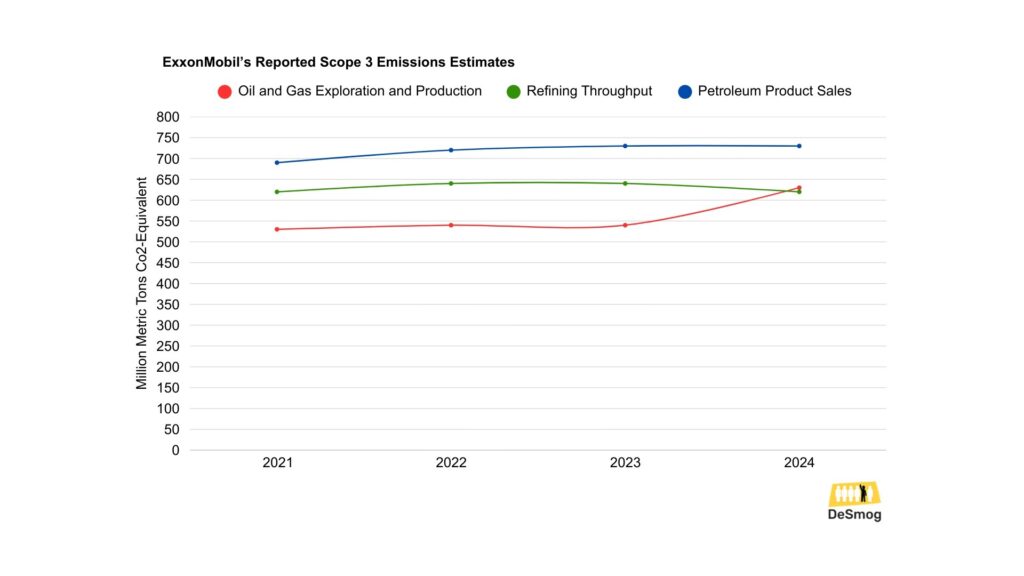
Note: ExxonMobil currently "chooses not to report on the full range of Scope 3 emissions estimates called for under the GHG Protocol," the company noted in its October legal complaint challenging California's mandatory climate emissions reporting laws. That means these numbers do not reflect the company's full Scope 3 emissions, and cannot be compared to estimates prepared by companies that fully follow the GHG Protocol's standards. They are provided here only to illustrate how ExxonMobil's own reported figures have changed over time. Image Credit: DeSmog. Data Source: ExxonMobil's annual climate and sustainability reports.
Independent estimates reveal that ExxonMobil single-handedly drove 2.76 percent of all carbon dioxide emissions from 1854 to 2023, a report last year from Carbon Majors found. That lands ExxonMobil among the top five all-time biggest contributors to the climate crisis, alongside "the former Soviet Union," "China (coal)," Saudi Aramco, and Chevron.
ExxonMobil's 2023 climate "progress report" spends nearly a full page critiquing the GHG Protocol framework and Scope 3 reporting. The document argues it "provides limited insight for a company like ours into how it might substantially lower its emissions, short of shrinking, discontinuing operations, or outright divesting operations."
In other words, the obvious conclusion from looking at Scope 3 data is that the most effective way for energy companies to curb emissions is by moving away from producing fossil fuels.
Instead, ExxonMobil prefers to focus on how it's cutting its own fossil fuel pollution, allowing the company to argue that its emissions are falling even as it remains deeply committed to producing more oil and gas.
In 2021, Woods testified before Congress, touting emissions cuts at ExxonMobil sites, which he described as the company's "own" emissions. "With respect to emissions, ExxonMobil has already reduced its own greenhouse gas emissions by 11 percent between 2016 and 2020," Woods testified, "and has set new plans for further reductions through 2025."
A Long History of Avoiding BlameIn the business press, ExxonMobil's support for Carbon Measures has been received, as Bloomberg put it, as "a willingness to engage in ideas to reduce emissions" and "a departure from its historical stance, which has included advertorials sowing doubt about climate science that ran in the 1980s and 1990s."
But a closer look shows that Carbon Measures' approach is a continuation of one of the longest-running strategies in ExxonMobil's playbook — focusing on consumers' responsibility for oil pollution.
For decades, the companies that make up ExxonMobil today, including Exxon, Mobil, and Canada's Imperial Oil, pushed the idea that pollution is demand-driven.
"As individuals, we may not approve of each and all of this multitude of activities," Imperial Oil's 1970 report continued. "Yet as members of the society which sanctions and encourages them, we must accept responsibility for all the consequences, both the desirable and the undesirable which include the pollution caused by the improper disposal of the inevitable waste."
That messaging shows up again and again in the company's documents related to climate change and air pollution, from the 1960s through the 2020s. DeSmog has collected examples from ExxonMobil reports, speeches, Congressional testimony, and advertisements in the timeline below.
Timeline of Events - (Click arrows to browse)From the 1960s through the 2020s, ExxonMobil highlighted consumers' responsibility for climate change and oil's air pollution, as illustrated in this timeline.
In 1998, shortly before the merger of Exxon and Mobil, Mobil CEO Lou Noto addressed climate concerns at an employee forum. There, he offered rough numbers showing the massive impact of shifting responsibility to consumers. "Our customers using our products probably count for 95 percent of those emissions," Noto said, calling the remainder "the five percent that we're responsible for."
The same pattern can even be seen in the company's advertorials. In their landmark 2021 study, climate disinformation researchers Geoffrey Supran and Naomi Oreskes found, as they put it, "ExxonMobil advertisements worked to shift responsibility for global warming away from the fossil fuel industry and onto consumers."
The researchers found that internally, ExxonMobil seemed more likely to use phrases that suggest pollution is driven by supply, rather than demand, in contrast to the company's public stance.
And of course, oil and gas companies aren't simply passive sellers. The industry has worked hard to entrench demand for fossil fuels, most recently by marketing natural gas power to data centers at the heart of the artificial intelligence (AI) boom.
Today, ExxonMobil is continuing to pour money into projects that will produce oil and gas for decades to come.
In early November, Carbon Measures and the International Chamber of Commerce put out a "call for interest" for accounting experts to help develop the details of the new guidelines. Carbon Measures announced its first round of appointments on January 19, with more expected later this quarter.
The new accounting standards, if they attract sufficient corporate backing, are expected to roll out sometime between 2027 and 2030.
Sachs, the Columbia climate finance expert, emphasized that we already know how to effectively cut carbon pollution: starting with clean-energy standards, electrification mandates, and measures that phase out fossil fuel demand. But, she noted, oil companies have consistently opposed those types of policies.
She told DeSmog, "No one should mistake Exxon's support for disclosure frameworks as an effort to solve the climate problem."
The post After Decades of Deflection, ExxonMobil Moves to Reshape Global Climate Accounting appeared first on DeSmog.
Alberta Separatism Would be Terrible for Indigenous Rights [ 22-Jan-26 9:36pm ]Separation from Canada would be a disaster for Indigenous rights in Alberta and plunge the provincial economy into even greater uncertainty. Yet providing an easier path for Alberta separatists seems strangely to be a top priority of Premier Danielle Smith, regardless of the ensuing constitutional chaos.
Bill 14 was hurried through the Alberta Legislature just before Christmas, clearing the way for a fringe cohort to move forward with a referendum question freshly deemed unconstitutional by Court of Kings Bench. Separatist extremists are now collecting signatures for a divisive question to be put to Alberta voters likely later this year that ignores Treaty obligations predating the province's entry into confederation.
Reaction from First Nations was unsurprisingly swift, with Chiefs of Treaty No. 6, 7, and 8 stating they "will not tolerate any action that seeks to undermine our Treaties, our Rights or our Sovereignty." The Alberta government is now being sued over their hasty pro-separation law, further metastasizing the mess created by the premier. The Sturgeon Lake Cree Nation (SLCN) has asked the court to issue an "urgent" interim injunction against the Alberta Prosperity Project (APP) petition.
"Alberta has treated SLCN as though they are chattel on the land, merely an afterthought in forced negotiations, not the first step in any potential secession," warned the SLCN lawyers in their statement of claim. "This is contrary to law: Alberta's secession cannot happen without First Nation consent to change a party to Treaty No. 8. Consent, not consultation, is required before the question of secession is delegated from a party to the treaty to the individuals who have come to inhabit Alberta."
One expert contacted by DeSmog agreed that any effort for Alberta to separate from Canada is standing on shaky legal ground in regard to First Nations.
"Every right that Indigenous people in Alberta have is the result of a settlement with the Crown and right of Canada," Amir Attaran, law professor at the University of Ottawa told DeSmog. "If you take that away, what legal status does that give these people in a new Alberta? Nobody knows the answer to that question."
Subscribe to our newsletterStay up to date with DeSmog news and alerts
Email Address What content do you want to subscribe to? (check all that apply) All International UK Sign Up (function($){ $('.newsletter-container .ijkidr-us').click(function() { $('.js-cm-form').attr('data-id', '2BE4EF332AA2E32596E38B640E905619D07B21962C5AFE16D3A2145673C82A3CEE9D9F1ADDABE965ACB3CE39939D42AC9012C6272FD52BFCA0790F0FB77C6442'); $('.js-cm-email-input').attr('name', 'cm-vdrirr-vdrirr'); }); $('.newsletter-container .ijkidr-uk').click(function() { $('.js-cm-form').attr('data-id', '2BE4EF332AA2E32596E38B640E905619BD43AA6813AF1B0FFE26D8282EC254E3ED0237BA72BEFBE922037EE4F1B325C6DA4918F8E044E022C7D333A43FD72429'); $('.js-cm-email-input').attr('name', 'cm-ijkidr-ijkidr'); }); })(jQuery);For some separatists, however, ignoring Indigenous rights is not only a side effect of an independent Alberta, but an explicit goal. At an event cross-promoted by APP, lawyer and Fraser Institute fellow Bruce Pardy made the case for Indigenous rights to be abolished in a sovereign Alberta.
On his Substack, Pardy has argued that "In a free Alberta, Aboriginal rights should not exist. Instead, reserve lands in Alberta should be divided into lots and transferred to individual Indigenous people, creating for them the same property rights and opportunities as everybody else." Former APP CEO Dennis Modry has said that his organization opposes the United Nations Declaration on the Rights of Indigenous Peoples, incorrectly calling it a "marxist agenda." Smith considers APP a key ally and speaks favourably of Modry.
All this is clearly a way for Smith to distract from the very real issues facing her province. Alberta is grappling with a $6.4 billion budget shortfall due to sagging oil prices. Beleaguered doctors are urging the province to declare a state of emergency for a collapsing healthcare system. Critical water infrastructure needs urgent upgrades.
So what did Premier Danielle Smith prioritize on the last sitting day of the legislature in 2025? Rushing through her last-minute bill to insulate Alberta separatists from having their referendum question struck down by the courts.
In a scathing decision issued the day after Smith's government introduced a bespoke bill to end legal oversight of referendum questions, Court of King's Bench Justice Colin Feasby determined that the proposed referendum question from the separatist APP was indeed contrary to the constitution and Indigenous rights. Treaties negotiated between Aboriginal governments and the Crown formed the basis of the founding of Alberta and mean that secession could only happen with the prior informed consent of those First Nations.
Feasby was blunt in what he thought about the hasty legislative maneuvering to avoid a legal ruling on the potential breakup of the country. "Alberta's cavalier disregard for court resources and lack of consideration for the parties and First Nations intervenors who participated in this proceeding in good faith is disappointing to say the least," Feasby wrote in a judgment made moot only a week later with the passage of the new law.
So egregious is Smith's assault on the legal system that two former Alberta ministers of justice and more than two dozen lawyers have since co-signed a letter calling out the premier's "unacceptable behaviour", including stripping referendum oversight from the Chief Electoral Officer.
"We do not want an authoritarian government," said Verlyn Olson, the former minister of justice and attorney general under Premier Ed Stelmach. "I think all you have to do is look a little ways south to see what happens when you get an authoritarian government that does not think it is bound by the normal rules that a democracy operates by."
Meanwhile, other First Nations are supporting the SLCN legal action for obvious reasons.
"We affirm that the Alberta UCP government's actions enabling and supporting the so-called Alberta Prosperity Project petition are a direct violation of Treaty obligations and the Honour of the Crown," Chiefs of Treaty No. 6, 7, and 8 said in a joint statement.
The premier's reckless rhetoric and actions now create a divisive constitutional crisis in the midst of an ongoing trade war with the erratic Trump Administration, which in its surprise attack on Venezuela earlier this year demonstrated a willingness to seize hemispheric oil resources by military force.
Experts recently warned that dark money funneled to separatist extremists or baseless allegations of a rigged referendum could be used as a ruse to try to absorb Alberta into the U.S. MAGA-adjacent commentators are already bragging about how the Trump Administration will assist Alberta separatists to help break up Canada.
Even the right-leaning Macdonald-Laurier Institute (MLI) has warned of the economic devastation that would be wrought from separation, calling oft-repeated claims of lower taxes in an independent Alberta "fiscal fantasy."
Trevor Tombe, the author of the MLI analysis, dismissed separatist statements about economic prosperity, stating plainly that "the fiscal and economic claims at the heart of such proposals are simply false. A separate Alberta would be a poorer Alberta."
Many Americans would be inclined to agree. Less than one-third of U.S. voters now believe the chaotic Trump Administration is doing a good job on the economy. Why would Albertans want to climb aboard such a sinking ship?
Creating a needless crisis with First Nations to favour a fringe cohort speaks to Smith's fixation on protecting her partisan flank rather than solving pressing problems for Albertans. Support for separation in Alberta has never exceeded 20 percent, slightly more than the proportion of Canadians that believe the Earth is flat or that the lunar landings were faked, but less than the number who think aliens have visited from outer space.
Playing footsie with separatist extremists during such a perilous time is the opposite of credible Canadian leadership. Alberta, Canada, and First Nations deserve better.
The post Alberta Separatism Would be Terrible for Indigenous Rights appeared first on DeSmog.
As the UN General Assembly Turns 80, Can Ordinary Citizens Change How the World Is Governed? [ 19-Jan-26 6:12pm ]On Saturday, 17 January, world leaders gathered at Westminster Central Hall to mark the 80th birthday of the U.N. General Assembly. The same room where it first convened in 1946.
At the same time, something quietly historic happened.
For the first time, the permanent Global Citizens' Assembly met.
Selected by lottery and representative of the world's population, a group of 105 people began deliberating on the climate and food crises. By 2026, more than 100,000 people will have taken part. Later this year, discussions on Artificial Intelligence (AI) will follow.
It's an experiment in global governance reform. A kind of anti Trump-Monroe spheres of influence project.
Instead of carving the world back up into competing empires, it connects communities, cities and countries into a living global network, designed not to replace governments, but to act where they increasingly cannot.
That matters because demand for global governance reform has rarely been higher. As Sir George Robertson, ex-Nato Secretary-General, said on Saturday: "It's not an underestimate to say that today we face our most acute crisis since 1946."
When the U.N. first opened its doors, many of its staff still bore the visible wounds of war. As the U.N. Secretary-General António Guterres reminded us, they understood that: "Peace, justice and equality are the most precious, practical and necessary pursuits of all."
Today, many governments are turning away from multilateralism. Yet around two-thirds of people worldwide want stronger international cooperation on climate, AI and global security.
That gap matters. It's where citizens' assemblies come in.
A citizens' assembly brings together a group of everyday people, selected by lottery, to reflect the wider population, to learn, deliberate and make recommendations on major public issues.
Our research suggests that more than 7,000 formal citizens' assemblies have been organised over the last decade. This does not include the hundreds of thousands, maybe millions, of community-level assemblies operating below the radar. This global movement of deliberative democracy has grown because we now know assemblies produce more effective policy, reduce polarisation, and act as an antidote to misinformation.
The task of the Global Citizens' Assembly is simply to connect and strengthen what already exists. Linking local assemblies into a global fabric that can begin to plug some of the gaps in the existing multilateral regime.
The U.N. has never been the whole of global governance. In 2021, the UN Foundation, Climate Analytics and E3G published The Value of Climate Cooperation, which mapped a far wider ecosystem of climate action: spanning science networks, businesses, investors and civil society alongside the U.N.Framework Convention on Climate Change.
Global governance, in other words, is already far more distributed than our institutional imagination tends to acknowledge.
This was exemplified during the pandemic when many now agree that the most important parts of the response emerged from a partnership between governments, academia and corporate manufacturing and distribution, rather than from any single multilateral institution.
AI is also transforming what's possible, making it feasible to run thousands of high-quality citizen conversations at a fraction of the cost and time of traditional assemblies.
In a world where crises now move faster than parliaments or summits, this kind of human-machine collaboration opens the door to a new form of civic infrastructure continuous, distributed and capable of matching the speed and scale of global challenges.
The members of the Global Citizens' Assembly are on the front line of today's crises, just as the first members of the U.N. General Assembly were 80 years ago. They know what suffering looks like. And they know that peace, justice and equality are not abstract ideals, but practical necessities.
That's why nation states committed to global collaboration in 1945.
And that's why people, ordinary people, need to be at the heart of global governance today.
The post As the UN General Assembly Turns 80, Can Ordinary Citizens Change How the World Is Governed? appeared first on DeSmog.
Danielle Smith Working With Trump Official Who Wants to Annex Greenland [ 14-Jan-26 9:41pm ]Alberta Premier Danielle Smith is part of a U.S. group whose leader, Louisiana Gov. Jeff Landry, has been tasked by the Donald Trump administration with helping to annex Greenland.
In the wake of the surprise U.S. military invasion of Venezuela, Trump has doubled down on threats to take over Greenland, musing about sending in U.S. military troops and saying that owning the sovereign territory is "psychologically important to me." World leaders have pushed back against these threats, including Canadian Prime Minister Mark Carney, who has said "the future of Greenland is a decision exclusively for the people of Greenland and Denmark."
In December, Trump appointed Landry as special envoy to Greenland. Landry reacted to his appointment by affirming his commitment "to make Greenland a part of the U.S." Denmark and Greenland officials have advocated strongly for their sovereignty to be respected. When asked last week how international law may view the U.S.'s comments about Greenland, Landry responded "when has the United States engaged in imperialism? Never!"
Behind the scenes, however, Landry is closely tied to Alberta Premier Smith. The Louisiana governor leads the Governors Coalition for Energy Security (GCES), that Smith also belongs to. The two have met on several occasions, and Smith has praised Landry as an "excellent" governor.
For her part, Smith has responded to Trump's past threats to Greenland by saying the U.S. president is "very concerned about Arctic security and he wants to make sure he's got partners who are equally concerned about it."
All this talk of seizing Greenland is happening as a separation referendum is underway in Alberta. As of January 3rd, an organization called Stay Free Alberta, which is linked to the separatist group Alberta Prosperity Project, has been collecting signatures on a referendum for Alberta to become an independent state.
Smith's office did not respond to DeSmog's questions related to the GCES or the Trump administration's threats to Canadian sovereignty.
Subscribe to our newsletterStay up to date with DeSmog news and alerts
Email Address What content do you want to subscribe to? (check all that apply) All International UK Sign Up (function($){ $('.newsletter-container .ijkidr-us').click(function() { $('.js-cm-form').attr('data-id', '2BE4EF332AA2E32596E38B640E905619D07B21962C5AFE16D3A2145673C82A3CEE9D9F1ADDABE965ACB3CE39939D42AC9012C6272FD52BFCA0790F0FB77C6442'); $('.js-cm-email-input').attr('name', 'cm-vdrirr-vdrirr'); }); $('.newsletter-container .ijkidr-uk').click(function() { $('.js-cm-form').attr('data-id', '2BE4EF332AA2E32596E38B640E905619BD43AA6813AF1B0FFE26D8282EC254E3ED0237BA72BEFBE922037EE4F1B325C6DA4918F8E044E022C7D333A43FD72429'); $('.js-cm-email-input').attr('name', 'cm-ijkidr-ijkidr'); }); })(jQuery); What Is the Governors Coalition for Energy Security?The GCES, launched in September 2024, is composed of 11 U.S. Republican governors and three Canadian premiers, including Ontario's Doug Ford and Saskatchewan's Scott Moe. According to its website, the coalition is "focusing on preserving all energy options" to "foster innovation, reduce regulatory barriers and attract business investment."
The coalition recently announced a set of policy recommendations to "address America's energy challenges" and "remove obstacles" to building energy infrastructure. These include limiting environmental regulations and speeding up permitting. The ultimate goal is to "secure America's energy future while supporting manufacturing competitiveness and job creation."
Smith joined the GCES shortly after Trump won the November 2024 election, framing it as an opportunity "to work with the Trump Administration and other US partners to increase our pipeline capacity to our greatest friend and ally, the United States."
Since Smith joined the coalition, it has commended the head of the Environmental Protection Agency, a climate crisis denier named Lee Zeldin who is backed by fracking billionaires, for "his recent actions to eliminate wasteful federal funding." Smith's group was referring to Joe Biden's Inflation Reduction Act, since rolled back under Trump, which was designed in part to fund and stimulate renewable energy across the U.S. The GCES argues that this funding "was intended to target energy producers and the petrochemical agency."
Saskatchewan Premier Moe joined the GCES in March 2025 while Ontario Premier Ford joined in November 2025.
Smith's relationship with Republican politicians goes beyond just the GCES, however. She attended several of Trump's inauguration events in January, 2025, and met with U.S. cabinet officials including Energy Secretary Chris Wright, Defense Secretary Pete Hegseth, and Homeland Security Secretary Kristi Noem.
During that trip, Smith met with Landry and another member of the GCEC. Smith shared a photo from this meeting with Landry and Arkansas Governor Huckabee Sanders on X, writing that she'd "had a great discussion with both of these excellent governors on how our great nations can work together to achieve the goal of North American energy dominance."
Smith, the 51st State, and MAGAHad a great discussion last night with Louisiana Governor Jeff Landry @LAGovJeffLandry (Chair of the Governors Coalition for Energy Security which Alberta recently joined), and Arkansas Governor Sarah Huckabee Sanders @SarahHuckabee (also a member of the Coalition). Had a great… pic.twitter.com/93jj4H9h8o
— Danielle Smith (@ABDanielleSmith) January 19, 2025
Not only has Trump been threatening to capture Greenland, but he has also made comments about turning Canada into the 51st U.S. state, starting in November 2024 when then-Prime Minister Justin Trudeau visited Trump at his resort in Mar-a-Lago.
In March 2025, Trump suggested Canada waive its sovereignty to end the tariffs he placed on Canadian goods and in September 2025 Trump raised the matter again with a Canadian official, saying "Why don't you just join our country?"
While Trump's annexation threats have angered many Canadians, some Albertans would like to see Alberta become the next star on the U.S. flag. Calgary Lawyer Jeffrey Rath joined Fox News last year to talk about the "hundreds" of Albertans interested in joining the United States. Rath is part of a group including two former Alberta members of parliament called the "Delegation to Washington" that has reportedly met twice with Trump officials to promote an economic union with the U.S.
Dennis Modry, the former CEO of the Alberta Prosperity Project, was also part of this delegation. According to Modry, on April 22, U.S. officials offered a $500 million transition loan to the province should it choose to leave Canada.
Smith has aided the group on multiple occasions, first by lowering the number of signatures required to force a referendum from 600,000 to 177,000, which one APP leader called a "big gift." Smith then pushed through legislation to protect the referendum from challenges to its constitutionality. A recent poll found that only 19 percent of Albertans would vote in favour of separation, and multiple First Nations are challenging the referendum.
Additional polling suggests that the vast majority of Albertans don't support Trump. Yet Smith has cultivated strong ties with the MAGA movement. Last March, she travelled to Florida to speak with conservative influencer Ben Shapiro. The two cracked jokes about Trump annexing Canada at the event, which was also a fundraiser for PragerU, a right-wing media organization.
Smith also met with the Heritage Foundation shortly after the U.S. 2024 election, ostensibly to represent Albertan and Canadian interests. The Heritage Foundation is the architect of Project 2025, the plan to "dismantle the administrative state" which has been enacted by the second Trump administration.
Separatists, including Rath, had a second meeting with Trump officials to talk about Albertan independence this fall. Rath claimed that "the level of the meeting has been elevated as an indication of the strong support from the United States for Alberta independence."
Smith has justified her MAGA ties in the past by saying "I would say that all of those interactions are part of the reason why we were able to get a lower tariff rate. I think we were able to effectively make the case that Alberta energy resources do get sold to the Americans at a discount."
But as Trump escalates his threats against Greenland, Smith hasn't made any public statements or posted about her ties to his administration, including the Louisiana governor tasked with helping annex the territory.
The post Danielle Smith Working With Trump Official Who Wants to Annex Greenland appeared first on DeSmog.
'Utterly Shameless': Tory Energy Chief Backs 'Nonsense' Anti-Net Zero Reports [ 13-Jan-26 2:01pm ]Conservative shadow energy secretary Claire Coutinho has endorsed two new anti-climate reports that have been rejected by experts and government bodies.
On 12 January, Coutinho launched a report by energy consultancy Watt-Logic which claimed that increasing renewable energy capacity in the UK will heighten the risk of blackouts - a claim rejected by the National Energy Systems Operator (NESO), which helps to plan and manage the country's energy network.
The Department of Energy and Net Zero (DESNZ) called the report "nonsense scaremongering", while energy expert Jess Ralston pointed out that "The recent major challenges to the UK's energy supply have been from the volatility of gas".
Watt-Logic, run by Kathryn Porter, advises the oil and gas industry. Porter claims to work for "businesses with projects across the electricity, gas and oil industries", including "clients with conventional energy assets including gas-fired power stations, gas storage, upstream oil and gas production and [Liquified Natural Gas]".
She has also authored reports for the Global Warming Policy Foundation (GWPF) - the UK's leading climate science denial group. The GWPF has stated that carbon dioxide has been "mercilessly demonised", when in fact it is a "benefit to the planet" and should be "two or three times" higher than current levels.
On the same day, Coutinho backed a separate report by the Institute of Economic Affairs (IEA), which claimed cutting UK emissions to net zero by 2050 could cost over £9 trillion - a figure 90 times that estimated by the independent Climate Change Committee (CCC).
Energy and climate expert Simon Evans, deputy editor of the publication Carbon Brief, called the IEA report "utterly shameless" for portraying the alternative scenario - an energy system powered by fossil fuels - as entirely cost-free.
The IEA's estimate for the cost of net zero also factored in the damage caused by climate emissions - despite the fact that a polluting energy system will result in far greater climate damages.
In reality, the CCC has stated that achieving net zero will require 0.2 percent of GDP per year from 2025 to 2050, with the majority of this investment coming from the private sector "as long as the right incentives are in place."
Subscribe to our newsletterStay up to date with DeSmog news and alerts
Email Address What content do you want to subscribe to? (check all that apply) All International UK Sign Up (function($){ $('.newsletter-container .ijkidr-us').click(function() { $('.js-cm-form').attr('data-id', '2BE4EF332AA2E32596E38B640E905619D07B21962C5AFE16D3A2145673C82A3CEE9D9F1ADDABE965ACB3CE39939D42AC9012C6272FD52BFCA0790F0FB77C6442'); $('.js-cm-email-input').attr('name', 'cm-vdrirr-vdrirr'); }); $('.newsletter-container .ijkidr-uk').click(function() { $('.js-cm-form').attr('data-id', '2BE4EF332AA2E32596E38B640E905619BD43AA6813AF1B0FFE26D8282EC254E3ED0237BA72BEFBE922037EE4F1B325C6DA4918F8E044E022C7D333A43FD72429'); $('.js-cm-email-input').attr('name', 'cm-ijkidr-ijkidr'); }); })(jQuery);The IEA report was written by David Turver, a retired business consultant turned blogger who writes critical articles about clean energy policies. Turver seemingly has little prior experience or qualifications in energy policy or climate science, according to his LinkedIn biography.
Like Porter, he also has ties to the GWPF. In July 2024, he wrote a report for Net Zero Watch, the GWPF's campaigning arm, accusing the "scandalous" CCC of "misleading Parliament" while attacking its "absurd" financial models.
As revealed by DeSmog, the IEA has historically received extensive funding from the fossil fuel industry - including from oil majors Shell and BP. The group is part of the Tufton Street network - an orchestrated alliance of radical right-wing groups based in Westminster that lobby to dismantle state services and privatise public bodies.
It is run by former Conservative peer David Frost, a director of Net Zero Watch, which along with the GWPF is based in 55 Tufton Street.
Lily Rose Ellis, a climate campaigner for Greenpeace UK, said: "Last time the government implemented Tufton Street's corporate lobbying as national policy back in 2022, Liz Truss's mini-budget crashed the economy. Whatever the current government's challenges, they're unlikely to be desperate enough to take the IEA's advice."
Over the past year, the Conservatives - under pressure from Nigel Farage's Reform UK - have deserted their previous support for climate action, with party leader Kemi Badenoch calling net zero "impossible" and pledging to repeal the 2008 Climate Change Act.
The party has received extensive donations from climate science deniers and fossil fuel interests.
The Conservative Party, the IEA, Turver, and Porter were approached for comment.
Climate 'Sceptic' AuthorsAs DeSmog revealed in July 2023, Porter has written blogs that contradict basic climate science. In a 2017 post, she wrote that "climate models overstate global warming". In fact, climate models have accurately predicted global temperature rises, with observed warming reflecting scientific forecasts.
She also publicly opposes climate policies. In a post on X in January 2025, Porter attacked what she called an "excessive focus on CO2" in energy policy, and in February she suggested the UK's landmark Climate Change Act should be repealed.
Turver writes a newsletter offering "fundamental analysis of energy policy and net zero". He has claimed that climate science is "just junk ideology given a fig leaf of respectability by academics and institutions who have their noses in the trough."
Turver has also said that Energy and Net Zero Secretary Ed Miliband "and his supporters are among the most dangerous people in Britain. Net zero is killing the economy."
In reality, according to the Confederation of British Industry (CBI), the UK's net zero economy grew by 10 percent in 2024, employing almost a million people in full-time jobs with an average wage of £43,000 - £5,600 higher than the national average.
In another X post, Turver said: "Ed Miliband, when will you end your obsession with net zero and get coal back on the grid?" Coal is the most carbon-intensive fossil fuel. In 2021, the International Energy Agency reported that coal power plants still produced a fifth of all global greenhouse gas emissions.
Last January, Coutinho called for Turver and Porter to vet government energy policy. In May, Lord Offord of Garvel, then Coutinho's shadow energy minister, helped to launch a report by Porter in Parliament on the supposed "true cost of net zero". Offord defected to Reform UK last month.
 Former Conservative peer Lord Offord, and energy consultant Kathryn Porter. A DeSmog collage.
Credit: Roger Harris (CC BY 3.0) / IEA / YouTube Questionable Claims
Coutinho, quoted in The Telegraph about Kathryn Porter's latest report, said that it "lays out in expert detail how Britain's net zero plans are taking us down a path of economic ruin. If ministers were truly interested in making Britain rich again, they would ditch their green ideology and take her report on board."
Coutinho also told The Express the report means "we need to build more gas plants", and provided a quote for the IEA's press release which accompanied Turver's report, saying: "It beggars belief that none of our 'independent' energy bodies can publish an accurate figure for what net zero is going to cost this country."
However, the accuracy of the two reports has been rejected by experts.
A spokesperson for NESO, the independent body which manages the UK energy supply, said of Watt-Logic's report: "Great Britain has one of the most secure energy systems in the world, operating with an outstanding track record of reliability, and we simply do not recognise the figures or claims presented in this report.
"We robustly test tens of thousands of worst-case scenarios, and our engineers are confident Britain's grid will continue to operate safely and securely as more renewables connect to the network in the years ahead."
Jess Ralston, head of energy at the Energy and Climate Intelligence Unit (ECIU) think tank said: "There have been many, many claims in the past couple of decades that blackouts are imminent because of renewables, but even as the UK keeps on breaking clean power records, we're yet to see one that's related to the level of renewables on the grid.
"NESO has many tools at its disposal to manage supply and demand and routinely does so, and has confirmed that with increasing clean power the UK will retain our 'world-class reliability standards'.
"The recent major challenges to the UK's energy supply have been from the volatility of gas, and every turn of a wind turbine means we need less gas to power our homes. With the North Sea running out of gas whether or not more drilling occurs, a continued reliance on gas power stations means British homes are increasingly dependent on foreign supplies and actors like Putin that control them."
A DESNZ spokesperson added that Porter's report was "nonsense scaremongering".
They added: "Gas will continue to play a key role in our energy system as we transition to clean, more secure, homegrown energy. NESO has also been clear the faster we decarbonise, the more secure we are.
"That's why we are also delivering the biggest upgrade to Great Britain's electricity network in decades to deliver clean power by 2030 and beyond."
Posting on Bluesky in relation to the IEA's "cost of net zero" report, Simon Evans pointed out that NESO has estimated a "holistic transition" away from fossil fuels is the "cheapest option" when you take account the economic damage caused by climate change.
Evans also pointed out that the IEA's report mistakenly assumes "free fossil fuel energy, free petrol cars, free gas boilers, [and] free gas power plants."
ECIU's Jess Ralston added: "Nobody has a crystal ball on costs of fossil fuels, but history tells us that oil and gas prices are volatile and at the mercy of actors like Putin.
"The recent gas crisis drove the UK to spend over £180 billion, and the Treasury and homeowners alike would struggle to afford a repeat in the event of a future conflict or price spikes."
The post 'Utterly Shameless': Tory Energy Chief Backs 'Nonsense' Anti-Net Zero Reports appeared first on DeSmog.
A Fox News Venezuela Expert Is Backed by MAGA Oil Billionaire Paul Singer [ 12-Jan-26 2:01pm ]In the chaotic lead-up to and aftermath of the United States' January 3 military raid on Venezuela, a national security expert named Rebeccah Heinrichs appeared multiple times on Fox News to describe American aggression as a victory for both ordinary Venezuelans and the world — sometimes more than once a day.
In one January 8 appearance, Heinrichs told Fox News host Sean Hannity that the surprise attack, which the Trump administration says was motivated by a desire to seize the country's oil fields, is "a boon for American industry" and would be "good for the Venezuelan people." In another interview that same day, Heinrichs argued on Fox Business that the military removal of Venezuelan President Nicolás Maduro by the U.S. has allowed a "friendly" government to take charge of the country.
In both appearances, Fox News identified Heinrichs as a senior fellow at the Hudson Institute. That organization is a Washington, D.C.-based conservative think tank with a powerful billionaire backer who is not neutral about Trump's military campaign against Venezuela.
The Hudson Institute is closely linked to Paul Singer, who has a personal fortune estimated by Forbes at $6.7 billion and donated $5 million to Trump's Super PAC in 2024. Late last November, Singer bought Citgo, a U.S. subsidiary of Venezuela's state-run oil company. As the Trump administration moves to control the flow of oil out of the Latin American nation, Singer is well-positioned for "a financial windfall," according to reporting by Popular Information and other outlets.
Subscribe to our newsletterStay up to date with DeSmog news and alerts
Email Address What content do you want to subscribe to? (check all that apply) All International UK Sign Up (function($){ $('.newsletter-container .ijkidr-us').click(function() { $('.js-cm-form').attr('data-id', '2BE4EF332AA2E32596E38B640E905619D07B21962C5AFE16D3A2145673C82A3CEE9D9F1ADDABE965ACB3CE39939D42AC9012C6272FD52BFCA0790F0FB77C6442'); $('.js-cm-email-input').attr('name', 'cm-vdrirr-vdrirr'); }); $('.newsletter-container .ijkidr-uk').click(function() { $('.js-cm-form').attr('data-id', '2BE4EF332AA2E32596E38B640E905619BD43AA6813AF1B0FFE26D8282EC254E3ED0237BA72BEFBE922037EE4F1B325C6DA4918F8E044E022C7D333A43FD72429'); $('.js-cm-email-input').attr('name', 'cm-ijkidr-ijkidr'); }); })(jQuery);DeSmog's review of recent federal tax filings by the Paul E. Singer Foundation turned up a $100,000 donation to the Hudson Institute during the fiscal year ending November 30, 2024. The think tank has also shared personnel with Singer's investment company and charity.
On December 11, just weeks after Singer's purchase of Citgo, Heinrichs went on Bill Hemmer's Fox News show to discuss the boarding of a Venezuelan oil tanker by U.S. troops. "The Trump administration is completely out of patience" with the Maduro government, she said.
Hemmer asked Heinrichs how far she thought U.S. military action could escalate: "Is this something that would suggest over the holidays we hear about special forces going into [Venezuela in] the dark of night? Can you see that happening?"
"We might hear about that, Bill," she replied.
Heinrichs, the Hudson Institute, Fox News, and the Paul E. Singer Foundation did not respond to DeSmog's requests for comment.
Singer's Connection to HudsonThe 81-year-old Singer has emerged as one of the prime potential beneficiaries of Trump's promises — backed up by U.S. military aggression — to revitalize Venezuela's oil industry.
 Paul E. Singer. (Credit: World Economic Forum, CC BY-SA 2.0, via Wikimedia Commons
With his purchase of Citgo via his private equity firm, Singer gained control of three Gulf Coast refineries configured to process heavy Venezuelan crude oil. If Trump is successful in jump-starting the country's lagging oil industry, "that would result in a cheaper feedstock, profits and a more valuable company, eventually," according to Wall Street Journal reporter Benoît Morenne.
Over the years, Singer's foundation has invested in a number of conservative think tanks that deny or question the science behind climate change, as well as pushing for regime change in Venezuela.
Since 2011, the charity has given more than $10 million to the Manhattan Institute, as well as other donations to groups including the American Enterprise Institute and the Heritage Foundation. Singer has also donated to the Copenhagen Consensus Center, a think tank created by the climate crisis denier Bjørn Lomborg.
Singer has particularly close links to the Hudson Institute, however, which as recently as 2014 published commentary stating — incorrectly — that more carbon dioxide in the atmosphere would benefit agriculture by increasing plant growth.
Heinrichs is not the only Hudson Institute expert who has loudly supported Trump's military aggression against Venezuela this week.
On January 6, Hudson Institute senior fellow Aaron MacLean hosted an episode of the group's School of War podcast devoted to discussion of Venezuela. MacLean expressed surprise at how "successful and casualty-free" the raid was, while the Venezuelan government has said that 100 people had died and that many or more were wounded.
On the federal tax filing that DeSmog reviewed, MacLean is named as senior director of the Paul E. Singer Foundation. This position is not mentioned on the Hudson Institute website. Hudson Institute adjunct fellow Mark Siegel, meanwhile, spent 16 years working at Elliott Management, Singer's investment company.
Singer himself is listed as a member of the chairman's advisory board in the institute's 2021 annual report. He has helped host prominent Hudson Institute events, such as a 2018 gala honoring Nikki Haley, the first Trump administration's ambassador to the United Nations at the time.
Pushing for Pressure on VenezuelaThe Hudson Institute has been making the case for greater U.S. pressure on Maduro's government since before Trump returned to the White House. In August 2024, the think tank published a post urging the Biden administration "to assert itself" in the country and warned that if Maduro "does not relent, he should pay a price."
On November 22, as Trump was escalating tensions in the Gulf of Mexico, Heinrichs discussed "getting a better regime in place" in Venezuela during an appearance on Fox News.
On November 28 she was again on Fox News, talking about the Trump administration's military strikes on Venezuelan boats. "This is about the United States asserting itself and making sure that our peer adversaries don't have a foothold," she said, referring to countries, such as China and Russia, that have sought deeper economic relationships with Venezuela.
The following week, on December 4, again on Fox, Heinrichs talked about "the possibility of land strikes in Venezuela."
These appearances were taking place as Singer's investment firm was moving forward with its winning $5.89 billion bid for Citgo.
"Just a few weeks ago, a U.S. hedge-fund manager known for playing the long game in Latin America won a protracted battle for one of Venezuela's crown jewels," MarketWatch reported on January 5. "That bet now looks shrewd in light of the American military operation that captured Venezuela's president, Nicolás Maduro."
The post A Fox News Venezuela Expert Is Backed by MAGA Oil Billionaire Paul Singer appeared first on DeSmog.
Reform 'Cosying Up to Authoritarian Petrostate' [ 09-Jan-26 11:08am ]Senior figures in Reform UK have been developing close connections to the United Arab Emirates (UAE), an authoritarian, monarchic state with vast fossil fuel resources.
New records show that party leader Nigel Farage was funded to attend the Formula 1 Grand Prix in Abu Dhabi in December by the city's government.
The trip, for Farage and a "non-staff member", cost £10,000 and included meetings in the UAE capital, according to Farage's register of interests.
The Financial Times has reported that these meetings took place with "senior Emirati officials" and were arranged by Reform donor and treasurer Nick Candy. The Abu Dhabi emirate - one of seven in the UAE - is led by UAE President Sheikh Mohamed bin Zayed Al Nahyan.
Candy, a billionaire luxury property developer and former Conservative Party backer, is in business with a real estate firm owned by Abu Dhabi that has ties to the UAE's national oil company.
He has donated almost £1 million to Nigel Farage's party in the past year, having been appointed as Reform treasurer in December 2024.
Just a few months earlier, in October 2024, his firm Candy Capital entered into a "strategic joint venture partnership" with Modon Holding, chaired by a board member of the Abu Dhabi National Oil Company (ADNOC).
Reform campaigns for new fossil fuel exploration, stating that the UK's clean energy policies should be scrapped.
"Given the party's growing traction, Reform cosying up to an authoritarian petrostate should worry us all," said Jon Noronha-Gant, a senior investigator at Global Witness.
"The UAE has a huge vested interest in pushing planet-wrecking oil and gas - it sought $100 billion worth of fossil fuel deals the year it hosted COP [2023] - and that's to say nothing of its dismal human rights record.
"This is not the state or the money that we want influencing our politicians."
Subscribe to our newsletterStay up to date with DeSmog news and alerts
Email Address What content do you want to subscribe to? (check all that apply) All International UK Sign Up (function($){ $('.newsletter-container .ijkidr-us').click(function() { $('.js-cm-form').attr('data-id', '2BE4EF332AA2E32596E38B640E905619D07B21962C5AFE16D3A2145673C82A3CEE9D9F1ADDABE965ACB3CE39939D42AC9012C6272FD52BFCA0790F0FB77C6442'); $('.js-cm-email-input').attr('name', 'cm-vdrirr-vdrirr'); }); $('.newsletter-container .ijkidr-uk').click(function() { $('.js-cm-form').attr('data-id', '2BE4EF332AA2E32596E38B640E905619BD43AA6813AF1B0FFE26D8282EC254E3ED0237BA72BEFBE922037EE4F1B325C6DA4918F8E044E022C7D333A43FD72429'); $('.js-cm-email-input').attr('name', 'cm-ijkidr-ijkidr'); }); })(jQuery);Last month, the Labour government launched an independent review into foreign financial interference in UK politics, following the jailing of Nathan Gill, Reform's former leader in Wales, for taking bribes from an agent of the Russian state.
Modon Holding is 85 percent owned by L'imad Holding, a company owned by the Abu Dhabi government.
Modon's chairman Jassem Mohammed Bu Ataba Al Zaabi has several official roles in the UAE, including serving as chairman of Abu Dhabi's department of finance, and vice president of the UAE central bank.
He is also on the board of ADNOC, the UAE's state oil company. Oil and gas accounts for 30 percent of the UAE economy and is its historic source of wealth.
Reform received 92 percent of its donations between the 2019 and 2024 UK elections from oil investors, major polluters, and climate science deniers, while Candy has claimed the party is actively raising money from oil executives.
The party has also praised U.S. President Donald Trump's "drill baby drill" agenda. The Trump administration recently captured Venezuela's President Nicolás Maduro and pledged that the U.S. oil industry will "go in, spend billions of dollars, fix the badly broken infrastructure and start making money for the country".
Steve Goodrich, head of research and investigations at Transparency UK, told DeSmog: "Currently there are no limits on political contributions, with some parties heavily reliant on a small number of very wealthy donors. When those holding public office become dependent on just a few wealthy backers, it increases the risk they make decisions based on their benefactors' private interests rather than the public good.
"The forthcoming Elections Bill is an opportunity for Parliament to take the corrupting influence of big money out of UK politics."
Candy Capital declined to comment. Reform and Modon Holding did not respond.
Reform's UAE PraiseCandy and other Reform figures have frequently praised the UAE, a monarchy and petrostate accused of human rights abuses at home and abroad.
In an article last January for the website Arabian Gulf Business Insight, Candy praised the UAE as an attractive place for "ultra high net worth" investors.
"Wealth mobility has reshaped the way the global elite think about where to live, work and invest - and all signs point to the Middle East, particularly Dubai and Abu Dhabi, as the new frontier," he wrote. "Having invested in the UAE's thriving property market, I see this as just the beginning of the Emirates' transformation into a global epicentre for success."
Candy praised the UAE's crime prevention and "robust law enforcement", adding: "Coupled with a high standard of living, excellent healthcare and top-tier schools, the UAE offers a lifestyle that few other locations can match."
Candy also lauded "the wisdom and visionary nature of the UAE's leadership", writing that "the quality of government officials is mind-blowing". By contrast, he said that Western countries are ruled by "second-tier individuals" who "allow political agendas to get in the way of what is best for the country".
Reform deputy leader Richard Tice has said he travels to the UAE "every six to eight weeks" to visit his partner, Telegraph columnist Isabel Oakeshott, who moved to Dubai in January 2025.
In an interview with Arabian Business in October, Tice praised the UAE for its sense of national pride, work ethic, law and order, integration of migrants, and energy sector, while stating that the UK is "decadent" and "going bust".
He failed to mention that migrant workers face "widespread abuses" in the UAE, according to Human Rights Watch, including wage theft and passport confiscation. Tice also told the BBC that the UK's "basic values" are "not working", when asked why he speaks so favourably about the UAE.
 Reform UK leader Nigel Farage at the Formula 1 Grand Prix in Abu Dhabi, December 2025.
Credit: Nigel Farage / X
Reform UK leader Nigel Farage at the Formula 1 Grand Prix in Abu Dhabi, December 2025.
Credit: Nigel Farage / X
Senior Reform figures have frequently contrasted the UK with the UAE, portraying the latter as a booming economy and an aspirational place to live compared to Britain.
Farage has repeatedly said Labour's latest budget will lead to an "exodus" to Dubai, while the party's head of policy Zia Yusuf and Durham councillor Darren Grimes have called Labour Chancellor Rachel Reeves "Dubai real estate agent of the year" after she increased taxes on super-wealthy home-owners.
The UAE - an Arab Muslim dictatorship partly governed by Sharia law where the population is 90 percent migrant workers - doesn't appear to conform with Reform's policies and espoused beliefs.
The party has called for the mass deportation of immigrants and, before the 2024 election, Farage suggested young Muslims don't share "British values". Reform MP Sarah Pochin has called for a ban on the burqa, Islamic clothing worn by Muslim women.
And, while Farage has called for the UK to "take back control" of its democracy, the UAE doesn't hold popular elections. There are no political parties, critics of the government are often jailed, women face unequal treatment, and its penal code allows for the arrest of lesbian, gay, bisexual, and transgender (LGBT) campaigners.
The UAE and the RightThe ties between the UAE and right-wing figures in the West are growing.
The UAE is home to investment firm Legatum Group, a co-owner of GB News, which has paid Farage £500,000 since he was elected to Parliament in July 2024.
GB News's other co-owner, Paul Marshall, opened an Abu Dhabi office for his hedge fund Marshall Wace in December 2024.
This December, UAE government officials reportedly met with far-right activist Tommy Robinson, who led an anti-migrant march in London in September.
The UK government also intervened in 2024 to block attempts by a consortium backed by Abu Dhabi from buying the Telegraph Media Group.
However, successive governments - including the current Labour administration - have sought to strengthen ties with the UAE.
Prime Minister Keir Starmer hosted UAE president Sheikh Mohamed bin Zayed Al Nahyan in Downing Street in November. In the meeting, Starmer spoke of "the value of a closer relationship between the UK and the UAE".
The UAE has pledged to invest £10 billion in "priority" UK industries.

A version of this article has been published by The New World
The post Reform 'Cosying Up to Authoritarian Petrostate' appeared first on DeSmog.
Nigel Farage Accepted £10,000 Gifts from Petrostate [ 07-Jan-26 11:00am ]Reform UK leader Nigel Farage received freebies worth £10,000 from the Abu Dhabi government, new records show.
Farage's latest register of interests shows that he accepted flights and accommodation to attend the Abu Dhabi Formula 1 Grand Prix in December, paid for by the regime that runs the capital of the United Arab Emirates (UAE). This included a front-row "paddock" pass to the event worth £4,500.
The records show that Farage also attended "meetings" during his visit.
The Reform leader has previously mocked Prime Minister Keir Starmer for receiving gifts from donors.
Reform campaigns for the UK to dramatically expand its fossil fuel production, scrap its clean energy policies, and dismantle its climate targets.
The UAE is an autocratic monarchy and petrostate. Roughly 30 percent of the country's GDP is directly based on its oil and gas output.
Reform received 92 percent of its donations between the 2019 and 2024 UK elections from polluting sources and climate science deniers, while its treasurer Nick Candy has claimed the party is actively raising money from oil executives.
Subscribe to our newsletterStay up to date with DeSmog news and alerts
Email Address What content do you want to subscribe to? (check all that apply) All International UK Sign Up (function($){ $('.newsletter-container .ijkidr-us').click(function() { $('.js-cm-form').attr('data-id', '2BE4EF332AA2E32596E38B640E905619D07B21962C5AFE16D3A2145673C82A3CEE9D9F1ADDABE965ACB3CE39939D42AC9012C6272FD52BFCA0790F0FB77C6442'); $('.js-cm-email-input').attr('name', 'cm-vdrirr-vdrirr'); }); $('.newsletter-container .ijkidr-uk').click(function() { $('.js-cm-form').attr('data-id', '2BE4EF332AA2E32596E38B640E905619BD43AA6813AF1B0FFE26D8282EC254E3ED0237BA72BEFBE922037EE4F1B325C6DA4918F8E044E022C7D333A43FD72429'); $('.js-cm-email-input').attr('name', 'cm-ijkidr-ijkidr'); }); })(jQuery);Senior party figures have also praised U.S. President Donald Trump's "drill baby drill" agenda, which has seen his administration recently capture Venezuela's President Nicolás Maduro and pledge that the U.S. oil industry will "go in, spend billions of dollars, fix the badly broken infrastructure and start making money for the country".
Farage denies basic climate science, claiming it's "absolutely nuts" for carbon dioxide to be considered a pollutant. The party is being advised by the Heartland Institute, a U.S.-based pro-Trump climate denial group. Farage helped to launch Heartland's UK-EU branch in December last year.
The UN's Intergovernmental Panel on Climate Change (IPCC), the world's leading climate science body, has said "it is a statement of fact, we cannot be any more certain; it is unequivocal and indisputable that humans are warming the planet."
The IPCC has also stated that carbon dioxide pollution "is responsible for most of global warming" since the late 19th century, which has increased the "severity and frequency of weather and climate extremes, like heat waves, heavy rains, and drought" - all of which "put a disproportionate burden on low-income households and thus increase poverty levels."
Key individuals in Reform have also heaped praise on the UAE in recent months.
Reform deputy leader Richard Tice has said he travels to the UAE "every six to eight weeks" to visit his partner, Telegraph columnist Isabel Oakeshott, who moved to Dubai in January 2025.
Tice has praised the UAE for its sense of national pride, work ethic, law and order, integration of migrants, and energy sector, while stating that the UK is "decadent" and "going bust".
In an article last January for the website Arabian Gulf Business Insight, Candy praised the UAE's crime prevention and "robust law enforcement", adding: "Coupled with a high standard of living, excellent healthcare and top-tier schools, the UAE offers a lifestyle that few other locations can match."
Candy also lauded "the wisdom and visionary nature of the UAE's leadership", writing that "the quality of government officials is mind-blowing". By contrast, he said that Western countries are ruled by "second-tier individuals" who "allow political agendas to get in the way of what is best for the country".
The UAE does not hold popular elections, and there are no political parties. Critics of the government are often jailed, while migrant workers face "widespread abuses" according to Human Rights Watch, including wage theft and passport confiscation.
The country also discriminates against women and its penal code allows the authorities to arrest people for campaigns promoting the rights of lesbian, gay, bisexual, and transgender (LGBT) people.
Reform was approached for comment.
The post Nigel Farage Accepted £10,000 Gifts from Petrostate appeared first on DeSmog.
How MAGA Changed the World in 2025, and What Comes Next [ 22-Dec-25 11:30am ]There's no doubt that 2025 has been one of the most politically chaotic years of the 21st century.
Amid the domestic and geopolitical mayhem unleashed by Donald Trump's return to the White House, powerful interests were busy enacting a radical anti-democratic agenda that has already changed our world and will continue shaping it for years to come.
DeSmog's team of investigative reporters, editors, and researchers have spent the past year tracking the fossil fuel companies and tech giants seeking private gain from MAGA, along with the climate deniers and right-wing political operatives attempting to export the movement globally.
Here are some of their most consequential achievements.
Supercharging Climate DenialFor years, the widely-held belief in the community of people advocating for aggressive climate action was that outright denial of the science was becoming a marginal relic of the past. That was never accurate, as DeSmog has extensively reported, but the second Trump administration has shattered the illusion for good.
Trump's Secretary of Energy, Chris Wright, is a former fracking executive. During a February speech to the Alliance for Responsible Citizenship (ARC) conference, Wright called 2050 net zero targets "a sinister goal."
In exclusive interviews with DeSmog at the London event, prominent climate crisis deniers praised Wright for his opposition to regulating CO2 as a pollutant. Overturning these regulations is a long-time goal of groups such as the CO2 Coalition and the Heartland Institute.
The energy secretary this year convened a panel of climate deniers, including the Canadian Ross McKitrick, to author an official Department of Energy report questioning the link between humans and global temperature rise. More than 85 actual climate experts released a scathing rebuttal describing the report as "junk science."
Nevertheless, Trump's Environmental Protection Agency (EPA) drew on Wright's report to initiate its effort to rescind the agency's own "endangerment finding" on CO2 and other carbon emissions, which provides the legal foundation for many major U.S. climate regulations. (It was perhaps not the most far-sighted strategy, as the administration's strident climate denial is now creating potential legal hurdles for the EPA's repeal effort.)
The administration also relied on climate crisis deniers to help craft legislation, such as Alex Epstein, who was credited with shaping sections of Trump's "Big Beautiful Bill" that eliminated tax credits supporting wind and solar energy. That legislative effort got an assist from Americans for Prosperity, a political advocacy group backed by oil and gas billionaire Charles Koch.
These assaults on climate science and renewable energy had already been laid out in Project 2025, the reactionary blueprint for a second Trump administration created by the Heritage Foundation. DeSmog found that over 50 high-level Trump administration officials were linked to Project 2025, including many of the president's closest advisors, such as Elon Musk.
Although Musk and Trump eventually had a bitter falling out, the consequences of Musk taking a power saw to the federal government will be felt for years in terms of shuttered climate programs, laid-off employees, and diminished bureaucratic expertise. DeSmog revealed that Musk's so-called "Department of Government Efficiency" (DOGE) effort was partly the result of a concerted effort — led behind the scenes by conservative groups — to tilt the U.S. towards hard-line Christian Nationalist and libertarian ideology.
In the process, the climate denial movement appeared to gain a powerful new ally. "We welcome Elon Musk into the climate red pill group," Climate Depot executive director Marc Morano stated in late 2024.
Undermining European DemocracyThis November, the White House published a National Security Strategy that outlined U.S. policy goals in Europe.
DeSmog has been reporting on these goals throughout the year.
"Our broad policy for Europe," the strategy stated, "should prioritize cultivating resistance to Europe's current trajectory within European nations."
The strategy "reject[s] the disastrous 'climate change' and 'Net Zero' ideologies that have so greatly harmed Europe, threaten the United States, and subsidize our adversaries."
At a private event that DeSmog attended during February's ARC conference, Kevin Roberts, head of the Heritage Foundation, seemed to articulate these same principles, rejecting climate science as "fiction" and urging "our friends from Europe" to oppose international institutions.
The following month, the Heritage Foundation convened hard-line European conservatives for a meeting in Washington, D.C., where they discussed how to dismantle the European Union.
In April, DeSmog revealed that the Heritage Foundation was actively trying to shape an upcoming national election in Albania in favor of a Trump-aligned candidate.
The following month, key MAGA influencers, including Trump administration Homeland Security Secretary Kristi Noem, descended on eastern Europe for the Conservative Political Action Committee (CPAC) Poland conference. According to audio of CPAC Poland obtained by DeSmog, speakers made calls to "liquidate" the European Commission, while pushing for the election of far-right Polish presidential candidate Karol Nawrocki. (Nawrocki won in a June runoff election.)
Trump-aligned groups were trying meanwhile to hollow out European climate legislation. The Heartland Institute set its sights on the EU's Corporate Sustainability Due Diligence Directive (CSDDD), a law requiring companies to address human rights and environmental issues in their operations.
Also fighting the CSDDD: A coalition of companies called the Competitiveness Roundtable whose members include ExxonMobil, TotalEnergies, Chevron, and Koch, Inc. Documents obtained by the research group SOMO and seen by DeSmog showed that this corporate campaign deliberately supported far-right groups in Europe in service of its goals.
It's now clear that combating EU climate rules was essential to carving out a market in Europe for American gas exporters. "The industry and the State Department are putting a lot of pressure on the EU [to] commit to our dirty LNG," one climate advocate told DeSmog.
Forging Anti-Climate Alliances with Big TechDuring the first Trump administration, the world's biggest tech companies pledged to fight for climate action even as the U.S. exited the Paris climate treaty and rolled back key environmental laws.
This time around, those same tech companies are actively supporting Trump's climate denial.
DeSmog revealed that during an April AI conference in Washington, D.C., Google president and chief investment officer Ruth Porat called a preceding speech by Interior Secretary Doug Burgum "fantastic," even though Burgum used his appearance to attack the so-called "climate extremist agenda" and push expanding the use of coal.
Porat's praise seemed at odds with her own company's ambitious 2020 pledge to power all its operations with carbon-free energy by 2030.
Google's shift wasn't an outlier, but part of a trend within Big Tech to go along with the Trump administration's embrace of fossil fuels to power its energy-hungry data centers, despite renewables remaining the cheapest and quickest-to-install electricity source worldwide.
DeSmog revealed that OpenAI this year hired a new head of global energy policy who is a dedicated champion of natural gas, and was a senior energy advisor in the first Trump administration. In September, OpenAI CEO Sam Altman joined Trump on an official state visit to the UK, where the company is planning a massive new AI infrastructure project.
Subscribe to DeSmog's weekly newsletterStay up to date with our investigations of AI, greenwashing, MAGA, and more.
Email Address What content do you want to subscribe to? (check all that apply) All International UK Sign Up (function($){ $('.newsletter-container .ijkidr-us').click(function() { $('.js-cm-form').attr('data-id', '2BE4EF332AA2E32596E38B640E905619D07B21962C5AFE16D3A2145673C82A3CEE9D9F1ADDABE965ACB3CE39939D42AC9012C6272FD52BFCA0790F0FB77C6442'); $('.js-cm-email-input').attr('name', 'cm-vdrirr-vdrirr'); }); $('.newsletter-container .ijkidr-uk').click(function() { $('.js-cm-form').attr('data-id', '2BE4EF332AA2E32596E38B640E905619BD43AA6813AF1B0FFE26D8282EC254E3ED0237BA72BEFBE922037EE4F1B325C6DA4918F8E044E022C7D333A43FD72429'); $('.js-cm-email-input').attr('name', 'cm-ijkidr-ijkidr'); }); })(jQuery);Jensen Huang, CEO of the supercomputer chip-maker Nvidia, also accompanied Trump to the UK in September. Huang followed that up in October by praising Energy Secretary Wright's "passion" for science, despite Wright's active promotion of climate denial.
DeSmog also reported on Nvidia's marketing of AI tools to Brazilian oil and gas companies just weeks before the COP30 climate negotiations in Belém.
This was no coincidence, as the fossil fuel industry is increasingly using AI to boost oil and gas production, as executives told the Reuters Global Energy Transition conference in June. In turn, AI advocates including former Google CEO Eric Schmidt are pitching AI energy demand to major oil producing countries as a way to keep fossil fuels alive.
In Texas alone, AI has spurred demand for over 100 new natural gas plants, while in Virginia local communities fought against a data center proposal that would have seen construction of the largest U.S. gas plant in a decade. The data center explosion is also delaying the retirement of at least 15 coal plants across the U.S.
DeSmog reported this year on the growing backlash to data centers in places like rural Georgia, despite a public charm offensive aimed directly at residents. Still, the large corporate backers behind these projects remain confident that they can overcome public opposition.
That includes a real estate arm of Koch, Inc. that has been building data centers in Chicago, Kansas City, and Atlanta, which is pitching itself as having the "expertise and capabilities that major tech companies either don't have or don't think would be worth the time."
At this point, it's safe to conclude, data centers are inseparable from fossil fuel expansion.
Backing the Rightwing Reform UKA fair question to ask this year was whether British MP Nigel Farage spent more time cultivating ties to MAGA in the U.S. than actually leading his rightwing political party, Reform UK, back at home. In September, Farage skipped Parliament's return from summer recess in order to speak at the National Conservatism (NatCon) conference in Washington, D.C., and address the Republican-controlled U.S. Congress.
"Nigel Farage is far more interested in pleasing Trump and jostling for his affections than he is in turning up to Parliament on time or standing up for British values," one Liberal Democrat source told DeSmog.
Farage in turn is helping MAGA expand into Europe. DeSmog reported in 2024 that he helped set up a UK-EU branch of the Heartland Institute. This year, the pro-Trump group claimed it was spearheading opposition to the EU's flagship Nature Restoration Law.
Back in February, Farage himself stated at the ARC conference that "I can't tell you whether CO2 is leading to warming or not, but there are so many other massive factors," while taking aim at the UK's net-zero policies. His comments are perhaps not surprising, given the previous donations Reform UK has received from fossil fuel and climate denier interests.
Other party figures also seem to be looking to the U.S. for inspiration. Reform UK Chair Zia Yusuf is an admirer of tech billionaire Musk, and apparently so is Paul Marshall, the right-wing owner of GB News and other outlets, which are key media backers of Reform UK. Marshall, who is also a hedge fund manager, bought a large stake in Tesla, the electric vehicle company led by Elon Musk, prior to the 2024 U.S. presidential election, DeSmog revealed.
Close ties to Trump may have helped smooth the way for massive new tech ventures in the UK. DeSmog reported in September that Trump's UK ambassador, Warren Stephens, has a family-owned investment firm with large shares in Microsoft, Nvidia, and Alphabet (Google's parent company), which are planning major UK projects.
The Trump-linked U.S. private equity firm Blackstone is meanwhile building a $13.4 billion (£10 billion) AI data centre in the UK that includes a fleet of massive backup diesel generators.
Fomenting Political Chaos in CanadaDeSmog was in the room at a conservative political event in Alberta where one of the speakers revealed a shocking piece of news. Dennis Modry, the former CEO of a group called the Alberta Prosperity Project, which is pushing for the oil-rich province to separate from Canada, claimed that he'd met directly with members of the Trump administration.
At that meeting, Modry claimed, U.S. officials offered "a $500 million transition loan that we would only draw down on as necessary as we work with the U.S. to transition from a province to a country." That wasn't the only instance of MAGA policies influencing the political discourse in Canada. Alberta premier Danielle Smith revealed in September that she had met with the Heritage Foundation shortly after Trump's election. Smith had already caused a national uproar months earlier by traveling to Florida to appear on a private panel with conservative U.S. pundit Ben Shapiro, who had previously called Canada "a silly country" that should be annexed by the U.S.
During the federal Canadian election, which was dominated by fears about Trump waging a trade war on the country, Smith told the right-wing U.S. media outlet Breitbart News that Conservative Party candidate Pierre Poilievre "would be very much in sync" with the Trump administration.
And indeed, DeSmog's careful analysis of Poilievre's inner circle turned up links to Elon Musk, Koch, Inc, and major oil and gas companies tightly linked to the U.S.
As in the UK, some Canadian conservatives and executives openly expressed admiration for Musk and his work with Trump. DeSmog was at a conservative event in Ottawa where representatives from Amazon and the pipeline builder TC Energy discussed how a right-wing prime minister could replicate elements of Musk's DOGE effort in Ottawa.
Poilievre ultimately lost the election to his Liberal opponent, current Prime Minister Mark Carney, but now Carney is implementing a pro-oil-and-gas agenda and taking ideas from the billionaire-founded AI and fossil fuel group Build Canada.
As we head into 2026, expect to see MAGA and its allies continue their global assault on climate science and policies to reduce planet-heating emissions.
The Canadian conservative influencer Jordan Peterson was a key organizer of this year's ARC conference, where Trump officials, European conservatives, tech investors, and climate crisis deniers discussed how to build and implement a global anti-net zero movement.
They will be meeting again in June.
The post How MAGA Changed the World in 2025, and What Comes Next appeared first on DeSmog.
Ditching Dualism #10: Determinism [ 27-Jan-26 3:00pm ] Ditching Dualism #9: Reductionism [ 20-Jan-26 3:00pm ] Ditching Dualism #8: Sentience [ 13-Jan-26 3:00pm ] Ditching Dualism #7: Objections [ 06-Jan-26 3:00pm ] Ditching Dualism #6: Maybe Monism? [ 30-Dec-25 3:00pm ] Ditching Dualism #5: Revolutions [ 23-Dec-25 3:00pm ] Ditching Dualism #4: Going Mental [ 16-Dec-25 3:00pm ] Ditching Dualism #3: The Divorce [ 09-Dec-25 3:00pm ] Ditching Dualism #2: Animism [ 02-Dec-25 3:00pm ] Ditching Dualism #1: Exaltation [ 25-Nov-25 3:00pm ]
Welcome to the 'Homogenocene': how humans are making the world's wildlife dangerously samey [ 29-Jan-26 12:36pm ] Pigeons are well-suited to urban living, and are outcompeting distinctive local species around the world. Wirestock Creators / shutterstock
The age of humans is increasingly an age of sameness. Across the planet, distinctive plants and animals are disappearing, replaced by species that are lucky enough to thrive alongside humans and travel with us easily. Some scientists have a word for this reshuffling of life: the Homogenocene.
Evidence for it is found in the world's museums. Storerooms are full of animals that no longer walk among us, pickled in spirit-filled jars: coiled snakes, bloated fish, frogs, birds. Each extinct species marks the removal of a particular evolutionary path from a particular place - and these absences are increasingly being filled by the same hardy, adaptable species, again and again.
One such absence is embodied by a small bird kept in a glass jar in London's Natural History Museum: the Fijian Bar-winged rail, not seen in the wild since the 1970s. It seems to be sleeping, its eyes closed, its wings tucked in along its back, its beak resting against the glass.
A flightless bird, it was particularly vulnerable to predators introduced by humans, including mongooses brought to Fiji in the 1800s. Its disappearance was part of a broad pattern in which island species are vanishing and a narrower set of globally successful animals thrive in their place.
It's a phenomenon that was called the Homogenocene even before a similar term growing in popularity, the Anthropocene, was coined in 2000. If the Anthropocene describes a planet transformed by humans, the Homogenocene is one ecological consequence: fewer places with their own distinctive life.
It goes well beyond charismatic birds and mammals. Freshwater fish, for instance, are becoming more "samey", as the natural barriers that once kept populations separate - waterfalls, river catchments, temperature limits - are effectively blurred or erased by human activity. Think of common carp deliberately stocked in lakes for anglers, or catfish released from home aquariums that now thrive in rivers thousands of miles from their native habitat.
Meanwhile, many thousands of mollusc species have disappeared over the past 500 years, with snails living on islands also severely affected: many are simply eaten by non-native predatory snails. Some invasive snails have become highly successful and widely distributed, such as the giant African snail that is now found from the Hawaiian Islands to the Americas, or South American golden apple snails rampant through east and south-east Asia since their introduction in the 1980s.
Homogeneity is just one facet of the changes wrought on the Earth's tapestry of life by humans, a process that started in the last ice age when hunting was likely key to the disappearance of the mammoth, giant sloth and other large mammals. It continued over around 11,700 years of the recent Holocene epoch - the period following the last ice age - as forests were felled and savannahs cleared for agriculture and the growth of farms and cities.
Over the past seven decades changes to life on Earth have intensified dramatically. This is the focus of a major new volume published by the Royal Society of London: The Biosphere in the Anthropocene.
The Anthropocene has reached the oceanLife in the oceans was relatively little changed between the last ice age and recent history, even as humans increasingly affected life on land. No longer: a feature of the Anthropocene is the rapid extension of human impacts through the oceans.
This is partly due to simple over-exploitation, as human technology post-second world war enabled more efficient and deeper trawling, and fish stocks became seriously depleted.
 Lionfish from the Pacific have been introduced in the Caribbean, where they're hoovering up native fish who don't recognise them as predators.
Drew McArthur / shutterstock
Lionfish from the Pacific have been introduced in the Caribbean, where they're hoovering up native fish who don't recognise them as predators.
Drew McArthur / shutterstock
Partly this is also due to the increasing effects of fossil-fuelled heat and oxygen depletion spreading through the oceans. Most visibly, this is now devastating coral reefs.
Out of sight, many animals are being displaced northwards and southwards out of the tropics to escape the heat; these conditions are also affecting spawning in fish, creating "bottlenecks" where life cycle development is limited by increasing heat or a lack of oxygen. The effects are reaching through into the deep oceans, where proposals for deep sea mining of minerals threaten to damage marine life that is barely known to science.
And as on land and in rivers, these changes are not just reducing life in the oceans - they're redistributing species and blurring long-standing biological boundaries.
Local biodiversity, global samenessNot all the changes to life made by humans are calamitous. In some places, incoming non-native species have blended seamlessly into existing environments to actually enhance local biodiversity.
In other contexts, both historical and contemporary, humans have been decisive in fostering wildlife, increasing the diversity of animals and plants in ecosystems by cutting or burning back the dominant vegetation and thereby allowing a greater range of animals and plants to flourish.
In our near-future world there are opportunities to support wildlife, for instance by changing patterns of agriculture to use less land to grow more food. With such freeing-up of space for nature, coupled with changes to farming and fishing that actively protect biodiversity, there is still a chance that we can avoid the worst predictions of a future biodiversity crash.
But this is by no means certain. Avoiding yet more rows of pickled corpses in museum jars will require a concerted effort to protect nature, one that must aim to help future generations of humans live in a biodiverse world.

The authors do not work for, consult, own shares in or receive funding from any company or organisation that would benefit from this article, and have disclosed no relevant affiliations beyond their academic appointment.


