
 What is the Definition of a Doomer? [ 03-Dec-25 6:29pm ] My Appearance on Science Talk: October 16, 2025 [ 18-Oct-25 7:02pm ] In Praise of Themis, by Gail Zawacki [ 12-Sep-25 5:55pm ] My Appearance on "Environmental Coffeehouse" on September 9, 2025 [ 11-Sep-25 12:17am ] My Appearance on "Santa Barbara Talks" on September 6, 2025 [ 07-Sep-25 4:19pm ] The Third and Final Form of Doomism [ 20-Aug-25 9:38pm ] Doomerism at the End of the Universe [ 25-Jun-25 8:01pm ] Canary in the Coal Mine: 2025 Full Doom Edition [ 23-Jun-25 7:23pm ] Doom Quotes: April, 2025 Edition [ 12-May-25 7:27pm ] Doom Quotes: March, 2025 Edition [ 31-Mar-25 10:50am ] Doom Quotes: February, 2025 Edition [ 02-Mar-25 2:17am ]
Addressing Threats to the United States by the Government of Cuba [ 30-Jan-26 7:25am ]
What is the Definition of a Doomer? [ 03-Dec-25 6:29pm ] My Appearance on Science Talk: October 16, 2025 [ 18-Oct-25 7:02pm ] In Praise of Themis, by Gail Zawacki [ 12-Sep-25 5:55pm ] My Appearance on "Environmental Coffeehouse" on September 9, 2025 [ 11-Sep-25 12:17am ] My Appearance on "Santa Barbara Talks" on September 6, 2025 [ 07-Sep-25 4:19pm ] The Third and Final Form of Doomism [ 20-Aug-25 9:38pm ] Doomerism at the End of the Universe [ 25-Jun-25 8:01pm ] Canary in the Coal Mine: 2025 Full Doom Edition [ 23-Jun-25 7:23pm ] Doom Quotes: April, 2025 Edition [ 12-May-25 7:27pm ] Doom Quotes: March, 2025 Edition [ 31-Mar-25 10:50am ] Doom Quotes: February, 2025 Edition [ 02-Mar-25 2:17am ]
Addressing Threats to the United States by the Government of Cuba [ 30-Jan-26 7:25am ]So, this came up in my news feed tonight. It is the white house website. Calling Cuba a threat for "human rights violations" and curbing free press.
What timeline are we on?
submitted by /u/IMNXGI[link] [comments]
Australia records consecutive 50C (122F) days [ 30-Jan-26 7:27am ]Two South Australian locations - Andamooka and Port Augusta - have reached 50°C during the past two days as a gruelling week-long heatwave continues to grip several states.
Prior to this week, 50°C had only officially been recorded in SA on two occasions. These were both in 1960 when Oodnadatta reached 50.7°C on January 2 and 50.3°C on January 3.
Over the five-day period from Monday to Friday this week, 12 separate weather stations across New South Wales and SA exceeded 49°C. These locations were:
50.0°C at Andamooka, SA on Thursday 50.0°C at Port Augusta, SA on Friday 49.8°C at Marree, SA on Thursday and 49.5°C on Friday 49.7°C at Pooncarie, NSW on Tuesday 49.7°C at Tarcoola, SA on Friday 49.6°C at Renmark, SA on Tuesday 49.6°C at Roxby Downs, SA on Thursday and 49.4°C on Friday 49.5°C at Ceduna, SA on Monday 49.2°C at Borrona Downs, NSW on Wednesday 49.1°C at Fowlers Gap, NSW on Tuesday 49.0°C at Wanaaring, NSW on Tuesday 49.0°C at Woomera, SA on Friday
It's likely that other areas of outback SA and NSW exceeded 50°C this week in between official weather stations.
Source: https://www.weatherzone.com.au/news/australia-records-first-50c-in-four-years/1891172
submitted by /u/DevilsAdvotwat[link] [comments]
Homes with air source heat pumps or solar panels for sale in England - in pictures [ 30-Jan-26 7:00am ]From a renovated Victorian village house in Hampshire to a new-build apartment in south London
Continue reading... Exploding trees: the winter phenomenon behind frost cracks [ 30-Jan-26 6:00am ]When temperatures drop suddenly, trapped water can freeze and expand, splitting trunks with a gunshot-like sound
During the recent cold spell in the northern US, meteorologists issued warnings about exploding trees.
A tree's first line of defence against freezing is its bark, which provides efficient insulation. In cold conditions, trees also enter a form of hibernation, with changes at a cellular level: cells dehydrate, harden and shrink, increasing their sugar concentration. This is the botanical equivalent of adding antifreeze, helping to prevent the formation of ice crystals.
Continue reading...
Intersolar Africa 2026 to Position Nairobi as East Africa's Key Hub for Solar & Energy Storage [ 30-Jan-26 4:57am ]East Africa is emerging as one of the world's most dynamic regions for solar power and battery storage. On 3-4 February 2026, Intersolar Africa will take place at the Sarit Expo Centre in Nairobi, expanding from the successful Intersolar Summit Africa in 2025 into a full international exhibition and conference. ... [continued]
The post Intersolar Africa 2026 to Position Nairobi as East Africa's Key Hub for Solar & Energy Storage appeared first on CleanTechnica.
my world collased last time i was at my cousins house,, +my doctor gave me this diagnosis. Read more: 2 [ 30-Jan-26 6:01am ]
Schneider Electric Recognized for Continued Sustainability Leadership Across Leading ESG Ratings in 2025 [ 30-Jan-26 4:56am ]Schneider Electric's performance across major global benchmarks reflects consistent progress on climate, social impact and governance Schneider Electric, a global energy technology leader, has once again been recognized by global environmental, social, and governance (ESG) organizations for the strength, consistency, and long-term credibility of its sustainability performance. Schneider Electric achieved ... [continued]
The post Schneider Electric Recognized for Continued Sustainability Leadership Across Leading ESG Ratings in 2025 appeared first on CleanTechnica.
Aspen Power Acquires New York Community Solar Projects [ 30-Jan-26 4:50am ]Two Upstate New York projects from CTEC Solar total nearly seven megawatts Aspen Power, a leading distributed generation platform building the clean energy future, today announced it has acquired the first two projects in an 18-megawatt direct current (MWdc) portfolio in upstate New York. The initial projects will cumulatively generate ... [continued]
The post Aspen Power Acquires New York Community Solar Projects appeared first on CleanTechnica.
Intersolar & Energy Storage North America Unveils Interactive Programming to Enhance Education and Networking [ 30-Jan-26 4:45am ]Intersolar & Energy Storage North America, the premier U.S. tradeshow and conference series for solar, energy storage, EV infrastructure, and manufacturing, today announced onsite activities that enhance education, collaboration, and connection at its Flagship event on February 18-20 at the San Diego Convention Center. "As the industry navigates administrative headwinds ... [continued]
The post Intersolar & Energy Storage North America Unveils Interactive Programming to Enhance Education and Networking appeared first on CleanTechnica.
Experience: a bear moved into my house [ 30-Jan-26 5:00am ]I heard this huff, then a stomp. A growl that sounded like a death warning
Last November, I'd been out for the evening with friends who were visiting Los Angeles. Afterwards, I checked the notifications on my phone. There was a motion alert from one of the cameras around my house. It had captured a big black bear nosing around my bins.
We get wildlife here: raccoons, skunks. But I'd never had a bear rummaging through my trash. I watched as it turned things over, then wandered off. I assumed he had left.
Continue reading...
Researchers Improve Sodium-Ion Batteries Almost 4× With Thin Layer Of Activated Carbon [ 30-Jan-26 3:35am ]Researchers are developing new materials to improve the performance of earth-abundant, sodium-ion batteries for stationary energy storage and EVs, too.
The post Researchers Improve Sodium-Ion Batteries Almost 4× With Thin Layer Of Activated Carbon appeared first on CleanTechnica.
Does life still feel different to you after covid or have you adjusted? [ 30-Jan-26 4:05am ]It's late, my mind gets hyperactive, the random sadness sets in and I begin to reflect on stones that are better left unturned... But here I am.
I keep having this memory of walking through my town in 2019 and seeing how lively it was. There was this one area where people would gather behind some building complex, I don't know how to explain it. A playground, picnic tables, all of it... And today I drove past and saw it was empty. For the life of me I could NOT figure out if I was hallucinating or if people had really once gathered there - Cut to: google Earth historic satellite imagery.
As I suspected, around 2021 they removed all of the the tables, benches, playground, etc - and now it's just an empty plot of grass. For some reason this fucks me up and I can't get over it. Something about lost time, another part feels like we were living in an entirely different dimension, etc.
This feeling is ubiquitous in my life. A profound sense of - BEFORE and AFTER since the winter of 2020....
The only hopeful sentiment I can provide is that on Twitter there was the image of a timeline... It showed 2018 - 2019 - and when it reached 2020-2025 the timeline turned into a big ball of yarn, a tangled mess... but then corrected itself and continued onto 2026, meaning that maybe we're past those strange 5 years. Maybe now we can finally move on?
submitted by /u/No_Departure7494[link] [comments]
Why US going to war with Iran would be a big mistake [ 30-Jan-26 3:46am ]
Lynk & Co Launches "The New 08 Limit Less" Campaign and a New in‑Car App Designed to Encourage Electric‑First Driving [ 30-Jan-26 2:00am ]Gothenburg, Sweden — Lynk & Co launches its new dedicated marketing campaign: "The New 08. Limit Less", celebrating a milestone product for the European market. "The New 08. Limit Less" campaign reignites the conversation around the Lynk & Co 08 by spotlighting range as a driver of flow - uninterrupted, ... [continued]
The post Lynk & Co Launches "The New 08 Limit Less" Campaign and a New in‑Car App Designed to Encourage Electric‑First Driving appeared first on CleanTechnica.
Which of the planet's river valleys could serve as places for society to continue in the long term, such as 2100 or 2200? [ 30-Jan-26 1:26am ]Societies made out of flesh and blood humans need food for the humans.
Every way of making food in quantities that are big enough to be useful to civilization needs a river system with at least eight or nine million acres of cropland, roughly the size of the U.S. state of Maryland. If the cultivated land is smaller than that then all the surplus can support is the bronze-age stuff, with maybe some horses for raiding and pillaging on top.
So, a list of places that can survive for 100 years or longer into the future under conditions of global collapse must be restricted to the valley lands around big river basins. Although most collapse subreddit enjoyers aren't rich enough to consider moves to these places, it is interesting and the list of them isn't very long, so I've decided to write it out for people to see. The thing that matters most is reliability. If a place makes enough food 9 years out of 10 and then everybody starves in year 10, it's worthless.
North America, Central America and the Caribbean
The Colorado, Rio Grande, Sacramento, Columbia-Snake, Fraser and Tombigbee river systems, along with the southern half of the Mississippi valley, Atlantic seaboard south of the Chesapeake and all of Central America and the Caribbean will have occasional superpowered heat domes, maybe one every ten years, that kills everybody stone dead and cooks their corpses. It's just rolling the dice. Those heat domes happen everywhere in the climate change future but they are worse and worse the closer people get to the equator.
The upper Mississippi-Missouri and the Ohio will have mosquitoes carrying malaria and occasional mega-floods that kill all of the lowlanders but a surviving society might survive long-term. There's no obstacle to keeping cereal crops going in the places that aren't dependent on the Ogalalla aquifer. This might be a major reason for the Trump administration's focus on Minnesota, but it's unlikely that the administration has enough brains to think about these things.
The same applies for the Atlantic seaboard, starting at the Susquehanna and going up to Quebec. Like the Mississippi system the climate-change powered super heat domes will be survivable at this latitude instead of fatal, but there is a real risk of megadrought when it comes to decades and decades. Ideally, anybody looking to build something that lasts will make the Hudson valley the southern limit of their options.
The Canadian prairie, either draining into the south or into Hudson Bay, has too much of a risk of drought after drought, plus, most of the soil is useless to a farmer who doesn't have a combine harvester and a million bags of potash to work with.
The Mackenzie, Yukon and miscellaneous Alaskan river systems are pretty promising. Once the forests burn up and get replaced with temperate tree species they will get heat domes but they won't be that bad.
South America
There will be infrequent, once-a-decade lethal heat domes in a lot of places, including the Urabamba valley the Incan civilization was once built on. The only places where it isn't guaranteed are Chile and Argentina.
Chile, today, is a major net food exporter on the basis of several different river valleys that are all breadbaskets. They all rely on Andean meltwater and will die when the glaciers finish melting away into nothing.
Argentina, today, is a major net food exporter on the basis of exactly four river systems that are all breadbaskets. From north to south, the Rio de la Plata is forecasted to get lethal heat domes, the Argentinian Colorado will dry up, the Río Negro will be perfectly fine and the Patagonian watershed south of the Río Negro will be perfectly fine.
Europe and Africa
The last few years have seen many news stories of droughts making the rivers of these regions useless for agriculture. Factor in the heat dome projections for the big rivers like the Zambezi and there aren't many options left at all.
The River Shannon runs through Ireland. It looks to be decent in the long term, with the heat domes only being bad enough to kill most old people and livestock.
The mountains of Norway and Sweden will get enough of a snowpack for agriculture to continue, if their attached croplands aren't nuked a gazillion times by any of the possible belligerent neighbours in their future. When CDR politicians joke about a nuclear deterrent, be very afraid.
Finland and Russia north of a line from Bryansk to Samara have really poor soil, so they will probably only get one harvest of wheat per annum, but they will not have any real problems with heat domes or megadroughts.
Asia and Oceania
In the climate of the near future, most of these places will get a heat dome that kills everybody about once a decade, or maybe more often than that. The exceptions are in Japan, New Zealand, Manchuria, Siberia, Yakutia, and maybe some of the Himalayan valleys. On a case by case basis:
Japan (roughly north of Shikoku). The heat domes won't be that bad and the floods won't be that bad. The only question is whether they can survive category 6 hurricanes.
New Zealand has the same situation as Japan right down to the picturesque stratovolcano, but they have a little bit more arable land.
Manchuria will have pretty bad heat domes and mosquitoes but the Amur river will keep going.
Siberia and Yakutia are basically the same so I'll lump them together. They have a bunch of rivers which are very promising (particularly the Yenisei) mixed with the tough combination of terrible soil and needing to replace all of the tree cover with stuff that doesn't burn in giant wildfires. If you are currently learning or fluent in Mandarin, consider spending an hour looking at topographic and biome maps of the vast frontier that might come to pass if China betrays Russia and launches an invasion.
The Himalayan valleys of Nepal, Tibet, Myanmar etc are heat-dome resistant and will continue to get regular water supplies after all the glaciers are gone, thanks to the monsoon. Some excellent research has found that the South Asian Monsoon, as a weather phenomenon, will keep going even if there is 30, 40 or 50 metres of sea-level rise and accompanied ocean salinity reductions. However, the flooding may destroy every single building a society in the mountains can build. It's a mystery.
.
Will all of these places have societies in 2100, 2200, 2300...?
It's unlikely. The collapse of civilization will produce billions of hungry mouths who go to war over the limited supplies of food. Wars may well prevent the formation of surviving societies by killing all of the potential founder populations and there might not even be founder populations, since the world has less and less people with farming know-how each year. Not to mention the effects of disease, crop diseases, biological warfare and metal shortages, which are forecasted to all be pretty huge problems. If there is no available ore for making plows, there won't be any plows. But I would bet that two, maybe three of these places are statistically likely to persist, disappointing the antinatalists and efilists lurking on this forum.
.
Special thanks to Dr. Jack Alpert of the SKIL Foundation, whose YouTube videos inspired this essay. Sources for cropland area, productivity and crop data are scattered around the UN Food and Agriculture website at https://fao.org and the heat dome projections are drawn from Vecellio et al (2022)'s work using the CIMP6 and ERA5 datasets. Furthermore, I'd like to point out that although Google is increasingly bad at getting results, the image results for "[river name] map", such as "Magdalena map" or "Murray-Darling map" were all pretty good.
submitted by /u/OGSyedIsEverywhere[link] [comments]
Critically endangered skink births expected after captive breeding program success - video [ 30-Jan-26 1:14am ]Eleven endangered skinks released into a gated community in Victoria's Alpine national park will soon become 13, when Omeo, one of the females, gives birth in March. One of Australia's only alpine lizards, guthega skinks live on 'sky islands' above 1,600 metres in two isolated alpine locations - Bogong high plains in Victoria and Mount Kosciuszko in NSW. 'They're extremely vulnerable, given where they live,' says skink specialist Dr Zak Atkins, director of Snowline Ecology. As the climate warms, their alpine zone is retracting, and there's nowhere higher for them to go
Continue reading...
Gleiche Länge, unterschiedliche Logik: Chinas industrielle Wasserstoffpipeline im Vergleich zu Deutschlands Backbone [ 30-Jan-26 12:38am ]Der Vergleich zwischen Deutschlands Wasserstoff-Backbone von nirgendwo nach nirgendwo und Chinas angeblich über 1.000 km langer Wasserstoffpipeline taucht immer wieder auf und wird oft als Beleg dafür gerahmt, dass Deutschland lediglich früh dran sei und nicht falsch liege. Das ist eine berechtigte Frage, denn aus der Distanz wirken beide Projekte ... [continued]
The post Gleiche Länge, unterschiedliche Logik: Chinas industrielle Wasserstoffpipeline im Vergleich zu Deutschlands Backbone appeared first on CleanTechnica.
Caribbean heat waves intensified over the last five decades, study finds [ 30-Jan-26 12:45am ] Rising underwater noise is impacting Arctic wildlife [ 30-Jan-26 12:58am ]
Insurance Gas Car Rental: Like a Time-Warp after Owning a Tesla Model 3 with FSD [ 29-Jan-26 10:11pm ]Note: I believe Donald Trump has done unthinkable damage to our country and to our relations with other countries. I was sadly disappointed when Elon Musk supported his run for reelection in spite of Trump getting in bed with fossil fuel companies. Musk's behavior as leader of the DOGE agency ... [continued]
The post Insurance Gas Car Rental: Like a Time-Warp after Owning a Tesla Model 3 with FSD appeared first on CleanTechnica.
Tim Berners-Lee Created The Internet, Now He Wants To Fix It [ 29-Jan-26 8:40pm ]Tim Berners-Lee invented the internet while he was at CERN in 1989. Today, he is searching for ways to make it live up to his dream.
The post Tim Berners-Lee Created The Internet, Now He Wants To Fix It appeared first on CleanTechnica.
GM Profit Sharing Takes a Hit & Some UAW Members Blame EVs [ 29-Jan-26 8:36pm ]Tesla's recent financial reporting has gotten a lot of attention this week. Its business continues to become less focused on EVs and its already limited lineup is shrinking. Overall, Tesla is not on a positive trajectory. Sales, revenue, and earnings are down, but it is still profitable. However, Tesla was ... [continued]
The post GM Profit Sharing Takes a Hit & Some UAW Members Blame EVs appeared first on CleanTechnica.
In The U.S. Right Now, Experience Isn't Valued, It's Punished. A Laid-Off Amazon Employee Says The System "Optimizes" Out People Who Cost Too Much [ 29-Jan-26 7:42pm ]
Europe Will Pull Back from US LNG [ 29-Jan-26 6:59pm ]
The UK government didn't want you to see this report on ecosystem collapse. I'm not surprised. [ 29-Jan-26 6:11pm ]The most important document published by the UK government since the general election emerged last week only through a freedom of information request. The national security assessment on biodiversity loss and ecosystem collapse was supposed to have been published in October 2025, but the apparatchiks in Downing Street sought to make it disappear. Apparently there were two reasons: because its conclusions were "too negative", and because it would draw attention to the government's failure to act.
It echoes warnings some of us have made for years, only to be dismissed as nutters, doomsayers and extremists. It tells us that "ecosystem degradation is occurring across all regions. Every critical ecosystem is on a pathway to collapse (irreversible loss of function beyond repair)." This presents a threat to "UK national security and prosperity". It says "the world is already experiencing impacts including crop failures, intensified natural disasters and infectious disease outbreaks. Threats will increase with degradation and intensify with collapse."
The results will include geopolitical and economic instability, increased conflict and competition for resources. "It is unlikely the UK would be able to maintain food security if ecosystem collapse drives geopolitical competition for food." It also warns that "conflict and military escalation will become more likely, both within and between states, as groups compete for arable land and food and water resources".
It provides a powerful vindication of certain messages that, when voiced by environmentalists, have been greeted with hatred, fury and denial. For example, it tells us that "food production is the most significant cause of terrestrial biodiversity loss", that "animal farming at current levels is unsustainable without imports" and that "the UK does not have enough land to feed its population and rear livestock: a wholesale change in consumer diets would be required".
I'd be lying if I wrote: "I hate to say, 'We told you so.'" After years of insults and abuse, I say it with pride.
submitted by /u/ClimateResilient[link] [comments]
How to cut harmful emissions from ditches and canals - new research [ 29-Jan-26 5:34pm ]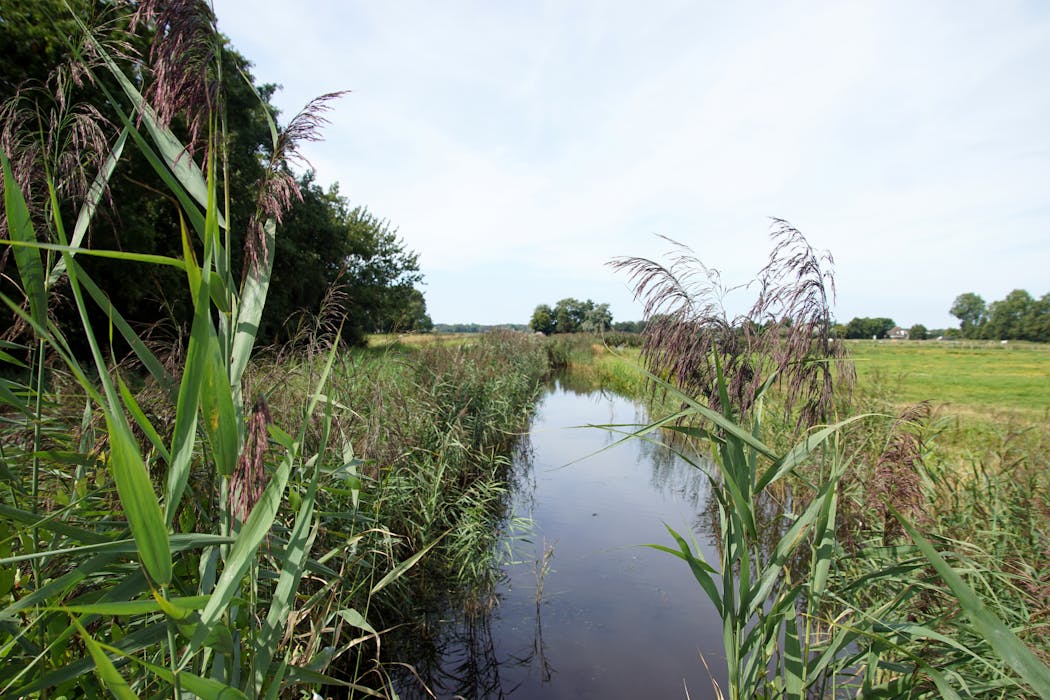 Thijs de Graaf/Shutterstock
Ditches and canals are the underdog of the freshwater world. These human-made waterways are often forgotten, devalued and perceived negatively - think "dull as ditchwater". But these unsung heroes have a hidden potential for climate change mitigation, if they're managed correctly.
We know that ditches and canals have a large global extent, covering at least 5.3 million hectares — about 22% of the UK's total land area. However, no one has yet mapped all global ditch and canal networks robustly, so it's potentially more.
These waterways are also hotspots of greenhouse gas emissions, which contribute to climate change. We have previously calculated that ditches emit 333 teragrams of carbon dioxide equivalents (a common unit to express the climate impact of all greenhouse gases), which is nearly comparable to the UK's total greenhouse gas emissions in 2023.
Ditches often contain stagnant waters and are commonly found running through farmland or cities, where they receive high amounts of nutrients from fertilisers, manure and stormwater run-off. This creates the low-oxygen, high-nutrient conditions that are ideal for the production of potent greenhouse gases methane and nitrous oxide - both of which warm the atmosphere considerably more than CO₂.
Read more: Ditches and canals are a big, yet overlooked, source of greenhouse gas emissions - new study
However, ditches and their surrounding landscape can be managed (by farmers and landowners, for example) in ways that reduce nutrient inputs and therefore lower their greenhouse gas emissions. This makes them an untapped solution for reducing the effects of climate change.
Many nature restoration solutions focus on storing atmospheric carbon - by planting trees or mangroves, for example. But there are also immediate wins to be made simply by reducing greenhouse gas emissions. The importance of methane reduction has now been recognised by more than 160 countries, all of which signed the global methane pledge to cut human-caused methane emissions by at least 30% from 2020 levels by the end of the decade.
Our new study outlines the steps needed to reduce emissions from global ditches and canals. First, we need to better understand these systems by mapping their global extent. We also need to collect more measurements of greenhouse gas emissions from underrepresented regions like South America and Africa. Emissions from irrigation ditches in these understudied places could be large.
We also need to improve our understanding of how the potent greenhouse gas methane escapes the sediments in bubbles. This involves using sensors that monitor methane concentrations continuously, in order to capture "hot moments" when weather or human activity (such as fertiliser use on farmland) cause sudden pulses of emissions.
All of these strategies will improve estimates of global greenhouse gas emissions from ditches. From that new baseline, any progress in reducing emissions can be more accurately measured.
New directions for ditchesThere are several ways to reduce greenhouse gas emissions from ditches and canals. These include reducing fertiliser application rates on farmland, excluding livestock from areas beside ditches to reduce the amount of manure that ends up in waterways (which has already been shown to be effective for ponds), and managing pollution sources like wastewater treatment plants.
In the Netherlands, researchers have tested the effects of dredging agricultural ditches to remove the nutrient- and organic matter-rich sediments that release greenhouse gases.
They found that dredging resulted in a 35% decline in ditch emissions after one year. However, this method isn't perfect, as the emissions from the removed sediments still need to be accounted for at a later stage, and dredging disturbs aquatic habitats and organisms.
Planting vegetation alongside ditches helps intercept nutrients and sediments before they reach the ditch. This vegetation also provides shading, which reduces water temperature and rates of greenhouse gas emissions. A study across Denmark, Great Britain and Sweden found that riverside vegetation helped to considerably reduce nutrient inputs to rivers and streams, and improved habitats for stream organisms like bugs and frogs.
Introducing floating vegetation can also trap methane and create the conditions for its removal before it is released into the atmosphere. Current trials in the UK are looking at introducing Sphagnum moss to peatland ditches. Once a floating mat of this moss has been established, it can trap bubbles of methane in an oxygen-rich environment created by the photosynthesising moss.
When methane and oxygen are present together, methane-eating bacteria can convert methane to carbon dioxide, which has a much lower impact on the climate. Initial results showed a decrease in methane of approximately 40% when Sphagnum was present.
Some of these techniques might be too expensive to scale, and many are still at the early stages of research into their use in ditches. Nevertheless, ditches and canals can in future be climate heroes - we just need to give them the chance by managing them in smart and sustainable ways.
Don't have time to read about climate change as much as you'd like?
Get a weekly roundup in your inbox instead. Every Wednesday, The Conversation's environment editor writes Imagine, a short email that goes a little deeper into just one climate issue. Join the 47,000+ readers who've subscribed so far.

Teresa Silverthorn has received funding for ditch research from from Defra, the Environment Agency, and EPSRC (UK research councils).
Jonathan Ritson has receive funding from the GGR-Peat project (UKRI funding, BB/V011561/1).
Mike Peacock has received funding for ditch research from Defra, the Environment Agency, NERC and EPSRC (UK research councils), and Formas and VR (Swedish research councils).
'The LED of heating': cheap geothermal energy system makes US comeback [ 29-Jan-26 5:33pm ]Minnesota housing project to draw energy from water stored deep underground, 45 years on from city's initial research
Nearly half a century ago, the US Department of Energy launched a clean energy experiment beneath the University of Minnesota with a simple goal: storing hot water for months at a time in an aquifer more than 100 metres below ground.
The idea of the seasonal thermal energy storage was to tuck away excess heat produced in summer, then use it in the winter to warm buildings.
Continue reading... 'Clean air should not be a privilege': how Bogotá is tackling air pollution in its poorest areas [ 29-Jan-26 5:30pm ]Colombian city launched its first clean air zone in one of its poorest neighbourhoods and has plans for green spaces too
Every Sunday in Bogotá, streets across the city are closed to cars and transformed into urban parks. Shirtless rollerbladers with boomboxes drift leisurely in figures of eight, Lycra-clad cyclists zoom downhill and young children wobble nervously as they pedal on bikes for the first time.
This is perhaps the most visible component of a multipronged plan to clean up the Colombian capital's air. At the turn of the century, Bogotá was one of Latin America's most polluted cities, with concentrations of harmful particulates at seven times the World Health Organization's limits. In the last decade the city of 8 million has started to turn that around, cutting air pollution by 24% between 2018 and 2024.
Continue reading... The Fukushima towns frozen in time: nature has thrived since the nuclear disaster but what happens if humans return? [ 27-Jan-26 7:00am ]Fifteen years after a tsunami caused the Fukushima nuclear accident, only bears, raccoons and boar are seen on the streets. But the authorities and some locals want people to move back
Norio Kimura pauses to gaze through the dirt-flecked window of Kumamachi primary school in Fukushima. Inside, there are still textbooks lying on the desks, pencil cases are strewn across the floor; empty bento boxes that were never taken home.
Along the corridor, shoes line the route the children took when they fled, some still in their indoor plimsolls, as their town was rocked by a magnitude-9 earthquake on the afternoon of 11 March 2011 which went on to cause the world's worst nuclear disaster since Chornobyl.
Continue reading...
Tesla will stop making the Model S and Model X in the second quarter of this year and begin production of Optimus robots instead.
The post Tesla To Eliminate Model S & Model X To Make Robots appeared first on CleanTechnica.
According to a new report from Paren, about 18,000 new fast EV chargers were installed in the US in 2025. "U.S. fast-charging networks expanded meaningfully in 2025, adding approximately 18,000 new DC fast-charging ports, a ~30% year-over-year increase. Deployment increasingly favored larger, higher-capacity stations, reflecting a continued shift toward sites ... [continued]
The post 18,000 New Fast EV Chargers Were Installed In The US In 2025 appeared first on CleanTechnica.
A proposed orbital data center design consists of solar panels branching out from long columns that hold computing hardware.
The post Data Centers In Space Could Make The Earth Look Like A Porcupine, With Solar Panels appeared first on CleanTechnica.
US leads record global surge in gas-fired power driven by AI demands, with big costs for the climate [ 29-Jan-26 5:00pm ] How ICE is using facial recognition in Minnesota | Technology | The Guardian [ 29-Jan-26 4:15pm ]
'Feels like a losing battle': the fight against flooding in Somerset [ 29-Jan-26 4:18pm ]Emergency pumps are deployed in attempt to stop water inundating homes around River Parrett
Since medieval monks started draining and managing the Somerset Levels, humans have struggled to live and work alongside water.
"At the moment it feels like a losing battle," said Mike Stanton, the chair of the Somerset Rivers Authority. "Intense rainfall is hitting us more often because of climate change. It may be that in the next 50 years, perhaps in the next 20, some homes around here will have to be abandoned."
Continue reading...
Trump Official: Nuclear Industry "Greedy" [ 29-Jan-26 4:05pm ]
VinFast Introduces Battery Subscription Program in the Philippines [ 29-Jan-26 3:31pm ]This story updated on January 28 to add some details on the battery subscription as it applied in the Philippines. As electric vehicle adoption continues to gain momentum in Southeast Asia, VinFast Philippines is once again highlighting battery subscription as a central strategy for lowering the cost barrier to EV ... [continued]
The post VinFast Introduces Battery Subscription Program in the Philippines appeared first on CleanTechnica.


