
 Responses to Tesla Trade-in Article [ 31-Jan-26 1:56am ]
A week ago, one of our writers who owns a Tesla Model 3 (like myself) wrote an article about potentially trading it in for a new Tesla. His article compared his 2019 Model 3 with a new Model Y and examined what would be better and what would be worse. ... [continued]
The post Responses to Tesla Trade-in Article appeared first on CleanTechnica.
How can I better myself for the times to come? [ 31-Jan-26 12:21am ]This decade has been utter madness and it's only ramping up from here. I always saw what was coming from the last ten years of politics, but never thought it would manifest so soon and so quickly, and I feel utterly helpless to fight it.
I don't live in the US, but I see what's going on day by day and it horrifies me, all the more so seeing how bigots in my own country blindly celebrate it and hope it comes our way - which feels increasingly likely with voter intention polls.
As of last week, I finally moved into my own place and have a real chance to knuckle down and focus on improving myself, but I barely know what to focus on. I'm an active member of a people-oriented political party and directly support the committee with editorial tasks. But for my own sanity I need to feel like I'm not wasting a moment that could be spent preparing.
Whether relevant to the political situation or just more broadly, what skills and knowledge would you recommend learning and practicing to best prepare for the coming decade? What sort of work (voluntary and otherwise) would be valuable to get involved with?
submitted by /u/Fragrant-Treat-6306[link] [comments]
Not Solving Collapse. [ 30-Jan-26 11:53pm ] Sustainability Models: From the Past to the Future [ 30-Jan-26 11:38pm ]An introduction to the so-called Sustainability 1.0, 2.0 and 3.0
submitted by /u/miaumee[link] [comments]
Indifference By Konstantin Chalabov [ 30-Jan-26 11:26pm ] 'We shouldn't be surprised': bushfires in Victoria push threatened species to the brink [ 30-Jan-26 9:41pm ] This is terrifying... "ICE Begins Buying 'Mega' Warehouse Detention Centers Across US" [ 30-Jan-26 9:10pm ]Fully realized, this would be a total of 76,500 detention beds. And they are only for holding immigrants temporarily while they are being deported. So the actual number of immigrants deported is going to be astronomical if this is the apparatus they need to support doing that.
submitted by /u/Practical_Hippo6289[link] [comments]
Something's not alright [ 30-Jan-26 9:22pm ]
Alberta's $900 Million Bet: How the Province Chose Fossil Risk Over Clean Energy Markets [ 30-Jan-26 7:32pm ]Alberta's January 2026 Order in Council authorizing expanded powers and funding for the province's petroleum marketing agency shouldn't exist, and if it had, it should have been a bill. Authorizing up to $900 million across borrowing, advances or investments by the Minister of Finance and provincial debt with broad powers ... [continued]
The post Alberta's $900 Million Bet: How the Province Chose Fossil Risk Over Clean Energy Markets appeared first on CleanTechnica.
Sustainability Models: From the Past to the Future [ 30-Jan-26 8:21pm ]This articles introduces the concept of Sustainability 1.0, 2.0 and 3.0, and proposes a holistic sustainability model to avoid impending collapses.
submitted by /u/miaumee[link] [comments]
Resignation is often called "maturity" [ 30-Jan-26 5:18pm ]Resignation is presented as maturity.
"That's just how it is."
"There's nothing we can do."
But accepting the unacceptable is not wisdom.
To act is to refuse that comfortable resignation.
It is to hold onto a standard, even a modest one.
Someone has to remind us that other choices are possible.
Not necessarily better ones, but more human ones.
If you're reading this and it resonates, then let's talk.
Maybe this is how something begins.
[link] [comments]
The Weekend Wonk: India Taking Short Cut to Electro Tech [ 30-Jan-26 5:03pm ]
The Art of Collapse: Survivors of Hiroshima and Nagasaki draw the devastation they saw [ 30-Jan-26 5:22pm ] Critical transitions in the Amazon forest system [ 30-Jan-26 5:13pm ]The possibility that the Amazon forest system could soon reach a tipping point, inducing large-scale collapse, has raised global concern1,2,3. For 65 million years, Amazonian forests remained relatively resilient to climatic variability. Now, the region is increasingly exposed to unprecedented stress from warming temperatures, extreme droughts, deforestation and fires, even in central and remote parts of the system1. Long existing feedbacks between the forest and environmental conditions are being replaced by novel feedbacks that modify ecosystem resilience, increasing the risk of critical transition. Here we analyse existing evidence for five major drivers of water stress on Amazonian forests, as well as potential critical thresholds of those drivers that, if crossed, could trigger local, regional or even biome-wide forest collapse. By combining spatial information on various disturbances, we estimate that by 2050, 10% to 47% of Amazonian forests will be exposed to compounding disturbances that may trigger unexpected ecosystem transitions and potentially exacerbate regional climate change. Using examples of disturbed forests across the Amazon, we identify the three most plausible ecosystem trajectories, involving different feedbacks and environmental conditions. We discuss how the inherent complexity of the Amazon adds uncertainty about future dynamics, but also reveals opportunities for action. Keeping the Amazon forest resilient in the Anthropocene will depend on a combination of local efforts to end deforestation and degradation and to expand restoration, with global efforts to stop greenhouse gas emissions.
submitted by /u/Konradleijon[link] [comments]
Animals might be sentient in the law's eyes, but how they're treated still varies hugely [ 30-Jan-26 4:53pm ]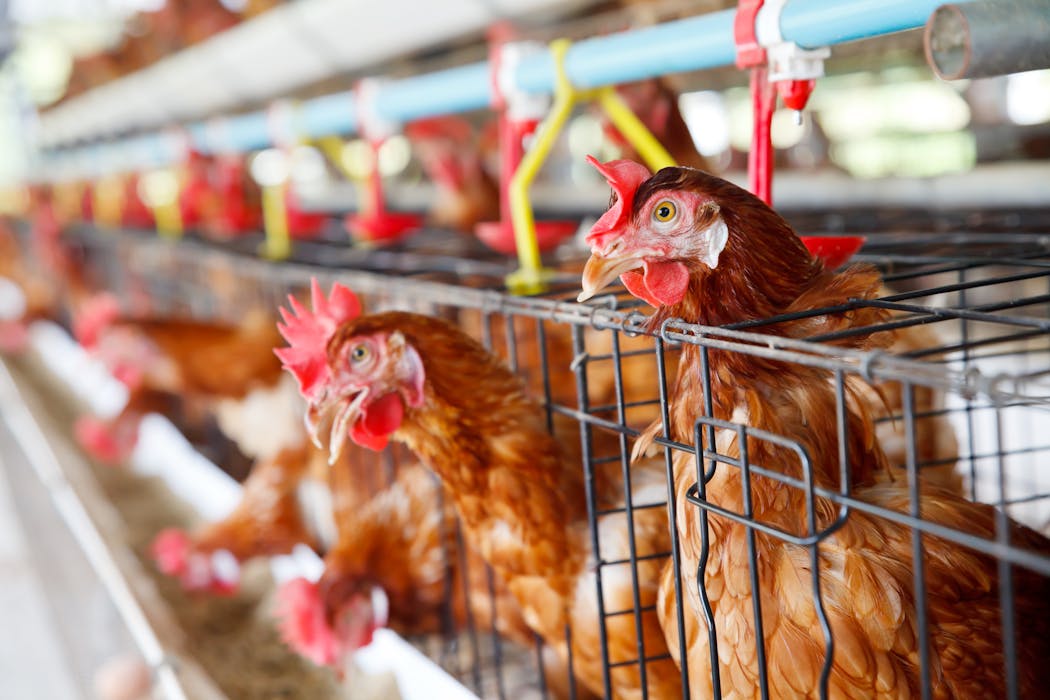 CHAIWATPHOTOS/Shutterstock
Caged hens will be a thing of the past. Puppy farming will be stopped. New laws will enforce humane slaughter standards. All this is part of a new animal welfare strategy for England announced by the government in December 2025.
The prospect of new animal welfare laws and better enforcement shows an intention to improve animal welfare standards and reduce animal suffering.
This follows the adoption into UK law in 2022 of the idea that animals are sentient beings. The Animal Welfare (Sentience) Act means that government has to check whether its policies consider and minimise any negative consequences for animal welfare. Other jurisdictions that have recognised animal sentience include the EU, New Zealand and parts of Canada and Australia.
But the wording of the law rarely means animal welfare should actually be prioritised. Instead, it means that animal welfare must be considered and properly taken into account. Where policy fails to do this it could be argued that there has been a failure in the decision-making process.
Ultimately, despite the legal recognition of sentience, the variety of welfare laws and policies highlights that how we treat animals still differs depending on their type and on how humans value or act around them.
The UK's animal sentience committee, the official body that scrutinises the government's animal welfare policy, recently identified some areas where policy falls short of properly considering animal welfare - for example, through inconsistent monitoring and enforcement of animal welfare standards. The committee also suggested there were "substantial" gaps in animal welfare enforcement.
Read more: How the world might look if animals had legal rights
Although animal sentience is recognised in law, animals are still treated as "things" in law and policy. While they have some protections, many people still consider them as our property. This is despite laws that create animal welfare standards and try to reduce animal harm by requiring the consideration of animal needs.
 Pigs are often farmed in crowded conditions.
Mark Agnor/Shutterstock
Pigs are often farmed in crowded conditions.
Mark Agnor/Shutterstock
When animals are viewed as food or needed to make products like milk or clothing, their sentience might not carry much weight. Clearly animals kept for meat will be killed but in this case, laws will usually require that slaughter is carried out "humanely" and that animals should suffer as little as possible before death.
Battery cages for poultry were banned in the UK in 2012, but "colony cages" (those that allow a larger number of hens to be kept in close proximity) are still allowed despite being considered by animal campaign groups and activists as cruel.
Some animals, such as crows or grey squirrels, are regarded as "pests" so that they can be killed or taken to protect human interests. Some controls are permitted as part of wildlife management to protect livestock or crops, for example and can be covered by what's known as a general licence.
Specific animals can be killed or taken without a clear identification and justification of the necessity of management or control. The law also allows control of pests on your property - this can include using poisons as long as the law is followed.
Five freedomsWild animals tend to be treated differently to companion animals like dogs and cats, which get more protection than wildlife mainly because they depend on humans for food and shelter. The law gives these companions a type of rights by creating legal obligations, sometimes creating a duty of care towards them.
The UK's Animal Welfare Act (2006) does more than just prevent animal cruelty. It creates a duty for people who own or care for companion animals to actively provide animal welfare.
These so-called "thin" rights are a limited form of rights that mean if you have a companion you must cater for the specific needs of your animals and ensure that the individual animal's needs are met according to the "five freedoms". These were developed in the 1960s following a major government report into the welfare of intensively farmed animals.
The five freedoms were then formally established by the Farm Animal Welfare Council - the independent body that has advised the UK government - as the basis of good animal welfare. These include freedom from hunger and thirst, discomfort, pain, disease and distress.
Read more: Animal sentience bill is necessary for the UK to be a true world leader in animal welfare
Thin rights are different to "thick" rights whereby the law protects all of an animal's fundamental interests such as an absolute right to life - such as the right not to be killed for human clothing or to be killed to benefit human commercial interests. The thick approach would prevent most actions that would interfere with an animal's rights.
A logical conclusion of applying thick rights would be an abolition of most if not all animal use, including the use of animals for food. The late animal rights lawyer Steven Wise argued that "without legal personhood, one is invisible to civil law. One has no civil rights. One might as well be dead". A thick approach gives animals rights not to be treated as "things".
Author George Orwell wrote in his 1945 book, Animal Farm, "All animals are equal, but some animals are more equal than others." He might have meant it as satirical comment on the Soviet Union, but the limitations of legal sentience for animals means it can be applied in a more literal way today. If we truly believe that all sentient creatures deserve protecting, the world has a long way to go to put this into practice.
Don't have time to read about climate change as much as you'd like?
Get a weekly roundup in your inbox instead. Every Wednesday, The Conversation's environment editor writes Imagine, a short email that goes a little deeper into just one climate issue. Join the 47,000+ readers who've subscribed so far.

Angus Nurse has received research funding from animal welfare organisations including the International Fund for Animal Welfare (IFAW) the RSPCA and Humane World for Animals (formerly called Humane Society International). He is an independent member of the Wild Animal Welfare Committee (WAWC)
Active Managed EV Charging Can Double EV Hosting Capacity [ 30-Jan-26 4:54pm ]Electric vehicles are 'batteries on wheels' and have capabilities beyond transportation. Because of the recent frigid weather and snow, someone mentioned the fact that a Ford Lightning can be used as backup power during an outage. Of course, it isn't only Lightnings that can provide such backup power. Potentially, any ... [continued]
The post Active Managed EV Charging Can Double EV Hosting Capacity appeared first on CleanTechnica.
Rooftop Solar Panels By Subscription: Up To 50% Savings On Electricity Bills [ 30-Jan-26 4:10pm ]The US startup Terra Energy is expanding its subscription-based rooftop solar panel business in California, Florida, and Texas, the three hottest solar markets in the US.
The post Rooftop Solar Panels By Subscription: Up To 50% Savings On Electricity Bills appeared first on CleanTechnica.
What a three-pointer [ 30-Jan-26 5:04pm ]
China is Riding an out of Control Energy Transition Avalanche [ 30-Jan-26 4:13pm ] In Australia, Electric Prices Plunge as Renewables Soar [ 30-Jan-26 4:03pm ]
The Flat Mars Society [ 30-Jan-26 3:00pm ]
DeBriefed 30 January 2026: Fire and ice; US formally exits Paris; Climate image faux pas [ 30-Jan-26 3:40pm ]Welcome to Carbon Brief's DeBriefed.
An essential guide to the week's key developments relating to climate change.
OZ HEAT: The ongoing heatwave in Australia reached record-high temperatures of almost 50C earlier this week, while authorities "urged caution as three forest fires burned out of control", reported the Associated Press. Bloomberg said the Australian Open tennis tournament "rescheduled matches and activated extreme-heat protocols". The Guardian reported that "the climate crisis has increased the frequency and severity of extreme weather events, including heatwaves and bushfires".
WINTER STORM: Meanwhile, a severe winter storm swept across the south and east of the US and parts of Canada, causing "mass power outages and the cancellation of thousands of flights", reported the Financial Times. More than 870,000 people across the country were without power and at least seven people died, according to BBC News.
COLD QUESTIONED: As the storm approached, climate-sceptic US president Donald Trump took to social media to ask facetiously: "Whatever happened to global warming???", according to the Associated Press. There is currently significant debate among scientists about whether human-caused climate change is driving record cold extremes, as Carbon Brief has previously explained.
Around the world- US EXIT: The US has formally left the Paris Agreement for the second time, one year after Trump announced the intention to exit, according to the Guardian. The New York Times reported that the US is "the only country in the world to abandon the international commitment to slow global warming".
- WEAK PROPOSAL: Trump officials have delayed the repeal of the "endangerment finding" - a legal opinion that underpins federal climate rules in the US - due to "concerns the proposal is too weak to withstand a court challenge", according to the Washington Post.
- DISCRIMINATION: A court in the Hague has ruled that the Dutch government "discriminated against people in one of its most vulnerable territories" by not helping them to adapt to climate change, reported the Guardian. The court ordered the Dutch government to set binding targets within 18 months to cut greenhouse gas emissions in line with the Paris Agreement, according to the Associated Press.
- WIND PACT: 10 European countries have agreed a "landmark pact" to "accelerate the rollout of offshore windfarms in the 2030s and build a power grid in the North Sea", according to the Guardian.
- TRADE DEAL: India and the EU have agreed on the "mother of all trade deals", which will save up to €4bn in import duty, reported the Hindustan Times. Reuters quoted EU officials saying that the landmark trade deal "will not trigger any changes" to the bloc's carbon border adjustment mechanism.
- 'TWO-TIER SYSTEM': COP30 president André Corrêa do Lago believes that global cooperation should move to a "two-speed system, where new coalitions lead fast, practical action alongside the slower, consensus-based decision-making of the UN process", according to a letter published on Tuesday, reported Climate Home News.
$2.3tn
The amount invested in "green tech" globally in 2025, marking a new record high, according to Bloomberg.
Latest climate research
- Including carbon emissions from permafrost thaw and fires reduces the remaining carbon budget for limiting warming to 1.5C by 25% | Communications Earth & Environment
- The global population exposed to extreme heat conditions is projected to nearly double if temperatures reach 2C | Nature Sustainability
- Polar bears in Svalbard - the fastest-warming region on Earth - are in better condition than they were a generation ago, as melting sea ice makes seal pups easier to reach | Scientific Reports
(For more, see Carbon Brief's in-depth daily summaries of the top climate news stories on Monday, Tuesday, Wednesday, Thursday and Friday.)
Captured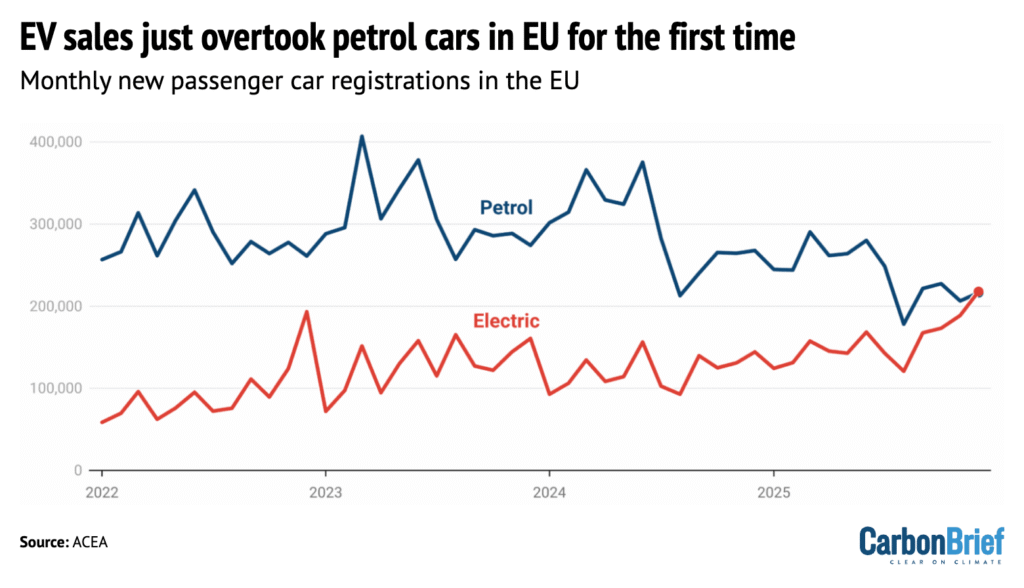
Sales of electric vehicles (EVs) overtook standard petrol cars in the EU for the first time in December 2025, according to new figures released by the European Automobile Manufacturers' Association (ACEA) and covered by Carbon Brief. Registrations of "pure" battery EVs reached 217,898 - up 51% year-on-year from December 2024. Meanwhile, sales of standard petrol cars in the bloc fell 19% year-on-year, from 267,834 in December 2024 to 216,492 in December 2025, according to the analysis.
Spotlight Looking at climate visualsCarbon Brief's Ayesha Tandon recently chaired a panel discussion at the launch of a new book focused on the impact of images used by the media to depict climate change.
When asked to describe an image that represents climate change, many people think of polar bears on melting ice or devastating droughts.
But do these common images - often repeated in the media - risk making climate change feel like a far-away problem from people in the global north? And could they perpetuate harmful stereotypes?
These are some of the questions addressed in a new book by Prof Saffron O'Neill, who researches the visual communication of climate change at the University of Exeter.
"The Visual Life of Climate Change" examines the impact of common images used to depict climate change - and how the use of different visuals might help to effect change.
At a launch event for her book in London, a panel of experts - moderated by Carbon Brief's Ayesha Tandon - discussed some of the takeaways from the book and the "dos and don'ts" of climate imagery.
Power of an image"This book is about what kind of work images are doing in the world, who has the power and whose voices are being marginalised," O'Neill told the gathering of journalists and scientists assembled at the Frontline Club in central London for the launch event.
O'Neill opened by presenting a series of climate imagery case studies from her book. This included several examples of images that could be viewed as "disempowering".
For example, to visualise climate change in small island nations, such as Tuvalu or Fiji, O'Neill said that photographers often "fly in" to capture images of "small children being vulnerable". She lamented that this narrative "misses the stories about countries like Tuvalu that are really international leaders in climate policy".
Similarly, images of power-plant smoke stacks, often used in online climate media articles, almost always omit the people that live alongside them, "breathing their pollution", she said.
 Ayesha Tandon with panellists at London's Frontline Club. Credit: Carbon Brief
During the panel discussion that followed, panellist Dr James Painter - a research associate at the Reuters Institute for the Study of Journalism and senior teaching associate at the University of Oxford's Environmental Change Institute - highlighted his work on heatwave imagery in the media.
Painter said that "the UK was egregious for its 'fun in the sun' imagery" during dangerous heatwaves.
He highlighted a series of images in the Daily Mail in July 2019 depicting people enjoying themselves on beaches or in fountains during an intense heatwave - even as the text of the piece spoke to the negative health impacts of the heatwave.
In contrast, he said his analysis of Indian media revealed "not one single image of 'fun in the sun'".
Meanwhile, climate journalist Katherine Dunn asked: "Are we still using and abusing the polar bear?". O'Neill suggested that polar bear images "are distant in time and space to many people", but can still be "super engaging" to others - for example, younger audiences.
Panellist Dr Rebecca Swift - senior vice president of creative at Getty images - identified AI-generated images as "the biggest threat that we, in this space, are all having to fight against now". She expressed concern that we may need to "prove" that images are "actually real".
However, she argued that AI will not "win" because, "in the end, authentic images, real stories and real people are what we react to".
When asked if we expect too much from images, O'Neill argued "we can never pin down a social change to one image, but what we can say is that images both shape and reflect the societies that we live in". She added:
Watch, read, listen"I don't think we can ask photos to do the work that we need to do as a society, but they certainly both shape and show us where the future may lie."
UNSTOPPABLE WILDFIRES: "Funding cuts, conspiracy theories and 'powder keg' pine plantations" are making Patagonia's wildfires "almost impossible to stop", said the Guardian.
AUDIO SURVEY: Sverige Radio has published "the world's, probably, longest audio survey" - a six-hour podcast featuring more than 200 people sharing their questions around climate change.
UNDERSTAND CBAM: European thinktank Bruegel released a podcast "all about" the EU's carbon adjustment border mechanism, which came into force on 1 January.
Coming up- 1 February: Costa Rican general election
- 3 February: UN Environment Programme Adaptation Fund Climate Innovation Accelerator report launch, Online
- 2-8 February: Intergovernmental Platform on Biodiversity and Ecosystem Services (IPBES) 12th plenary, Manchester, UK
- Climate Central, climate data scientist | Salary: $85,000-$92,000. Location: Remote (US)
- UN office to the African Union, environmental affairs officer | Salary: Unknown. Location: Addis Ababa, Ethiopia
- Google Deepmind, research scientist in biosphere models | Salary: Unknown. Location: Zurich, Switzerland
DeBriefed is edited by Daisy Dunne. Please send any tips or feedback to debriefed@carbonbrief.org.
This is an online version of Carbon Brief's weekly DeBriefed email newsletter. Subscribe for free here.

DeBriefed 23 January 2026: Trump's Davos tirade; EU wind and solar milestone; High seas hope
DeBriefed
|23.01.26
DeBriefed
|16.01.26

DeBriefed
|09.01.26
DeBriefed
|19.12.25
jQuery(document).ready(function() { jQuery('.block-related-articles-slider-block_fd6c8d128fbe93645ae5997219aef1f5 .mh').matchHeight({ byRow: false }); });The post DeBriefed 30 January 2026: Fire and ice; US formally exits Paris; Climate image faux pas appeared first on Carbon Brief.
Factcheck: What it really costs to heat a home in the UK with a heat pump [ 30-Jan-26 2:55pm ]Electric heat pumps are set to play a key role in the UK's climate strategy, as well as cutting the nation's reliance on imported fossil fuels.
Heat pumps took centre-stage in the UK government's recent "warm homes plan", which said that they could also help cut household energy bills by "hundreds of pounds" a year.
Similarly, innovation agency Nesta estimates that typical households could cut their annual energy bills nearly £300 a year, by switching from a gas boiler to a heat pump.
Yet there has been widespread media coverage in the Times, Sunday Times, Daily Express, Daily Telegraph and elsewhere of a report claiming that heat pumps are "more expensive" to run.
The report is from the Green Britain Foundation set up by Dale Vince, owner of energy firm Ecotricity, who campaigns against heat pumps and invests in "green gas" as an alternative.
One expert tells Carbon Brief that Vince's report is based on "flimsy data", while another says that it "combines a series of worst-case assumptions to present an unduly pessimistic picture".
This factcheck explains how heat pumps can cut bills, what the latest data shows about potential savings and how this information was left out of the report from Vince's foundation.
How heat pumps can cut billsHeat pumps use electricity to move heat - most commonly from outside air - to the inside of a building, in a process that is similar to the way that a fridge keeps its contents cold.
This means that they are highly efficient, adding three or four units of heat to the house for each unit of electricity used. In contrast, a gas boiler will always supply less than one unit of heat from each unit of gas that it burns, because some of the energy is lost during combustion.
This means that heat pumps can keep buildings warm while using three, four or even five times less energy than a gas boiler. This cuts fossil-fuel imports, reducing demand for gas by at least two-fifths, even in the unlikely scenario that all of the electricity they need is gas-fired.
.cb-tweet{ width: 65%; box-shadow: 3px 3px 6px #d3d3d3; margin: auto; } .cb-tweet img{ border: solid 1.25px #333333; border-radius: 5px; } @media (max-width:650px){ .cb-tweet{ width:100%; } }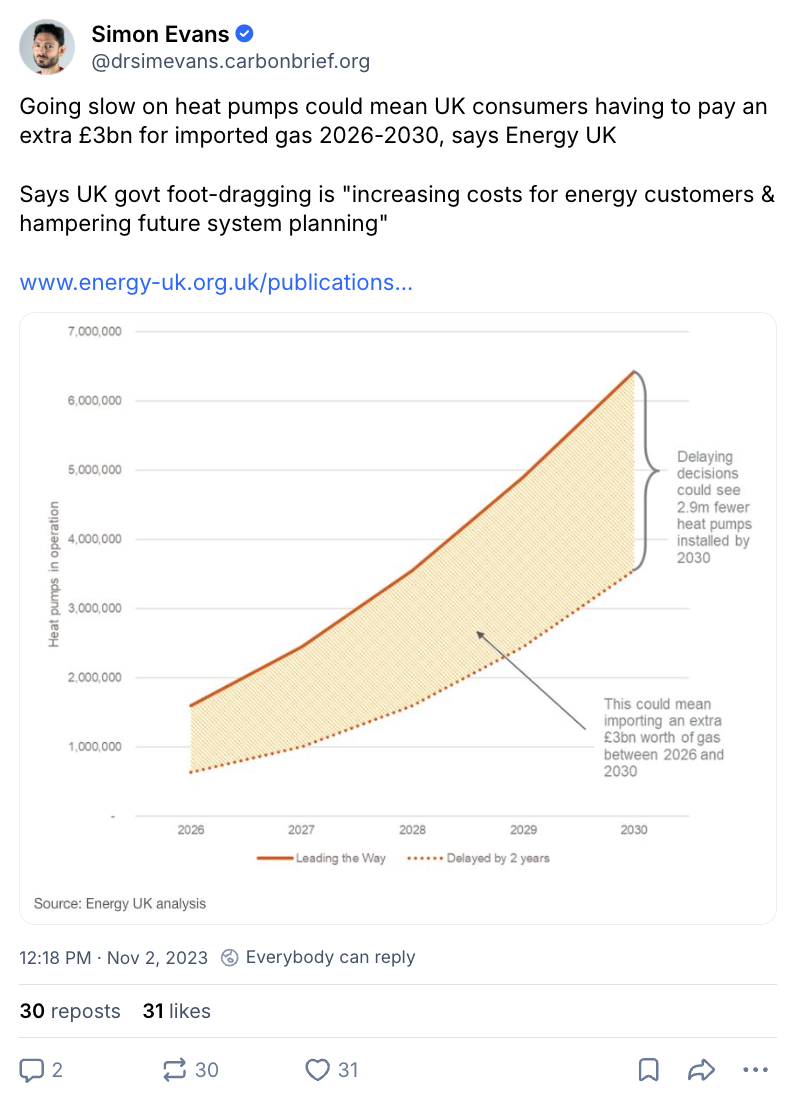
Since UK electricity supplies are now the cleanest they have ever been, heat pumps also cut the carbon emissions associated with staying warm by around 85%, relative to a gas boiler.
Heat pumps are, therefore, the "central" technology for cutting carbon emissions from buildings.
While heat pumps cost more to install than gas boilers, the UK government's recent "warm homes plan" says that they can help cut energy bills by "hundreds of pounds" per year.
Similarly, Nesta published analysis showing that a typical home could cut its annual energy bill by £280, if it replaces a gas boiler with a heat pump, as shown in the figure below.
Nesta and the government plan say that significantly larger savings are possible if heat pumps are combined with other clean-energy technologies, such as solar and batteries.
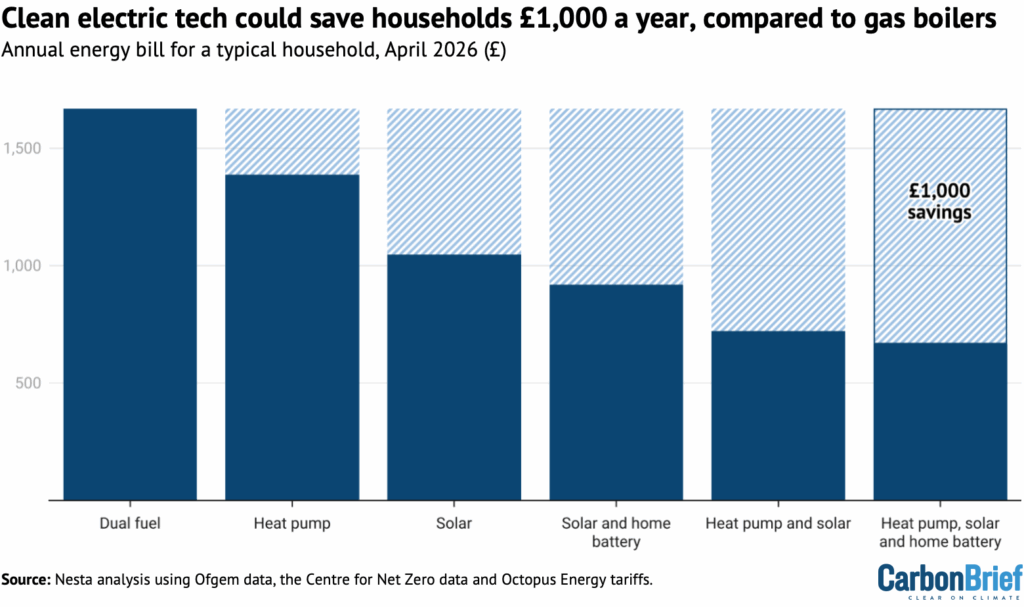 Annual energy bill savings (£) for a typical household from April 2026, by using different clean-energy technologies in comparison with a gas boiler. Source: Nesta analysis, using data from Ofgem, the Centre for Net Zero and an Octopus Energy tariff.
Both the government and Nesta's estimates of bill savings from switching to a heat pump rely on relatively conservative assumptions.
Specifically, the government assumes that a heat pump will deliver 2.8 units of heat for each unit of electricity, on average. This is known as the "seasonal coefficient of performance" (SCoP).
This figure is taken from the government-backed "electrification of heat" trial, which ran during 2020-2022 and showed that heat pumps are suitable for all building types in the UK.
(The Green Britain Foundation report and Vince's quotes in related coverage repeat a number of heat pump myths, such as the idea that they do not perform well in older properties and require high levels of insulation.)
Nesta assumes a slightly higher SCoP of 3.0, says Madeleine Gabriel, the organisation's director of sustainable future. (See below for more on what the latest data says about SCoP in recent installations.)
Both the government and Nesta assume that a home with a heat pump would disconnect from the gas grid, meaning that it would no longer need to pay the daily "standing charge" for gas. This currently amounts to a saving of around £130 per year.
Finally, they both consider the impact of a home with a heat pump using a "smart tariff", where the price of electricity varies according to the time of day.
Such tariffs are now widely available from a variety of energy suppliers and many have been designed specifically for homes that have a heat pump.
Such tariffs significantly reduce the average price for a unit of electricity. Government survey data suggests that around half of heat-pump owners already use such tariffs.
This is important because on the standard rates under the price cap set by energy regulator Ofgem, each unit of electricity costs more than four times as much as a unit of gas.
The ratio between electricity and gas prices is a key determinant of the size and potential for running-cost savings with a heat pump. Countries with a lower electricity-to-gas price ratio consistently see much higher rates of heat-pump adoption.
(Decisions taken by the UK government in its 2025 budget mean that the electricity-to-gas ratio will fall from April, but current forecasts suggest it will remain above four-to-one.)
In contrast, Vince's report assumes that gas boilers are 90% efficient, whereas data from real homes suggests 85% is more typical. It also assumes that homes with heat pumps remain on the gas grid, paying the standing charge, as well as using only a standard electricity tariff.
Prof Jan Rosenow, energy programme leader at the University of Oxford's Environmental Change Institute, tells Carbon Brief that Vince's report uses "worst-case assumptions". He says:
"This report cherry-picks assumptions to reach a predetermined conclusion. Most notably, it assumes a gas boiler efficiency of 90%, which is significantly higher than real-world performance…Taken together, the analysis combines a series of worst-case assumptions to present an unduly pessimistic picture."
Similarly, Gabriel tells Carbon Brief that Vince's report is based on "flimsy data". She explains:
What the latest data shows about bill savings"Dale Vince has drawn some very strong conclusions about heat pumps from quite flimsy data. Like Dale, we'd also like to see electricity prices come down relative to gas, but we estimate that, from April, even a moderately efficient heat pump on a standard tariff will be cheaper to run than a gas boiler. Paired with a time-of-use tariff, a heat pump could save £280 versus a boiler and adding solar panels and a battery could triple those savings."
The efficiency of heat-pump installations is another key factor in the potential bill savings they can deliver and, here, both the government and Vince's report take a conservative approach.
They rely on the "electrification of heat" trial data to use an efficiency (SCoP) of 2.8 for heat pumps. However, Rosenow says that recent evidence shows that "substantially higher efficiencies are routinely available", as shown in the figure below.
Detailed, real-time data on hundreds of heat pump systems around the UK is available via the website Heat Pump Monitor, where the average efficiency - a SCoP of 3.9 - is much higher.
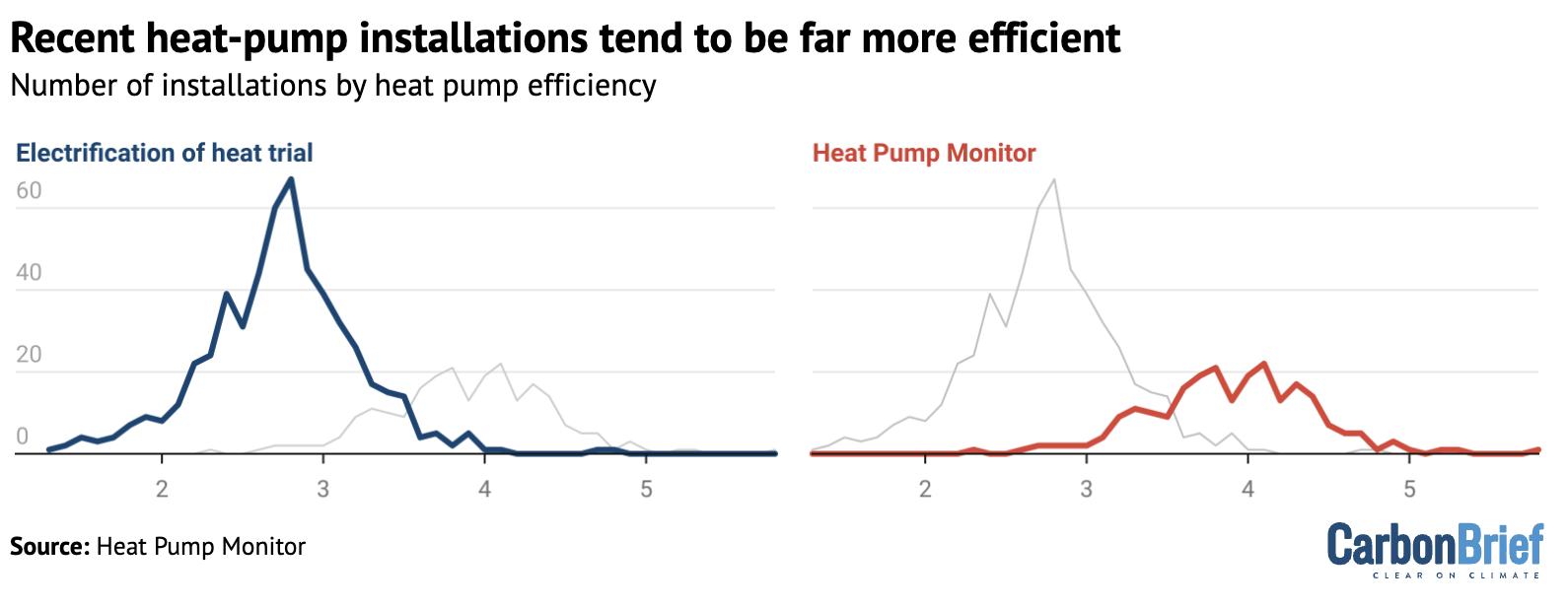 Number of installations by heat pump efficiency, in the electrification of heat trial (left) and on the website Heat Pump Monitor (right). An efficiency of three means that each unit of electricity delivers three units of heat, on average, across a year. Source: Heat Pump Monitor.
Homes with such efficient heat-pump installations would see even larger bill savings than suggested by the government and Nesta estimates.
Academic research suggests that there are simple and easy-to-implement reasons why these systems achieve much higher efficiency levels than in the electrification of heat trial.
Specifically, it shows that many of the systems in the trial have poor software settings, which means they do not operate as efficiently as their heat pump hardware is capable of doing.
The research suggests that heat pump installations in the UK have been getting more and more efficient over time, as engineers become increasingly familiar with the technology.
It indicates that recently installed heat pumps are 64% more efficient than those in early trials.
.cb-tweet{ width: 65%; box-shadow: 3px 3px 6px #d3d3d3; margin: auto; } .cb-tweet img{ border: solid 1.25px #333333; border-radius: 5px; } @media (max-width:650px){ .cb-tweet{ width:100%; } }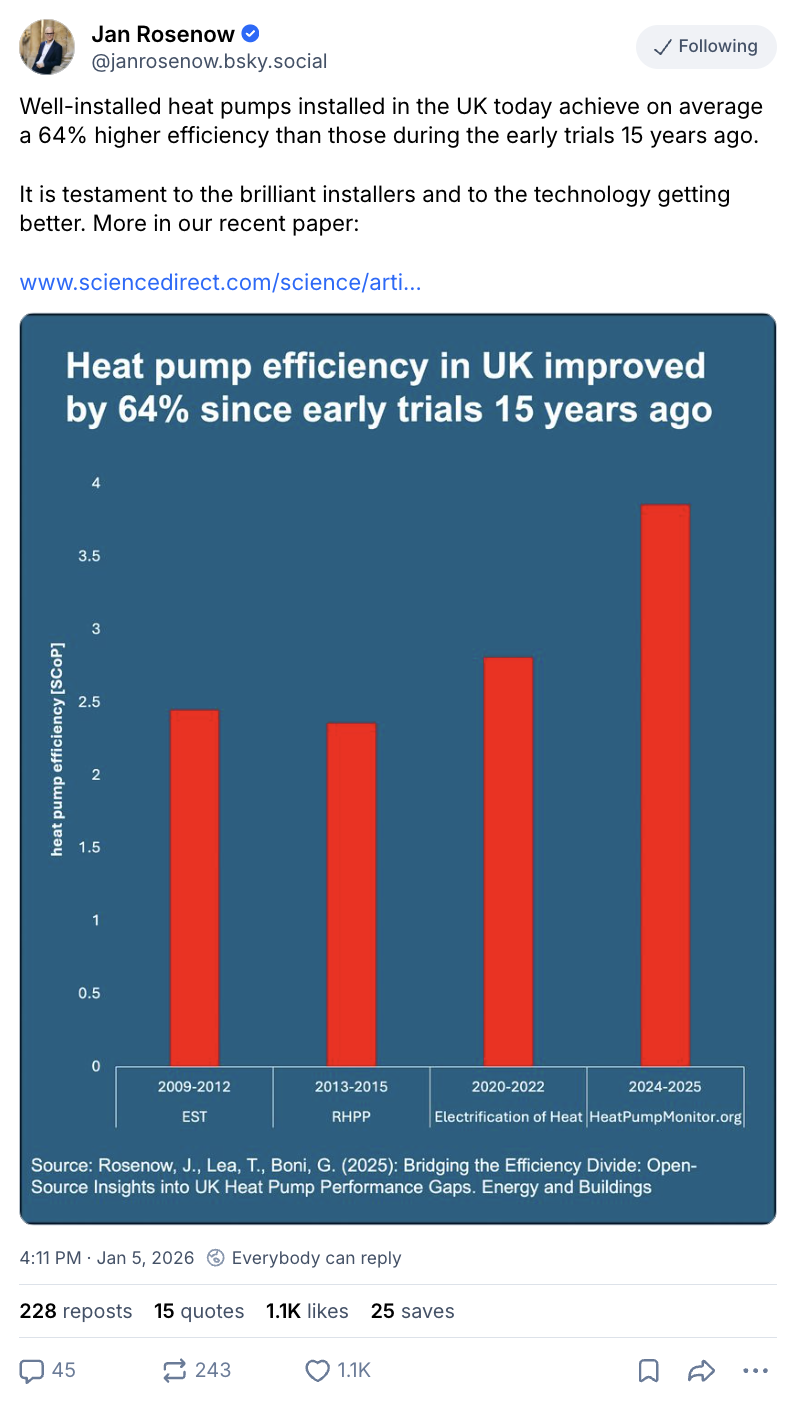
Notably, the Green Britain Foundation report only refers to the trial data from the electrification of heat study carried out in 2020-22 and the even earlier "renewable heat premium package" (RHPP). This makes a huge difference to the estimated running costs of a heat pump.
Carbon Brief analysis suggests that a typical household could cut its annual energy bills by nearly £200 with a heat pump - even on a standard electricity tariff - if the system has a SCoP of 3.9.
The savings would be even larger on a smart heat-pump tariff.
In contrast, based on the oldest efficiency figures mentioned in the Green Britain Foundation report, a heat pump could increase annual household bills by as much as £200 on a standard tariff.
To support its conclusions, the report also includes the results of a survey of 1,001 heat pump owners, which, among other things, is at odds with government survey data. The report says "66% of respondents report that their homes are more expensive to heat than the previous system".
There are several reasons to treat these findings with caution. The survey was carried out in July 2025 and some 45% of the heat pumps involved were installed between 2021-23.
This is a period during which energy prices surged as a result of Russia's invasion of Ukraine and the resulting global energy crisis. Energy bills remain elevated as a result of high gas prices.
The wording of the survey question asks if homes are "more or less expensive to heat than with your previous system" - but makes no mention of these price rises.
The question does not ask homeowners if their bills are higher today, with a heat pump, than they would have been with the household's previous heating system.
If respondents interpreted the question as asking whether their bills have gone up or down since their heat pump was installed, then their answers will be confounded by the rise in prices overall.
There are a number of other seemingly contradictory aspects of the survey that raise questions about its findings and the strong conclusions in the media coverage of the report.
For example, while only 15% of respondents say it is cheaper to heat their home with a heat pump, 49% say that one of the top three advantages of the system is saving money on energy bills.
In addition, 57% of respondents say they still have a boiler, even though 67% say they received government subsidies for their heat-pump installation. It is a requirement of the government's boiler upgrade scheme (BUS) grants that homeowners completely remove their boiler.
The government's own survey of BUS recipients finds that only 13% of respondents say their bills have gone up, whereas 37% say their bills have gone down, another 13% say they have stayed the same and 8% thought that it was too early to say.
Factcheck: North Sea gas is not 'four times cleaner' than LNG imports
Factchecks
|05.09.25
Factcheck: 16 misleading myths about solar power
Factchecks
|28.08.25
Factcheck: Trump's climate report includes more than 100 false or misleading claims
Factchecks
|14.08.25
Factcheck: Why expensive gas - not net-zero - is keeping UK electricity prices so high
Energy
|20.05.25
jQuery(document).ready(function() { jQuery('.block-related-articles-slider-block_3ba2ed77192775b000d94a528c6b6e15 .mh').matchHeight({ byRow: false }); });The post Factcheck: What it really costs to heat a home in the UK with a heat pump appeared first on Carbon Brief.
Do neurodivergent people see reality easier? [ 30-Jan-26 3:10pm ]I am neurodivergent and have some AuDHD characteristics. I've seen collapse coming pretty much my whole lifetime (I am 70 now) but particularly after having this confirmed in the 1972 MIT limits to growth work.
My problem was I saw things way too early, so bought gold at $500 an ounce, built resiliency buffers into my life 30 years ago etc... while neurotypical people thought I was crazy when I would try and explain the future that was coming... ~40+ years ahead of the curve.
I just read this very interesting article suggesting these foresights are common in people with neurodivergent brains... and am curious if others have found this to also be true?
https://adrianlambert.substack.com/p/why-some-people-see-collapse-earlier/comments
submitted by /u/shastatodd[link] [comments]
As climate-fueled disasters grow in frequency and strength, the worst possible people are in charge of FEMA. It's costing Americans billions. [ 30-Jan-26 3:23pm ]
Nipah Virus is Asia's Ebola [ 30-Jan-26 2:34pm ]
Plastic patrol: the citizen scientists tackling litter in Australian waterways [ 30-Jan-26 2:00pm ]Plastics make up the majority of litter across the country. In the absence of regulation, the public are taking matters into their own hands
Change by degrees offers life hacks and sustainable living tips each Saturday to help reduce your household's carbon footprint
Got a question or tip for reducing household emissions? Email us at changebydegrees@theguardian.com
Neil Blake weighs a paper bag of fake grass fragments he has collected from a stormwater gutter near Darebin Creek in Melbourne's north.
Over the past three years Blake has conducted 56 collections of synthetic turf in the waterway alongside the KP Hardiman Reserve hockey pitch.
Continue reading...
New limits on global trade of sharks won't be enough to save them from overfishing - new research [ 30-Jan-26 1:01pm ]More than one-third of sharks and rays are now threatened with extinction, making them among the most imperilled vertebrates on Earth. Why? Overfishing, both as targeted catches for their valuable fins, meat, gills and liver oil, and as bycatch in nets and lines set for other fish.
In late 2025, governments took sweeping action for sharks and rays. At a global conference on wildlife trade in Uzbekistan more than 70 shark and ray species received new or stronger international trade limits.
Whale shark, oceanic whitetip shark, wedgefish, devil rays and gulper sharks were among those subject to stricter regulations. This is a major political milestone for shark conservation.
But here's the uncomfortable truth: as I outline in my new research paper published in the journal Nature Ecology and Evolution, trade regulation alone won't save sharks.
Cites, the convention on international trade in endangered species of wild fauna and flora, is the main global agreement regulating international wildlife trade, seeking to ensure the survival of the 41,000 species covered by the convention.
Read more: The world wildlife trade regulator is 50 - here's what has worked and what needs to change
Countries can only export most of the more than 1,000 shark and ray species covered by Cites regulations if they demonstrate trade is sustainable. A handful of highly threatened species (including sawfishes, manta and devil rays, whale shark, oceanic whitetip shark) are afforded the highest protection, where international trade is permitted only under exceptional circumstances.
In theory, these regulations can reduce fishing pressure. In practice, the pathway from paperwork to population recovery is far from guaranteed.
Promise and pitfallsInternational trade is only one driver of shark overfishing. Shark and ray fishing mortality is also a byproduct of wild-caught fish. And, in many small-scale fisheries, sharks and rays are valuable secondary catch - meaning they are not the main target catch, but they still have value to fishers because they are sold in domestic markets or eaten locally.
These local drivers sustain fishing mortality, which means lots of sharks and rays get killed regardless of what happens to international trade.
Some shark fishing isn't even driven by demand. In many coastal communities, production is supply driven: shaped mainly by the need to generate income and survive.
In Indonesia, when I've asked fishers what they'd do if shark prices fell, some say they'll fish harder, not less, to maintain their income. In such contexts, Cites listings alone are unlikely to reduce fishing pressure unless trade regulations drive efforts to address local causes of overfishing.
Cites is also implemented through each country's own policies and domestic management measures. Those can range from exemplary - with meaningful, well-implemented trade management that helps wild populations recover (such as the saiga antelope in Kazakhstan) to performative - where regulations exist on paper but are never implemented in practice (this includes, arguably, protection for some sharks, based on recent global trade analyses).
Even trade restrictions implemented with good intentions can backfire. For example, when supply is restricted but demand stays strong, prices rise - potentially incentivising more fishing and black markets.
This dynamic has played out with pangolins and ivory and cannot be ignored for sharks and rays, especially due to the "the snob effect" - when demand for a product increases as it becomes rarer or more expensive. When people consume shark products to display their status, scarcity can make them more attractive - meaning that restrictions on shark fishing might accidentally drive up demand rather than reduce it.
There's also displacement to consider. When Indonesia protected manta rays, some fishers shifted to catching other unprotected ray species instead. Restrictions in one part of the market can redistribute pressure rather than reduce it.
From paperwork to positive outcomesThree broad scenarios now lie ahead for sharks and rays.
In the best case, Cites catalyses integrated reforms across trade chains and the entire seafood sector. Supply countries establish sustainable catch limits to manage bycatch and targeted fisheries in small-scale and commercial contexts. Limits are implemented through effective compliance management including fair support for small-scale fishers already on the margins.
On the demand side, targeted demand management for shark products and other seafood with embedded negative impacts weakens the market signals that makes overfishing profitable in the first place. Overfishing halts and populations begin to recover. Evidence from mammals suggests this pathway is possible - but only if Cites triggers a range of global-to-local management measures.
In a business-as-usual scenario, the new listings deliver little. Countries adopt policies on paper while fishing continues unabated. Trade continues legally, in domestic markets or through new international bureaucracies, or moves illegally, through black markets and laundering. Current evidence on global shark trade flows suggests this is the direction of travel, though these new listings may shift the needle.
In the worst case, well-intended restrictions backfire. Prices spike, black markets expand, and fishers - squeezed economically - fish harder and riskier. Policy inadvertently accelerates decline.
Which future unfolds depends on what happens next. New Cites listings represent an opportunity for transformative change. But only if they are seen as a means to an end - one which catalyses broader reforms, from fisheries through to consumption, focused on limiting fishing mortality - rather than a standalone measure.
If the goal is a more sustainable future for both people and nature, then success must be measured in both the abundance and diversity of species and the wellbeing of people, not in the number of new policies. New trade regulations got the headlines. The harder, messier work of making them count starts now.
Don't have time to read about climate change as much as you'd like?
Get a weekly roundup in your inbox instead. Every Wednesday, The Conversation's environment editor writes Imagine, a short email that goes a little deeper into just one climate issue. Join the 47,000+ readers who've subscribed so far.

Hollie Booth is the Co-Founder and Director of Yayasan Kebersamaan Untuk Lautan, a marine conservation non-profit in Indonesia.
Experts: Will Chinese wind power help or hinder Europe's climate goals? [ 30-Jan-26 12:54pm ]The European Union and the UK are not on track to meet their 2030 offshore wind targets.
At the same time, Chinese wind-turbine manufacturers - who account for more than half of global wind-turbine capacity - are looking to grow their footprint in the European market, where their presence is currently tiny.
To some, the solution seems clear: allowing Chinese manufacturers to invest in Europe could boost competition, alleviate supply chain bottlenecks and lower costs - not to mention bring climate targets within reach.
But the possibility of a growing role for Chinese wind-turbine manufacturers in the European market has sparked heated debate among European policymakers and industry participants.
In 2024, three of China's top wind-turbine companies accounted for less than 1% of Europe's installed wind capacity.
But their focus is increasingly shifting to the continent, which some are concerned could hollow out the one clean-energy industry in which Europe is still competitive.
Competition between European and Chinese manufacturers would be "unfair", according to critics, because the discounts Chinese firms are offering seem to be at least in part due to state subsidies.
In a recent report published by the Oxford Institute for Energy Studies, we explore whether Chinese wind turbine companies are competitive in Europe and the real risks and benefits of Chinese participation in European offshore wind markets.
Our findings build on interviews with policymakers and industry experts, who have been granted anonymity to allow for candid discussion.
Cost advantages are less clear-cut than they appearChina ranks first for many of the global statistics for offshore wind. It has been by far the largest offshore wind market in the world for several years running.
China had 47 gigawatts (GW) of offshore wind installed, as of September 2025, more than all other countries combined. Furthermore, China also dominates several key fields critical to offshore wind globally, ranging from permanent magnets to offshore installation vessels.
This stands in firm contrast to Europe - where offshore development has experienced several years of slow growth - and the US, which faces an almost complete halt in new development under the Trump administration.
As happened before in solar and batteries, China's offshore wind industry scale-up has brought about stunning declines in installation costs.
However, this cost advantage is not as straightforward as these headline numbers would suggest. Despite the vast difference in capacity cost, the electricity produced by Chinese offshore wind farms is only 30% cheaper.
A key reason for this is the lower overall capacity factor of China's offshore wind sector, referring to the actual output of windfarms in China, compared to their maximum possible output. This can be partly explained by lower wind speeds at China's offshore sites, but could also relate to lower performance of Chinese turbines, as well as power transmission issues.
Lower production costs in China also would not necessarily translate to the European market, as Chinese cost advantages would be partly offset by transport costs, as well as higher insurance and financing premiums.
Greater localisation of turbine production could mitigate against some of these premiums, but would be offset by higher input costs in Europe.
Nonetheless, as more European governments add local content requirements, Chinese manufacturers have announced plans to set up European factories for turbine blades and towers, with core components shipped from China.
These factories could also be costlier to finance than those back home if financing for investments also comes from Europe, further reducing the cost advantage enjoyed by China's domestic offshore-energy infrastructure.
Issues beyond costs and bottlenecksEuropean offshore wind development plans have faced a number of hurdles, including rising costs, slow permitting processes, inefficient auction designs, lengthy grid connection times and limited availability of parts, port capacity and installation vessels.
The small number of players in Europe's offshore wind sector is seen as part of the problem, according to our interviews.
Currently, there are only three major wind turbine manufacturers in the European offshore wind market: Vestas, Siemens Gamesa and GE Vernova.
The latter announced in 2024 that it is downsizing its offshore wind business and has not taken new offshore orders, although it remains active in onshore wind projects. This reduces competition and could hinder efforts to bring down the cost of offshore wind projects.
Bottlenecks, inadequate industry capacity and lack of competition cannot in themselves explain the current European predicament. Developers we interviewed also note that offshore wind auctions with price caps and stringent contractual terms, designed with an expectation of falling costs, have also been part of the problem.
When these auctions have failed - as in the UK in 2023 and Germany in 2025 - this led to capacity contraction, higher costs and industry consolidation, which have only made it more difficult to reach policy targets, according to a report by European offshore wind company Ørsted.
Even with improved European auction design, it may take years for Europe's offshore wind installation numbers to recover. With or without Chinese participation, it will also take time to build domestic manufacturing bases and installation vessels.
Pathways to Chinese involvementMeanwhile, Chinese developers benefit from a large and growing domestic market in China. At the same time, however, intense competition on price and quality is spurring them to seek opportunities overseas.
Throughout Europe's supply chain, Chinese components and services are already helping alleviate shortages and bottlenecks.
Still, our report found there are divergent views on whether a greater Chinese presence in Europe's wind markets represents a threat or an opportunity - or both.
Policymakers are expected to continue to emphasise concerns about technology dependence and cybersecurity risks, leading to more domestic content requirements and increased scrutiny of Chinese deals.
The case of the 300 megawatt (MW) Luxcara project in Germany highlights the difficulties for Chinese market entry. Chinese manufacturer Mingyang was initially selected by the project owner in 2024, but was later replaced by Siemens-Gamesa, reportedly due to concerns about security and political risks.
The recent announcement of a deal between the UK's Octopus Energy and Mingyang may illustrate an emerging model. According to Octopus, Mingyang will supply the physical equipment, while Octopus will supply the software and manage the turbines.
Mingyang will still need access to operational data to support ongoing maintenance, but this can be provided periodically by Octopus without compromising security, the energy company told us.
Meanwhile, following policy signals such as the EU's new pricing mechanism for electric vehicle imports from China, it seems likely that policymakers will continue to encourage Chinese players to establish production bases in Europe and to require technology licensing or technology transfer in exchange for market access. This would amount to applying the Chinese industrial development model in Europe.
This could allow for technological learning in Europe. In China, the largest players have deployed advanced automated manufacturing lines, including robotic blade bonding, modular stator assembly and real-time quality monitoring - although this may have implications for job creation, a stated aim in Europe's clean-energy policy.
Despite pointing to some advantages, our interviews suggest that Chinese participation in Europe's offshore wind market is not a panacea.
Its low costs are unlikely to be transferrable to the European context. But greater Chinese participation in auctions and in manufacturing, with local content requirements and other guardrails, could help spur competition in Europe.
At the same time, our report suggests that the focus on China distracts from deeper issues. Without a growing domestic market, it may be difficult for European players to reduce manufacturing costs and upgrade production, with or without Chinese partners.
Ultimately, industry participants tell us that the greatest determinant of success in Europe's offshore wind market will be consistent policy support, rather than a decision to allow - or to block - Chinese participation.

Explainer: Why gas plays a minimal role in China's climate strategy
China energy
|22.01.26

Experts: What to expect from China on energy and climate action in 2026
China energy
|16.01.26
Analysis: Coal power drops in China and India for first time in 52 years after clean-energy records
China energy
|13.01.26

Q&A: Five key climate questions for China's next 'five-year plan'
China energy
|11.12.25
jQuery(document).ready(function() { jQuery('.block-related-articles-slider-block_884cb99f440fac162005e6c3b18c806e .mh').matchHeight({ byRow: false }); });The post Experts: Will Chinese wind power help or hinder Europe's climate goals? appeared first on Carbon Brief.
Met Office: A review of the UK's climate in 2025 [ 30-Jan-26 12:23pm ]The UK's climate saw a record-breaking 2025, with the year being both the warmest and sunniest seen since observations began.
The year 2025 has joined 2024, 2023, 2022 and 2014 in the UK's top-five warmest years.
In this review, we take a look back at the UK's climate in 2025 and place the record-breaking year in the context of human-caused climate change. We find:
- It was the warmest and sunniest year on record. January and September were the only months that were cooler than average.
- A Met Office attribution study estimates that 2025's average temperature would have been exceptionally unlikely in pre-industrial times - but could now occur, on average, every three years.
- Spring was the warmest on record, breaking a record set in 2024.
- Spring was not only the sunniest on record, but the fourth-sunniest season ever recorded, after the summers of 1976, 1996 and 1911.
- It was the warmest summer on record. The summer temperature record was made around 70 times more likely due to human-induced climate change.
- The persistent high-pressure systems in spring and summer, which contributed to the warm and sunny conditions, also resulted in an extended dry spell - including the driest spring since 1974.
- Wetter conditions at the end of the year alleviated some of the rain shortfall. The year concluded with 90% of average annual rainfall.
- Storm Éowyn in late January was the most powerful wind storm in over a decade and the most severe storm in Northern Ireland since 1998.
- Storm Floris in early August was not unprecedented for a storm, but was one of the most severe wind storms to affect Scotland during the summer.
- Storm Amy in early October hit north-western parts of the UK, with heavy rain falling widely, resulting in the wettest day of the year for the UK overall.
(See our previous annual analysis for 2024, 2023, 2022, 2021, 2020, 2019 and 2018.)
The year in summaryThe Met Office relies on the long-running HadUK-Grid dataset to place recent UK weather and climate into its historical context. The gridded, geographically complete dataset combines observational data for monthly temperature since 1884, rainfall since 1836 and sunshine since 1910.
Unless stated otherwise, the rankings of events and statements (such as "warmest on record") in this article relate to the HadUK-Grid series.
The "climate anomaly" maps below show the difference between the average temperature (left), rainfall total (middle) and sunshine duration (right) between 2025 and the 1991-2020 period. In other words, they show how much warmer, cooler, wetter, drier, sunnier or cloudier the year was than average for each county of the UK.
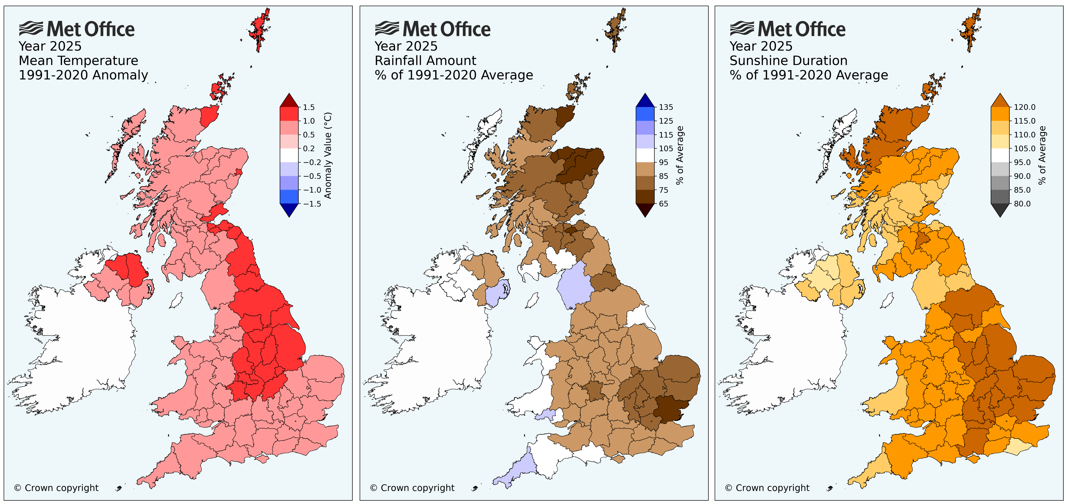 Maps showing anomalies in 2025 relative to a 1991-2020 reference period for temperature (C), precipitation (%) and sunshine (%). The darker shading indicates a greater departure from average. Credit: Met Office
The maps show that the whole country was warmer than average, with central and north-east England, parts of Northern Ireland and the tip of north-west Scotland, Orkney and Shetland seeing the greatest change.
The UK overall had 90% of average rainfall. The driest regions relative to average were around Essex, Moray and Aberdeenshire, which received less than 75% of normal annual rainfall.
In contrast, some western counties were slightly wetter than average - including Cornwall (110%) and Cumbria (107%).
Sunshine was above average across the UK, with eastern England and north Scotland exceeding 120% of the average.
AttributionThe UK's absolute temperature averaged at 10.09C in 2025. This follows 2022 (at 10.03C) as the second time that the annual average temperature has exceeded 10C.
In our analysis of the UK's climate in 2022 for Carbon Brief, we reported on a Met Office attribution study that found that human-caused climate change had increased the likelihood of UK annual absolute temperature averaging above 10C by a factor 160.
That study concluded that exceeding 10C - while unprecedented in the historical observational record - would become increasingly common and would likely occur every three-to-four years.
Three years on from that analysis and the 10C threshold has been breached for a second time - and an updated attribution analysis has been produced exploring the likelihood of a return of temperatures above the 10.09C recorded in 2025.
The study, which uses the same methodology as the 2022 paper, finds that UK annual mean temperatures above 10.09C are estimated to occur approximately every three years in the current climate. In contrast, they would have occurred around every 780 years in pre-industrial times.
Human-caused climate change has, therefore, increased the probability of average temperatures in excess of 10.09C by a factor of 260.
These results show that 2025's record-breaking annual temperature - while unprecedented in the historical observational record - should be considered fairly normal in the current climate.
Climate projections indicate that, by the later part of the 21st century, a year like 2025 could be a relatively cool year.
The figure below compares observations of UK annual average temperatures (black line) - relative to the long-term average - to climate model simulations that include (red/purple) or exclude (green) human-caused emissions of greenhouse gases and land-use change.
The green and red curves start to diverge from around the 1980s, suggesting that human influence is indeed the dominant factor in the warming trend. The shaded range of the simulations show that in our current and future climate, much warmer years than 2025 are plausible.
Colder years are also still possible, but it is much less likely that we would experience a cold year like 2010 - and exceptionally unlikely for a year to be in the top-10 coldest years for the UK. The most recent year to feature in the top-10 coldest years was 1963.
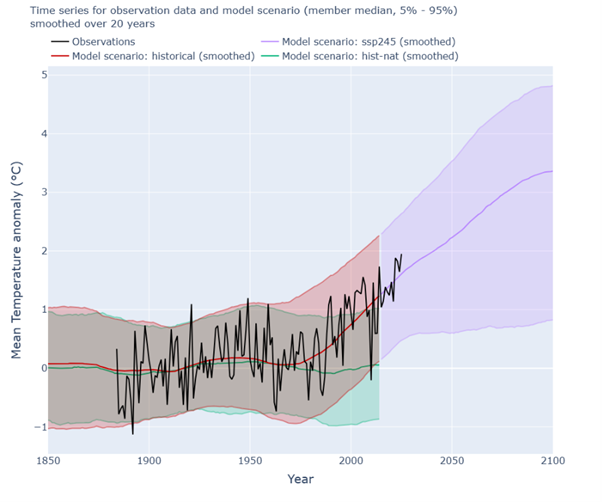 Timeseries of the UK annual mean temperature anomaly (w.r.t. 1901 - 1930). Observational data from HadUK-Grid (black). Simulations from the CMIP6 historical simulation including natural and human-caused drivers (red), SSP2-4.5 projections of future climate based on a "medium" emissions scenario (purple) and "hist-nat" simulations that include only natural drivers of climate such as solar and volcanic activity (green). Simulation data is represented as median values and filled 5-95th percentile ranges explored by members of the multi-model ensemble. Percentiles of simulation data are smoothed with a rolling window of 20 years, with historical and SSP2-4.5 combined into one continuous series. Observed data runs from 1884-2025. Credit: Met Office
Warmer, wetter, sunnier
Timeseries of the UK annual mean temperature anomaly (w.r.t. 1901 - 1930). Observational data from HadUK-Grid (black). Simulations from the CMIP6 historical simulation including natural and human-caused drivers (red), SSP2-4.5 projections of future climate based on a "medium" emissions scenario (purple) and "hist-nat" simulations that include only natural drivers of climate such as solar and volcanic activity (green). Simulation data is represented as median values and filled 5-95th percentile ranges explored by members of the multi-model ensemble. Percentiles of simulation data are smoothed with a rolling window of 20 years, with historical and SSP2-4.5 combined into one continuous series. Observed data runs from 1884-2025. Credit: Met Office
Warmer, wetter, sunnier
Four of the UK's last five years all appear in the top-five warmest years since 1884.
The Central England Temperature (CET) series is the longest continuous instrumental climate record in the world, dating back to 1659. Covering a region roughly enclosed by Lancashire, London and Bristol, it does not represent the whole of the UK. However, when averaged across a year and analysed across centuries, it does provide a multi-century perspective that is representative of climate variations and changes that impacted the UK.
As with the HadUK-Grid temperature record, the CET series also identifies 2025 as the warmest year on record. The longer-running temperature series identifies the same five years - in the same order - as the warmest on record. This is shown in the table below.
YearUK (from HadUK-Grid)Central England Temperature 202510.09C11.23C 202210.03C11.18C 20239.97C11.13C 20149.88C11.04C 20249.79C10.96CThe graph below of the CET series shows that temperatures recorded in recent years are well outside the range of variability recorded over more than 300 years.
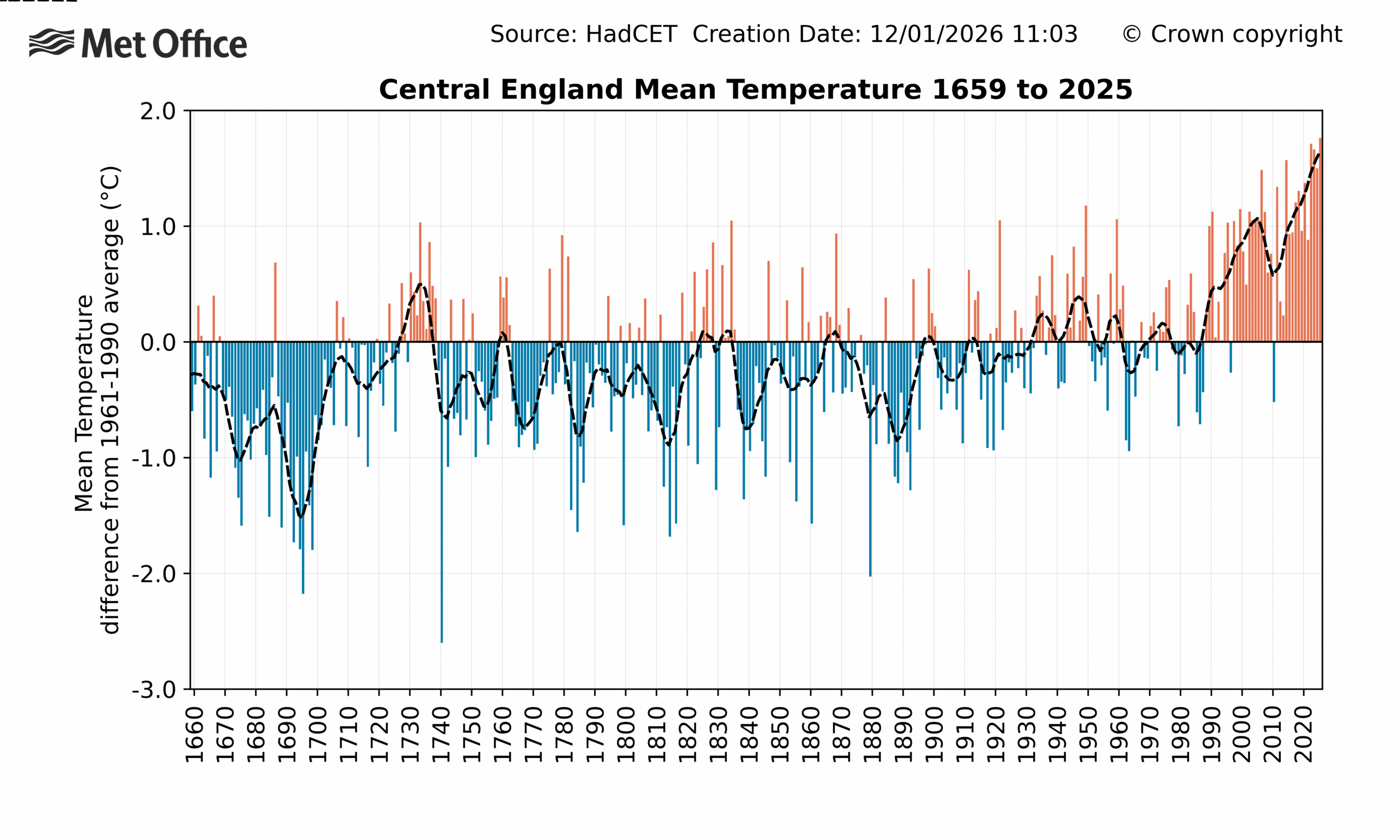 Average temperature anomalies (relative to a 1961-90 average) for each year in the CET series from 1659 to 2025. Colours show years that are above (red) or below (blue) average. The dashed line is a smoothed series to show the decadal variations and trend. Credit: Met Office
However, the UK is not only warming, it is also getting wetter and sunnier. The year 2025 was relatively dry, recording 90% of average rainfall. This made it the driest year recorded since 2010 and put it in contrast to relatively wet years in 2023 and 2024.
The longer-term trend can be seen in the figure below, which shows that 2025 was relatively dry compared to recent decades, but not exceptional in the longer-term historical context.
The last time the UK had a year in the top-10 driest was in 1955, whereas all five of the top-10 wettest years have occurred this millennium. The wettest year on record still stands as 1872.
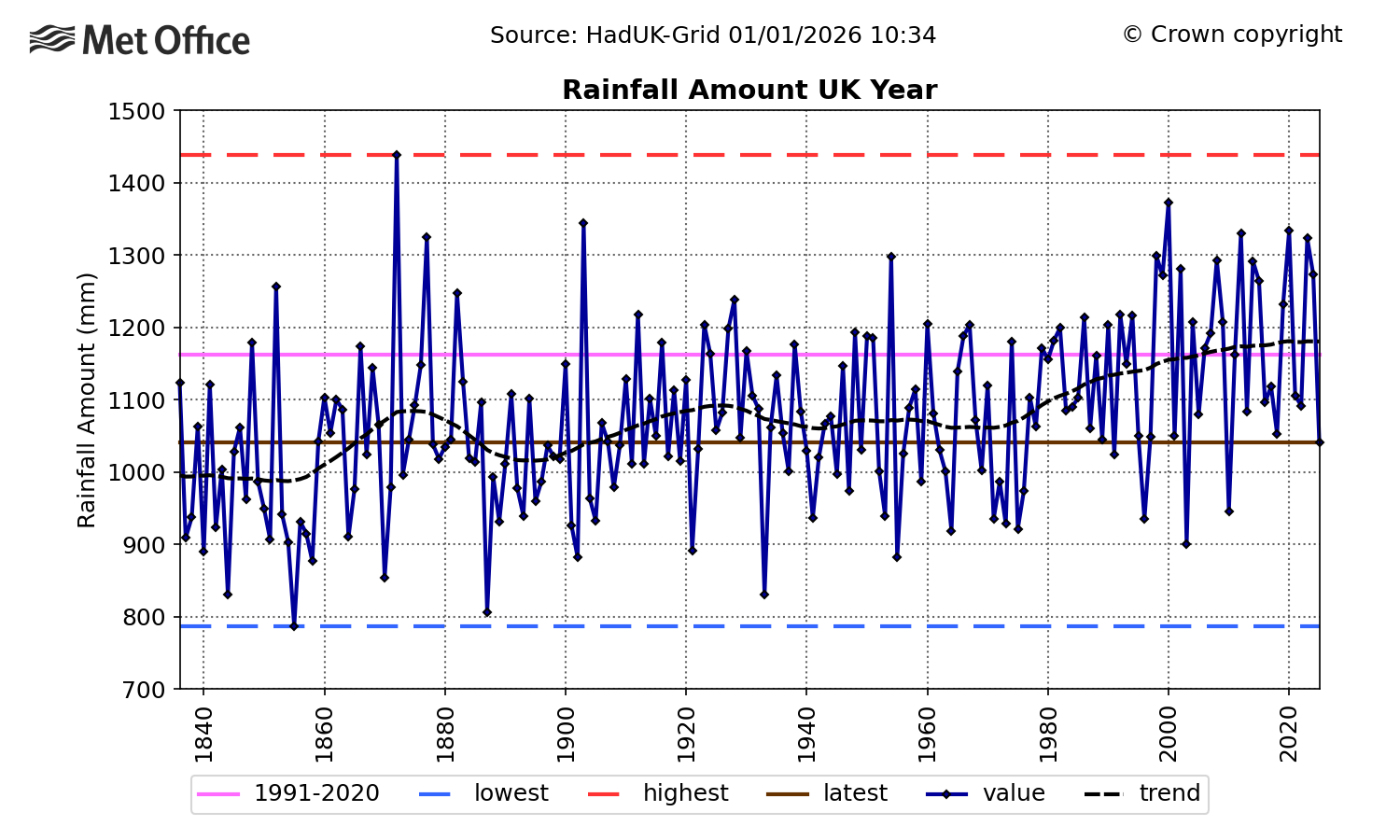 Timeseries of UK total rainfall from 1836 to 2025. The trend is represented by a black dashed line, the 1991-2020 average is shown in pink and the highest and lowest values in the series are shown by the red and blue dashed lines, respectively. The 2025 value is represented by the horizontal brown line. Credit: Met Office
The drivers of annual rainfall trends are more complex than for temperature.
A significant factor in rainfall trends is a warming atmosphere's ability to hold more moisture. However, this does not completely account for recent increases in rainfall.
Large-scale atmospheric circulation patterns - particularly features such as the jet stream and associated storm tracks across the North Atlantic - also play a crucial role. These are influenced by annual and decadal fluctuations in the Earth's climate, as well as human-caused climate change.
UK annual sunshine totals have also been rising since the 1980s, with 2025 setting a record by a considerable margin. This is in sharp contrast to 2024, which was the dullest year since 1998. This is shown in the graph below, where the dotted line shows the underlying long-term trend, with year-to-year variations removed.
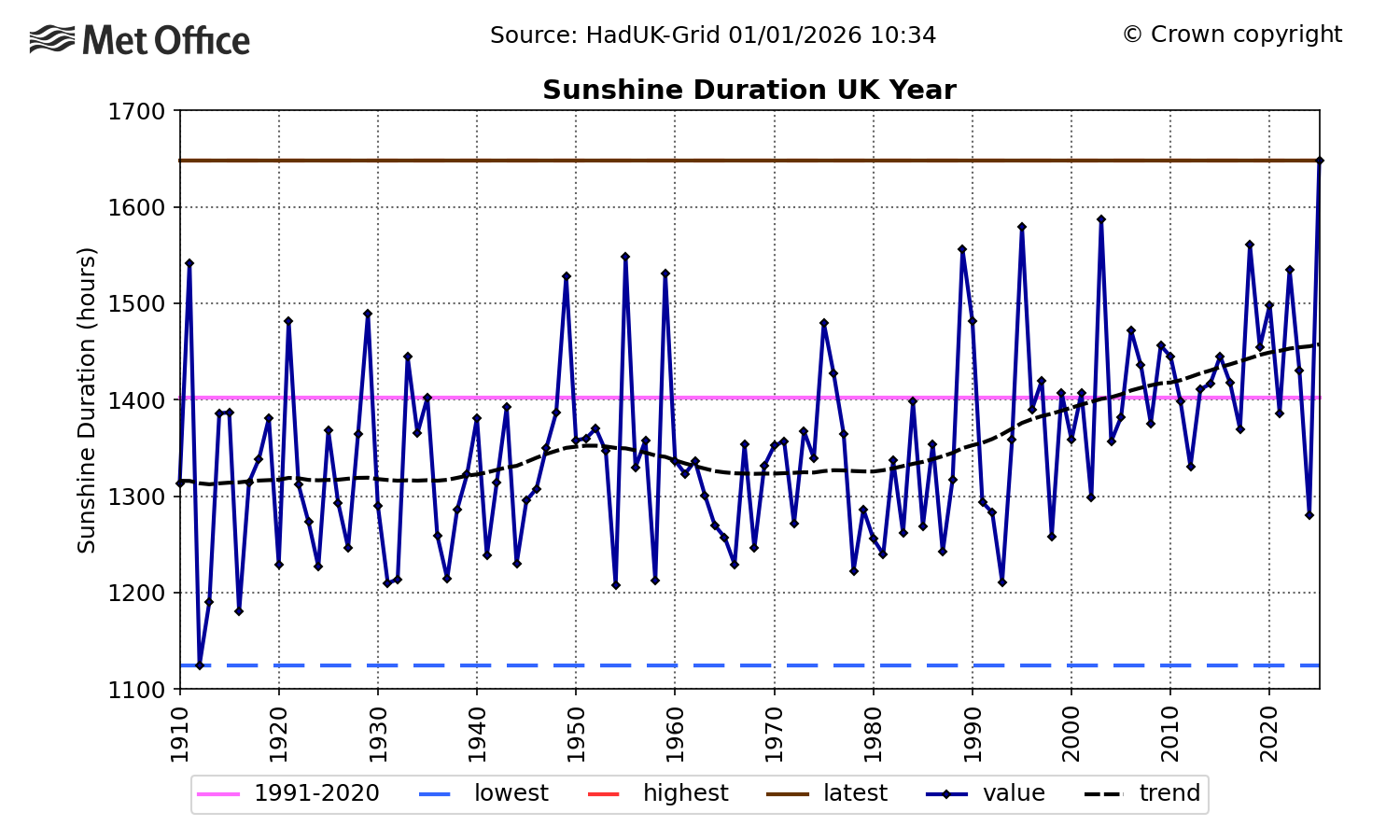 Timeseries of UK total annual sunshine hours from 1910 to 2025. The trend is represented by a black dashed line, the 1991-2020 average is shown in pink and the highest and lowest values in the series are shown by the red and blue dashed lines, respectively. The 2025 value is represented by the horizontal brown line (which covers the red line for the highest in the record). Credit: Met Office
The cause of the sunshine trend is also uncertain, with both natural climate variability and human activity (through reduced regional air pollution caused by a reduction in aerosol emissions) potential contributors. Climate projections do not provide any strong evidence for how sunshine trends might develop.
The year in stormsThe Met Office has been naming storms since 2015. Each storm-naming period runs from September to August.
(For more on storm naming in the UK, read Carbon Brief's explainer.)
The criteria for storm naming has changed over time. It accounts for meteorological conditions, as well as the potential severity of impacts. As a result, comparisons between years can indicate relative levels of storm activity, but should not be done on a like-for-like basis.
Between the 2015-16 and 2024-25 storm seasons, there have been, on average, 7.7 named storms each year, with a high of 12 recorded in the 2023-24 season and a low of four over 2022-23. This is shown in the line chart below.
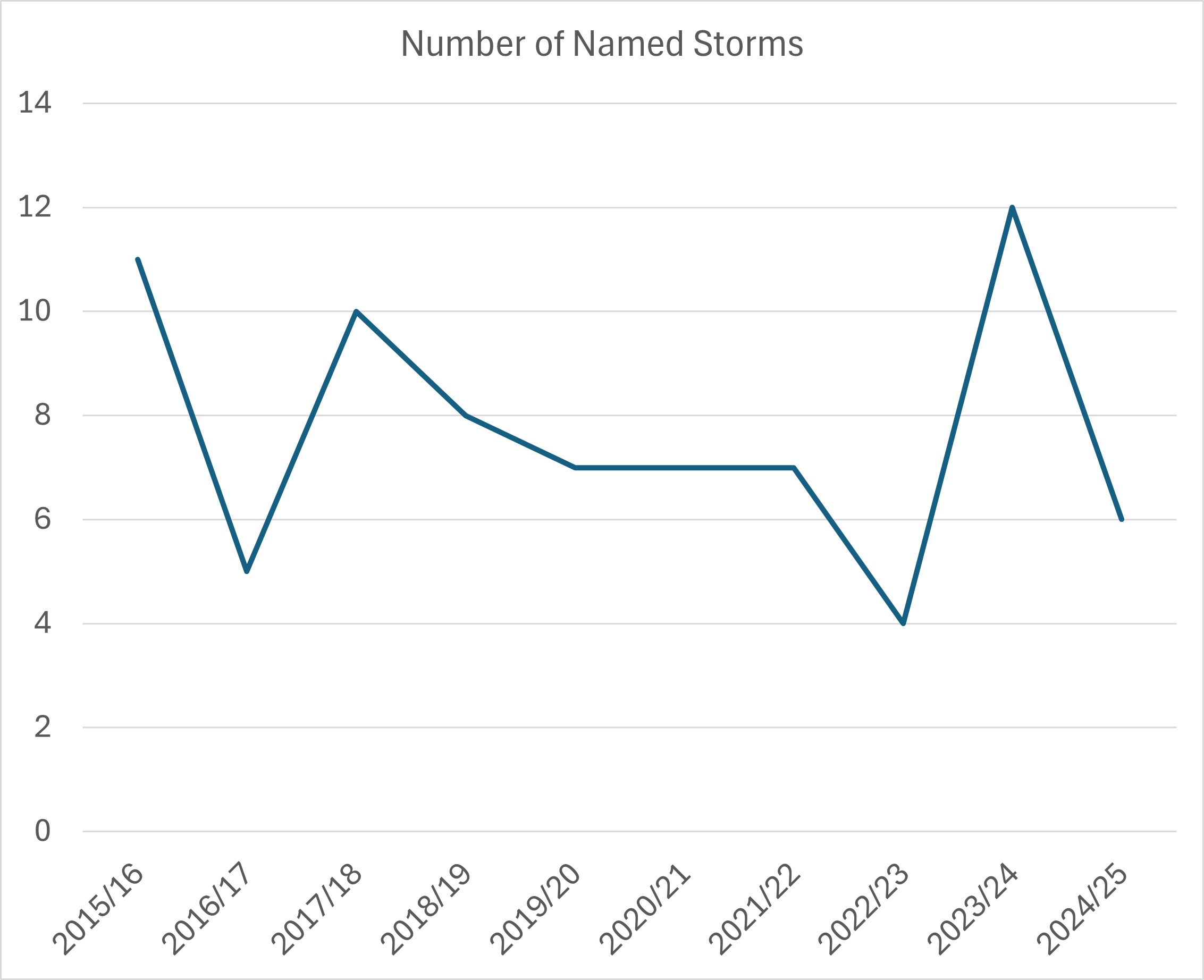 Timeseries of the number of named storms for each storm-naming period (which runs from September to August) since 2015. It includes storms named by other Met Services that impacted the UK. Source: Met Office
By this measure, 2025 was not exceptional with six named storms - two from the 2024-25 season and four from 2025-26. These are listed in the table below.
Storm nameDate(s) of impact in UKMaximum wind gustNotable features 2024-25 names Éowyn24 January87Kt (100mph), Drumalbin, LanarkshireMost powerful storm for over a decade Floris4-5 August71Kt (82mph) at Wick Airport, CaithnessEqualled Scotland's August gust speed record 2025-26 names Amy3-4 October83Kt (96mph) at Tiree, ArgyllSignificant disruption from flooding. Benjamin (named by Meteo France)22-23 October52Kt (60mph) Needles, Isle Of WightStrongest winds affected northern France Claudia (named by AEMET, Spain)14 November59Kt (68mph) Warcop Range, CumbriaExtensive heavy rainfall across England and Wales Bram8-10 December73Kt (84mph), Capel Curig, ConwyFlooding from heavy rainfall on saturated ground. Credit: Met Office storm centreStorm Éowyn in January had the most severe winds of any storm in 2025. The Met Office issued a red warning for wind across Northern Ireland and the south-west and central belt of Scotland. An amber warning was issued for the northern half of the UK. At the peak of the storm, power outages were reported at around 1m homes.
Storms from October to December were notable for bringing some persistent and heavy rain during a period of wetter weather, in contrast to the extended dry spell earlier in the year.
Weather through the yearThe charts below show the progression of temperature and rainfall through the course of 2025.
The plot below charts average daily temperature over the course of 2025, with orange shading showing warmer-than-average conditions. Overall, the year had 244 days - 66% of the total - where temperatures were above average.
On the other hand, cold spells - indicated by blue shading - were generally short-lived and not very severe, with the exception of events in early January and November.
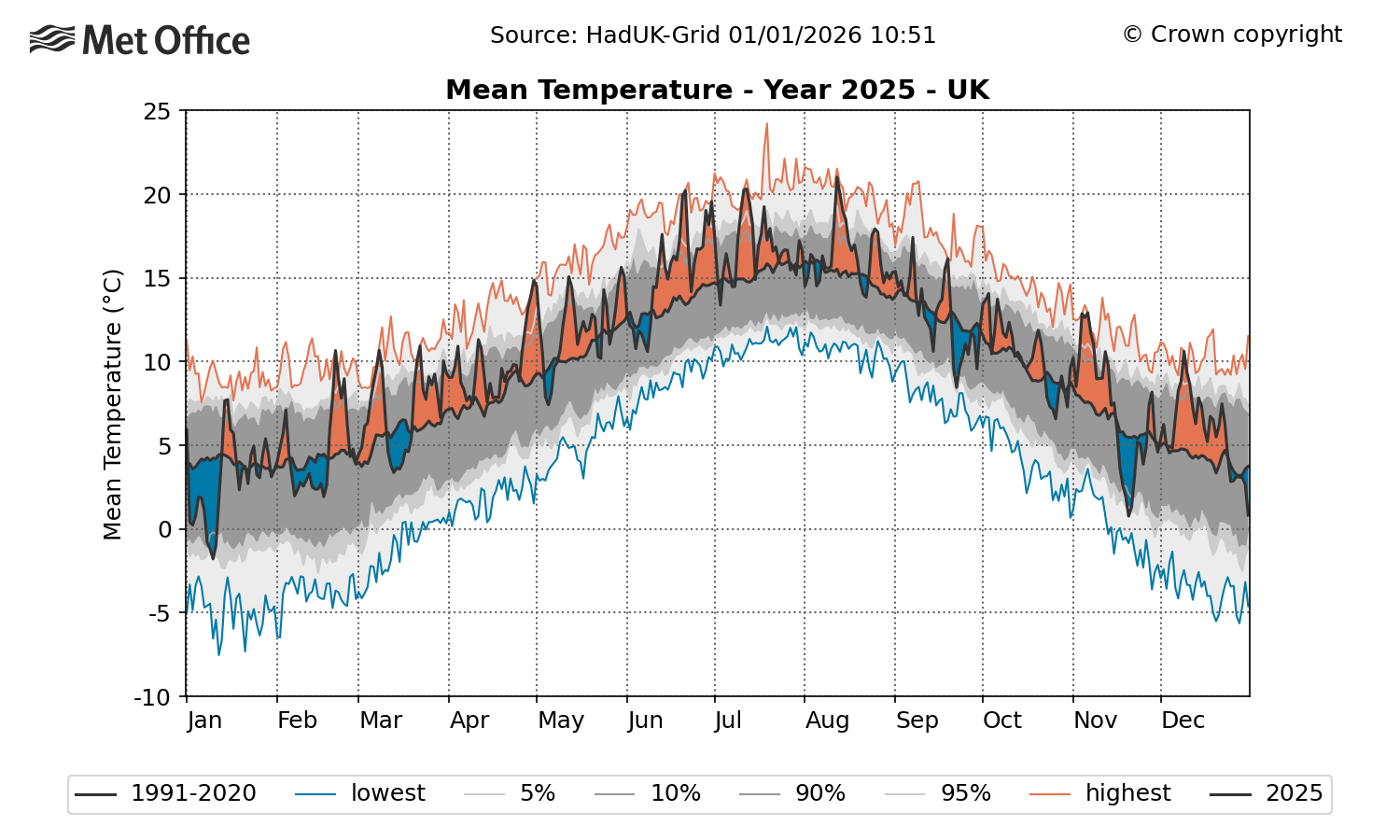 Timeseries of daily UK average temperature during 2025. Orange shading indicates periods of above-average temperature and blue shading below average. The solid black line is the 1991-2020 reference period by day of the year. The grey shading reflects the 5th, 10th, 90th and 95th percentiles of the temperature distribution and the red and blue lines are the highest and lowest values for each day of the year, based on a dataset of daily data from 1960. Credit: Met Office
Fifty-one days in 2025 were in the top 5% warmest for the time of year in the historical record, but only one day - 20 November - was in the 5% of coldest.
The significant number of warmer days and absence of cool ones helps build a picture of how 2025 was the warmest year overall.
The highest daily maximum temperature recorded in the year was 35.8C at Faversham, Kent on 1 July during an early summer heatwave. The lowest minimum temperature was -18.9C, recorded at Altnaharra, Sutherland on 11 January.
A maximum annual temperature of 35.8C is not an exceptional high for recent years - especially when compared with 2022's record of 40.3C. However it would have been a rare event in the 20th century, when just three years - 1932 (36.1C), 1976 (35.9C) and 1990 (37.1C) - saw a higher temperature.
In the 21st century, six years have seen temperatures above 35.8C - 2003, 2006, 2015, 2019, 2020, and 2022.
The plot below illustrates 2025's below-average rainfall accumulation.
The brown shading - which represents the deficit in rainfall at that point of the year compared to the 1991-2020 average - highlights how rainfall totals were particularly low during the dry spring and summer period. The lower blue line shows how rainfall accumulation in 2025 came close to - but did not quite reach - a record low in late May and late August.
Wetter conditions in the autumn saw rainfall totals recover a little to reach 90% at the end of the year - which is below average, but not exceptional. As noted previously, there were regional variations.
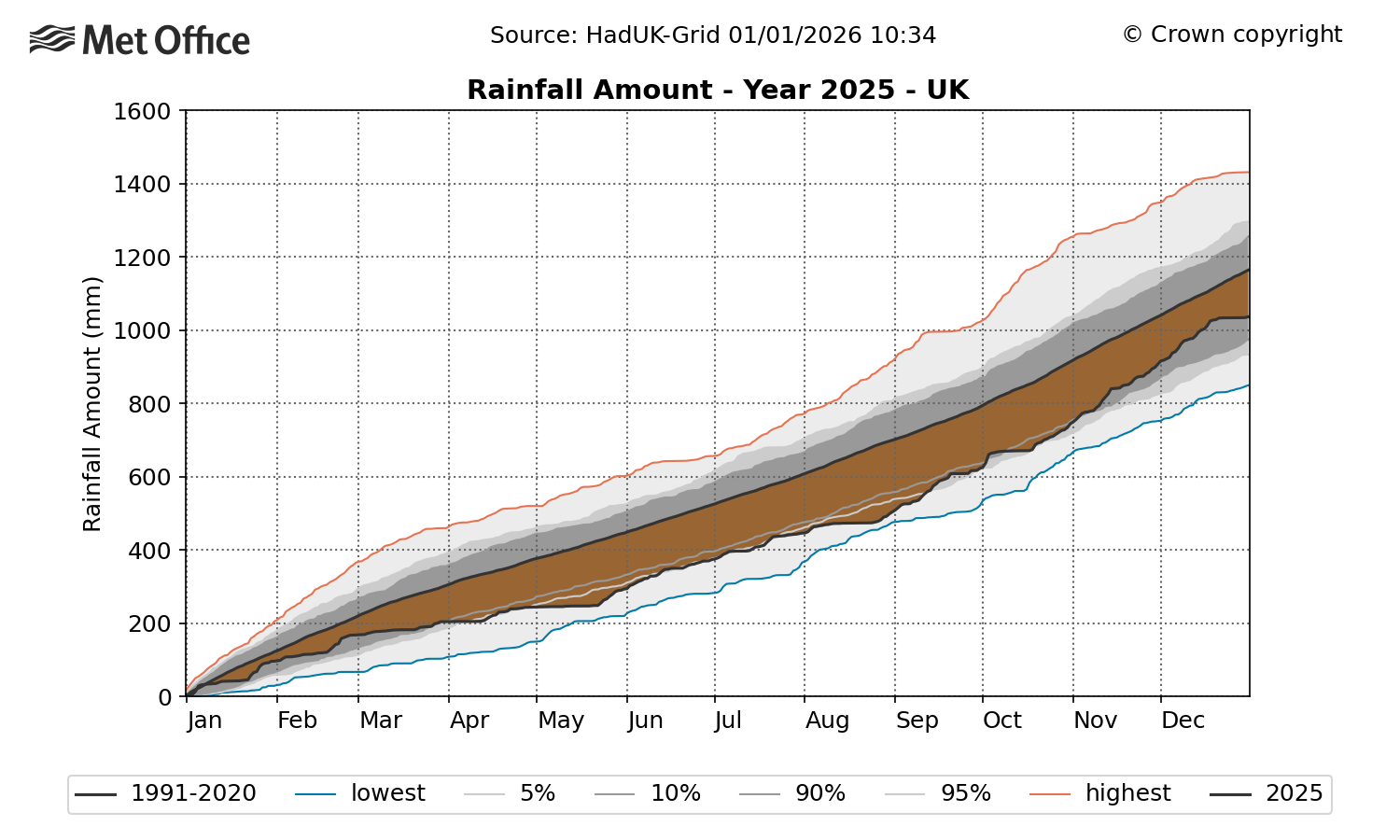 Timeseries showing rainfall accumulation through 2025 for the UK. Brown shading represents a deficit in rainfall compared to average for that point in the year, and blue shading is an excess of rainfall compared to average. The solid line represents the 1991-2020 average and grey shading shows the 5th, 10th, 90th and 95th percentiles of the distribution. The blue and red lines represent the lowest and highest values based on a dataset of daily rainfall from 1891 to 2022. Credit: Met Office
Winter
Timeseries showing rainfall accumulation through 2025 for the UK. Brown shading represents a deficit in rainfall compared to average for that point in the year, and blue shading is an excess of rainfall compared to average. The solid line represents the 1991-2020 average and grey shading shows the 5th, 10th, 90th and 95th percentiles of the distribution. The blue and red lines represent the lowest and highest values based on a dataset of daily rainfall from 1891 to 2022. Credit: Met Office
Winter
In climate terms, the UK winter spans the calendar months of December, January and February.
The winter of 2024-25 was slightly warmer than average, but not exceptional, with an average temperature of 4.62C. This is 0.53C above the 1991-2020 average. The winter months had 89% of average rainfall and 94% of average sunshine.
New Year's Day saw significant flooding that affected parts of Lancashire and the south side of Manchester. The River Mersey reached record levels in the wake of two days of heavy, persistent rain.
The coldest spell of 2025 occurred in early January, with significant snowfall in some regions.
Storm Éowyn and heavy rain at the end of January were the winter's most impactful events, bringing high winds and flooding that resulted in considerable disruption.
SpringSpring - which encompasses the months of March, April and May - was the warmest and sunniest on record, as well as the sixth driest.
The record high temperature came only one year after the previous record set in 2024, continuing a trend of increasing spring time temperature for the UK.
(A Met Office attribution analysis which explored the record-breaking temperatures of May 2024 showed that the temperatures were caused by a combination of a marine heatwave which persisted through May and into June and human-induced climate change.)
The timeseries below shows average spring temperature in the UK over 1884-2025. It shows a significant warming trend since the 1970s, with temperatures in 2024 and 2025 sitting well outside the range of variability observed in the late 19th and 20th centuries.
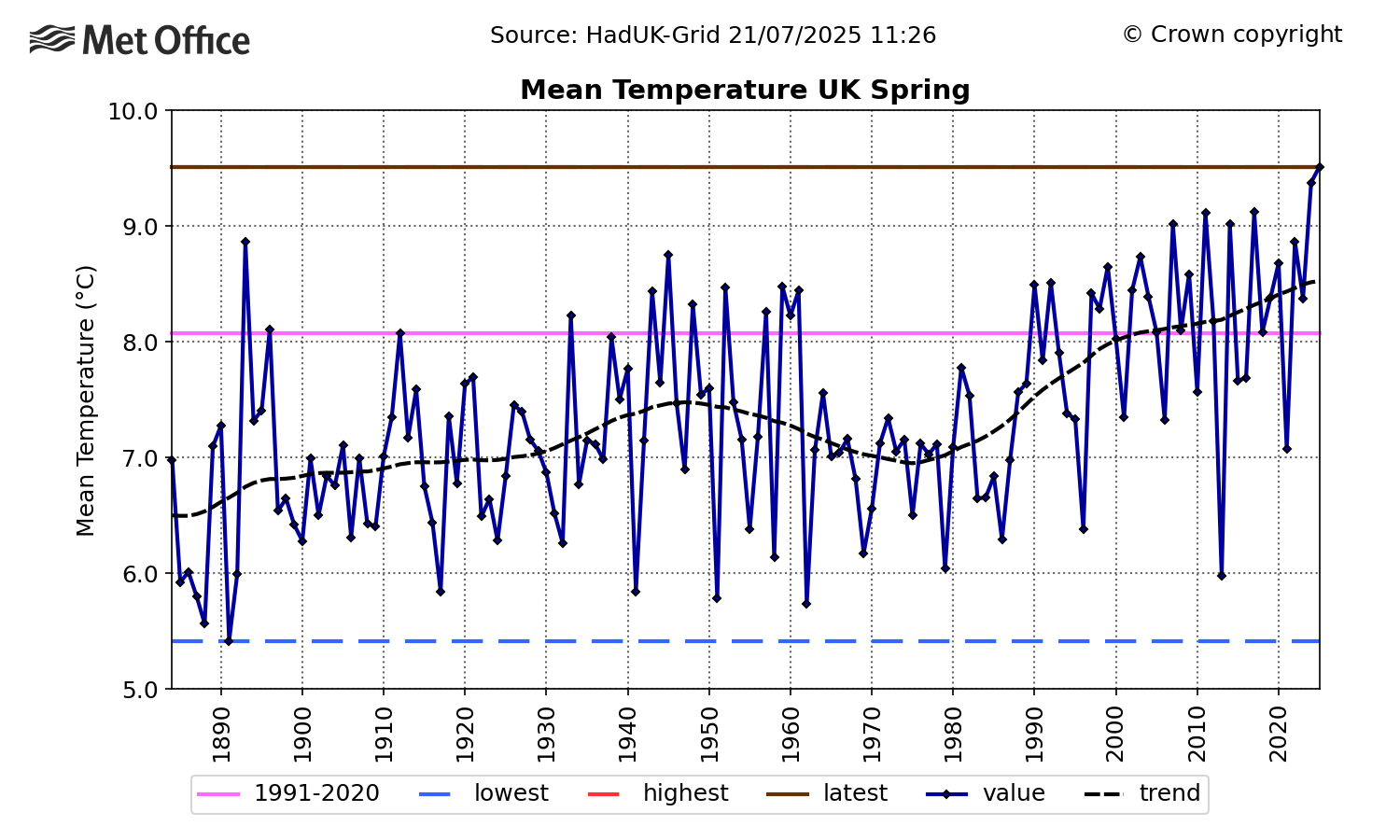 Timeseries of spring average absolute temperature for the UK over 1884-2025. The trend is represented by a black dashed line, the 1991-2020 average is shown in pink and the highest and lowest values in the series are shown by the red and blue dashed lines, respectively. The 2025 value is represented by the horizontal brown line (which covers the red line for the highest in the record). Credit: Met Office
The UK's changing climate is having an impact on the natural cycles of many species and habitats. Citizen science initiatives have highlighted how "signs of spring" - for instance, the first flowering or first nest-building - occur increasingly early in the year.
SummerWarm, sunny and dry conditions persisted into the summer season, drying out soils.
There were four heatwave events, which impacted almost all regions of the UK. Two of these events took place in June.
A marine heatwave also took place, with sea surface temperatures of 1.5-3C above the 1983-2012 average in the Celtic Sea, English Channel and southern North Sea.
An attribution study by the World Weather Attribution service estimated that human-caused climate change had made exceeding June heatwave thresholds around 10 times more likely. The research also found that one of the June heatwaves had been made 2-4C more intense as a result of human influence.
The five warmest summers recorded in the UK to date are 2025 (16.10C), 2018 (15.76C), 2006 (15.75C), 2003 (15.74C) and 2022 (15.71C).
Met Office analysis estimates that in a pre-industrial climate, a summer like 2025 would be expected to occur every 340 years. However, in the current climate, we could expect to see these sorts of summers roughly once every five years.
The study also shows that the UK could plausibly experience much hotter summers in the current and future climate. Events that would have been seen as extremes in the past are becoming more common.
A Met Office attribution study published in 2019 estimated that the then record-breaking summer of 2018 had a statistical return period of approximately eight-to-nine years. The summer of 2025 has broken that record in seven years, consistent with these previous findings.
The science is clear that UK summers are becoming warmer and extreme heat events are becoming more common. This could mean more significant impacts on people, infrastructure and the environment - both now and in the future.
The map below plots the number of heatwaves that took place in June, July and August across the UK. It shows how a significant number of regions across saw more three (green shading) or four (pink shading) over the summer months.
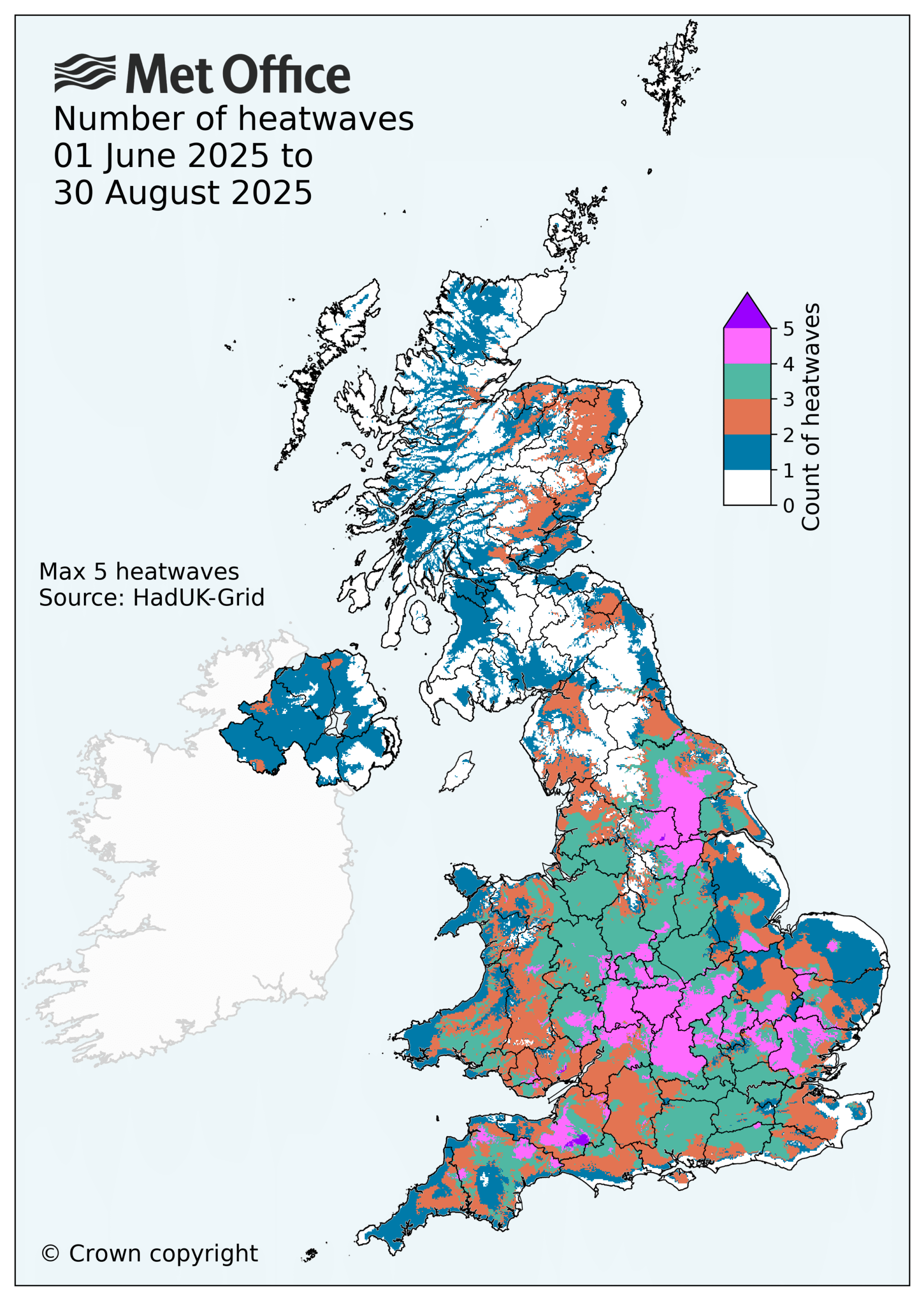 Map showing the number of heatwaves by location during the summer of 2025. Source: Met Office
Autumn
Map showing the number of heatwaves by location during the summer of 2025. Source: Met Office
Autumn
Autumn and the month of December were marked with unsettled weather, with mild and wet conditions over the four-month period.
The season was warmer and wetter than average. Northern Ireland had its third-wettest autumn on record, Northern England its fifth wettest and Wales its 10th wettest.
Storm Amy set a record for highest gust speed for a storm in October, with 80Kt (92mph) recorded at Magilligan, County Londonderry.
Other major storms were notable for heavy rainfall that caused flooding. Storm Claudia brought heavy rainfall to central England and Wales in mid-November, which fell on already saturated ground.
The second half of November saw snow cause across the North York Moors during a cold northerly spell which saw some hard frosts. This was followed by generally mild and unsettled conditions until late December, when strong easterly winds brought more low temperatures and hard frosts.
The UK chalked up a number of significant climate records in 2025, particularly for high temperatures. This aligns with the well-established warming trend that is the result of human-caused climate change.
Climate attribution studies continue to provide further evidence that human factors are increasing the likelihood and severity of UK climate extremes.
Many of 2025's records will not stand for long. There is a high chance they will be broken again in the near future as the climate continues to warm.
Experts: Will Chinese wind power help or hinder Europe's climate goals?
China Policy
|30.01.26

Guest post: 10 key climate science 'insights' from 2025
Guest posts
|22.01.26
Guest post: How to steer EVs towards the road of 'mass adoption'
Guest posts
|18.12.25
Guest post: How the Greenland ice sheet fared in 2025
Guest posts
|15.12.25
jQuery(document).ready(function() { jQuery('.block-related-articles-slider-block_a619db7fe62d11aff02016cd262b69bc .mh').matchHeight({ byRow: false }); });The post Met Office: A review of the UK's climate in 2025 appeared first on Carbon Brief.
How Trump's EPA rollbacks could harm our air and water - and worsen global heating [ 30-Jan-26 1:00pm ]Experts say administration has launched 'war on all fronts' to undo environmental rules - here are the key areas at risk
In his first year back in office, Donald Trump has fundamentally reshaped the Environmental Protection Agency, initiating nearly 70 actions to undo rules protecting ecosystems and the climate.
The agency's wide-ranging assault on the environment will put people at risk, threatening air and water quality, increasing harmful chemical exposure, and worsening global warming, experts told the Guardian. The changes amount to "a war on all fronts that this administration has launched against our health and the safety of our communities and the quality of our environment," said Matthew Tejada, the former director of the EPA's environmental justice program.
Continue reading...
Things are happening very fast [ 30-Jan-26 11:18am ]
 "Copper hits record high above $14 000 as speculators pile in.
"Copper prices hit a record high of more than $14 000 a metric ton on Thursday, as speculators extended their buying spree, encouraged by expectations of strong demand and supported by a weak dollar and geopolitical concerns."
 "Tungsten rises to record highs as export curbs turn up supply heat.
"Tungsten prices have rocketed to record highs in January, fuelled by tightening inventory, Chinese export controls and industrial demand, leaving consumers scrambling for supplies in an already constricted market."
 "Gold and silver fall from record highs in metals market whiplash…
"Investors have poured into metals this year at an unprecedented pace in search of reliable stores of wealth in the context of growing geopolitical turmoil and concerns about the dollar, historically seen as a haven asset."
https://www.ft.com/content/28f59fc3-1af1-45c5-b973-483916456105
 "Oil slips, but set for biggest monthly gain in years on geopolitical risks.
"Oil prices slipped more than 1% on Friday from multi-month highs, though they are set for their most substantial gains in years, as the risk premium surged due to a potential U.S. attack on Iran that could disrupt supplies."
 "Global Oil Discoveries Are Badly Lagging Consumption…
"Annual conventional discoveries have fallen from over 20 billion boe in the early 2010s to about 8 billion boe since 2020. This results in an effective replacement rate of well under one-third of yearly production."
https://oilprice.com/Energy/Crude-Oil/Global-Oil-Discoveries-Are-Badly-Lagging-Consumption.html
 "America's Power Bill Shock Is Just Getting Started…
""Higher interest rates have increased the cost of financing power plants and transmission projects. Rising natural gas prices are pushing up electricity generation costs. At the same time, electricity demand is growing rapidly, driven in part by the expansion of data centers," reads the report cited by Fox Business."
https://oilprice.com/Energy/Energy-General/Americas-Power-Bill-Shock-Is-Just-Getting-Started.html
 "Trump says Jerome Powell is 'hurting our country' as president finally weighs in on Fed's plan for interest rates.
"President Donald Trump renewed his attacks on the head of the Federal Reserve and demanded once again that the central bank artificially cut interest rates regardless of whether such a decision is indicated by economic conditions."
 "Trump threatens Canada with 50% tariff on aircraft sold in US, expanding trade war.
"President Donald Trump on Thursday threatened Canada with a 50% tariff on any aircraft sold in the U.S., the latest salvo in his trade war with America's northern neighbor as his feud with Prime Minister Mark Carney expands."
 "Trump warns Starmer: Getting cosy with China will be 'very dangerous'…
"The US president issued the warning as the Prime Minister concluded his second day of his visit to China. On Thursday, Sir Keir met Xi Jinping, the president of China, and said it was time for a "more sophisticated" relationship between the countries."
 "Higher food prices 'inevitable' due to energy cost shock, growers warn [UK].
"Growers will be forced to raise food prices or halt production if the government does not intervene on new energy standing charges, the sector has warned. Electricity standing charges are expected to increase by 60%-80% from 1 April, and an additional 60% by 2030."
 "Banks Borrow Record £100.9 Billion From Bank of England Short-Term Repo Tool.
"Banks borrowed a record amount from a Bank of England repo facility, signaling growing demand for cash at a time when the central bank continues to drain excess liquidity from the financial system."
 "'Shadow banks' quizzed over meltdown threat from hidden losses.
"The $2tn (£1.5tn) private credit industry is being quizzed by the City watchdog over fears its unrecognised losses could fuel a financial system meltdown, The Telegraph can reveal."
 "Germany plans satellite missile detection system to cut reliance on US.
"Germany plans to be the first European power to develop its own space-based missile detection capability, as the continent seeks to cut its reliance on Washington for defence."
https://www.ft.com/content/c775b46e-9359-4fc5-89be-3cc21683addc
 "The time has sadly come for a Nordic nuclear weapon.
"Nordic countries have a lot to lose, which brings the political responsibility to discuss "nuclear what-ifs". These governments must have the courage for this public debate precisely because they can afford the independent nuclear deterrence needed today."
https://www.euractiv.com/opinion/the-time-has-sadly-come-for-a-nordic-nuclear-weapon/
 "Barring last-minute nuclear deal, US and Russia teeter on brink of new arms race…
"The New START treaty is set to end on February 5. Without it, there would be no constraints on long-range nuclear arsenals for the first time since Richard Nixon and Soviet leader Leonid Brezhnev signed two historic agreements in 1972 on the first-ever trip by a U.S. president to Moscow."
 "Ukraine Can No Longer Spare Its Youngest Soldiers From the Front Lines…
"Most men willing to fight signed up long ago. Infantry units are full of older men unfit for arduous combat missions. Front-line stints are far longer than they used to be, compounding exhaustion. Many other men are either in hiding or have paid bribes to flee the country illegally."
https://www.wsj.com/world/ukraine-young-soldiers-russia-war-e7c28620
 "Kremlin's War Machine Set to Hit the Brakes Under Tighter Budget…
"Top officials have signaled shifting priorities. Finance Minister Anton Siluanov, who two years ago declared fiscal policy was in the service of financing victory, has since recast the government's goals around a balanced budget resilient to lower oil prices and sanctions."
 "China reportedly drops rules that sparked property crisis, developer shares surge…
"The "three red lines" refer to caps on debt-to-cash, debt-to-assets and debt-to-equity ratios that Chinese authorities imposed in 2020 on developers for obtaining new lending. The idea was to rein in the sector's appetite for unbridled borrowing, but it backfired spectacularly…"
 "Tokyo hopes voters will hand PM Takaichi new clout to counter China…
"A big win will help send a message to Beijing that its attacks have not damaged her domestically, a senior Japanese government official said, speaking on condition of anonymity as the matter is a sensitive one."
 "Japan Selloff Reflects Global Bond Deluge, Fitch's Coulton Says.
"Japan's bond selloff last week and its global ripples reflect wariness at a huge supply of government debt exacerbated by central bank balance-sheet reduction, according to the chief economist of Fitch Ratings."
 "A dispute over drones between North Korea and South Korea could threaten one of Asia's last natural refuges, where bears, deer, and cranes survive amid mines and barbed wire…
"Scientists describe the DMZ as one of the best preserved temperate habitats on the planet."
 "Ceasefire with Cambodia still 'fragile': Thai foreign minister.
"The ceasefire agreement reached last month with Cambodia following deadly border clashes is still "fragile," Thailand's top diplomat said in an interview Thursday, stressing that both sides are working to avoid incidents that could worsen the situation."
 "Junta-backed party secures sweeping victory in Myanmar's 'sham' election.
"Myanmar's military-backed party has completed a sweeping victory in the country's three-phase general election, state media said, cementing an outcome long expected after a tightly controlled political process held during civil war and widespread repression."
https://www.theguardian.com/world/2026/jan/30/junta-backed-party-victory-myanmar-sham-election
 "As the Taliban continue their war on women and girls, it is clear that appeasement has failed [Gordon Brown]…
"In successive edicts since 2021, women have now been banned from universities and most employment… They have been required to cover their faces, to be accompanied by male relatives for any long-distance travel, and have been warned they face arrest if seen in public spaces such as parks, gyms and beauty salons."
 "EU designates Iran's Revolutionary Guard as terrorist group over protest crackdown.
"EU foreign policy chief Kaja Kallas said foreign ministers from the 27-member bloc unanimously backed the move, which she described as placing Iran's Revolutionary Guard "on the same footing" as groups such as al Qaeda, Hamas and Islamic State."
 "US military action in Iran risks igniting a regional and global nuclear cascade…
"On Jan. 28, 2026, President Donald Trump sharply intensified his threats to the Islamic Republic, suggesting that if Tehran did not agree to a set of demands, he could mount an attack "with speed and violence.""
 "Kurdish-led forces being pushed back in Syria - but what happens next?
"The Kurds' semi-autonomous region is rapidly shrinking but Kurdish fighters remain a sizeable military force. Damascus, meanwhile, is demanding they disarm and integrate into the national army."
 "Illegal Israeli settlers torch Palestinian homes once again in occupied West Bank.
"Several posts on social media platform X shared images and videos that showed homes burning in the village of Mukhamas, northeast of Jerusalem. "It happened again," one activist wrote, saying that settlers attacked the community and set houses ablaze."
https://www.trtworld.com/article/39ab562c34bc
 "Clashes between government troops and Tigrayan forces erupt in Ethiopia.
"Clashes between Ethiopian federal government troops and Tigrayan forces have erupted in the country's northern Tigray, a region still devastated and impoverished from a full-blown war and more recent huge cuts in international aid."
 "Saudi-UAE Spat Finds New Front in Lucrative Sudan Gold Shipments.
"Saudi Arabia is poised to buy gold from war-torn Sudan, potentially taking a share of the lucrative market from the United Arab Emirates as a dispute simmers between the two Gulf powers."
 "South Sudan bishops warn of genocide, plead for peace as fears of a full-scale war grow…
"South Sudan gained independence in 2011, but in 2013, the world's youngest nation descended into a brutal civil war that killed nearly 400,000 people and forced millions out of their homes."
 "Niger's military ruler vows retaliation after gunfire and explosions heard in capital.
"Heavy security has been deployed around the main airport in Niger's capital, Niamey, after overnight gunfire and explosions that the country's military ruler blamed without evidence on France, Benin and Côte d'Ivoire."
 "Islamic State-aligned militants killed dozens of people, including soldiers, in an overnight attack in northeast Nigeria's Borno state on Thursday, local sources said.
"The assault in Sabon Gari underscores persistent violence in a region where an Islamist insurgency since 2009 has killed over 40,000 and displaced nearly two million."
https://www.france24.com/en/africa/20260129-dozens-killed-jihadist-attack-nigeria
 "Nigerian police fire tear gas, protester injured in Lagos floating slum protests.
"Nigerian police fired tear gas to disperse residents protesting in Lagos on Wednesday over demolition work in one of Africa's largest floating slums that has displaced thousands of people, with one protester reportedly injured."
 "Venezuela approves bill to open oil sector to foreign investment after US pressure…
"Analysts remain cautious about the law's practical application, arguing that the text lacks clarity and that the changes, while welcome, are insufficient to deliver the reforms sought by the US as it attempts to revive Venezuela's battered oil industry."
 "Cuba has '15 to 20 days' of oil left as Donald Trump turns the screws.
"Cuba has enough oil to only last 15-20 days at current levels of demand and domestic production as its sole remaining supplier Mexico appeared to cancel a shipment to the island, the Financial Times reported, citing data firm Kpler."
 "Data show oil and gas blocks cover one-fourth of Ecuador, mostly in the Amazon.
"Ecuador has 65 oil and gas lease blocks, 88% of them in the Amazon, covering a quarter of the country's total area. That's according to a new data set from the Stockholm Environment Institute. Many of the lease blocks overlap with several Indigenous territories…"
 "Visit the North Sea oil field used to store greenhouse gas…
"The plan is to pump thousands of tonnes of climate-warming CO2 into the old oil field… In the UK, a number of carbon capture clusters are under development, including Scotland's Acorn Project and the Viking project off Lincolnshire."
https://www.bbc.co.uk/news/articles/cq5y7dd284do
I rely on donations and tips from my readers to to keep the site running. Every little bit helps. Can you chip in even a dollar? Buy me a coffee or become a Patreon supporter. A huge thank you to those who do subscribe or donate.
You can read the previous "Economic" thread here. I'll be back tomorrow with a "Climate" thread.
The post 30th January 2026 Today's Round-Up of Economic News appeared first on Climate and Economy.
Stoke-on-Trent, Staffordshire: No finches yet and only a single thrush, but tuning into January's sounds has revealed that nature is beginning to stir
If my teenage son hadn't mentioned it one grey morning this week, I'm not sure I'd have noticed, having been too caught up in the January doldrums. But he was right: there's a new fullness to the soundscape here on our urban housing estate. "The birds just sound louder," he said, scanning the rooftops, "more enthusiastic."
"Go on then, what are they?" he grinned, giving me permission to perform my party trick. I closed my eyes and listened. Sparrow. Robin. Wood pigeon. Wren. Blue tits - a bickering winter flock of them - and, there, the see-see-see of long-tailed tits. "Which one makes this sound?" he asked, and whistled a long, descending note like something falling from the sky. "They're my favourite." "Starling!" I said. Right on cue, one made that exact sound somewhere above us, confirming his perfect impression.
Continue reading...More than 300 brown hairstreak butterfly eggs discovered near Llandeilo this winter after decade of decline
Record numbers of eggs of the rare brown hairstreak butterfly have been found in south-west Wales after landowners stopped flailing hedges every year.
The butterfly lays its eggs on blackthorn every summer. But when land managers and farmers mechanically cut hedges every autumn, thousands of the eggs are unknowingly destroyed.
Continue reading...This week's best wildlife photographs from around the world
Continue reading...
Well, things might be getting wild. When SolarCity was facing financial challenges, Tesla swallowed it up. Elon Musk was the Chairman of the Board at SolarCity, and his cousins were the cofounders, CEO, and CTO. The synergies were supposed to help both, but Tesla's solar business has declined a great ... [continued]
The post Tesla, SpaceX, & xAI Merging? appeared first on CleanTechnica.
In response to my article yesterday about Tesla's gradually declining net income, a reader pointed me in the direction of an interesting article from Fortune. Before I get to that and some additional thoughts that came out of that, it just hit me that I didn't take a good look ... [continued]
The post Wall Street's Failures on Tesla (TSLA) — And Has It Simply Flip Flopped? appeared first on CleanTechnica.
Is it Hopium or Hope Porn? [ 26-Jan-26 7:14pm ] Taking the Planet's Temperature: 2026 Edition [ 14-Jan-26 10:18pm ] Betting on the End of the World: 2026 Edition [ 01-Jan-26 5:32pm ] How to Deal with Climate Denier Trolls [ 26-Dec-25 4:04pm ] Wagers of Doom for 2025: Pay Up! [ 16-Dec-25 6:06pm ] What is the Definition of a Doomer? [ 03-Dec-25 6:29pm ] My Appearance on Science Talk: October 16, 2025 [ 18-Oct-25 7:02pm ] In Praise of Themis, by Gail Zawacki [ 12-Sep-25 5:55pm ]

