
Four-year study warns destabilised marine food webs could jeopardise food security by 2050
Warming seas around the UK and the wider north-east Atlantic could destabilise marine food webs, weaken ocean health and jeopardise food security by 2050, according to a four-year study.
Scientists who projected the impact of climate breakdown on four key groups of marine life crucial to maintaining ocean ecosystems in the region said their results challenged assumptions that in middle latitudes, such as the UK, marine biodiversity was likely to increase across the board.
Continue reading...Liverpool: Their summer flowers provide the name and the fame, but this species is arguably at its best now
Beech mast crunches underfoot, and the occasional conker catches the sunlight, tiny beacons leading me to Camp Hill, south Liverpool, with its distant views over the Mersey estuary. Goldfinches erupt from desiccated knapweed, and a flock of pink-footed geese fly overhead. For once, the birds are not my goal, but a tree: the tulip tree (Liriodendron tulipifera).
Every autumn, the Camp Hill tulip tree flaunts its flamboyant presence: the Lady Gaga of the parkland. Named because its flowers resemble a tulip flower, and its leaves a tulip silhouette, few can resist its tulle lace canopy of butter-gold leaves. The luminescence is enhanced by the sheen of its leaf cuticles, and the fissured trunk adds yet more sensory impact. Yet this year there is a strangeness: instead of the golden monotone you would expect of this moment, there is a messy mix of different shades. Might the summer drought have disrupted the pigment battle between anthocyanins and carotenoids?
Continue reading...
It was a remarkably mild early November morning at 6am as I left the Chelsea Cloisters apartments to get the tube to Westminster and the Supreme Court. I had been worried because I had forgotten to pack my thermal underwear.
I had queued overnight for the Assange hearings, the Salmond trial and the ICJ Genocide case - the latter in minus 5 degrees at The Hague - and thermals were an essential part of the kit. On the first night for the Assange hearings, at Woolwich Crown Court, I stood for seven hours in freezing drizzle with Patrick Henningsen and Randy Credico. Immediately that first day in court finished, I headed to Mountain Warehouse to buy a large, warm, waterproof jacket.
I found the one I wanted which was on sale, and tried it on. I then took it to the counter and explained to the young lady that it was labeled XXL, but I couldn't get the zip to do up. She looked at me coolly and replied "fat people don't climb mountains".
My ego somehow survived, and now as I approached the Supreme Court I saw the flashing orange lights of three trucks parked outside, and hear the ringing metallic sound of crews putting up metal crowd barriers around the building. I had slightly worried I was late for the queue, but there was only one tall young man sitting on the benches outside. He was a journalism student from City University, and neither of us having anything else to do, he interviewed me.
There were three men in sleeping bags along the front of the court building, one right across the door. We speculated as to whether the were part of the queue or simply homeless. As barriers were clamped into place behind us, we worried where the front of the queue was meant to be. I approached the hi-viz wearing man who looked in charge. He had long hair and beard and a friendly open face. He wore a builder's helmet, presumably in case the Supreme Court somehow fell on top of him.
"Do you know what the system is for installing these barriers?" I asked,
"I'd be pretty bad at my job if I didn't", he replied.
I explained we were the queue. He laughed and said we were fine where we were. About five minutes later the crew left with two and three quarters trucks still full of barriers, presumably to cordon off somewhere else. Their work was inexplicably pointless - they had created narrow a pen on the pavement behind us, which led nowhere, finished twenty yards from the court entrance and left a thirty yard gap anybody could walk past to the court on the West side.
I pointed out to Tony this seemed strangely pointless and he said its purpose might become clear later. It didn't, Nobody ever entered the pen and it didn't stop anyone going anywhere.
His name, incidentally, probably wasn't Tony. I introduced myself but he didn't volunteer a name so I didn't press him.
At 7.30am a young lady arrived. She was pleasant and joined our conversation but again did not give her name. She worked for a Westminster lobbying company, so I would assume was in the Israeli interest. It was 8.45am before a real queue began to gather. Public information had been that doors would open at 9am and they did, but we were kept standing outside until after 10am.
There was then a great disappointment as an official arrived and told us no members of the public would be admitted to the courtroom. Court No 1, he explained, has no public gallery and all the rows of benches would be fully occupied by the legal teams. The public would be allowed into an overspill Court No3, where screens were set up.
This was very annoying. It was also later plainly observable on the screens that the official explanation of no seats being available was untrue. Exactly the same thing had happened at the High Court hearing. I have no doubt that "security" was the motivation, and having designated Palestine Action supporters are terrorists, they were determined to treat any of the public interested in the case as potential terrorists.
The building is a very late flowering of Victorian medieval revivalist architecture and was originally Middlesex County Council. When the Supreme Court was established a quarter century ago, it was converted to the purpose, the county of Middlesex itself having essentially already been abolished. It is rather a good building, which is important as a close neighbour to Westminster Abbey. Unfortunately the principle of open justice had not been applied in its conversion to the creation of public galleries.
Today was the last gasp of the UK legal system in challenging the legality of the proscription of Palestine Action, in the case brought by its founder Huda Ammori. This judicial review had proceeded through the High Court, which found the proscription unlawful, and Appeal Court, which found it lawful. As the process went through these courts, the grounds for permitted appeal were whittled down until only one was allowed: whether the effect of the proscription on Article X and XI rights (freedom of speech and freedom of assembly) were disproportionate in terms of what was necessary to protect the public from the terrorist organisation.
Articles X and XI are from the European Convention on Human Rights, enshrined into UK law by the Human Rights Act.
In the Supreme Court they do not wear old horsehair wigs and gowns, including the judges. This felt rather strange as such costume had been worn at all the prior stages. The five judges were situated on a curved dais, with the lines of lawyers below them.
One problem with not being in the courtroom was that, every time a judge spoke, the camera immediately cut to that judge in close up. The judges all looked extremely similar - white men aged about sixty in suits and ties. It was very difficult to tell in close-up which judge was which. Some of the identifications in this account are therefore almost certainly wrong, but not deliberate.
When you think about it, in our society the difficulty of telling Supreme Court judges physically apart is possibly a problem?
Raza Hussain KC opened for Huda Ammori. Raza seemed a much more imposing figure without his wig and gown, and spoke with a force and fluency that I had not really seen in full flow in the earlier hearings.
His first point may have been excellent but as the screens in Court Number 3 had no sound for the first five minutes I did not catch it. We therefore join him at point number 2.
2) Hussain said that Palestine Action was not a terrorist group, but a protest group that takes direct action. He said it could only be caught by stretching the outer limits of the definition of terrorism in the Terrorism Act, a definition which the Supreme Court had already described in an earlier case as "striking in its breadth".
3) Hussain said that according to the Home Secretary herself, the vast majority of Palestine Action's activities did not fall within the definition of terrorism. Only 3 actions out of 385 were so described. Yet these three were used to make all fall as terrorism.
4) Unlike other proscribed organisations, the objectives of Palestine Action were in line with the principles of liberal democracy. They simply wished to impede genocide and war crimes.
5) Contrary to the Appeal Court judgement, Palestine Action did fall within the tradition of other direct action groups, such as the suffragettes, environmentalist and animal rights groups, which were not treated as terrorist.
6) Important civil society groups such as Amnesty, Liberty and PEN, and international organisations had expressed opposition to the proscription
7) Proscription of Palestine Action had wider effects on public confidence in the proscription regime itself, and in the Terrorism Act. There was public revulsion at the arrest of over 4,000 for supporting Palestine Action, many of them elderly and distinguished.
8) Proscription of Palestine Action was prone to upset the court's judgements in many other compatibility cases over the years. (A compatibility case tasts whether a law is compatible with the Human Rights Act). The decision on proportionality of the effect on civil liberties must itself depend on whether the anterior exercise of the proscription power itself was proportionate to the alleged threat.
If an elderly and distinguished person arrested for expressing non violent support for Palestine Action were to win a case against their arrest at the European Court of Human Rights in Strasbourg (he gave the example of an 81 year old female Christian ex-magistrate arrested at a vigil at a Truro church), that could strike down all the Supreme Court's previous decisions on Section 13 of the Terrorism Act (expressing support for a terrorist organisation) where other, real terrorist organisations were concerned.
This last was a very good argument I had never heard before, and one tailored to meet the sensibilities of a court with no interest in civil liberties. Maintaining this absurd proscription could ultimately result by the law of unitended consequences to more freedom of speech, not less).
Lord Sales now interrupted from the judicial bench to ask whether Hussain's description of just three terrorist incidents included that at RAF Brize Norton.
Raza Hussain replied that incident did not meet the bar of Terrorism. It should rather be seen in the light of the famous Margaret Jones case, which was not assessed by anybody to be terrorism. The anti-militarist tradition is not terrorist.
Lord Sale then asked whether the proportionality exercise should not be conducted by this court on the facts as of now, as opposed to the facts at the initial hearing. Hussain replied that Lord Justice Lewis had ruled at an earlier stage that material that had happened after the initial Divisional (High) Court ruling was not admissible. Lord Stepehns aske why the Court of Appeal had made this ruling.
There was a hiatus as everybody in court went through sheaves of papers looking for the answer to this question, but nobody seemed able to find one.
Lord Sales asked why Hussain said Brize Norton was not a terrorist attack. Raza Hussain re[lied that it was the Secretary of State's judgement it was not a terrorist attack. He suggested the government lawyers might explain that. Lord Sales said he was asking Hussain why he would say it was not terrorism. Hussain replied because of the limited amount of damage done, and because of the Jones case.
Lord Stephens then interjected that RAF planes had been damaged. Why was that not terrorism? Raza Hussain said that was a precise comparison to the Jones case which was judged not terrorism. The Jones case involved attempted arson at RAF Fairford. The Brize Norton case was merely spraying paint.
Lord Briggs said that surely the seriousness of damage depended on what the paint was sprayed upon? There was a difference between psraying paint on a railing and spraying paint on a Van Gogh. Lord Sales then asked why it was not for the Supreme Court, rather than the Secretary of State, to decide whether Brize Norton was terrorism?
James Eadie KC for the government intervened to say that the extent of the damage at Brize Norton was the disputed subject of a current criminal trial. But there were other factors to be considered in determining whether an incident was terrorism.
Lord Sales said Raza Hussain appeared to accept it was for this court to determine whether Brize Norton was terrorism.
Raza Hussain suggested that whether one individual act was characterised as terrorism was not determinative of the proportionality of the interference with Article X and XI rights. The definition of terrorism in UK legislation is very broad. The power to proscribe is very broad. The effects of proscription are very severe. The "guardrails" provided by the Convention rights were therefore very necessary.
He outlined the draconian powers of the act, in empowering the police to arrest people on suspicion of supporting Palestine Action, and criminalising speech which could lead somebody else to support Palestine Action, irrespective of whether that was the intention of the speaker.
Lord Stephens asked whether speaking against the proscription of Palestine Action, rather than in support of Palestine Action as such would be an offence. Raza Hussain replied that people are being arrested for doing exactly that.
Lord Sales asked whether, if he wrote a judgement opposing the proscription of Palestine Action, that would itself be an offence. Raza Hussain replied that on the ground people were being arrested for just opposing proscription, as well as those being arrested specifically for supporting Palestine Action.
Lord Briggs said that people opposing proscription were not necessarily supporting Palestine Action, and therefore there was no offence. Raza Hussain said that it was an offence under the Act to make a statement that gave rise to a suspicion of supporting Palestine Action. People opposing proscription were being arrested for that. These offences carried up to 14 years in jail.
Lord Reid said that if an academic published "I understand why Hamas (also a proscribed organisation) did what they did", that would not be actionable.
Raza Hussain said people simply do not know what they may or may not say. There is no clear line. That is precisely the chilling effect on free speech.
I must break now to go back into court on the morning of day 2. I will continue this account afterwards. Production of Day 1 was delayed because, when I got back to Chelsea Cloisters last night, my room had been broken into. This was done with force, the door jamb split apart. Nothing was taken from my room, including cash on the table nor my laptop. I reported to the front desk who came and took photos, but they have to apply to an outside security company for the CCTV footage.
OK, back to court.
—————————————-
Anybody is welcome to republish and reuse my work, including in translation.
My work has no funding at all except for your subscriptions. If you already subscribe, I would be grateful if you could check if your subscription is still active. Over 80% of my subscriptions lapse when debit or credit cards expire: the systems do not warn you.
Because some people wish an alternative to PayPal, I have set up additional new methods of subscription payment including Patreon account and a Substack account, if you wish to subscribe that way. The content will be the same as you get on this blog. Substack has the advantage of overcoming social media suppression by emailing you direct every time I post. You can, if you wish, subscribe free to Substack and use the email notifications as a trigger to come to this blog and read the articles for free.
I am determined to maintain free access for those who cannot afford a subscription.
Choose subscription amount from dropdown box:
Recurring Donations
3 Pounds : £3.00 GBP - monthly5 Pounds : £5.00 GBP - monthly10 Pounds : £10.00 GBP - monthly15 Pounds : £15.00 GBP - monthly20 Pounds : £20.00 GBP - monthly30 Pounds : £30.00 GBP - monthly50 Pounds : £50.00 GBP - monthly70 Pounds : £70.00 GBP - monthly100 Pounds : £100.00 GBP - monthly

PayPal address for one-off donations: craigmurray1710@btinternet.com
Alternatively by bank transfer or standing order:
Account name
MURRAY CJ
Account number 3 2 1 5 0 9 6 2
Sort code 6 0 - 4 0 - 0 5
IBAN GB98NWBK60400532150962
BIC NWBKGB2L
Bank address NatWest, PO Box 414, 38 Strand, London, WC2H 5JB
Bitcoin: bc1q3sdm60rshynxtvfnkhhqjn83vk3e3nyw78cjx9
Ethereum/ERC-20: 0x764a6054783e86C321Cb8208442477d24834861a
The post Palestine Action Supreme Court Hearing Day 1 appeared first on Craig Murray.
The Club of Rome has signed a Memorandum of Understanding with the Organization of Ibero-American States for Education, Science and Culture (OEI) to drive knowledge and action on regeneration in Latin America.
Mariano Jabonero, Secretary-General of the Organization of Ibero-American States for Education, Science and Culture (OEI), and Silvia Zimmermann, Co-President of the Club of Rome, led the signing of this regional strategic alliance in Buenos Aires, consolidating the first initiative of the Club of Rome Latin American Network.
This agreement aims at driving a transformative socio-ecological agenda in Latin America and the Caribbean, framed within the process of strengthening and expanding the Club of Rome Latin American Network. The initiative builds upon the cooperation protocol signed during the International Conference "Thought and Action: The Path to Regeneration," held in April 2026 in Buenos Aires.

Buenos Aires, October 15th, 2026 — In an institutional milestone for the region, the Secretary-General of the Organization of Ibero-American States (OEI), Mr. Mariano Jabonero, and the Co-President of the Club of Rome International, Silvia Zimmermann, signed a Memorandum of Understanding (MoU) and a Specific Work Agreement.
Beyond Latin America, the partnership reflects the Club of Rome's wider strategy to strengthen its presence and impact across continents. The aim is to move beyond a global-first approach and build up at every scale: local, national and continental. The Club of Rome Latin American Network is the first of these continental initiatives. Led by Co-President Silvia Zimmermann, it gives members and partners a space to shape the organisation's global agenda from a Latin American perspective. Similar possibilities are now being explored in Africa. Strategic partnerships rooted in each region, such as this one with the Organization of Ibero-American States, are central to this approach.

The signing was also attended by Luis María Scasso, Director and Permanent Representative of the OEI in Argentina; Gonzalo del Castillo, Executive Director of the Argentine Chapter of the Club of Rome; Belén Bertero, Applied Research Coordinator at the Argentine Chapter of the Club of Rome; and Diego Badaloni Giner, Member of the Board of Directors of the Argentine Chapter of the Club of Rome, who accompanied the authorities during the meeting.
A cutting-edge regional project
The signing of the agreement lays the groundwork for implementing the regional project "Science, Artificial Intelligence, and Regeneration: Building a Knowledge Infrastructure for Regeneration in Latin America (2026-2028)".
The central objective of the project is to advance the development of a regional knowledge infrastructure for the socio-environmental regenerative transition in Latin America and the Caribbean by diagnosing capabilities, mobilising a multi-stakeholder network, and designing evidence-based decision-support tools.
The project will operate under the direction of the Ibero-American Observatory of Science, Technology and Society (OCTS) of the OEI and the Secretariat of The Club of Rome Latin American Network, both based in Argentina.
The joint signing between the OEI and The Club of Rome represents a fundamental step toward strengthening Latin America's own sovereign scientific-technological capabilities, seeking to reinforce the region's role as a leading engine for systems thinking and regenerative action.
The post New alliance for a regenerative Latin America appeared first on Club of Rome.
Google Cloud has revealed that the cause of the October 20 outage in its europe-west-2-b availability zone was a 'misconfiguration' of its systems that meant its emergency generators didn't start.
The outage at the London facility caused service interruptions at outfits including Lloyds, HSBC, Royal Mail, and Revolut.
In a November 4 update to its service status page, Google explained what went wrong.
"The site relies on a 2N utility power architecture — where the facility has complete duplicate power paths for every critical load — backed by a central high-voltage generator bank managed by a dual-redundant Programmable Logic Controller (PLC)," Google revealed.
The facility gets its juice from two independent utility feeders, which Google calls "A" and "B". There's also a "standby utility connection configured for manual campus-wide transfer during maintenance operations or emergency events."
Google says the root cause of the incident was failure in an external underground cable through which its power supplier brings 'leccy to its bit barns.
That cable connects to primary feeder A and it broke at a time when feeder B wasn't working.
"Circuit breaker feeder B was physically opened to allow for corrective repairs following issues identified during a quarterly generator load test on 14 Oct 2026," Google admitted. "Consequently, primary utility feed A was supporting the total critical load while the feed B breaker remained in an open position to allow repairs to be conducted on the B feeder pathway."
That shouldn't be a problem for a top-tier operator like Google, which knows it needs to install backup sources of electricity like uninterruptible power supplies (UPS) and on-site generators.
Indeed, europe-west-2-b employs UPSes that Google says can keep things up and running for five minutes if the availability zone loses its connection to the grid.
The UPSes worked, but a "voltage-sensing design flaw and PLC misconfiguration prevented the facility's generator plant from receiving an automatic start signal to assume the critical load."
Google's UPSes therefore ran out of juice, but its generators didn't start. The rest is history.
The search giant has figured out that its PLCs weren't set up to handle the conditions it faced on this fateful day.
"PLC logic indicated that a healthy utility source was available, even though the primary and secondary distribution feeds were de-energized, and did not issue a start command to the generator plant," the status update reveals.
Once Google was able to reconnect to its power utility, it reprogrammed the PLC so it wouldn't make the same mistake again.
The Big G has since made many changes to the electrical setup at europe-west-2-b and says it's tested them and that they all work.
It's also given itself two action items, one of which it describes as a "Communications Enhancement" that will see it "bolster notification speed by developing an automated alert-to-communication mechanism for location-impacting incidents."
The other is to "expand platform-wide testing outcomes for infrastructure-level events."
Once Google gets that done, perhaps it will be able to handle outages better - and if not, at least advise customers about its troubles more quickly. ®
VMware appears to have made a concession to European regulators by extending the life of its low-end vSphere Standard and Enterprise Plus products.
The virtualization pioneer quietly announced the extension in the November 4 blog post in which it announced a new low-end product called vSphere Express, which The Register reported yesterday.
We based our report about vSphere Express on an interview, and on material provided by VMware - which sent a version of the blog post linked to above.
The version we saw did not include the following paragraph, the contents of which were not mentioned in our interview:
"Furthermore, for customers in countries in the European Economic Area, vSphere Standard version 8 and vSphere Enterprise Plus version 8 will remain available for sale until October 31, 2027, and will have Extended Support included in any active subscriptions to those offerings until the earlier of the applicable subscription end date or October 31, 2028."
The latter date is more than a year past the October 11, 2027, end-of-general-support date for the more capable vSphere 8 and Cloud Foundation 5.x products.
"This has the potential to be a positive development for organisations within the European Economic Area," independent analyst Michael Warrilow told The Register. "It could provide them up to an extra 12 months to transition vSphere 8 to VCF 9 and/or migrate workloads to another platform."
Warrilow thinks European users should seek "absolute clarity" from VMware about the specifics of its offer.
"What level of extended support will be provided and what longer-term commitments will need to be made? I cannot find any of that detail," he wrote.
A reminder: VMware has promised in the past to make patches available for users who choose to persist with perpetual licenses instead of moving to its preferred subscriptions. The Broadcom business unit later paused patch downloads for months, claiming it needed to adjust its website to make them possible.
Warrilow wonders why VMware will keep selling vSphere Standard only in Europe and suggested "regulatory muscle" is the reason.
Regulators around the world cleared Broadcom's acquisition of VMware. In Europe, authorities have since revisited the matter.
Lobby group Cloud Infrastructure Services Providers in Europe (CISPE) has succeeded in having the European Commission open an antitrust investigation into whether VMware's channel changes inappropriately shaped the cloud infrastructure provider market. The Register understands CISPE feels regulators are receptive to its arguments.
In the Netherlands, local courts enforced a VMware support contract of the sort that Broadcom has tried to walk away from at other users.
Warrilow wonders if VMware might now change its policy regarding vSphere Standard in other countries.
"The subsequent question is how can organisations in other regions get the same concessions from Broadcom? I would encourage them to amplify their voice by rallying industry associations and user groups to the cause whilst lobbying the regulators in their jurisdiction."
Overall, however, he thinks VMware's decision isn't enormously impactful.
"Ultimately, all it does is buy a little more time to upgrade or migrate," he wrote.
It may not even do that, as The Register often heard that VMware seldom issued quotes for vSphere Standard or Enterprise Plus.
Paul Turner, chief product officer for VMware's Cloud Foundation Division, told The Register that inappropriate incentives for channel partners caused that situation, and that VMware later fixed it.
Continental users will be hoping VMware got that effort right. ®
When The Register writes about professional certifications offered by vendors, we often receive comments arguing that such credentials are nowhere near as valuable as real-world experience. Now, Microsoft has acknowledged there's some merit in that argument.
Redmond revealed its stance last week in a post from general manager for content and insights Cameron Percy, who observed: "For years, people have asked for a simpler way to prove the skills they use in the flow of work, without stepping away to prepare for another test."
Microsoft's response is the "Pro Badge," a new form of credential that Percy wrote "works alongside Microsoft Certifications."
"Certifications show that you can solve problems in a role or field. Pro Badge shows how you use a specific product in your everyday work. Together, they give a more complete picture of what you can do."
"Instead of capturing skills on a single test day, this approach keeps pace with your work and the products you use," Percy added. "It gives you a current, verified signal of what you can do, at no cost and without a separate exam or study guide."
The first Pro Badge is for GitHub Copilot. To earn it, users need only visit learn.github.com and sign in with their GitHub account.
Going through those steps fires up a "proficiency engine" that Microsoft says "gets to work analyzing relevant product usage signals and evaluating them against a defined proficiency framework." Percy's post says it "systematically uses evidence from everyday product use to calculate and automatically update your proficiency level."
Microsoft offers five levels of proficiency: beginner, intermediate, proficient, advanced, and expert. To earn a Pro Badge, users must reach the proficient level.
A beginner has had "first contact" with GitHub and "understands what Copilot is, where it can be used, and how it might fit into everyday development workflows."
An intermediate user is "familiar with web-based collaboration features, core IDE features, model management, agent configuration, customization options, and techniques for managing context."
To score the Pro Badge, users will need to demonstrate "practical ability to work on projects" and use GitHub "across typical scenarios, demonstrated through consistent hands-on usage across multiple repositories and extended periods."
"A Proficient user can use many web and IDE features, select appropriate models, and apply customizations to tailor Copilot for specific project needs. They have experimented with extended features and are aware of extensibility/integration options."
At the time of writing, Redmond hasn't defined expert or advanced proficiency. It has published more criteria for the first three levels here.
Microsoft has kindly integrated GitHub's learning site with LinkedIn, which it owns, so users can add Pro Badges to their profiles.
Percy's post suggests Microsoft has other Pro Badges in the works.
Elsewhere, Microsoft makes it plain that Pro Badges won't replace its other credentials.
"GitHub Verified Proficiency is part of Microsoft Pro Badge, a new credential type designed to recognize skills as they are applied in the flow of work," explains a page offering detail of the new cred. "It does not replace certifications or Microsoft Applied Skills. It adds a third signal: how skills show up through everyday product use."
The Register welcomes comment on this new approach to professional credentials. ®


The American composer, producer and audio engineer warps time and space on a slow-burning album that riffs on Philip K. Dick's "orthogonal" temporalities
Photo credit Charmaine Lee
Imagine your entire life, your entire world, being dreamed into existence by a creator who, night after night, gradually gives shape to your being, only to discover that he, too, is someone else's dream. This is the premise of Jorge Luis Borges' short story 'The Circular Ruins', after which Randall Dunn christened his Brooklyn studio. He's the man behind the production of some of the highest peaks in experimental metal, from Earth's The Bees Made Honey in the Lion's Skull to Sunn O)))'s monumental Monoliths & Dimensions, via Old Man Gloom's Light of Meaning and...
The post A Dream Within a Dream: Manifold of Partially Actualized Realities by Randall Dunn appeared first on The Quietus.

Silverwingkiller
Desperate Struggle
Manchester duo's second album feels like inhabiting a video game - from the perspective of a non-player character
DESPERATE STRUGGLE by SILVERWINGKILLER
On 'Worldstar', Silverwingkiller's arpeggiators resemble the swirl of evil slot machines, a rigged jackpot ringing above breakbeats and blown-out electronics. The duo say its pulse comes from a loop of 1970s Somali disco. Across five tracks, Desperate Struggle feels less like a collection of regular songs than a series of playable locations: stations, street corners and checkpoints. It's a post-cyberpunk carnival, closer to the multicultural streets of the video game Jet Set Radio Future than an exoticised East reflected in Western mirrorshades, with those once reduced to scenery grabbing hold of the camera in the Reality Studio.
There's a particular...
The post Silverwingkiller - Desperate Struggle appeared first on The Quietus.
Through 2026, EVs have gained significant momentum all over the world (safe for the US), and Latin America has been no exception. Sales grew by almost 140% in the third quarter, and clock in at a very healthy 120% growth through 2026, bringing the yearly total to more than half ... [continued]
The post Latin America EV Sales Report: With Over 200,000 Units Sold in Q3, EVs Now Stand at 12% Market Share! appeared first on CleanTechnica.
Author: Marco Ghezzi - THE PACK Italia | The brand born in the Motor Valley returns to the spotlight with new international ownership, its technological heart firmly rooted in Italy, and a relaunch plan focused on production, innovation and new markets. The Experia will be the first model to return to production, followed by the entire Energica range.
Energica is back on the road. And it is doing so by returning to its roots, its passion for motorcycles and the wealth of technology, innovation and expertise that made it one of the best-known and most respected names in the international electric two-wheeler industry. Founded in Modena, at the heart of Italy's Motor Valley, Energica was among the pioneers of high-performance electric motorcycles. Its journey began with the Ego family of sport bikes, continued with the Eva Ribelle and EsseEsse9 naked bikes, and expanded with the Experia, a sport-tourer designed to take on long-distance journeys.

These motorcycles have won over enthusiasts around the world through their performance, technological solutions and distinctive character, proving that electric propulsion can deliver an authentic motorcycling experience. That legacy was also forged in racing, from the Isle of Man to four seasons as the sole official motorcycle supplier to the FIM MotoE World Cup. This international proving ground helped advance Energica technology, particularly its high-voltage systems and DC fast charging.
Following a period of financial difficulties that culminated in the company entering judicial liquidation and ceasing operations in 2024, the brand is now preparing to write a new chapter in its history. This has been made possible by its acquisition by Energica Pte. Ltd. a Singapore-based company backed by a group of international private investors who share a passion for the brand and
a belief that the technological and industrial heritage developed in Italy deserves a new opportunity for growth.

To announce and celebrate this return, "Energica Back on the Road" was being held on November 4 at Fonderie Napoleoniche in Milan, bringing together the press, dealers and industry professionals during EICMA 2026 week.
New ownership, the same Italian soulThe new Energica has a clear goal: to preserve what has made the brand unique while building a stronger, more efficient and competitive business around that legacy. The new owners see the value of the acquisition not only in the brand, patents, intellectual property and existing type approvals, but above all in the people and the international community of riders who continued to believe in Energica even during the shutdown. They are the clearest proof of what the product can deliver.

Technical continuity is one of the cornerstones of the project. The core engineering and design leadership team that helped establish and develop the company has remained active in Italy, preserving the knowledge, skills and experience built up over the years. The company is led from Singapore by Shivangi Bagri, Interim Chief Executive Officer who is leading the company through the transition. Design, engineering and R&D are led from Italy by Giampiero Testoni, part of Energica's founding team and its Chief Technology Officer, with his core designer Paolo Imeni, and their expanding R&D team.
Production in Asia, technology and research in ItalyMotorcycle production is moving to Asia, while design, engineering, research and development, and responsibility for technical and quality standards will remain in Italy. Every motorcycle will continue to be built to Energica specifications under the supervision of the Italian technical team, but with a leaner manufacturing model and a lower cost base. This will significantly reduce manufacturing costs and allow motorcycle prices to fall by approximately 20% compared with the past, while preserving the brand's identity and technological standards.
 Experia leads the return of the entire range
The commercial relaunch will begin with the Experia, the electric sport-tourer that broadened the brand's horizons into motorcycle touring and long-distance travel. It will be the first motorcycle to return to production, progressively followed by the Ego, Eva Ribelle and EsseEsse9, bringing all four models in the Energica range back to market. Initially, the motorcycles will retain their existing technical platforms, making use of already developed and homologated technology to accelerate the restart of operations.
Technological upgrades will follow, beginning with a new battery, alongside further improvements to range, efficiency, performance and, above all, reliability. The new strategy will also place greater emphasis on customisation, with lighter, made-to-order versions featuring carbon-fibre bodywork.
 Europe, the United States and Australia: rebuilding the sales network
The new Energica will initially focus on markets where the brand has already established a significant presence and a strong owner community. Europe, with Italy at the forefront, the United States and Australia are the priorities for resuming sales, rebuilding the distribution network and strengthening after-sales support. The company is working to re-establish relationships with dealers and importers, market by market, with the aim of creating a commercial structure capable of supporting its next phase of growth. A first concrete milestone is set for November 15, 2026, when an updated list of dealers and authorised service centres will be published on Energica's official website.
Asia will also play an important role, both as a growing market and as the manufacturing base. India, in particular, will be where "ride-intelligence" technology is implemented on other motorcycle models. Italy will remain a strategic market, both because of the brand's origins and because of the role Italian design and technology will continue to play in its identity.
 Service and spare parts: Energica customers come first
One of the new owners' first commitments is to rebuild the relationship with existing Energica motorcycle owners. This international community continued to ride and enjoy their motorcycles throughout the crisis, travelling across continents, deserts and remote regions. For these riders, Energica's return means, above all, having a technical point of reference and a support organisation they can rely on once again. Service has already resumed, and spare parts shipments to dealers in several countries have restarted. The Italian technical team works directly with the dealer network and owners, providing support even in areas where no authorised service centre is yet available. In these cases, European customer support can be contacted directly at: service-eu@energicamotor.com
In addition, Energica ReCharge is an already active programme that will give existing owners the opportunity to upgrade to new versions of the motorcycles when they become available.
 Energica Owners' Lounge: a new experience for riders
Energica's new strategy goes beyond motorcycles and the sales network. It aims to build a closer, more lasting relationship with owners. This vision has led to Energica Owners' Lounge, a digital platform designed to support the entire motorcycle ownership and riding experience.
The application will feature four main areas.
- Community will enable riders to connect, share routes and organise rides, using tools that can also take weather conditions, charging opportunities and participants' availability into account.
- Collection will offer technical riding apparel, accessories and a selection of products reflecting Italian design and craftsmanship.
- Garage will provide a digital space for managing motorcycles, including those from other brands, with information and tools dedicated to maintenance.
- Ride Intelligence will introduce an intelligent riding analysis system developed from Energica's technological experience in racing. The aim is to turn data collected on every journey into useful insights and recommendations to improve the riding experience.
The device supporting this technology will be designed to work both with Energica motorcycles already on the road and with new models, allowing existing owners to benefit from future innovations as well. This project reflects the desire to involve the community directly in the brand's development by gathering suggestions, ideas and experiences from riders who use Energic motorcycles every day.
 Energica Back on the Road: the future starts again in Milan
"Energica's return represents much more than restarting production of a motorcycle range," said Shivangi Bagri. "It is about carrying forward an Italian industrial and technological achievement that helped demonstrate the potential of high-performance electric mobility, while building a new organisation capable of meeting the challenges of the global market. On one side stands the Motor Valley heritage, racing experience and expertise of the Italian technical team. On the other are international ownership, a more competitive manufacturing model, new technologies and a strategy centred not only on motorcycles, but also on the people who ride them."
Choosing Milan during EICMA week underscores Energica's determination to reconnect with the international motorcycling world. On November 4, "Energica Back on the Road" officially opened a new chapter for the brand. One that builds on its Italian roots, looks towards international markets and aims to restore Energica's leading role in the future of electric two-wheelers.
Because Energica riders never stopped. Now the brand is getting back on the road with them.
ENERGICA >Images: © THE PACK ITALIA

Stevenson family rusticating in Samoa, as seen by eye-witness Henry Adams
Some people think Elon Musk has lost his mind. Others think he's always been a charlatan and has just had an insane amount of luck. Some people think he's a genius and that everything he touches will turn to gold. And then there's also a decent portion of folks who ... [continued]
The post Elon Musk Threw Away $474 Million (Or More) … But May Benefit From Failing appeared first on CleanTechnica.
Events that deliver about half of global rainfall are getting shorter but more intense, with wide-ranging implications
The world's wettest rainstorms produce about half of the global annual rainfall. Now a study shows that these intense downpours have become shorter in duration and fewer in number, compressing the same amount of rain into quicker and more extreme events, with implications for flood and drought risk.
Chiyuan Miao and colleagues from Beijing Normal University in China analysed daily measurements between 1980 and 2022 from more than 19,000 rain gauges around the world. They found that an average of about half of the world's rainfall fell during about nine multi-day storms, delivered over a cumulative time of about 28 days.
Continue reading...
The impact of the midterm election result is going to be felt for years, to be sure. But some of the effects will be far more swift than that, likely kicking off right after the new Congress is sworn in. We're mere hours removed from the election, with some votes still being tallied, but already some in the media are handicapping who in the administration will remain in their positions and who will not, either because an angry Trump searching for a scapegoat fires them, or through impeachment efforts. Many people think that a third Trump impeachment will be the focus. I don't. And I hope that's not the route the Democrats go, though not every Techdirt writer agrees with me. I guess I'm just not all that excited to watch J.D. Vance walk into a room while Hail to the Chief plays behind him, even temporarily.
I much prefer the government go after the many valid targets for impeachment that currently sit in Trump's cabinet. And, given that both Trump and Vance are currently blaming the Iran not-a-war for the GOP loss, Pete Hegseth seems like a likely candidate to be the first to go.
Pentagon chief Pete Hegseth faces impeachment accusations when Congress returns after the midterm elections and others, including President Donald Trump, could be investigated for alleged misconduct as Democrats return to power.
There are all kinds of reasons to impeach Hegseth. His injection of Christian nationalism into the DoD is plainly unconstitutional. He's currently running a war with Iran that is without Congressional authorization and has resulted in the cavalier bombing of such dastardly targets as Iranian schoolgirls. He is almost certainly personally responsible for the murder of human trafficking victims as part of his campaign to lob bombs at boats off the coast of South America because they might be running drugs. In quick order, the military under Hegseth also managed to double-tap strike its victims in these boats to ensure the victims couldn't seek justice.
Thomas Massie already has articles of impeachment for Hegseth written. But Hegseth is also an easy target for Trump to fire, which may happen before any impeachment efforts can really get kicked off. It's not like Trump would lose much in firing Hegseth. He wasn't qualified for the position to begin with.
And neither is the other likely target of impeachment efforts: RFK Jr. The number of justifications for impeaching Kennedy are legion. He's completely failed in his role, preferring to run podcasts and host cooking shows instead of doing his job. Measles, screwworms, pertussis are all on the rise under his failed leadership. The medical community is in full revolt over his vaccine policies. He's hiding data from the public as to the results of his disaster of a tenure at HHS.
Like Hegseth, Kennedy already has impeachment articles filed against him that are ready to go.
Rep. Haley Stevens, D-Michigan, filed impeachment accusations against Health Secretary Robert F. Kennedy Jr. in December. Stevens accused Kennedy of freezing or canceling billions of dollars in research, firing health advisers and spreading conspiracy theories.
"Robert F. Kennedy Jr. has imperiled the health and safety of the American people, eroded public confidence in the nation's public health institutions and stalled decades of scientific and medical progress," Stevens wrote in the resolution.
Kennedy's ouster from HHS is long, long overdue.
None of this should be misconstrued to suggest that Democrats should take a page from Trump's playbook and go on a revenge tour. But dismantling the corrupt, inept regime at the Secretary level makes all the sense in the world. Both Hegseth and Kennedy have been absolute disasters for the country on a variety of levels. Allowing them two more years to continue to harm the country is plainly unacceptable. And, importantly, there are Republicans that would be likely allies to impeachment efforts of both of them.
The project of American restoration has to start now. Tearing down the House of MAGA must begin, brick by brick.
Perhaps then, and only then, we can truly be great again.
Tesla brought home power backup to America. In Australia, an update is switching it off. North American owners just got Powershare with Powerwall. Australian owners of existing Teslas got a software update that appears to block the third-party gear they use to power their homes. It is a test case ... [continued]
The post Who Controls the Battery in Your Driveway? appeared first on CleanTechnica.
Health advocates, environmental groups, heat pump installers, local electeds celebrate decision as. SAN FRANCISCO — The Bay Area Air District voted today to move forward with the strongest clean appliance standards in the nation, putting millions of Bay Area homes on a path to switch from gas water heaters to zero-emission alternatives. ... [continued]
The post Bay Area Air District Moves Forward with Nation's Strongest Water Heater Standards appeared first on CleanTechnica.
Washington, DC — As Democrats regain control of the US House of Representatives and the US Senate, the Sierra Club today released a new legislative policy blueprint for the incoming Congress that will deliver for the American people by addressing the affordability crisis, holding polluters accountable, preserving our public lands, and ... [continued]
The post Sierra Club Releases Post-Election Congressional Policy Blueprint to Reduce Costs, Preserve Public Lands, and Make Polluters Pay appeared first on CleanTechnica.
We were promised a panacea for the climate crisis and a way to save our food system. So why is nobody firing up the chicken vats? I went to find out
On 5 August 2013, a man and a woman ate a burger. Not just any burger: a world-historic burger, made from cattle cells grown in a laboratory by Mark Post, a professor of vascular physiology at Maastricht University in the Netherlands. The burger had taken two years to produce and cost €250,000 (about £210,000 at the time), money furnished by the Google co-founder Sergey Brin. Now it was being tasted in public for the first time at Riverside Studios in London, at an event attended by 200 members of the press and livestreamed to thousands.
To make this particular burger, Post had extracted stem cells from the shoulder muscle of a living cow, then cultivated them in plastic containers filled with a nutrient-rich supplement called foetal bovine serum, which is derived from cow foetuses. The cells eventually became 20,000 strands of tissue, which in turn became a single 140g patty. Post believed that beef produced this way had the potential to dramatically reduce greenhouse-gas emissions and slow the climate crisis. Raising cattle for consumption requires massive amounts of land and water - and massive amounts of feed grown at a high environmental cost. He projected that global demand for meat would soon outstrip our ability to produce it the old-fashioned way, at which point our food systems would become unsustainable. But that didn't have to mean a mass recalibration of our consumption habits or a global shift away from red meat. Post and his team had found another way.
Continue reading...
Early registration discounts offer savings of up to $350, with zero-percent financing options available at checkout. With a 2026 fill rate of more than 96% and most events selling out months in advance, riders are encouraged to register early to secure their preferred dates and take advantage of available savings and financing options.
Every in-person class includes the Champ U: Core Curriculum online course for free to help students prepare before they arrive. The online curriculum introduces key concepts so riders can make the most of their time with the coaches.
The best way to make safer riders is to make better riders.
ChampSchool is for every rider: new street riders building their foundation, returning riders rebuilding confidence, experienced motorcyclists refining their skills, track day riders, and racers working to improve lap times with greater control.
Students do not have to race, attend track days, own a sportbike, or own leathers to benefit from training. 90% of our students are street riders, and more than 60% have never been on a race track before.
They simply want to get better at riding motorcycles. Better on a favorite back road. Better on the daily commute. Better on the next motorcycle trip. Better on the next lap. Better on the motorcycle they own today and every motorcycle they will own in the future. Kevin Olmedo (front) and Yamaha Champ School Lead Instructor Chris Perris. Photo courtesy Yamaha Champion School.
Champions Habits
At the center of every program are Champions Habits: the data-proven best practices used by the world's best riders. These techniques work because they are based on how motorcycles are engineered to be ridden and respond to rider inputs, with principles that apply across motorcycle types, riding environments, and experience levels.
Students learn how vision, braking, throttle application, body position, and steering work together to manage speed, direction, and grip. Students build confidence by understanding what to do, how to do it, and why it works, and then developing the habits to apply those skills consistently across any riding environment at whatever pace the rider chooses.
Those skills matter when a corner tightens unexpectedly, traffic stops suddenly, the pace increases, or grip decreases. Under pressure, or when things go wrong, practiced habits can make the difference between knowing what to do and being able to do it.
ChampSchool's approach emphasizes operational excellence: the ability to operate a motorcycle with precision, awareness, and adaptability. Most riders already understand that they should respect traffic laws, wear proper gear, and ride responsibly. Training must also teach them how to use the motorcycle's controls effectively when things go wrong.
World Class Coaches
ChampSchool's coaching team brings together world champions, national champions, career police motor officers, industry experts, factory test riders, and motorcycle journalists. Their collective experience spans decades of professional racing, street riding, motorcycle development, testing, and the daily demands of riding a motorcycle for a living.
That depth of experience supports a shared curriculum and a practical teaching approach. Coaches help students connect Champions Habits to their individual riding goals, identify habits that limit control, and develop techniques they can continue practicing long after school.
Whether a student wants more confidence on a touring motorcycle, greater control in traffic, or improved performance on a racetrack, the objective remains the same: better riding through better understanding. Yamaha Champion Riding School instructor Robertino Pietri. Photo courtesy ChampSchool
A Programs for Every Rider and Every Budget
2-Day ChampSchool — The premium flagship program provides two days of focused instruction and coaching at racetracks nationwide. A controlled, repeatable environment allows students to practice at real-world riding speeds while developing skills they can apply on the street or track. Optional Yamaha motorcycle, Dainese riding gear, and Arai helmet rentals provide a complete arrive-and-ride experience.
1-Day ChampStreet — An economical, scaled-down version of ChampSchool that brings the same core riding principles to a one-day format. Held in a facility's paddock or kart track area, ChampStreet focuses on the needs of everyday motorcyclists using their own street bikes and street gear. No leathers required.
1-Day ChampPrecision — ChampSchool principles applied at low speeds, drawing on the techniques used by career police motor officers. Students develop balance, coordination, and precise clutch, throttle, and brake control to make tight turns, parking lots, and other low-speed situations easier to manage.
ChampGrad — Continuing education customized for ChampSchool graduates who want to deepen their understanding and refine their technique. Private, semi-private, and 4:1 group programs provide options for different goals and coaching needs, allowing graduates to build on their previous training.
Private Lessons — Customizable experiences for ChampSchool graduates seeking dedicated coaching. Instruction can focus on specific challenges, individual riding goals, or a broader plan for continued development, with arrangements tailored to the rider.
Champ U — Affordable online courses that bring Champions Habits and the core principles taught at ChampSchool to riders wherever they live. In-person training requires a significant investment of time, travel, and money; Champ U makes that knowledge accessible on your schedule and at your own pace. Whether riders are preparing for school, exploring what they could learn, or continuing their education from home, Champ U offers a practical way to invest in better riding. Every in-person class includes a complimentary Champ U: Core Curriculum course to help students prepare and make the most of their time with the coaches.
Invest in the Rider
Motorcyclists invest in exhaust systems, tires, suspension, and electronics to improve their bikes. An investment in the rider improves the skills they bring to every motorcycle they own. Better vision, better braking, and better control stay with the rider long after the bike has been sold.
Two days of training: A lifetime of better riding.2027 Schedule:
January 28-29 — Homestead-Miami Speedway — Homestead, FL
February 1-2 — Homestead-Miami Speedway — Homestead, FL
February 9-10 — Chuckwalla Valley Raceway — Desert Center, CA
February 23-24 — Inde Motorsports Ranch — Willcox, AZ
March 9-10 — Buttonwillow Raceway Park — Buttonwillow, CA
March 23-24 — Eagles Canyon Raceway — Decatur, TX
March 26-28 — Las Vegas Motor Speedway — Las Vegas, NV
April 12-13 — Thunderhill Raceway Park — Willows, CA
April 22-23 — NCBIKE — Garysburg, NC
April 26-27 — NCBIKE (ChampGrad Semi-Private) — Garysburg, NC
May 4-5 — Inde Motorsports Ranch (ChampGrad Semi-Private) — Willcox, AZ
May 11-12 — New Jersey Motorsports Park — Millville, NJ
May 26-27 — Road Atlanta — Braselton, GA
May 29-30 — High Plains Raceway — Deer Trail, CO
May 31 — CODE 303 Emergency Vehicle Operations Center (ChampStreet) — Douglas County, CO
June 15-16 — New Jersey Motorsports Park — Millville, NJ
June 30-July 1 — The Ridge Motorsports Park — Shelton, WA
September 16-17 — Ozarks International Raceway — Gravois Mills, MO
September 30-October 1 — NCM Motorsports Park — Bowling Green, KY
October 5-6 — Buttonwillow Raceway Park — Buttonwillow, CA
October 12-13 — Inde Motorsports Ranch — Willcox, AZ
October 21-22 — NCBIKE — Garysburg, NC
October 25-26 — NCBIKE (ChampGrad Semi-Private) — Garysburg, NC
November 9-10 — Inde Motorsports Ranch (ChampGrad Semi-Private) — Willcox, AZ
December 11-12 — Las Vegas Motor Speedway — Las Vegas, NV
Additional 2027 events and locations will be announced soon. Program availability varies by location. For the latest schedule, program availability, pricing, and registration, visit www.champschool.com.
Yamaha Champions Riding School is proudly sponsored by: Yamaha Motor Corporation USA, Bridgestone Motorcycle Tires, Dainese, Arai Helmets, GoPro, Yamalube, GYTR, Chatterbox, GB Racing, Stompgrip, and N2 Track Days.
About Yamaha Champions Riding School: Yamaha Champions Riding School is the evolution of the Freddie Spencer High-Performance Riding School. Led by racer, author, and curriculum architect Nick Ienatsch, ChampSchool teaches Champions Habits, the data-proven best practices used by the world's best riders to help motorcyclists develop better control, stronger skills, and greater confidence at any pace or environment they choose. Its programs serve new and experienced street riders, returning riders, track day enthusiasts, and racers.
For details and registration, visit www.champschool.com or email info@champschool.com.
The post Yamaha Champions School Announces Tentative 2027 Schedule appeared first on Roadracing World Magazine | Motorcycle Riding, Racing & Tech News.
Introducing your 2027 SFLMINIGP schedule.
We have added a second 3 day camp by popular demand and we working on two NEW VENUES that could shake everything up.
The schedule is out early so prep your calendars and as always…these dates are subject to change.

The post SFLMiniGP Announces 2027 Schedule appeared first on Roadracing World Magazine | Motorcycle Riding, Racing & Tech News.
Prospective competitors can now apply for 2027 entries for the FIM MotoJunior World Championship in the following categories: FIM Moto3 Junior World Championship, Moto2 European Championship, Stock European Championship, and Momoven Moto4 European Cup.
Key dates:
• Applications open: 4 November 2026
• Applications close: 15 January 2027
• Confirmation of selected riders: no later than 2 February 2027 (via email)
• Selected riders must register online: no later than 2 March 2027
The Organization reserves the right not to admit or reject any application, at any time.
Applications/Registrations are accepted by the Organization on the basis of the double criteria of Team/Rider. The right to register is limited to the accepted rider within the selected category and the accepted Team's structure during a given season. Whether the accepted rider wishes to move to a different team, or change the previously selected category, or the accepted team wishes to substitute the rider, changes are only permitted if previously approved by the Organization. In any of these cases, additional Entry Fees may apply.
The Organization reserves the right not to organize a category. In such a case, the applications of that category that eventually is cancelled by the Organization will be fully reimbursed using the same payment method used to pay the application fee.
The Organization reserves the right to split one of the categories into two groups.
Participants applying for the FIM Moto3 Jr WCh, the Moto2 ECh and Stock ECh categories are required to make an advance payment of the registration fee of €1,500.
Momoven Moto4 EC applicants are not required make any advance payment, and the application form is sufficient for their application to be considered.
Please also note that, for the FIM Moto3 Jr WC and the Moto4 EC, a 30% discount will be applied to the Season and One Event entry fee for each rider whose nationality makes up less than 10% of the MotoGP grid across the three classes in 2026*.
Applications/registrations of accepted riders shall correspond to registrant to whom the relevant invoice has been issued, in accordance with the information provided in the application form (the "Owner"). Accordingly, the Owner shall be the only party entitled to request any modification to the application/registration and shall be obliged to inform DWW of any change relating thereto.
In case of vacancies, the Organization will contact those candidates that have not been included on the first list of selected riders.
For further information about application conditions for the 2027 season, click here.
*The two nationalities that would not qualify for this discount in 2027 are Spanish and Italian
The post FIM MotoJunior World Championship: Applications Now Open appeared first on Roadracing World Magazine | Motorcycle Riding, Racing & Tech News.
Fermin Aldeguer is set to return to the grid this weekend, while Iker Lecuona continues his stint with BK8 Gresini Racing MotoGP.
BK8 Gresini Racing MotoGP has confirmed on social media that Fermin Aldeguer will return to MotoGP action this weekend, whilst Iker Lecuona will replace Alex Marquezfollowing the #73's recent surgery.
Aldeguer crashed on Lap 2 of the Indonesian GP, sustaining a fracture at the base of the first metacarpal bone in his right hand. Following successful surgery and a recovery period, the #54 is ready to return to the grid this weekend.
Meanwhile, Alex Marquez underwent surgery after the Malaysian GP, with hopes of returning in Portugal. Stepping in for the #73 is Lecuona, who will take part in his fifth MotoGP weekend of the season, having already substituted for Gresini on multiple occasions this year.
Welcome back, Fermin and speedy recovery, Alex!
The post MotoGP: Aldeguer Returns, Lecuona Replaces A.Marquez in Qatar appeared first on Roadracing World Magazine | Motorcycle Riding, Racing & Tech News.
Google-owned autonomous cab company Waymo has revealed it will stop allowing Uber users to book its robo-cabs, hours before the OG rideshare giant made a case for all autonomous vehicle fleet operators to use its platform instead of creating their own.
This slow-motion fender bender played out across Wednesday, starting with Waymo Co-CEO Tekedra Mawakana telling Bloomberg that her company would end a partnership that saw it work exclusively with Uber in Austin and Atlanta.
Mawakana said Waymo wasn't happy about the fact that when users of Uber's app requested a ride in one of its robo-cabs, they weren't guaranteed to get one.
News of that break-up came on the same day that Uber announced its quarterly results. As is common on such occasions, the company published remarks [PDF] its execs intend to make during an earnings call.
CEO Dara Khosrowshahi used those remarks to promote the idea that Uber is the natural home for robotaxi fleet operators, because it already delivers around 30 percent higher trips per vehicle per day compared to apps run by autonomous cab companies. He said that higher utilization rate, plus use of shared charging and maintenance infrastructure, can deliver "higher fleet profitability even after paying Uber's marketplace fee."
"As autonomous technology becomes more widely available, we believe this ability to commercialize vehicles profitably will become an increasingly important source of competitive advantage and value capture."
The two events are deliciously ironic, because Uber is arguing the scale of its platform makes it the ideal host for third-party players - just as Google does with its search, app store, and YouTube services. Left unsaid is that the two companies hold concerningly dominant positions in their respective markets.
Khosrowshahi also outlined more ways Uber intends to strengthen its position, including by putting around 2,000 robo-cabs on the road in 2027, before "a much larger commercial ramp beginning in 2028." That plan means Uber will run some cars itself and rely on third-party robo-cab operators who allow bookings on its app.
"Importantly, building a broad ecosystem does not mean spreading our resources evenly," the CEO explained. "We intend to maintain an open platform while concentrating capital, integration resources, and hands-on deployment support behind a smaller group of partners with the clearest paths to commercial scale and attractive economics at maturity."
Or in other words, as Uber uses more robo-cabs, it will try to maximize profits.
Uber users booked $59.8 billion worth of services in its third quarter, up 20 percent year-over-year. The company recognized $14.75 billion of that as revenue, a ten percent improvement.
Rideshare accounted for $29.5 billion of bookings and $7.5 billion of revenue. Delivery services brought in $5.5 billion of revenue on $28.5 billion of bookings.
No wonder Khosrowshahi wants more robo-cabs: they'll boost Uber's more lucrative business.
The company might need that boost because Australia's High Court yesterday decided [PDF] that the company must pay AU$81 million ($57 million) in State payroll taxes because the fees paid to rideshare drivers are effectively wages. While the case considered Uber's activities in one of Australia's six States, all of them charge payroll tax. The case is one of many around the world in which courts have found gig workers should be treated as employees for legal and tax purposes. The High Court is Australia's highest judicial authority and like-minded jurisdictions around the world are aware of its decisions, potentially making more trouble for Uber further down the road. ®
Meta has acquired AI coding startup Conductor, signaling interest in applying AI to software engineering tasks.
Charlie Holtz, the startup's co-founder and CEO, made the announcement in a blog post. He also revealed that the company's hosted Conductor Cloud, a sandbox for hosted agents, will go read-only on November 13 and shut down on November 20.
Conductor, the eponymous company's macOS app for running multiple coding agents simultaneously in isolated copies of Git projects, will continue working for the next few months, and the biz expects to provide a way to transfer Conductor Cloud workspaces to local machines.
But in early 2027, Conductor will no longer receive new models or critical bug fixes.
A Meta spokesperson confirmed that the acquisition will strengthen the company's developer-oriented AI capabilities but declined to elaborate further. Perhaps Conductor will play nicely with Muse Code, Meta's recently introduced coding agent.
Having spent heavily on strengthening its AI research lab, Meta has moderated its appetite for big acquisitions since April when China blocked its $2 billion offer for Manus AI, a developer of software agents.
Meta's other acquisitions this year, Moltbook, Assured Robot Intelligence, and Stilla, are also AI-oriented but more modest in scope.
The Conductor deal comes without an announced price, and follows in the footsteps of Meta regaining credibility as a model provider: Llama 4 disappointed but Meta's recent Muse Wonder and Spark models rank respectably among the top LLMs at the moment.
In Meta's most recent conference call for investors [PDF], CEO Mark Zuckerberg said his company aims to provide AI agents that non-technical people can deploy for business tasks.
"What we see is a lot of people are actually using Muse today to help run especially small businesses," he said. "And we think that there's both an opportunity to help create an agent that people use to really enable them to automate and do a lot of the parts of spinning up a small business that are just kind of difficult and time-consuming but aren't the core thing that a person is trying to do."
Meta's AI strategy, as Zuckerberg describes it, is focused on collecting transaction fees from businesses for enabling agentic commerce, selling advanced AI capabilities to developers in the form of model access or tokens, charging for Muse to automate business tasks, and applying AI to personalize and improve results from ads.
It's a good time to run an AI-related startup, as leading model companies seek to add value beyond offering AI models. Models themselves have become commoditized to the point that only a few leading model makers can get away with charging a premium. In an effort to maintain that lead, top model makers have been purchasing innovation (and talent) while they are still flush with investor funds.
On Wednesday, OpenAI said it plans to acquire Pierre Computer Company, maker of distributed storage service Code Storage and open-source developer tools. And a few months earlier, the ChatGPT maker snapped up Ona, which makes cloud development environments for agents.
Anthropic's most recent developer tools deal involved Stainless back in May. Its purchase of Opaque Systems, which offers confidential computing technology, could also be squeezed into the developer tool category.
At some point, when it becomes clearer what kinds of AI services people will pay for, startup acquisitions may become more focused. But for the moment, with software development being the most successful use of AI, makers of AI-oriented developer tooling have a shot at a glorious exit. ®
The size of the Democrats' victory Tuesday night shattered records and even the most optimistic expectations, handing the party a governing mandate with a clear demand for change.
But what do voters want that change to look like? This week on The Intercept Briefing, politics reporter Jessica Washington and managing editor Maia Hibbett break down Tuesday night's election and hear from voters in Maine, Michigan, and Texas about what drove them to the polls in the midterms that saw a so-called "blue tsunami."
"The rich get richer, the poor get poorer," said one voter in Maine. In Michigan, a voter told The Intercept that politics "feels like a game that the rich play sometimes." A Texas voter expressed anger that President Donald Trump was "spending taxpayer money to renovate the White House and turn it into this gold sanctuary."
Frustration with wealth inequality and money in politics came up again and again in The Intercept's conversations with voters. So did a desire for more social welfare spending, Medicare for All, freedom for Palestinians — and responses to transphobic and Islamophobic fearmongering on the campaign trail.
"When Democrats win so far across the board, you can make an argument that any faction of the Democratic Party has the mandate," said Hibbett, "because Democrats of all stripes won Tuesday night."
In any case, the results indicated a clear disapproval of the way the Trump administration is governing and the use of fearmongering as a tactic of distraction.
"One lesson maybe for Democrats is there's no point in attempting to placate people when it comes to bigotry," said Washington. "The thing that'll motivate voters is if you can convince them that you're going to make their lives better, not if you can convince them that you're playing the middle on an issue of civil rights."
For more, listen to the full conversation of The Intercept Briefing on Apple Podcasts, Spotify, YouTube, or wherever you listen to podcasts.
TranscriptBruce Bryan: We're just hoping that people step up and tell Washington to go fuck itself.
Jessica Washington: Welcome to the Intercept Briefing. I'm Jessica Washington, politics reporter at The Intercept.
Maia Hibbett: And I'm Maia Hibbett, managing editor here.
JW: Over the past few days, Intercept reporters hit the ground in key states to speak to voters about the issues driving them to the polls. We went to Texas.
Jermiah Robinson: The food prices, for one, and the gas prices.
Darryl Moore: Gotta work two jobs just to make it.
Tiffany Williams: I never really understood, like, how important it is for the minority to vote.
Lenna Tasby: This election is important because this election is going to make or break whether we have a vote or not. There's a reason why they're shutting down these polling places.
Intercept reporter Akela Lacy: What are the issues that motivated you this cycle?
Charles Senter: Well, I love Trump.
Helen Dexter: Red ticket all the way. The stop of the Muslim influx.
Lenna Tasby: If you're spending taxpayer money to renovate the White House and turn it into this gold sanctuary, that's money that can be used for our military veterans. That's money that can be used to help with this homeless population. The government needs to be held accountable.
MH: We heard from voters in Michigan.
Erin Horne: The election this year is very critical because Trump's got two more years.
Zouheir Alawieh: Our democracy is in danger.
Noora Iskander: I believe in Medicare for All. People have a right to self-determination, especially in Palestine.
Wendy: There's a lot of concern about, of course, the economy, but the data centers, our children's education.
JW: And we spoke to voters in Maine.
Intercept reporter Noah Hurowitz: What mattered to you as a voter this election?
Tyler Echard: Cost for the most part. Everything keeps going up.
Bryan Golay: The rich get richer, the poor get poorer. At least 30 years ago, there was like a veneer of caring, and now there's just blatant corruption and greed.
JW: So Maia, what a night.
MH: Yeah, it's honestly embarrassing if you're a Democrat and you did not win. They swept the House and the Senate by just about the biggest margins that the pollsters could have predicted. So luckily, the audience I'm concerned about, the pollsters, can rest easy. As of 11:00 a.m. [ET] on Wednesday morning, they had 228 seats in the House, Democrats did. They only needed 218 for a majority, so obviously that is more, and they're expected to pick up some more seats as some more races get called. They had 54 seats in the Senate, which means that they have a big enough margin that they can't be stopped from legislating by one lone senator, if one senator wanted to gum things up.
JW: And not at all surprising. The White House tried to spin Republican losses on Trump not being on the ballot and the quality of candidates, despite the fact that Trump repeatedly said at rallies across the country, "Pretend I'm on the ballot."
Donald Trump: We're going to ask you to pretend I'm on the ballot, because when I'm on the ballot, this has nothing to do with ego, I just get 49.2 percent more vote. And if we get even a good percentage of that, we'll have the biggest victory that you've ever seen.
MH: He's saying, "We'll have the biggest victory ever" — and it was a very historic night. I think people will hear the word "historic" a lot in the coverage in the coming days because of this huge blue wave, not the kind of history Trump wanted, but also because there are some really surprising major firsts.
One of them was that last night, very early, like at 2:30 a.m. [ET], Abdul El-Sayed became the winner of the Senate race in Michigan, which means he will be the first ever Muslim U.S. senator.
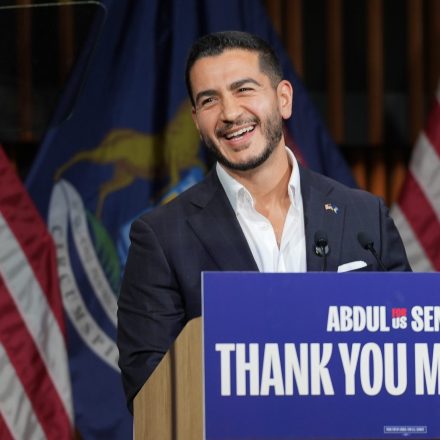 Related
Abdul El-Sayed Wins Senate Seat With Pro-Palestine Campaign
Abdul El-Sayed (acceptance speech): To all the kids who watched this last month, to all the parents who struggled to explain why the president openly mocked someone for their name or how they pray, let them know tomorrow that the bad guys lost.
JW: That race was filled with Islamophobia, both in the primary and in the general election. His Republican opponent, Mike Rogers, just peddled in a million different Islamophobic tropes. Voters told our colleague, Matt Sledge, who was out in Michigan speaking with them, that they really didn't like hearing all of this hate speech.
Zouheir Alawieh: They don't have any programs for our economy, for our health, for our future. So that's why they are attacking us as Muslims and as human beings.
Tea Edwards: Just, like, all of the Islamophobic hate campaigns that have been going around will probably sway a few people. The people who are actually researching what will be good for communities I think will see right through it.
MH: This was a campaign that was defined by so much panic about El-Sayed being Muslim. The race ended 25 years after 9/11, and there were all of these really kind of vitriolic Islamophobic tropes. It reminded me a lot of the campaign against [Mayor] Zohran Mamdani here in New York last year. There's all this fear of the left and this fearmongering suggesting that there's no way a Muslim candidate could represent American interests.
And of course, one of the big differences between El-Sayed and Mamdani is that El-Sayed is not a socialist.
JW: Say that again for the people in the back, because they are not going to believe you. El-Sayed has described himself as a capitalist who understands how capitalism works, so definitely not a socialist.
I've heard him described as much more of a [Sen. Elizabeth] Warren than someone in the Bernie Sanders mold.
MH: But he still faced millions of dollars in outside spending in this race, mostly because of his stance on the United States relationship to one other country.
We've heard in some of these deep-blue districts in the House races where socialists were elevated in the primaries, there was a lot of rhetoric on opposing Israel's genocide in Gaza and fighting U.S. weapons flows to Israel. But it's pretty rare to hear that from a U.S. Senate candidate, and now from a senator-elect.
JW: It also caused some really ugly drama with his former primary opponent, Haley Stevens.
MH: Do you want to try to recap that as fast as we can, or should I?
JW: I'll get started and see if you can add in anything that I miss.
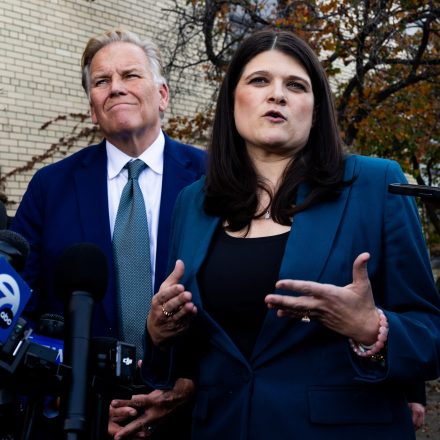 Related
Radical Centrists Like Haley Stevens Are the Real Extremists in the Democratic Party
So essentially, on the Friday right before [Election Day], Haley Stevens released a statement condemning an ad that was not even created by the El-Sayed campaign, calling on him to condemn the ad, which he did disavow. She also asked him to take back his statements on Israel.
Now, things seemed fine for a second. Haley Stevens had all of these Democratic surrogates going on air saying that she promised to support him. While Haley Stevens's staffers were at an event for El-Sayed, Haley Stevens popped up at an event supporting the Republican candidate, Mike Rogers, giving him her endorsement.
Maia, is there anything that I missed in that?
MH: Jessie, I think the only thing you missed was just how baffling and strange this episode was. So you mentioned this ad that kicked it off. It was produced by this outside group Rebellion PAC, which is the group headed by Cenk Uygur, who some listeners might know from The Young Turks. He is also famously Hasan Piker's uncle.
Haley Stevens, as she was struggling to explain why she switched from El-Sayed to the Rogers camp, kept citing Hasan Piker and the "uncle." It was this kind of almost incomprehensible move where Anderson Cooper, the CNN host, was pressing her at one point, saying, well, you cite his affiliation with Hasan Piker and this part of the Democratic Party you don't like, but you knew about this before — so what changed?
It really seemed strange. So we sent Matt Sledge out in Michigan to ask some voters what they thought of it, and if they thought that this was a politically savvy move that would have any resonance. And here's what they said.
Kathleen Britton: I'm so disappointed in Haley Stevens. I gave her serious consideration during the primary.
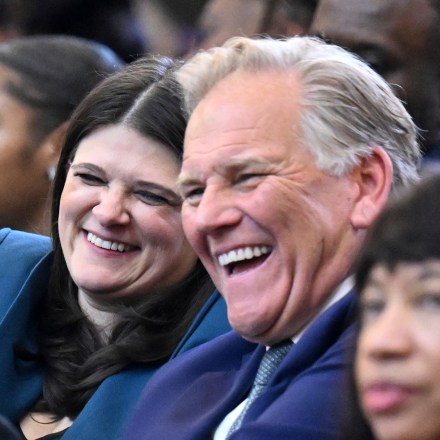 Related
Haley Stevens Destroyed Her Political Career for Absolutely Nothing
Jesse Craft: She fought against Mike Rogers, then said somehow he earned her vote. I don't really understand it. I kinda think it's career-ending for her.
Wendy: How embarrassing to use an African American church. How embarrassing for you to use our votes and then disregard them because of your own personal issues.
Intercept reporter Matt Sledge: So you don't think it's gonna help Mike Rogers?
Kathleen Britton: I do not.
Erin Horne: No, I think she actually helped Abdul.
[Break]
JW: Maia, before the break, you started talking about money and politics, and I want to get into how that shaped the midterms. Last week, we talked about how this election cycle became the most expensive on record. Midterms ad spending is expected to reach north of $11.6 billion. Mega-donors overwhelmingly gave to Republican candidates, including Elon Musk, who spent nearly $450 million, with large sums of that directed at boosting Ken Paxton in Texas, who, by the way, lost to James Talarico. Now, for context, the next highest donors under Musk are a Republican couple [Richard and
Elizabeth Uihlein] who spent $150 million, mostly in Wisconsin and Illinois.
Jesse Craft: We all see where money is coming from. It's coming from very, very wealthy billionaires. I don't think we should be able to buy elections.
Tea Edwards: Politics, it just feels like a game that the rich play sometimes. Kind of feels hopeless when you're just looking at all of these people and corporations giving money to each other.
MH: You hate to see Elon Musk throw away almost half a billion dollars. It only leaves him so many billions to go.
JW: Heartbreaking.
MH: But, I mean, in Texas, as you mentioned, that money really did not pan out. It didn't seem to sway voters. It seemed like if anything from the voters who talked to our reporters in Texas, in Michigan, and in Maine, which we'll get to later, people were really mad about outside election spending and don't like the idea that billionaires or corporations can buy their elections.
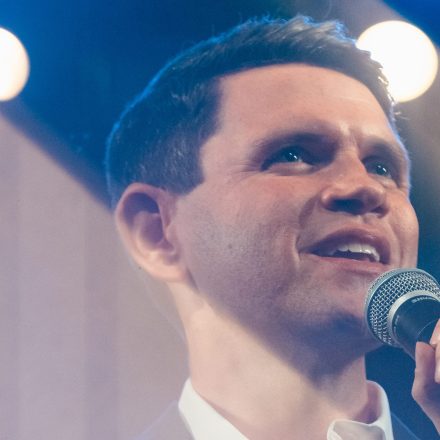 Related
Anti-Trans Panic Couldn't Save Republicans in Deep-Red Texas
And in Texas, a lot of that money went to propping up this anti-trans panic campaign that Paxton was running. But all that money was not enough to save Paxton from James Talarico. Paxton was a pretty bad candidate: He was mired in too many scandals to keep track of, including a 2015 grand jury indictment on felony securities fraud charges.
In 2020, eight of his top deputies reported to the FBI that he was potentially abusing his office to do favors for a donor and friend. And just earlier this year, he offered a plea deal in a child sex abuse case that seemed to anger Texans and voters.
Remember, this is the era of the Epstein files and people being very concerned about child sex abuse. It did not seem like the wisest calculation for Paxton to offer this while running for Senate.
JW: As it turns out, there is not enough money in the world to buy Ken Paxton out of being Ken Paxton and voters recognizing that. But Republicans tried this cycle to spend big on transphobia and to blanket the airwaves with these anti-trans advertisements.
Elon Musk's Texas PAC spent $78 million on anti-transgender ads in Texas, which actually accounted for nearly half of all ad spending in support of Paxton. Republicans' big play in Texas was transphobia — and that play failed.
While clearly it didn't sway the election, some of those messages did appear to trickle down to voters. Our colleague, Akela Lacy, talked to voters in Dallas and the surrounding areas, and she did come across some voters who said they wanted to support Talarico or even some voters who did support Talarico but were concerned about his stance on trans rights, an issue that Republicans really fearmongered on this cycle yet again after doing it in 2024.
Akela Lacy: When you said you saw some stuff about James Talarico that made you unsure about voting for him, can you say more about that? What did you see, and what's your impression of him?
Jermiah Robinson: I think I seen something about the LGBTQ+ community? I mean, I don't really care about it, but I don't know. People were saying a lot of bad stuff. I think they said something about him —
Canvasser: Encouraging sex change.
Jermiah Robinson: Yeah, on the children. I don't really stand for that.
Maia Hibbett: The watchdog group Media Matters also put together a montage that showed just how much Republicans really leaned into this transphobic rhetoric.
Danielle Buck: He wants to trans our kids. He believes that there are six genders.
Andrew Kolvet: They wanna indoctrinate your kids. They wanna trans your kids.
Adam Sosnick: They're gonna trans your kids. They're gonna Talarico your kids.
Donald Trump Jr.: Trans kids back in school, trans agendas back in school, in your classrooms, with your children.
JW: Clearly, some of that rhetoric did trickle down to voters based on Akela's conversations, and some people even believed the misinformation being spread in those ads.
But fearmongering was just clearly not persuasive enough to distract people from their lived reality, and that lived reality is that gas prices are up, rent is unaffordable, and grocery prices are up.
 Related
Right-Wing Trans Hate Comes for the WNBA
I think one lesson maybe for Democrats is, there's no point in attempting to placate people when it comes to bigotry. The right can and will distort your messages, and so you can stand in your values or not, but the thing that'll motivate voters is if you can convince them that you're going to make their lives better, not if you can convince them that you're playing the middle on an issue of civil rights.
MH: We saw a parallel to this in some ways in Michigan as well, where a lot of the Republican argument was based on this perception of Islamophobia and fearmongering. Ultimately, that was not enough to elevate Mike Rogers over Abdul El-Sayed. In Texas, there's also, of course, the strong anti-immigrant sentiment that Republicans frequently run on, and I think the statewide results showed us that that narrative really fell apart this cycle.
JW: To your point, clearly, attacks on trans people, attacks on immigrants didn't work in Texas. Democrats had an amazing night. Gina Hinojosa toppled three-term incumbent Gov. Greg Abbott. The state has not had a Democratic governor since 1990.
"Attacks on trans people, attacks on immigrants didn't work in Texas."
MH: And speaking of toppling long-term incumbents that have been hard to get out of office, our colleague Noah Hurowitz was in Maine, where Troy Jackson defeated Susan Collins last night after many Democratic attempts to get her out of office.
This issue of disillusionment with money and politics came up quite a bit when he was talking to Maine voters.
Sharon McDonnell: It's immoral. It is immoral to have people worried about their fuel and have that much money coming into this. It's just wrong.
"The amount of money is more than I will probably make in my lifetime, spent in this election."
Tyler Echard: The amount they spent on just mailers, not handed at the door but in the mail, is especially, it seems, on the Republican side of things, has been absolutely insane. The amount of money is more than I will probably make in my lifetime, spent in this election.
Charlie Dingman: It's been extraordinary in Maine, the amount of spending in this race, particularly in the Senate race. I think there's a lot of fatigue. I think people are tired of it. I have had some conversations with voters at the doors that lead me to think that the extremely negative and extremely untruthful ads may be backfiring.
JW: It seems like those ads backfired. The last voice you heard was Charlie Dingman, Maine Democratic Party chair.
Collins campaigned on her record of securing federal investments for state infrastructure, such as rural hospitals, and she really prided herself on being a moderate Republican who apparently breaks rank with President Donald Trump. But the reality of the situation is quite different.
 Related
Lockheed Martin Showered Susan Collins With Cash as F-35 Program Hit Turbulence
The Congressional Quarterly Roll Call found that her votes aligned with Trump 90 percent of the time in both of the president's first and second terms, and voters really noticed that. They understood the difference between what she said she was, a political moderate, and her voting record, which aligned with the really far-right Donald Trump. And that's something that Noah heard from voters as well.
Sharon McDonnell: She has had this persona of moderate cross-party stuff that's just really eroded. If you read every article about her, it's like, "Moderate Susan Collins." Like, wait a minute, she's voted with Trump. She hasn't used her power.
Susan Collins "has had this persona of moderate cross-party stuff that's just really eroded."
MH: Collins really used that line about her being a moderate and being an independent voice in Washington as a go-to for her campaign.
In past cycles, it has worked. As we alluded to a little bit earlier, the Democrats have mounted challenges against her before. In 2020, they ran a candidate named Sara Gideon, who looked somewhat likely to oust Collins. And I think this cycle, there were a lot of reasons for Democrats to be nervous about this race.
Troy Jackson, the nominee, is a former state senator, and he ran on lowering costs, really centering working-class interests. But he had jumped into the race kind of hastily. If you remember Graham Platner, Jessie, he was the former nominee for Senate in Maine for the Democratic Party, and he was really considered a rising star, but had to drop out because of a series of scandals, and Jackson had to jump in last minute and fill his place.
But ultimately, Jackson pulled it off.
Troy Jackson (acceptance speech): We did it. Working people did it.
JW: Clearly, Jackson had a disadvantage going into this race. There were people who complained and said that he wasn't as charming as Platner, he wasn't as polished. But in this election, the ideas and running on affordability seems to have won the day in Maine and really throughout the country.
Collins had a reputation of delivering for the state, but clearly that wasn't enough to overcome this blue wave across the country and some frustrations with Collins as well.
But Maia, taking a step back to look at the full scope of Democratic wins, what do you make of their gains on Tuesday? Are there other races that stood out to you? What stood out to you overall?
MH: Well, there's the spin about the spin, which is that everybody is going to be framing this election and these results in their own interests. When Democrats win so far across the board, you can make an argument that any faction of the Democratic Party has the mandate, because Democrats of all stripes won Tuesday night.
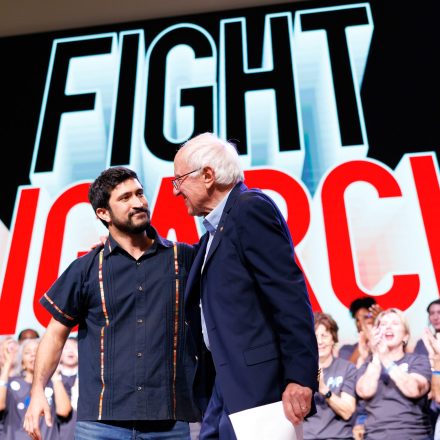 Related
The Progressive Agenda: End Iran War, Rein in AI, Get Dems to Actually Do Something
But to my view, it's hard to see how this is a world where there isn't a clear demand for some kind of transformational change. So I'm wondering what Democrats do with their mandate now, especially as we think ahead to 2028.
If you recall 2020 and the last time the U.S. elected a Democratic president, you might remember that the Biden campaign was the sort of centrist, moderate return to normalcy choice, but they got there after a lot of left momentum in the primary and a really serious showing of support for Bernie Sanders, who remains one of the most popular politicians in the country.
Once Biden got into office, he arguably tried to give some of that kind of left, dare we say, populist economic message some service. There was the Build Back Better plan that had a lot of social safety net spending and Covid relief. There were climate infrastructure projects. There was the elevation of Lina Khan [to Federal Trade Commission chair].
For a little while, Biden was getting called the most progressive president since FDR, and then he threw it all away supporting the genocide in Gaza and really lost the support of the left, and then lost the support of the country when he was kind of visibly melting on the debate stage and refusing to drop out of the race.
So I'm curious what Democrats have learned from the Biden years and how that will convert into the next congressional term and the next presidential election.
JW: It really feels like I've lived a million lives in between now and that debate that really tanked Joe Biden's entire political career at the end there.
I will say to your point, we're already seeing Hakeem Jeffries, who's likely to be the House Speaker, calling for unity and saying that people don't want to fight. But you don't really get a blue wave like this or a political wave like this when people don't want to fight.
Clearly, there's anger at Republicans. There's anger at the cost of living. There's anger at the war. If Democrats don't deliver, they're likely to see a red wave come the next cycle.
 Related
The Supreme Court Ends Multiracial Democracy as We Know It
But I did want to take just a little bit of a step back and talk about Black voters and what's happened in the aftermath of the Supreme Court voting rights decision. Black voters in this election really delivered historic victories in southern states for Democrats, but Black representation in Congress thus far appears to have been slightly reduced in this election. Now, for those who remember our discussion earlier this year about the Supreme Court decision to gut the Voting Rights Act, there were a lot of deep concerns that the decision would crater Black political representation, and so far that hasn't come to bear, but it's worth paying attention to in cycles that are less blue, where we've seen really massive redistricting.
I will shout out, there was one historic victory for Black Americans: Keisha Lance Bottoms, the former Atlanta mayor, won her race for governor, becoming the first Black female governor in the country.
MH: We've talked a lot about these historic wins, but we would be remiss to not mention a close call in Florida, where Angie Nixon narrowly lost.
Nixon is a Black woman who's a member of the Democratic Socialists of America and had a really shocking primary upset when she defeated the establishment favorite to get the Democratic nomination. The Democrats didn't invest very much in her Senate race in Florida. The conventional wisdom says Florida's not flippable, but conventional wisdom also says that South Carolina's not flippable — and they did that.
"The conventional wisdom says Florida's not flippable, but conventional wisdom also says that South Carolina's not flippable — and they did that."
Nixon ended up coming within about 2 [percentage] points to Ashley Moody, the Republican incumbent, who just won a full term after being appointed to hold the seat that used to belong to [Secretary of State] Marco Rubio. A lot of people on the left side of the Democratic Party are wondering what would have happened if Democrats had invested in a DSA candidate running statewide in Florida, which is kind of a crazy statement to make if you think of just two years ago.
JW: I mean, I listened to her [concession] speech, she is an incredible speaker, but obviously, that's not enough to win elections. You need money, clearly, and investment from the party.
We're going to leave it there, but there is so much more election coverage you can follow at theintercept.com.
That does it for this episode.
We want to hear from you. Tell us what you're following or want to see more coverage of. Email us at podcasts@theintercept.com, or leave us a voice mail at 530-POD-CAST, that's 530-763-2278.
This episode was produced by Laura Flynn. Chelsey B. Coombs is our social media producer. Ben Muessig is our editor-in-chief. Maia Hibbett is our managing editor. Thank you to all of our reporters who worked late on election night: Matt Sledge, Akela Lacy, Noah Hurowitz, Jonah Valdez, and Austin Campbell, and the rest of our team.
Nara Shin is our copy editor. William Stanton mixed our show. Legal review by David Bralow.
Slip Stream provided our theme music.
This show and our reporting at The Intercept do not exist without you. Your donation, no matter the amount, makes a real difference. Keep our investigations free and fearless at theintercept.com/join.
And if you haven't already, please subscribe to The Intercept Briefing wherever you listen to podcasts. Do leave us a rating or a review; it helps other listeners find our reporting.
Until next time, I'm Jessica Washington.
MH: And I'm Maia Hibbett.
The post How Democrats Changed Everything appeared first on The Intercept.
Jamal Khalique of the Taj Stores is giving an illustrated talk telling the tale of ninety years of trading in Spitalfields at 7pm on Thursday November 12th in the Hanbury Hall, Hanbury St, E1 6QR
Please note that tickets are free on the door to all Taj Stores customers

The gentleman on the right is Abdul Khalique, standing with his shop assistant, in the early nineteen-fifties outside the very first Taj Stores in Hunton St (now Buxton St). Abdul Khalique's brother Abdul Jabbar, the founder of the grocery store, commonly known then as 'Jabber's Shop', was a seaman who came here from Bengal to Spitalfields in 1934 after leaving the navy. He worked in textile sweatshops for two years before opening his store, which he ran with his Irish wife Cathleen.
These sparse facts, which I learnt from Abdul Jabbar's nephew Jamal - who never met his uncle - are all that is known of this brave man who travelled across the world and undertook the risky venture of starting a business in another continent, working so hard to build it up until his death in 1969. He would be amazed to visit the Taj Stores today and see how his modest enterprise has blossomed.
I enjoyed the privilege of a tour of the aisles in the company of Jamal (Abdul Quayum), who has been involved in the family business since he was seventeen years old, and now runs the store jointly with his elder brother Junel (Abdul Hai) and younger brother Joynal (Abdul Muhith).
It is a wonderful experience simply to explore here and savour the rich selection of produce on offer from all over the world in the Taj Stores. I love to study the beautifully organised displays of exotic fruit and vegetables, printed sacks of rice, tall stacks of brightly coloured cardboard packages, cans, bottles and jars - each with their distinctive fragrances. Then there is the cooking equipment, towers of plastic jugs and bowls, steel pots and pans, and scourers. There is a vast intricate diversity of attractive things collected here and it is a phenomenal feat of organisation that the brothers have pulled off, bringing this huge range of supplies together from the different corners of the globe.
Jamal explained to me how the business is run nowadays between the three brothers. Jamal does the hiring and the paperwork, while Joynal takes care of the day-to-day buying and selling, and Junel runs the catering supply and wholesale side of the business.'The beauty of it is, we have different responsibilities. We are a modern muslim family and we treat each other like friends,' said Jamal proudly.
Their father Alhaj Abdul Khalique first came to the United Kingdom in 1952 as a student before becoming involved in running the business with his brother. In 1956, the grocery shop moved to larger premises at 109 Brick Lane and then when Abdul Jabbar died in 1969, Abdul Khalique ran it with his brother Abdul Rahman. The pair were photographed looking every bit the sharp business men they were, in a handsome studio portrait taken at that time.
As the Taj Stores prospered, they moved again in 1979 to 112 Brick Lane and an era ended in 1994 when Abdul Khalique died. Then the family business passed from the brothers who had emigrated to this country, into the stewardship of the current generation born in East London.
This year, Joynal, Junel & Jamal - the brothers who run the shop today - moved the shop out of Brick Lane into their former warehouse premises at 26 Princelet Street. They explained to me that they now look back to their roots and, in the tradition of nineteenth century businessmen turned benefactors, they are funding a school and a mosque, building social housing, investing in irrigation and two cancer clinics back in Moulvibazar, Sylhet, Bangladesh - the home town where Abdul Jabbar set out from all those years ago when this story began.

Abdul Jabbar, the founder of Taj Stores

Abdul Khalique and his brother Abdul Rahman who ran the Taj Stores in the fifties

Taj Stores, 109 Brick Lane in 1977 (Photograph by Homer Sykes)

Taj Stores, 1980

Taj Stores, 109 Brick Lane (photograph by Phil Maxwell)

Taj Stores, 109 Brick Lane (photograph by Phil Maxwell)

Demolition of 109 Brick Lane, early eighties (photograph by Phil Maxwell)
Outside Taj Stores, 112 Brick Lane, c.1987 (photograph by Phil Maxwell)

Komor Uddin, Taj Stores, 7th December 1990 (photograph by Clive Murphy)

Joan Lauder the cat lady, buying cat food at Taj Stores, Brick Lane, 3rd August 1992 (photograph by Clive Murphy)

Taj Stores, 112 Brick Lane 2012 (photograph by Phil Maxwell)

Delivering cooking oil to Taj Stores, 112 Brick Lane 2002 (photograph by Phil Maxwell)

AI has become a juggernaut, driving technical strategy in the tech sector and outside of it. With the worldwide server market growing 30 percent in a single year to hit $122.6bn in the first quarter of 2025, IDC now feels safe recategorizing AI-driven investment "from cyclical to durable".
The analyst company expects inference to account for over 70 percent of computing demand by next year, adding that it's growing fastest at the edge.
Why enterprises are building their ownAll this investment in AI infrastructure might once have come mainly for hyperscalers, but that's changing quickly. Adoption is spreading quickly beyond public cloud service providers into enterprise environments, IDC adds. They're eager to run agentic AI in-house.
There are plenty of reasons for companies to own their own AI infrastructure rather than offloading it to the cloud. One of these is data control, especially in regulated sectors such as finance, healthcare, manufacturing, and the public sector that have sovereign data requirements. Another revolves around the need for predictable costing from tokens delivered on tunable in-house systems.
So what should companies look for in a supplier? Delivery speed will be a powerful driver for many who are under the gun to deliver AI initiatives for the business, especially during periods of constrained memory and CPU supply. Life cycle services will also come near the top of the list, for companies that need help managing everything from the power through to the reasoning LLM models and the workloads that use them. That need for expertise is unlikely to stop; companies will undergo changes in AI strategy as they get to grips with a still-evolving technology.
From the desk to the datacenterASUS expects this AI surge to continue in the datacenter, but elsewhere too, specifically in edge locations (especially industrial use cases) and at developers' desks, as the applications that will power the enterprise get made. It wants to be top of peoples' list for hardware and services at all these places along the AI continuum.
At NVIDIA's GTC show in Berlin on Oct 21-22, it announced a full-stack AI offering that it's calling its Enterprise Agentic AI Solution. It's three-layer affair, featuring:
ASUS AI Server and Infrastructure: Its selection of AI servers, including several new units.
ASUS AI Software Stack: Its software for integrating and controlling AI workflows.
ASUS AI HUB: A services operation that ties it all together.
These bring together some existing assets that ASUS had for enterprise AI users, along with some new ones. The time is right for an end-to-end offering with new hardware because of the way the market is shifting, say ASUS execs.
"ASUS servers help enterprises build high-performance agentic AI infrastructure capable of supporting both complex task execution and large-scale AI agent deployment, accelerating enterprise adoption of agentic AI," says Paul Ju, senior vice president and head of infrastructure solution BG at ASUS.
While generative AI initially spiked demand, the advent of agentic AI has sent compute demand into overdrive. Ju explains that the focus is expanding from the GPU.
"Historically, AI servers have been optimized primarily around GPU compute. But as enterprise AI shifts toward agentic AI, workloads increasingly revolve around a continuous 'agent loop' that is heavily CPU-dependent," he says. That loop takes in task planning, code execution, external tool invocation, and reflection or correction work.
The CPU's increased role in this execution work is creating bottlenecks in conventional AI servers, he adds.
The first such sticking point is single-thread performance, which leaves GPUs idling while they wait for CPUs to complete. The second lies in memory bandwidth. When this is managed on a per-core basis, it can slow things down when many agents run at once.
The multi-die design of many CPUs also penalizes them in AI environments, because accessing data across dies introduces latency, Ju argues. CPUs with cores and cache on different dies suffer latency when data has to cross between them. Maintaining cache coherency exacerbates that problem.
Finally, there's a security risk: a lack of hardware level sandbox isolation on some CPUs make it possible for prompt injection to reach core systems, he warns.
Customers also bring their own challenges as they grapple with different applications for AI. Enterprises evaluating AI server options have to match their server platforms to the projected AI workload profiles, Ju adds. Training a supervised learning model to batch-classify insurance claims takes different technical resources to running a low-latency reasoning employee chatbot.
What ASUS took to BerlinASUS wants to help customers solve problems like these wherever they come up. With this in mind, the company had plenty of goodies for onlookers at GTC.
Starting at the datacenter, the company announced both single and full-rack systems built around the NVIDIA HGX Rubin NVL8 eight-GPU server board. It has a 3U hybrid-cooled system, the XA NR11-E12L, along with the 2U 100 percent liquid-cooled XA NR11-E12, both targeting large AI reasoning workloads.
The two Rubin units target different use cases. The 3U hybrid liquid cooling system uses direct-to-chip liquid cooling on the 8GPU baseboard, along with air-cooled dual Xeon 6 chips on a sled. The company pegs this as the easy transition path into AI factory hardware. The 2U unit, with its 100 percent liquid cooling, is tailored for maximum PUE and compute density. It also uses a cable-free board-to-board design to keep its footprint low.
The kit will be speedy, too, with NVIDIA HGX Rubin offering 800Gbit of integrated bandwidth per GPU.
ASUS is promoting the serviceability of these units through their use of tool list CPU and GPU sleds. It claims up to a 50 percent time saving on maintenance operations for these units, meaning less downtime per service and ultimately a lower total cost of ownership.
Delivered fast for NVIDIA HGX RubinASUS is structuring its hardware proposition around speedy delivery so that customers can get hardware up and running to support their AI initiatives. That speed comes from validation carried out before delivery with the help of a pre-validated rack reference architecture.
NVIDIA MGX Server for flexible buildsIn keeping with its focus on multiple designs for the right AI workload, ASUS also supports NVIDIA's modular MGX Blueprint for server builds. The selling point here is flexibility with a mixture of GPUs, CPUs, and networking options for enterprise inference, agents, and visual computing. This is the modular route for workloads that don't need the power of an 8-GPU HGX baseboard, and it covers a large gamut of enterprise inference and agentic use cases.
ASUS showcased MGX servers including the 6U XA P8A-E14AXL with its eight liquid-cooled NVIDIA RTX PRO 6000 Blackwell Server Edition GPUs. A 2U sibling, the XA P4N-E2, sports NVIDIA Vera processors for agentic work.
Solutions for the edge and developersThe ASUS booth also featured the ExpertCenter Pro ET900N G3, powered by the GB300 Grace Blackwell Superchip developer desktop with 748GB of coherent memory, and the Ascent GX10 based on NVIDIA DGX Spark for agentic work. Also on show were the ProArt GR1X Mini PC and ProArt P16 and P14 laptop - the first laptops powered by NVIDIA RTX Spark - aimed at both developers and creators.
For edge installations, it showed the PE3000N, its rugged NVIDIA Jetson T5000-based edge-AI computer aimed at use cases including industrial environments. Announced a year ago, this delivers up to 2,070 FP4 TFLOPS of peak AI performance with 128GB of memory. Targeted at industrial AI environments was the PE6000G, a workstation-grade AI and simulation platform.
Rehearsing the AI factory in a digital twinEquipment only supports an AI factory when there is power to run it. ASUS has been taking steps with NVIDIA as a partner here, adopting its DSX AI Factory platform with digital twin system for laying out hardware and power in AI factory environments. DSX supports equipment using the NVIDIA Vera Rubin processor line, which supports dry coolers and a lower PUE with a 45 degree centigrade warm water inlet.
ASUS configured racks become simulation-ready assets inside DSX, adopting its OpenUSD shared file format. That covers engineering data alongside the geometry for measuring real power draw and cooling requirements.
ASUS wanted to target cooling as part of the original design plan for the AI Factory, not as a facility afterthought. So, the DSX partnership allows implementation teams to model water temperature, flow, pressure, CDU placement, and piping within the digital twin model. They translate information from the planning resources that go around this, such as the NVIDIA Omniverse DSX Blueprint framework, using the ASUS Infrastructure Deployment Center.
Faster to build, easier to runThe digital twin system isn't just for design and setup. It's supposed to keep working after go-live so that AI factory operators can simulate changes before touching hardware. The ASUS Control Center monitors the infrastructure while DSX exchange links IT and operational technology data. Operators can validate changes in the simulation before flipping the switch to go live.
ASUS' goal here is clear: to assist enterprise customers as they tackle in-house AI opportunities while acknowledging that the performance profile and physical locations of their workloads will vary. As companies continue to evolve their understanding of AI and where it fits within the organization, they will need to be agile in how they plan and nurture their infrastructure from the datacenter out to the edge, and to the developer's desk.
The Berlin announcements tie it together in a neat package for organizations that need help with their agentic aspirations.
Learn More about ASUS NVIDIA HGX Rubin NVL8 Systems: XR R1I12B-M1BLFS | ASUS Servers
Sponsored by ASUS
Young people and women most at risk, study finds, as researchers call for vegan products to be fortified with iodine in particular
Switching from dairy products to plant-based alternatives could lead to deficiencies in vital micronutrients, especially among young people and women, a study has found.
Even moving partly to vegan alternatives to milk, cheese and yoghurt could lead to falls in iodine, calcium, riboflavin and vitamin B12 if the substitutes, often based on soya, almonds or oats, are not fortified, scientists said.
Continue reading...
A last minute attempt to throw the midterm election into chaos failed. Leading up to this point, the signs were never good in the Magic 8 Ball way. The Trump administration wants people to believe California was overrun with non-citizen voters. The facts, however, refuse to comply with the narrative.
This particular ship has been sinking for a couple of weeks now. The DOJ delivered an accusation before it even delivered a list. It claimed — absolutely without facts in evidence — that there were at least 20,000 "illegal" voters in California. And by "illegal," the administration definitely meant "brown people we'd like to expel from the country."
California pushed back. First, it questioned the claim and received no definite answer. Then the administration reluctantly admitted — as it has in other states — that its first allegation may have been overstated. But rather than pull back and reassess, the DOJ went the other way.
I assure you that I am not making this next part up: it delivered a thumb drive containing a list of the 20,000 "illegal voters," along with a password written on a Post-It note… you know, the way aging parents handle login info for their cable TV-provided email accounts.
Then the state sued the DOJ, right after the DOJ demanded California investigate each and every one of these 20,000 allegations within 48 hours of being thumb-drived. Other voters sued the DOJ as well, which set it up for the string of extremely speedy failures it recently experienced.
Things already looked bad for the DOJ when its DHS-aided raids in California resulted in the arrests of 28 "illegal" voters — this in a state that has 23 million registered voters. Not content with this failure, the DOJ then claimed California election officials just weren't doing enough and demanded they do all the heavy lifting while the DOJ pursued its minuscule number of prosecutions.
With the mid-term election just a couple of days away, the courts moved speedily to handle this bullshit. As Chris Geidner reports, the first thing the DOJ did with the clock counting down to "FLIP EVERYTHING" time is shoot itself in the face while attempting to shoot itself in the foot:
A Justice Department lawyer on Monday admitted in court that it was "fair" to say that the Trump administration's list of "likely noncitizen" voters has a high error rate.
The shocking admission from Assistant U.S. Attorney Kenneth Kao came in a hearing in a lawsuit brought last week by unions representing election workers and civil rights organizations over the Trump administration's threatened prosecution of those election workers and other related conduct.
Yep, that's the way the DOJ does business under Trump's control: You fuck up until you're forced to admit you've fucked up. Firings and forced resignations ensue. New sychophantic rubes are pressed into service. Rinse and repeat.
But what's really enjoyable about this is how fast the DOJ (and the administration overseeing it) lost at every single level of the federal court system after making this admission. Geidner has reproduced the entire timeline, which is truly a sight to behold.
At 10:10 pm (ET), the federal court handling the lawsuit denied a request for a stay of its order. This led immediately to the administration running its election interference campaign to the next two levels of the court system, hoping against hope that at least one set of judges would give the DOJ permission to fuck with midterm elections in Calfornia. No dice.
[UPDATE, 4:00 p.m. ET November 3: After a flurry of activity in the U.S. Court of Appeals for the Ninth Circuit since Judge Thompson denied DOJ's motion for a stay of her TRO, a 6-5 limited en banc panel of the appeals court issued an order Tuesday that stays Thompson's TRO pending the Justice Department's appeal of it at the Ninth Circuit.]
[UPDATE, 6:15 p.m. ET November 3: The plaintiffs are seeking full court en banc review at the Ninth Circuit, arguing, "Federalism principles of the highest order, embedded in our Constitution, require correction of this erroneous decision by the full Court."]
Meanwhile, the administration was trying to secure a parallel victory in the highest court in the land, pursuing its appeal of an earlier rejection of the DOJ's lawsuit against California — one that demanded election officials "segregate" any ballots that might be related to the DOJ's admittedly highly erroneous list of 20,000 voters.
The Supreme Court couldn't be bothered. Its rejection failed to state if it was less than impressed with the administration's lack of subtlety when it came to its own election-rigging efforts:
[Update, 6:05 p.m: The Supreme Court quickly rejected [Solicitor General John] Sauer's request on Monday evening — before any opposition was even sought or filed… There were no noted dissents.]
So, if you're following along and can read a clock, you're seeing something rather remarkable: an administration being shut down by three consecutive levels of the federal court system in less than 24 hours.
And that means California doesn't have to do any of the bullshit the DOJ demanded and then sued about. It also means the DOJ doesn't actually have any illegal election dirt on 99.9999% of California's voters and we wouldn't be shocked at all if it doesn't have any dirt on the 28 people it managed to round up during its statewide sweep.
Orders for what one official called a "national no enforcement day" began circulating on Monday inside U.S. Immigrations and Customs Enforcement.
Handed down through ICE's Enforcement and Removal Operations division through internal group chats and verbal commands, the directive called for a halt to all immigration enforcement operations on Election Day, according to ICE officials across the country who spoke to The Intercept.
"We were told all operations are canceled for Election Day."
"We were told all operations are canceled for Election Day," said one ICE immigration official, who operates in the south and requested anonymity to protect their livelihood. "Word of mouth from our first-line supervisors, no official email notice."
According to multiple ICE officials who spoke to The Intercept, the orders were handed down quietly to avoid media attention.
"Yesterday was the least amount of activity observed from ICE ERO throughout the entire year so far," said Sherman Austin, the creator of StopICE.net, a crowdsourced platform tracking reported ICE activity across the United States. "You can kind of tell like from the morning. Usually, ICE gets started really early, and there's a huge spike in activity between 5 a.m. and 10 a.m. That spike wasn't there on Election Day."
Another ICE official, who works in the Great Lakes region, confirmed the orders ahead of Election Day, referring to it as "National No Enforcement Day."
 Related
Inside ICE, Officials Question String of Trump Admin "Midterm Panic Moves"
"We were told to do 'admin' shit," the official said. They said that ICE deportation officers who regularly do street-level operations were diverted to administrative office work: "I'll be drinking coffee at the office for the first time in a year."
In total, ICE officials working in four areas of responsibility — ICE's jurisdictional regions — coving parts of the northeastern, midwestern, northern, and south-central U.S. regions told The Intercept that they had received orders to stand down on Election Day.
"Something Unusual Was Going On"StopICE, the tracking website, which has roughly half a million subscribers, did record some ICE activity on Election Day, according to Austin, although most of the reports stemmed from sightings unrelated to any immigration enforcement activities.
 Related
"Offensive Driving": ICE's Deadly Weaponization of Vehicles Against Civilians
"There were a few reports that came in about ICE being at usual spots like the jails," Austin said, "or seen driving in certain areas in in the city, but it wasn't the same type of activity that's usually seen on the site. It was pretty clear that something unusual was going on."
AntiFreeze, another crowdsourced ICE-tracking platform that allows users to report and receive real-time alerts about ICE raids, also saw abnormally low levels of ICE activity on November 3, according to Josh, the creator and developer behind the site, who requested to keep his last name anonymous.
"On Election Day, our network only logged about 56 reported ICE sightings nationwide, which is one of the quietest Tuesdays we've ever seen," Josh said. "We did get about three sightings that did report ICE activity near polling stations, but most of the reports were observations of vehicles associated with ICE. We barely got any reports about actual ICE arrests yesterday."
Local activists also observed a low level of ICE activity on the street level.
"There was no evidence of street abductions," said an activist working with the rapid-response network in Minnesota's Twin Cities.
 Related
In California's Central Valley, ICE Swung a Red District Blue
"ICE, in some capacity, was still out and about, but we did not see any reports of off-the-street detainments by ICE or attempts at detainments," said the activist, who said they got word of ICE arrests at jails, but not targeted operations among the general public. "There were a lot of folks, probably more than usual, observing, and so I think we can be pretty confident that this wasn't due to lack of observation."
Leo Martinez, who volunteers with VC Defensa in Southern California, told The Intercept that no one in his rapid-response group reported any sightings of ICE activity on Tuesday.
It is still unclear exactly where the orders to halt immigration enforcement operations on Election Day originated from, although some ICE officials believe the orders stemmed from ICE Enforcement and Removal Operations leadership — and not directly from the White House.
"Nobody from the SDDO level" — a reference to Supervisory Detention and Deportation Officer, part of ICE's upper management — "expected it to happen until the very last moment," said another ICE official familiar with the matter. "But I think some of us caught on that senior leadership was making this call with fears of us being at the polls."
The official said, "It's crazy that The White House didn't catch on."
The post ICE Was Secretly Ordered to Stop All Immigration Raids on Election Day appeared first on The Intercept.

During the final weeks of the campaign, convicted felon and oft-accused of sexual misconduct, Donald Trump kept talking about Jon Husted's butt.
After repeatedly describing Husted's backside as a "pile of muscle," Dementia Don claimed the Ohio senator had jumped 12 points in the polls because "the audience loved" his anatomical review. — Read the rest
The post Trump's anal fixation fails to deliver in the end appeared first on Boing Boing.

TL;DR: Turn one USB-C port into 13 with this docking station, now $34.97 (reg. $70).
A laptop bag full of single-purpose adapters gets heavy, and you usually leave the one you need at home. If you want one small gadget to replace them all, try the 13-in-1 Docking Station with Dual HDMI. — Read the rest
The post A 3-ounce docking station with 13 ports is now half off—just $34.97 appeared first on Boing Boing.
If you share content using public iCloud links, Apple could soon be looking over your shoulder and checking for "harmful content." The iBiz announced plans to moderate publicly accessible iCloud share links in version 27.3 of iOS, iPadOS, macOS, and visionOS on a support page published on Tuesday. To clarify, this applies only to iCloud content shared via links created to be accessible to anyone, as opposed to content shared directly with other people.
"Items shared using Anyone with the Link will be checked by Apple for harmful content," Apple explained on the new help page without bothering to define what harmful content means. Based on the wording, it appears those checks will apply to all iCloud items shared using "Anyone with the Link," which Apple says it can also access. The company hasn't explained how the checks will work.
The share-with-anyone option removes end-to-end encryption from the shared item, Apple said, even if Advanced Data Protection, Apple's optional end-to-end encryption feature for supported iCloud data, remains enabled for the account.
"If you try to upload harmful content, Apple reserves the right to move, refuse, modify, remove, or delete the content at any time," the help page continues, adding that the iMaker may also block or disable accounts associated with harmful content.
The company also said it reserves the right to involve law enforcement when necessary, suggesting that its undefined "harmful content" category could include child sexual abuse material (CSAM), malware, and other potentially unlawful content.
Without a proper definition of what it defines as harmful, however, iCloud users are essentially left at Apple's mercy: If it chooses to continue to bend the knee to the Trump administration, for example, content deemed objectionable by the standards of political figures could end up wiped out.
Apple also hasn't explained whether human moderators, automated systems, or both will be responsible for identifying and removing so-called harmful content, or whether any decisions will be left to AI, which can easily be fooled into making a bad moderation call.
The scanning of such content, as mentioned above, begins with version 27.3 of Apple's various OSes, which were released to developers in beta on Tuesday, with a general release expected in December.
Apple didn't respond to questions for this story. ®
As of Tuesday, developers can explore expanded Siri AI integration for their Apple platform apps through beta releases of iOS 27.3, iPadOS 27.3, macOS 27.3, and visionOS 27.3. Next spring, nearly three years after announcing plans for deeper third-party Siri integration, Apple expects to begin accepting App Store submissions using the new capabilities.
"This developer beta offers a sneak peek at Siri AI app intents for developers," Apple said in a developer news post. "With this early Developer Preview, your app can work directly with Siri AI, giving you a first look at new ways to reach and serve your customers."
Anything is likely to be an improvement. Apple's Siri, a voice-activated assistant service, dates back to 2011 and gained limited third-party app access in 2016. In 2024, it became an interface for interacting with Apple Intelligence, its suite of generative AI features.
Apple Intelligence has not been very intelligent - several advertised Siri capabilities were delayed, so much so that Apple was sued in 2025 over allegations of misleading marketing. After a shakeup of Apple's machine learning group in December 2025, Siri and Apple Intelligence received a makeover at Apple's Worldwide Developers Conference in June.
"Before this year, Siri was a timer with a voice," said Roberto Gutierrez, Apple platforms staff engineer at a media company and author of the e-book On-Device Intelligence, in an email to The Register. "Weather, alarms, calls. Anything past that was a coin toss.
"On the developer side, SiriKit covered a handful of domains and Shortcuts only worked if users memorized the phrase. Siri AI is the first version that understands context and can chain actions across apps. That's a real change."
There is a catch, however, Gutierrez observed. Siri AI is available in a limited number of languages and regions. Support for Traditional Chinese is expected by the end of 2026, and EU availability remains a matter of negotiation - Siri AI is unavailable on iOS, iPadOS, and watchOS in the bloc as Apple works through interoperability concerns under Europe's Digital Markets Act.
"Apple is working constructively with the EU in an attempt to find a path forward," the company said last month without committing to any concessions.
Gutierrez said that he expects opening Siri to third-party developers will be useful to some extent.
"Siri can only do what apps expose through App Intents, and SiriKit is on its way out," he said. "If your app's main actions aren't exposed, the new Siri can't see you. The bigger shift is letting Claude, Gemini and others plug in. Developers already choose between three options for every AI feature: Apple's system model, an open model through MLX, or a cloud API. Siri is heading the same way. It doesn't need to be the smartest model. It needs to be the best router. That's the right call."
Apple has made choosing between those three options more difficult by failing to publish benchmarks that show how its Foundation Models compare with open-weight alternatives.
The biz has published measurements of how its third-generation Foundation Models compare to their 2025 predecessors. But the company's commitment - to "[share] more details on our latest foundation models, including updated evaluations and benchmarks, in a technical report later this summer" - remains unfulfilled so far as we're aware.
Gutierrez ran his own benchmarks to compare Apple's iOS system model (FM system, ~3B) to several open-weight models that are suitable for use on-device.
"On an A17 Pro iPhone running iOS 26, I tested Apple's system model against Qwen3 1.7B and 4B, Llama 3.2 3B and Gemma 3 4B on a structured-output task," he said. "Speed: Apple's model ran at about 149 tok/s, roughly 3x the fastest open model (Qwen3 1.7B, about 46)."
Quality, he said, was a tie, with every model passing five typed checks. But memory, he said, was where Apple's models had an advantage.
"The system model's weights live outside your app's memory budget," he explained. "My app peaked at 12 MB during inference. An open 4B model costs 2.4-2.7 GB, and a 2.4 GB model plus your app plus a WebView is a crash report. So yes, it's competitive, and on iPhone it's the default I'd recommend. If you want your own model, Qwen3 1.7B is the one."
But Gutierrez urged Apple to publish proper competitive benchmarks. "Their numbers compare against their own previous models," he said. "Developers aren't choosing between Apple 2025 and Apple 2026. We're choosing between Apple, Qwen and a cloud API. I had to build my own harness to answer a question Apple could settle with one table."
The absence of competitive model metrics is not the only gap. Apple has also failed to accommodate web apps.
"Web apps are locked out," said Gutierrez. "Foundation Models is a Swift API (and now Python). No JavaScript, no WebKit. A PWA's only option is to ship its own model into the browser and pay the full memory bill inside a WebView."
And bringing your own model may pose performance problems. "On an A17 Pro iPhone, the 3-4B open models pushed the phone into 'fair' thermal state and dropped to 12-24 tok/s," he said. "In practice, your own model on iPhone means ~2B or smaller."
With Siri AI unavailable on iPhones, iPads, and Apple Watches in the EU (and its rollout in mainland China subject to regulatory requirements), developers may need a fallback for global apps to handle regional restrictions. Apple's Private Cloud Compute offers eligible developers access to Foundation Models, Gutierrez observed, though it requires membership in the App Store Small Business Program, fewer than two million first-time App Store downloads across their apps, and the necessary entitlement. ®


