





The Blog
25 Aug 2005 23 Aug 2005 IntarWeb Warning: Rising Meme.
The first church of the Flying Spaghetti Monster is growing strongly. Have you been touched by his Noodly Appendage? rAmen. ps. More here at WIkipedia. [from: JB Ecademy] [ 23-Aug-05 9:10am ] Ecademy Clubs: Skype Directory Club - Forum : It would appear Skype is miles ahead in terms of numbers and has potential to become a de facto standard for PC PC voip. Skype has a unique propriety standard that is scalable (?). However, what about competitors? It's a fairly easy game to get into and the only commitment Skype has are paying clients and the fact that my contacts use Skype too. Could a competitor deplete Skype growth? Will corp users prefer the enterprise MS product with full integration to existing MS products? Could a competitor build a Skype compatible product without calling it Skype? Perhaps Skype should move to the licensing route to rubber stamp that de facto standard?
Two things make this difficult - Installed base. It's critical with an app like this that you can call your friends who have the same system installed. - Quality. Skype have raised the bar and it's not trivial any more to compete. Scenarios that might topple them. - The SIP community come up with a communal directory, there's some common way of busting NAT and firewalls, a common standard for encrypting coalesces around Phil Zimmerman and gpg and multiple alternate clients appear that are good enough. All four tasks look pretty hard but perhaps Gizmo can lead the way. With Jabber contributing the decentralised but communal directory. - Microsoft swallow their desire to make money from partners and open up MSN again so that it can talk to any SIP partner rather than just seleceted paid services. They build NAT and firewall busting into Longhorn as a service or switch wholesale to IPv6. Don't hold your breath. I don't think they want to be a telco so they'll try and build all the Skype-out/in stuff via partners. Who will then want an exclusive, charge for everything and won't be global. - Yahoo forget about partnering with BT and make Yahoo voice work properly. Except that YM! is pretty nasty and I don't think they can assemble enough programmming smarts. - AOL work closer and closer with Apple. The clever guys at Apple extend iChat into AIM and produce a PC version on the back of the move to Intel. In some ways this actually looks the most likely. I think the question for Skype is whether they can keep innovating fast enough to move further and further ahead into a really unassailable position where the only option for the commercial scenarios is to buy them out. This is a critical time in their growth where internal process and dealmaking will be pulling the limited programming resource into poor productivity. Rapid growth in company size and hence demands on time can be a real bitch to manage. 22 Aug 2005 Boing Boing: Customers of new UK ISP get to share all Sony music on P2P :
Cory is waxing lyrical about this. This is such stupendously good news that I frankly didn't believe it. This is what EFF has been calling for for years now, a Voluntary Collective Licensing Scheme will break the file-sharing deadlock and give the majority of Internet users who file-share today the chance to get legit while compensating rightsholders. and later PlayLouder MSP has deals with many indy labels as well as Sony, and those labels will also get a proportional cut of the money that PlayLouder MSP takes in based on their network monitoring. The ISP says that it is negotiating with other major labels and hopes they'll come into the fold soon. The thing that bothers me about this is the centralization and the dependence on deals with specific labels to get compensation at least nearer to the artist. Is there a mechanism here for truly independent artists to get paid? What about artists signed to a label that doesn't participate? And why isn't this going through the Perfoming Rights Society? But I think the biggest confusion here is going to be the relationship between the end user and the copyright owner. Can we expect the end user to be able to work out that sharing Sony tunes is OK, but sharing EMI tunes is not ok and likely to get you a law suit through the letter box? And finally there's some double think here. The EFF has been quick to debunk Audible Magic. But now they are going to be the saviour. 17 Aug 2005 MAKE: Blog: Dave Matthews DRM workaround HOW TO : which points at a description on the "Official Dave Matthews Band Website"
If this wasn't so sad it would be funny. Musicians explaining to their customers how to bypass the DRM on their CDs to get the song onto their iPod. By copying the embedded WMAs to their PC, downloading a license which then allows them to burn an audio CD copy of the original (modulo two lossy compression steps) so that they can then rip the CD to unencrypted MP3s to finally copy them to an iPod. And noting that the CD copy protection doesn't work on Macs so that a Mac can rip the original CD directly. And finally topping it off with a request to petition Apple to support WMA. And all this when the original copy protection on the CD can be bypassed by simply disabling auto-run on your windows box or holding down the shift key while mounting the CD. I mean, WTF? In the immortal words of John McEnroe, "You cannot be serious?" Just Say No To DRM and don't buy anything from the Dave Matthews Band. I'd suggest you tell them why but their website doesn't have any obvious way of talking back apart from this email address fanmail@davematthewsband.com Kim Cameron's Identity Weblog : New Identity Incubation Project at Apache
Hans Granqvist via Kim, "WSS4J's functionality overlaps TSIK's, but there are some differences. WSS4J uses Apache Axis as SOAP engine, and builds on the Apache XML-Security project. TSIK contains its own XML security engine as well as its own SOAP stack implementation." Kim: To put it slightly differently, it is my hope that by implementing the Infocard Identity Metasystem components Apache would effectively build in support for the whole gamut of identity tokens, including those used by Liberty, Sxip, Identity Commons, LID and Passel. In other words, I see InfoCards and the Metasystem as a platform, not a competitor, for these other systems. Kim: Clearly this type of involvement at Apache starts to answer some of the very legitimate questions posed to me by Julian Bond. Um. An Identity project within Apache is to be welcomed. I don't know the reasons but I wonder why an Apache project would start with a new SOAP stack when Apache Axis is probably the most well developed SOAP stack outside MS. SOAP Interop is not easy. So starting with a SOAP stack with a lot of experience of that would seem like a good idea rather than developing another from scratch. Lumping SXIP and LID in with Liberty (and missing out OpenID) as potential layers on top of the MS Identity metasystem seems odd to me. The technologies used are *so* different. And the only roadmap I can see for the MS identity metasystem to support Drupal, Wordpress et al via an Apache Java identity server is for TSIK to be very widely implemented on hosted Apache installations. This doesn't seem very likely to me in the medium term let alone the long term given that Axis is pretty rare now. So I reckon my gauntlet for Kim still lies on the floor. Pick a very popular open source web system wth very wide deployment. It doesn't matter which, but something like Drupal, phpBB, Wordpress, Movable Type, PHP-Nuke. Now try and imagine a roadmap where Infocard gets implemented on that application and gets widely deployed. I think we're beginning to see and understand MS' vision for the metasystem. "Here's all the heavy lifting done for you. now go and write something that uses it to provide end user services. BTW you'll be locked in to our platform and we'll be competing directly with you with our own end user service. We reserve the right to change the platform to suit our end user service but any changes will of course be documented." Sound familiar? Or am I being too cynical? 16 Aug 2005 Slyck News - Music Industry: Small Furry Animals Biggest Threat : Forrest creatures. Yes, forest creatures are now the number one threat to the music industry. Chipmunks, squirrels, raccoons, bunnies, field mice and opossums. Each one is using its own unique talents to disrupt the music industry and cause the collapse of an American and indeed global institution. In an evidential shift in piracy techniques, physical piracy is now a greater threat than P2P. Music industry intelligence has identified the following creatures as the main culprits in the physical CD trade:
Raccoons: Responsible for raiding and pillaging music stores for original data. Bunnies: "Mules" of the underground. Their quickness is utilized for distribution to burning plants. Squirrels: Use their opposable thumbs to operate heavy machinery such as CD/DVD burners and Nero Burning Rom. Field Mice: Security. Who isn't spooked by a scurrying mouse? Opossums: Financial backers. Don't ask. It gets worse. Peter Rabbit got a 60Gb USB portable disk drive for Easter. He's got his whole music collection on it and has been walking round all his friends and relations dumping his music and sucking up their's. And there's rather a lot of P. (diddy) R@661t's friends and relations, what with all the cousins and all. Flopsy Bunny prefers to carry round a couple of DVDs of hers. But she's such a party animal. She always takes over the music at the hop and starts playing endless Goa Trance. It must be something to do with the cabbage hearts and banana skins, which is all she will eat. Quick, quick! Hide all the children! Mr MacGregor's coming! Don't let him turn you into rabbit pie (or demand money with menaces). 13 Aug 2005 Our Social World
Conference Friday 9th September 2005 The Moller Centre, Churchill College, Cambridge, UK - just 45 mins from London Theme: Getting businesses into blogging and wikis! Enabling conversations with your customers and users by learning about web logs and related applications. Who should attend: All involved in business from CEO’s to receptionists, VC’s and entrepreneurs. Blogs can destroy or build a company’s reputation: Kryptonite Locks in the USA lost a $15m class action suit on issue’s first raised by a blogger. There's a stellar cast of speakers including yours truly. Anything you can do to promote this to business people (rather than geek bloggers) will be much appreciated. [from: JB Ecademy] 11 Aug 2005 09 Aug 2005 Google news feeds
Well congratulations guys, what kept you? Gnews2RSS dates back to 2002 (I think). But look at the output. Here's a typical description field. <br><table border=0 width= valign=top cellpadding=2 cellspacing=7><tr><td valign=top><a href="http://www.charlotte.com/mld/observer/news/local/states/north_carolina/counties/gaston/12267732.htm">True location of <b>lemurs</b>' love still a mystery</a><br><font size=-1><font color=#6f6f6f>Charlotte Observer, NC -</font> <nobr>Jul 31, 2005</nobr></font><br><font size=-1><b>...</b> Catawba Science Center exhibited the two adult <b>lemurs</b> -- primates of Madagascar and the Comoro Islands, with fox-like faces -- Feb. 5 to May 15. <b>...</b> </font><br></table> - What's that line break doing at the start? - Tables? Ugh! I strip those on all incoming RSS so they're gone. - Tables with no closing TD or TR? Double Ugh! - Repeating the title in the first line of the description. Why? - More line breaks. Why? So that's a solid 4 out of 10 and I'll stick to my scraper thank you. 07 Aug 2005 Real Tech News - Independent Tech » New FCC Ruling Forces ISPs and VoIP Services to Open Up to Wiretapping : Currently this initiative is limited to broadband users and VoIP networks that are capable of making calls to and from the traditional phone system (this would include Skype!).
We've had this discussion before. It's really hard for me to see how the FCC could impose this on something like Skype. If there's an end point in the USA such as Skype-In or Skype-Out then I can understand it. But for Skype to Skype calls, I can't see how the FCC could do this without requiring a back door in the code. Which then raises all sorts of jurisdiction issues. However, Skype may well want to have an official USA presence at some stage in the future for the VC's exit strategy. Even if there was a back door, you'd have to mirror all the traffic from one of the participants PCs to a 3rd party server for analysis. tricky to do without it being pretty obvious. And the same goes for any VOIP system that does P2P calls. This then raises the question of how secure Skype's encryption is. It's got all the encryption buzz words but with no-peer review of the code how sure can we be about the implementation? 05 Aug 2005 Inspired by this.
 It's a buggy excel macro used to print counterfeit logos on jeans. =if(Label="","RMA","?") I thought NTK might like this. 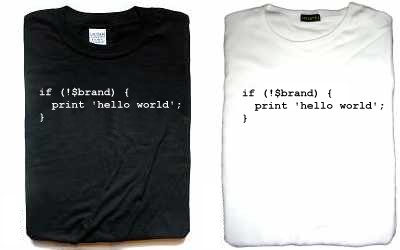 04 Aug 2005 Yahoo! Publisher Network This is their Adsense competitor.
Participants of the program must be a resident of the U.S., with valid U.S. Social Security or Tax ID number. Oh, well. 03 Aug 2005 I was looking for a quote and came across this.
http://www.fullcirc.com/community/onlinefacilitationbasics.html Well worth a read for anyone involved in community building and moderation. Here's a key takeaway. Central to the rules are two tenants: "You Own Your Own Words" and "Assume Good Intent." 1) When you hit the send button, your words are out there and probably can't be taken back. And nobody is responsible for them but you. So don't go into denial and say "I didn't mean to say that". It's all about communication and that means the important end result is the reaction in the reader's mind, not the reaction in your own to your words. So make a conscious effort to think about this when you write. "How will this be read?". 2) Communication is always flawed especially the written word. Take the best possible meaning you can get from other people's words and react to that. They may not have expressed well what they were actually trying to say. If you assume bad intent and fire bad intent back at them, you'll just start a flame war. If you assume good intent, perhaps the conversation can move forward. These are good rules to live by in the online world. [from: JB Ecademy] 02 Aug 2005 UK Brews World's Largest Pot of Tea as Anti-terrorist Measure
The task was accomplished by converting the Millennium Dome into an enormous teapot with a 95 meter spout. "We pretty much just turned on all the hot water taps and made sure the doors were closed," said Clarence Poltiss, director of operations at the Dome. "We lowered several tons of Typhoo teabags through the roof, and so far it's worked out pretty well. They did have to set off some munitions in the basement to get the overall temperature high enough for brewing, but I'm assured only conventional weapons were used."  01 Aug 2005 The Times Online guest contributors Opinion The Times has a policy of only allowing web access to UK visitors so you'll excuse me if I copy the relevant text from today's paper here.
Chains of love Back in the old days of physical distribution of music, this was easy. He took all the Barry Manilow records and the battered "Never mind the boll*cks" album, she took all the Celine Dion. But in this modern world of downloadable music and DRM it's all rather harder. It's his computer and he does all the downloading, ripping and sorting but it's her iPod and she chose and listens to the music. So who owns it? But much more importantly who gets to keep it? Again, back in the old days, when a parent died and left you all their Opera you could just box it up and put it in the attic until you were old enough to appreciate it. But now and in the future, you'll have a hard time listening to it. So can you leave your 60Gb of music to your heirs? Unless we turn round and say NO loudly, this is only going to get worse. It's now becoming apparent that Apple and Intel in future versions of the Mac are going to embed "Trusted Computing" in the processor and deep in the operating system. You can bet that this will be used to control access and use of the DVD drive, iTunes and probably the screen. Meanwhile, Microsoft is working on PVP-OPM (Protected Video Path – Output Protection Management) and again with Intel's help trying to lock down the general purpose PC so that only approved content can be shown on approved hardware all the way out to the screen. So what we have here is one cartel (Intel-Microsoft-Apple) aiding and abetting another cartel (The Media-Entertainment industries) to build systems and lobby for laws originating in the USA, but spreading thoughout the western world via secretive organisations like WIPO, to reduce your customer rights, to produce hobbled systems and all to prop up existing business models that no longer make sense. This is a monopolistic, mercantilist, plutocrat political system at it's most abhorrent, protecting itself by whatever means necessary and even going so far as to demanding money with menaces by suing it's own customers. Apart from "Just Say No To DRM" and trying to influence the market by refusing to buy their products, what can you do? Well the EFF tries to track and limit the damage in the USA, but there's precious little in Europe. So perhaps you'd like to sign this pledge. "I will create a standing order of 5 pounds per month to support an organisation that will campaign for digital rights in the UK but only if 1000 other people will too." We desperately need some counter balance to the current protectionist system. [from: JB Ecademy] [ 01-Aug-05 1:25pm ] The hacking conference Defcom always throws up some interesting stuff. Makezine has some coverage.
MAKE: Blog: @ DEFCON - The wall of sheep is a public name and shame projection of people at the conference who had sent IDs and Passwords in clear over any of the wireless networks. This should be a warning to anyone who uses public WiFi hotspots without using a VPN or SSL encrypted POP3 and SMTP email. This stuff is not hard and you should demand POP3S and SMTPS from your local sysadmin. Or just use Gmail. This has the added benefit of being able to send email from anywhere as the SMTPS port is virtually always open. What perhaps is hard is web sites who use a password but don't use SSL. Generally, the password is low security, but to hide yourself you really need an encrypted link to a secure proxy server which is beyond the reach of most users. This was collected via The Janus 6 Wi-Fi card 0wning station A PC with enough cards in it to track 802.11a/b/g and Bluetooth across all the channels and then log, sniff and interpret the results. RFID World record attempt managed to read an RFID tag at 65 feet. Which is nothing compared with getting a 30mW unamplified wifi card to pass data across 125 miles. Perhaps the best bit was Hotel Room TV hacking. A vulnerability in many hotel television infrared systems can allow a hacker to obtain guests' names and their room numbers from the billing system. It can also let someone read the e-mail of guests who use web mail through the TV [from: JB Ecademy] The Times Online guest contributors Opinion The Times has a policy of only allowing web access to UK visitors so you'll excuse me if I copy the relevant text from today's paper here.
Chains of love Back in the old days of physical distribution of music, this was easy. He took all the Barry Manilow records and the battered "Never mind the boll*cks" album, she took all the Celine Dion. But in this modern world of downloadable music and DRM it's all rather harder. It's his computer and he does all the downloading, ripping and sorting but it's her iPod and she chose and listens to the music. So who owns it? But much more importantly who gets to keep it? Again, back in the old days, when a parent died and left you all their Opera you could just box it up and put it in the attic until you were old enough to appreciate it. But now and in the future, you'll have a hard time listening to it. So can you leave your 60Gb of music to your heirs? Unless we turn round and say NO loudly, this is only going to get worse. It's now becoming apparent that Apple and Intel in future versions of the Mac are going to embed "Trusted Computing" in the processor and deep in the operating system. You can bet that this will be used to control access and use of the DVD drive, iTunes and probably the screen. Meanwhile, Microsoft is working on PVP-OPM (Protected Video Path – Output Protection Management) and again with Intel's help trying to lock down the general purpose PC so that only approved content can be shown on approved hardware all the way out to the screen. So what we have here is one cartel (Intel-Microsoft-Apple) aiding and abetting another cartel (The Media-Entertainment industries) to build systems and lobby for laws originating in the USA, but spreading thoughout the western world via secretive organisations like WIPO, to reduce your customer rights, to produce hobbled systems and all to prop up existing business models that no longer make sense. This is a monopolistic, mercantilist, plutocrat political system at it's most abhorrent, protecting itself by whatever means necessary and even going so far as to demanding money with menaces by suing it's own customers. Apart from "Just Say No To DRM" and trying to influence the market by refusing to buy their products, what can you do? Well the EFF tries to track and limit the damage in the USA, but there's precious little in Europe. So perhaps you'd like to sign this pledge. "I will create a standing order of 5 pounds per month to support an organisation that will campaign for digital rights in the UK but only if 1000 other people will too." We desperately need some counter balance to the current protectionist system. [from: JB Ecademy] 

  1 to 20 of 3860 1 to 20 of 3860 |