





The Blog
05 Aug 2005 Inspired by this.
 It's a buggy excel macro used to print counterfeit logos on jeans. =if(Label="","RMA","?") I thought NTK might like this. 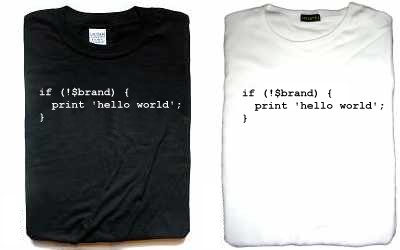 04 Aug 2005 Yahoo! Publisher Network This is their Adsense competitor.
Participants of the program must be a resident of the U.S., with valid U.S. Social Security or Tax ID number. Oh, well. 03 Aug 2005 I was looking for a quote and came across this.
http://www.fullcirc.com/community/onlinefacilitationbasics.html Well worth a read for anyone involved in community building and moderation. Here's a key takeaway. Central to the rules are two tenants: "You Own Your Own Words" and "Assume Good Intent." 1) When you hit the send button, your words are out there and probably can't be taken back. And nobody is responsible for them but you. So don't go into denial and say "I didn't mean to say that". It's all about communication and that means the important end result is the reaction in the reader's mind, not the reaction in your own to your words. So make a conscious effort to think about this when you write. "How will this be read?". 2) Communication is always flawed especially the written word. Take the best possible meaning you can get from other people's words and react to that. They may not have expressed well what they were actually trying to say. If you assume bad intent and fire bad intent back at them, you'll just start a flame war. If you assume good intent, perhaps the conversation can move forward. These are good rules to live by in the online world. [from: JB Ecademy] 02 Aug 2005 UK Brews World's Largest Pot of Tea as Anti-terrorist Measure
The task was accomplished by converting the Millennium Dome into an enormous teapot with a 95 meter spout. "We pretty much just turned on all the hot water taps and made sure the doors were closed," said Clarence Poltiss, director of operations at the Dome. "We lowered several tons of Typhoo teabags through the roof, and so far it's worked out pretty well. They did have to set off some munitions in the basement to get the overall temperature high enough for brewing, but I'm assured only conventional weapons were used."  01 Aug 2005 The Times Online guest contributors Opinion The Times has a policy of only allowing web access to UK visitors so you'll excuse me if I copy the relevant text from today's paper here.
Chains of love Back in the old days of physical distribution of music, this was easy. He took all the Barry Manilow records and the battered "Never mind the boll*cks" album, she took all the Celine Dion. But in this modern world of downloadable music and DRM it's all rather harder. It's his computer and he does all the downloading, ripping and sorting but it's her iPod and she chose and listens to the music. So who owns it? But much more importantly who gets to keep it? Again, back in the old days, when a parent died and left you all their Opera you could just box it up and put it in the attic until you were old enough to appreciate it. But now and in the future, you'll have a hard time listening to it. So can you leave your 60Gb of music to your heirs? Unless we turn round and say NO loudly, this is only going to get worse. It's now becoming apparent that Apple and Intel in future versions of the Mac are going to embed "Trusted Computing" in the processor and deep in the operating system. You can bet that this will be used to control access and use of the DVD drive, iTunes and probably the screen. Meanwhile, Microsoft is working on PVP-OPM (Protected Video Path – Output Protection Management) and again with Intel's help trying to lock down the general purpose PC so that only approved content can be shown on approved hardware all the way out to the screen. So what we have here is one cartel (Intel-Microsoft-Apple) aiding and abetting another cartel (The Media-Entertainment industries) to build systems and lobby for laws originating in the USA, but spreading thoughout the western world via secretive organisations like WIPO, to reduce your customer rights, to produce hobbled systems and all to prop up existing business models that no longer make sense. This is a monopolistic, mercantilist, plutocrat political system at it's most abhorrent, protecting itself by whatever means necessary and even going so far as to demanding money with menaces by suing it's own customers. Apart from "Just Say No To DRM" and trying to influence the market by refusing to buy their products, what can you do? Well the EFF tries to track and limit the damage in the USA, but there's precious little in Europe. So perhaps you'd like to sign this pledge. "I will create a standing order of 5 pounds per month to support an organisation that will campaign for digital rights in the UK but only if 1000 other people will too." We desperately need some counter balance to the current protectionist system. [from: JB Ecademy] [ 01-Aug-05 1:25pm ] The hacking conference Defcom always throws up some interesting stuff. Makezine has some coverage.
MAKE: Blog: @ DEFCON - The wall of sheep is a public name and shame projection of people at the conference who had sent IDs and Passwords in clear over any of the wireless networks. This should be a warning to anyone who uses public WiFi hotspots without using a VPN or SSL encrypted POP3 and SMTP email. This stuff is not hard and you should demand POP3S and SMTPS from your local sysadmin. Or just use Gmail. This has the added benefit of being able to send email from anywhere as the SMTPS port is virtually always open. What perhaps is hard is web sites who use a password but don't use SSL. Generally, the password is low security, but to hide yourself you really need an encrypted link to a secure proxy server which is beyond the reach of most users. This was collected via The Janus 6 Wi-Fi card 0wning station A PC with enough cards in it to track 802.11a/b/g and Bluetooth across all the channels and then log, sniff and interpret the results. RFID World record attempt managed to read an RFID tag at 65 feet. Which is nothing compared with getting a 30mW unamplified wifi card to pass data across 125 miles. Perhaps the best bit was Hotel Room TV hacking. A vulnerability in many hotel television infrared systems can allow a hacker to obtain guests' names and their room numbers from the billing system. It can also let someone read the e-mail of guests who use web mail through the TV [from: JB Ecademy] The Times Online guest contributors Opinion The Times has a policy of only allowing web access to UK visitors so you'll excuse me if I copy the relevant text from today's paper here.
Chains of love Back in the old days of physical distribution of music, this was easy. He took all the Barry Manilow records and the battered "Never mind the boll*cks" album, she took all the Celine Dion. But in this modern world of downloadable music and DRM it's all rather harder. It's his computer and he does all the downloading, ripping and sorting but it's her iPod and she chose and listens to the music. So who owns it? But much more importantly who gets to keep it? Again, back in the old days, when a parent died and left you all their Opera you could just box it up and put it in the attic until you were old enough to appreciate it. But now and in the future, you'll have a hard time listening to it. So can you leave your 60Gb of music to your heirs? Unless we turn round and say NO loudly, this is only going to get worse. It's now becoming apparent that Apple and Intel in future versions of the Mac are going to embed "Trusted Computing" in the processor and deep in the operating system. You can bet that this will be used to control access and use of the DVD drive, iTunes and probably the screen. Meanwhile, Microsoft is working on PVP-OPM (Protected Video Path – Output Protection Management) and again with Intel's help trying to lock down the general purpose PC so that only approved content can be shown on approved hardware all the way out to the screen. So what we have here is one cartel (Intel-Microsoft-Apple) aiding and abetting another cartel (The Media-Entertainment industries) to build systems and lobby for laws originating in the USA, but spreading thoughout the western world via secretive organisations like WIPO, to reduce your customer rights, to produce hobbled systems and all to prop up existing business models that no longer make sense. This is a monopolistic, mercantilist, plutocrat political system at it's most abhorrent, protecting itself by whatever means necessary and even going so far as to demanding money with menaces by suing it's own customers. Apart from "Just Say No To DRM" and trying to influence the market by refusing to buy their products, what can you do? Well the EFF tries to track and limit the damage in the USA, but there's precious little in Europe. So perhaps you'd like to sign this pledge. "I will create a standing order of 5 pounds per month to support an organisation that will campaign for digital rights in the UK but only if 1000 other people will too." We desperately need some counter balance to the current protectionist system. [from: JB Ecademy] 31 Jul 2005 One of my favourite Sci-Fi authors. Charles Stross had this to say in an interview in Interzone.
If the period from 1910 to 1970 was all about speed and power, and 1960 through 2010 was the golden age of data, then it's reasonable to suppose we're moving into the age of biomimetics - mechanisms like life forms. That's assuming the peak oil crisis doesn't irreversibly damage our civilization, which has alarmingly unprecedented feature of being the only one currently in play on the planet. Note. The Peak Oil Crisis is the moment when oil production peaks. Will it be this year or next? 30 Jul 2005 How would you change Skype? - Engadget - www.engadget.com :
- SIP gateway - Command line version for Server side API applications - Better contact management - Video (coming) - User set Supernode limits; Can I be a supernode; max connections; max bandwidth. - Keep Linux, Mac, PocketPC versions better in step with MS Win version - Improve echo cancellation for people without headsets - 3rd party peer review of security and encryption - Make the line protocols public - Provide a web presence service (coming) - Make it easier to record conversations without playing your own voice back through the headphones - Provide nativie language bindings for all the major languages rather than forcing people to use a 3rd party COM control. - Provide API examples in all the major languages - Build community around Skype user's interests, not just around support - Build more standards into the profile. FOAF, hCard, - Provide a web profile service to go with the web presence service. - Open up the ID checking and produce a Passport clone that works and is open. - Make it easy to archive chats and especially group chats to a web page. - Make group chats more IRC like. Allow you to join a known group chat rather than be invited - Remove the 50 person limit on group chats - Raise the 5 person limit on group conference calls - Add callto://yourname/chat to open a chat from a web link instead of a voice call. - Provide a mechanism for 3rd parties to charge for voice calls. The equivalent of POTS premium rate numbers - Provide a mechanism for calling premium rate POTS numbers via Skype-out - Provide App to Skype to Skype to App API functions so Apps can use Skype as a communication mechanism - Provide finer grained permissions on presence, profile access, calling and chat 2005 Results - Best Bad Writing
[from: del.icio.us] I especially like this one for the image it conjures up. It was high noon in the jungles of South India when I began to recognize that if we didn't find water for our emus soon, it wouldn't be long before we would be traveling by foot; and with the guerilla warriors fast on our heals, I was starting to regret my decision to use poultry for transportation. Maybe there should be a writer's competition to take these paragraphs as the first line of a story. 29 Jul 2005 I've just read that one of the alleged bombers was given a Passport and UK
citizenship despite having a UK criminal record. This wasn't a case of identity theft or identity fraud. It was case of the official process breaking down. So apologies if this is already in Kim's laws, but I'll add another. All identity systems contain some identities that cannot be trusted. In fact it shouldn't be too hard to come up with a Godel style mathematical proof that this must be true in every case. There may not be anything terribly deep in this statement, we're really just saying that to be human is to err. But it should be remembered that there is *never* 100% trust when we're talking about Digital ID. So we must *always* analyse and allow for the level of percentage risk and it's implications. From the IDWorkshop mailing list.
There seems to be a lot of activity at the moment around government driven identity schemes. In the last few days, I've seen a report on Californian limitations on rfid based cards. But being a Brit what really interests me is the UK proposals. This has been given a kick by the recent atrocities. And not all in favour of the ID cards. Even the Home Secretary has admitted on TV that ID cards and ID systems would not have made any difference. These are particularly interesting. http://www.theregister.co.uk/2005/07/26/overseas_passports_biometric/ http://www.theregister.co.uk/2005/07/25/id_card_goes_icao/ One aspect I find fascinating is the problems they are having deciding where the source of all subsequent trust comes from. What they are falling back on is that the whole house of cards rests on the integrity and accuracy of the National Identity Register which is the underlying database. But they are using security by obscurity (or simple political spin) to avoid explaining how this integrity is maintained. As El Reg so eloquently puts it. "Effectively, it's a system which by design puts all of its eggs in one basket, and is dependent on that basket being made impregnable via measures which the Government will never reveal or discuss. Trust us..." This reminds me of the problems and process obtaining SSL Certs from the major Cert suppliers. All they were ever really proving was that whoever ordered the Cert could work a fax machine. But having done that the Cert could then be used to verify the identity of the holder. So IMHO, the whole trust tree surrounding web certs rests on a dubious premise and really just looks like a mechanism for charging fees. This doesn't stop SSL working, but it does limit it's usefulness. I can understand how PGP's web of trust works. What I can't understand is how any tree structured ID trust system can work. It feels like "turtles all the way down". Eventually you get to some body that claims ultimate accuracy. But in the real world, they can't. Back to politics, while this is happening, two pledges have started http://www.pledgebank.com/refuse I will refuse to register for an ID card and will donate £10 to a legal defence fund but only if 10000 other people will also make this same pledge. 10724 people have signed http://www.pledgebank.com/resist "I will actively support those people who, on behalf of all of us*, refuse to register for an ID card, and I pledge to pay at least £20 into a fighting fund for them but only if 50000 other people will too." A mere 190 signatures. A rant from me on this blog entry. Pledge 5 pounds per month to support an organisation that will campaign for digital rights in the UK
For instance, one of the key questions in my list is whether you should be able to time shift TV programs and skip through the ads. We think it's fair use because we've been doing it for years with VCRs. The media industry do *not* see this as an automatic right. And they are actively fighting to prevent us from being able to do this as we shift to all digital HDTV. And as what constitutes a Digital HDTV is not at all clear (PC, DVD player, PVR, iPod Movie, cellphone, linux box, Mac, Xbox, PSP, etc etc) actually preventing us from doing this has some very unwelcome side effects. I absolutely do not want to be told that I can only use this monitor with that DVD with that hard disk under this operating system and only if I pay that subscription tax to this body that might hand out a proportion to that musician. Today, because tomorrow they changed the rules without asking me for something I've already bought. And then be sent a threatening letter extorting money with menaces if I try to get round it. 26 Jul 2005 Side-Business Software: The neglected software market - Signal vs. Noise (by 37signals)
building software for 1-10 people small businesses [from: del.icio.us] 'I will actively support those people who, on behalf of all of us*, refuse to register for an ID card, and I pledge to pay at least £20 into a fighting fund for them' - PledgeBank
[from: del.icio.us] Don Young talked at Opentech about Amazon Web Sevices. I wanted to contact him afterwards and found this.
Don Young * Role: Talking on Amazon Web Services. * Photos: Can’t find any. * On the web: None. * Employment: Presumably Amazon. * Other notes: None. Doh! How can you be a Web Services evangelist and have no presence on the web. At all, at all?  25 Jul 2005 'I will actively support those people who, on behalf of all of us*, refuse to register for an ID card, and I pledge to pay at least £20 into a fighting fund for them' - PledgeBank
Let's say that you are against the proposed UK ID card, but don't feel that you can take the radical step of refusing to sign up for one. You may have dependents, a standing in the community or simply not feel strongly enough about the issue to take a stand. Well here's a way for you to support the 10,000 who are prepared to be that radical on your behalf. [from: JB Ecademy] [ 25-Jul-05 5:25pm ] Pledge 5 pounds per month to support an organisation that will campaign for digital rights in the UK
'I will create a standing order of 5 pounds per month to support an organisation that will campaign for digital rights in the UK' - PledgeBank
If you ask yourself questions like:- - Why is it fair use to quote text from a copyrighted book in an article but not ok to quote audio or video in a performance piece? - Why don't the media companies want you to time shift programs and skip the ads in the future the way you've been doing for 20 years in the past? - Is it extortion by a cartel or good business for the media companies to sue their customers for doing something the customers don't see as wrong and where the customers have vastly less legal resources to fight it? - Is the life of the artist plus 20 years really a fair term for copyright? - Should orphan works where the copyright owner is untraceable be automatically public domain? - Should the media industry be able to mandate that the technology industry build in support for their copy protection schemes and make it illegal to tamper with them? - Should the BBC be allowed to give away the content they've generated in competition with commercial interests in the same area and under what license? - And should all this be decided by some faceless bureaucrats in Brussels in a non-democratic fashion where dissenting voices are excluded? - And should US approaches to all this be accepted by default in Europe and the UK? Then consider signing this pledge. [from: JB Ecademy] [ 25-Jul-05 2:10pm ] 

  1 to 20 of 3860 1 to 20 of 3860 |