





The Blog
12 May 2004 I'm in the middle of trying to puzzle out a tricky programming problem. 15 minutes later I realized that I'd completely lost the plot when I had a Skype instant message, an MSN instant message, 3 incoming SMS and the phone rang.
That's it, the phone's off the hook, my cellphone is turned off, MSN and Skype are turned off. If you need to get in touch send me an email. I'll deal with it in my time not yours. Am I being too extreme?  Oh dear, I see I've got another 20 emails where I'm on the cc: list but have no real interest in the content and those are buried in the 50 virus warnings and spam that all my filters didn't catch. Oh dear, I see I've got another 20 emails where I'm on the cc: list but have no real interest in the content and those are buried in the 50 virus warnings and spam that all my filters didn't catch.Seriously, how does anyone get anything done in this modern life? When I was in corporates you couldn't actually do any work for meetings. Now I'm working from home, I can't do any work for interruptions. I don't know. I love all these new forms of communication just as long as I'm in control. But I'm beginning to really hate the ones that demand attention where it wasn't me that initiated the conversation. [from: JB Ecademy] 11 May 2004 The display and sort of ratings on your network list on Ecademy has been broken for some time. Also the Friends of Friends list wasn't working right either. Well they're both now fixed and working the way they're supposed to.
A bit of clarification. Friends of Friends is a composite of everyone who knows you or knows someone you now. Is that everyone within 3 degrees of separation? As you'd expect if you know Thomas Power or one of the other top networkers, your FoF list will cover everyone who is anyone! [from: JB Ecademy] [ 11-May-04 3:09pm ] 10 May 2004 For those of you who feel they need it, there are now two extra settings on the profile visibility controls.
- Hide from guests. This hides your profile from people who are visiting the website but are not logged in and hence probably not members of Ecademy. - Hide from search engines. If the above setting is off (ie guests can see your profile), this inserts a command to tell the search engine not to index the page but to follow any links it finds. If your profile is hidden from guests, it's obviously also hidden from search engines. Both settings default to off and hence to openness. Just to clarify, you should assume that anything you post on Ecademy is visible to the world and to search engines. The exceptions are:- - Profile detail under the control of the above visibility controls. - The forum and membership of Private Clubs - Network messages - Meetings and attendance at meetings that are set to anything less than "Anyone". [from: JB Ecademy] [ 10-May-04 6:09pm ] 08 May 2004 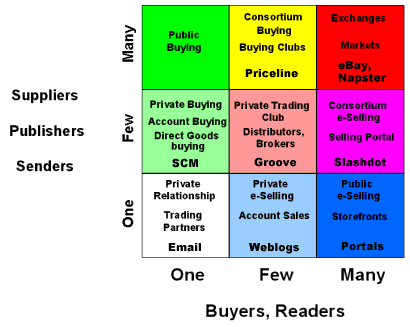 This is several emails stitched together so doesn't flow as well as it should. But I think it needed publishing. At the height of the B2B period I did quite a lot of work on understanding conversations in terms of one-few-many to one-few-many so traditional publishing is one-to-many; most plain email is one-to-one; most blogs are one-to-few; mailing lists are few-to-few; and so on. YASNs do answer some needs that are not currently provided elsewhere. The key one is enabling initial one-to-one communication between people who don't know each other. The centralised system can provide a venue for this where the initial contact is at arms length and so "safe". Given that the this initial contact often leads quickly to traditional one-to-one methods like phones and email, it's only the initial contact that matters. It might be possible to de-centralise it but we'll have to do a lot more work on standard ways of anonymity, encryption and search. FOAF and Socialgrid deal with the search bit but assume that complete transparency is ok. It may be OK for geeks and self-publicists but it's not ok for everyone else. The second one that Ryze, Tribes, Ecademy, Orkut, Yahoogroups, Meetup, and discussion boards answer is the need for few-to-few group communication. The Blog community is trying to bolt this onto a one-to- many system with comments and trackbacks and frankly it sucks. Trying to track and remain involved in group discussion that happens across multiple comments threads on multiple blogs really doesn't work very well. phpBB, Mailman and hosted sites like quicktopics or communityzero have dropped the barrier to entry and Yahoogroups has dropped it to zero as long as you can put up with the ads. For the YASNs that provide this feature it's been quite successful but it's quite hard to understand why when the implementations aren't very good compared with the dedicated systems. Also this area could really do with a good dedicated search engine. The effects on monetizing YASNs So YASNs and YABNs (Yet Another Business Network!) do fulfil some fairly basic needs in people. We're still on the first generation so most of them (including our own Ecademy) are fairly clunky. As I said above, These needs seem to revolve around three areas:- - Personal Publishing: one to many communication - Group Discussion: few to few communication - Meeting people we don't know: one to one communication in a safe environment If these needs are real and the YASNs are a real answer to them, then we'll find a way of monetizing it. If we go back a few years this is the same question as asking "How should eGroups/Hotmail make money?". The answer in that case was Yahoo!/Microsoft. And there's hundreds of answers only one of which is to take a skim on transactions. Here's a few. - Advertising: VC poured scorn on this and continues to do so. And yet Google/Overture have made it work. If you can keep your costs down and sell the advertising cleverly, there's a nice little earner available. Eyeballs *are* worth money. Just not as much as we thought. - Subscriptions for premium services: The churn may kill you but it does work. At least until the same offer is free elsewhere. Similarly for paid listings. - Auctioning/selling associated product to corporates: The classic is Meetup selling aggregated customer attendance to venues. My guess is that the current crop of heavily VC supported YASNs will flame out when they burn all their cash and then either disappear or be absorbed. Mainly because I don't think they can generate as much money as is needed to service the VC they've taken. In the shake out, maybe Barry Diller will buy them all for cents on the dollar. Or a big portal will spend silly money instead of writing and building their own. Which means we'll end up with a couple of large competitors where money is not an issue and a group of niche sites that are self sufficient but remain quite small. The Decentralizing YASNs postscript. There is another possibility. Someone will work out how to decentralise all the YASN function into a Movable Type style, free, open source project and there'll be a few million YASNs instead of 100. It might even be nothing more than a plugin for Movable Type/Typepad. This wouldn't kill the existing hosted services but it would reduce their ability to monetize significantly. [ 08-May-04 9:04am ] 02 May 2004 Really excellent speech to the World Economic forum about the future of entrepreneurial bsuiness in Europe. Here's the main points but I'd recommend reading the full text and watching the video.
Loic Le Meur Blog: Speech on the Future of Business in Europe Video : 1. Decrease the regulations in the EU and member Countries -change the fiscal framework into an Entrepreneur friendly environment 2. Entrepreneurship -improve the image of Entrepreneurs in Europe 3. Measure, gather and promote centers of excellence. We need to focus on our successes and build Silicon Valleys of Europe all around the EU. 4. Education -needs for an Education and training reform. EU students are some of the best educated in the world but they face obstacles becoming stars and innovators 5. Information Society as a priority 6. R&D and Innovation -increase the budget for R&D, US is close to three times as more as ours [from: JB Ecademy] 30 Apr 2004 AllOfMp3.com is an interesting approach to downloading music. and definitely worth checking out.
- Russian - Legal (so far). They have distribution licenses for everything from Russian Organization for Multimedia and Digital Systems - Any encoding at any bitrate from MP3 through to full CDA including Ogg, WMA - No DRM. Copy the resulting files to whatever media you need on whatever machine you use. - Streamed LoFi free samples for everything - Big and growing library - Pay per Mb of download. So if you go for high quality you pay more or get fewer songs. - Payment via Paypal, direct credit card and a few others. - 1 gigabyte costs $10. The costs are a mixture of $0.01 and $0.02 per Mb. So a full copy of a CD in original CDA format is approx $11. Is this the future of music distribution? This is actually much more innovative than iTunes. I really can't see any downsides. Except maybe to the record companies getting less money than they hoped. [from: JB Ecademy] [ 30-Apr-04 9:10am ] 29 Apr 2004 Google News on Google IPO
Google's S-1 Slashdot LIS News: "In the filing, Google said that it generated revenues of $961.9 million in 2003 and reported a net profit of $106.5 million. Sales rose 177 percent from a year ago although earnings increased by just 6 percent." "They're doing a Dutch Auction IPO and want to earn $2.7B, although speculation puts this closer to $20B. The underwriters are Morgan Stanley and Credit Suisse First Boston." From the risks section: "The initial option grants to many of our senior management and key employees are fully vested. Therefore, these employees may not have sufficient financial incentive to stay with us. Many of our senior management personnel and other key employees have become, or will soon become, substantially vested in their initial stock option grants. While we often grant additional stock options to management personnel and other key employees after their hire dates to provide additional incentives to remain employed by us, their initial grants are usually much larger than follow-on grants. Employees may be more likely to leave us after their initial option grant fully vests, especially if the shares underlying the options have significantly appreciated in value relative to the option exercise price. We have not given any additional grants to Eric, Larry or Sergey. Larry and Sergey are fully vested, and only a small portion of Eric’s stock is subject to future vesting. " Dan Gillmor: As of March 31, the company had "1,907 employees, consisting of 596 in research and development, 961 in sales and marketing and 350 in general and administrative." [from: JB Ecademy] 26 Apr 2004 1) What do you do if you're on a Mac? This was prompted by Glenn Fleishman.
2) How would you go about building a wiretap for VoIP. With VoIP that has a link into the Plain Old Telephone System (POTS) there's clearly a choke point that could use traditional wiretap techniques. But it's still made considerably harder by one side of the choke being internet based. Where the VoIP is between computers with no POTS, it's much harder as Voice is just another collection of packets mixed in with the web, email and so on. So that means building logging facilities that understand the protocols which themselves are evolving. The only available choke points are in the ISP so now we're going to have to force the ISPs to put in hardware and software to support the wiretap. This includes large corporates who buy their internet access wholesale. Now what about Voice facilities that are proprietary such as the IM tools and Skype. Your wiretap vendor has a running battle now to keep up with all the various possible protocols some of which are proprietary. 3) Which brings us to Skype. Skype is fully decentralised, P2P and proprietary. How and where exactly would a Skype conversation between two arbitrary endpoints be wiretapped? How would a government agency go about building wiretap facilities for Skype? As if that wasn't hard enough, this is made considerably harder because Skype traffic and setup is encrypted. 4) So the next question is how good is the Skype encryption? Has anyone done any peer analysis and review of Skype's encryption? It's a truism in encryption that security by obscurity doesn't work. The only way to ensure reasonably good encryption is to make the process and technology completely transparent and open. So for example, it's completely useless to use military grade encryption if the key generation or key transfer is done badly or easily guessed. But Skype are probably never going to allow their code to be peer-reviewed which means that we can never know if it's any good. 5) We're beginning to see encryption add ons for things like MSN Messenger and the other IM packages. All the same peer review issues apply. And all the same wiretap issues apply. 6) Almost all the IM systems now have voice capability. But just as their IM functions don't interoperate, their voice functions don't use common standards and they don't interoperate. Unusually, the most surprising was actually MSN Messenger. Up to V4.7 it had a SIP compliant mode that would work with any SIP VoIP system. After that they removed the UI but I think kept the underlying code and now only support specific commercial VoIP-POTS services. MS (and I think the other main IMs) are active in the SIP and SIMPLE standards bodies so why don't they offer it to the end user. 7) Why is SIP and NAT-Firewall configuration so hard for VoIP? The great thing about Skype is that it *just works*. Every other VoIP client I've tried has either been a PITA to configure, or simply didn't work, or depended on a central proxy/relay that is never going to scale. 8) And the big one. Really cheap rate international and national call gateways are starting to appear that piggy back on commodity VoIP systems like IM and Skype. This is going to progressively eat into the Telco's core revenue streams. It seems inevitable that this will become an issue sooner rather than later and Telco's will have to either downsize, shift to a wholesale model or just rely on cellphone charges and cellphone addons like ringtone sales. How long will it be before one or more Telcos get hit *hard* in their bottom line by loss of core business to internet based voice calls? 9) Before the year is out, we'll see combined GSM/CDMA cellphones with a built in WiFi card that can switch relatively seamlessly between cell and WLAN+VoIP access. In the last few years we laughed at journalists writing yet another WLAN vs 3G story. But this could finally kill 3G except for data access in the wild countryside. If I can wait 30 minutes to drive to the nearest Little Chef, Texaco or McDonalds, I can get all the data access and all the free voice calls I need. How long before WLAN hotspots become so widespread that a traveling salesman (and the rest of us) could make that sort of choice? [from: JB Ecademy] 12 Apr 2004 Imagine a web site that holds photographs of every street number in London. Each picture would be uploaded by the general public using camphones. The system would hold a history of photos. It would be searchable by postcode or street name and street number in the style of Streetmap.co.uk. Attached to each photo would be a Wiki style page where people could leave comments and reviews. When you're going somewhere new, you could get a map from streetmap and visit this site to see what #23 actually looks like. If you were using a Wifi or GPRS connected PDA, you could look at the reviews and pictures while deciding whether to go in.
This is a lazyweb request where I'm not going to build it but I think it ought to exist. There's obviously lots of wrinkles to work out and a business plan to build behind it. The UI would need lots of work to make it fast and easy to use. There'd need to be quite a lot of storage and bandwidth available. The big trick would be to make it self-correcting rather than involve moderators and editors. And I can't see any reason why it shouldn't be exended to cover the whole UK based on postcode and street number. Does anyone want to try and build a proof of concept? Does it already exist and I just haven't heard of it? This is a repost of an old weblog of mine that brought up The Open Guide to London The difference now is that there are a *lot* more cameraphones around. [from: JB Ecademy] [ 12-Apr-04 1:40pm ] 09 Apr 2004 NotCon04 - Call for papers : NotCon '04, Sunday 6th June 2004, Imperial College Union, London http://www.notcon04.com/ Proposals due by: Friday 14th May 2004 Have you coded, created, or discovered an interesting application of technology? Then why not come and talk about it at NOTCON '04? NOTCON '04 is an informal, low-cost, one-day conference looking at things that technologies were perhaps not intended to do. [from: JB Ecademy]
[ 09-Apr-04 3:40pm ] 08 Apr 2004 Combine OPL for Series 60 phones[1] with FOAF and get real world matching via Bluetooth proximity of cellphones. Now imagine being at an Ecademy Event. You've loaded your profile onto your phone. You arrive and your phone makes contact with the people like you and your friends who are already there.
This should get built. It's just way too cool to stay as a research project. [1]OPL is effectively visual basic for phones. It's an open source scripting language that makes it relatively easy to write applications. It works with any Series 60 phone. It's dramatically dropped the barriers to entry for hone programming. [from: JB Ecademy] 07 Apr 2004 Just got this from Google.
------------------------------------ Thank you for your note. Google Web APIs include search, cached page lookup, and spelling. Google News is not currently accessible through this service. We are however gathering ideas for other useful APIs to export and very much appreciate your input. Regards, The Google Team Original Message Follows: ------------------------ From: Julian Bond Subject: New APIs Date: Tue, 30 Mar 2004 08:16:53 +0100 Where's the APIs for the other parts of Google? Especially Google News. [ 07-Apr-04 7:31pm ] If anyone here is interested in the science of social and business networking as opposed to actually doing it, I've added a new topic in DailEnews on "Business and Social Networking". I'd also recommend joining the Social Software and Social Capital club.
This is a relatively new but rapidly expanding field, so there's lots of analysis, research and ideas to be done and thought up. I can also recommend these sites:- Corante: Social Software Online Business Networks Blog The Social Software Weblog [from: JB Ecademy] Today is "Post a club message day"
Go and have a look at your "My Clubs" page and post something to as many as you can manage. This is particularly important for Club Owners. Can you re-awaken your dormant clubs? [from: JB Ecademy] 05 Apr 2004 In Oct 2002, I saw Google News Beta and being an RSS junkie thought "I want some of that". I emailed news-feedback asking for RSS Output and got no reaction. So I hacked, cut and pasted some scraping code and produced gnews2rss.php and started using it to feed my personal aggregator. I made the source public domain and encouraged people to use it, host it themselves and hack it on further. I got really burnt on bandwidth costs by doing the same thing for blogger before they had RSS, so twice a month I insert a dummy item telling people to host it themselves and to email Google asking for RSS from News. About 6 months ago I started including gnews2rss feeds in Ecademy and waited for the Google complaint. It's finally arrived so the feeds have gone from Ecademy. Google have never asked me to remove gnews2rss, only to stop republishing the data on the web.
Now, Google is heading into an IPO and needs to be seen to enforce their T&Cs. I have no problem with that. I was playing fast and loose with their terms and now I've had my knuckles rapped. But the underlying problems remain. - No Ads on Google News. So what's the problem? - Google News still in beta. Why? - Google API is unchanged since launch and still only covers the main search. Where's the API for images, news, groups, froogle? - No metadata or XML/RDF output from any of their systems apart from Blogger. And when the Blogger people finally do syndication (now that Google has removed the bandwidth objection) the Blogger people choose Atom. Why? Is it just lack of programming resource? Perhaps the people who might spend their 20% private programming time on this aren't interested in metadata? Meanwhile Yahoo has the MyYahoo aggregator and RSS from news search. So I've just switched to Yahoo! news for the websites. Right now though, Google news search is still superior so for my own personal use I continue to use gnews2rss. So instead of (or as well as) arguing here, can I ask you all to email Google news feedback and ask for RSS/Atom output? The API was a great start and won them a lot of geekie kudos. But they've dropped the ball. Yahoo! has pretty much everything now that Google has and in some cases more. It's just that the quality is not quite as good. That's a pretty slim margin for Google to base themselves on. This story has been covered here. http://groups.yahoo.com/group/syndication/message/4405 http://www.boingboing.net/2004/04/02/google_news_which_sc.html http://battellemedia.com/archives/000533.php http://www.internetnews.com/ec-news/article.php/3334651 http://www.buzzmachine.com/archives/2004_04_02.html#006729 http://socialsoftware.weblogsinc.com/entry/6450235144623213/ http://blogs.it/0100198/2004/03/30.html#a2486 http://diveintomark.org/archives/2004/04/02/ten-words http://www.infoshop.org/inews/stories.php?story=04/04/05/1244428 http://archive.scripting.com/2004/04/13#When:4:12:14AM 02 Apr 2004 Nick Denton's blog of blogs :: AO known as Kinja.
This is a pretty easy to use tool to read the contents of large numbers of blogs. Beware though. It will suck you in to hours and hours of random searching. It's another example of what I've come to think of as Blogs as productivity reducers. They are a actually a vast conspiracy to stop westerners doing any work by giving them more content than they can cope with. to give you some idea of the growth. Here's David Sifry at Technorati. http://www.sifry.com/alerts/archives/000342.html At 4:35AM PST today, Technorati broke the 2 Million weblogs tracked milestone. The blogosphere continues to expand at an amazing pace, with about 12,000 new weblogs being created every day. We're tracking over 150,000 weblog updates every day, and growing. One of the reasons for this has been the substantial growth in hosted weblog systems like Typepad, LiveJournal, and Blogger, but also a tremendous amount of growth in smaller systems, like EasyJournal and Suicide Girls and moblogs like TextAmerica. Blogging is also growing outside of the United States and the English-speaking Internet, as we've seen lots of growth in non-English language weblogs as well, especially in Russian, French, Portuguese, Chinese, and Farsi. [from: JB Ecademy] [ 02-Apr-04 8:40am ] My run in with Google over RSS has made the papers. http://www.internetnews.com/ec-news/article.php/3334651
It's mostly accurate... Also here. http://socialsoftware.weblogsinc.com/entry/6450235144623213/ [ 02-Apr-04 8:07am ] 01 Apr 2004 Google to offer gigabyte of free e-mail - News - ZDNet Google has announced a test of a rival to Hotmail and other web mail systems. The hook is that they give you a large amount of storage so you can leave your old mail up there where you can then use Google's advanced search to find old entries.
All the major news outlets have picked up on this. There's even a press release. Maybe someone should remind them what day it is? Or is the joke on me? [from: JB Ecademy] We're starting to see mutterings about VoIP phones that have a built in WiFi connection like the Vonage's WiFi phone - Engadget - www.engadget.com
This is an idea who's time has come as providing you can find an open hotspot you can make cheap or free phone calls. The problem is authentication. How do you get past the typical splash sign on screen when you're device doesn't have a browser? [from: JB Wifi] [ 01-Apr-04 8:40am ] 30 Mar 2004 Bob Frankston and his three newly proposed YASNS — EomE [Enemy of my Enemies,] Blind Trust Network, and the Mindless Philatelist Network:
Brilliant! Enemy of my Enemies is a new social network. Unlike the old ones it focuses on the real need to protect ourselves from “themâ€. The Trust Network is the new effort to solve the problem of trust on the Internet. You can simple check a box to say you trust me. The Mindless Philatelist Network. This is the network for people who don’t really care what they collect as long as they have the most. So do you recognise any of these on Ecademy? [from: JB Ecademy] 

  1 to 20 of 3860 1 to 20 of 3860 |