
 Elon Musk Has Changed His Mission Statement [ 14-Feb-26 1:00pm ] The Best Time to Leave xAI Is Before Joining. The Next Best Time is Right Now [ 14-Feb-26 12:30pm ]
Book Review: 20 Goto 10 - 10101001 facts about retro computers by Steven Goodwin ★★★★☆ [ 14-Feb-26 12:34pm ]
Elon Musk Has Changed His Mission Statement [ 14-Feb-26 1:00pm ] The Best Time to Leave xAI Is Before Joining. The Next Best Time is Right Now [ 14-Feb-26 12:30pm ]
Book Review: 20 Goto 10 - 10101001 facts about retro computers by Steven Goodwin ★★★★☆ [ 14-Feb-26 12:34pm ]
This is an excellent "dipping" book. There are nearly 200 articles ranging from short anecdotes, multi-page synopses of complex topics, and quirky little asides. Rather than a linear history of computing, each short chapter ends with a multiple-choice "GOTO".
From there, you take a meandering wander throughout retro-computing lore.
Some paths lead to dead-ends (a delightful little Game-Over experience) while others will send you round in loops (much like any text adventure). I've no idea if I actually read everything - although I did stumble onto some Easter Eggs!
Some of the knowledge in here is of the geeky arcane trivia which is of no use to man nor beast - yet strangely compelling to anyone who remembers POKE, CHAIN, and all the other esoteric commands. Some of the stories you'll undoubtedly heard before. Others are deliciously obscure.
Sadly, the book is caught up in the continuing Unbound drama so is rather hard to buy. There are signed copies available from The Centre for Computing History.
I'm grateful to the kind friend who lent me their copy.
1993: Lea Valley Walk follows the Limehouse Cut to the Thames because the last mile is inaccessibleHere's a map I showed you in 2019, since when nothing has changed connectivitywise. There are still no extra bridges across the river and the 'Coming Soon' along the river never happened.
2000s: Half-mile dead-end riverfront promenade opens opposite Bow Locks
2009: Plans for linear Leaside park and riverside path (the 'Fatwalk')
2012: Cody Dock opens, connecting dead end to industrial estate
2016: Fatwalk renamed the Leaway (but remains unbuilt)
2016: Ramp opens linking Twelvetrees Bridge to Lea towpath
2019: Cycle ramp opens beside A13 underpass
2021: Funding for new Lochnagar Bridge (but no subsequent action)

The latest development is a joint project between Tower Hamlets and Newham because a bridge has to involve them both. It's called the Mayer Parry Bridge and is one of five tentative crossings the councils put forward for levelling-up funding in 2021. At the time the intention was to focus on the Lochnagar Bridge instead, a footbridge roughly halfway down the disjoint mile. It has planning consent but not full funding, also still no sign of developers building any of the proposed flats on the west side, so that's been mothballed in favour of something deliverable. The Mayer Parry Bridge has thus been promoted from option 2 to option 1, and if all goes to plan construction could begin next year. Where the red line is.

(the other crossings that look like footbridges only carry cables, so ignore those)
On the Tower Hamlets side the bridge launches off from the corner of the old Poplar Gasworks, which is currently being transformed into 2800 homes. One day the entire squarish plot will be covered, but for now only the west corner has flats. On the Newham side the bridge lands in the corner of what before 2022 was the Mayer Parry scrap metal recycling yard, since cleared out. It too is to be redeveloped, indeed the groundworks have already started. Annoyingly these two sites aren't opposite each other, the remainder of the riverside occupied by industrial units and business estates, so the cunning bit is to make the bridge cross the river on a diagonal. Across here.

This is the view from the A13 bridge, an unpleasant roar that those on the Poplar side have to cross if they want to get to Canning Town station. The Mayer Parry Bridge, if built, would provide many with a quicker and more pleasant shortcut. Down below is the seriously tidal end of the River Lea, known as Bow Creek, held back at the highest tides behind a floodwall of corrugated metal. You can see a huge crane is already on site marking out the land ready for the laying of foundations. The new development will be called Crown Wharf, will have 800 flats and is presented as "a fantastic opportunity for Newham to densify around a major transport interchange." Four riverside towers are planned and you already know exactly what they'll look like, but feel free to click here to confirm.
What really surprised me is what's planned for the far end of the site between the flats and the start of the Mayer Parry Bridge. It's an absolutely massive data centre, to be precise an 80MW Hyperscale Data Centre, designed by Foster and Partners no less. To fit the space it needs to be over 70m tall, already cut down from 90m during the planning process, with separate blocks containing plant, data halls, heat recovery and water processing. It's the perfect spot for one of the largest data centres in the UK because The London Internet Exchange, a key global switch-house, is just across the river. Even so, blimey, the rundown urban backwoods of Bidder Street will never look the same again.

As for the landing point on the west bank, it takes a very long time to turn a gasworks into housing. Poplar's gasholders were disassembled as long ago as 2017, then during lockdown I watched as remediation works eventually gave birth to the first few residential skeletons. Thus far only two blocks are complete and two more part-sold, with the developers planning a "Special Lunar New Year Open House Weekend" which tells you all you need to know about the intended purchasers. It feels strange to be able to walk into what was once heavily contaminated land, past boards promoting swimming pools and spa rooms for residents, down generic walkways that could be any new housing development in London.

The Mayer Parry Bridge landing site is screened off and entirely inaccessible, it being part of Phase 3 whereas we're still only on Phase 1. You can however walk down to the river's edge because that's where they located the Sales Office, inexplicably crunching across hundreds of purple shells scattered across the promenade. From the gull-splattered rail you can then look out towards another development shooting up on the far side of a mudflat meander, also two more locations where nobody can afford to build a footbridge. Without a crossing it takes 30 minutes to walk to the opposite bank rather than potentially two.

A consultation event for the Mayer Parry Bridge is taking place on Tuesday between 9am and 2pm at a cafe on the Poplar side. I would have gone but I'm out of town that day so feel free to interrogate the staff on our behalf and report back. I'm particularly interested in the great unmentioned subject in all the online collateral which is whether the footpath along the Lea gets completed at the same time as the bridge. There's already a mothballed promenade beyond Cody Dock so all that was ever needed was an onward connection through the old scrap metal yard, and seemingly the bridge connection delivers that too. What a brilliant outcome that would be, for locals, cyclists and long distance ramblers alike.
The intention is for construction to begin on the Mayer Parry Bridge in 2027, with the slender diagonal span opened to the public in 2029. But as I said we've been here before and nothing's happened, even with all parties onside, so it wouldn't surprise me if I'm still writing about utter inaccessibility in the Lower Lea Valley in 2030 and beyond.

Japanese noise is often talked about as if it is one thing, a single wall of sound, a fixed idea. That is not how it really feels when you spend time with it. It is messy, personal, awkward, funny, tiring, and sometimes deeply moving. It grew from real places and real people, not from theory or fashion. To understand it, you have to accept that it does not always want to be understood. Why should it?
Noise in Japan did not appear because musicians wanted to shock people in Europe or America. It came from small rooms, cheap gear, and a sense that normal music was not enough. In the late seventies and early eighties, there was already a feeling that rock music had reached limits. Punk had opened a door, but for some people that door was still too narrow. They wanted sound without structure, without songs, without a clear message. After the rapid growth of cities and technology, sound became part of daily stress. Trains, adverts, crowds, machines, all fighting for attention. Noise music felt like a mirror of that life, but also a way to take control of it. By choosing noise, artists could shape chaos instead of just suffering it.
Even before what most people call noise, there were important earlier examples in Japan that set the ground. Groups like Taj Mahal Travellers in the early seventies explored long drones, outdoor performances, and sustained sound that blurred the line between music and environment. Their recordings and performances treated sound as something physical and shared, not something to consume. This way of thinking mattered deeply and later fed into noise, even if the sound itself was often quiet and slow. Was this already noise in spirit, even if not in volume?
Another crucial early figure is Kaoru Abe. Although usually described as a free jazz saxophonist, his late recordings and performances push so far into intensity and abstraction that they clearly belong to the roots of Japanese noise. His solo performances were relentless. Screeching tones, circular breathing, physical exhaustion, and complete refusal of comfort. Albums recorded shortly before his death feel raw and unfiltered, as if the sound might collapse at any moment. Abe treated sound as a form of total release and pressure, not communication. This attitude had a deep influence on later noise artists who valued commitment and risk over control and polish. How far could a single sound be pushed before it became something else entirely?
Masayuki Takayanagi was one of the early Japanese noise musicians who seemed less interested in pleasing people and more interested in telling the truth, even when it hurt. His noise was not about chaos for its own sake. It came from a deep urge to strip music back until only raw sound was left. Guitars screamed, cracked and fell apart in his hands, but there was focus behind it, not carelessness. Listening to him can feel uncomfortable, even tiring, yet it also feels honest. He treated noise as a way of thinking out loud, a way to push against rules that felt too small. Takayanagi did not try to explain his music much. He played, and let the sound argue for itself.
This early period connects strongly to the wider Japanese avant garde. Experimental music, theatre, dance, and visual art were deeply intertwined. Artists were less interested in categories and more interested in breaking habits. Sound was part of a larger push to reject comfort and expectation. Noise did not arrive from nowhere. It grew out of this avant garde culture, where failure, discomfort, and excess were seen as useful tools rather than problems.
Les Rallizes Dénudés are another vital part of this story. Often labelled as psychedelic rock, their live performances were built around overwhelming volume, endless feedback, and repetition that pushed beyond songs altogether. Recordings from their live shows feel unstable and obsessive. Guitars dissolve into pure sound. Time stretches until it almost stops. Many later noise artists took this idea of feedback as a main voice directly from them.
Keiji Haino stands as a bridge between early experimental music and noise. His early work with Lost Aaraaf, and later solo performances, showed an intense focus on extremes. Screaming vocals, distorted guitar, long silences, and sudden eruptions all appear. Albums and live recordings from the seventies and eighties feel ritualistic rather than musical in a normal sense. Even when melody appears, it feels fragile and threatened. This emotional intensity influenced many noise artists who cared less about sound alone and more about total commitment. How far could expression be pushed before it stopped being music?
Some of the earliest Japanese noise grew close to performance art and underground theatre. Groups like Hijokaidan are a key example. Their early shows were chaotic events rather than concerts. Broken glass, shouting, feedback, body movement, and confrontation were all part of the sound. Albums such as their early live recordings capture this feeling clearly. They do not sound planned or refined. They sound like events barely under control. That sense of danger mattered. It was not about making records that lasted forever. It was about presence and risk.
Incapacitants deserve special attention, and they deserve serious praise. They are not just influential. They are truly great. Their work represents one of the highest points of Japanese noise. Toshiji Mikawa and Fumio Kosakai approached noise with rare focus and intelligence. There is nothing careless in their sound. Albums like Feedback of NMS, As Loud As Possible, and their many live recordings show an incredible sense of balance between force and control. The sound is dense, crushing, and physical, yet carefully shaped over long stretches of time.
Mikawa's electronics create thick, suffocating layers that feel almost architectural, while Kosakai's use of feedback and signal chains adds movement and tension. Together they build noise that feels alive, not static. Changes happen slowly, but they matter. Listening to Incapacitants feels like being locked inside a vast machine that breathes and shifts around you. Few noise acts anywhere achieve this level of discipline without losing intensity. They prove that noise can be overwhelming without being sloppy, and extreme without being empty. How many noise projects sustain this level of quality for so long?
Hanatarash moved in another direction entirely, toward physical danger and confrontation. Their performances became known for using heavy machinery, power tools, sparks, and real destruction. Bulldozers, concrete, and metal were not stage props. They were sound sources. Recordings like Hanatarash 3 still carry this sense of threat. Even without seeing the performances, the recordings feel unstable, as if the sound could collapse at any moment. The question of whether this was music hardly matters. What mattered was the refusal to separate sound from action.
Projects connected to this confrontational spirit also include Niku-Zidousha. This group pushed noise toward raw aggression and physical pressure, often mixing distorted electronics with violent repetition. Their recordings feel blunt and hostile, with little interest in balance or comfort. Niku-Zidousha fit naturally into the Japanese noise world, but they also echo the wider avant garde idea of sound as an attack on the listener's expectations. Is endurance part of listening here, or is it the entire point?
Japanese noise often developed outside normal music spaces. Small galleries, basements, temporary venues, and illegal spaces all played a role. Many artists had no interest in careers or recognition. They made work because they felt driven to do it. Tapes were duplicated by hand. Covers were drawn, painted, cut, or photocopied. Labels like Alchemy Records helped spread this work, but everything remained close to its source. The physical object mattered as much as the sound inside it.
It is impossible to talk about Japanese noise without mentioning Merzbow, but it is also hard not to feel tired of that name. He has become a symbol that overshadows everything else. For some listeners, he is Japanese noise. That is a problem. His work often feels like excess without direction. Endless layers of distortion pushed to the same limit again and again. After a while, the impact fades. Loud becomes flat. Shock becomes routine. When attention stays fixed on Merzbow, it hides how careful, varied, and thoughtful much of the scene actually was.
There is also something uncomfortable about how Merzbow is often treated as a hero. The idea of the artist who goes further than anyone else, who destroys sound completely. This turns noise into a competition. Who is louder? Who is harsher? That misses the point. Noise was never about winning. It was about finding new ways to exist in sound. When everything is pushed to the same maximum, nothing has space to matter. Is destruction really enough?
Many other Japanese noise artists explored very different ideas. Masonna is a strong example. His work combines harsh noise with screaming vocals, sudden silences, and sharp changes. Albums like Spectrum Ripper and his many live recordings feel frantic and unstable. There is fear, humour, and absurdity mixed together. The music constantly shifts, refusing to settle. This nervous energy makes his work feel alive in a way that static noise often does not.
KK Null, both solo and with Zeni Geva, brought a heavy physical weight to noise. Thick guitar tones, repetition, and rhythm play a large role in his work. Albums like Desire for Agony and later Zeni Geva releases balance noise with pounding structure. The sound feels solid and relentless, showing how noise could merge with metal without losing intensity.
There is also a quieter side that people often ignore. Sachiko M is essential here. Her use of sine tones and near silence reduces sound to its smallest elements. Tiny shifts become huge events. Listening demands patience and focus. In the context of Japanese noise, this approach makes sense. It is still extreme, just in a different direction. It challenges the listener through attention rather than force.
Government Alpha explored another path, combining harsh electronics with movement and flow. Albums like Venomous Cumulonimbus Cloud feel less like walls of sound and more like evolving environments. The noise rises, falls, and mutates slowly. It invites long listening rather than immediate reaction.
Other important artists deepen this picture further. The Gerogerigegege used noise, tape manipulation, and provocation to attack ideas of taste and decency. Their releases feel confrontational even before you hear the sound. Astro combined noise with psychedelic repetition, creating trance like chaos. K2 pushed electronics into brutal, metallic forms that feel mechanical and inhuman. Aube focused on single sound sources, like water or metal, building entire albums from one material. This focus shows how conceptual Japanese noise could be without losing intensity.
Japanese noise is often linked to ideas of extremity. Louder. Faster. More brutal. This idea is partly true, but also lazy. Yes, volume matters. Physical impact matters. But there is also control, patience, and detail everywhere. Long stretches of near silence. Repeated textures that slowly shift. Small sounds that feel more intense than any blast of volume. People who say it is just loud do not listen very closely. Are they really listening at all?
Another important part of Japanese noise is how it connects to daily life. There is often a sense of routine in it. Repetition. Mechanical action. Labour without release. Instead of escaping this feeling, noise leans into it. It turns pressure and frustration into sound. That can be difficult to sit with, but it can also feel more honest than polished music designed to comfort. Why look away from this reality?
The way noise was shared also matters. Tapes, burned CDs, handmade covers. Small labels run from bedrooms. This created a loose community, even if the music itself felt isolating. You knew someone had taken time to make this object and send it to you. It was slow, fragile, and imperfect. That fits the sound perfectly.
Over time, Japanese noise became an export. Foreign labels and festivals picked it up. Writers framed it as something exotic or extreme. This changed how it was heard. Some artists leaned into that image. Others faded away. When noise becomes a product, it loses some of its danger. It becomes safe to admire from a distance. Is that what this music was ever meant to be?
Today, Japanese noise still exists, but it feels quieter in a strange way. Not in volume, but in attention. The internet has flattened everything. Harsh sound is easy to find now. Anyone can make it. That makes shock harder, but maybe shock was never the core idea. What still matters is intent. Why make this sound? Why now?
Japanese noise, at its best, asks difficult questions. How much can you take? What do you ignore every day? What happens when you stop trying to please? It does not always give answers. Sometimes it gives nothing at all. That is fine. Not everything needs to be useful.
If you only know Japanese noise through a few famous names and extreme records, you are missing most of it. The heart of it is smaller, deeper, and stranger. It lives in moments that feel pointless and overwhelming at the same time. It does not care if you like it. It does not care if you understand it. That refusal is where its real power sits.
.
Ade Rowe
.

their victims grow up
find their voices
refuse to bind themselves
with shame
that is not theirs.
Sooner or later
girls become women
reach out to others
share their stories.
Sooner or later
the lies unravel,
the hiding places fall apart
and they will be judged.
Sooner or later
the women will speak.
And women everywhere will say
we will hold you to account
and you will pay.
Tonnie Richmond
.
Richard Reeves
Inspired by the elements of nature, this abstract animation film explores the element of light through optical sound and projected images painted directly onto film.
Director: Richard Reeves
Animation: Richard Reeves
Production: Flicker Films
Animation Sound Design: Colin Kennedy
.
the return of, The Fleeing Villagers (Fred Lonberg-Holm)
Convergência do Vôo, Fred Lonberg-Holm / João Madeira / Bruno Pedroso / Carlos "Zíngaro" (4daRecord)
Transgressive Coastlines, Caroline Kraabel / Pat Thomas / John Edwards / Steve Noble (Shrike Records)
LliFT #18, Llift (Recordiau Dukes)
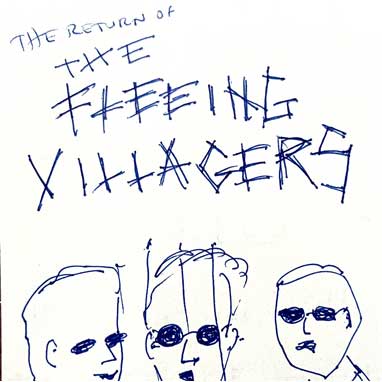
Based in the San Francisco Bay area, Fred Lonberg-Holm is an American cellist or, as he's described himself, anti-cellist. He studied with Anthony Braxton and Pauline Oliveros among others and is most well-known for his work in free improvisation and jazz, although he's also worked as a session musician and arranger with rock, pop and country artists. His latest release, the return of by The Fleeing Villagers, is a savage collage, a punk/noise juggernaut of an album which holds a mirror up to the current state of the USA. You've been warned. I like it and, indeed, it deserves to achieve some sort of cult status. He also figures on another recent release, a collaboration on the 4daRecord label which is, let's just say, a more sedate affair. The title, Convergência do Vôo translates as 'flight convergence'. It describes a meteorological phenomenon, much prized by glider pilots, whereby two air masses meet, forcing air to rise and thereby enabling gliders to gain altitude. I guess it's intended as a metaphor - and it's a good one - for the experience of improvising as part of a group. On it, Lonberg-Holm loops the loop - not for the first time - with fellow string players João Madeira and Carlos "Zíngaro". As a trio of string-players they've made at least a couple of albums in the past on which they've collaborated with a fourth musician (one features Swiss guitarist Florian Stoffner another, bass clarinettist José Bruno Parrinha). On this occasion, they're joined by drummer Bruno Pedroso.

A classically-trained violinist, Carlos "Zingaro" has worked with Derek Bailey's Company and has appeared on over fifty recordings. Bass player and founder of the 4daRecord label, João Madeira, has conducted research into fado (a form of traditional Portuguese music) and worked across many genres, although his main focus is on free improvisation and composition. Bruno Pedroso has been involved in jazz drumming since 1995. As well as teaching, he's very active as a freelance performer.
The guy credited with the mixing, Gordon Comstock, deserves a mention, too. A balance between the instruments has been achieved which allows all kinds of textural nuance to come through. And there's plenty of it, even though the music is often - but not always - fast-paced and dense. There's a lot of subtle shading going on, and, as I hear it, there's an improbably lyrical edge to it. Pedroso's drumming effortlessly joins in the conversation, creatively seeking out - and finding - common ground with the strings in ways I imagine you could only achieve by actually doing it in real time and, indeed, there's a sense of seat-of-the-pants discovery to the music which adds to it's forward drive.
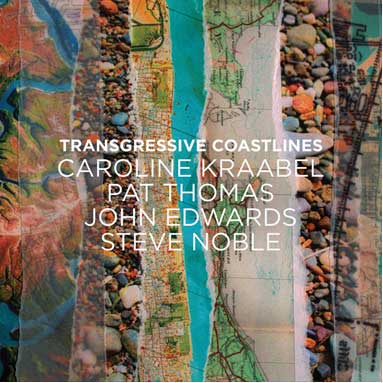
Transgressive Coastlines, the latest release - at time of writing - from Shrike Records, brings together the formidable quartet of Caroline Kraabel, John Edwards, Pat Thomas and Steve Noble. Born in Seattle, Kraabel moved to London in her teenage years and has been a fixture in the free improvised music scene ever since. For almost five years, she had her own programme on Resonance FM, Taking a Life For a Walk, in which she wandered the streets of London with her sax and her children. Among other large-group compositions, she created, for the South Bank Centre, Saxophone Experiments in Space, a 'site-specific ambulant composition for 55 saxophonists'. She's also been involved with the London Improvisers Orchestra and, in addition, has regularly worked as half of a long-standing duo with bassist John Edwards. Obsessed with sound from an early age (his brother played the drums, which intrigued him), Edwards took up the bass guitar in his teens, switching to the double bass in his twenties. He's played with likes of Evan Parker, Derek Bailey, Lol Coxhill and Peter Brötzmann among many others. He's said of improvisation: 'the establishment - by which I mean people in offices, suits and government - maybe want people to do nothing. They want to keep people drugged up with the banal, working, doing the same thing. Maybe free music upsets that'. Pat Thomas began playing the piano when he was eight and started to play jazz piano in his teens. He went on to develop a style of his own, drawing on free jazz, improv and new music. As Rae-Aila Crumble put it on Bandcamp Daily, 'The music he releases is both transcendent and grounded, rooted in his Muslim background and fascination with Islamic mysticism, as well as the histories of jazz afronauts like Sun Ra. Browsing through his … catalog feels like tapping into the secrets of the universe, similar to the way jazz historians describe Coltrane's discography as always searching for something.' Drummer Steve Noble got his first drum kit when he was twelve. He was mainly self-taught, but then, as he explained in an interview with Chris Searle for the Morning Star, 'In 1979 I met Nigerian drum master Elkan Ogunde and we played many concerts [and] workshops together - a great learning experience. By the mid-80s I was organising concerts and festivals and performing with Sheffield guitarist Derek Bailey, another huge influence'. Since then, he's worked with a wide range of musicians and toured extensively throughout Europe.
Like that of the album, the two-word titles of the three tracks on Transgressive Coastlines all suggest surrealist word-play. In the first track, 'Dark Rainbow', the quartet create a complex texture that veers between the polyphonic and the pointillist. You could think of the musical colours here as a rainbow - there are dazzling moments of bright light - but there are others in which the music reaches a point of near stasis which might be thought to invoke the visual impossibility of the title. At first fragmentary, the music of the second track ('Volcanic Tears') gradually becomes more dense. The musicians trade explosive gestures which build into something more sustained, at times static, even, only to be sent off in new directions by further explosive activity. The third track ('Diamond Ashes') again begins with fragmentary explorations, but this time the music settles into a sustained monolith of sound. A pulsing chord from Pat Thomas within it becomes increasingly distinct, transforming the monolith into a series of repeated chords. It finally comes to an end, but no-one seems to want to move away from the zone they've created. The repeated chord idea makes a comeback and the sax, bass and drums continue to pursue their close but inventive orbits around it.
Listening to it all for a second time, I was struck by the sheer virtuosity. Of course, virtuosity isn't essential to good music (it can even become a substitute for real content), but you get a real sense listening to this that you're listening to four seasoned musicians in total command of what they do while, at the same time, still finding fresh and inventive things to say.
Which brings me on to LliFT #18. Just to remind us, LliFT are an 'inclusive community group giving individuals the opportunity to play freely improvised ensemble music on a regular basis in North Wales'. It's only a few weeks since I was writing about #17, saying how it was one of the best LliFT albums yet. #18 carries on where #17 leaves off. One might think that after an outfit putting out so many albums in quick succession, one might detect a note of tiredness, a drop off in quality. Nothing, however, could be further from the case. What we have here is well over an hour of immersive musical landscapes packed with creativity. Listening to it, I was reminded of M John Harrison's Light Trilogy: not only on account of the enthralling strangeness of both, but on account of a striking passage in which the book describes how different civilisations living in different parts of the galaxy developed space travel independently of each other: 'Every race they met on their way through the Core had a star drive based on a different theory. All those theories worked, even when they ruled out one another's basic assumptions. You could travel between the stars, it began to seem, by assuming anything.' What he says about space travel here could also, in many ways, be said about the world of improvised music. People navigate musical space with often very different musical 'star drives': you can, for example, put together a small group of the most experienced improvisers (as in the case of TC), or, like LliFT, create an 'inclusive community group'. Neither is a recipe for success or failure, although, in the case of the albums here, both more than succeed.
Dominic Rivron
LINKS
the return of: https://fredlonberg-holm.bandcamp.com/album/the-return-of
Convergência do Vôo: https://joaomadeira.bandcamp.com/album/converg-ncia-do-v-o
Transgressive Coastlines: https://shrikerecords.bandcamp.com/album/transgressive-coastlines
LliFT #18: https://recordiaudukes.bandcamp.com/album/llift-18
.

It might be a dream repeated, unclear in its own right, perhaps within a dream held from another night, wild with words but always coherent for opening doors in that world. Tenses get muddled up, and a long sequence of numbers will surely mean a winning lottery ticket in the morning, or temptation to join you in bed.
Asked with gravitas to remember a name that makes perfect sense in the present night, and that will be Googled tomorrow with little result, I still hope to dispel blurriness, plead with turbulence and dispersion. "Paradisial" retains the original inflection, but we wise people think "heavenly" preferable to ignite the erotic in a subtitle.
On a summer stroll, we will be gifted the sound of birdsong and the very last pear blossom. With joy and relief, we will finally hear what they sing of and mean, their lyrics of two regular syllables or more. I will create a new season just for sleep, for a space where I do not have to repeat myself, to not have lips follow mine in silent imitation, not to be counted on fingers one, two, three, as if I and larger figures needed to be contained. Ah, to be seen in my language, from my best side!
Melisande Fitzsimons
Picture Rupert Loydell
.

Alan Dearling writes:
A great celebration of live music at a great Independent Music Venue. The Pale Blue Eyes' gig at the Grayston Unity in Halifax created an almost perfect marriage of music. First up, Warm Parts provided a wall of sound, a dark undertow of Kraut-rock styled drum-driven intensity. In my mind's eye I was taken back to the late 1960s when Hawkwind wereAlan Dearling blowing minds with pummelling, psychedelic waves of sound. Warm Parts received an enthusiastic response from the nicely packed crowd, which is not always the case for support bands. They are certainly continuing and sustaining their musical journey into the oeuvre of outsider, psychedelic weirdness - noise-rock a little akin to bands such as Wooden Shjips.
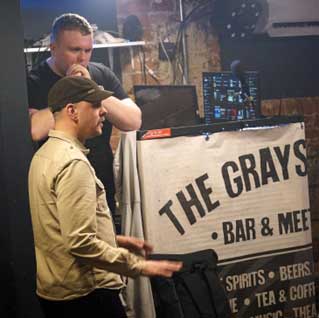
Rachael explained to me: "The band was conceived in early 2024 by myself, Rachael Elwell (synths, programming, theremin and visual artist), and I quickly recruited Dan Smith (guitars), who had moved in similar musical and creative circles, performing in various DIY and experimental bands in and around Manchester in the early 2000s. With the sound evolving and a shared desire for having live drums, we were introduced to Bryn, who, after hearing some early rehearsal recordings was keen to add to the group. With his shared musical background and style he quickly became an integral part of the band's ever evolving sound."


Warm Parts suggest that these are online sites where you can hear Warm Parts' 'Special Square' EP (these are not clickable links):
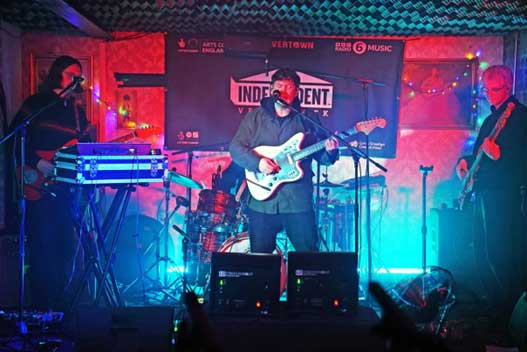
The Pale Blue Eyes arrived on stage. They are mesmerising, professional, polished, offering propulsive rock music with a high melodic content, whilst providing quite an adrenalin rush…
Matt Board is a suitably charismatic front-man and singer with PBE, who already have a significant fan-base and much support from BBC Radio 6 Music. Matt and myself have met up before, back in the halcyon days of music in Devon's town of Teignmouth, during the advent of Muse and the other local favourites, The Quails.
Pale Blue Eyes say that they are:
"Born of a cross-pollination between Totnes and Sheffield, Pale Blue Eyes have been steadily grafting over a number of years to exact their modernist pop vision.
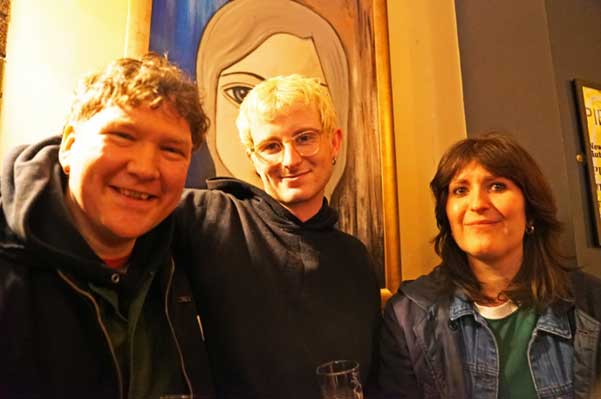
At the ship's helm, Matt and Lucy Board are a genuine marriage of two stylistic perspectives, each bringing unique sonic tropes to the table.

It is the pair's fascination with DIY ethic, retro synths and reminiscence that truly fuels their sound world, calling upon nostalgia and a captivating optimism.
The third part of the Pale Blue Eyes triad arrived when Matt and Lucy met bassist Aubrey Simpson at South Devon's Sea Change festival.
Together they've made three albums, with several tracks from the albums playlisted at BBC Radio 6 Music. They've played three Riley sessions, toured extensively in the UK and Europe, supported GOAT, Slowdive, Sea Power, The Editors, Public Service Broadcasting, The Midnight, FEWS and more…
The band released their third album in March 2025 on their own imprint, Broadcast Recordings. As with the first two albums the record has been produced by the band and finally mixed and mastered by Dean Honer. Honer has produced the likes of The Human League, Add N to (x) and Roisin Murphy and worked with countless Sheffield names from Jarvis Cocker to Tony Christie."
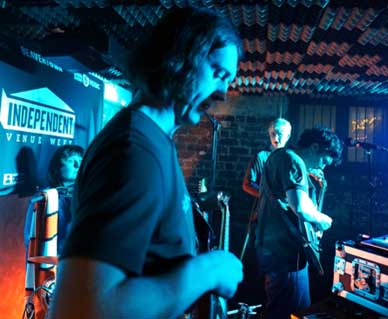
On the current live dates, producer and musician, Lewis Johnson-Kellett joins the trio of Pale Blue Eyes on guitar and synths/keys.
Live video: https://youtu.be/0SFd5nkpFoU
Online, Stephanie Pipe recommends Pale Blue Eyes:
"…saw them when they were on with Public Service Broadcasting a couple of years ago. Blew me away. Bought several cds and merch and am excited to see them back in Sheffield again soon…"
Pale Blue Eyes add: "Thanks to Marc Riley and Gideon Coe for including our track 'The Dreamer' in their best of 2025 show on BBC Radio 6 Music in amongst some class tracks! Cheers to them, and to those who tune in."
It was a great event to celebrate the importance and cultural contribution of the UK's Independent Venues.
'Signify'…jangling, guitar pop with disembodied vocals…
https://www.youtube.com/watch?v=vbf6EsAf8ag
'The Dreamer' (2025) …A thing of Floating effervescence… Official video: https://www.youtube.com/watch?v=wUbdIWLpGls
'New Place' film about making their PBE third album (2024):

My favourite baby Jesus painting is the one of Mary
in her halo giving him a spanking in front of witnesses
by Max Ernst, the German, who helped found Dada
and became involved with Surrealism, quietly distancing
himself without rancour and being interned by the Nazis
when they invaded France and escaping to America
where he met up once again with Andre Breton and
Marcel Duchamp, briefly married Peggy Guggenheim
before going back to Europe, and becoming more abstract,
lyrical. I've met none of them. Not Max, Marcel or Andre.
Jesus, Mary, Peggy. Although I've read accounts. Seen
some photographs. Had clever thoughts. In the painting,
the baby Jesus is big and blonde and Aryan. His mother,
I imagine, is trying to beat some sense into him. At least
that's my understanding. The three witnesses
appear aloof, disinterested. Only present for posterity.
Andre Breton, Paul Eluard (the poet), Ernst himself.
Steven Taylor
Picture Max Ernst
.

Tales from Topographic Oceans, Yes (Super Deluxe Edition: 12 CDS + 2 LP + blu-ray box set)
You just couldn't resist it, could you?
Umm, no. What?
Another reissue… The same old crap repacked for susceptible drongos like you.
It's not the same old crap, it's got new remixes, new versions, new recordings of works-in-progress and - finally - some live recordings of Yes' greatest, well one of their greatest, albums.
Waddya mean 'finally some live recordings'? I've seen your bloody CD shelf, loads of bootleg downloads. Surely you've got them already?
Well, yes, no. I mean, the ones I've got are actually better… and complete, but they weren't in Steve Howe's tapes library so they're not in the box. It's nice to have some official cleaned-up versions.
So nice you have to buy a 12 CD box?
Well, I like having the official stuff.
Even if that bloke Steve Wilson gets to mess it all up with his remixes?
Well, I shan't be playing those much. Or the instrumental versions he has done. Or the single versions.
Single versions? I thought the whole idea was to bore you into a mystical state through duration and repetition? Peak hippyshit.
Well, I wouldn't put it quite like that.
What would you put it like then?
Look, I explained this to you last time, Tales from Topographic Oceans is a double album based on a footnote in Paramahansa Yogananda's Autobiography of a Yogi. Jon Anderson, the singer, and Steve Howe, the guitarist, composed the initial suites of music at night on tour, and then the band all worked on it together.
But we all know it's boring as fuck. I mean Rick Wakeman dissed it from the word go, and it's renowned as overlong and overambitious.
But it's that ambition that makes it stand out, makes it unique. I mean, who else was releasing spiritual stuff like that?
Well thankfully, nobody else. One band is enough.
You're just ignorant. A bit of spiritual insight, too much wonder or magic and you run away scared.
At least I don't end up buying massive box sets full of stuff I already have.
And remixes and live tracks.
That you won't ever listen to again.
Maybe. Maybe not. And there's talk of them doing Relayer next in the box set series.
Woohoo. For goodness sake Johnny, reign it in. You spend more on box sets and reissues than beer.
That's a good thing isn't it?
Not in my books. Pub?
Oh, ok then. Can you carry this though, this box set is bloody heavy.
Ok, but it's your round.
Again?
Think of it as an outpouring of spiritual love.
Johnny 'soft summer mover' Brainstorm
.
Nick Drake
CELLO SONG
Strange face
With your eyes
So pale and sincere
Underneath you know well
You have nothing to fear
For the dreams that came
To you when so young
Told of a life
Where spring is sprung
You would seem so frail
In the cold of the night
When the armies of emotion
Go out to fight
But while the earth
Sinks to it's grave
You sail to the sky
On the crest of a wave
So forget this cruel world
Where I belong
I'll just sit and wait
And sing my song
And if one day you should see me in the crowd
Lend a hand and lift me
To your place in the cloud
© Nick Drake
.

Vintage Bus Day, 21st May 2023
Olive single-decker accelerates for Happy Mount
gentle hills beyond the bay, occluded mountains misted out
the panorama undulates a hypnotic content
a summer model of life and tide
all cast below Bare's tall tower
whose distinctive chequerboard exudes the decades passed -
though May blossom recurs forever, we hope
and whitens the greens on the way to Hest Bank
countering the daffodils all gone - and that melancholy shiver:
how many Springs?
Gateways and gardens to Bolton-le-Sands
where the Far Pavilion's exotic dancer, girded with praise
is suppliant for custom.
A white 20s house with a redbrick Plimsoll line
leads the way to a perfect jumble of Metroland
mellow red roof tiles and graceful windows
open meandering pathways in the mind
travelling a century back.
Here the stained-glass oval doorway myths
are undisturbed by the power catenary
which the railway weaves through this sweeping land
shallow rise and fall towards the border
freshened fields in lines of cut grass,
the smell, the greenness, another throwback to the past
but the future is here, we shouldn't waste time thinking of all that is lost
meeting Carnforth with the mind's cross-Channel drift . . .
to Sailly-sur-la-Lys.

Carnforth - twinned with Sailly-sur-la-Lys
© Lawrence Freiesleben, January 2026
.
On the face of it the English High Court ruling that the Palestine Action proscription is unlawful makes the decision that the proscription remains in place pending appeal utterly illogical. But what if the High Court ruling is deliberately designed to fail at appeal?

I believe that it is. They chose an extremely narrow path to rule that proscription was unlawful and produced an extremely weak judgment. This gives an impression of fairness in the judicial system - except that nothing has changed, the ban remains in force. And it remains in force because the judgment is designed for the government to win at appeal.
The judgment for the most part is precisely what you would expect from three hand picked, known right wing, judges. They:
- State that Palestine Action is a terrorist group within the meaning of the 2000 Terrorism Act (para 134)
- State that they do not accept the United Nations assertion that the UK definition of Terrorism is incompatible with international norms (para 141)
- State that in any case international law has no impact on English statute law (para 142)
- State that all those arrested for showing support for Palestine Action - specifically including for holding placards - were rightly arrested as they were deliberately committing a criminal act (para 118)
- State that there was no need for Yvette Cooper to consult before the proscription (para 60)
- Repeat the Crown's assertions of the Filton case as fact with no reference at all to the findings of the jury (paras 34, 139)
- State that comparisons with Just Stop Oil and Extinction Rebellion are not valid as those organisations have not carried out serious property damage (para 144)
- State that the motive of Palestine Action in trying to stop Genocide is not "material" (para 70)
- Argue that the interests of national security and protection of the rights and freedoms of others justify the interference with freedom of speech and assembly (para 128)
The judges have therefore supported the government on almost all of its key propositions. You may well ask, how did they find all that and still find the proscription unlawful?
Well, they chose a deliberately narrow and precarious path through. They first found that the proscription was unlawful in that it contradicted the Home Office's published policy on how the discretion of the Secretary of State would be applied in deciding whether to proscribe a terrorist organisation.
It is important to understand this. The ruling is that Palestine Action is a terrorist organisation, but that the Secretary of State is not obliged to proscribe all terrorist organisations but may use her discretion.
I have read the judgment again and again and it is incredibly obscure as to in what way the Home Secretary did not follow her policy. It seems to be that she did not consider the factors peculiar to Palestine Action, but merely proscribed as though that automatically followed a determination that an organisation is terrorist. Rather than consider the question in the round, she merely looked at the "operational advantages" of proscription.
I assume the underlying assumption is that this means she failed to take into account the disadvantages of proscription, but it does not say that. I don't think I am being obtuse. You try.
92. This conclusion may appear to rest on a very narrow basis - the Home Secretary had,
after all, formed the belief that Palestine Action is an organisation concerned in
terrorism and in these proceedings the claimant does not challenge that decision.
However, this conclusion is a direct and necessary consequence of the policy the Home
Secretary has applied to the exercise of her discretion to proscribe such organisations.
The purpose of the policy is that not all organisations that meet the concerned in
terrorism requirement should be proscribed.93. Any decision-maker who adopts a policy for a particular purpose is at liberty to disapply
or modify that policy in a particular case, but any such disapplication or modification
must be express and must be for a sufficient reason. In this case, the Home Secretary's
approach was to apply the policy (a policy of long-standing, dating back to the time the
2000 Act was enacted), without modification.94. The operational consequences and advantages of proscription is not a factor consistent
with the policy for the obvious reason that such consequences and advantages will apply
equally to any organisation that could be proscribed - i.e. any and every organisation
that meets the requirement to be an organisation concerned in terrorism. In principle
the position could be otherwise if in a particular case, by reason of an organisation's
structure, membership, activities or otherwise, the measures in the 2000 Act that are the
consequences of proscription would be unusually effective. In such a case, it could be
consistent with the policy to regard the operational consequences of proscription as an
"other factor". But that is not the present case. There is no such evidence so far as
concerns Palestine Action. Nor in the present case could it be contended that the
reliance placed on the consequences of proscription was immaterial to the exercise of
the discretion or the application of the policy. Both in the note of the meeting of the
Proscription Review Group and in the 26 March 2025 ministerial submission, the
operational advantages are relied on as providing a clear case to use the discretion to
proscribe. Each suggests that it is an important matter going to the exercise of the
discretion, if not the central consideration in that exercise in that case.95. The consequence and conclusion of this point is that, notwithstanding the latitude that
the policy provides, the Home Secretary's decision to proscribe Palestine Action was
not consistent with her policy. The closed material does not affect our conclusion on
this ground.
There are two problems with this aspect of the judgment.
Firstly it seems so obscure that it is designed to fail at appeal.
The notion that its proscription was unlawful because the Secretary of State had failed to follow, not the established law, but the precise procedures in some buried Home Office policy document that nobody had ever read, is not one that I would have expected to carry the day compared to all the other issues.
It is indeed an established legal point, but one used in objections to planning applications rather than cases of alleged terrorism. Which is what I believe the Court of Appeal will say.
Secondly it leaves it open to the Secretary of State just to change the published policy, then proscribe again.
The second ground on which the court found against the government is that the proscription is incompatible with Articles X and XI of the European Convention on Human Rights - Freedom of Speech and Assembly.
But again this is not what you think.
Remember the judges found that the 2700 people arrested for opposing the ban have been quite rightly arrested, as expressing support for Palestine Action is a criminal act. The court does not hold that their right to freedom of speech is infringed.
In fact the court rehearses all the ways that speech will be chilled and people will be de-platformed as a result of the proscription, but does not find they are unreasonable to combat "terrorism".
128. The Home Secretary's pleaded case is that the purpose of proscription was to "disrupt
and degrade PA so as to protect the rights of others and maintain national security".
The submissions on behalf of the Home Secretary sought to define the objective as
"controlling terrorism" or "controlling terrorist organisations" through proscription of
organisations that engage in "terrorism" as defined in s.1 of the 2000 Act. It seems to
us that the latter is a description of the means of obtaining the objective. The identified
legitimate aims of the proscription decision are "the protection of the rights and
freedoms of others" and "the interests of national security". Those aims appear in each
of articles 10(2) and 11(2), respectively and are objectives that, in principle, are capable
of warranting an interference with each Convention right.129. Although the claimant raised the question whether there is a rational connection
between the means chosen and the aim in view, no basis for suggesting there is not a
rational connection was put forward. Proscription is rationally connected to the
objective of disrupting Palestine Action so as to protect the rights of others and the
interests of national security. That is so whether the objective was limited to curtailing
actions by Palestine Action causing serious property damage within the meaning of
section 1 of the 2000 Act, or extended more broadly
When after all this support for the government, the judgment finally delivers the key paragraph on why the proscription was unlawful, it suddenly leaps out at you: the result of a proportionality exercise the judgment had not previously defined or given a methodology.
140. Considering in the round the evidence available to the Home Secretary when the
decision to proscribe was made, the nature and scale of Palestine Action's activities, so
far as they comprise acts of terrorism, has not yet reached the level, scale and
persistence that would justify the application of the criminal law measures that are the
consequence of proscription, and the very significant interference with Convention
rights consequent on those measures.
It is a goal entirely against the run of play in the previous 139 paragraphs. I am afraid to say that I think the marked lack of intellectual underpinning again makes it a structure designed to fail.
Three known very conservative judges were appointed at the last moment to replace the liberal judge Chamberlain, who was unceremoniously booted off the case. It seemed astonishing that these known sympathisers with the security state had found the proscription unlawful.
But they cannot really think both that it is unlawful, and that it should continue pending appeal. That is utterly illogical.
They cannot really think it is an unlawfully disproportionate interference with freedom of speech, and that those arrested for holding placards opposing it were criminals and rightfully charged.
That is a logical impossibility also. Yet both sit side by side in this judgment.
The judges are not stupid. It can only be that they do not really mean it when they state one of those opinions. All the signs are that it is para 140, swinging entirely unsupported and exposed and waiting to be struck down, that they do not really mean.
If they believed in their own judgment, the judges would have quashed the proscription pending appeal.
Palestine Action was a proscribed organisation before this judgment and it is a proscribed organisation after this judgment. Everything else is smoke and mirrors.
That is why it is essential that the Scottish judicial review goes ahead. I for one am very interested to discover whether the paragraph
142. We doubt that the consensus claimed exists: see and compare R v Gul (Mohammed)
[2013] UKSC 64, [2014] AC 1260 per Lords Neuberger and Judge at paragraphs 44 -
51. In any event, this submission faces the further obstacle that, when taking her
decision, the Home Secretary was entitled to rely on the definition of terrorism in the
2000 Act. Indeed, she was required to apply that definition. Had she purported to rely
on any other definition for the purposes of her decision she would have acted
unlawfully. A "consensus" in international law is not a trump card in English law; any
such consensus cannot permit either disregard of or derogation from an English statute
save to the extent permitted by statute.
which specifically references "English law", applies equally in Scotland. The English legal tradition is that the "Crown in parliament" is sovereign and may do absolutely anything it wishes, irrespective of international law, individual rights or any other consideration. The Scottish legal tradition is that the people are sovereign and protected from arbitrary or oppressive executive action.
Should Huda Ammori again win at appeal, Shabana Mahmood will certainly appeal to the Supreme Court. It would be extremely difficult for the Supreme Court to rule against the highest courts of both England and Scotland. So there is reason to continue the Scottish action even if the English case continues to win.
Should the UK government win at appeal in England, the Scottish case becomes still more crucial.
The UK government has succeeded in postponing the Scottish case, in order to give time to prepare for the admission of secret evidence. This is an incredible authoritarian procedure where they can submit "intelligence" to the court, which neither I nor my legal team will ever be permitted to know about, let alone have a chance to reply.
My interest will be "represented" by a "special advocate" with whom I shall never be able to communicate and thus will have no ability to give them the answer to whatever lies the UK government has put forward - probably about non-existent Iranian funding or entirely invented bomb plots.
This system is simply fascist. We have no idea to what extent the "secret evidence" used in the English case contributed to the court's agreement that Palestine Action is a terrorist organisation.
We push on. I hate to say this, but we are now desperately short of funds to continue this action. I cannot keep asking the same supporters to give more, but if you know people who can afford it and will contribute, please activate them.
You can donate through the link via Crowd Justice, which goes straight to the lawyers, or through this blog.
https://www.crowdjustice.com/case/scottish-challenge-to-proscription/
paypal.HostedButtons({ hostedButtonId: "NZDEN7BYDHVS4", }).render("#paypal-container-NZDEN7BYDHVS4")
Alternatively by bank transfer:
Account name
MURRAY CJ
Account number 3 2 1 5 0 9 6 2
Sort code 6 0 - 4 0 - 0 5
IBAN GB98NWBK60400532150962
BIC NWBKGB2L
Bank address NatWest, PO Box 414, 38 Strand, London, WC2H 5JB
Or crypto:
Bitcoin: bc1q3sdm60rshynxtvfnkhhqjn83vk3e3nyw78cjx9
Ethereum/ERC-20: 0x764a6054783e86C321Cb8208442477d24834861a
The post Postpone The Celebrations appeared first on Craig Murray.


There may by now be an unbridgeable margin of doubt as to whether the PM's reputation can be repaired. Though at the end of this week, after the smoke of battle has cleared, we are none the wiser as to what happens next. This is, not least, because the news media (and in particular the BBC), instead of reporting what was in front of their eyes, had set themselves a story they were confident would break. And when it failed to follow their requirements then, come hell or high water, they refused to let go.
So Keir Starmer is still there, and in all the hoo-ha, no hack ever bothered to explain exactly the processes and seamy realities by which he would be removed. Or why their prophesies failed to materialise. Labour MPs are frustrated at the PM's performance - but also at their own. Once again, the plotters have blanched at the prospect of regicide. They failed to strike.
Others express lukewarm support for the PM, though few are prepared to talk about it openly. Many seem as much bystanders as the average Guardian reader: Morgan McSweeney's hold over Keir Starmer seemed a mystery to them too.
But one regional MP whose patience is long past declares: "The same people and policies will still be fronting the same unpopular programme. Like a wounded animal, this government will drag itself away till it expires, probably after the May locals.
"By then, Starmer can resign on the grounds of those losses and not the reputational disaster of Epstein and Mandelson. He'll go down as the worst PM in Labour history, and one that may have finally broken it. He's a coward who refuses to take responsibility for his own actions… A genuine disaster for this country and the Labour movement."
*
 Václav Havel (L) playing chess. Image by L. Kaválka Archive.
When Vaclav Havel was made president of what was Czechoslovakia, effectively by public acclaim, he saw no reason to change his life. He still turned up to play chess with his old friends in their favourite bar on Friday evenings. They weren't alone by then, of course, and were surrounded by journalists and well-wishers. When somebody disturbed his concentration to ask what he was planning to do about some problem or other, the new president said: "I don't know. What would you do?"
Nobody would ever have claimed Mr Havel was a weak man, but he didn't claim to have all the answers or feel the need to beat his chest in public. Yet in Britain, we are always led by men and women who claim to have all the answers. That only proclaims their weakness. They believe we, as a nation, are so lacking in courage we need to believe Britain's omnipotence in all things, in order to add an inch or two to the nation's manhood.
So how do we escape from this embarrassing cycle? Compare the dignity of the defenestrated Sue Gray, who came from a different and less tribal tradition, with the deposed-at-last Morgan McSweeney - a jumped-up office manager - who declared in his resignation letter that he had "resigned from the government".
So does the PM soldier on, claiming he was right all the time? Or does he admit he (or Mr McSweeney) got things catastrophically wrong? In order to change, he has to change his entire team and culture, though neither his team nor his culture will allow him to do that. And how would he explain an ear splitting and rubber burning handbrake turn on Brexit and immigration? Dear reader, whichever way up you hold it, this just won't do.
*
 Jenny Riddell-Carpenter in Parliament. Image by LDRS. Used with permission
Of the 2024 intake of Labour MPs, Jenny Riddell-Carpenter (Suffolk Coastal) is a name which keeps popping up. In truth, she was not expected to become a well-known voice, but she has the ability to express herself honestly, as well as the courage to challenge her party when it gets things wrong. Her reasons for backing Keir Starmer will sound reasonable to many voters.
"We have had five Prime Ministers in seven years," she writes in the East Anglian Daily Times. "Swapping Keir Starmer for a sixth would not cleanse politics. It would plunge the country back into the troubled waters of political instability voters rejected. It would damage the economy, deter investment, and erode trust in politics altogether."
*
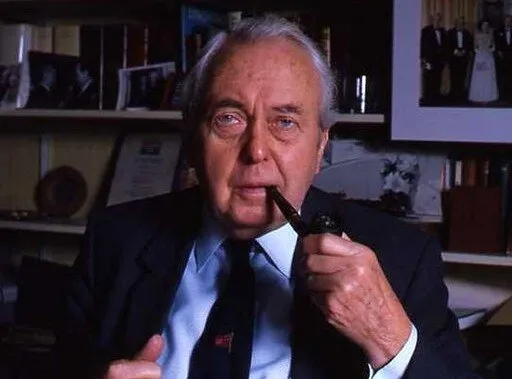 Harold Wilson. Image by Alan Warren via Wikimedia Commons (CC BY-SA 3.0)
"The Labour Party is a moral crusade or it is nothing," said Harold Wilson, but that is an altar long since cast down. Nobody could describe this week's tatty political parlour games as having much to do with a moral crusade. So, does that mean the Labour Party is nothing?
They are engaged in what is always Labour's favourite sport, visceral and unforgiving internecine warfare. While Keir Starmer waits to see whether his new high chamberlain decides he should be born again, or whether it's to be business as usual, his rivals blithely plot quite openly.
 Angela Rayner. Image by 70023venus2009 on Flickr (CC BY-ND 2.0)
The two figures who always crop up are Angela Rayner and Wes Streeting. In fact, so blatant have ambitions become that Ms Rayner launched her 'Rayner for leader' website early, and it had to be withdrawn. Meanwhile, one of the Streeting team is reported on record as saying the reason they are on manoeuvres early is to jump the gun on Ms Rayner.
 Wes Streeting. Image by Number 10 via Flickr (CC BY 2.0)
Wes Streeting looks rather like a dissipated cherub. Pecksniff finds him a puzzle, only partially solved by talking to a few of the region's Labour MPs. One who admits that they and Mr Streeting are "somewhat opposite" politically, nevertheless declares: "He's a hard worker, on top of his brief, regularly communicates with backbench MPs and takes them on the journey. He knows MPs' names - you'd be amazed how many cabinet members don't - and he's a good communicator."
Another says: "Starmer will probably struggle on till May and then try and go out on his own terms. It will give Wes time the to ride out the storm as well. Time is his friend."
*
There was once a row in one of the Commons bars between two MPs, one Tory and one Labour. The Tory cried in exasperation: "You bloody fool!"
"You may be right," observed the Labour man. "But there are millions of bloody fools in this country, and they deserve representation just like anybody else."
This anecdote may explain the appeal of Reform. They appeal to the bloody fools. And they appear to have gone about the Gorton and Denton by-election in their usual hypocritical, uninformed, clumsy and presumptuous manner.
Their candidate even flounced away from a public hustings after, it is claimed, having been refused his intention of packing the audience with his supporters who had been bused in.

They are also accused of breaking electoral law, by misrepresenting a supposed letter from a local voter, when it looks suspiciously like a campaign tactic they used in the recent Caerphilly by-election; only this time it doesn't have the imprint necessary under law. Police are investigating.
Meanwhile, Labour and Greens accuse each other of cynically misrepresenting recent voting figures in their election material. Both are correct. Both are effectively lying to the voters. Any claims of a 'new politics' are bogus.
But nobody has yet accused either the Tories or Liberal Democrats of blatant disregard for the truth, (admittedly something of a first for the LibDems). This is rather faint praise, however. The most likely reason there have been no complaints is that nobody has noticed they are taking part.
*

More on Reform's hypocrisies. This week, Nigel Farage declared: "People aren't more productive working from home - it's a load of nonsense".
At the same time, Reform are advertising for a regional director, describing the job as: "Home working with occasional travel".
*
The Jim Ratcliffe 'immigration row' this week would have been the perfect opportunity for the government to point out that Britain needs more immigration to support an ageing population, and that immigrants are major net contributors to the British economy. But they didn't.
This might have been because, post-McSweeney, No.10's communications is as bad as ever and they didn't think of it. Or it could be that, pending the arrival of Keir Starmer's new satrap to replace him, the PM has yet to be told what his policy on immigration should be.
*
More evidence of how even the cabinet don't know what Labour's policies are at the moment. On Thursday, the Telegraph reported Rachel Reeves, the chancellor, as saying that "Closer ties with EU are Britain's biggest prize". Whereas last month in Davos she reiterated what was then Morgan McSweeney's her government's position that urged cabinet ministers to stop floating the idea of a closer union.

*
Incidentally, for those Westminster hacks still dribbling at the prospect of a Reform election victory in three years' time, a glance at the latest YouGov approval ratings of the party leaders might rather piss on the matches.
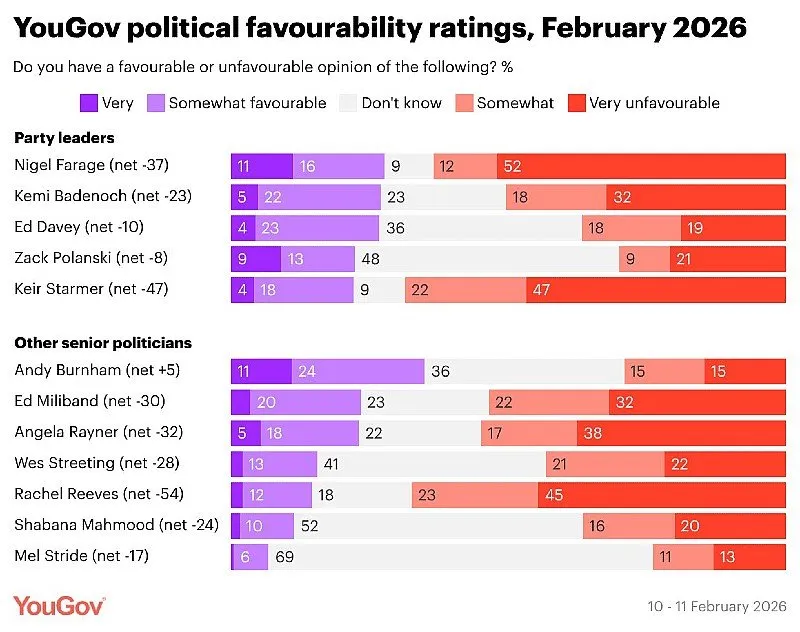
Nigel Farage ranks second bottom, with an approval rating of -37. This is interesting, since though Keir Starmer is constantly lambasted for his poor showing - currently -47 - the eulogies constantly poured over Mr Farage by Chris Mason et al might imply he is flying high.
The full results are: Zack Polanski -8, Ed Davey -10, Kemi Badenoch -23, Nigel Farage -37 and Keir Starmer -47. And incidentally (and quirkily) Sir Keir's ratings have improved by 10 points during the present political fandango, from -57 last month. Whereas Mr Farage continues to decline…
*
Last week, Pecksniff mentioned a new political grouping called Prosper, launched by many of the old Tory faces supportive of what The Times calls "softer Conservative values". This week they tell us they have attracted 17,000 supporters in those first seven days. They have also analysed them. The group aims to extend the Tory vote and reveal that only one in three of their shiny new supporters voted Tory in the last election.
But it also seems that fewer than one in six is presently a member of the party. Which rather suggests that, though Prosper might appeal to the lost souls who haunt the political fringes, they still have a long way to go to make an impression on the hard right on whom Kemi Badenoch is so dependent.
*
 Zack Polanski at the Green Party Conference 2025
If ever a party were likely to be riven with schisms, it ought to be today's Green Party. Making the jump from unforgiving ideology to practical political reality was always going to be a major bridge to cross. But as they have shown especially in Suffolk, it can be done.
That is unlikely, however, to impress those who Green party members themselves refer to as the 'ultras', no doubt buoyed by the influx of ex-Corbynistas who jumped ship from Labour and are still keen to pursue their schisms. So at the same time there is a realistic chance of a major breakthrough electorally, the party faces stormy weather ahead caused by their looming article 105, likely to be up before conference: 'Zionism is Racism'.
The left have always placed ideological purity above the messy business of winning democratic power, and destroying the party in order to make an empty gesture is always worth the candle. Self-righteousness is a powerful drug, which is why the causes of the left so often languish.
*
The state of our politics, my dears, really. There was a by-election for Peterborough City Council on Thursday. Reform won with 7.4% of the electorate…
*
This week's secret letter boxers were Stace Richards, James Porter, David Patey, Celina Błędowska, Liz Crosbie, Malcolm Lynn, Karl Whiteman and Helen Forte.
<<< Previous Pecksniff's Diary
More from East Anglia Bylines
 Brexit
The will of the rich and powerful: Brexit and the Epstein files
byStephen McNair 11 February 2026
Brexit
The will of the rich and powerful: Brexit and the Epstein files
byStephen McNair 11 February 2026
 Brexit
Exiting the UK to re-join the European Union
byAidan Marshall 13 February 2026
Brexit
Exiting the UK to re-join the European Union
byAidan Marshall 13 February 2026
 Politics
The great Ministry of Defence-to-Palantir pipeline
byEthan Shone 9 February 2026
Politics
The great Ministry of Defence-to-Palantir pipeline
byEthan Shone 9 February 2026
 Party politics
The strange people who join political parties
byStephen McNair 8 February 2026
Party politics
The strange people who join political parties
byStephen McNair 8 February 2026
 Friends of Bylines Network
There has never been a greater need for grassroots journalism that investigates the stories that really matter, holds power to account and champions the voices of everyday citizens. We are proudly powered by volunteers but what we do isn't free.
STAND WITH US for independent, citizen-led journalism that makes democracy stronger, and you will even get some exclusive benefits.
BECOME A FRIENDThe post Pecksniff: A bruising week in politics, ill served by both MPs and media first appeared on East Anglia Bylines.

Once again, the internet has done what the internet does best: amateur sleuths have now turned their attention to an alleged Oval Office "audio incident," with one self-described sound engineer claiming to have isolated and enhanced the offending noise like it's the Zapruder film. — Read the rest
The post Internet "Forensically Analyzes" Trump's alleged "Shartgate" appeared first on Boing Boing.

After being sent home in the wake of failure, which turned fatal in Minneapolis, the face of Trump's immigration crackdown and self-styled Gruppenführer Greg Bovino resurfaced online. Apparently, acting under the misconception that anyone missed him at all, the internet did what it does best. — Read the rest
The post Bovino attempts comeback, spontaneously combusts appeared first on Boing Boing.

Erika Kirk, the grieving widow of Charlie, who instantly declared herself CEO of his Turning Point USA organization, is facing renewed allegations of grooming after screenshots allegedly showing her sending flirtatious and intimate messages to a 15-year-old girl in 2014. Erika was 25 at the time. — Read the rest
The post Turning Point USA CEO Erika Kirk faces grooming allegations appeared first on Boing Boing.
Cyclops time.
Thirteen years ago, when I was just entering the final demographic, I had the cataract in my right eye replaced. It was a quick and easy procedure that left me with 20/10 vision when I walked out the door of the surgery center. It's still that sharp.
Which is good, because this morning I had the cataract in my left eye replaced, and now I'm blind on that side, at least for now. In retrospect, I should have had both cataracts replaced way back when I had the first one done. I didn't then because the cataract in my left eye wasn't bad, and that eye could still focus. Vision on that side was 20/25, and I could use that eye to read as well, meaning that most of the time I didn't need glasses.
But, because I waited, the cataract in my left eye gradually turned brunescent, meaning brown. This required an extra $2050 for Femtosecond Laser-Assisted Cataract Surgery (FLACS), which isn't covered by Medicare.
Anyway, the surgeon had to turn his emulsifying machine up to 9 (normal is 3) to demolish the old brown lens. This, plus the antiquity of my cornea, caused it to swell, so the world to my left eye is now just colors and shapes. If all goes according to plan, this will gradually go away. Meanwhile, no driving, no lifting heavy things, and hopefully no new regrets.
Advice: If you do have cataracts, don't wait around. Get them done.
On Valentine's Day, I cannot help thinking back to the days when we had Viscountess Boudica of Bethnal Green to make the East End a more colourful place, before she was 'socially cleansed' to Uttoxeter

Viscountess Boudica of Bethnal Green confessed to me that she never received a Valentine in her entire life and yet, in spite of this unfortunate example of the random injustice of existence, her faith in the future remained undiminished.
Taking a break from her busy filming schedule, the Viscountess granted me a brief audience to reveal her intimate thoughts upon the most romantic day of the year and permit me to take these rare photographs that reveal a candid glimpse into the private life of one of the East End's most fascinating characters.
For the first time since 1986, Viscountess Boudica dug out her Valentine paraphernalia of paper hearts, banners, fairylights, candles and other pink stuff to put on this show as an encouragement to the readers of Spitalfields Life. "If there's someone that you like," she says, "I want you to send them a card to show them that you care."
Yet behind the brave public face, lay a personal tale of sadness for the Viscountess. "I think Valentine's Day is a good idea, but it's a kind of death when you walk around the town and see the guys with their bunches of flowers, choosing their chocolates and cards, and you think, 'It should have been me!'" she admitted with a frown, "I used to get this funny feeling inside, that feeling when you want to get hold of someone and give them a cuddle."
Like those love-lorn troubadours of yore, Viscountess Boudica mined her unrequited loves as a source of inspiration for her creativity, writing stories, drawing pictures and - most importantly - designing her remarkable outfits that record the progress of her amours. "There is a tinge of sadness after all these years," she revealed to me, surveying her Valentine's Day decorations," but I am inspired to believe there is still hope of domestic happiness."


Take a look at
The Departure of Viscountess Boudica
Viscountess Boudica's Domestic Appliances

Republican lawmakers dumped the problem in the White House's lap and left the Capitol as a midnight deadline for DHS funding looms. Their weeklong recess abandons the standoff over ICE and leaves it to White House negotiators and Democratic lawmakers to solve. — Read the rest
The post Republicans jet off as DHS runs out of money appeared first on Boing Boing.

The International Olympic Committee is under fire for selling a men's T-shirt commemorating the 1936 Berlin Olympics, hosted by Hitler.
The shirt, featuring the original Berlin 1936 poster art, showed up on the Olympics website with the kind of bland "celebrate humanity" framing that only works if you aggressively forget what a celebration of humanity Berlin 1936 was. — Read the rest
The post IOC adds Nazi-era Berlin Games to "Heritage Collection" appeared first on Boing Boing.

This Star Wars racing game looks like it has the right amount of sound effects, visuals, and dirty deeds to be a good time.
While slightly generic and not focused on the timeframe I enjoy most in Star Wars, this looks like it has enough Star Wars elements to be fun as a racing game, and fun as Star Wars. — Read the rest
The post "Now this is pod racing!" Star Wars: Galactic Racer coming soon appeared first on Boing Boing.

I have become obsessed with Solvej Balle's story of a woman trapped on a single day.
On the Calculation of Volume introduces us to Tara Selter, a woman living the classic Bill Murray Movie "Groundhog Day" but with no explanation or idea of how or why. — Read the rest
The post A phenomenal time travel story: On the Calculation of Volume (Book I) appeared first on Boing Boing.

Stay calm, the ground has risen an inch across a 20-mile area around the northern edge of Yellowstone's caldera since last July.
This isn't the precursor to a massive cinematic moment. Yellowstone hasn't erupted for 70,000 years, and it seems unlikely to pop off any time soon. — Read the rest
The post Uplift being tracked at Yellowstone's caldera appeared first on Boing Boing.

The Wall Street Journal reports staff beratings, polygraph tests, showboat raids, and a Coast Guard pilot allegedly fired because someone didn't pack the secretary's favorite blanket.
The Department of Homeland Security under Noem and Lewandowski is apparently run like a YouTube influencer's channel. — Read the rest
The post Noem and Lewandowski turned Homeland Security into a reality show with poor trigger discipline appeared first on Boing Boing.

Congressperson Jamie Raskin (D-MD) paid the ICE facility in Baltimore a surprise visit. What he found was "disgraceful. "
Raskin found 60 men packed into a single room, with only one toilet and no showers. The inhuman conditions also involved sleeping with a simple aluminum foil survival blanket. — Read the rest
The post 60 Men, one toilet: Lawmaker describes conditions inside ICE facility appeared first on Boing Boing.


