
Altitude, the world leading carbon dioxide removal (CDR) financier, has significantly expanded its purchases by partnering with Alcom for +360.000t of CDRs. Altitude has crossed more than 720,000 t CDRs in total procurement. In one of the largest individual off-take agreements to date, Altitude is procuring over 360,000 tonnes of ... [continued]
The post Altitude Partners With Alcom For +360.000t Carbon Removals appeared first on CleanTechnica.
The "undervaluing" of nature by businesses is fuelling its decline and putting the global economy at risk, according to a major new report.
An assessment from the Intergovernmental Science-Policy Platform on Biodiversity and Ecosystem Services (IPBES) outlines more than 100 actions for measuring and reducing impacts on nature across business, government, financial institutions and civil society.
A co-chair of the assessment says that nature loss is one of the most "serious threats" to businesses, but the "twisted reality is that it often seems more profitable to businesses to degrade biodiversity than to protect it".
The "business and biodiversity" report says that global "finance flows" of more than $7tn (£5.1tn) had "direct negative impacts on nature" in 2023.
The new findings were put together by 79 experts from around the world over the course of three years, in what IPBES described as a "fast-track" assessment.
IPBES is an independent body that gives scientific advice to policymakers about biodiversity and ecosystems.
This is the "first report of its kind" to provide guidance on how businesses can contribute to 2030 nature goals, says IPBES executive secretary Dr Luthando Dziba in a statement.
Below, Carbon Brief explains four key findings from the "summary for policymakers" (SPM), which outlines the main messages of the report.
The full report is due to be released in the coming months after final edits are made.
.innerArt>ol { font-family: 'PT Serif'; font-size: 18px !important; }- Businesses both depend on, and harm, nature
- Current practices 'do not support' efforts to halt and reverse biodiversity loss
- Businesses can act now to address their impacts on nature
- Government policies can drive a 'just and sustainable future' for nature and people
Businesses of all sizes rely on nature in one way or another, says the report.
The SPM outlines that biodiversity provides many of the goods and services businesses need, such as raw materials from the environment or controlled water flows to reduce flooding during wet seasons and provide water in dry seasons.
Biodiversity also "underpins genetic diversity" that informs the development of products in many industries, including pharmaceuticals and cosmetics.
Individual businesses often do not address their impacts and dependencies on nature, "in part due to their lack of awareness", the SPM says.
They also often do not have the data or knowledge to "quantify their impacts on dependencies on biodiversity and much of the relevant scientific literature is not written for a business audience", the report claims. It adds:
"Lack of transparency across value chains, including of the risks and opportunities related to the sustainability of resource extraction, use, reuse and waste management, is a further barrier to action."
The report says it is well established that businesses depend on biodiversity, but also that the actions of businesses "continue to drive declines in biodiversity and nature's contributions to people".
(IPBES says it uses terms such as well established to express "how assured experts are about the findings". Well established findings, the highest level of confidence, have significant evidence and high agreement behind them. The three other terms used in IPBES reports are: unresolved (a lot of evidence but low agreement), established but incomplete (limited evidence but good agreement) and inconclusive (limited or no evidence and little agreement).)
The report notes that the size of a business "does not always reflect the magnitude of its impacts", with companies in sectors such as agriculture, forestry, fishing, electricity, energy and mining having "relatively high" direct impacts on nature.
A "failure" to account for nature as the economy has expanded over the past two centuries has "led to its degradation and unprecedented rates of biodiversity loss", the SPM says. It adds:
"The decline in biodiversity and nature's contributions to people has become a critical systemic risk threatening the economy, financial stability and human wellbeing with implications for human rights."
It is well established that nature loss as a result of "unsustainable use" threatens the "ability of businesses, local economies and whole sectors to function", the report details.
These risks and others - such as extreme weather events and critical changes to Earth systems - are "among the highest-ranked global risks over the next 10 years", it adds.
The SPM notes further that it is well established that risks around climate change and biodiversity loss "may interact to amplify social and economic impacts".
These risks have "disproportionate impacts on developing countries whose economies are more reliant on biodiversity and have more limited technical and financial capacity to absorb shocks", the report adds.
2. Current practices 'do not support' efforts to halt and reverse biodiversity lossThe SPM says that it is well established that current political and economic practices "perpetuate business as usual and do not support the transformative change required to halt and reverse biodiversity loss".
These practices have "commonly ignored or undervalued biodiversity, creating tension between business actions and the conservation and sustainable use of biodiversity", the report continues.
For example, the report says there is established but incomplete evidence that "time pressures on decision-making and timescales for investment returns and reporting by businesses - with an emphasis on quarterly earnings or annual reporting - are shorter than many ecological cycles".
This prevents businesses from "adequately" considering nature loss in decision-making, says the SPM.
There is well established evidence that businesses fail to assign adequate value to "biodiversity and many of nature's contributions to people, such as filtration of pollutants, climate regulation and pollination", it continues.
As a result, "businesses bear little or no financial cost for negative impacts and may not generate revenue from positive impacts on biodiversity", leading to "insufficient incentives for businesses to act to conserve, restore or sustainably use biodiversity".
Prof Stephen Polasky, co-chair of the assessment and a professor of ecological and environmental economics at the University of Minnesota, said in a statement:
"The loss of biodiversity is among the most serious threats to business. Yet the twisted reality is that it often seems more profitable to businesses to degrade biodiversity than to protect it. Business as usual may once have seemed profitable in the short term, but impacts across multiple businesses can have cumulative effects, aggregating to global impacts, which can cross ecological tipping points."
It is well established that policies from governments can "further accelerate biodiversity decline", the SPM says.
It notes that, in 2023, global public and private financial spending with direct negative impacts on nature was estimated at $7.3tn.
This figure includes public subsidies that are harmful to nature (around $2.4tn) and private investment in high-impact sectors ($4.9tn), says the report.
Industries harmful to nature include fossil-fuel extraction, mining, deforestation and large-scale meat farming and fishing.
In contrast, just $220bn in public and private finance was directed to activities that contribute to protecting and sustainably using nature in 2023, adds the report.
(In recognition of the need to address public spending on activities that are destructive to nature, countries agreed to reduce biodiversity-harming subsidies by at least $500bn by 2030 as part of a global pact made in 2022.)
There are additional "barriers to action" facing businesses, ranging from challenging social norms to a lack of capacity, data or technology. These are summarised in the table below.
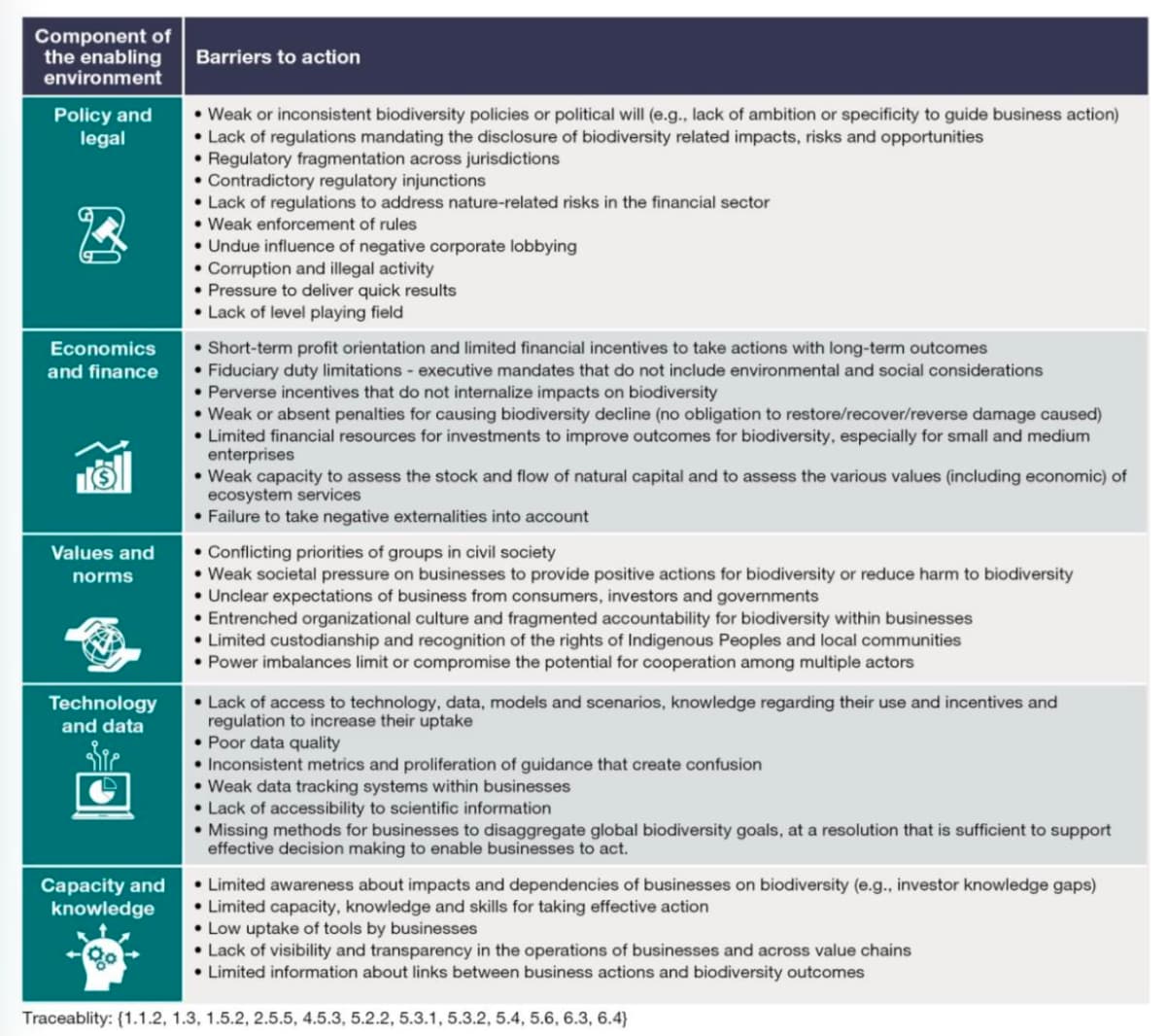 Barriers preventing businesses from taking action on biodiversity loss. Credit: SPM.4, IPBES (2026)
"These barriers do not affect all actors equally and may disproportionately affect small and medium-sized businesses and financial institutions in developing countries," adds the report.
3. Businesses can act now to address their impacts on natureThe SPM says it is well established that the "transformative change" required to halt and reverse biodiversity loss requires action from "all businesses".
However, the report continues that it is also well established that the current level of business action is "insufficient" to deliver this "transformative change". This is, in part, because the "enabling environment is missing", it says.
IPBES says all businesses have a responsibility to act, even if this responsibility is not shared "evenly".
"Priority actions" that businesses should take differ depending on the size of the firm, the sector in which it operates in, as well as the company structure and its "relationship with biodiversity", the report notes.
The exact actions businesses should pursue also depends on companies' "degree of control and influence over stakeholders", it says.
According to the report, firms can act across four "decision-making levels" - corporate, operations, value chain and portfolio - to measure and address impacts on biodiversity.
("Corporate" refers to decisions focused on overarching strategy, governance and direction of the business; "operations" to day-to-day activities; "value chain" to the system and resources required to move a product or service from supplier to customer; and "portfolio" to investments and business assets).
The SPM sets out a series of examples for how businesses can act across all four levels. These are summarised in the table below.
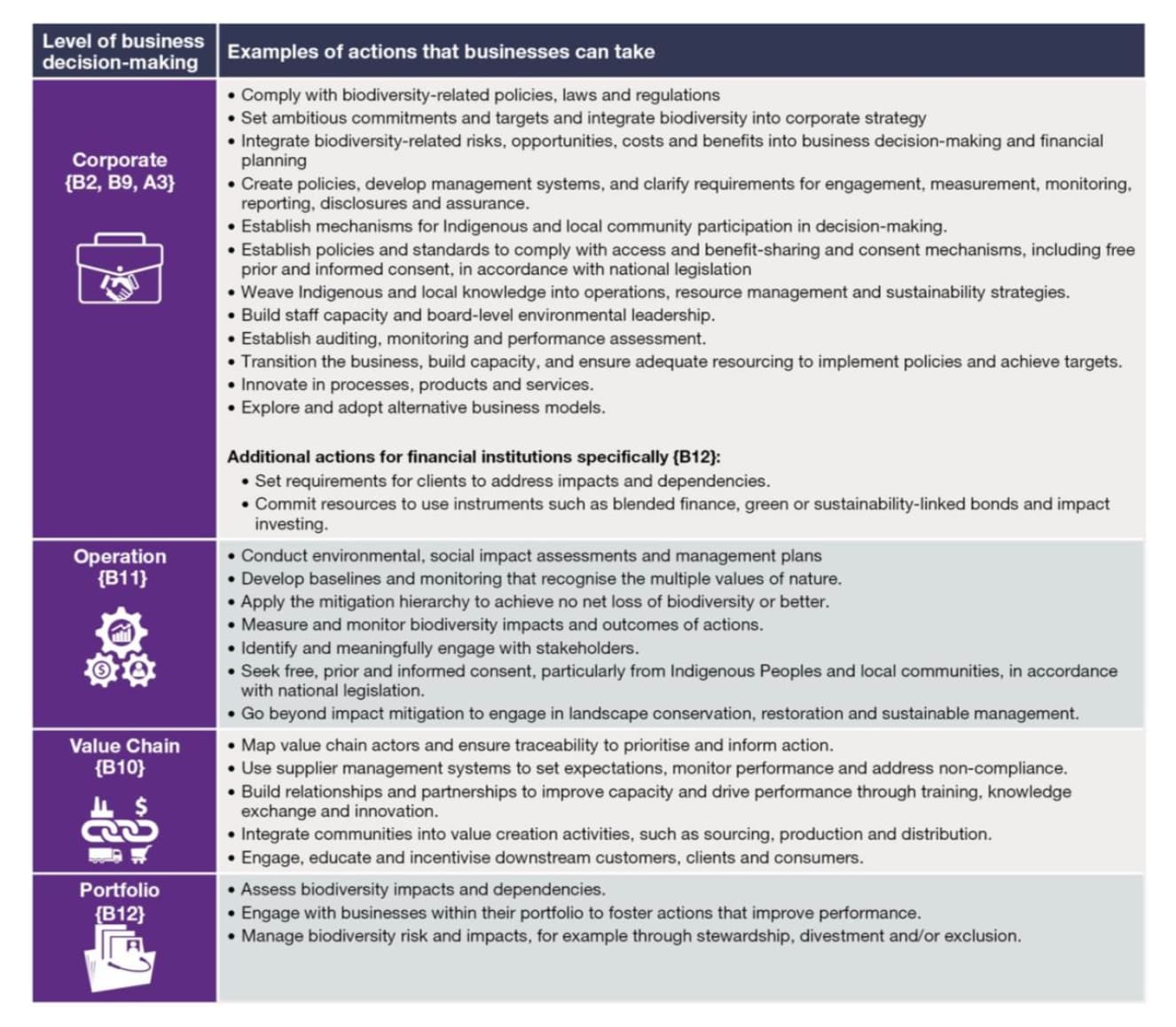 Actions that businesses can take now to address their impacts and dependencies. Credit: SPM.2, IPBES (2026).
At a corporate level, the report notes that firms can establish ambitious governance and frameworks that can then have a ripple effect across the other levels, according to the report. This includes the integration of biodiversity commitments and targets into corporate strategy.
The SPM says that corporate biodiversity targets are "most effective" when they are aligned with "national and global biodiversity objectives" and "take into consideration a business's impacts and dependencies on biodiversity and nature's contributions to people".
At an operations level, businesses should focus on ensuring that their operations are located and managed in a way that benefits biodiversity, IPBES says. Environmental and social impact assessments and management plans that are supported by "credible monitoring of both actions and biodiversity outcomes" can underpin this effort, the SPM notes.
It says it is well established that using the "mitigation hierarchy" framework can help businesses deliver "lasting outcomes on the ground". (The framework guides users towards limiting as far as possible the negative impacts on biodiversity from development projects by first avoiding, then minimising, restoring and offsetting impacts.)
Next, the report notes there are actions businesses can take to drive change within its broader spheres of influence, including suppliers, retailers, consumers and peers within industry. This is important, the SPM notes, as significant impacts and dependencies on biodiversity and nature "accrue" across the lifecycle of products or services, especially those that rely on raw materials.
The report notes there is established but incomplete evidence that efforts to "map" company value chains and improve traceability by linking products and materials to suppliers, locations and impacts can help "identify risks and prioritise actions".
While noting that "mapping" beyond direct suppliers "often remains challenging" for businesses, the report adds:
"Examples at the corporate and value chain levels exist, such as companies in the chocolate industry that have made advances in recording biodiversity dependencies to improve business decisions through full traceability of materials and improved supplier control mechanisms."
Elsewhere, the SPM notes that there is also established but incomplete evidence that consumer-focused measures - such as product labelling, education and incentives - can "shape behaviour and improve transparency". However, it cautions that the effectiveness of these strategies is "constrained by consumer scepticism, certification costs and business models reliant on unsustainable consumption".
The SPM also highlights that, at a "portfolio" level, financial institutions can shift finance away from harmful activities - for instance, companies whose products drive deforestation - and towards business activities with positive impacts for biodiversity and nature.
Speaking to Carbon Brief, Matt Jones, co-chair of the report, explains the rationale behind including options for how businesses can address biodiversity impacts in the document:
"Businesses and governments in different countries are coming at this from a very different perspective. So we can't present a set of really prescriptive 'how tos'…but we can present a huge number of options for action that businesses, governments, financial institutions and civil society and other actors can all take."
Elsewhere, the report says it is well established that "robust, transparent and credible reporting of actions and outcomes" is required to "inspire others".
4. Government policies can drive a 'just and sustainable future' for nature and peopleBoth governments and financial institutions can set policies and create incentives to protect biodiversity and stem its decline, says the SPM.
According to the report, the types of policies that governments can put in place that have an influence over business include:
- Fiscal policies, such as subsidies and taxes.
- Land use or marine spatial planning and zoning, such as designating new national parks or areas protected for nature.
- Permitting for business activities that affect nature - for example, by requiring environmental impact assessments.
- Public procurement policy (rules for how governments purchase goods and services).
- Controls on advertising and the creation of standards to prevent "greenwashing".
Governments can also promote action through paying for ecosystem services, creating environmental markets and through "multilateral benefit-sharing mechanisms", which set out rules for ensuring profits from nature are shared equally, says the SPM.
It says this includes the Cali Fund, a fund that businesses can voluntarily pay into after reaping benefits from genetic resources found in biodiverse countries.
(The fund was agreed in 2024 with expectations that it could generate up to billions of dollars for conservation, but it has so far only attracted $1,000.)
Governments could also promote action by phasing out or reforming subsidies that are harmful for nature, as well as fostering positive incentives, according to the report.
Overall, governments can work with other actors to create an "enabling environment" to "incentivise actions that are beneficial for businesses, biodiversity and society for a just and sustainable future", says the SPM. It adds:
"Creation of an enabling environment that provides incentives for the conservation and sustainable use of biodiversity and nature's contributions to people could align what is profitable with what is good for biodiversity and society.
"Creating this enabling environment would result in businesses and financial institutions being positive agents of change in transforming to a just and sustainable economic system, by addressing their impacts on biodiversity loss, climate change and pollution, which are all interconnected."

Cropped 28 January 2026: Ocean biodiversity boost; Nature and national security; Mangrove defence
Cropped
|28.01.26
Adopting low-cost 'healthy' diets could cut food emissions by one-third
Food and farming
|21.01.26
Brazil's biodiversity pledge: Six key takeaways for nature and climate change
Nature policy
|16.01.26
Cropped 14 January 2026: Wildfires scorch three continents; EU trade; Food and nature in 2026
Cropped
|14.01.26
jQuery(document).ready(function() { jQuery('.block-related-articles-slider-block_b4f006103142983c7da2fc5d1291de87 .mh').matchHeight({ byRow: false }); });The post IPBES: Four key takeaways on how nature loss threatens the global economy appeared first on Carbon Brief.
This was published on Eurekalert about an hour ago. It is a brief summary of a new study concerning arctic tourism.
The main author of the study argues that this activity is not "raising awareness" and is actually making the problem much worse. Collapse related because the number of people who took luxury arctic cruises in 2025 more than tripled from the year 2024. This year it could easily be over a million people - next year perhaps millions.
These cruises generate a shitload of waste (literally) as well as black carbon - soot that settles on ice, darkening it, accelerating melting.
The noise from these ships is very damaging to ocean ecosystems. The noise pollution interferes with migration, feeding, breeding and communication.
The article ends with a stark reminder that 60% of global ice cover will likely be gone by the end of the century.
That's 74 years from now. 74 years ago was 1952 - the year the world's first passenger jet service began. Time flies, ice melts and the world keeps on turning...
submitted by /u/Fast_Performer_3722[link] [comments]
When a customer chooses to reinvest after more than a year of successful operation, it sends a powerful signal. For european cleantech champion Syncraft, that signal now comes from long-time partner PurEnergy, which has decided to order a second climate-positive Syncraft power plant following the strong performance of their first ... [continued]
The post Syncraft Builds 2nd Climate-Positive Power Plant For PurEnergy In Austria appeared first on CleanTechnica.
VinFast is formally entering Indonesia's electric scooter market through partnerships with seven national level dealers. This is not a soft market test. It is a scale play aimed directly at a market long dominated by internal combustion engines. With its Subang manufacturing complex in West Java now operational, VinFast is ... [continued]
The post VinFast Accelerates Indonesia Green Transition With E-Scooter Launch appeared first on CleanTechnica.
The Philippine government has formally turned over operations of the Caliraya-Botocan-Kalayaan (CBK) Hydroelectric Power Plant complex in Laguna to the Aboitiz-led Thunder Consortium, completing one of the country's most consequential power sector privatizations at a time when grid flexibility is becoming just as important as sheer generation capacity. The Thunder ... [continued]
The post Philippines Hands Over Strategic Hydropower Complex to Private Consortium appeared first on CleanTechnica.
Researchers have established a clear link between lower nitrous oxide emissions and a higher concentration of zero emissions vehicles.
The post EVs Lower Nitrous Oxide Levels In California appeared first on CleanTechnica.
The local operations of Chinese automaker GAC have been consolidated under a single, factory-owned structure in the Philippines as the company expands its electric vehicle lineup. In late January of this year, GAC International Philippines confirmed that it had assumed unified control of all GAC-related brands operating in the country ... [continued]
The post GAC Takes Over Philippine Operations, Will Add 8 New Models This Year appeared first on CleanTechnica.
It's been interesting to be part of an all-inclusive tour of the Caribbean during one of the coldest weather snaps in recent memory. High winds and rough seas prevented us from visiting each originally planned destination. Since travelers were required to stay on the ship instead of touring cultural sites, ... [continued]
The post A Reminder About The Food We Eat: "Every Seed We Place In The Earth Is An Act Of Trust" appeared first on CleanTechnica.
Good things are happening in Africa, especially in the electric vehicle sector. We are starting to see significant traction in a number of countries on the African continent. In Ethiopia, a total ban on the import of fully built ICE cars has resulted in an incredible increase in the number ... [continued]
The post Electric Motorcycles Reach 15.3% Market Share Of New Registrations In Kenya In 2025 appeared first on CleanTechnica.
The ComEd branch of the powerful US utility Exelon has just doubled down on EV rebates and financial assistance for new charging stations.
The post Leading US Utility Goes Rogue, Offers New Round Of EV Funding appeared first on CleanTechnica.
If you've never towed a medium or large travel trailer, it might sound like it's an easy task. I mean, you can just hook the trailer onto the back of a capable pickup truck and drive off, right? Sadly, it's never that simple, even for a diesel truck. On top ... [continued]
The post Real-World RV Towing With The Silverado EV appeared first on CleanTechnica.
Relates to collapse because it shows how the global elites only care about protecting and benefitting each other. They normalise crime against women and girls just like they do with thier financial crimes and crimes against the planet.
submitted by /u/Still-Improvement-32[link] [comments]
The venerable BBC just reported that 10,000 new EV chargers will be installed in Kent, UK. Kent is a county in southeast England, perhaps most well known as the location of Canterbury Cathedral and the white cliffs of Dover. Charles Dickens had a home there and he took long walks ... [continued]
The post 10,000 New EV Chargers Planned For UK appeared first on CleanTechnica.
Deutschland verfügt inzwischen über einen unter Druck stehenden Abschnitt seines Wasserstoff-Backbones, der physisch fertiggestellt, aber betrieblich leer ist. Es gibt keine angeschlossenen Lieferanten, die Wasserstoff einspeisen, keine vertraglich gebundenen Abnehmer, die Wasserstoff entnehmen, und keinen glaubwürdigen kurzfristigen Pfad, der an einem dieser beiden Punkte etwas ändern würde. Dies ist keine ... [continued]
The post Von Optionalität zu Ergebnissen: Wie Deutschland Wasserstoff neu ausrichten kann, ohne das Gesicht zu verlieren appeared first on CleanTechnica.
It has rained in parts of the country every day of the year so far and downpours are expected to continue this week
In a "miserable and relentlessly wet" start to the year, rain has fallen somewhere in the UK every single day for weeks on end.
With more than 100 flood warnings in force across the country and further downpours forecast this week, scientists say the atmospheric forces behind Britain's endless drizzle are the same ones driving devastating floods across Spain and Portugal.
Continue reading...Push to restart uranium mining in Patagonia has sparked fears about the environmental impact and loss of sovereignty over key resources
On an outcrop above the Chubut River, one of the few to cut across the arid Patagonian steppe of southern Argentina, Sergio Pichiñán points across a wide swath of scrubland to colourful rock formations on a distant hillside.
"That's where they dug for uranium before, and when the miners left, they left the mountain destroyed, the houses abandoned, and nobody ever studied the water," he says, citing suspicions arising from cases of cancer and skin diseases in his community. "If they want to open this back up, we're all pretty worried around here."
Continue reading...
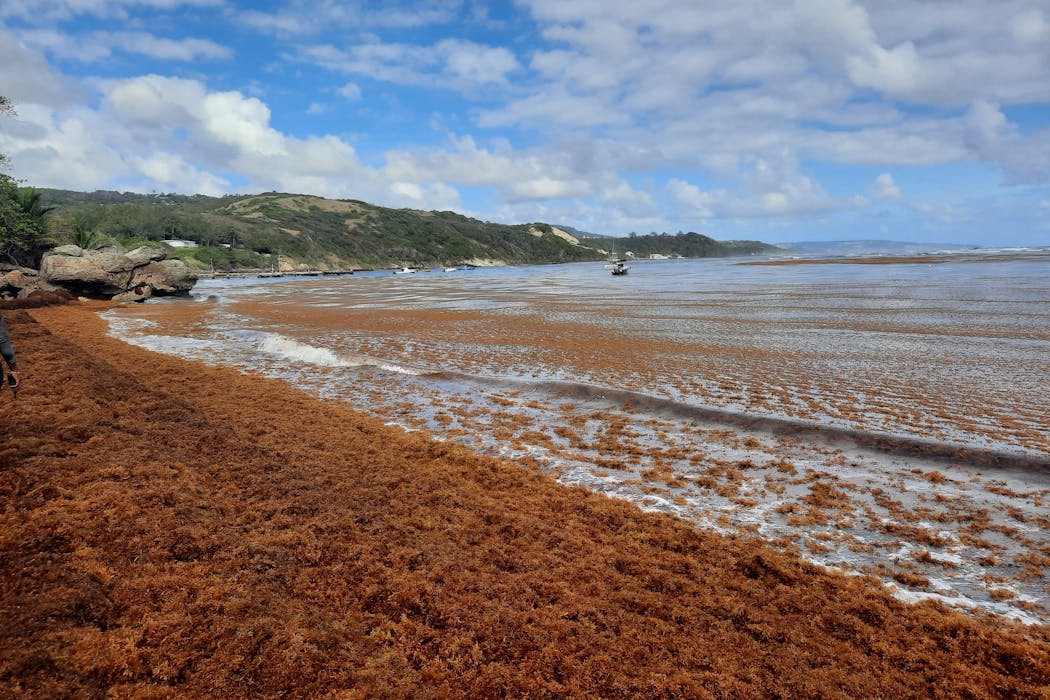 Sargassum seaweed on a beach in Barbados. Yanna Fidai, CC BY-NC-ND
Large blooms of seaweed are increasingly being reported along coastlines globally, from Europe and Asia to the tropics and beyond.
Both native and invasive (non-native) seaweeds are appearing in quantities that are hard to ignore and at unusual or surprising times of year.
As an earth observation and remote-sensing scientist, I track these blooms from space using high-resolution satellite imagery. My research shows that seaweed blooms are getting bigger.
My team's 2025 study reveals a significant rise in sargassum blooms in the north-eastern tropical Atlantic, with a staggering 2.6 million tonnes washing up in September 2020. This is the first long-term analysis of trends in seaweed blooms from 2011 to 2022 in this region.
These unpredictable tides of seaweed have serious consequences for West African coastal communities and marine ecosystems. Our research shows that warming sea surface temperatures link closely with peaks in seaweed growth. Essentially, warmer temperatures can promote seaweed growth and lead to bloom surges.
Seaweed blooms are not a new phenomenon. But over the past 15-20 years, their scale and persistence have increased noticeably.
Of particular concern are free-floating seaweeds: species that float at the ocean surface, either because they detach from the seabed or because they spend their entire lives drifting. Unlike seaweeds that are anchored to the seafloor, floating seaweed can travel long distances to new territories and accumulate in large mats or wash ashore in huge quantities.
One example I have spent much of my career studying is sargassum. Like something from a sci-fi movie, I've seen swathes of sargassum seaweed spreading across the tropical Atlantic, with mats reaching depths of 7 m and spanning hundreds of square miles.
 Sargassum fluitans collected on a beach in Mexico. The air-filled grape-like sacs help this seaweed to float on the surface of the ocean.
Yanna Fidai, CC BY-NC-ND
Sargassum fluitans collected on a beach in Mexico. The air-filled grape-like sacs help this seaweed to float on the surface of the ocean.
Yanna Fidai, CC BY-NC-ND
While most sargassum species are anchored to the seafloor, two species - Sargassum natans and Sargassum fluitans - are entirely free floating. They float freely at the surface of the ocean, kept buoyant by small air-filled grape-like sacs called pneumatocysts, which lift them up towards the surface for photosynthesis.
Our study shows that, since 2011, huge blooms of sargassum seaweed have appeared across the tropical Atlantic, piling up on coasts in the Caribbean, Gulf of Mexico and increasingly West Africa. This drifting seaweed makes fishing difficult and causes mayhem for coastal communities.
Read more: How seaweed is a powerful, yet surprising, climate solution
Seaweed plays an essential role in marine ecosystems, but excessive growth can disrupt them. Large floating mats block sunlight, limiting the growth of seagrasses and corals below. They also alter oxygen conditions in the water, and when seaweed decomposes, particularly in sheltered bays or on beaches, it can create low-oxygen environments that are harmful to marine life.
Some of the most striking consequences are seen on wildlife. In tropical regions, sargassum has accumulated on turtle nesting beaches, with recent studies suggesting that up to a quarter of nesting habitat can be affected. Hatchlings struggle to move through both sand and dense seaweed before eventually reaching the sea, exhausted. This reduces their chances of survival.
 Seaweed blooms make it more difficult for fishers in Ghana.
Yannai Fidai, CC BY-NC-ND
Across Europe
Seaweed blooms make it more difficult for fishers in Ghana.
Yannai Fidai, CC BY-NC-ND
Across Europe
Sargassum as an invasive species has actually found its way to UK waters, but sargassum blooms are not nearly as vast as in the tropical Atlantic. Blooms of other types of seaweed are becoming more noticeable in the UK and Europe. For example, ulva, a green seaweed known as sea lettuce regularly forms dense mats on the surface of the sea in places like Poole harbour, Dorset.
In small amounts, ulva is a native and largely harmless part of UK coastal ecosystems. But when it blooms excessively, it can start to cause problems. Thick mats at the surface reduce the amount of sunlight reaching seagrasses and other organisms below, while decomposition can reduce oxygen levels in the water, creating stressful conditions for fish and invertebrates and death of plants and animals as a result.
Across Europe, invasive seaweeds are becoming a growing concern. In the Mediterranean, species such as Rugulopteryx okamurae (originally from the northwest Pacific) have spread rapidly, likely introduced through shipping routes. These seaweeds can attach to the seabed, but then detach, float for long distances, and then reattach elsewhere, allowing them to spread efficiently along coastlines. In parts of Spain and Portugal, large accumulations are now washing up on beaches, with negative effects similar to those seen with sargassum in the tropics.
Even when blooms are smaller or more localised, their effects can still be disruptive. Seaweed accumulation can interfere with recreation, small-scale fishing and coastal tourism - all important parts of the UK's coastal economy.
Why is seaweed blooming?Seaweed growth is driven by a combination of triggers and favourable conditions, so there isn't a single cause.
In the case of sargassum in the tropical Atlantic, one important trigger appears to have been an anomaly in the large scale atmosphere-ocean pattern known as the North Atlantic Oscillation in 2009. This change in atmospheric pressure at sea helped redistribute seaweed from the Sargasso Sea. Once established in new regions, further seaweed growth was fuelled by access to nutrients.
Seaweed growth is limited by the availability of nutrients such as nitrogen and phosphorus. As long as those nutrients are available for them, they will grow. Nutrient-rich runoff from agriculture, rivers such as the Amazon and Congo, and sediment inputs all deliver these nutrients into the ocean - so human-caused pollution also plays a part.
Together, warming waters, nutrient enrichment and changing ocean circulation can create ideal conditions for blooms to persist and expand.
Seaweed blooms, while sometimes problematic, are fundamental to ocean ecosystems. They act as habitats to small fish and crustaceans. They absorb carbon dioxide through photosynthesis and transport it to deeper waters. They are also a valuable resource. They are used to make fertiliser and building materials, pharmaceuticals and potentially biofuels.
With effective monitoring, more accurate forecasting and better management, communities can live alongside seaweed blooms, harnessing their benefits while minimising environmental and economic consequences.
Don't have time to read about climate change as much as you'd like?
Get a weekly roundup in your inbox instead. Every Wednesday, The Conversation's environment editor writes Imagine, a short email that goes a little deeper into just one climate issue. Join the 47,000+ readers who've subscribed so far.

My previous research on sargassum has been supported by the Economic and Social Research Council GCRF (Grant number: ES/T002964/1), and the UK Natural Environment Research Council (grant number NE/W004798/1), a scholarship from Southampton Marine and Maritime Institute, University of Southampton, and the School of Geography and Environmental Sciences, University of Southampton.
All comments in this thread MUST be greater than 150 characters.
You MUST include Location: Region when sharing observations.Example - Location: New Zealand
This ONLY applies to top-level comments, not replies to comments. You're welcome to make regionless or general observations, but you still must include 'Location: Region' for your comment to be approved. This thread is also [in-depth], meaning all top-level comments must be at least 150-characters.
Users are asked to refrain from making more than one top-level comment a week. Additional top-level comments are subject to removal.
All previous observations threads and other stickies are viewable here.
submitted by /u/AutoModerator[link] [comments]
Corteva will discontinue a mixture of Agent Orange and glyphosate, but another of its herbicides will still use Vietnam war-era defoliant
The chemical giant Corteva will stop producing Enlist Duo, a herbicide considered to be among the most dangerous still used in the US by environmentalists because it contains a mix of Agent Orange and glyphosate, which have both been linked to cancer and widespread ecological damage.
The US military deployed Agent Orange, a chemical weapon, to destroy vegetation during the Vietnam war, causing serious health problems among soldiers and Vietnamese residents.
Continue reading...Storm Marta sweeps Iberian peninsula just days after Storms Kristin and Leonardo brought deadly flooding and major damage
Spain and Portugal have endured another storm over the weekend, just days after the deadly flooding and major damage caused by Storm Kristin and Storm Leonardo last week. Storm Marta passed over the Iberian peninsula on Saturday, bringing fresh torrential rain and killing two people. Storm Kristin killed at least five people after it made landfall on 28 January with Storm Leonardo claiming another victim last Wednesday.
The outlook for this week is for more rain across Spain, Portugal and France, especially across north-west Portugal, where more than 100mm is possible during the first half of the week. Some of the heaviest of the rain will transfer to southern Italy and western parts of Greece and Turkey later in the week.
Continue reading...
Huge thanks to my February sponsor, John Rember, author of the three-book series Journal of the Plague Years, a psychic survival guide for humanity's looming date with destiny, shaped by his experiences living through the pandemic in his native Idaho. Thoughtful, wry and humane, Journal 1 is a pleasure.
 "Economic nationalism giving rise to a zero-sum world…
"…new walls are rising, not of concrete, but of tariffs, subsidies and export bans. The grand narrative of seamless globalization now sounds increasingly like a relic from a bygone era… economic nationalism has gone global, spreading across ideologies and regions alike."
https://asiatimes.com/2026/02/economic-nationalism-giving-rise-to-a-zero-sum-world/
 "Public debt: A ticking time bomb about to explode?
"Countries have sharply increased the money they owe to the markets, putting their own spending policies at risk in an increasingly unstable world."
 "Elon Musk warns the U.S. is '1,000% going to go bankrupt' unless AI and robotics save the economy from crushing debt…
"Interest payments alone on the $38.5 trillion debt pile are about $1 trillion a year, exceeding the U.S. military budget, Musk pointed out."
 "£99,987 and counting: graduates trapped by ballooning student loans [UK].
"Growing anger over the plight of millions of graduates saddled with ballooning student loan debts is threatening to develop into a fresh crisis for the government…"
https://www.theguardian.com/money/2026/feb/06/graduates-student-loans-finances
 "Italian police use tear gas and water cannons on protesters near Olympic Village.
"The larger demonstration, organised by unions and community activists, saw around 10,000 people take to the streets of Milan in protest of the
environmental and social impact of the games."
https://www.lbc.co.uk/article/italy-protests-winter-olympics-5HjdRz7_2/
 "Ukraine-Russia war latest: Suspect detained in Putin general shooting while Zelensky reveals Trump's peace deadline.
"…the US is aiming to get a peace deal between Ukraine and Russia over the line in March despite a lack of progress on territorial concessions, according to reports."
 "China's future growth rate could drop to 2.5% without market reforms: economist.
"China will struggle to keep growth above 4 per cent unless there is a 'strong turnaround' in productivity and consumer spending, economist warns."
 "Japan's dangerous game with China.
"Japan's postwar constitution renounces war 'forever'. But with fears that US actions in Venezuela could embolden China to seize Taiwan, Sanae Takaichi could be tempted into a risky game."
https://mondediplo.com/2026/02/07japan
 "Japan Goes to the Polls on Sunday With an Economy at Tipping Point…
"Long-suppressed forces are re-emerging all at once: inflation, rising interest rates, shortages, and fiscal strain. Japan now faces choices it has postponed for decades, and the cost of delay is rising."
 "Thailand on high alert as security chiefs warn of renewed border conflict.
"Thai security officials have issued a stark warning regarding a "concerning" escalation of military activity along the Cambodian border, with intelligence suggesting that Phnom Penh is preparing a fresh wave of strikes."
https://www.nationthailand.com/news/asean/40062258
 "Outcry in Bangladesh over politician's call to curb women in workforce.
"The proposal has sparked concerns that it would damage the country's vital garment sector, which is dominated by female workers."
 "Is Pakistan's Job Crunch Pushing it Towards Unrest?
"Pakistan's worsening unemployment crisis is pushing the country toward a dangerous crossroads, with experts warning that rising joblessness could fuel both internal unrest and a steady exodus of skilled workers."
https://english.mathrubhumi.com/amp/news/world/pakistan-job-crisis-unrest-migration-vak3ti0g
 "Balochistan strikes test Pakistan's bid to market minerals globally.
"Recent coordinated attacks by separatists in Pakistan's southwestern Balochistan province, and the military's operations in response, have killed more than 250 people, underscoring renewed security risks just as the country prepares to pitch its mineral wealth to global investors."
 "Iran warns will not give up enrichment despite US war threat.
"Iran will never surrender the right to enrich uranium, even if war "is imposed on us," its foreign minister said Sunday, defying pressure from Washington."
 "Thousands of Iraqis volunteer to defend Iran against US attack…
"According to a statement, almost 5,000 people in Iraq's Diyala province gathered to declare their intent to defend both Iraq and its eastern neighbour, as well as Iran-backed armed groups, "without any compensation"."
https://www.middleeasteye.net/news/thousands-iraqis-volunteer-defend-iran-against-us-attack
 "Yemen's crumbling health system leaves patients without treatment options.
"In northern Yemen, thousands of patients endure prolonged agony or die prematurely amid a crippled health sector and the absence of commercial flights."
 "It feels like humanity has died in Sudan…
"The UN estimates that more than half the women and girls arriving from Sudan are victims of sexual violence, many too ashamed to speak. "This is sexual violence on an industrial scale," says Yvette Cooper, the UK foreign secretary, who visited Adré last week…"
https://www.thetimes.com/world/africa/article/sudan-civil-war-yvette-cooper-2pnkchv0l
 "An estimated 4.5 million girls worldwide are at risk of undergoing female genital mutilation this year, the United Nations warned on Friday…
"It is practiced in some parts of Africa, the Middle East and Asia on religious or traditional grounds. Children under the age of five are sometimes victims…"
 "2026 brings no respite to children living in violence and conflict in the Middle East and North Africa…
""Violence, including grave violations against children, such as killing and maiming, are unacceptable. Children must always be protected, yet the first month of 2026 across the Middle East and North Africa has already been marked by the devastating loss of young lives."
 "Outgunned and overrun: Nigeria struggles to contain surge in militant violence.. .
"The senseless violence marked another gruesome chapter in a deteriorating security crisis that has left vast tracts of Nigeria beyond the reach of its exhausted soldiers at a time when President Bola Tinubu's government is under intense pressure from Washington."
https://www.ft.com/content/7ab6ff74-b03c-4512-8f0d-19f3c2923b13
 "Dakar universities rocked by renewed clashes between students and police. [Senegal]
"Students have been protesting a lack of financial aid from the government, leading to clashes with police. On Friday, the situation there deteriorated again. Other institutions also saw protests."
 "US President Donald Trump's efforts to shut off fuel shipments to Cuba are starting to cut into parts of its crucial tourism industry.
"At least two large beach resorts on Cayo Coco, on the northern coast of the Caribbean nation, will be closing as soon as this weekend due to gasoline shortages, employees reported Friday."
 "'Panic Mode'—$10,000 Bitcoin Price Crash Warning Suddenly Triggers Huge BlackRock Earthquake…
"Now, in the aftermath of Binance's founder suddenly flipping, bitcoin and crypto traders are reeling from a $10 billion BlackRock exchange-traded fund (ETF) shock."
 "If you're not terrified by AI, you're not paying attention…
"Amodei conjures up the prospect of advanced AI being used to propagandise populations, direct swarms of armed drones or monitor every piece of communication and conversation for disloyalty to the regime."
https://www.thetimes.com/comment/columnists/article/ai-uk-technology-ll28d70n8
I rely on donations and tips from my readers to keep the site running. Every little bit helps. Can you chip in even a dollar? Buy me a coffee or become a Patreon supporter. A huge thank you to those who do subscribe or donate.
You can read the previous "Economic" thread here. I'll be back tomorrow with a "Climate" thread.
The post 9th February 2026 Today's Round-Up of Economic News appeared first on Climate and Economy.
Rising GDP continues to mean more carbon emissions and wider damage to the planet. Can the two be decoupled?
During Cop30 negotiations in Brazil last year, delegates heard a familiar argument: rising emissions are unavoidable for countries pursuing growth.
Since the first Cop in the 1990s, developing nations have had looser reduction targets to reflect the economic gap between them and richer countries, which emitted millions of tonnes of CO2 as they pulled ahead. The concession comes from the idea that an inevitable cost of prosperity is environmental harm.
Continue reading...Cullernose Point, Northumberland: These cliffs are always thrilling, but today is a riot of sound and damp air as we take the coastal path
The sea is still raging after yesterday's storm, waves the highest that I've seen here, more ocean than North Sea. The grey-green water, full of churned up sand, is frothing and erupting against dark rocks, bursting with the force of geysers as it collides with the land.
Here at Cullernose Point, the dolerite cliffs of the Whin Sill thrust a giant wedge as they taper into the sea. It's dramatic at all times, but today is especially thrilling, the sound all enveloping, the wind cutting, the air damp with spume.
Continue reading...

Late afternoon: witching hour of the soul.
Old men at the bar, their voices gravel.
They speak the names the lake has swallowed whole,
The wives who walked, the threads they couldn't unravel.
The waitresses arrive. The evening shift.
One stops where windows face the frozen deep.
She watches the world turn white, dissolve, and drift,
Then turns to serve the ones not yet asleep.
The lake holds still—a cold that won't expire.
The white has eaten distance, depth, and shore.
Still diners come and whisper their desire:
"A window seat." They can't say what it's for.
What do they think they'll see beyond the pane?
A mirror, or a door they hope to find?
Perhaps they come for what they can't explain—
What has no name, long buried in the mind.
Now voices fill the room like something warm,
With wine poured out, the ritual of plates.
A thin domestic hedge against the storm—
The way we talk while something silent waits.
The waitresses glide swift from chair to chair,
Their hands like birds, their motions deft and sure.
Thought is a luxury they cannot spare.
The body knows its work, its only cure.
They never look. The orders keep arriving.
The bread runs low. The glasses must be filled.
And yet they serve through all their quick surviving,
A silence underneath that won't be stilled.
For when they pour the water, clear and cold,
Into each glass beside each waiting face,
Unknowing priests, they serve the unconsoled—
They serve the lake, and give the drowned their place.
The lake asks nothing. It does not require
Our witness, or our grief, or our way back.
It holds the cold, the depth, the dark entire,
And waits beneath, immense, unbroken, black.
The check arrives. We've eaten what we owe.
We leave our tips like debts paid to the drowned.
The lake is in our blood, its undertow—
Cold current calling us to hallowed ground.
The waitress waves. The door swings shut. We go.
The lake is where it was. The lake remains.
We start our cars. We leave the drowned below.
Or think we do. The drowned course through our veins.
 both underestimation and overestimation of world population carry a significant risk of underestimating the dangers of overpopulation. [ 09-Feb-26 6:58am ]
https://www.popularmechanics.com/science/environment/a70202293/human-population-miscalculated-study/
A news recently appeared suggesting that the world population may have been underestimated.
First, underestimation carries the risk of failing to accurately capture the true extent of the population explosion, leading to delays in preparation.
In the case of overestimation, even though the population is large, it may be less crowded than expected, and the harmful effects of overpopulation may be less noticeable, creating the illusion that even a large population is acceptable.
There is no evidence yet that the world's population is overestimated, but it exists locally and is well-founded.
Therefore, both are harmful.
That's why we need to be wary of blindly trusting statistics and examine them with a critical eye.
submitted by /u/madrid987[link] [comments]
'To live a normal life again, it's a dream come true': UK's first climate evacuees can cast off their homes and trauma [ 09-Feb-26 6:00am ]Forty-odd residents of Clydach Terrace in Ynysybwl, south Wales, relieved by council buyout after years in fear of fast flooding
When Storm Dennis hit the UK in 2020, a wall of dirty, frigid water from a tributary of the Taff threw Paul Thomas against the front of his house in the south Wales village of Ynysybwl. He managed to swim back into his home before the storm surge changed direction, almost carrying him out of the smashed-in front door.
"I was holding on to downpipes to stop myself being dragged out again. It was unbelievably strong, the water," he said.
Continue reading...
Canada Pension Plan is Bankrolling Trump's Fossil Fuel and AI Agenda [ 06-Feb-26 4:38pm ]The Canada Pension Plan Investment Board (CPPIB) is financing — and profiting from — U.S. President Donald Trump's fossil fuel and AI development agenda, DeSmog has learned.
The CPPIB has invested billions in fossil fuel expansion in the U.S. since Trump's return to office. It has partnered with private equity firms to acquire American oil and gas producers, and financed AI companies like Elon Musk's xAI.
The CCPIB is an independent investment management organization responsible for managing the Canada Pension Plan (CPP), Canada's largest public pension. It was created by an Act of Parliament in 1997, and is accountable to Canada's Parliament. The CPPIB's primary responsibility is to ensure the CPP maximizes its long term revenues with minimal risk.
The CPPIB has a policy on sustainable investing, updated in May 2025, that recognizes climate change as a serious risk, and which encourages adapting its investment strategy to evolving decarbonization pathways and investing "for a whole economy transition required by climate change." However, the same policy indicates the CPPIB's belief "that accelerating the global energy transition requires a sophisticated, long-term approach rather than blanket divestment."
In response to Canadian Prime Minister Mark Carney's pledges to fast-track major infrastructure projects, CPPIB CEO John Graham stated in September 2025 that the CPPIB was keen to invest in major projects, particularly in the energy sector. As reported by the Financial Post, Graham singled out fossil fuel pipelines, saying "Here in Canada, we like pipelines. We like oil and gas pipelines."
Its recent investments in the U.S. fossil fuel and AI sectors are a growing concern to pension fund watchdogs, which argue that at a time when the US is actively waging a trade war against Canada and destabilizing the climate, the CPPIB is providing capital to allow it to happen.
"As the U.S. government wages economic warfare against Canadian industry, upends the international rules-based order, and threatens to annex Canada, CPPIB appears content to continue gambling the Canada Pension Plan on risky U.S.-based companies," said Patrick DeRochie, Senior Manager with Shift Action, a charitable organization dedicated to protecting pensions and the environment from investments in the fossil fuel sector, in a statement to DeSmog.
"With so many Canadians boycotting U.S. products and companies while coping with the economic shocks triggered by our volatile neighbor to the south, I think many Canadians would be shocked to learn where CPPIB has invested some of their hard-earned retirement savings during this time of turbulence and uncertainty," said DeRochie.
CPPIB didn't respond to a request for comment.
Subscribe to our newsletterStay up to date with DeSmog news and alerts
Email Address What content do you want to subscribe to? (check all that apply) All International UK Sign Up (function($){ $('.newsletter-container .ijkidr-us').click(function() { $('.js-cm-form').attr('data-id', '2BE4EF332AA2E32596E38B640E905619D07B21962C5AFE16D3A2145673C82A3CEE9D9F1ADDABE965ACB3CE39939D42AC9012C6272FD52BFCA0790F0FB77C6442'); $('.js-cm-email-input').attr('name', 'cm-vdrirr-vdrirr'); }); $('.newsletter-container .ijkidr-uk').click(function() { $('.js-cm-form').attr('data-id', '2BE4EF332AA2E32596E38B640E905619BD43AA6813AF1B0FFE26D8282EC254E3ED0237BA72BEFBE922037EE4F1B325C6DA4918F8E044E022C7D333A43FD72429'); $('.js-cm-email-input').attr('name', 'cm-ijkidr-ijkidr'); }); })(jQuery); CPPIB's Failing Climate GradeThe CPPIB operates at an arm's length from the Canadian government and is accountable to it, but operates under the guidance of an independent Board of Directors. It manages assets totaling C$777.5 billion, from 22 million contributors to the CPP. The CPPIB has recently invested in or entered into joint ventures with firms involved in sectors as diverse as American outpatient medical facilities, the Japanese hospitality sector, and the AI sector.
The CPPIB received its worst grade to date in Shift Action's latest climate report card, dropping to a D grade overall and coming in second to last in the non-profit group's annual ranking of Canadian pension funds' climate policies. The CPPIB's performance fell in four out of six categories, earning failing grades when it came to meeting Paris Agreement aligned targets, intermediate targets, and for not excluding fossil fuels.
Part of the rationale for that low grade is that the CPPIB has major investments in American fossil fuel companies, AI companies, and fossil fuel companies seeking to power America's AI expansion.
The CPPIB invested US$300 million last year in xAI, specifically to construct a gas-powered AI data centre in a low-income Black neighborhood in Memphis, Tennessee. The xAI facilities in Memphis have been cited as examples of environmental racism by advocacy groups and have been recorded emitting massive quantities of pollution. Most recently, xAI was in the news because its AI chatbot product Grok was flooding the Internet with pornographic and sexualized images of women and children. In response to the Toronto Star's questions about why the CPPIB was investing in xAI, a spokesperson said the CPPIB wasn't endorsing how Grok was being used.
The CPPIB recently spent $1.2 billion to acquire a roughly 25 percent stake in Tallgrass Energy, a pipeline company invited to the White House to participate in discussions about the exploitation of Venezuela's oil industry.
Tallgrass Energy has 16,000 kilometre's worth of pipelines and terminals across 14 states. A managing director of the CPPIB's 'sustainable energies' group sits on Tallgrass' board.
Tallgrass is also focused on developing fossil fuel infrastructure to capitalize on the AI boom. The company has proposed a new pipeline from the Permian Basin to support new data centres and gas plants across the United States. The company has also partnered with the AI infrastructure company Crusoe to build an AI-focused data centre that would be powered primarily by natural gas and "future renewable resources."
"It appears that CPPIB is betting that the expansion of AI infrastructure will drive an increase in demand for fossil gas, and is planning to finance and profit from gas-fired data centres," said DeRochie.
During a November 2024 meeting, CPPIB CEO John Graham described how "the demand for energy globally is not declining" and AI is "further driving the demand for energy." Graham further stated that the CPPIB needs to "continue to support the oil and gas industry" because the "industry has a long track record of delivering energy into the economy in a very safe and economical way."
The CPPIB has committed hundreds of millions to VoltaGrid, a Houston-based company that specializes in modular natural gas systems for data centres and fossil fuel operations. The company regularly misidentifies natural gas as a "low-emission" solution for the AI and data centre sectors, yet is part of CPPIB's "Sustainable Energies" portfolio. Moreover, a CPPIB managing director sits on VoltaGrid's board.
The company's CEO, Nathan Ough,is a Republican donor who has eagerly embraced Donald Trump's "drill, baby, drill" agenda. VoltaGrid isn't merely supportive of Trump's focus on gas-powered data centre expansion, but also collaborates with companies owned by major Trump donors, including Oracle and Energy Transfer. The company is also involved in a controversial project to build a gas plant to power a data centre in Saint John, New Brunswick. Responding to this criticism, Ough responded that VoltaGrid is 51 percent Canadian-owned and that its finances are "banked in large part out of Canada."
Shift Action further notes that the CPPIB in general is overweighted with American investments: approximately 47 percent of its portfolio is invested in the U.S., a percentage that far exceeds their share of the global economy.
Several fossil fuel companies owned by the CPPIB sit on the U.S. Department of Energy's National Petroleum Council (NPC). These include The Williams Companies, AlphaGen, and California Resources Corp. Though not backed by the CPPIB, two other Canadian fossil fuel companies — Enbridge and TC Energy — also sit on the NPC. These companies are involved in oil and gas production, transporting fracked gas, and operate fossil fuel power plants in six states.
According to Shift Action, the CPPIB reported that it invested US$807 million in fossil fuel expansion in the U.S. in the final quarter of 2024. This includes a US$300 million investment in Salamanca Infrastructure LLC, which owns midstream energy assets in the United States, more than US$200 million to fund pipeline assets that transport fossil gas in Pennsylvania, Ohio, and West Virginia, and three co-investments with Quantum Capital Group, a Houston-based private equity firm focused on the energy sector.
These investments included stakes ranging from 10 to 29 percent in three different firms involved in fossil fuel exploration. The CPPIB's commitment to Quantum Capital Group / Quantum Energy Partners has been steadily growing since its first investment of US$200 million in 2008, followed by another US$300 million in 2014. In 2024, it committed US$500 million to Quantum despite the fact that the company stated the investment would be used to support the US' conventional energy industry.
"For a national pension manager meant to ensure the long-term retirement security of 22 million Canadians, CPPIB sure has a strange way of investing in our best interests and avoiding undue risks of loss," said DeRochie. "You would think that the risks of American aggression, catastrophic climate change, and Trump-aligned tech oligarchs would give the CPPIB pause before making these investment decisions."
The post Canada Pension Plan is Bankrolling Trump's Fossil Fuel and AI Agenda appeared first on DeSmog.
MAGA Gathers in European Parliament to Attack EU Laws [ 06-Feb-26 4:30pm ]BRUSSELS - Groups aligned with Donald Trump's administration rallied against "online censorship" and "extreme environmentalism" as they took to the stage at an event held in the heart of the European Parliament earlier this week.
The meeting in Brussels comes amid reports that the U.S. State Department is poised to fund MAGA-aligned think tanks and charities across Europe to further Trump's agenda overseas.
At the one-day conference run by the Political Network for Values (PNfV) on 4 February, speakers from the Heritage Foundation, the Alliance Defending Freedom (ADF), Family Watch International, and other U.S. conservative Christian groups defended what they described as "basic truths […] such as love of God, country and family."
The event was co-organised by the far-right Patriots for Europe (PfE) and right-wing European Conservatives and Reformists (ECR), which have used their growing influence in the EU Parliament to undermine climate policies.
Trump-aligned groups spoke in defence of the absolute right to free speech, and against EU regulations designed to regulate hate speech online.
They were referring to the Digital Services Act (DSA), the flagship legislative package designed to hold big tech platforms to account for the harms they produce, including online hate and climate change disinformation.
The event has prompted concerns from Members of European Parliament (MEPs) that the Trump administration is realising its aim to cultivate "resistance to Europe's current trajectory within European nations" as set out in a White House National Security Strategy document published last year.
"Fostering far-right movements to destabilise the continent is no longer just a line in a White House strategy document. It is a political reality," said Daniel Freund, a German MEP for The Greens.
"This week, the enemies of Europe, the adversaries of freedom, gathered in the European Parliament. These individuals call themselves patriots, yet they are nothing more than Trump's foot soldiers. The event made one thing clear: Trump's MAGA movement has established a political foothold in Europe. The answer must be a stronger, more independent Europe."
Subscribe to our newsletterStay up to date with DeSmog news and alerts
Email Address What content do you want to subscribe to? (check all that apply) All International UK Sign Up (function($){ $('.newsletter-container .ijkidr-us').click(function() { $('.js-cm-form').attr('data-id', '2BE4EF332AA2E32596E38B640E905619D07B21962C5AFE16D3A2145673C82A3CEE9D9F1ADDABE965ACB3CE39939D42AC9012C6272FD52BFCA0790F0FB77C6442'); $('.js-cm-email-input').attr('name', 'cm-vdrirr-vdrirr'); }); $('.newsletter-container .ijkidr-uk').click(function() { $('.js-cm-form').attr('data-id', '2BE4EF332AA2E32596E38B640E905619BD43AA6813AF1B0FFE26D8282EC254E3ED0237BA72BEFBE922037EE4F1B325C6DA4918F8E044E022C7D333A43FD72429'); $('.js-cm-email-input').attr('name', 'cm-ijkidr-ijkidr'); }); })(jQuery); 'Backbone of the Trump Regime'On Thursday, the Financial Times revealed that the Trump administration plans to fund MAGA-aligned think tanks and charities across Europe in an effort to spread "American values".
The Heritage Foundation, one of the most prominent MAGA think tanks, is credited with producing the authoritarian playbook known as Project 2025, the intellectual blueprint for Trump's second term. That effort has helped to set the U.S. government on a path to "energy dominance", which in practice means abandoning climate targets in favour of massively expanded fossil fuel extraction.
The MAGA groups at the PNfV event have a long record of attacking and attempting to undo progressive social gains on issues including gender, religion, and LGBTQ+ rights. Alliance Defending Freedom (ADF) in particular was instrumental in the 2022 overturning of the constitutional right to an abortion that was guaranteed under Roe v. Wade.
An early version of the event's programme showed both ADF and Heritage as sponsors of the event, along with the Foundation for a Civic Hungary, the official party think tank of Fidesz, the ultraconservative party of Viktor Orbán's Hungary. This version was quietly removed from the PNfV's website to show no sponsors, although speakers from these organisations remained on the updated programme.
The groups at the event identified removing regulation on X and other digital platforms sympathetic to right-wing views as a top priority.
One speaker from the European branch of the ADF, Adina Portaru, labelled the EU's DSA "one of the most dangerous threats to freedom of expression online in the Western world today".
The criticism of Europe's attempt to regulate hate speech online echoes comments made by JD Vance in his address to the Munich Security Conference in February 2025. He argued Europe's biggest threat was the "threat from within", partly caused by "digital censorship". This, he argued, posed a bigger threat than Russia, at a time when Europe faces the escalating threat of Russian hybrid warfare on its eastern flank.
The ADF has itself made inroads into Europe, and has been quietly working with Nigel Farage's Reform UK. Farage had rarely, if ever, mentioned abortion in his 31-year political career until May last year, when he called the UK's 24-week abortion limit "absolutely ridiculous".
"The timing is shocking. While the rest of Europe is re-considering its links with the U.S. after the Greenland affair, here we have quite a few European far-right parties rubbing shoulders with the core of Trump's hinterland," said Kenneth Haar, researcher and campaigner at Corporate Europe Observatory, an advocacy group pushing for greater accountability in European institutions.
"The Heritage Foundation is not just a think tank. It is part of the backbone of the Trump regime."
'Revolution of Common Sense'The PNfV event was the seventh "Transatlantic Summit" organised by the groups, a coalition of Christian conservative groups that brings together senior government officials, legislators, and well-connected civil society groups to fight progressive social gains. The group has active members in Europe, North and Latin America, and Africa.
In a programme handed out at the summit, the group's president, Stephen Bartulica, a Croatian MEP, said the group "must promote what some have called a revolution of common sense."
The PNfV counts the President-elect of Chile, Jose Antonio Kast, among its list of former presidents. The Republican chair of the Iowa State Senate, Amy Sinclair, and members of Polish and Hungarian parliaments sit on its board.
Kast, who delivered the single keynote speech of the day, spoke about defending "fundamental beliefs", from "isms" such as "extreme environmentalism," which allegedly "prioritises the environment over people". He was introduced as having nine children - the second speaker to be introduced in this way.
Alongside calls to "defend the values of God, country and family," speakers at the summit railed against a "far-reaching online censorship regime". This, they claimed, was established by efforts to regulate hate speech online, which they said infringes on the "innate natural right of all human beings to free speech," a "natural right that comes before the state". Censorship was mentioned on average once every six and half minutes during the nine-hour conference, according to DeSmog's analysis.
Jay Richards, vice president of social and domestic policy at the Heritage Foundation, denounced the "white martyrdom" imposed on U.S. Americans who are, he claimed, "having his or her free speech violated". Richards also cited the removal of Donald Trump's former Twitter account for spreading the lie that the 2020 election was "stolen" by 46th U.S. President Joe Biden as an example of "white martyrdom".
The second Trump administration has banned the use of terms like "diversity, equity and inclusion", "climate change", "vaccines", and "disability" from departmental websites across the U.S. government, while arresting and detaining people for actions including writing op-eds for a student newspaper.
"This conference confirms that there is a campaign underway against any kind of content moderation," Kenneth Haar said.
"It is waged by ultraconservative groups, some of which belong to the MAGA-coalition. We are seeing a camp against European regulation emerge, with religious groups, people from Trump's inner circle, and Big Tech emerge."
'Totalitarian Act'Attacks on the DSA were repeated throughout the day.
The DSA is a "totalitarian act" that "must be abolished" said Slovenian MEP Branko Grims, who closed his speech with "God bless Europe, and God bless Western civilization".
Grims also called for the EU to revoke the €120 million fine it levied against Elon Musk's X platform in December for breaching transparency obligations under the DSA.
Despite pleas from speakers that the attacks on LGBTQ+ rights were an attempt to "protect our kids," none of the speakers mentioned the recent scandal enveloping X - that the platform's built-in chatbot, Grok, has been digitally undressing people, including women and children, on command.
While primarily focussed on free speech and reinstating "Christian values", speakers also used their platform to attack climate targets in Europe, with one arguing that voters "demand realism and affordability in climate policy, but the Green Deal remains untouchable dogma".
Tom Vanderdreissche, MEP from Vlaams Belang, the Belgian party pushing for independence for the Dutch-speaking Flanders, asked in his address: "Is there anyone who believes that the Green Deal will save the world when Europe only produces around 6 percent of global CO2 emissions?"
This is a typical 'Whataboutism' argument made by those seeking to delay climate action, which tries to redirect responsibility for tackling climate change to other actors.
 Nigel Farage and Donald Trump in 2016.
Credit: Associated Press
Other speakers from across the world bemoaned their frustration at being labelled "homophobic," "transphobic," "fascists," and "extreme" for their opposition to LGBTQ+ rights.
Ugandan MP Lucy Akello received widespread applause following her speech, where she identified as the victim of a hunt against those who seek to "protect family values".
Akello is one of the MPs who called for Uganda's Anti-Homosexuality Act to be reinstated in 2023 after it was overruled by the courts. The act prescribes life imprisonment for homosexual sex and the death penalty for "aggravated homosexuality".
Akello argued her actions were about "protecting our kids who were being coerced, who were forced into homosexuality activities".
"Looking at the speakers and the organisations in this mix, tells me that when they say free speech, what they really mean is free hate speech," Kenneth Haar added.
Later in the same panel, Guatemalan MP Ronald Portillo added that "people have a right to feel what they feel, even if it's hatred," in his defence of "fundamental rights".
Many of the speakers also complained of how Christianity had become marginalised in the West. The words "God" and "Christ" were mentioned 76 times throughout the day.
One address from British Catholic Priest, Father Benedict Kiely, included a call to "declare war on dumptyism," a reference to the children's tale of Humpty Dumpty, which he used to make a point about rediscovering the meaning of words. He also warned that "I'll probably be arrested when I go home" for his address.
At the time of publication, he had not been.
The post MAGA Gathers in European Parliament to Attack EU Laws appeared first on DeSmog.
Q&A: Tech Billionaires' AI Space Empire Fantasies Are 'An Insidious Form of Climate Denial' [ 04-Feb-26 4:26pm ]In the wildest dreams of tech billionaires, humans colonize the solar system on giant space stations, dodge mortality by uploading their brains into computers, and solve climate change in a single swoop of god-like AI-generated genius.
It's a hubris that has led Big Tech companies, which until recently were seen as corporate climate leaders with ambitious clean energy goals, to run full-tilt towards oil and gas — powering the rapid expansion of their monstrously energy-hungry AI data centers with natural gas, and holding court with Trump energy officials who deny climate science while championing American fossil fuel "energy dominance."
To all of this, Adam Becker, an astrophysicist and science journalist, basically says - Um. No.
Becker's book, More Everything Forever: AI Overlords, Space Empires, and Silicon Valley's Crusade to Control the Fate of Humanity, exposes how tech billionaires' sci-fi inspired fantasies about ever-more technology making everything, endlessly, better are basically, well — terrible. These billionaires' promises, in Becker's careful accounting, veer from what he says is "wildly implausible" to "profoundly immoral" - and ultimately paves the way for a descent into oligarchy.
They're also, in Becker's view, emerging as the root of a new, Silicon Valley-styled "insidious form of climate denial" - replete with its own set of what he calls greenwashing tactics.
DeSmog reporter Rei Takver spoke with Becker about what he thinks drives this new kind of climate denialism, and its consequences.
This interview has been condensed and edited for concision and clarity.
Rei Takver: You've said that writing More Everything Forever started after uncovering that evangelical Christian tech billionaire and Palantir founder Peter Thiel was funding a science magazine, Inference: International Review of Science, that was publishing not only creationism, but full-on climate science contrarianism. Why did Thiel's climate denial take you over the edge?
Adam Becker: People take Silicon Valley's ideas about science and technology very seriously, as though the leaders of the tech industry actually know anything about science or tech. It's an understandable mistake to make, but it's a mistake. When I started thinking about what I already knew about that, I realized that there was this through-line in Silicon Valley of climate denial of a kind, usually not the outright climate denial that you find in that Thiel-funded magazine, but a more insidious form of climate denial that minimizes climate change as a problem and says, "Oh, this is something that we can solve later, once we've built an [artificial intelligence] god, or gone to space."
Rei Takver: When I see the phrase "more everything forever," it conjures visions of endless power — more oil, more gas, more nuclear, forever. You've written about how many of these tech billionaires, such as OpenAI CEO Sam Altman, love dreaming about tapping into endless sources of infinite energy — often alongside the Trump administration. Why do you think Altman, and a wide selection of other tech leaders are aligning with the Trump administration's aggressively fossil-fuel dominant AI energy policy?
Adam Becker: Let me answer your question with a segue. Nuclear fusion is one of these false promises of the tech industry, right? There's a company, Helion, saying that they're going to get a nuclear fusion power plant online at commercially competitive rates by 2028. I'm a physicist. That's delusional. More realistically, we're talking 40 years, and even that is probably optimistic — 2028 is not going to happen. Guess who's the single largest investor in Helion and chairman of the board? It is Sam Altman. In an interview in January he was asked, what's the best way to combat climate change? And he said, oh, we need to loosen up permitting for nuclear fusion plants, something that doesn't exist and will not exist for probably decades.
Rei Takver: I wonder if Altman knows that himself. He's written in his personal blog that "the 22nd century is going to be the century of atomic energy," but also that he's "unsure" how we'll power the 21st century. Well, it does seem like he has some idea, since OpenAI is firing up gas turbines to run data centers already.
Adam Becker: I think it's important to take a careful look at the world view here. Altman hired a Trump natural gas dude [to lead OpenAI's global energy strategy] because he wants to build out as much AI infrastructure as possible, and he wants to get people to give him as much money as they can — before either the AI bubble pops or they succeed in building an AI god, which is not going to happen.
Rei Takver: Hasn't Altman even said he believes AGI, artificial general intelligence, a supercomputer that in theory would match or exceed the intelligence of a human being, is going to solve climate change when it's invented?
Adam Becker: Yeah, he said back in 2023 that climate change isn't going to be that big a deal for a super intelligent AGI, because we can just ask it for three wishes to solve global warming. That's not a viable plan. That's not even a concept of a plan. The thing about these insane, futuristic visions that Altman and other tech billionaires are trying to sell the rest of us on is that it allows them to justify any action that they possibly want to take. As in, sure, we can just burn as many fossil fuels as we want right now, because the AGI is going to solve it for us.
Eric Schmidt, former CEO of Google, billionaire venture capitalist, and CEO of a space company [Relativity Space], said a little over a year ago now that"we're not going to hit the climate goals anyway because we're not organized to do it," so we need to just burn as much energy as possible, get into AGI now, so the AI will solve climate change for us. That's a better climate plan.
Solar and renewables are cheaper than they've ever been, and more reliable than they've ever been, but sure, buddy, we're not going to meet our climate goals, even if we try. Whatever. I'm sure that the solution is to have people invest in the companies in your venture capitalist portfolio, which, by the way, includes another one of these boondoggle fusion companies.
Rei Takver: Microsoft and its founder Bill Gates have also been backtracking on climate issues recently. Last year, Microsoft announced publicly that its own climate targets had been a "moonshot," and Bill Gates recently argued that AI will do more to solve climate change than worsen it.
Adam Becker: The idea that tech will save us, and is the only thing that will save us, and will solve every single problem, is something that you see over and over again in the tech industry. It is the idea that, his time, we found the thing that's going to save the world, the World Wide Web! Oh, no. no, no. What's going to save people is social media — look at the Arab Spring! Oh, no, no. What's going to save the world is AI! No. What's going to save the world is AI data centers in space!
Rei Takver: Speaking of data centers in space, Jeff Bezos is a huge fan, and also a huge fan of expansive space colonization that would see trillions of humans across the solar system. What is going on with this?
Adam Becker: Bezos said recently that he "doesn't see how anybody can be discouraged who is alive right now" because "in the next couple of decades, there will be millions of people living in space." No, that's definitely not happening. You are wrong. The only reason you could actually say that with a straight face was you just don't believe anything that anyone with expertise tells you about the world, or don't bother to seek it out in the first place before you make statements.
Rei Takver: And part of the reason that Bezos says we need these space colonies is because he thinks there's just not enough energy on Earth.
Adam Becker: Bezos is right about the fact that if our energy usage growth continues at the current rate, in a few hundred years we will not be able to keep growing our energy usage, because we'll be using all the energy that the sun delivers to Earth in the form of sunlight. He's right about that, too. The problem is, first of all, we're not even going to get close to that. There's all sorts of reasons why our energy usage is going to have to stop growing way before that point. Even if it doesn't stop before that point, the waste heat from thermodynamic limits would boil the oceans.
The other way Bezos goes wrong is that after he says "Earth is the best planet," he then says, so therefore, since we have to go into space to keep growth going, we need to build giant artificial space stations, and then we can have Earth as a kind of like planetary preserve.
Rei Takver: Which doesn't have any congruence with the fact that his company just sponsored a summit where a bunch of fossil fuel companies came together with Trump energy officials to fantasize about building out more carbon belching, everything in the name of building out AI infrastructure.
Adam Becker: Yup. We get more, everything, forever.
Rei Takver: Elon Musk is also really into space colonies — in his case, on Mars. Musk says humans need to be multi-planetary because we need a backup, and weirdly, he seems to talk more about asteroids hitting the Earth than climate change. Why do you think that is?
Adam Becker: I'm going to quote [astronomer] Lucianne Walcowicz on this. They speculate, and I think they're probably right, that an asteroid hitting Earth is something that a billionaire can't be culpable for, right? Billionaires are not complicit in the fact that planet-killing asteroids exist, right? That's just a fact about the solar system. Of course, it's also true that if one of those asteroids hit here, it would still be nicer to be on Earth than it would be on Mars. And it's also true that Mars gets hit with more asteroids than the Earth does.
Musk talks about terraforming Mars … if we have the technology to terraform Mars, why not just use that technology to solve climate change here on Earth? If such technology existed, it would absolutely be easier to use it here to fix climate change, because stopping climate change and getting the climate back into a good state that is compatible with advanced human civilization is so much easier than terraforming Mars. And yet, we have not shown ourselves capable of getting climate change under control. Mars is just a terrible idea as a backup for humanity for so many reasons. Even the idea of a backup for humanity is inherently problematic.
Rei Takver: Totally. In going after a "backup" planet, Musk is not just abdicating responsibility about climate change in a hypothetical future, he's abdicating responsibility for the climate, and humanity, here and now.
Adam Becker: Oh yeah, I mean, look at the un-permitted natural gas plants that Musk is using to power an xAI data center in Tennessee. These tech billionaires are using these futuristic visions of their technologies to justify continuing extractive practices and continuing to accumulate power and wealth that's always going to be at the expense of lots of other people. And I don't think that they're acting in their own enlightened self interest, right? What good is your money if civilization collapses due to a climate crisis?
Rei Takver: How much would you say we should be thinking of these tech bro fantasies and these tech bros as explicitly anti-climate?
Adam Becker: That's exactly what they are. They do not care about the climate because they don't see it as a problem, which is a form of climate denial, right? They think, we'll fix it in post, basically, right? That's essentially Sam Altman's answer about climate change is: "Oh, yeah, we'll get to AI and then we can fix everything else with that." That's not going to happen. And they just don't think that anything else is as important as these futuristic fantasies that they have about AI in space and, you know, having more everything forever. Even the nuclear fusion stuff, where they say, "Oh yeah, this is green energy." It's not going to happen. And so what it is, is essentially a form of greenwashing, by using false promises of a futuristic green energy technology that is not going to arrive in time, if ever, as an excuse to temporarily use fossil fuels as transition to this technology that will never come, instead of just using the abundant, cheap green energy technology that we have now.
Adam Becker's More Everything Forever can be purchased in the U.S., UK, and Canada.
The post Q&A: Tech Billionaires' AI Space Empire Fantasies Are 'An Insidious Form of Climate Denial' appeared first on DeSmog.
The Political Roots of Nigel Farage and Reform UK Stretch Back To Alberta [ 03-Feb-26 9:59pm ]If an election were held in the UK tomorrow, hardcore climate denier Nigel Farage's Reform UK would likely win as the party is surging in the polls. This outcome - almost unimaginable just a few years ago - can trace its roots back to another once-fringe movement based in Alberta.
Preston Manning, founder of the Reform Party of Canada, was hailed as a hero and an "inspiration" to Reform UK by Farage at their annual convention in September 2025, the Globe and Mail reported. It turns out bitumen is not the only hazardous export from Alberta.
Farage fawningly introduced Manning and described the party he founded as "transformational" and that it had "put Canada back on the right track." Manning in turn received a standing ovation for his speech supporting Farage's political party known for rage-baiting on immigration, opposing climate change action, and leading the pro-Brexit campaign to leave the European Union projected to cost the UK economy over £300 billion by 2035.
In a prerecorded interview, Manning gave his blessing to the Reform UK project. "Nigel, I carried the torch for Reform in Canada, I now hand that torch over to you and wish you and your people every success."
Reform UK has so far absorbed eight elected members from the floundering Conservative Party, most recently the controversial former Home Secretary Suella Braverman who Farage previously described as "useless" and "absolutely pathetic".
Manning's Reform Party started as a fringe political protest in 1987 steeped in populism and Alberta grievance. Thirty-nine years and several name changes later, this political movement eventually came to power for ten years under former Prime Minister Stephen Harper.
Reform's culture of ill-informed anger also helped spawn dangerously deluded political shards including the so-called "freedom convoy" that occupied the Canadian capital during COVID, openly supported at the time by the current Conservative leader Pierre Poilievre.
Large portions of the governing United Conservative Party in Alberta seem sympathetic to separatist extremists now threatening to take the province into the arms of their MAGA-aligned allies. Even in his eighties, Manning continues to cast a shadow over Canada's conservative movement through the Canada Strong and Free Network, formerly the Manning Centre for Building Democracy.
Reform UK likewise began as a rump protest in 1993 led by then-obscure agitator Farage under the name UK Independence Party. This far-right group stoked anger around immigration and the European Union. The Brexit campaign led by Farage became a case study in weaponizing social media platforms like Facebook to spread disinformation that helped sway the outcome. Recent polls put Farage within striking distance of becoming the next UK prime minister.
Subscribe to our newsletterStay up to date with DeSmog news and alerts
Email Address What content do you want to subscribe to? (check all that apply) All International UK Sign Up (function($){ $('.newsletter-container .ijkidr-us').click(function() { $('.js-cm-form').attr('data-id', '2BE4EF332AA2E32596E38B640E905619D07B21962C5AFE16D3A2145673C82A3CEE9D9F1ADDABE965ACB3CE39939D42AC9012C6272FD52BFCA0790F0FB77C6442'); $('.js-cm-email-input').attr('name', 'cm-vdrirr-vdrirr'); }); $('.newsletter-container .ijkidr-uk').click(function() { $('.js-cm-form').attr('data-id', '2BE4EF332AA2E32596E38B640E905619BD43AA6813AF1B0FFE26D8282EC254E3ED0237BA72BEFBE922037EE4F1B325C6DA4918F8E044E022C7D333A43FD72429'); $('.js-cm-email-input').attr('name', 'cm-ijkidr-ijkidr'); }); })(jQuery);Similar tactics are now unfolding in Canada as emboldened Alberta extremists spread wild online claims on the supposed benefits of separating from Canada. Like Reform UK and Farage, Alberta's angry political ecosystem can trace its roots to early agitation from their founder Preston Manning that continues to this day.
While allegedly retired, Manning still makes time to stoke dangerous grievances even as our country is menaced by the erratic Trump Administration. On the eve of the last federal election Manning wrote an opinion piece in the Globe and Mail warning that a democratic outcome not to his liking would lead to Alberta separation, a position described by one political commentator as "fundamentally disgraceful".
Farage and Reform UK have another tie to Canada: Canadian rightwing influencer Jordan Peterson's Alliance for Responsible Citizenship (ARC). One of Reform UK's new members of parliament, Danny Kruger, is a member of ARC's advisory board. Other members include an executive and a partial owner of the climate denying outlet GB News that features Farage prominently as a presenter.
GB News frequently platforms climate science denial organizations and regularly undermines climate science and policy. At ARC's conference in 2025, Farage dismissed the now scientific certainty that carbon dioxide is a dangerous climate pollutant as "absolutely nuts" despite admitting he knows little about climate science.
Farage recently delivered a speech at an event hosted by the UK and EU branch of the Heartland Institute, the U.S.-based group at the forefront of denying the scientific evidence for man-made climate change. Investigative work by DeSmog and the Guardian documented efforts by Heartland to use European far-right figures like Farage to thwart EU climate progress.
Manning has his own record on climate delay. He founded the Manning Centre for Building Democracy, later renamed the Canada Strong and Free Network (CSFN), that remains a nexus of so-called climate skepticism. Former Conservative Cabinet Minister Joe Oliver is a board member, who recently claimed in an opinion piece published in the Financial Post that "climate science is not settled", comparing the overwhelming consensus among experts to the "Spanish Inquisition".
Other associates of the CSFN include economist Ross McKitrick who has stated, "the phony claim of 97 per cent [climate science] consensus is mere political rhetoric aimed at stifling debate and intimidating people into silence." The CSFN was also a member as recently as 2021 of the U.S.-based Atlas Network, described by SourceWatch as "the Johnny Appleseed of antiregulation groups".
While the populist parties spawned by both Farage and Manning enjoyed a recent upswell of support, the grotesque excesses of the Trump Administration have undermined this momentum. The Canadian Conservative Party seemed on their way to a resounding victory until Trump was elected in November 2024 and began openly musing about America annexing their closest ally.
DeSmog documented the multiple ties between Conservative leader Pierre Poilievre and MAGA-adjacent interests and the multiple Trump cronies that endorsed him. Alberta Premier Danielle Smith's ham-handed outreach to Trump and his allies also did not aid her efforts to elect Poilievre, who lost not only the federal election but his own seat in parliament.
The popularity of Reform UK is also being impacted by Trump's ongoing outrages. The President's demand that Greenland be somehow ceded to the United States was unsurprisingly unwelcome in Europe, even among supporters of UK Reform. Farage's tortured principles seemed to exist in a state of quantum superposition, voicing obedient support for Trump's gambit while calling the President's annexation threats "a very hostile act".
Farage's far-right political base is forgiving of their leader but perceived association with Trump - like Poilievre - could be his undoing. Projecting a public image as champion of the working class, Farage was recently revealed to rack up £151,000 in donor-funded flights to support Trump since entering Parliament.
Manning and Farage appear to relish political disruption. Viewing the ugly unwinding of America provides a preview of where this ideology ultimately leads. Perhaps voters in the UK and Canada will decide that a toxic state of perpetual anger is not where they want to go.
The post The Political Roots of Nigel Farage and Reform UK Stretch Back To Alberta appeared first on DeSmog.
'We've lost everything': anger and despair in Sicilian town collapsing after landslide [ 09-Feb-26 5:00am ]People in Niscemi struggle to comprehend loss of homes and businesses and feel disaster could have been avoided
For days, the 25,000 residents of the Sicilian town of Niscemi have been living on the edge of a 25-metre abyss. On 25 January, after torrential rain brought by Cyclone Harry, a devastating landslide ripped away an entire slope of the town, creating a 4km-long chasm. Roads collapsed, cars were swallowed, and whole sections of the urban fabric plunged into the valley below.
Dozens of houses hang precariously over the edge of the landslide, while vehicles and fragments of roadway continue to give way, hour by hour, under the strain of unstable ground.
Continue reading...
The end of population growth [ 09-Feb-26 5:00am ]The era of population growth is ending—and societies are unprepared, argues Ugo Bardi in a new book published today.
In The End of Population Growth, a report to the Club of Rome, the renowned author and systems scientist Ugo Bardi argues that population decline is likely to begin earlier than widely assumed—potentially within the next few decades - and that societies must adapt now in order to be prepared for the new trend.
"For thousands of years, population growth has been treated as both inevitable and desirable," says Bardi, former professor of chemistry at the University of Florence and member of the Club of Rome. "But the data now tell a very different story. We are facing a population 'U-turn', and the social, economic, and political consequences are far larger than most governments are prepared for."
Drawing on decades of research in systems dynamics, demography, history and environmental science, the book challenges both traditional Malthusian fears of overpopulation and optimistic assumptions that technological progress alone can sustain perpetual growth. With the clarity and wit characteristic of Bardi's popular blog The Seneca Effect, the author presents population change as part of a long-term global cycle shaped by resources, pollution, social stress and economic structures.
Combining demographic data with historical and systems-based analysis, the book shows how fertility rates are falling across nearly all regions of the world. While global population may continue to rise for a short time, the underlying trend points towards stabilisation and decline well before the end of the century. Bardi argues that we are likely to see a decline even in current growth areas such as sub-Saharan Africa.
While a declining population could ease pressure on ecosystems and climate, The End of Population Growth warns that unmanaged depopulation could strain public services, intensify inequality, and destabilise political systems—particularly if governments continue to rely on short-term, growth-dependent solutions. At the same time, the book rejects alarmist narratives, arguing that population decline is neither inherently catastrophic nor something that can be reversed through simple policy fixes.
"Depopulation is not necessarily a catastrophe," Bardi explains. "But failing to adapt to it could be. The real danger lies in denial and in clinging to economic models that no longer match reality."
Drawing on the legacy of The Limits to Growth, the book invites readers to question one of the deepest assumptions of modern society: that growth—whether demographic or economic—can be relied upon indefinitely. In doing so, it explores how societies might adapt through policy, technology and cultural change to a world where fewer people, rather than more, is the defining challenge.
Buy the bookThe post The end of population growth appeared first on Club of Rome.
Overconsumption has made us insufferable: Do we hear ourselves? [ 09-Feb-26 3:46am ]Those of you in the social sciences will immediately recognize this. For those who don't know - there is a famous study called The Marshmallow Test.
I will you one marshmallow now. You can eat it, or you can wait and I will give you two more. You don't know how long you must wait - but you will. If you want to double up.
That is what this article talks about, philosophically. Instant gratification is warping our minds and sending us down a very dark path. When the leaders of the world have no concept or appreciation for this idea of delayed gratification - things get bad.
I'm not pro-China by a mile, but recently a Chinese investor was interviewed and he said, in no uncertain terms, that the west is run by narcissistic sycophants that have no understanding of science and no loyalty to their fellow countrymen.
I could spend hours criticizing the CCP but that would be an useless distraction. The dude was right. This is no longer a nation of engineers, physicists, chemists, doctors... it is a nation of law and business degrees.
Why do you think our infrastructure is crumbling before our very eyes? We are punishing smart people for stupid political reasons and we are, more or less, shooting ourselves in the foot. This is insane.
submitted by /u/Fast_Performer_3722[link] [comments]
A way of visualising the Metacrisis [ 09-Feb-26 3:48am ]This video is a little over a year old, and while it bears relation to NZ (it was running in an exhibition about climate change), the majority of the statistics and figures relate to our global society. If you want something of a baseline for how bad things were at the end of 2024, this is for you, and then you can compare this with how bad things are right now! Woooo!
Why is this collapse related? Well it collects around 60+ topics that feed into collapse, presents a novel way of visualising these within a metacrisis umbrella, and then attempts to provide a crash course illustrating how so many of the problems we face interlink and affect each other. It provides a lot of facts and exciting data, all in a colourful and eyecatching video so as to appease our dopamine hungry gods. Wooo again!
I think it's a good way of introducing people to the complex reality we are facing. Again, if you ignore the NZ aspect, you'll still get a lot out of it.
https://www.youtube.com/watch?v=yEIm8gfExJ8
submitted by /u/Fruesli[link] [comments]
What is modern life? [ 09-Feb-26 2:50am ]Not sure if this belongs here but I believe this could open up some meaningful discussion and perspective, an open new perspectives for me as well.
So what is life? The pain that circulates every being? Or the moments of release we experience through our downtime. Life is beautiful, yet unrelenting. Everything is an existential crisis, yet every crisis we experience has beauty. It all loops back, the same thing for every person to experience sentience on this planet. Preform an activity that creates the ability to live, wear out the resource that gave us that ability, and repeat. The constant is the downtime we experience between the activity of which sustains us. The view of a blue sky, the sound of waves crashing against the rock on the shore, the connection of those close to us, these are the things that breathe meaning into our lives. The rest is buffer to let us experience these surreal phenomenon another day.
Creativity is the sentience of the world breathing. A mere painting can bring you to a place of stress free existence and bliss, yet the moment after you dropped back into an unrelenting world of pain, suffering, and grind. These escapes we experience through art are the very glue that keeps hope alive, the hope of a better future, the hope of release from the prison of materialistic belongings and a light onto a more fulfilling form of media such as the arts. A way to express ourselves without needing to worry about the next meal we put on the table. Yet we come back to that reality.
Every day we grind and disregard our personal state of being for the primal instinct of staying alive for another day. Every day we feel the weight of being that modern day has created for us. Gone are the days of scavenging for our sustancence through wildlife and scenery. Now we fight for our existence through a wage, through hours spent behind spreadsheets, or grills, in a building that blocks and connection to nature, that blocks any connection to the raw, beautiful, and uncertain wilderness
Stress used to be a tool of survival, it was a tool that would awaken our senses to immenent danger, possible threats in the vicinity. Now it triggers for deadlines. This world that we built ourselves from is gone. We have built a new world based on fear, desperation, and scarcity. Housing is more and more unaffordable to the average person, good healthy food is a luxury only for those who are wealthy, or willing to sacrifice quality of life in other fronts, and physical and mental well-being are put behind a pay wall to access services such as a gym, or a therapist.
Our world built on capitalism is not built for the sustainability of the human species. Instead, the goal is to milk profit for people who already have enough wealth to provide for a whole nation, as their greed knows no bounds. Is this what we evolved for? To work for the predatory man who's only goal is to raise the pillar that already oversees the rest of us, already drowning in a world of which is a battle to continue existing for the common person?
So we fight through media, we fight through voice, and we fight through art, to bring back a world which was once equal ground for everyone. We fight in hopes for a better future of which may not ever reveal itself, while we drive ourselves into a global crisis with all the resources to sustain a healthy life just out of reach, all because a few hundred people out of countless billions decide that life itself should be monetized.
So we push, we strive another day to create the stress free future of which may never arise. We obey and continue feeding into the same system that brought us into both an existence that provides just enough to keep us alive, but not enough to let us live. An existence that feeds off of our instinct to survive, exploited to create profit, all for the pursuit of happiness. This cycle is life, but those moments of beauty are living.
submitted by /u/FiftyDalton254[link] [comments]
The Median of US Bank Accounts if We Remove Billionares From The Equation [ 08-Feb-26 11:01pm ]If we strip away the top 1% (billionaires and multi-millionaires) to see the "real" America in 2026, the traditional "Middle Class" has essentially split into distinct survival tiers.
Using Median Account Balances and Debt-to-Income ratios, here is how the classes actually look for the remaining 99%:
The "Invisible" Class (Bottom 15%)
- Median Bank Account: $0 - $100
- The Vibe: Deeply impoverished, often working "under the table" or relying entirely on government assistance (TANF/SNAP).
- Debt Status: "Defaulted." They are often Judgment Proof—meaning creditors don't even bother garnishing them because there's nothing to take.
The Reality: They exist outside the traditional banking system.
The "Fragile" Class (Bottom 40%)
Median Bank Account: $600 - $1,200
Debt Status: "Underwater." Credit card debt often exceeds total liquid savings.
The Reality: This group is one flat tire or one 25% garnishment away from homelessness. They are the 56% of Americans who cannot cover a $1,000 emergency.
Primary Stress: Housing and food inflation.
The "Working Fragile" (The 51%-85%)
- Median Bank Account: $500 - $4,000
- The Vibe: The backbone of the service and labor economy.
- Debt Status: Revolving credit card debt and high-interest car loans.
- The Reality: This is the group where the 56% of Americans who can't find $1,000 live. They are currently being crushed by 2026 housing costs.
Garnishment Impact: Lethal. This is the group most likely to be garnished for medical or credit card debt.
The "Treading Water" Class (Next 40%)
Median Bank Account: $5,000 - $9,000
Debt Status: High "Lifestyle Debt" (Mortgages, Student Loans, Car Payments).
The Reality: They look "Middle Class" on paper but have zero "real" wealth. Their account balance is a temporary pass-through for bills. If they lose their job, their "median" $8,000 in savings lasts exactly 5 to 7 weeks.
Primary Stress: Job security and the cost of childcare or eldercare.
The "Comfortable 19%" (Top of the 99%)
Median Bank Account: $45,000 - $150,000
Debt Status: Manageable or "Positive Net Worth."
The Reality: These are the high-earning professionals (Doctors, Tech Leads, Dual-Income managers). They are the only group with a "Safety Net." They can survive a garnishment, though it would hurt their retirement plans.
Primary Stress: Tax brackets and maintaining their Standard of Living.
The "Safety Net" Class (Top 2%-10%)
Median Bank Account: $150,000 - $400,000 (Liquid)
- The Vibe: These are the "Rich, but not Wealthy." High-end specialists, corporate VPs, and successful small business owners.
- Debt Status: They have debt (luxury mortgages), but they have the assets to wipe it out if they had to.
- Garnishment Impact: Rare. They usually have the legal retainers to block it before it starts.
The "Math" of the Split
When you remove the billionaires, the "Average" U.S. wealth drops by trillions. You're left with a Dual Economy:
- The Capital Owners (The 1%): They own the debt.
- The Debt Payers (The 99%): They spend their high salaries paying interest to the 1%.
[link] [comments]
POLL: WHOS READY TO UNITE FOR OUR CHILDREN [ 08-Feb-26 9:01pm ]
Why China's Aluminum Industry May Have Reached Peak CO2 [ 08-Feb-26 8:31pm ]China's aluminum manufacturing CO2 emissions likely peaked in 2024, not because production collapsed or because a single policy suddenly bit, but because the structure of where aluminum is made and how it is made changed in ways that compound over time. Aluminum is a useful material to examine because it ... [continued]
The post Why China's Aluminum Industry May Have Reached Peak CO2 appeared first on CleanTechnica.
US Energy Storage Startup Moves In On The Residential Market With Another $232 Million [ 08-Feb-26 5:19pm ]The US startup Lunar Energy has raised another $232 million towards its goal of dominating the US home energy storage market, pushing Tesla's Powerwall out of the picture.
The post US Energy Storage Startup Moves In On The Residential Market With Another $232 Million appeared first on CleanTechnica.
Deutschlands Rechnungshof erklärt die vermeintliche Unvermeidlichkeit von Wasserstoff für beendet [ 08-Feb-26 5:11pm ]Der Sonderbericht des Bundesrechnungshofs vom Oktober 2025 zur Umsetzung der Wasserstoffstrategie der Bundesregierung entfaltet ein ungewöhnliches Gewicht, weil es sich weder um eine politische Kritik noch um einen akademischen Beitrag handelt, sondern um eine gesetzlich verankerte haushaltsrechtliche Prüfung, die dem Parlament vorgelegt wurde. Der Bericht bewertet die Wasserstoffstrategie anhand der ... [continued]
The post Deutschlands Rechnungshof erklärt die vermeintliche Unvermeidlichkeit von Wasserstoff für beendet appeared first on CleanTechnica.


