
There has been a lot of bellyaching among right wing extremists about the NFL's decision to make Puerto Rican musician Bad Bunny the headline attraction of this year's Super Bowl halftime show, claiming he was "not an American artist." That dismissive attitude offers insight into the fraught relationship between the ... [continued]
The post Bad Bunny Put A Spotlight On The Special Relationship Between The US & Puerto Rico appeared first on CleanTechnica.
 Richard M Lee/Shutterstock
Supermarket shelves can look full despite the food systems underneath them being under strain. Fruit may be stacked neatly, chilled meat may be in place. It appears that supply chains are functioning well. But appearances can be deceiving.
Today, food moves through supply chains because it is recognised by databases, platforms and automated approval systems. If a digital system cannot confirm a shipment, the food cannot be released, insured, sold, or legally distributed. In practical terms, food that cannot be "seen" digitally becomes unusable.
This affects the resilience of the UK food system , and is increasingly identified as a critical vulnerability.
Look at the consequences, for example, when recent cyberattacks on grocery and food distribution networks disrupted operations at multiple major US grocery chains. This took online ordering and other digital systems down and delayed deliveries even though physical stocks were available.
Part of the problem here is that key decisions are made by automated or opaque systems that cannot be easily explained or challenged. Manual backups are also being removed in the name of efficiency.
This digital shift is happening around the world, in supermarkets and in farming, and has delivered efficiency gains, but it has also intensified structural pressures across logistics and transport, particularly in supply chains which are set up to deliver at the last minute.
Using AIAI and data-driven systems now shape decisions across agriculture and food delivery. They are used to forecast demand, optimise planting, prioritise shipments, and manage inventories. Official reviews of the use of AI across production, processing, and distribution show that these tools are now embedded across most stages of the UK food system. But there are risks.
When decisions about food allocation cannot be explained or reviewed, authority shifts away from human judgment and into software rules. Put simply, businesses are choosing automation over humans to save time and cut costs. As a result, decisions about food movement and access are increasingly made by systems that people cannot easily question or override.
Extreme weather such as Storm Chandra can cause food shortages, but there are other factors as well.This has already started to happen. During the 2021 ransomware attack on JBS Foods, meat processing facilities halted operations despite animals, staff, and infrastructure being present. Although some Australian farmers were able to override the systems, there were widespread problems. More recently, disruptions affecting large distributors have shown how system failures can interrupt deliveries to shops even if goods are available.
Getting rid of humansA significant issue is fewer people managing these issues, and staff training. Manual procedures are classified as costly and gradually abandoned. Staff are no longer trained for overrides they are never expected to perform. When failure occurs, the skills required to intervene may no longer exist.
This vulnerability is compounded by persistent workforce and skills shortages, which affect transport, warehousing and public health inspection. Even when digital systems recover, the human ability to restart flows may be limited.
The risk is not only that systems fail, but that when they do, disruption spreads quickly. This can be understood as a stress test rather than a prediction. Authorisation systems may freeze. Trucks are loaded, but release codes fail. Drivers wait. Food is present, but movement is not approved.
Based on previous incidents within days digital records and physical reality can begin to diverge. Inventory systems no longer match what is on shelves. After about 72 hours, manual intervention is required. Yet paper procedures have often been removed, and staff are not trained to use them.
These patterns are consistent with evidence from UK food system vulnerability analyses, which emphasise that resilience failures are often organisational rather than agricultural.
Food security is often framed as a question of supply. But there is also a question of authorisation. If a digital manifest is corrupted, shipments may not be released.
This matters in a country like the UK that relies heavily on imports and complex logistics. Resilience depends not only on trade flows, but on the governance of data and decision-making in food systems, research on food security suggests.
Who is in control?AI can strengthen food security. Precision agriculture (using data to make decisions about when to plant or water, for instance) and early-warning systems have helped reduce losses and improve yields. The issue is not whether AI is used, but who is watching it, and who manages it.
Food systems need humans to be in the loop, with trained staff and regular drills on how to override systems if they go wrong. Algorithms used in food allocation and logistics must be transparent enough to be audited. Commercial secrecy cannot outweigh public safety. Communities and farmers must retain control over their data and knowledge.
This is not a risk for the future. It already explains why warehouses full of food can become inaccessible or ignored.
The question is not whether digital systems will fail, but whether we will build a system that can survive its failure.

Mohammed F. Alzuhair does not work for, consult, own shares in or receive funding from any company or organisation that would benefit from this article, and has disclosed no relevant affiliations beyond their academic appointment.
S is HTF in Johannesburg
SS: No water in large neighbourhoods for weeks; tankers are running out before everyone gets water even after waiting hours; water employees striking for not getting paid in full; protesters closing road, and unrest building up. We are witnessing a political failure leading to infrastructure collapse.
All of these articles are from today or the last few days:
https://allafrica.com/stories/202602100415.html
>•WaterCAN says Johannesburg residents already live in Day Zero conditions, with areas experiencing outages lasting close to 20 days.
>•The group calls on the government to declare Johannesburg a national disaster area and demands daily updates from Johannesburg Water.
>Johannesburg has run out of water, civil society group WaterCAN warns, as extreme heat makes the city's water crisis worse.
>Johannesburg Water has been hit by an unprotected strike by members of Cosatu-affiliate, the SA Municipal Workers' Union (Samwu), over performance bonuses not fully paid in December, as the city's water crisis deepens.
>"This is not a drought issue; it is a failure of infrastructure planning and accountability. Everyone has to take responsibility for the situation we're in right now. People are now queuing for tankers, fighting for water, and the vulnerable are being left with nothing."
SS:
https://www.joburgetc.com/news/midrand-water-outage-protest/
>Officials point residents to water tankers, but accessing them is far from simple. Without a car, collecting water can mean hours of waiting or relying on neighbours and friends. Some residents say they arrive at advertised tanker points only to find no trucks, no water and no updates.
>On the ground, even Joburg Water officials admit the problem. Tankers refill from fire hydrants in Midrand, but there simply aren't enough trucks to serve the growing population.
>On social media, anger has spilled over. Residents have shared images of long queues, empty buckets and even illegally opened fire hydrants a risky but desperate move by people who say they've been left with no alternatives.
https://allafrica.com/stories/202602100548.html
>Families in RDP housing in Arla Park Extension 2 and 3 of Nigel shut down the busy Balfour Road on Tuesday, demanding water be restored to the community immediately.
>Residents gathered from 7am. They were monitored by a large police contingent, and a few warning shots were fired. However, protesters said they would not leave until a representative of the Ekurhuleni mayoral office addresses them.
>According to residents, water supply has been unreliable for the past five years.
submitted by /u/IntoTheCommonestAsh[link] [comments]
In Lancashire, I met people living with dangerous levels of Pfas, including in their food. The government is failing them
Last week, on the morning the government published its Pfas action plan, I got a worried phone call from a woman called Sam who lives next door to a chemical factory in Lancashire. Sam had just been hand-delivered a letter from her local council informing her that after testing, it had been confirmed that her ducks' eggs, reared in her garden in Thornton-Cleveleys, near Blackpool, are contaminated with Pfas.
Pfas - per- and poly-fluoroalkyl substances, commonly known as "forever chemicals" due to their persistence in the environment - are a family of thousands of chemicals, and I have been reporting on them for years. Some, including those found in the eggs Sam and her family have been eating, have been linked to a wide range of serious illnesses, including certain cancers.
Continue reading...
When I worked at an energy efficiency organization, a manager once said, "There are metrics and there are meaningful metrics." Some measuring yields numbers that may not be useful or applied productively. Lately while writing about electric vehicle chargers, one metric that stood out from the others was the fact ... [continued]
The post 200 Electric Trucks Can Be Charged At One Depot In A Day? appeared first on CleanTechnica.
Tesla used to absolutely dominate brand loyalty surveys in the United States, and elsewhere. The vast majority of Tesla buyers said they'd buy a Tesla again or buy a Tesla as their next vehicle. However, recent research has shown that Tesla brand loyalty has dropped a lot in the past ... [continued]
The post Tesla Buyer Loyalty Drops a Ton, But Still 3rd in USA appeared first on CleanTechnica.
US courts, scholars and Democrats are pushing back against the president's aggressive drive to boost fossil fuels
Donald Trump's aggressive drive to boost fossil fuels, including dirty coal, coupled with his administration's moves to roll back wind and solar power, face mounting fire from courts, scholars and Democrats for raising the cost of electricity and worsening the climate crisis.
Four judges, including a Trump appointee, in recent weeks have issued temporary injunctions against interior department moves to halt work on five offshore wind projects in Virginia, New York and New England, which have cost billions of dollars and are far along in development.
Continue reading...
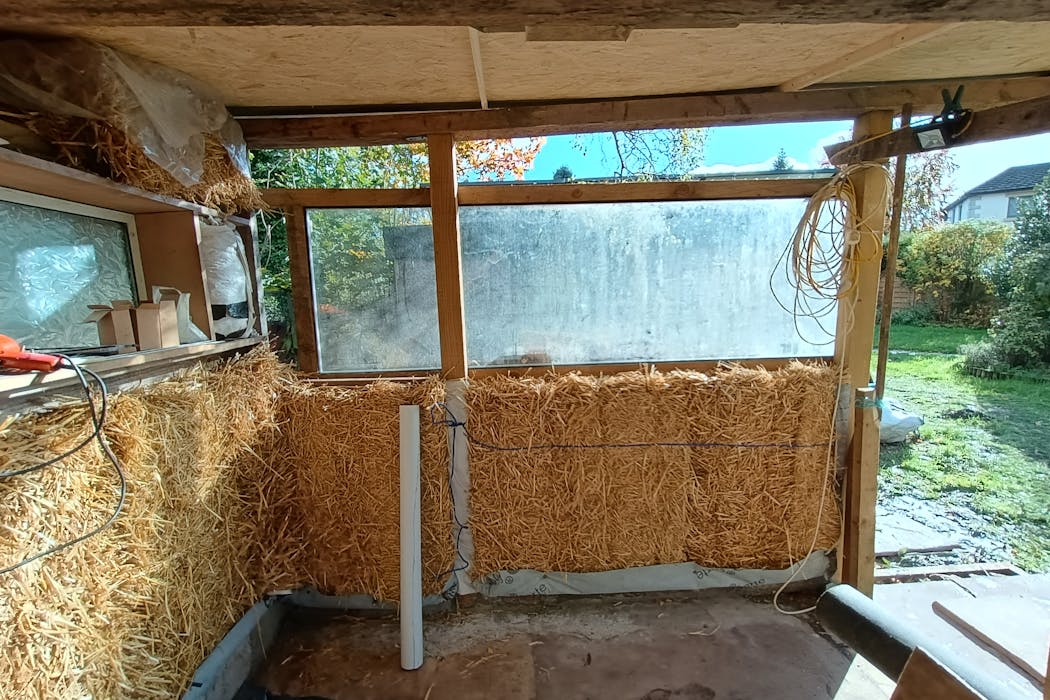 The garden office from the inside. Lorna Jackson, CC BY-NC-ND
When we moved into our house, there was a shed in the garden. Its timbers were rotten, the floor had long since disappeared into the ground, there was no door, the window had fallen out and various creatures had moved in.
I decided to rebuild it out of a material that has been used around the world for hundreds of years, but is less commonly seen in modern buildings: straw bales. A year later, and the "work shed" is now nearly finished.
As sustainability assessment lead at Sheffield University's Grantham Centre for Sustainable Futures, I wanted to make sure my garden office had the lowest possible embodied carbon (a term used to describe the amount of carbon contained, or "embodied" in the materials used to make a product), and low energy use once it was up and running.
That meant the office would need to be very well insulated to avoid using lots of energy to heat it, and made of materials with low carbon content.
Due to its structure, straw is a fantastic insulating material. It's also cheap, easy to work with, and since the straw absorbs carbon dioxide from the atmosphere as it grows, straw buildings act as carbon stores. If we use this in a building, the carbon remains stored for the lifetime of the building, and can even be returned to the soil at the end of life.
My first real involvement with straw building was through the design of a low carbon cold room in Kenya, working with energy efficiency experts from the Energy Saving Trust and Solar Cooling Engineering, and architects from Switzerland and Kenya. A cold room is an easy-to-build and cheap alternative to a large fridge, enabling farmers in developing countries to store produce at a market, improving incomes and reducing food waste.
 Stuart Walker working on his straw bale office.
Lorna Jackson., CC BY-NC-ND
Stuart Walker working on his straw bale office.
Lorna Jackson., CC BY-NC-ND
This cold room is now operating at Homa Bay market on the shores of Lake Victoria, Kenya. It has cement-free foundations, solar panels and batteries, water storage, low energy cooling units, a timber structure and straw bale walls. The project showed me that straw bale structures can provide good insulation without the environmental impact of expanded polystyrene.
Natural materials like mud, earth and dung, as well as fibrous materials such as straw were used to build homes for centuries.
Straw bale housing historyStraw in bale form has been used for buildings since the 1800s. After the invention of mechanical baler in the US, straw bales were used to construct homes in places where timber and stone were hard to find.
Some of these early buildings still exist, but most straw bale houses in the US were built since the 1970s. These buildings offer warm comfortable homes and were the inspiration for a new wave of UK straw bale builders in the 1990s.
Read more: How we can recycle more buildings
Straw works well for single or two-storey buildings, but requires careful design to avoid water leaking into it. Provided the bale buildings are protected from rain splash at the bottom and have an overhanging roof at the top, water isn't really a problem. Fire requires oxygen and fuel, so a compressed straw bale is fire resistant, and straw bale buildings have met all fire, planning, and building regulations, and even achieved Passivhaus - extremely high standards of insulation, thermal performance and energy use.
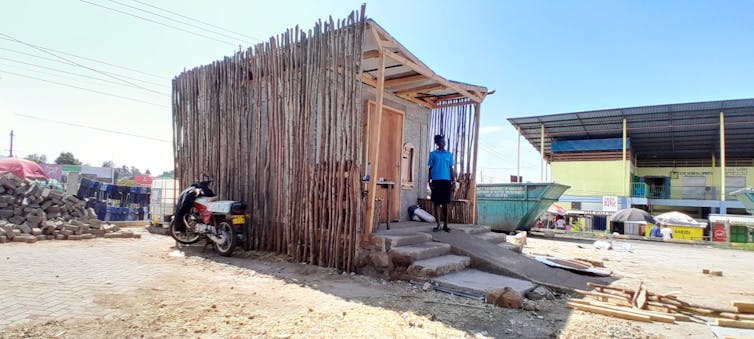 The straw bale 'fridge' built in Kenya.
Francis Maina, CC BY-NC-ND
The straw bale 'fridge' built in Kenya.
Francis Maina, CC BY-NC-ND
My new garden office has 40cm thick walls and double glazed windows, it's clad on the outside with reclaimed timber (some of which came from the original shed) and the roof, windows, doors and underfloor insulation are all secondhand. The final step is cladding the inside.
Here I've adopted another traditional building practice and used cob. Cob is a mixture of clay, water, sand and chopped straw. After digging the clay from our garden and mixing it, I've applied the cob by hand, via an incredibly messy but very satisfying process.
I know that the lifetime greenhouse gas emissions of my shed will be about 20 tonnes lower than they would have been if I had used expanded foam insulation and plasterboard.
People who live in straw bale houses talk about how the irregular shape and natural materials of straw bale buildings also have a positive impact on them, and say that buildings like my shed create a connection with the builder particular to the use of natural materials.
This concept, known as biophilic design, is challenging to quantify but I look forward to finding how it feels to sit inside it.

Stuart Walker is affiliated with The Grantham Centre for Sustainable Futures, University of Sheffield. He receives funding from the Grantham Foundation for the Protection of the Environment.
Exclusive: only matter of time until decrepit ships cause spill bigger than Exxon Valdez disaster, analysts say
Decrepit oil tankers in Iran's sanctions-busting shadow fleet are a "ticking time bomb", with a catastrophic environmental disaster only a "matter of time", maritime intelligence analysts have warned.
Such an oil spill could be far bigger than the 1989 Exxon Valdez disaster that released 37,000 tonnes of crude oil into the sea, they said.
Continue reading...Birdwatchers flock to Montréal for rare sighting of 'vagrant' bird that has made its home during a bitterly cold winter
On a quiet Montréal street of low-rise brick apartment buildings on one side and cement barrier wall on the other, a crowd has gathered, binoculars around their necks and cameras at the ready. A European robin has taken up residence in the neighbourhood, which is sandwiched between two industrial areas with warehouses and railway lines and, a few blocks away, port facilities on the St Lawrence River.
Ron Vandebeek from Ottawa, Ontario, is here on a frigid February morning hoping to see the rare bird, which was first spotted at the beginning of January.
Continue reading...
Huge thanks to my February sponsor, John Rember, author of the three-book series Journal of the Plague Years, a psychic survival guide for humanity's looming date with destiny, shaped by his experiences living through the pandemic in his native Idaho. Thoughtful, wry and humane, Journal 1 is a pleasure.
 "Chance of El Niño forming in Pacific Ocean may push global temperatures to record highs in 2027.
"Experts told the Guardian it was too early to be confident, but there were signals in the spread of sea surface temperatures in the Pacific that suggested an El Niño could form in 2026."
https://www.theguardian.com/environment/2026/feb/08/global-weather-el-nino-pacific-ocean-high-temperatures-2027
 "Will the Pacific Decadal Oscillation turn neutral (or positive) this year?
"If the negative PDO was natural variability and has *relatively* limited regional and global heat uptake, the next positive (=not good) PDO will lead to further acceleration of global warming." [Leon Simons]
https://x.com/LeonSimons8/status/2020481216810492411
 "In the Arctic, the major climate threat of black carbon is overshadowed by geopolitical tensions
"A coalition of nations and environmental groups is lobbying the International Maritime Organization to create regulations around black carbon, or soot, that spews from ships and blankets parts of glaciers and snow."
https://www.independent.co.uk/news/arctic-donald-trump-iceland-greenland-reykjavik-b2916469.html
 "Hundreds of flood warnings and alerts in place across UK following days of non-stop rain.
"On Thursday, the Met Office announced that rain had fallen every day of 2026 in south-west England and South Wales.
Both have experienced a far wetter than average January, with 50% more On Thursday, the Met Office announced that rain had fallen every day of 2026 in south-west England and South Wales."
https://www.lbc.co.uk/article/flood-rain-warning-alert-uk-5HjdS2D_2/
 "Farmers report 'catastrophic' crop damage as Storm Marta sweeps Spain and Portugal.
"Farmers in Spain warned on Saturday that torrential rains and high winds had left fields submerged and caused millions of euros worth of damage to crops, as Spain and Portugal braced for more extreme weather."
 "Flash floods sweep northern Morocco, killing at least four including toddler…
"Provinces across northwestern Morocco have been battered by heavy rainfall over the past week. The national weather service forecast further bad weather through Tuesday."
 "NORTH AFRICA HEAT WAVE
Historic and unprecedented heat wave for early February.
"36.9C In Guezzam ALGERIA
34.2C Ghat LIBYA… This is just the beginning,this heat wave will cross all Asia from Middle East to end up in Japan."
https://x.com/extremetemps/status/2020162012827800061
 "Heat with no end: climate model sets out an unbearable future for parts of Africa.
"This is not just a slight warming; it is a fundamental change in how people will have to survive on the continent. Once regions in Africa enter a state of almost continuous heatwaves, the human body will have no window of time to recover."
https://www.modernghana.com/news/1469826/heat-with-no-end-climate-model-sets-out-an-unbear.html
 "Today's weather: Severe storms, extreme heat, and fire danger across South Africa.
"South Africa faces a day of hazardous weather, with severe thunderstorms in the east, extreme heat in the interior, and high fire danger across multiple provinces."
 "'Our children are next' fear Kenyans as drought wipes out livestock.
"In drought-hit northeastern Kenya, villagers have been forced to drag their dead livestock to distant fields for burning to keep the stench of death and scavenging hyenas away from their homes."
https://addisstandard.com/our-children-are-next-fear-kenyans-as-drought-wipes-out-livestock/
 "HISTORIC MIDDLE EAST HEAT WAVE:
"Records of Hottest February day in history pulverized: 33.6C Sedom ISRAEL; 33.4C Ghor El Safi JORDAN. Records also at Jericho PALESTINE."
https://x.com/extremetemps/status/2020577063653245426
 "Heavy rains trigger deadly floods in Syria, emergency teams mobilized.
"Syria's Ministry of Emergency and Disaster Management said Sunday its teams continued large-scale response operations late Saturday after heavy rainfall triggered flash floods across several western and northwestern provinces, causing casualties, displacement and widespread damage to civilian areas."
 "Forests are changing fast and scientists are deeply concerned…
"A massive global analysis of more than 31,000 tree species reveals that forests are becoming more uniform, increasingly dominated by fast-growing "sprinter" trees, while slow-growing, long-lived species are disappearing. These slower species act as the backbone of forest ecosystems…"
https://www.sciencedaily.com/releases/2026/02/260208233836.htm
 "Benguet hit by early forest fires [Philippines].
"Benguet and other parts of Cordillera are once again entering a season of forest fires, underscored by a blaze that hit Mount Posdo in Mankayan in Benguet last week—the latest in a string of fires recorded in the area over the past three years."
https://newsinfo.inquirer.net/2179212/benguet-hit-by-early-forest-fires/
 "'Basyang' dumps record rainfall as shear line worsens.
"Tropical storm ''Basyang'' has dumped extremely rare volumes of rain that exceeded Northern Mindanao's 100-year return period and contributed to flooding in Iligan City due to overwhelmed rivers and drainage systems."
 "Darkwaves research allows scientists to measure impact of 'underwater blackouts' on marine life [Australia]…
"As recovery efforts continue, Mr Ridgley said watching Cyclone Mitchell develop along WA's Pilbara coast was making him anxious."
 "Avian flu behind mass skua die-off in Antarctica, scientists say.
"H5N1 was detected at three sites and diagnosed as the cause of death of nearly all dead skuas at Beak Island. The birds rapidly died of multi-organ necrosis (tissue death).
 "Torrential rain not normally seen at this time of year left at least 13 people dead across Colombia this week, according to officials.
"The country has experienced a surge in rainfall after a cold front pushed south from the north of the Americas towards Colombia's Caribbean coastline."
 "El Salvador declares national emergency: more than 600 forest fires reported so far this year.
"Reports from the Ministry of Environment and Natural Resources (MARN) indicate that the presence of numerous hot spots and the abundance of dry vegetation have created a conducive environment for the fire's expansion."
 "This winter's snow drought is shaping up to be the worst on record for the Upper Colorado River Basin…
"Both Colorado and Utah are experiencing their lowest snowpack on record. In the Colorado River headwaters, snow-water equivalent is just 54% of median…"
 "Western Canada Glaciers Record Second Worse Ice Loss…
""We have to understand that it's not a question of if the glaciers are going to disappear, they are going to disappear. What we're finding is that these glaciers are disappearing much faster than previously projected.""
https://planetski.eu/blog/western-canada-glaciers-record-second-worse-ice-loss/
 "Breaking News! Code Yikes!
"The 36-month running average for total column precipitable water just hit a new record high … for the 15-th consecutive month! The Climate 8-ball is moving to higher ground." [Prof Eliot Jacobson]
https://x.com/EliotJacobson/status/2020518426842722698
 "The 3-year running mean for the global surface temperature anomaly is now at 1.53°C above the 1850-1900 IPCC pre-industrial baseline.
"Meanwhile, the Climate 8-ball is snookered again." [Prof Eliot Jacobson]
https://x.com/EliotJacobson/status/2020136061297361348
 "There May Be No Turning Back This Climate Crisis.
"…there is a growing fear that climate change in the future won't, as it has until now, happen gradually. It will happen suddenly, as formerly stable planetary systems transgress tipping points—thresholds beyond which things cannot be put back together again."
 "'Stark warning': pesticide harm to wildlife rising globally, study finds.
"Synthetic chemicals that kill pests have increased the productivity of farmland, allowing more food to be grown on the same area, but have harmed the ecosystems in which they are used."
 "Economic growth is still heating the planet. Is there any way out?
"Rising GDP continues to mean more carbon emissions and wider damage to the planet. Can the two be decoupled?"
I rely on donations and tips from my readers to keep the site running. Every little bit helps. Can you chip in even a dollar? Buy me a coffee or become a Patreon supporter. A huge thank you to those who do subscribe or donate.
You can read the previous "Climate" thread here. I'll be back tomorrow with an "Economic" thread.
The post 10th February 2026 Today's Round-Up of Climate News appeared first on Climate and Economy.
Abbeydale, Sheffield: I'm genuinely scared when I wake at 2am to the sound of screaming. Then I see two male badgers in an almighty scrap
Fast asleep, my dreamworld takes an unexpected swerve as raucous screaming erupts outside the open bedroom window. For a moment, I assume this is imagined, some emotional outburst from my subconscious. Then I realise that I'm awake. This is real. I check the time: 2am. The screaming continues. In fact, it's now louder and somehow more intense. The back of the house is woodland, and noises off are common enough. A fox barking. Robin song that eases those anxious, wakeful stretches of the night. But this is something else altogether. This is violence.
My heart is racing now. I fear someone is being attacked, and from the pitch of the screaming, a woman. Mercifully, I soon discount this. My startled mind then suggests a catfight, but the sound I'm hearing is too big for that. So, despite the freezing cold beyond the duvet, I hop out of bed, pull back a curtain and stick my head outside.
Continue reading...
Born of student disquiet after the 2008 crash, the group says it reshaping economists' education
As the fallout from the 2008 global financial crash reverberated around the world, a group of students at Harvard University in the US walked out of their introductory economics class complaining it was teaching a "specific and limited view" that perpetuated "a problematic and inefficient system of economic inequality".
A few weeks later, on the other side of the Atlantic, economics students at Manchester University in the UK, unhappy that the rigid mathematical formulas they were being taught in the classroom bore little relation to the tumultuous economic fallout they were living through, set up a "post-crash economics society".
Continue reading...The beautiful game has a fast fashion problem, with clubs bringing out multiple kits every season. But a move towards upcycling old shirts and wearing vintage garments is on the rise
It may have been a quiet January transfer window, but even so, thousands of new shirts will be printed for Lucas Paquetá, returning to his former Brazilian club Flamengo, while his West Ham shirt instantly feels old. Not to mention the thousands of other players moving from one club to another. Uefa estimates that up to 60% of kits worn by players are destroyed at the end of the season, and at any one time there are thought to be more than 1bn football shirts in circulation, many of which are discarded by fans once players leave.
The good news is that lots of designers are bringing their upcycling skills to old kits, taking shirts and shirring them, sewing them or, as in the case of designer and creative director Hattie Crowther, completely transforming them into one-of-a-kind headpieces. "I'm not here to add more products into the mix, I'm here to reframe what's already in circulation and give it meaning, context, and longevity while staying culturally relevant," says Crowther, whose creations involving the colours and emblems of Arsenal, Liverpool and Paris Saint-Germain, are, she says, "a response to how disposable football product has become".
Continue reading...
This was published today on Phys. It concerns a new study also recently published in Nature Communications.
I think the last sentence shows why this is collapse related -
"The widespread slowdown may indicate that the internal engines of biodiversity are losing momentum due to the depletion of regional life"
The researchers are very worried about shrinking species pools - a polite way of saying global bioviversity is collapsing.
submitted by /u/Fast_Performer_3722[link] [comments]
In Creating the Factory of the Future, Lucid's Manufacturing Vision Puts People Ahead of Machines At Rockwell Automation Fair 2025 three months ago, one of the most quietly consequential conversations about the future of manufacturing did not revolve around artificial intelligence, robotics, or automation speed. Instead, it centered on a ... [continued]
The post Lucid VP for Engineering Says: Technology is Finite, Human Creativity Infinite appeared first on CleanTechnica.
US President Donald Trump swept back into office on a mission to stop the domestic offshore wind industry in its tracks. That is actually something any idiot could accomplish with the swipe of a pen. All you need to do is yank the federal leases that offshore developers depend on, ... [continued]
The post Canada Blows A Big, Fat Offshore Wind Raspberry At Trump appeared first on CleanTechnica.
Since we cover electric vehicles continuously and are often analyzing market trends, we have focused a lot of time in recent months covering the huge EV sales hit in the United States. Of course, it's just natural — if you are going to take away a $7,500 subsidy, people are ... [continued]
The post Electric Cars Are Simply Better — Subsidies Or Not appeared first on CleanTechnica.

Van Halen had a rule.
Their contract required a bowl of M&Ms backstage with all the brown ones removed. People thought they were just being divas. They weren't.
It was a safety check. If the band walked in and saw a brown M&M, they knew the promoter hadn't read the technical manual. Errors with one thing probably meant there were errors with other things. If they missed the candy, they probably missed the weight limits on the stage or the wiring for the pyrotechnics. One small error meant the whole show was dangerous.
Trust works the same way. When one big lie comes to light, you have to look at everything else.
Despite the pathetic lack of accountability, the Epstein files changed the calculus. What used to be dismissed as a niche conspiracy theory turned out to be a global system of trafficking involving people at the top. When a secret that large is proven true, the "mad" theories start to look plausible. What other huge lies are we being told? What else exists behind the curtain?
We see a pattern now. A group of powerful people shape the world to fit their needs. They tell the public to "move on" while they build doomsday bunkers in remote locations, private security forces, and tech replacements for human labor.
The amazing thing is they are building all this right in the open, and we're like, "nah, they cant really be planning for half of us to die, are they?"
Yes. The audacious goals of the elites are real. You better fucking believe it.
People often say the rich need us because we buy their products. That is a mistake. Much of the world's wealth circulates among the elites themselves. The real value of the masses has always been labor. But labor is changing. Wages are dropping toward the cost of a drone, automation handles production, and AI handles the thinking.
When a machine can plant a seed or write code for less than the cost of a human's food and rent, the human becomes a liability. We become disposable pawns in a game we never wanted to play.
The future looks like Mumbai. You see billion-dollar towers standing right next to slums. One group lives behind high walls with every luxury. The other group lives in the dirt, a stone's throw away. An entire class is already considered disposable. There's nothing stopping this from happening to the rest of the world.
Indeed, the middle class is a 20th century flash in human history, ignited by plentiful, cheap energy. A temporary surplus that granted each of us thousands of invisible slaves, operating 24/7. With more than enough to go around, everyone feasted.
The convergence of crises is changing that rapidly. That house your adult child cant afford, food prices skyrocketing, corporate weaponization...those are symptoms of the weakening surge that lifted the tide. Mistaken, we attributed much of our wealth, comfort, success to ingenuity. We are told it's "immigrants" or "China" or internal "enemies" slowing us down. Meanwhile, they hide from view the fuel gauge, which is near empty.
Back to normal.
Many of our ancestors lived in societies with high concentration of wealth, resources and power. Most people couldn't afford much. What happens when we stop buying iPhones? Things will change, but Kings existed in societies with high Gini coefficients, just as they will in the future.
Perhaps the elite would prefer to turn every beggar into a customer. And perhaps if we all vanish some companies with their hands in the middle class pocketbook will go bust. But the oligarchs realize to prevent that, by maintaining and building the middle class, we need a few more planets worth of resources.
They won't tell us, but they see the same data we do and are moving into self-preservation mode. The revenge of Malthusian logic, temporarily sidelined by the Haber-Bosch process, leads to two possible outcomes: Tall guarded walls or 21st century Lebensraum.
We are moving toward a world where you are either inside the physical or virtual walls or outside of them. Those outside will be left to fight over scraps, pitted against scapegoats to protect systemic disparity.
It sounds like dystopian fiction, but its time we start believing what we are witnessing. They've laid bare their intentions, and we must stop disregarding logical ends as conspiracy theory.
The naked truth, while too painful to accept is also too dangerous to ignore.
Thank you for reading.
My name is Sarah and I run Collapse2050 by myself. It is a passion project to explore humanity's frightening future - a topic traditional media ignores.
The site is free for all, as I believe this information shouldn't be locked behind a paywall. I also don't accept corporate advertising so I remain totally free to tear the kleptocracy a new one.
To fund this site, I depend on the kindness of strangers. Paid subscribers and one-time contributors to help me cover hosting and production costs.
Thank you.
Sarah
The failure of food supply chains over the past decade is usually explained as logistics snarls, bad policy, or profit-driven actors. Those narratives are comfortable. They miss the structural truth: our dominant food system is designed like a centralized nervous system, optimized for speed and control, not resilience. When one critical node fails, the whole system seizes. That's collapse by design.
In my recent analysis, I use mycelium networks - the decentralized fungal webs that naturally distribute nutrients and information across an ecosystem - as a structural model for what a resilient system actually looks like. In contrast with brittle, linear chains, mycelial structures absorb shocks, reroute flows, and adapt without a single central brain.
Key points that align with collapse theory:
▫️Centralized control equals fragility.
▫️Traditional supply chains depend on narrow, optimized pathways. ▫️Disruption anywhere propagates system-wide failure.
Distributed networks endure. In ecosystems, mycelium reroutes around local damage, redistributes resources, and keeps the organism functioning. This is anti-fragile behavior in real biological systems.
Food as infrastructure. Food systems are not just markets; they are physical and informational networks. When infrastructure reliably moves food laterally across regions and scales, shock intolerance declines. When it doesn't, shortages become cascading failures — not anomalies.
The piece grounds this framework in real rural experience, showing that local capability is not the missing variable, connectivity is. It also reframes common assumptions like "local is too expensive" as artifacts of industrial design, not inevitabilities.
If collapse is about systems failing under stress, then understanding why current models break is a prerequisite for imagining what comes after. This does not offer utopia; it clarifies mechanics: decentralized, adaptive networks are more resilient than top-heavy, optimized chains.
submitted by /u/Serious-Marketing-26[link] [comments]
The G7 major economies "f[e]ll notably behind China and the rest of the world" in 2025 as the amount of wind and solar power being developed reached a new high, according to Global Energy Monitor (GEM).
A new report from the analysts says that the amount of wind and large-scale solar capacity being built or planned around the world reached a record 4,900 gigawatts (GW) in 2025.
This "pipeline" of projects has grown by 500GW (11%) since 2024, GEM says, with the increase "predominantly" coming from developing countries.
China alone has a pipeline of more than 1,500GW, equivalent to that of the next six countries combined: Brazil (401GW); Australia (368GW); India (234GW); the US (226GW); Spain (165GW); and the Philippines (146GW).
In contrast, GEM says that G7 countries - the US, UK, France, Germany, Italy, Canada, Japan - represent just 520GW (11%) of the wind and solar pipeline, despite accounting for around half of global wealth.
Diren Kocakuşak, research analyst for GEM, said in a statement that G7 countries risk "ced[ing] leadership" in what is a "booming growth sector". He added:
"The centre of gravity for new clean power has shifted decisively toward emerging and developing economies. [In 2025] G7 countries, despite their wealth, fell notably behind China and the rest of the world in year-over-year prospective capacity growth."
Moreover, while others have surged ahead, wind and solar plans in the G7 have remained largely unchanged since 2023, as shown in the chart below.
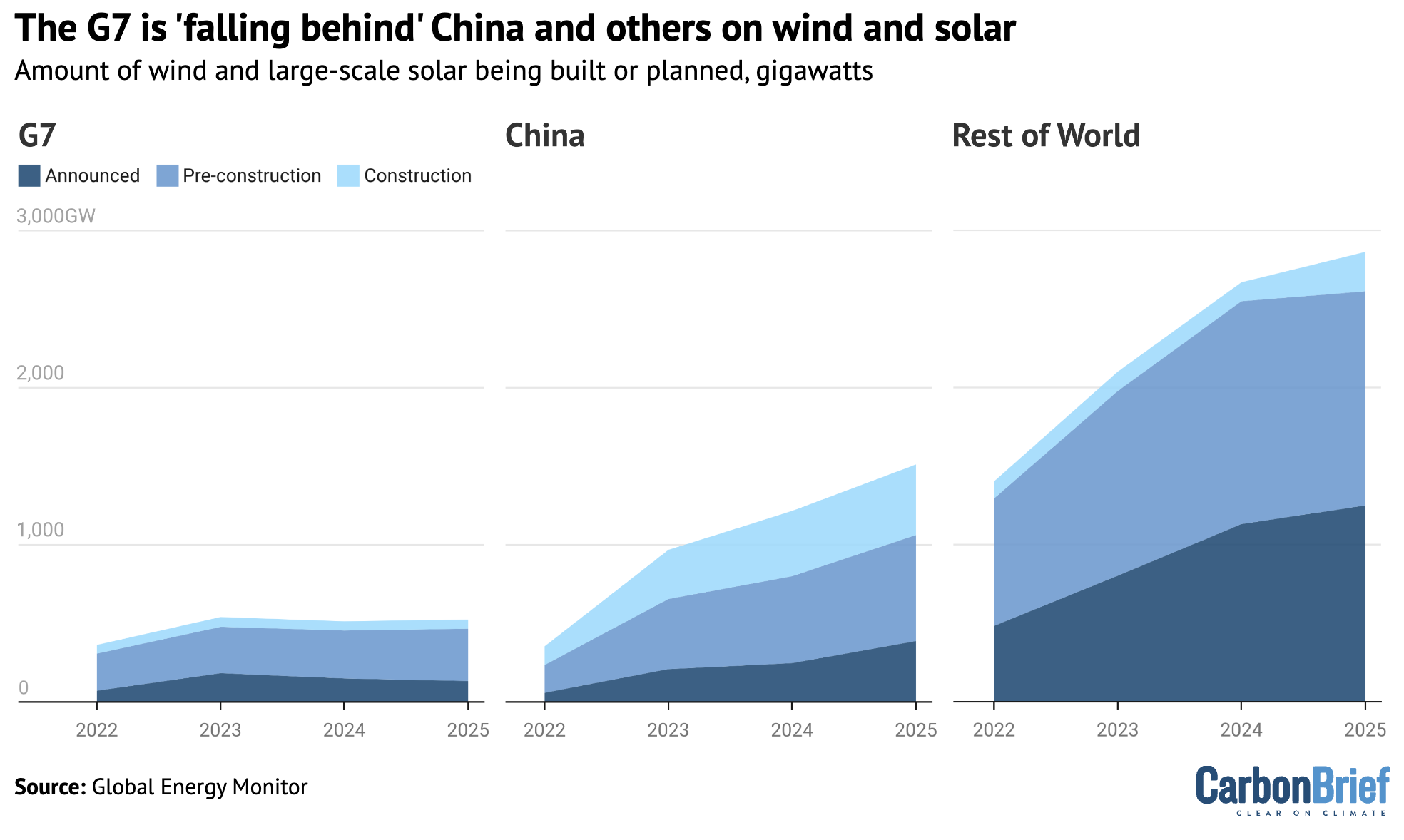 Amount of wind and large-scale solar capacity being built or planned in the G7 major economies, China and the rest of the world, gigawatts, 2022-2025. Source: Global Energy Monitor.
Of the 4,900GW of projects being built or planned and tracked by GEM, 2,700GW is wind and 2,200GW is large-scale solar.
However, the rate of expansion of the global pipeline for new wind and solar has slowed from 22% in 2024 to 11% last year, GEM says, with a more pronounced drop for wind projects. It adds that this was due to political barriers and a string of failed auctions.
For example, offshore wind subsidy auctions in Germany and the Netherlands in 2025 did not attract any bids, while an auction in Denmark was officially cancelled last year after there were no bidders at the end of 2024.
The report notes that the "growth trend of the prospective wind and [large]-scale solar pipeline is critical for meeting the COP28 commitment to triple renewable energy capacity by 2030, as the world enters the final five years of the implementation period".
At COP28 in 2023, countries committed to tripling renewable energy capacity globally by 2030 from an unspecified baseline, generally assumed to be 2022.
According to the International Renewable Energy Agency (IRENA), the world would need to complete an average 317GW of wind and 735GW of solar capacity every year to reach this target.
Some 758GW of wind and large-scale solar was under construction in 2025, GEM says, with around three-quarters of this in China and India.
Both countries saw a reduction in the amount of electricity generated from coal last year, according to a separate recent analysis for Carbon Brief.
Note that GEM's report predominantly uses data from its Global Solar Power Tracker and the Global Wind Power Tracker, the first of which only includes solar projects with a capacity of 1 megawatt (MW) and the latter with a capacity of 10MW or more.
Five key climate and energy announcements in India's budget for 2026
Explainers
|04.02.26
Experts: Will Chinese wind power help or hinder Europe's climate goals?
China Policy
|30.01.26

Q&A: What Trump's US exit from UNFCCC and IPCC could mean for climate action
International policy
|09.01.26
IEA: Declining coal demand in China set to outweigh Trump's pro-coal policies
Coal
|17.12.25
jQuery(document).ready(function() { jQuery('.block-related-articles-slider-block_dc4fd693ae4cb45f2640242bea1c608a .mh').matchHeight({ byRow: false }); });The post G7 'falling behind' China as world's wind and solar plans reach new high in 2025 appeared first on Carbon Brief.
The failure of food supply chains over the past decade is usually explained as logistics snarls, bad policy, or profit-driven actors. Those narratives are comfortable. But, they miss the structural truth: our dominant food system is designed like a centralized nervous system, optimized for speed and control, not resilience. When one critical node fails, the whole system seizes.
That's collapse by design.
In my recent analysis, I use mycelium networks - the decentralized fungal webs that naturally distribute nutrients and information across an ecosystem - as a structural model for what a resilient system actually looks like. In contrast with brittle, linear chains, mycelial structures absorb shocks, reroute flows, and adapt without a single central brain.
Key points that align with collapse theory:
▫️Centralized control equals fragility.
▫️Traditional supply chains depend on narrow, optimized pathways.
▫️Disruption anywhere propagates system-wide failure.
Distributed networks endure. In ecosystems, mycelium reroutes around local damage, redistributes resources, and keeps the organism functioning. This is anti-fragile behavior in real biological systems.
Food as infrastructure. Food systems are not just markets; they are physical and informational networks. When infrastructure reliably moves food laterally across regions and scales, shock intolerance declines. When it doesn't, shortages become cascading failures, not anomalies.
The piece grounds this framework in real rural experience, showing that local capability is not the missing variable; connectivity is. It also reframes common assumptions like "local is too expensive" as artifacts of industrial design, not inevitabilities.
If collapse is about systems failing under stress, then understanding why current models break is a prerequisite for imagining what comes after. This does not offer utopia; it clarifies mechanics: decentralized, adaptive networks are more resilient than top-heavy, optimized chains.
Read the full analysis (systems perspective on food collapse):
https://roguemediasolutions.com/mycelium-vs-the-machine-why-our-food-system-keeps-breaking/
submitted by /u/Serious-Marketing-26[link] [comments]

Last summer, I wrote what I think is one of my most important posts about our species' nature and how it has led to our civilization's accelerating collapse. My thesis was that what differentiates us from all other species on the planet, including h. neanderthanesis, is our profound distrust, fear, discomfort, and intolerance of creatures (including other humans) who are significantly different from us in their behaviours or beliefs.
My argument was that the cause of this differentiating quality was the unique evolution of our brains, with the emergent capacity to conceive of ourselves as separate and apart from all other life on Earth (which I also argued was delusional, a catastrophic misunderstanding of the actual nature of reality). In other words, we have evolved to suffer a species-wide, severe, and highly-infectious mental illness. This is not merely a belief in our separateness; it is an embodied sense of separateness, one unique to our species and one that is inherently terrifying.
And likewise, I argued that the inevitable consequence of this terrified intolerance of those different from us was a violent propensity to dominate, subdue, and exterminate any life form whose differences caused us to fear that they posed a serious or existential threat to us.
If you've been reading my earlier work, you'll know that I have come to believe we have absolutely no free will, and that our behaviours and beliefs are entirely determined and conditioned by our biology, our culture, and the circumstances of the moment.
And hence I believe that our transformation, over millennia, from a biophilic species to a biophobic and thence biocidal species, has been inevitable, irreversible, and ultimately fatal for our own species and for all life on Earth. Just as we ruthlessly exterminated h. neanderthanesis because we couldn't tolerate how they were different from us, we are going to keep exterminating other life forms (we're doing a bang-up job of this as the sixth great extinction accelerates), and also other humans who we assess to be different and hence terrifyingly intolerable, until (with our unwitting help) nature removes us from the planet so we can do no further harm.
This is a brutally negative and pessimistic assessment of the state of our species and of our world, and one that I have fiercely resisted for most of my life. But I'm coming, reluctantly, to the belief that it is an assessment that is entirely consistent with the evidence all around us.
Of course, this assessment and the beliefs and rationalizations underpinning it are neither provable nor disprovable, and I'm not trying to convince anyone of their veracity (nor seeking anyone to disavow me of their veracity). We have no choice about what we believe, any more than we have choice about our (bodies') behaviours.
Obviously, this assessment does not suggest or offer any course of action to 'deal' with it, either internally by trying to 'rethink' our own beliefs or externally by trying to change the current trajectory of unfolding events. There is nothing that can be done, and hence no 'need' for anything to be done. Even trying to 'accept' this assessment and its implications is not something we can choose to do or not do.
Where does that leave us, then?
In my case it seemingly drives me to chronicle this collapse as competently as I can. I am afflicted with the human propensity to try to make sense of things, and that propensity will obviously colour my chronicle. But, slowly but surely, my conditioning seems to be leading me to be a little less judgemental about what is happening, a little less preoccupied with causes and effects. And more attentive to the details — the astonishing beauty, the exquisite pleasures, the delicious, absurd cosmic joke, the wonders of utter unknowing and delightful discovery, and the endless joyful play of just being.
That does not require denying or ignoring (or obsessing about) the ghastly, growing evidence of ugly violence and dizzying chaos and frightening collapse happening all around us. But instead, it entails just setting it aside, at least when the work of chronicling is done, 'working around' it so as not to be consumed by it (or consumed by what, we dream, could or should or might 'otherwise' be). Fortunately, my conditioning seems to be allowing that, slowly, to happen.
That's me. It's not a prescription that I would presume to recommend to others. It's not as if any of us has any choice in the matter.
self-portrait by AI; my own prompt
I'm working on a piece of fiction and trying to think through the scenario of a collapse in realistic way.
In the story, it's revealed that the global system (governments, corporations, education, finance, etc.) is secretly run by a deeply corrupt and pedophilic ruling class. The population eventually realizes something very uncomfortable, that they are the cogs in the wheel that keeps this whole evil system operating.
Once the illusion breaks, it is clear that the people in charge don't actually run anything, they sit at coordination points controlling the people below them who do the actual work. Truck drivers, nurses, retail workers, teachers, line cooks, IT workers, warehouse staff, office managers, farmers, doctors….
Suddenly everyone notices that the people at the top don't grow food, fix infrastructure, heal bodies, or keep water running. They coordinate extraction and that's it. It becomes apparent that every "institution" is just layers wrapped around human labor they get to extort. The moment people stop donating their time, energy, belief, and compliance, would the machine explode or simply stall out?
Would it be realistic to think that in a dramatic scenario people could come together and actually make a change for the better? That neighbors could pool resources, food and tools, workers could continue essential roles without corporate ownership, and care can be given without profit layers, where skills becoming currency instead of money, and trust forms locally because it has to.
I'm not pitching a fantasy where everything's easy and they all skip off into the future. I'm more interested in the eerie realization that the system's biggest threat was never rebellion, but it was masses of people uniting, not by revolt- by-force, but by population themselves pulling the plug. I don't know just an idea.
submitted by /u/jessierichie4[link] [comments]
Pairing scientists with an artist-in-residence can cut through "ecofatigue" (feelings of overwhelm or exhaustion about environment issues that lead to apathy and inaction), spark emotion and change the way people deal with plastics.
My team and I recently published a study that demonstrated this is a low-cost and feasible way to tackle plastic waste in towns.
In a quiet gallery space in London, visitors paused before 13 luminous coastal scenes. Throwaway bottles bobbed in the surf; snack wrappers frayed into microplastic constellations. Many people left this exhibition determined to change their own habits.
These paintings were part of my team's project called Trace-P (Transitioning to a circular economy for plastics with an artist-in-residence) which involves turning environmental evidence into compelling art, then measuring what the public do as a result.
Decades of leaflets, posters and worthy campaigns about plastic pollution haven't shifted behaviour fast enough. Research (including our own previous work) shows that emotion, storytelling and "intergenerational influence" - ideas flowing from children to adults - can outperform dry facts alone. Throughout that previous project, 99% of audiences reported higher awareness, 70% intended to change how they dispose of electronic or e-waste and 65% planned to repair or reuse their belongings more. That success inspired us to test an art-led model for plastics.
The global context is stark. More than 400 million tonnes of plastic are produced each year. Only around 9% of that is mechanically recycled worldwide. A global plan to end plastic pollution by 2040 will require deep shifts in policy and markets to eliminate problematic items, scale reuse and design products that are suitable for recycling.
Art cannot deliver those reforms, but it can mobilise public demand for them.
Our plastics researchers collaborated with a professional artist, Susannah Pal. After interviews and laboratory visits, she produced a series of tragicomic (humorously sad) seascapes. In addition to running public exhibitions in London and Southampton, Pal held an online and in-person drawing workshop for the public.
Visitors learnt about the science of marine litter pathways, microplastics and consumption patterns through powerful imagery that intended to trigger emotion rather than through facts and data. We collected feedback from participants and gallery visitors via on-site in-person surveys, Post-it note "reaction walls" where people could scribble their comments and impressions of the artwork and social media posts by visitors.
Our paper, recently published in the Journal of Cleaner Production, calls this approach "com-art". This combination of creative skills with scientific evidence can improve communication with the general public and lead to more positive action.
Viewers told us that the artworks educated them about sources and negative effects of plastic pollution. They also said that the art provoked emotions - from sadness to resolve - that helped the messages stick and encouraged them to cut personal plastic use or question throwaway lifestyles.
The feedstock problemEurope's plastics system is inching towards circularity via new policies and technologies such as deposit return schemes, but not nearly fast enough. In 2022, circular plastics accounted for 13.5% of new products. EU plastic recycling has essentially stalled, with plastic packaging recycling rates hovering around 40-42%.
Huge amounts of plastic waste are sent for incineration and valuable feedstock (the fossil fuel-based raw materials used to make plastic) is burned instead of being recycled or redirected back into manufacturing.
Public support for reuse, deposit return schemes and better sorting of contaminated waste is the missing multiplier.
Globally, governments are negotiating a treaty to end plastic pollution. To reach its proposed goals, citizens will need to accept refills, returnables and redesigned packaging. Art projects like ours can engage citizens with changes to everyday routines around plastic consumption and disposal.
Read more: How Captain Planet cartoons shaped my awareness of the nature crisis
From inspiration to influence
Cities, schools and museums can start by making art part of their waste strategy. A local artist-in-residence, hosted by a council gallery, museum or library, costs little (a few thousand pounds) compared with large-scale infrastructure projects (that cost millions).
Art projects can help unlock more enthusiasm from citizens for deposit return schemes (refundable deposits for returning containers), reuse pilots or new recycling sorting rules. Artists can jointly create exhibitions with local schools to harness intergenerational influence. You can use short before- and after-project surveys to see what works.
Art interventions often deliver powerful but shortlived boosts in awareness and intent. By reinforcing moments - new shows, classroom projects, hands-on repair events - we can extend this awareness. It is also worth repeating art activities to reinforce messages.
Emotion opens the door to action, and convenient systems keep people walking through it. Exhibitions can be ideal opportunities to recruit residents to refill trials, deposit return collections or school "plastic-free lunch" weeks. These events can showcase possible next steps for people to take through QR codes and sign-ups to activities or maps of refill points, for example.
Plastics touch everything: health, climate, local jobs. Moving to a circular economy will take regulation, redesign and investment and public imagination. Our study shows that artists make the science more legible, memorable and motivating - and this can spark change in communities.
Don't have time to read about climate change as much as you'd like?
Get a weekly roundup in your inbox instead. Every Wednesday, The Conversation's environment editor writes Imagine, a short email that goes a little deeper into just one climate issue. Join the 47,000+ readers who've subscribed so far.

Ian Williams received funding from UK Research Councils to support this work. TRACE-P was supported by the Engineering and Physical Sciences Research Council's Impact Acceleration Account (EPSRC IAA 2017-2020). IAAs are strategic awards provided to institutions to support knowledge exchange and impact from their EPSRC-funded research. Ian also acknowledges support from the EPSRC Centre for Doctoral Training in Sustainable Infrastructure Systems (EP/L01582X/1).
Release into Helman Tor reserve marks historical first for keystone species hunted to extinction in UK 400 years ago
Shivering and rain-drenched at the side of a pond in Cornwall, a huddle of people watched in hushed silence as a beaver took its first tentative steps into its new habitat. As it dived into the water with a determined "plop" and began swimming laps, the suspense broke and everyone looked around, grinning.
The soggy but momentous occasion marks the first time in English history that beavers have been legally released into a river system, almost one year after the government finally agreed to grant licences for releases.
Continue reading...The disruption and distress caused by record downpours must focus minds on the need for climate preparedness
With flood warnings still in place across south-west England and Wales on Monday, followed by another fortnight of wet weather forecasts, the sodden ground across swathes of the UK is not likely to dry up any time soon. Reports that Aberdonians have not seen so much as a sliver of sun since 21 January prompted an outburst of stoicism on BBC radio, with one resident commenting: "You have to get on with it, brighter days are coming".
Before then, however, north-east Scotland is braced for more heavy rain. For farmers and businesses in the affected areas, the impact goes far beyond inconvenience. Marketing consultant Sam Kirby told the Guardian that she had to work from a car park in Cornwall following Storm Goretti, because her broadband wasn't working. And Goretti was the first of three January storms.
Do you have an opinion on the issues raised in this article? If you would like to submit a response of up to 300 words by email to be considered for publication in our letters section, please click here.
Continue reading...
Altitude, the world leading carbon dioxide removal (CDR) financier, has significantly expanded its purchases by partnering with Alcom for +360.000t of CDRs. Altitude has crossed more than 720,000 t CDRs in total procurement. In one of the largest individual off-take agreements to date, Altitude is procuring over 360,000 tonnes of ... [continued]
The post Altitude Partners With Alcom For +360.000t Carbon Removals appeared first on CleanTechnica.
The "undervaluing" of nature by businesses is fuelling its decline and putting the global economy at risk, according to a major new report.
An assessment from the Intergovernmental Science-Policy Platform on Biodiversity and Ecosystem Services (IPBES) outlines more than 100 actions for measuring and reducing impacts on nature across business, government, financial institutions and civil society.
A co-chair of the assessment says that nature loss is one of the most "serious threats" to businesses, but the "twisted reality is that it often seems more profitable to businesses to degrade biodiversity than to protect it".
The "business and biodiversity" report says that global "finance flows" of more than $7tn (£5.1tn) had "direct negative impacts on nature" in 2023.
The new findings were put together by 79 experts from around the world over the course of three years, in what IPBES described as a "fast-track" assessment.
IPBES is an independent body that gives scientific advice to policymakers about biodiversity and ecosystems.
This is the "first report of its kind" to provide guidance on how businesses can contribute to 2030 nature goals, says IPBES executive secretary Dr Luthando Dziba in a statement.
Below, Carbon Brief explains four key findings from the "summary for policymakers" (SPM), which outlines the main messages of the report.
The full report is due to be released in the coming months after final edits are made.
.innerArt>ol { font-family: 'PT Serif'; font-size: 18px !important; }- Businesses both depend on, and harm, nature
- Current practices 'do not support' efforts to halt and reverse biodiversity loss
- Businesses can act now to address their impacts on nature
- Government policies can drive a 'just and sustainable future' for nature and people
Businesses of all sizes rely on nature in one way or another, says the report.
The SPM outlines that biodiversity provides many of the goods and services businesses need, such as raw materials from the environment or controlled water flows to reduce flooding during wet seasons and provide water in dry seasons.
Biodiversity also "underpins genetic diversity" that informs the development of products in many industries, including pharmaceuticals and cosmetics.
Individual businesses often do not address their impacts and dependencies on nature, "in part due to their lack of awareness", the SPM says.
They also often do not have the data or knowledge to "quantify their impacts on dependencies on biodiversity and much of the relevant scientific literature is not written for a business audience", the report claims. It adds:
"Lack of transparency across value chains, including of the risks and opportunities related to the sustainability of resource extraction, use, reuse and waste management, is a further barrier to action."
The report says it is well established that businesses depend on biodiversity, but also that the actions of businesses "continue to drive declines in biodiversity and nature's contributions to people".
(IPBES says it uses terms such as well established to express "how assured experts are about the findings". Well established findings, the highest level of confidence, have significant evidence and high agreement behind them. The three other terms used in IPBES reports are: unresolved (a lot of evidence but low agreement), established but incomplete (limited evidence but good agreement) and inconclusive (limited or no evidence and little agreement).)
The report notes that the size of a business "does not always reflect the magnitude of its impacts", with companies in sectors such as agriculture, forestry, fishing, electricity, energy and mining having "relatively high" direct impacts on nature.
A "failure" to account for nature as the economy has expanded over the past two centuries has "led to its degradation and unprecedented rates of biodiversity loss", the SPM says. It adds:
"The decline in biodiversity and nature's contributions to people has become a critical systemic risk threatening the economy, financial stability and human wellbeing with implications for human rights."
It is well established that nature loss as a result of "unsustainable use" threatens the "ability of businesses, local economies and whole sectors to function", the report details.
These risks and others - such as extreme weather events and critical changes to Earth systems - are "among the highest-ranked global risks over the next 10 years", it adds.
The SPM notes further that it is well established that risks around climate change and biodiversity loss "may interact to amplify social and economic impacts".
These risks have "disproportionate impacts on developing countries whose economies are more reliant on biodiversity and have more limited technical and financial capacity to absorb shocks", the report adds.
2. Current practices 'do not support' efforts to halt and reverse biodiversity lossThe SPM says that it is well established that current political and economic practices "perpetuate business as usual and do not support the transformative change required to halt and reverse biodiversity loss".
These practices have "commonly ignored or undervalued biodiversity, creating tension between business actions and the conservation and sustainable use of biodiversity", the report continues.
For example, the report says there is established but incomplete evidence that "time pressures on decision-making and timescales for investment returns and reporting by businesses - with an emphasis on quarterly earnings or annual reporting - are shorter than many ecological cycles".
This prevents businesses from "adequately" considering nature loss in decision-making, says the SPM.
There is well established evidence that businesses fail to assign adequate value to "biodiversity and many of nature's contributions to people, such as filtration of pollutants, climate regulation and pollination", it continues.
As a result, "businesses bear little or no financial cost for negative impacts and may not generate revenue from positive impacts on biodiversity", leading to "insufficient incentives for businesses to act to conserve, restore or sustainably use biodiversity".
Prof Stephen Polasky, co-chair of the assessment and a professor of ecological and environmental economics at the University of Minnesota, said in a statement:
"The loss of biodiversity is among the most serious threats to business. Yet the twisted reality is that it often seems more profitable to businesses to degrade biodiversity than to protect it. Business as usual may once have seemed profitable in the short term, but impacts across multiple businesses can have cumulative effects, aggregating to global impacts, which can cross ecological tipping points."
It is well established that policies from governments can "further accelerate biodiversity decline", the SPM says.
It notes that, in 2023, global public and private financial spending with direct negative impacts on nature was estimated at $7.3tn.
This figure includes public subsidies that are harmful to nature (around $2.4tn) and private investment in high-impact sectors ($4.9tn), says the report.
Industries harmful to nature include fossil-fuel extraction, mining, deforestation and large-scale meat farming and fishing.
In contrast, just $220bn in public and private finance was directed to activities that contribute to protecting and sustainably using nature in 2023, adds the report.
(In recognition of the need to address public spending on activities that are destructive to nature, countries agreed to reduce biodiversity-harming subsidies by at least $500bn by 2030 as part of a global pact made in 2022.)
There are additional "barriers to action" facing businesses, ranging from challenging social norms to a lack of capacity, data or technology. These are summarised in the table below.
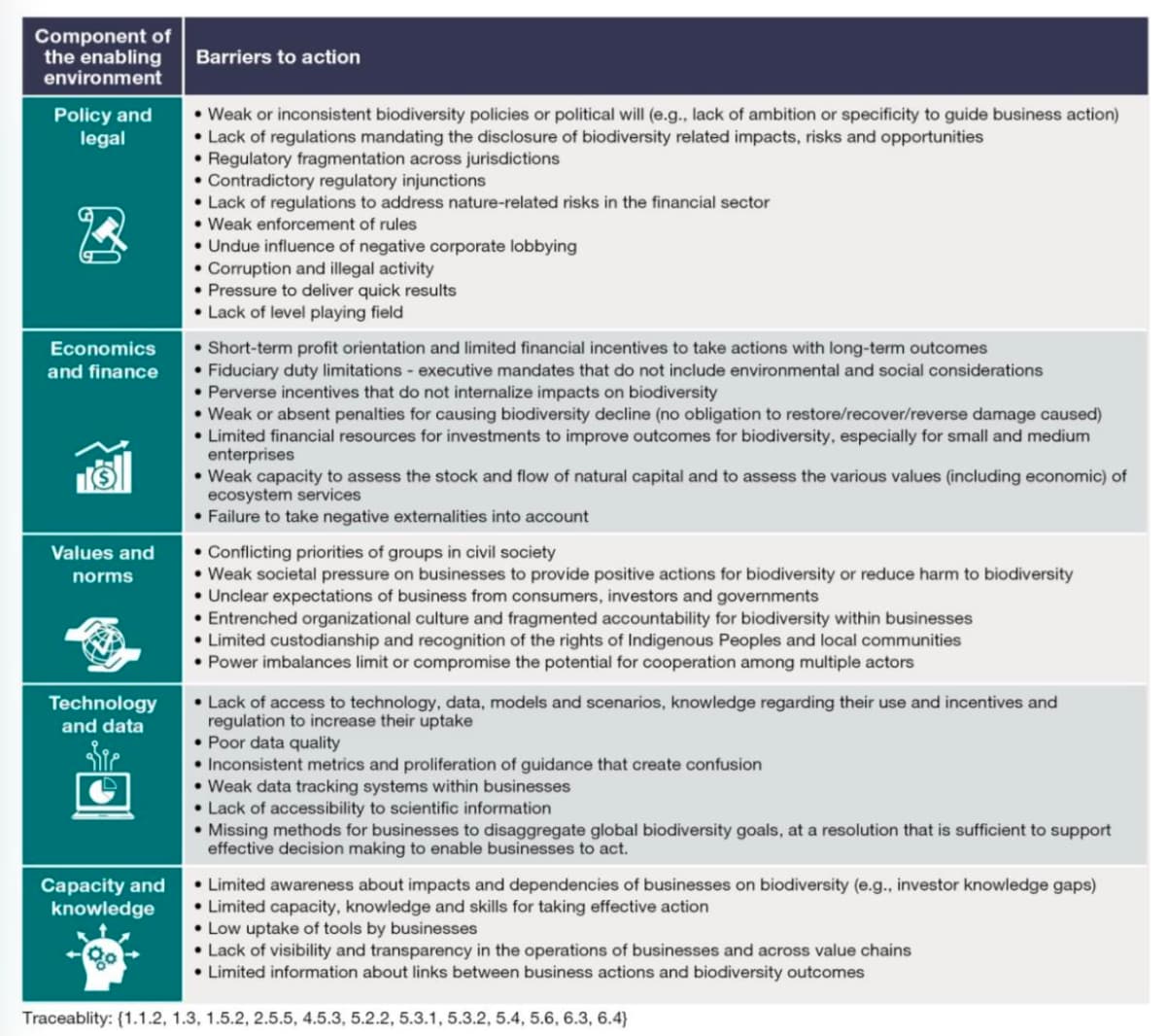 Barriers preventing businesses from taking action on biodiversity loss. Credit: SPM.4, IPBES (2026)
"These barriers do not affect all actors equally and may disproportionately affect small and medium-sized businesses and financial institutions in developing countries," adds the report.
3. Businesses can act now to address their impacts on natureThe SPM says it is well established that the "transformative change" required to halt and reverse biodiversity loss requires action from "all businesses".
However, the report continues that it is also well established that the current level of business action is "insufficient" to deliver this "transformative change". This is, in part, because the "enabling environment is missing", it says.
IPBES says all businesses have a responsibility to act, even if this responsibility is not shared "evenly".
"Priority actions" that businesses should take differ depending on the size of the firm, the sector in which it operates in, as well as the company structure and its "relationship with biodiversity", the report notes.
The exact actions businesses should pursue also depends on companies' "degree of control and influence over stakeholders", it says.
According to the report, firms can act across four "decision-making levels" - corporate, operations, value chain and portfolio - to measure and address impacts on biodiversity.
("Corporate" refers to decisions focused on overarching strategy, governance and direction of the business; "operations" to day-to-day activities; "value chain" to the system and resources required to move a product or service from supplier to customer; and "portfolio" to investments and business assets).
The SPM sets out a series of examples for how businesses can act across all four levels. These are summarised in the table below.
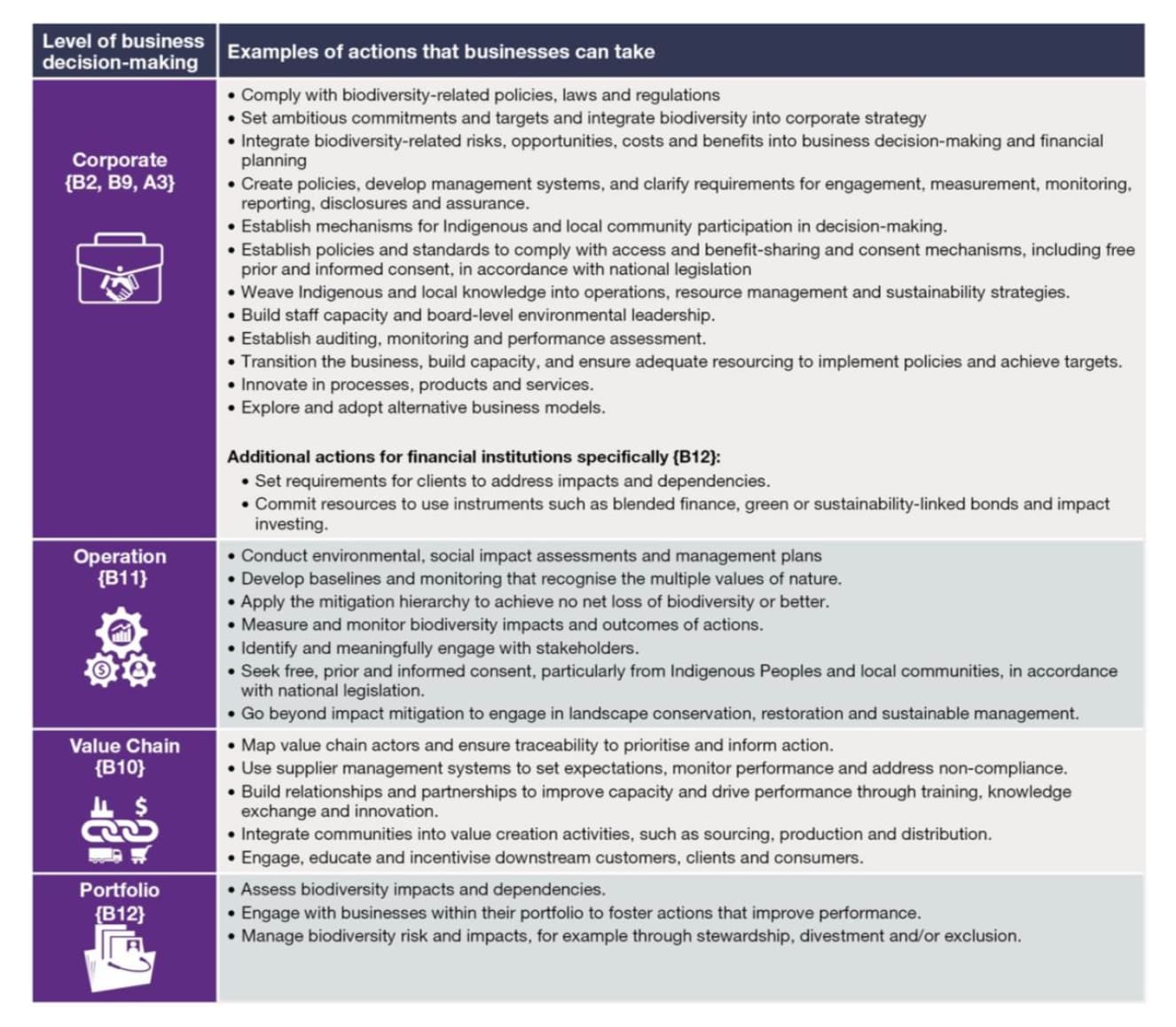 Actions that businesses can take now to address their impacts and dependencies. Credit: SPM.2, IPBES (2026).
At a corporate level, the report notes that firms can establish ambitious governance and frameworks that can then have a ripple effect across the other levels, according to the report. This includes the integration of biodiversity commitments and targets into corporate strategy.
The SPM says that corporate biodiversity targets are "most effective" when they are aligned with "national and global biodiversity objectives" and "take into consideration a business's impacts and dependencies on biodiversity and nature's contributions to people".
At an operations level, businesses should focus on ensuring that their operations are located and managed in a way that benefits biodiversity, IPBES says. Environmental and social impact assessments and management plans that are supported by "credible monitoring of both actions and biodiversity outcomes" can underpin this effort, the SPM notes.
It says it is well established that using the "mitigation hierarchy" framework can help businesses deliver "lasting outcomes on the ground". (The framework guides users towards limiting as far as possible the negative impacts on biodiversity from development projects by first avoiding, then minimising, restoring and offsetting impacts.)
Next, the report notes there are actions businesses can take to drive change within its broader spheres of influence, including suppliers, retailers, consumers and peers within industry. This is important, the SPM notes, as significant impacts and dependencies on biodiversity and nature "accrue" across the lifecycle of products or services, especially those that rely on raw materials.
The report notes there is established but incomplete evidence that efforts to "map" company value chains and improve traceability by linking products and materials to suppliers, locations and impacts can help "identify risks and prioritise actions".
While noting that "mapping" beyond direct suppliers "often remains challenging" for businesses, the report adds:
"Examples at the corporate and value chain levels exist, such as companies in the chocolate industry that have made advances in recording biodiversity dependencies to improve business decisions through full traceability of materials and improved supplier control mechanisms."
Elsewhere, the SPM notes that there is also established but incomplete evidence that consumer-focused measures - such as product labelling, education and incentives - can "shape behaviour and improve transparency". However, it cautions that the effectiveness of these strategies is "constrained by consumer scepticism, certification costs and business models reliant on unsustainable consumption".
The SPM also highlights that, at a "portfolio" level, financial institutions can shift finance away from harmful activities - for instance, companies whose products drive deforestation - and towards business activities with positive impacts for biodiversity and nature.
Speaking to Carbon Brief, Matt Jones, co-chair of the report, explains the rationale behind including options for how businesses can address biodiversity impacts in the document:
"Businesses and governments in different countries are coming at this from a very different perspective. So we can't present a set of really prescriptive 'how tos'…but we can present a huge number of options for action that businesses, governments, financial institutions and civil society and other actors can all take."
Elsewhere, the report says it is well established that "robust, transparent and credible reporting of actions and outcomes" is required to "inspire others".
4. Government policies can drive a 'just and sustainable future' for nature and peopleBoth governments and financial institutions can set policies and create incentives to protect biodiversity and stem its decline, says the SPM.
According to the report, the types of policies that governments can put in place that have an influence over business include:
- Fiscal policies, such as subsidies and taxes.
- Land use or marine spatial planning and zoning, such as designating new national parks or areas protected for nature.
- Permitting for business activities that affect nature - for example, by requiring environmental impact assessments.
- Public procurement policy (rules for how governments purchase goods and services).
- Controls on advertising and the creation of standards to prevent "greenwashing".
Governments can also promote action through paying for ecosystem services, creating environmental markets and through "multilateral benefit-sharing mechanisms", which set out rules for ensuring profits from nature are shared equally, says the SPM.
It says this includes the Cali Fund, a fund that businesses can voluntarily pay into after reaping benefits from genetic resources found in biodiverse countries.
(The fund was agreed in 2024 with expectations that it could generate up to billions of dollars for conservation, but it has so far only attracted $1,000.)
Governments could also promote action by phasing out or reforming subsidies that are harmful for nature, as well as fostering positive incentives, according to the report.
Overall, governments can work with other actors to create an "enabling environment" to "incentivise actions that are beneficial for businesses, biodiversity and society for a just and sustainable future", says the SPM. It adds:
"Creation of an enabling environment that provides incentives for the conservation and sustainable use of biodiversity and nature's contributions to people could align what is profitable with what is good for biodiversity and society.
"Creating this enabling environment would result in businesses and financial institutions being positive agents of change in transforming to a just and sustainable economic system, by addressing their impacts on biodiversity loss, climate change and pollution, which are all interconnected."

Cropped 28 January 2026: Ocean biodiversity boost; Nature and national security; Mangrove defence
Cropped
|28.01.26
Adopting low-cost 'healthy' diets could cut food emissions by one-third
Food and farming
|21.01.26
Brazil's biodiversity pledge: Six key takeaways for nature and climate change
Nature policy
|16.01.26
Cropped 14 January 2026: Wildfires scorch three continents; EU trade; Food and nature in 2026
Cropped
|14.01.26
jQuery(document).ready(function() { jQuery('.block-related-articles-slider-block_b4f006103142983c7da2fc5d1291de87 .mh').matchHeight({ byRow: false }); });The post IPBES: Four key takeaways on how nature loss threatens the global economy appeared first on Carbon Brief.


